This Just In: Spring Miscellany

U.Va.’s Final Exercises have concluded, and Grounds is quiet this week. Shortly the summer session will begin (as well as the inevitable summer construction projects), and both temperature and humidity will, no doubt, rise. Under Grounds it is busyness as usual as we catch up with what so far has been a banner spring for acquisitions. Following is a random selection of some early printed books newly added to our shelves.
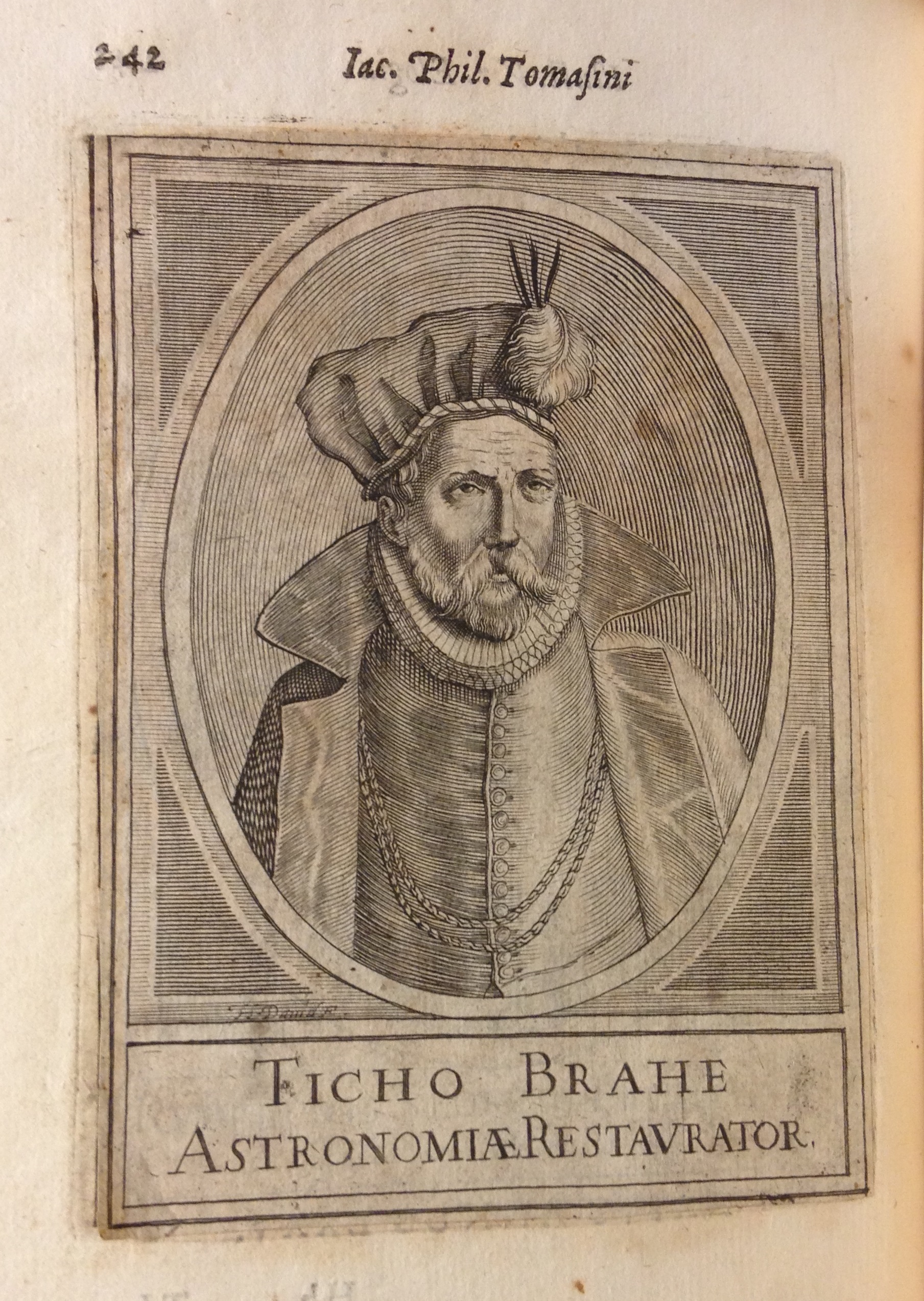
A stellar eclipse! This engraved portrait of astronomer Tycho Brahe is actually a cancel slip pasted over another engraved portrait inadvertently printed on the wrong leaf. Note how the lower left corner is lifting upward, and the engraved border of the underlying portrait visible at left. Giacomo Filippo Tomasini, Illustrium virorum elogia iconibus illustrata (Padua, 1630), p. 242.   (CT1122 .T6 1630)

A stellar eclipse! This engraved portrait of astronomer Tycho Brahe is actually a cancel slip pasted over another engraved portrait inadvertently printed on the wrong leaf. Note how the lower left corner is lifting upward, and the engraved border of the underlying portrait is visible at left. Giacomo Filippo Tomasini, Illustrium virorum elogia iconibus exornata (Padua, 1630), p. 242. (CT1122 .T6 1630)

Giacomo Filippo Tomasini’s Illustrium virorum elogia iconibus exornata (Padua, 1630) is a collection of biographies of noted scientists, astronomers, doctors, jurists, and theologians, most of whom lived in Padua and taught at its famous university. Of special note are the bibliographies of each subject’s writings, and the fine full-page engraved portraits by the French artist Jérôme David. Indeed, it was the engraved portrait of Danish astronomer Tycho Brahe that caught our eye in a bookseller’s booth at the New York International Antiquarian Book Fair last month. Unbeknownst to the dealer, this portrait is actually a cancel pasted over a different engraved portrait inadvertently printed in the wrong place! During the hand-press period, serious printing errors were typically corrected by “cancelling” an entire leaf and replacing it with a corrected replacement leaf or, as here, by pasting a cancel slip over the portion needing correction. Text cancels are fairly common in early printed books, but a cancel illustration is rarely encountered.

Engraved reproduction of the famous Dove Mosaic discovered by Giuseppe Alessandro Furietti at Hadrian's Villa and now in Rome's Capitoline Museum. Furietti believed it to be the actual mosaic created by Sosus for the royal palace at Pergamon, as described by Pliny the Elder in his Natural History. Giuseppe Alessandro Furietti, De musivis (Rome, 1752), plate [1].   (NA3750 .F8 1752)

Engraved reproduction of the famous Dove Mosaic discovered by Giuseppe Alessandro Furietti at Hadrian’s Villa and now in Rome’s Capitoline Museum. Furietti believed it to be the actual mosaic created by Sosus for the royal palace at Pergamon, as described by Pliny the Elder in his Natural History. Giuseppe Alessandro Furietti, De musivis (Rome, 1752), plate [1]. (NA3750 .F8 1752)

De musivis (Rome, 1752), by the Italian antiquarian and cleric Giuseppe Alessandro Furietti, is one of the earliest scholarly works devoted to Roman mosaics. Written just as the rediscovery of Pompeii and Herculaneum was inspiring new interest in Greek and Roman antiquities, Furietti’s work summarizes what was then known about Roman mosaics, incorporating new findings from Furietti’s own excavations at Hadrian’s Villa. Of particular interest are Furietti’s notes on the musivarii (the Roman artisans responsible for the figurative portions of mosaics), as well as his comments on mosaic art in Italy since the fall of the Roman Empire.
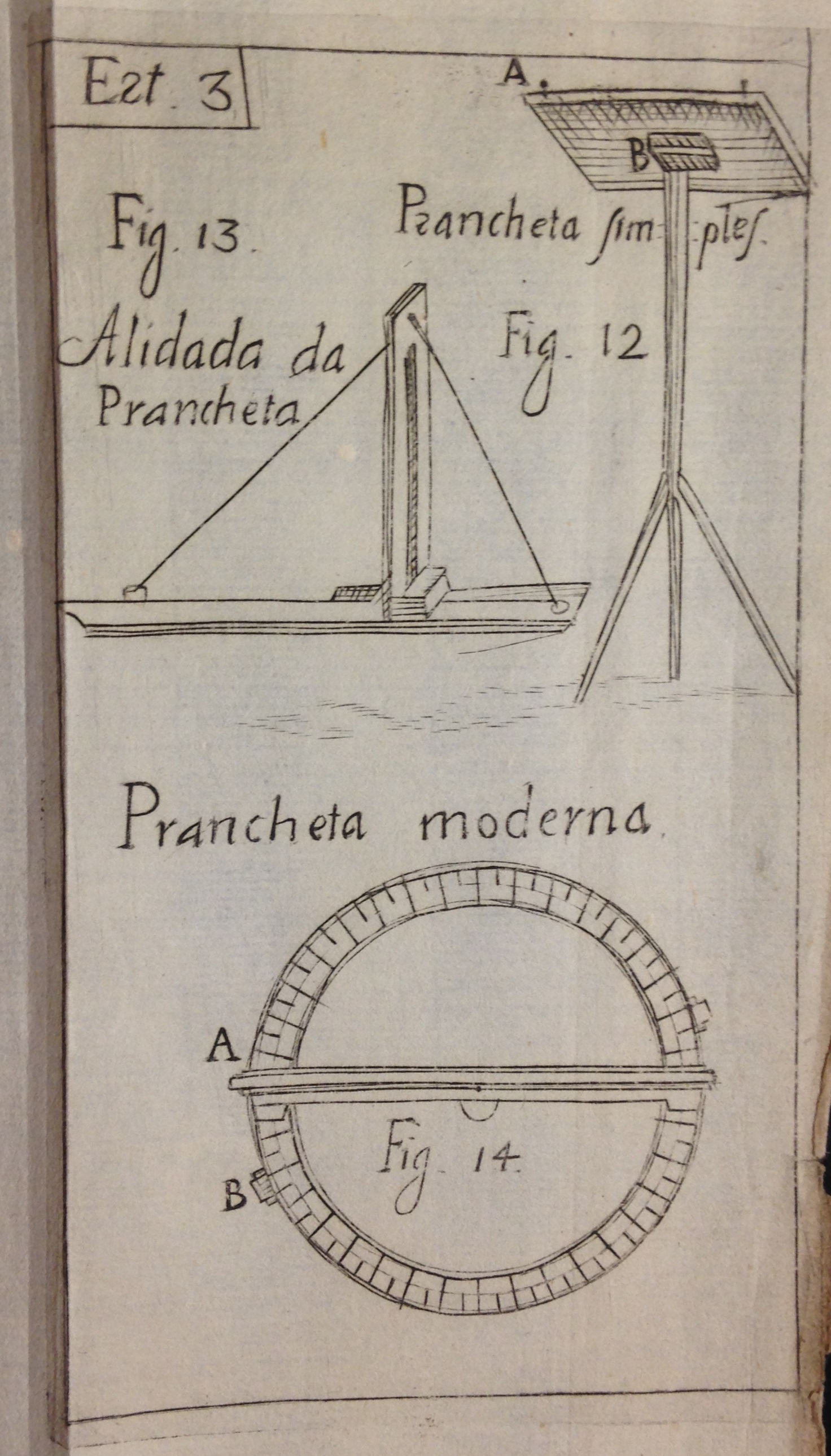
A cartographer's tools, from Manoel de Azevedo Fortes, Tratado do modo o mais facil, e o mais exacto de fazer as cartas geograficas (Lisbon, 1722), plate 3.   (GA102.3 .F67 1722)

A cartographer’s tools, from Manoel de Azevedo Fortes, Tratado do modo o mais facil, e o mais exacto de fazer as cartas geograficas (Lisbon, 1722), plate 3. (GA102.3 .F67 1722)

Special Collections is well known for its distinguished cartographic holdings—particularly of maps and atlases concerning the discovery and exploration of North America—and recently we added the perfect complement: one of the earliest printed manuals on mapmaking. Cartography had long been an essential skill for military engineers and surveyors, who could turn to printed works in their fields for guidance, but manuals specifically directed at cartographers were a late development. Manoel de Azevedo Fortes’s rare Tratado do modo o mais facil, e o mais exacto de fazer as cartas geograficas … (Lisbon, 1722) was the first such manual in Portuguese. Fortes based his work in part on French manuals. Although he writes in part for a military audience, Fortes directs this work primarily at fellow members of Portugal’s Royal Academy of History who desire to complement their writings with maps. Of particular interest are his comments on cartographic symbols and map coloring.
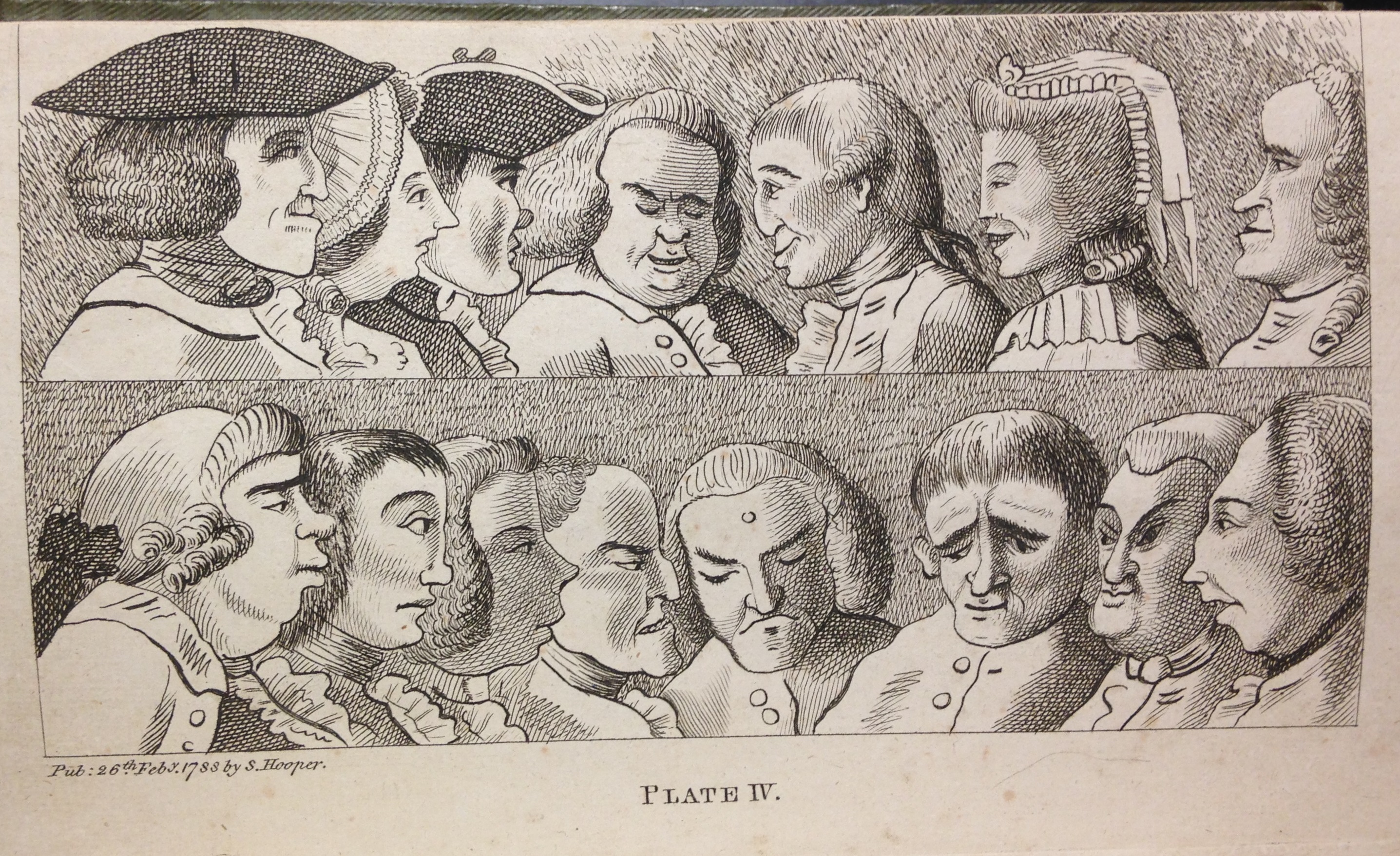
A lesson in caricature: examples of various noses, profiles, and head shapes. Francis Grose, Rules for drawing caricaturas, 2nd ed. (London, 1796), plate IV.   (NC1320 .G76 1796)

A lesson in caricature: examples of various noses, profiles, and head shapes. Francis Grose, Rules for drawing caricaturas, 2nd ed. (London, 1796), plate IV. (NC1320 .G76 1796)

We have also acquired another early manual on an entirely different subject: the art of caricature. A well known English antiquary and scholar of English slang, Francis Grose (1731-1791) was also an amateur artist who delighted in “comic painting.” In Rules for drawing caricaturas: with an essay on comic painting, Grose sought to explain how artists such as Hogarth and Gilpin manipulated the human form and visage for comic effect. This second, expanded edition, published posthumously in London in 1796, includes 21 plates, seventeen of which were etched by Grose himself. Most are caricatures of himself and his fellow antiquaries.
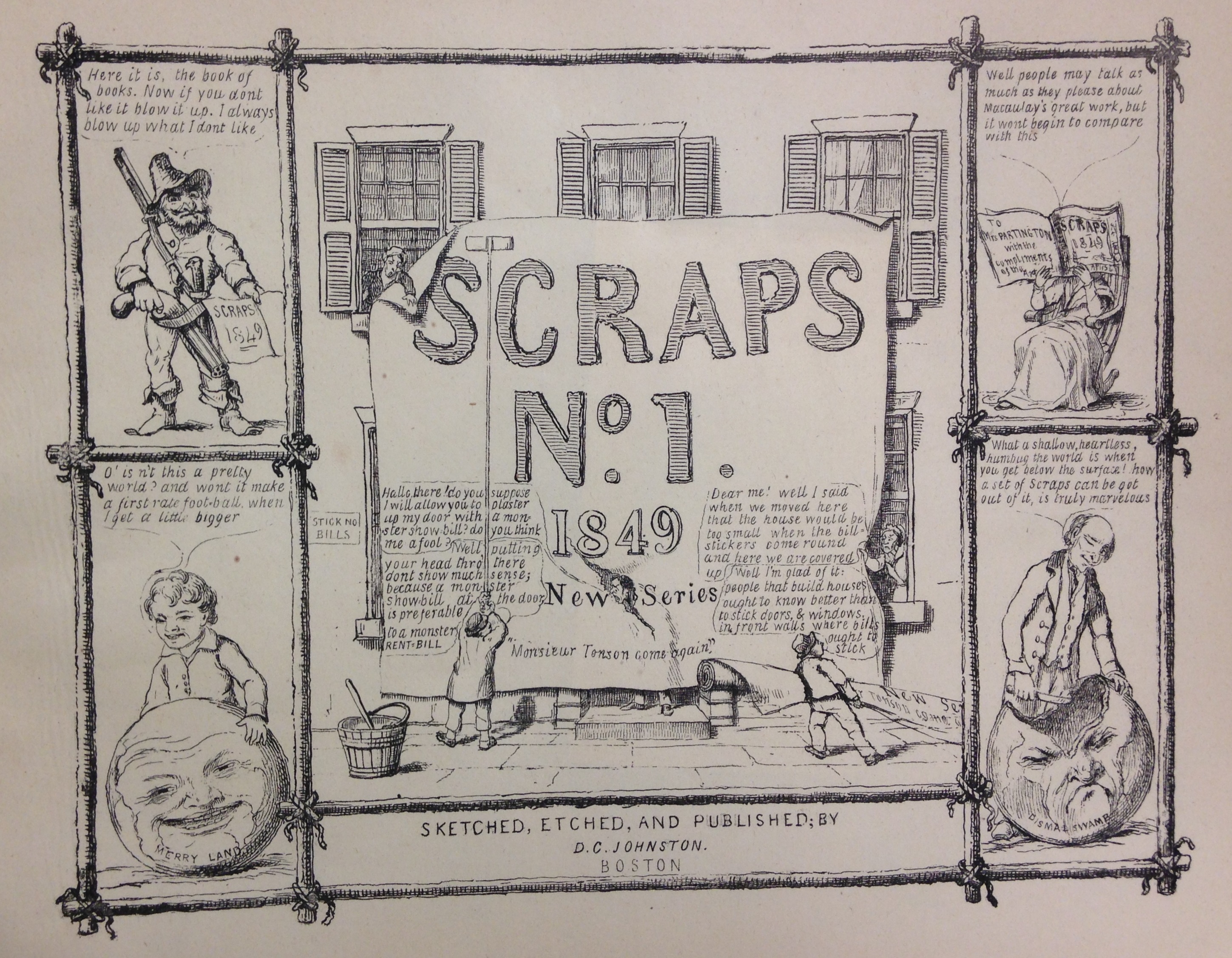
Front cover of David Claypoole Johnston, Scraps no. 1, new series (Boston, 1849).    (E166 .J65 1849)

Front cover of David Claypoole Johnston, Scraps no. 1, new series (Boston, 1849). (E166 .J65 1849)

The art of caricature soon took root in the United States, thanks in part to the influence of English émigré artists. One of the most famous antebellum American cartoonists was David Claypoole Johnston (1798-1865), who excelled in many artistic media. Some of his best cartoon “Scraps” were published from 1828 to 1849 in a series of numbered portfolios, of which we recently acquired two. Their etchings poke fun at contemporary events such as the Mexican-American War, emerging issues such as women’s rights, contemporary fads such as phrenology, and, of course, the art world.
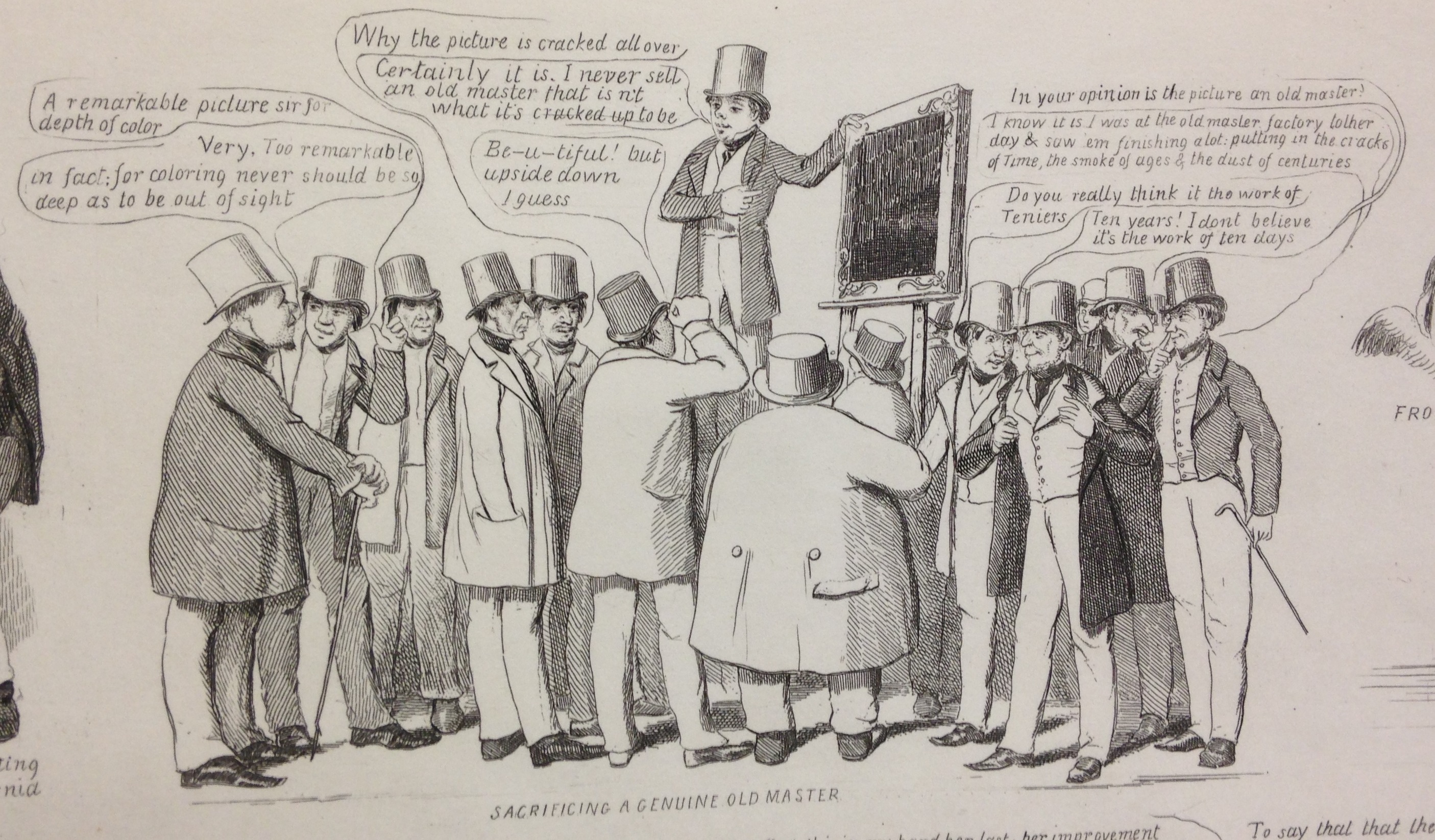
One of the cartoon "scraps" in David Claypoole Johnston, Scraps no. 1, new series (Boston, 1849)   (E166 .J65 1849)

One of the cartoon “scraps” in David Claypoole Johnston, Scraps no. 1, new series (Boston, 1849) (E166 .J65 1849)
This Just In: Printing Planographically

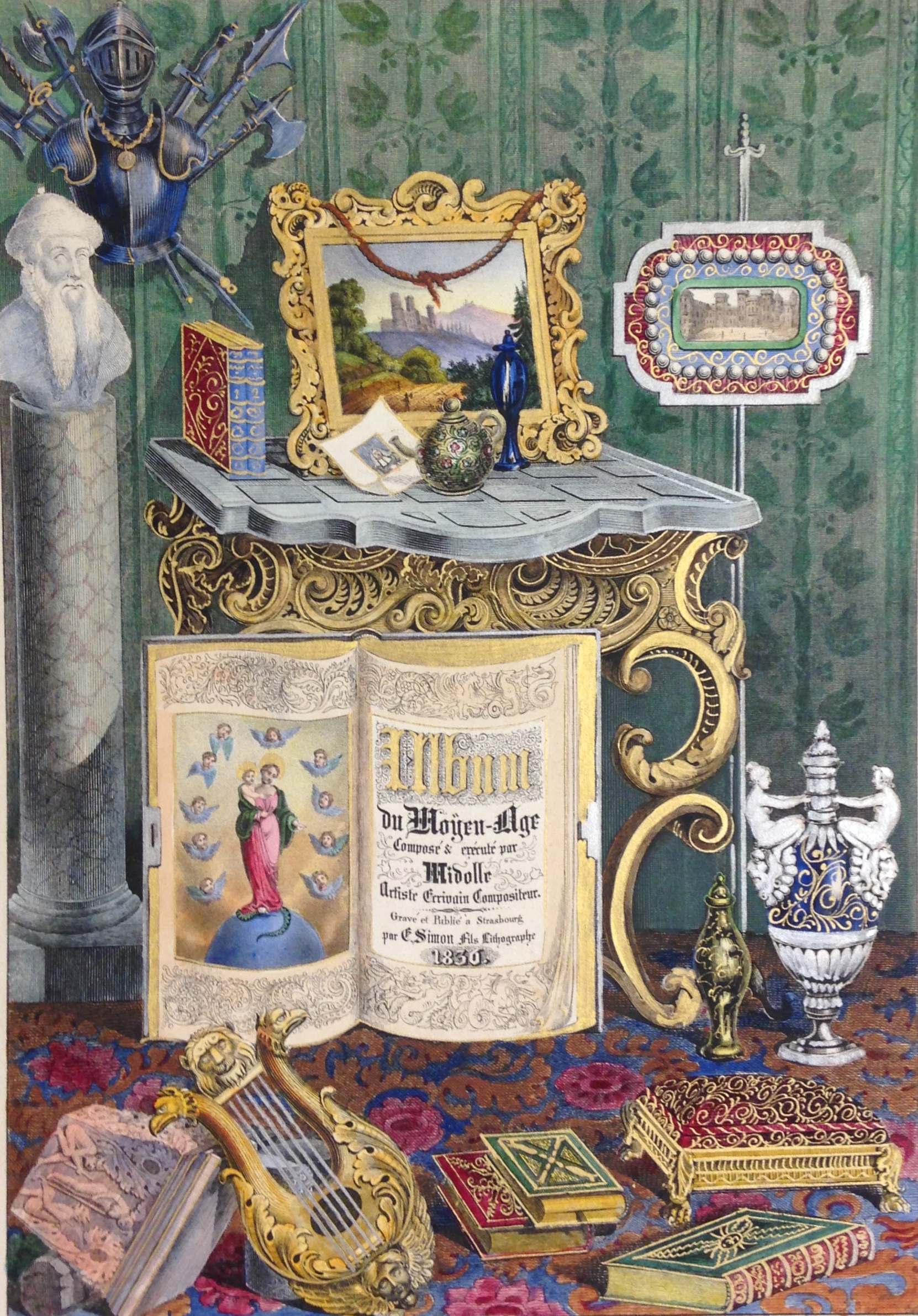
Title page to Jean Midolle, Album du Moyen Âge (Strasbourg, 1836)  ( NK3630 .M53 1836)

Title page to Jean Midolle, Album du Moyen Âge (Strasbourg, 1836) ( NK3630 .M53 1836)

In recent months U.Va. has had unusual opportunities to enhance its already strong collections on 19th-century planographic printing. Prior to the invention of lithography by Alois Senefelder in 1796, printers used a variety of relief (letterpress, woodcut &c.) and intaglio (engraving, etching &c.) processes for replicating text and image. Senefelder’s innovative method of printing from a flat surface offered printers a new tool which, thanks to continuing refinement during the 19th century, emerged as the leading method for printing multicolor illustrations. And by the later 20th century, offset lithography would supplant letterpress as the preferred method for printing text.

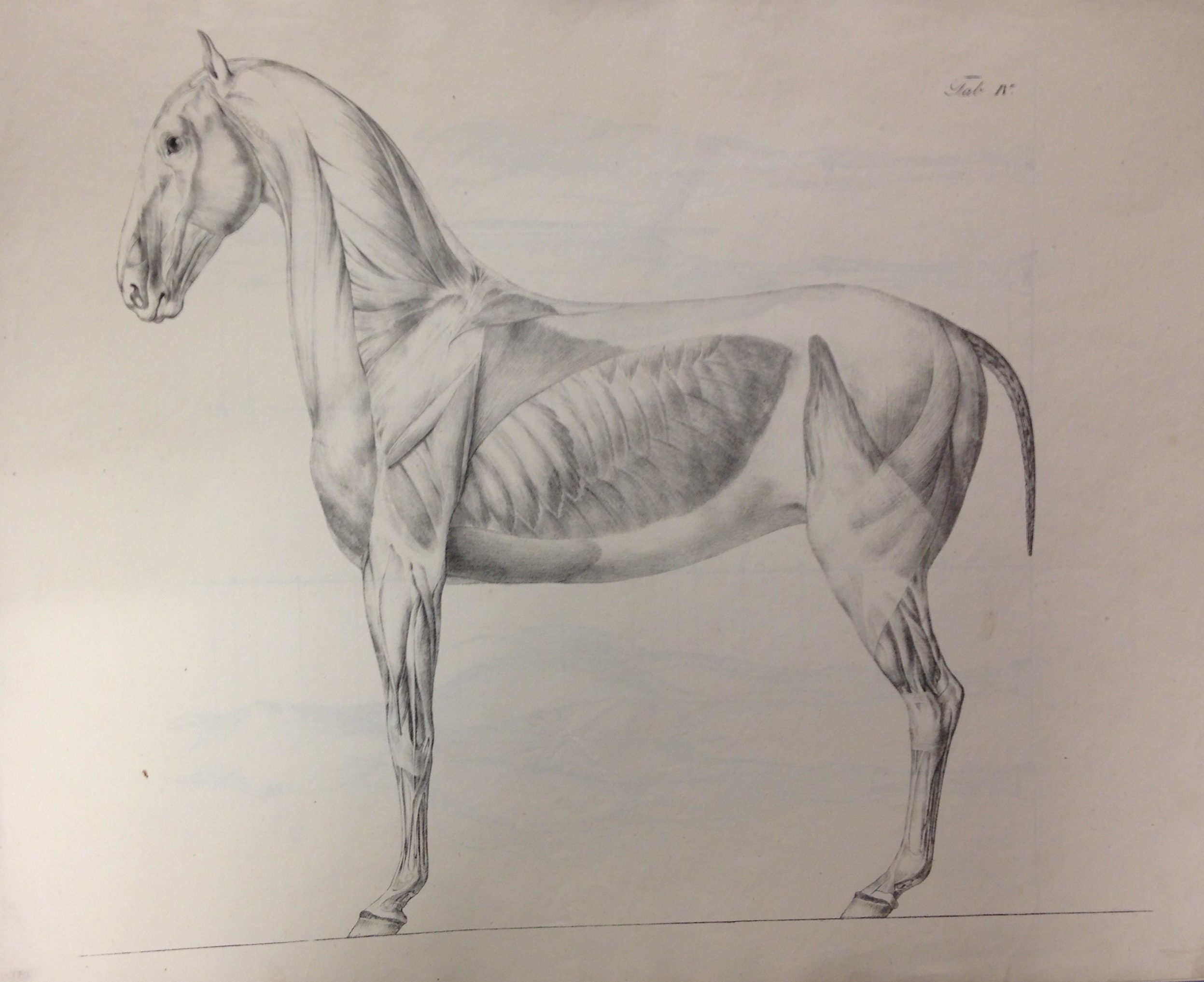
A lithographed plate from Konrad Ludwig Schwab. Anatomische Abbildungen des Pferdekörpers (Munich, 1820 ) (SF765 .S45 1820)

A lithographed plate from Konrad Ludwig Schwab. Anatomische Abbildungen des Pferdekörpers (Munich, 1820 ) (SF765 .S45 1820)

Because the technologies of lithography inform many aspects of 19th-century printing, the graphic arts, and book culture, the Small Special Collections Library has long sought to acquire a representative collection of technical manuals and printing specimens documenting lithography’s gradual ascendancy. Included are rare lithographic “incunabula” printed up to ca. 1820. Five years ago we were fortunate to acquire a fine copy of Konrad Ludwig Schwab’s Anatomische Abbildungen des Pferdekörpers (1813) published (as were many of the earliest lithographed books) in Munich, and illustrated with several large plates depicting horse anatomy. To it we have now added the equally rare second edition (Munich, 1820). This is no mere reprint, for the plates have been redone in more accomplished fashion, demonstrating how far lithography had progressed in only a few short years.

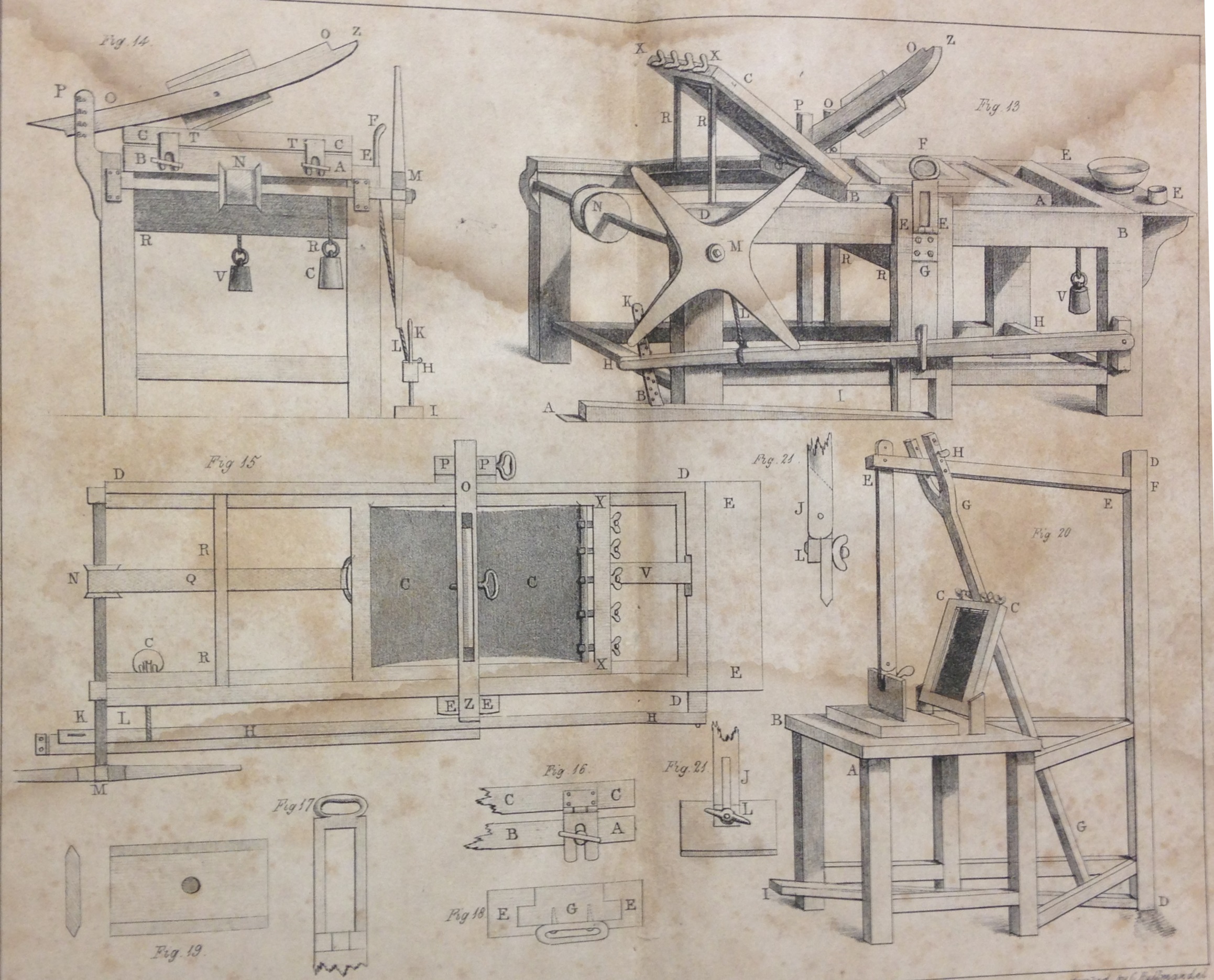
An early lithographic press and related equipment as depicted in Antoine Raucourt de Charleville, A manual of lithography, or memoir on the lithographical experiments made in Paris (2nd ed., London, 1821)  (NE2420 .R25 1821)

An early lithographic press and related equipment as depicted in Antoine Raucourt de Charleville, A manual of lithography, or memoir on the lithographical experiments made in Paris (2nd ed., London, 1821) (NE2420 .R25 1821)

Lithography quickly spread throughout Europe and beyond, particularly after 1818 when Senefelder published the first comprehensive manual. Others followed in quick succession, and through these we can trace the many technical innovations introduced during the 1820s and 1830s. By 1819 English printers could read not only Senefelder’s work, but also the leading French manual (by Antoine Raucourt de Charleville) in an English translation prepared by the London lithographer Charles Hullmandell. We recently acquired the second edition (1821), to which Hullmandell appended plates depicting a lithographic press, which looked and operated far differently from relief and intaglio presses. Another recent acquisition is the very rare Mémoire sur l’art du lithographe (Paris, [1829]) of Alphonse Chevallier. Included is a set of progressive plates illustrating Chevallier’s methods for creating certain artistic effects lithographically.

Two stages in the creation of a lithographic image, from Alphonse Chevallier, Mémoire sur l’art du lithographe (Paris, [1829])  (NE2420 .C54 1829)

Two stages in the creation of a lithographic image, from Alphonse Chevallier, Mémoire sur l’art du lithographe (Paris, [1829]) (NE2420 .C54 1829)

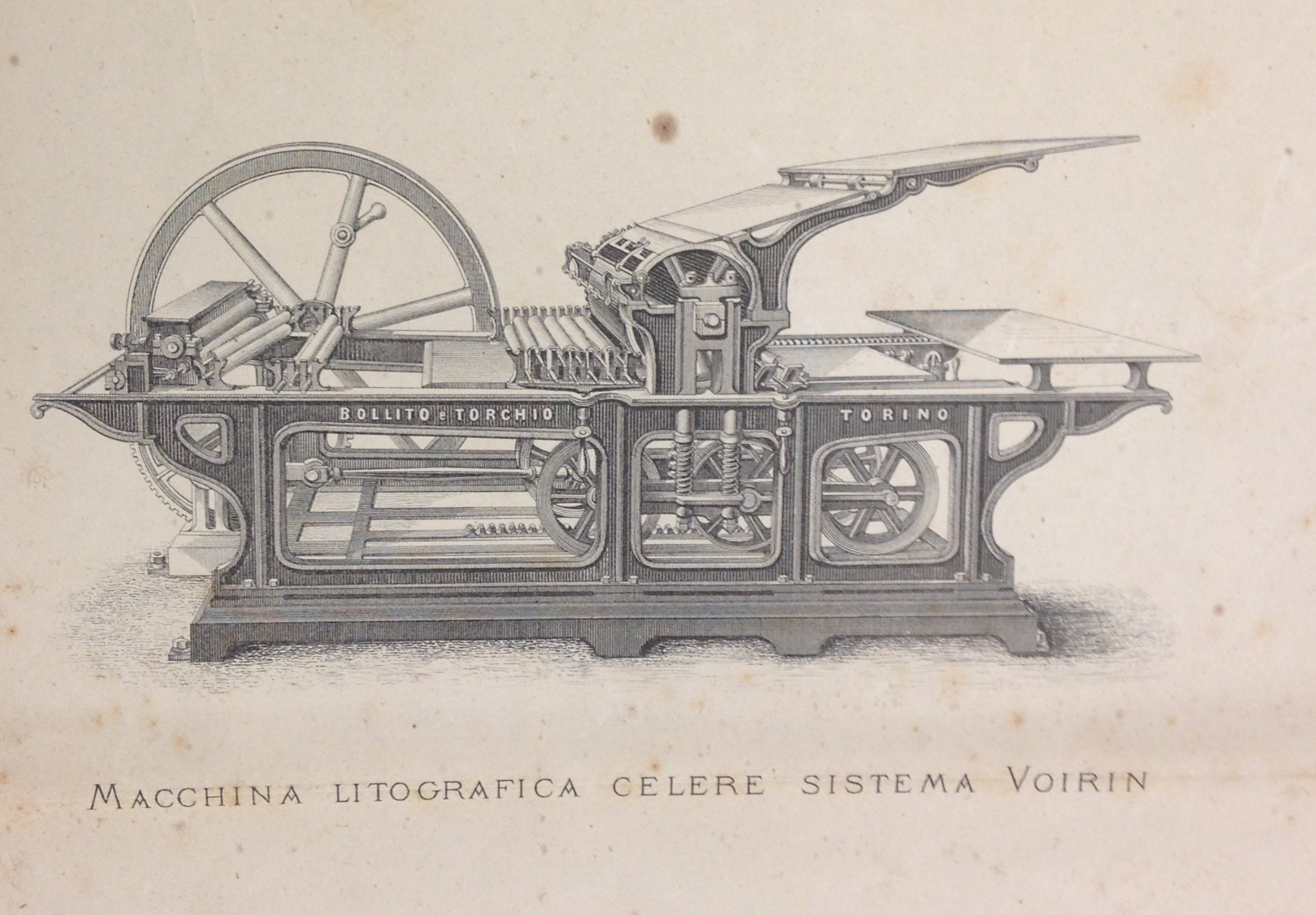
Lithography flourished in the late 19th century with the perfection of new technologies (most notably chromolithography and photolithography), improved equipment (especially steam-powered presses), and its application to new markets such as advertising matter and commercial packaging. Camillo Doyen’s rare Trattato di litografia: storico, teorico, pratico ed economico (Turin, 1877) is typical of later lithographic manuals: massive, richly detailed, and full of useful insights into regional practices.

A steam-powered lithographic press illustrated in Camillo, Doyen, Trattato di litografia: storico, teorico, pratico ed economico (Turin, 1877)  (NE2425 .D68 1877)

A steam-powered lithographic press illustrated in Camillo, Doyen, Trattato di litografia: storico, teorico, pratico ed economico (Turin, 1877) (NE2425 .D68 1877)

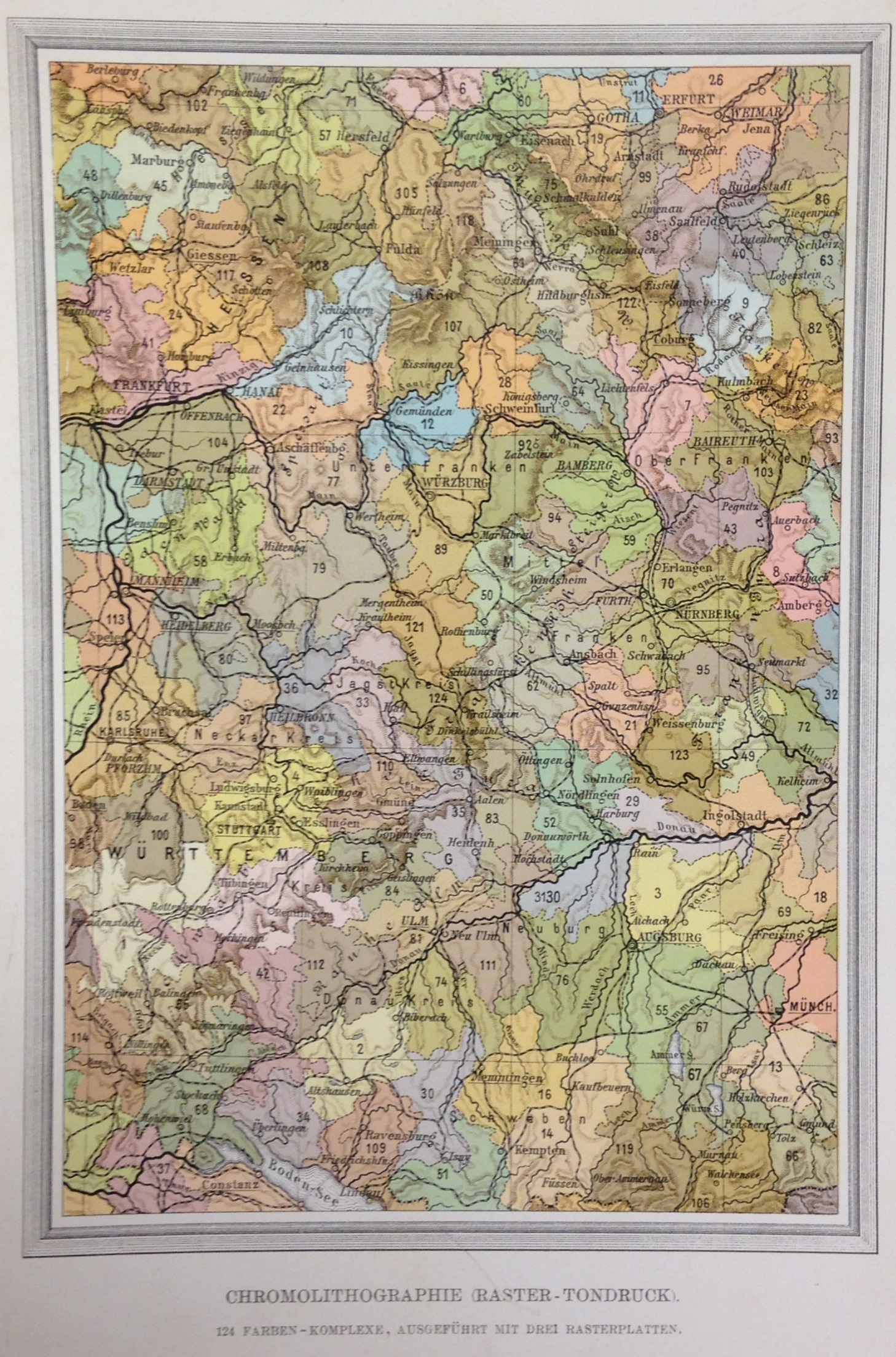
By 1900 German and Austrian lithographers were perhaps the most accomplished in Europe, producing high quality book illustrations and other work for publishers as far afield as the United States. The text and sample plates to Friedrich Hesse’s Die Chromolithographie (2nd ed., Halle, 1906) are important for understanding and identifying the many variant processes in the commercial lithographer’s toolkit.

A specimen chromolithographed map inserted as a plate in Friedrich Hesse, Die Chromolithographie (Halle, 1906)  (NE2500 .H47 1906)

A specimen chromolithographed map inserted as a plate in Friedrich Hesse, Die Chromolithographie (Halle, 1906) (NE2500 .H47 1906)

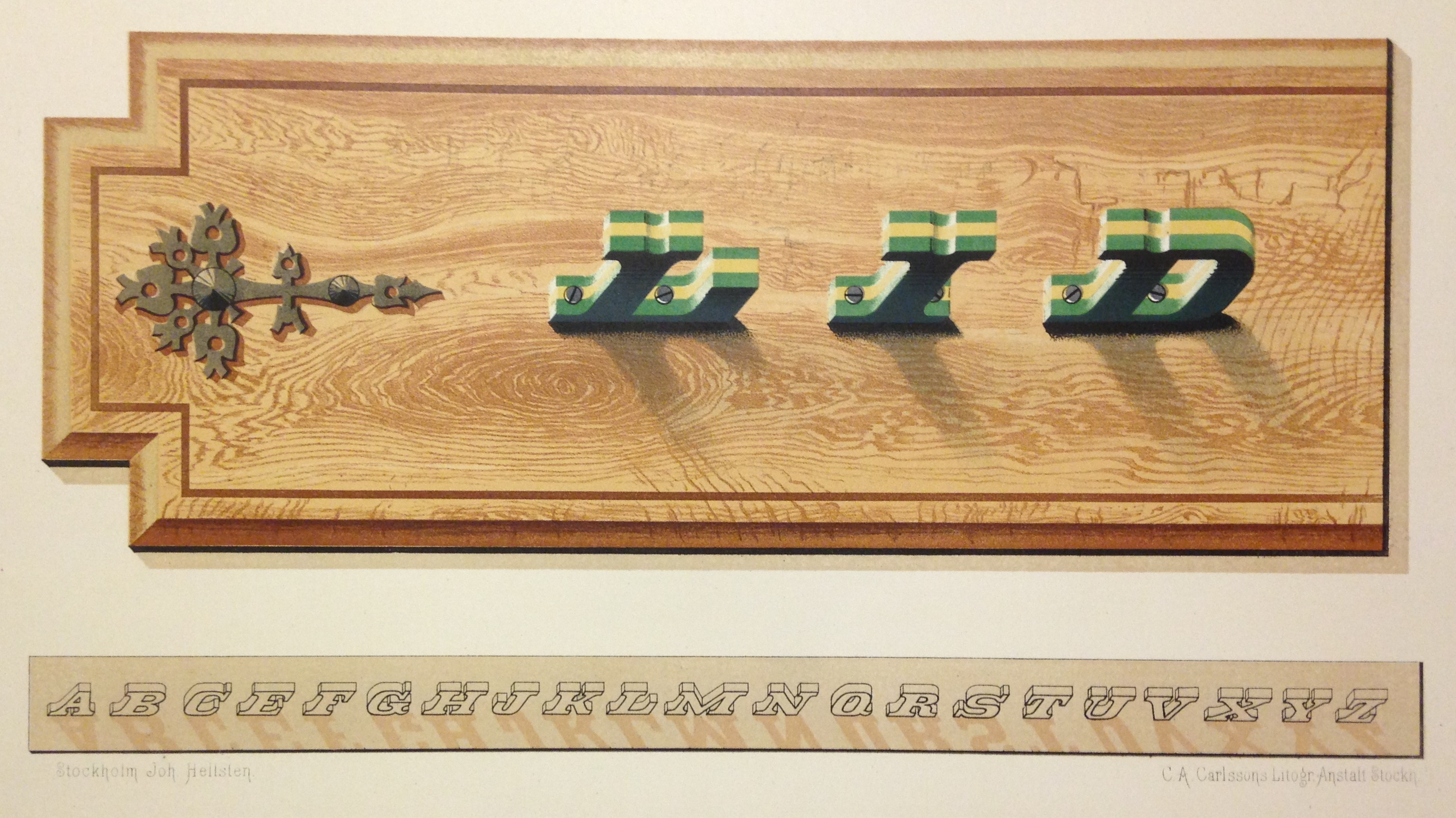
Printers have long sought to demonstrate and advertise their prowess through specimen work, and lithographers have been no exception. Perhaps the finest early chromolithographic printing was that executed by the Strasbourg firm of Frédéric Émile Simon. During the 1830s Simon teamed with the innovative calligrapher Jean Midolle to issue three extraordinary specimen books, one of which we have now acquired: Album du Moyen Âge (1836). That many of its plates are heightened with dusted gold, silver, and bronze powders, and even some discreet hand coloring, does not detract from their beauty and technical mastery. Fifty years later the Swedish sign painter advertised his work to potential clients by issuing Skyltmotiv (1884), a very rare portfolio containing 30 sample designs of his best work. Here the ability of Stockholm chromolithographer C. A. Carlsson to reproduce woodgraining and three-dimensional effects planographically is nothing short of miraculous.

A chromolithographic tour de force  from Frithiof Telenius, Skyltmotiv (Stockholm, 1884)

A chromolithographic tour de force from Frithiof Telenius, Skyltmotiv (Stockholm, 1884)

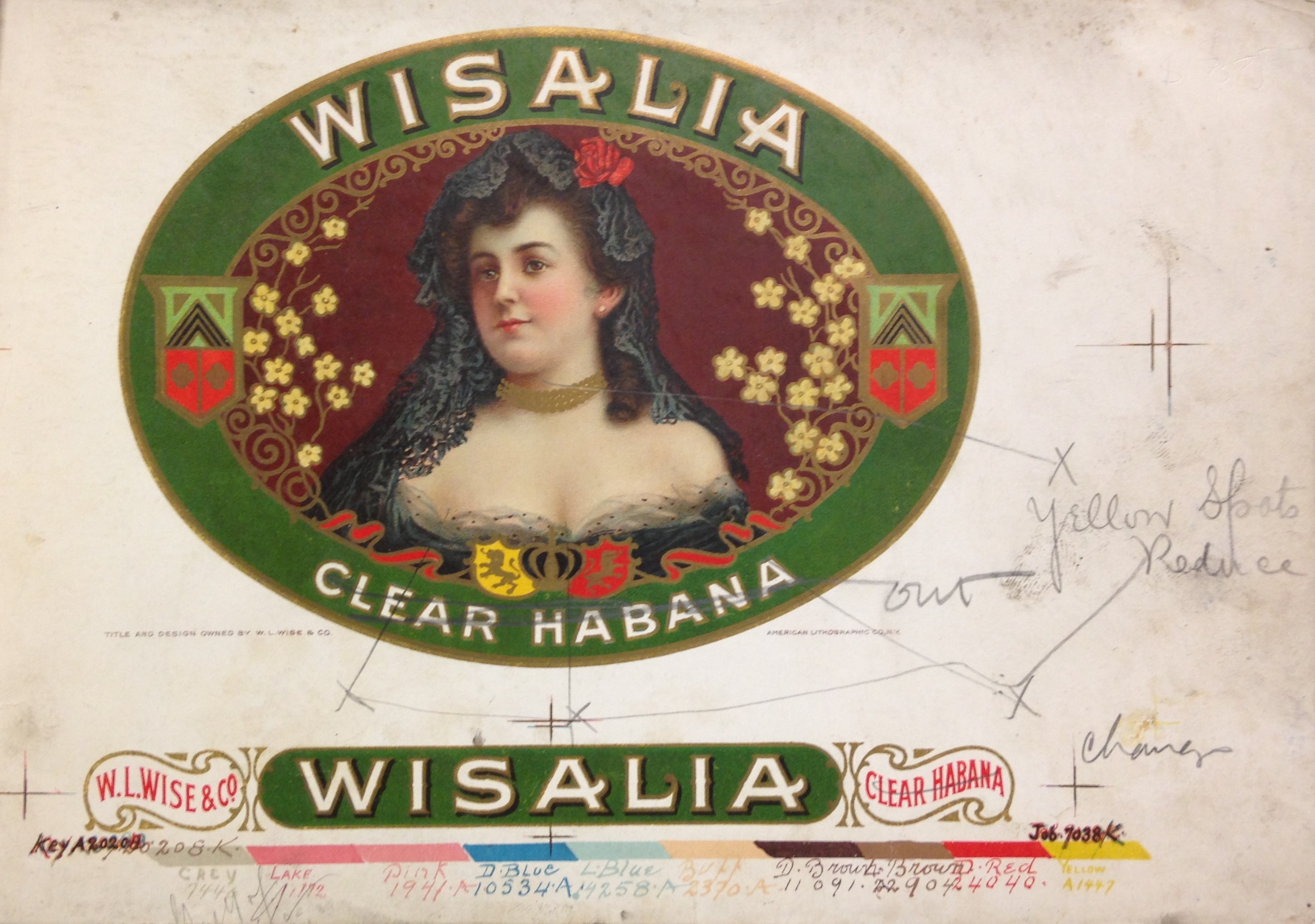
By 1900 it was not unusual for lithographers to print chromolithographic images in 20 or more colors, each applied with a different lithographic stone. A successful image required not only perfect registration, but the careful application of colors in proper sequence to achieve the desired effect. How this was done is illustrated through a set of progressive proofs we recently acquired. Formerly in the archive of the American Lithographic Co., it comprises the firm’s official set of 39 proofs documenting job no. 7038K: a cigar box label printed ca. 1900. Many proofs bear annotations indicating corrections to be made, followed by the corrected proofs. At front is the completed image (still marked for correction) showing at bottom a color bar with the ten hues employed, applied in sequence from right to left.

Proof of a 10-color chromolithographed cigar box label, marked up for correction (NE2515 .A54 1900)

Proof of a 10-color chromolithographed cigar box label, marked up for correction (NE2515 .A54 1900)

This Just In: Display Fonts and Clip Art and Show Cards, oh my!

This week, we are pleased to feature a guest post from curatorial assistant Elizabeth Ott, who is a doctoral candidate in the English Department. Liz recently produced preliminary catalog records for the collection she discusses in this post.

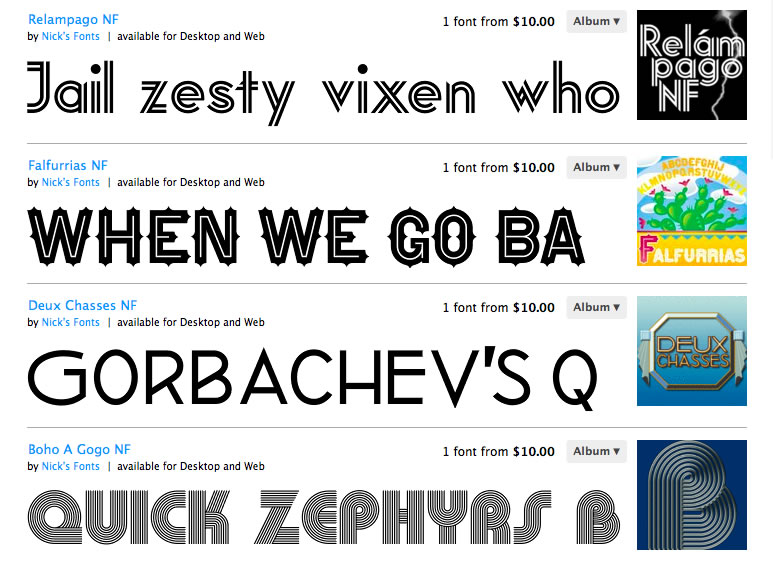
Special Collections is known for our fantastic collections in the history of type design; this strength just expanded dramatically with the generous gift of approximately 300 books on typography, letterforms, calligraphy, show cards, and graphic design given by the prolific American type designer Nicholas Curtis (b. 1948). Curtis, a resident of Charlottesville, has had a long a varied career as a graphic artist and type designer dating back the late 1960s when he got his start designing rock posters. He now operates his own independent type foundry, Nick’s Fonts, and his type designs can be found everywhere from Trader Joe’s labels to the titles for the recent film Oz the Great and Powerful (2013)—in fact, Curtis is also responsible for many of those super-condensed fonts you see at the foot of film posters, which help cram in the names of a film’s key cast and crew.

Some of Nick Curtis's type designs. The influence of hand lettering from across the decades may be seen in his faces.

Some of Nick Curtis’s type designs. The influence of lettering and type design from across the decades may be seen in his faces.

The range of books in the Curtis gift reflects Curtis’s eclectic style and nostalgic designs. It includes items such as specimen catalogs from nineteenth-century type foundries, how-to guides for producing calligraphy alphabets, books of clip art for early computers, and many manuals for creating show cards. Most of the items in the gift relate to commercial art and offer a glimpse behind the curtain of nineteenth and twentieth-century graphic design. The show card manuals, in particular, offer an example of a now-obscure commercial art profession that had a profound impact on the visual and print culture of nineteenth and twentieth century America.

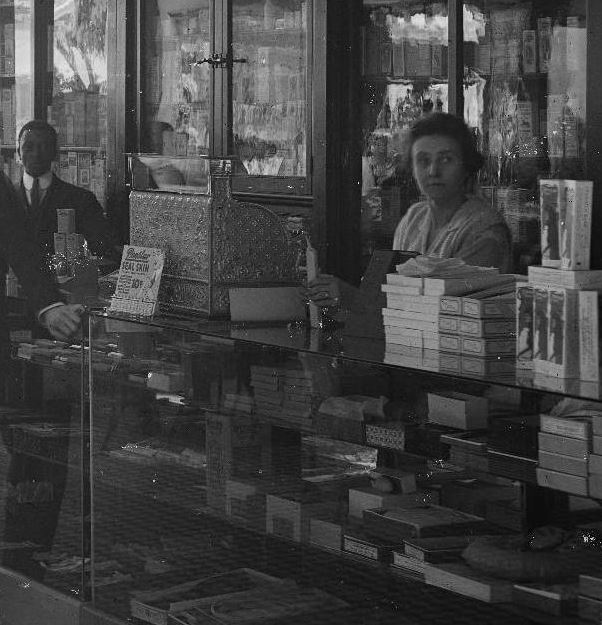
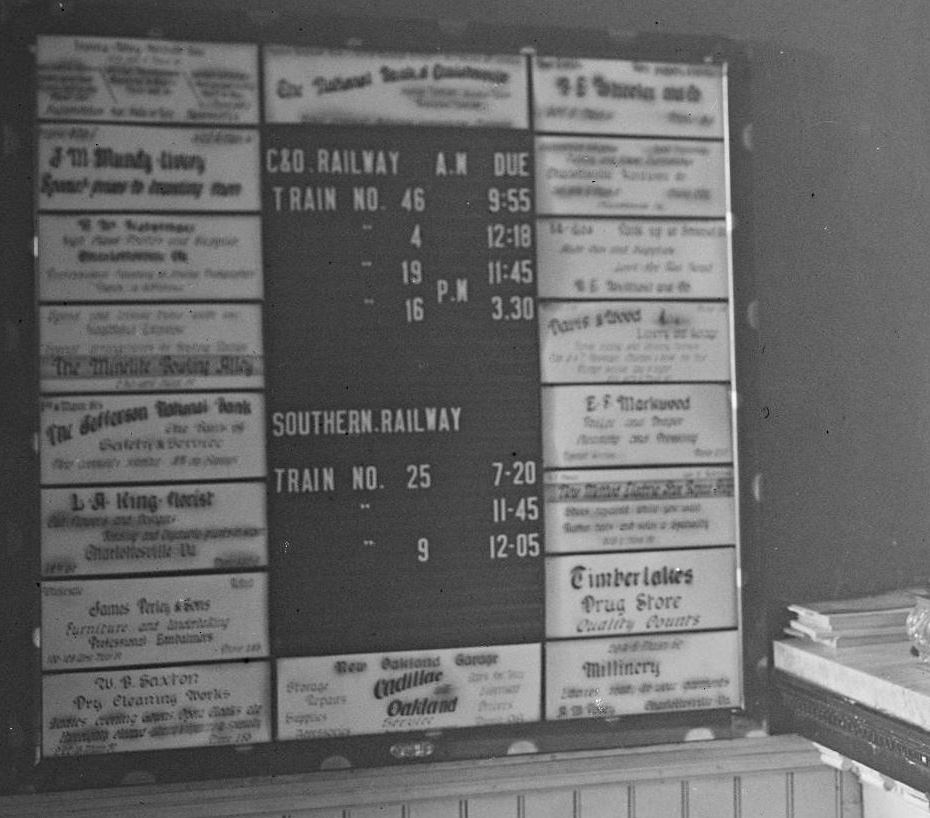
Show cards (sometimes show-cards, sho-cards, or sho’ cards) were hand-lettered signs used for local advertising and incidental labeling, popular to the point of near ubiquity between about 1880 and 1920, though the practice of show card writing survived well into the sixties. Show cards filled a niche role in early twentieth-century advertising distinct from printed posters or painted signs, allowing shops, restaurants, and other local businesses to produce inexpensive displays for goods and services. Typical show cards were small in scale, at most 11 by 14 inches, and produced on a stiff cardboard or poster board. Examples may be seen in this series of photographs of Charlottesville in the early twentieth century from the Rufus Holsinger Studio Collection:

A show card rests in front of the cash register in this detail from a 1917 photograph of the Timberlake Drugstore on mainstreet.

A show card rests in front of the cash register in this detail from a 1917 photograph of the Timberlake Drugstore on Main Street. (MSS 9862. Image by UVA Digitization Services)

Hand-lettered advertisements for local businesses surround the Charlottesville train timetable in the Gleason Hotel in 1915, detail from a larger photograph. photograph from

Hand-lettered advertisements for local businesses surround the Charlottesville train timetable in the Gleason Hotel in 1915, detail from a larger photograph. (MSS 9862. Image by UVA Digitization Services)

asdf

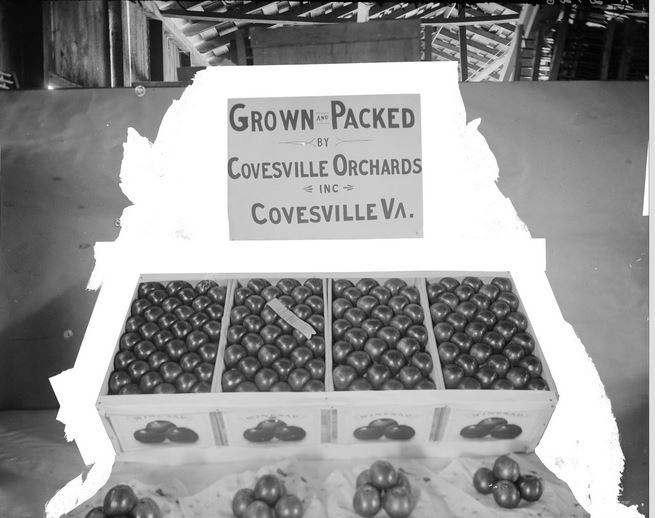
A very simple 1914 show card for tomatoes. Sections of the photograph’s background have been whited out, perhaps in preparation for use of the image in an article or advertisement. (MSS 9862. Image by UVA Digitization Services)

Show card writers used water based paints or inks in conjunction with a “rigger” brush—a long-handled sable brush—or nibbed pen to create designs. Show cards could be made and remade swiftly, so they were ideal for displays where signs needed to be rotated frequently.

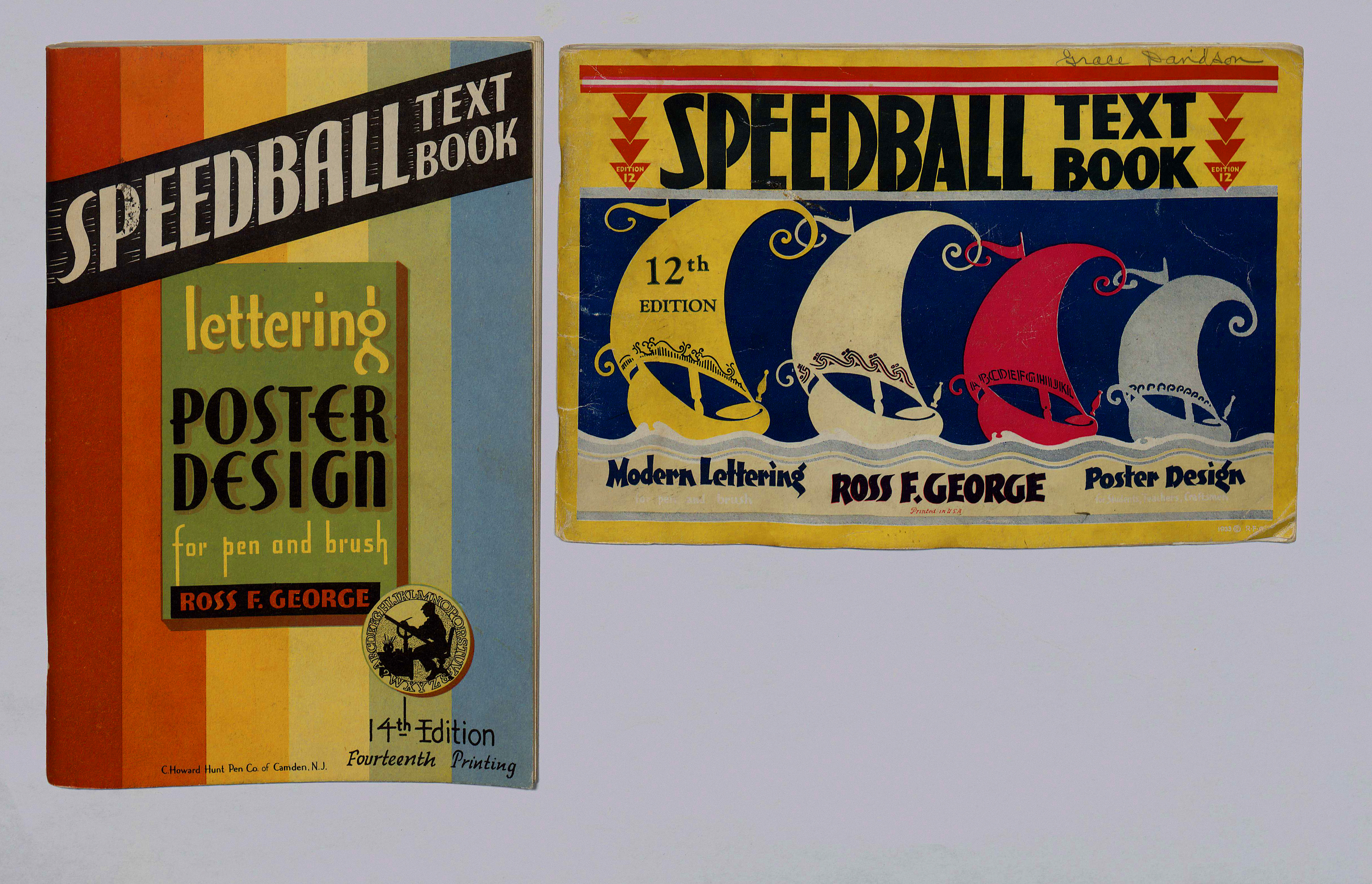
Two scarce instruction books produced by the Speedball pen company, still in operation today. The company name reflects its origins: Speedball began as a specialty company producing nibbed pens specifically for the quick work of show card lettering.

Two scarce instruction books for Speedball pens produced by the C. Howard Hunt Pen Company, which operates today as Speedball. Speedballs were nibbed pens produced specifically for the quick work of show card lettering. Left: Ross F. George,  Lettering, Poster Design for Pen and Brush (Camden: C. Howard Hunt Pen Co., n.d.); Right: Ross F. George, Modern Lettering/Poster Design (Camden: C. Howard Hunt pen Co. , n.d.). (Image by Elizabeth Ott)

Because show cards were meant to be produced quickly, show card writers did not want to spend time creating unique designs and layouts for every new card. Show card manuals offered design templates and best practices for producing attractive, readable show cards that could be easily copied. Manuals instructed writers on how to scale alphabets up and down, how to balance negative and positive space, and how to choose complementary color schemes. More than just a compendium of display alphabets, show card manuals condense the aesthetics of early twentieth-century graphic design into readable, concrete lessons.

curtispracticestrokes

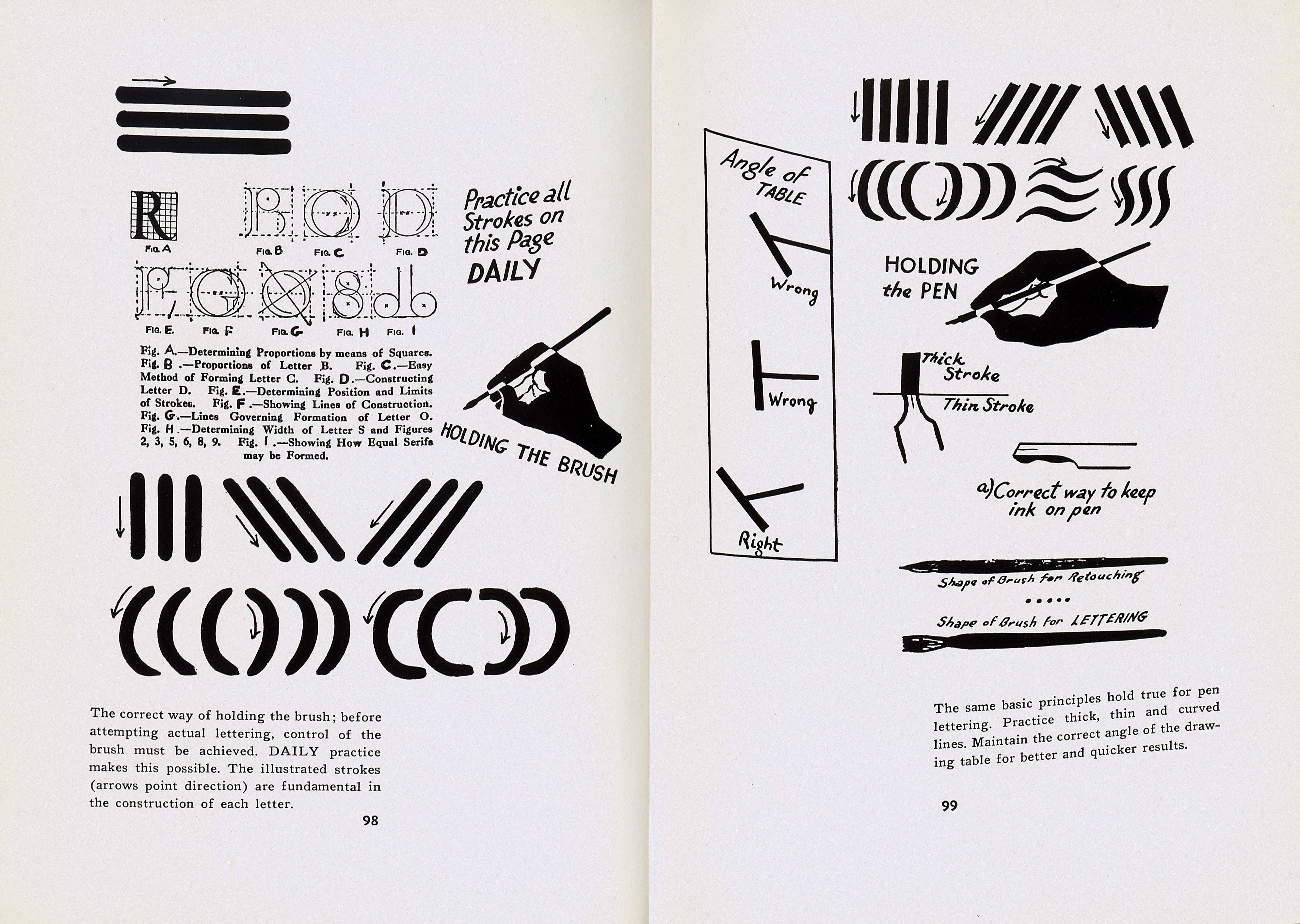
A page spread from E. C. Matthews, How to Paint Signs and Show Cards (New York: Illustrated Editions, 1940). (Image by Elizabeth Ott)

curtisclouded

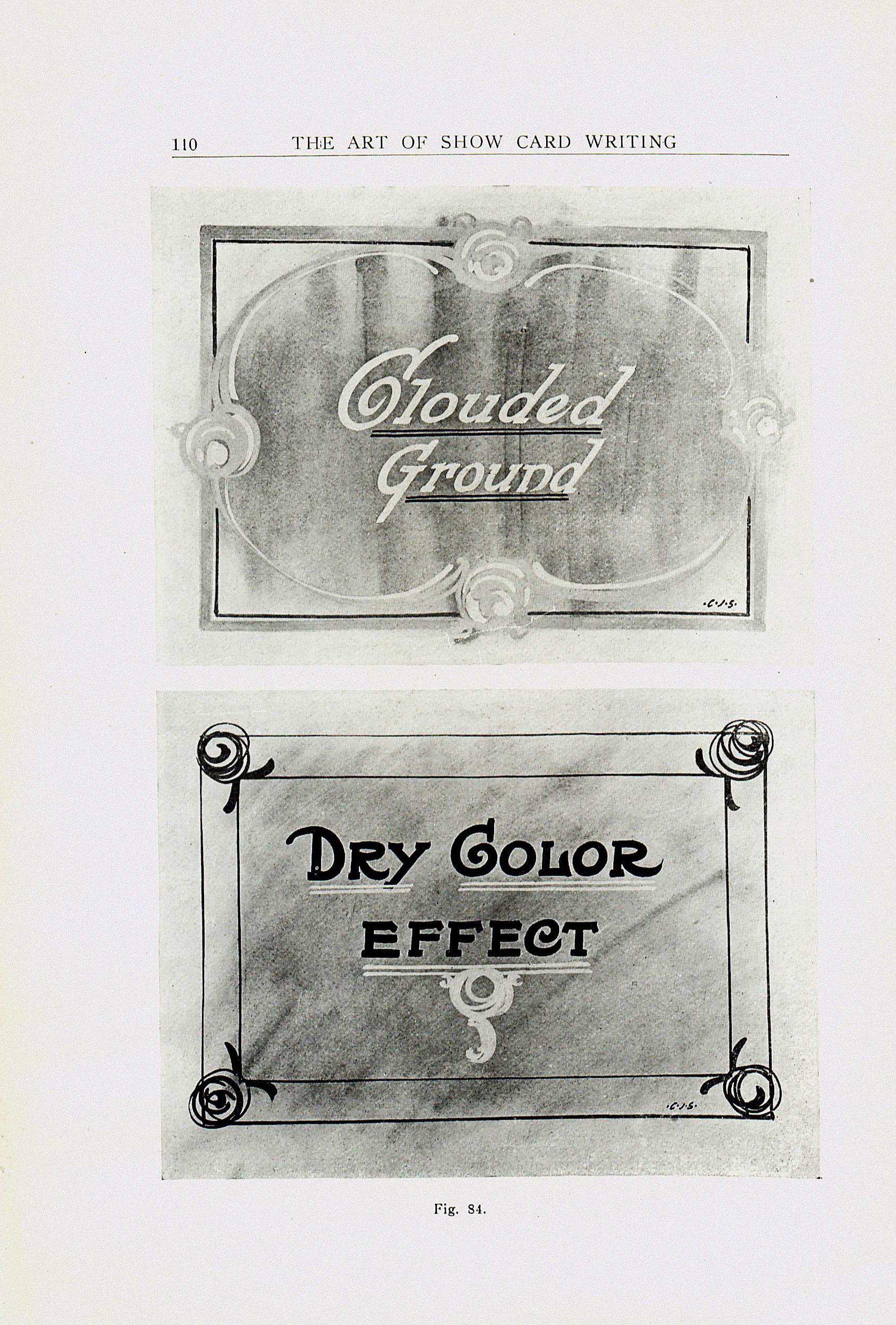
A page from Charles Strong’s The Art of Show Card Writing, showing an airbrushing technique used to add depth and texture quickly to a flat design. (Detroit: The Detroit School of Lettering, 1907).

These show card manuals are an important, but often overlooked, aspect of the history of typography, graphic design, and American advertising. The script alphabets of show cards influenced type design, especially for display types, but also diverged from many trends in typography. Similarly, the non-pictorial nature of most show cards and their freedom from the constraints of printing meant they were both like and unlike printed advertisements produced during the same time. Ephemeral and rarely preserved, show cards are largely absent from the cultural record, except in photographs that attest to their prevalence. Show card manuals are thus an invaluable resource for understanding the practice of show card writing. Many of the manuals in the Nicholas Curtis gift are extremely rare, available in only a handful of libraries world-wide—indeed, we were unable to find existing holdings for more than two dozen. We are particularly pleased to add these books to our collections, adding their richness and texture to our extensive collections on the history of typography and type design.

The books are marvelous specimen collections in their own right. Incidentally, we believe the ancient author of the concept of humours, Galen, would put his stamp of approval on the layout of the recto of this page. From Pen and Brush Lettering and Practical Alphabets (London: Blandford Press, [1947].

The books are themselves often exuberant celebrations of the myriad ways to design the Roman alphabet.  Pen and Brush Lettering and Practical Alphabets (London: Blandford Press, [1947]).

This Just In: Disability in the Archives

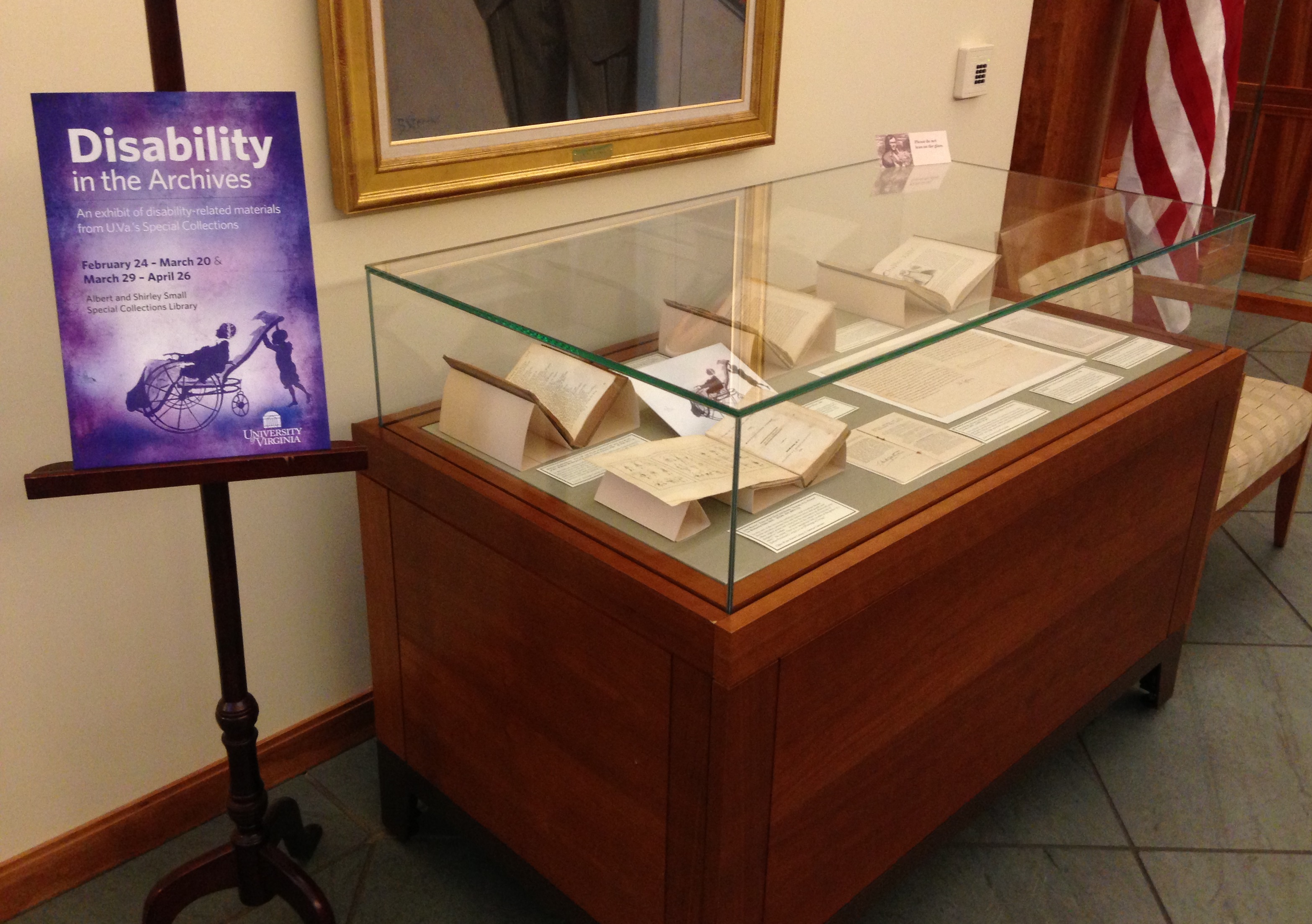
"Disability in the Archives," case 1

“Disability in the Archives,” case 1

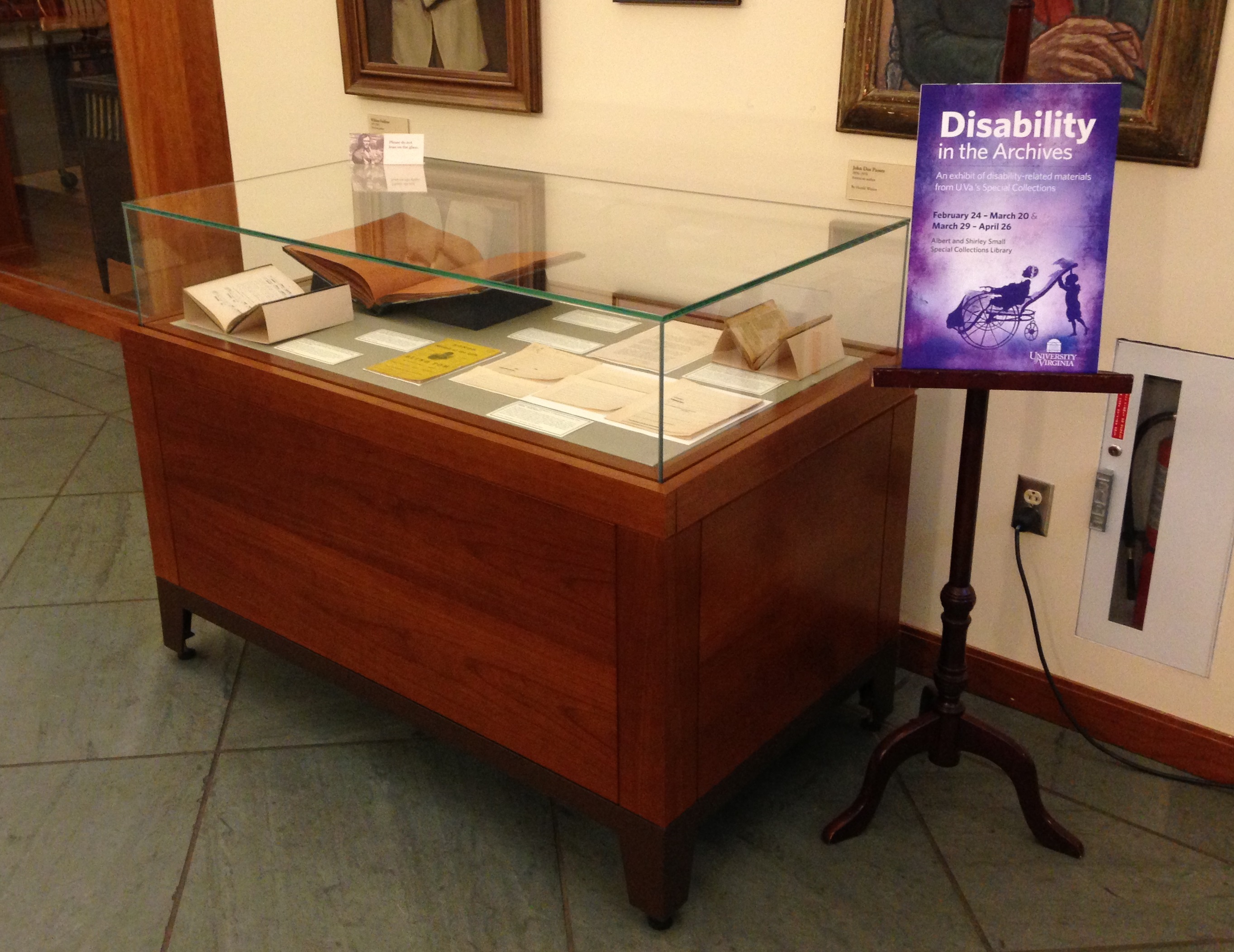
On February 27-28 U.Va. hosted “Disabling Normalcy,” an interdisciplinary conference organized by Christopher Krentz, Associate Professor of English and Director of American Sign Language.  In conjunction with the conference, Prof. Krentz and graduate student Philip Timmerman prepared an exhibition, “Disability in the Archives,” which is on view in the first floor gallery of the Small Special Collections Library through April 26. Drawn entirely from our holdings, the exhibition features books, manuscripts, and photographs relating to the deaf, blind, physically handicapped, and mentally ill.

"Disability in the Archives," case 2

“Disability in the Archives,” case 2

The exhibition includes several recent acquisitions, some obtained before Prof. Krentz proposed the exhibition and others acquired since, partly with the exhibition in mind.  In this post we feature a few of these items, including several omitted from the exhibition for want of space.

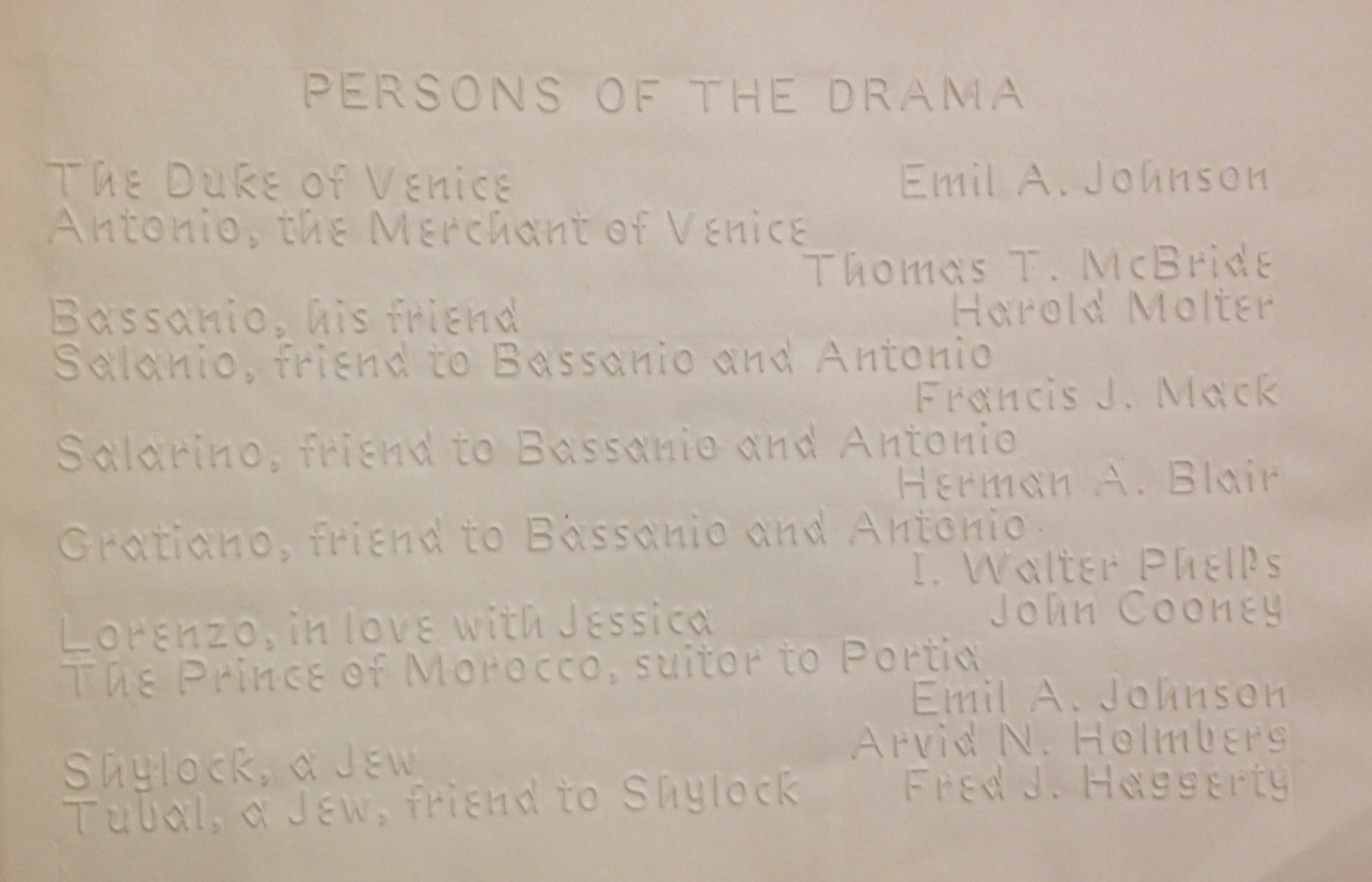
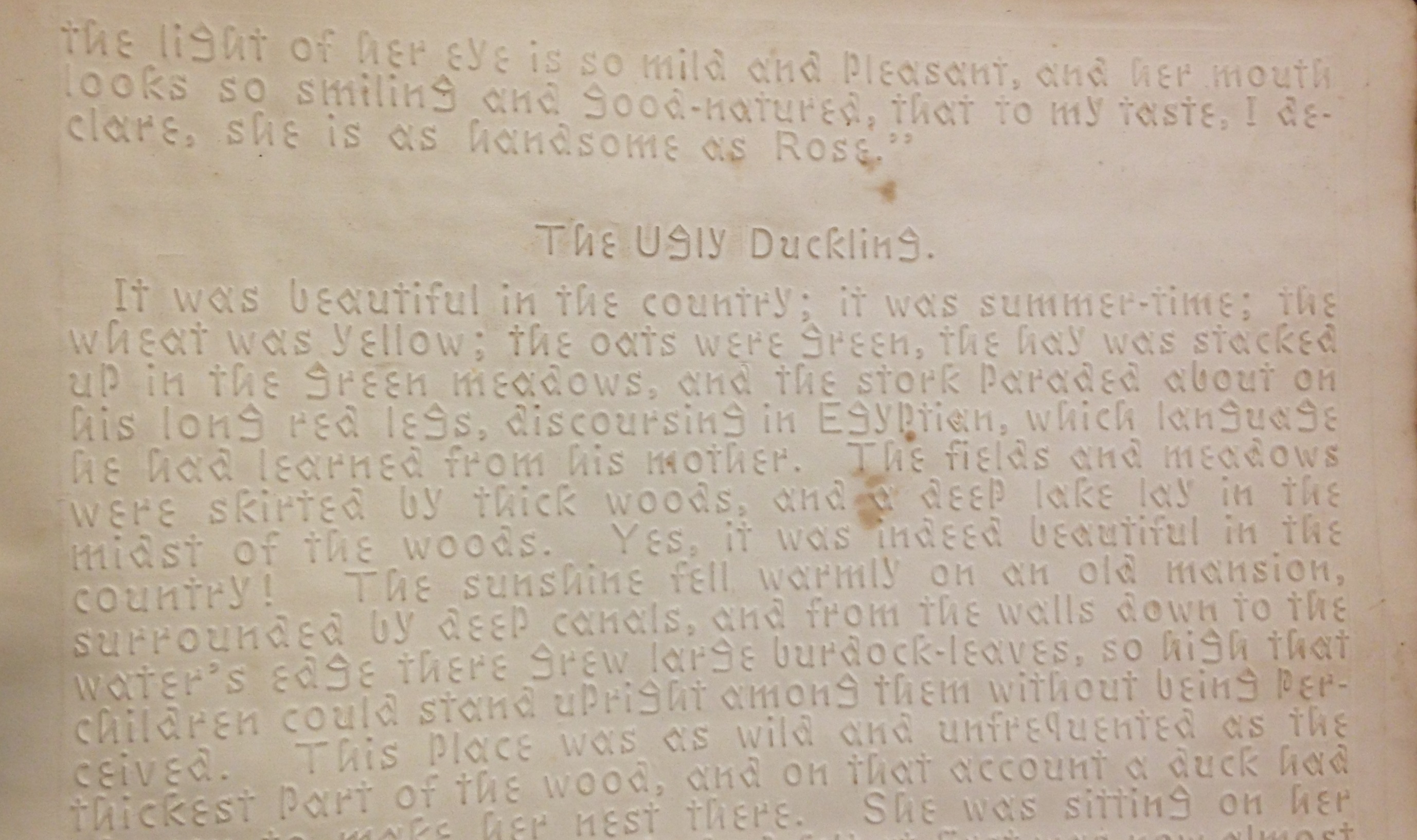
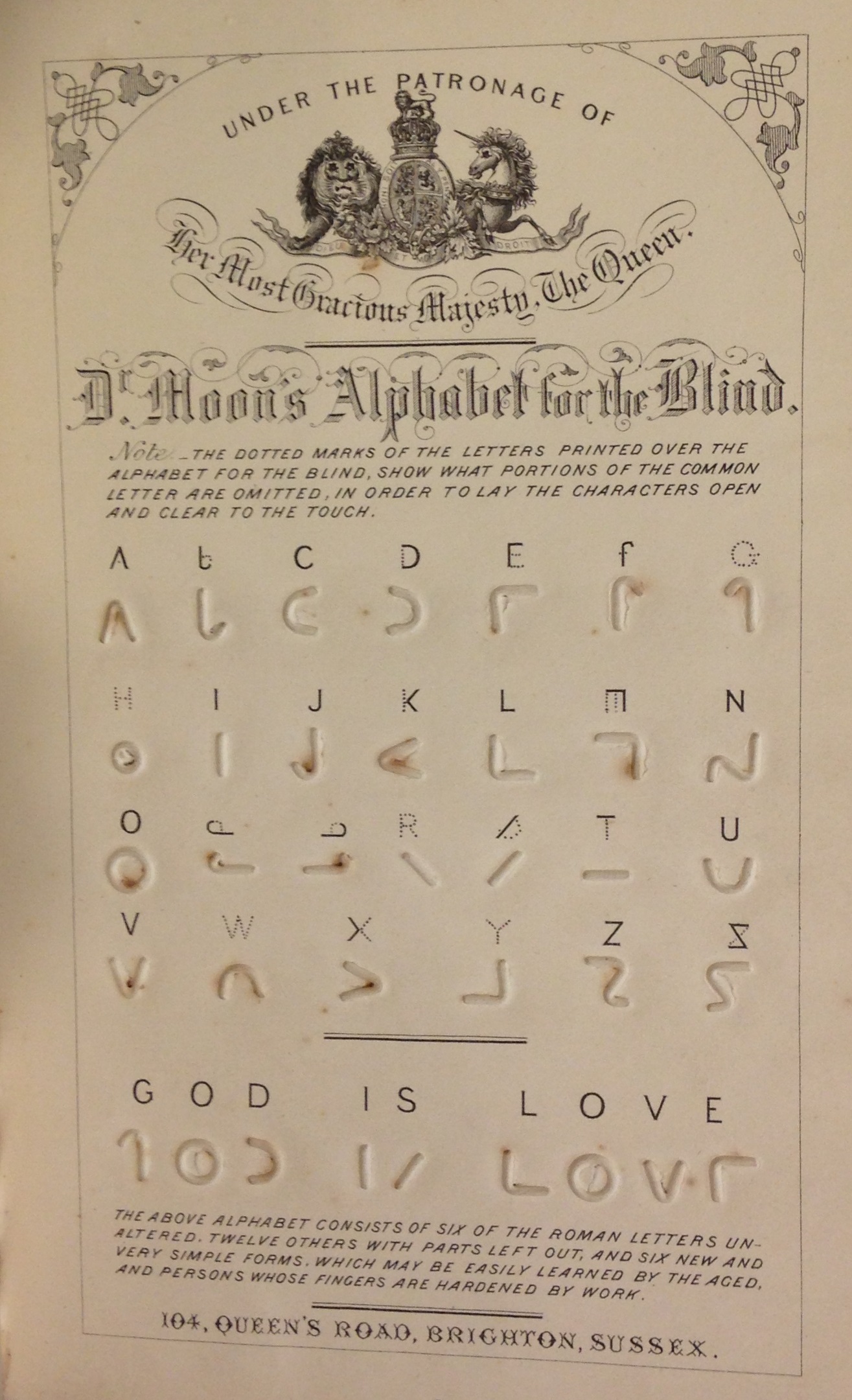
Efforts to educate the blind and vision-impaired received a major boost in the early 19th century with the invention of various tactile reading systems. Although Louis Braille’s dot system has become the international norm, raised letter systems were standard in the United States until the early 20th century. The first to be introduced was “Boston line,” an adaptation by Dr. Samuel Gridley Howe of a Scottish raised-letter alphabet. Much as a type designer adjusts letterforms for legibility, Howe adapted the shapes of letters and numerals so that, when embossed in paper in high relief, they could be more easily distinguished by touch. In 1835 Howe established a press at the New England Asylum for the Blind in Boston (now the Perkins School for the Blind in Watertown, Mass.), where he proceeded to print many raised-letter books for the blind.

Cast list for a benefit performance of Shakespeare's The Merchant of Venice,  by the "Perkins Players" of the Perkins School for the Blind in Watertown, Mass., May 1917  (HV1796 .M46 P4 1917)

Cast list for a benefit performance of Shakespeare’s The Merchant of Venice, by the “Perkins Players” of the Perkins School for the Blind in Watertown, Mass., May 1917. This raised-print program was set in Boston line and printed at the school.  (HV1796 .M46 P4 1917)

We recently added an unusual Boston line imprint to our Joseph M. Bruccoli Great War Collection: a theater program for two benefit performances of Shakespeare’s The Merchant of Venice, held in May 1917 at the Perkins School and featuring Perkins students as actors, musicians, and dancers. Proceeds went to the American, British, French, Belgian Permanent Blind Relief War Fund, which assisted Allied soldiers blinded in battle.

Hans Christian Andersen's The Ugly Duckling, from Fancies of Child-Life (Louisville, Ky.: American Printing House for the Blind, 1877).  (PZ7 .F1997 1877)

Hans Christian Andersen’s The Ugly Duckling, from Fancies of Child-Life (Louisville, Ky.: American Printing House for the Blind, 1877). (PZ7 .F1997 1877)

Following the Civil War, the American Printing House for the Blind in Louisville, Kentucky, became the leading American supplier of raised-letter texts. The APHB employed a modified form of Boston line for its publications until 1893, when Braille was first introduced. At the Boston International Antiquarian Book Fair we acquired a copy of the 1877 APHB edition of Fancies of Child-Life, a collection of children’s stories by Hans Christian Andersen and Harriet Beecher Stowe. This copy was sent to the Virginia Institute for the Deaf, Dumb, and Blind in Staunton, Va., where in 1893 it was presented as a school prize “For learning to read in one Session” to Edgar Hickam. A blind resident of Maces Spring, Va. (in the extreme southwest region bordering Tennessee), Hickam was well known locally as a musician and piano tuner, though celebrity would fall, not to him, but to his neighbors, the Carter Family.

The Rev. William Moon's simplified manual alphabet, in Light for the blind: a history of the origin and success of Moon's system of reading (embossed in various languages) for the blind (London: Longmans & Co., 1873).  (HV1678 .M84 1873)

The Rev. William Moon’s simplified manual alphabet, in Light for the blind: a history of the origin and success of Moon’s system of reading (embossed in various languages) for the blind (London: Longmans & Co., 1873). (HV1678 .M84 1873)

Perhaps Boston line’s primary shortcoming was that it adopted essentially the same rather complex letterforms employed for written and printed texts. Hence publications in Boston line are more easily read by eye than by touch. In 1847 the Rev. William Moon of Brighton, England, invented a simplified alphabet better suited to touch. It consisted of “six of the roman letters unaltered, twelve others with parts left out, and six new and very simple forms, which may be easily learned by the aged, and persons whose fingers are hardened by work.” Moon’s Light for the blind (London, 1873) describes his invention, provides a list of available publications, and chronicles his labors on behalf of the blind.

We know far less about the history of mapmaking for the blind, and embossed maps are very uncommon.  Hence we were delighted to acquire at the California International Antiquarian Book Fair a fine copy of a world atlas for the blind published in Germany in the mid-1930s. The challenge was a straightforward one: how to convert two dimensions into three so that cartographic information could be conveyed by touch?  Here the solution was to emboss maps in high relief on durable kraft paper. Geographic and topographic features are differentiated as follows: coastlines by dotted lines, political boundaries by dashed lines, rivers by solid lines, oceans by a uniform pattern of small dots in low relief, and so on, with captions added in Braille.

A manual alphabet from a collection of ornamental alphabets, Recueil d'alphabets, dedié aux artistes (Paris & New York: L. Turgis jeune, [ca. 1845?].  (NK3600 .B65 1845)

A manual alphabet from a collection of ornamental alphabets, Recueil d’alphabets, dedié aux artistes (Paris & New York: L. Turgis jeune, [ca. 1845?].   (NK3600 .B65 1845)

Last month we acquired a rare mid-19th century alphabet book, with a dual Paris & New York imprint, consisting of 24 lithographic plates bearing elaborate ornamental alphabets. These were intended as inspiration for artists, signmakers, and others seeking out-of-the-ordinary letterforms. Imagine our surprise to find on the penultimate plate the standard manual alphabet on which various sign languages used by the deaf (including American Sign Language) are based.

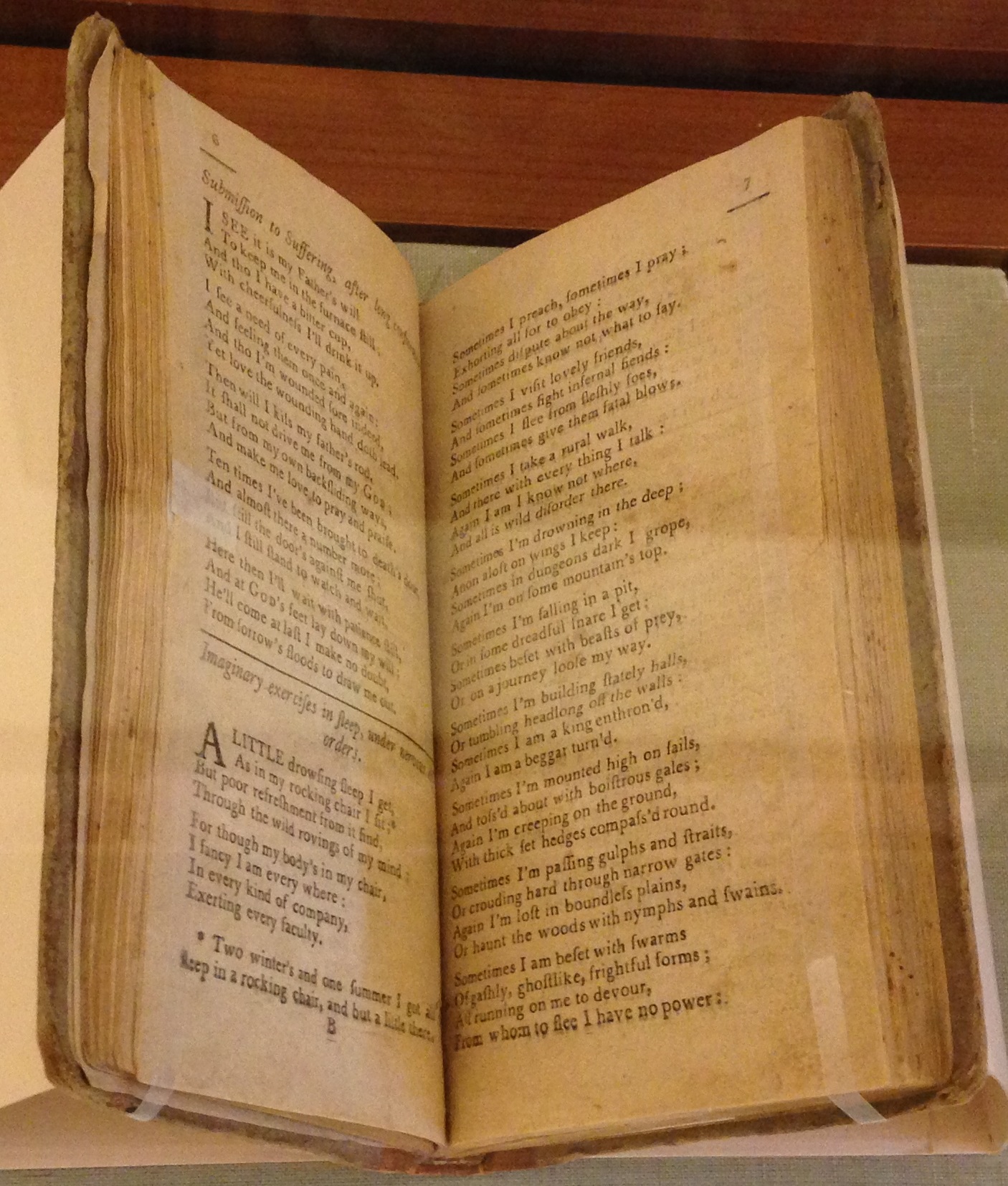
Nervous disorder conveyed in verse, in Miscellaneous reflections. In Verse (Greenfield, Mass.: Thomas Dickman, 1792)  (BD420 .F52 1750 no. 2)

“Nervous disorder” conveyed in verse, in Miscellaneous reflections. In Verse (Greenfield, Mass.: Thomas Dickman, 1792)   (BD420 .F52 1750 no. 2)

Early autobiographical accounts of battles with mental illness are quite rare, and recently we acquired one for the Clifton Waller Barrett Library of American Literature. In 1792, in the small town of Greenfield, Mass., Thomas Dickman printed Miscellaneous reflections. In verse. Mostly written at sundry times, when under long confinement by a complication of nervous disorders. Only three copies are recorded of this 40-page pamphlet, written “by a valetudinary” (whose identity remains unknown) and “printed by request of friends of that class.” Most of the poems are religious in nature, but the initial poems are extraordinary for attempting to convey, in verse, the author’s experience of being in a state of “nervous disorder.”

This Just In: Breaking Bad

No, not that “Breaking Bad”!  In fact, this writer confesses to having never seen the television series. Rather, this post concerns the practice of “breaking,” that is, disbinding a book or manuscript and dispersing the individual leaves, plates, or sections. The breaker believes that, at least in some instances, a book or manuscript is worth more broken up than intact.  Breaking up a book or manuscript may increase its monetary value, enhance its pedagogical utility, result in irreparable harm to the cultural record, or paradoxically, all of the above.  The question is a complex and controversial one, and opinions run the gamut from a willingness to break up anything for any expedient reason to the view expressed in the latest edition of John Carter’s ABC for Book Collectors: “Breaking up books, whether for filthy lucre or from higher motives, is wrong.”

Disjecta membra: disbound, but not dispersed.

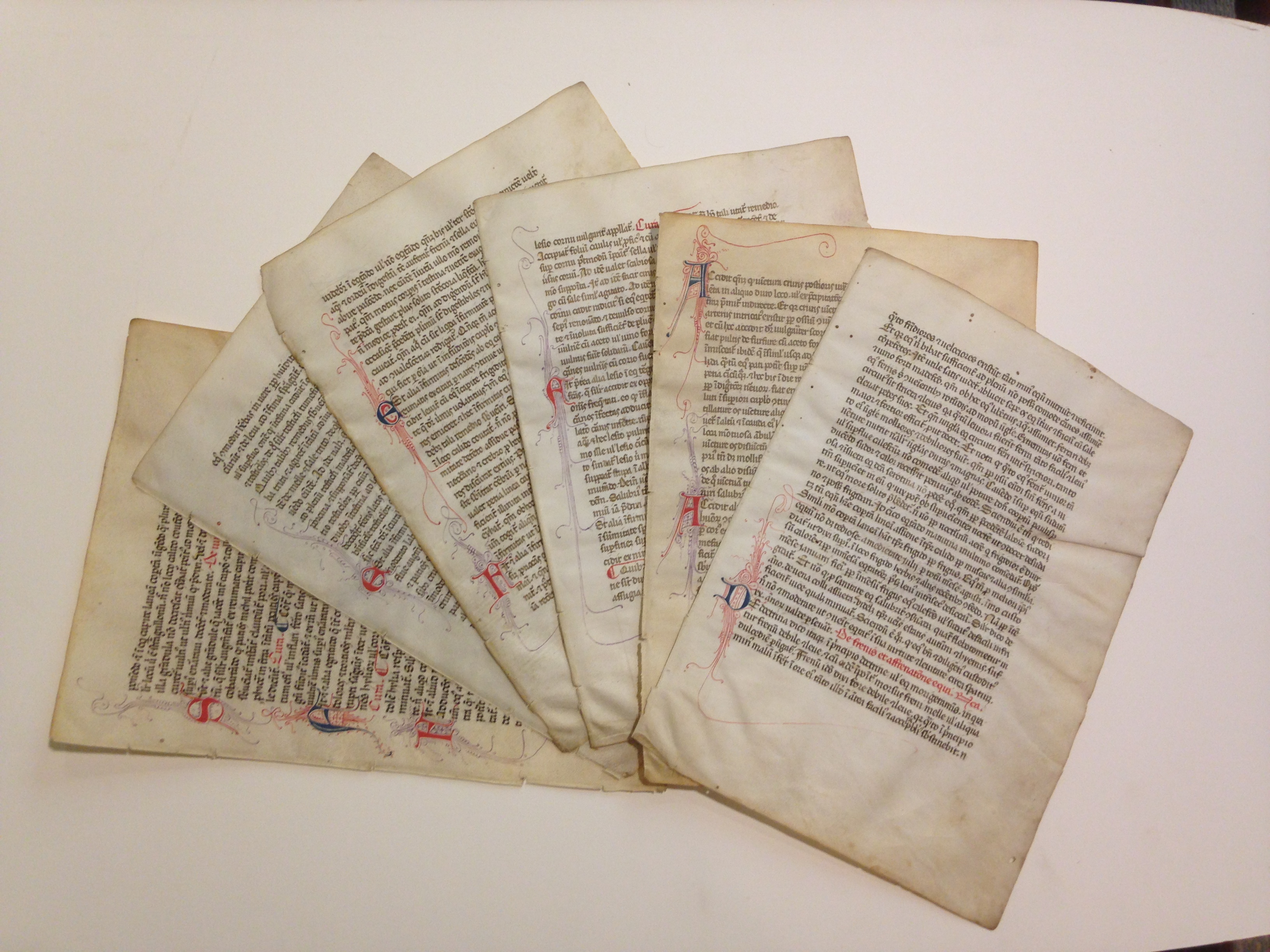
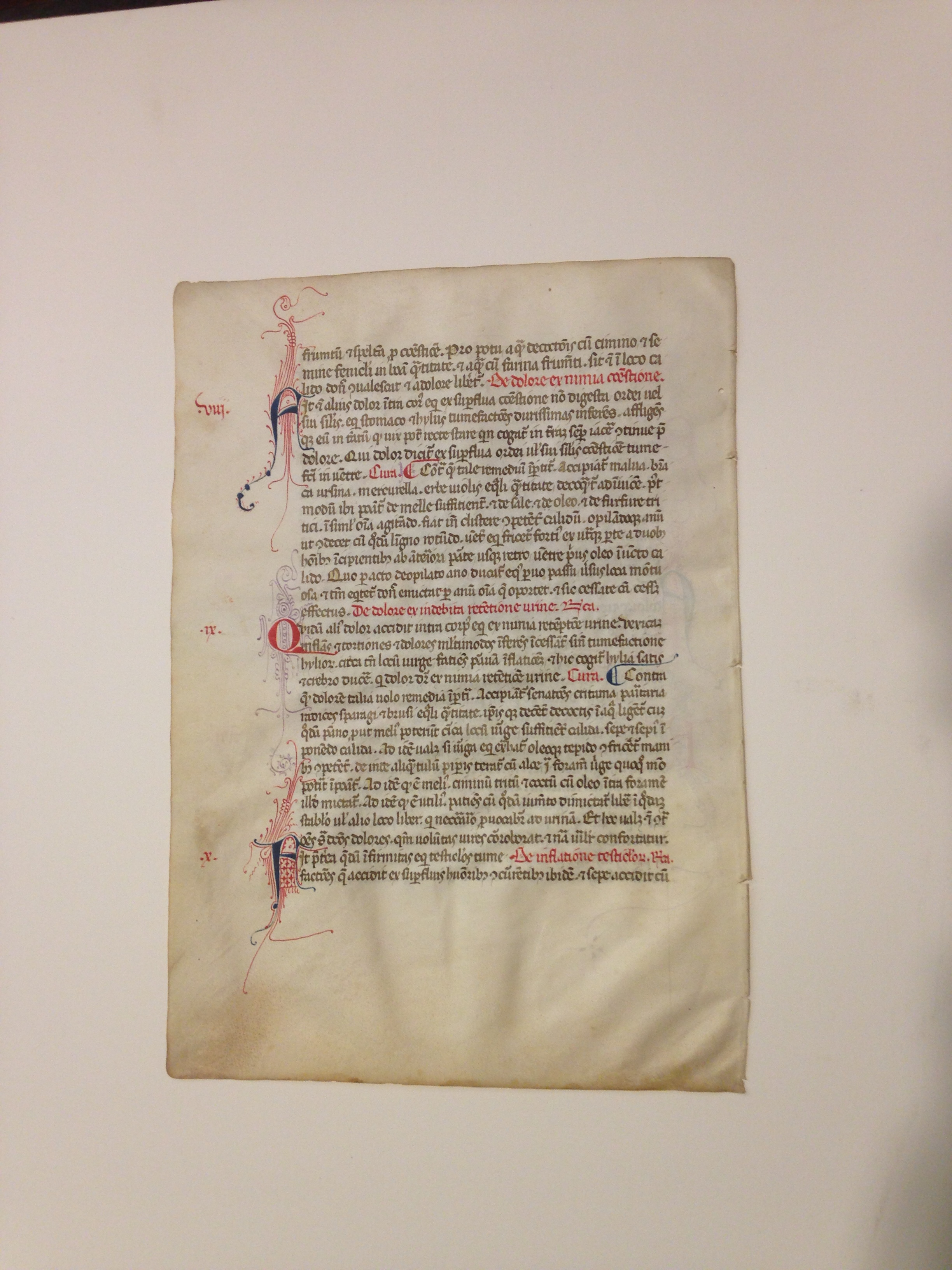
Disjecta membra: disbound, but not dispersed. Six recently acquired leaves from a mid-14th century manuscript of Giordano Ruffo’s De Medicina Equorum.  (MSS 15703)

It has long been, and remains, a frequent practice among book and print dealers to break up color plate books—especially imperfect copies—and sell the plates individually, with the text often discarded. Although this practice has effectively placed John James Audubon’s spectacular double elephant folio Birds of America on the endangered editions list, how else could one hope to possess one of its hand-colored engravings? Some might cast a kinder eye on the bookseller Gabriel Wells, who in 1921 broke up a modestly imperfect copy of the Gutenberg Bible, selling the nearly six hundred leaves individually or in sections, tipped into a specially published “leaf book.” Thanks to Wells, dozens of educational institutions worldwide have been able to acquire Gutenberg leaves for instruction and exhibition (U.Va. owns two at present). And by breaking up dozens of imperfect copies, some significant and valuable, U.Va.’s Rare Book School has created an extraordinary teaching resource for the history of book illustration and typography that has been used by several thousand students to date.

Perhaps nowhere has the practice of breaking been more fraught than in the realm of medieval manuscripts. In the last century alone, hundreds of medieval codices (especially Books of Hours) have been broken up, with the illuminated and more highly decorated leaves sold as works of art, some of the remaining leaves repurposed as specimens in paleography study collections (such as Special Collections’ Rosenthal Medieval Manuscript Collection), and others turned into collectibles or simply discarded.

The manuscript leaves are finely rubricated in red and blue with incipits, paragraph marks, chapter numbers in the outer margin, and fine initial letters with penwork embellishments in red or purple.

The manuscript leaves are finely rubricated in red and blue with incipits, paragraph marks, chapter numbers in the outer margin, and fine initial letters with penwork extensions in red or purple.  (MSS 15703)

Consider Special Collections’ most recent medieval manuscript acquisition: six finely rubricated vellum leaves from a mid-14th century Latin manuscript, written in Italy, of Giordano Ruffo’s De Medicina Equorum, a treatise on the care of horses originally composed in the 13th century. Secular manuscripts on such topics from the medieval period are of great rarity—indeed, a survey conducted fifty years ago located only 21 manuscript copies of Ruffo’s text, all in European libraries—and we jumped at the opportunity to add these leaves to our Marion duPont Scott Sporting Collection.

Here is what we know about their provenance. In December 2011, 21 leaves from an imperfect copy of Ruffo’s manuscript were offered at a Sotheby’s auction in London. The leaves went unsold but were bought privately following the auction. This past fall we learned of the manuscript when an American bookseller’s catalog, in which eight of the leaves were offered, arrived in the mail. We promptly placed an order for all eight leaves, but two had already been sold. The bookseller subsequently reported that he had originally acquired 11 of the 21 leaves, three of which were sold to two different American research libraries, and two to private collectors in the U.S. and Europe, before U.Va. bought the remaining six. Eleven leaves, five new owners on two continents, with ten leaves still unaccounted for. U.Va.’s interest is primarily in the text, given our extensive holdings on the horse and equestrian sports, though the leaves will also be quite useful for research and instruction in the medieval book, paleography, &c. The other institutional and private collectors presumably were more interested in the leaves as paleographical specimens.

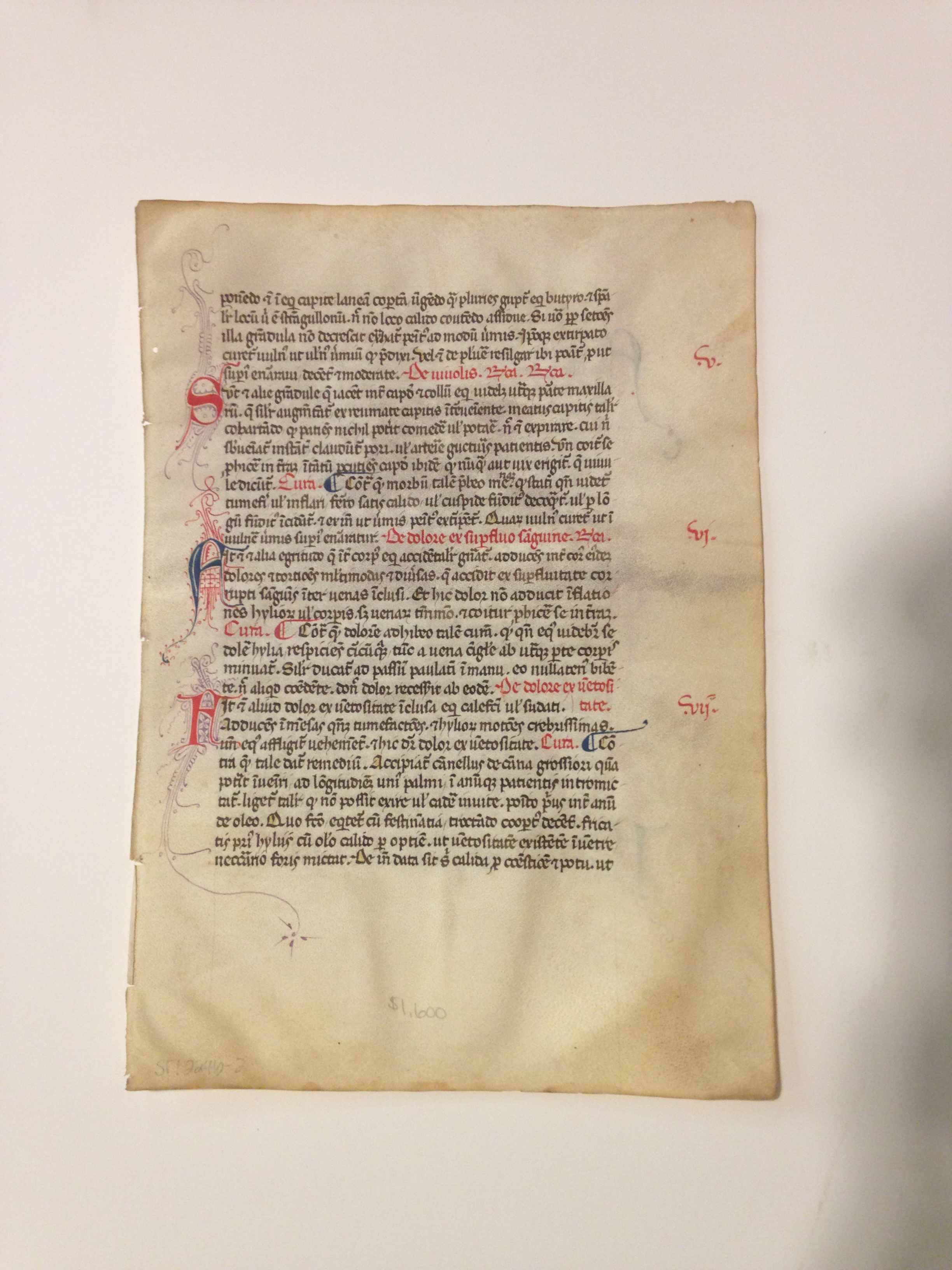
Verso of the manuscript leaf shown above. the chapters concern treatments for certain equine ailments.  (MSS 15703)

Verso of the manuscript leaf shown above. the chapters concern treatments for certain equine ailments. (MSS 15703)

All parties have benefited from these transactions: the booksellers made money, and the five new owners have acquired useful materials for their collections. But what of the manuscript itself? Any attempt to study the text and its relation to other exemplars has been seriously, perhaps fatally, compromised. (Fortunately, the bookseller kindly sent us study images of the five leaves we missed.) This is a chronic dilemma for any researcher using medieval manuscripts as primary sources. Various efforts are under way to reunite dispersed manuscripts virtually—Manuscriptlink (to which U.Va. intends to contribute its six Ruffo leaves), a project based at the University of South Carolina, is but one example. But these initiatives are unlikely to redress more than a small fraction of the losses already sustained, and still to come. And digital images—it bears constant repeating—can never supersede access to the original artifact.

This Just In: Architectural Publications

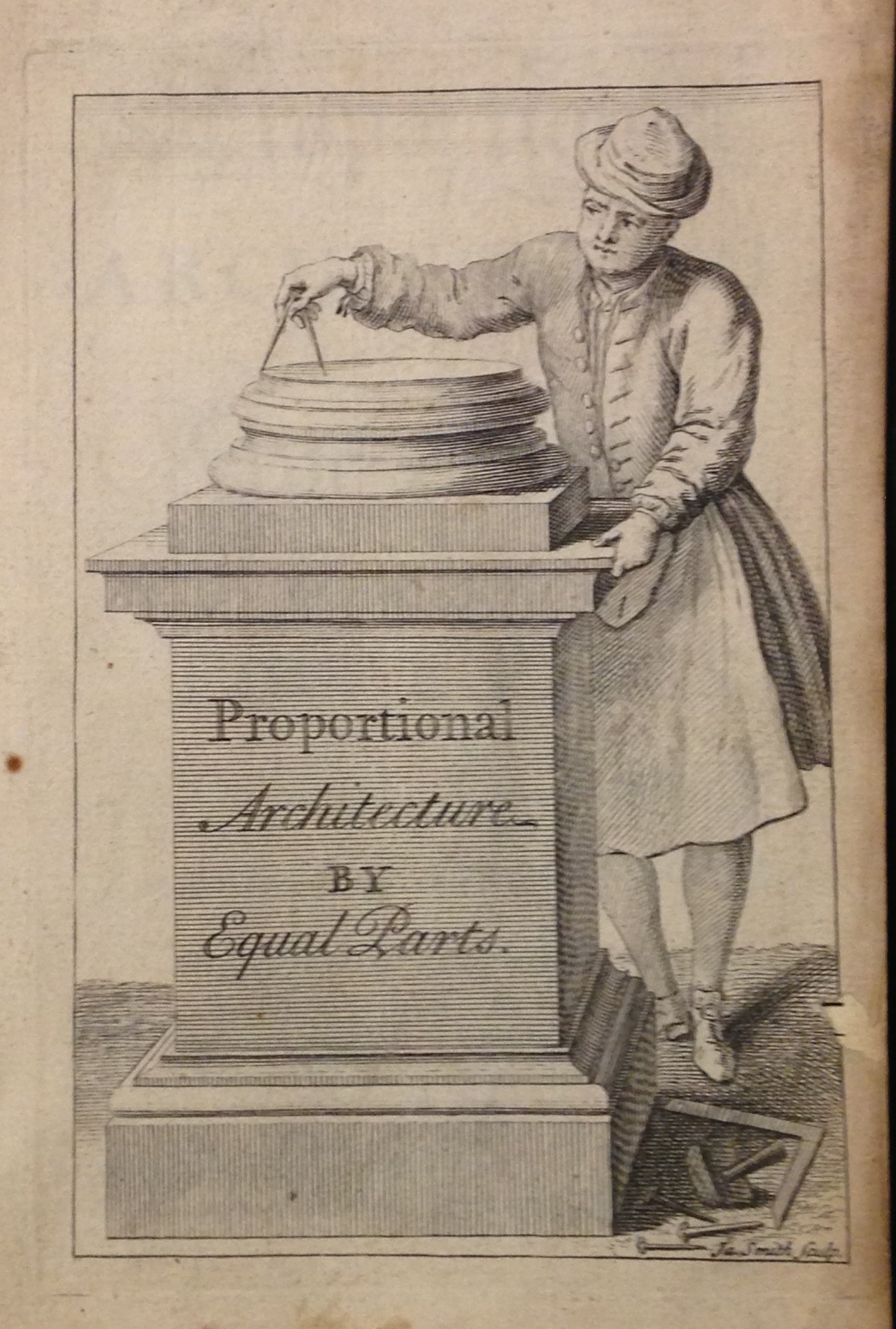
Frontispiece to William Robinson's Proportional Architecture; or, the Five Orders. London, 1736.  (NA2810 .R65 1736)

Frontispiece to William Robinson’s Proportional Architecture; or, the Five Orders. London, 1736. (NA2810 .R65 1736)

U.Va. has long been famous, not only for its Thomas Jefferson-designed Academical Village, but also for its highly ranked academic programs in architecture, architectural history, and landscape architecture. Supporting these programs has been a priority for the U.Va. Libraries, and strong collections are to be found in the Fiske Kimball Fine Arts Library as well as under Grounds in the Albert and Shirley Small Special Collections Library. Following is a sampling of our recent acquisitions in the field of architecture.

Given the thousands of books amassed by Thomas Jefferson for his personal libraries, it has never been practicable for U.Va. to replicate these collections. Since 1956, however, we have endeavored to reconstitute a small subset: the fine arts books that Jefferson selected for the original U.Va. Library collection (only 17 of which survived the 1895 Rotunda fire), plus the architectural titles found in Jefferson’s personal libraries. These total 130 in all, as fully described in William B. O’Neal’s checklist, Jefferson’s Fine Arts Library (Charlottesville: University Press of Virginia, 1976). With substantial support from the Thomas Jefferson Foundation and other sources, the U.Va. Library has managed to acquire copies of no fewer than 112 of the 130 titles— only 18 to go! (For the curious: our desiderata are O’Neal numbers 9, 11, 12, 16, 17, 31, 41, 43a, 50, 61a, 62, 65, 70, 74, 77, 79, 103, and 125b.)

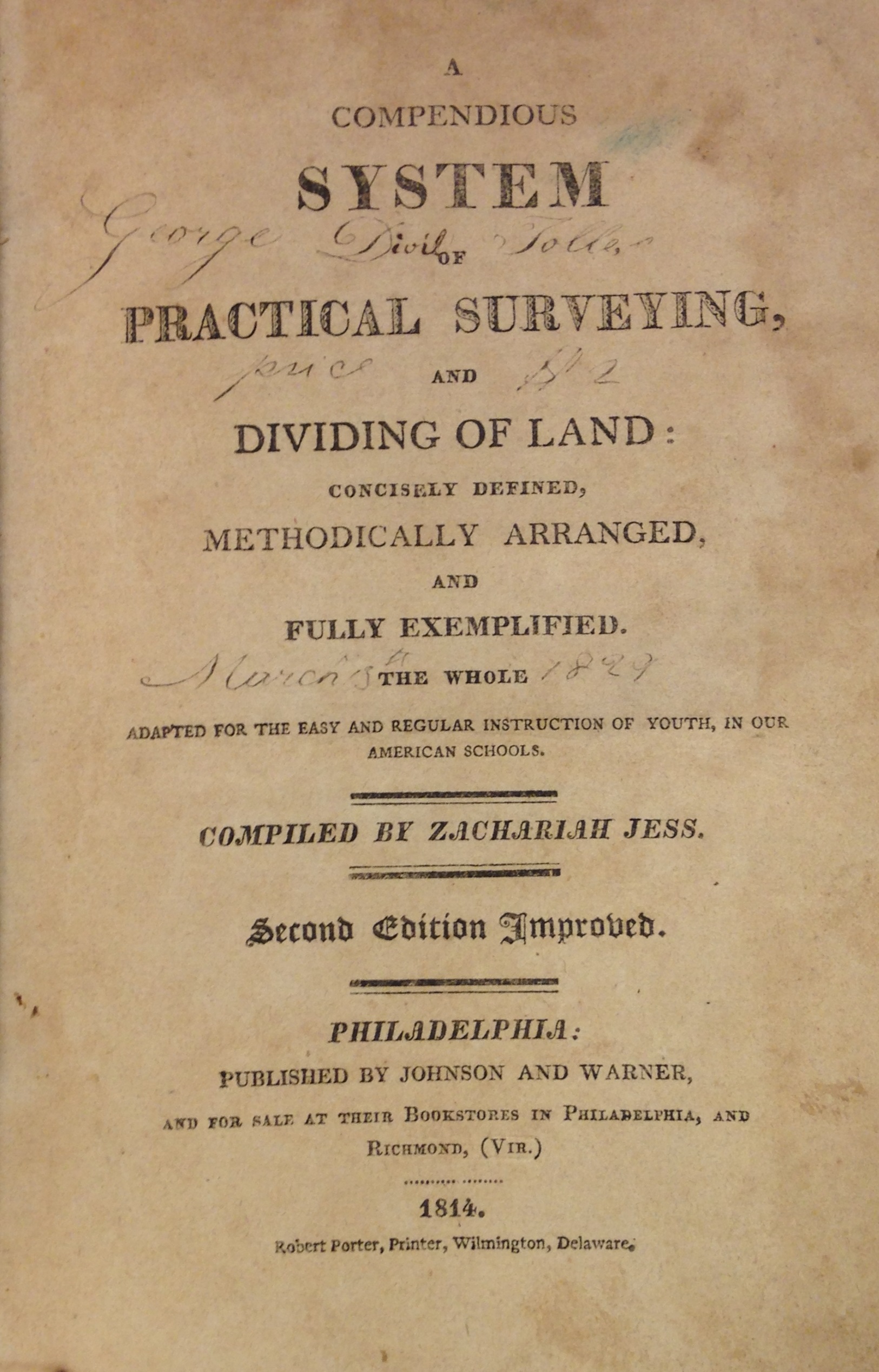
Title page, with 1829 purchase inscription, of Zachariah Jess's Compendious System of Practical Surveying. Philadelphia, 1814.  (TA544 .J59)

Title page, with 1829 purchase inscription, of Zachariah Jess’s Compendious System of Practical Surveying. Philadelphia, 1814. (TA544 .J59)

From time to time we search the Internet for available copies of O’Neal desiderata, and last month we were able to tick no. 57—the Philadelphia, 1814 edition of Zachariah Jess’s A Compendious System of Practical Surveying—off our list.  A copy of this edition was included in Jefferson’s final personal library, formed following the 1815 sale of his earlier library to the United States government. We know this because Jefferson’s remaining books were sold at auction, in Washington, D.C., in late February and early March of 1829; the printed auction catalog lists a copy of Jess as lot 414. An Internet search revealed a nice, reasonably priced copy being offered for sale by, of all places, a Nevada antiques shop. Intriguingly, the book was described as bearing a March 13, 1829 purchase inscription—could this possibly have been Jefferson’s own, untraced copy?! The purchaser, George D. Tolle, had indeed lived near Washington, D.C. in the mid-1820s, but further investigation revealed that he had relocated to Kentucky by 1829. A Jefferson provenance, alas, is unlikely.

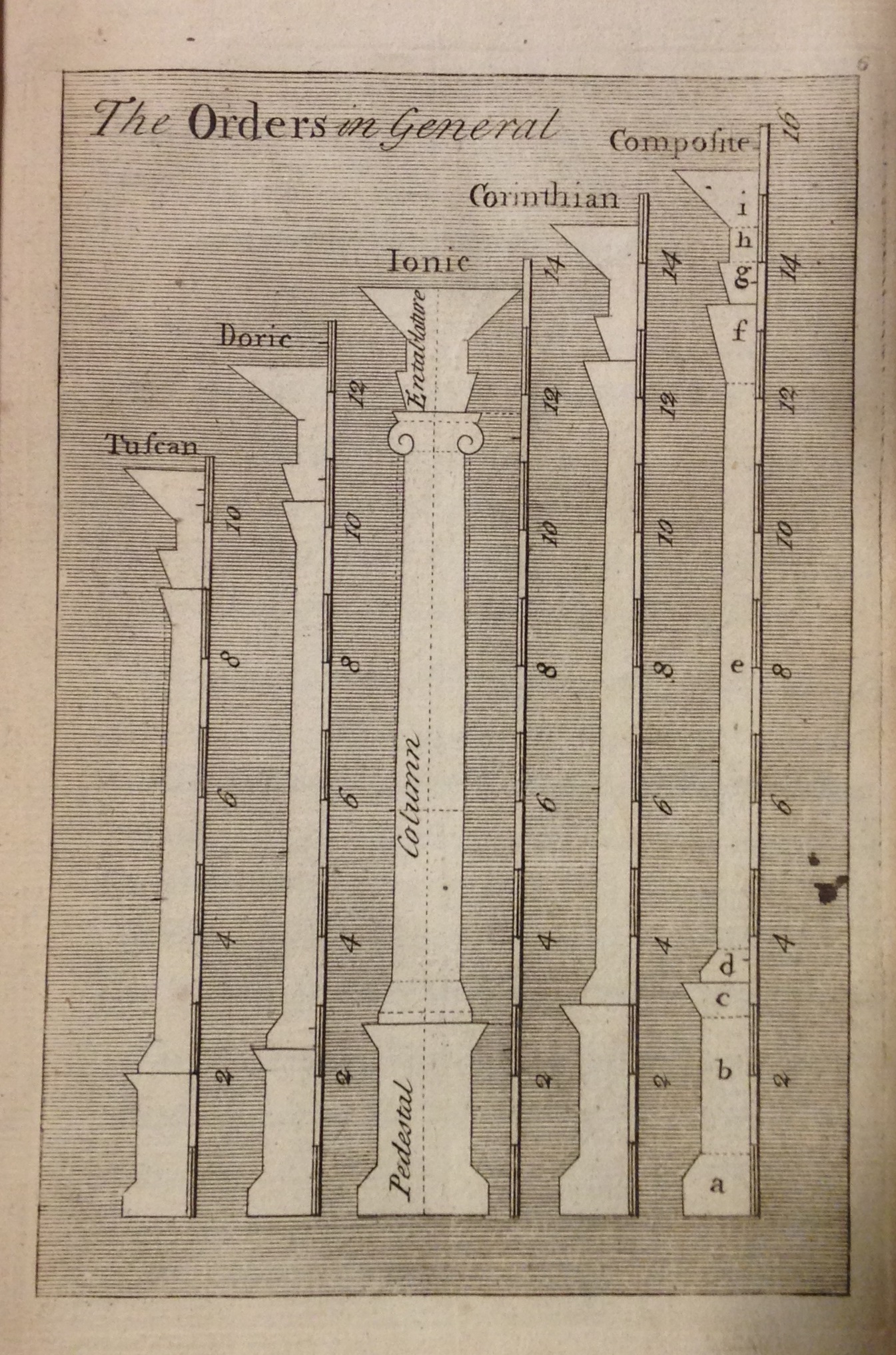
Everything in proper proportion: a plate from William Robinson's Proportional Architecture; or, the Five Orders. London, 1736.  (NA 2810 .R65 1736)

Everything in proper proportion: a plate from William Robinson’s Proportional Architecture; or, the Five Orders. London, 1736. (NA 2810 .R65 1736)

Even if not once owned by Jefferson, 18th-century architectural pattern books and manuals are of special interest to us. In an age when most structures were designed, not by architects per se, but by master builders and skilled amateurs (such as Jefferson), the books they drew upon for inspiration remain useful primary sources. William Robinson’s Proportional Architecture; or, The Five Orders; Regulated by Equal Parts, containing 32 leaves of engraved text and diagrams, was first issued in 1733. We recently acquired a fine copy of the second, pocket-size, edition of 1736, to which was added a 15-page letterpress glossary of architectural terms used in the work. With this book as a reference, a builder would know how to size architectural details in any of the five architectural orders. Robinson’s work remained sufficiently popular to merit a reissue in 1759.

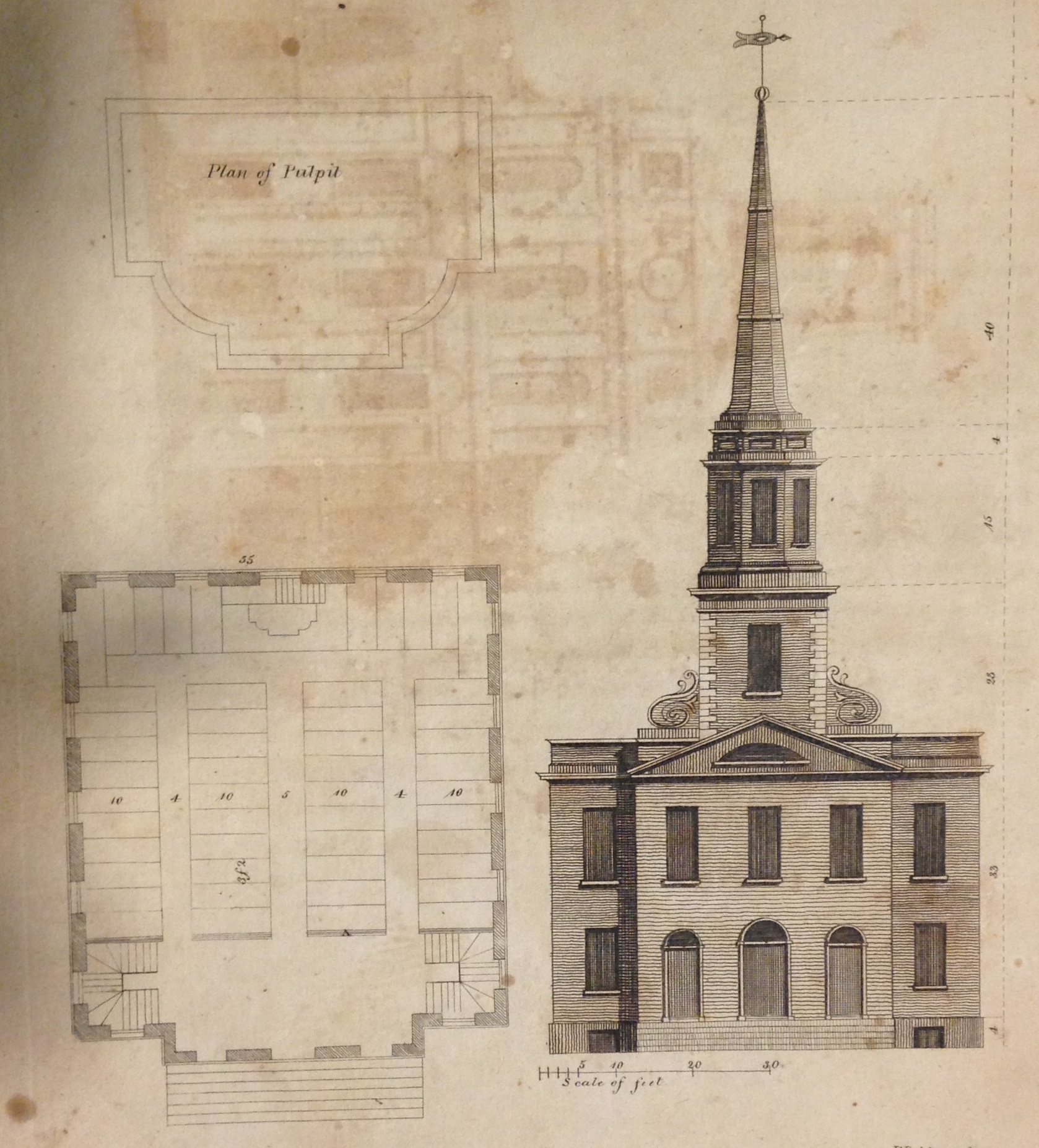
Plan and elevation for a "meetinghouse" by Asher Benjamin.

Plan and elevation for a “meetinghouse” by Asher Benjamin.

Greenfield, Mass., architect Asher Benjamin published the first original American architectural pattern book in 1797. The first edition of his profoundly influential (and very rare) Country Builder’s Assistant still eludes us, but recently we were able to acquire a copy of the 1798 second, expanded edition published in Boston. Benjamin’s work offered in its 37 engraved plates far more detail than in Robinson’s earlier handbook, and it was rapidly embraced by local builders. Indeed, many early 19th-century private homes and public buildings either designed by Benjamin or clearly based on his pattern book can still be found throughout New England. Benjamin soon relocated to Boston, where he published several other pattern books.

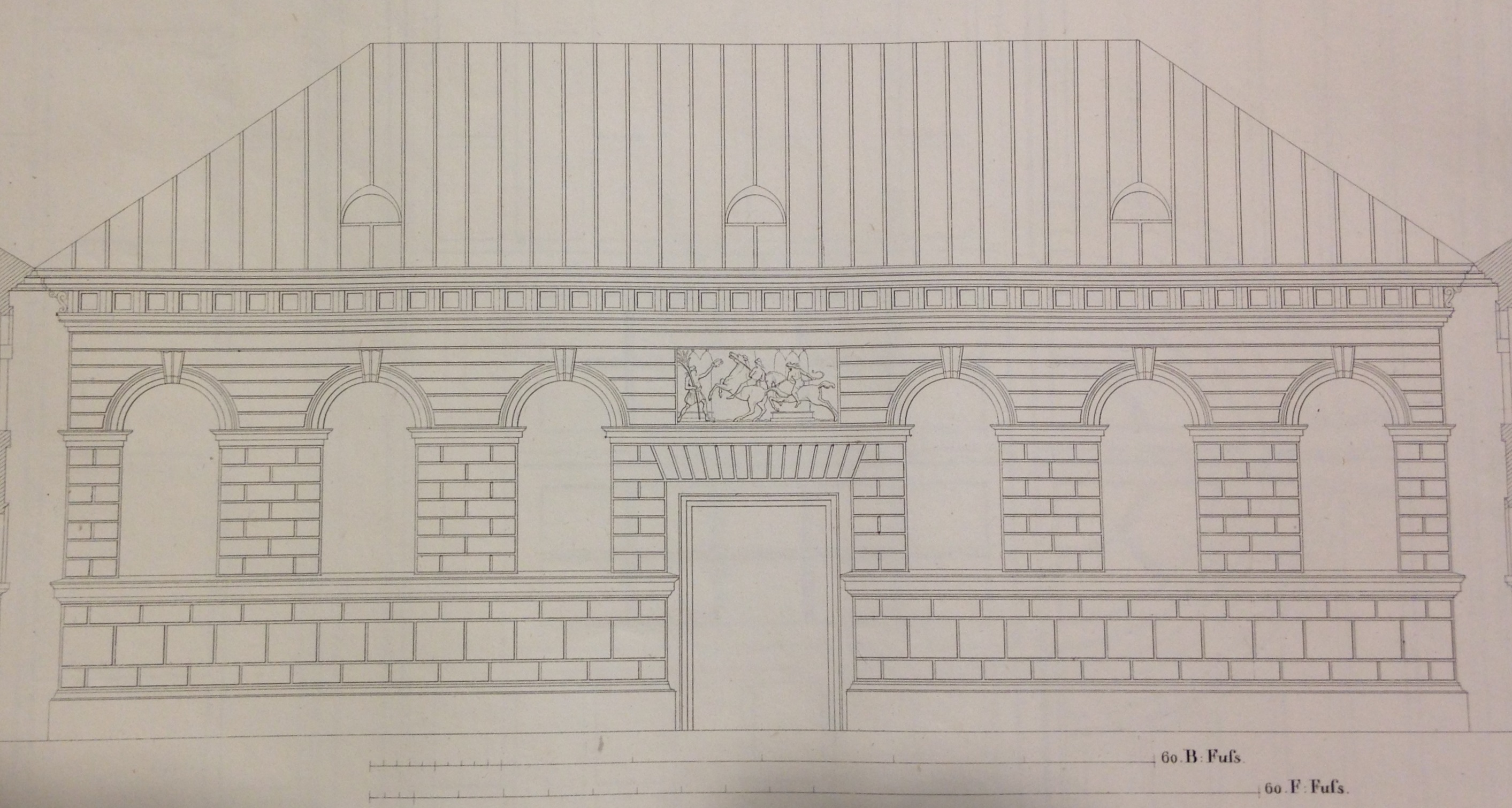
Facade of the riding academy designed by Jean Baptiste Metivier, from Grund-Plane, Durchschnitte und Facaden nebt Details der Reitbahm und Stallungen. Munich, 1836.  (NA8340 .M48 1836)

Facade of the riding academy designed by Jean Baptiste Metivier, from Grund-Plane, Durchschnitte und Facaden nebt Details der Reitbahm und Stallungen. Munich, 1836. (NA8340 .M48 1836)

One may not think to consult our Marion duPont Scott Sporting Collection for architectural publications, but in fact it includes a small but significant holding of early works relating to the design and construction of equestrian facilities. The most recent (and now the earliest such publication) to be added is the only recorded copy of Jean Baptiste Metivier’s Grund-Plane, Durchschnitte und Facaden nebst Details der Reitbahm und Stallungen (Munich, 1836). Born in Rennes and trained as an architect in Paris, Metivier (1781-1853) spent most of his career in Munich, where several of his buildings may still be seen. This, his third and final publication, is a portfolio of 14 large lithographic plates depicting plans, elevations, and architectural details for the riding school and stable buildings commissioned by the Princely House of Thurn and Taxis.

Architectural detail from Metivier, Grund-Plane ... Munich, 1836.  (NA8340 .M48 1836)

Architectural detail from Metivier, Grund-Plane … Munich, 1836. (NA8340 .M48 1836)

This Just In: Rotunda Redivivus

Right now U.Va.’s iconic Rotunda—the centerpiece of Thomas Jefferson’s “Academical Village” and the U.Va. Library’s original home—is undergoing a multi-year, $50 million restoration. These have been interesting times for sidewalk supervisors and armchair architects as the restoration work reveals hitherto unknown details about the Rotunda’s design and construction.  It has also been an interesting time Under Grounds, for we have fortuitously acquired two early images of the Rotunda previously lacking from our collection.  Although these images do not advance our understanding of the Rotunda’s architecture, they do enhance our knowledge of its early iconography.

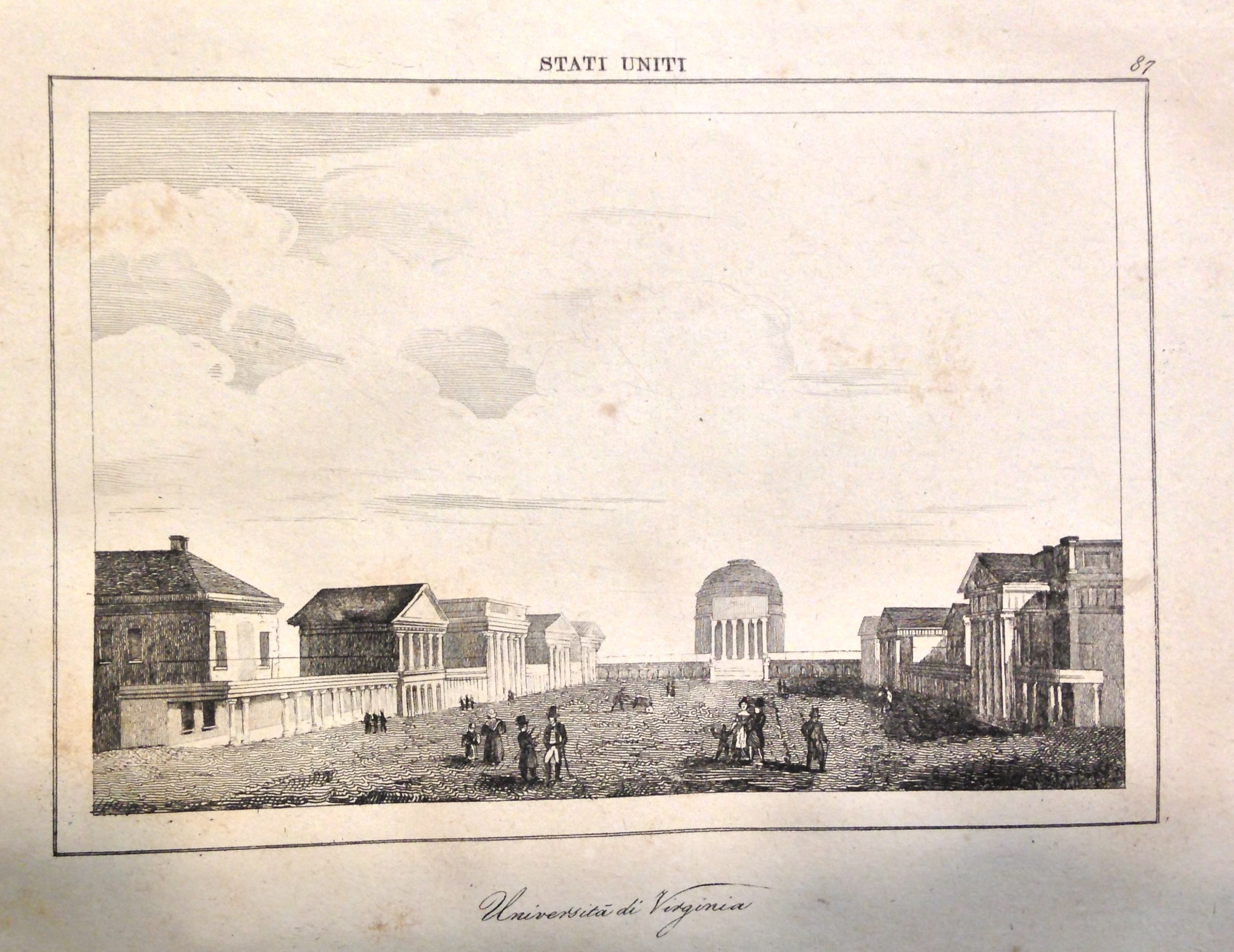
The Lawn, as it appeared in Roux de Rochelle, Stati Uniti d'America (Venice, 1839)   (E178 .R8216 1839).

The Academical Village, as it appeared in Roux de Rochelle, Stati Uniti d’America (Venice, 1839) (E178 .R8216 1839).

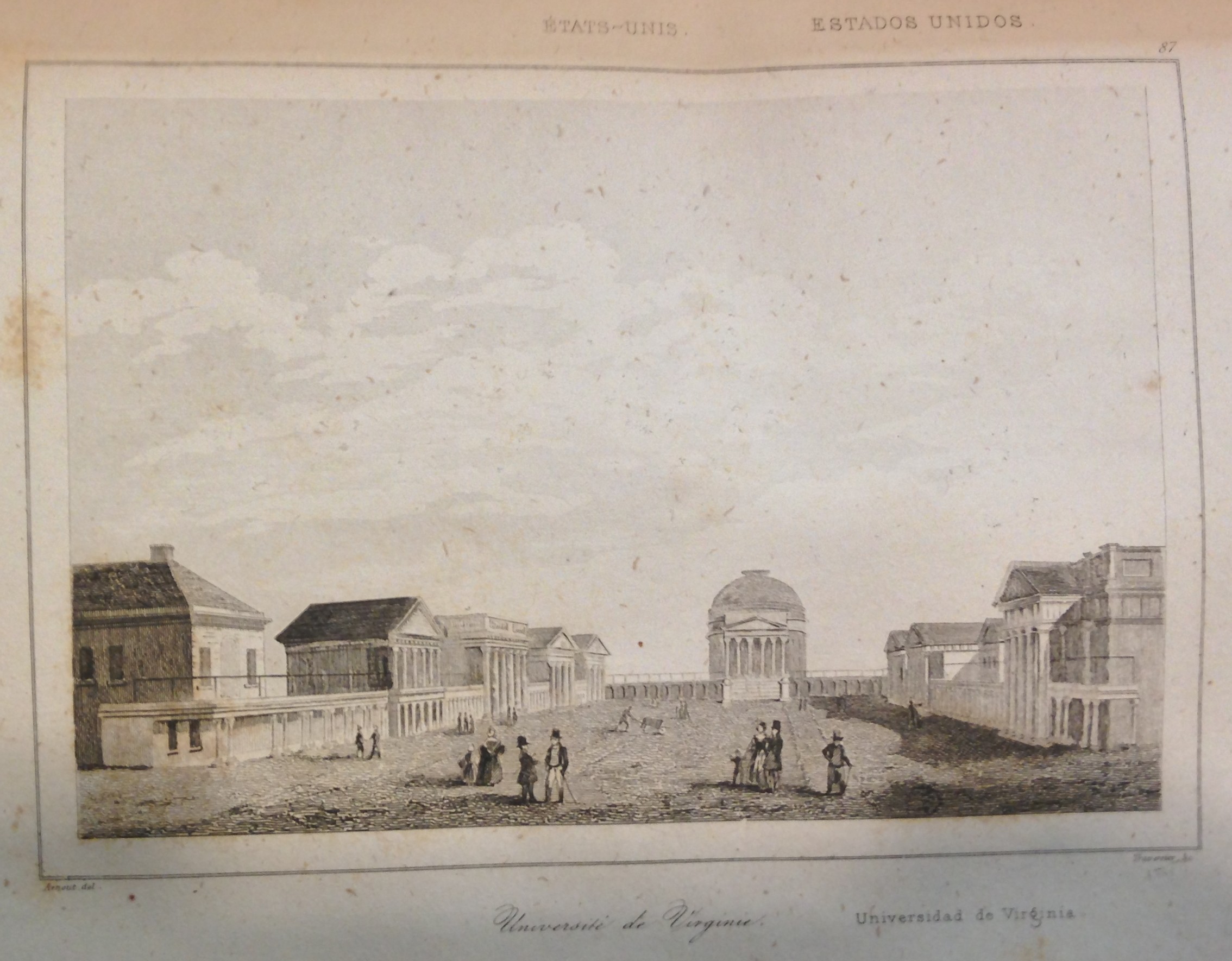
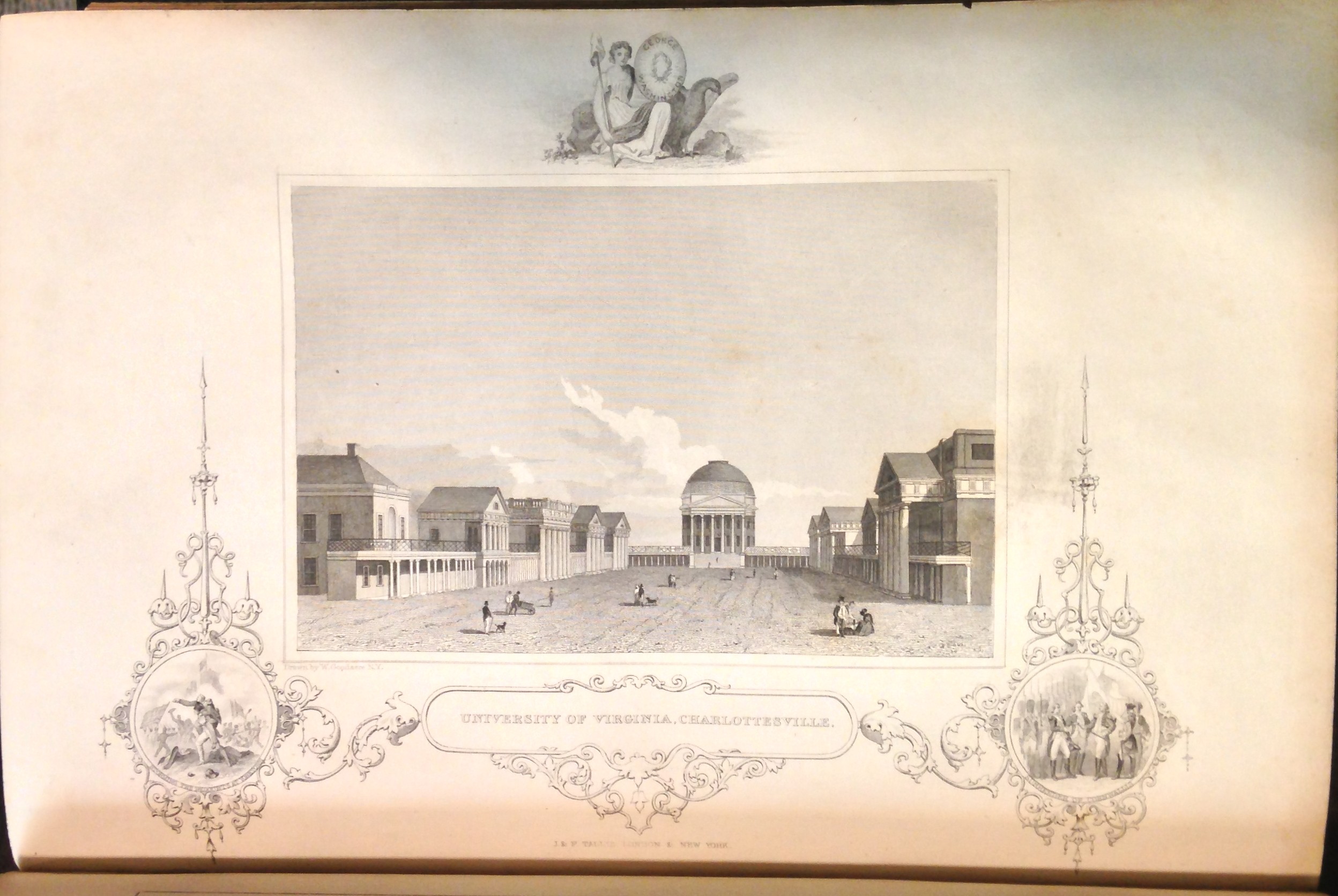
The two newly acquired images are engraved plates in the Italian (Venice, 1839) and Spanish (Barcelona, 1841) translations of Jean Baptiste Gaspard Roux de Rochelle’s États-Unis d’Amérique. This history and description of the United States, first issued in 1837 as part of the series, L’univers, histoire et description de tous les peuples, proved popular and was reprinted several times. Perhaps its major selling point was the 96 engraved plates depicting historical personages and events, as well as numerous contemporary American views. Plate 87 is of special interest, as it depicts U.Va.’s Academical Village as it looked in the mid-1820s, after the Rotunda, faculty pavilions, and student rooms had been completed.

U.Va. has long held copies of the Paris, 1837 and 1838 editions, and the Stuttgart, 1838 German translation.  That we lacked the Italian and Spanish translations was brought to our attention this fall, when a collector offered to donate copies: “I should tell you that I’ve removed the U.Va. plates, but perhaps you could use the books anyway?”  We politely declined the gift, choosing instead to purchase complete copies on the antiquarian market.  To our knowledge, only the Mexico [City], 1841 Spanish edition still eludes our dragnet.

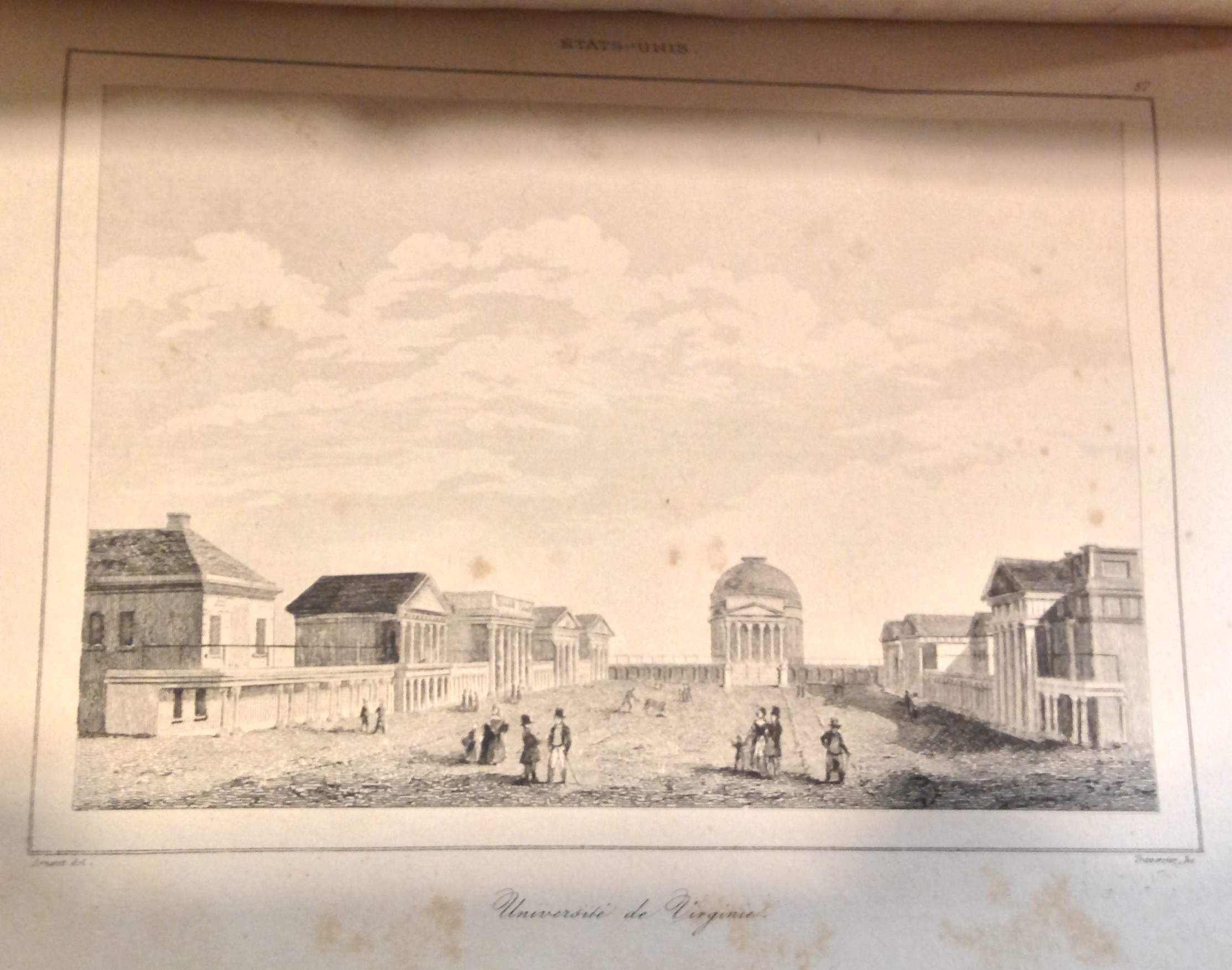
The Academical Village as it appeared in Roux de Rochelle, États-Unis de’Amérique (Paris, 1837) (E178 .R82 1837)

The Academical Village as it appeared in Roux de Rochelle, États-Unis de’Amérique (Paris, 1837) (E178 .R82 1837)

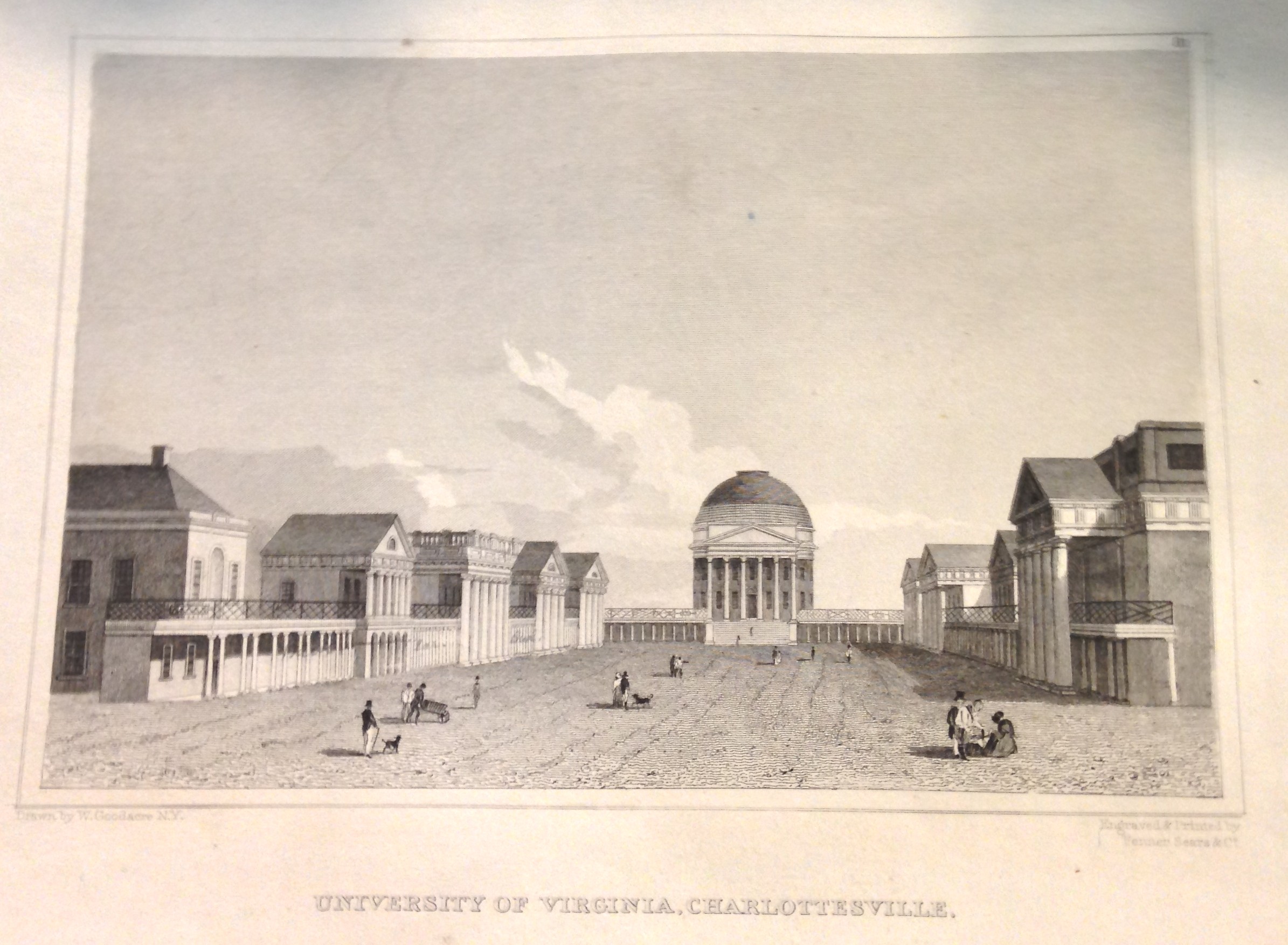
Although the text mentions U.Va. only in passing, it was through the engraving in Roux de Rochelle’s work that many Europeans first learned of U.Va. and its distinctive architecture. What few readers probably realized is that Roux de Rochelle’s knowledge of U.Va. was by no means first-hand. Born in 1762, Roux de Rochelle had served as French consul in New York during the early 1820s, returning as French Minister to the U.S. from 1830 to 1833. Perhaps it was then that he saw a copy of John Howard Hinton’s two-volume History and topography of the United States, published in London, New York, and Philadelphia from 1830-1832. Roux de Rochelle evidently decided to write a similar work for a French audience, and though the text is quite different, its many engraved plates are largely copies of those prepared for Hinton’s work. Indeed, Hinton’s plate 81 is an identical view of U.Va.’s Academical Village.

Plate 81 from John Howard Hinton, The history and topography of the United States (London & New York, 1830-1832) (E178 .H691 1830)

Plate 81 from John Howard Hinton, The history and topography of the United States (London & New York, 1830-1832) (E178 .H691 1830)

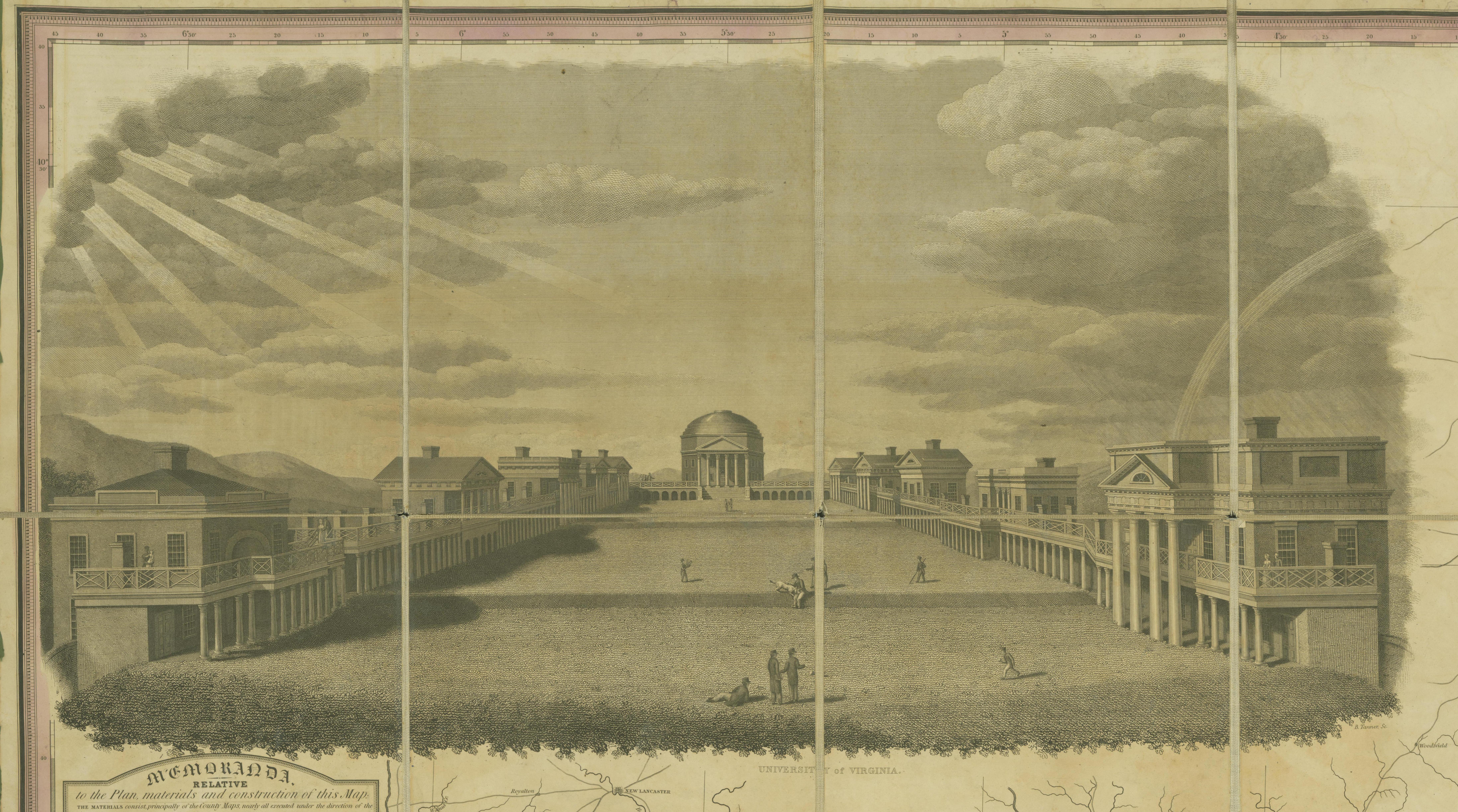
But even Hinton’s plate is derivative, for its immediate source was the highly detailed view of U.Va., engraved by Benjamin Tanner, that appears on the top left sheet of Herman Böÿe’s famous 1826 wall map of Virginia. For Hinton’s work, Tanner’s engraving was copied in New York by landscape artist William Goodacre, whose drawing was sent to London to be engraved on steel by artists in the employ of Fenner Sears & Co. The Hinton engraving is smaller in size and less detailed than Tanner’s view, though some effort was made to render the architectural elements relatively faithfully.

Benjamin Tanner's 1826 engraved view of the newly opened University of Virginia.

Benjamin Tanner’s 1826 engraved view of the newly opened University of Virginia.

In preparing Roux de Rochelle’s work for the press, the Paris publisher commissioned 96 full-page engraved reproductions of existing artworks. Some of the sources are credited in the text, though the liberal copying of plates from Hinton’s work goes unmentioned. In the Roux de Rochelle plate—signed by “Arnoult” as designer [sic] and “Traversier” as engraver—the Hinton view is reduced still further in size and the architectural details muddied somewhat. One wonders whether the book’s European readers could derive from this view an informed appreciation of Jefferson’s architectural vision.

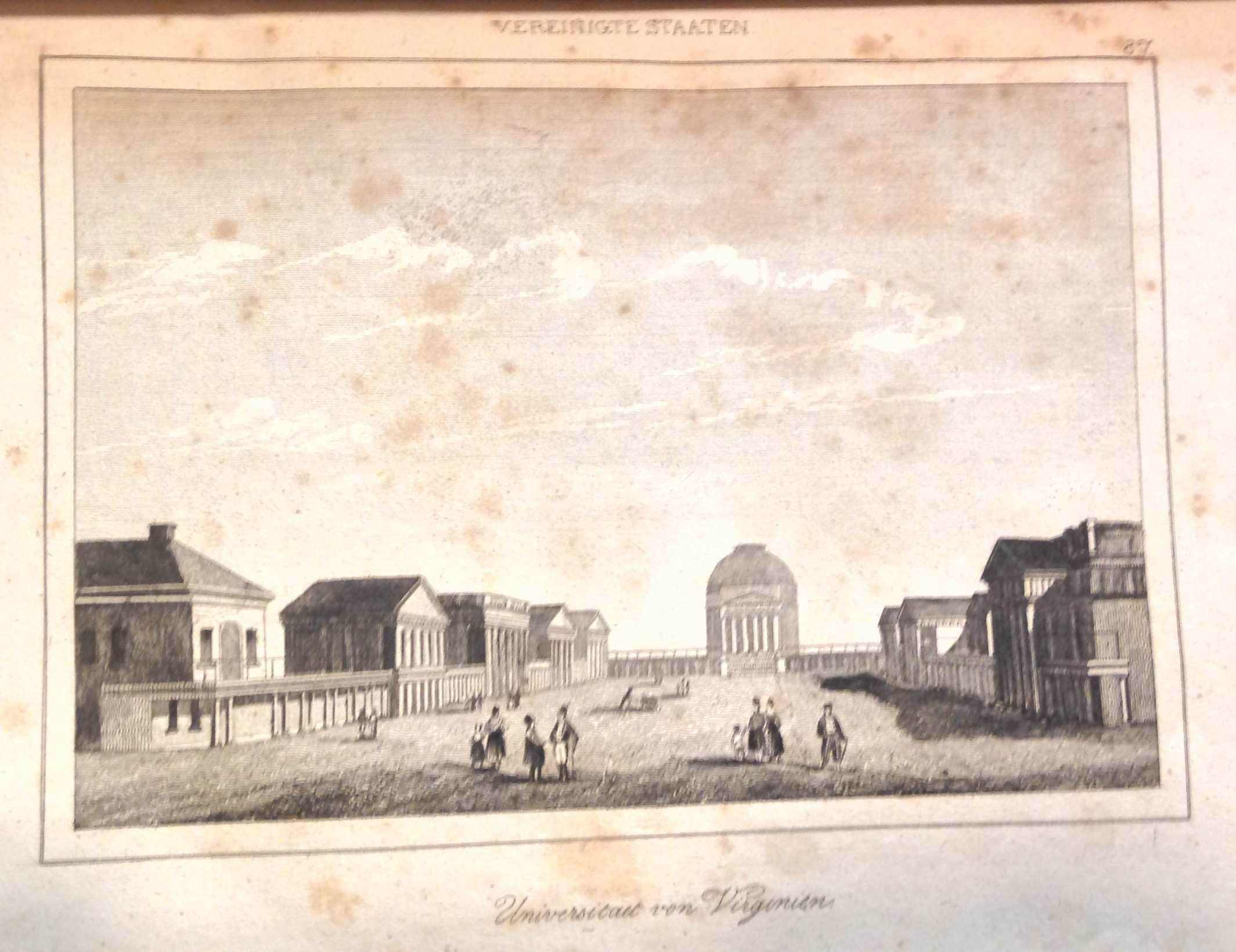
The Academical Village reinterpreted for the German translation of Roux de Rochelle: Vereinigte Staaten von Nord-Amerika (Stuttgart, 1838)  (G115 .W4 1838)

The Academical Village reinterpreted for the German translation of Roux de Rochelle: Vereinigte Staaten von Nord-Amerika (Stuttgart, 1838) (G115 .W4 1838)

A year after Roux de Rochelle’s work first appeared in Paris, a German translation was published in Stuttgart. The Stuttgart publisher did not have access to the engraved plates used for the Paris edition—indeed, per the custom of these pre-copyright days, he likely did not bother to obtain permission to translate and republish the work—so it was necessary to commission German artists to re-engrave the 96 plates. The U.Va. view is a very close copy, albeit a less careful rendering; and while the engraver dutifully reproduced the buildings, he took a bit of artistic license with the human figures on the Lawn.

The following year, the Venice publisher of the Italian translation faced an identical problem and solved it in the same way, by commissioning copies of the 96 plates. And once again, various architectural details have been lost or distorted when re-engraved, and minor liberties taken with the human figures.

The French plate reused, with added captions in Spanish, in Roux de Rochelle, Historia de los Estados-Unidos de América (Barcelona, 1841)  (E178 .R8218 1841)

The French plate reused, with added captions in Spanish, in Roux de Rochelle, Historia de los Estados-Unidos de América (Barcelona, 1841) (E178 .R8218 1841)

Not so with the Spanish translation published in Barcelona in 1841, however. Here the publisher evidently sought and obtained permission to illustrate the edition with the Paris engravings, to which an additional caption in Spanish has been added. (Presumably the Mexico City edition is a reissue of the Barcelona printing and also contains the Paris engravings, but perhaps not.)

The Hinton plate reappeared in the 4th edition (London & New york, 1850?) with an added decorative border (E178 .H691 1850)

The Hinton plate reappeared in the 4th edition of The history and topography of the United States of America (London & New York, 1850?) with an added decorative border (E178 .H691 1850)

And what, finally, of the Hinton plate? Although absent from the second edition of Hinton’s work (Boston, 1846), it reappears in the third and fourth editions (London and New York, 1849 and [1850?]), but with a new caption and an added decorative border.

This Just In: The UPI Wire, November 22, 1963

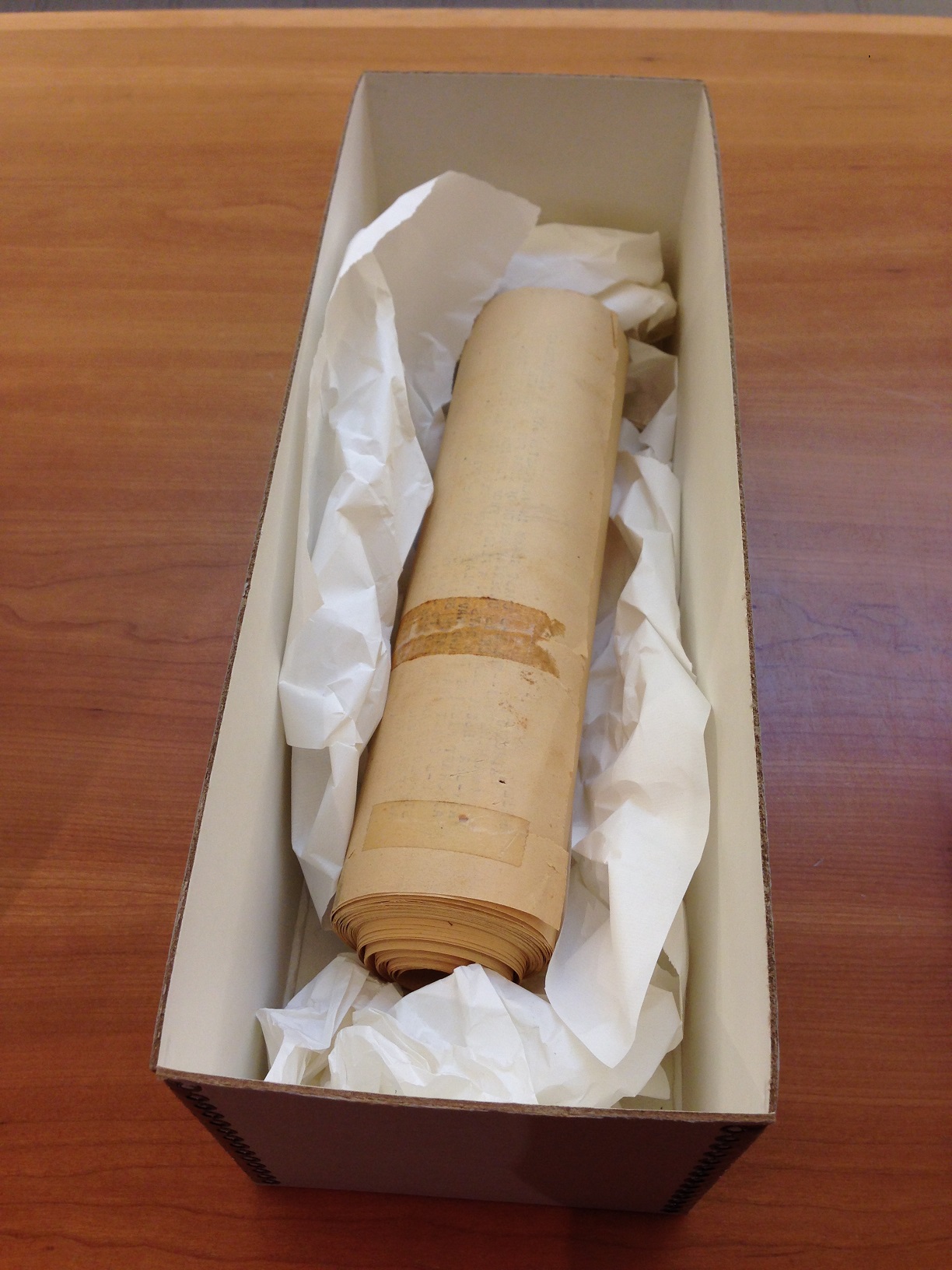
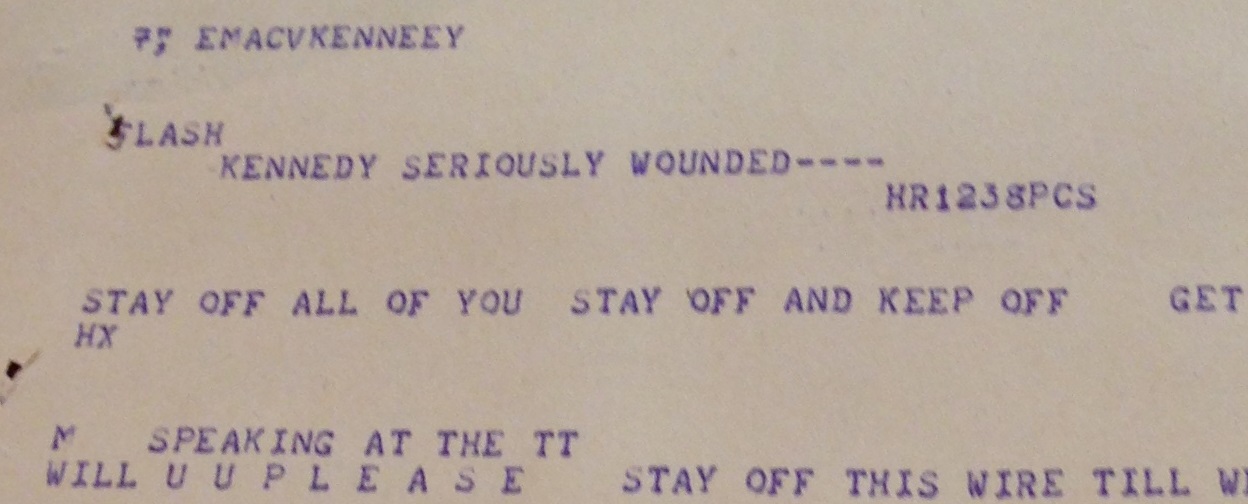
The teletype printout of the UPI broadcast wire from Jacksonville, Florida, from just before the first report of Kennedy's shooting to the end of the day. (MSS 15678, Gift of Randolph Pendleton. Photo by Molly Schwartzburg)

The teletype printout of the UPI broadcast wire from Jacksonville, Florida, from just before the first report of Kennedy’s shooting to the end of the day. (MSS 15678, Gift of Randolph Pendleton. Photo by Molly Schwartzburg)

Special Collections recently received an unusual–and remarkable–gift: a roll of paper, over forty feet long, which plunges its reader into the hours following John F. Kennedy’s assassination. It is a teletype machine printout of wire reports received by the United Press International bureau in Jacksonville, Florida, following the shooting, from which local radio stations–and others across the nation–communicated the news to rapt regional audiences.

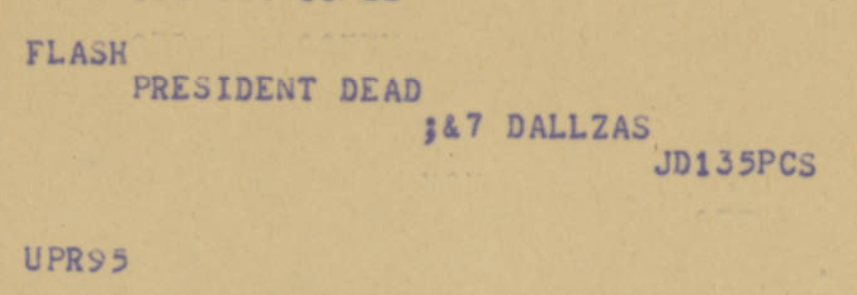
This section of the scroll reveals the moment at which radio-station employees learned that Kennedy had not survived. (Image by U.Va. Library Digitization Services)

This section of the scroll reveals the moment at which radio-station employees learned that Kennedy had not survived. (Image by U.Va. Library Digitization Services)

The printout was rescued for posterity on November 22, 1963, by UPI’s Jacksonville bureau manager Randolph Pendleton, who now lives in Charlottesville. Mr. Pendleton has kept the printout all these years. With the anniversary drawing near, he decided to donate it to Special Collections so it could be seen by all who are interested. We were thrilled to oblige. The library’s Digital Curation Services division rushed to produce a high-resolution digital facsimile of the entire scroll, which is now available to read in full. This Friday, on the fiftieth anniversary of the assassination, you can follow the broadcasts in real time on twitter at @uvadigserv.

Mr. Pendleton contributed a summary of the broadcast’s transmission:

“The broadcast wire, designated 7551 and usually referred to as the radio wire, went to hundreds of radio and television stations across the United States. It was rewritten in broadcast style from the A-wire, which was the main newspaper wire, and thus ran a few seconds behind. It was filed by the Chicago bureau, (call letters HX) and was split for twenty minutes every hour on the half-hour so that local bureaus could file state and local copy. Because this was a teletype in Florida, it was running Florida stories filed by the Miami bureau (call letters MH) when Chicago broke in to reclaim the wire and file the flash, a rarely used priority that is accompanied by ten bells. The Chicago bureau then sought to keep the wire clear by warning bureaus to stay off. This flash was the first word of the shooting that broadcast stations across the country received.

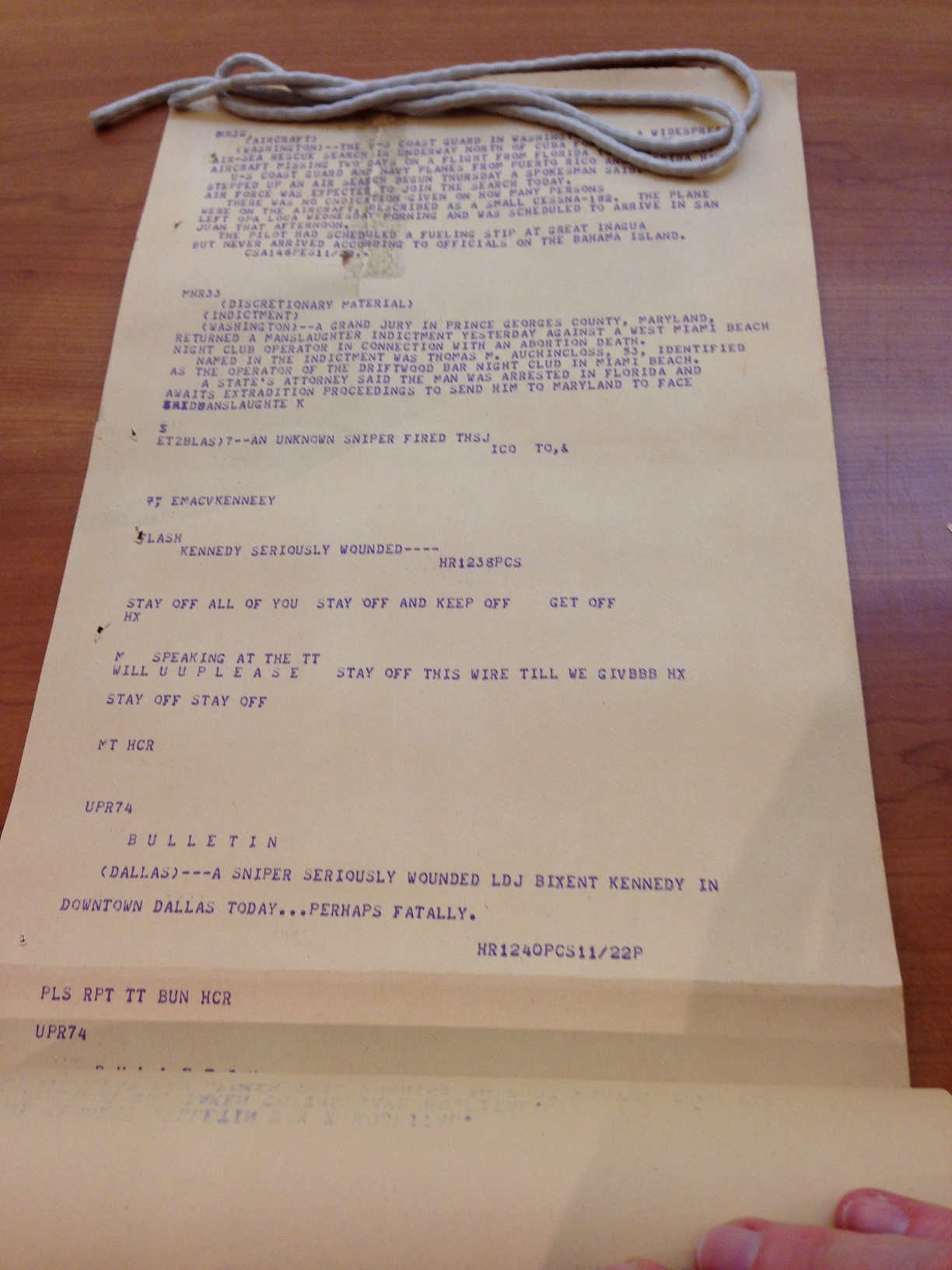
The first news of the shooting appeared in typo-ridden flashes. (Image by Molly Schwartzburg)

The first news of the shooting appeared in  flashes, whose text was sometimes garbled due to the efforts of multiple bureaus to file at once. (Image by Molly Schwartzburg)

Repeated requests from the Chicago bureau for clear lines, in the first minutes of the news breaking. (Image by U.Va. Library Digitization Services)

Repeated requests from the Chicago bureau for clear lines, in the first moments of the news breaking. (Image by Molly Schwartzburg)

“The reporting came from Merriman Smith, the UPI White House reporter and dean of the White House press corps, who was in the front seat of the wire service pool car, riding six cars behind the president’s convertible. He grabbed the car’s phone when he heard three shots and began dictating to the Dallas bureau, fending off attempts by Associated Press reporter Jack Bell to get the phone away from him. On arrival at Parkland Hospital, Smith (who won the Pulitzer Prize for his coverage) was able to grab a Secret Service agent and get confirmation that Kennedy was seriously wounded and then find another phone amid the chaos in the hospital to call in the flash. The bulletin filed from the pool car had said only that three shots had been fired at the motorcade. This ran on the A-wire but came through garbled on the first broadcast wire because Chicago had trouble getting some of the state bureaus to stop filing. The first bulletin after the flash was also garbled and the Los Angeles bureau, (call letters HC) asked for a repeat.

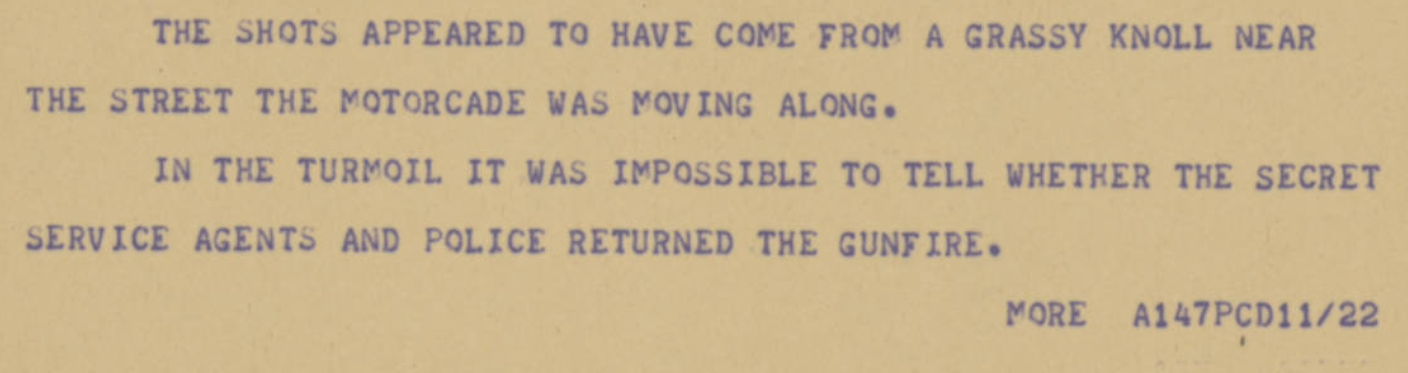
“After that, the story unfolded quickly and within minutes there was a reference to the famous ‘grassy knoll.'”

The first mention of the phrase "grassy knoll." Time stamps at the end of each posting are Central Standard, because the wire was being filed from Chicago.

The broadcast wire’s first use of the phrase “grassy knoll.” Time stamps at the end of each posting are Central Standard, because the wire was being filed from Chicago. (Image by U.Va. Digitization Services)

Thanks to Mr. Pendleton for his generous donation and summary. And thanks also to Digitial Curation Services for the magnificent digital facsimile, which will allow many readers to experience this unique artifact.

We encourage readers to share their memories–particularly if they heard the news on the radio. For more background on the Chicago bureau’s role in the day’s events, see this recent article in the Chicago Sun Times.


This Just In: New McGregor Library Acquisitions

The opening last week of Collecting American Histories: the Tracy W. McGregor Library at 75—the major new exhibition of highlights from our world renowned McGregor Library of American History—prompts us to describe a few of the many acquisitions made for the McGregor Library in recent months.

M8

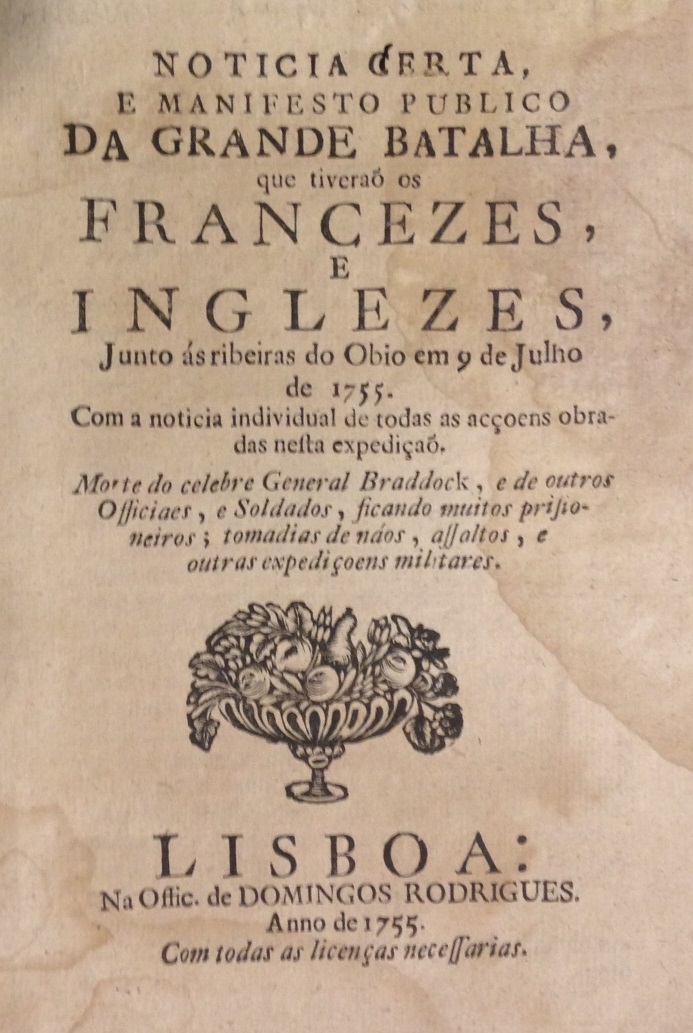
Noticia certa, e manifesto publico da grande batalha, que tiveraõ os francezes, e inglezes, junto ás ribeiras do Obio em 9 de julho de 1755. Com a noticia individual de todas as acçoens obradas nesta expediçaõ. Morte do celebre General Braddock, e de outros officiaes, e soldados, ficando muitos prisioneiros … Lisbon: Domingos Rodrigues, 1755.     (A 1755 .N67)

The French and Indian War began badly for Britain. Sent to rout the French from western Pennsylvania, General Edward Braddock’s forces suffered a disastrous defeat on July 9, 1755, at the Battle of Monongahela near present-day Pittsburgh.  Braddock was among the hundreds of British casualties before a young junior officer—George Washington—was able to lead an orderly retreat.  The McGregor Library contains some important primary sources concerning the battle—two are included in the 75th anniversary exhibition now on view—and this very rare, ephemeral pamphlet is the latest addition. News of Braddock’s defeat spread quickly by letter, word of mouth, newspapers and other printed accounts. This newsletter conveyed the news to a Portuguese audience. Following a brief description of the battle (no mention is made of Washington, however) and the diplomatic aftermath, it lists the names of British officers who were killed or wounded.

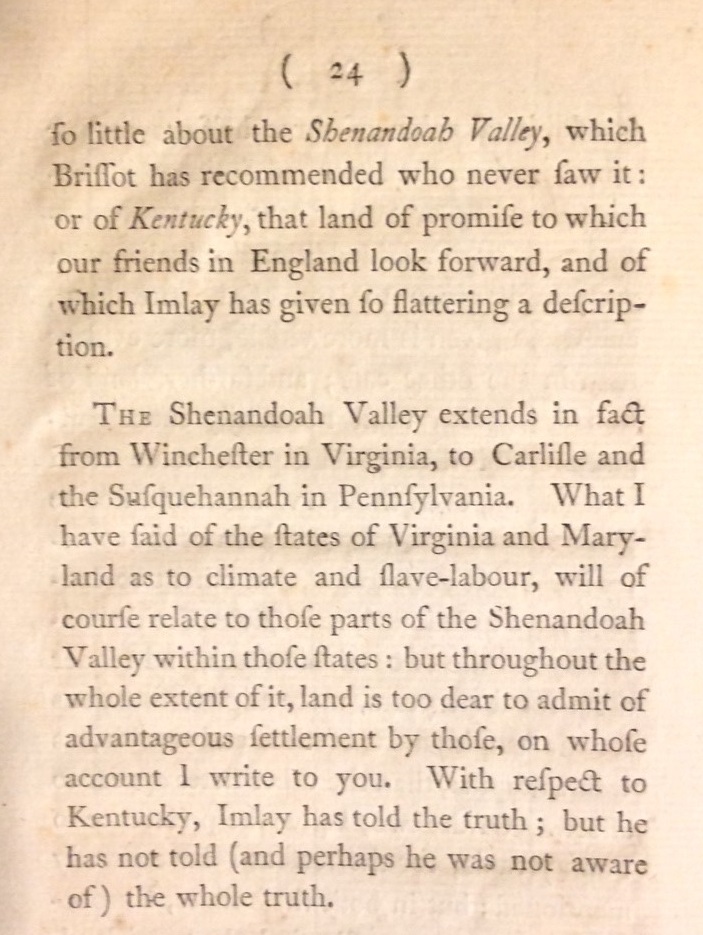
M1[Thomas Cooper, 1759-1839?] Extract of a letter from a gentleman in America to a friend in England, on the subject of emigration. [London?, 1794?]     (A 1792 .G45)

Likely the first edition (of two published in England ca. 1794) of this concise description of the United States. Written from the perspective of an Englishman contemplating emigration, it offers carefully reasoned arguments for and against settling in specific states. Particular consideration is given to the frontier regions of New York and Kentucky, though the anonymous author concludes that Pennsylvania is the better option. Indeed, that is precisely where the probable author, Thomas Cooper, settled later in 1794 after touring the United States; the letter was likely addressed to, and published at the behest of, Joseph Priestley, who also emigrated to Pennsylvania in 1794. An economist and liberal political thinker, Cooper soon developed a thriving Philadelphia law practice which helped to earn him the esteem of Thomas Jefferson. In 1819 Cooper was the first professor appointed to the faculty of the as-yet-unopened University of Virginia, but he resigned in 1820 following controversy over his religious views. Later he served as president of the University of South Carolina.

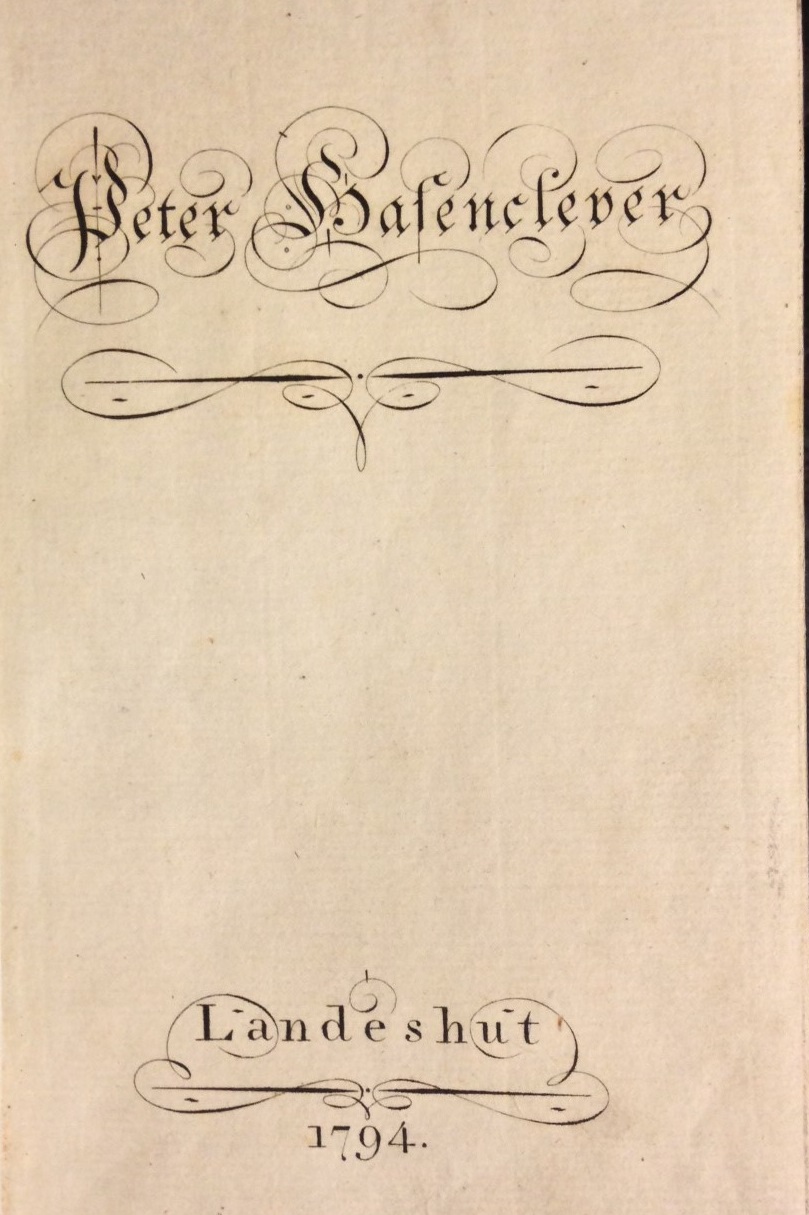
M5Christian Gottlieb Glauber, 1755-1804.  Peter Hasenclever.  Landeshut, 1794.     (A 1794 .G53)

Privately printed in a small number of copies, this is a biography of Peter Hasenclever, a German entrepreneur who, by establishing several business enterprises in New Jersey, Pennsylvania, and New York between 1764 and 1769, became Colonial America’s leading industrialist. With the coming of peace following the Seven Years’ War, Hasenclever raised over £50,000 from English backers to open a network of iron mines and ironworks and a potash manufactory, and to raise hemp and harvest timber. His enterprises were staffed by the over 500 German workers who heeded his invitation to emigrate. Hasenclever spent lavishly on his businesses, only to be plunged into bankruptcy in 1769 when his English partners withdrew financial support. After returning to Germany, Hasenclever was able to rebuild his fortune in the textile trade. The biography concludes with a lengthy appendix of letters written by Hasenclever during his American sojourn.

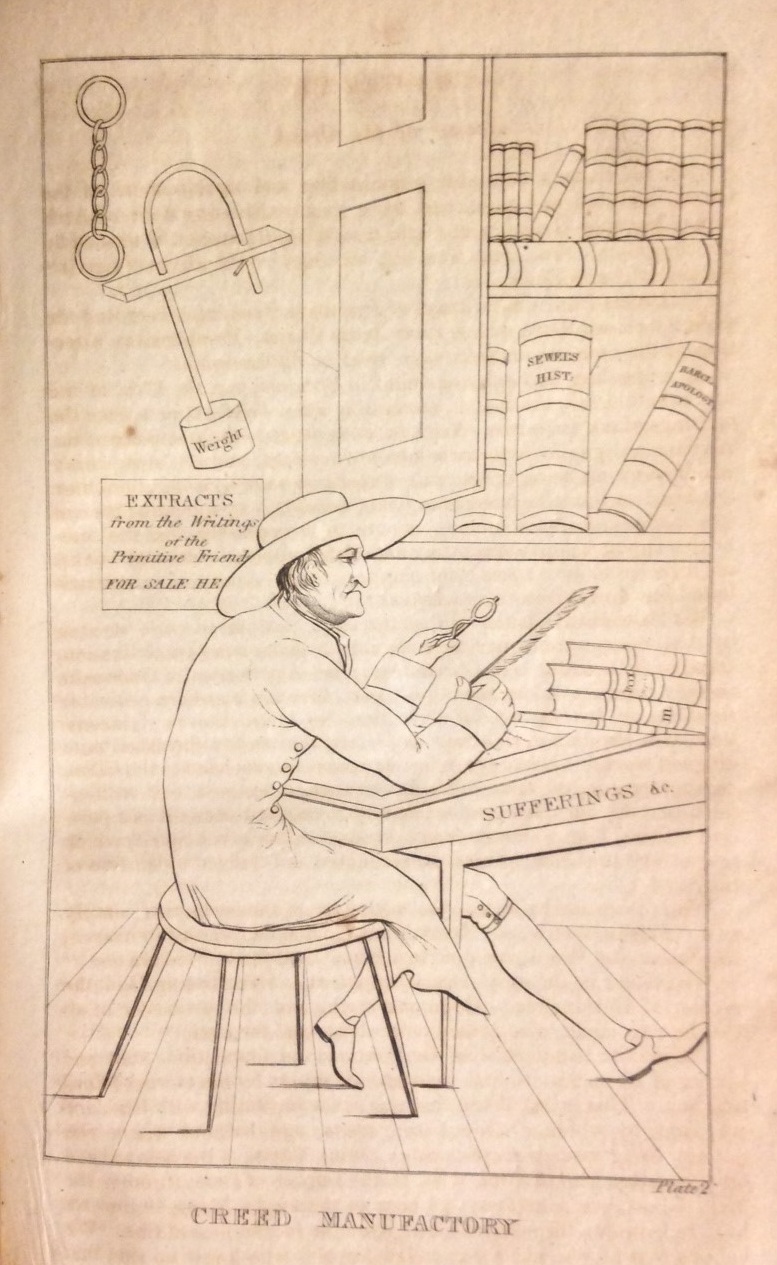
M3Hole in the wall; or A peep at the creed-worshippers. [Philadelphia], 1828.     (A 1828 .H65)

This rare and unusual tract was an important salvo in the bitter schism, or “Great Separation,” between orthodox Quakers and their Hicksite adversaries. By the 1820s significant tensions had arisen between Philadelphia’s wealthy Quaker merchants and the Quaker farmers of southeastern Pennsylvania, who were attracted to the teachings of Elias Hicks—tensions comparable to those between New England Congregationalists and Unitarians. Unable to settle their differences at the 1827 Philadelphia Yearly Meeting, the two camps set up competing Meetings, with the orthodox Quakers adopting and enforcing a doctrinal creed. This pamphlet, which vigorously promotes the Hicksite view, is “embellished” with three accomplished satirical engravings by the anonymous author.

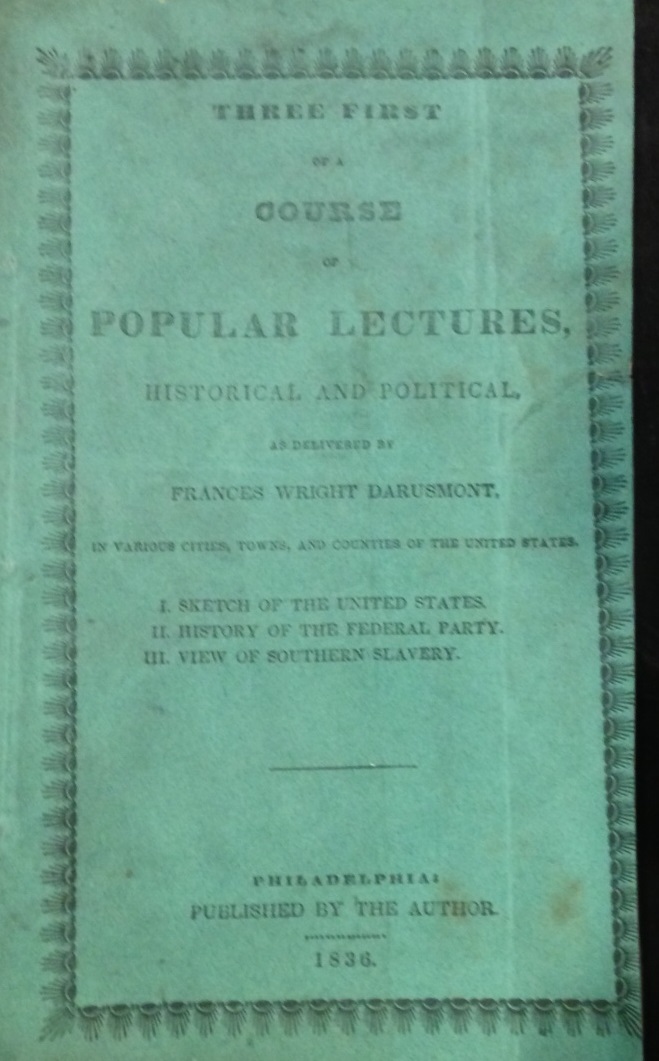
M4Frances Wright (1795-1852). Course of popular lectures, historical and political, Vol. II.  As delivered by Frances Wright Darusmont, in various cities, towns and counties of the United States. Philadelphia: Published by the author, 1836.     (A 1836 .W75)

During the 1820s and 1830s, Fanny Wright was perhaps the most notorious woman in the United States. Born in Scotland, Wright visited the United States from 1818-1820, recording her observations in the bestselling Views of society and manners in America (1821). Having befriended Lafayette, Wright accompanied him on much of his 1824-1825 tour of America. She then launched a career as a radical political and social reformer. An ardent feminist, freethinker, and friend of labor, Wright visited Robert Owen’s utopian community at New Harmony, Ind., before setting up her own settlement, Nashoba, near Memphis. The objective of this multi-racial community was to promote the abolition of slavery by preparing slaves for freedom. By 1830 it had failed, and Wright henceforth promoted her views through journalism and a career as America’s first prominent female public speaker. This very rare pamphlet in its original wrappers prints the text of three lectures from Wright’s 1836 lecture tour: two praise Jefferson’s vision of an agrarian republic and condemn the contrasting Hamiltonian vision, and a third outlines her abolitionist views.

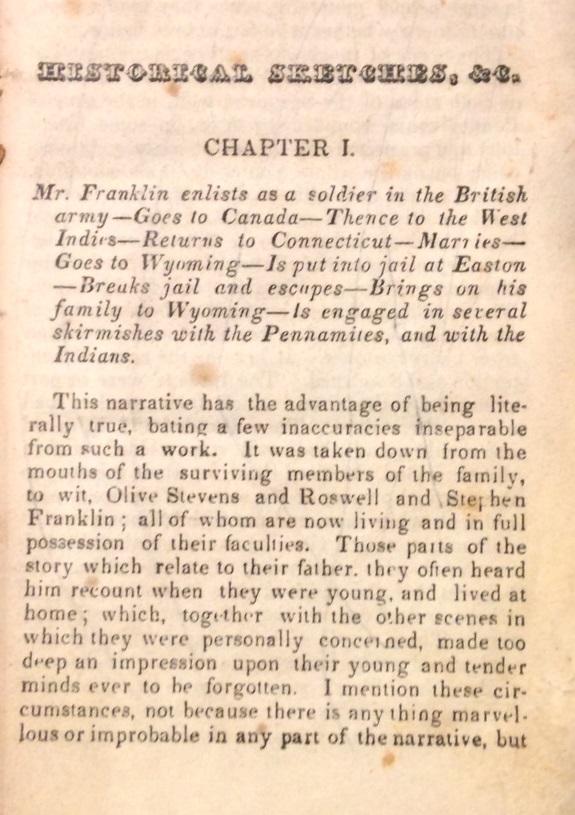
M2Robert Hubbard (1782-1840).  Historical sketches of Roswell Franklin and family: drawn up at the request of Stephen Franklin. Dansville, N.Y.: A. Stevens for Stephen Franklin, 1839.     (A 1839 .H85)

A rare and very early work of American local history, published in a small town some 40 miles south of Rochester, N.Y.  Written by the local minister at the behest of the Franklin family, most of the book is a biography of the family patriarch, Roswell Franklin (d. 1791 or 1792), drawn primarily from family oral tradition. Born in Woodbury, Conn., Franklin fought for the British in the West Indies and Cuba before moving his family to northeastern Pennsylvania’s Wyoming Valley in 1770. With the outbreak of revolution, Franklin and his fellow patriots found themselves in a frontier war zone, besieged by British forces and their Iroquois allies. Included here is a vivid account of the 1778 Battle of Wyoming, in which Franklin was one of few patriots to survive. Subsequent chapters describe the family’s role as pioneers, following the expanding frontier northwestward into west central New York, and the tremendous contrasts between Roswell Franklin’s time and America in 1839.

This Just In: Scarlet Letters from the Backlog

Every Special Collections library has a number of mysterious boxes that for some reason or another have never been dealt with–gifts with mysterious provenances, duplicate copies, a collection that someone was working on but for some reason never finished, and so on. U.Va. is no exception, though we do pride ourselves on how small that backlog is, and how well-described our cataloged materials are.

Soon after starting this job, I was tasked, with my co-hire David Whitesell, to dig into the backlog. For many months now, we have each enjoyed tackling a box or two on a quiet afternoon at the reference desk, or whenever the temptation is too strong and more pressing work is set aside.

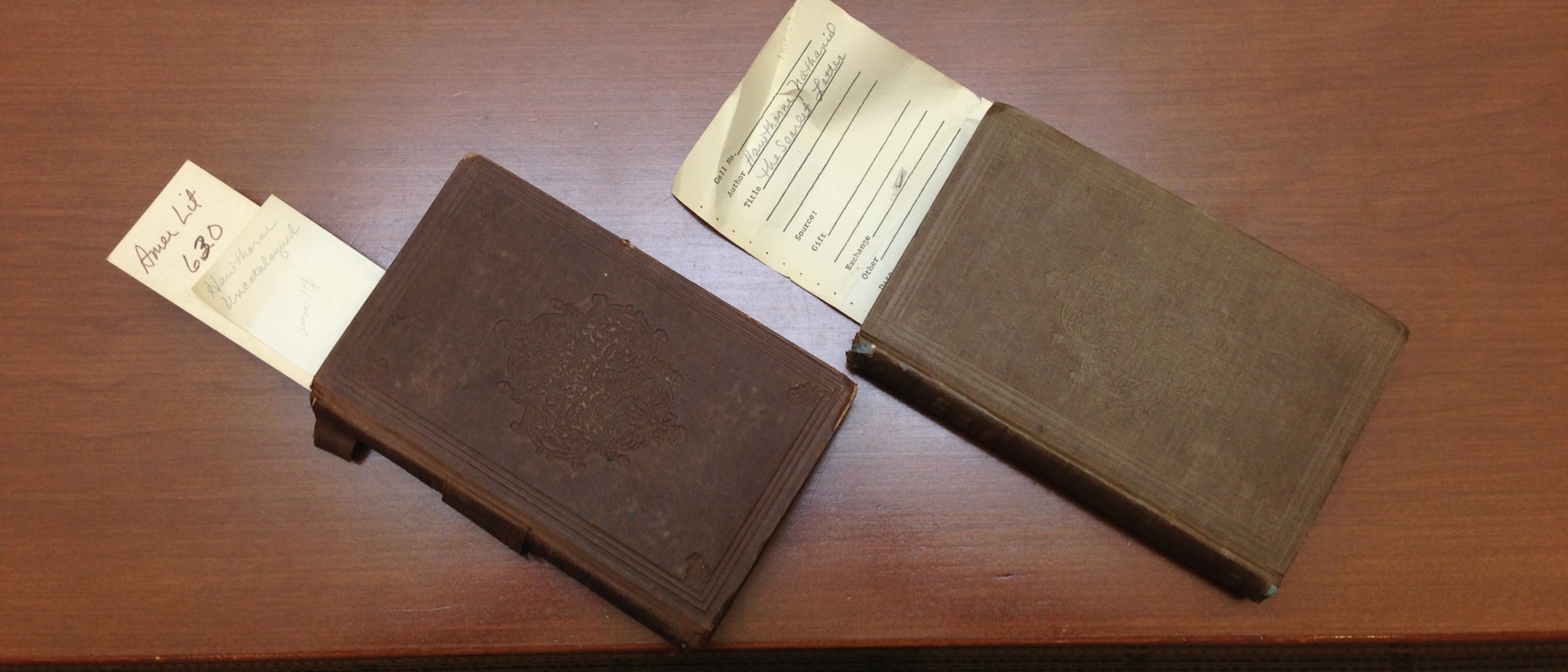
Much of the pleasure of curatorial work comes from the element of surprise–unexpected gifts, unexpected acquisitions opportunities, unexpected discoveries in the stacks, unexpected researcher projects, and so on. So I was thrilled to find one day recently, mixed with various unremarkable volumes in a box, two early copies of Nathaniel Hawthorne’s The Scarlet Letter. I was even more thrilled to discover that neither came near to duplicating the numerous early copies already in our collection.

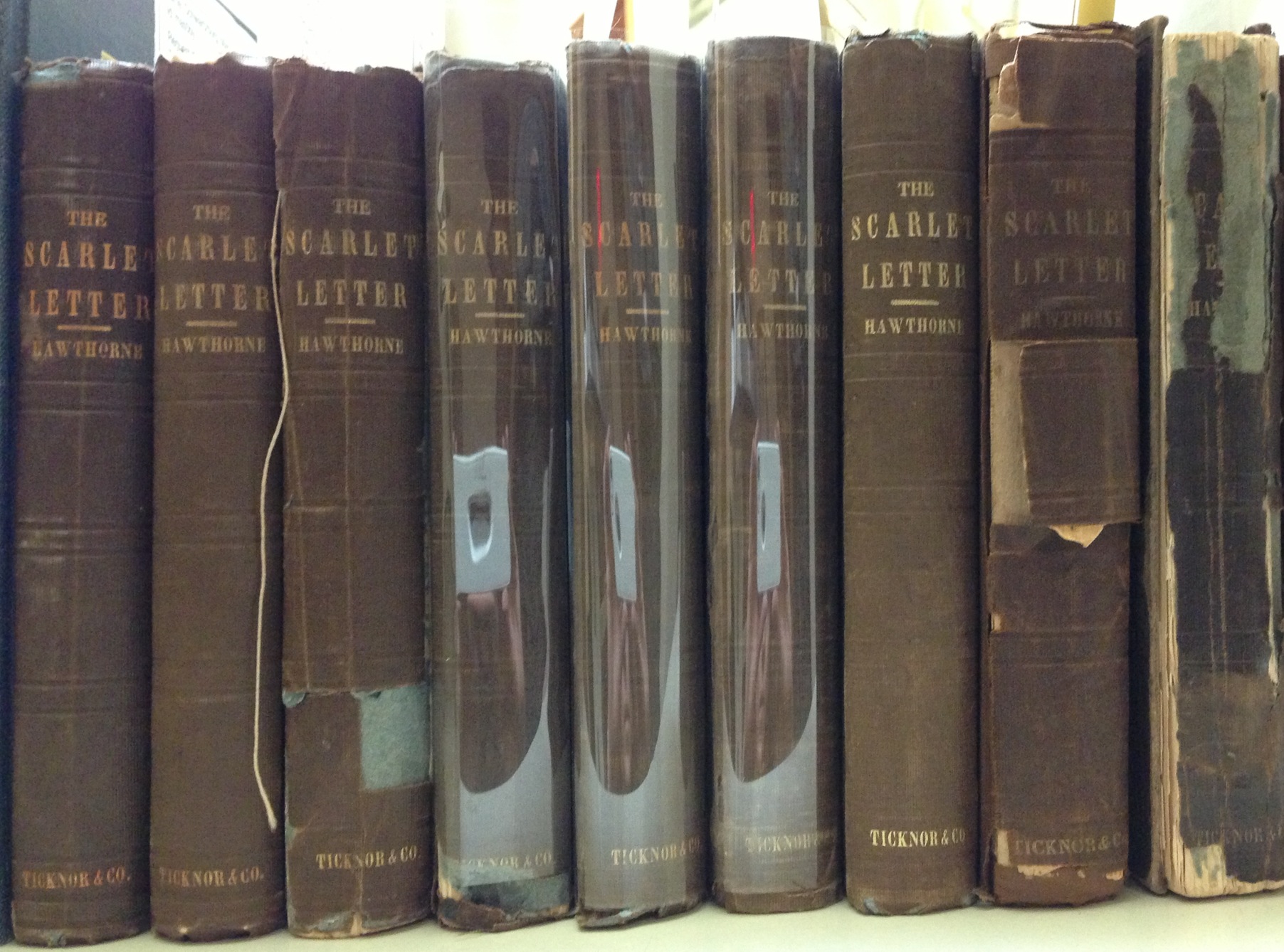
Existing holdings in early printings of the novel accompanied by the two books that will soon join them on our shelves.The dull brown covers were, in their day, a mark of great prestige, since they were the signature of the highly regarded publishers  Ticknor and Fields.

Seven existing Scarlet Letters accompanied by two volumes that will soon join them on our shelves. The dull brown covers were a mark of literary prestige, since they were the signature of the highly regarded Boston publishing house of Ticknor, Reed and Fields.

The Second Edition Advertisements

The Scarlet Letter was a huge success from the moment it was published. Released on March 16, 1850, the first edition of 2,500 copies sold quickly. On April 22nd, the second edition was released. It also comprised 2,500 copies, and is easily identified because it includes an additional preface by Hawthorne, in which he responds to criticisms of the famous essay that prefaces the novel, “The Custom House.”

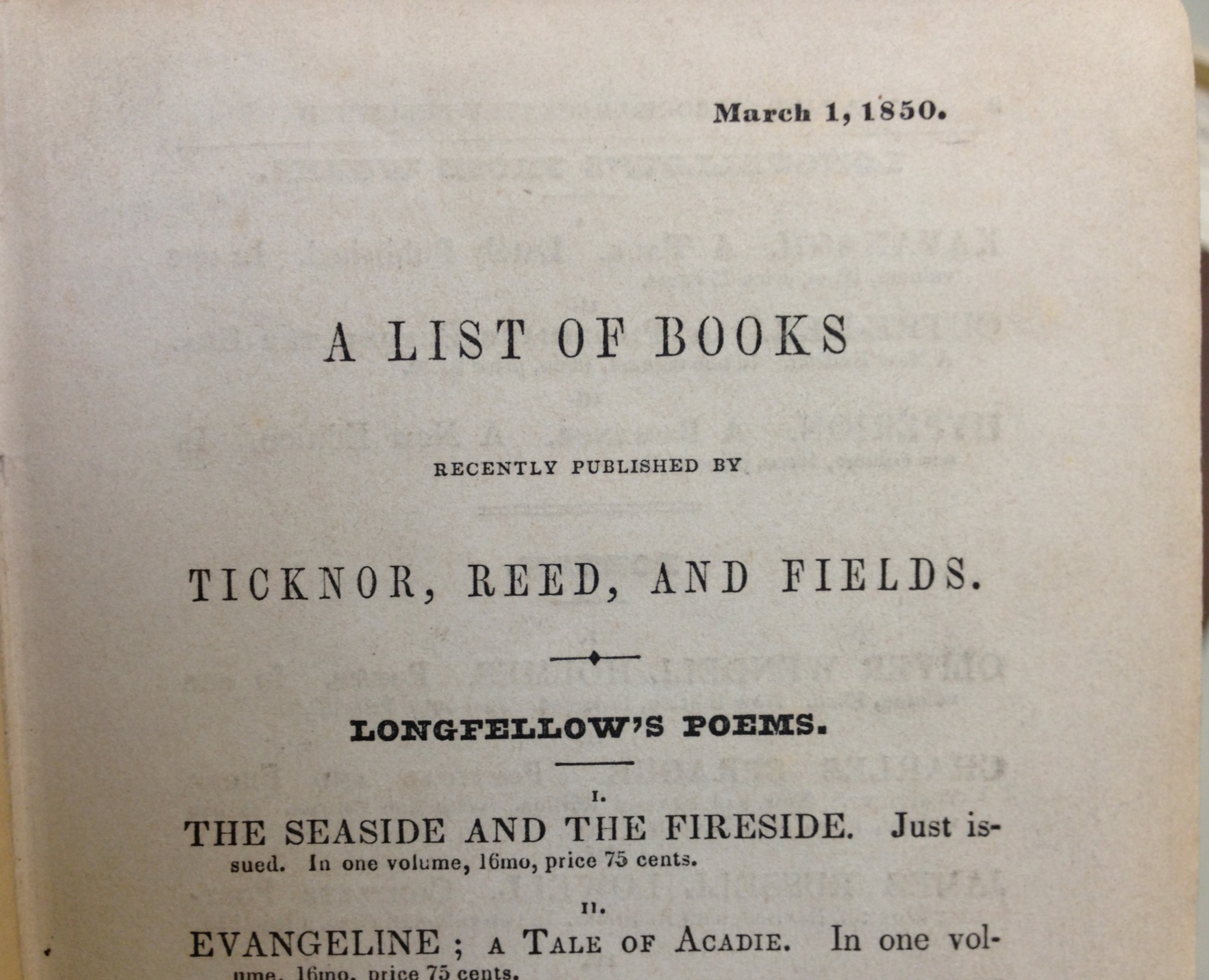
Our three cataloged copies of the second edition vary dramatically in condition and paratexts. All but one have bookplates, and all three have advertisements. The publishers added to each copy a multi-page advertising insert variously titled “New Books and New Editions” or “A List of Books Recently Published,” all beginning with the publisher’s Longfellow list.  The three copies have inserts dated March 1850 and May 1850 (in two copies).

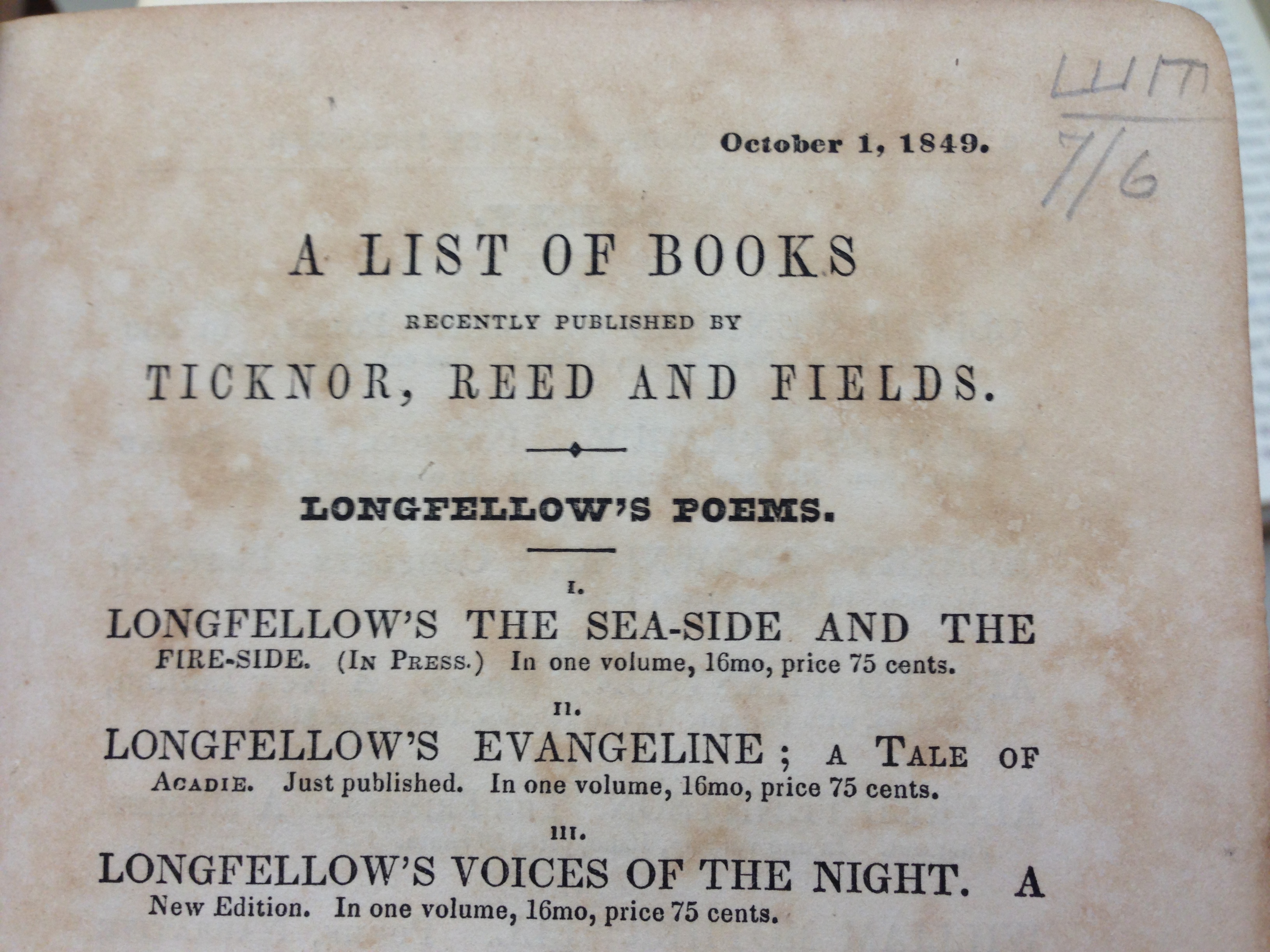
Notably, the newly unearthed copy has an advertising insert dated October 1849, which is the earliest insert of any copy of this novel in our collection. Presumably, the insert was lifted from a stack of old leftovers, since the book could not have been bound before the spring of 1850.

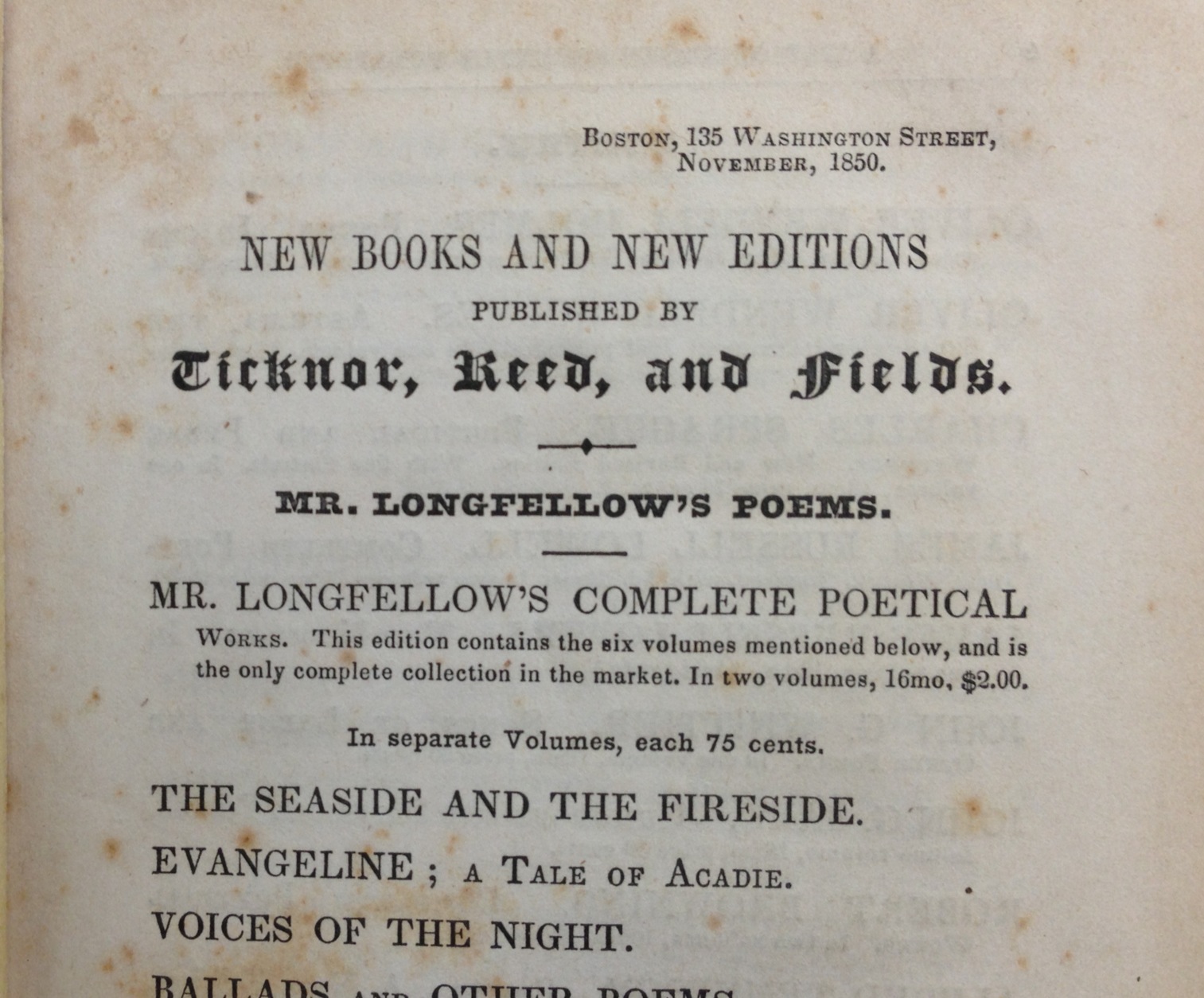
The images below show a variety of advertisements from the first three editions of the novel, all published in 1850.

scarlet_march1850ad

Detail of the advertisement in one of our copies of the first edition. (PS 1868 .A1 1850. Gift of Mr. and Mrs. Randolph Catlin. Photograph by Molly Schwartzburg)

scarlet_oct1849ad

Detail of the advertisement in the soon-to-be-added copy of the second edition. (Uncataloged. Photograph by Molly Schwartzburg)

scarlet_november1850ad

Detail of the advertisement in one of our copies of the third edition, the first to be printed from stereotyped plates, and which appeared in September, 1850 (A 1850 .H39 S3a. Tracy W. McGregor Library of American History. Photograph by Molly Schwartzburg)

An 1854 impression

The other volume found in the backlog is unquestionably unique to our collection, as the only standalone copy of the novel we own with an imprint date of 1854 (a collected works edition we hold is also dated that year). It is printed from the stereotyped plates produced in late 1850 for the third edition. The only 1854 printing, it totaled 500 copies, and brought the total number of copies of the novel’s American standalone editions alone to 10,300.

So, Hawthorne fans and bibliographers, we encourage you to come by in a few weeks when these new additions have been cataloged, snugly housed, and added to the shelves alongside their brethren!

scarlet_two_new_copies

Our new second edition, on the left, and third edition, 1854 printing, on the right. The yellowed slips in the book show how long these have waited for their moment in the sun (and in Virgo, our online catalog). The origins of these volumes are lost to the sands of time.