This post was written by Small Special Collections Library Curator George Riser.
At the age of 22, after leading a peripatetic existence, Langston Hughes moved to Washington, D.C., and took a job as a busboy at the Wardman Park Hotel. One day, he saw a notice announcing renowned poet Vachel Lindsay would be giving a reading in the hotel theater that evening. Hughes writes in his autobiography, The Big Sea (PS3515.U274 Z464 1940), “I very much wanted to hear him read his poems, but I knew they did not admit colored people to the auditorium.”
That afternoon, Hughes wrote out three of his poems—“The Weary Blues,” “Jazzonia,” and “Negro Dancers”—and placed them in the pocket of his busboy uniform. Again, from The Big Sea:
“In the evening when Mr. Lindsay came down to dinner, quickly I laid them beside his plate and went away, afraid to say anything to so famous a poet, except to tell him I like his poems and that these were poems of mine. The next morning on the way to work, as usual I bought a paper—and there I read that Vachel Lindsay had discovered a Negro bus boy poet! At the hotel the reporters were already waiting for me. They interviewed me. And they took my picture, holding up a tray of dirty dishes in the middle of the dining room. The picture, copyrighted by Underwood and Underwood, appeared in lots of newspapers throughout the country.”
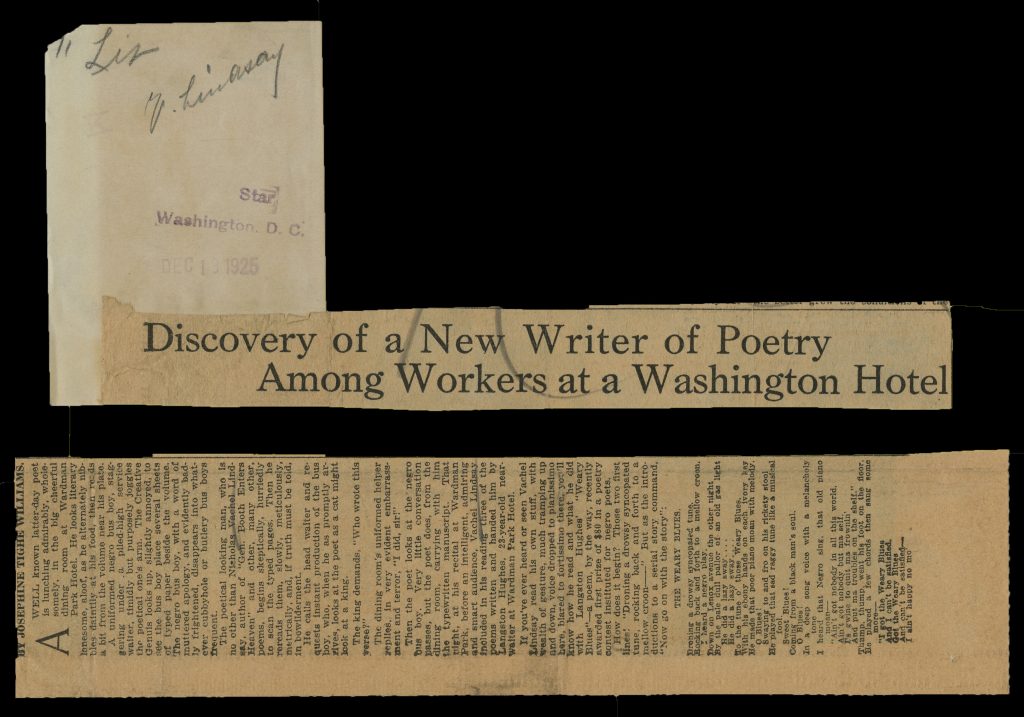
Josephine Tighe Williams, “Discovery of a New Writer of Poetry Among Workers at a Washington Hotel,” Star, December 13, 1925. Papers of Vachel Lindsay (MSS 6259)
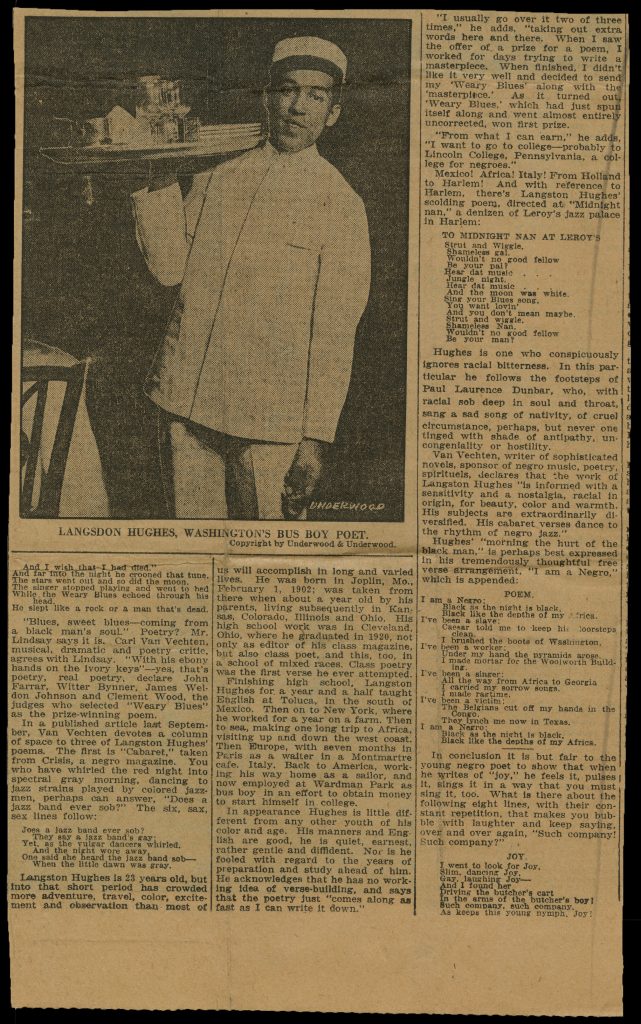
Josephine Tighe Williams, “Discovery of a New Writer of Poetry Among Workers at a Washington Hotel,” Star, December 13, 1925. Papers of Vachel Lindsay (MSS 6259)
Lindsay’s “discovery” of Hughes introduced his works to a broader audience and helped him garner wider literary acclaim. However, by the time they first met in 1925, Hughes had already begun establishing his own reputation.
In fact, Hughes had published several poems in popular Black journals—such as Crisis, Opportunity, and Alain Locke’s guest-edited issue of Survey Graphic—and had signed a contract for his first book. It was through his acquaintance with Locke that Hughes met Georgia Douglas Johnson, who hosted the S Street Salon in her home—a weekly gathering of celebrated poets, writers, and artists. There, Hughes met, among others, Zora Neale Hurston, Richard Bruce Nugent, and Carl Van Vechten, who sent some of Hughes’ poems to his publisher, Alfred A. Knopf. Not long after, Hughes received a letter from Blanche Knopf, Alfred’s wife and business partner, saying his poems had been accepted for publication.
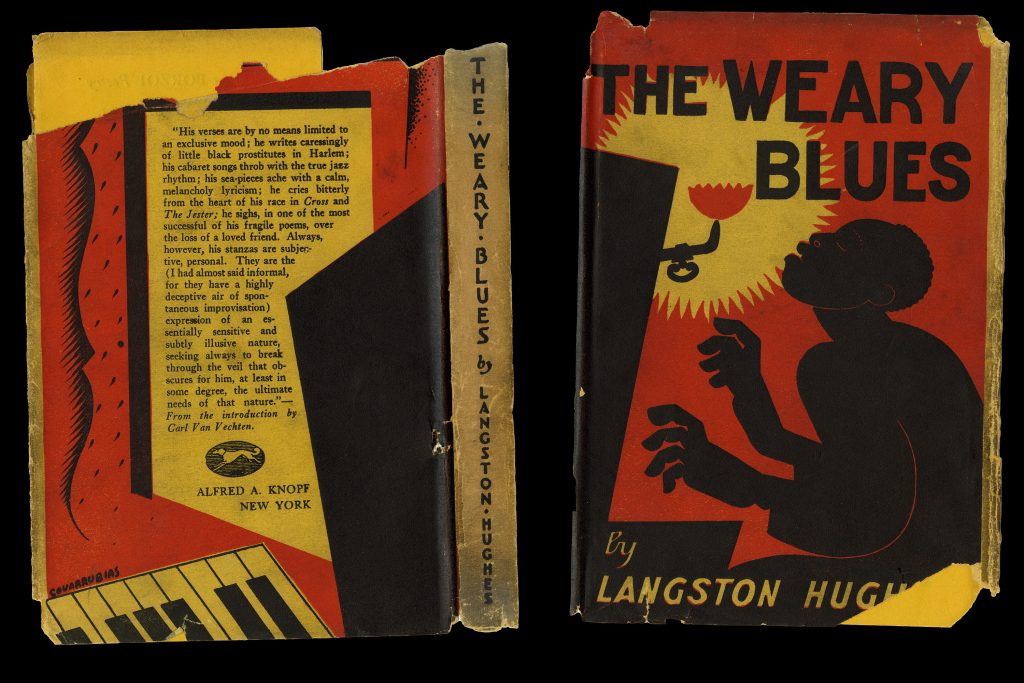
Dust jacket designed by Miguel Covarrubias. Langston Hughes, The Weary Blues (New York: Alfred A. Knopf, 1926). Clifton Waller Barrett Library (PS3515.U274 W4 1926)
The Weary Blues (PS3515.U274 W4 1926), Hughes’ first published book of poetry, came out the following year in 1926. It would not be long before Langston Hughes would become one of the most influential and celebrated poets of the Harlem Renaissance and beyond, eclipsing the fame of his early advocate, Vachel Lindsay.
Shown here are five typed and signed poems Langston Hughes sent to Vachel Lindsay at his address in Spokane, Washington. Marks made by Lindsay in black ink are visible on the pages. These poems are found in Box 65 of the Papers of Nicholas Vachel Lindsay (MSS 6259) in the Clifton Waller Barrett Collection of American Literature.
-
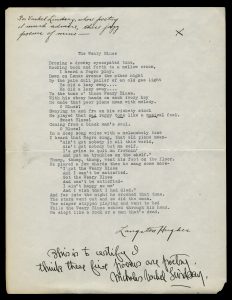
- “The Weary Blues” became the titular poem of Hughes’ first published book of poetry. Hughes inscribed this typescript version, “For Vachel Lindsay, whose poetry I much admire, these jazz poems of mine.” Lindsay writes somewhat pompously below Hughes’ signature, “This is to certify I think these five poems are poetry.”
-
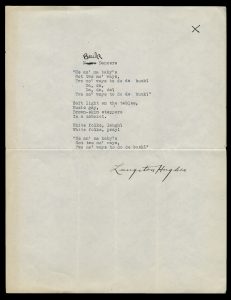
- Here, Lindsay has modified the title of the poem from “Negro Dancers” to “Buck Dancers.”
-
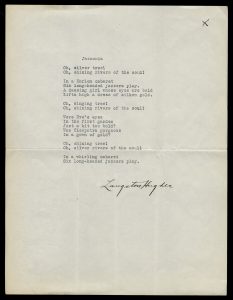
- “Jazzonia”
-
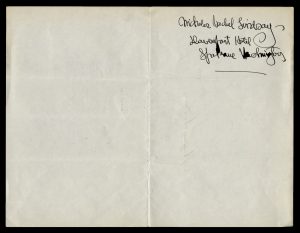
- On the back of “Jazzonia,” Hughes addressed this set of poems to “Nicholas Vachel Lindsay[,] Davenport Hotel[,] Spokane[,] Washington.”
-
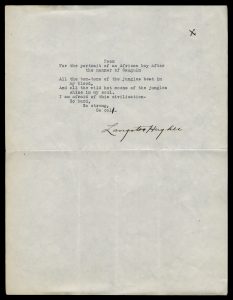
- “Poem For the portrait of an African boy after the manner of Gauguin”
-
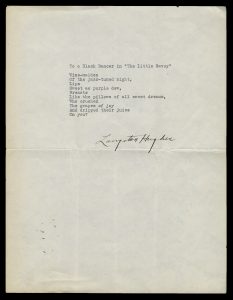
- “To a Black Dancer in ‘The Little Savoy'”