

Digitizing the Albert H. Small American Trade Catalogs Collection

Contributed by Stacey Evans, senior digital imaging specialist and project coordinator in the Digital Production Group (DPG), Nicholas Cummins, research librarian for economics & commerce, and Tara Udani, DPG student assistant

Philanthropist Albert H. Small donated his collection of 3,400 trade catalogs (under the TS199.A5 call number) to the Albert and Shirley Small Special Collections Library in 2014. Today, 165 of these catalogs have been digitized and are accessible through Virgo, the UVA Library’s catalog.   

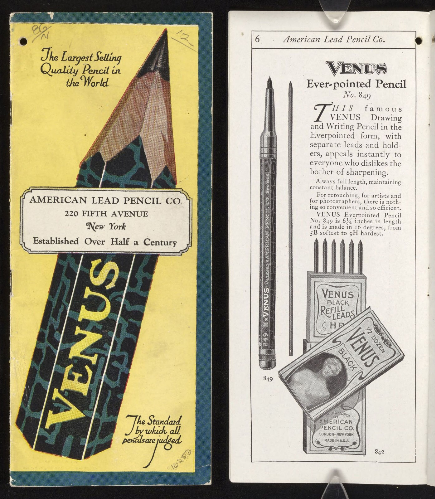
The trade catalogs offer a window into American commerce around the turn of the 20th century. The collection shares an eclectic range of American manufacturing, from the mystical marketing of the American Lead Pencil Co.’s Venus pencil in 1920 (TS199.A5 A84 no.03) to the sober design of E.T. Barnum Iron Works’ steel jail cells and jail work designs from 1913-1914 (TS199.A5 A757 no.06).  
Pencils:  
Two vintage advertising pages displayed side by side against a dark background. The left page shows a colorful vertical design dominated by a large, illustrated pencil labeled “VENUS” in bold letters, set on a yellow and teal background. Surrounding text reads “The Largest Selling Quality Pencil in the World” and identifies the American Lead Pencil Company at 220 Fifth Avenue, New York, noting it was established over half a century earlier. The right page is printed in black and white and features the heading “Venus Ever-pointed Pencil.” It includes dense serif text describing the pencil’s features, a detailed illustration of the pencil, and smaller images of replacement lead boxes labeled “Venus Black Refill Leads.” The pages show signs of age, including slight discoloration and wear along the edges. 
The cover and a page of the American Lead Pencil Company twentieth-century trade catalog featuring the Venus pencil (TS199.A5 A84 no.03). (Photo by Tara Udani) 

Stacey Evans led the project to bring the Albert H. Small American Trade Catalogs Collection into a digital format. For Stacey, working with these materials was a chance to travel through the visual and marketing language of another era. 

The creation of this digital collection was made possible by funding included with Small’s gift of the catalogs for the labor of cataloging, curation, and digitization. Guided by a curated list made by Special Collections Curator of Print Culture Yuki Hibben and former curators Molly Schwartzburg and David Whitesell, the DPG team photographed every page of these selected catalogs to ensure these historical artifacts are preserved in high-resolution digital formats. 

Camera Station:  
A digitization workspace arranged for overhead photography in a small studio. At the center is a copy-stand camera mounted vertically above a black-covered table, where a single yellowed pamphlet lies flat for imaging. Two bright rectangular LED light panels on stands are positioned symmetrically on either side of the table, evenly illuminating the object. To the right, a white desk holds a computer and keyboard, with a monitor displaying a scanned image of a historical title page. To the left, a small wooden side table holds a stack of documents or books. The room has gray walls, a dark floor, and visible cables, emphasizing a controlled, professional imaging environment. 
Caption: A DPG camera station setup to photograph the cover of a trade catalog. (Photo by Stacey Evans) 

DPG hires student assistants to help digitize materials. Tara Udani, a third-year undergraduate double majoring in data science and environmental science, was responsible for the creation of most of the digital files (photographing, cropping, and exporting files) while other DPG staff did quality assurance before the files were made available on Virgo.  

An overhead view of a digitization workspace with a person seated at a black-covered table, holding open an aged book in a supportive cradle. The book displays yellowed pages and a printed title page with an engraved illustration visible on the facing page. One hand turns a page while the volume is secured with a white page holder. A bright rectangular LED light panel stands to the left, illuminating the book evenly. The background shows studio equipment, shelves, and dim surroundings, emphasizing a controlled environment for handling and imaging rare materials. 
Caption: Tara Udani photographs historical trade catalogs one page at a time using cradle supports for safe handling of fragile materials. (Photo by Stacey Evans) 

In the Small Special Collections Library’s main gallery, the ABCs of the UVA Library exhibition is on display through June 2026. Stacey invited Nicholas to collaborate on “T for Trade Catalogs.” In his work, Nicholas regularly supports students with market research, industry analysis, and information literacy and collaborates with faculty on their instructional and research needs. His own research and professional writing draw on political economy and critical information literacy, and, as part of his graduate program, he interned with the Small Special Collections Library. Serendipitously, Nicholas had previously encountered a similar style of advertisement as found in these trade catalogs in the form of a decorative tea towel that he inherited from his grandmother.

A linen tea towel asking What Will you do  in the long, cold, dark, shivery evenings.  It features a phonograph. It towel was made in Wales.
Caption: The tea towel inherited from Nicholas’s grandmother advertising a phonograph. (Photo by Stacey Evans) 

In their research, Nicholas and Stacey discovered that these catalogs were crafted when the best way to sell products was to design and distribute a catalog. Because it was prohibitively expensive to include photographs in mass-produced texts, businesses relied primarily on narrative, not images, to advertise their goods & services. Studying these objects allows us to investigate the working conditions, gendered labor roles, and techno-optimism present at the turn of the last century.  
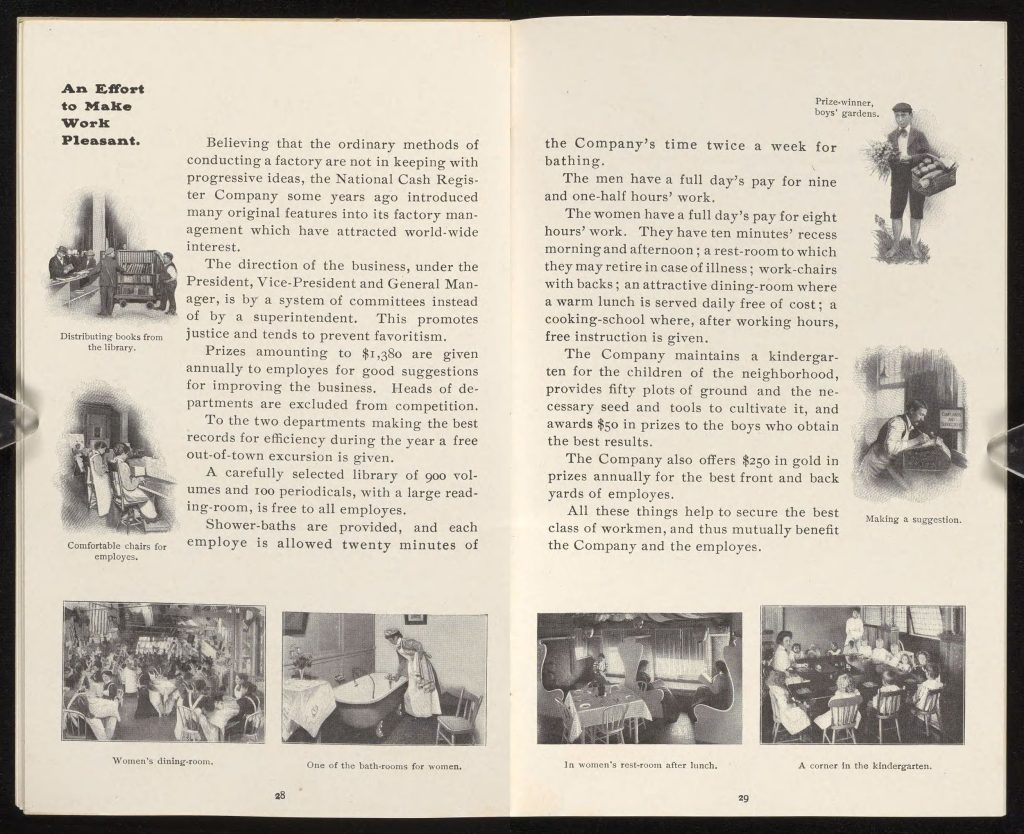
A scanned two‑page spread from a historical industrial publication displayed against a dark background. The left page is titled “An Effort to Make Work Pleasant” and contains dense serif text describing factory management practices, alongside small illustrations and photographs. The right page continues the text and includes a small illustration of a worker labeled “Making a suggestion.” Along the bottom of both pages are several black‑and‑white photographs with captions showing workplace scenes such as a dining room, a restroom area, an interior work space, and a corner of a kindergarten. The pages are cream-colored with visible aging and feature a structured, magazine‑style layout with text blocks and images. 
Caption: A spread highlighting a pleasant work environment. (TS199.A5 T4 no. 6) (Photo by Tara Udani) 

Washing machines were sold as both time- and life-saving devices; telephones promised greater connection; typewriters were described as the best way to save time and thus maximize profit; and watches were intended not only to display individual style but also “disrupt” the market and promote closer relationships between buyer and seller.  
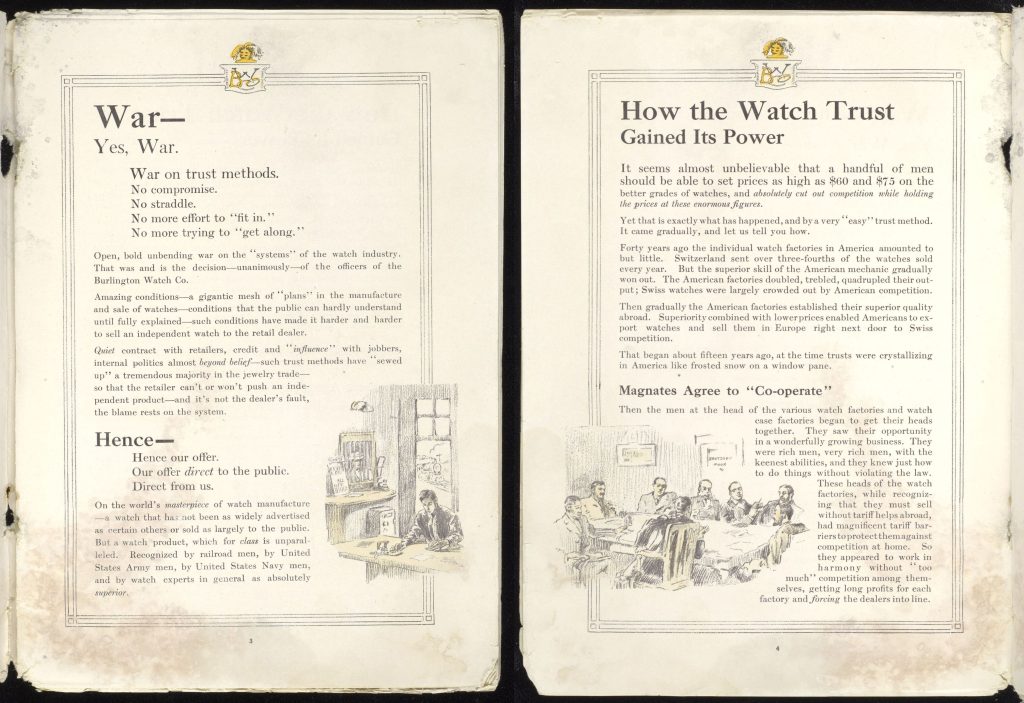
Two facing pages of a historical printed pamphlet displayed side by side on a dark background. The left page is titled “War—Yes, War” and contains dense black serif text arranged in poetic, manifesto-like lines, with a small illustration of buildings near the bottom. The right page is titled “How the Watch Trust Gained Its Power” and features a long block of explanatory text describing monopoly practices, accompanied by a small cartoon illustration near the lower section showing several figures seated around a table. Both pages have ornate borders, visible aging, yellowed paper, and worn edges, suggesting early twentieth-century printing. 
Caption: Two pages from the Burlington Watch Co. trade catalog declaring “war on the ‘systems’ of the watch industry,” plus the “Magnates” — who were “rich men, very rich men with the keenest abilities and they knew just how to do things without violating the laws” — agree to “‘Co-operate.’” (TS199.A5 C56 no. 5) (Photo by Tara Udani) 

New technology has always been leveraged to make work more efficient so that workers can produce more. By studying these catalogs and their historical context, we can trace the evolution of labor-saving technology over the past 100 years. In many ways, these conditions and concerns are not too different from our own age of techno-optimism. Contemporary AI tools claim to make work faster, be more efficient, and be less laborious. The hope at the dawn of the last century that technological progress would prove our salvation was shredded in the mechanized destruction of World War I: will we experience a similar disappointment? 

Regarding the digitization process, Tara noted, “What has stood out to me most while working with this material is the difference in artistry between what was sold during the turn of the twentieth century and today. The visual appeal is compelling, particularly in catalogs about greenhouses and flooring. So much attention and craftsmanship were put into those simple aspects of the home, especially in comparison to today. Needless to say, looking through these trade catalogs has inspired my future interior design choices.” 
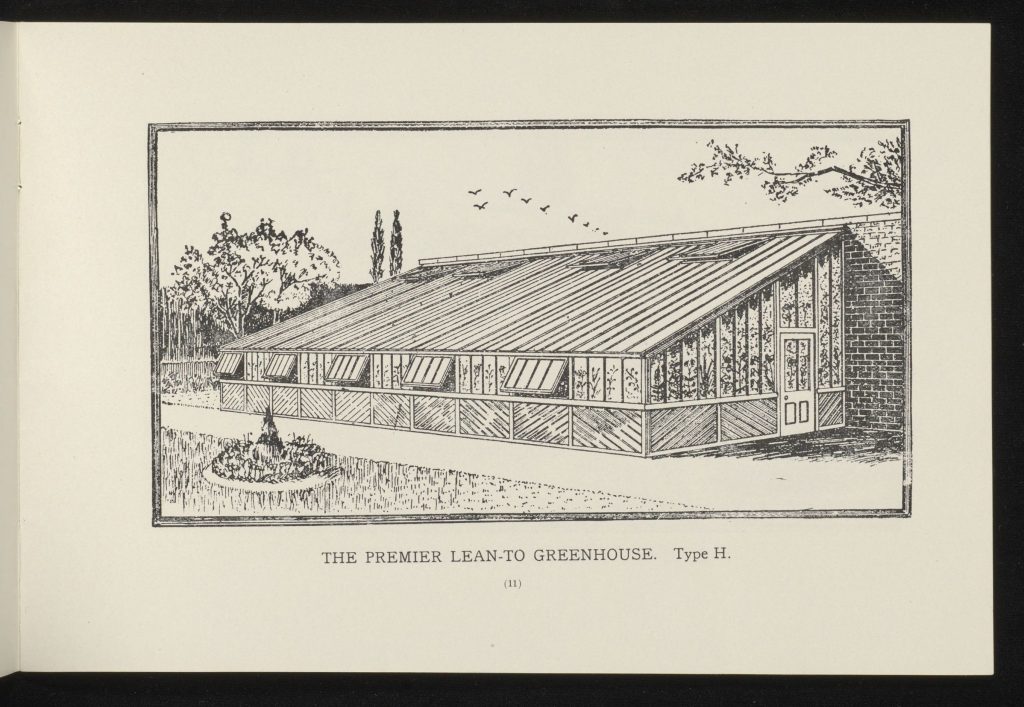
A black-and-white line illustration of a lean‑to greenhouse mounted against a dark border. The structure is long and rectangular with a slanted glass roof supported by wooden framing, attached along one side to a brick wall. Multiple hinged window panels line up the lower portion of the greenhouse for ventilation. The scene includes surrounding trees, grass, and a small central garden feature in the foreground. Beneath the illustration, printed text reads: “The Premier Lean‑to Greenhouse. Type H.”