
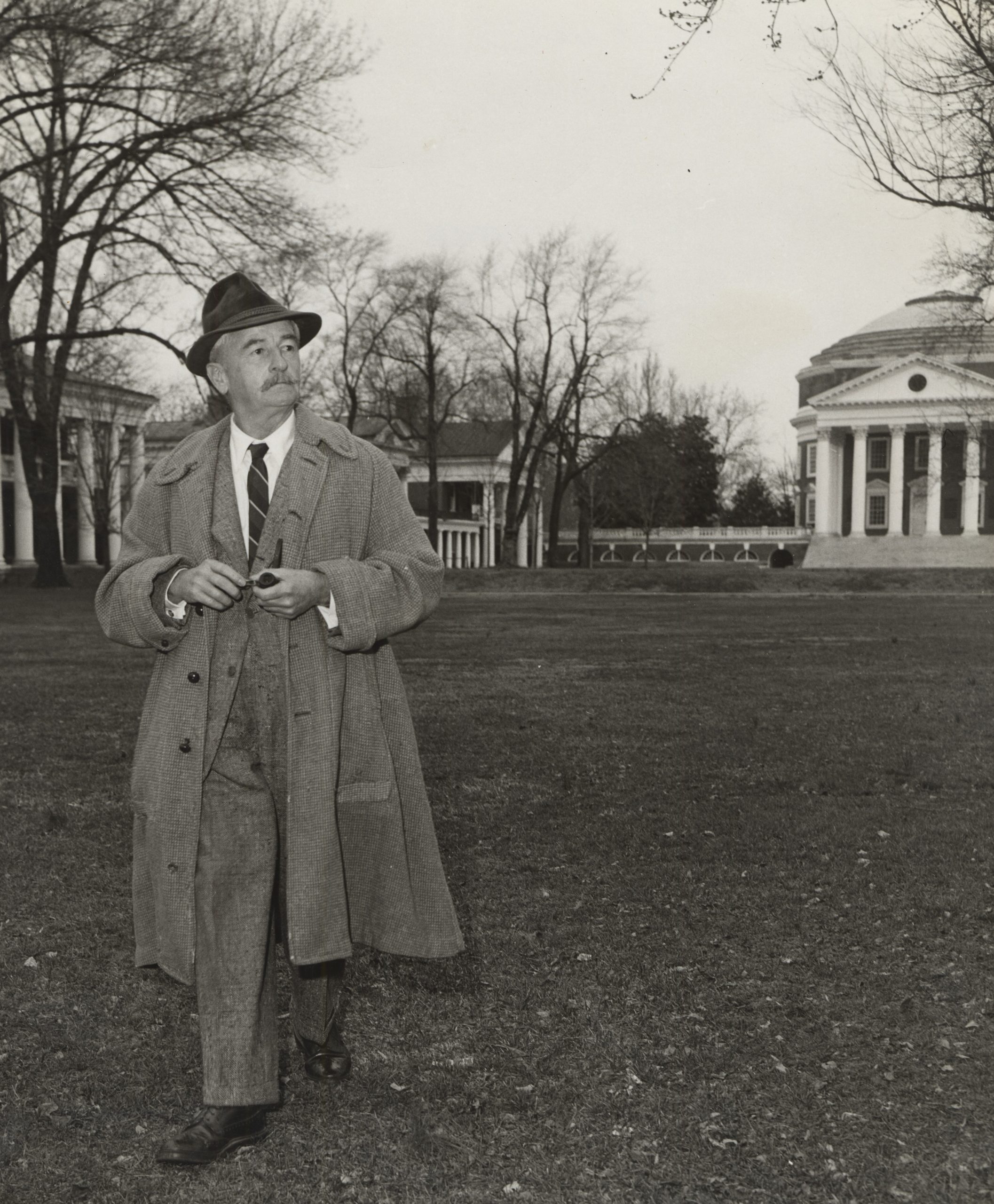
William Faulkner walking in front of the UVA rotunda
The first time I heard of the impressive collection of William Faulkner materials housed at the University of Virginia’s Special Collections Library was as an English graduate student when I had not the remotest idea that I would one day be working at Albert and Shirley Small Special Collections Library, let alone be one of the archivists who worked to process the collection. Like many of us in the GLAM (Galleries, Libraries, Archives and Museums) profession, I found my way here by accident. What started as a way to add to my income while finishing graduate school and teaching undergraduate students turned into a love for library and archival work that led to a career shift into the profession.
After more school and many internships along the way, I found myself in the role of the “William Faulkner Processing Intern,” which led to my newer position as the “William Faulkner Processing Archivist.” It’s difficult to convey just how surreal it felt, both as a former English student and a newly graduated Library Science student, to first lay eyes on the collection and be told that it was now my job to process it.
To give some more background information on the William Faulkner Collection, it is made up of nearly 300 different accessions. An archival accession is an acquisition of materials transferred to a repository as a unit at a single time. The very first of which in the William Faulkner Collection were deposited by William Faulkner himself, originally labeled as manuscript collection number (also known as MSS) 6074. Many other accessions have since been added by Joseph Blotner, Linton Massey, Jill Faulkner Summers, and more. The purpose of the William Faulkner Collection (now labeled as MSS 16807) project was to take all of these different accessions and put them together into one large collection to create a centralized location for researchers. Original MSS numbers would be kept in the descriptions of each folder/item so that researchers’ original citations would not be lost in the process.
For those who may not know, processing a collection involves first surveying and inventorying all parts of a collection, creating a processing plan, and then arranging and describing the collection, both intellectually and physically, creating a finding aid, like this one for Faulkner: Collection: William Faulkner Collection | ArchivesSpace Public Interface, and making notes and preservation interventions, if necessary. These tasks can include relocating materials from acidic folders or moldy boxes to new housings.
Before I was hired to continue processing the collection, it had first been taken on by a former UVA Processing Archivist, Elizabeth Nosari, who had done much of the preliminary work of inventorying the collection and creating a processing plan that divided the collection into ten series. A series is a way of organizing a collection into different categories that all materials can ideally fit into. The ten different series within the William Faulkner Collection consist of the following:
- Series I: Literary Works of William Faulkner
- Series II: Correspondence
- Series III: Personal Papers, Files, and Realia
- Series IV: Publishing Records
- Series V: Business and Legal Records
- Series VI: Photographs and Portraits
- Series VII: Press and Publicity
- Series VIII: William Faulkner at the University of Virginia
- Series IX: Papers of Faulkner Scholars and Collectors
- Series X: Adaptations and Third-Party Works Based on Faulkner Publications.
Nosari had already arranged and described Series I and II, so my job was to continue arranging and describing the collection and adding it to the ArchivesSpace finding aid, starting with Series III and ending with Series X.
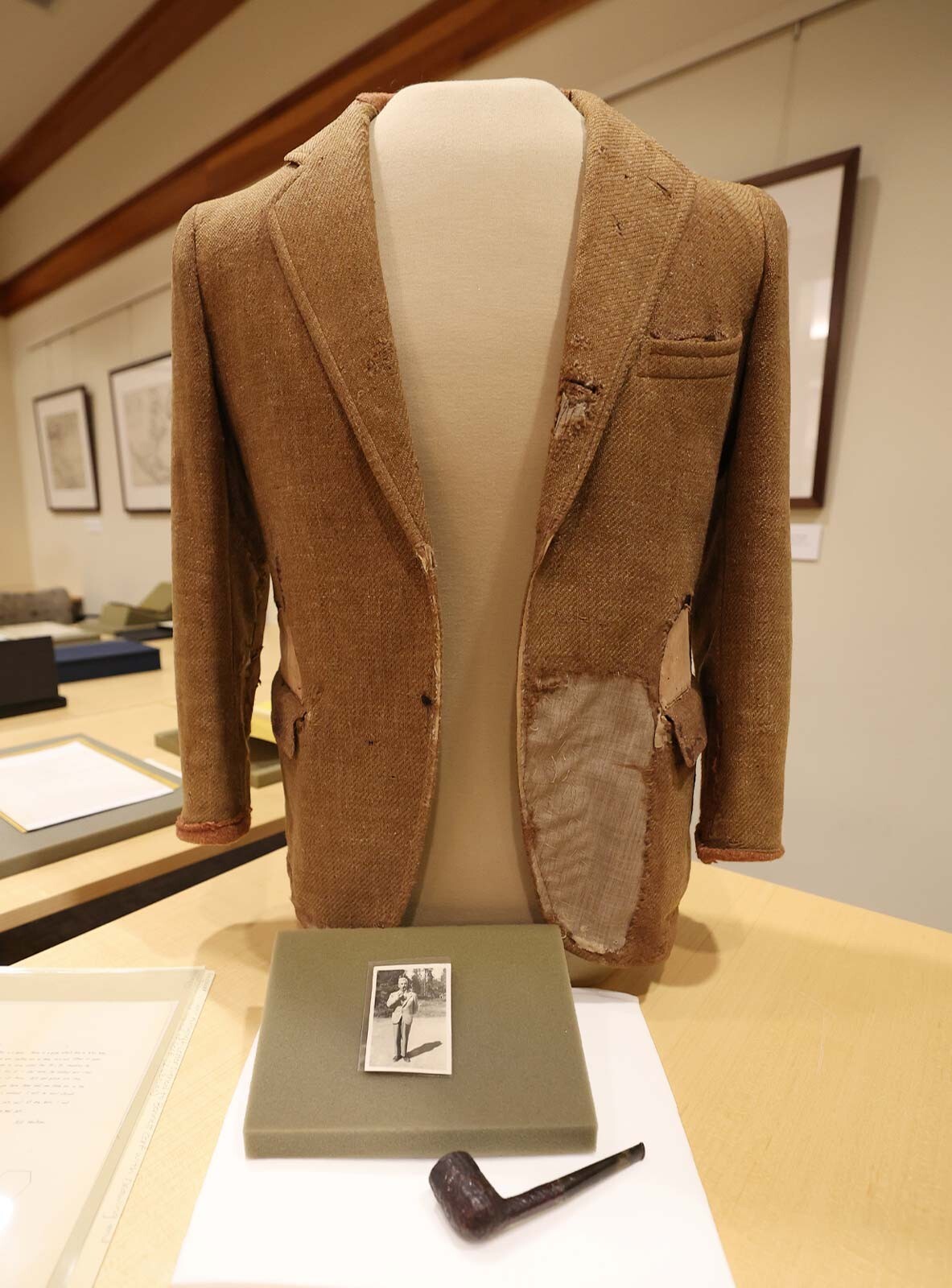
William Faulkner’s well-loved tweed jacket and pipe, posed alongside a photograph image of Faulkner wearing the jacket and smoking the pipe
I was pretty nervous, as while I had finished my formal education, this would be my first time processing a legacy archival collection, let alone one of this magnitude and one that had already been started by another archivist. I was fortunate to have colleagues who fully supported me as an early career professional and were always there to answer any questions I might have. One of the biggest challenges I faced was simply finding everything, as materials were in a variety of different locations throughout the stacks, vault, and other areas within Special Collections. One can imagine how difficult finding materials for researchers must have been for our reference archivists, as there were no concrete centralized locations to pull from. Another initial challenge, that soon became one of my favorite parts about working with the collection, was the sheer variety of differing materials within the collection, many of which I had not yet worked with, ranging from clothing, photographs, framed paintings, and more (including an actual brick from the post office where Faulkner used to work in Mississippi)!
If I had to choose my personal favorite part of the William Faulkner Collection, it would have to be the very first series I started with, Series III: Personal Papers, Files, and Realia, followed closely by Series VI: Photographs and Portraits. As a former English student, I had spent time reading and studying Faulkner’s work, but nothing could have prepared me for what it was like to delve so deeply into his personal life and records. There is something very intimate about processing a person’s collection, which feels a little like taking a step into their lives for hours of the day. While processing Series III and VI in particular, I really felt like I was getting to know not just William Faulkner the writer, but William Faulkner the person, as I worked with materials like personal notes, small doodles and illustrations done on the backs of scrap paper, family photographs, and even his used pipes. This is, at the end of the day, part of what first drew me to archival work; this ability to connect with others through time. When someone accesses the humanity of another through their collected histories or belongings, whether that be of a famous writer, like Faulkner, or of someone in their local community, an opportunity for learning is not only presented, but through that opportunity, another for connection. As I say goodbye to the William Faulkner Collection and to my lovely colleagues at the library, I am incredibly grateful for the opportunity I had to work with both an exceptional collection and an exceptional team. If you are reading this piece, I encourage you to visit the William Faulkner Collection, and when you are finished, see what else Special Collections has to offer!
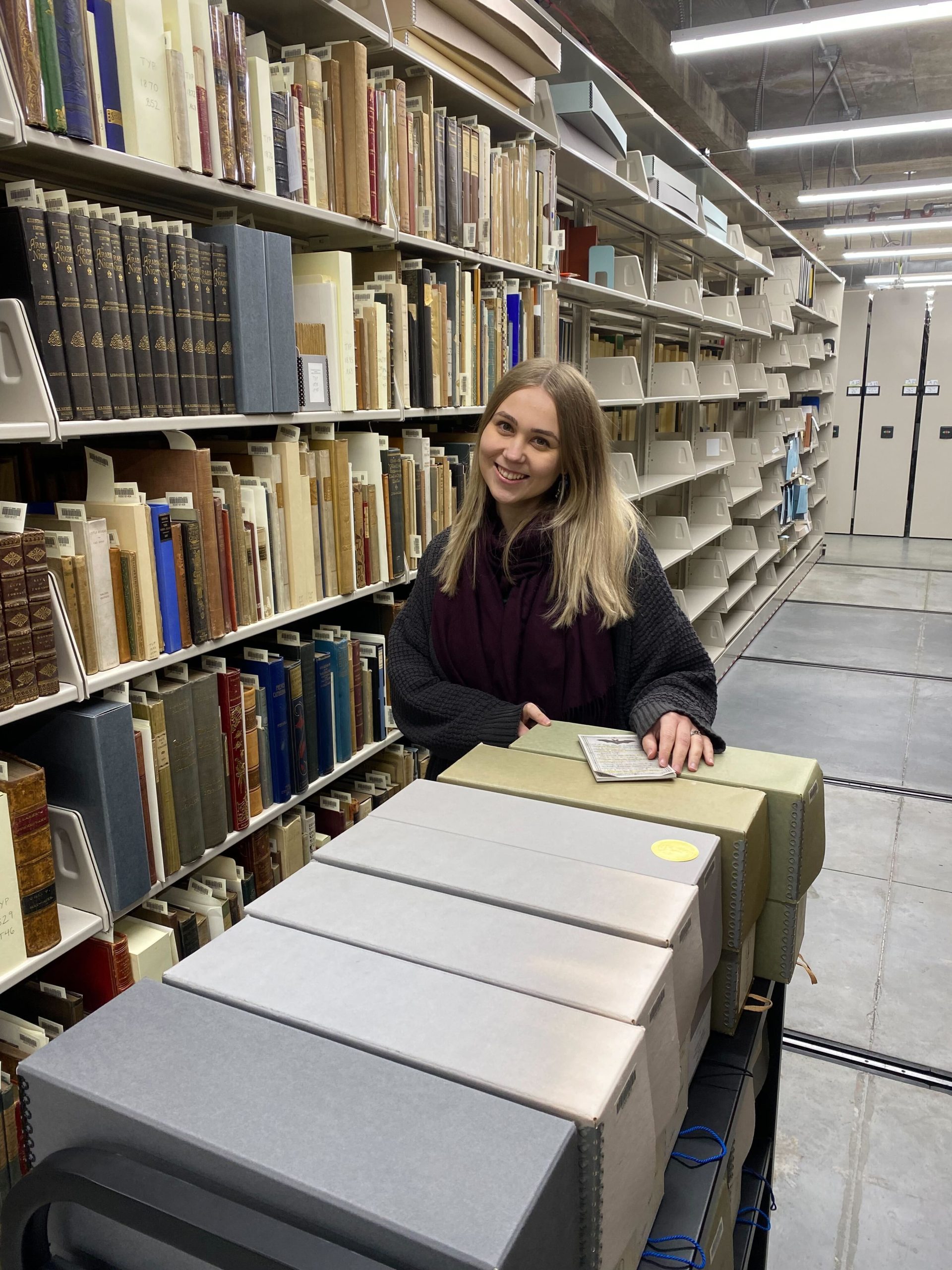
William Faulkner Collection Processing Archivist, Kaylin Preslar, in the stacks of UVA’s Special Collections Library
Thank you for reading!
Kaylin Preslar, William Faulkner Collection Processing Archivist