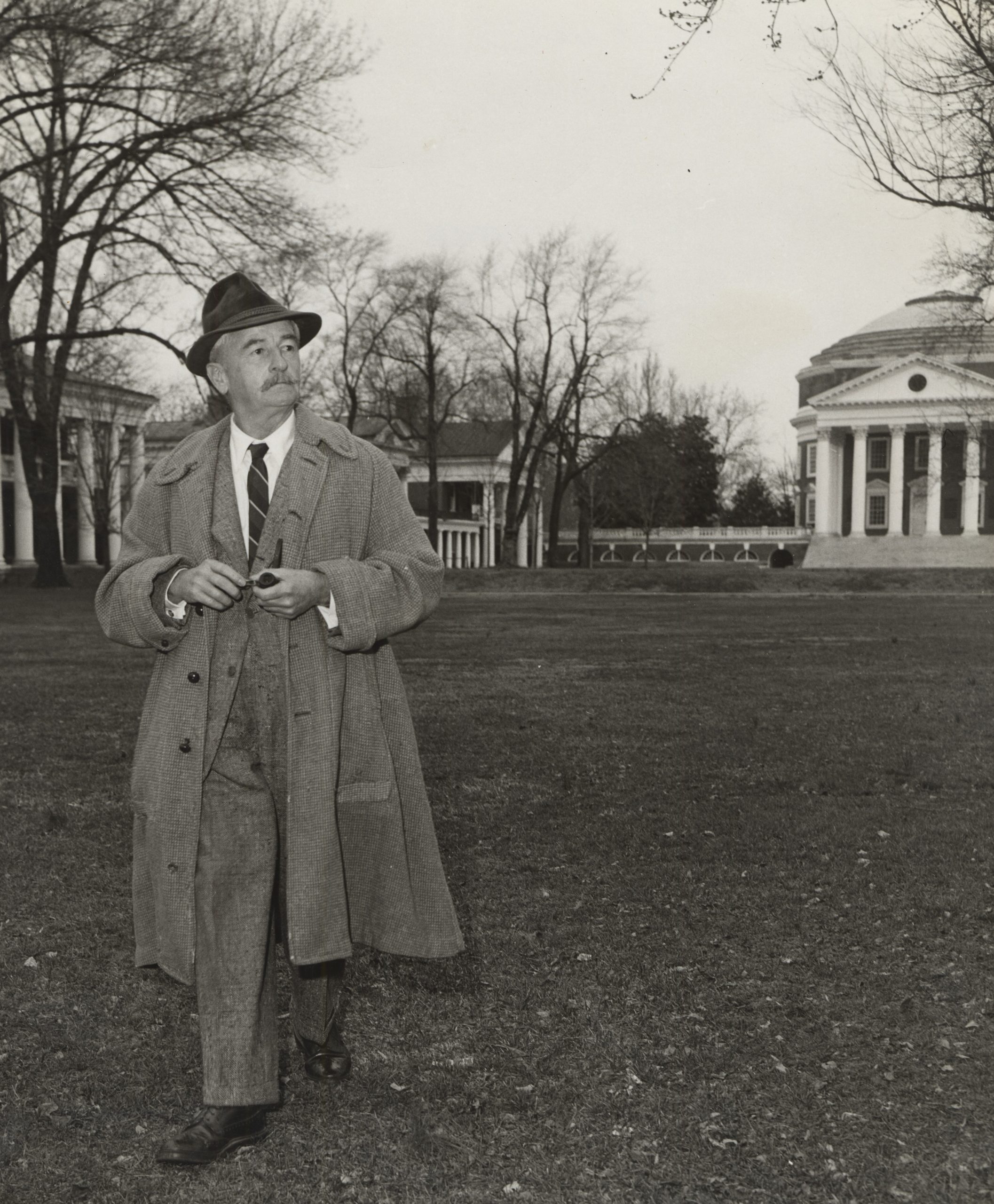
William Faulkner walking in front of the UVA rotunda
The first time I heard of the impressive collection of William Faulkner materials housed at the University of Virginia’s Special Collections Library was as an English graduate student when I had not the remotest idea that I would one day be working at Albert and Shirley Small Special Collections Library, let alone be one of the archivists who worked to process the collection. Like many of us in the GLAM (Galleries, Libraries, Archives and Museums) profession, I found my way here by accident. What started as a way to add to my income while finishing graduate school and teaching undergraduate students turned into a love for library and archival work that led to a career shift into the profession.
After more school and many internships along the way, I found myself in the role of the “William Faulkner Processing Intern,” which led to my newer position as the “William Faulkner Processing Archivist.” It’s difficult to convey just how surreal it felt, both as a former English student and a newly graduated Library Science student, to first lay eyes on the collection and be told that it was now my job to process it.
To give some more background information on the William Faulkner Collection, it is made up of nearly 300 different accessions. An archival accession is an acquisition of materials transferred to a repository as a unit at a single time.The very first of which in the William Faulkner Collection were deposited by William Faulkner himself, originally labeled as manuscript collection number (also known as MSS) 6074. Many other accessions have since been added by Joseph Blotner, Linton Massey, Jill Faulkner Summers, and more. The purpose of the William Faulkner Collection (now labeled as MSS 16807) project was to take all of these different accessions and put them together into one large collection to create a centralized location for researchers. Original MSS numbers would be kept in the descriptions of each folder/item so that researchers’ original citations would not be lost in the process.
For those who may not know, processing a collection involves first surveying and inventorying all parts of a collection, creating a processing plan, and then arranging and describing the collection, both intellectually and physically, creating a finding aid, like this one for Faulkner: Collection: William Faulkner Collection | ArchivesSpace Public Interface, and making notes and preservation interventions, if necessary. These tasks can include relocating materials from acidic folders or moldy boxes to new housings.
Before I was hired to continue processing the collection, it had first been taken on by a former UVA Processing Archivist, Elizabeth Nosari, who had done much of the preliminary work of inventorying the collection and creating a processing plan that divided the collection into ten series. A series is a way of organizing a collection into different categories that all materials can ideally fit into. The ten different series within the William Faulkner Collection consist of the following:
Series I: Literary Works of William Faulkner
Series II: Correspondence
Series III: Personal Papers, Files, and Realia
Series IV: Publishing Records
Series V: Business and Legal Records
Series VI: Photographs and Portraits
Series VII: Press and Publicity
Series VIII: William Faulkner at the University of Virginia
Series IX: Papers of Faulkner Scholars and Collectors
Series X: Adaptations and Third-Party Works Based on Faulkner Publications.
Nosari had already arranged and described Series I and II, so my job was to continue arranging and describing the collection and adding it to the ArchivesSpace finding aid, starting with Series III and ending with Series X.
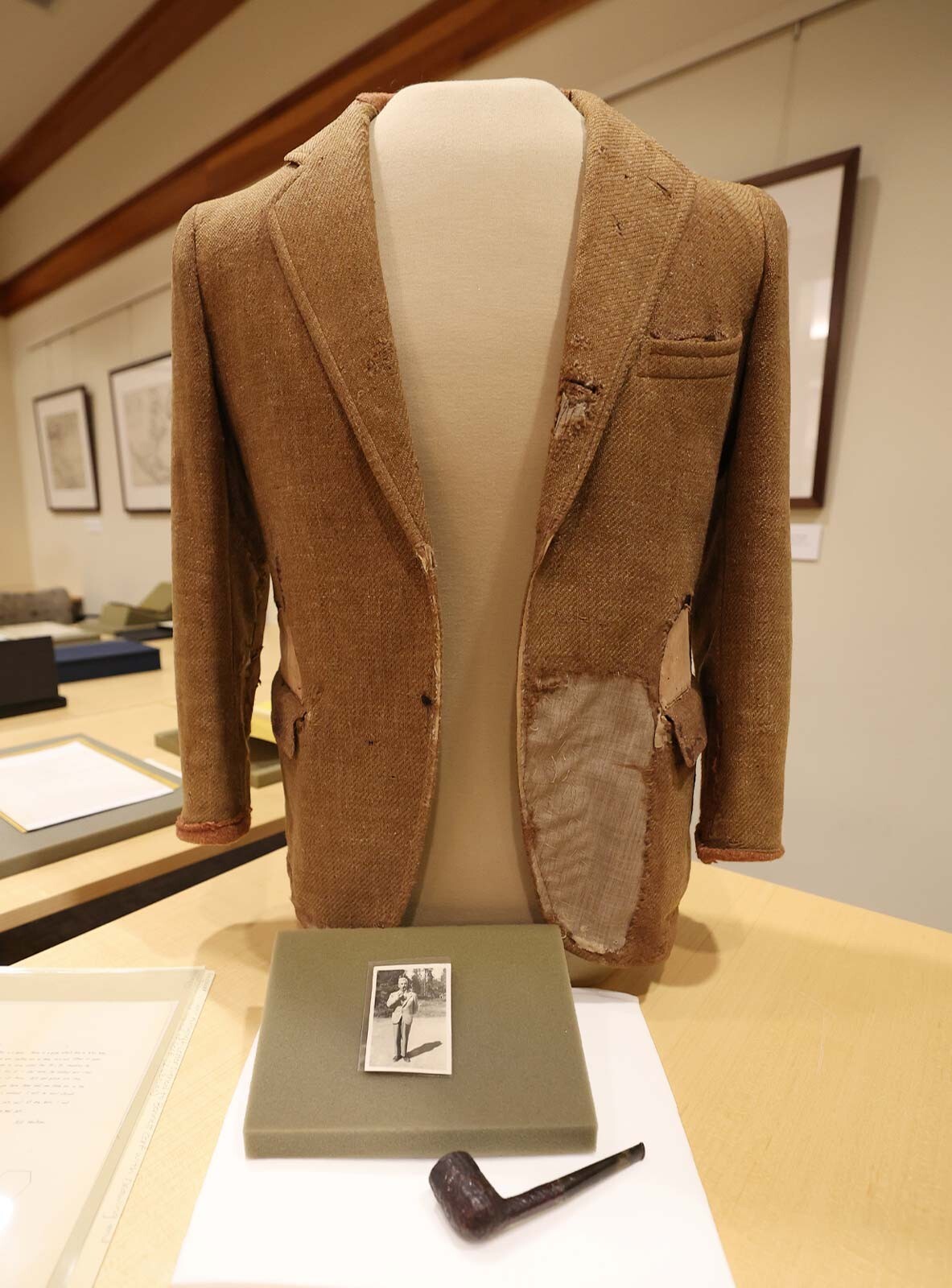
William Faulkner’s well-loved tweed jacket and pipe, posed alongside a photograph image of Faulkner wearing the jacket and smoking the pipe
I was pretty nervous, as while I had finished my formal education, this would be my first time processing a legacy archival collection, let alone one of this magnitude and one that had already been started by another archivist. I was fortunate to have colleagues who fully supported me as an early career professional and were always there to answer any questions I might have. One of the biggest challenges I faced was simply finding everything, as materials were in a variety of different locations throughout the stacks, vault, and other areas within Special Collections. One can imagine how difficult finding materials for researchers must have been for our reference archivists, as there were no concrete centralized locations to pull from. Another initial challenge, that soon became one of my favorite parts about working with the collection, was the sheer variety of differing materials within the collection, many of which I had not yet worked with, ranging from clothing, photographs, framed paintings, and more (including an actual brick from the post office where Faulkner used to work in Mississippi)!
If I had to choose my personal favorite part of the William Faulkner Collection, it would have to be the very first series I started with, Series III: Personal Papers, Files, and Realia, followed closely by Series VI: Photographs and Portraits. As a former English student, I had spent time reading and studying Faulkner’s work, but nothing could have prepared me for what it was like to delve so deeply into his personal life and records. There is something very intimate about processing a person’s collection, which feels a little like taking a step into their lives for hours of the day. While processing Series III and VI in particular, I really felt like I was getting to know not just William Faulkner the writer, but William Faulkner the person, as I worked with materials like personal notes, small doodles and illustrations done on the backs of scrap paper, family photographs, and even his used pipes. This is, at the end of the day, part of what first drew me to archival work; this ability to connect with others through time. When someone accesses the humanity of another through their collected histories or belongings, whether that be of a famous writer, like Faulkner, or of someone in their local community, an opportunity for learning is not only presented, but through that opportunity, another for connection. As I say goodbye to the William Faulkner Collection and to my lovely colleagues at the library, I am incredibly grateful for the opportunity I had to work with both an exceptional collection and an exceptional team. If you are reading this piece, I encourage you to visit the William Faulkner Collection, and when you are finished, see what else Special Collections has to offer!
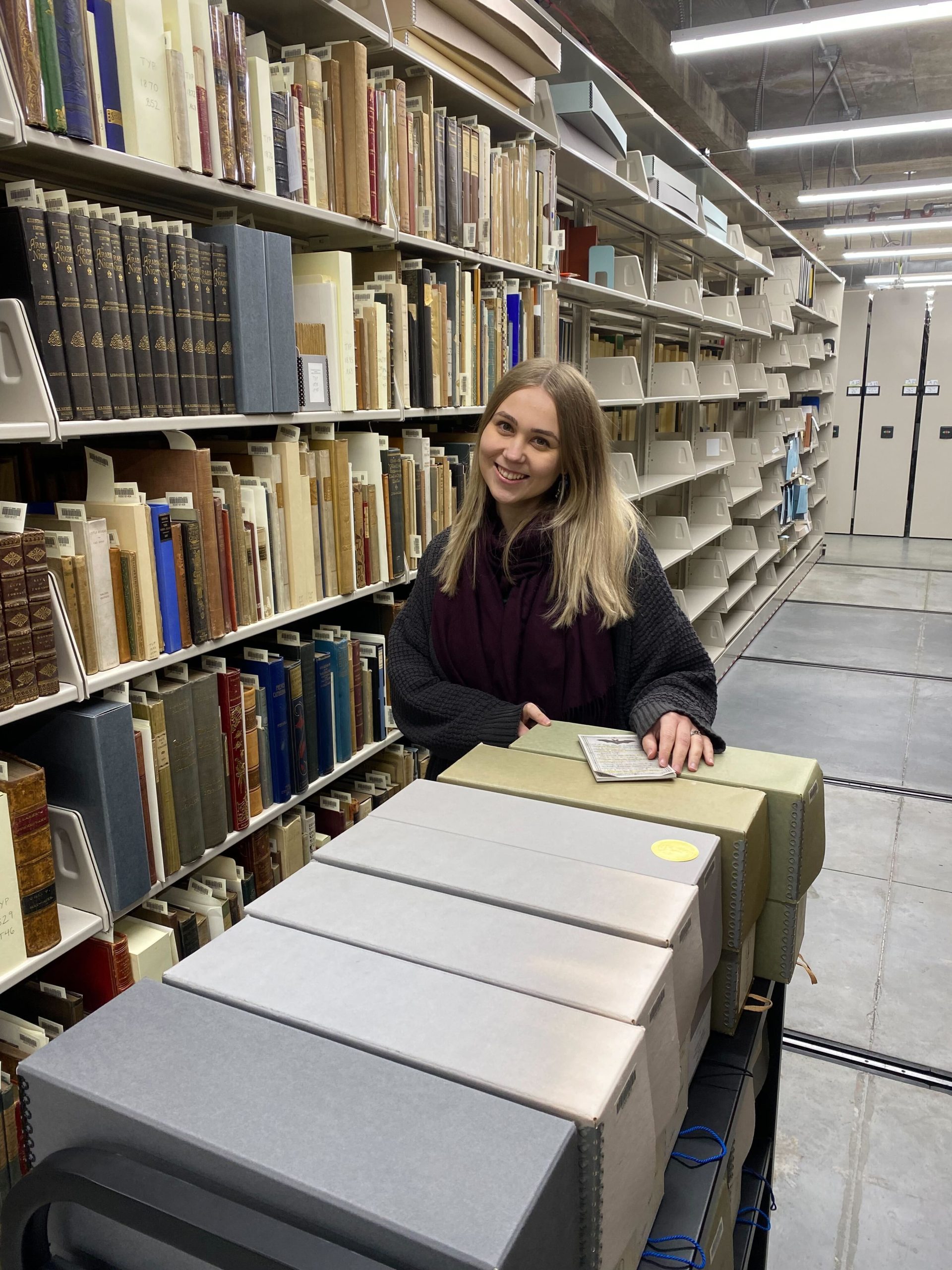
William Faulkner Collection Processing Archivist, Kaylin Preslar, in the stacks of UVA’s Special Collections Library
Thank you for reading!
Kaylin Preslar, William Faulkner Collection Processing Archivist
This post was contributed by Ellen Welch, Manuscripts and Archives Processor, to celebrate Juneteenth with a recent acquisition of two muster rolls from the United States Colored Troops. Company A, 19th Regiment. Maryland and Virginia. 1864–1865. Visit our library to view these documents and call out to the bravery of these soldiers! According to Pulitzer-prize winning historian and legal scholar, Annette Gordon-Reed, “Juneteenth is a day that all consider the importance of advancing human rights.”1 United States Colored Troops, 19th Regiment, Company A muster rolls, Chaffin Farm, Virginia, MSS 16963 (opens in new tab).
Emancipation Proclamation
On September 22, 1862, five days after the Battle of Antietam, President Lincoln announced that he would issue a formal emancipation of all enslaved men in any of the Confederate States that did not return to Union control by January 1, 1863. No states rejoined the Union, so President Lincoln implemented the Emancipation Proclamation by establishing a “Bureau of Colored Troops” to facilitate the recruitment of African American soldiers to fight for the Union Army.
Recruitment and Bravery of African American Troops
The United States Colored Troops (USCT) were regiments of the Army during the Civil War composed of over 200,000 soldiers. First recruited in 1863 following the Proclamation, the men of the 175 regiments of African American troops constituted approximately one-tenth of the Union Army. These men and their officers are remembered as Freedom Fighters who won in the struggle for their own liberation.2
African Americans from anywhere in the country were sanctioned to join the United States military and contribute to the cause that some saw as a struggle for a “new birth of freedom”. As the National Park Service notes, through their “valor, service, and sacrifice during the war, Black soldiers and sailors disproved the claims of African American inferiority and laid the groundwork for the future struggles in citizenship and voting rights that would continue for over one hundred years.”2
The USCT regiments were established in response to a demand for more units from Union Army commanders. They served in infantry, artillery, and cavalry. Approximately 110 African American soldiers became commissioned officers before the end of the war, as surgeons or chaplains. Nearly 20 percent of USCT soldiers were killed in action or died of disease and other causes — a rate about 35 percent higher than that of white Union troops. Many fought with distinction, with 16 receiving the Medal of Honor, according to historian Kelly Mezurek, author of For Their Own Cause: The 27th United States Colored Troops (The Kent State University Press, 2016).3
Muster Rolls from Company A, 19th Regiment
Krystal Appiah, Albert and Shirley Small Special Collections Library curator and head of collection development, acquired the muster rolls.They document the service of brave African American men who served over a two-month period at the outset of the final year of the Civil War.
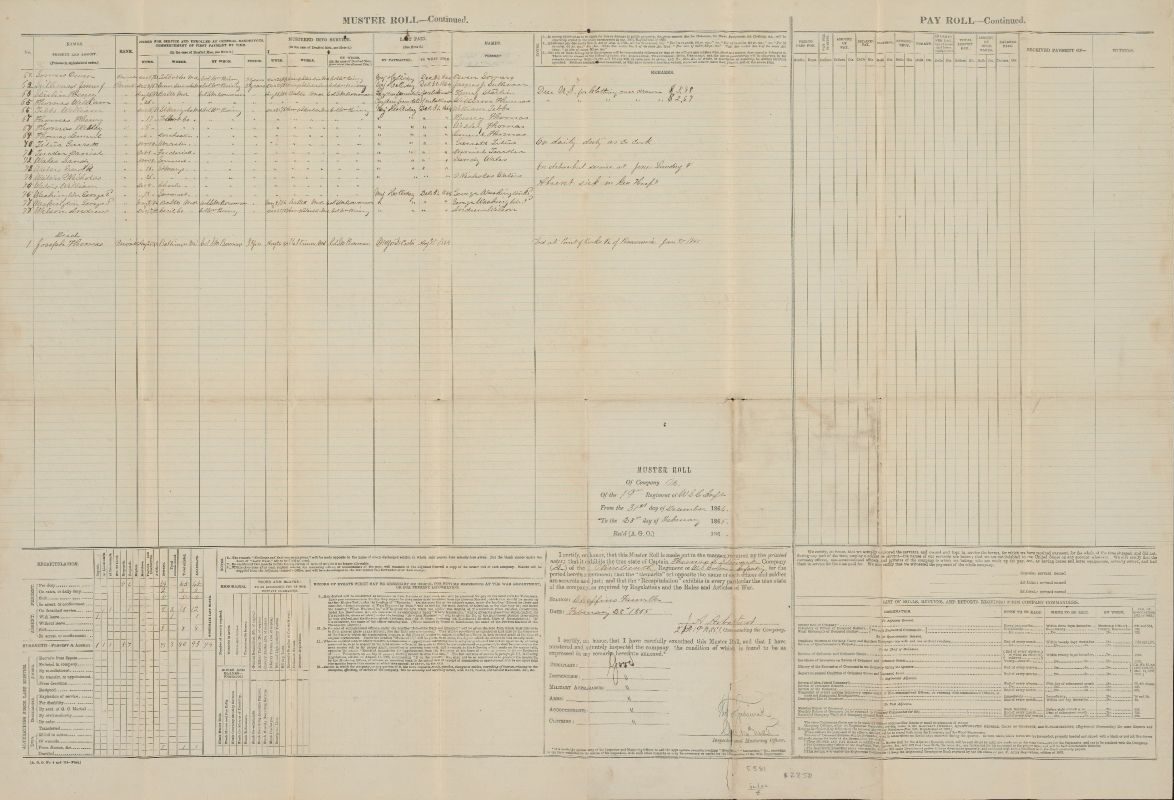
The first of the two muster rolls records details for seven officers, a surgeon, a chaplain, and four sergeants at Chaffin’s Farm, the site of the Battle of Chaffin’s Farm, 8 miles south of Richmond on the James River in Henrico County, Virginia. It includes the place and date of enlistment; where, when, and by whom mustered; the last date of pay; and comments about the status of each serviceman, including promotions and demotions, absences due to sickness, detached duty, and leave.
Muster Roll 1 (recto and verso)
Muster Roll 1 (recto-front of the muster roll): Muster Roll of the Field and Staff of the 19th Regiment of U.S.C. Troops Volunteers, Lt. Col. Joseph Perkins, December 31, 1864 – February 28, 1865. Special Collections, MSS 16963.Transcripts of Muster Roll (recto)
Field and Staff Officers — 19th Regiment USCT, December 31, 1864 to February 28, 1865, Chaffin’s Farm
Name
Rank
Date of Commission
Station
Mustered When / Where / By Whom
Last Pay Date
Remarks
Joseph Perkins
Lt. Col.
Nov. 9, 1863
Chaffin’s Farm
Nov. 9, 1863 / Washington, D.C. / Capt. H. J. Wood
Feb. 27, 1864 (Paymaster: Maj. Holliday)
Commanding Regiment
Samuel Knou
Major
Oct. 5, 1864
Near Petersburg
Oct. 5, 1864 / W. H. Harkins
Feb. 27, 1865
Pay due as Capt. from Aug. 31 to Oct. 5, 1864
Mills O. Carter
Surgeon
Oct. 12, 1864
Near Petersburg
Oct. 12, 1864 / W. H. Harkins
Dec. 31, 1865
Received pay of Surgeon from [date partially illegible]
Henry H. Spratz
AA Sergeant
Feb. 12, 1865
—
—
—
—
John Ransom
Surgeon
Feb. 20, 1865
Chaffin’s Farm
Capt. Pennington
Feb. 28, 1864 (Paymaster: Major Rochester)
Pay due from date of muster, 1865
Wm T. Sappington
1st Lt.
Nov. 27, 1863
Chaffin’s Farm
Dec. 20, 1863 / Benedict / Brig. Gen. Birney
—
Act. Brig. Quartermaster 3rd Brigade, 1st Div.
George H. Ropes
1st Lt. Adjt.
Nov. 18, 1863
Chaffin’s Farm
Dec. 24, 1863 / Brig. Gen. Birney
Feb. 28, 1864 (Paymaster: Major Rochester)
AA Adj. Gen.
Wm C. Bryant
1st Lt.
Nov. 19, 1863
Chaffin’s Farm
Dec. 20, 1863 / Benedict / Brig. Gen. Birney
Dec. 31, 1864 (Paymaster: Major Rochester)
—
Joseph A. Leach
Chaplain
Mar. 5, 1864
Baltimore, Maryland
Col. Bowman
—
Discharged by Order of War Dept. S.O. No. 81, February 1865
Muster Roll 1 (verso-back of the muster roll): Reverse side showing the commanding officer’s certification, inspector’s report rating the company “Good” in all six categories, continued roster of privates, and administrative reporting tables. 19th Regiment U.S.C. Troops, Chaffin’s Farm, February 28, 1865. Special Collections, MSS 16963.Transcript of Muster Roll (verso)
Non-Commissioned Staff — 19th Regiment USCT, December 31, 1864 to February 28, 1865
Name
Rank
Date of Enlistment
Place of Enlistment
Service Term / By Whom
Remarks
Charles W. Wright
Sgt. Major
Dec. 22, 1863
Baltimore, MD
3 yrs, Drafted / Brig. Gen. Birney
—
Charles Wachter
Steward
Feb. 12, 1864
Baltimore, MD
3 yrs, Re-enlisted
Due for clothing not drawn: $70.63
Alexander Martin
GM Sergeant
Nov. 14, 1863
Baltimore, MD
3 yrs, Drafted / Brig. Gen. Birney
—
John W. Diggs
Com. Sergeant
Mar. 31, 1864
Baltimore, MD
3 yrs / Col. Bowman
Absent, sick Sept. 25, 1864
Muster Roll 2
Muster Roll showing enlisted men at Camp Stanton and other Maryland locations under then Colonel William Birney and Colonel S. M. Bowman. Special Collections, MSS 16963.Transcript of Second Muster Roll
Muster Roll Continued
No. Names (Present and Absent), Rank, Joined and Enrolled at General Rendezvous commencement of first payment by time, When, Where, Whom, Period, Mustered into Service, Last Paid, Names, When, Where, By Whom, By Paymaster, to When, Notes.
62. Somers, Owen. Private. December 9, 1863. Talbot County, MD. Col. Wm Birney. 3 years. December 25, 1863, Camp Stanton. Col. Wm. Birney, Major Holladay, December 31, 1864
63. Sullivan, James, J. Private. December 8, 1863. Queen’s Anne County, MD. Col. Wm. Birney. 3 years. December 25, 1863. Camp Stanton. Col. Wm. Birney. Major Holladay, December 31, 1864.
64. Starlin, Henry. Private. August 26, 1864. Baltimore, MD. Co. S. M. Bowman. 3 years. August 26, 1864. Camp Stanton. Col. S. M. Bowman. Pay due from date of enlistment. Due US for clothing overdrawn $3.88. $2.67
65. Thomas, William. Private. August 26, 1864. Baltimore, MD. Colonel S. M. Bowman. 3 years. August 26, 1864. Camp Stanton. Col. S.M. Bowman. Major Holladay. December 31, 1864.
66. Tebbs, William. Private. December 16, 1863. St. Mary’s County, MD. Col. Wm. Birney. 3 years. December 25, 1863. Camp Stanton. Col. Wm. Birney. Major Holladay. December 31, 1864.
67. Thomas, Henry. Private. December 17, 1863. Talbot County, MD. Col. Wm. Birney. 3 years. December 25, 1863. Camp Stanton. Col Wm. Birney. Major Holladay. December 31, 1864.
68. Thomas, Wesley. Private. December 9, 1863. Talbot County, MD. Col. Wm. Birney. 3 years. December 25, 1863. Camp Stanton. Col. Wm. Birney. Major Holladay. December 31, 1864.
69. Thomas, Lemuel. Private. December 4, 1863. Dorchester, MD. Col. Wm. Birney. 3 years. December 25, 1863. Camp Stanton. Col. Wm. Birney. Major Holladay. December 31, 1864.
70. Titus, Garrett. Private. November 28, 1863. Worchester, MD. Col. Wm. Birney. 3 years. December 25, 1863. Camp Stanton. Col. Wm. Birney. Major Holladay. December 31, 1864.
71. Tucker, Daniel. Private. October 8, 1863. Frederick, MD. Col. Wm. Birney. 3 years. December 25, 1863. Camp Stanton. Col. Wm. Birney. Major Holladay. December 31, 1864. On daily duty.
72.Wales, Sandy. Private. November 28, 1863. Somerset, MD. Col. Wm. Birney. 3 years. December 25, 1863. Camp Stanton. Col. Wm. Birney. Major Holladay. December 31, 1864.
73. Waters, Enoch. Private. November 26, 1863. St. Mary’s County, MD. Col. Wm. Birney. 3 years. December 25, 1863. Camp Stanton. Col. Wm. Birney. Major Holladay. December 31, 1864. For detached service.
74. Waters, Nicholas. Private. November 26, 1863. St. Mary’s County, MD. Col. Wm. Birney. 3 years. December 25, 1863. Camp Stanton. Col. Wm. Birney. Major Holladay. December 31, 1864.
75. Waters, William. Private. December 8, 1863. Charles (County, MD) Col. Wm. Birney. 3 years. December 25, 1863. Camp Stanton. Col. Wm. Birney. Major Holladay. December 31, 1864. Absent. Sick in General Hospital.
76. Washington, George (2). Private. December 13, 1863. Somerset, MD. Col. Wm. Birney. 3 years. December 25, 1863. Camp Stanton. Col. Wm. Birney. Major Holladay. December 31, 1864.
77. Washington, George (3). Private. May 6, 1864. Baltimore, MD. Col. S. M. Bowman. 3 years. May 6, 1864. Camp Stanton. Col. S. M. Bowman. Major Holladay. December 31, 1864.
78. Wilson, Andrew. Private. December 7, 1863. Cecil County, MD. Col. Wm. Birney. 3 years. December 25, 1863. Col. Wm. Birney. Camp Stanton. Major Holladay. December 31, 1864.
Died
Joseph Thomas. Private. August 26, 1864. Baltimore. Col. S. M. Bowman. 3 years. August 26, 1864. Baltimore. Camp Stanton. Col. S. M. Bowman. Major DeCosta. August 31, 1864. Died at Point of Rocks, Virginia. Pneumonia. January 31, 1865.
The second muster roll records two months of activity from December 31, 1864, to February 28, 1865, also at Chaffin’s Farm. It lists three officers, five sergeants, seven corporals, and almost eighty privates, including one deceased soldier who died of pneumonia in January 1865. The enlisted men in the 19th Regiment came mostly from Maryland, as well as Accomack County, Virginia, and Washington, D.C. The inspection report on the verso (back of the muster roll) appraises the company as “Good” in all six categories evaluated: discipline, instruction, military appearance, arms, accoutrements, and clothing.
“Men of Color to Arms! Now or Never!” — Broadside recruiting African Americans for service, written by Frederick Douglass, 1863. Printing ink on rag paper. Collection of the Smithsonian National Museum of African American History and Culture.4
Transcription of broadside
MEN OF COLOR
To Arms! To Arms!
NOW OR NEVER
This is our golden moment! The Government of the United States calls for every Able-bodied Colored Man to enter the Army for the THREE YEARS’ SERVICE! AND JOIN IN FIGHTING THE BATTLES OF LIBERTY AND THE UNION
A new era is open to us. For generations we have suffered under the horrors of slavery, outrage and wrong; our manhood has been denied, our citizenship blotted out, our souls seared and burned, our spirits cowed and crushed, and the hopes of the future of our race involved in doubt and darkness. But now our relations to the white race are changed. Now, therefore, is our most precious moment. Let us rush to arms!
FAIL NOW, & OUR RACE IS DOOMED
On this the soil of our birth. We must now awake, arise, or be forever fallen. If we value liberty, if we wish to be free in this land, if we love our country, if we love our families, our children, our home, we must strike now while the country calls; we must rise up in the dignity of our manhood and show by our own right arms that we are worthy to be freemen. Our enemies have made the country believe that we are craven cowards, without soul, without manhood, without the spirit of soldiers. Shall we die with this stigma resting upon our graves? Shall we leave this inheritance of Shame to our Children? No! a thousand times NO! We WILL Rise! The alternative is upon us. Let us rather die freemen than live to be slaves. What is life without liberty? We say that we have manhood; now is the time to prove it. A nation or a people that cannot fight may be pitied but cannot be respected. If we would be regarded men, if we would forever
SILENCE THE TONGUE OF CALUMNY
of Prejudice and Hate, let us Rise Now and Fly to Arms! We have seen what
VALOR AND HEROISM
OUR BROTHERS DISPLAYED AT PORT HUDSON AND MILLIKEN’S BEND,
Though they are just from the galling, poisoning grasp of Slavery, they have startled the World by the most exalted heroism. If they have proved themselves heroes, cannot WE PROVE OURSELVES MEN?
ARE FREEMEN LESS BRAVE THAN SLAVES
More than a Million White Men Have Left Comfortable Homes and joined the Armies of the Union to save their Country. Cannot we leave ours, and swell the Hosts of the Union, to save our liberties, vindicate our manhood, and deserve well of our Country. MEN OF COLOR! the Englishman, the Irishman, the Frenchman, the German, the American, have been called to assert their claim to freedom and a manly character, by appeal to the sword. The day that has seen an enslaved race in arms has, in all history, seen their last trial. We now see that
OUR LAST OPPORTUNITY HAS COME
If we are not lower in the scale of humanity than Englishmen, Irishmen, White Americans, and other Races, we can show it now.
MEN OF COLOR, BROTHERS AND FATHERS! WE APPEAL TO YOU!
By all your concern for yourselves and your liberties, by all your regard for God and humanity, by all your desire for Citizenship and Equality before the law, by all your love for the Country, to stop at no subterfuge, listen to nothing that shall deter you from rallying for the Army. Come Forward, and at once Enroll your Names for the Three Years’ Service.
STRIKE NOW!
And you are henceforth and forever FREEMEN!
E.D. Bassett, Wm. Whipper, D.D. Turner, Jas. McCrumell, A.S. Cassey, A.M. Green, J.W. Page, L.R. Seymour, Rev. J. Underdue, John W. Price, Augustus Dorsey, William D. Forten, Rev. Stephen Smith, N.W. Depee, Dr. J. H. Wilson, J.W. Cassey, Frederick Douglass, P.J. Armstrong, J.W. Simpson, Rev. J. B. Trusty, S. Morgan Smith, William E. Gipson, Rev. J. Boulden, Rev. J. Asher, Rev. J.C. Gibbs, Daniel George, Robert M. Adger, Heary M. Cropper, Rev. J.B. Reeve, Rev. J. A. Williams, Rev. A.L. Stanford, Thomas J. Bowers, Elijah J. Davis, John P. Burr, Robert Jones, O. V. Catto, Thos. J. Dorsey, I.D. Cliff, Jacob C. White, Morris Hall, James Needham, Rev. Elisha Weaver, Ebenezer Black, Rev. William T. Catto, James R. Gordon, Samuel Stewart, David B. Bowser, Henry Minton, Daniel Colley, J.C. White, Jr., Rev. J.P. Campbell, Rev. W.J. Alston, J.P. Johnson, Franklin Turner, Jesse E. Glasgow.
U.S. Steam-Power Book and Job Printing Establishment, Ledger Buildings, Third and Chestnut Streets, Philadelphia.
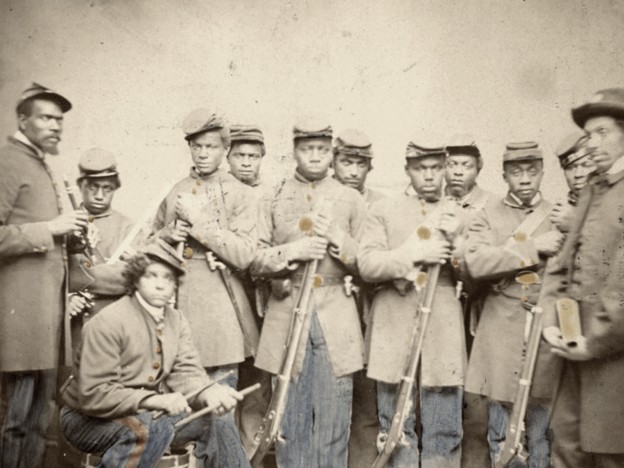
United States Colored Troops, Company C, 19th Regiment. Samuel Bond (center, sixth from left) was formerly enslaved in Talbot County and died of dysentery in Brownsville, Texas. Infectious disease was the leading cause of death for all soldiers. Photograph from the Ross Kelbaugh Collection, promised gift to the National Gallery of Art.5
Training at Camp Stanton and the Surrender of General Lee’s Army at Appomattox Courthouse
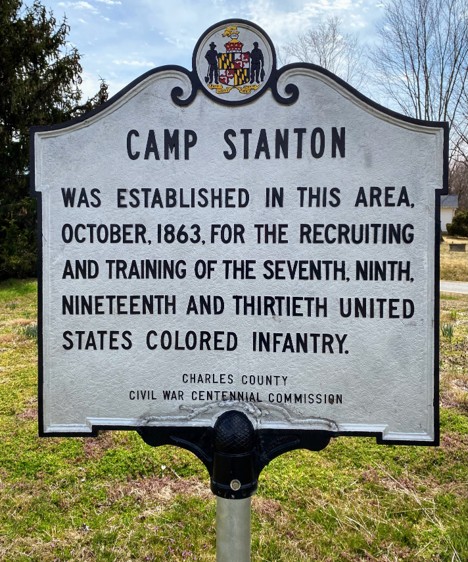
Training and organization took place at Camp Stanton, located on the Patuxent River in Benedict, Maryland. It was strategically placed near the quarters of enslaved people and was a pivotal Civil War recruiting and training camp for African American soldiers.6 General William Birney organized and oversaw several regiments of African American troops, including the 7th, 9th, 19th, and 30th USCTs at Camp Stanton. He recruited soldiers for the Union and was an ardent abolitionist who aggressively liberated enslaved people.7
The soldiers of the 19th Regiment were described as having “great proficiency in discipline and drill” and were commended for their “bearing and military qualities,” despite the prejudice of the times against “colored troops.” They were ordered to join the Army of the Potomac under General Ulysses S. Grant in the Overland Campaign. Following skirmishes, the 19th Regiment engaged in their first major combat on May 6, 1864, at the Battle of the Wilderness, and later participated in the Siege of Petersburg, sustaining heavy casualties.8
African American soldiers were among the first Union troops to enter Richmond, Virginia, when the Confederate capital fell in April 1865. The soldiers of the 19th Regiment played a central role in the Appomattox campaign leading to the surrender of General Lee’s army on April 9–10, 1865, at Appomattox Courthouse.8
Camp Stanton Historic Marker9
African American Troops at Camp Stanton Help to Bring Freedom
After further service at Brownsville and the Rio Grande in Texas, the regiment was mustered out on January 25, 1867. On June 19, 1865, federal troops went into Texas to effectively end slavery in the United States and create a day of celebration and independence for African Americans across the country. This was the birth of Juneteenth, commemorating an important event in our nation’s history and honoring African American men who fought to make it happen and whose role in ending slavery and whose sacrifices for the country are often overlooked. In 2021, Juneteenth became a federal holiday, recognizing the significance of this day in American history on a national level.
The courage displayed by African America troops during the Civil War played an important role in obtaining their Civil Rights. As Frederick Douglass said in an 1863 speech:
Once let the black man get upon his person the brass letters U.S.; let him get an eagle on his button, and a musket on his shoulder, and bullets in his pocket, and there is no power on the earth or under the earth which can deny that he has earned the right of citizenship in the United States.
By supporting the Union, enslaved and free African Americans living in the North and South courageously advanced the cause of freedom for more than four million enslaved people.10
Sam Collins, Texas historian and co-chair of the Juneteenth Legacy Project, described the often-unrecognized contribution that could only have been made by African American service members and volunteers during the Civil War:
The North could not have won if not for the Black troops, the United States Colored Troops, because in addition to additional manpower, many of them were [enslaved persons] who had important intel. What is often forgotten is that those runaway slaves — men who escaped in search of freedom — knew the Southern territory and landscape. So not only did they take their physical bodies when they ran away, hurting the labor force of the Southern plantations, they also took intel with them. They knew where the creeks were; they knew where you could cross; they knew where [the Confederacy] was storing guns and supplies. So, they would have been able to share that information with Union officers.
Collins also reflected on how Juneteenth relates to July 4th as a day of American independence:
The Fourth of July was a freedom birthday for the country. So just like a family, we’re family members who have different birthdays. We celebrate on both days, because not everybody was free on July 4, and Juneteenth represents that expansion of freedom to others.
In 1865, President Lincoln acknowledged that “without the military help of the black freedmen, the war against the south could not have been won.”11
The USCT were a big part of bringing the message into Galveston, Collins noted — a role that made Juneteenth possible.
According to Annette Gordon-Reed, author of ‘On Juneteenth’, “The day is tailor-made for thinking about history and the struggle that Blacks and our allies have waged to make the promise of Juneteenth real. Juneteenth has always been about gathering family and community together. Everyone of any race can do that.” 12
Lincoln’s proclamation to establish a “Bureau of Colored Troops.” National Parks Service. African American Civil War Memorial. District of Columbia. Accessed 29 May 2026. https://www.nps.gov/afam/learn/historyculture/index.htm