Photo-Process Phriday… Blueprints!

The Conservation Lab is taking over the Photobook Phriday post this week to feature a Photographic process: blueprints!

Recently, the conservation lab has been working on blueprints from the Charles M. Robinson Collection. A blueprint is essentially a photographic process used to copy architectural drawings. A support (paper or piece of linen) is coated with a material that is sensitive to light. Then that support is put in contact with a photographic negative or object and exposed to light, which makes the lines of the negative or object water soluble. The now water-soluble lines are then washed off, leaving an image that is mostly blue with white lines where the negative had touched the surface. A fixing solution is usually also required, which prevents re-sensitizing of the surface.
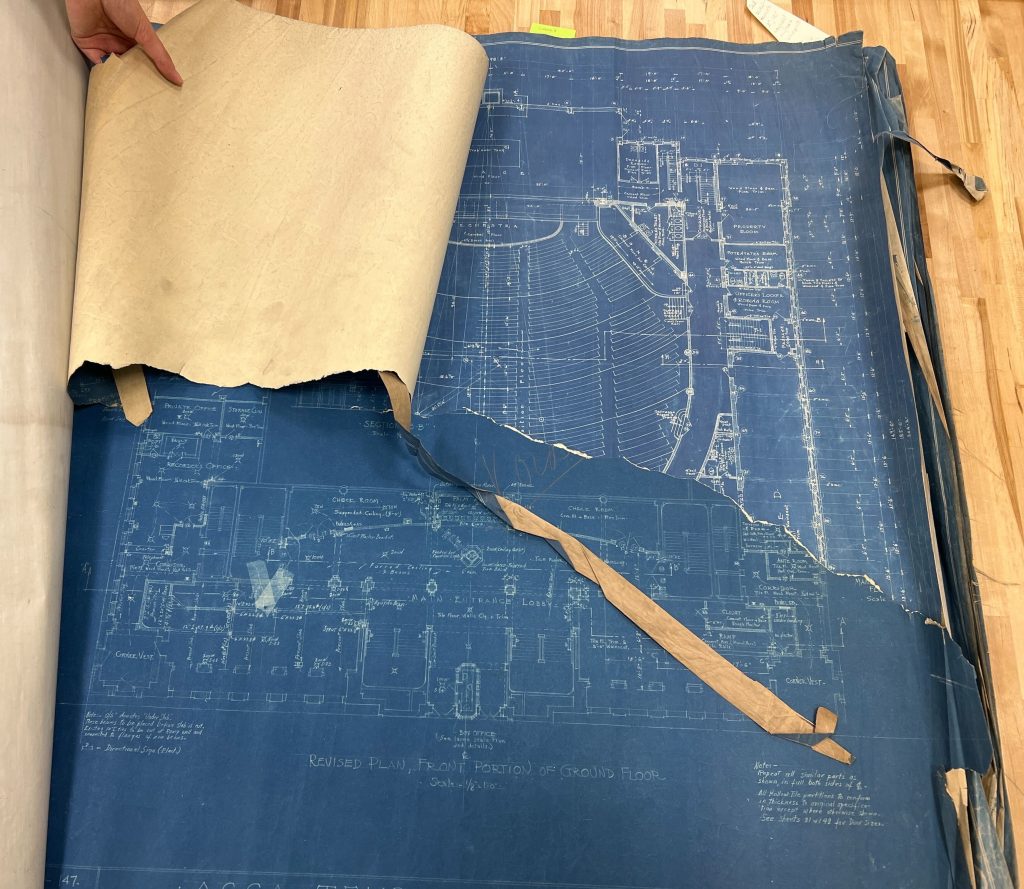
Image of a blueprint showing the inside of a building. A hand at the top left of the image is holding back half of the blueprint to demonstrate it has been torn in half.
Example of a blueprint from the Charles M. Robinson collection that has been torn through the middle.

Charles M. Robinson was an architect in the Richmond, Virginia, area who was active between the early 1900s-1930s. UVA Library’s Special Collections acquired Robinson’s archives as well as successor architectural firms in 2019 because of the wealth of information regarding the design of public buildings and schools for Black and minority citizens in Virginia.

The blueprints in the lab are designs for the Acca Temple in Richmond, at the northwest corner of Main and Laurel streets. The design for the building was inspired by Mosque Temples and opened in 1926. Today, the location is known as the Altria Theater.

The Acca Temple blueprints were working blueprints, which means they were heavily used by the architects and construction workers on site. In this set of blueprints, there are 22 individual pages 36″ x 36″ square that are bound together with brass brads between a linen cover sheet that is 72″ x 36″. They are on two different kinds of supports: paper and coated linen, and both kinds are stained and torn, showing the evidence of their use. The archivists responsible for processing, or describing, this collection identified this set of blueprints as needing help from Preservation primarily because of the large tears through the middle of page 6 of the Acca Temple blueprints, as well as other pages.

CAV Collections Conservator Brittany Murray dry cleaned the blueprints with soot erasers and cosmetic sponge erasers. The designs were so dirty that without cleaning them, it would be nearly impossible to adhere torn pieces back together. Conservator for Special Collections Sue Donovan then reached out to photograph conservators to ensure we were applying the most up-to-date information about blueprint mending to the items in the lab. The Conservators first tried applying strips of thin Japanese paper, previously coated with an even layer of wheat starch paste and then reactivated with an ultrasonic mist of deionized water. These mends were unfortunately not strong enough to hold on the paper or the linen, however. So Sue used wheat starch paste to realign the edges of jagged tears and then applied strips of a thin Japanese paper called Tengucho to the verso of the blueprints with an even layer of wheat starch paste.
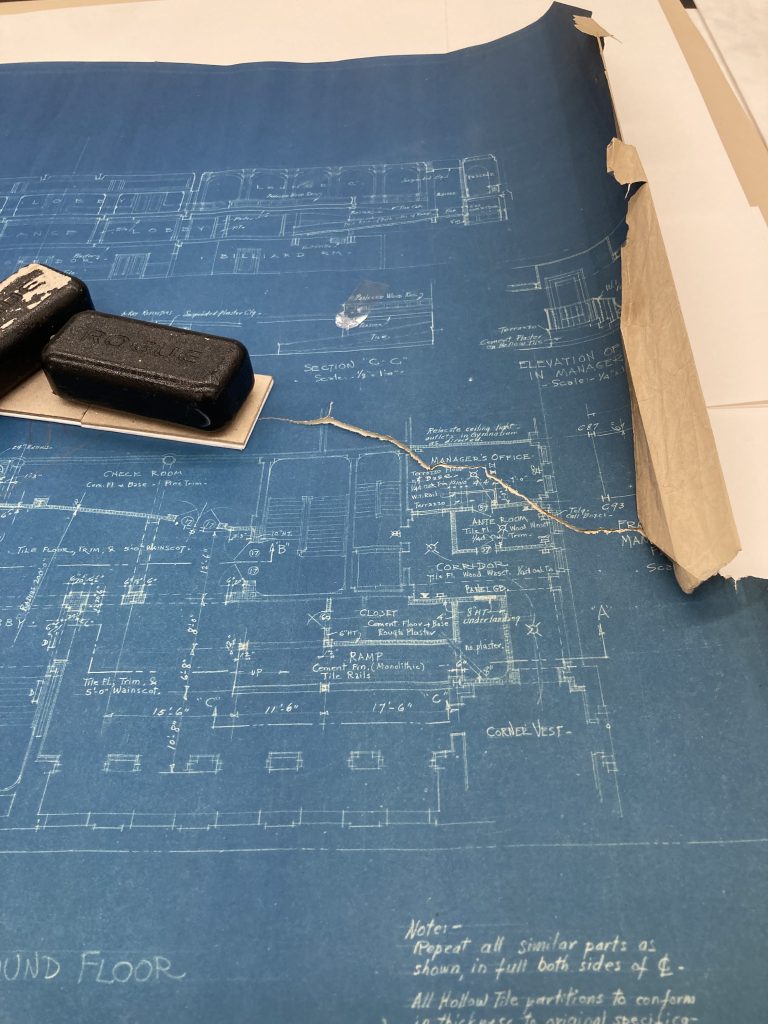
A blueprint is being mended, with a stack of board weight down with a black weight on top of a torn section of the blueprint.
The overlapping areas of the large tear through page 6 of this set of blueprints are reattached to each other with paste, weight down under a small stack of blotter and board and a heavy weight.

These mends were dried under small stacks of non-woven polyester strips, blotter, board, and weight. Blueprints are sensitive to alkalinity and light, so the blotters were tested to make sure the pH was suitable for blueprints prior to using them for the mending process. While the blueprints were in the lab, they were covered up to protect them from light when they were not actively being worked on.
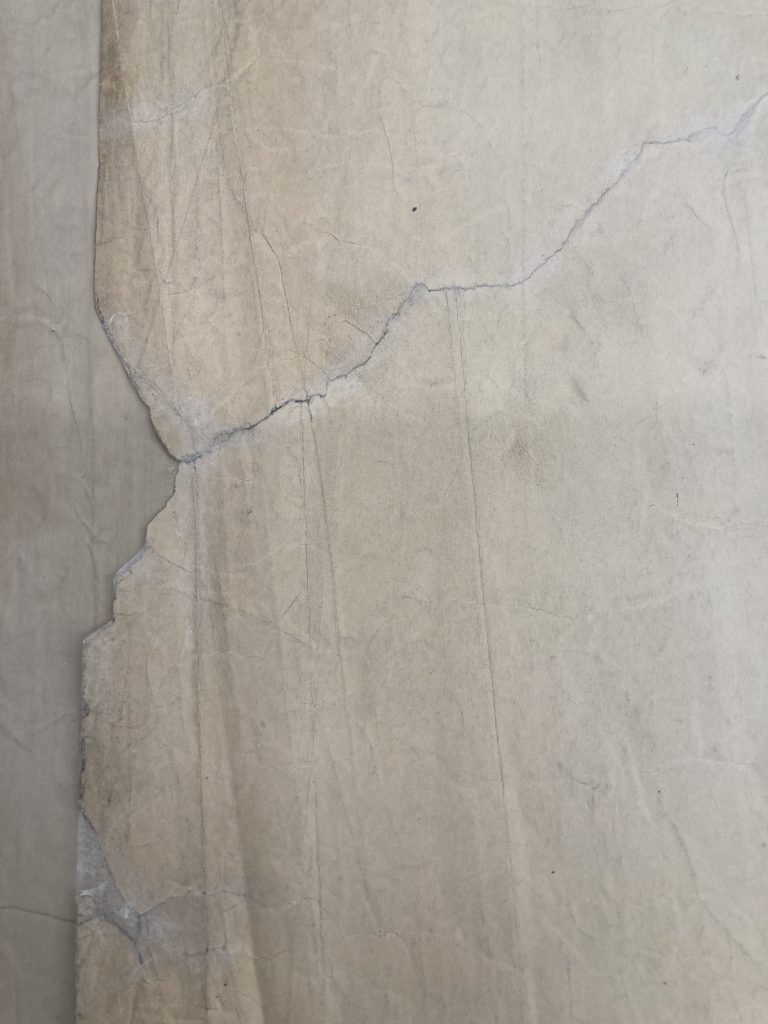
The blueprint has now been completely mended, and work will continue on the other blueprints in this collection, including blueprints made on coated linen.

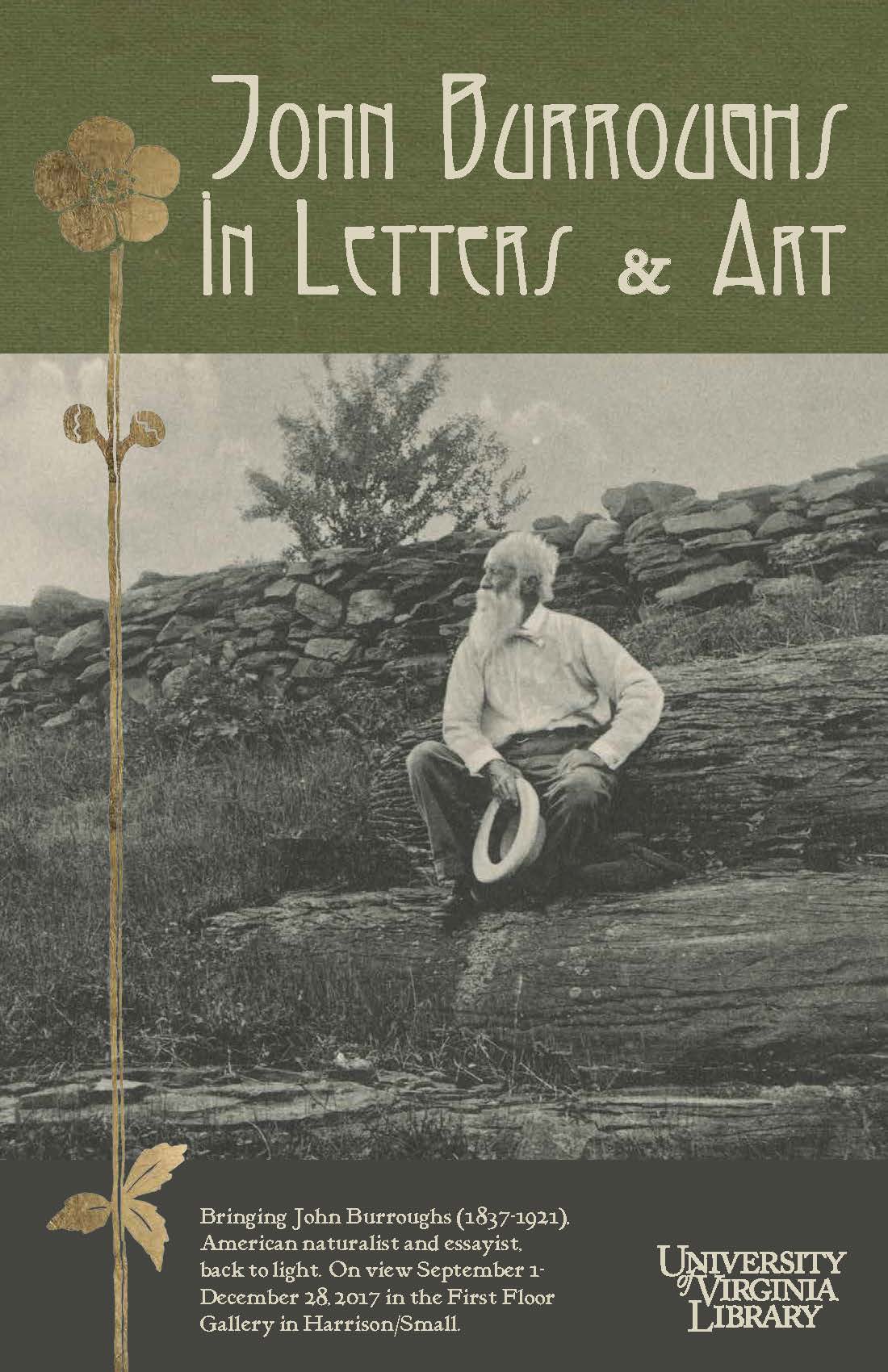
Image of a blueprint with a large tear going through the middle of the page that has been mended.
The same blueprint from the first photograph, now mended.

On View Now: “John Burroughs: In Letters & Art”

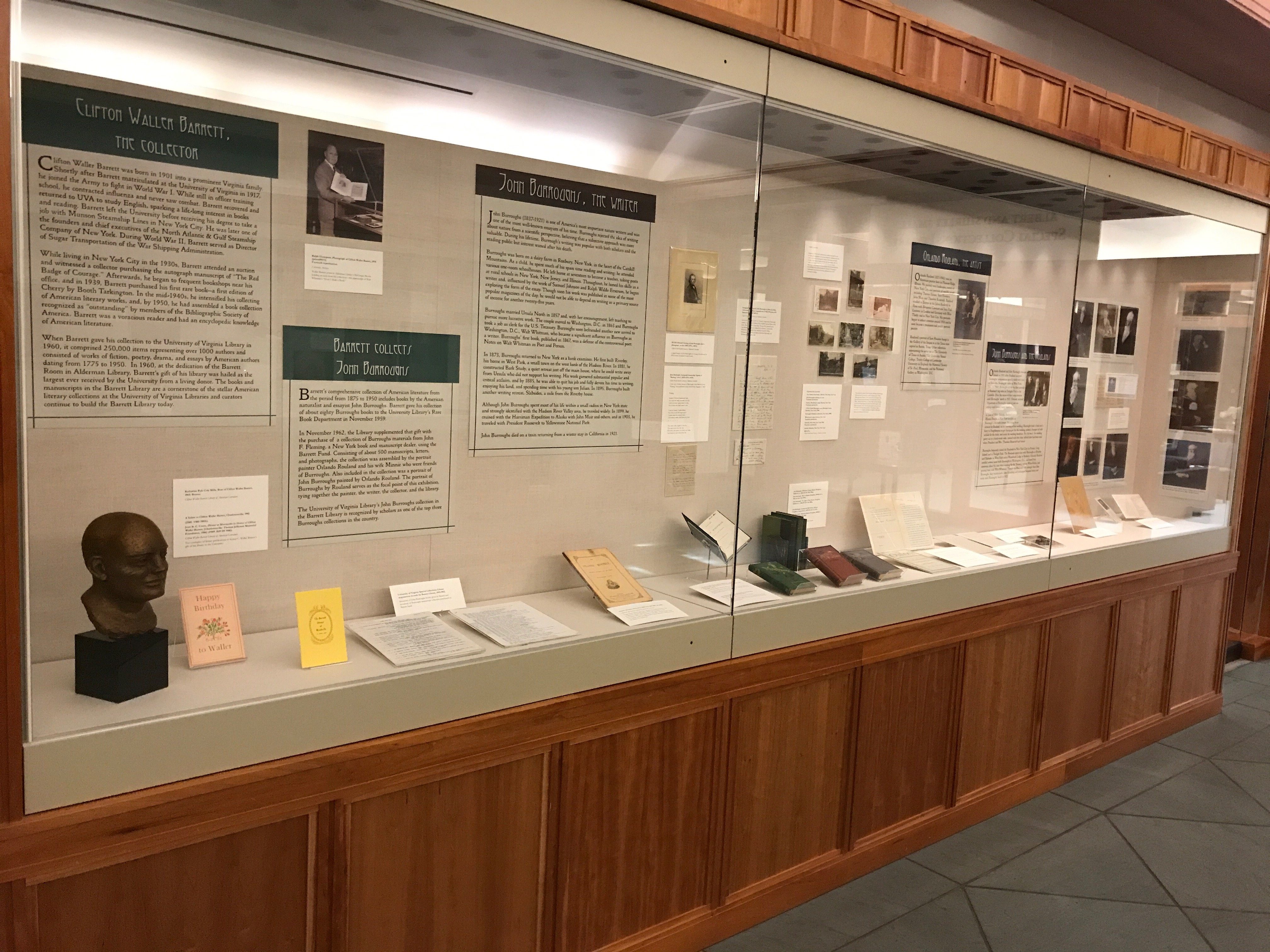
We are pleased to announce our latest First Floor Gallery exhibition, “John Burroughs: In Letters & Art.” It runs through December 28, 2017.

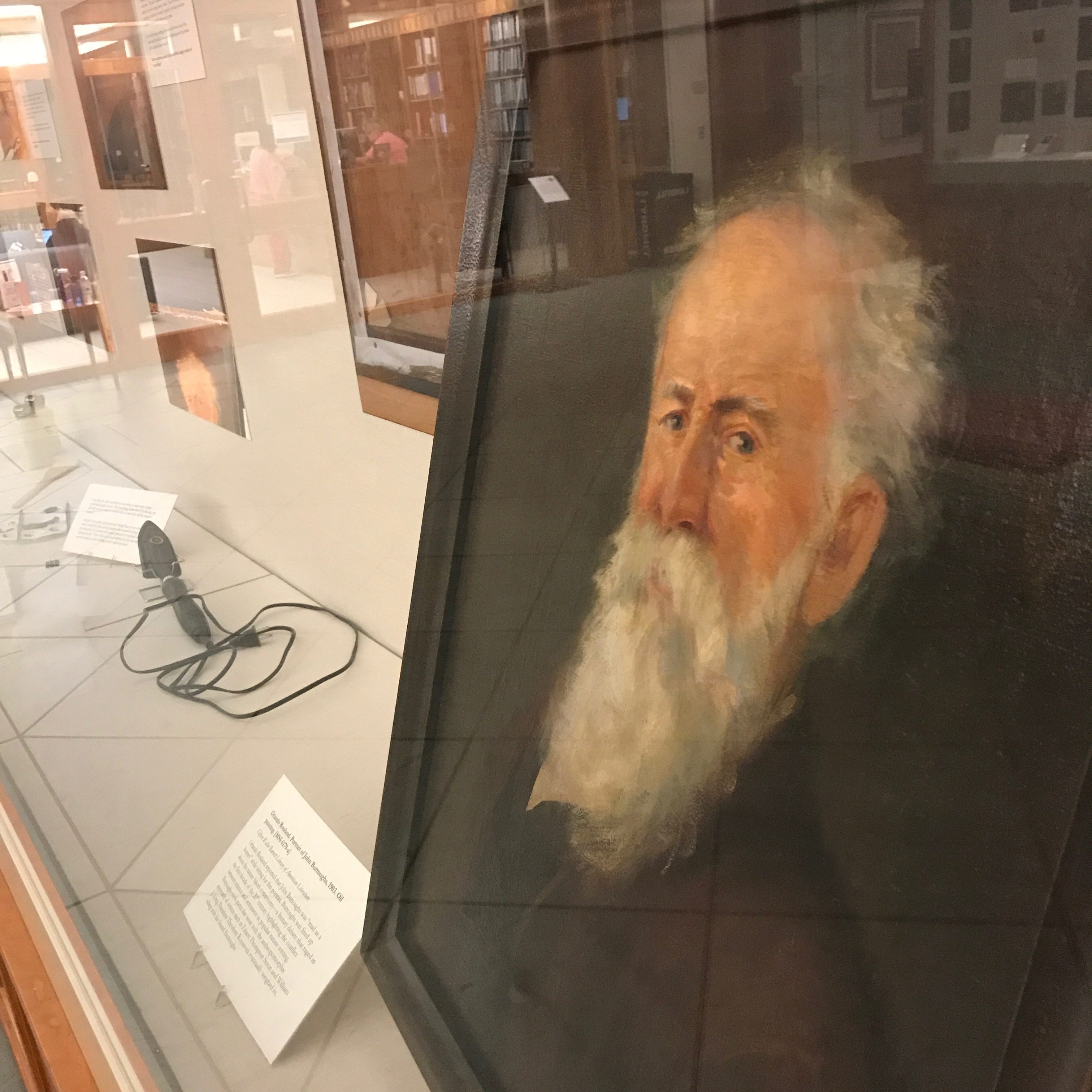
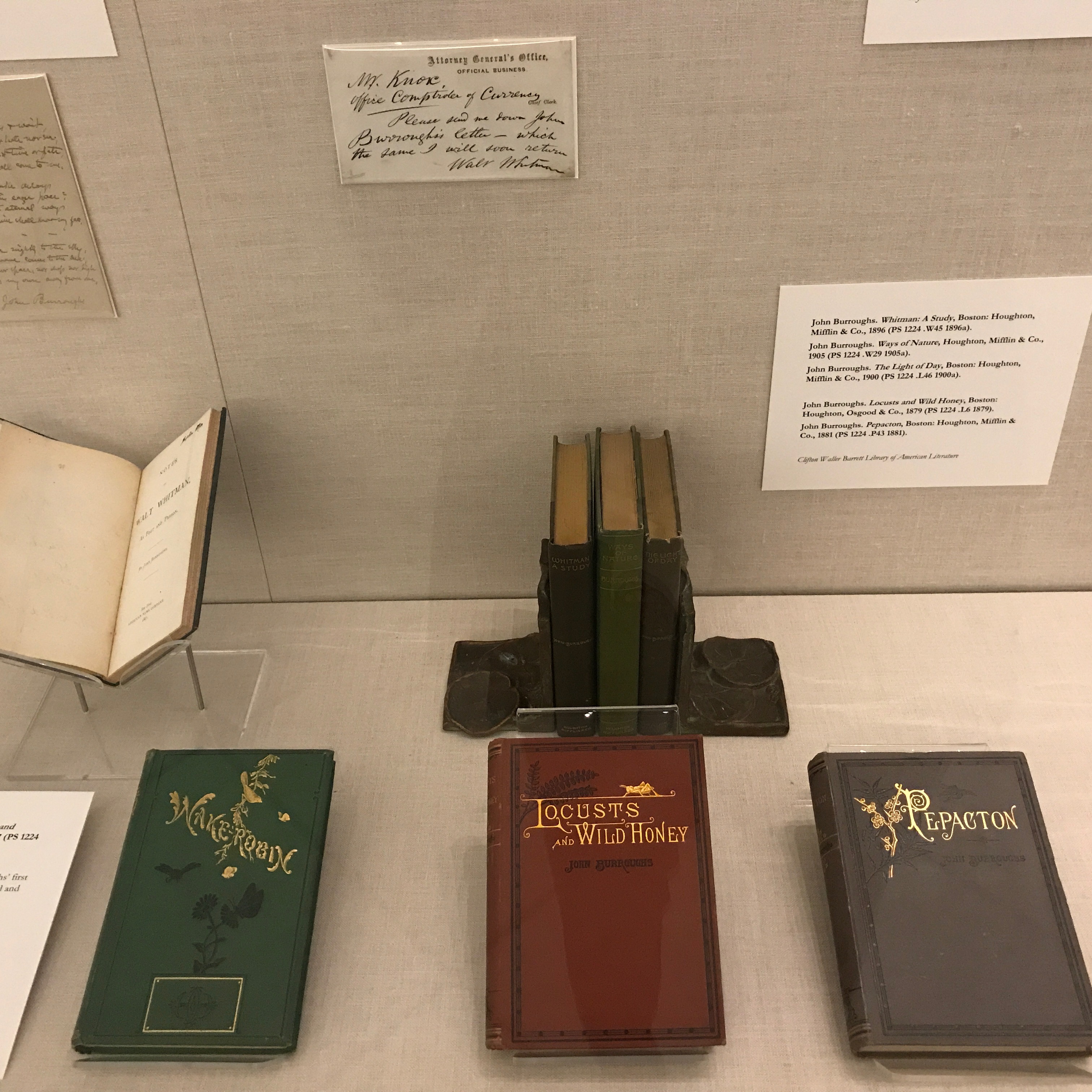
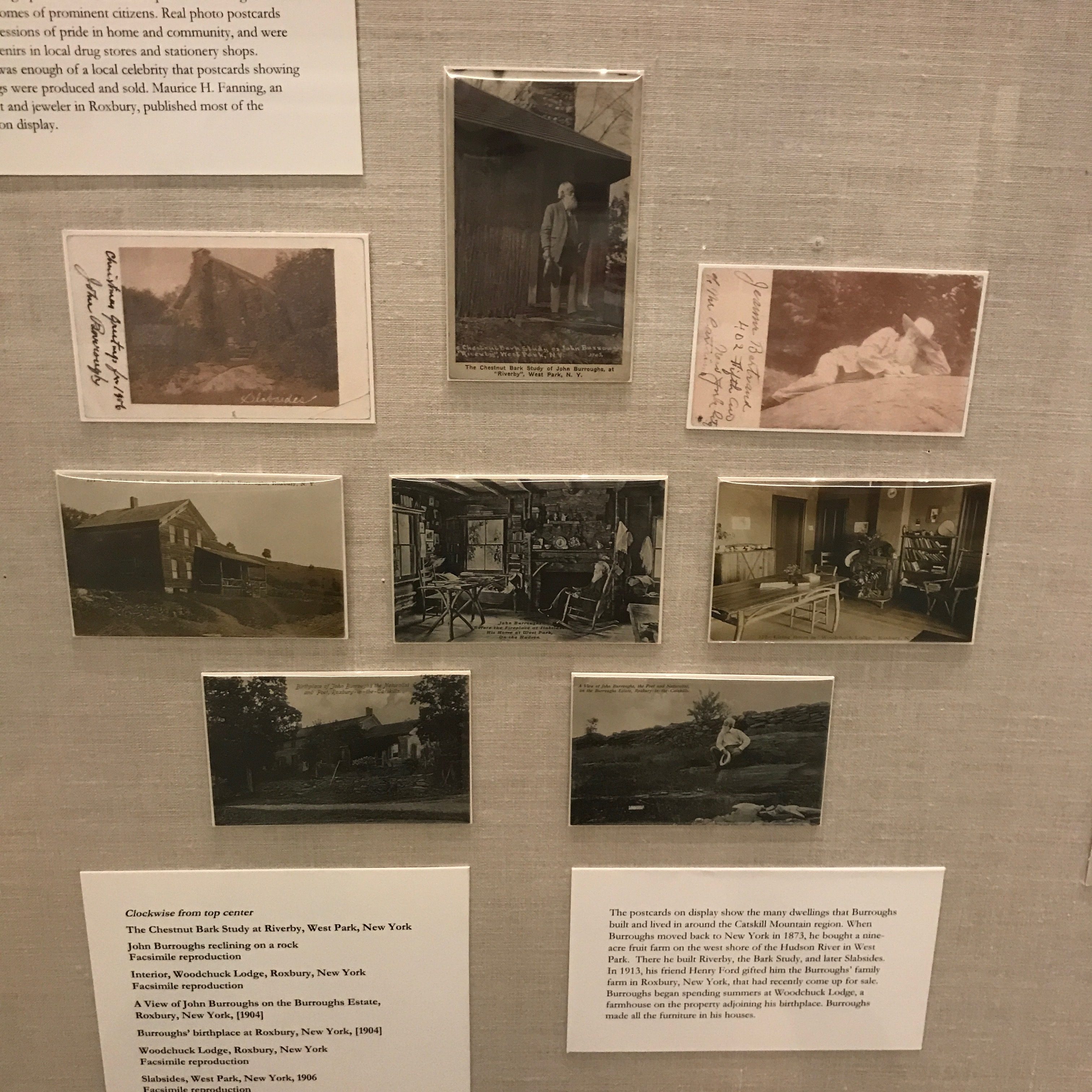
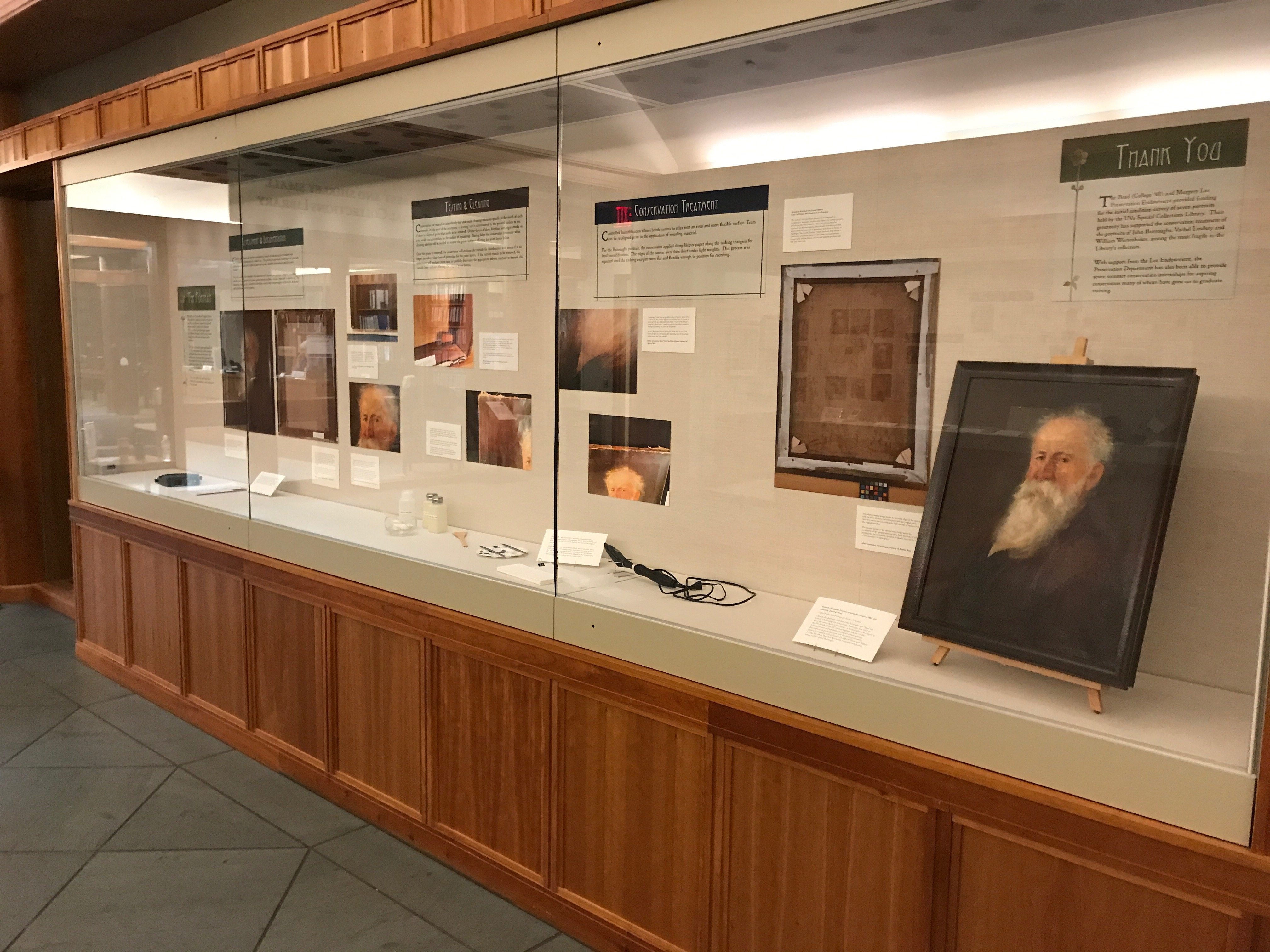
Inspired by the recent conservation treatment of a portrait of Burroughs painted by Orlando Rouland, this exhibition brings an important American naturalist back to light. The painting serves as the focal point of the exhibition, tying together writer, artist, collector, and library. The exhibition showcases books, manuscripts, and other materials from the Burroughs collection. John Burroughs’ (1837-1921) essays on nature were widely read by both scholars and the reading public during his lifetime. He counted among his friends prominent men including Walt Whitman, Theodore Roosevelt, Henry Ford, John Muir, and Thomas Edison.The Burroughs collection is part of the Clifton Waller Barrett Library of American Literature at the University of Virginia.

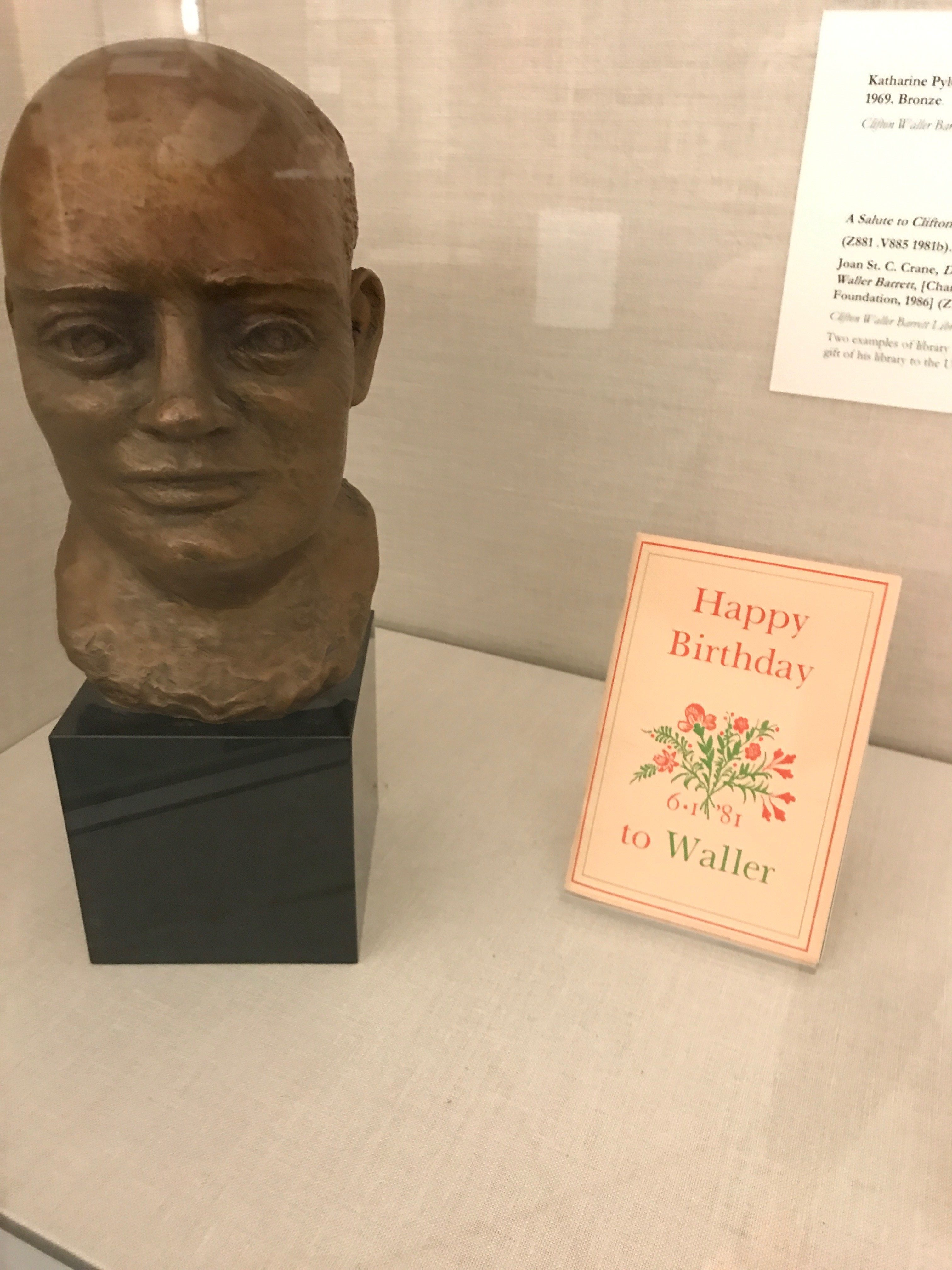
Here are a few tastes of the exhibition in photographs:

The portrait around which the exhibition was planned. Nearby are some of the tools used in its conservation treatment.


Part of the exhibition celebrates Clifton Waller Barrett’s work building the Burroughs collection.


We look forward to seeing you in the gallery!


This Just In: We Welcome The Day of Doom!

Today’s post actually concerns an important acquisition made nearly two years ago. At that time the item was too fragile for reader use. But after extensive conservation treatment, it is now ready and available. Please join us in welcoming to our shelves Michael Wigglesworth’s celebrated didactic poem, The day of doom!

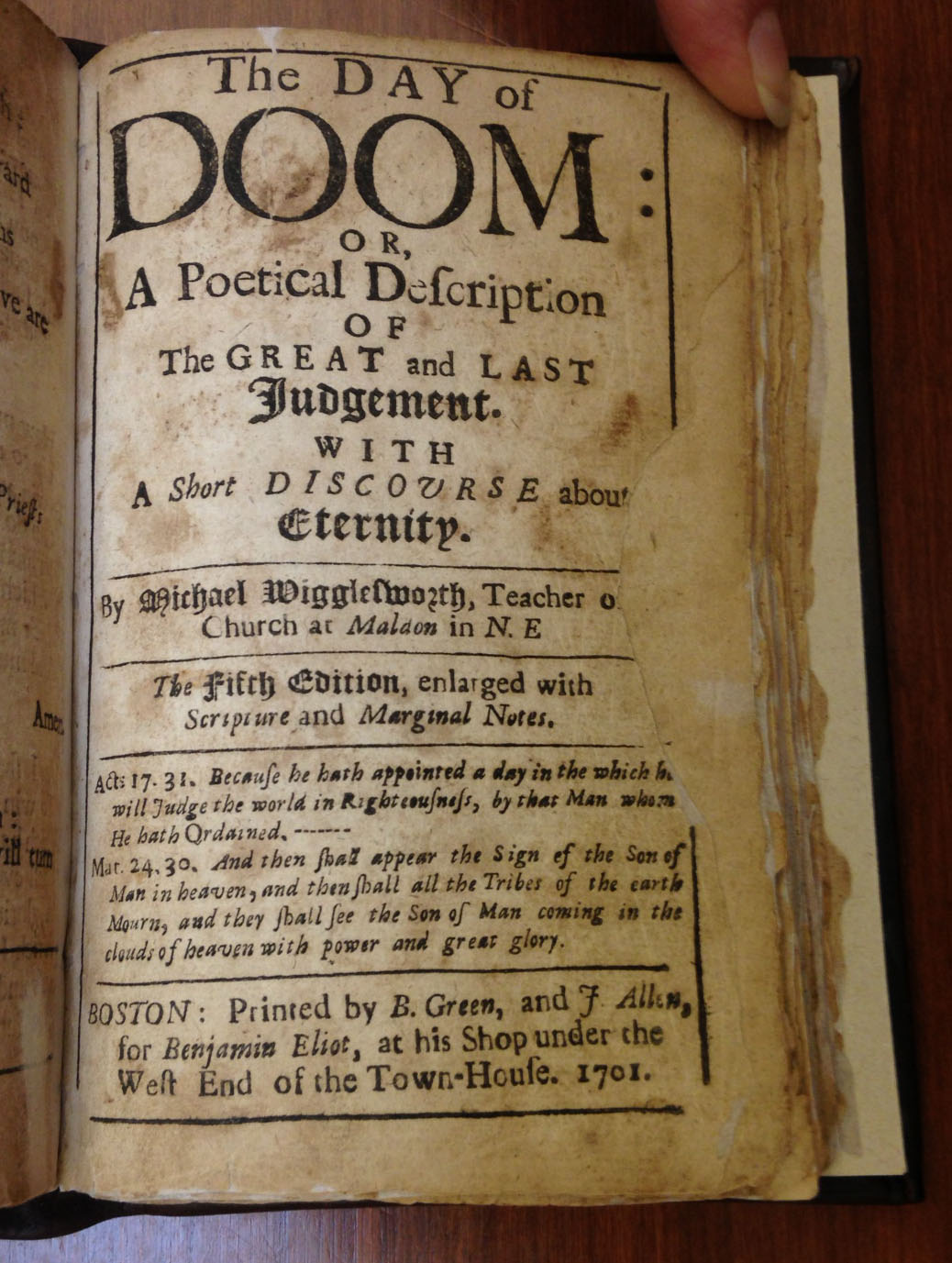
The title page to Michael Wigglesworth's The Day of Doom (Boston, 1701). It is bound, as issued, following the second edition of Wigglesworth's other verse collection, Meat Out of the Eater (Boston, 1689).

The title page to Michael Wigglesworth’s The Day of Doom (Boston, 1701). It is bound, as issued, following the second edition of Wigglesworth’s other verse collection, Meat Out of the Eater (Boston, 1689).

The day of doom, a quintessentially Puritan poem of over 200 eight-line stanzas vividly describing Judgment Day and the torments awaiting sinners in Hell, was the first book of poetry printed in the American Colonies and the first American bestseller. Its author, Michael Wigglesworth, graduated from Harvard in 1651 and served the town of Malden, Mass., as minister and physician. The day of doom is the foundation of any collection of early American literature, yet it is also one of the legendary rarities of early American printing. Only one fragmentary copy survives of the first edition, printed in Cambridge, Mass., ca. 1662, and only four fragmentary copies of the second edition of 1666. For the past century the Boston, 1715 edition (there is a copy at U.Va. in the Tracy W. McGregor Library of American History) has been what booksellers term the “earliest obtainable edition,” that is, the earliest one could still hope to find a copy of.

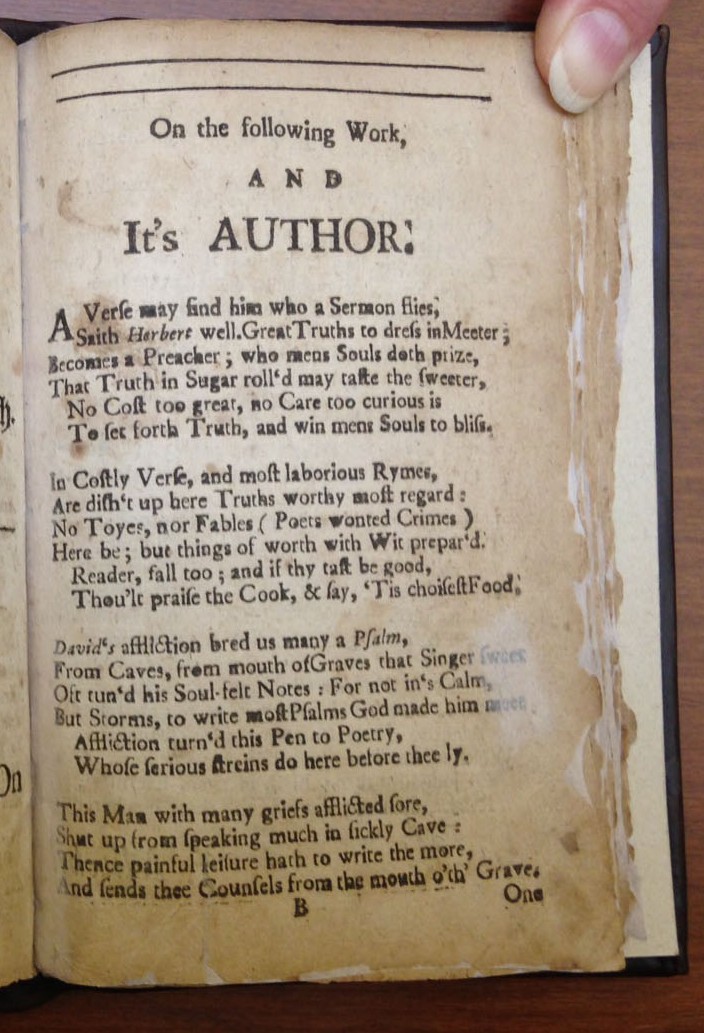
Wigglesworth explains (and the popularity of his Day of Doom proves) why a stanza of verse is worth more than the proverbial thousand words of sermon.

Wigglesworth explains (and the popularity of his Day of Doom proves) why a stanza of verse is worth more than the proverbial thousand words of sermon.

Two years ago a previously unrecorded copy of the Boston, 1701 edition—the third printed in America—unexpectedly surfaced. It is the eighth known copy, and one of only three that are complete. Passed down from generation to generation in one New England family for three centuries, it was acquired by a bookseller who immediately gave U.Va. first refusal. The offer could not be refused, for U.Va.’s otherwise superlative American literature collection has notable gaps in its Colonial-era holdings. This acquisition, purchased on the McGregor Endowment, Library Associates, and Robert and Virginia Tunstall Trust Funds, significantly remedies that weakness.

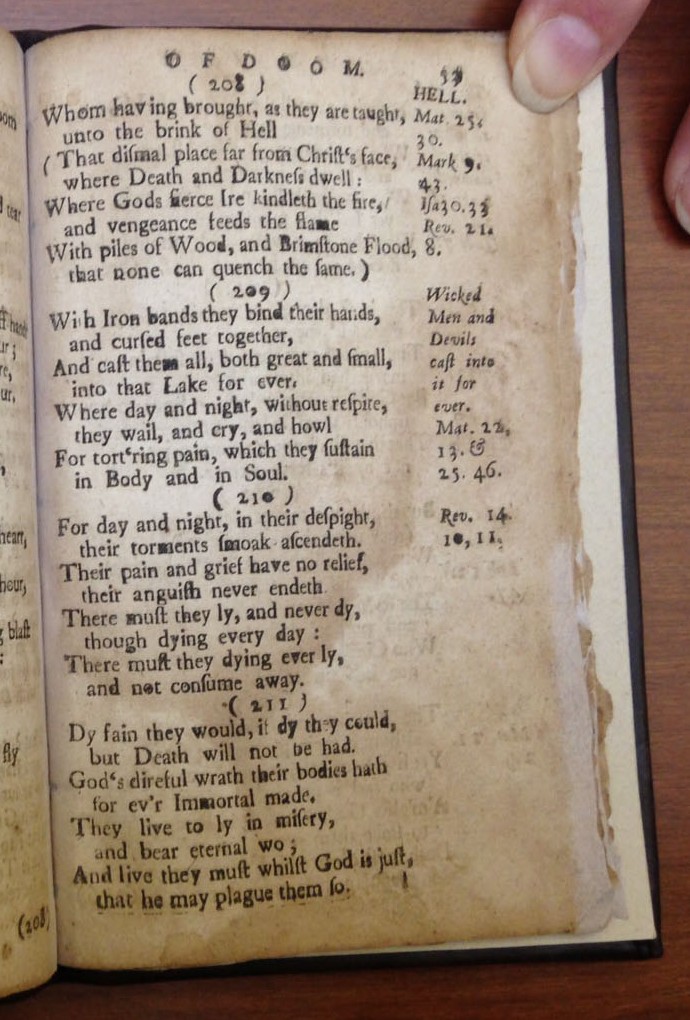
A portion of Wigglesworth's vivid verse description of the torments awaiting sinners in Hell.

A portion of Wigglesworth’s vivid verse description of the torments awaiting sinners in Hell.

The volume actually contains two works bound together: the 1701 Day of doom (Boston: Printed by B. Green, and J. Allen, for Benjamin Eliot), and the second edition (Boston: Printed by R. P[ierce] for John Usher, 1689) of Wigglesworth’s only other book of poetry, Meat out of the eater or meditations concerning the necessity, end, and usefulness of afflictions unto Gods children, of which this is only the sixth known copy. This newly discovered copy is especially important because it proves what bibliographers have long suspected: that the 1689 work was reissued in 1701 with a new printing of the Day of doom to form a volume containing Wigglesworth’s collected works.

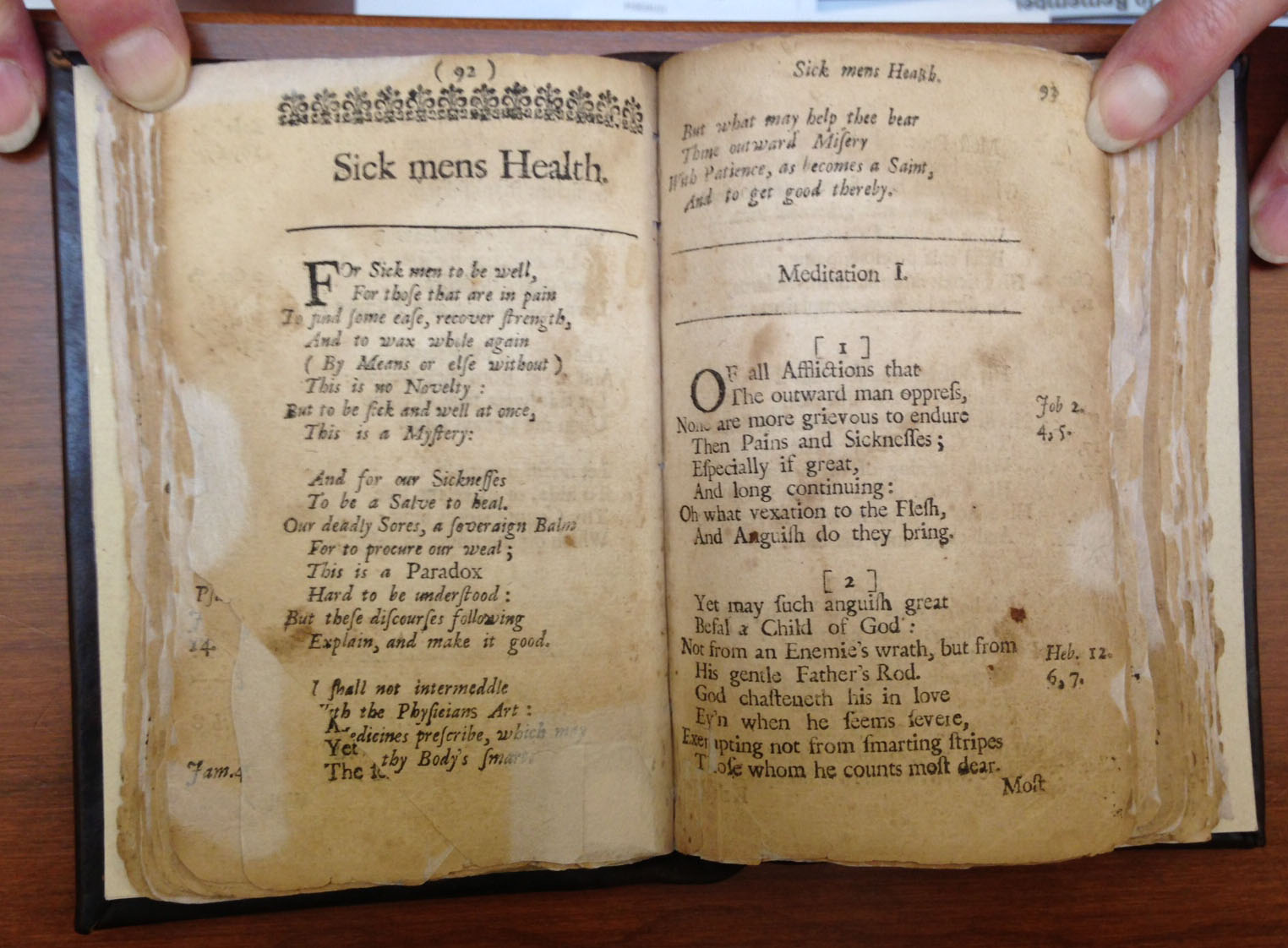
An opening from Meat Out of the Eater, showing a bit of textual loss and some of the marginal mends made to virtually every leaf.

An opening from Meat Out of the Eater, showing a bit of textual loss and some of the marginal mends made to virtually every leaf.

When received, the volume lacked two leaves and portions of others and was in very fragile state, with marginal tears to virtually every leaf. The blind-tooled calf binding, probably done in Boston shortly after publication, was quite worn, and a previous owner had crudely repaired the original sewing. Several generations of owners had added their signatures to the book. Clearly the volume had been read so frequently as to nearly wear it out. All in all, a very evocative object, but one that was too fragile to use. But because this unexpected opportunity would almost certainly be the only chance we would ever have to obtain a copy of either of these exceptionally rare works in any condition, we decided to acquire it.

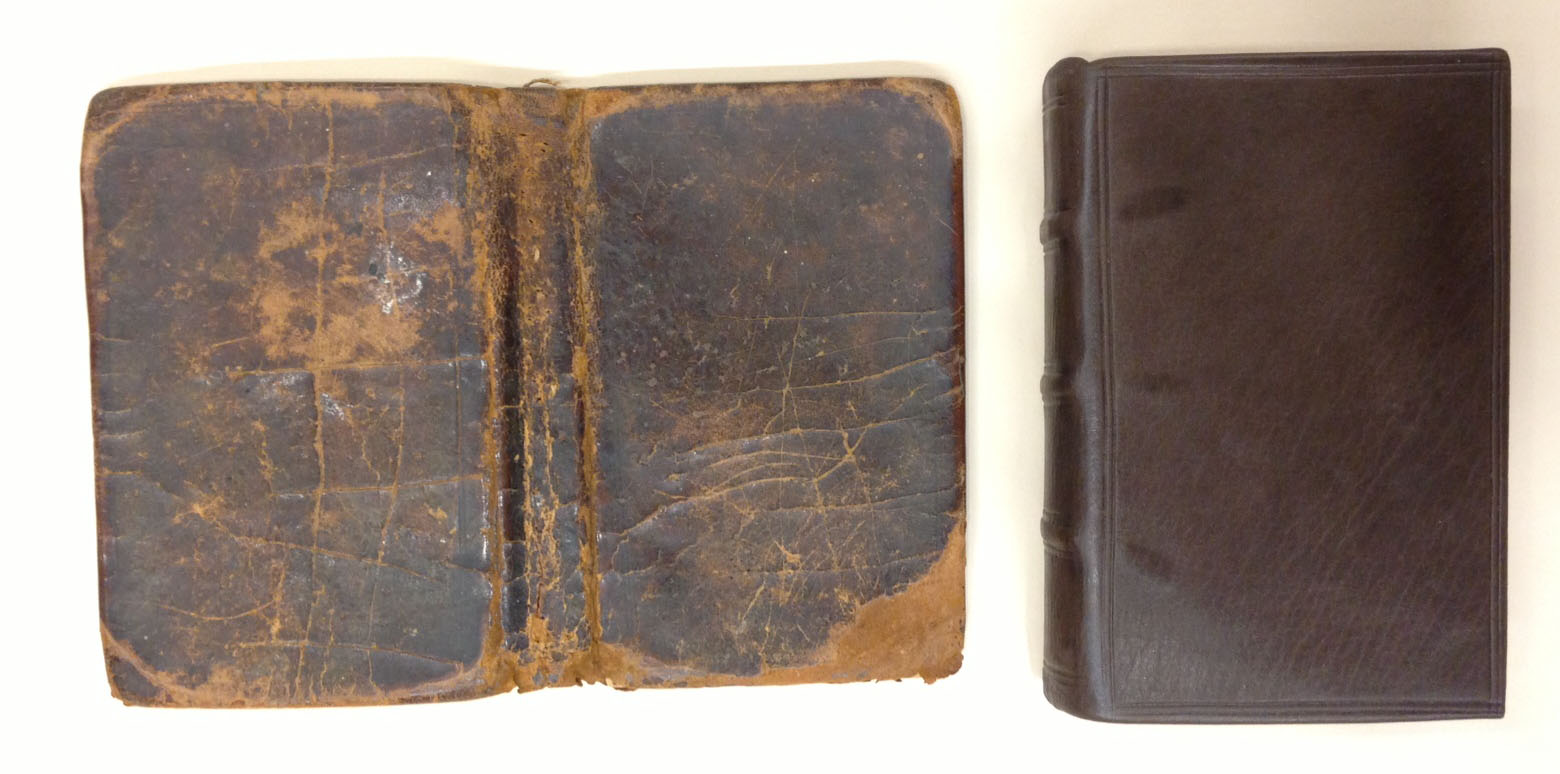
At left is the volume's original blind-tooled calf binding. At right is the volume in its new calf binding by U.Va. Library conservator Eliza Giligan, copying the original style and structure.

At left is the volume’s original blind-tooled calf binding. At right is the volume in its new calf binding by U.Va. Library conservator Eliza Giligan, copying the original style and structure.

In order to preserve the volume and make it available for research, teaching, and exhibition, the U.Va. Library’s conservator, Eliza Gilligan, undertook a thorough conservation treatment, now successfully completed. First, the original binding and sewing were thoroughly documented. Then the binding was carefully removed (it will be retained permanently for research purposes); the text leaves carefully washed, deacidified, and mended with Japanese tissue; the textblock reassembled and resewn; and a new calf binding, tooled like the original, added. Now nearly as good as new, the book can be handled safely and will inform many future generations of readers about the Day of Doom!