This post was contributed by Stacey Evans, senior imaging specialist and project coordinator in the Digital Production Group at the University of Virginia Library.
Introduction
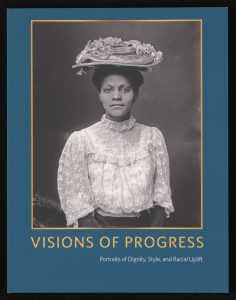
Visions of Progress: Portraits of Dignity, Style and Racial Uplift catalog cover featuring featuring a black-and-white photograph of an African American woman in a high-necked lace blouse and a floral hat, set against a dark background.
“Can we re-digitize a set of glass plate negatives of African American portraits from the Holsinger Studio Collection?” That question came from Curator of Exhibitions Holly Robertson as the Visions of Progress: Portraits of Dignity, Style and Racial Uplift exhibition approached in 2022.
The UVA Library’s Holsinger Studio Collection (MSS 9862) consists of approximately 10,000 wet-plate glass negatives and 500 celluloid negatives from the commercial studio of Rufus W. Holsinger—and later his son, Ralph—based in Charlottesville, Virginia. The unique collection includes 600 portraits of Africans Americans in central Virginia and offers insights into life in central Virginia from the late 19th century to the early twentieth century.
I have known John Edwin Mason, the exhibition’s chief curator, since the early days of my freelance photography career in Charlottesville. I first encountered photographs from the Holsinger Studio Collection soon after moving to Charlottesville in 1996. Holsinger’s landscape photographs appear throughout the city, and, for Virginia Magazine assignments, I retraced his steps—pairing my contemporary images with his early twentieth-century views.
In more recent years, I noticed Holsinger’s portraits reproduced on vinyl across Charlottesville on buildings and construction fences—a striking reminder of his enduring visual legacy. Joining the University Library in 2020, I was delighted to be in a position to revisit this collection in a new context. So, when the question of re-digitization arose, my answer was yes. As someone new to cultural heritage imaging and the process of digitizing glass plates, I began my research.
The Holsinger Studio Collection was first digitized in the 1990s using flatbed scanners. Advances in digital imaging now allow us to capture significantly greater pixel detail and a wider tonal range. Re-digitizing the plates would not only enhance image quality but also provide researchers access to un-cropped versions that include portrait numbers corresponding to sitters’ names recorded in two fragile business ledgers held in the Albert and Shirley Small Special Collections Library.
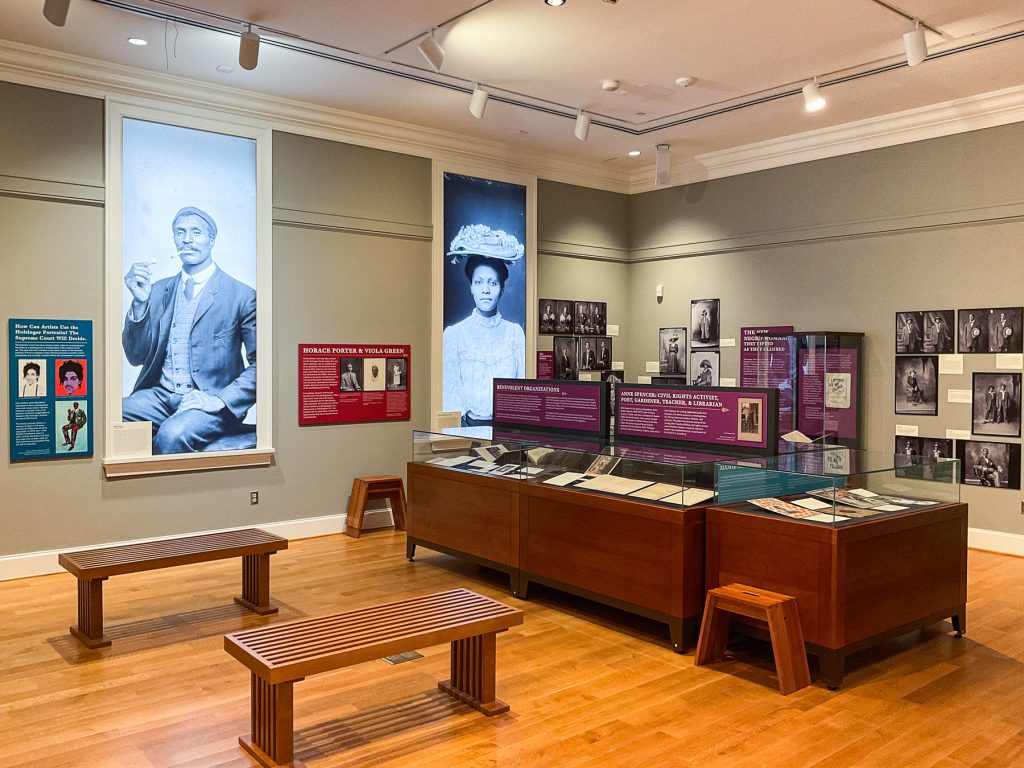
2022 installation of the Visions of Progress exhibition in the Small Special Collections Library
Research & Production
The primary sources for my research included the Federal Agencies Digitization Guidelines Initiative (FADGI), the Digital Transitions Transmissive Digitization Guide, and a blog post by TownsWeb Archiving. I hold a BFA in Photography from the Savannah College of Art and Design, earned in 1995. My early professional experience included positions as a newspaper lab technician and as a first assistant to an architectural photographer. During that time, I gained extensive experience converting slides and film negatives into digital files using drum and desktop film scanners. However, before this re-digitization, I had no prior experience working with glass plate negatives or using a digital camera system as the capture device—now the preferred approach in cultural heritage imaging.
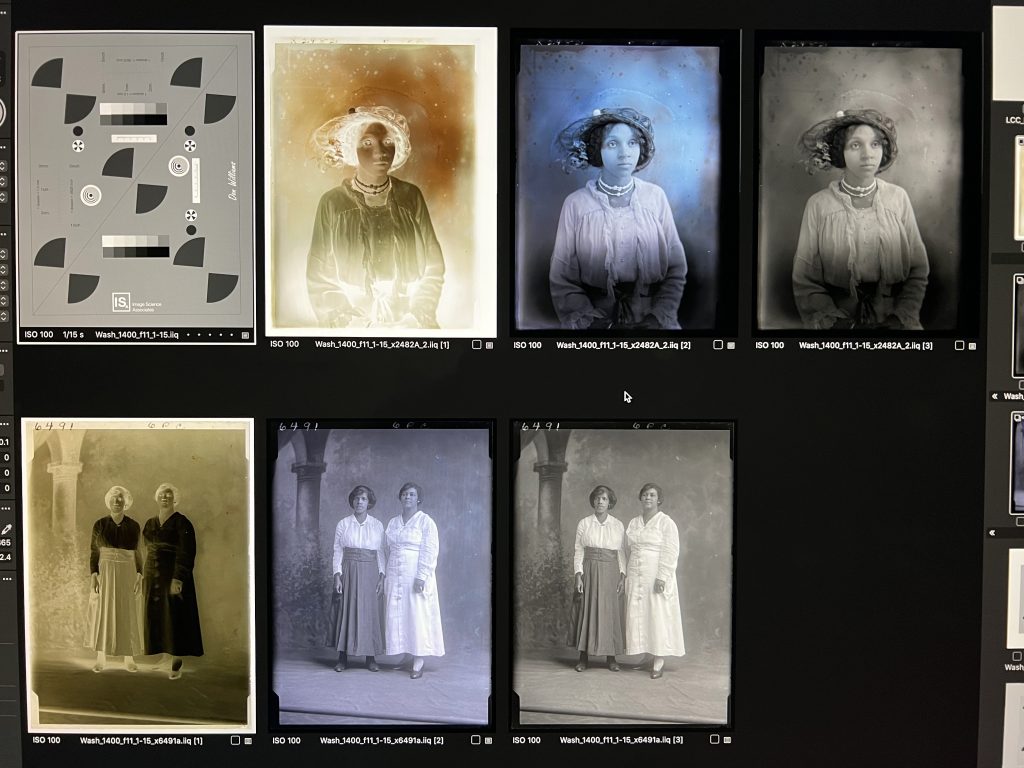
A screenshot from working with Capture One software showing a 4”x5” black-and-white film target and object, content, and speculative artist’s intent versions of two plates featuring African American women.
From the equipment available in our studio, I selected an XF Phase One camera with an 80-megapixel digital back and a 120mm macro lens, paired with Capture One Cultural Heritage software, a DT Film Stage table, a lightbox, and a sheet of glass to stabilize the plates. I began the workflow by creating a Lens Cast Correction (LCC) profile for the session, capturing the film stage and glass in position to ensure even illumination across the frame. Next, I photographed an Image Science Associates 4”x5” black-and-white film target to establish a baseline for exposure, white balance, and resolution. This target served as a reference for tonal consistency and system performance throughout the session.
Once the setup was calibrated, we proceeded to photograph each plate (emulsion side up), adjusting the shutter speed as needed to compensate for the varying densities and contrast levels among the negatives. My objective was to produce an uncropped primary file that faithfully represented the full tonal range of each plate—retaining both highlight and shadow detail. In my research, I learned that there are typically three “versions” to consider when digitizing for archival purposes: object, content, and speculative artist’s intent. We decided to preserve both the object and speculative artist’s intent versions.

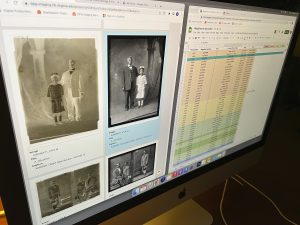
The two preservation formats of the Bill Hurley glass plate negative and associated metadata as shown in the UVA Library’s internal tracking system.
Interpreting artistic intent can be challenging when working with glass plates from a studio more than a century old. Fortunately, John had several original prints from the Holsinger Studio, and, when it came time to finalize the digital renderings, he joined me at the workstation as I fine-tuned images. I tend to prefer flatter tonal curves that preserve subtle detail giving printers more to work with, while John advocated for a bit more contrast based on his Holsinger prints in hand. We met in the middle, taking into consideration both our professional perspectives.

The re-digitized glass plate of Jessie White, accessible through Virgo, shows two images of White, an African American woman, sitting slightly diagonal on a chair with print publications on her lap. Her hair is just below the ears and might be tied back. She wears a full-length white skirt with a white three-quarter length sleeve blouse. The blouse is embroidered with a pin, and a black rectangular shaped bow on toward the collar. Her left gaze is slightly off camera to the right, and the right image holds a more straightforward gaze.
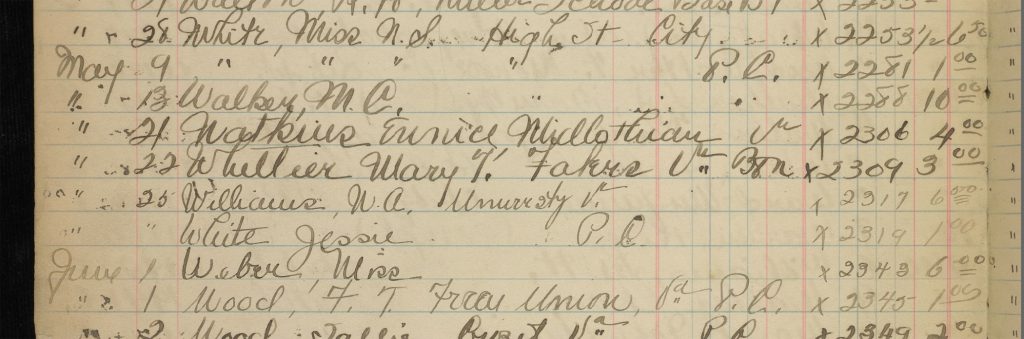
A detail from the Holsinger Studio Ledger which tracks customers and their portrait purchases. From left to right is the date, the sitter’s name, identification number, and cost.
Each glass plate negative has an identification number etched into the emulsion of the plate. These numbers enabled us to identify portrait sitters based upon a ledger in the Holsinger Studio Collection that included the name of the sitter and how much they paid. For example, Jessie White (X02319) paid $1.00 for her photograph on May 25, 1914.
-
-
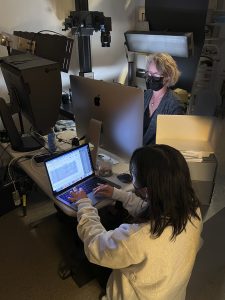
Imaging Specialist Stacey Evans working at a camera station photographing the glass plates and Exhibitions Coordinator Jacquelyn Kim working on a laptop with the item list spreadsheet to handle the re-digitization of the Holsinger glass plates.
-
-
During the quality assurance process, the title and caption metadata were embedded in the file and double-checked against the item spreadsheet.
Working alongside me was Exhibitions Coordinator Jacquelyn Kim. She worked closely with John and Holly to select which portraits would be included and created a spreadsheet to record the corresponding metadata for each plate. During the digitization sessions, she handled the plates with care, allowing me to focus entirely on image capture and adding the identification number to the metadata.
Outcome
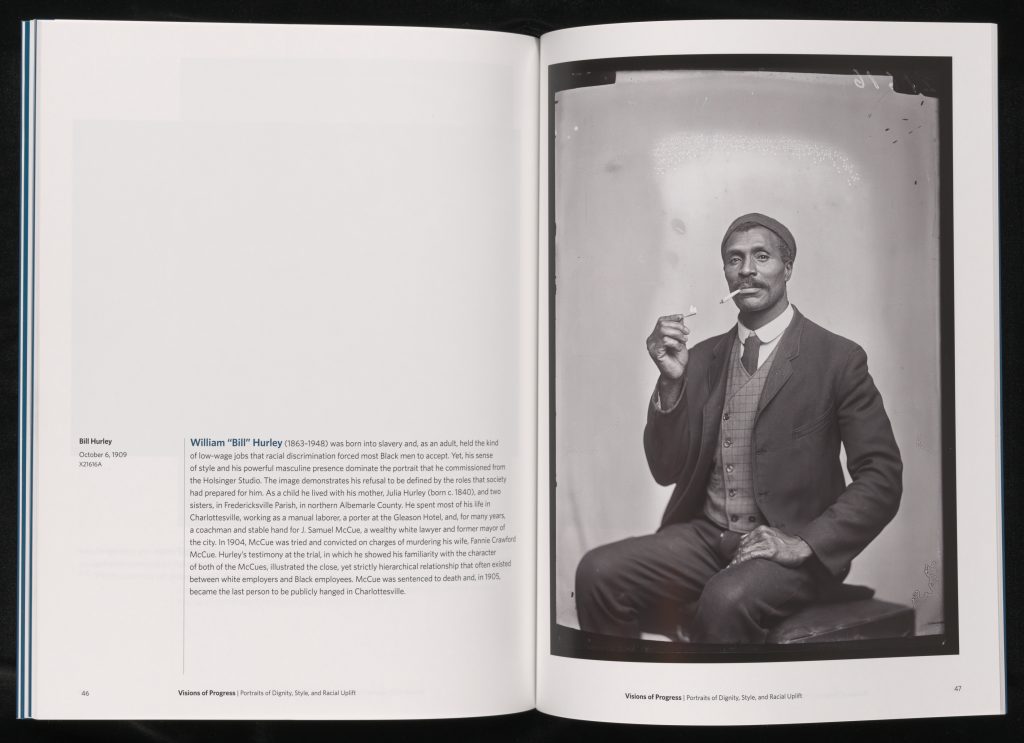
A two-page catalog spread with text describing Bill Hurley’s life in Charlottesville and the speculative artist’s intent reproduction of Hurley’s glass plate, originally photographed in 1909 at the Holsinger Studio. Hurley is seated with a slight diagonal holding a lit match gazing directly at the camera with a cigarette in his mouth. He wears a hat, suit, vest, white shirt and tie and long pants.
The resulting images are beautifully reproduced in the exhibition catalog. We maintained the full frame of each plate, leaving a thin black border to assure researchers that no detail was omitted. The delicate textures of lace, the richness of skin tones, and the soft transitions in shadow and light all contribute to the dignity and depth of these portraits. Beyond their technical achievement, these re-digitized images strengthen the connection between the glass plates and the people they represent—linking descendants today with the stories of their ancestors’ portraits of dignity, style, and racial uplift.
Although the exhibition has come and gone, the new files are accessible through the University of Virginia Library’s Virgo catalog. Forty portraits are featured in an exquisite catalog along with essays and descriptions of the plates.
The re-digitization of the Holsinger Studio glass plates reflects the University of Virginia Library’s ongoing commitment to advancing cultural heritage imaging and digital preservation. I am grateful to have contributed to this work alongside dedicated colleagues who share a passion for both technical excellence and historical storytelling.
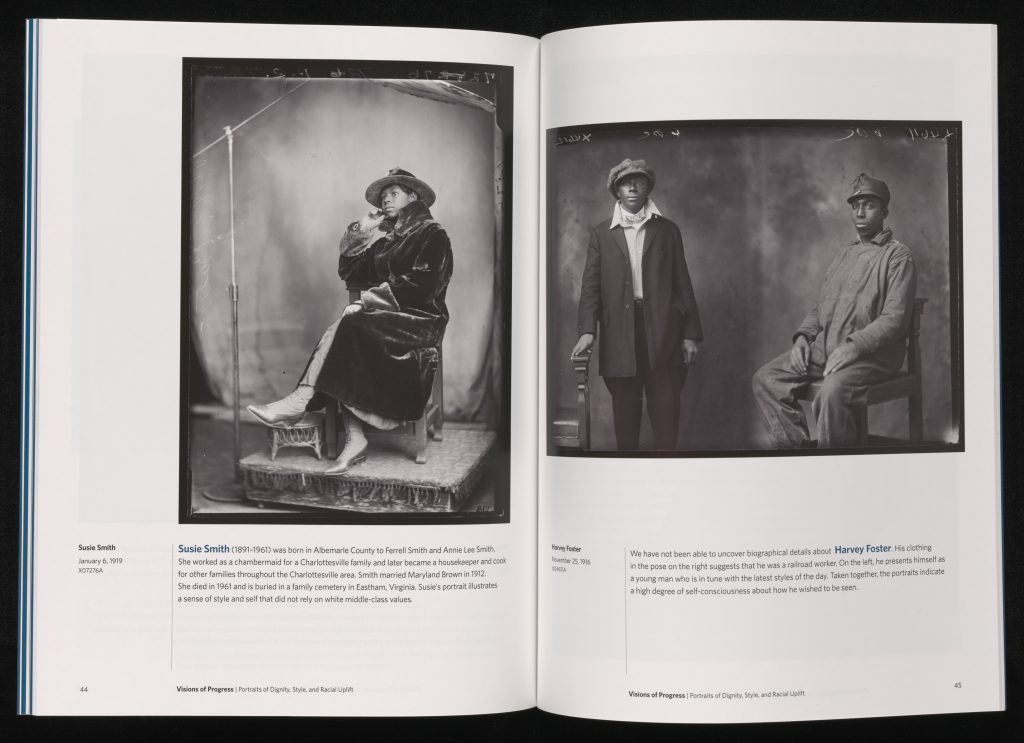
A two-page catalog spread featuring photos and descriptions of the lives of Susie Smith and Harvey Foster. Smith is seated in a long coat and hat. Foster, dressed formally, stands beside a seated companion.