The Philip Slaughter Daybook Treatment, Part 1
To Wash a Manuscript
By: Sue Donovan, Conservator for Special Collections.
Sue Donovan, Conservator for Special Collections, is currently engaged in a long-term, intricate treatment that you might be able to see as you walk past the Special Collections Conservation Lab in Shannon Library for the next few months. On the bench is the Philip Slaughter Daybook (MSS 6556), dating from 1808-1816, which is a manuscript written in iron gall ink. A daybook is a recording of daily information for a given location, and the term is often seen for a plantation logbook in the 1800s. The Slaughter Daybook is such a manuscript and recounts the day-to-day purchases and events of a plantation in Culpeper County, Va. One of Sue’s favorite entries is the recipe for soothing rheumatism: it involves placing earthworms inside a stoppered vial within bread dough and then cooking it all together. This results in steamed earthworm juice that you can rub on your aching knees, and a fresh loaf of bread! A true two-birds-one-stone situation.
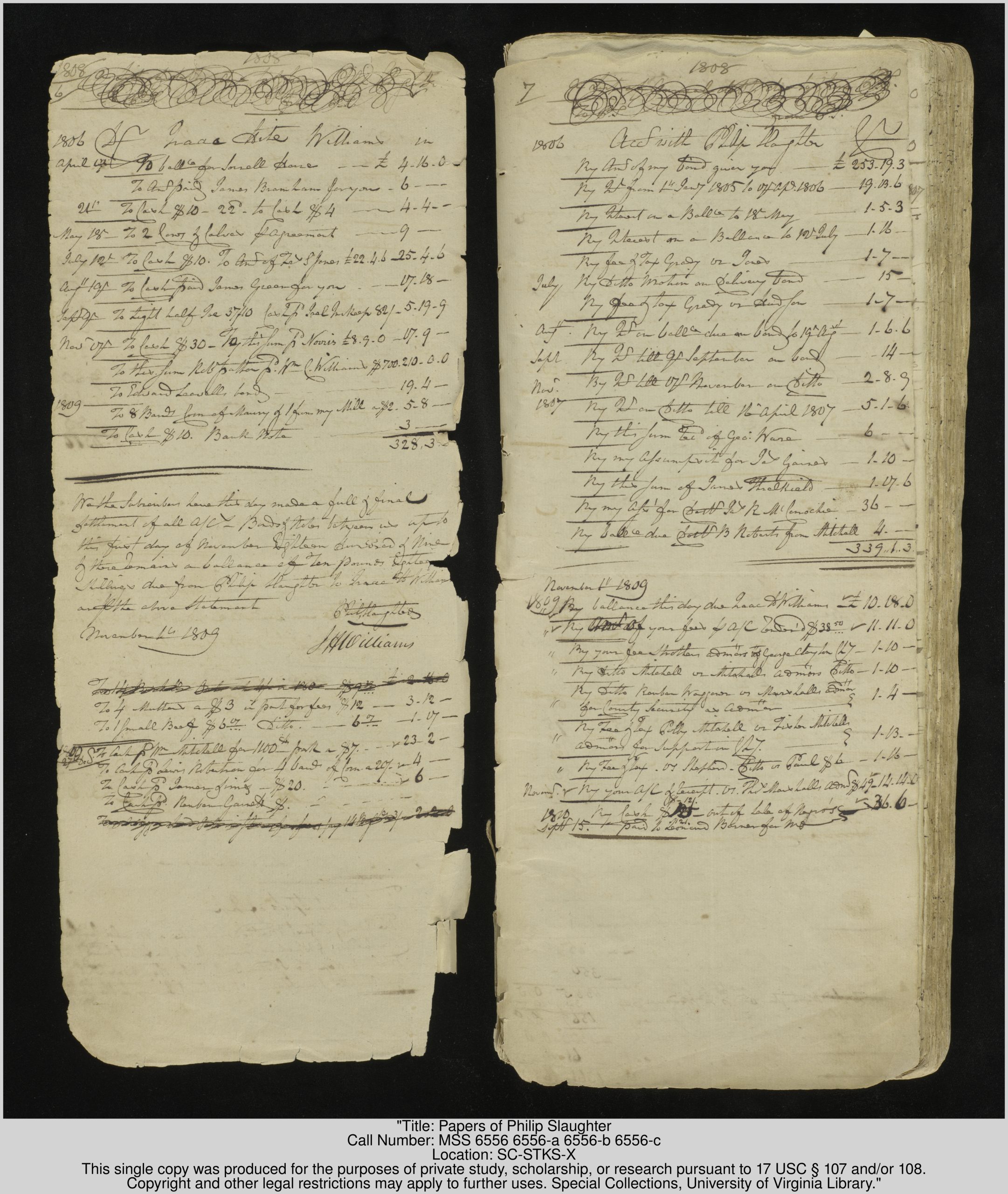
The Philip Slaughter Daybook, before treatment.
The daybook was acquired by UVA Library Special Collections in 2018 and was brought to the attention of Preservation Services in 2023/24. Because the book was written in iron gall ink and was bound with a sewing method that put severe strain on the paper, the manuscript was in poor shape. Iron gall ink is a type of writing media that was in widespread use from the Middle Ages up until the early 20th century. It is made with three main components: iron (metal salts), tannic acid, and gum arabic. Other ingredients could be (and were) added, and proportions and recipes for ink were highly variable. Iron gall ink had originally been made for use with parchment, a durable and relatively alkaline writing surface made from animal skins, for which it was beneficial for the ink to “bite” into the parchment. When paper started to be used as a writing surface hundreds of years later, that ink’s capacity to bite became a slow-motion tragedy for many manuscripts.
Over time, iron gall ink can actually eat through the paper, causing letters to drop out or whole lines of text to crack. The Philip Slaughter Daybook was unfortunately a victim of what conservators call “inherent vice,” due to the iron and acids in the ink, and every page of the manuscript had instances of drop through.
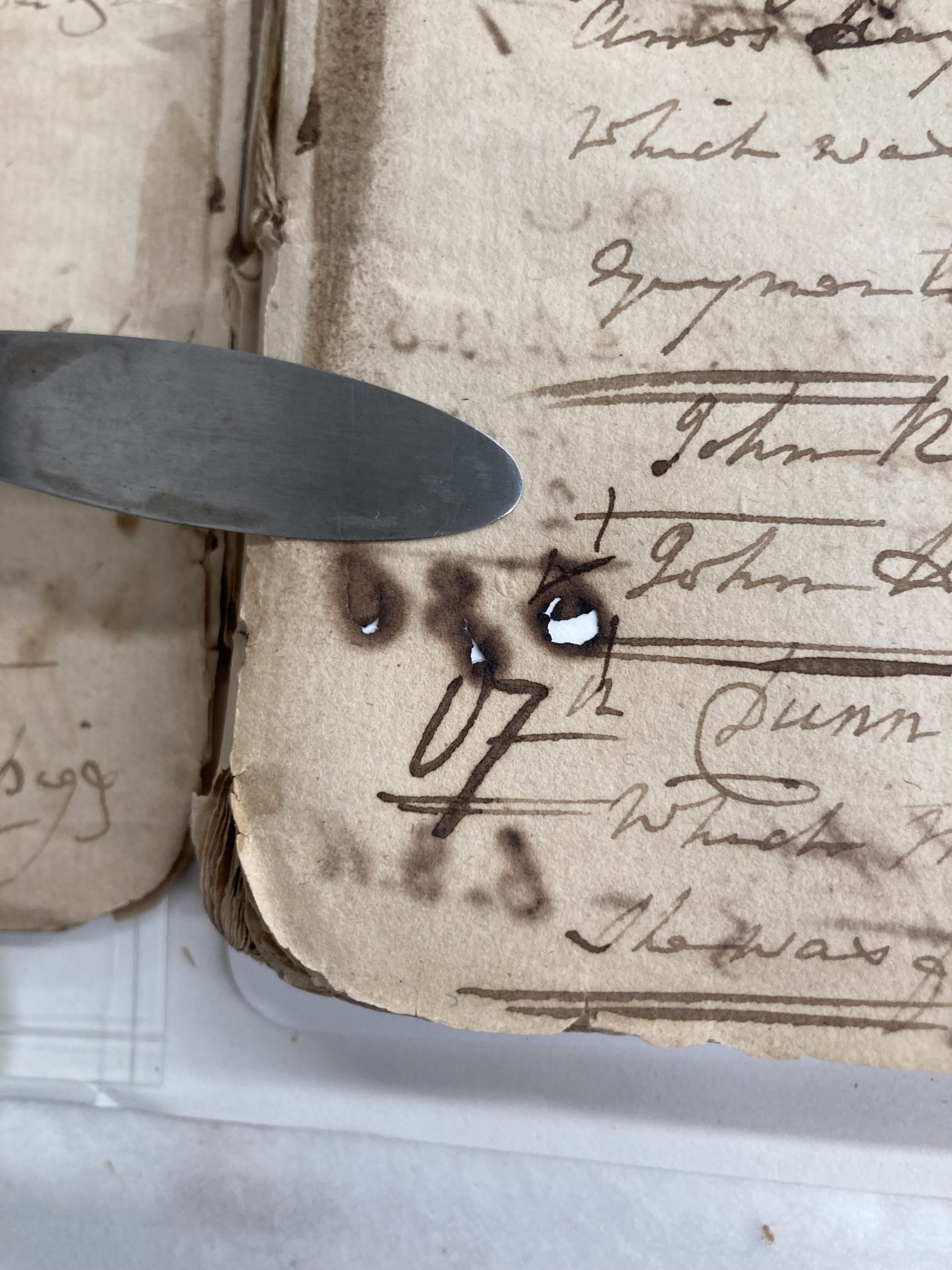
A letter that has “dropped through.”
In addition, the paper used for the manuscript, while it was originally a relatively good quality paper, had degraded over time and was discolored and acidic. Acidic environments can speed up the degradation of iron gall ink, and metal ions can accelerate the deterioration of paper, so the manuscript needed an intervention that would arrest deterioration and allow researchers and staff members to use the daybook safely.
Calcium phytate treatment is a multi-step process that reduces the metal ions and the acidity in the paper. The treatment requires multiple baths in different chemicals, which is not without risks, but comes with undeniable rewards as well. The first part of the treatment requires bathing the paper in deionized water to remove acidic degradation products and water-soluble metal ions.
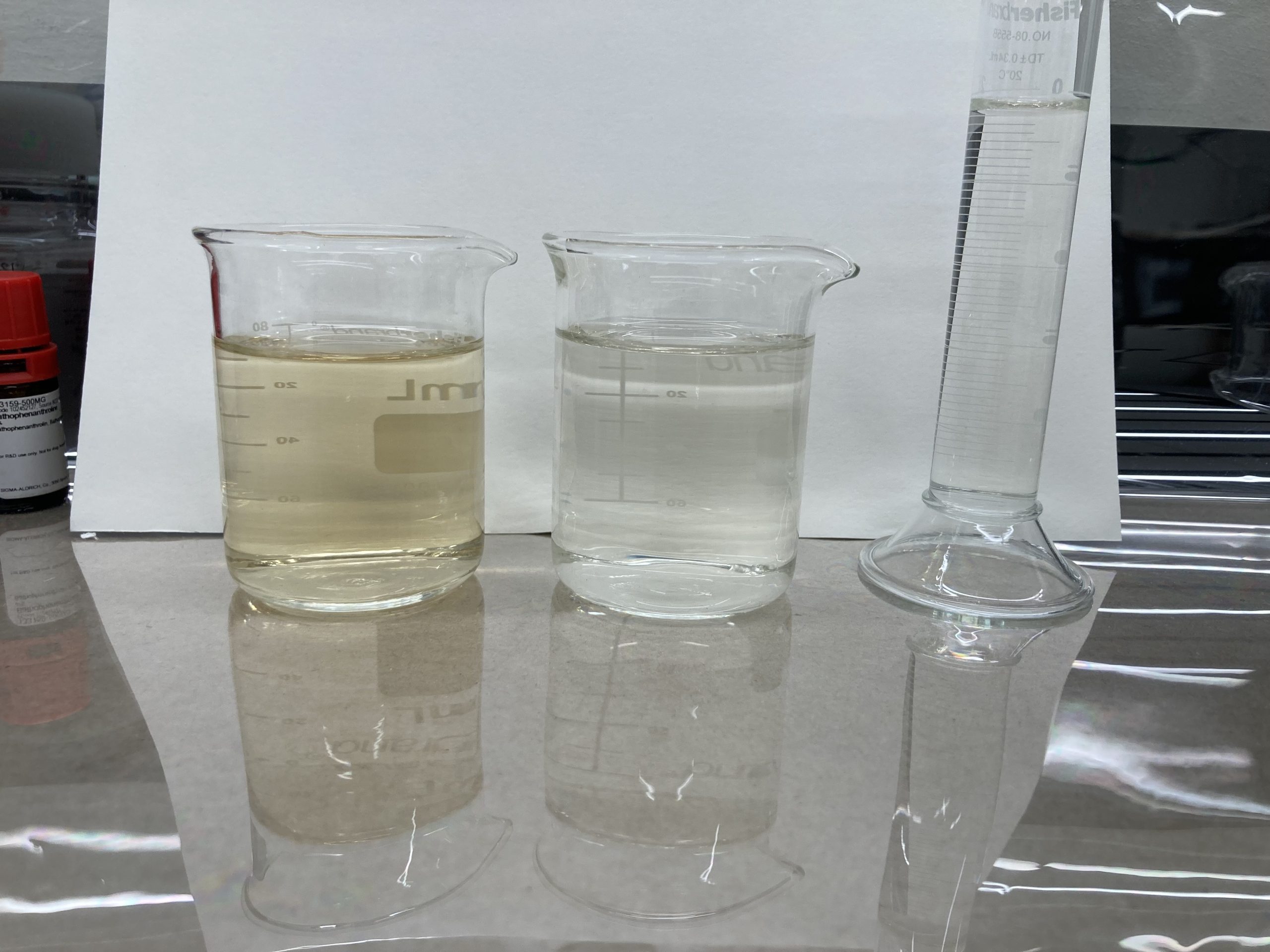
The conservator uses beakers of water from each subsequent bath to determine the effectiveness of washing the pages. The first bath removes a high quantity of acidic degradation products, as seen in the first beaker on the left, which is quite yellow. Each following bath is less yellow, which shows that the acidity is being washed away.
In the second part of the treatment, the manuscript pages are washed in a solution of calcium phytate, which complexes free radical metal ions and changes them into water-soluble particles that can be washed away. If the free radicals were allowed to stay in the paper, they would continue to cause damage. Making them water soluble and washing them out thus improves the long-term life of the paper. During this stage of the treatment, testing strips made in-house from a chemical called bathophenanthroline help determine if the metal ions are being complexed and taken out of solution. Every 10-20 minutes a folio is removed from the Calcium Phytate bath, lightly rinsed, and then a specific area of written text is tested. Using plastic tweezers because metal tweezers can cause a false positive, a drop of acetic acid is placed on the testing strip, which will turn pink if metal ions are present. If the strip is very pink, the folio is returned to the bath in a different location, e.g. underneath another folio if it had previously been floating on the top.
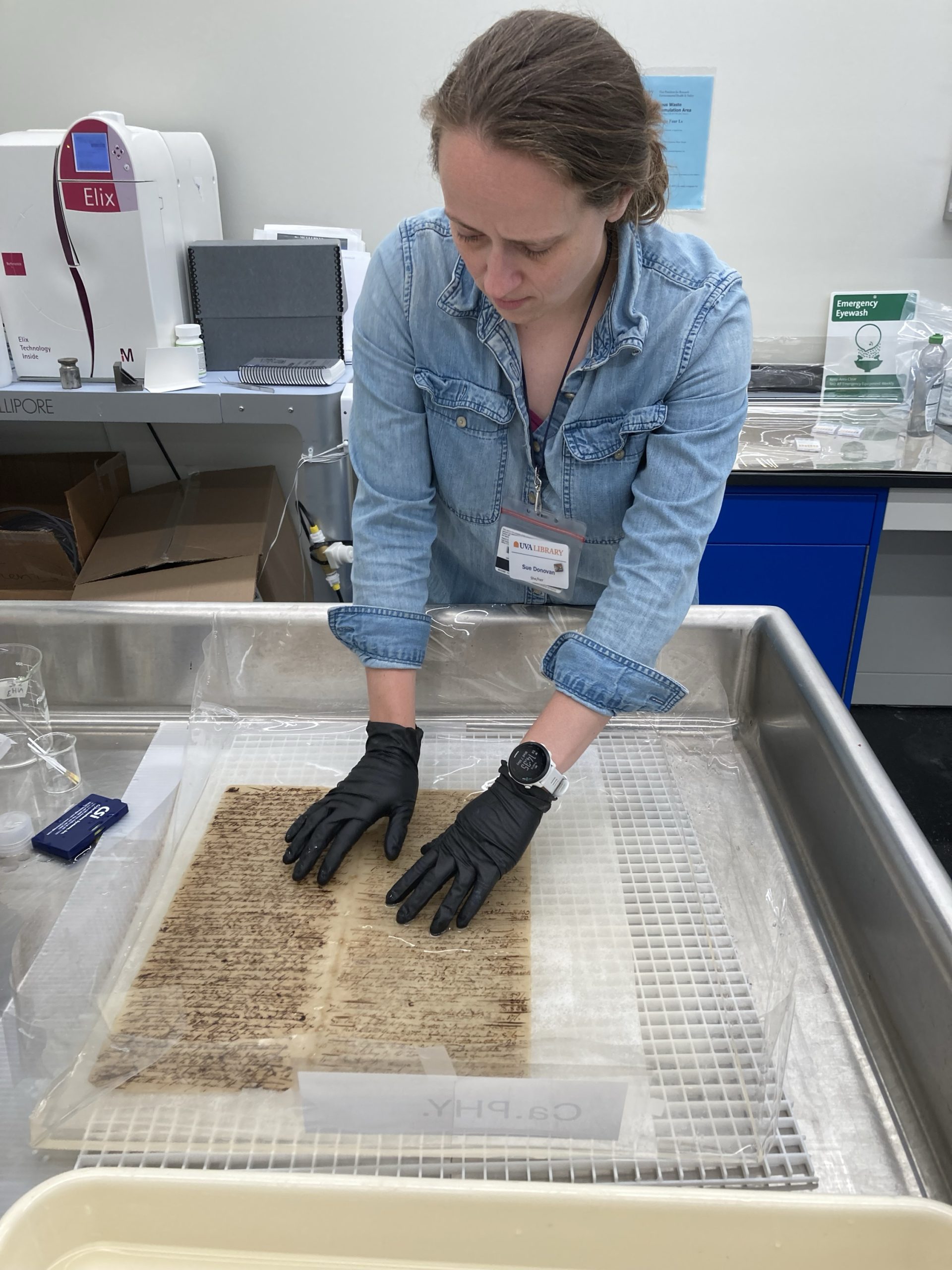
Conservator Sue Donovan gently manipulates gently manipulates a folio from the Philip Slaughter Daybook in the calcium phytate bath.
Once the testing strips are mostly white, the paper is deacidified in a bath of calcium bicarbonate, a solution made with calcium carbonate, deionized water, and a water carbonator. An exterior size of 0.5 % gelatine is brushed onto the paper to provide more protection against metal ions and to restore sizing that was lost during the washing. Finally, the pages are allowed to air dry for one hour, and then they are placed under blotters, felts, and light weight to dry.
With the curators in Small Special Collections Library, Sue discussed how the benefits to washing the manuscript would outweigh the risks of the treatment. The time this treatment needs is a significant factor in weighing whether to proceed: It takes about 6-8 hours to complete all steps of the calcium phytate treatment for one batch of documents, not counting the drying time in the felts. Four folios are washed during one session, and the solutions have to be made either the night before or the day of treatment. Overall, Sue estimates that the treatment will likely take over 150 hours for the washing steps alone.
Luckily, Sue has discovered that applying pre-made mending strips to damp (not soaking) pages significantly cuts down on mending time, which goes to show that innovations are being made every day!

A mending strip held above the wet surface of the iron gall ink document.
While it is a long treatment, it will be satisfying to accomplish. The washed pages are brighter and more legible, as seen in the first two batches of folios that were washed as a trial. Furthermore, once the pages are washed and metal ions are removed, mending materials applied with more water can be used, which means stronger but also faster application. Mending iron gall ink documents that haven’t been washed can be quite slow and tedious, since conservators must limit the amount of moisture used during the application of wheat starch paste typically used in paper conservation. The Slaughter Daybook, therefore, can be more safely handled and more strongly conserved because of the steps taken to wash the acids and the metal ions out of the paper.
Once the washing and mending are done, the manuscript will need to be bound back together, but that will be addressed in another blogpost! The overall goal for the daybook is for it to be used safely in the reading room, but in the meantime, the manuscript has been fully digitized to facilitate access to the content within. Make sure to check out what Sue and colleagues Nicole and Melanie are up to in the lab when you walk by Shannon 200!