Photo-Process Phriday… Blueprints!

The Conservation Lab is taking over the Photobook Phriday post this week to feature a Photographic process: blueprints!

Recently, the conservation lab has been working on blueprints from the Charles M. Robinson Collection. A blueprint is essentially a photographic process used to copy architectural drawings. A support (paper or piece of linen) is coated with a material that is sensitive to light. Then that support is put in contact with a photographic negative or object and exposed to light, which makes the lines of the negative or object water soluble. The now water-soluble lines are then washed off, leaving an image that is mostly blue with white lines where the negative had touched the surface. A fixing solution is usually also required, which prevents re-sensitizing of the surface.
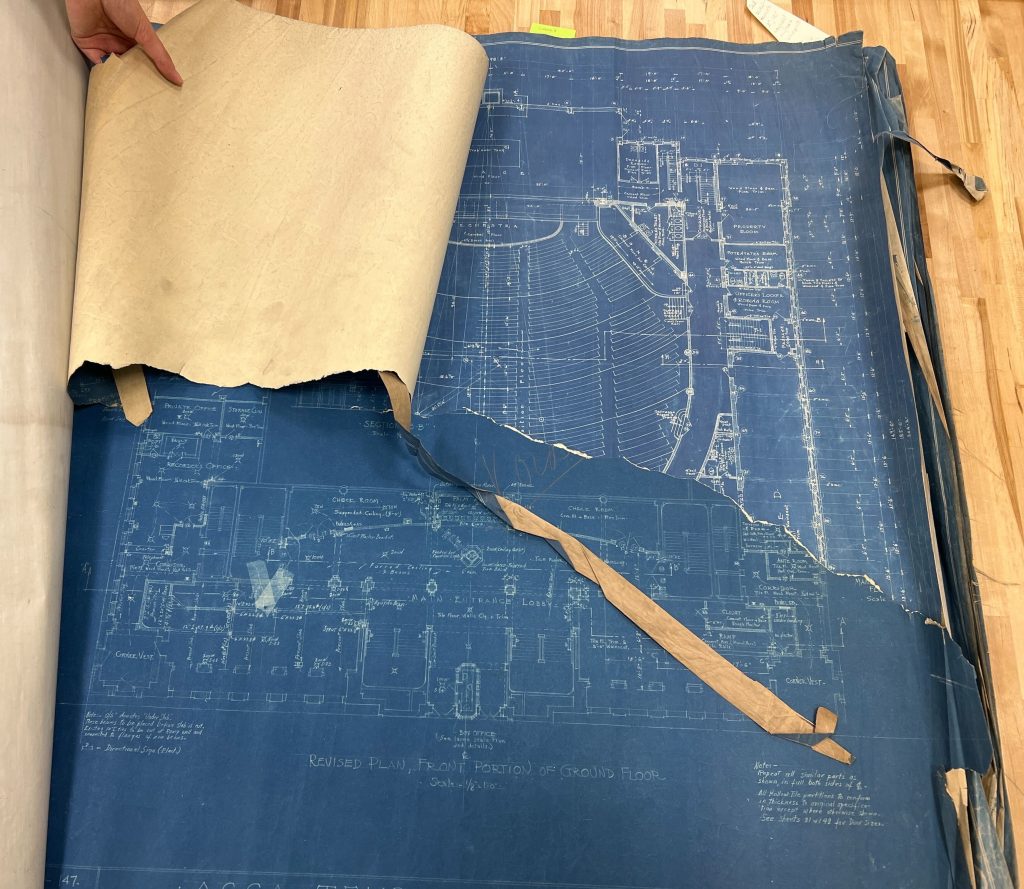
Image of a blueprint showing the inside of a building. A hand at the top left of the image is holding back half of the blueprint to demonstrate it has been torn in half.
Example of a blueprint from the Charles M. Robinson collection that has been torn through the middle.

Charles M. Robinson was an architect in the Richmond, Virginia, area who was active between the early 1900s-1930s. UVA Library’s Special Collections acquired Robinson’s archives as well as successor architectural firms in 2019 because of the wealth of information regarding the design of public buildings and schools for Black and minority citizens in Virginia.

The blueprints in the lab are designs for the Acca Temple in Richmond, at the northwest corner of Main and Laurel streets. The design for the building was inspired by Mosque Temples and opened in 1926. Today, the location is known as the Altria Theater.

The Acca Temple blueprints were working blueprints, which means they were heavily used by the architects and construction workers on site. In this set of blueprints, there are 22 individual pages 36″ x 36″ square that are bound together with brass brads between a linen cover sheet that is 72″ x 36″. They are on two different kinds of supports: paper and coated linen, and both kinds are stained and torn, showing the evidence of their use. The archivists responsible for processing, or describing, this collection identified this set of blueprints as needing help from Preservation primarily because of the large tears through the middle of page 6 of the Acca Temple blueprints, as well as other pages.

CAV Collections Conservator Brittany Murray dry cleaned the blueprints with soot erasers and cosmetic sponge erasers. The designs were so dirty that without cleaning them, it would be nearly impossible to adhere torn pieces back together. Conservator for Special Collections Sue Donovan then reached out to photograph conservators to ensure we were applying the most up-to-date information about blueprint mending to the items in the lab. The Conservators first tried applying strips of thin Japanese paper, previously coated with an even layer of wheat starch paste and then reactivated with an ultrasonic mist of deionized water. These mends were unfortunately not strong enough to hold on the paper or the linen, however. So Sue used wheat starch paste to realign the edges of jagged tears and then applied strips of a thin Japanese paper called Tengucho to the verso of the blueprints with an even layer of wheat starch paste.
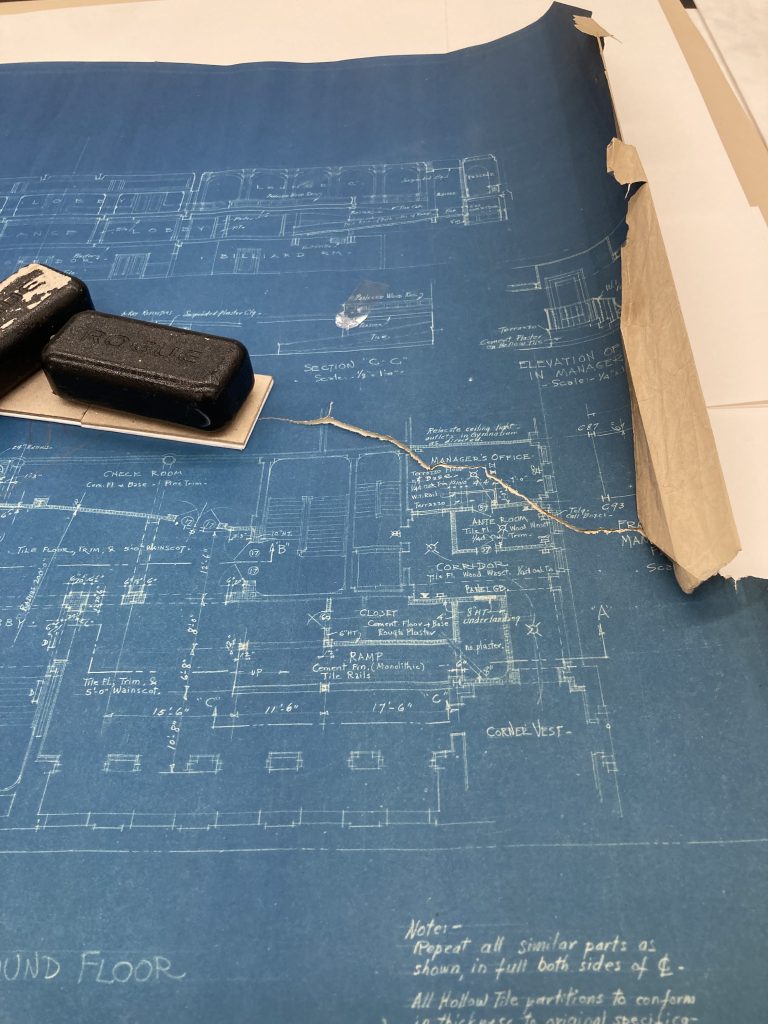
A blueprint is being mended, with a stack of board weight down with a black weight on top of a torn section of the blueprint.
The overlapping areas of the large tear through page 6 of this set of blueprints are reattached to each other with paste, weight down under a small stack of blotter and board and a heavy weight.

These mends were dried under small stacks of non-woven polyester strips, blotter, board, and weight. Blueprints are sensitive to alkalinity and light, so the blotters were tested to make sure the pH was suitable for blueprints prior to using them for the mending process. While the blueprints were in the lab, they were covered up to protect them from light when they were not actively being worked on.
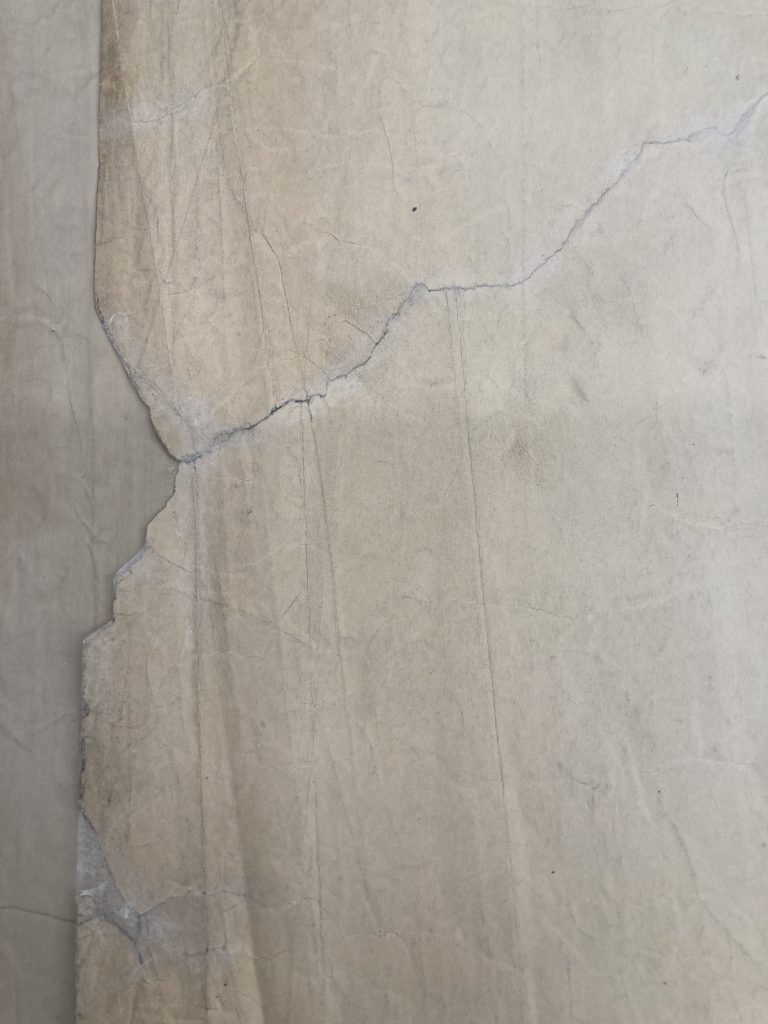
The blueprint has now been completely mended, and work will continue on the other blueprints in this collection, including blueprints made on coated linen.

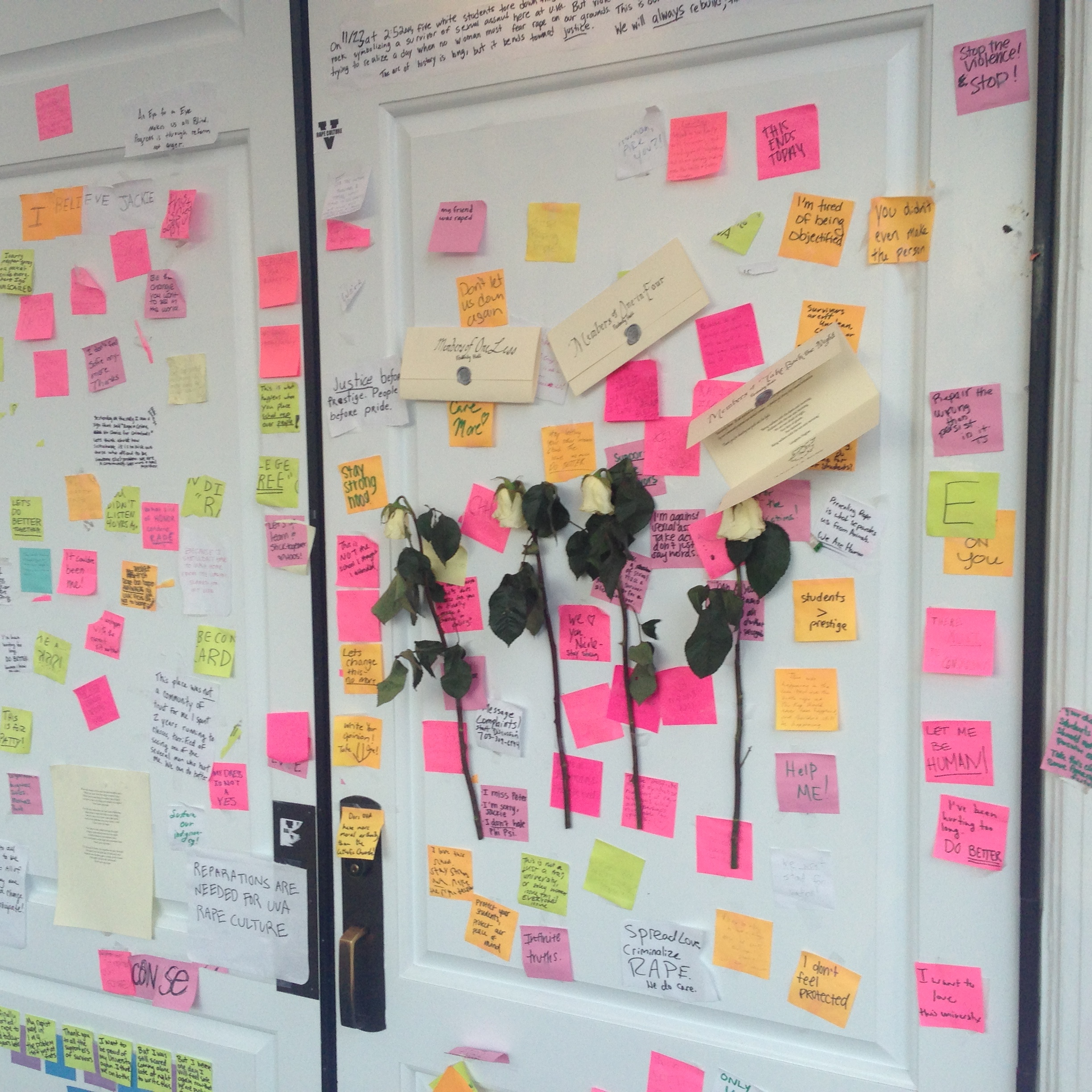
Image of a blueprint with a large tear going through the middle of the page that has been mended.
The same blueprint from the first photograph, now mended.

Collecting History in Real Time

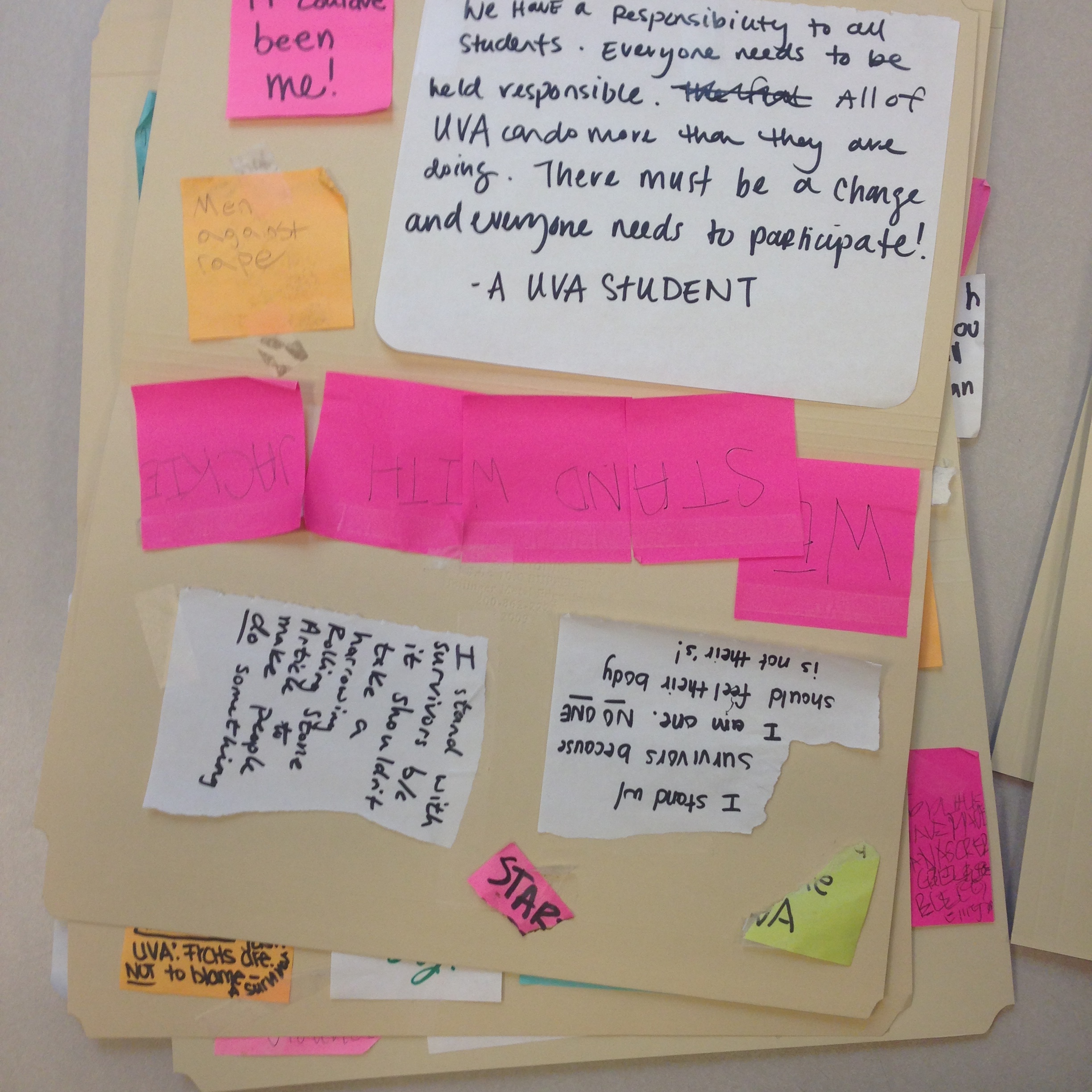
As early as November 21st, a spontaneous display of notes, supporting rape survivors and expressing grief and anger, began appearing at the entrance of Peabody Hall, home of the Office of the Dean of Students and Undergraduate Admissions. The display was the result of the controversial Rolling Stone article, “A Rape on Campus: A Brutal Assault and Struggle for Justice at UVA” by Sabrina Rubin Erdely.

Display of Notes on the doors of Peabody Hall, 10 December 2014. (Photograph taken by Edward Gaynor.).

Display of notes on the doors of Peabody Hall, 10 December 2014. (Photograph by Edward Gaynor)

Staff at special collections and archives across the country, including the Albert and Shirley Small Special Collections Library, have become increasingly active in collecting material, ephemeral and otherwise, born out of crises that have rocked their communities. These records–be they notes, flowers, posters, photographs, poems, press releases, online articles, etc.–help to document and provide insight into the actions, reactions, and  emotions of the people, institutions, and their associated communities as they are impacted by each wave of the event. We know from experience that our own students and faculty are deeply interested in researching events from the university’s past, distant and recent alike, and we want to ensure that we can provide future generations with a rich record of our present.

During U.Va. finals week, the Dean of Admissions contacted Library Administration, who in turn contacted Special Collections staff, to start the process of removing the notes for permanent preservation. On Wednesday of finals week, Librarian for Virginiana and University Archives Edward Gaynor and Rare Books Cataloger Gayle Cooper removed the notes and other ephemera from the doors and brought them to Special Collections.

To get the materials researcher-ready, staff had to answer questions, like “How do you preserve it?” and “How do you capture something so ephemeral?” The first step was to temporarily house them by sticking them to archival folders.

Notes from Peabody Hall door, temporarily housed on archival folders, 10 December 2014. (Photograph by Edward Gaynor)

Notes from the Peabody Hall door, temporarily housed on archival folders, 10 December 2014. (Photograph by Edward Gaynor)

The second step was to consult Library Conservator Eliza Gilligan for guidance in permanently housing and treating the items. She suggested transferring the notes to pieces of archival mat board cut to the size of our standard document box, and then shelving them in the University Archives. She recommended methyl cellulose as the adhesive and determined that placing each piece of mat board in a labelled folder would best support later scanning, display, and researcher use. What about the flowers? They will be freeze-dried in the Preservation Department’s freezer.

Now that the preservation and housing methods have been decided upon, our manuscripts and archival processing staff will begin arranging and describing the notes so that they will be fully processed and accessible to the public spring semester 2015.

***

Do you have fliers, posters, signs, or other materials related to the current events surrounding sexual violence at U.Va.? If so, please consider donating them to Special Collections. Just drop them by the reference desk, or contact Edward Gaynor at efg2f@virginia.edu.

Goodbye, Special Collections!: Two graduating student assistants reflect

This week, we are pleased to feature a guest post by two graduating students: Christina Balangue and Alex Valdez. Christina and Alex are long-time student assistants in Special Collections and have generously agreed to tell the blog a bit about their work down in the stacks. We will be so sad to see them go!

CHRISTINA: I’m a fourth year at U.Va.’s McIntire School of Commerce, concentrating in accounting. I started working at Special Collections the summer of my first year. After graduation, I will be joining PwC as a tax associate in the private company services group, preparing entity and partnership returns for clients in the greater Washington Metro area.

ALEX: I’ve been working at Special Collections since February 2012. I am also a fourth year but I am majoring in sociology and economics. My plans for after graduation remain fuzzy, but I’m hoping to get involved in social policy research and consulting.

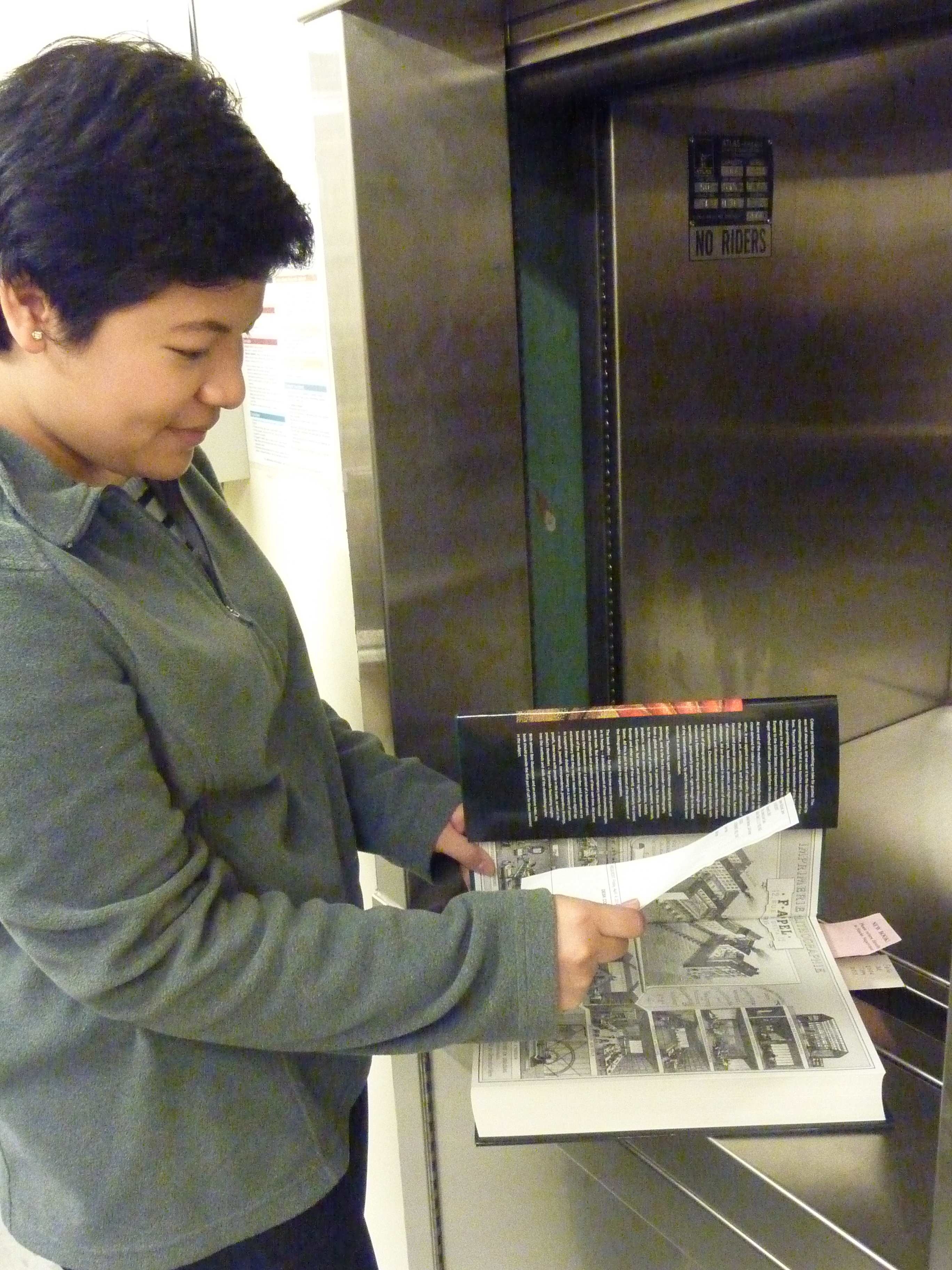
CHRISTINA: The first thing that students realize about the stacks is it’s cold. Not plain cold—parka cold. So we often start our shifts with as much hustle and bustle as possible in order to warm up and acclimate. This means shelving new books, re-shelving pulled books, and pulling patron requests. Re-shelving books and pulling patron requests is one of the first things that students learn in the stacks. Every day, the ding of the dumbwaiter echoes in the stacks, signaling to students that items need to be retrieved from the shelves and sent to the reference desk. After the patrons find what they’re looking for (or not), the items get sent down to be re-shelved.

Christina gets ready to send a book up to the reading room in the dumb waiter.

Christina gets ready to put a patron request in the dumb waiter to be sent up to the reading room.

asdf

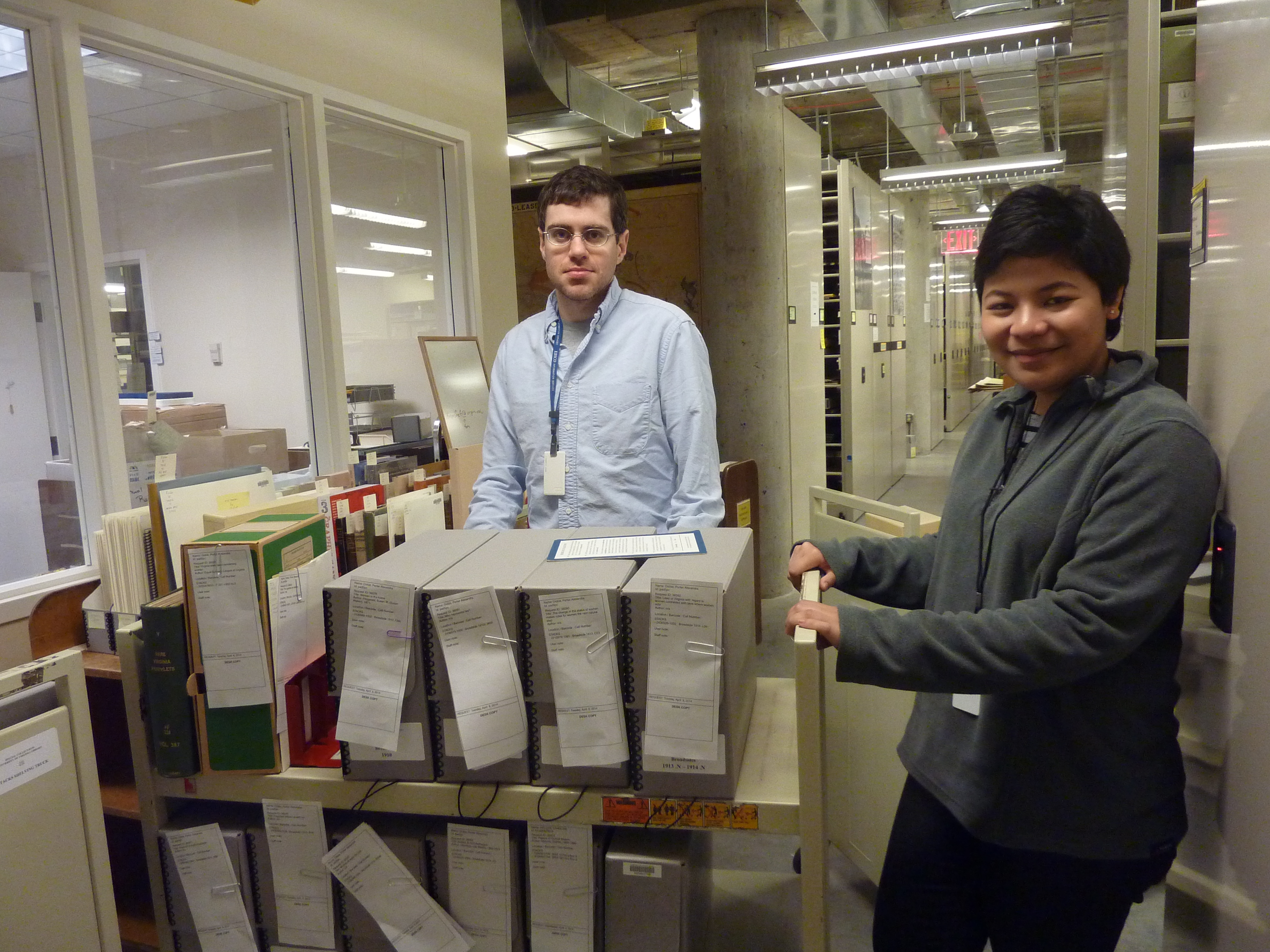
Brendan Fox, Stacks Supervisor, and Christina with a truckful of books and boxes to be reshelved.

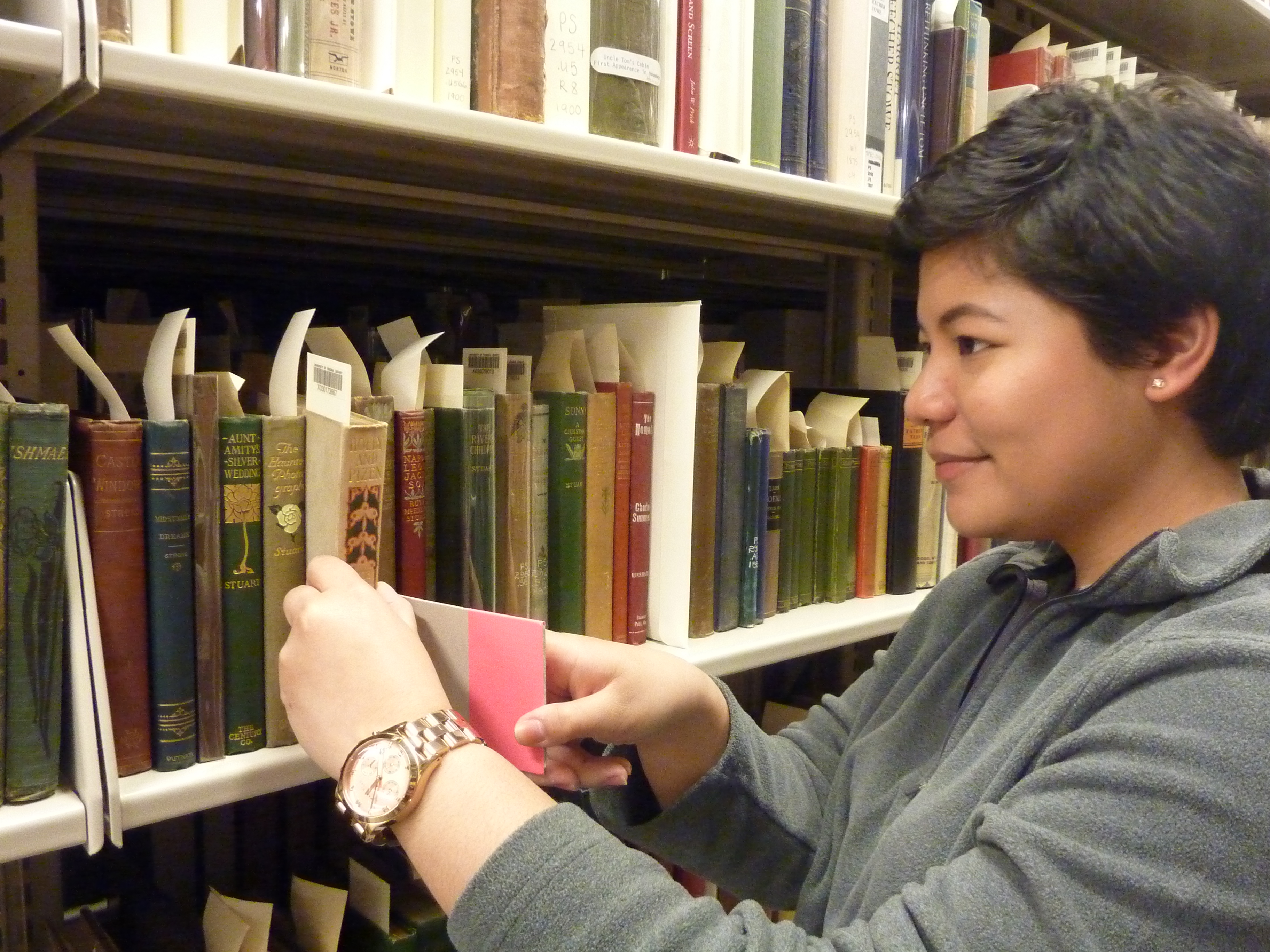
CHRISTINA: New shelving is a task most of us learned on our first day on the job. It’s simple enough: take a cart of newly acquired materials and place them on the shelf accompanied by a colored flag. This allows our supervisor, Brendan, to check and ensure the book is shelved accurately. Most students, including myself, dread new shelving. While I can’t pinpoint an exact reason for my dislike, the fact remains that every time I see a cart of new books, I turn around and dash to find another task, leaving the new books for the next unsuspecting stacks student to discover.

asdf

Christina flagging a new book so that her supervisor can double-check the location.

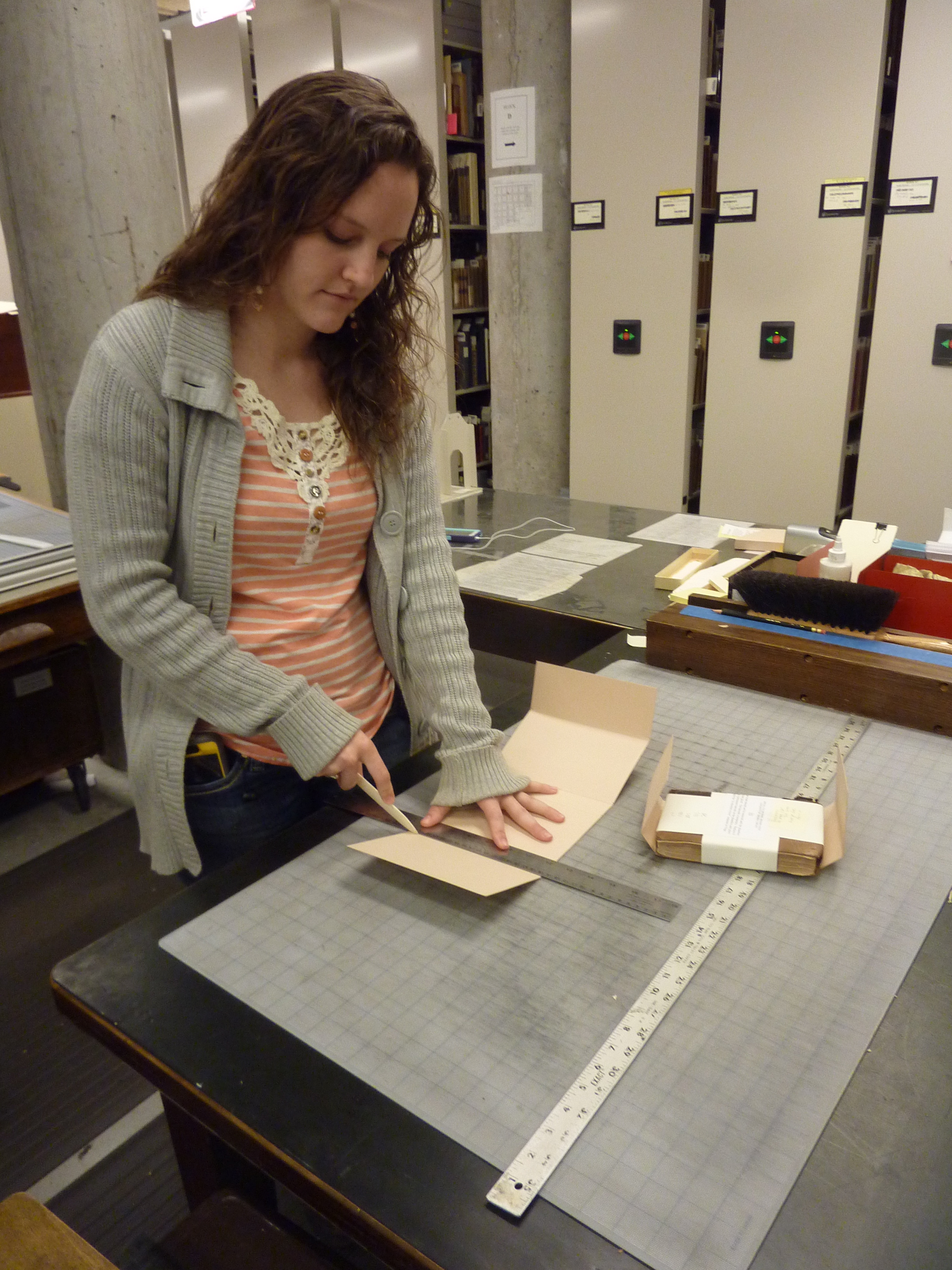
ALEX: If we’re not putting something away or wandering through the aisles trying to find something, then we’re probably in the preservation area. Here, we carry out tasks meant to protect Special Collection treasures from the many destructive elements threatening an item’s long-term survival (and yes, we are as dramatic about this job as I make it sound). The first task we learn is how to mylar. We create specialized plastic wraps for books with fragile paper dust jackets or fading front covers to prevent the paper from being torn or the covers from fading further.

asdf

Christina prepares a mylar cover for a book with a paper dust jacket.

ALEX: The second preservation duty we take on is the construction of phase boxes. These are acid-free cardboard boxes custom-designed to fit each individual book. Their job is to hold together books that are falling apart. In our experience, this task appears particularly daunting to the newbie student employee because of its many steps. You get the hang of it eventually, though, and it has actually become my favorite Special Collections job!

asdf

Alex working on a phase box.

CHRISTINA: Special Collections also collects lots of serial publications from the New Yorker to the obscure Crime Times.  We’re responsible for housing and shelving these materials. What’s my favorite part of shelving serials? Sneaking a peek at this week’s New Yorker Caption Contest winner.

asdf

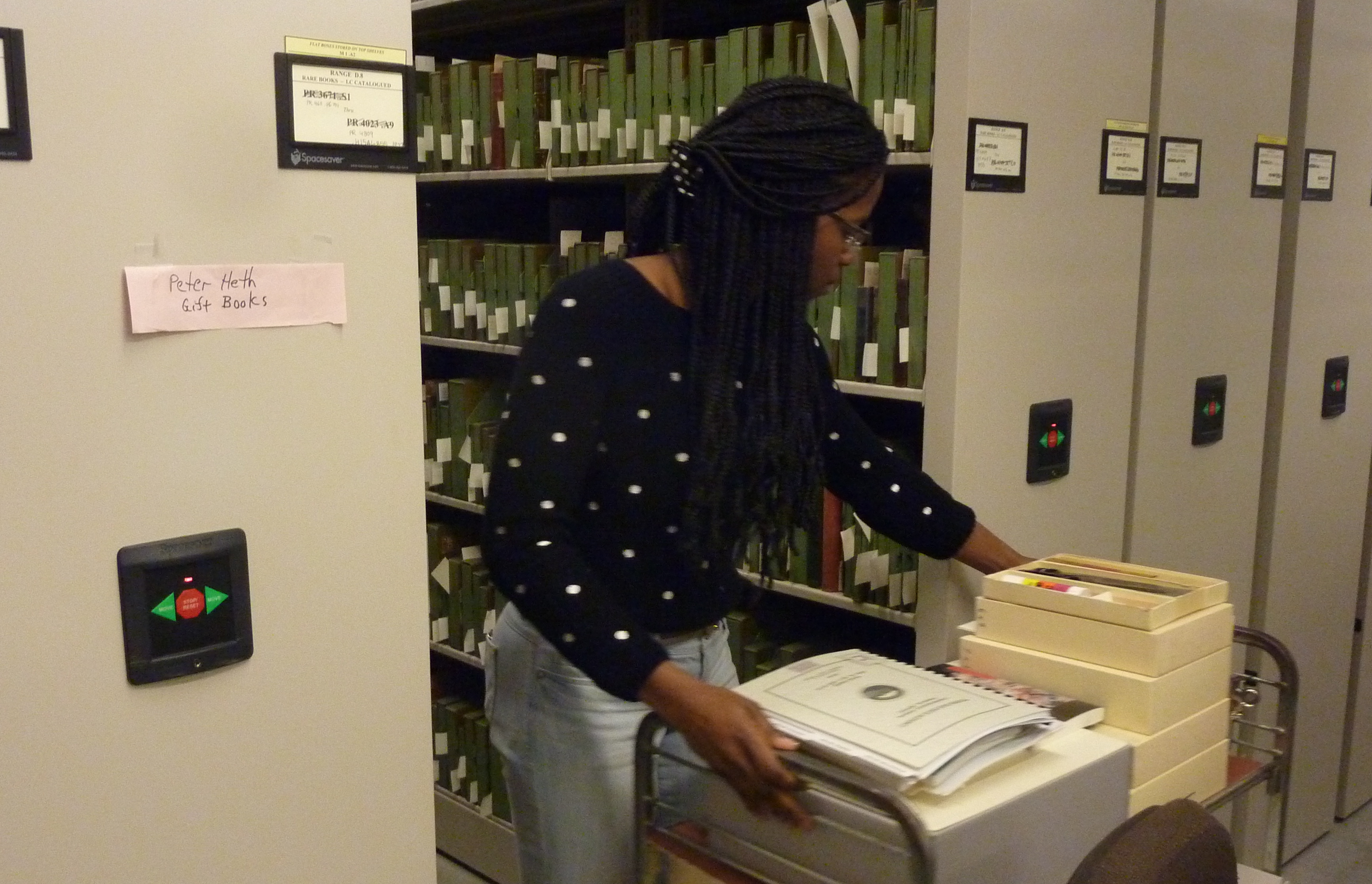
Student assistant Ashlyn Walker with the special serials truck, preparing to put new issues of serial publications into the stacks.

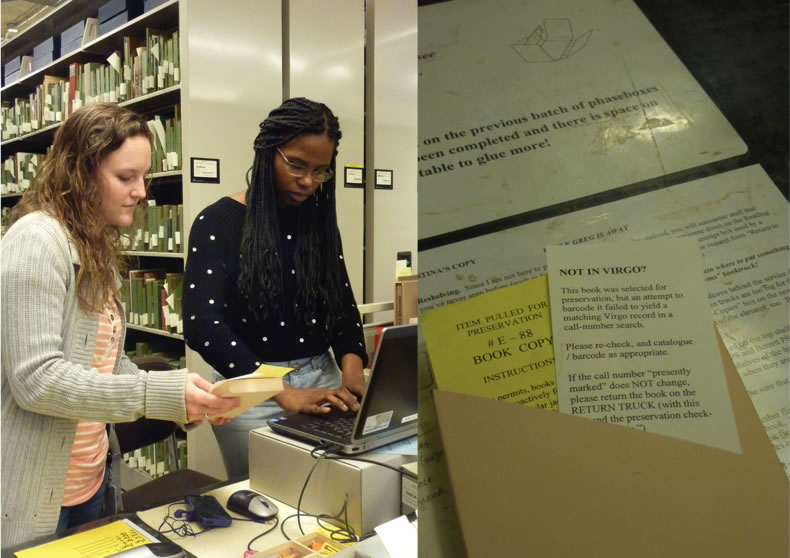
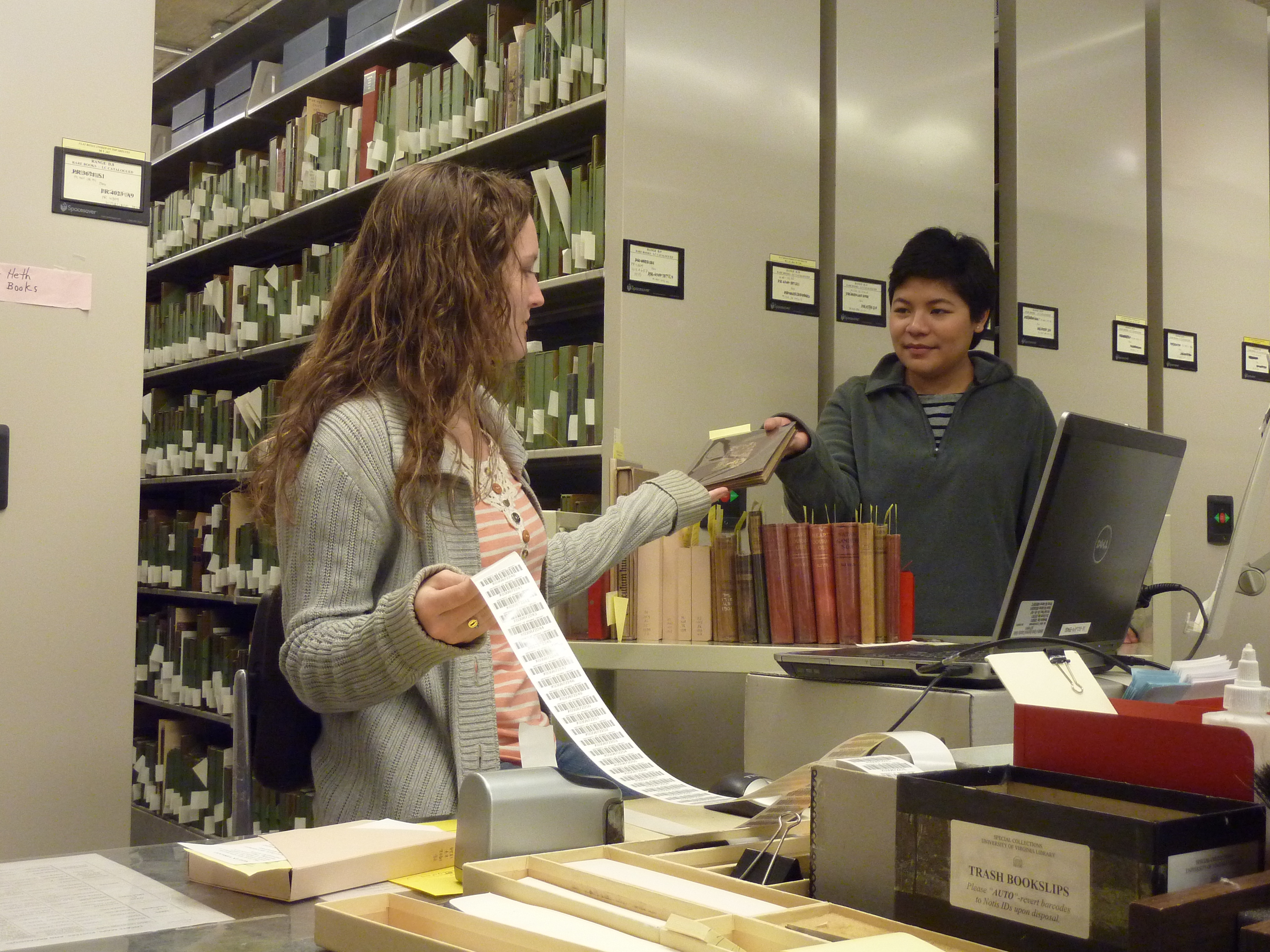
ALEX: Whenever we come into contact with an item that requires unusual housing or has a call number that can’t be found in Virgo, we reach out to our fellow student employees for help. We also often work together to barcode items and make sure the records we have on file are correct.

asdf

Alex and Ashlyn work together to determine why the call number of a phaseboxed book isn’t showing up in U.Va.’s online catalog, Virgo

asdf

Alex and Christina barcode a truck of books that have just been through the preservation process

CHRISTINA: There are many reasons I love working at Special Collections. Being surrounded by rare materials published hundreds of years ago, and protecting these items, are just the tip of the iceberg. What I will miss the most when I graduate are the people working here.  The smiles, care, and trust that I have received from both student and library employees are incomparable and this is why coming to work is always such a pleasure. Special Collections, thank you for a wonderful four years.

ALEX: I enjoy working here because I love U.Va.’s collections. From the miniature books that are no bigger than my thumb to the elephant folios that weigh a ton, I’m fascinated by them all and honored to be able to help with their preservation. Like Christina said, the people we get to work with here are also amazing. Their passion for the materials inspires me and they’re actually all just fun to be around. It’ll be a difficult goodbye, but I am grateful to have been surrounded by such wonderful company over these last few years.

asdf

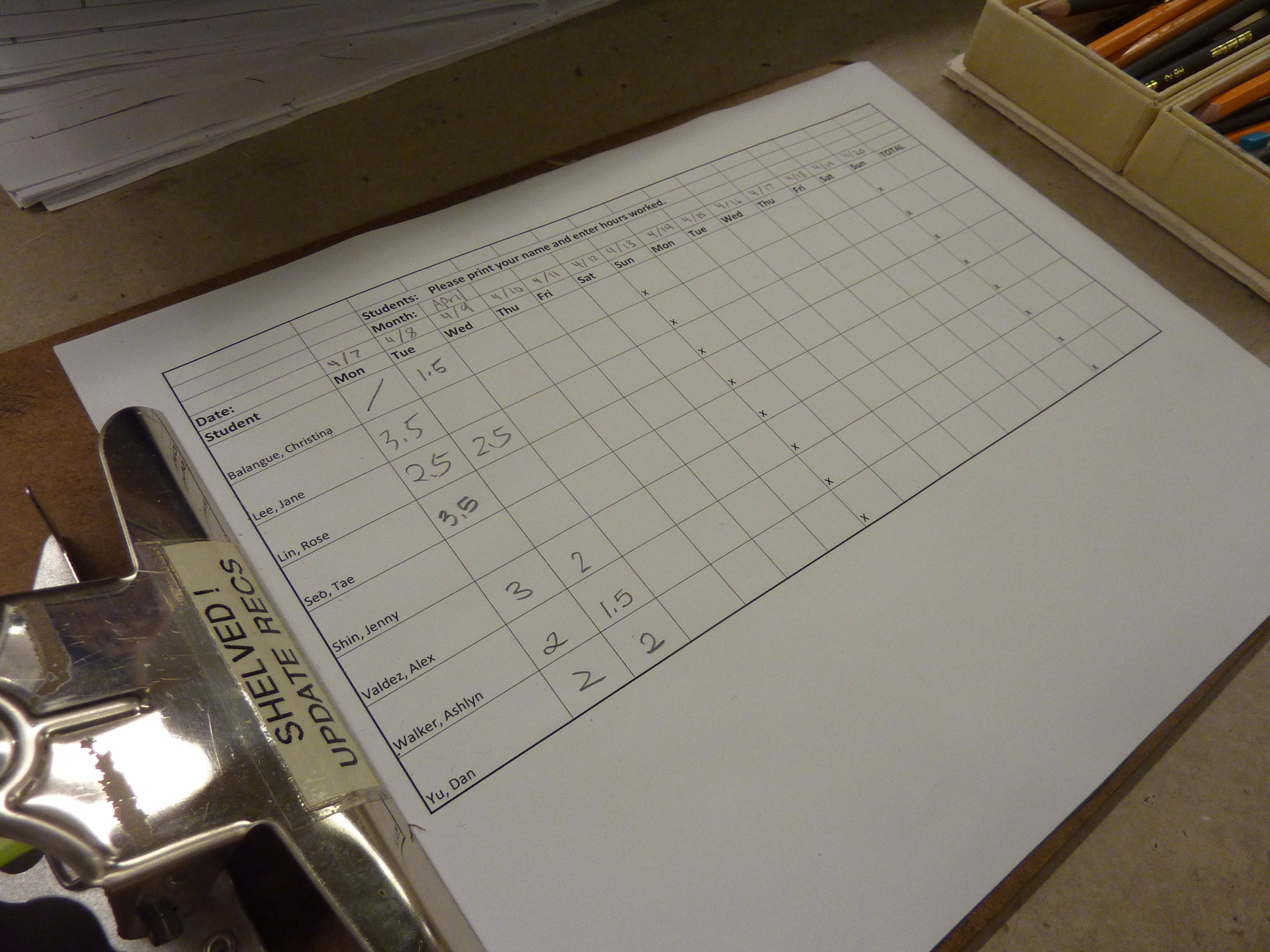
Here’s the timesheet where we record the hours we have worked…it’s our favorite thing.

Thank you, Alex and Christina, for all your wonderful work over the years. We can’t say enough about how much we appreciate your dedication. And congratulations on your upcoming graduations! WAHOOWA!