On View Now: What Lies Beneath (Visit if you dare…)

Curated by the Small Library’s Reference Team, What Lies Beneath: The Macabre and Spooktacular of Special Collections, takes a deeper dive into the catacombs of UVA’s archival netherworld. Leaving no page unturned nor manuscript box unopened, curators Anne Causey, Regina Rush, and Penny White have ferreted out the frightening and ghoulish side of Special Collections. The resulting exhibition is designed to whet the appetite of ghoul seekers young and old.
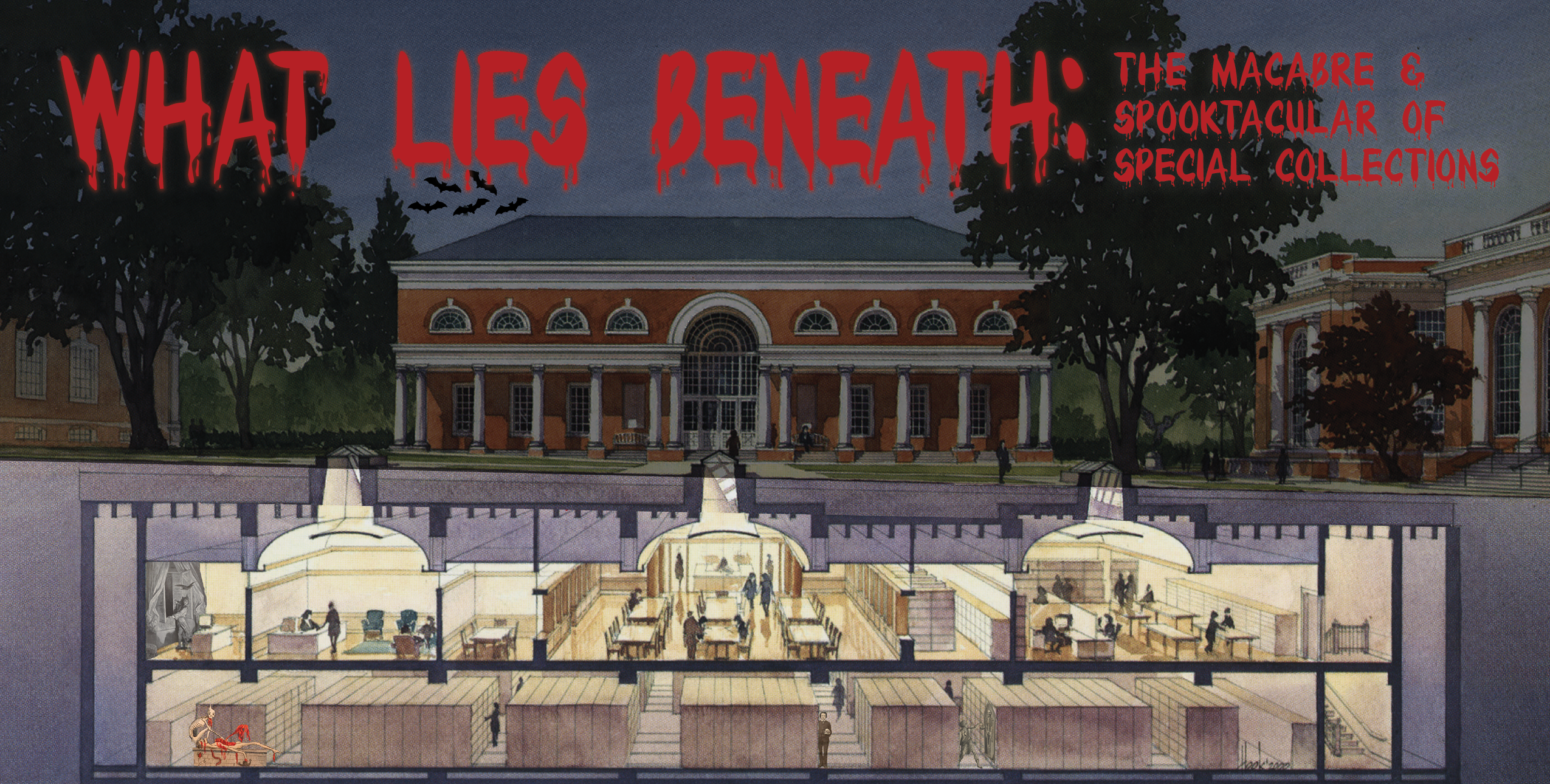
Ever want to see our stacks in person? Our exhibition poster might change your mind. Or you might want to pick one up to take back to your dorm–weirdo!
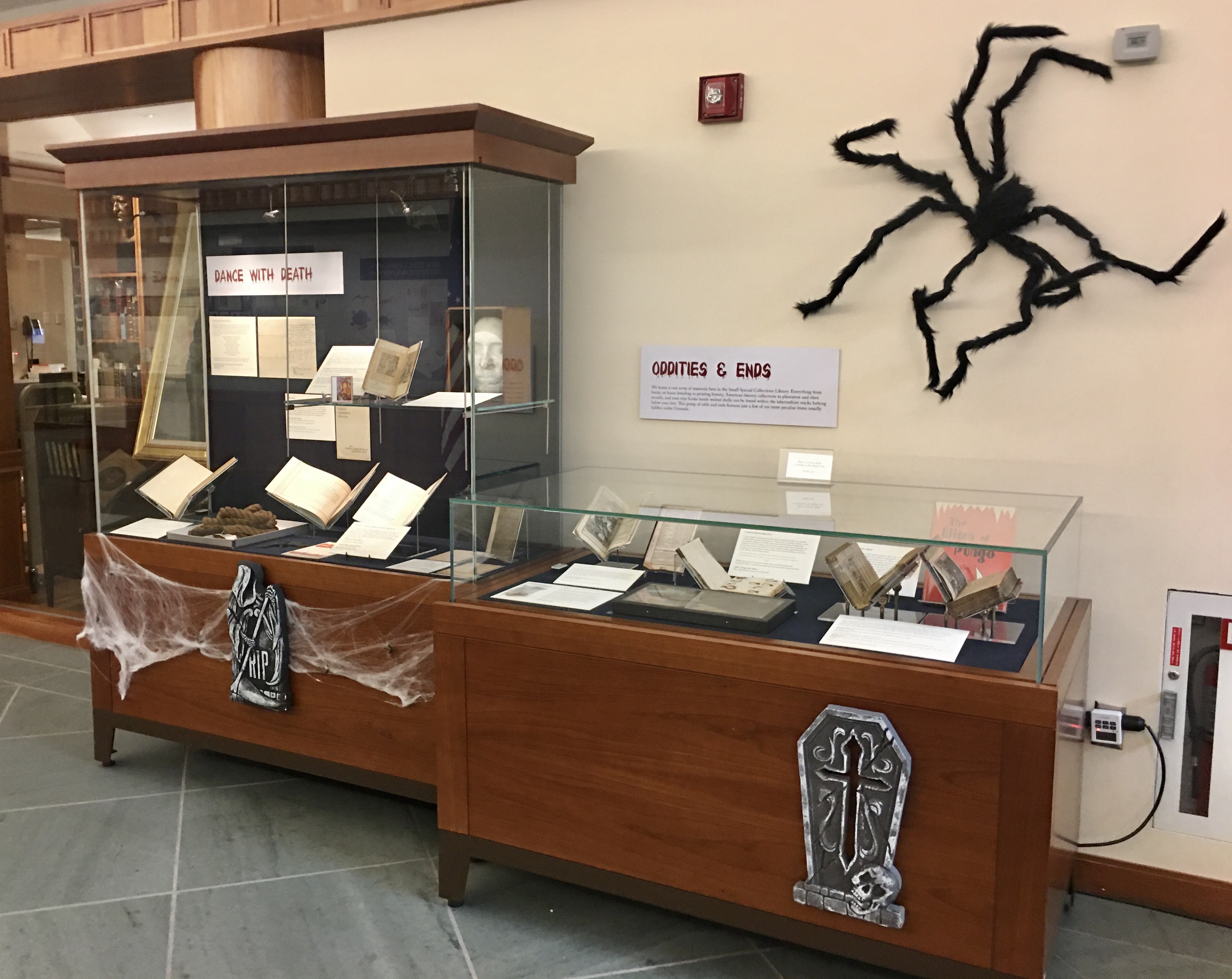
Would you believce that’s a real spider on the wall? Ok, ok, we admit, it’s a facsimile of a spider.

Located just a stone’s throw away from West Range #13—the purported room of the University of Virginia’s masterful matriculate of the macabre, Edgar Allan Poe—lies a subterranean treasure trove of historical and literary scholarship.
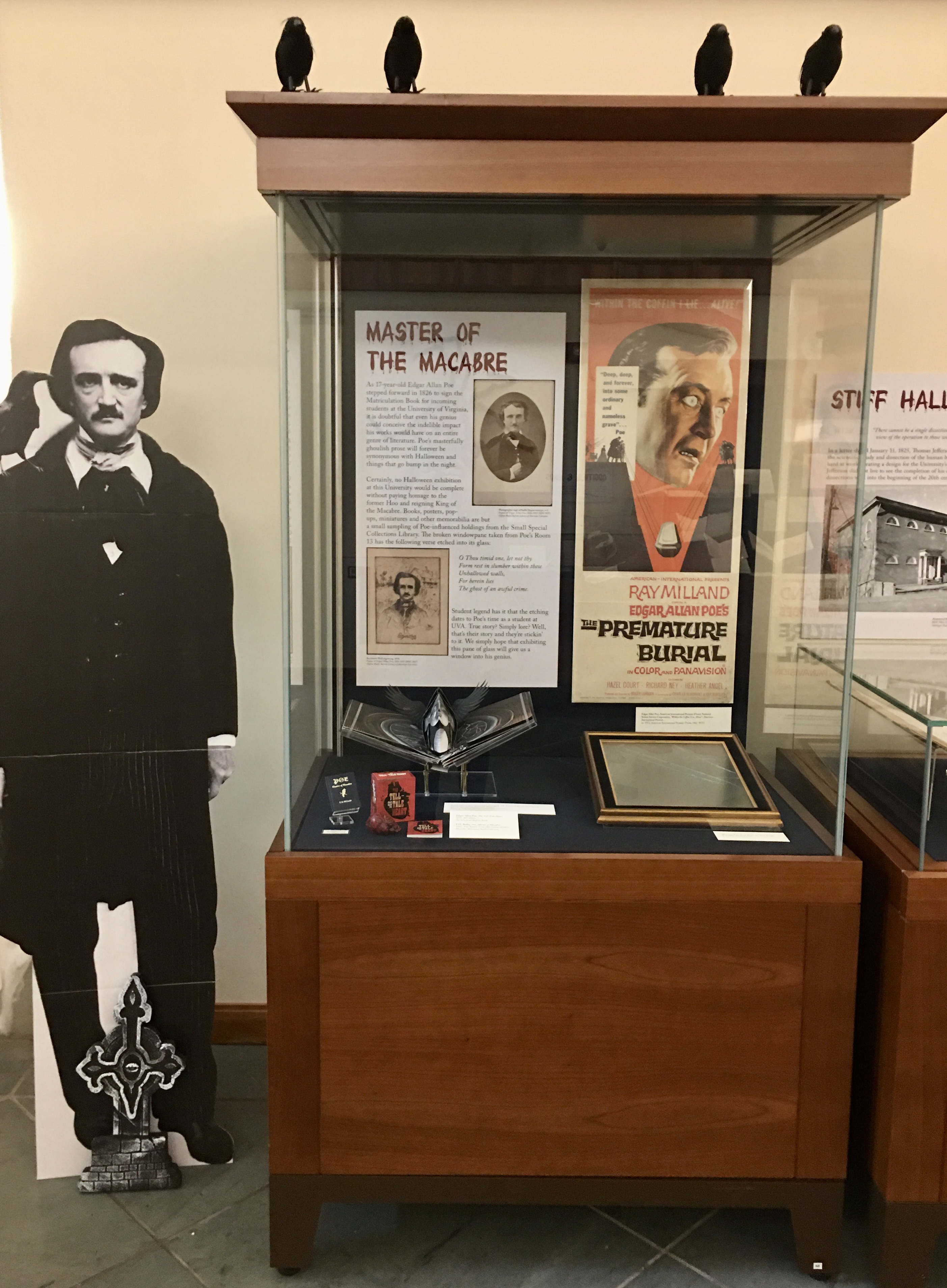
Poe’s raven gets top billing, of course.
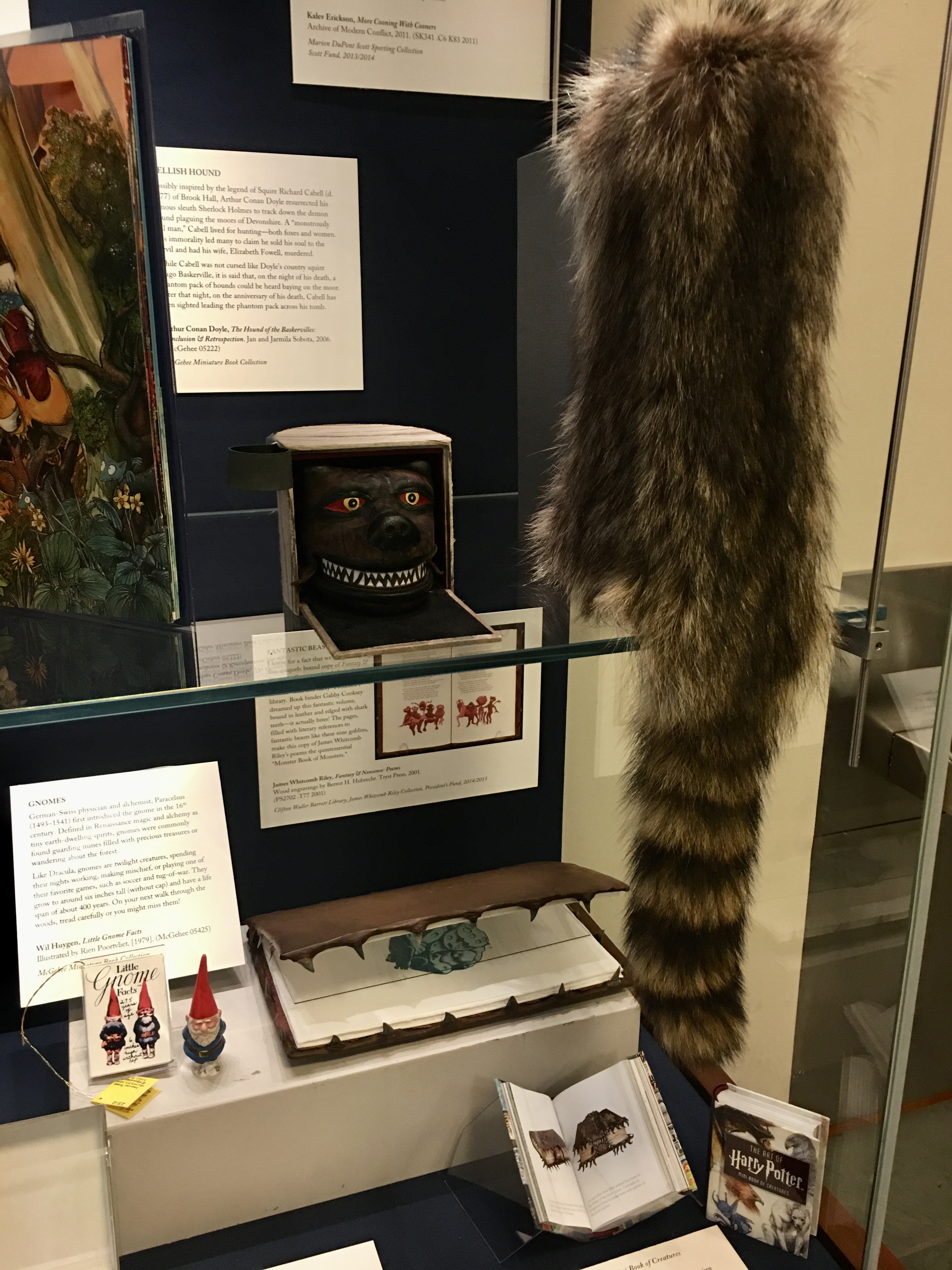
Yes, that’s a real raccoon coat and tail (More Cooning With Cooners, SK341 .C6 K83 2011-Marion DuPont Scott Sporting Collection); a leather book edged with shark teeth by fine binder Gabby Cooksby (Fantasy & Nonsense: Poems, PS2702 .T77 2001-Clifton Waller Barrett Library, James Whitcomb Riley Collection); and a miniature book bound in black calf suede and leather with colored leader onlays and shaped into the head of a hound by fine bookbinder Jarmila Sobata (The Hound of the Baskervilles: Conclusion & Retrospection, McGehee 05222 -McGehee Miniature Book Collection).
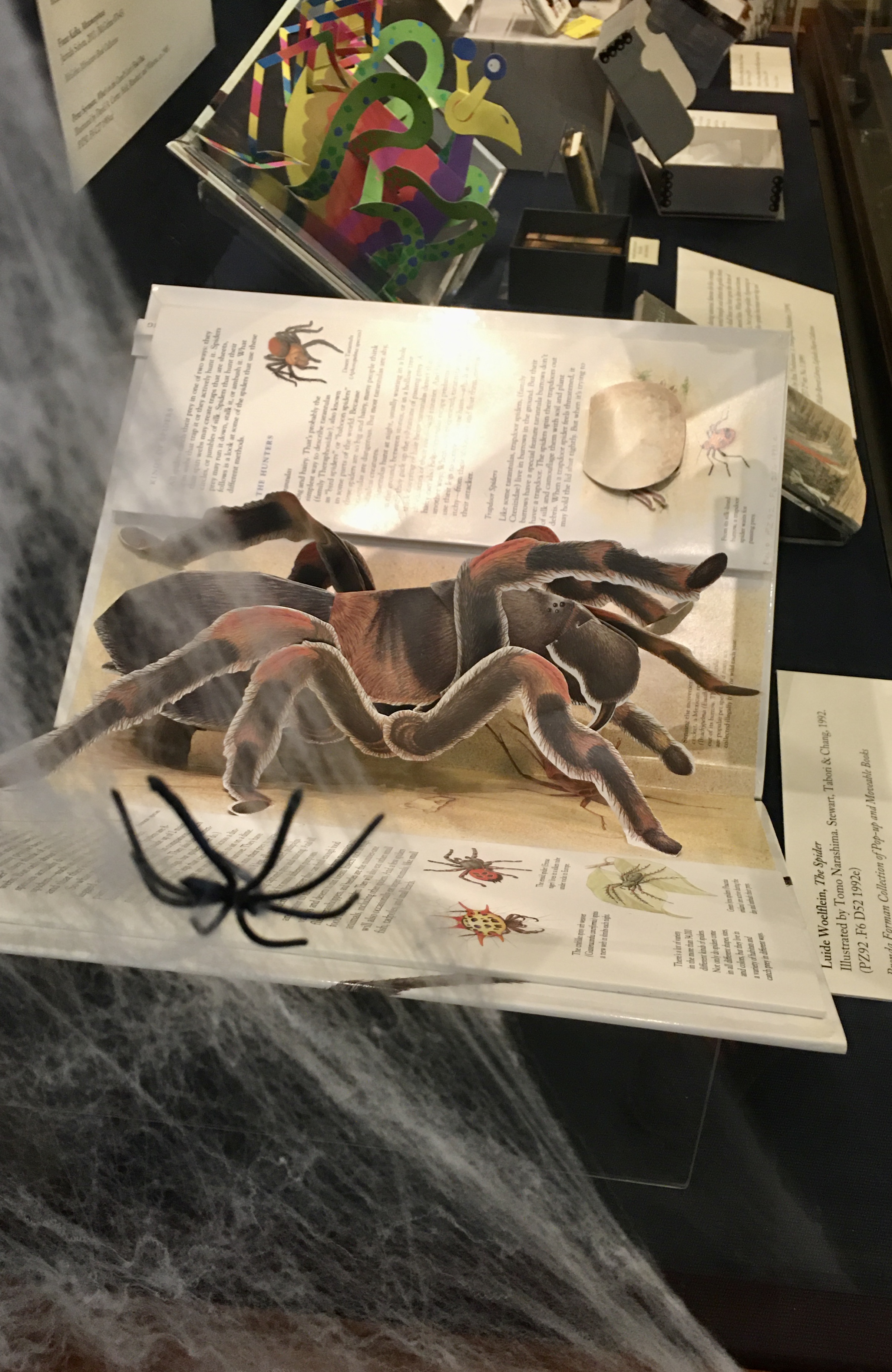
Did you know there are more than 3,000 species of spiders roaming around North America? We even have a few right here in the stacks, including The Spider written by Luide Woelflein and illustrated by Tomo Narashima (PZ92 .F6 D52 1992e) from the Brenda Forman Collection of Pop-up and Moveable Books.
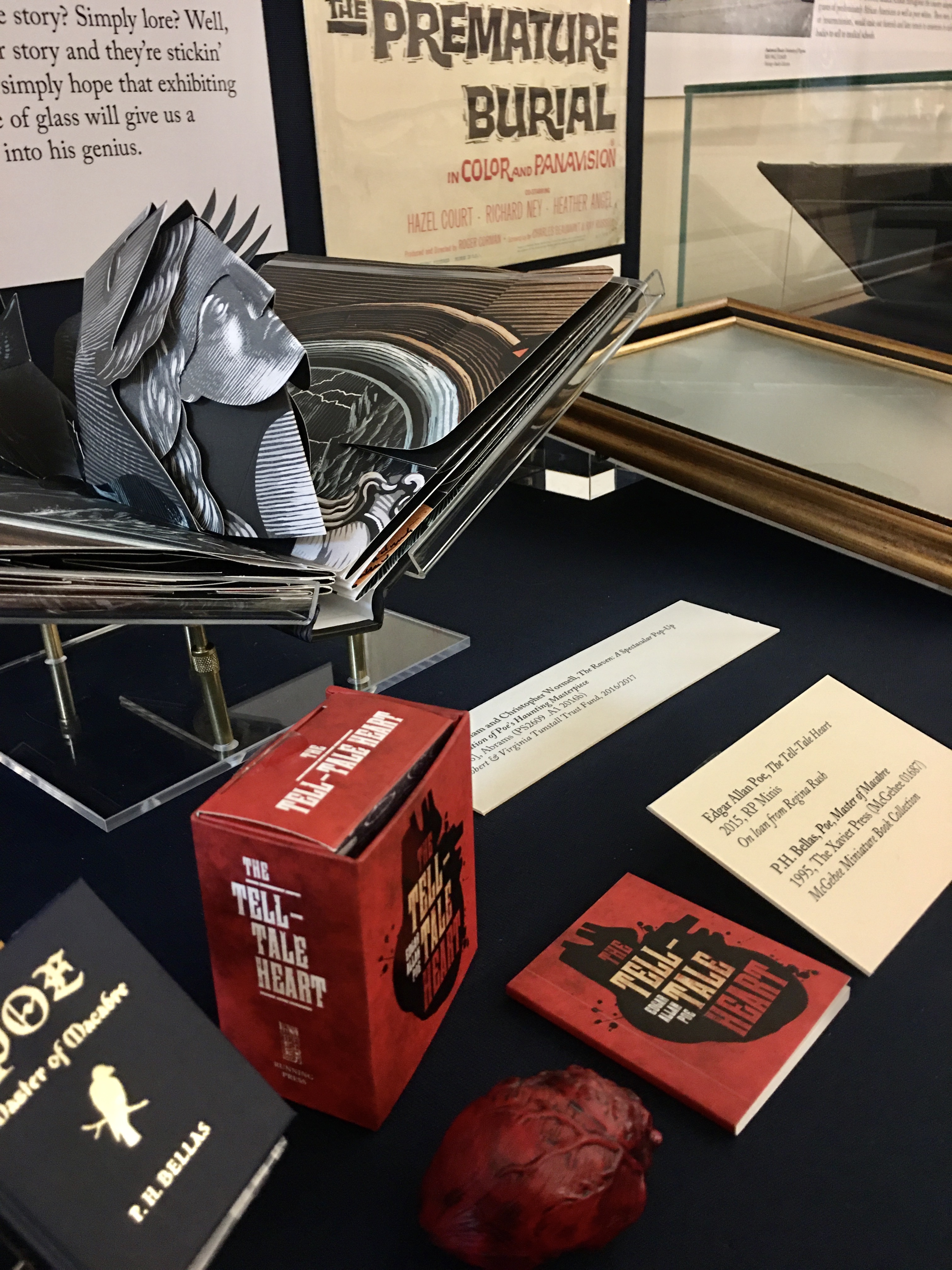
No Halloween exhibition at this university would be complete without paying homage to the former Hoo and reigning Master of the Macabre, Edgar Allan Poe. Books, including miniatures (The Tell-Tale Heart, 2015, on loan from private collection and Poe, Master of Macabre, McGehee 01687 -McGehee Miniature Book Collection) and pop-ups (The Raven: A Spectacular Pop-Up Presentation of Poe’s Haunting Masterpiece, PS2609 .A1 2016b -Robert & Virginia Tunstall Trust Fund) are but a small sampling of Poe-influenced holdings. The broken windowpane on view in the exhibition—rumored to be from Poe’s Room 13 on the West Range—has the following verse etched into its glass: “O Thou timid one, let not thy/ Form rest in slumber within these/ Unhallowed walls,/ For herein lies/ The ghost of an awful crime.”
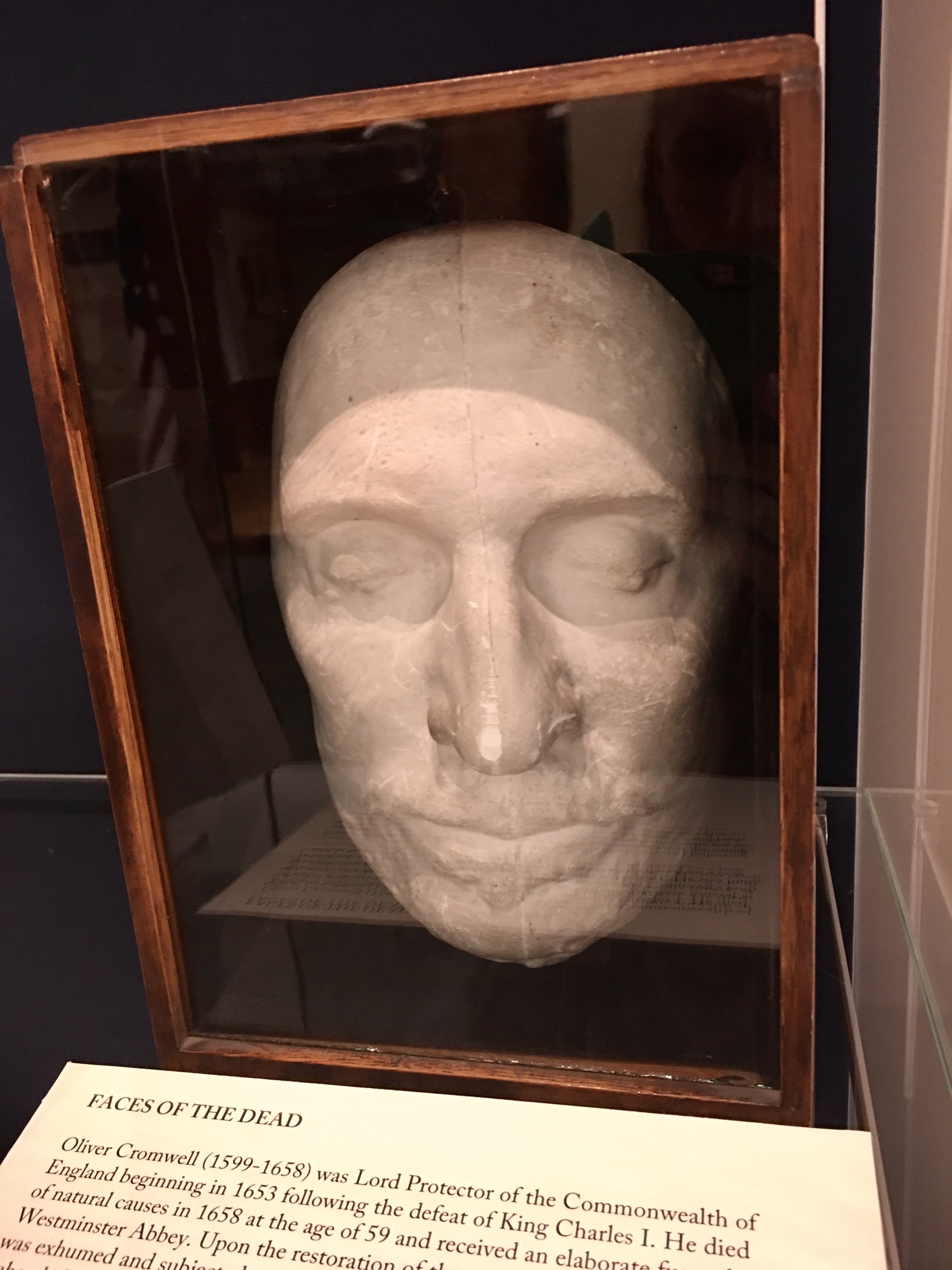
Oliver Cromwell, Lord Protector of the short-lived Commonwealth of England following the defeat of King Charles, died of natural causes in 1658. Upon the restoration of the monarchy in 1661, Cromwell’s body was exhumed and subjected to a posthumous execution: he was hanged, beheaded, and his body thrown into a pit. His head was displayed on a pole outside Westminster Hall until 1685. This plaster cast is a copy from one of several death masks created(by pouring plaster or wax over the deceased’s face shortly after death)following Cromwell’s death in 1658, prior to his grim exhumation. (MSS 5368-a-Gift of Charles C. Abbott).


Come meet James Steele, the Revolutionary War soldier who lost his head and lived to tell about it. Have a Dance with Death…or, perhaps, you may want to sample an embalming recipe that’s simply to die for. As you explore this exhibition, we hope you will go, in the words of Edgar Allan Poe,“deep into that darkness peering…wondering, fearing, doubting,dreaming dreams no mortal dared to dream before.”Come and See…If You Dare!

What Lies Beneath is on view in the First Floor Gallery of Harrison/Small through December 21, 2019.
 

Now Live: The New Special Collections Request System!

Today, the Albert & Shirley Small Special Collections Library is launching a new online request and material circulation system.

The Special Collections Request System is an automated request and workflow management software specifically designed for special collections libraries and archives.

This new system will improve how researchers register and request materials held by the Small Special Collections Library by…

This one-time registration process is easy and includes the creation of your online account. With this account, you will be able to request materials from the Library’s online catalog, VIRGO and archival materials from Archives at UVA for use in our reading room. You will also be able to track the status of your requests. UVA students, faculty, staff, and current community users will be required to register in this new systemRegister now.

  • Empowering researchers to request materials before visiting:

Researchers will now be able to request collection materials before arriving at the Library. Please note that researchers are limited to 10 active item requests at one time. Additional requests may be made once the initial 10 items have been viewed. Requests can be made from your online account by using the links under the New Requests section of your dashboard.

Please note that visitors must bring a valid photo ID:

ALL researchers will be asked to present a valid photo ID once to confirm registration. UVA students, faculty, and staff should present their UVA ID card to complete registration.

Questions? For more information about our new request system and how it can serve you, please see our FAQ page.

Begin your registration now.

Coming Soon: A New Special Collections Request System!

New flexibility. New look. New procedures.

On Wednesday, May 15, 2019, the Albert & Shirley Small Special Collections Library will launch a new online request and material circulation system.

The Special Collections Request System is an automated request and workflow management software specifically designed for special collections libraries and archives. This new system will improve how researchers register and request materials held by the Small Special Collections Library.

Stay tuned for more information about how our new request system will serve you on Wednesday!

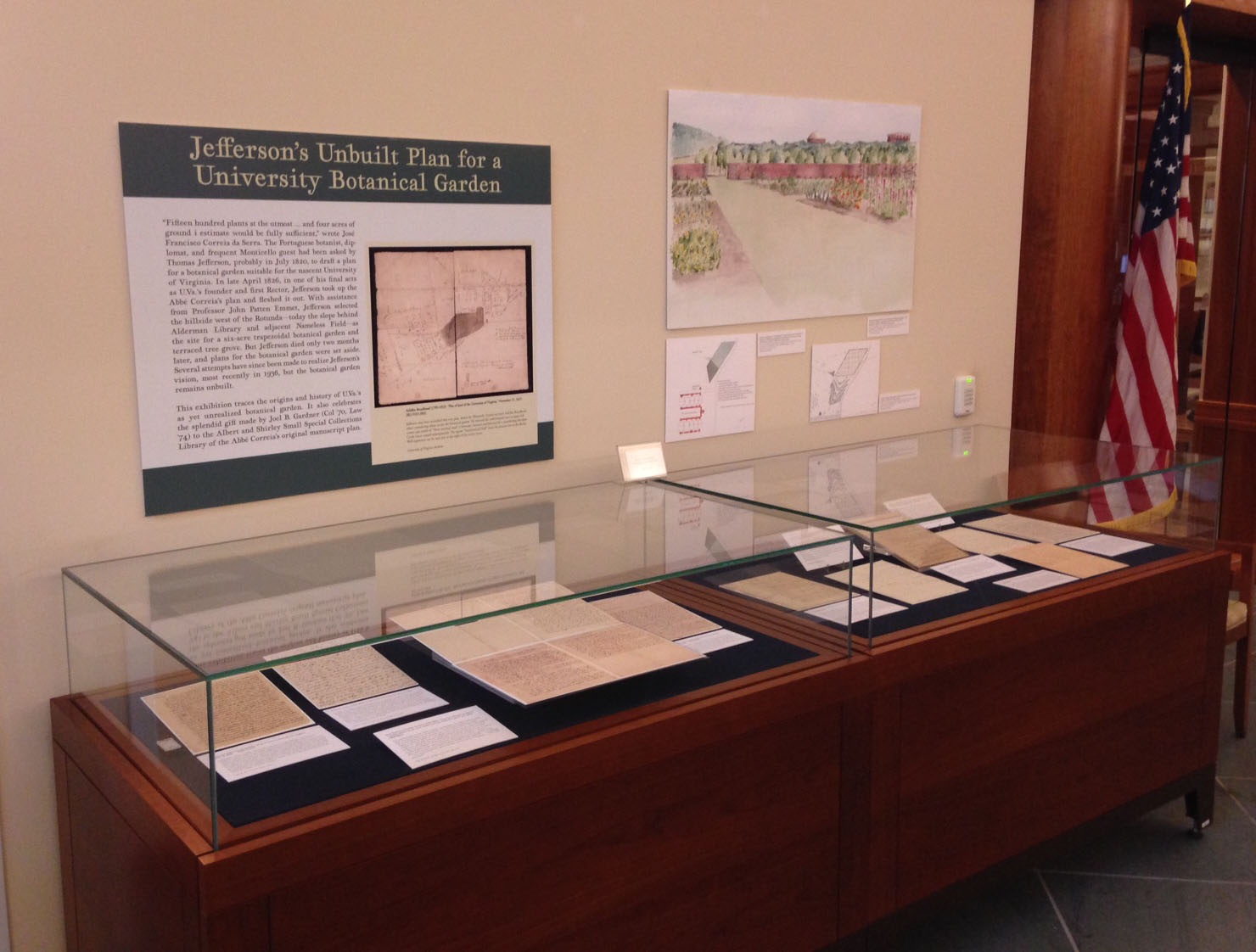
New Exhibition: Jefferson’s Unbuilt Plan for a University Botanical Garden

Our library neighbors—Alderman Library and Clemons Library—were built into the side of a hill sloping down to a sunken grassy area known as Nameless Field. When not too swampy to traverse, Nameless Field is home to the occasional soccer game or Quidditch match, and the recently added beach volleyball courts are popular with U.Va. students. But apart from the small portion now occupied by Alderman and Clemons Libraries, and a service road, U.Va. has yet to designate the site for permanent development.

Actually, that’s not fully accurate. In April 1826, U.Va.’s first Rector, Thomas Jefferson, selected the site as the location for a university botanical garden. Jefferson then tasked U.Va.’s first professor of natural history, John Patten Emmet, with its construction. But neither funds nor laborers could be spared just then from other U.Va. priorities, such as completing the Rotunda and patching its leaky dome. Following Jefferson’s death on July 4, 1826, interest in the botanical garden soon waned. Despite occasional attempts to revive the project—most recently in the early 20th century—it remains unbuilt.

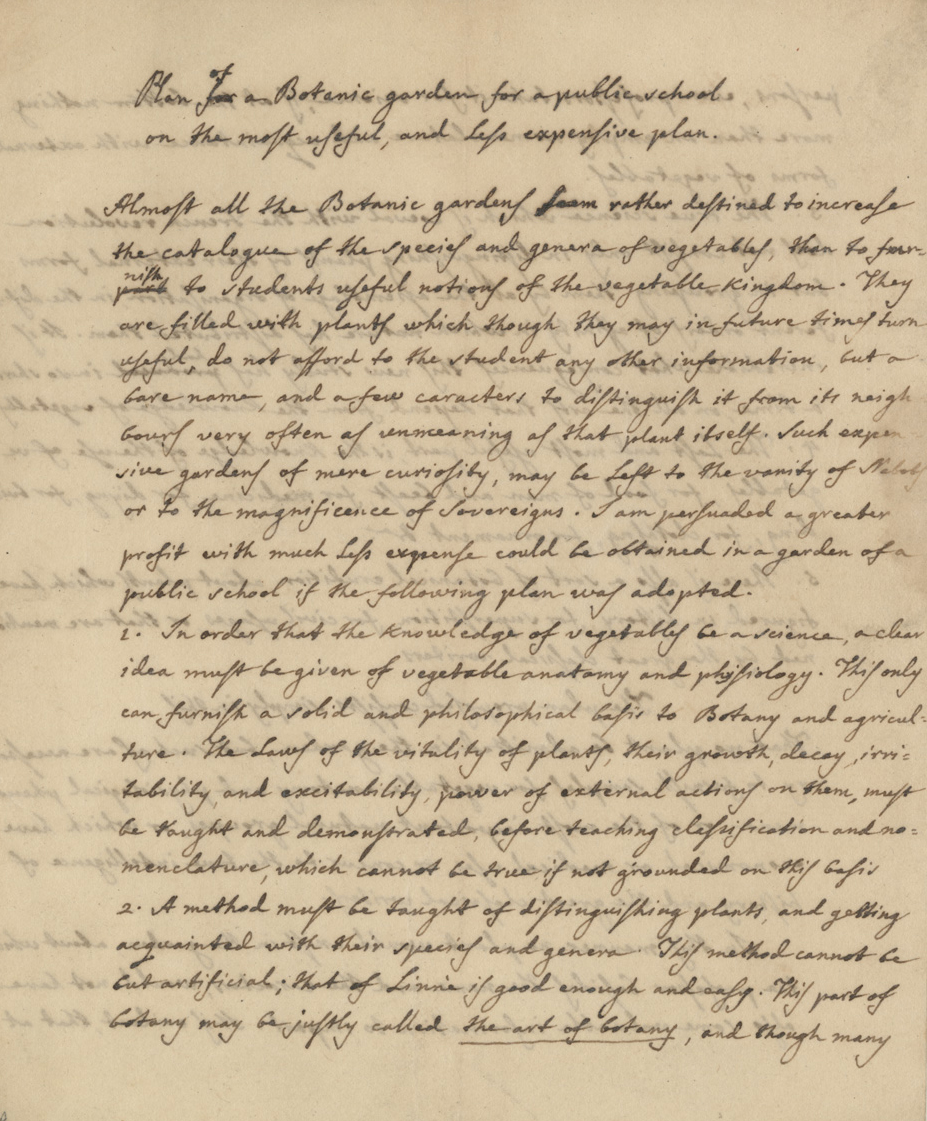
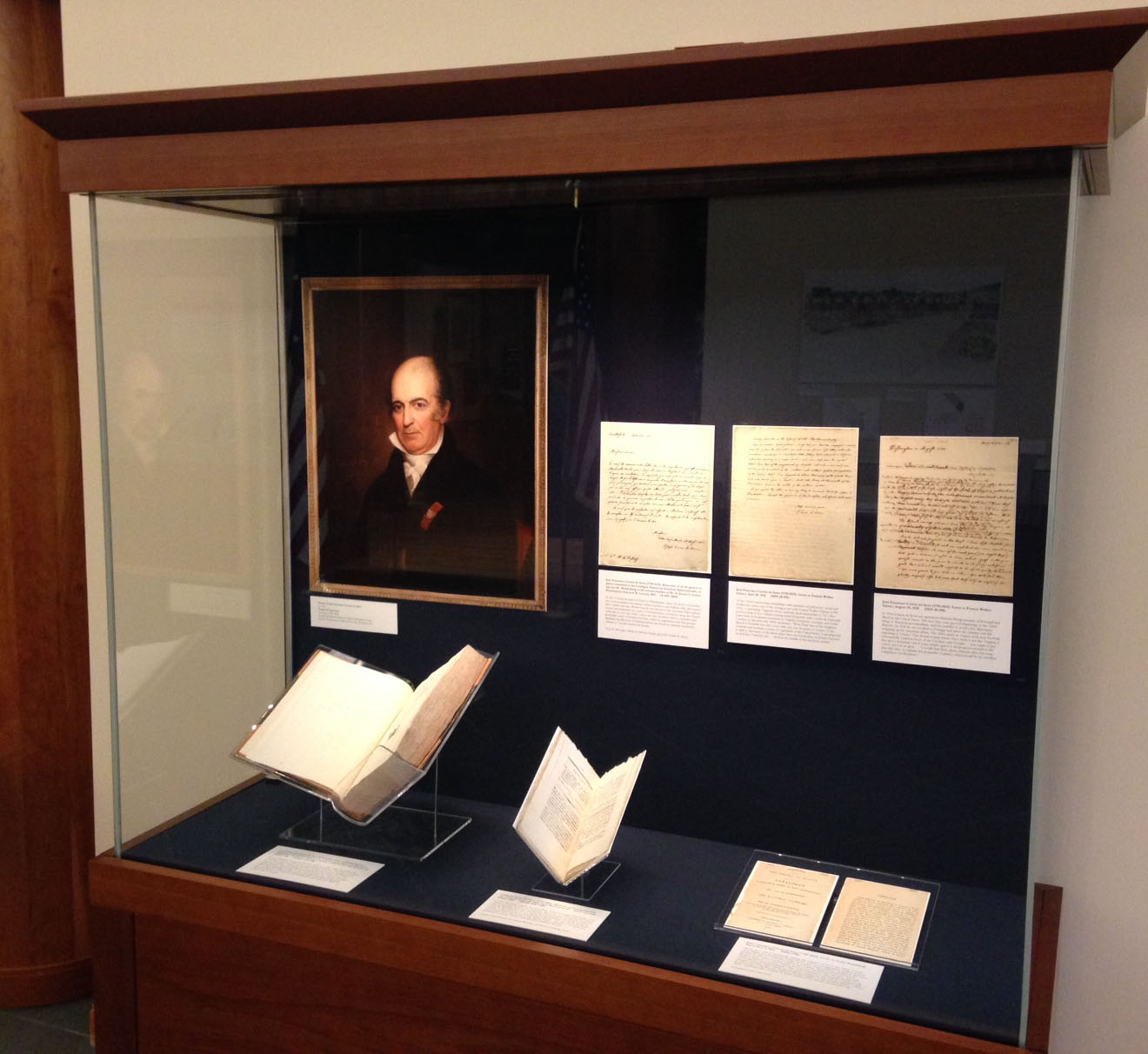
Jefferson had long contemplated a botanical garden for U.Va., and he sought advice from his friend (and frequent Monticello visitor), the Portuguese botanist and diplomat José Francisco Correia da Serra (1750-1823). At Jefferson’s request, probably in July 1820, Correia da Serra drafted a “Plan for a Botanic garden for a public school on the most useful, and less expensive plan.” It was this plan that Jefferson turned to in April 1826 when drafting the specifications for Emmet to follow.

First page of the “Plan for a Botanic garden for a public school,” drafted at Thomas Jefferson’s request by Jose Francisco Correia da Serra ca. 1820. The gift of Joel B. Gardner (Col ’70, Law ’74) (2019-0024)

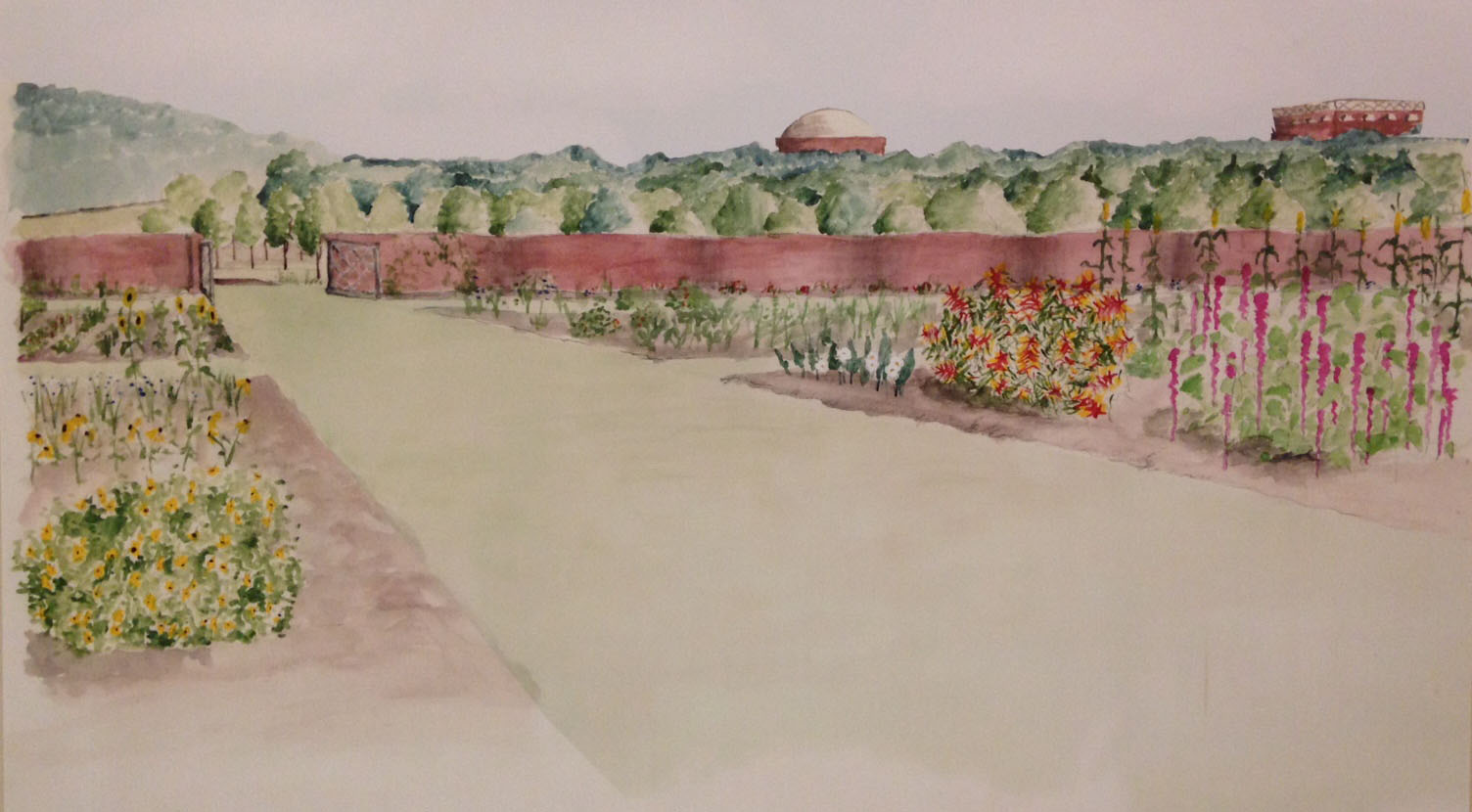
Jefferson envisioned a four-acre botanical garden—trapezoidal in shape per the site’s awkward boundaries—surrounded by a serpentine brick wall. Inside would be planted approximately 1,500 botanical specimens, carefully selected to serve a range of instructional purposes. Two acres of the sloping hillside above would be turned into a grove planted with specimens of non-native trees.

Conjectural perspective view from within the botanical garden, looking east towards the Rotunda and Anatomical Theater, ca. 1830. Plan by Jenny Jones. From Lily Fox-Bruguiere, “An Uncultivated Legacy: Jefferson’s Botanical Garden at the University of Virginia,” U.Va. Master’s Thesis, 2010 (Masters Arch. Hist. 2010 .F69) (reproduced with permission)

Last October, the original holograph manuscript of Correia da Serra’s plan was generously given by Joel B. Gardner (Col ’70, Law ’74) to the Albert and Shirley small Special Collections Library. In honor of Mr. Gardner’s splendid gift, we have mounted a special exhibition, Jefferson’s Unbuilt Plan for a University Botanical Garden.  On view in our First Floor Gallery through June 29, the exhibition traces through rare books and manuscripts Correia da Serra’s life and botanical activities, his friendship with Jefferson, and Jefferson’s ultimately unsuccessful efforts in his final months to create a botanical garden for U.Va.

Introducing the Archiving Student Life for the Third Century Project and Workshop

This week we are pleased to welcome a guest post by Jacob Shaw, who is a third year majoring in Economics and Sociology.

I am one of the two archives project assistants for the Archiving Student Life for the Third Century project at the UVA Archives in the Albert and Shirley Small Special Collections Library. Funded by UVA Bicentennial, the goal of the project is twofold—to document student life both through making past records of student life visible and accessible, and to expand the collection of records from student groups on Grounds today. In regards to the first goal, we have been working on processing new donations, such as records documenting Greek life and organizations like the Jefferson Society, along with reprocessing and rearranging important record groups and collections. To help expand our holdings of contemporary student groups, my coworker Aasritha Natarajan and I have been reaching out to a variety of student groups via email to inform them about the Archives’ initiative, and to see if they are interested in donating their records. To further engage student groups in the archiving process, we will be hosting a workshop in the Rotunda multipurpose room on April 24th, 5:30-6:30 pm, to talk to students about the project, what we do at the UVA Archives, and how they can preserve their records and donate them to the Archives.

Radical Student Union publication, Southern Student Organizing Committee Records, (MSS 11192, Box 13). Image by Bethany Anderson.

While my coworker and I have both worked on the archiving and outreach ends of this project, I have spent most of my time working with documents and records, both processing and reprocessing. The main group of records I have been working with are the Southern Student Organizing Committee records, a large group of documents that has been compiled by several donors.

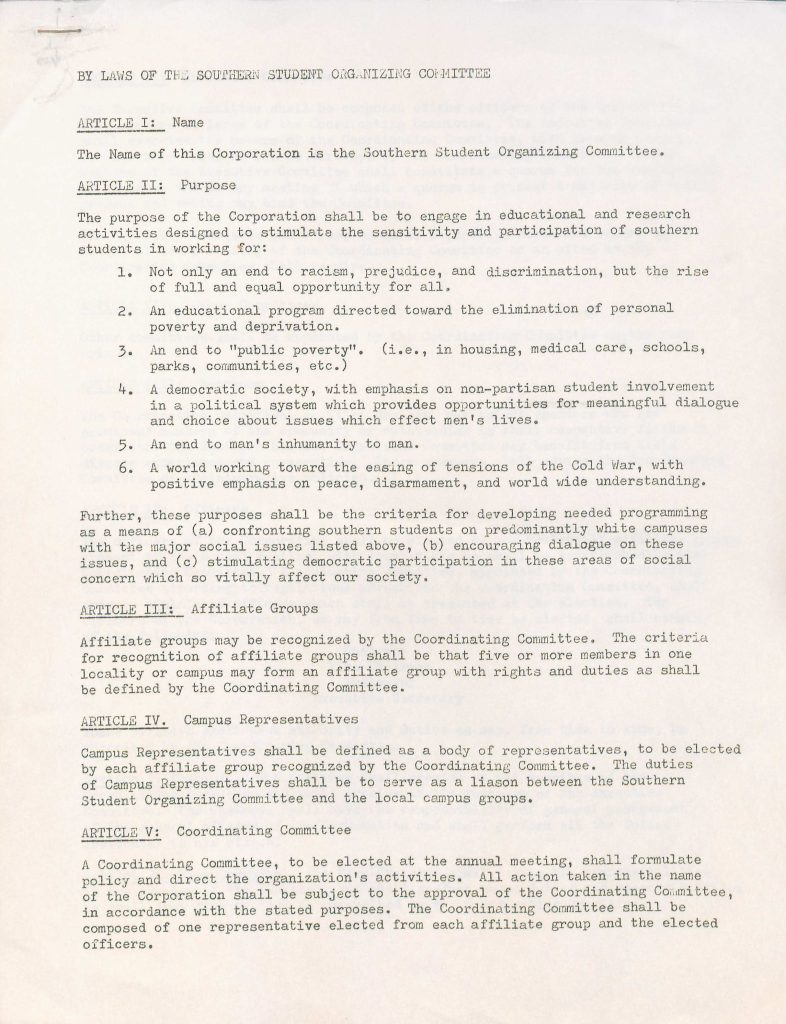
The Southern Student Organizing Committee (SSOC) records tell a very important and interesting story regarding the Civil Rights Movement, the Vietnam War Era, and issues of domestic economic and social policy all through the lens of student activism, particularly at the University of Virginia. The SSOC was an inter-collegiate organization of students at predominantly white universities in the South whose initial aim was to promote progressive social policy regarding racial equality at their universities. While the group remained true to their aims of racial equality in the era of the Civil Rights Movement, they expanded their activism to anti-Vietnam War efforts, by providing legal information to conscientious objectors of the draft and critiquing a variety of American institutions. Also, the group devoted significant energy to supporting labor movements and pushing back against corporate interests. Looking through the documents, it becomes clear that the SSOC was embedded in an important network of student groups, such as the Students for a Democratic Society and the Student Nonviolent Coordinating Committee and their different campus chapters, and taking parts in composite organizations such as the Radical Student Union at the University of Virginia.

Bylaws of the Southern Student Organizing Committee, Southern Student Organizing Committee records (MSS 11192, Box 12). Image by Bethany Anderson.

The importance of the UVA Archives becomes clear when one realizes that the SSOC almost sank into oblivion, at least in terms of their records. According to Gregg L Michel, a UVA graduate student who wrote about student organizing, many of their records were intentionally destroyed after the dissolution of the SSOC. While writing his dissertation on the SSOC he reached out to two UVA alumni who both served as the chairs of the organization (Tom Gardner and Steve Wise), leading to the donation of their records, along with records from other members they knew. The records donated by Gardner and Wise really bring the story of the SSOC to UVA, as these two figures, particularly Gardner, saw the SSOC through the bulk of their Civil Rights and Vietnam activism, along with a variety of projects that incorporated UVA groups beyond just the SSOC, such as the “Virginia Summer Project” and the Radical Student Union.

The writings of Gardner highlight the local aspects of student activism, with essays and memos discussing issues around grounds and critiquing UVA as an institution.

At our upcoming workshop, I will be talking more about the Southern Student Organizing Committee, and leading the participants through an activity using an example of a document from their records. The goal of the activity will be to think about our current university climate through the lens of the SSOC’s documents, thinking about the state of student activism on grounds today, and understanding the role and importance of the Archives in preserving student life.

Participants will also learn about how to preserve and donate their own records and hear from several students and staff from the UVA Library and Special Collections about their projects that relate to preserving history, identity, and student activity!

Thank you for reading and please consider coming to the Rotunda on April 24th at 5:30 pm. You can register and find more information about the workshop here: https://bit.ly/2TFZK9a


Samuel V. Lemley Wins the National Collegiate Book Collecting Contest

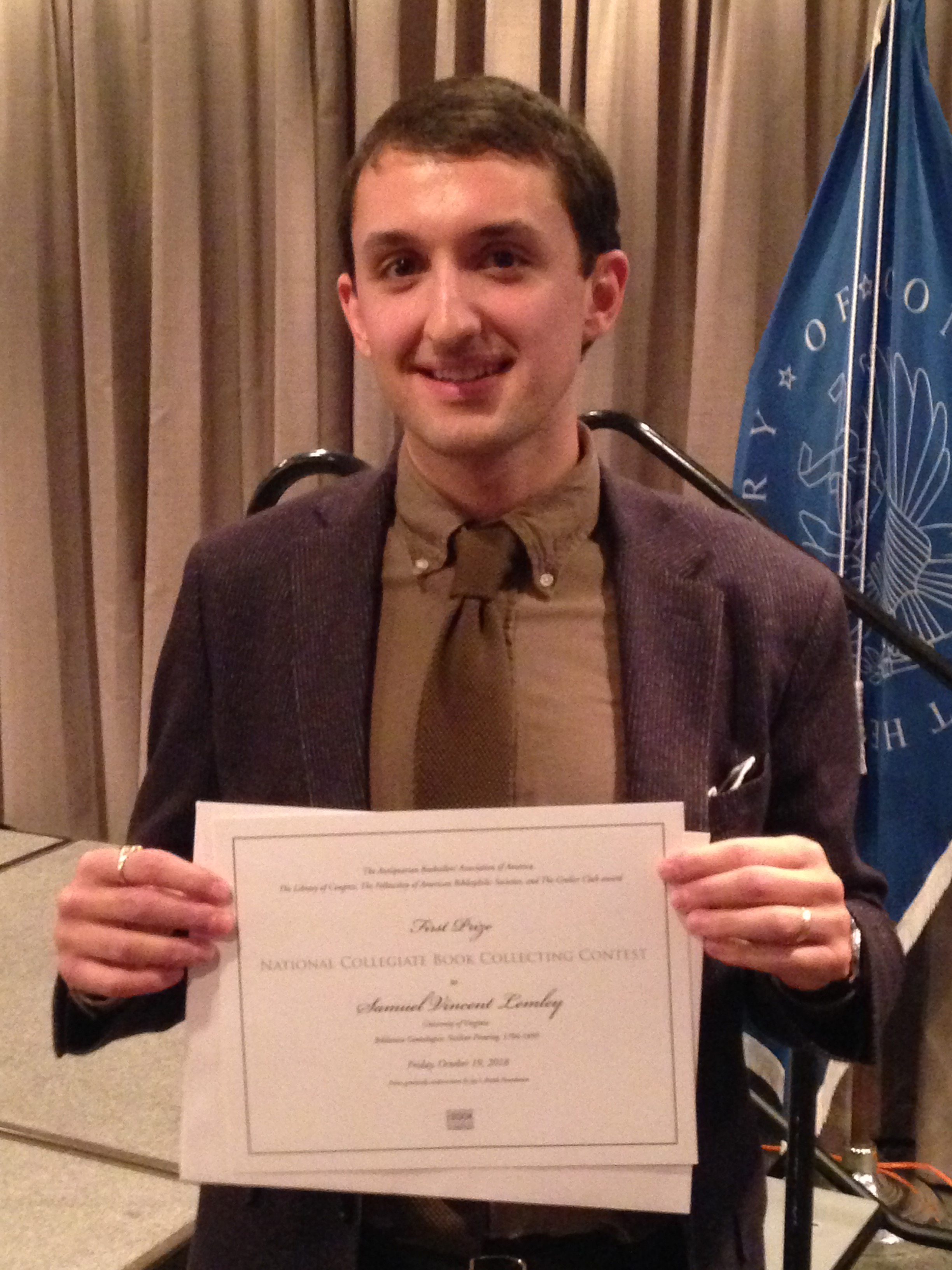
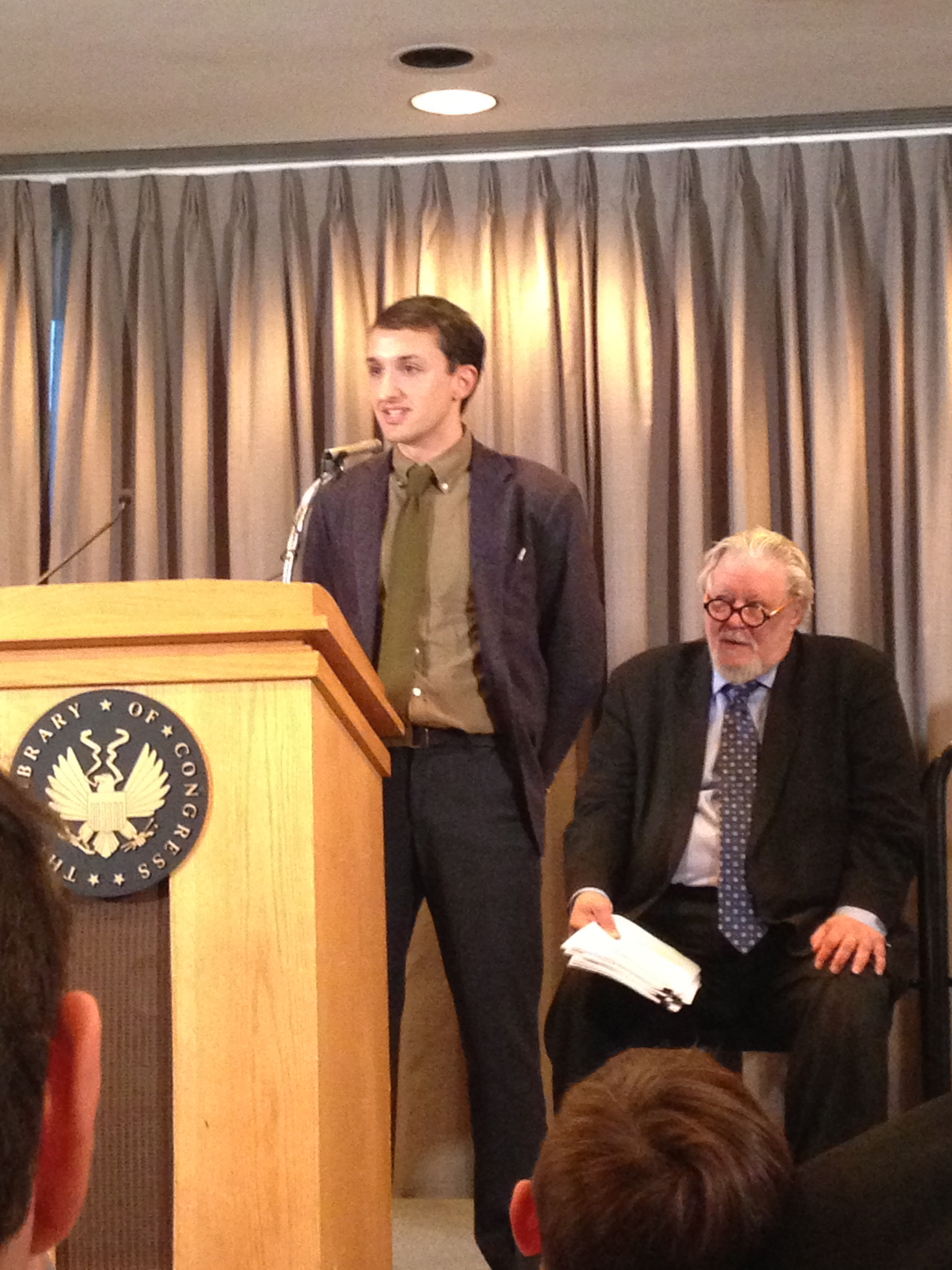
Samuel V. Lemley displays his 2018 National Student Book Collecting Contest First Prize certificate.

On Friday, October 19, bibliophiles from around the nation gathered at the Library of Congress for the presentation of the 2018 National Collegiate Book Collecting Contest awards. Established in 2005 to recognize bibliophilic excellence among American college and university students, the annual competition is open to the first place winners of the over 40 collegiate book collecting competitions held nationwide. The national contest is jointly administered by the Antiquarian Booksellers’ Association of America, the Fellowship of American Bibliophilic Societies, the Grolier Club, and the Library of Congress’s Center for the Book and Rare Books and Special Collections Division.

Samuel V. Lemley discusses his collection of Sicilian imprints at the awards ceremony for the 2018 National Student Book Collecting Contest. Seated behind is awards presenter Mark Dimunation, Chief of the Rare Book and Special Collections Division, Library of Congress.

This year’s First Prize winner is U.Va. doctoral candidate in English Samuel V. Lemley, whose entry, Biblioteca Genealogica: Sicilian Printing, 1704-1893, won the 52nd U.Va. Student Book Collecting Contest held earlier this year.  Several U.Va. Contest winners have won national awards in previous years, but Sam is the first to claim the top prize.  In addition to a cash award of $2,500, he will receive a year’s membership in the Grolier Club, the nation’s leading bibliophilic society.  Students from the University of Kansas, Harvard University, and Washington University also received national awards at the awards presentation in the Library of Congress’s Montpelier Room.

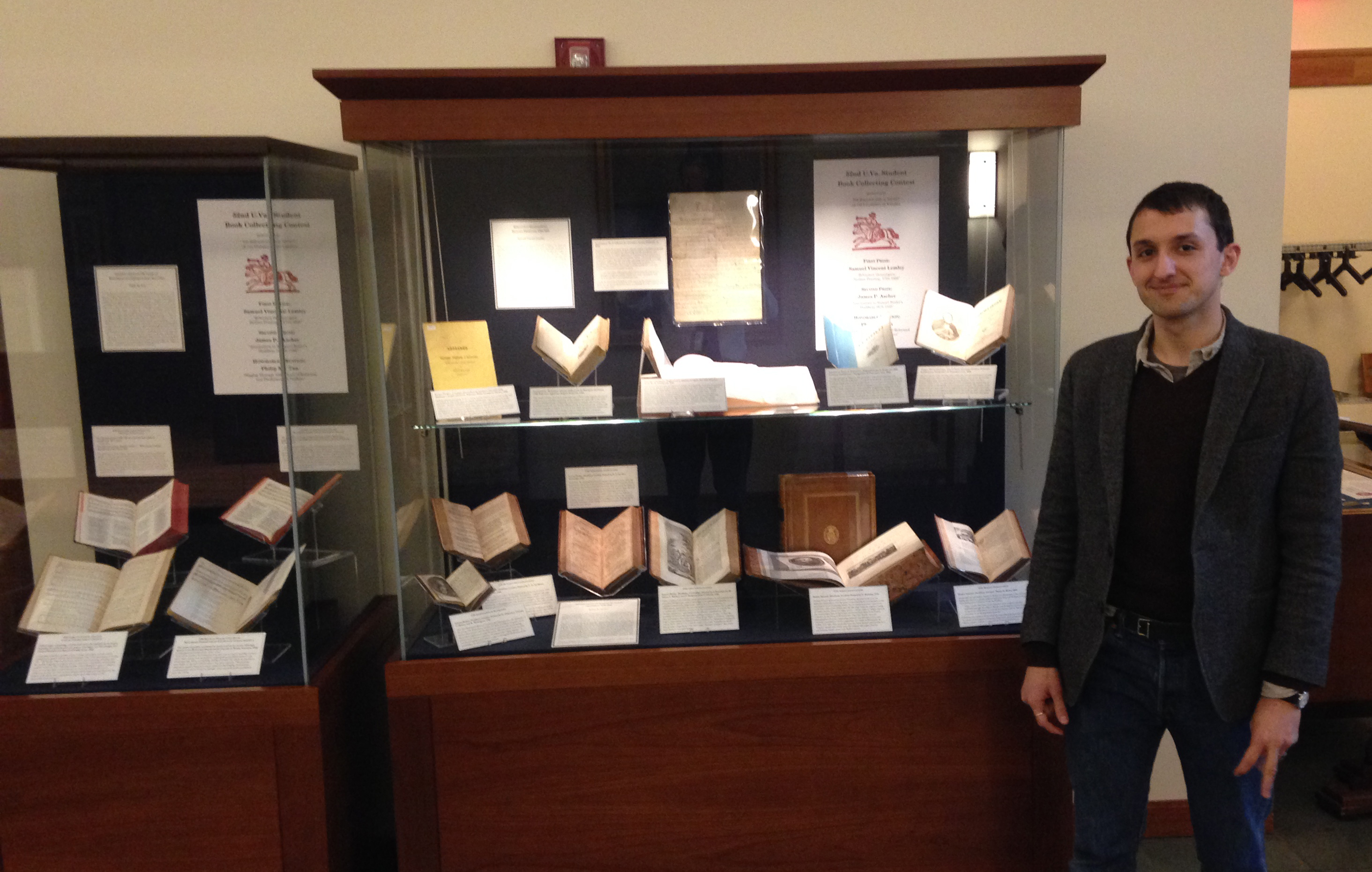
Visitors under Grounds may recall seeing highlights from Sam’s collection on display last spring in the First Floor corridor leading to the Special Collections Reading Room.  Special Collections was pleased to honor the winners of the 52nd U.Va. Student Book Collecting Contest–Samuel V. Lemley, James P. Ascher, and Philip M. Tan–by hosting an exhibition drawn from their collections.

The U.Va. Student Book Collecting Contest is one of many activities undertaken by the Bibliographical Society of the University of Virginia.  Watch their website for news of the 53rd U.Va. Student Book Collecting Contest!

On View Now: UVA Health System: 200 Years of Learning, Research, and Care

Over the next five months, the Harrison/Small main gallery is home to the exhibition “UVA Health System: 200 Years of Learning, Research, and Care.” This exhibition explores how trends in U.S. history and the history of the health sciences have shaped the development of the UVA Health System, while examining some of the events and personalities that make UVA’s story unique.
Visitors will view collection highlights from the Claude Moore Health Sciences Library, Eleanor Crowder Bjoring Center for Nursing Historical Inquiry, and the Albert and Shirley Small Special Collections Library. Among the many items featured are an iron lung used in the UVA Hospital during the mid-20th century. There are bloodletting instruments from the 19th century and a nursing student’s uniform from the 1950s. Visitors can view a digital model of Thomas Jefferson’s Anatomical Theatre and a short film of a surgery being performed at the hospital in 1927.

These and other items help to tell the story of how the Health System grew from a school with a single professor into a world-class academic medical center and regional health-care network. The exhibition also takes a closer look at some specific topics in this 200-year history including medical and nursing education, patient care, biomedical research, wartime service, and racial inequality.

“UVA Health System: 200 Years of Learning, Research, and Care” will be on display in the Main Gallery of Harrison/Small from July 26, 2018 to January 4, 2019. For more information about the exhibition and related programs contact Dan Cavanaugh, Alvin V. and Nancy Baird Curator of Historical Collections at dmc7be@virginia.edu. Learn more, view images, and book class and group tours on the exhibition website.

This exhibition was produced with the support of the University of Virginia Bicentennial with funding provided by the Alumni Board of Trustees.


How Borges Wrote: Symposium on the Creative Process of Jorge Luis Borges

Please join us on Tuesday, April 24, 2018, at 4:00 pm in the auditorium of the Albert and Shirley Small Special Collections Library for a special event marking the publication of an important new book on the great Argentine writer Jorge Luis Borges. The event is free and open to the public.

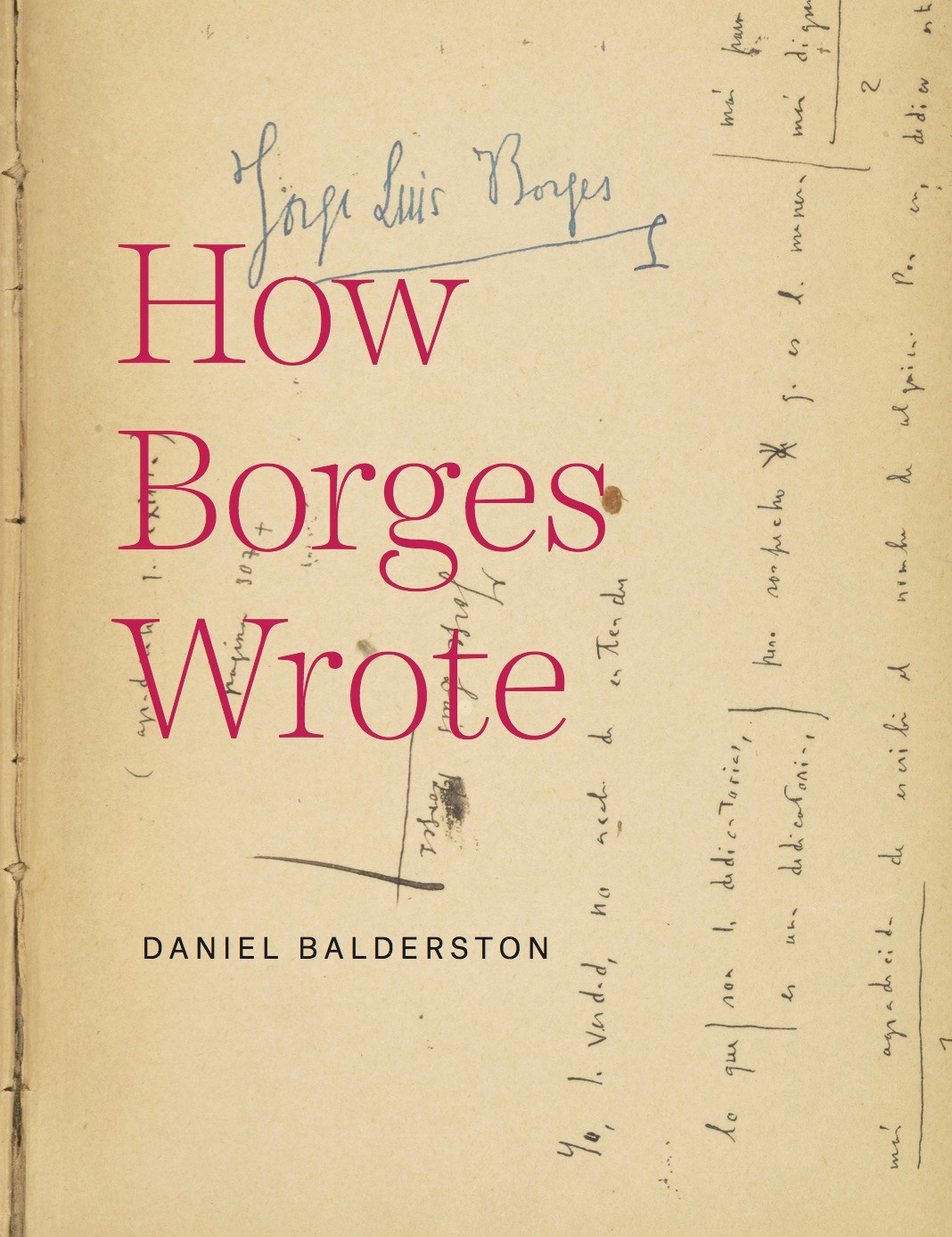
Cover of Daniel Balderston’s “How Borges Wrote” (University of Virginia Press, 2018)

This month the University of Virginia Press is publishing How Borges Wrote, a monograph by Daniel Balderston, Director of the Borges Center and Andrew W. Mellon Professor of Modern Languages at the University of Pittsburgh. Drawing on nearly four decades of research into Borges’s life and writings, and having examined nearly 200 of Borges’s surviving literary manuscripts, Balderston carefully explicates the complex process by which Borges composed and revised the short stories, essays, and poems that brought him worldwide fame.

Daniel Balderston

“How Borges Wrote” will feature presentations by Balderston and three other Borges scholars: Jared Loewenstein (founding curator of U.Va.’s Borges Collection), Nora Benedict (Princeton University), and María Laura Bocaz (University of Mary Washington).

The Albert and Shirley Small Special Collections Library holds one of the world’s best collections relating to Jorge Luis Borges, numbering over 1,100 printed works and including the largest holding of Borges manuscripts outside of Argentina. The collection was a major resource for Balderston while researching his book. Highlights from U.Va.’s Borges manuscript holdings will be on display during the event.

52nd U.Va. Student Book Collecting Contest Winners

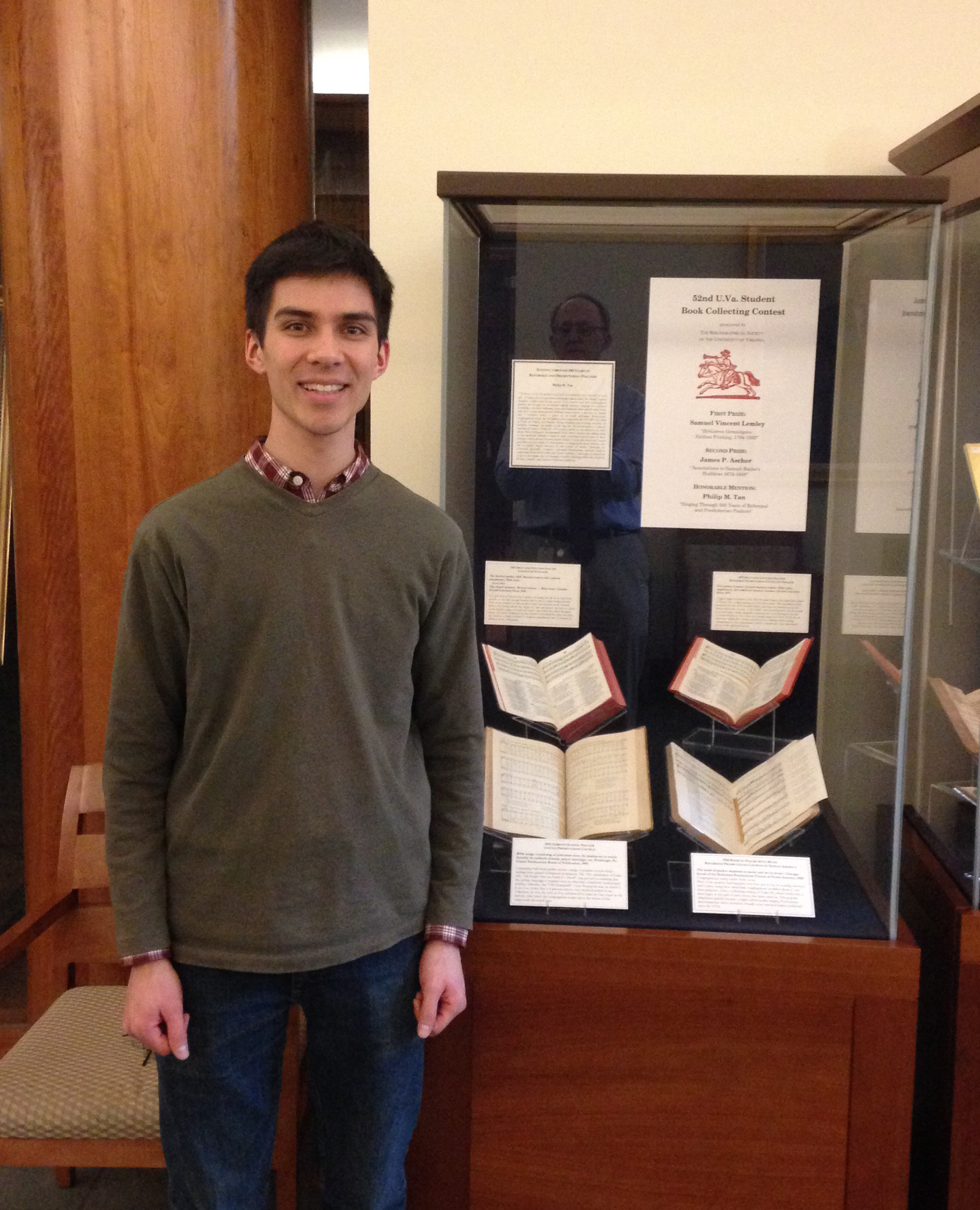
First prize winner Samuel V. Lemley with selections (top shelf) from his collection of Sicilian printing.

Winners of the 52nd U.Va. Student Book Collecting Contest were announced at the Bibliographical Society of the University of Virginia’s annual meeting on Friday, March 23, 2018 in the Auditorium of the Albert and Shirley Small Special Collections Library. The competition, sponsored by the Bibliographical Society, is a tradition dating back to 1948. It offers all U.Va. students a chance to showcase their personal book collections, and to win substantial cash prizes as well. Highlights from the winners’ collections were exhibited in our first floor exhibition gallery.

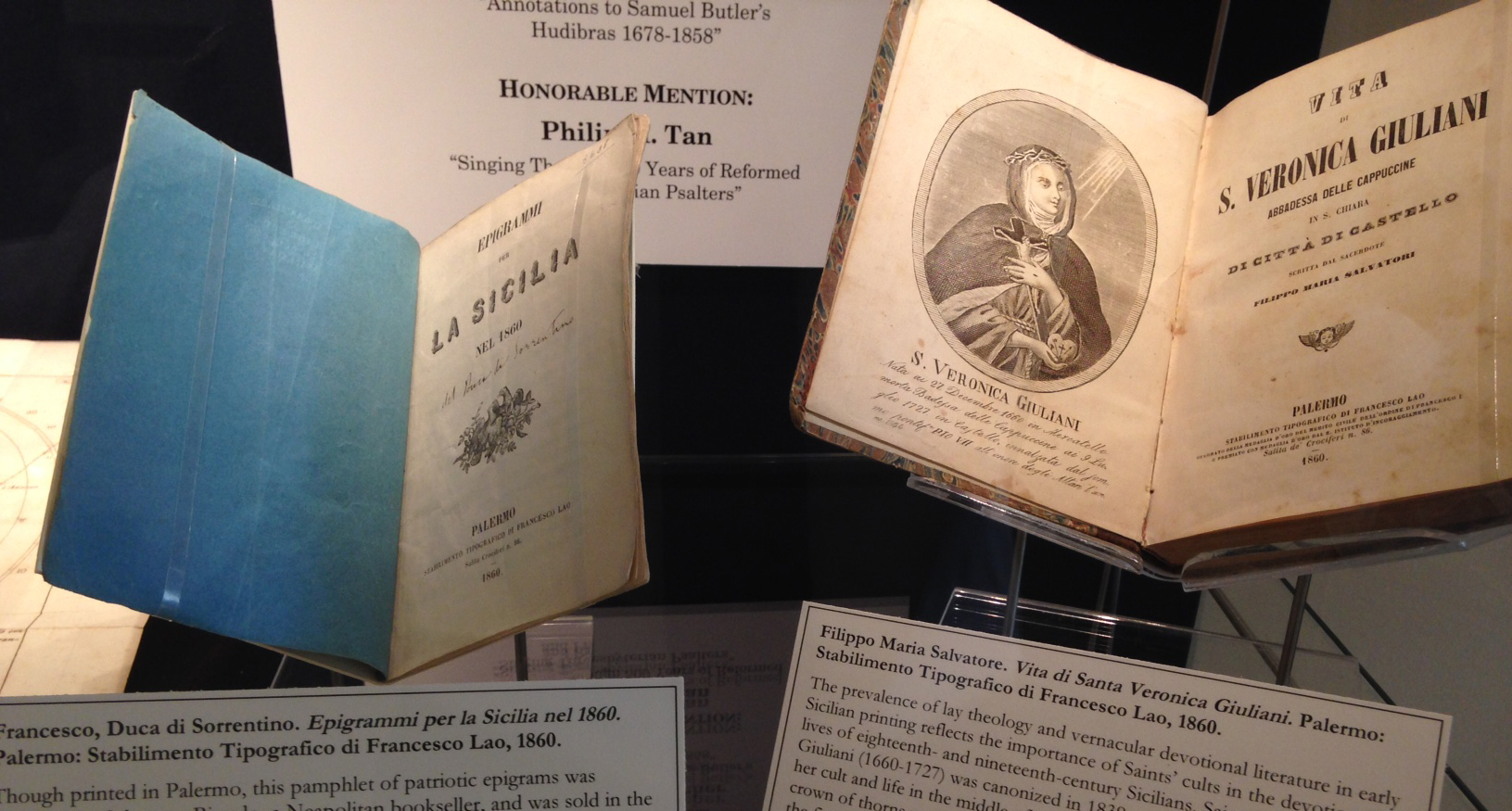
A closeup of two mid-19th century Sicilian imprints.

First prize was awarded to Samuel V. Lemley, a Ph.D candidate in the Dept.of English, for “Biblioteca Genealogica: Sicilian Printing, 1704-1893.”  Lemley’s collection “offers a representative sample of Sicilian printing and ephemera from the 18th and 19th centuries, a period in which my maternal ancestors lived in the Sicilian provinces of Palermo and Agrigento. The chronological limits, 1704 to 1893, reflect the years for which genealogical records (births, baptisms, and deaths) for the Militello and Marchese families survive: Gabriele Militello, my earliest documented ancestor, was born in Bivona in 1704; my great-grandfather, Pietro Marchese, was born in Pollina in 1893. These are the genetic bookends of my Sicilian family tree and the figurative bookends of this collection.” Lemley will represent U.Va. in this year’s National Collegiate Book Collecting Contest.

Honorable mention was awarded to Philip M. Tan, a fifth-year doctoral student in the Dept. of Biomedical Engineering, for “Singing Through 500 Years of Reformed and Presbyterian Psalters.”  Tan comments: “Unlike most books, meant to be merely read and contemplated, psalters are the gear for an intense athletic activity—singing! In a tradition extending over three millennia, Jews and Christians have united mind, body, and soul to sing these ancient Hebrew compositions, a practice my friends and I continue today. I grew up in small reformed Presbyterian congregations where the 150 psalms were sung from the 1973 RPCNA Book of Psalms for Singing, but we were always discovering new arrangements and adding them to our repertoire. Eventually I began purchasing other psalters, or begging the more obscure ones off of church music directors in the course of travels. Although the collection primarily comprises reformed Presbyterian metrical psalters originating from the Scottish and Dutch traditions, I am eager to expand its scope to encompass the rich heritage of psalm chanting within the Anglican, Roman Catholic, and Eastern Orthodox traditions.”

Philip M. Tan with selections from his collection of psalters.

Researcher Alert: Flat Files Will Close for Move in April

Some large, flat special collections materials will be UNAVAILABLE beginning April 2, 2018 for the installation of new flat file storage. We do not have a set end-date for the project, but researchers should expect that items stored in our flat files will remain unavailable through the summer.

Q: Why is this happening?

A: We are replacing our old flat file storage with moveable carriages that will allow us to double capacity. Because our building has no onsite swing space, existing files need to be moved offsite so we can install the new system.

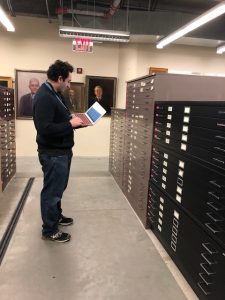
Stacks manager Joseph Azizi standing near some of our current flat files. Notice that behind Joseph is a black strip in the concrete. This is a rail for a moveable flat file carriage. These rails were installed when the building was built in 2004 with the expectation that we would eventually get moveable flat file storage. Needless to say, we are ready!

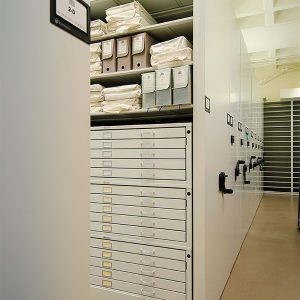
This is a moveable file system similar to the one we are installing. The only difference is that ours will move automatically, rather than manually. Not only does the compact structure allow more rows, but we can store additional collection materials above the flat files. Double efficiency!

Q: What collection items are impacted?

A: Flat files are used to store many of our largest items, including some maps, posters, large broadsides, genealogical charts, galleys, panoramic photographs, and architectural drawings.

Q. Can I request items to be retrieved from their temporary location during this process?

A. Unfortunately, no. All items will be stored offsite in a manner that renders them impossible to access until they are placed in the new drawers.

Q: How do I know whether the item I need is stored in the flat files?

A: If you are planning a visit to study items that you believe may be stored in flat files, we can help you determine whether that is the case. Please submit a reference request with a list of the items, and a staff member will inform you of the status of the materials you are hoping to view. Due to legacy metadata formats used for many items stored in the flat files, we are unable to show the status of most flat file materials in Virgo.

Q: Are the items digitized? Can I see images in place of originals?

A. Some items are digitized and their images are visible in the item’s Virgo record. Many items are not yet digitized. If you are unable to come back to visit the library in person after the flat files are reopened, please submit a digitization request. As soon as we have access to the flat files again, we can begin filling these requests.

Q: Why can’t you provide an exact end date for this project?

A: This is a once-in-a-lifetime project, so we are expecting the unexpected. If all goes smoothly, we hope to announce in mid-July that the new flat files are open to researchers. But just in case, researchers should not expect materials to be available until late August.

We thank you in advance for your understanding as we undertake this crucial collection-maintenance project. It will allow us to continue to add to our oversize collections. And it will also allow us to continue to provide you with one of our proudest services: delivering the flat items you request within just a few minutes of your request!

If you have any questions about the flat file project, please submit a reference request.