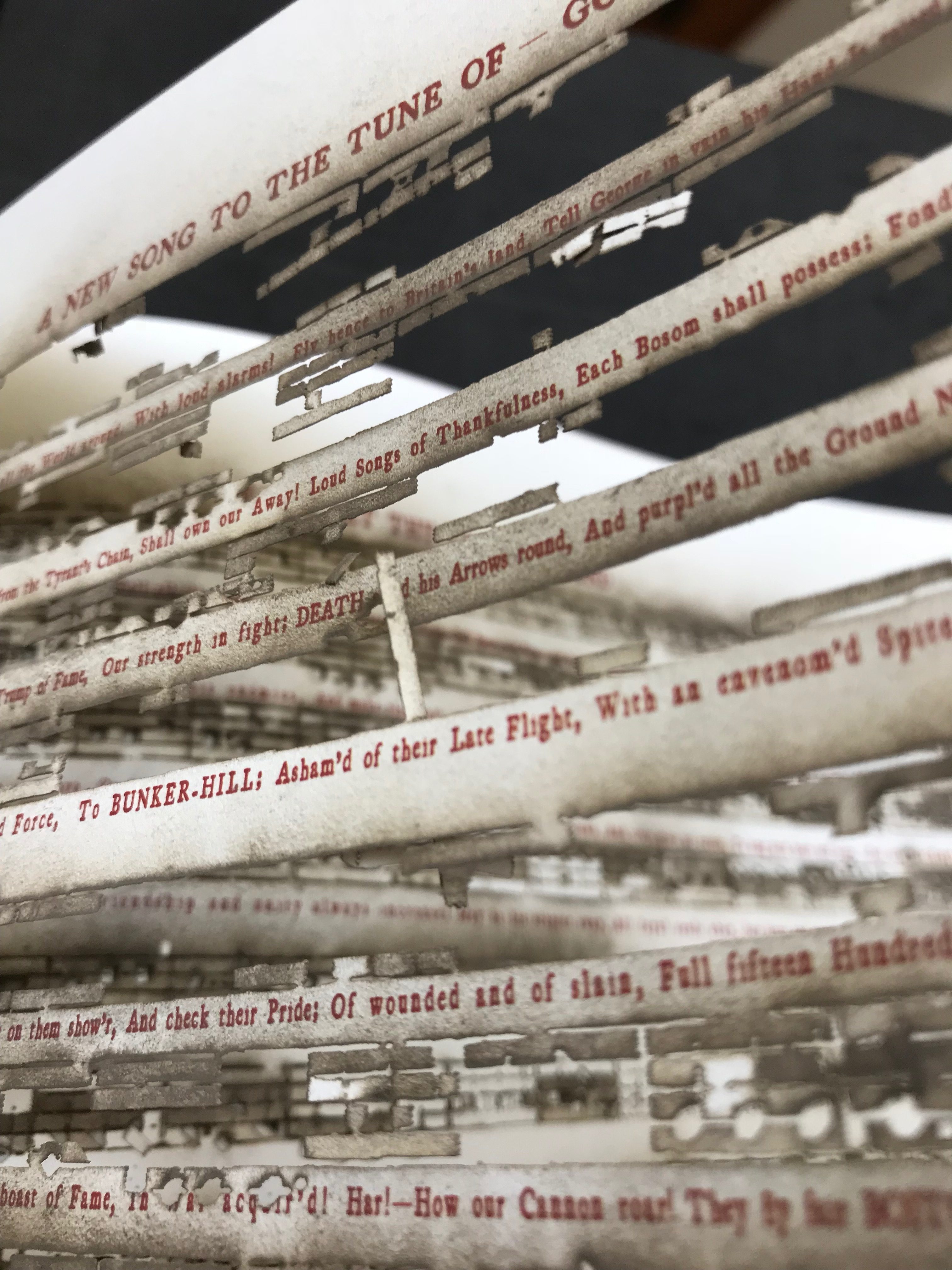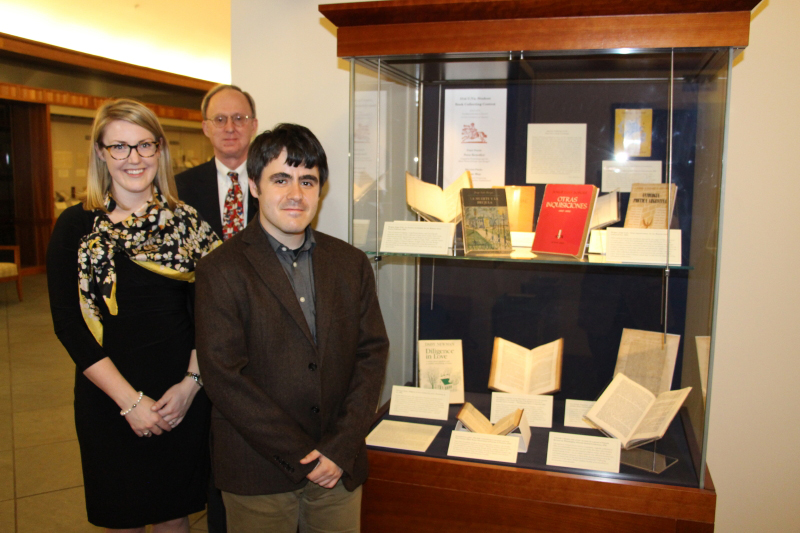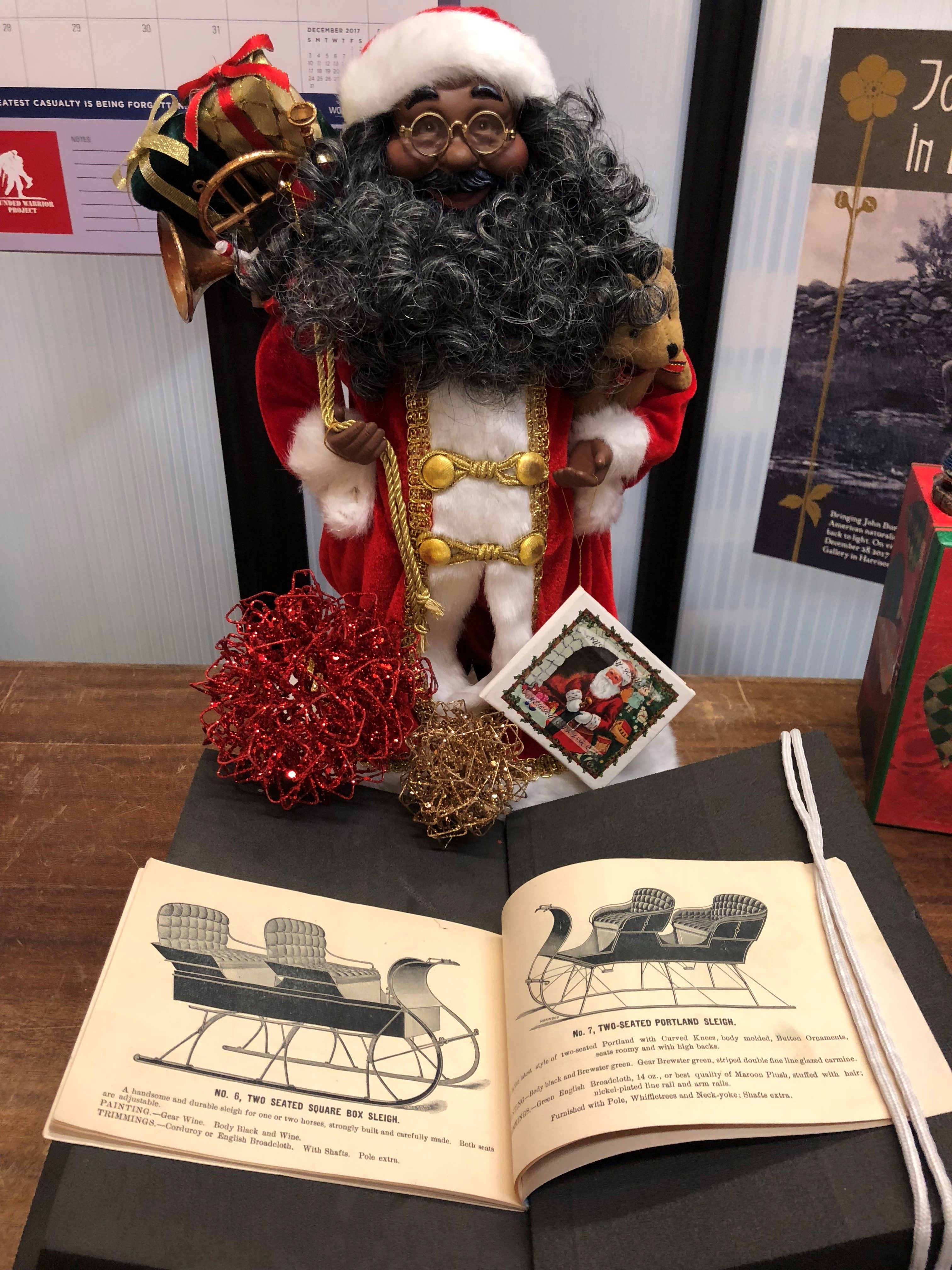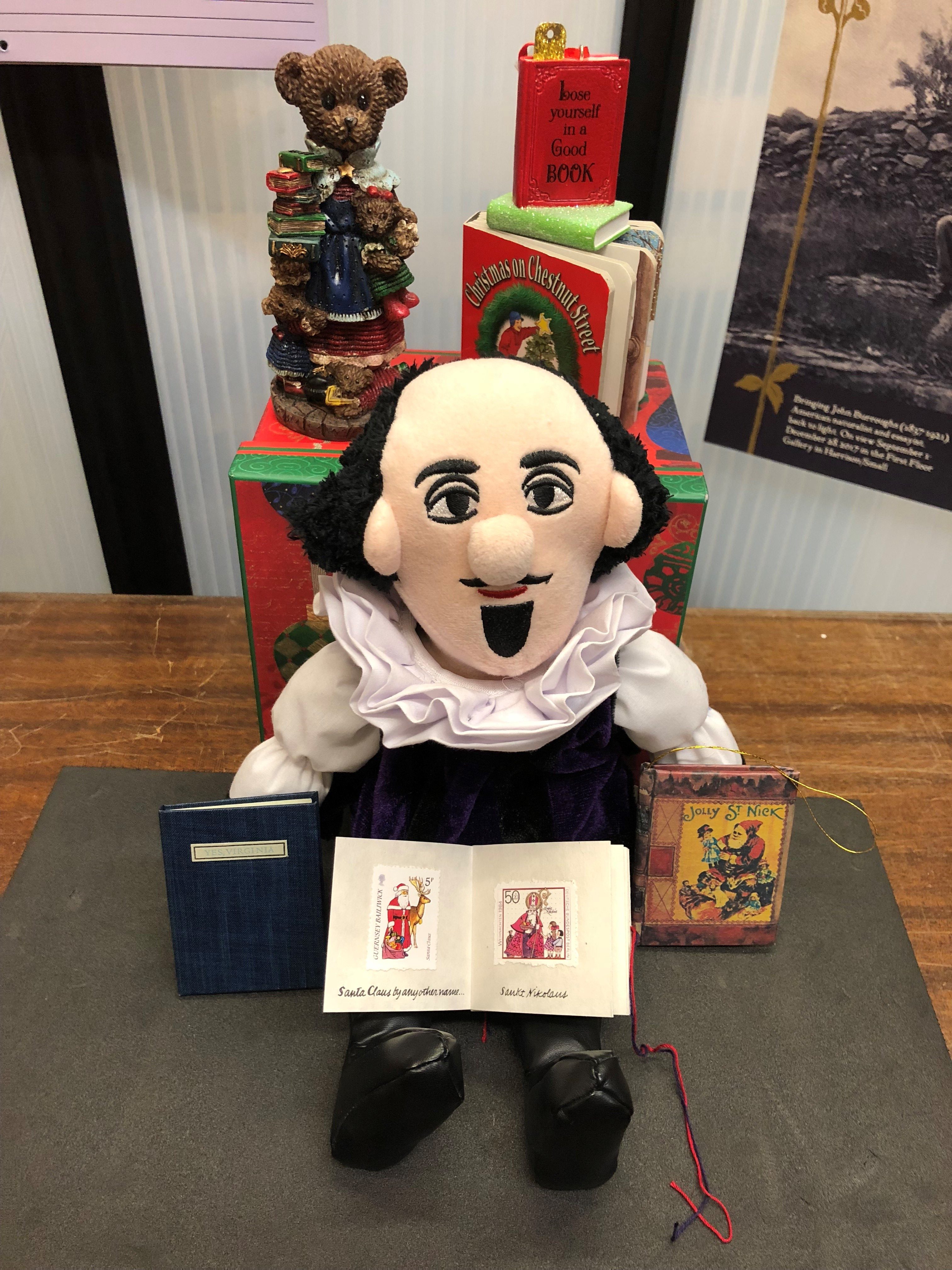
Unearthing Fiction: Creative Writing Inspired by UVA’s Archive

This week we are pleased to share a guest post from Nichole LeFebvre. Nichole is a Poe/Faulkner Fellow at the University of Virginia, where she teaches creative writing. Her poems can be found in Prairie Schooner and Barrelhouse and recent prose in Lit Hub, Paper Darts, and Vol. 1 Brooklyn. She is the Nonfiction Editor of Meridian: A Semi-Annual and is at work on a memoir.

Researchers may have met Nichole at Special Collections, where she used to work as a graduate student assistant in the Reference department. Now, she’s using that experience to incorporate original materials into her creative writing instruction.

Working at Special Collections, I’d often find myself in awe. Researchers would carry diaries and ledgers to the reference desk, pointing out their surprising finds. Reading Faulkner’s grocery list, I’d wonder about his carbo-loading: “breadsticks, bread, breakfast bread.” I’d show students how to aim a black light at a seemingly blank book. One afternoon, a librarian grinned and said, “Have you seen the bone fragment from the Revolutionary War?”

When I had the chance to design a themed writing workshop, I knew exactly where to go: down the spiral staircase, under the skylights. How many stories hid, waiting latent, below our feet?

Fourth-year Halley Townsend recalls the first time she held an artifact: “There’s something immutable in the feeling of touching history that can be gleaned nowhere else.” And that’s exactly right: in fiction, we focus on creating sensory-rich scenes for the reader. Students in my class, “Unearthing Fiction,” were able to feel that texture first-hand, noticing minor details otherwise forgotten with time.

“Being an engineer, I preferred to look at objects that were manmade and complex,” says Daryn Govender, hailing all the way from New Zealand. For his stories, he studied a field compass from World War II as well as a New Tyme Edison light bulb, patented in 1881. Because these objects are catalogued without specific historical context—letters or diary entries from their owners—Govender felt “allowed to write more freely, unconstrained by a pre-existent scenario or background story.”

Of our first visit to Special Collections, second-year Caroline Bohra writes, “My mind started to race thinking of all the people who could have come in contact with these objects. I could not help but wonder what made these specific objects so special that they had been chosen to be saved and preserved? And what modern artifacts would be deemed important enough to be studied years from now?”

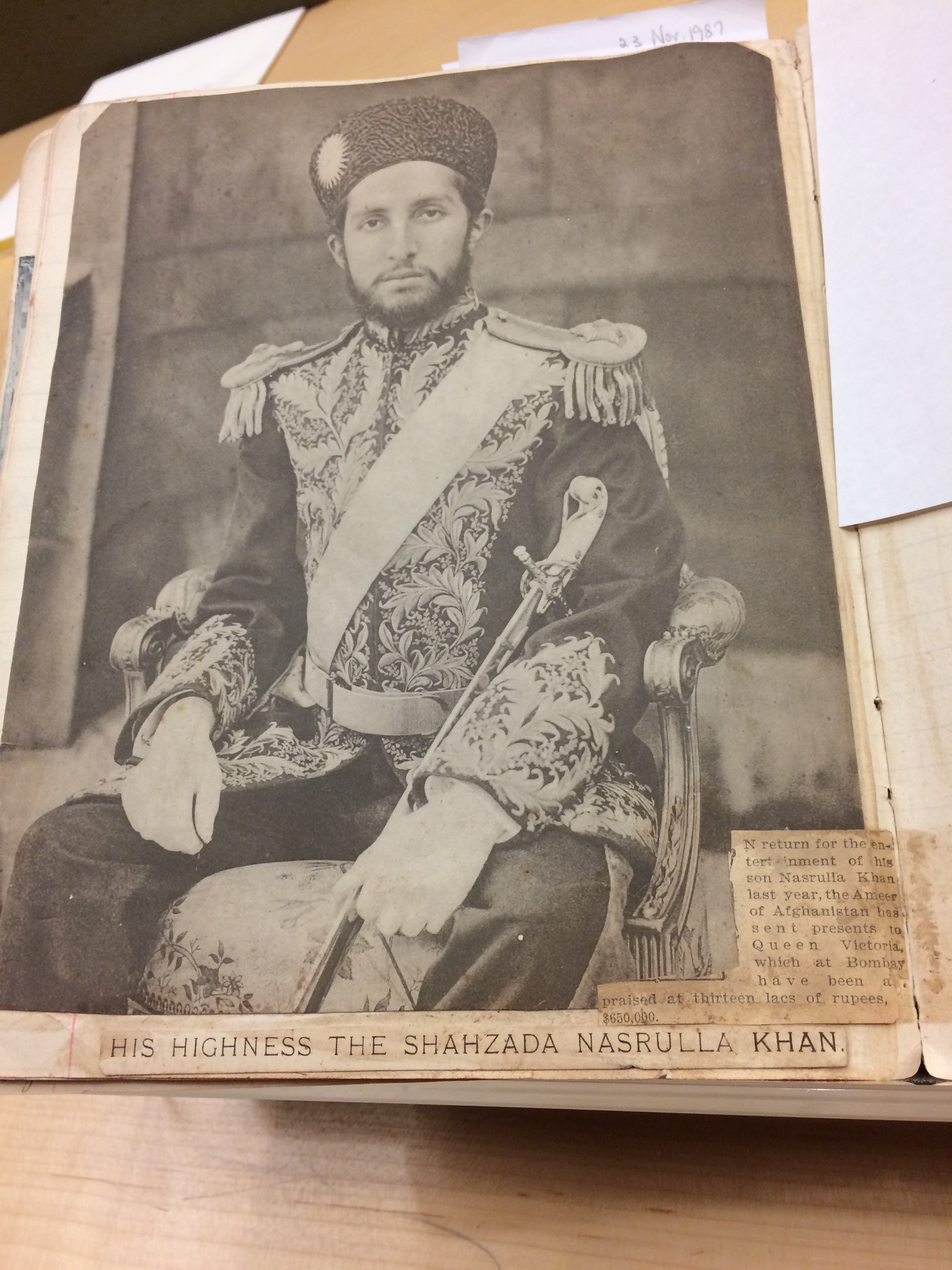
The travel scrapbook of Nina Withers Halsey, 1895, inspired Alexander O’Connor to write about a self-taught American teenager who meets and impresses the Shahzada Nasrulla Khan with her knowledge of tenuous British-Afghan relations (MSS 10719-b). Photograph by Alexander O’Connor.

How archives shape history was on our mind, all semester. Fiction is likewise political: whose stories are told, and therefore remembered? Third-year Hunter Wilson wondered how to write “historical women, on the one hand acknowledging that women often lacked basic rights, while on the other, respecting the character.” She decided to set her first story in 17th Century Scotland, inspired by the ballad of the Outlandish Knight. The twist? It’s the princess who uncovers the dreamy knight’s murder plot. “I wanted Isabel to act accurately in her historical context, but also give voice to the likely frustrations that came with her place in history.”

Fourth-year Matin Sharifzadeh enjoyed the depth of creative control he had over his work. “When we would go down into the library, the artifacts weren’t there for us to write about. They were there for us to create a world.” And like history itself, those worlds weren’t always pretty: the rope used in the hanging of a Charlottesville mayor inspired Sharifzadeh to write “a psychological thriller involving a mentally ill serial killer in the late 19th Century.”

Students faced, first-hand, the challenges of writing historical fiction. First-year Julia Medina found an embroidered handkerchief “depicting a group of children and a school teacher from the early 20th century.” This morphed into her story of an exploitative school for gifted children. But she couldn’t have her characters talking in today’s slang. To research the nuances of 1940s speech, Medina found “a collection of letters than an ordinary military man wrote to his wife.” These “seemingly mundane letters” allowed her to imagine “what he felt, how he talked, and where he’d been.”

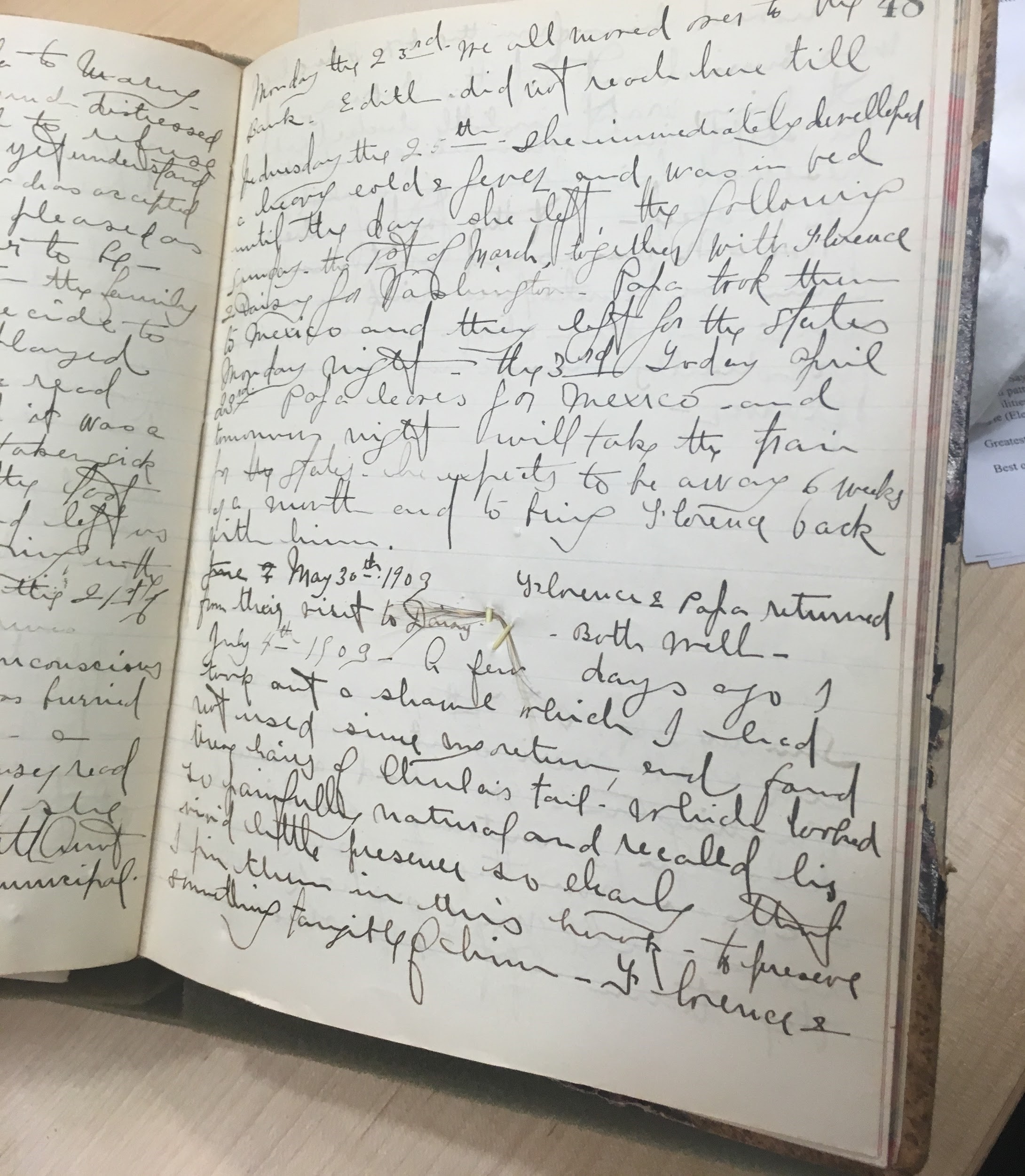
Some details will remain buried with time, unless you, dear reader, can read this handwriting.  Elizabeth Oakes-Smith’s diary, 1861 (MSS 38-707-a). Photograph by Veronica Sirotic.

The question of historical accuracy recurred throughout the semester. How do we earn a reader’s trust when we aren’t historians, we’re writers?

The answer? More reading, more research, and a deep personal connection to the material. Second-year Veronica Sirotic pored over radical feminist and music magazines from the 60s, 70s, and 80s, inspired by not only the articles, but the advertisements, as well. A few students returned to the feminist periodical The Monthly Extract including first-year Megan Lee, who tried to get into the mindset of both a feminist and her “tolerant husband,” digging up manuscript boxes of period photographs to build images of these characters, in her head.

Students realized when they were most curious, most personally engaged, their own fiction was at its strongest. Caroline Bohra found a children’s book from 1927 and was “struck by a sort of nostalgic happiness,” changing her initial character’s personality as she researched real-life author Christopher Morley, who “believed in the magic of childhood and instilled that in his children, specifically Louise Morley Cochrane, who went on to produce a children’s television series, following in her father’s footsteps, as well as work directly for Eleanor Roosevelt.”

Finding patterns across time was another an important way in. First-year Alexander O’Connor was struck by former Secretary of State John Hay’s life story. “Two out of the three Presidents he worked for, Abraham Lincoln and William McKinley, were assassinated while he worked for them, and the third, Theodore Roosevelt, experienced an assassination attempt but lived. Coincidence? I think not!”

The class also sought guidance from UVa’s own Jane Alison, Professor and Director of Creative Writing. Students read Alison’s Ovid translations and a section of her novel The Love-Artist, curious how she was able to write from the point of view of the ancient poet. Alison explained her range of primary and secondary sources, as well as her trip to Rome, to see and imagine how the ruins once looked. She placed herself inside the poet’s shoes, inside his head, tried to imagine how he saw and described the world around him.

Alison urged the students to recognize the overlap between historical fiction and memoir, a comment that struck Veronica Sirotic as especially true: “We have the power to shape history to our liking.” Alexander O’Connor, agreed, noting that even “memoir is a retelling of history through the author’s lens.”

“‘Unearthing’ means to dig up, to discover, to recover in an active sense,” writes Halley Townsend. “Throughout the semester, that definition has aligned more and more with my creative writing; I feel like I’m discovering or rediscovering something that was already there in my mind.”

All semester long these students uncovered and re-imagined artifacts into fiction, resulting in eighteen riveting short stories. Whether setting their work in the distant past, or today’s world, they used history to deepen the story’s emotional content and lasting impact—looking forward, while looking back.

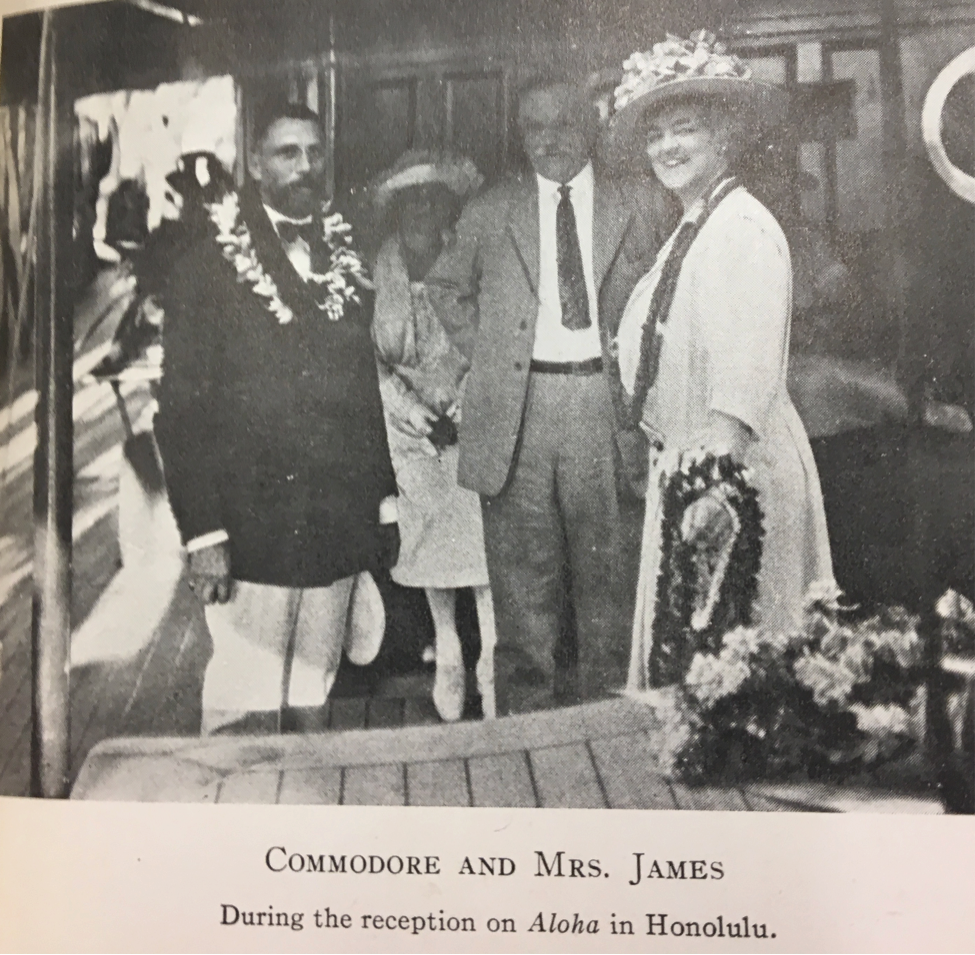
“I took this image from a couple’s autobiography about their circumnavigation in the early 1920s,” writes student Halley Townsend. “Based on this picture, I wanted to imagine their relationship. What kind of relationship survives on a small boat during stressful circumstances?”
(G440 .V8 1923).

Thank you, Nichole, for sharing your students’
marvelous insights with us.

Lumos Maxima: Illuminating the magical presence of Harry Potter at UVa

This week, we are pleased to feature a guest post by Penny White, Reference Librarian and Hufflepuff. Thanks, Penny, for braving our enchanted stacks and sharing these treasures with wizards and muggles alike. Happy Halloween, everyone!
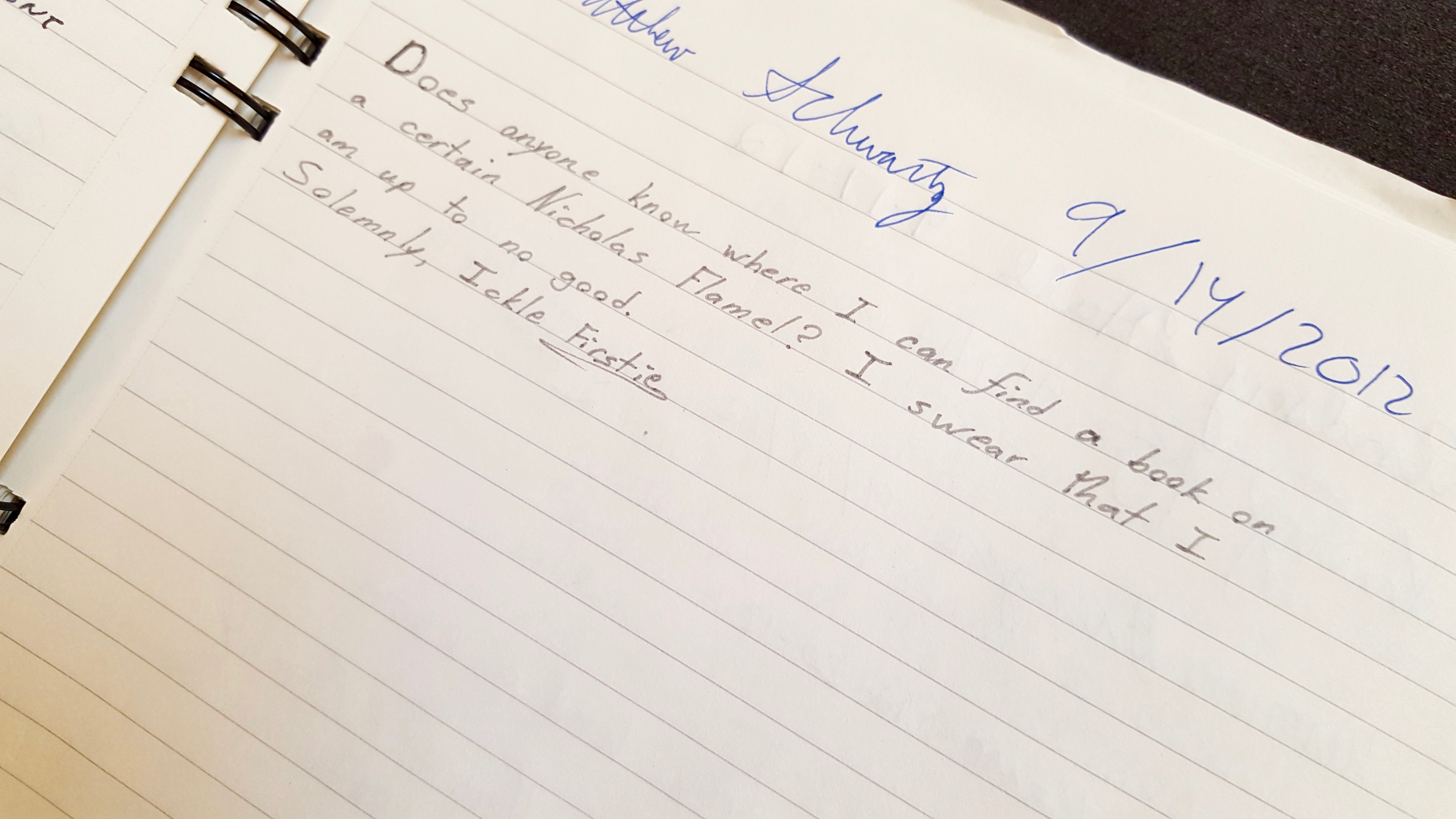
Lovingly referred to as the “Harry Potter” room, the McGregor Room in Alderman Library, with its cozy chairs and caged books, is sure to make any Potter fan feel as though they have apparated right into Hogwarts. The affection for this association is clear in a clever entry from one ickle firstie who visited the room in 2012.

Although Frenchman Nicolas Flamel perished in 1417, myths surrounding his work to decipher an alchemical text that would reveal the secret of the Philosopher’s Stone live on. “Guest Book for the McGregor Room” (RG-12/36/1.141).

Now, what if I said the magic does not stop at the McGregor Room gates? What if I told you that deep under Grounds in the bowels of Archives & Special Collections, fantastic beasts hide, spells are cast, and mischief is made?

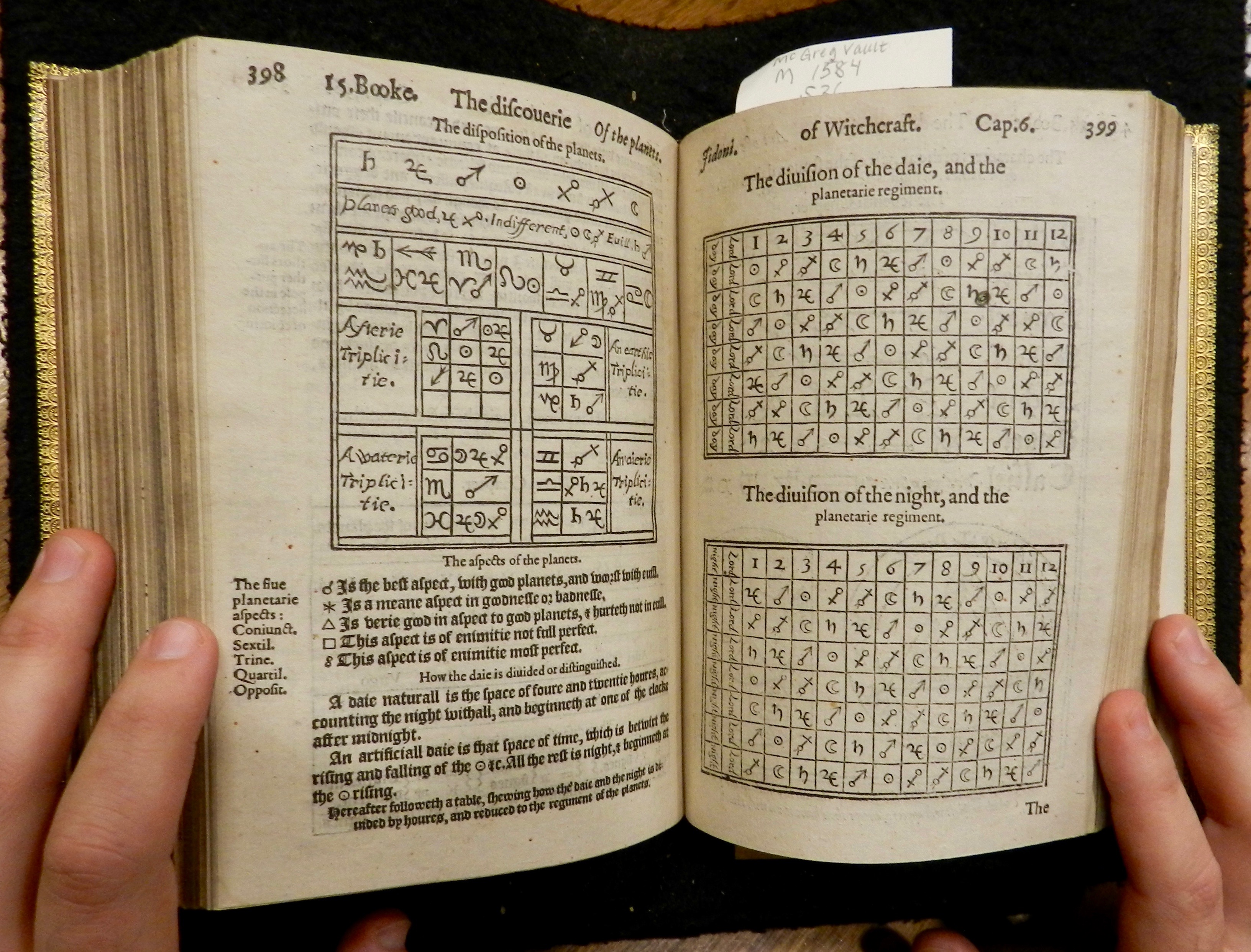
The Discoverie of Witchcraft, published in 1584 by Englishman Reginald Scot.

With a tone reminiscent of Vernon Dursley, Scot set out to prove that there was no such thing as magic. And while his text was central to debates about the implausibility of witchcraft, it also proved to be a useful if not always accurate source on supernatural beliefs and practices

Pages from “The Discoverie of Witchcraft” addressing the disposition and aspects of the planets (M 1584 .S36).


Magical botanicals

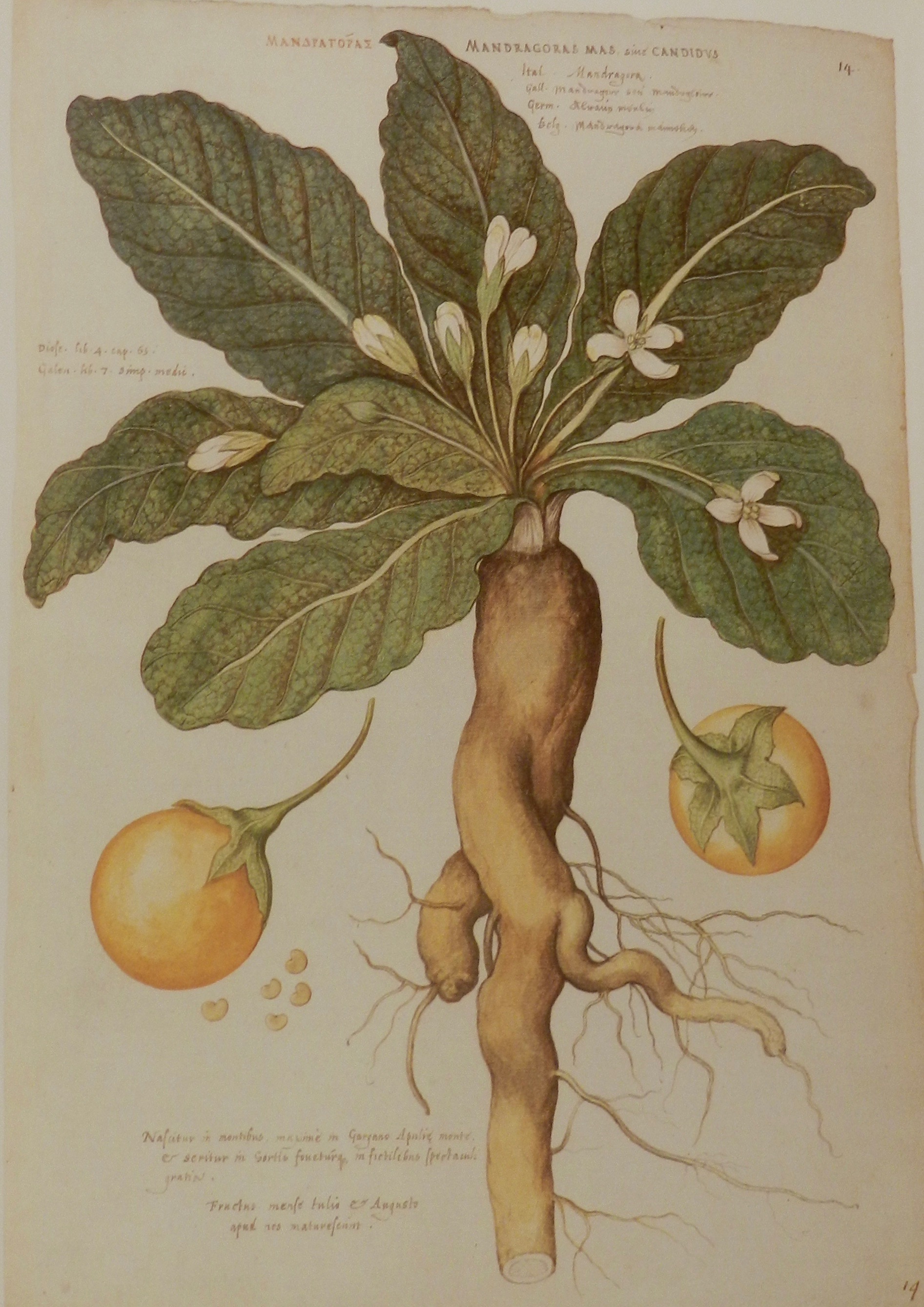
While you are unlikely to encounter the mandrake in modern medical texts, Hermione’s definition of the root as “restorative” is historically accurate. Both early Greek and Latin texts, as well as medieval naturalists document the root as being a cure for all diseases, barring death. Ground up the root could even be used in wine, which when drunk could numb patients enough for amputation.

The human-like appearance of the Mandrake in Harry Potter is rooted in first-century Greek physician, Dioscurides’ description of the root as resembling the human form. This belief was reinforced by the medieval doctrine of signatures, which claimed that when eaten, plants that looked like certain body parts could cure what ails those body parts. “The Clutius Botanical Watercolors…” (QK98 .S93 1998).

Magizoology

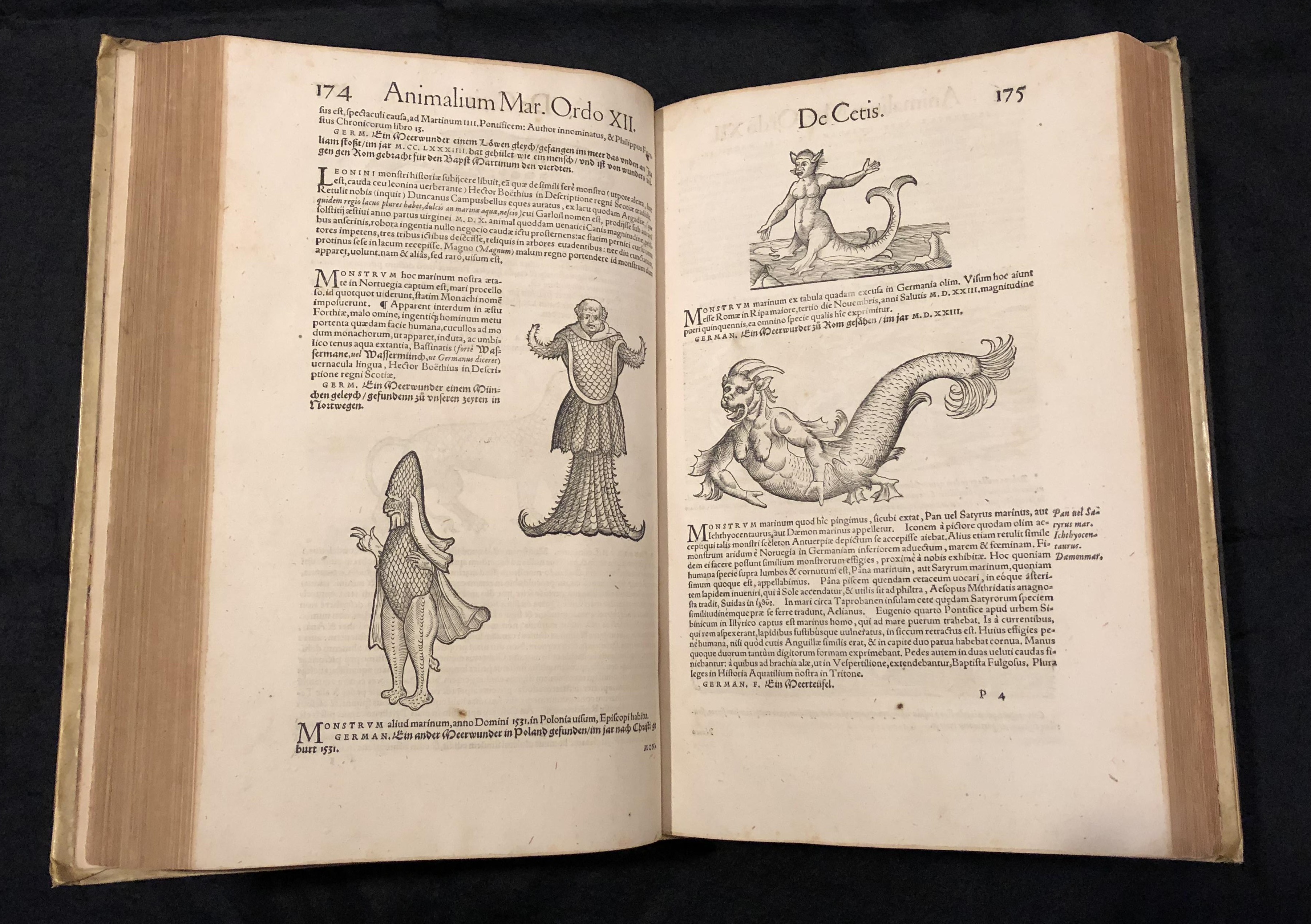
On the subject of magical beasts, Swiss naturalist Conrad Gessner authored one of the most widely read natural histories of the Renaissance. Historiae Animalium published from 1551-1558 is a zoological inventory and depicts everything from the mythical to the factual.  I have no doubt that this four volume set would have found a place on the shelves in Magizoologist, Newt Scamander’s library.

“Merfolk” from Gessner’s “Historiae Animalium” (QL41 .G37 1551 v.2)

A book that bites–literally

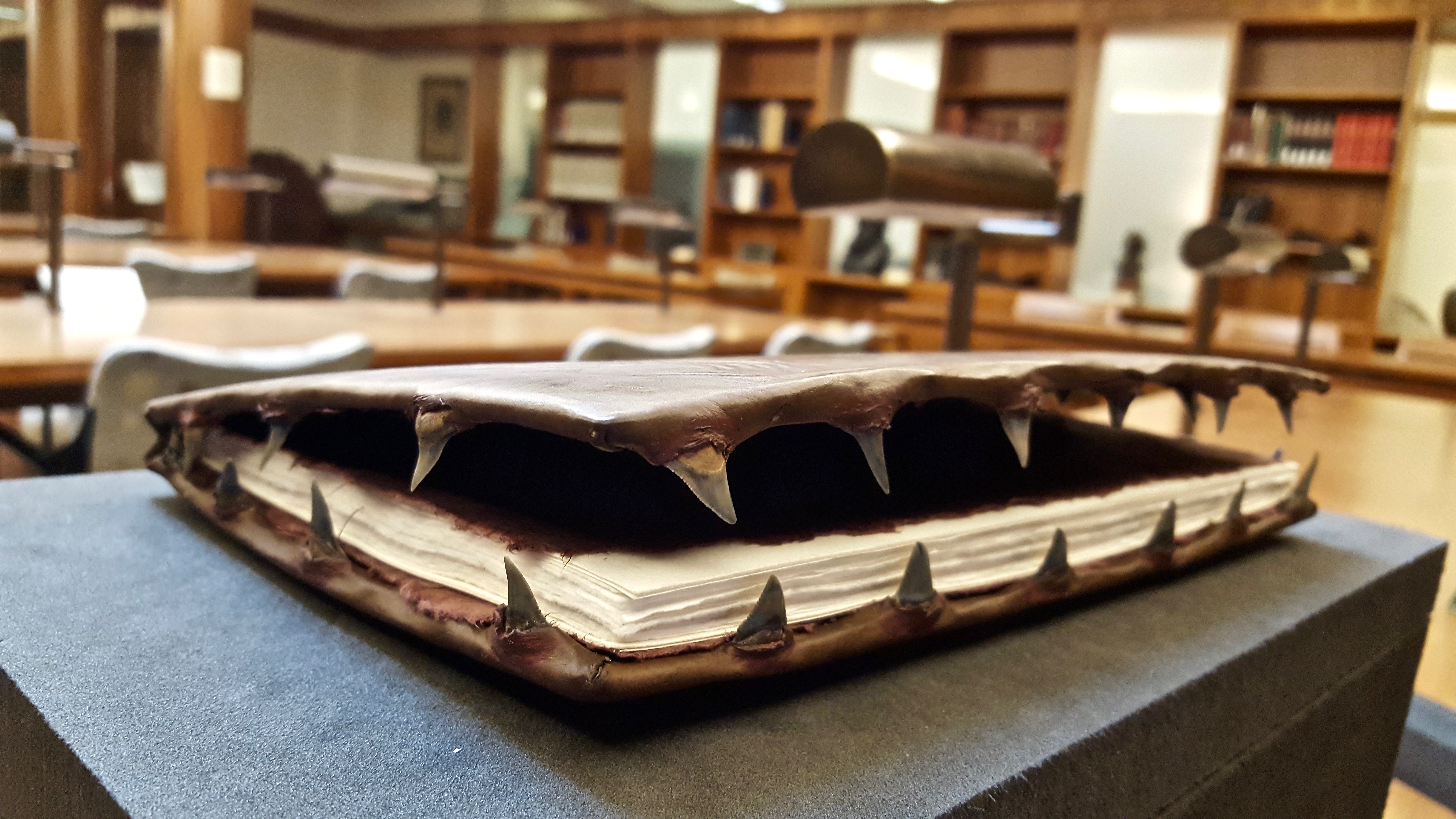
I know for a fact that we could find this uniquely bound copy of Fantasy & Nonsense: Poems gracing the shelves of our favorite “mad and harry” Professor’s library. This striking book of poetry is the embodiment of what Hagrid considered funny and Malfoy considered hand severing.

Leather bound, edged with shark teeth, and filled with literary references to fantastic beasts, James Whitcomb Riley’s “Fantasy & Nonsense: Poems” is the quintessential “Monster Book of Monsters” (PS2702 .T77 2001). Binder Gabby Cooksey dreamed up this gorgeously executed volume, which actually bites you a little bit every time you turn a page. Come check it out and feel the pain yourself!

Peevish phantoms

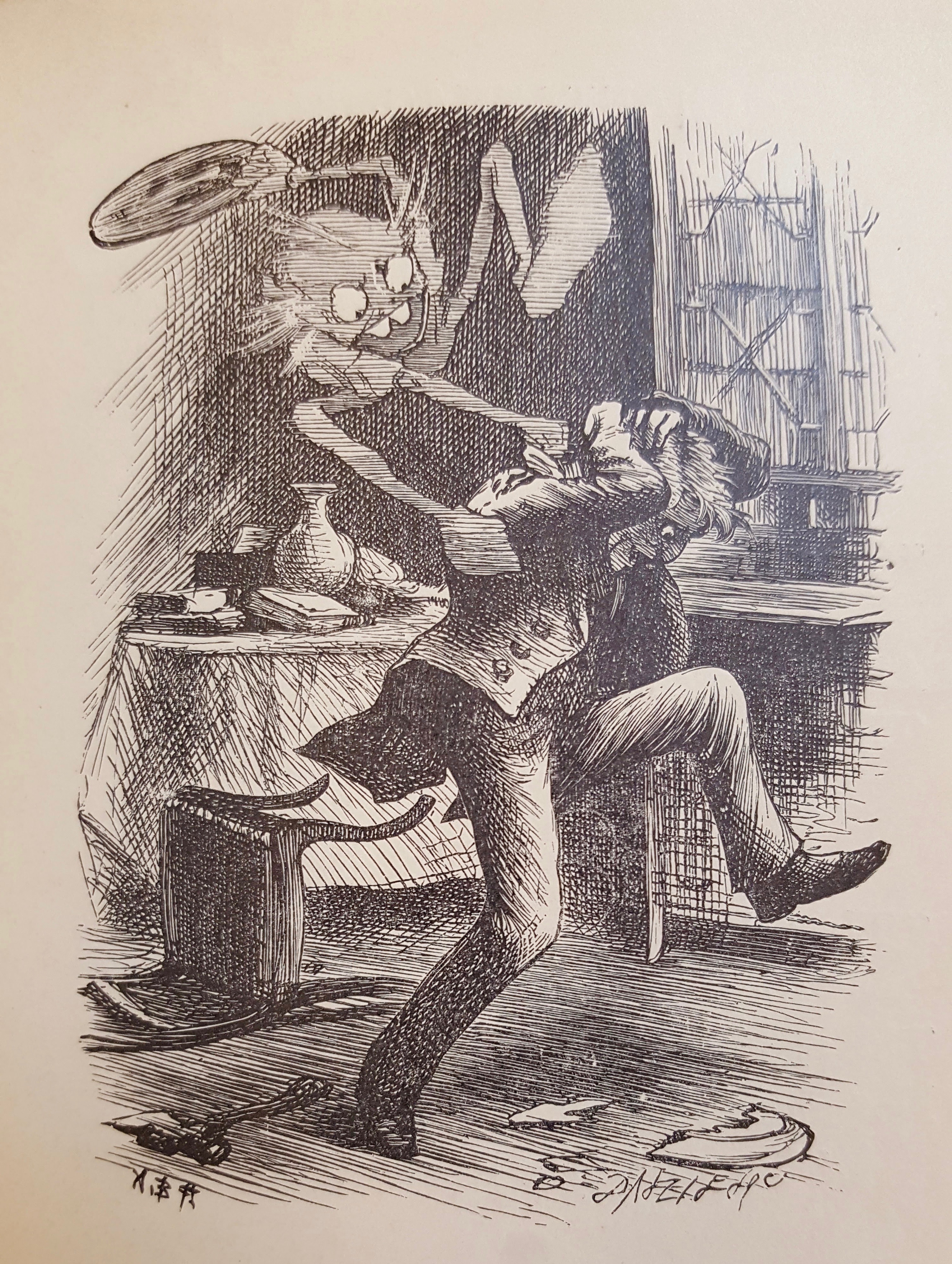
He may have been fond of mischief and caused all sorts of trouble, but it was hard not to love Peeves the Poltergeist. Besides, according to Lewis Carroll’s longest poem, Phantasmagoria, ghosts simply have one job to do and that job is to haunt.

Here the ghost from Carroll’s second canto “Hys Fyve Rules” shows his host just how he feels about being treated so rudely (PR4611 .P6 1869).

Horcrux or just an old cup?  

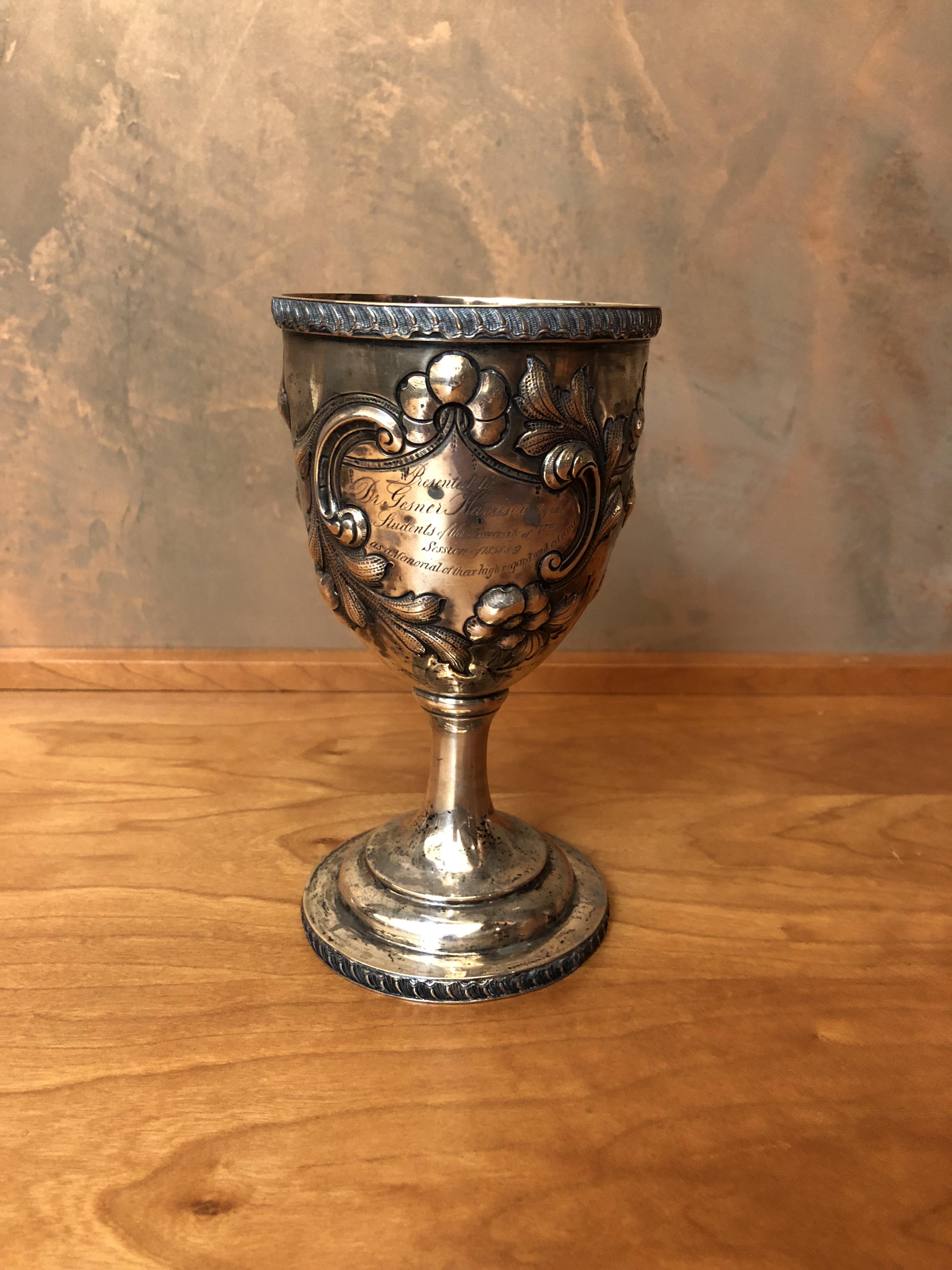
You do not need to use the Imperio curse on any of our staff to get your hands on this goblet given to Dr. Gessner Harrison by UVa students attending the 1858-59 class session. Visit the reference desk and we will happily pull it for use in the Reading Room. While we do require you to wear gloves when handling this goblet, I can assure you that it is not because it could be one of Lord Voldemort’s horcruxes.

One of two goblets presented to Dr. Gessner Harrison by UVa students attending the 1858-59 session (MSS 12762).

Weapons against the dark wizard

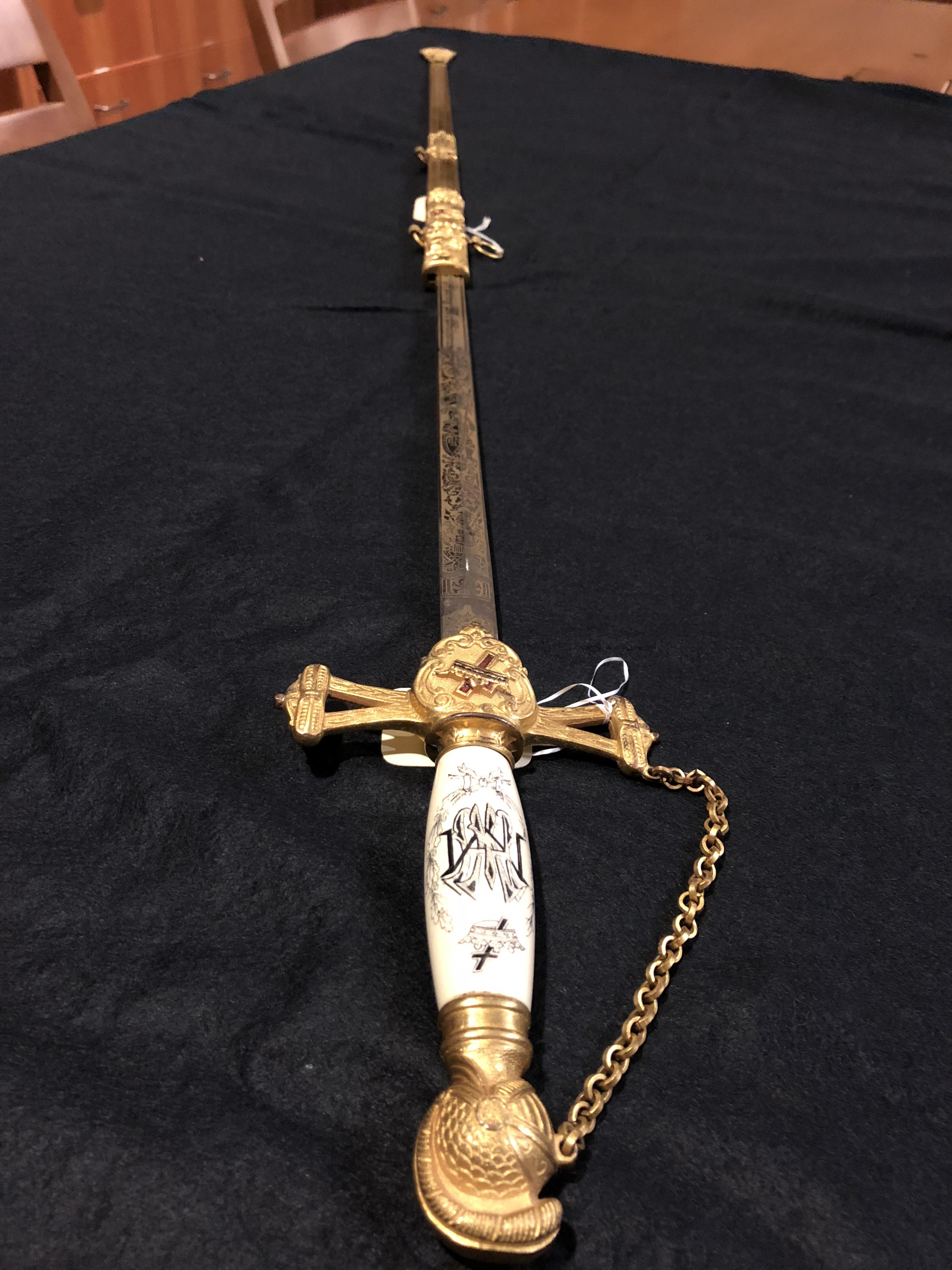
Harry Minor Wilson, Grand Commander of the Knights Templar of Virginia may not have used his regalia sword to help defeat the most powerful dark wizard of all time, but it would make a fine stand-in for the sword of Gryffindor. The sword will appear to anyone who asks for it. We cannot, however guarantee that when requested, the sword will be delivered in a magical hat by Faux the phoenix.

Harry Minor Wilson’s ceremonial sword as Grand Commander of the Knights Templar of Virginia (MSS 8977-a).


“Happiness can be found, even in the darkest of times, if one only remembers to turn on the light.”

– Albus Dumbledore

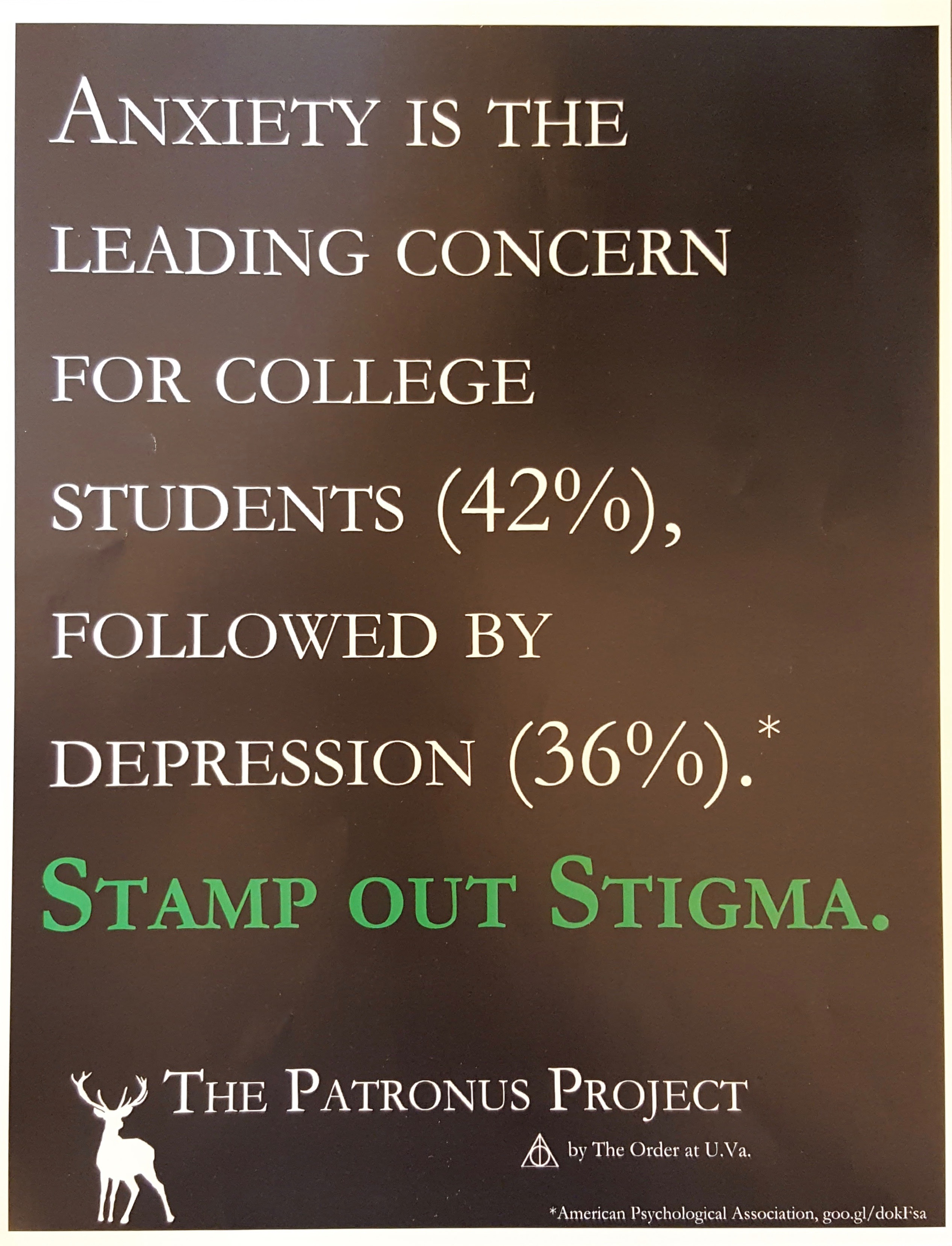
Like Hogwarts end of the year exams, college can be frightful. Not all of us possess Hermione’s zeal for learning, or her time-turner, which would no doubt help with the overwhelming workload. Thankfully, The Order at UVA, the University’s only Harry Potter secret society, established The Patronus Project, which seeks to educate and change the way people talk about metal illness and wellness.

Started by a group of University students who love Harry Potter, The Patronus Project’s mission is to illuminate and banish the stigma surrounding mental illness like Expecto Patronum expels Dementors (Broadside 2015 .O73 no.01).


These are only a few of the many Harry Potter-esque collection items at the Albert and Shirley Small Special Collections Library. Want to uncover more magical materials? Ask a staff member how! No invisibility cloak required.

Nox!

William Styron’s “Confessions of Nat Turner” at 50

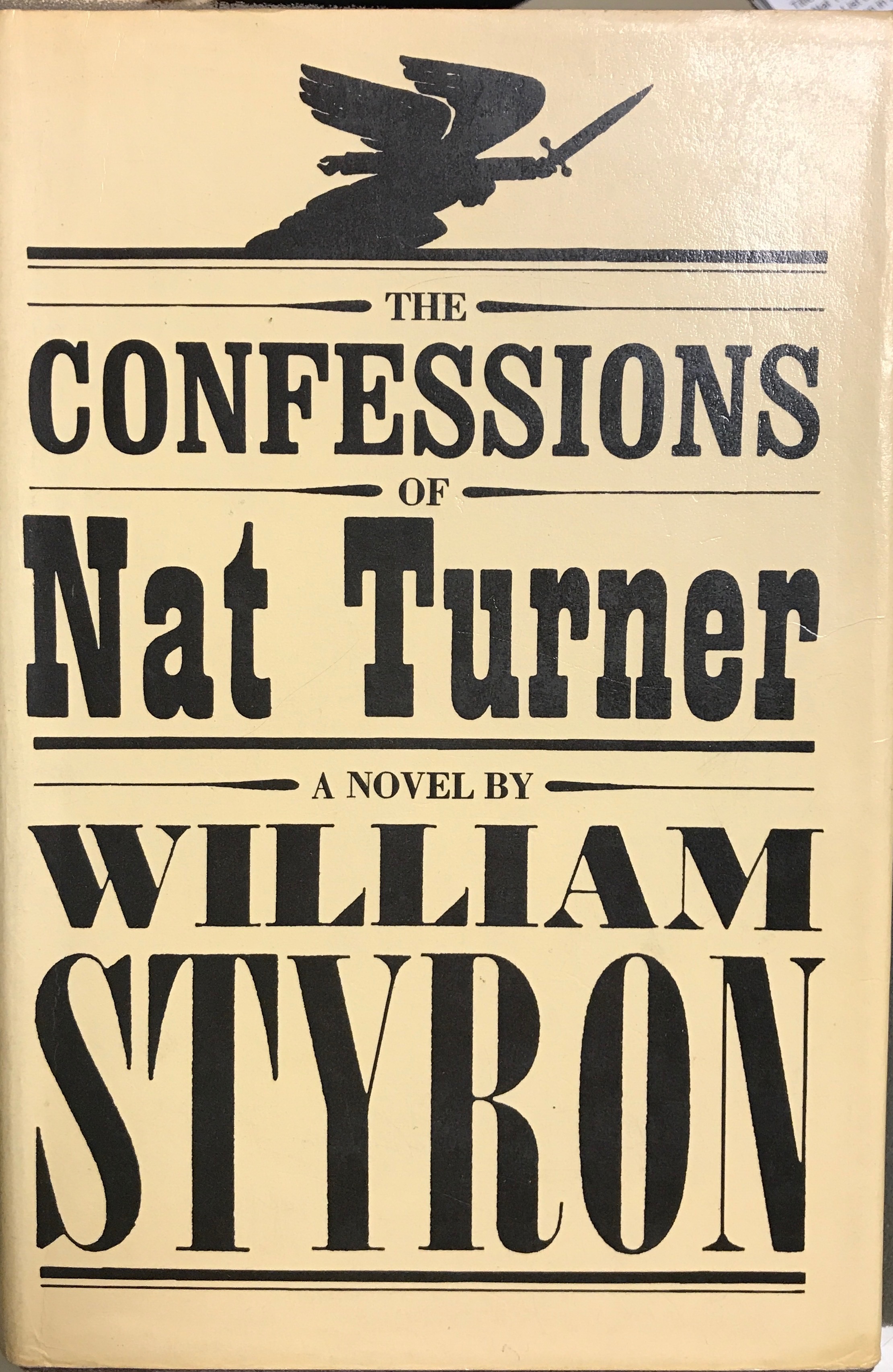
On October 9, 1967, William Styron’s novel from history, The Confessions of Nat Turner, was published to acclaim and controversy. Styron was raised in Newport News, Virginia, about a hundred miles from the site of the rebellion in Southampton County, Virginia. The novel was awarded the Pulitzer Prize, despite controversy over its characterization of Turner and other characters, and the fact that it was written in the voice of a Black man by a white writer. The novel remains in print today, and is still widely read.

The text-heavy cover of the first edition evokes broadsides of the early nineteenth century. (PS 3569 .T9 C6 1967)

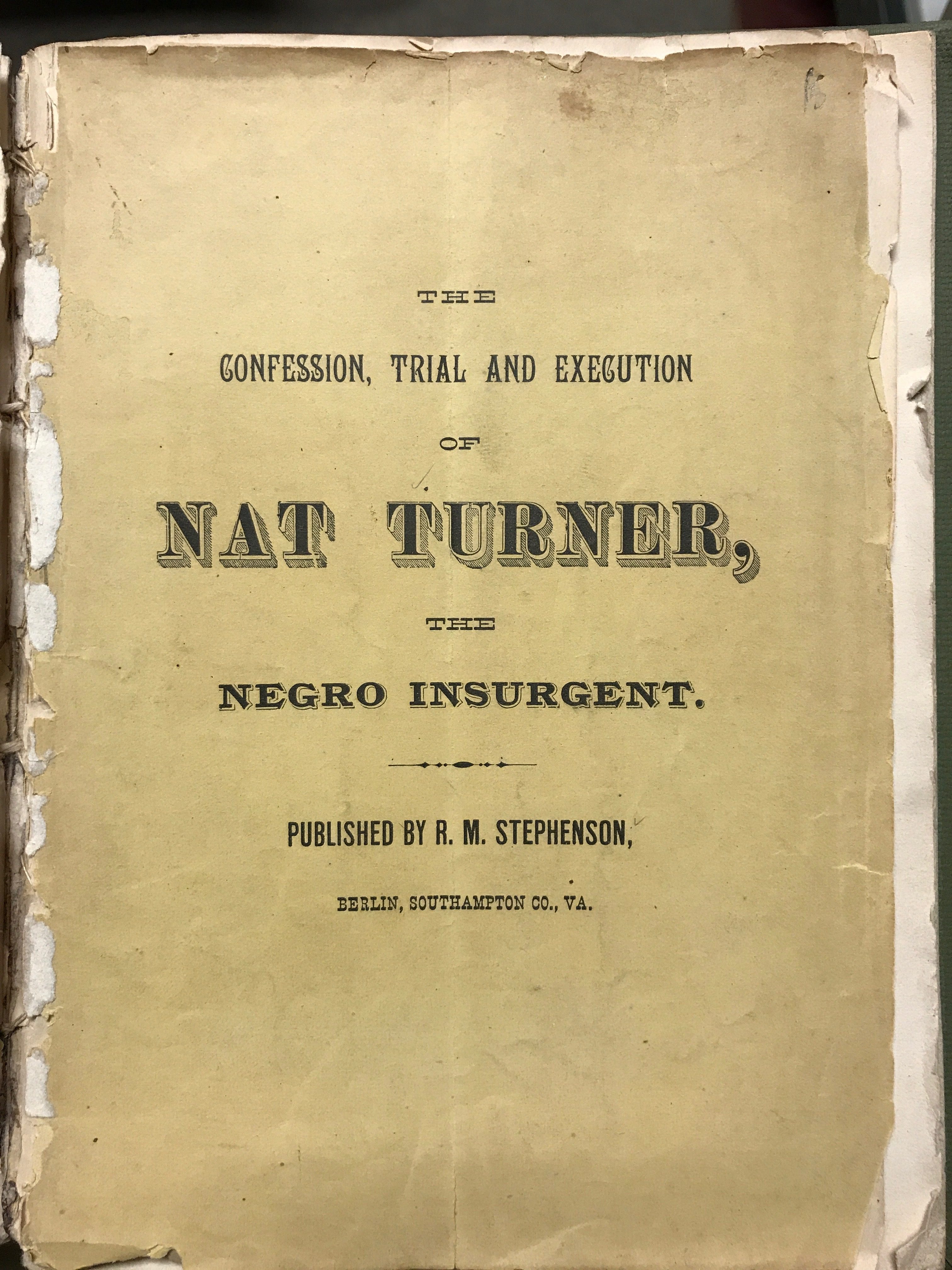
Our strong holdings in the history of Virginia include some of the essential source material upon which Styron based the novel. Of particular importance was this text, first published in 1831. It is written in the form of an interview with Turner, who tells his tale in the first person:

Gray’s “The Confession, Trial and Execution fo Nat Turner, the Negro Insurrectionist” (Berlin, VA: R.M. Stephenson,  1881). (F 221 v.163 no. 15)

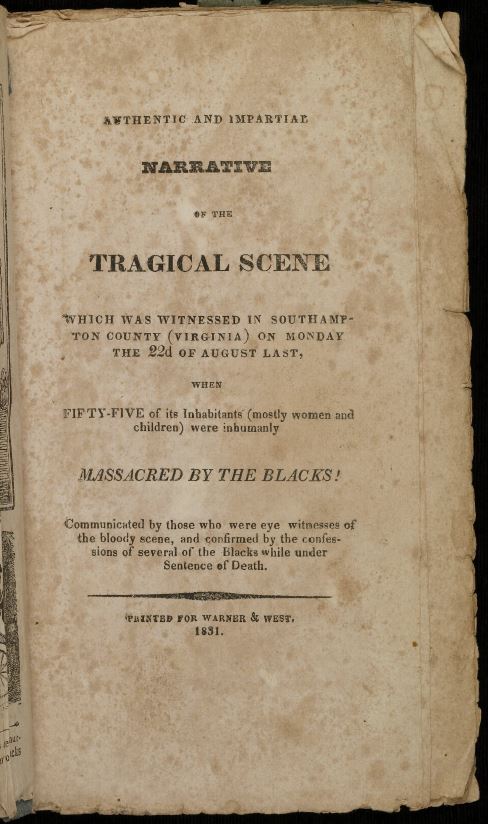
Also in the collections is another period narrative, shown below. this item is digitized in full and available online:
“Authentic and Impartial Narrative of the Tragical Scene Which Was Witnessed in Southampton County (Virginia) on Monday the 22d of August Last: When Fifty-Five of Its Inhabitants (Mostly Women and Children) Were Inhumanly Massacred by the Blacks! : Communicated by Those Who Were Eye Witnesses of the Bloody Scene, and Confirmed by the Confessions of Several of the Blacks While Under Sentence of Death” [New York]: Printed for Warner & West., 1831. (A1831 .W377)

Styron is also known to have depended on the following two volumes for his project, copies of both of which are likewise held in our collections:

Almost half of Frederick Law Olmstead’s” A Journey in the Seaboard Slave States: With Remarks on Their Economy” (New York: Dix & Edwards,1856) is dedicated to Virginia. (A1856 .O55)

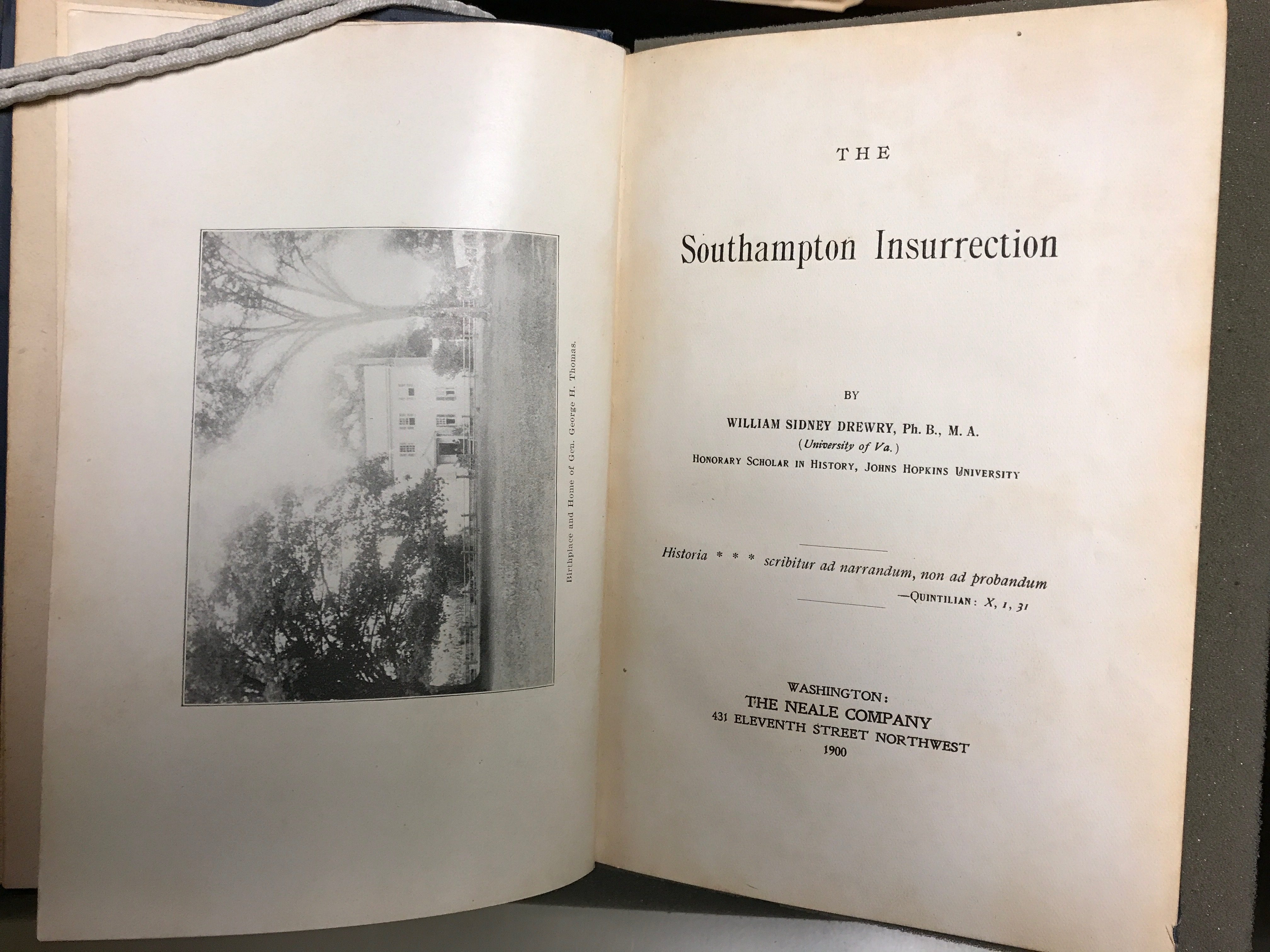
At the turn of the century, William Sidney Drewry composed a book-length study, “The Southampton Insurrection” ((Washington: Neale, 1900). (F232 .S7 D7 1900)

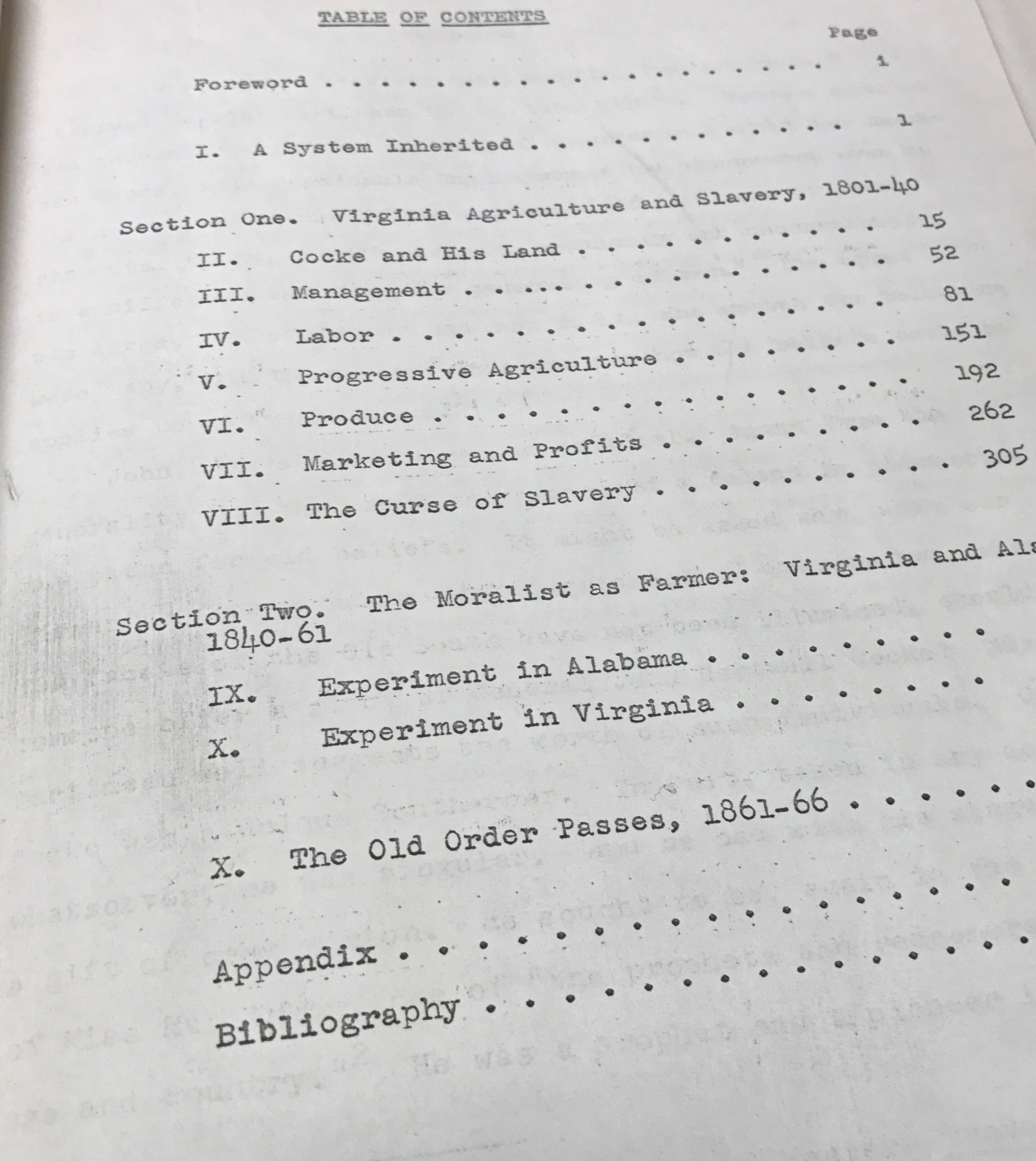
Finally, Styron depended upon M. Boyd Coyner’s UVA dissertation based upon our Cocke family papers collection. As James West tells it, “Styron was alerted to the existence of the dissertation by C. Vann Woodward, and Styron secured a copy of it from Coyner, who was then teaching at Hampden-Sydney.”

The table of contents page of M. Boyd Conyer,  “John Hartwell Cocke of Bremo: Agriculture and Slavery in the Ante-bellum South.” (Diss. 992).

Thanks to donor and Styron bibliographer James West for calling our attention to this anniversary and these fantastic source materials!

Miniature Books, coming to you from Facebook Live

Today, the folks over at UVA’s facebook page invited curator Molly Schwartzburg to share with them some of her favorite items in the miniature book collection on the Facebook Live streaming video platform. For those of you not on Facebook, here’s the video. We’re impressed that those teeny tiny books are actually in pretty good focus! Check out some of our beautiful and unusual minature treasures.

https://www.facebook.com/plugins/video.php?href=https%3A%2F%2Fwww.facebook.com%2FUniversityofVirginia%2Fvideos%2F10155802478383331%2F&show_text=0&width=560

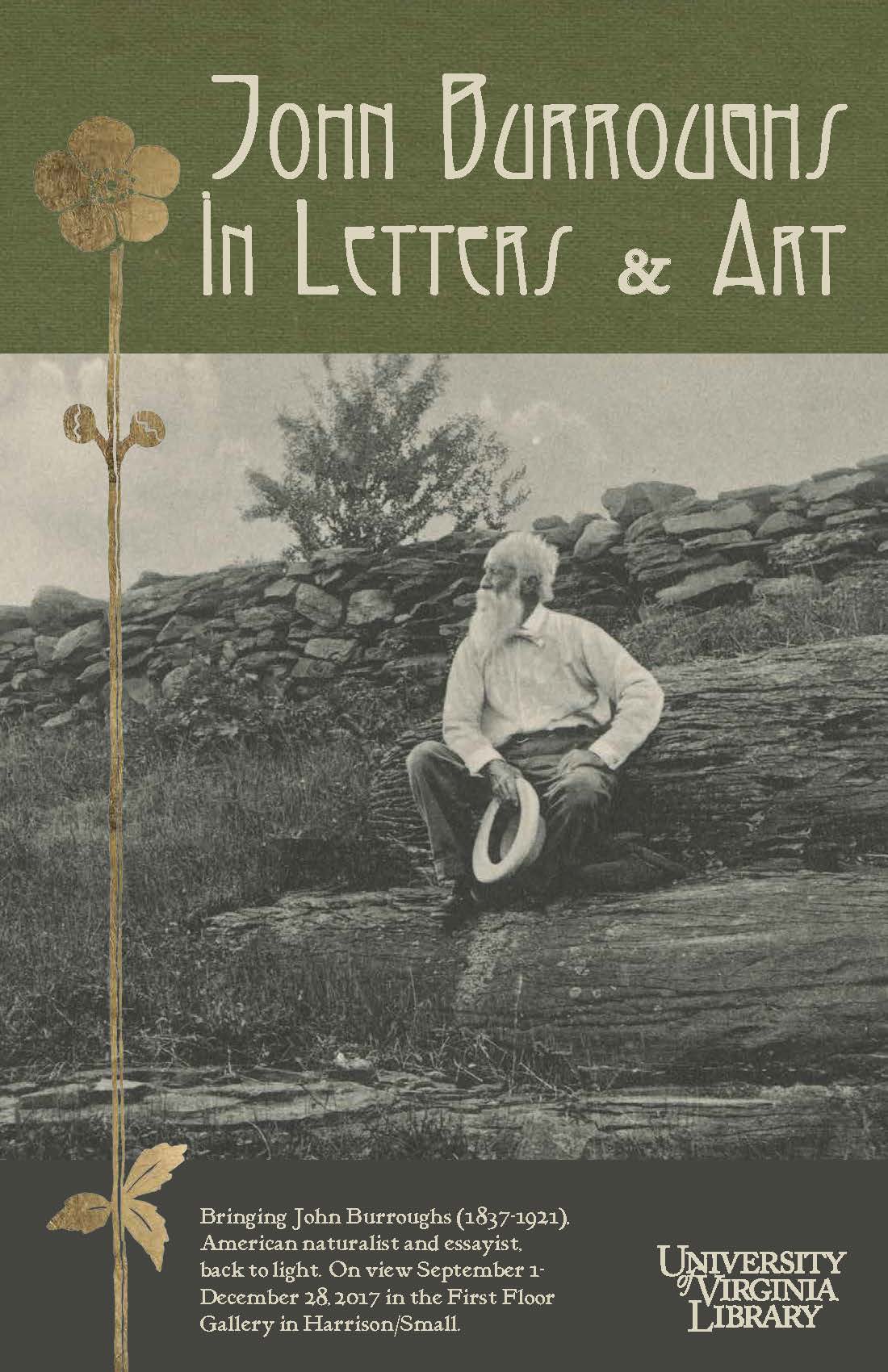
On View Now: “John Burroughs: In Letters & Art”

We are pleased to announce our latest First Floor Gallery exhibition, “John Burroughs: In Letters & Art.” It runs through December 28, 2017.

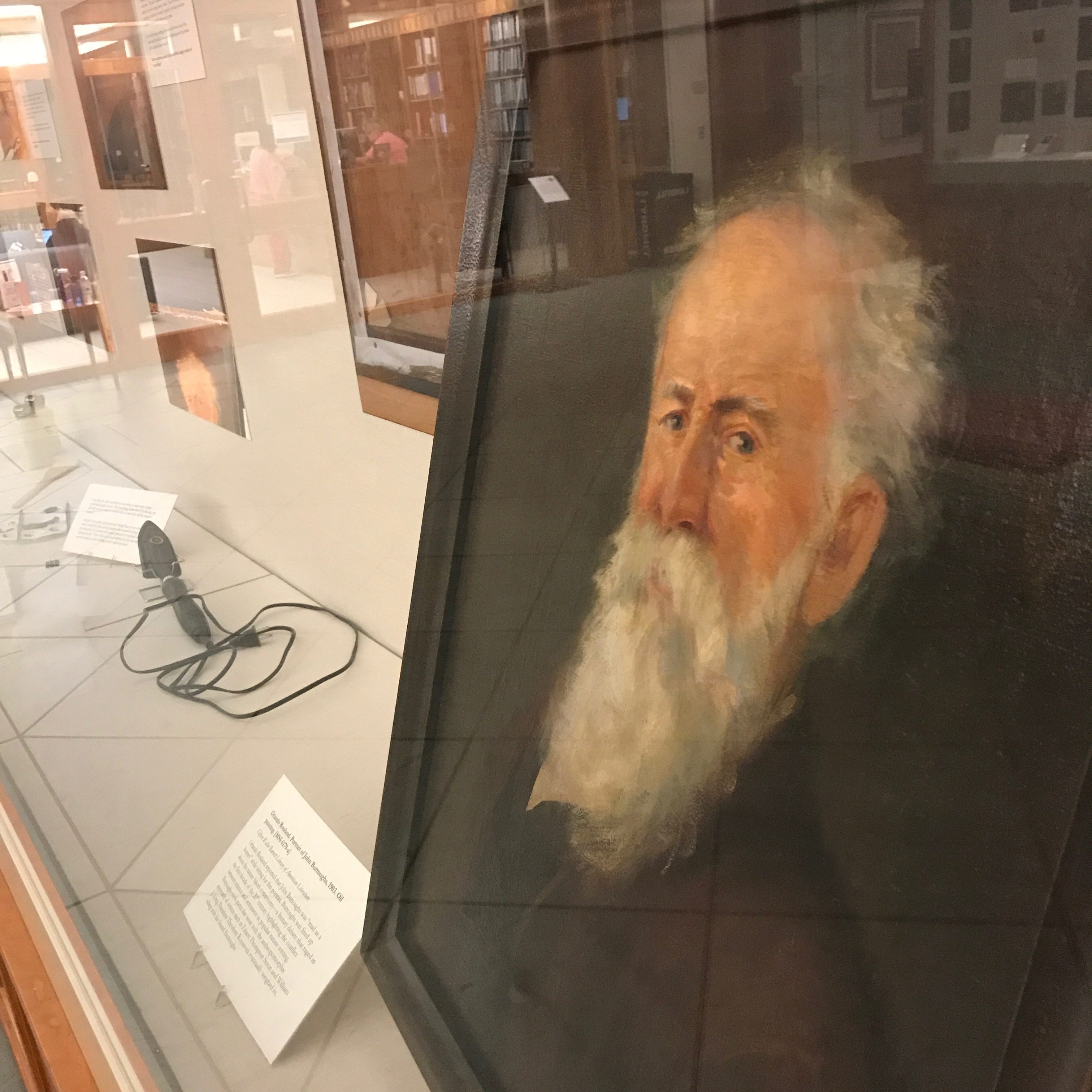
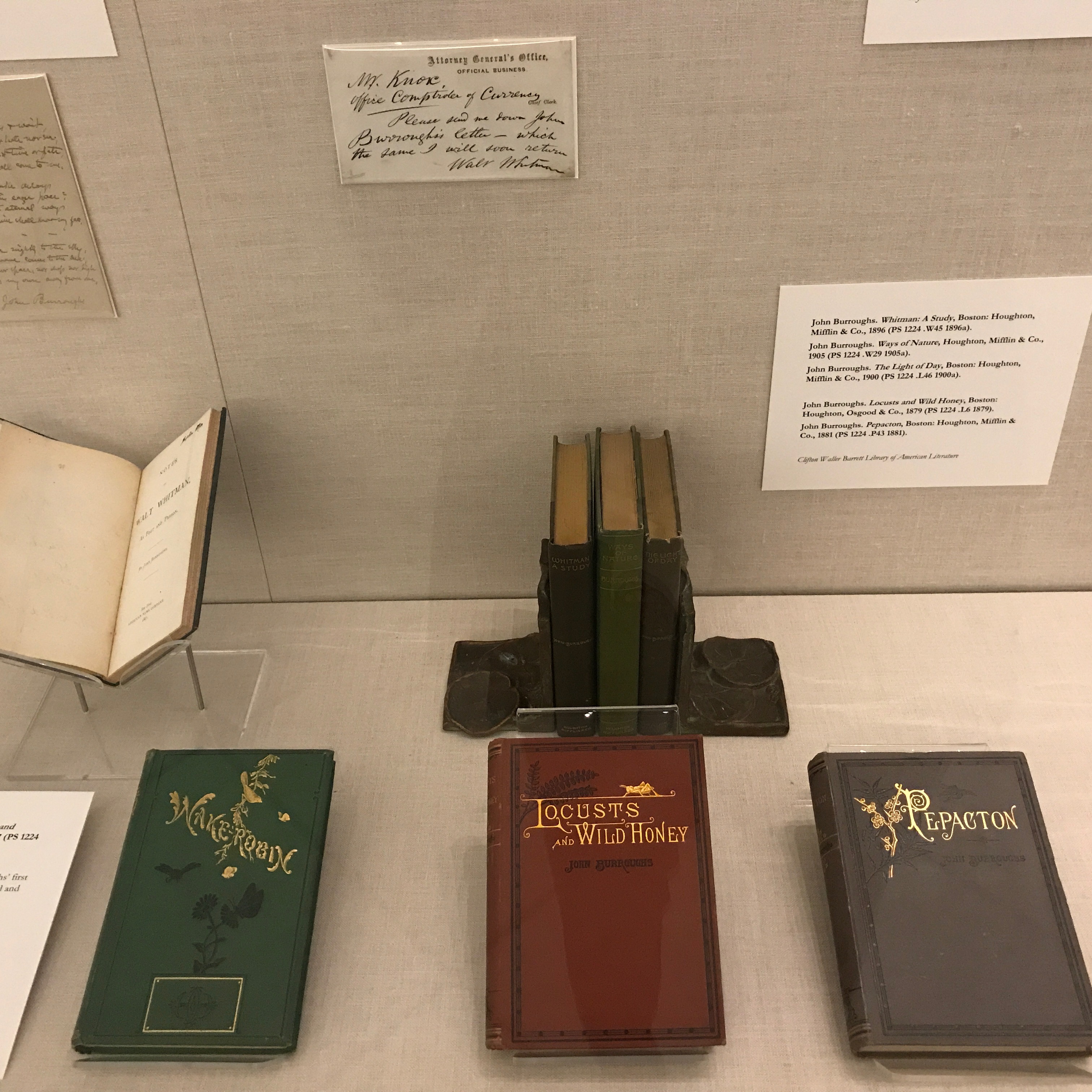
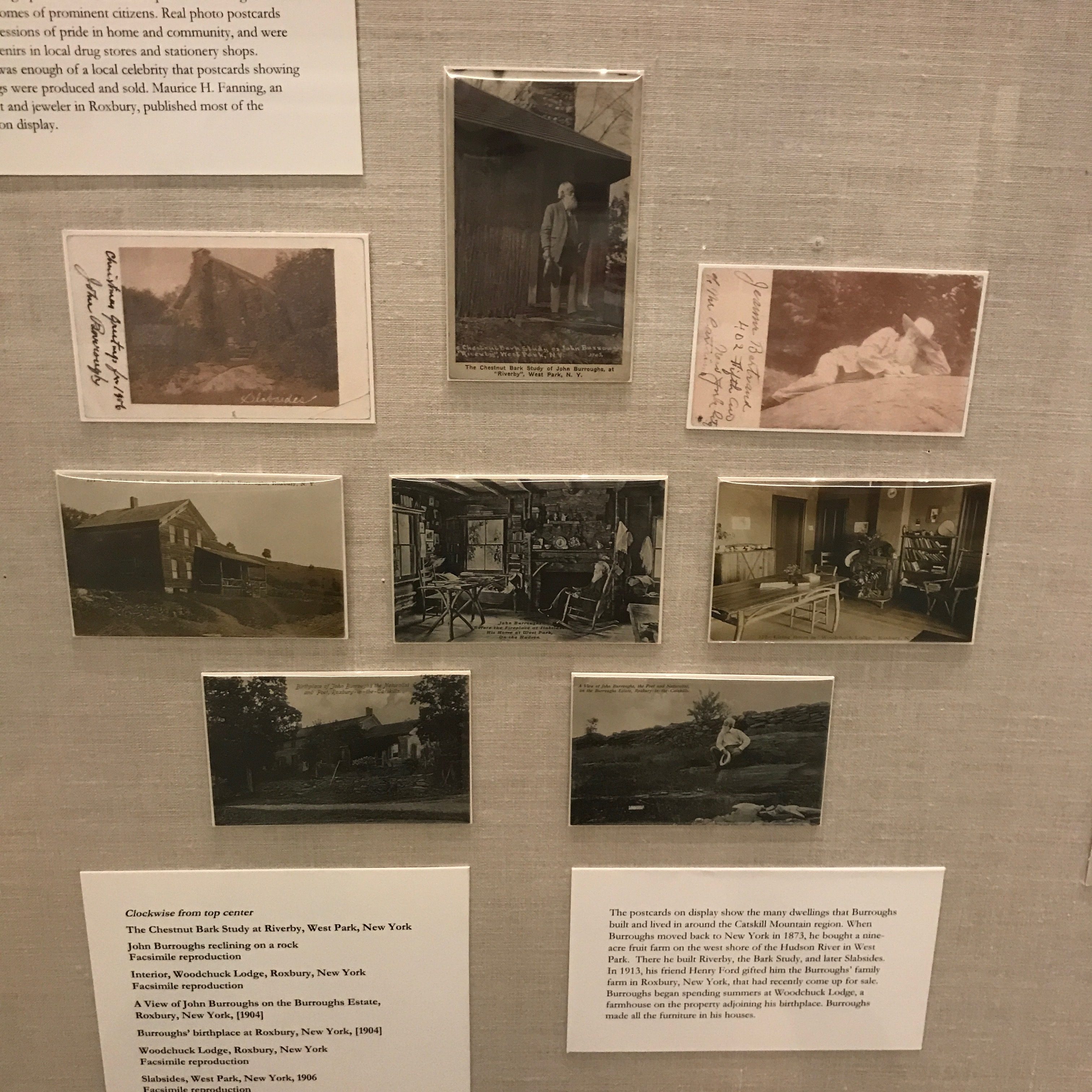
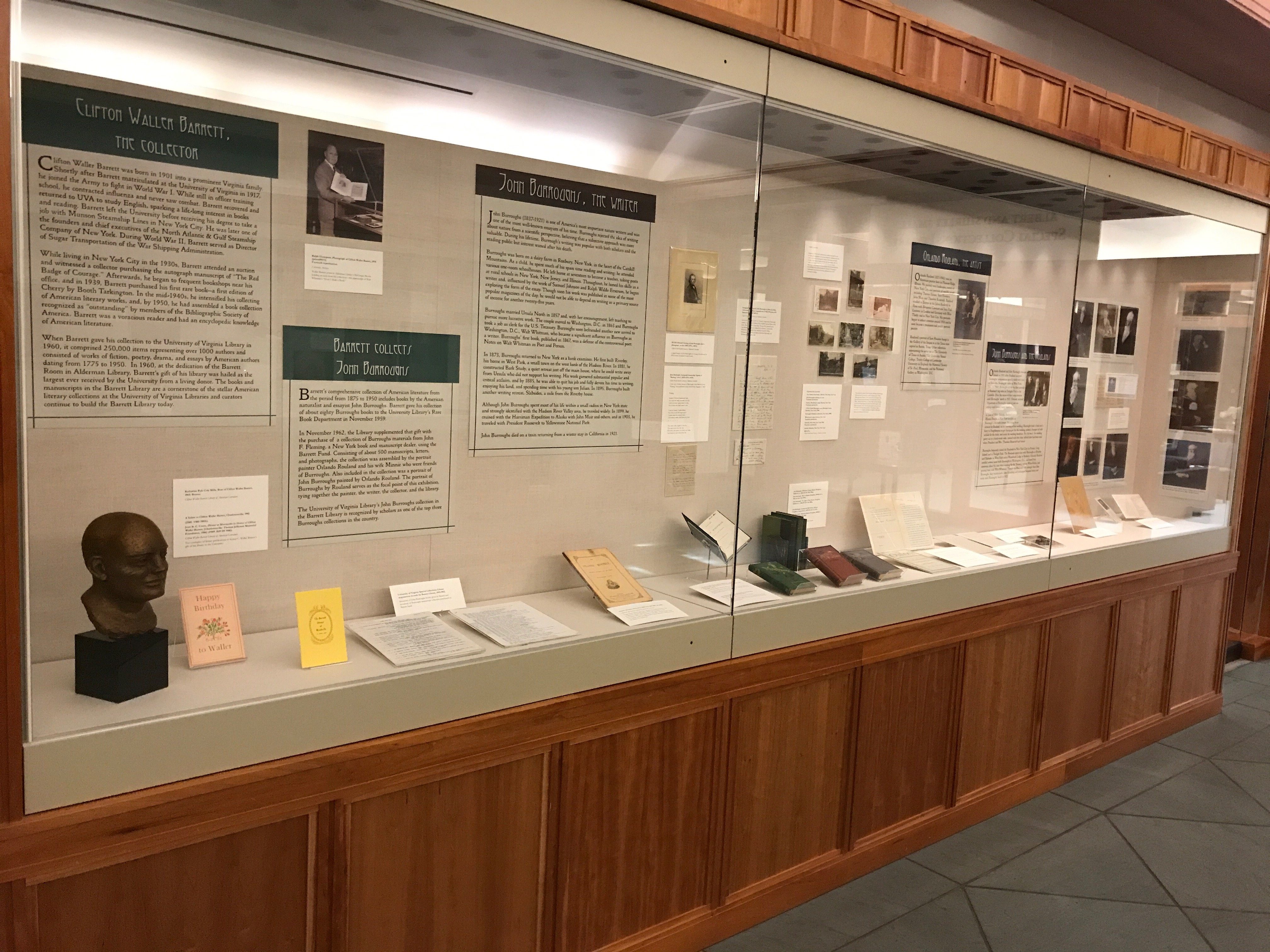
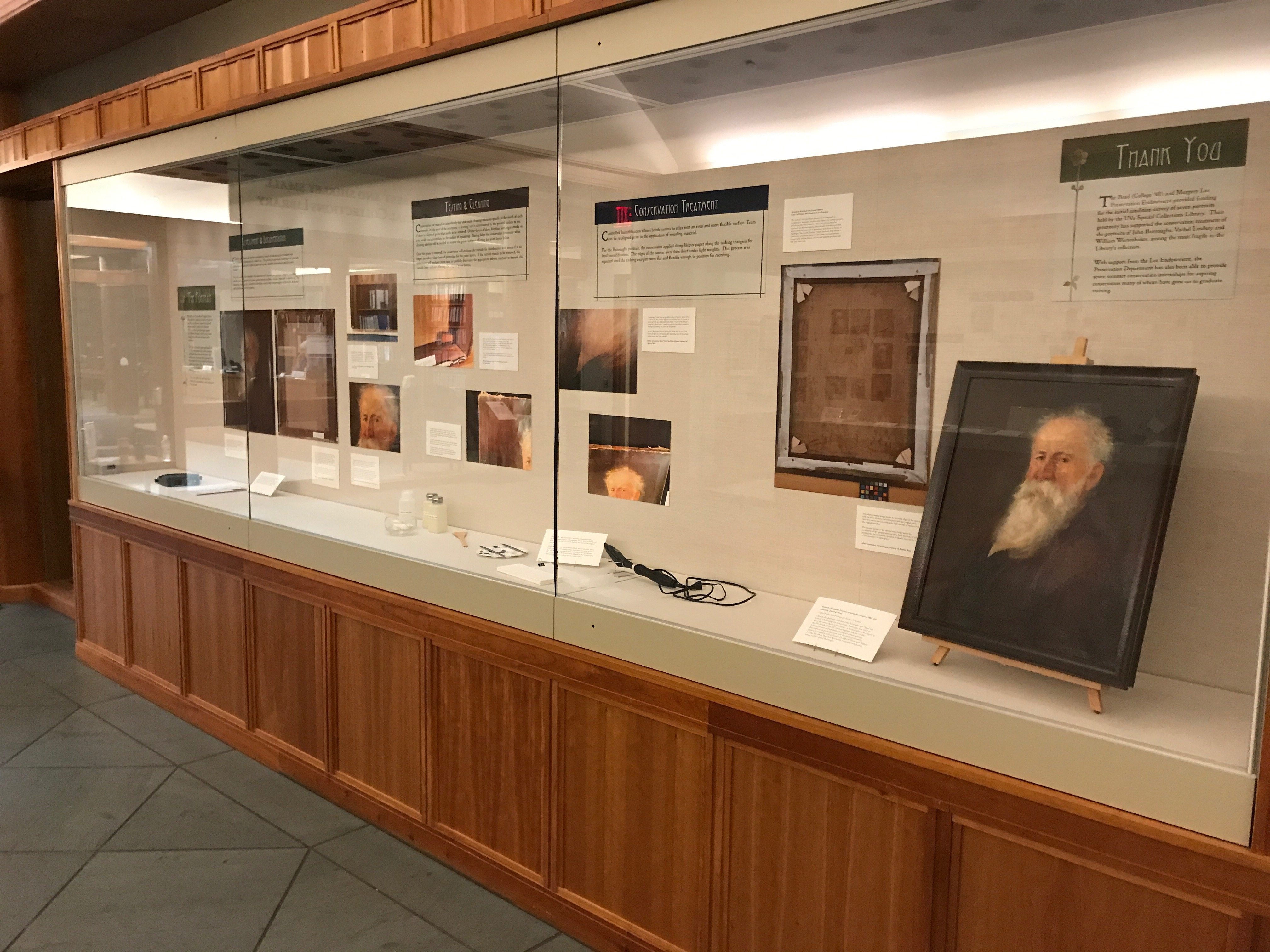
Inspired by the recent conservation treatment of a portrait of Burroughs painted by Orlando Rouland, this exhibition brings an important American naturalist back to light. The painting serves as the focal point of the exhibition, tying together writer, artist, collector, and library. The exhibition showcases books, manuscripts, and other materials from the Burroughs collection. John Burroughs’ (1837-1921) essays on nature were widely read by both scholars and the reading public during his lifetime. He counted among his friends prominent men including Walt Whitman, Theodore Roosevelt, Henry Ford, John Muir, and Thomas Edison.The Burroughs collection is part of the Clifton Waller Barrett Library of American Literature at the University of Virginia.

Here are a few tastes of the exhibition in photographs:

The portrait around which the exhibition was planned. Nearby are some of the tools used in its conservation treatment.


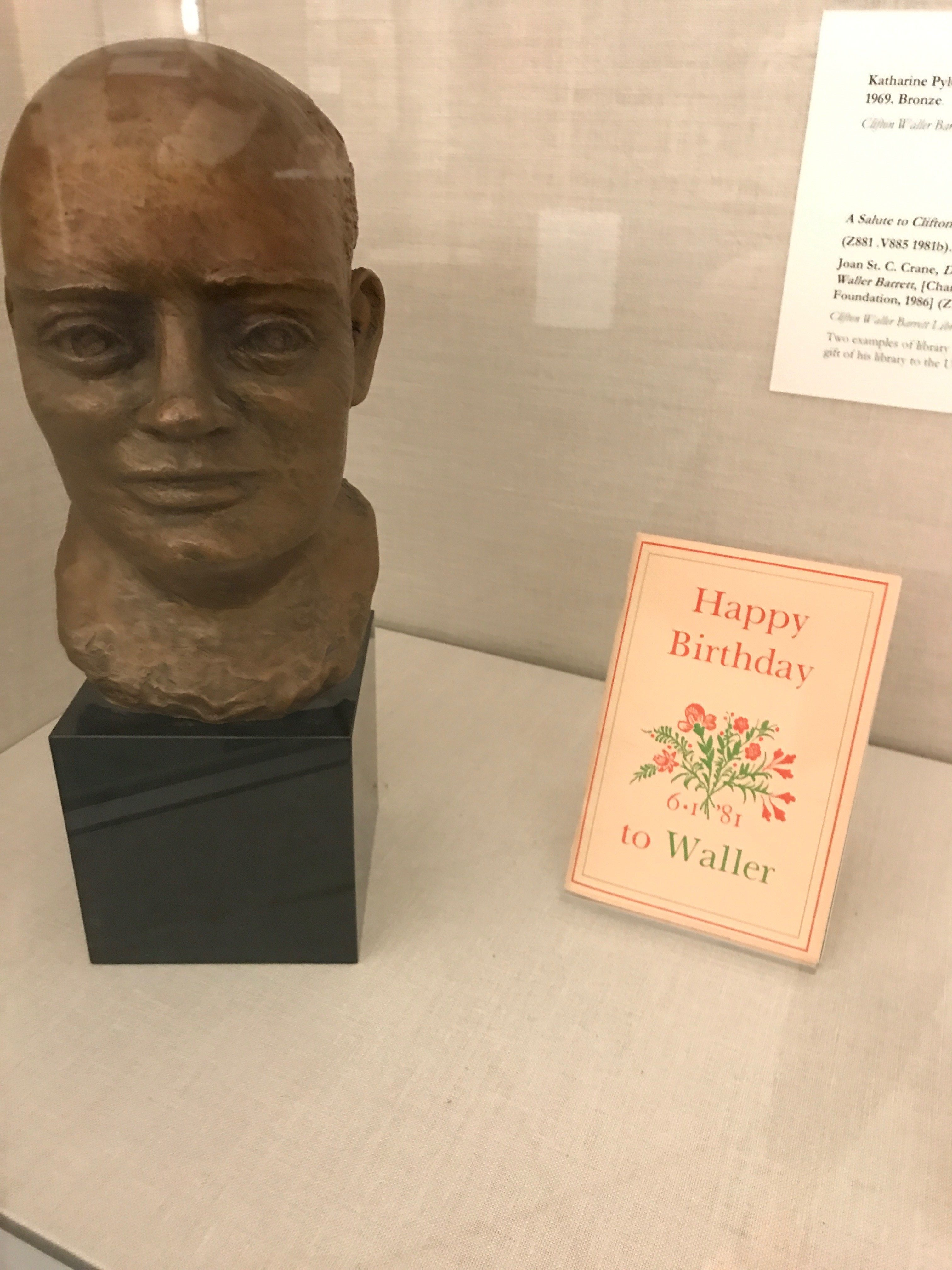
Part of the exhibition celebrates Clifton Waller Barrett’s work building the Burroughs collection.


We look forward to seeing you in the gallery!


POSTPONED: Exhibition Opening

Please note that the exhibition opening and book launch party planned for this Thursday, August 31, has been POSTPONED due to logistical problems produced by the “Unite the Right” Rally earlier this month. We are very sorry for the inconvenience and hope you will share this email with other friends who were planning to attend.

Stay tuned for a new date for this celebration!

John Dunlap, Charlottesville’s First Printer

The Philadelphia printer John Dunlap (1747-1812) is best known for having printed the so-called “Dunlap Broadside”—the first printing of the Declaration of Independence—of which the Albert and Shirley Small Special Collections Library is privileged to possess two of the 26 known copies.  Less well known is Dunlap’s distinction as the person responsible for bringing printing to Charlottesville, Virginia, in 1781.  On the eve of July 4th, and in celebration of having acquired our very first John Dunlap Charlottesville imprint, here is the story of Dunlap’s brief career as Charlottesville’s pioneer printer.

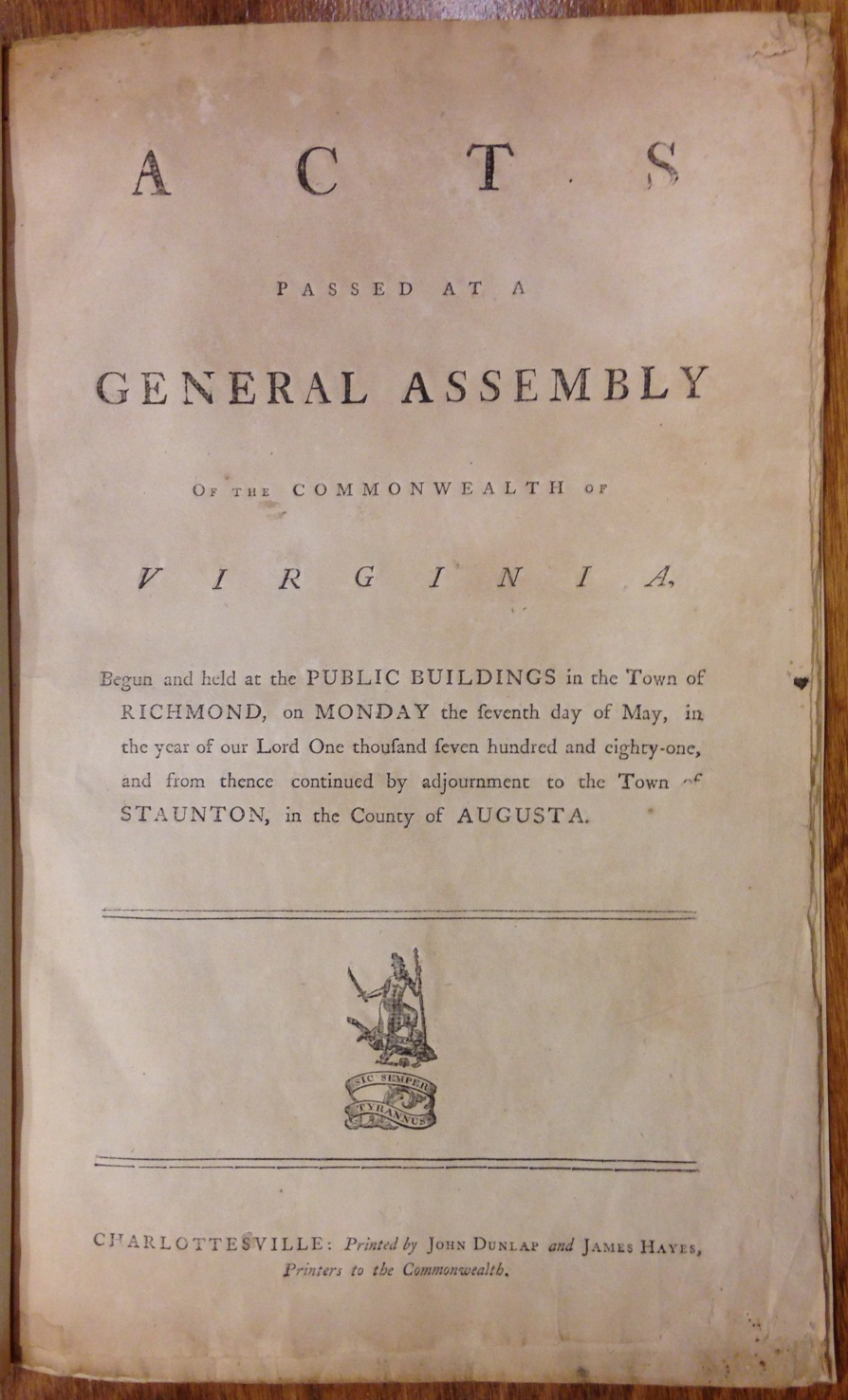
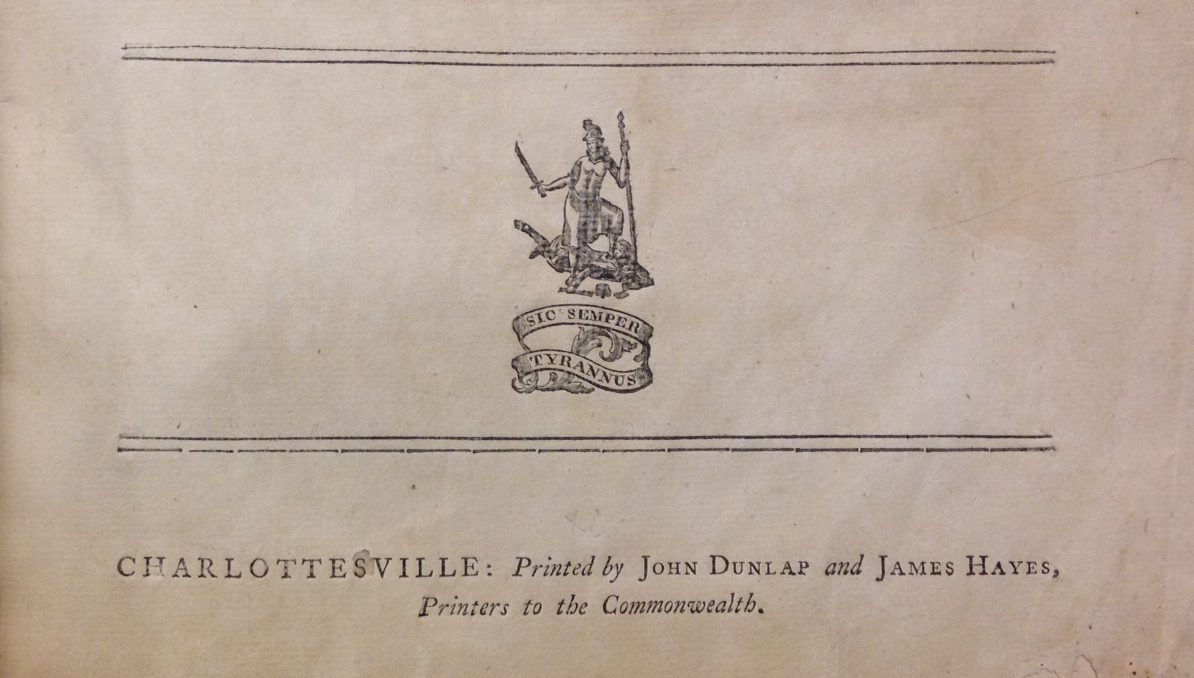
Title page of U.Va.’s newly acquired 1781 Charlottesville imprint, the first and only item from Charlottesville’s first press to have entered the U.Va. Library collections.

Eighteenth-century American printers were eager for significant business and steady cash flow, which were more easily obtained through newspaper publishing and government printing contracts than through other printing work. John Dunlap did well on both accounts. He immigrated from Ireland to Philadelphia in 1757 and, after serving an apprenticeship in his uncle’s printing establishment, took over the business. In 1771 Dunlap launched the weekly Pennsylvania Packet, or the General Advertiser. Taking advantage of his Philadelphia location and the urgent need for public printing during the American Revolution, Dunlap secured printing contracts not only for the state of Pennsylvania, but also for the Continental Congress.

The two-line imprint crediting John Dunlap and James Hayes as Charlottesville’s first printers. Although undated, this work was printed during September and October of 1781.

In August of 1780, Dunlap expanded his public printing portfolio to Virginia. Directed by Virginia’s House of Delegates to engage a public printer, then-Governor Thomas Jefferson recommended acceptance of the proposal submitted by Dunlap and his business partner (and former apprentice) James Hayes. That fall a press and supply of printing types was dispatched to Richmond, where Hayes was to establish and manage a printing office. But its opening was delayed when the shipment fell into British hands. A second press was sent from Philadelphia to Richmond, and Hayes was at long last able to begin printing in April 1781.

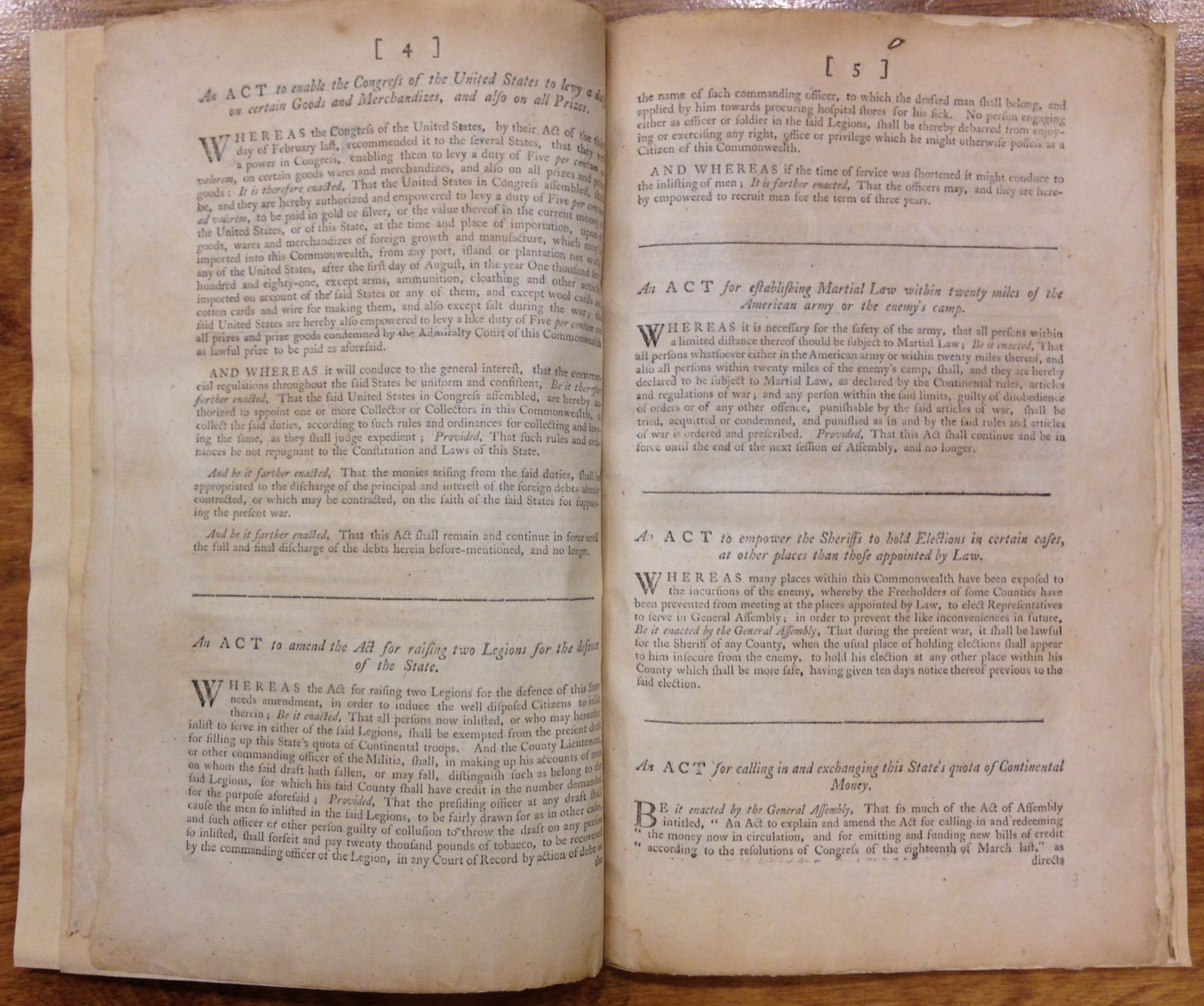
A two-page opening from the Acts Passed at a General Assembly of the Commonwealth of Virginia (Charlottesville, 1781).

The following month, however, the arrival of British forces under General Cornwallis prompted Virginia’s state government to flee Richmond, first to Charlottesville, and then to Staunton. Hayes packed up his printing equipment and followed. But in late June, near Charlottesville on his way back from Staunton, Hayes was captured by the British and then released on condition that he not print “until properly exchanged.” This was soon arranged, and in July 1781 Hayes set up his press in Charlottesville. It remained in operation into October, but by early December Hayes had relocated the press to Richmond. All the while Dunlap remained in Philadelphia.

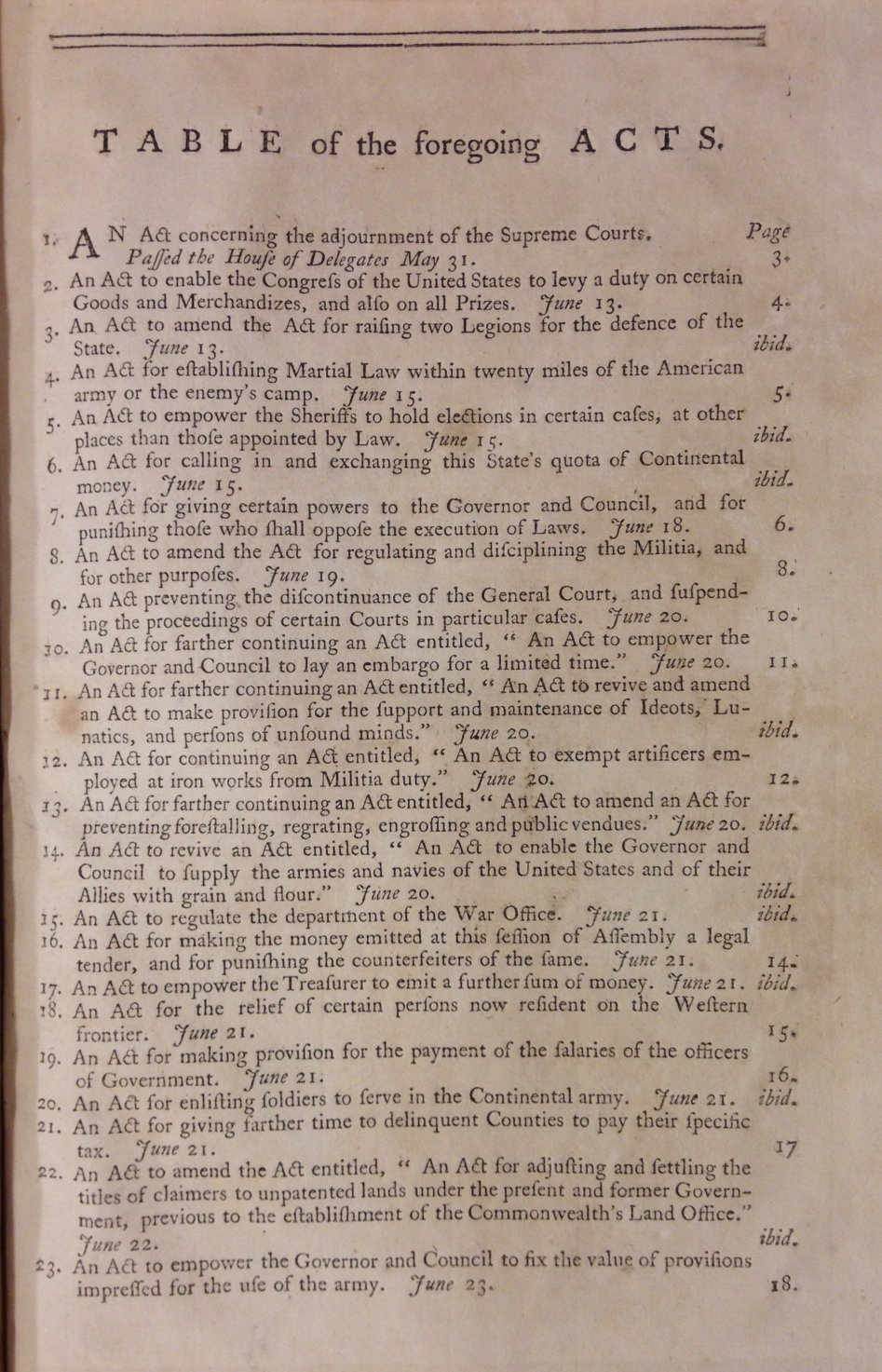
The list of acts contained in the 1781 Virginia session laws printed in Charlottesville.

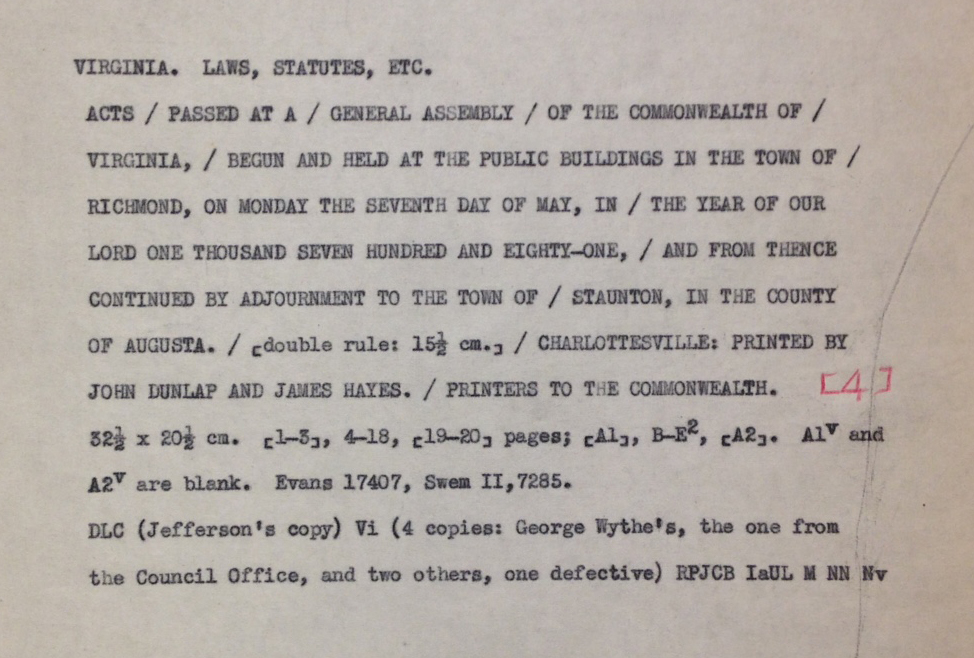
In its three months of operation, the first Charlottesville press is known to have printed at least four items: two broadsides, the 52-page Journal of the House of Delegates of Virginia for 1781, and the 1781 Virginia session laws. It is a copy of this last publication—a 20-page folio publication titled Acts Passed at a General Assembly of the Commonwealth of Virginia—that has now been acquired by U.Va.  Given the constraints under which Hayes is known to have operated, it is tolerably well printed, bearing the Virginia seal on its title page above the two-line imprint:  CHARLOTTESVILLE: Printed by John Dunlap and James Hayes, Printers to the Commonwealth.

John Cook Wyllie’s bibliographical description of the 1781 Virginia session laws (Charlottesville, 1781) with (at bottom) a census of copies known ca. 1960.

All four known 1781 Charlottesville imprints were printed by Hayes in his role as public printer, and all are very rare. It is likely, however, that Hayes printed a few other items, e.g., broadsides, printed forms, and other jobbing work, during his Charlottesville sojourn. Some day we may be able to identify these through careful typographical analysis. The history of Charlottesville’s first press has yet to be written–this précis is based on unpublished research by former U.Va. Librarian John Cook Wyllie, which is available for consultation in the Small Special Collections Library.

Following Hayes’ departure, Charlottesville would remain without a printing press for another four decades, until Clement P. and J.H. McKennie established a newspaper, The Central Gazette, in 1820.

Patron’s Choice: Letters from Liberia and American Postal Policy

This week we are pleased to feature a guest post by Christy Pottroff, who was in residence at the library last year as a Lillian Gary Taylor Visiting Fellow in American Literature, Mary and David Harrison Institute. Christy is an Andrew W. Mellon Dissertation Fellow in Early Material Texts at the McNeil Center for Early American Studies at the University of Pennsylvania and a Ph.D. candidate in English at Fordham University. Her dissertation is entitled “Citizen Technologies: The U.S. Post Office and the Transformation of Early American Literature.” Thanks so much to Christy for sharing with us her experience studying in our marvelous collections of letters from Liberia.

In 1833, Peyton Skipwith and his family set foot on African soil for the first time. After enduring decades of slavery in the United States, the Skipwith family was eager to start a new life in Liberia. But, after a harrowing fifty-six day journey across the Atlantic Ocean, they soon discovered the conditions were much more difficult than they had been led to believe. The Skipwiths endured disease, harsh climate, inadequate supplies, and conflict with local African tribes–experiences chronicled in a small collection of letters held at the University of Virginia Special Collection Library. These letters, addressed to the Skipwiths’ former owner General John H. Cocke, are at times relentlessly hopeful and at other moments filled with despair. This dissonance between hope and despair is in many ways representative of Liberian Colonization.

[Life Membership Certificate for American Colonization Society], ca. 1840. Certificate. American Colonization Society Papers, Manuscript Division, Library of Congress.

In the first half of the nineteenth century, progressive Southern slaveholders founded the American Colonization Society to promote the resettlement of free-born and formerly enslaved African Americans to West Africa. This strategy emerged, largely, because white reformers could not imagine the viability of a racially diverse society post-slavery. Most African Americans, however, did not support the colonization plan. The United States was their home and they wanted to work toward justice rather than emigrate. Despite the controversy, the American Colonization Society began sending African Americans to West Africa in 1822 where they established Liberia. By 1867, over 13,000 free African Americans, including the Skipwiths, had emigrated to Liberia through the American Colonization Society.

Each new Liberian had deep roots in the United States; many left behind friends and family they would never see again. And yet, despite the strong ties between Liberia and the United States, very few letters passed between the two countries. The Skipwith letters housed at the University of Virginia Special Collections Library are special indeed.

Letter from Peyton Skipwith in Monrovia, June 25th 1846. Cocke Family Papers (MSS 640). Albert and Shirley Small Special Collections Library. Topics covered in the portion shown here are his wish for more farming knowledge and  for books other than the Bible, which is widely available.

The dearth of letters between Liberia and the United States is curious. In the middle decades of the nineteenth century, the United States postal system delivered more letters than ever before, and an increasing number of those letters were from countries across the globe. The U.S. Post Office Department facilitated international mail by entering into bilateral postal treaties that guaranteed easy and inexpensive communication and commerce beyond the nation’s borders. In 1851, the United States maintained postal treaties with every country in Europe. The Postmaster General was proud to report new treaties with Algeria, Hong Kong, St. Kitts and Nevis, Beirut, and many more.

The United States did not enter a postal treaty with Liberia until 1879 (when Liberia was admitted to the newly established Universal Postal Union). Despite the special relationship between the two countries in the first half of the nineteenth century, there was no standardized way to send a letter between them. Liberia did have a rudimentary postal system, though its origins and development are difficult to track. In the 1850s, the Liberian government entered into postal treaties with Great Britain, France, and Germany. It was through these roundabout channels that the existing Liberian letters to the United States traveled. As a contemporary American Colonization Society member writes:

Great Britain…sends a weekly line of steamers to the Western Coast of Africa, which touch at Liberia. In fact, by a postal treaty, the mails between Liberia and America go by these steamers, and then by the British steamships between England and the United States!

This roundabout mail channel between the U.S. and Liberia meant that letters were twice as expensive (as they needed postage in two different postal systems) and were at much greater risk for delay, loss, or misdelivery.

Advertisement for mail transport in The New York Herald, November 12, 1844. (Source: Readex Early American Newspapers Database. Accessed: October 23, 2016)

For Peyton Skipwith and his family, the absence of a postal treaty had great consequences. They left behind their homeland, friends, and family–and had no reliable way to communicate with loved ones left behind. One of the most striking things about the Skipwith family letters is the frequent reference to lapses in communication. In an 1835 letter, Peyton writes “This is the third letter that I have wrote to you and have received no answer.” And a year later, he expresses frustration because “I write by almost every opportunity but cannot tell how it comes to pass that only two of my letters have been received.” Later, in 1839, he writes “Reverend Colin Teague should have brought [your letter] to me but he did not reach his home but died…which was a great disappointment to me…I am always anxious to hear from you all.”

Top:  Letter from Peyton Skipwith to John Hartwell Cocke, June 25, 1846. John Hartwell Cocke Papers 1725-1949 ( MSS 640, etc. Box 117).  Albert and Shirley Small Special Collections Library.
Center: Letter from Switzerland, via France, to U.S. Schaefer Collection. (Source: Frajola Philatelist. Accessed: October 23, 2016. http://www.rfrajola.com/sale/RFSaleP6.htm)
Bottom: Letter from Judy Hardon to Howell Lewis, Dr. James H. Minor, and Frank Nelson, February 27 1858. Letters From Former Slaves of James Hunter Terrell Settled in Liberia. 1857-1866 (MSS 10460, 10460-a). Albert and Shirley Small Special Collections Library.

The absence of any American-Liberian postal treaty is perplexing. Both countries had entered into other postal treaties during the period, and the United States was sending mail steamers across much greater distances for postal purposes. This unsettled postal state was most likely the result of an ideological problem.

The same rationale for sending free African Americans to Liberia likely permeated into contemporary international postal policy. Free people of color were thought to threaten the stability of slave society, and their proximity to enslaved Americans was considered dangerous. A single letter cannot collapse geographical distance, but it can do a great deal to shrink ideological distances. With a postal treaty, new Liberians would have had the freedom to send letters to free and enslaved friends and family members in the United States. They could have shared ideas, money, or other resources with privacy, dispatch, and ease. The thought of regular correspondence between free and enslaved African Americans is very likely what kept the United States Post Office Department from opening up any reliable public channel of communication to and from Liberia.

The absence of an American-Liberian postal treaty did not solve a real problem; the likelihood of conspiratorial international communication between African Americans was quite slim. Instead, the treaty’s absence created countless problems for the Skipwiths and their fellow Liberian emigrants. Peyton, for example, tried in vain to send a letter to his brother George before his death. Another Americo-Liberian, William Douglass, desperately sought $50 that had been lost in transit between Liberia and the United States (worth over $1,300 in today’s currency). Without a reliable international postal treaty these instances of lost letters and impossible communication were dishearteningly common. In light of these institutional barriers, that these letters from Liberia ever arrived at the University of Virginia Special Collections Library is itself a small miracle.


John O’Brien’s Literature Incorporated Wins the Louis Gottschalk Prize

It is one thing to write a book. It is quite another for that book to receive widespread acclaim from one’s peers, as is the case with Literature Incorporated: The Cultural Unconscious of the Business Corporation, 1650-1850, the most recent work by John O’Brien, NEH Daniels Distinguished Teaching Professor in U.Va.’s Department of English. Literature Incorporated has been awarded the Louis Gottschalk Prize, presented annually “for an outstanding historical or critical study on the eighteenth century” by the American Society for Eighteenth Century Studies.

One need not be aware of the Supreme Court’s 2010 ruling in Citizens United or of Mitt Romney’s statement that “corporations are people” to benefit from a close reading of Literature Incorporated. Its subject is the corporation, “an abstraction that gathers up a long history of institutions and practices as varied as city governance, guild organization, state-sponsored colonial exploration, money lending, insurance, slave trading and university funding.”  Its method is to trace the trope of incorporation in a wide range of Anglo-American texts, including “economic tracts, legal cases, poems, plays, essays, novels, and short stories.” And its goal “is to discover some of the ways in which language has ‘repeated’ the influence of the corporation to us, given it form in our imaginations.”

The U.Va. Library is proud to have earned a place in the book’s Acknowledgements. Indeed, most of the works discussed in Literature Incorporated (and many more that inform and amplify its arguments) can be found in the Albert and Shirley Small Special Collections Library. Here is a modest selection, which we invite you to come explore in more depth.

King as corporation, comprised of the bodies of his subjects. Detail from the engraved title page to Thomas Hobbes, Leviathan (London, 1651). (E 1651 .H658; Tracy W. McGregor Library of English Literature)

Literature Incorporated begins with Thomas Hobbes’ work of political theory, Leviathan (1651). Its famous engraved title page “offers an image of incorporation, of the people of a realm incorporated into the sovereign.” Although Hobbes viewed private corporations as potential rivals to government, O’Brien shows how Alexander Hamilton and John Marshall, among others, appropriated Hobbes’ language in support of corporations.

The Carolina Company’s vision for its American colony, drafted in large part by John Locke. The Two Charters Granted by King Charles IId to the Proprietors of Carolina (London, 1698). (A 1698 .G746; Tracy W. McGregor Library of American History)

Among the earliest English corporations were entities such as the Carolina Company, chartered by the sovereign to promote colonial settlement and trade. The philosopher John Locke was instrumental in developing the English mercantilist system, and O’Brien traces Locke’s crucial role in drafting the company’s Fundamental Constitutions (1669; final edition 1698), in which the Carolina proprietors envisioned the society they hoped to establish in the New World. Indeed, Locke’s empiricist philosophy permeates the document.

Frontispiece and title page to an early edition of Richard Steele’s The Conscious Lovers (London, 1735). (PR3704 .C66 1735)

Another such company, the South Sea Company, was at the heart of one of the greatest financial bubbles of all time, the South Sea Bubble of 1720. The speculative frenzy and resulting financial crash can be traced in many contemporary literary works, such as Sir Richard Steele’s play, The Conscious Lovers (1720). To the familiar plot lines of marriage and mistaken identity Steele added innovative complications concerning property rights. Steele also found himself accused publicly, through his involvement with the Drury Lane Company, of creating a theatrical equivalent of the South Sea Bubble to unfairly inflate the play’s ticket prices.

Tobias Smollett on why a novel needs a “principal personage,” from The Adventures of Ferdinand Count Fathom (London, 1753). (PR33694 .F54 1753 v.1)

The 18th century also saw the rise of insurance companies, which offered protection from risk and the fickle winds of divine providence. O’Brien demonstrates how contemporary English fiction’s “well-known investigations of risk and reward look different when they are read in the context of insurance history.” A perfect example is Tobias Smollett’s Adventures of Peregrine Pickle (1751), in which the plot is driven by Peregrine’s involvement with two different insurance policies. O’Brien also invokes Smollett’s famous statement, in the preface to The Adventures of Ferdinand Count Fathom (1753), that a novel requires “a principal personage to attract the attention, unite the incidents, unwind the clue of the labyrinth, and at last close the scene by virtue of his own importance.” In O’Brien’s words, the protagonist of a novel “resembles the corporation itself, a prosthetic person who helps bring the broader organization of a specific kind of economic activity into representation.”

Frontispiece to The Interesting Narrative of the Life of Olaudah Equiano (London, 1789). (CT2750 .E7 1789; Gift of Mrs. Emily D. Kornfeld)

During the late 18th century, the London Society for Effecting the Abolition of the Slave Trade waged a successful abolitionist campaign. O’Brien traces how “the society became a corporate voice that found itself emulating the very entities that it sought to attack,” for example, through its frequent use of an emblem featuring a supplicatory slave on bended knee. However, one key abolitionist publication—The Interesting Narrative of the Life of Olaudah Equiano (1789)—deliberately separated itself in form and content from this corporate voice, instead establishing itself “as a kind of corporate representative [of] ‘the African.’”

Beginning of Edgar Allan Poe’s story, The Gold-Bug, which leads off his Tales (New York, 1845). (PS2612 .A1 1845 copy 3; Gift of D. N. Davidson)

Literature Incorporated concludes with a discussion of Anglo-American literary responses to the fiscal and banking crises of the 1820s, 1830s, and 1840s. In particular, O’Brien offers a close reading of The Gold-Bug, the lead-off story in Edgar Allan Poe’s Tales (1845) and his most popular with contemporaries.

And to wrap up: hold the date! Another recent recipient of the Louis Gottschalk Prize—David Hancock, Professor of History at the University of Michigan—will deliver this year’s Thomas Jefferson Foundation Lecture on Wednesday, April 5, 2017 at 4:00 p.m. in the auditorium of the Albert and Shirley Small Special Collections Library. His talk, “The Man of Twists and Turns: Personality, Portrait & Power in the Re-Shaping of Empire,” concerns the 2nd Earl of Shelburne, the British prime minister who helped negotiate an end to the American Revolution. The lecture is co-sponsored by the Thomas Jefferson Foundation and the U.Va. Library.

Collaborative Curation: Cori Field on Student Exhibitions

This week, we are pleased to feature a guest post by Cori Field of the Women, Gender & Sexuality Program. Cori is an exceptional colleague who really “gets” what an exhibition can do for her students. We are so lucky to have worked with her on the exhibition described below.
The “Sounds and Silences of Black Girlhood” exhibition resulted from a remarkable collaboration between undergraduates in the Women, Gender & Sexuality Program and Library staff. Finding archival sources by and about black girls is difficult even for professional historians because most collections are organized around the concerns of white adults. Undaunted, UVA students eagerly stepped up to the challenge. With the help of Molly Schwartzburg, Holly Robertson, and Erin Pappas, they identified a wide range of materials in Special Collections related to the global history of black girlhood, researched the significance of those items, and designed a compelling exhibit focused around the core themes of identity, resistance, and voice. In addition to curating the exhibit, they wrote longer articles about each item.

A screenshot of the blog that accompanies the exhibition. We encourage visitors to check it out to see the students’ hard work.


The key to this project was advanced planning. When I first decided to teach an advanced undergraduate seminar on the “Global History of Black Girlhood,” I met with Molly Schwartzburg to ask if it would be possible to produce a public history project from materials in Special Collections. Molly eagerly embraced the idea, volunteered her time, and most importantly, advised me on how to structure assignments so that students could complete the separate components of an exhibit on time. This early consultation enabled me to write an effective syllabus structured around the final project.

Because WGS is an interdisciplinary program, I knew most students in the seminar would not be historians and would likely be unfamiliar with archival research. To further complicate matters, sources on black girls are often hidden in larger collections and difficult to locate. It was therefore essential to provide students with some preliminary guide to relevant sources. The best resource was the expertise of Molly, Edward Gaynor, and other staff who pointed to numerous collections with promising material. Over the summer, Angel Nash, a Ph.D. student in the Curry School, worked with Edward and Molly to identify more sources and construct a bibliography of archival holdings at UVA related to black girlhood. By handing out this bibliography on the first day of class, I was able to give students the information they needed to hit the ground running.

Molly then met with class to discuss strategies for locating other types of sources. This became a history lesson in itself as students discussed the changing language of race and the complications of searching for people categorized variously as African, Negro, colored, African American, or black. Molly helped students to think about how different types of sources—for example, eighteenth-century travelogues, nineteenth-century wills, or early twentieth-century photographs—might prompt different types of research questions. Finally, she helped students figure out how to pursue their own interests by studying the past.

The best part came next as students went into Special Collections. Within two weeks, everyone in the class had identified a primary source that interested them and developed a plan for further research. The range of sources was amazing. For example, Nodjimadji Stringfellow found a 1820 memoir by a British official stationed on the Gold Coast. Dhanya Chittaranjan located a deed from a planter who presented his young granddaughter with the gift of an enslaved girl—”Martha Jane about six years old.” Diana Wilson, Emma McCallie, and Ivory Ibuaka all picked very different photographs from the Jackson Davis Collection. Lucas Dvorscak focused on a 1972 children’s book that retold the story of Alice in Wonderland with a black protagonist.  Samantha Josey-Borden found an original edition of Ntozake Shange, for colored girls who have considered suicide/when the rainbow is enuf. Other students found sources exploring black girls’ labor; resistance to sexual violence; creativity; and political organizing.

Some of the curators of the exhibition at the opening celebration with their instructor, Cori Field (far right).

The next challenge was to combine these materials into a coherent exhibit. Once again, Molly provided guidance, encouraging students to begin with the exhibition space. We went to the exhibition hall, looked at the cases, and talked about how different items might fit. We then returned to the seminar room and discussed organizational strategies. Students quickly rejected a geographical or chronological approach and decided to organize the exhibit around key themes—but what themes? Together, students brainstormed ideas, eliminated some, voted for others and grouped their items into three broad categories of identity, resistance, and voice. They also thought about the physical properties of the items themselves and came up with the idea of enlarging two particularly striking images and hanging these on the wall as the entry to the exhibit.

Two of the three exhibition cases that make up the exhibition.

The next challenge was locating secondary sources that would provide some historical context for every student. The subjet liaison for WGS, Erin Pappas, consulted with the whole class and then worked with individual students facing particularly difficult challenges. Some students who initially thought they couldn’t find any relevant information experienced the thrill of locating material, as when Erin helped Emily Breeding find information about the Lynchburg NAACP at Emory University. A quick call to Emory produced the information Emily needed for her article.

Condensing all of the information students had found into succinct labels was the greatest challenge of the course. Students were shocked to realize how little can be said in 150 words. Through multiple drafts, rigorous peer editing, and feedback from Molly and Holly, students all succeeded in crafting labels that draw the viewer in to the exhibit without providing too much detail. Writing longer articles enabled students to develop their insights in more detail for the accompanying blog.

Throughout this course, the students worked incredibly hard both on their own projects and on their thoughtful contributions to the collective project. I have never seen undergraduates edit each other’s work with such care and insight. The knowledge that this work mattered, that the exhibit would be available to the general public and visiting scholars, inspired a level of commitment and mutual support that is truly rare—in undergraduate seminars and in workplaces more generally. The students learned important skills in managing a complex project, working with others, and contributing to a shared product. At moments, they got incredibly frustrated, but then pulled together and took the project to a higher level. It was a true joy to be involved in this project.

Visitors interact with the blog on an iPad and peruse the artifacts on display during the exhibition opening party.

“The Sounds and Silences of Black Girlhood” will be on view in the first floor gallery at the Harrison-Small building through March 24, 2017.