
This Just In: Breaking Bad

No, not that “Breaking Bad”!  In fact, this writer confesses to having never seen the television series. Rather, this post concerns the practice of “breaking,” that is, disbinding a book or manuscript and dispersing the individual leaves, plates, or sections. The breaker believes that, at least in some instances, a book or manuscript is worth more broken up than intact.  Breaking up a book or manuscript may increase its monetary value, enhance its pedagogical utility, result in irreparable harm to the cultural record, or paradoxically, all of the above.  The question is a complex and controversial one, and opinions run the gamut from a willingness to break up anything for any expedient reason to the view expressed in the latest edition of John Carter’s ABC for Book Collectors: “Breaking up books, whether for filthy lucre or from higher motives, is wrong.”
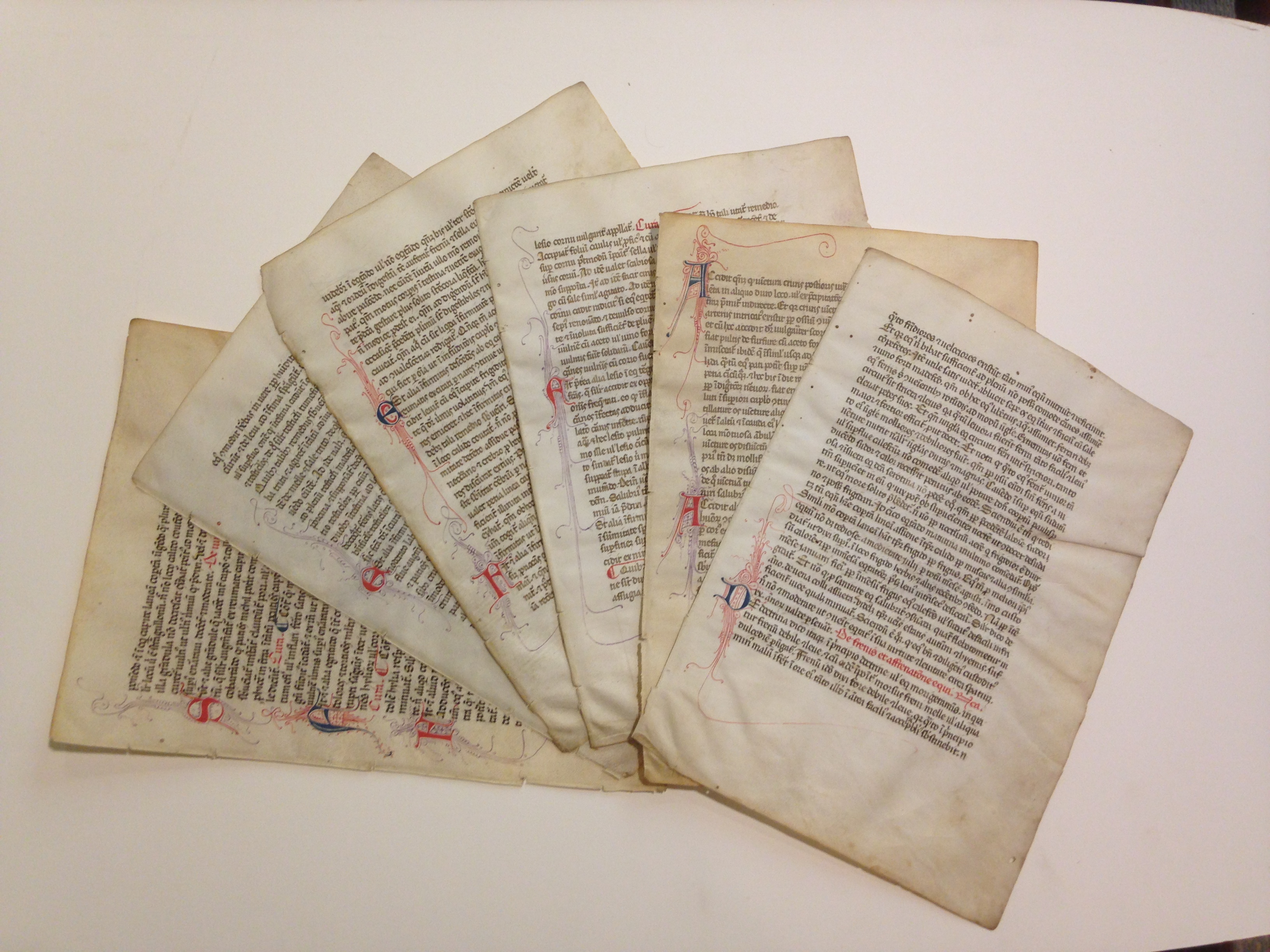
Disjecta membra: disbound, but not dispersed.

Disjecta membra: disbound, but not dispersed. Six recently acquired leaves from a mid-14th century manuscript of Giordano Ruffo’s De Medicina Equorum.  (MSS 15703)

It has long been, and remains, a frequent practice among book and print dealers to break up color plate books—especially imperfect copies—and sell the plates individually, with the text often discarded. Although this practice has effectively placed John James Audubon’s spectacular double elephant folio Birds of America on the endangered editions list, how else could one hope to possess one of its hand-colored engravings? Some might cast a kinder eye on the bookseller Gabriel Wells, who in 1921 broke up a modestly imperfect copy of the Gutenberg Bible, selling the nearly six hundred leaves individually or in sections, tipped into a specially published “leaf book.” Thanks to Wells, dozens of educational institutions worldwide have been able to acquire Gutenberg leaves for instruction and exhibition (U.Va. owns two at present). And by breaking up dozens of imperfect copies, some significant and valuable, U.Va.’s Rare Book School has created an extraordinary teaching resource for the history of book illustration and typography that has been used by several thousand students to date.

Perhaps nowhere has the practice of breaking been more fraught than in the realm of medieval manuscripts. In the last century alone, hundreds of medieval codices (especially Books of Hours) have been broken up, with the illuminated and more highly decorated leaves sold as works of art, some of the remaining leaves repurposed as specimens in paleography study collections (such as Special Collections’ Rosenthal Medieval Manuscript Collection), and others turned into collectibles or simply discarded.
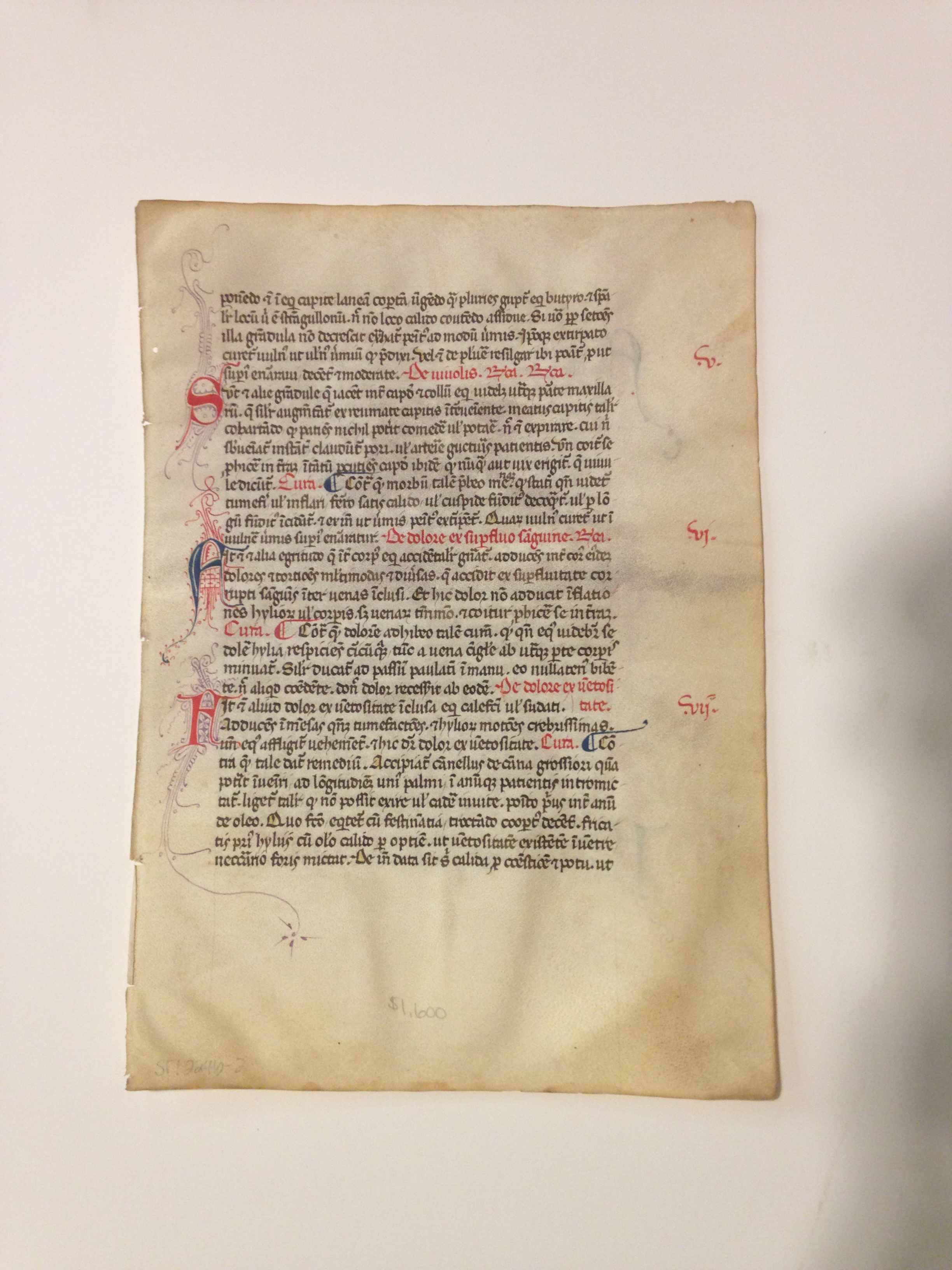
The manuscript leaves are finely rubricated in red and blue with incipits, paragraph marks, chapter numbers in the outer margin, and fine initial letters with penwork embellishments in red or purple.

The manuscript leaves are finely rubricated in red and blue with incipits, paragraph marks, chapter numbers in the outer margin, and fine initial letters with penwork extensions in red or purple.  (MSS 15703)

Consider Special Collections’ most recent medieval manuscript acquisition: six finely rubricated vellum leaves from a mid-14th century Latin manuscript, written in Italy, of Giordano Ruffo’s De Medicina Equorum, a treatise on the care of horses originally composed in the 13th century. Secular manuscripts on such topics from the medieval period are of great rarity—indeed, a survey conducted fifty years ago located only 21 manuscript copies of Ruffo’s text, all in European libraries—and we jumped at the opportunity to add these leaves to our Marion duPont Scott Sporting Collection.

Here is what we know about their provenance. In December 2011, 21 leaves from an imperfect copy of Ruffo’s manuscript were offered at a Sotheby’s auction in London. The leaves went unsold but were bought privately following the auction. This past fall we learned of the manuscript when an American bookseller’s catalog, in which eight of the leaves were offered, arrived in the mail. We promptly placed an order for all eight leaves, but two had already been sold. The bookseller subsequently reported that he had originally acquired 11 of the 21 leaves, three of which were sold to two different American research libraries, and two to private collectors in the U.S. and Europe, before U.Va. bought the remaining six. Eleven leaves, five new owners on two continents, with ten leaves still unaccounted for. U.Va.’s interest is primarily in the text, given our extensive holdings on the horse and equestrian sports, though the leaves will also be quite useful for research and instruction in the medieval book, paleography, &c. The other institutional and private collectors presumably were more interested in the leaves as paleographical specimens.
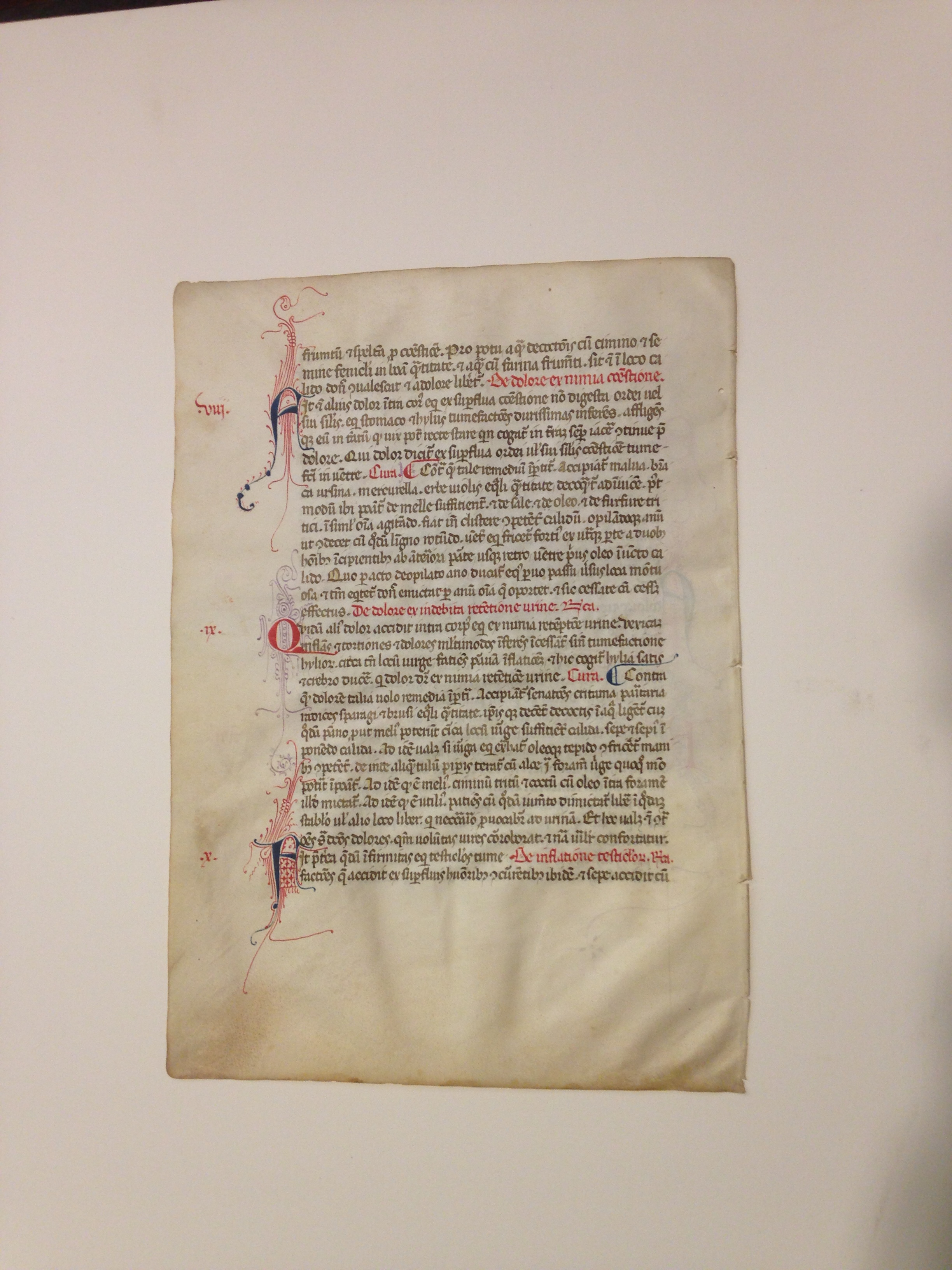
Verso of the manuscript leaf shown above. the chapters concern treatments for certain equine ailments.  (MSS 15703)

Verso of the manuscript leaf shown above. the chapters concern treatments for certain equine ailments. (MSS 15703)

All parties have benefited from these transactions: the booksellers made money, and the five new owners have acquired useful materials for their collections. But what of the manuscript itself? Any attempt to study the text and its relation to other exemplars has been seriously, perhaps fatally, compromised. (Fortunately, the bookseller kindly sent us study images of the five leaves we missed.) This is a chronic dilemma for any researcher using medieval manuscripts as primary sources. Various efforts are under way to reunite dispersed manuscripts virtually—Manuscriptlink (to which U.Va. intends to contribute its six Ruffo leaves), a project based at the University of South Carolina, is but one example. But these initiatives are unlikely to redress more than a small fraction of the losses already sustained, and still to come. And digital images—it bears constant repeating—can never supersede access to the original artifact.
Albemarle Garden Club Celebrates 100 Years of Service

On November 19, 2013, the Albert and Shirley Small Special Collections Library had the pleasure of hosting the Albemarle Garden Club’s 100-year anniversary celebration and business meeting. The Club’s mission is “to encourage the knowledge and love of gardening; to protect our environment through education and conservation; and to promote community development and restoration.” The library’s holdings include this illustrious group’s archival records, documenting its 100 years of service.

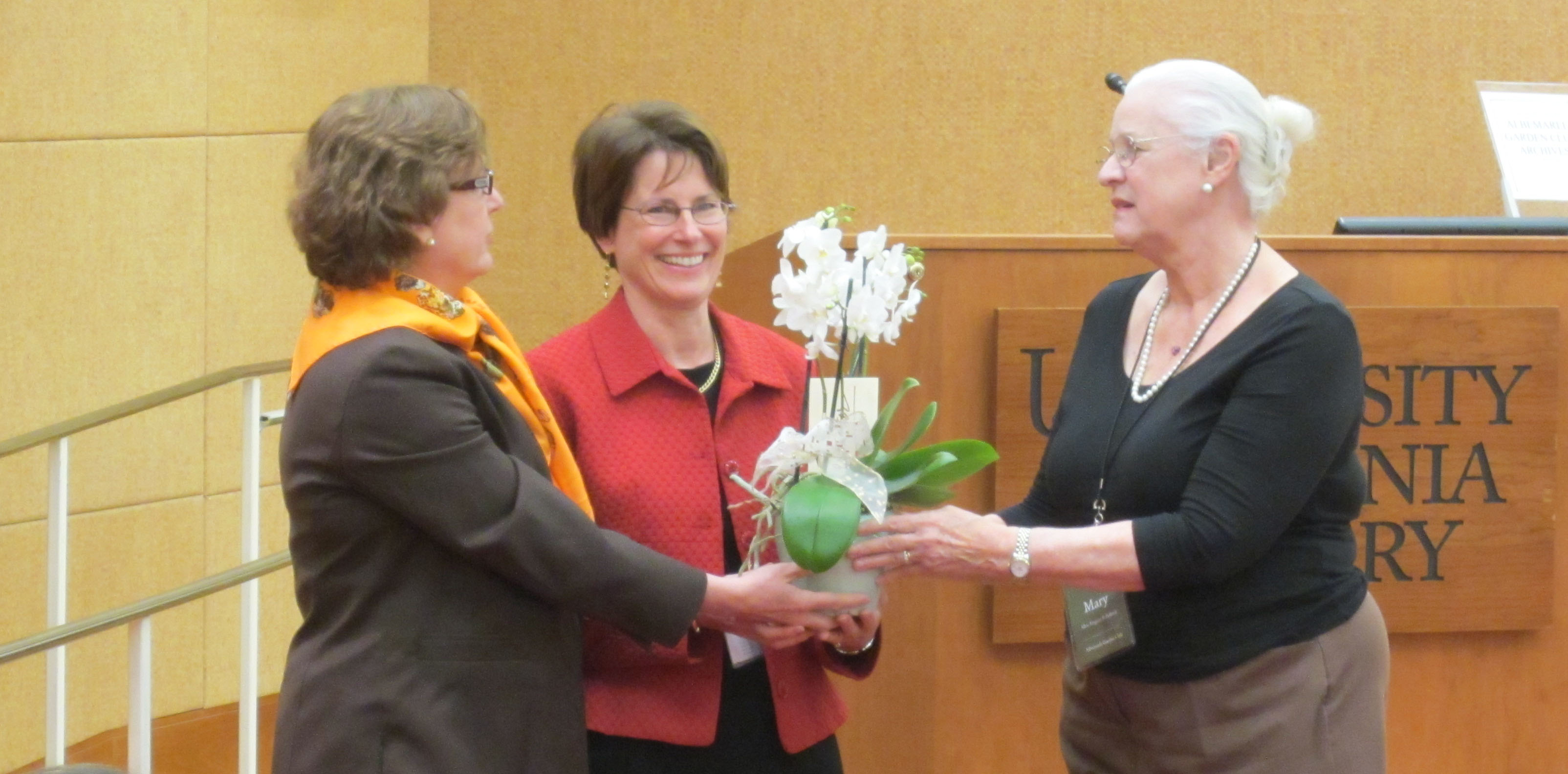
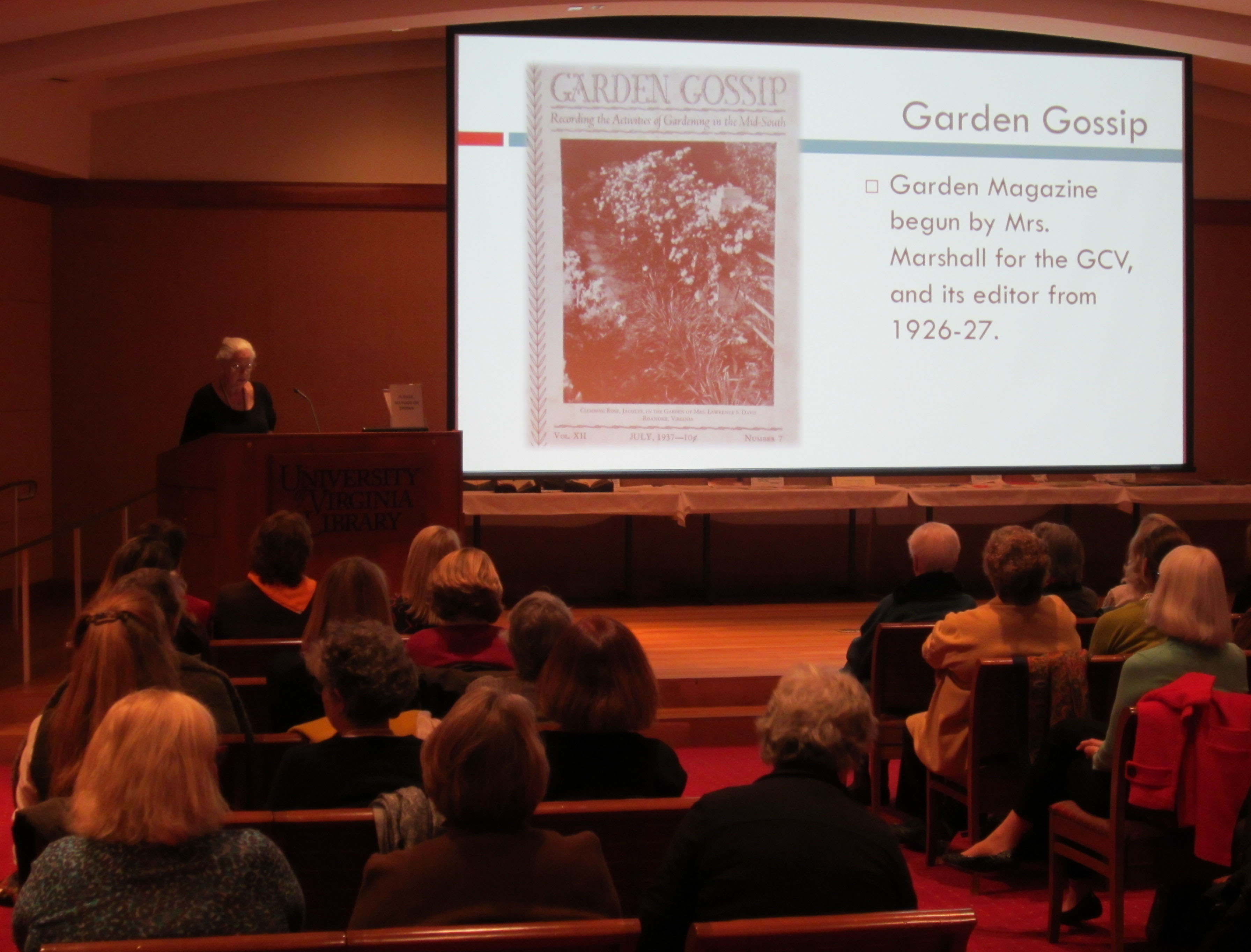
During the event, club members viewed a wonderful array of items documenting the club’s history, President Kim Cory presented the Special Collections Library with a check, and Historian Mary Pollock shared an amazing history of the organization.

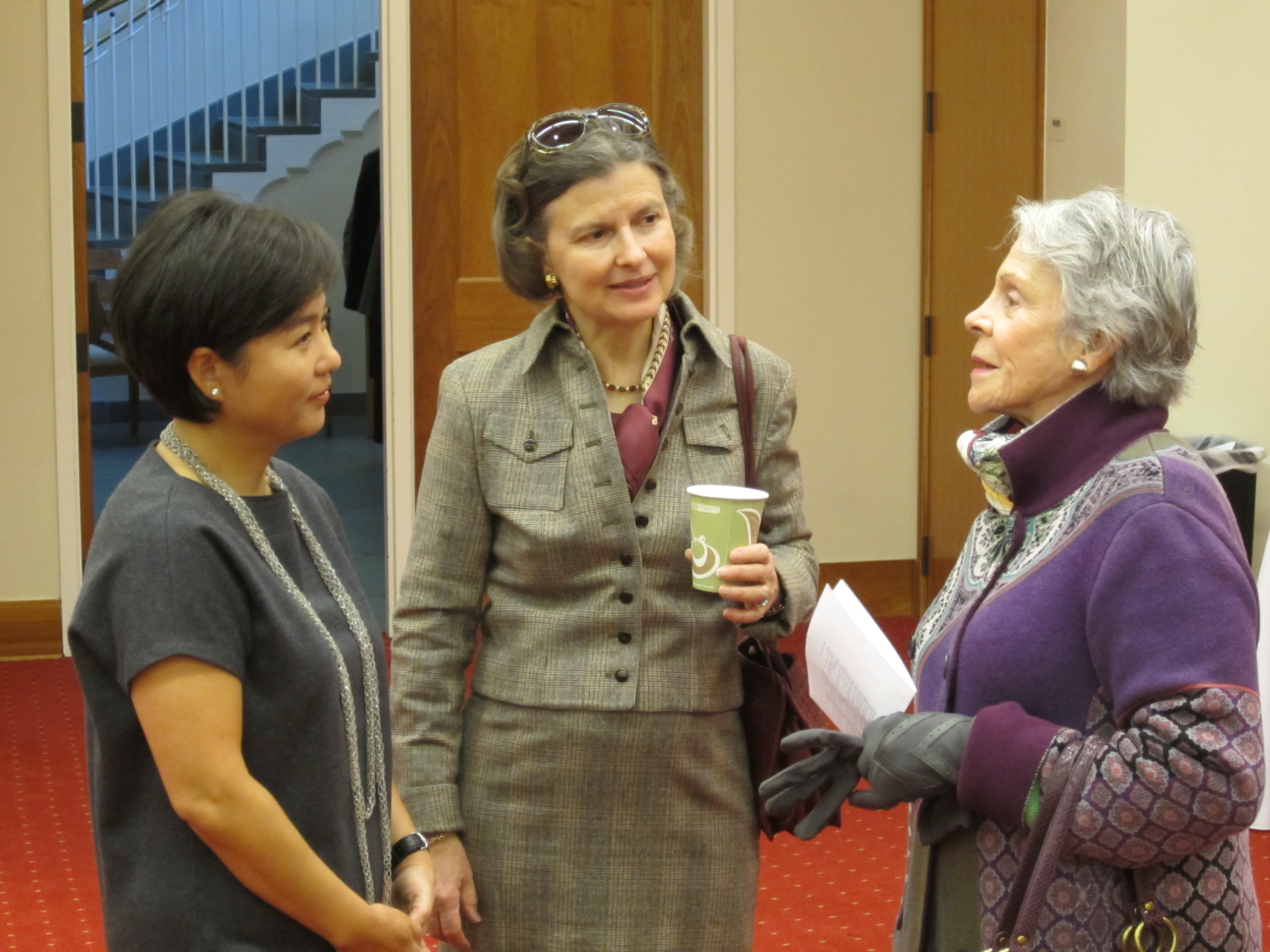
Albemarle Garden Club members catch up before the program begins. (Photograph by Petrina Jackson)

Albemarle Garden Club (AGC) members catch up before the program begins. (Photograph by Petrina Jackson)

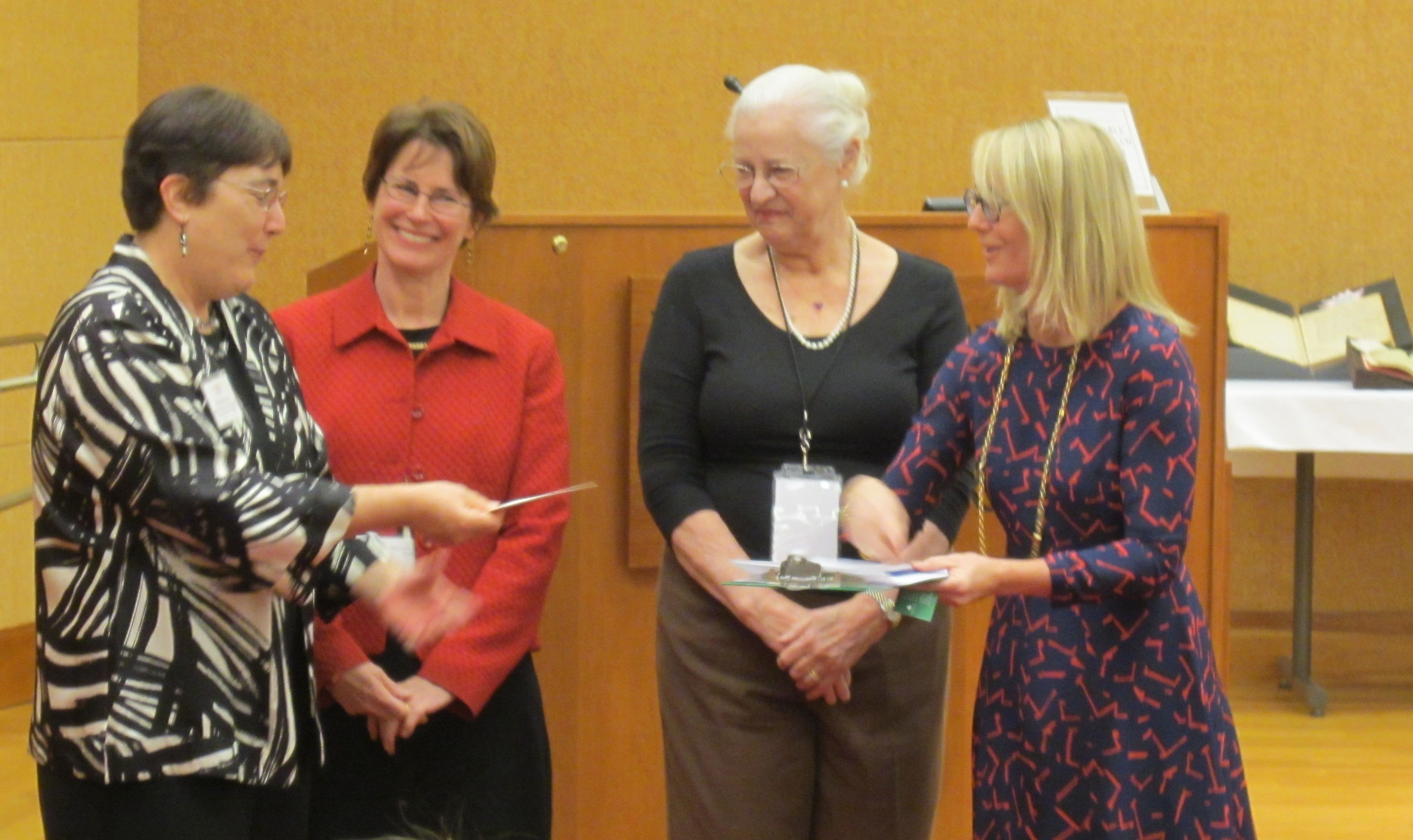
AGC President Kim Cody present Special Collections Director Nicole Bouche with a check as Head of Research Services Heather Riser and AGC Historian Mary Pollock look on. (Photograph by Petrina Jackson)

Albemarle Garden Club President Kim Cory present Special Collections Director Nicole Bouche with a check as Head of Reference and Researcher Services Heather Riser and AGC Historian Mary Pollock look on. (Photograph by Petrina Jackson)

AGC members present Special Collections Head of Researcher and Reference Services Heather Riser with a for her tireless work in assisting the club with their 100 Anniversary program. (Photograph by Petrina Jackson)

AGC members present Head of Reference and Researcher Services Heather Riser with a orchid for her tireless work in partnering with the Club on their 100th Anniversary program. (Photograph by Petrina Jackson)

AGC Historian gives a presentation of the club's 100-year history. (Photograph by Petrina Jackson)

AGC Historian Mary Pollock gives a presentation of the Club’s 100-year history. (Photograph by Petrina Jackson)

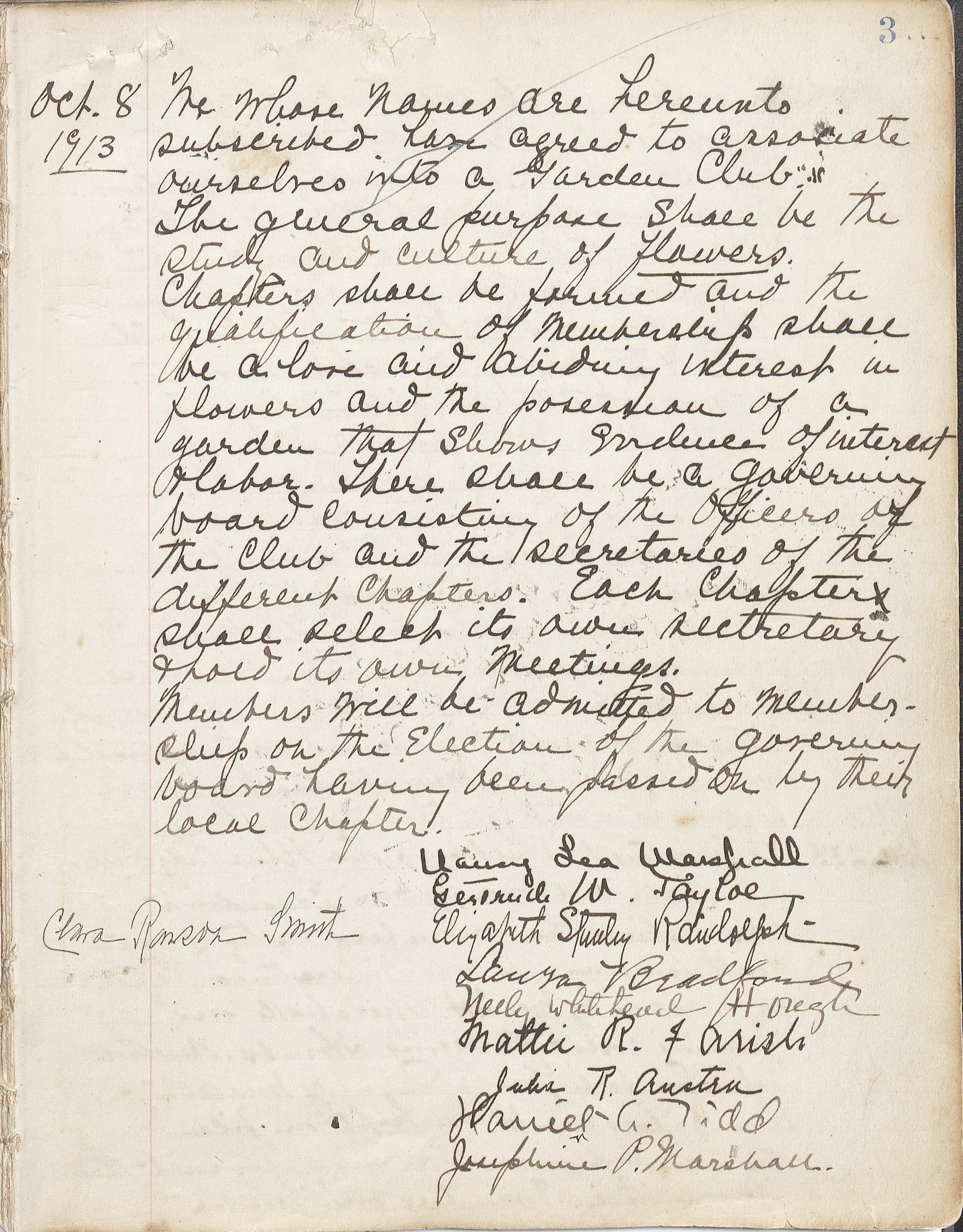
Special Collections acquired the Records of the Albemarle Garden Club in 1987.  The records include meeting minutes, reports, yearbooks, handbooks, programs and miscellaneous letters from Club members as well as histories of the Club written by Elizabeth B. Gamble and Mary Stuart Cocke Goodwin. In 2013, the library obtained a second group of records from the club, including year-by-year histories, obituaries, awards, calendars, photographs, and miscellaneous materials.

First entry of the first minute book of the Albemarle Garden Club, 1913. (MSS 5520. Image by Petrina Jackson)

First entry of the first minute book of the Albemarle Garden Club, 1913. (MSS 5520. Image by Petrina Jackson)

Albemarle Garden Club year book, 193.  The year book features the club's programs, members, and other activities. (MSS 5520. Image by Petrina Jackson)

Albemarle Garden Club year book, 1934-1953. The year book features the Club’s programs, members, and other activities. (MSS 5520. Image by Petrina Jackson)

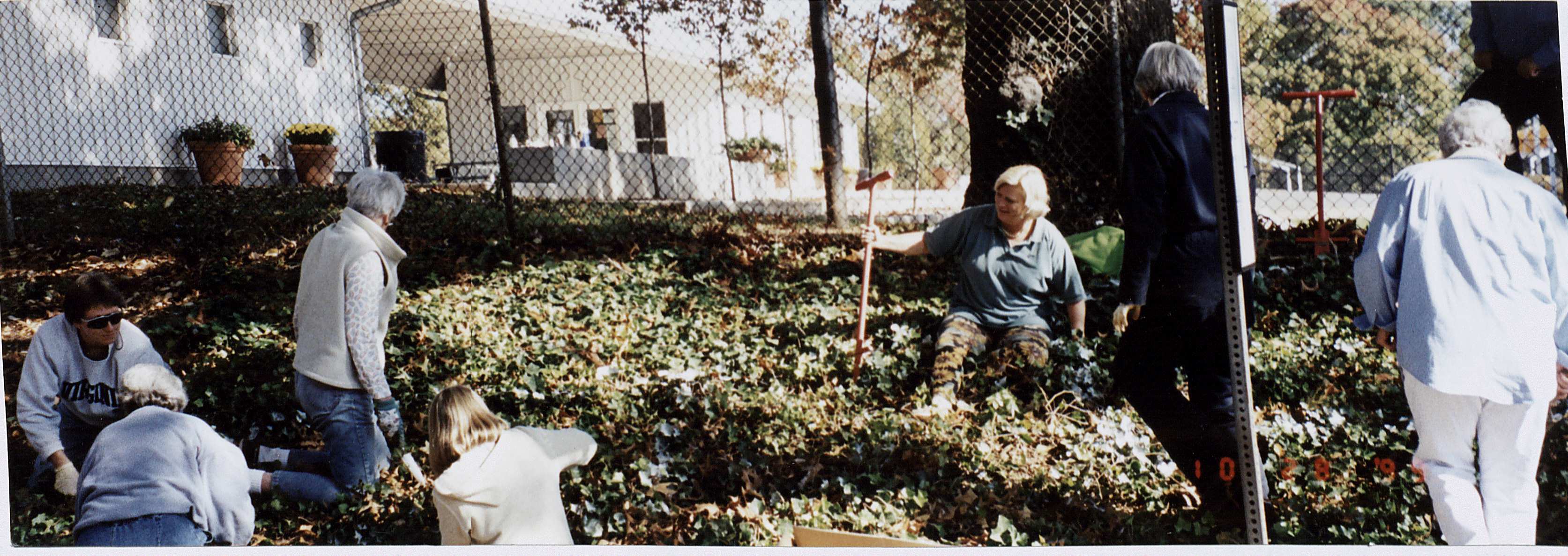
AGC members at work at , 1999. (Image by Petrina Jackson)

AGC members at work at Booker T. Washington Park, Charlottesville, October 1999. (MSS 15320. Image by Petrina Jackson)

We celebrate all of the great work the Albemarle Garden Club is doing in the community and look forward to its continued partnership with the Library!

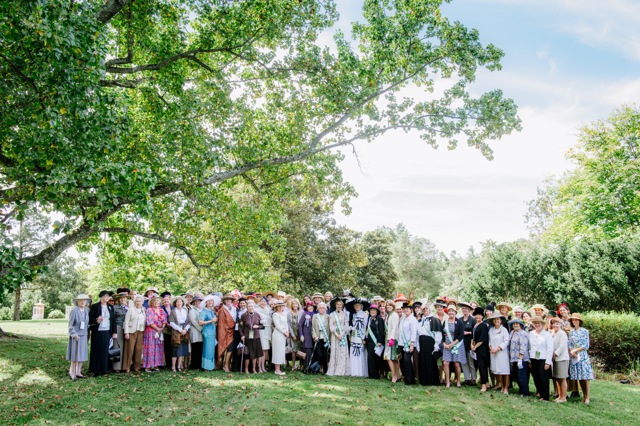
Albemarle Garden Club, ()

Photograph of Albemarle Garden Club by Jen Fariello, taken at Morven on September 18, 2013. Morven is the birthplace of the Albemarle Garden Club and the site of the first meeting of the Centennial celebration.

ABCs of Special Collections: T is for…

Today’s alphabetical installation brings you the letter

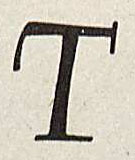
The letter "T" written by Oldrich Menhart from Italic Handwriting by Tom Gourdie, 1955. (Z43 .G68 1955. Image by Petrina Jackson)

The letter “T” written by Oldrich Menhart from Italic Handwriting by Tom Gourdie, 1955. (Z43 .G68 1955. Gift of Willis W. Tompkins. Image by Petrina Jackson)

T is for William S. Tallman

William Staples Tallman (1906-1997) was one of two engineers who managed the construction of Mount Rushmore in South Dakota. Hired by sculptor Gutzon Borglum in 1929, he served as superintendent of construction from 1930 to 1935.  Tallman had also assisted Borglum on the North Carolina Monument at Gettysburg National Military Park; he also served as model for that monument’s lead figure. For the balance of his career, he worked as a potter and sculptor and in technical ceramics manufacturing. Our large collection of his papers includes extensive documentation of his work at Mount Rushmore.

Contributed by Molly Schwartzburg, Curator

ajd

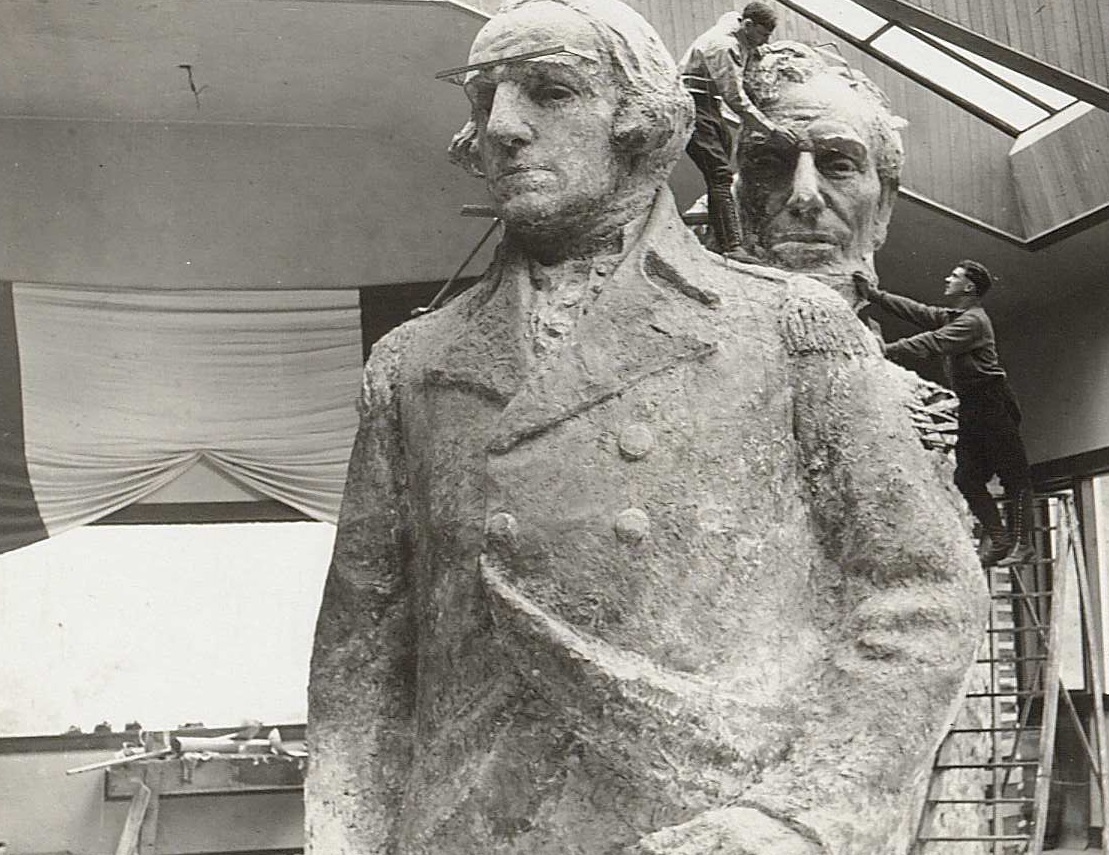
A photograph of William Tallman and Ivan Houser, an assistant sculptor for Gutzon Borglum,  studying a scale model of Abraham Lincoln produced in preparation for the monument’s construction (ca. 1927, photographer not identified). (MSS 12129. Image by Molly Schwartzburg.)

dfg

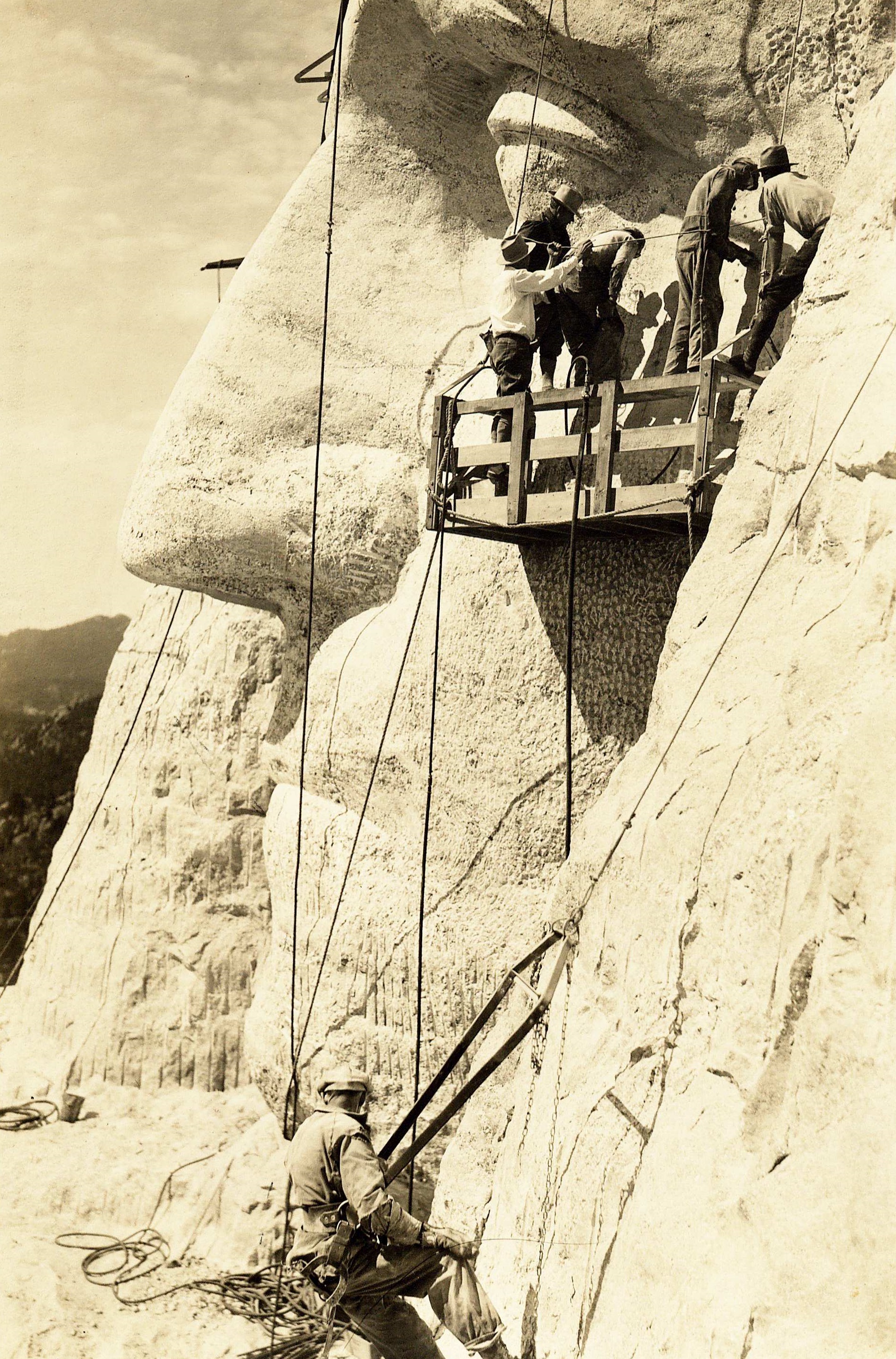
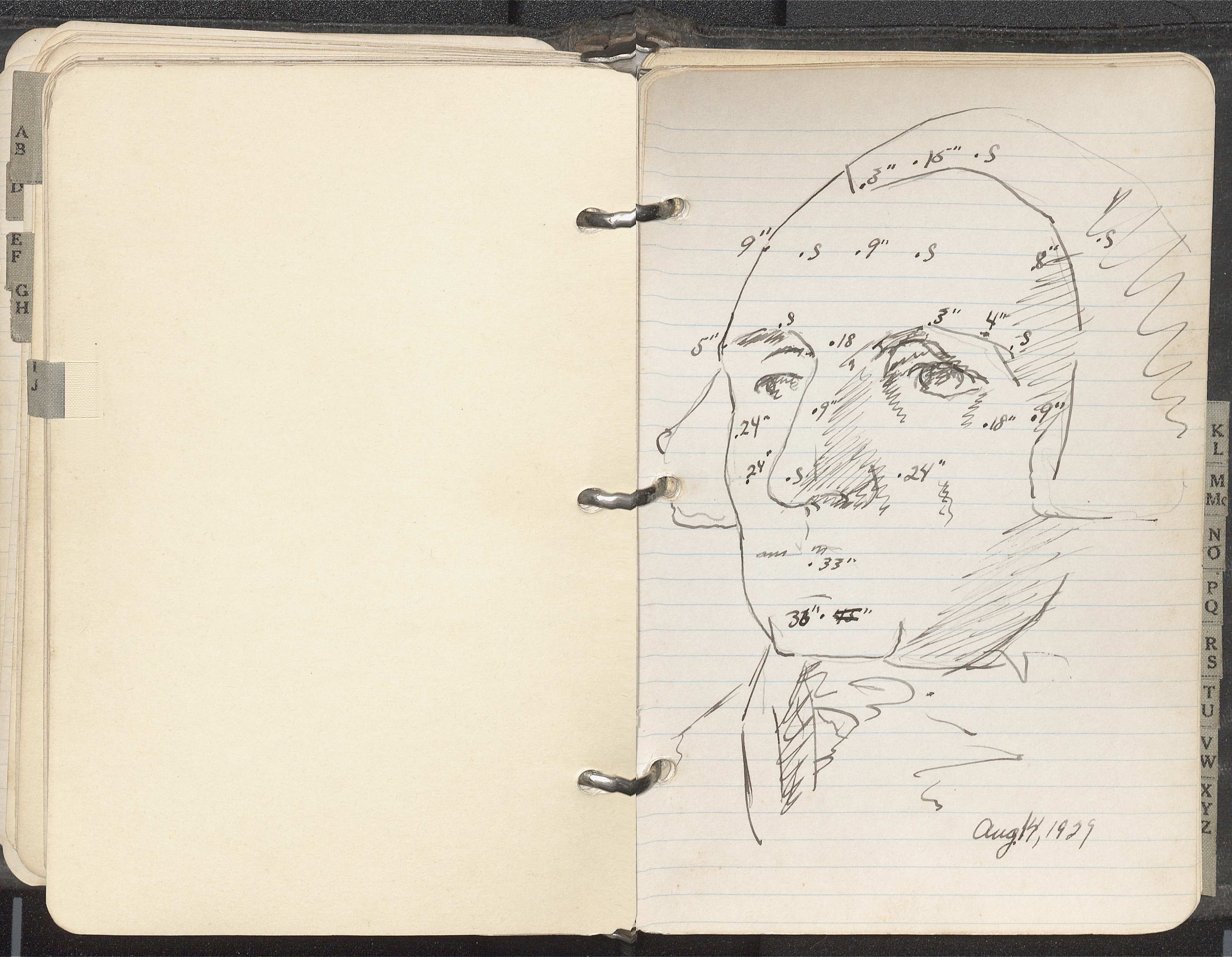
This photograph shows, from left to right, assistant sculptor Hugo Villa, sculptor Gutzon Borglum, two unidentified workers, and engineer William Tallman.  A note on the back of the photograph describes the image as follows: “Inspection of work according to ‘points’ near the eye’” (ca. 1929-1930, photographer not identified). (MSS 12129. Image by Molly Schwartzburg.)

sag

A drawing of the George Washington sculpture from a notebook kept by William S. Tallman from 1929-1932. The notebook contains diary entries, correspondence, lists of supplies, measurements, and diagrams from the Mount Rushmore project. (MSS 12129. Image by Molly Schwartzburg.)
T is for Celia Thaxter

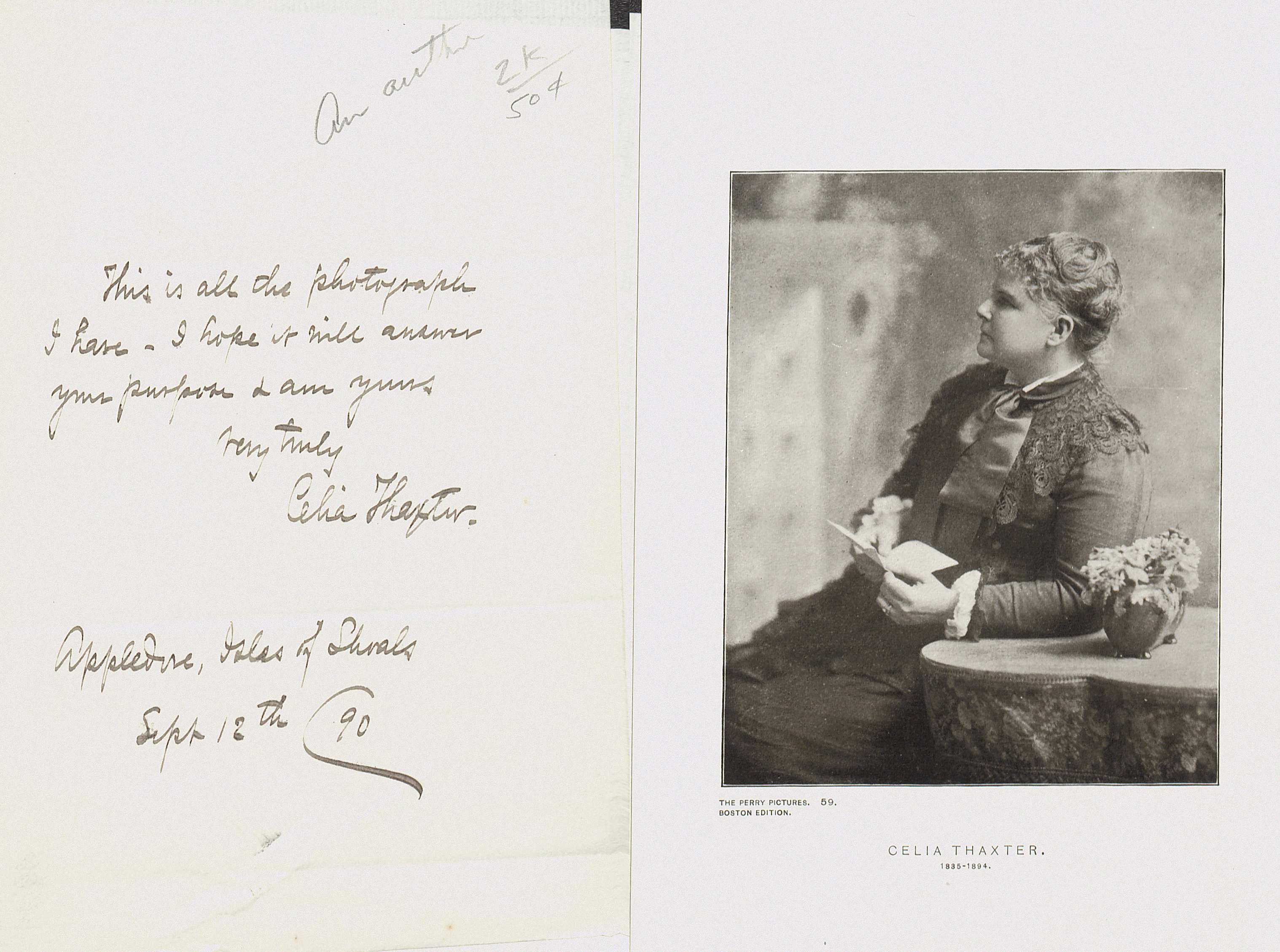
Celia Thaxter, the nineteenth century American poet and story writer, grew up on and around the coast of New Hampshire. In her middle age, she became hostess of her father’s hotel on Appledore Island, and hosted many of the important writers of her time, including Ralph Waldo Emerson, John Whittier, Sara Orne Jewett, and Nathaniel Hawthorne. They in turn welcomed her into Boston’s literary world as a favored poet. A search of our online catalog shows 28 records relating to Celia Thaxter.

Contributed by George Riser, Collections and Instruction Assistant

(PS3012 .D7 1879. Image by Petrina Jackson)

Cover of the first printing of Drift Weed, 1879. (PS3012 .D7 1879. Image by Petrina Jackson)

(Image by Petrina Jackson)

An autographed note and photograph of Celia Thaxter, 1890. (MSS 6994-d. Clifton Waller Barrett Library of American Literature. Image of Petrina Jackson)

T is for the Treaty of Guadalupe-Hidalgo 

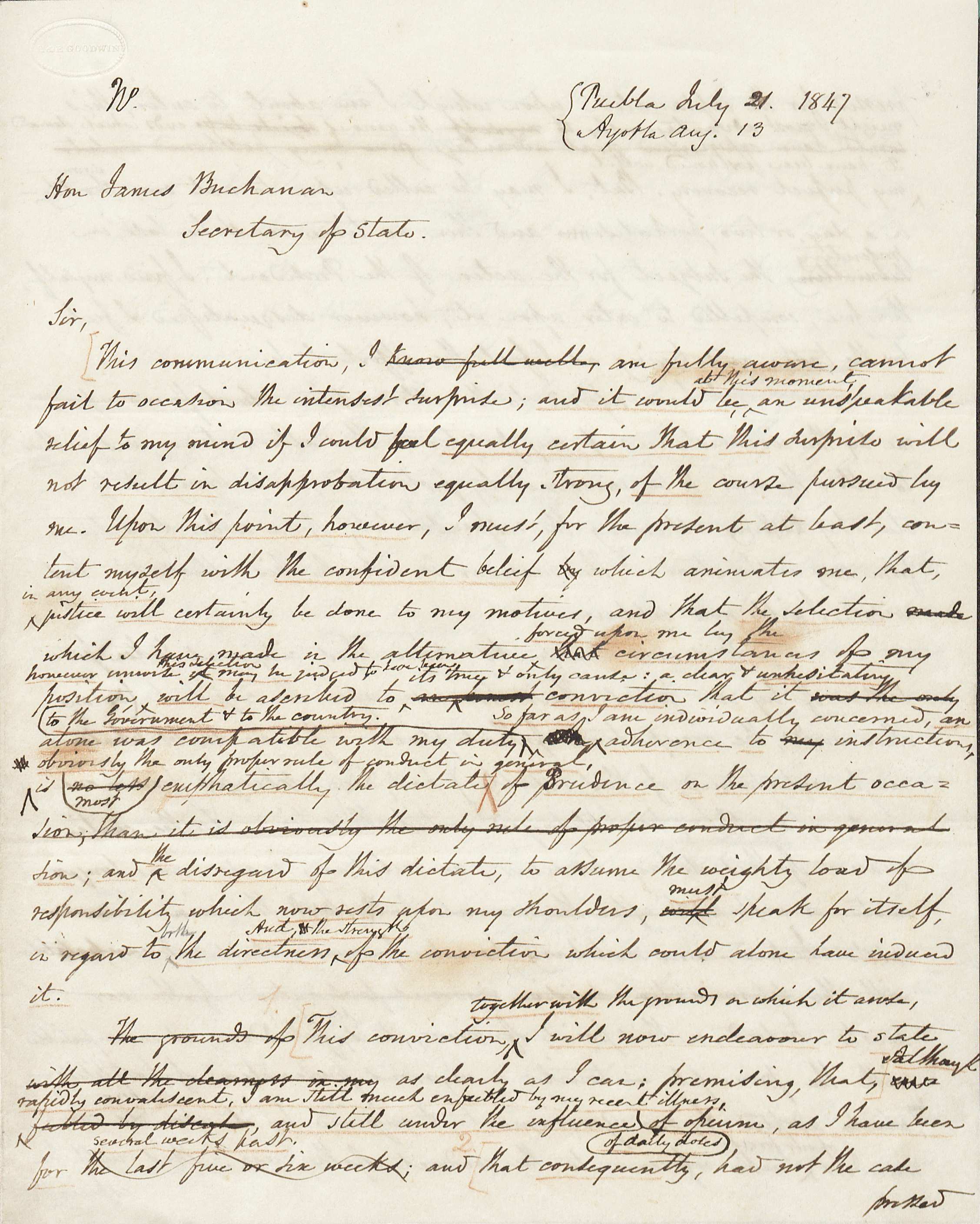
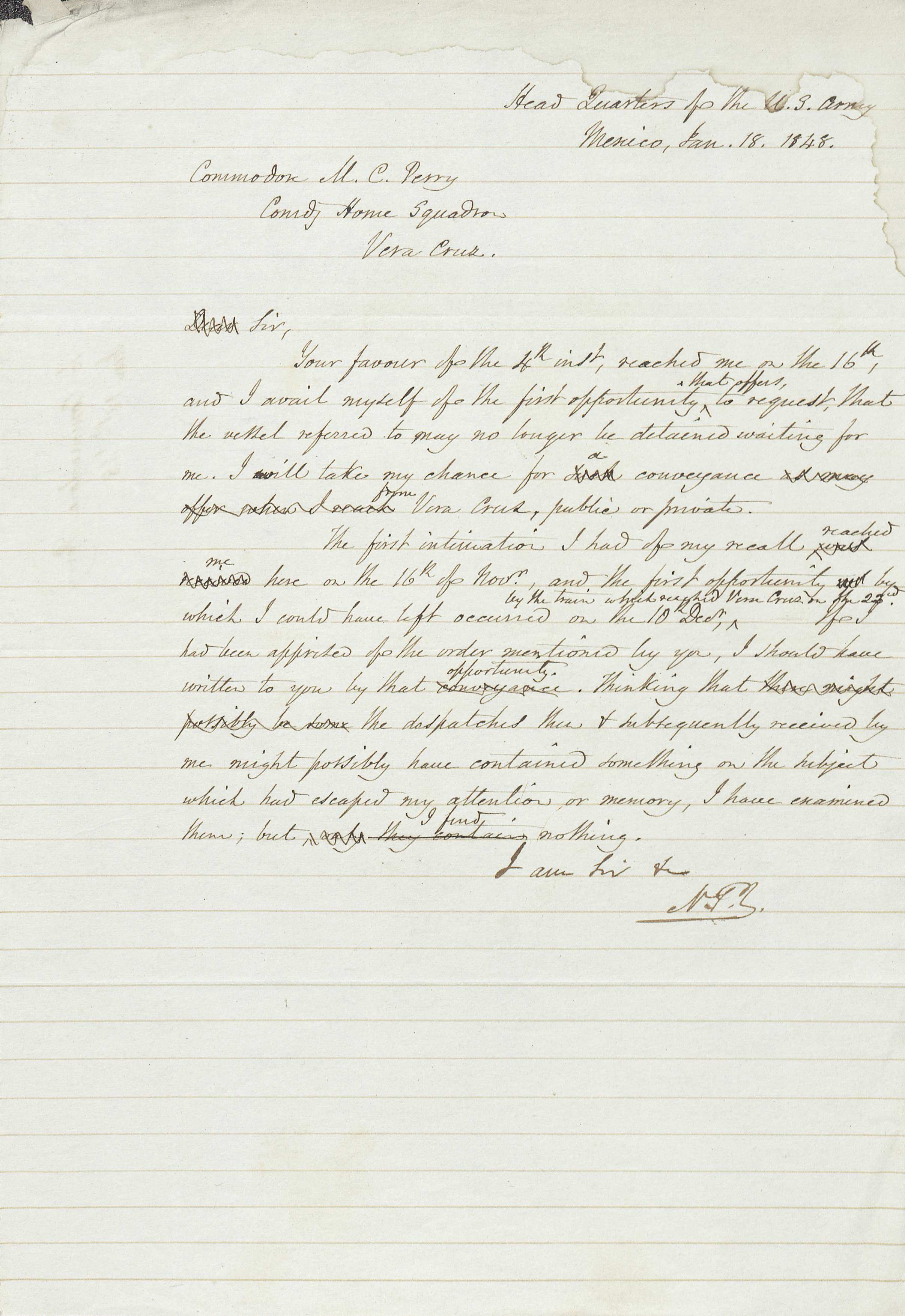
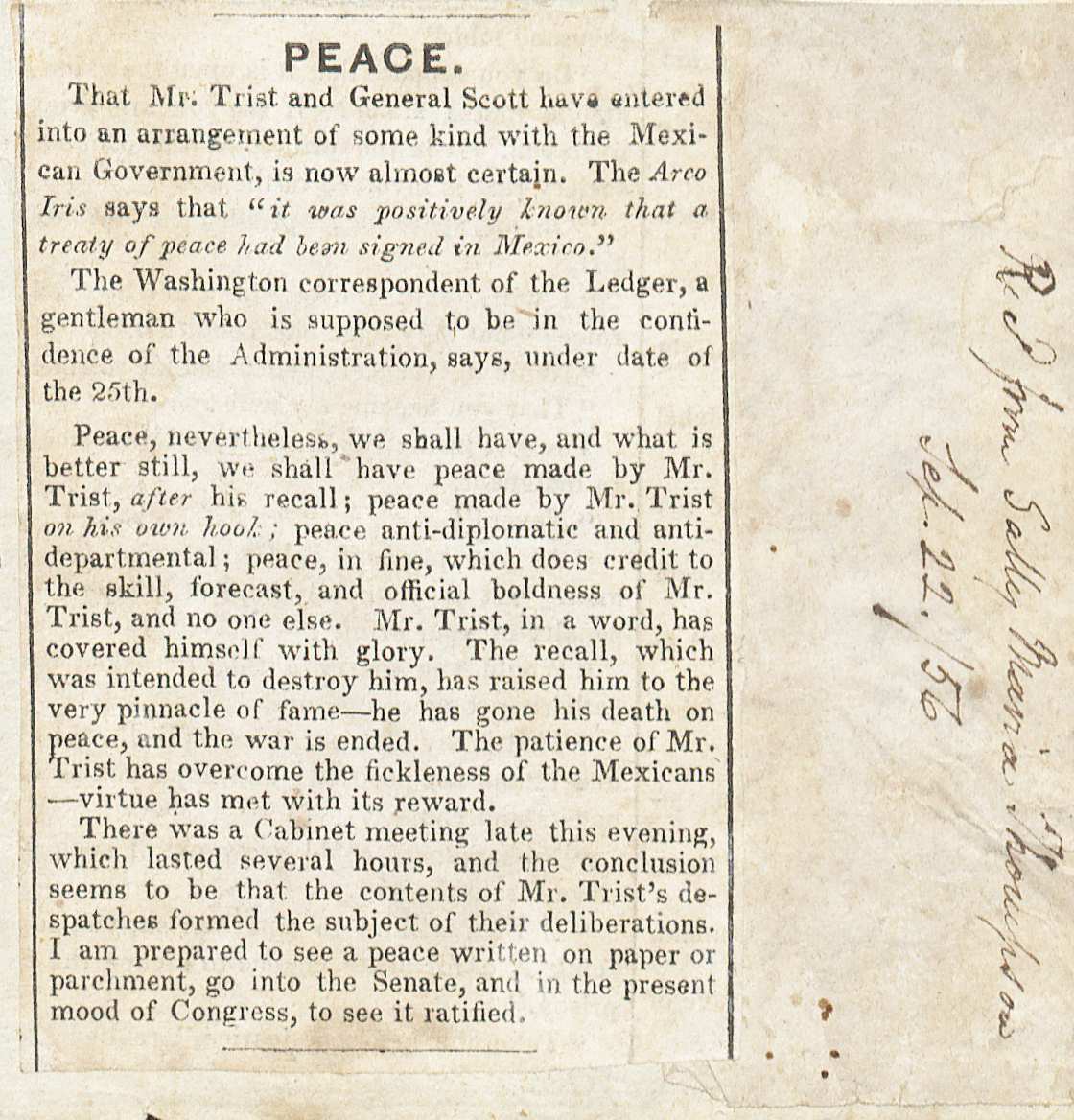
Nicholas Philip Trist, Chief State Department clerk (and former secretary to Andrew Jackson and husband of Jefferson’s granddaughter Virginia), was appointed by President James K. Polk to negotiate a treaty to end the war with Mexico. While in Mexico, Trist ignored a recall from Polk and continued negotiations with the Mexican peace commissioners. The treaty was concluded at the city of Guadalupe-Hidalgo on February 2, 1848. On his return to the United States, Trist was dismissed from the State Department for insubordination and the government refused to reimburse his expenses until 1871. The terms of the treaty ceded an immense amount of Mexican territory to the United States including present-day California, Arizona, and New Mexico and parts of Utah, Nevada, and Colorado.

Contributed by Edward Gaynor, Head of Description and Virginiana and University Archives Specialist

Letter draft from Nicholas Trist to James Buchanan, 1847 (Image by Petrina Jackson)

Letter draft from Nicholas Trist to James Buchanan, 1847 (MSS 5096-a. Deposit of the Thomas Jefferson Foundation. Image by Petrina Jackson)

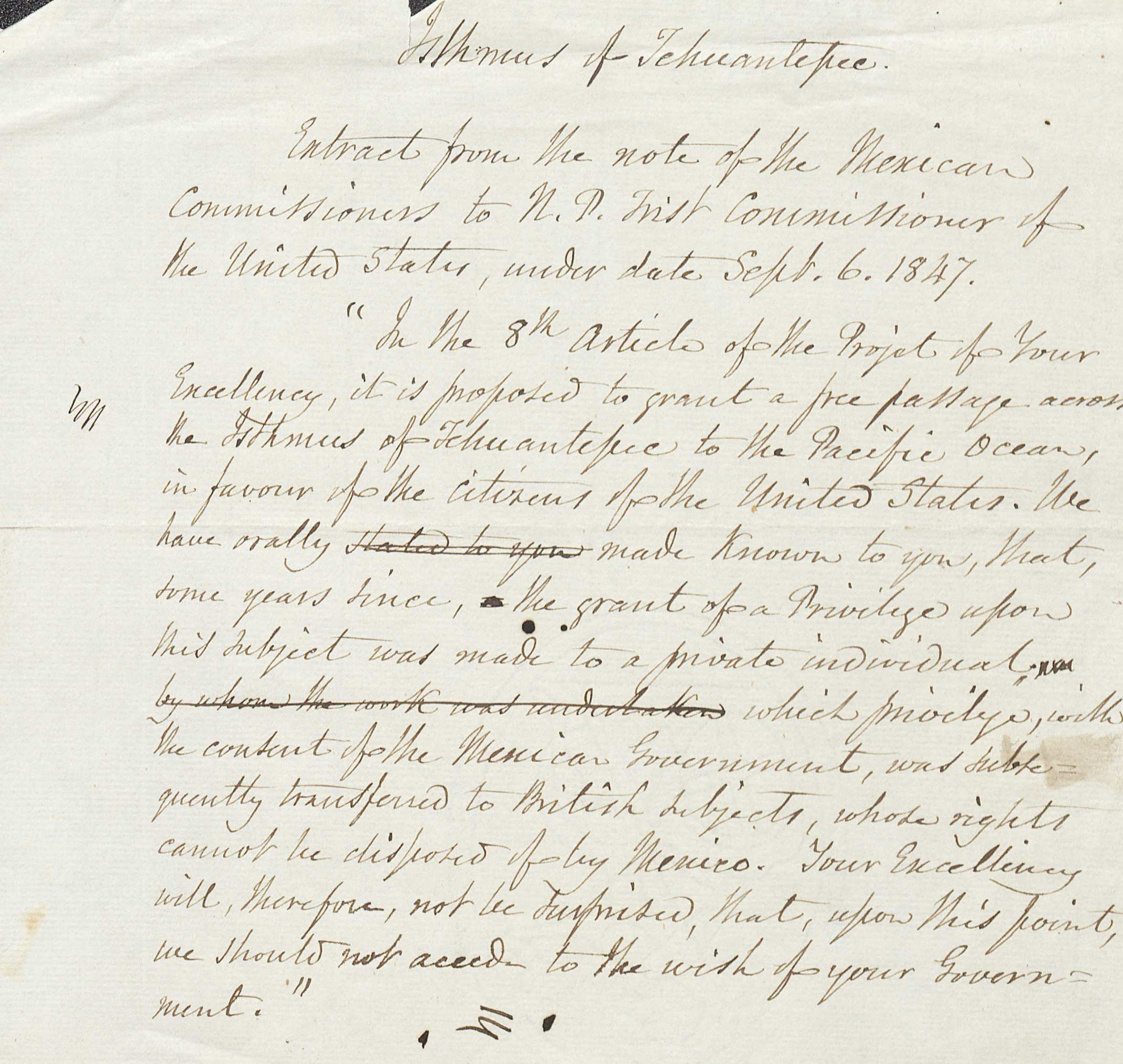
Extract from the note of the Mexican Commissioners, September 6, 1847. ()

Extract from the note of the Mexican Commissioners, September 6, 1847. (MSS 5096-a. Deposit of the Thomas Jefferson Foundation. Image by Petrina Jackson)

Letter from Nicholas Trist to Commodore M. C. Perry, January 18, 1848.

Letter from Nicholas Trist to Commodore M. C. Perry, January 18, 1848. (MSS 5096-a. Deposit of the Thomas Jefferson Foundation. Image by Petrina Jackson)

Newspaper clipping on the Mexican War peace settlement ()

Newspaper clipping on the Mexican War peace settlement (MSS 5096-a. Deposit of the Thomas Jefferson Foundation. Image by Petrina Jackson)

That concludes the the letter “T.”  We can’t wait to show you the fantastic collection highlights when we feature “U”.

On View Now: We Are U.Va.

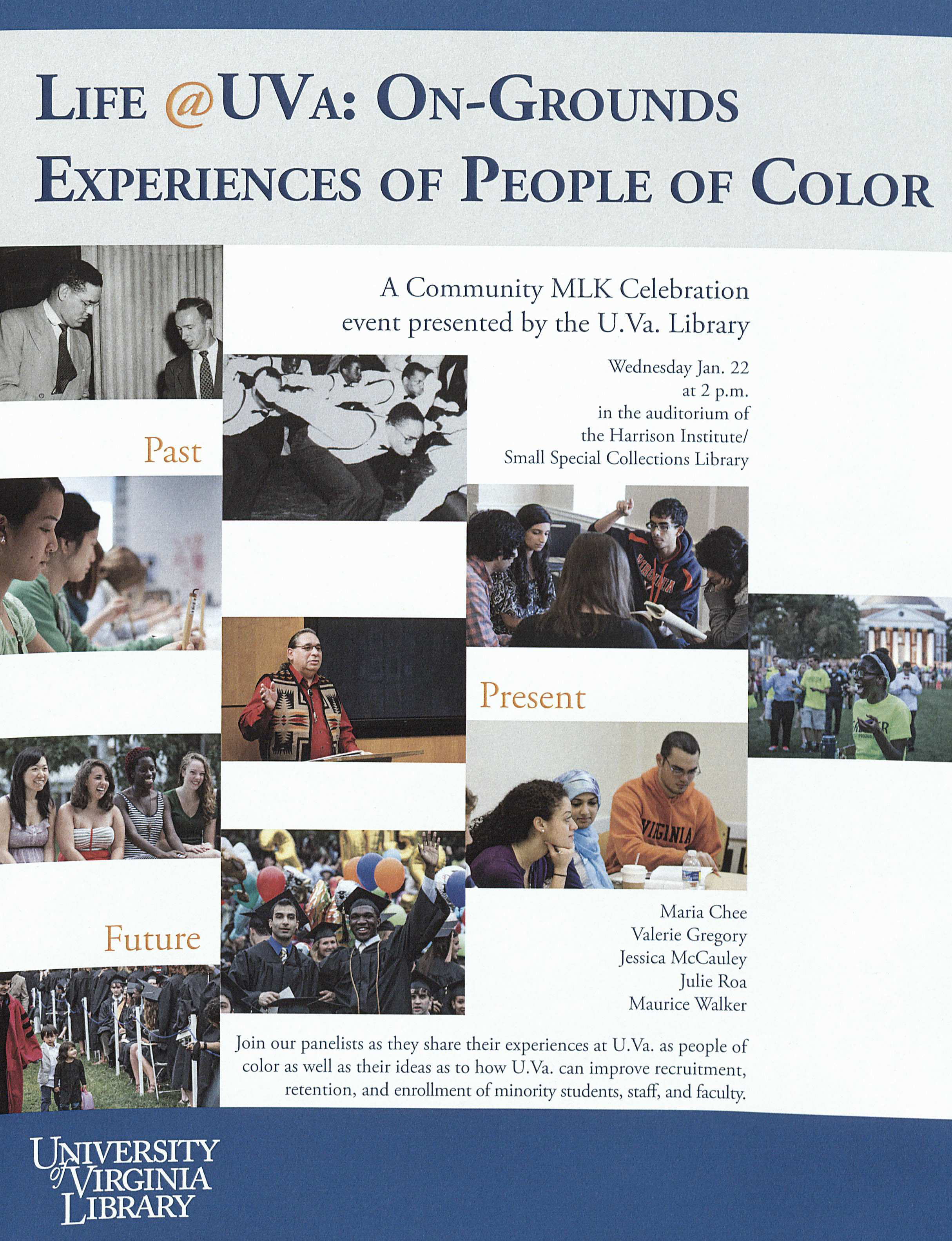
On January 22nd, the University Library hosted “Life@ UVA: On-Grounds Experiences of People of Color,” a panel discussion to commemorate the life and work of Dr. Martin Luther King, Jr. The panelists described their experiences at U.Va. from the perspective of students, non-faculty and faculty employees.

Life@U.Va. On-Grounds event flyer, January 2014. (Image by Petrina Jackson).

Life@U.Va. event flyer, January 2014. (Image by Petrina Jackson).

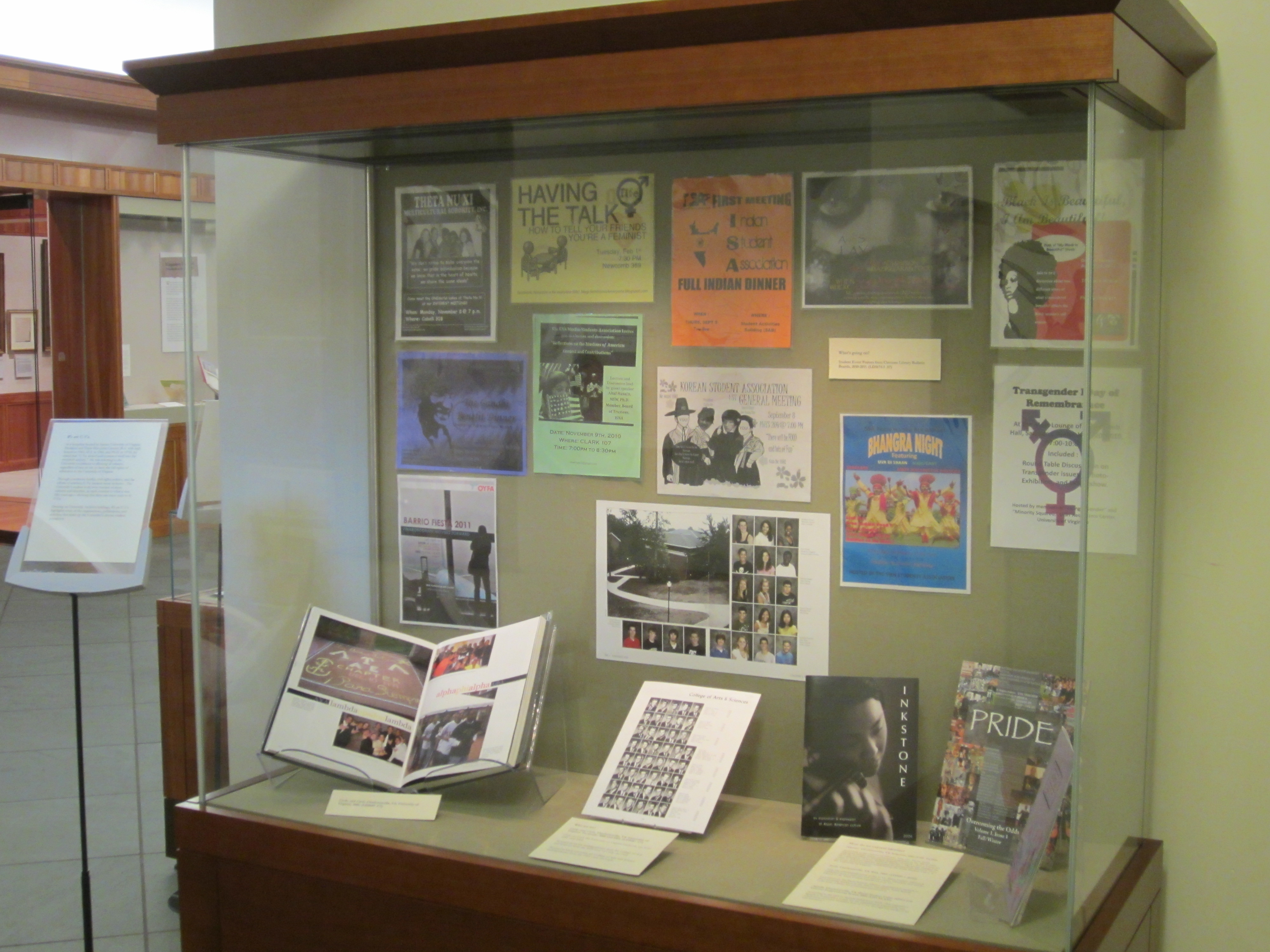
In conjunction with the panel discussion, the Albert and Shirley Small Special Collections Library has on view, the mini exhibition, We are U.Va.

Mini-exhibition We Are U.Va., January 2014. (Photograph by Petrina Jackson)

Mini-exhibition, We Are U.Va., January 2014. (Photograph by Petrina Jackson)

Drawing on University Archives holdings, this exhibition features some of the organizations, publications, and activities of University’s diverse student population.

Undergraduates from the College of Arts and Sciences from the 2008 issue of Corks and Curls. (LD5687 .C7 2008. Image by Petrina Jackson)

Undergraduates from the College of Arts and Sciences from the 2008 issue of Corks and Curls. (LD5687 .C7 2008. Image by Petrina Jackson)

We are U.Va. is on display on the first floor lobby of the Small Special Collections Library/Harrison Institute from Tuesday, January 21st until Friday, January 31st.

We hope you come and see it!

This Just In: Architectural Publications

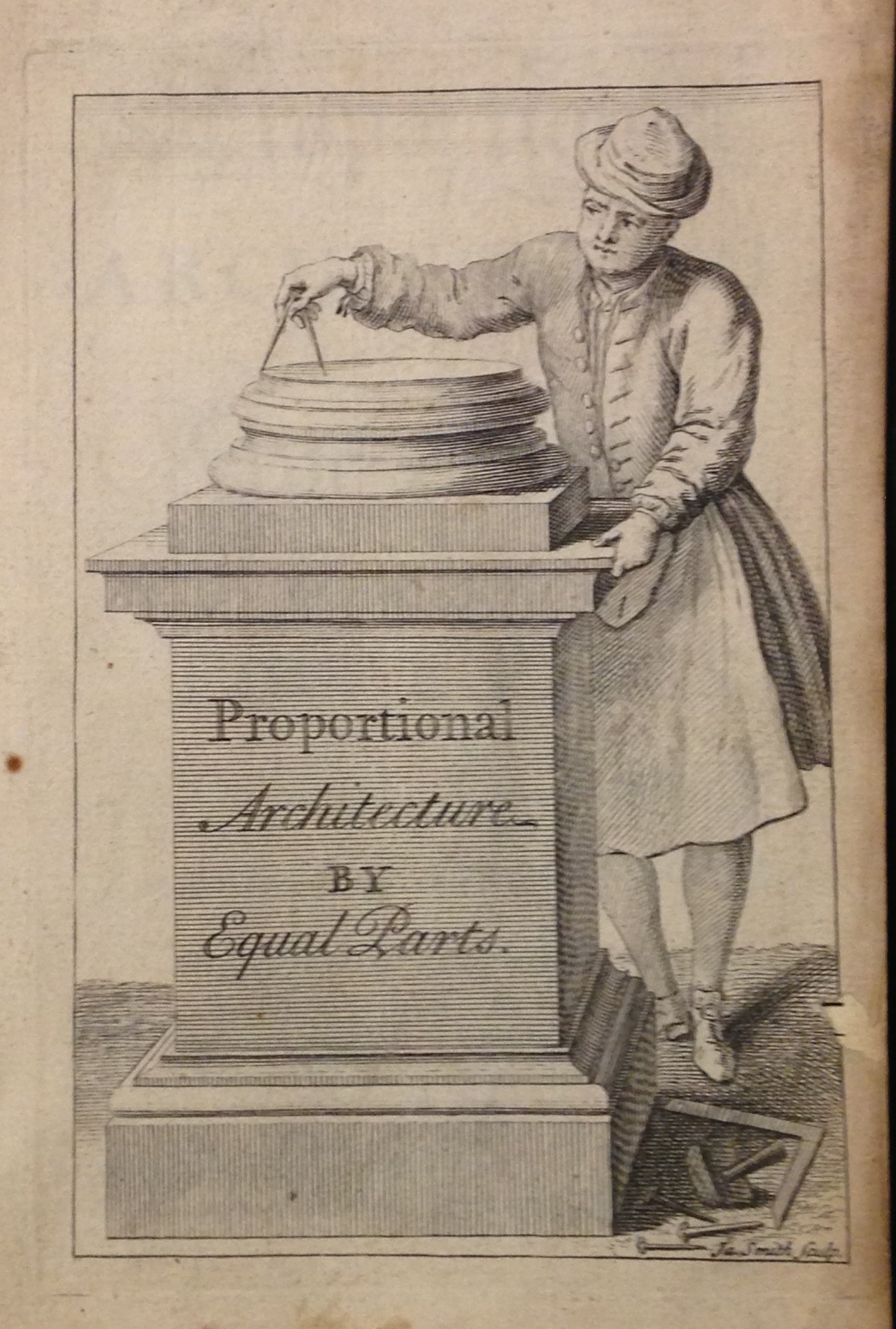
Frontispiece to William Robinson's Proportional Architecture; or, the Five Orders. London, 1736.  (NA2810 .R65 1736)

Frontispiece to William Robinson’s Proportional Architecture; or, the Five Orders. London, 1736. (NA2810 .R65 1736)

U.Va. has long been famous, not only for its Thomas Jefferson-designed Academical Village, but also for its highly ranked academic programs in architecture, architectural history, and landscape architecture. Supporting these programs has been a priority for the U.Va. Libraries, and strong collections are to be found in the Fiske Kimball Fine Arts Library as well as under Grounds in the Albert and Shirley Small Special Collections Library. Following is a sampling of our recent acquisitions in the field of architecture.

Given the thousands of books amassed by Thomas Jefferson for his personal libraries, it has never been practicable for U.Va. to replicate these collections. Since 1956, however, we have endeavored to reconstitute a small subset: the fine arts books that Jefferson selected for the original U.Va. Library collection (only 17 of which survived the 1895 Rotunda fire), plus the architectural titles found in Jefferson’s personal libraries. These total 130 in all, as fully described in William B. O’Neal’s checklist, Jefferson’s Fine Arts Library (Charlottesville: University Press of Virginia, 1976). With substantial support from the Thomas Jefferson Foundation and other sources, the U.Va. Library has managed to acquire copies of no fewer than 112 of the 130 titles— only 18 to go! (For the curious: our desiderata are O’Neal numbers 9, 11, 12, 16, 17, 31, 41, 43a, 50, 61a, 62, 65, 70, 74, 77, 79, 103, and 125b.)

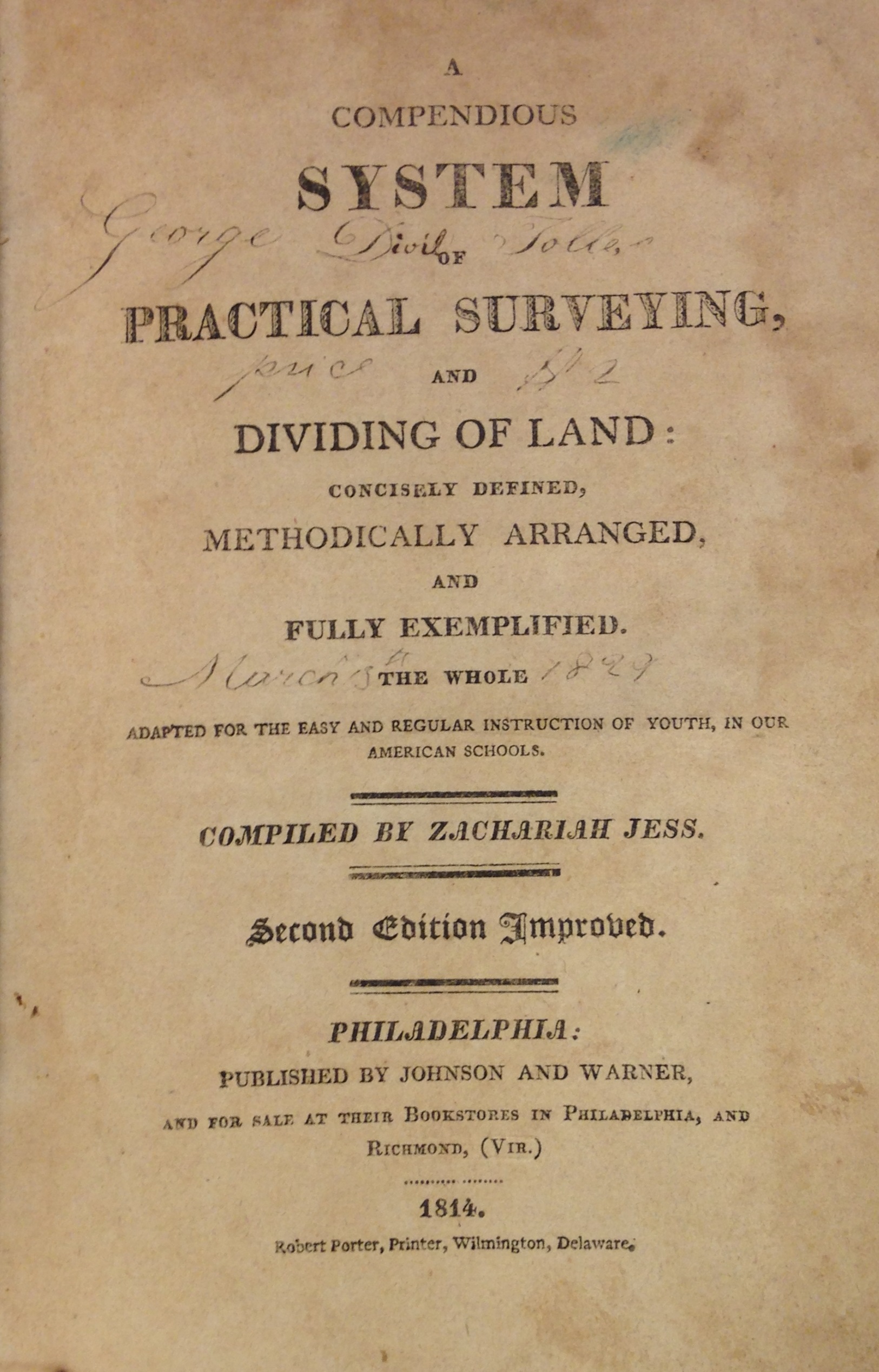
Title page, with 1829 purchase inscription, of Zachariah Jess's Compendious System of Practical Surveying. Philadelphia, 1814.  (TA544 .J59)

Title page, with 1829 purchase inscription, of Zachariah Jess’s Compendious System of Practical Surveying. Philadelphia, 1814. (TA544 .J59)

From time to time we search the Internet for available copies of O’Neal desiderata, and last month we were able to tick no. 57—the Philadelphia, 1814 edition of Zachariah Jess’s A Compendious System of Practical Surveying—off our list.  A copy of this edition was included in Jefferson’s final personal library, formed following the 1815 sale of his earlier library to the United States government. We know this because Jefferson’s remaining books were sold at auction, in Washington, D.C., in late February and early March of 1829; the printed auction catalog lists a copy of Jess as lot 414. An Internet search revealed a nice, reasonably priced copy being offered for sale by, of all places, a Nevada antiques shop. Intriguingly, the book was described as bearing a March 13, 1829 purchase inscription—could this possibly have been Jefferson’s own, untraced copy?! The purchaser, George D. Tolle, had indeed lived near Washington, D.C. in the mid-1820s, but further investigation revealed that he had relocated to Kentucky by 1829. A Jefferson provenance, alas, is unlikely.

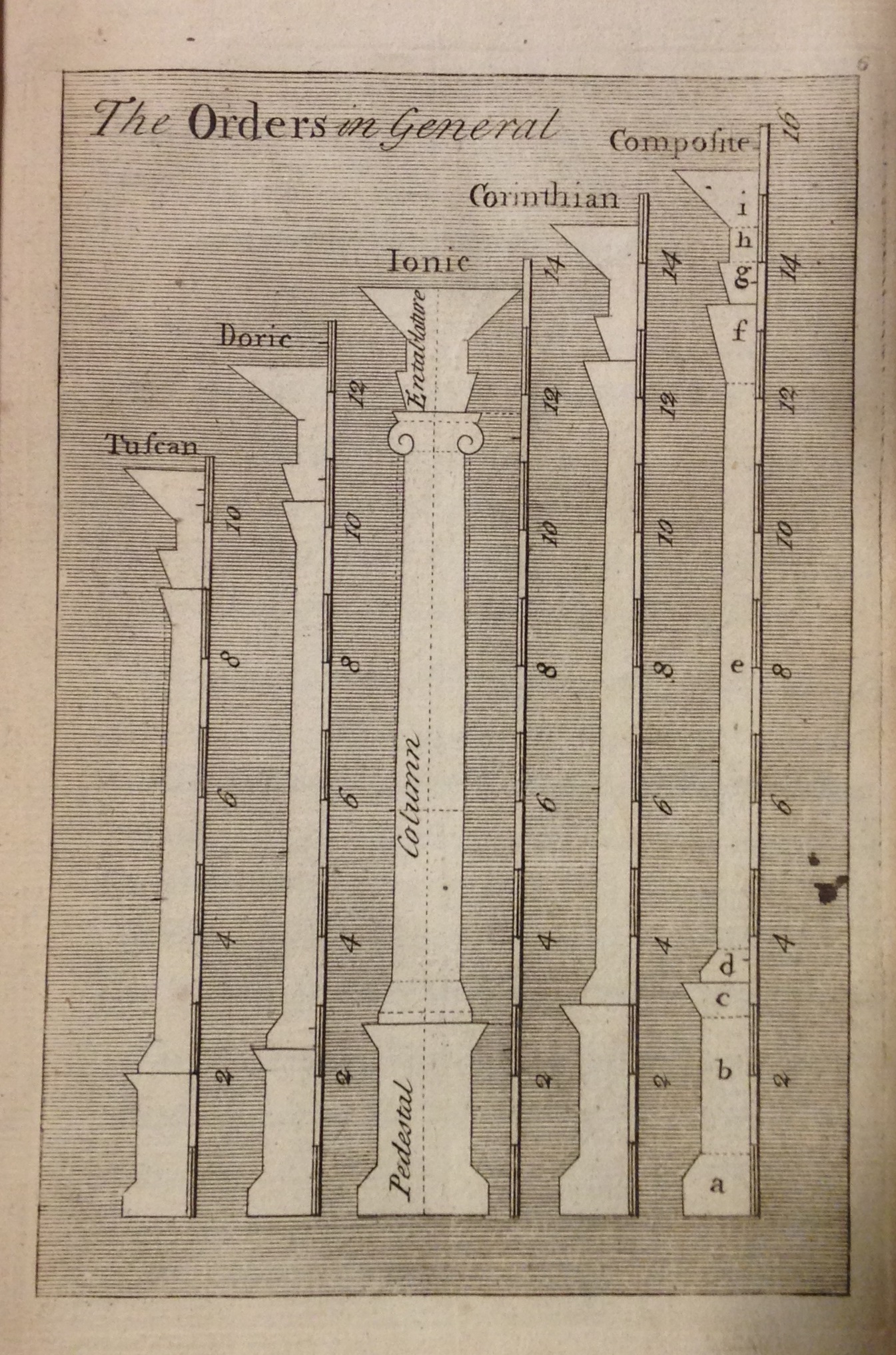
Everything in proper proportion: a plate from William Robinson's Proportional Architecture; or, the Five Orders. London, 1736.  (NA 2810 .R65 1736)

Everything in proper proportion: a plate from William Robinson’s Proportional Architecture; or, the Five Orders. London, 1736. (NA 2810 .R65 1736)

Even if not once owned by Jefferson, 18th-century architectural pattern books and manuals are of special interest to us. In an age when most structures were designed, not by architects per se, but by master builders and skilled amateurs (such as Jefferson), the books they drew upon for inspiration remain useful primary sources. William Robinson’s Proportional Architecture; or, The Five Orders; Regulated by Equal Parts, containing 32 leaves of engraved text and diagrams, was first issued in 1733. We recently acquired a fine copy of the second, pocket-size, edition of 1736, to which was added a 15-page letterpress glossary of architectural terms used in the work. With this book as a reference, a builder would know how to size architectural details in any of the five architectural orders. Robinson’s work remained sufficiently popular to merit a reissue in 1759.

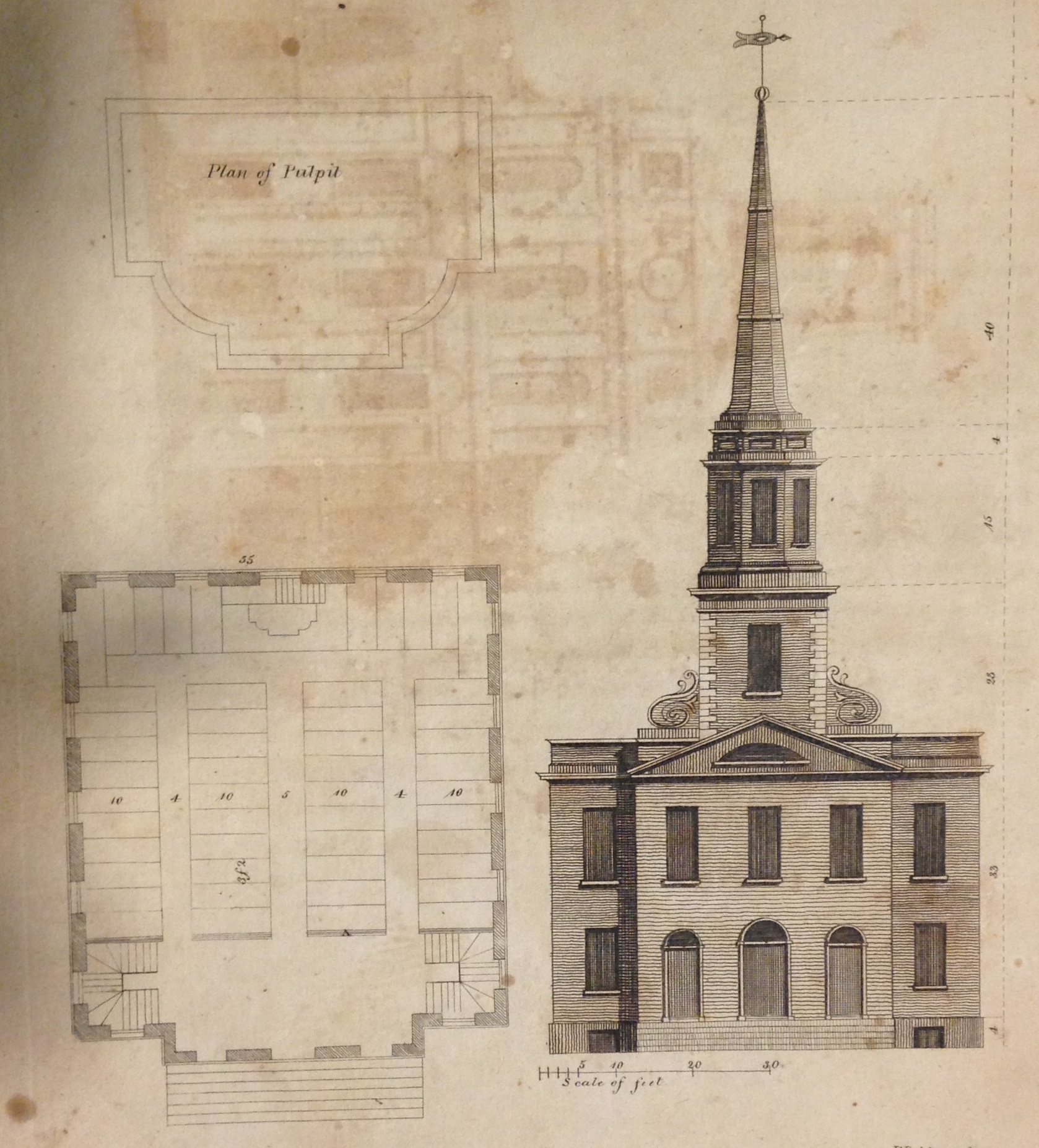
Plan and elevation for a "meetinghouse" by Asher Benjamin.

Plan and elevation for a “meetinghouse” by Asher Benjamin.

Greenfield, Mass., architect Asher Benjamin published the first original American architectural pattern book in 1797. The first edition of his profoundly influential (and very rare) Country Builder’s Assistant still eludes us, but recently we were able to acquire a copy of the 1798 second, expanded edition published in Boston. Benjamin’s work offered in its 37 engraved plates far more detail than in Robinson’s earlier handbook, and it was rapidly embraced by local builders. Indeed, many early 19th-century private homes and public buildings either designed by Benjamin or clearly based on his pattern book can still be found throughout New England. Benjamin soon relocated to Boston, where he published several other pattern books.

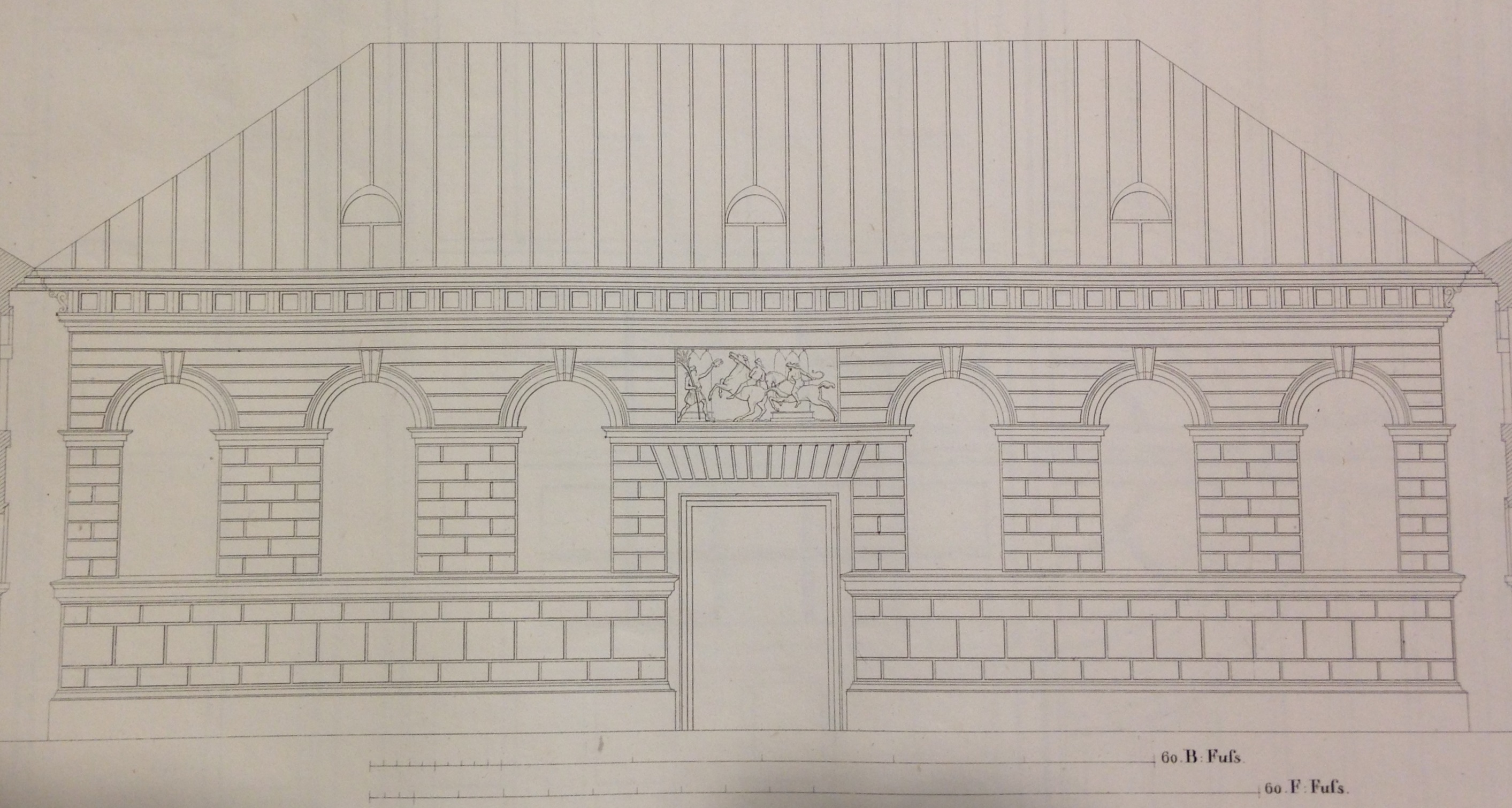
Facade of the riding academy designed by Jean Baptiste Metivier, from Grund-Plane, Durchschnitte und Facaden nebt Details der Reitbahm und Stallungen. Munich, 1836.  (NA8340 .M48 1836)

Facade of the riding academy designed by Jean Baptiste Metivier, from Grund-Plane, Durchschnitte und Facaden nebt Details der Reitbahm und Stallungen. Munich, 1836. (NA8340 .M48 1836)

One may not think to consult our Marion duPont Scott Sporting Collection for architectural publications, but in fact it includes a small but significant holding of early works relating to the design and construction of equestrian facilities. The most recent (and now the earliest such publication) to be added is the only recorded copy of Jean Baptiste Metivier’s Grund-Plane, Durchschnitte und Facaden nebst Details der Reitbahm und Stallungen (Munich, 1836). Born in Rennes and trained as an architect in Paris, Metivier (1781-1853) spent most of his career in Munich, where several of his buildings may still be seen. This, his third and final publication, is a portfolio of 14 large lithographic plates depicting plans, elevations, and architectural details for the riding school and stable buildings commissioned by the Princely House of Thurn and Taxis.

Architectural detail from Metivier, Grund-Plane ... Munich, 1836.  (NA8340 .M48 1836)

Architectural detail from Metivier, Grund-Plane … Munich, 1836. (NA8340 .M48 1836)

ABCs of Special Collections: S is for

Happy New Year!  We are glad to return with the newest installment of our alphabetical series.  As promised, we are starting 2014 with the letter

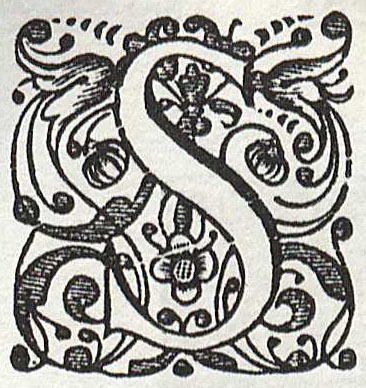
Flowered Letters--8 lines Pica from The Roman Italic & Black Letter Bequeathed the University of Oxford by Dr. John Fell, 1951. (Z116 .T95 V.26 1951. Image by Petrina Jackson).

“S” from Flowered Letters–8 lines Pica face from The Roman Italic & Black Letter Bequeathed the University of Oxford by Dr. John Fell, 1951. (Z116 .T95 V.26 1951. Image by Petrina Jackson).

S for Senape, Antonio

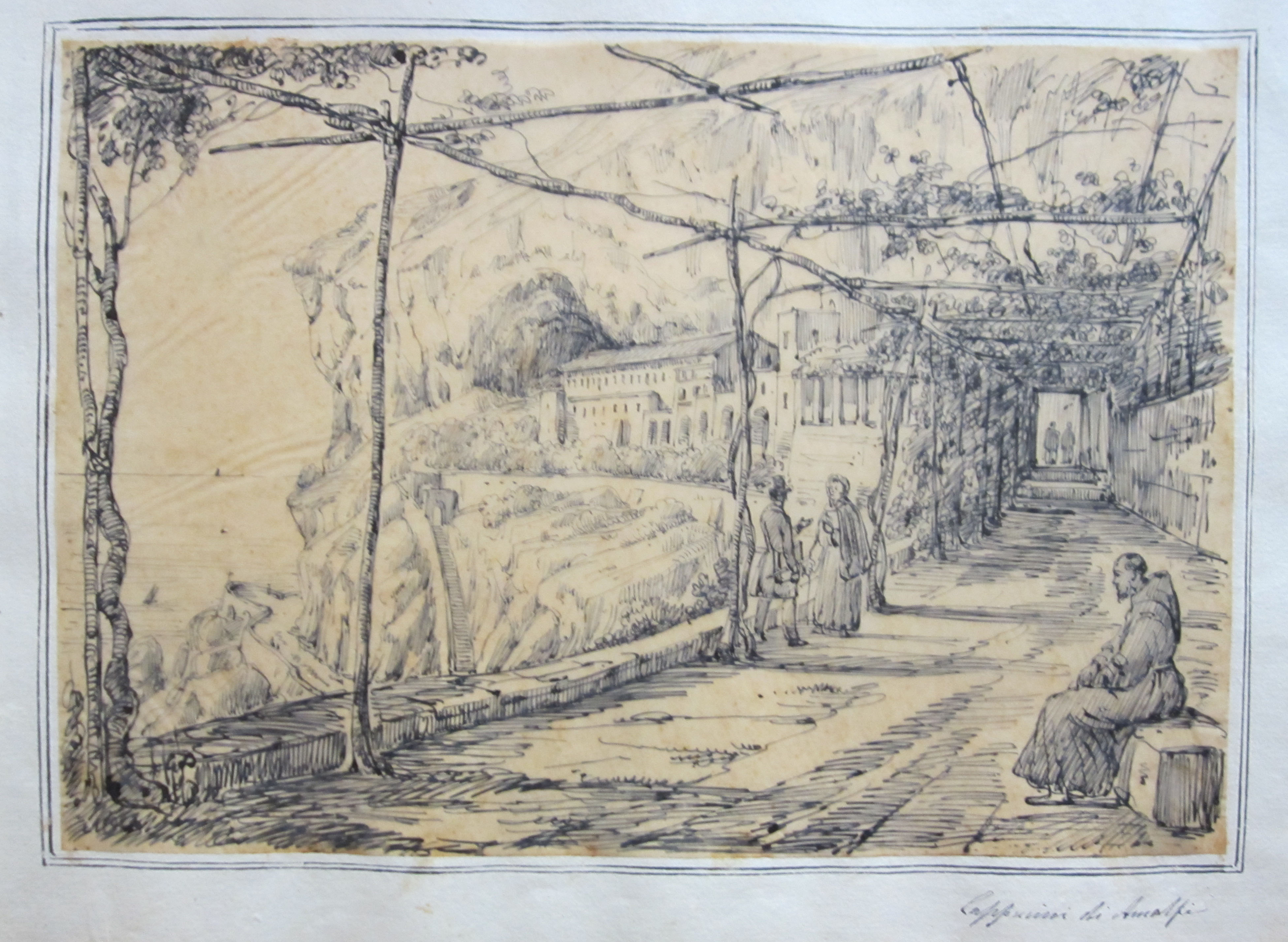
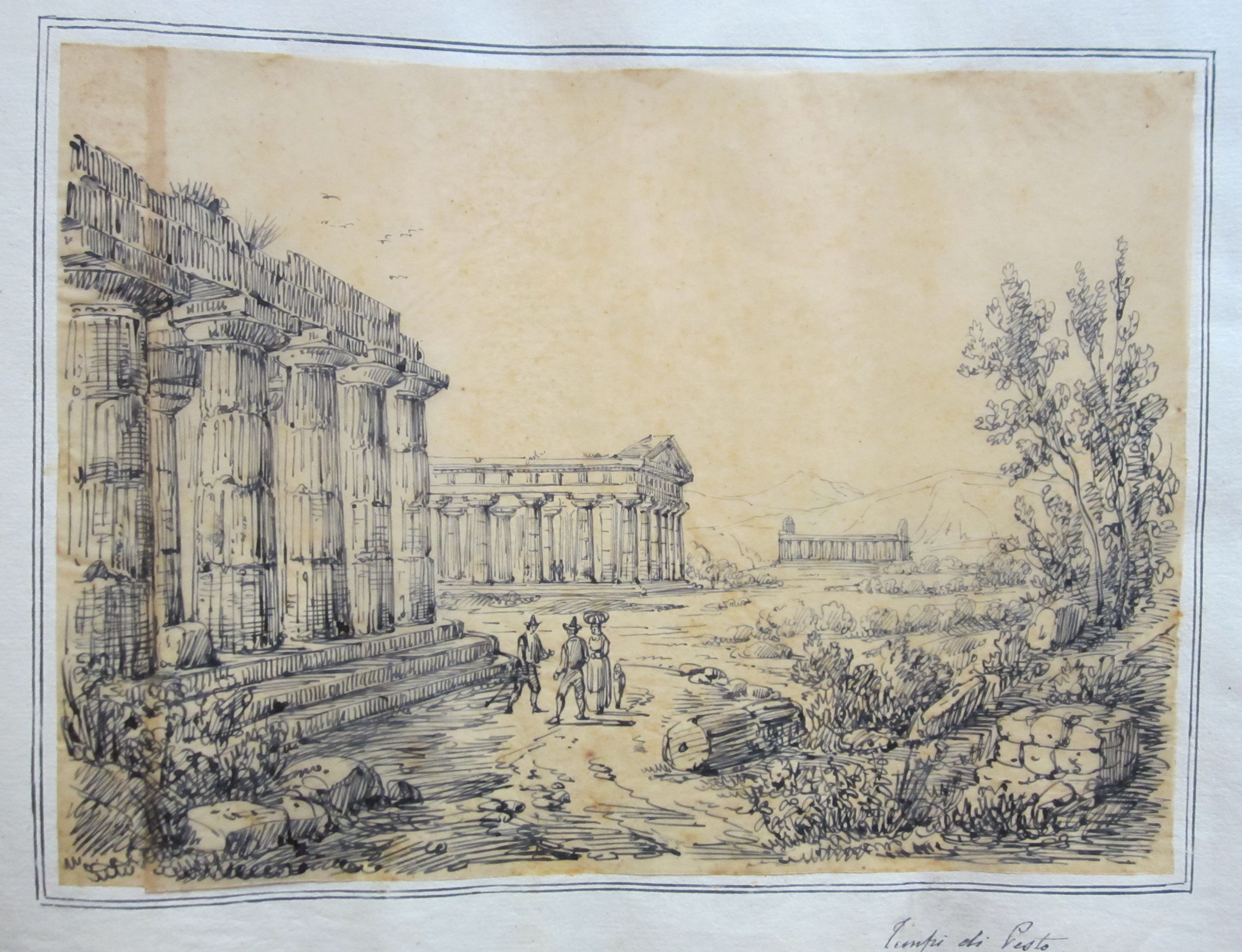
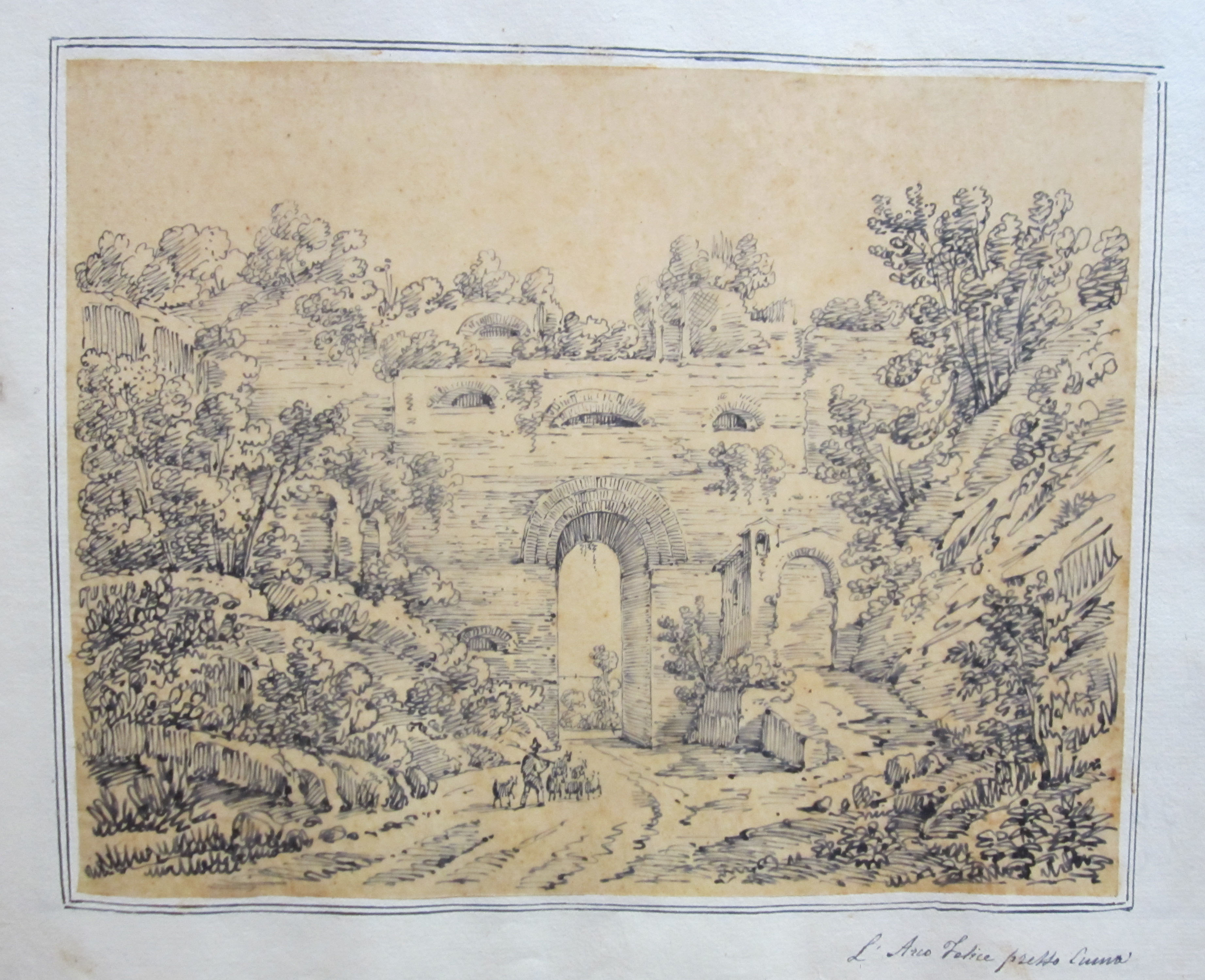
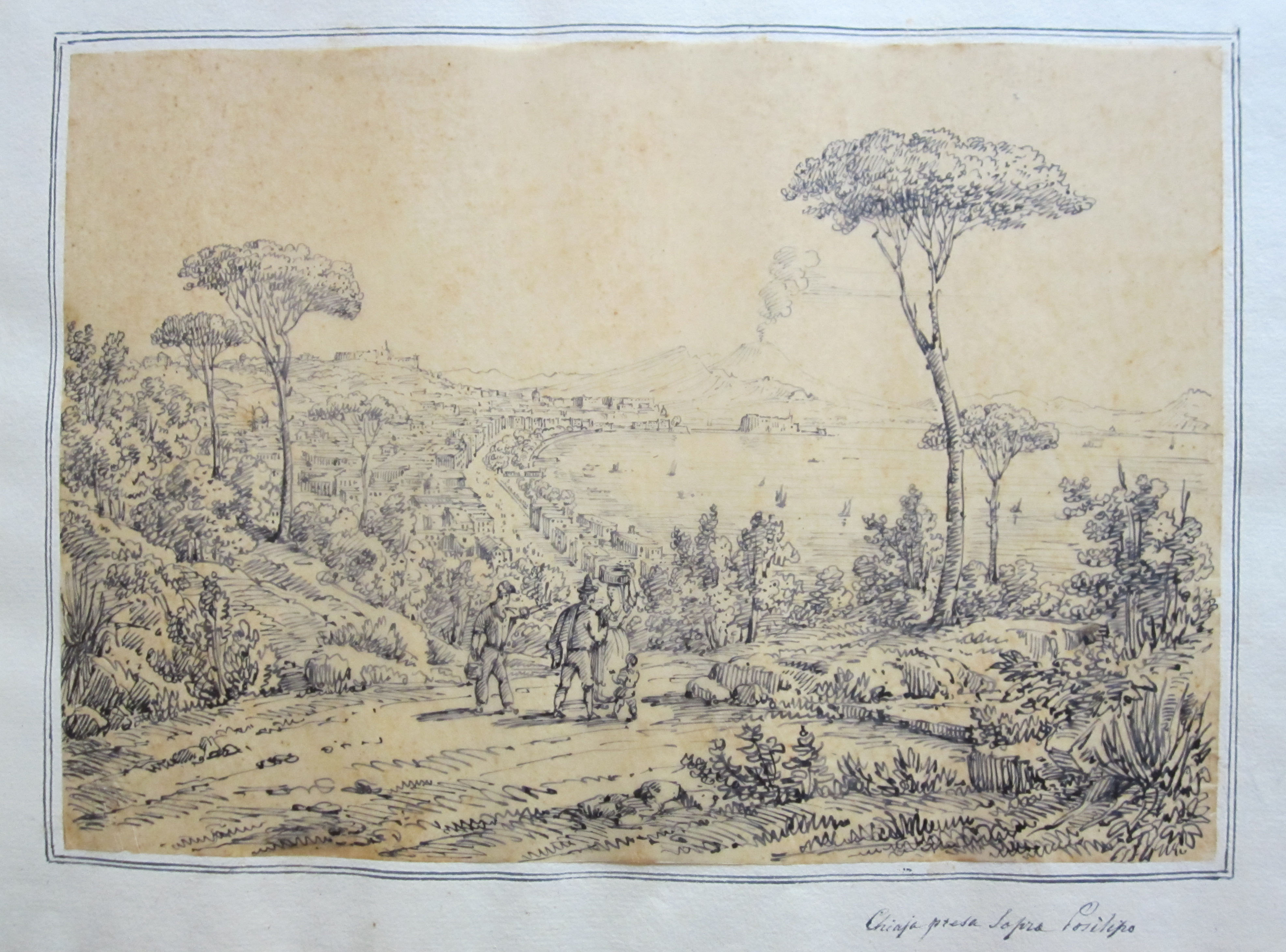
Very little is known of Antonio Senape, a prolific pen and ink artist, except that he was likely born in Rome in 1788.  A rare bound sketchbook, housed in the Albert and Shirley Small Special Collections, was owned by Senape and contains sixty of his original drawings. The drawings take the viewer on a tour of Italian markets, ancient ruins, and sailing ships, many with the active volcano, Mt. Vesuvius, looming in the background.

Donna Stapley, Assistant to the Director

Antonio Senape's pen and Ink drawing from  from (MSS 15135. Gift of Mrs. Joseph Wood. Image by Donna Stapley).

Pen and Ink drawing from Antonio Senape’s sketchbook, n.d. (MSS 15135. Gift of Mrs. Joseph Wood. Photograph by Donna Stapley).

(Photograph by Donna Stapley).

Pen and Ink drawing from Antonio Senape’s sketchbook, n.d. (MSS 15135. Gift of Mrs. Joseph Wood. Photograph by Donna Stapley).

(Photograph by Donna Stapley).

Pen and Ink drawing from Antonio Senape’s sketchbook, n.d. (MSS 15135. Gift of Mrs. Joseph Wood. Photograph by Donna Stapley).

(Photograph by Donna Stapley).

Pen and Ink drawing from Antonio Senape’s sketchbook, n.d. (MSS 15135. Gift of Mrs. Joseph Wood. Photograph by Donna Stapley).

S is for Snead & Company

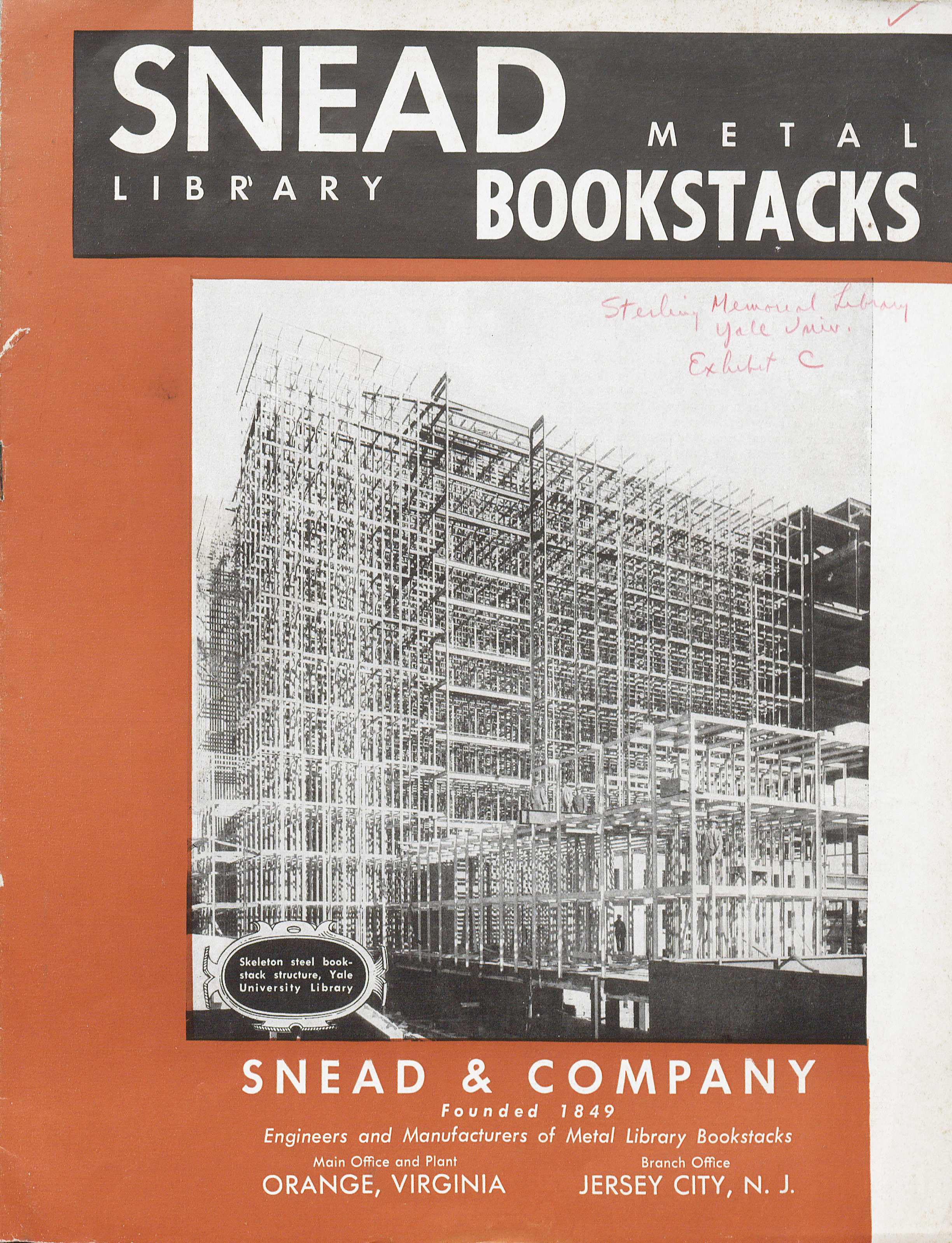
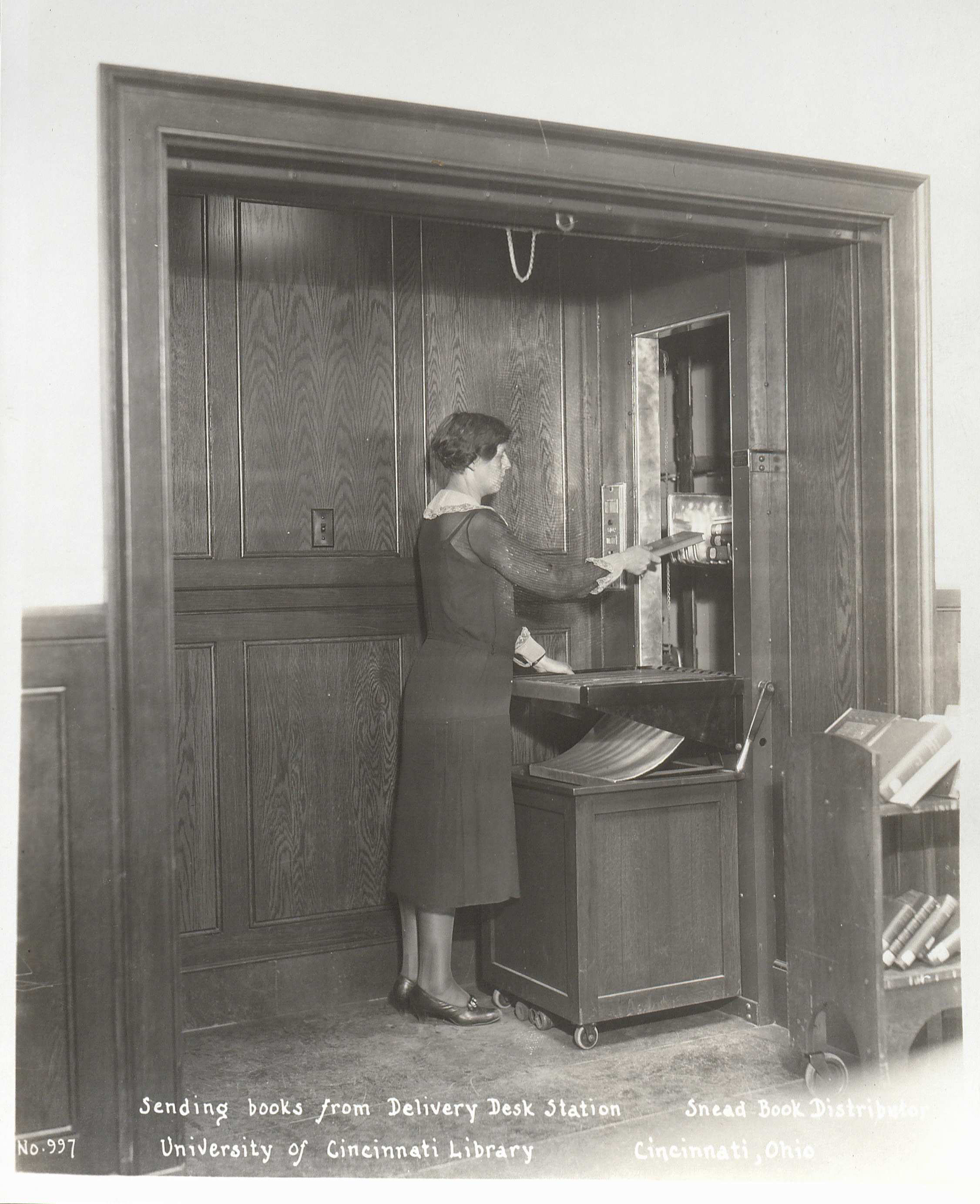
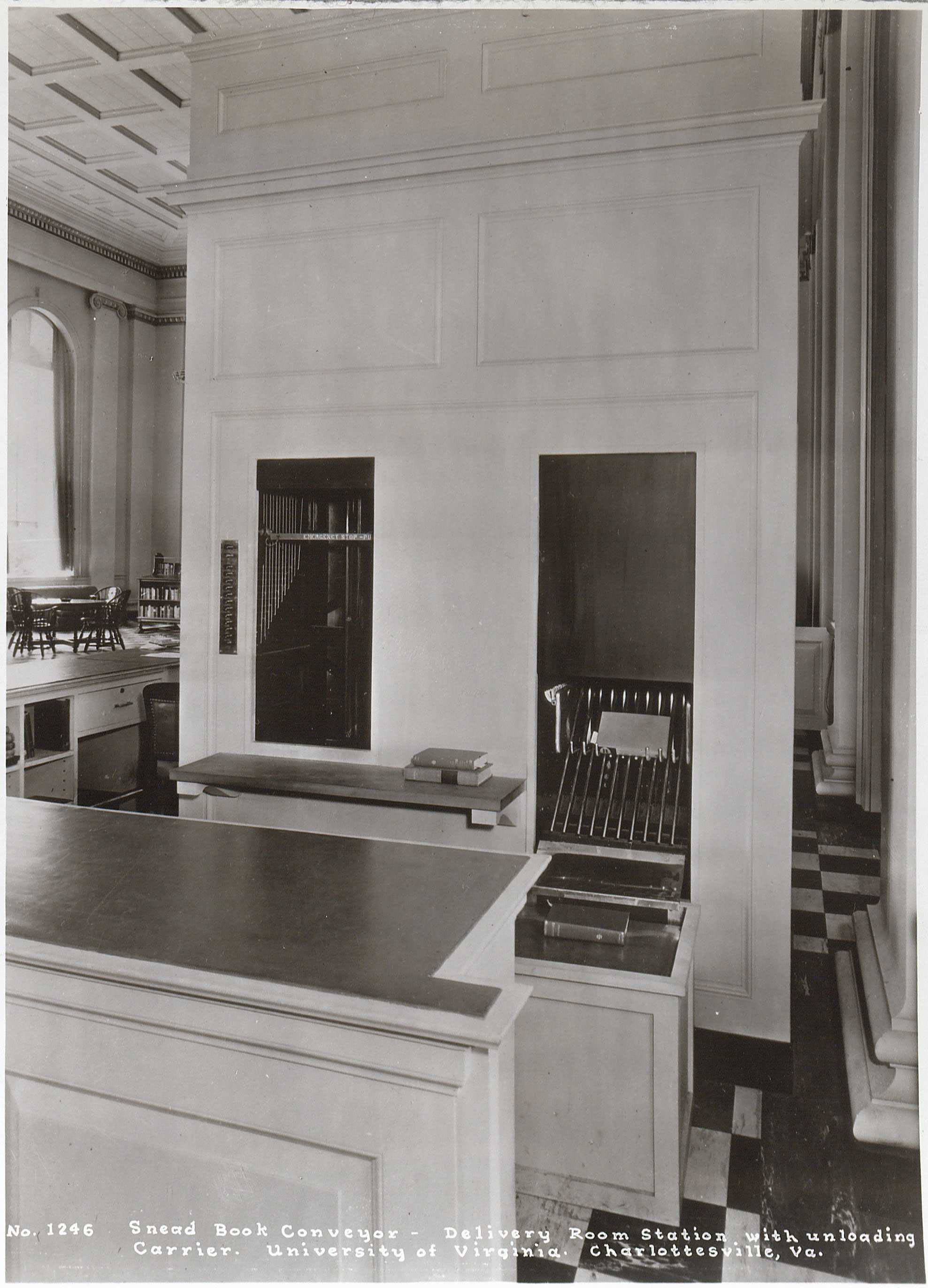
Snead & Company was established in Louisville, Ky. in 1849 as a supplier of decorative and architectural cast iron. By the turn of the 20th century, the company’s focus turned to providing large research libraries—including the Library of Congress, Widener Library, and the British Museum—with structural elements to construct and equip book stacks. Angus Snead MacDonald, the long time president, was responsible for moving the company to the forefront of library design and was himself one of the major contributors to the open, modular plans that dominated research library architecture in the post World War II years.

Edward Gaynor, Head of Description and Specialist for Virginiana and University Archives

(Image by Petrina Jackson).

Cover of a Snead & Company Pamphlet, n.d. (MSS 9325. Image by Petrina Jackson).

(Image by Petrina Jackson).

“Sending books from delivery desk station” University of Cincinnati Library, Cincinnati, Ohio, n.d. (MSS 9325. Image by Petrina Jackson).

(Image by Petrina Jackson).

“Snead book conveyor–delivery room station with unloading carrier.” University of Virginia, n.d. (Image by Petrina Jackson).

(Image by Petrina Jackson).

“Snead standard stacks. Reference room of the Vatican Library.” Vatican City, Italy, n.d. (MSS 9325. Image by Petrina Jackson).

S is for Gary Snyder

American poet Gary Snyder met Allen Ginsberg when they both read at the Six Gallery event in San Francisco in October 7, 1955, thus cementing his identity with the Beat poets and writers. He was an influential member of the San Francisco Renaissance before moving to Japan to study Zen Buddhism in 1955. He won a Pulitzer Prize for Turtle Island in 1974, and is also well known as an essayist, lecturer, and environmental activist.
A search of our online catalog shows 61 entries for Mr. Snyder dating from 1946.
Shown here is a first printing of Riprap and a broadside titled “Siberian Outpost” that he made on the occasion of a visit to Brown College at the University of Virginia in 2010. The broadside was printed by Josef Beery.

George Riser, Collection and Instruction Assistant

(PS3569 .N88T8 1974. Clifton Waller Barrett Library of American Literature. Image by Petrina Jackson).

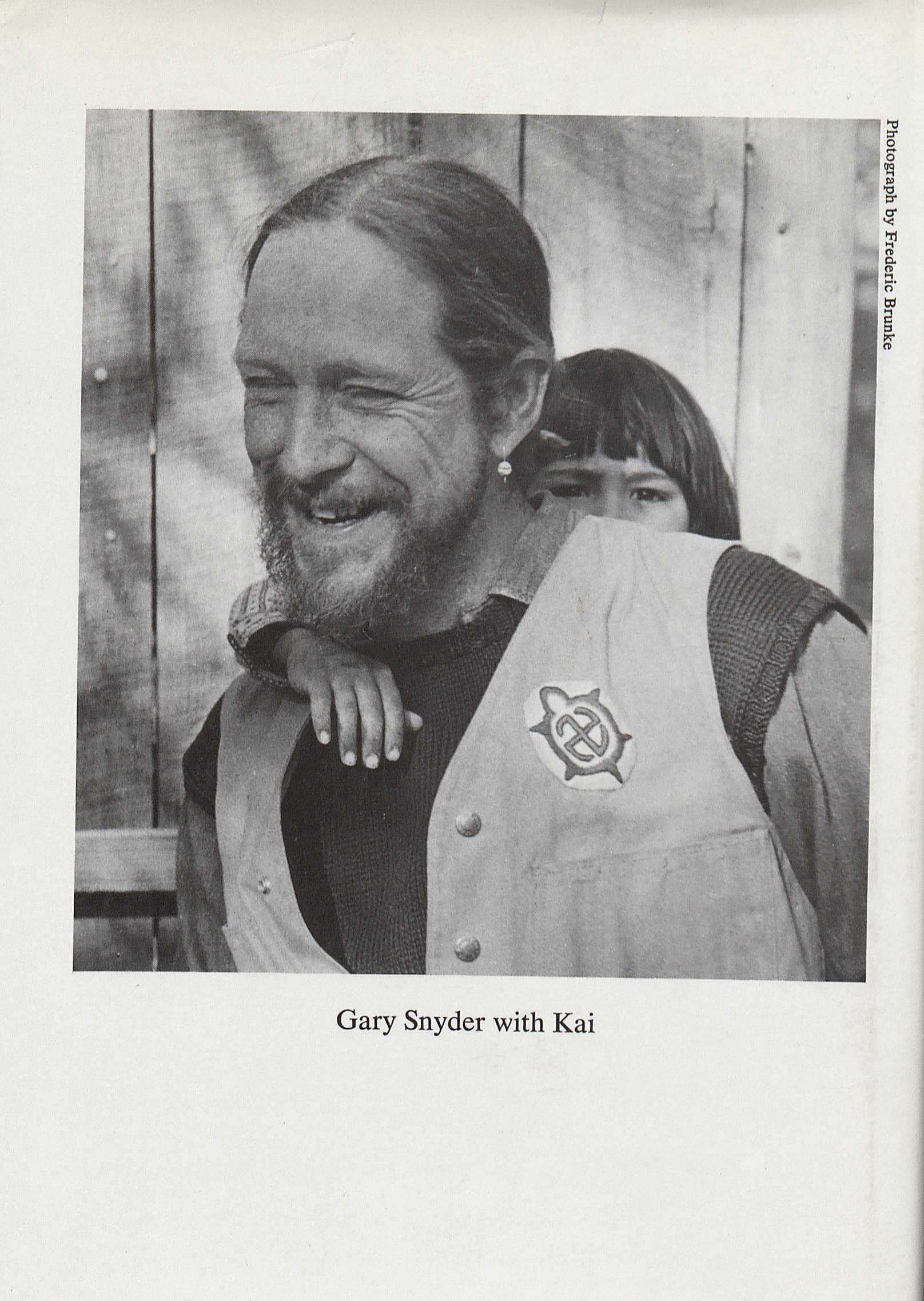
Back cover of Gary Snyder’s Turtle Island. Photograph by Frederic Brunke. (PS3569 .N88T8 1974. Clifton Waller Barrett Library of American Literature. Image by Petrina Jackson).

Cover of Gary Snyder's Riprap, 1959. (PS3569 .N88R49 1959. Image by Petrina Jackson).

Cover of Gary Snyder’s Riprap, 1959. (PS3569 .N88R49 1959. Marvin Tatum Collection of Contemporary Literature. Image by Petrina Jackson).

Snyder_Siberian Outpost

“Siberian Outpost,” written by Gary Snyder. Woodcut by Josef Beery, 2010. (Broadside 2010.S58. Courtesy of Gary Snyder. Image by Petrina Jackson).

We hope you enjoyed the “S” selections. See you in two weeks when we feature the letter “T.”

Patron’s Choice: The Life and Times of A. J. Weed

This week, we are pleased to feature a guest post from researcher Charles Morrill. Mr. Morrill is an independent scholar researching the creation of Thomas Jefferson’s polygraph by Charles Willson Peale and John Isaac Hawkins. He is also a guide at Jefferson’s home, Monticello.

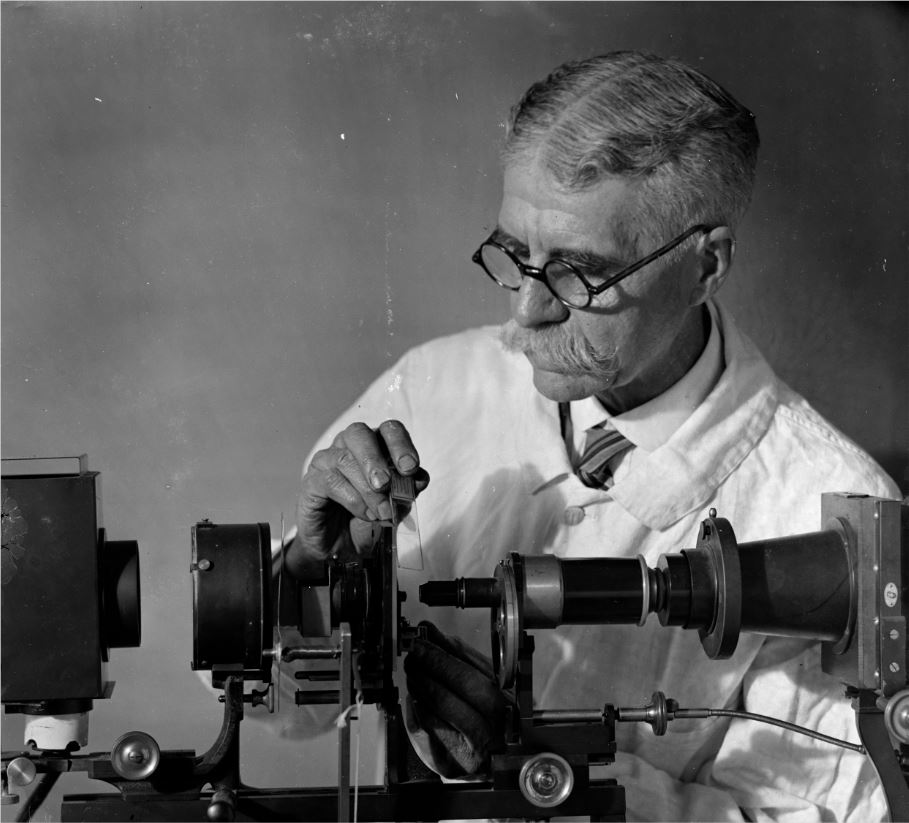
Contemporaries called Arthur J. Weed the “shop man” of the University of Virginia physics department, but he was much more. True, he was a machinist, a woodworker, and also a photographer, but he was even more than those things as well.

He was a scientific-instrument maker from upstate New York who often lived in the basement of Rouss Hall, the building that housed the university physics department in the years between the great wars of the last century. He could make, machine, or build just about anything. For years he quietly worked to advance physics; medicine; and frequently on his own time, and with his own money, the science of detecting earthquakes.

He came up with a type of strong motion seismograph used by the U.S. government for many years, and machined the precise parts that allowed U.Va.’s physics department to do important work in the 1930s.

The students called him “old Weed,” but never to his face. He came to U.Va. around 1920, a slender, middle-aged man who sported a “Mr. Chips” head of white hair and round glasses that probably made him look Edwardian by the standards of the Jazz age.

He didn’t seem to mind.

Arthur J. Weed at work.( Digital image from glass plate negative by University of Virginia Digitization Services.)

Arthur J. Weed at work.(MSS 12558. Digital image from glass plate negative, by University of Virginia Digitization Services.)

In fact, Weed seems to have been as amused by the students as they were of him. He once told Professor Frederick Lyons Brown that students used to measure the acceleration of gravity by dropping a brick down an open stairwell at Rouss Hall and timing it with a stopwatch.

“But,” said Weed. “This practice was discontinued when one boy became flustered and dropped the watch and tried to time it with a brick.”

He loved photography and cats. He worked for the university hospital too, taking high-quality microscopic images so students could learn the processes of disease.

And he loved the university itself, constantly photographing its buildings, sporting events, and graduations. He seems to have stuck with glass-plate negatives for most of his life. Special Collections has nearly two hundred photographs taken by Weed, nearly a hundred on extremely fragile thin glass plates: cats, the lawn, his wife Emma, more cats, vacations, and always another shot of the Rotunda in the spring, in the summer, in the fall, and in the winter.

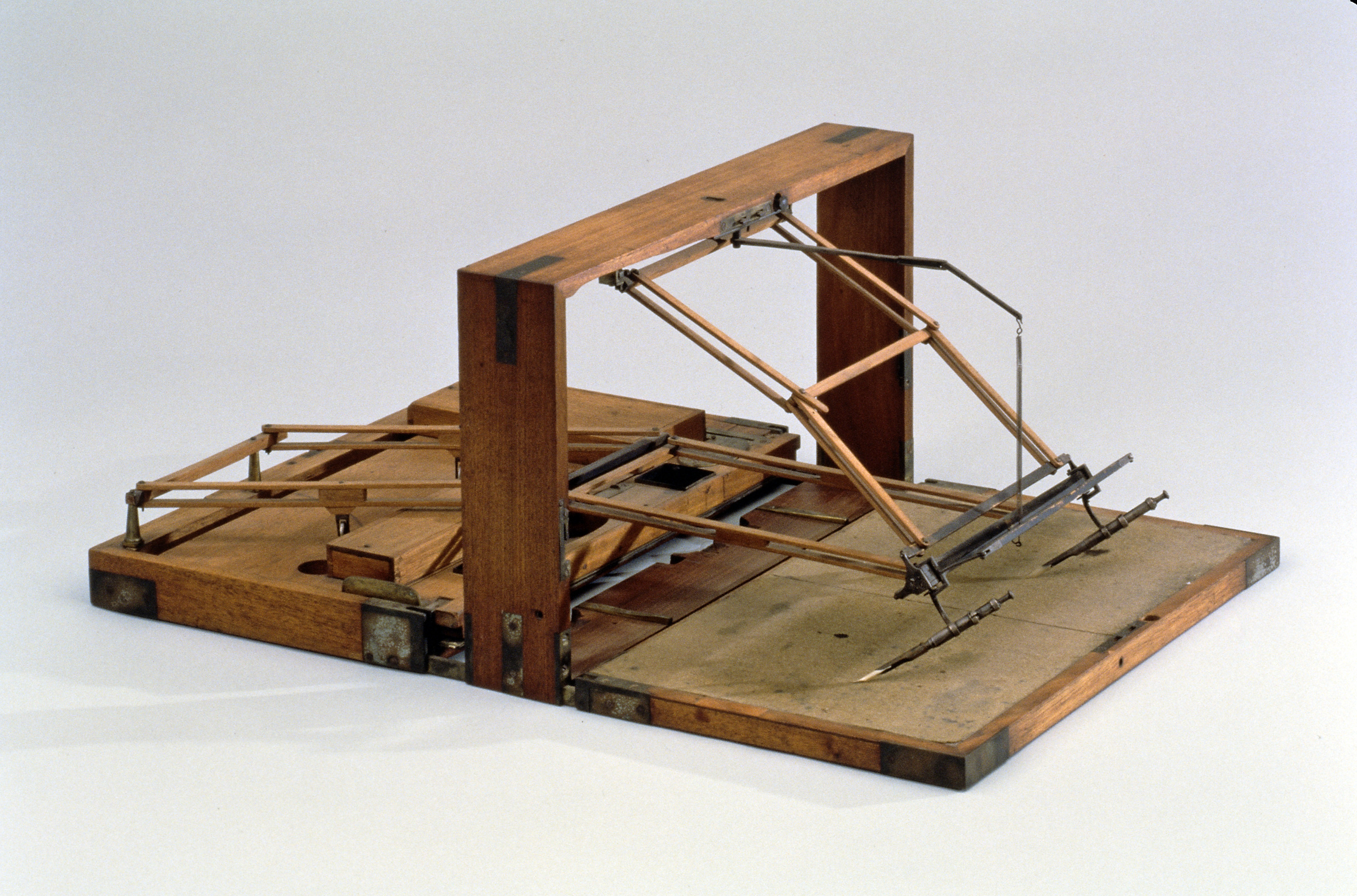
He captured Monticello in its first few years as a public museum before much restoration. Weed did his part for that effort too. That’s how I found out about him.  In 1922, he restored Jefferson’s polygraph, or copy machine, for U.Va.

The University of Virginia's polygraph, which is on long-term loan to Thomas Jefferson's Monticello. (MSS ****. Image courtesy of Monticello.)

The University of Virginia’s polygraph as it looks today, almost a century after Weed’s restoration work. The polygraph is on long-term loan to Thomas Jefferson’s Monticello and is seen by nearly a half-million visitors yearly on the house tour. (Image courtesy of Monticello.)

“The polygraph has just been restored to a working condition in the workshop of the Rouss Physical Laboratory at the University of Virginia by the mechanical A. J. Weed,” the Washington Post reported on May 28, 1922.

UVA subsequently loaned the machine to Monticello in 1947. It remains on view for visitors in Jefferson’s “cabinet” or study.

Weed lived in more humble surroundings, and stuck to a simple bed in the basement of Rouss Hall. He apparently commuted home to Washington D.C. on weekends until the early 1930s when he and his wife Emma bought a house on 17th Street in Charlottesville.

And it was in the depths of Rouss Hall that Weed worked to perfect his great love: the strong-motion seismograph.

Though seismographs had been around for decades in Weed’s time, instrument makers tended to make them ever more sensitive. Trouble was, if an earthquake actually took place next to such a device it could not record anything meaningful. At the suggestion of an engineer he’d heard at a lecture, Weed worked at devising instruments tuned to “hear” and record strong vibrations on the theory that they might be of use to those who designed bridges and buildings in earthquake zones.

He was, of course, absolutely right.

“Mr. Weed has designed an instrument easily portable and capable of making an accurate record of stresses and strains in a building shaken by a quake,” the Associated Press reported on May 4, 1932. “It is set with a hair trigger that releases with the first tremor. For the next two minutes a record of the quake intensity is traced upon a smoked glass plate.”

Weed also worked on his own larger more sensitive seismographs, some taller than an adult person, wonderful pieces of machine work and theory, one bedded deep in the ground beneath Rouss Hall.

Weed and one of his seismographs, undated. (MSS ****. Digital image from glass plate negative by University of Virginia Digitization Services.)

Weed and one of his seismographs, undated. (MSS 12558. Digital image from glass plate negative, by University of Virginia Digitization Services.)

The early 1930s saw Weed working with U.Va. Physics Professor Jesse Beams to develop the ultracentrifuge described by both in Science magazine (June 10, 1931). Looking like some gleaming child’s top on steroids, the instrument ultimately spun a half-million revolutions per minute. Years later Beams took the idea to the Manhattan Project during World War II as one method for separating different types of uranium.

Both Beams and Weed posed for photos with their device in the 1930s. One, the intent young professor, the other his machinist and something more.

On April 15, 1936, Weed gave a lecture titled “Some Experiments With Soft Cast Iron Magnets”  at the University’s Physics Journal Club in Rouss Hall, where he’d spent some of the best years of his life.

He finished speaking, collapsed, and died of apparent heart failure.

The University buried him in a lovely quiet spot at the northeast corner of its cemetery. Emma moved back home to upstate New York but lies in Charlottesville next to Arthur today. No one got around to engraving the date of her death on their headstone.

By the 1960s the U.S. government had phased out most Weed strong-motion seismographs in California. One or two may remain in museums.

Someone once said we stand on the shoulders of giants and I think that’s true. But, I also think it’s true that we stand on the shoulders of quiet photographers and cat-loving machinists with a passion to build and to help.

Arthur Weed, **** Weed, and a furry canine friend at home, undated. (MSS ****. Digital image from a glass plate negative, by University of Virginia Digitization Services.)

Arthur Weed, Emma Weed, and a furry canine friend at home, undated. (MSS 12558. Digital image from a glass plate negative, by University of Virginia Digitization Services.)

Patron’s Choice: Finding Buried Treasure in Edward Le Roy Rice’s “Monarchs of Minstrelsy”

This week we are pleased to feature a guest post by Jessica Showalter. Showalter was a Lillian Gary Taylor Fellow at the Harrison Institute in 2013. She is a doctoral candidate in the Literature & Criticism program at Indiana University of Pennsylvania. Below, Jessica explains why she ended up spending two weeks of her fellowship studying two books that she had expected to peruse for perhaps an hour.

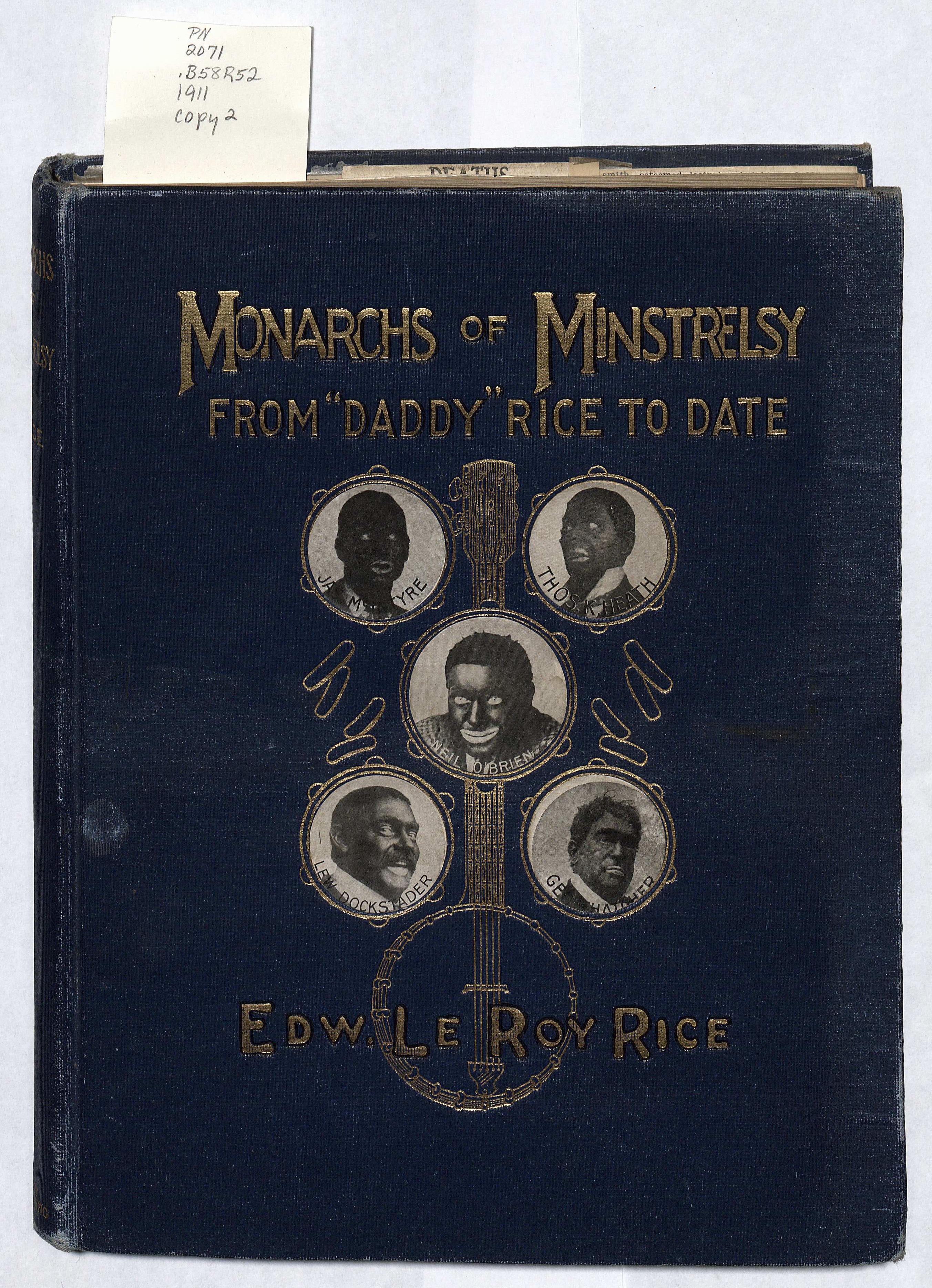
I suppressed a squeal when I opened Copy 1 of Edward Le Roy Rice’s Monarchs of Minstrelsy (1911). The book is a 350-page early history of minstrel shows, the ubiquitous nineteenth-century pop culture phenomenon which combined song, dance, and comic sketches based on racist stereotypes. The Albert and Shirley Small Special Collections Library holds two annotated copies of Monarchs of Minstrelsy. Although I had examined a digitized copy on Google Books a few months before coming to Charlottesville, I figured the annotations might be worth a glance.

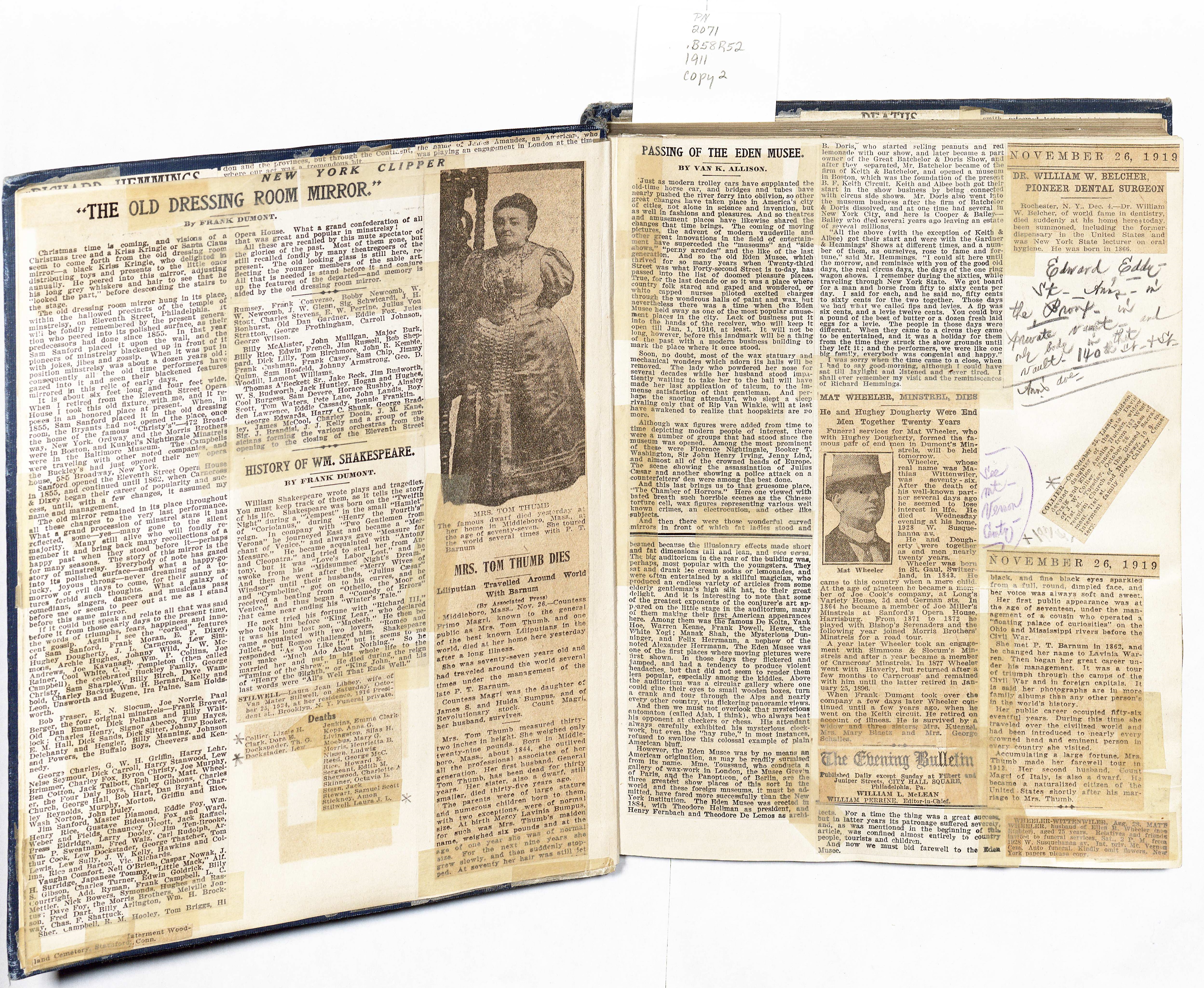
Newspaper clippings pasted into the front matter of Monarchs of Minstrelsy. (PN2071 .B58 R52 1911, Copy 2, Gift of Mr. and Mrs. Douglas M. Valentine. Image by Molly Schwartzburg.)

Newspaper clippings pasted into the front matter of Monarchs of Minstrelsy. (PN2071 .B58 R52 1911, Copy 2, Gift of Mr. and Mrs. Douglas M. Valentine. Image by Molly Schwartzburg.)

Imagine my surprise when I surveyed the extent of the annotations—the books resembled scrapbooks. Newspaper clippings about minstrel performers were crammed into any available white space. Many of these newspaper stories were new to me, even though I had examined minstrelsy-related articles in digitized nineteenth-century newspaper databases. Many newspapers have not yet been digitized, and may never be.

One clipping told the story of Charlie Bensel, a minstrel performer who was shipwrecked in Peru en route to California during the Gold Rush. Finally arriving in San Francisco with only his banjo, Bensel exchanged music for food until he found a job in the mines. Later, Bensel started a minstrel company that toured China. Another clipping about the minstrel William Blakeney reported that he performed in Australia, India, Japan, the South Seas, and England during the 1870s. These kinds of stories helped my quest to track down the international routes of traveling minstrel performers for a chapter in my dissertation, Hemispheric Minstrelsies: Race, Nation, and Empire in Nineteenth-Century Performance.

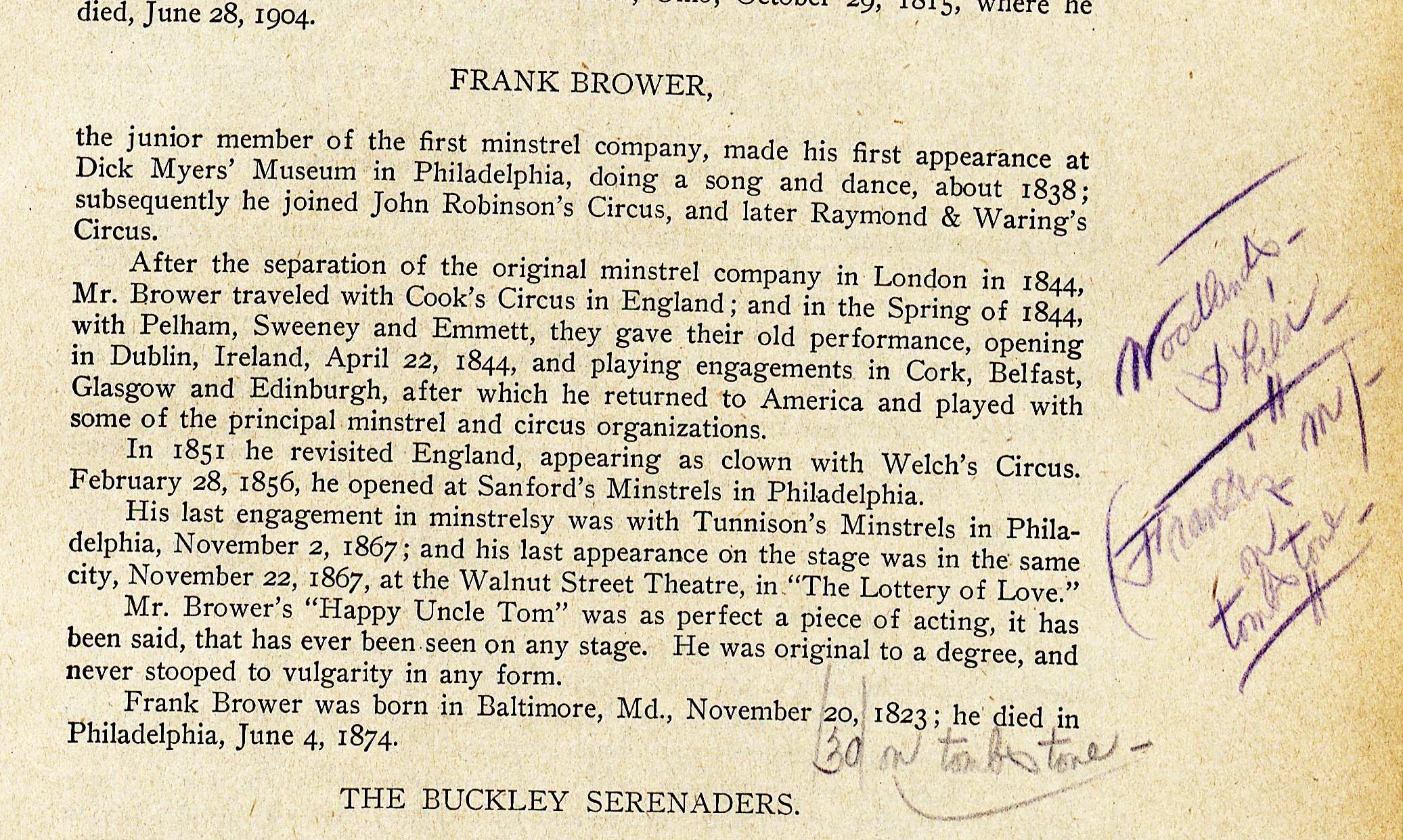
In addition to pasted-in newspaper clippings, these copies of Monarchs of Minstrelsy were peppered with penciled notes supplementing the book’s biographies of minstrel performers. The book’s unidentified owner visited the graves of many of these minstrels to fact-check Rice’s biographies. For instance, a note on page 15 in Copy 2 edits the famous performer Frank Brower’s birthday—according to his tombstone, he was born November 30th, not November 20th.

•Image 2: An annotated page of Monarchs of Minstrelsy. (PN2071 .B58 R52 1911, Copy 2, Gift of Mr. and Mrs. Douglas M. Valentine. Image by Molly Schwartzburg.)

• Image 2: An annotated page of Monarchs of Minstrelsy. (PN2071 .B58 R52 1911, Copy 2, Gift of Mr. and Mrs. Douglas M. Valentine. Image by Molly Schwartzburg.)

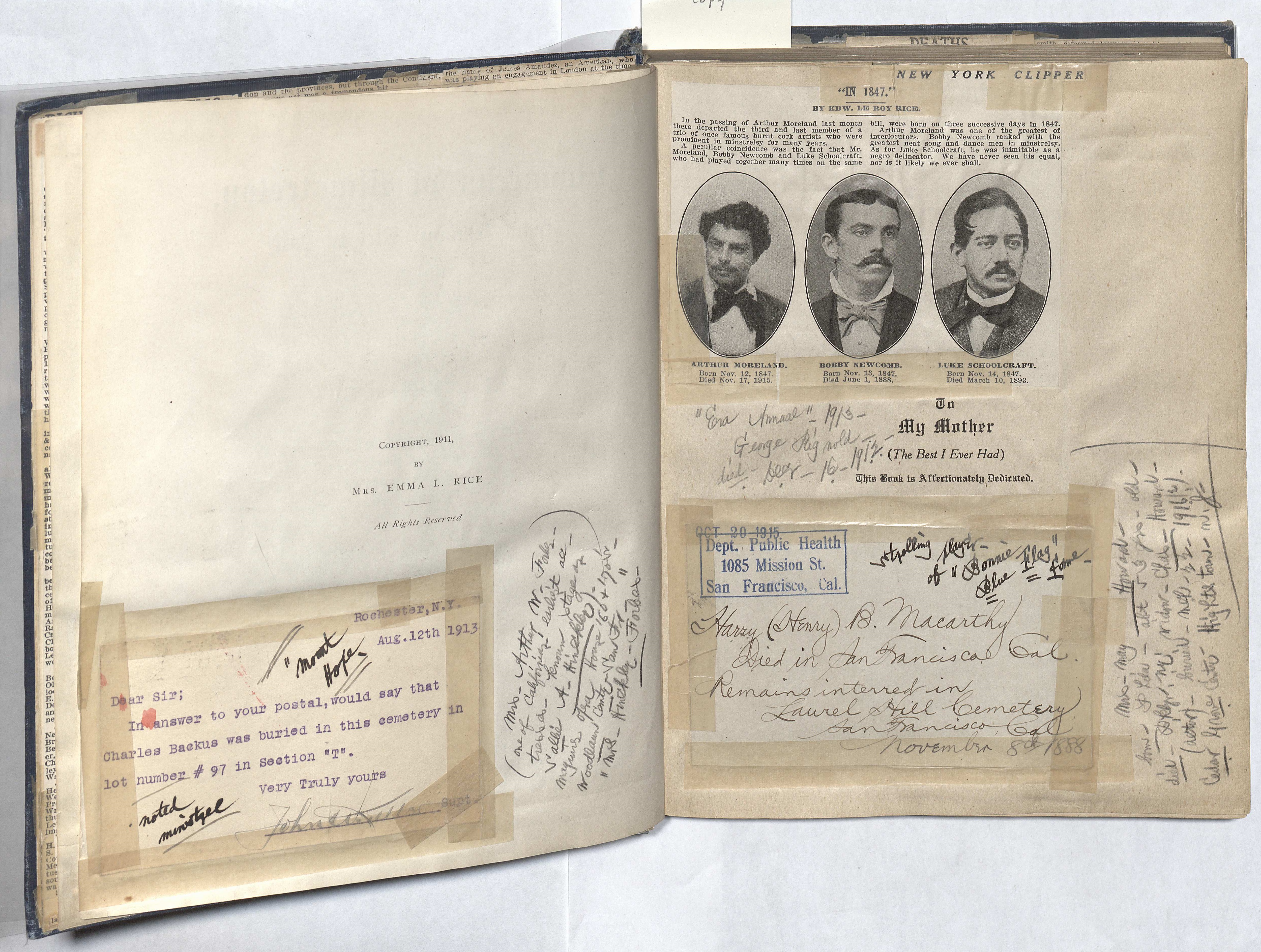
Sometimes, these marginal notes describe the condition of the gravesites, noting whether they were well-kept or neglected and overgrown. In cases where visits were impractical, the book’s owner corresponded with cemetery managers via mail and inserted the correspondence in one of the copies of the book. One letter from 1913 confirms the location of Charles Backus’ grave in Rochester, NY; another letter from 1915 confirms the burial of Harry (Henry) B. Macarthy in San Francisco. Copy 1 even includes a letter from the American Consul in Moscow about the performer Charley Sutton Leman’s burial.

Correspondence regarding the burial of Harry B. McCarthy may be found pasted into the front matter of Monarchs of Minstrelsy. (PN2071 .B58 R52 1911, Copy 2, Gift of Mr. and Mrs. Douglas M. Valentine. Image by Molly Schwartzburg.)

Correspondence regarding the burial of Harry B. McCarthy may be found pasted into the front matter of Monarchs of Minstrelsy. (PN2071 .B58 R52 1911, Copy 2, Gift of Mr. and Mrs. Douglas M. Valentine. Image by Molly Schwartzburg.)

The scrapbooked clippings and penciled annotations provided many minute details that will enrich my dissertation research, and as a whole the two books pushed me to speculate about how history is made. The book’s owner did not just passively read these accounts but engaged in fact-checking and revision, creating a personalized historical record. The marked up copies of Monarchs of Minstrelsy preserve a snapshot of a messy, contested history in progress. Plus, these scrapbooked copies reminded me of the importance of consulting physical texts in addition to electronic resources. Yes, a digitized copy allowed me to prime my research from home, but the Small Special Collections Library’s two idiosyncratic copies offered unique information, while also illuminating how just one reader repurposed a book according to his or her own objective.

The cover of one of the two heavily annotated copies of Monarchs of Minstrelsy in Special Collections. (Image by Molly Schwartzburg.)

The cover of one of the two heavily annotated copies of Monarchs of Minstrelsy in Special Collections. (Image by Molly Schwartzburg.)

Holiday Greetings!

For your viewing pleasure, here are a couple of fantastic finds from the Magruder Family Papers*, which are currently being arranged and described.

Christmas postcard (Image by Petrina Jackson)

Christmas postcard, 1925. (Image by Petrina Jackson)

New Years postcard (Image by Petrina Jackson)

New Years postcard, 1914. (Image by Petrina Jackson)

See you in the New Year!

*Edward May Magruder was a Charlottesville doctor who established a private sanitarium in 1899 at his house on W. Jefferson St. Along with 6 other local doctors, he was one of the founders of Martha Jefferson Hospital in 1902. Magruder’s daughter, Evalina, was the first woman to graduate from the University of Virginia School of Architecture. The Magruder family papers were donated to the University of Virginia by Eleanor Magruder Harris in 2001 when the Magruder house was purchased by Christ Church for use as offices.

Encountering John Powell: Virginian, Musician, Eugenicist

This week, we are pleased to feature a guest post by Caroline Newcomb, 4th year student in the College of Arts and Sciences and Special Collections instruction assistant. 

***

Most students at U.Va. never have the opportunity to enter the stacks at the Albert and Shirley Small Special Collections Library. As such, most students have no idea what it’s like down there. Let me give you a description. The place is practically a bomb shelter. Accessible only with a security badge, the stacks are well underground, designed to preserve and protect the collection of over 13 million manuscripts, 325,000 rare books, 5,000 maps, 3.6 million University Archives items, 250,000 photos, 4,000 broadsides and countless other items from all matters of destruction. If things went wrong on Grounds, I would hide in the stacks. That being said, the stacks can also be a bit scary. Especially late at night, after most people have left, you are one of only two people “under grounds,” and you’re searching for a gun.

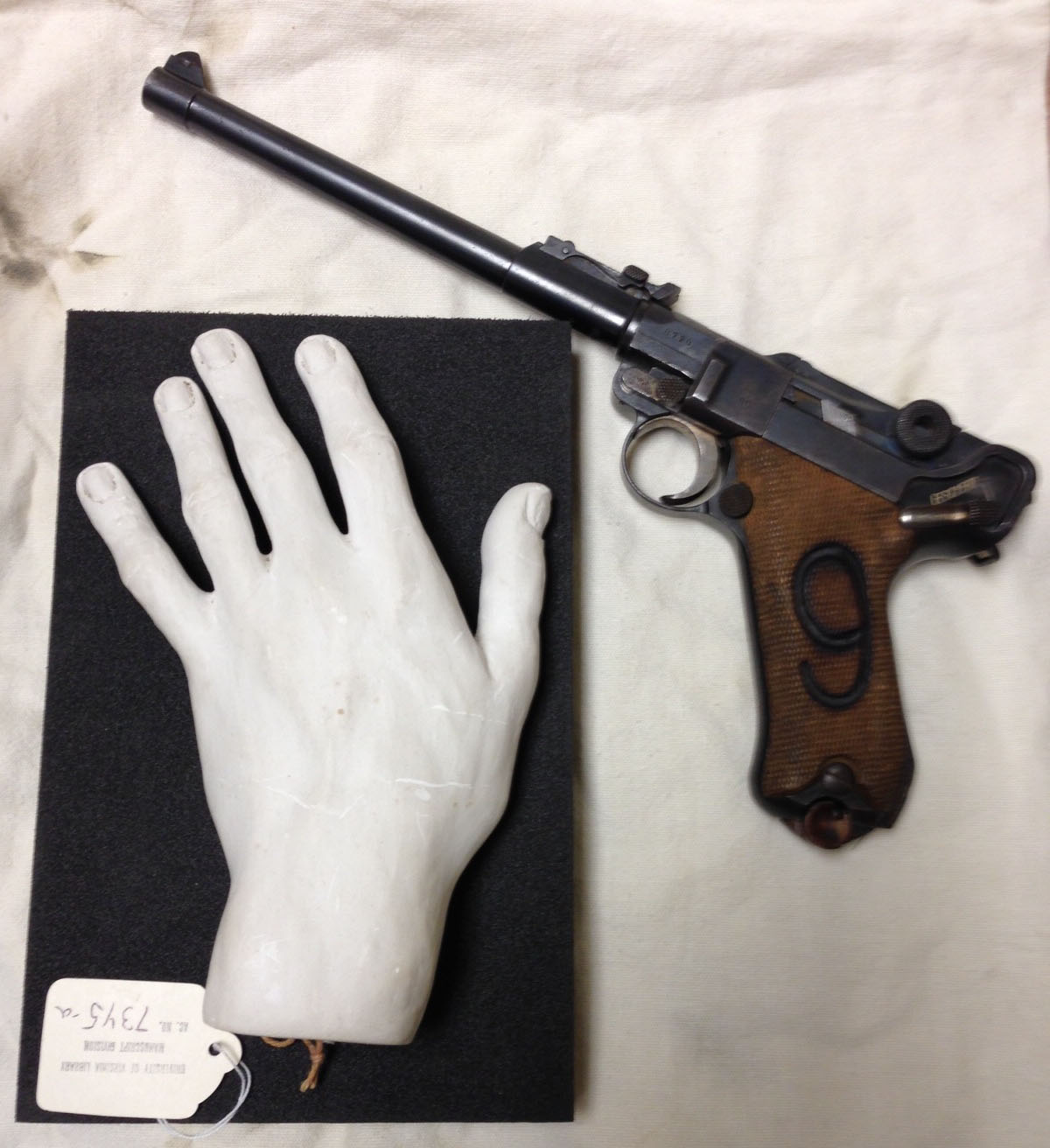
Yep. That’s right, a gun. Petrina Jackson, my boss, had sent me on a mission to find the German Luger the library holds for her USEM the next day. Naturally, it was in the far-off corner of the stacks furthest from any doors, where people rarely go. Just where I wanted to look for a gun that belonged to a German officer in World War I—please note my sarcasm. Nevertheless I steeled myself, and searched that isolated corner and found the box where I thought the gun was kept. Not wanting to have to embark on this gun-finding mission a second time, I wanted to ensure that the gun was actually in this particular box. So I pulled it down in that isolated corner, set it down, and lifted off the lid–only to find a preserved human hand inches from my face.

Needless to say, I screamed. And being in an isolated corner of stacks, no one came to my rescue. OK, “screamed” might be a bit of an exaggeration, but the fact that I found a hand in the process of looking for a German Luger was enough to shake me up.

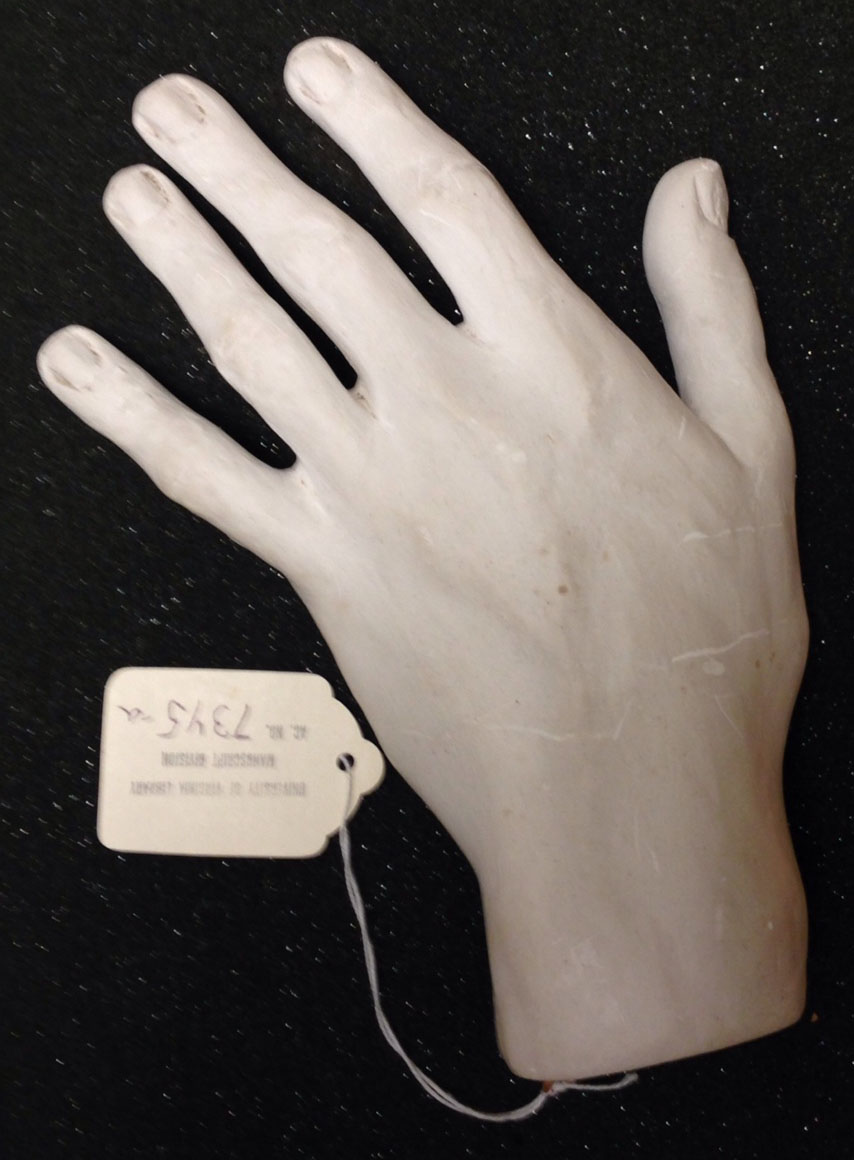
Upon closer inspection, I ascertained that this particular hand was not petrified; but rather, was a cast of someone’s hand– albeit a very convincing cast. Regardless, I wasn’t about to search the box any further for the gun, which, as it turns out, wasn’t even in that box anyway.

(Photograph by Caroline Newcomb)

Cast of John Powell’s hand. (MSS 7345-a. Photograph by Caroline Newcomb)

But why on earth does the Special Collections library hold a cast of a hand? Whose hand was it?

As it so happens, this particular hand belonged to the well-known John Powell, whose extensive personal papers are housed in Special Collections.

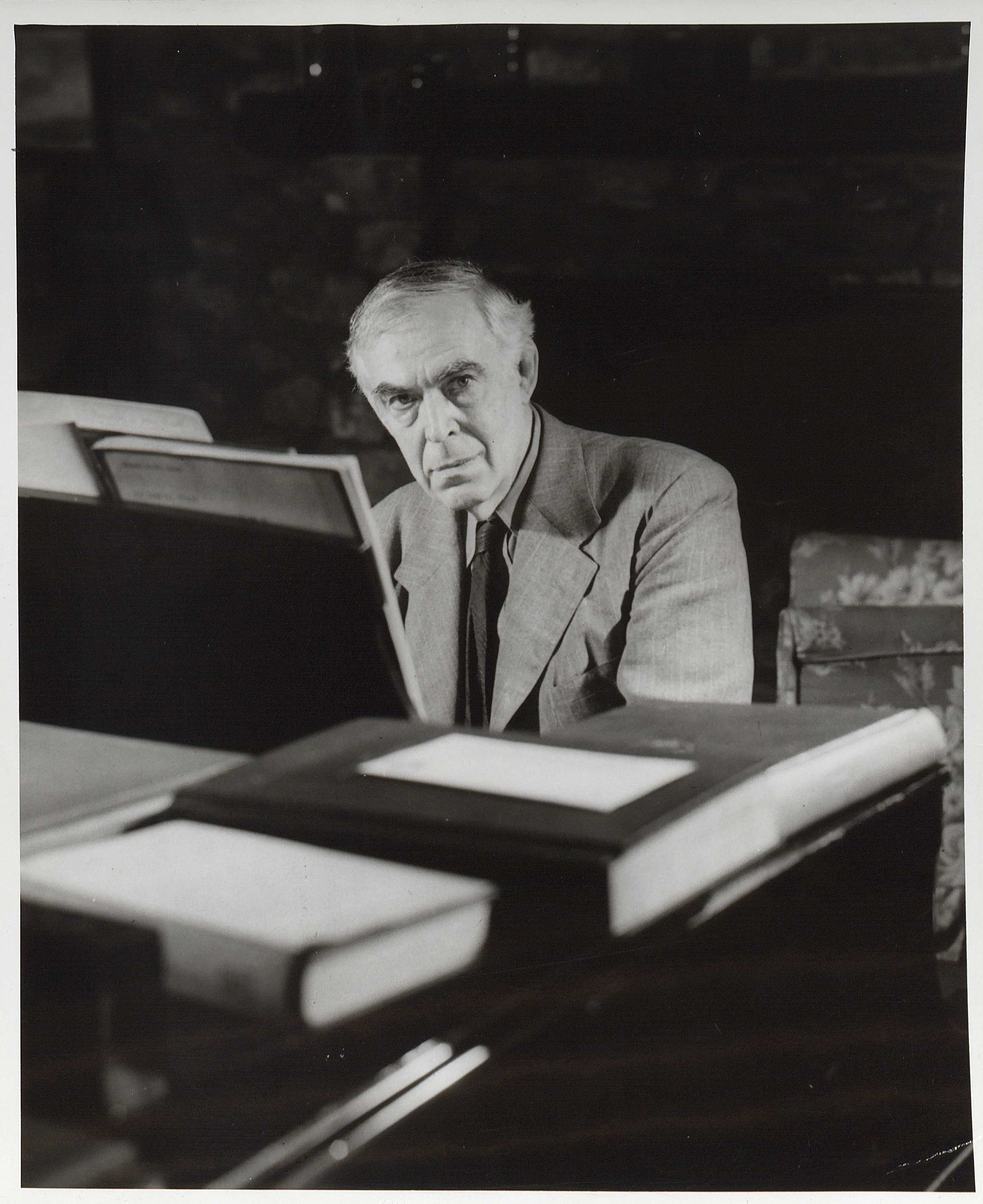
Portrait of John Powell, undated. (Image by Caroline Newcomb)

Portrait of John Powell, undated. (MSS 7284. Image by Caroline Newcomb)

John Powell devoted much of his life to music. In addition to trying to establish a chair of music here at U.Va., he wrote and performed music around the country.
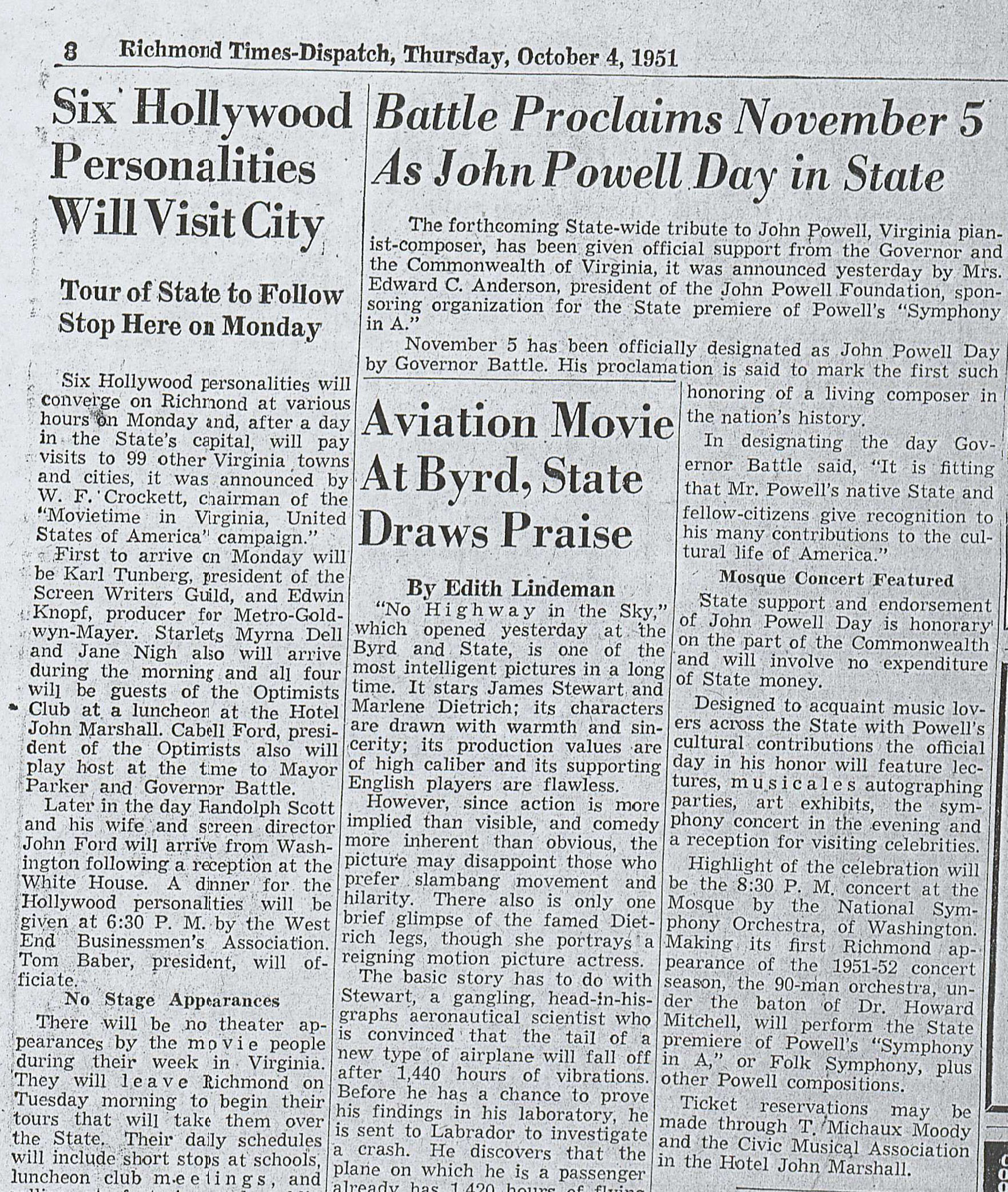
In fact, he was so talented and well-known that when his Symphony in A premiered on November 5, 1951, the governor declared it “John Powell Day.” “It is fitting,” Governor Battle said, “that Mr. Powell’s native State and fellow-citizens give recognition to his many contributions to the cultural life of America”

Newsclipping about John Powell Day, featured in the Richmond Times-Dispatch, 19 (Image by Caroline Newcomb.)

Newsclipping about “John Powell Day,” featured in the Richmond Times-Dispatch, 4 October 1951. (MSS 7284. Image by Caroline Newcomb)

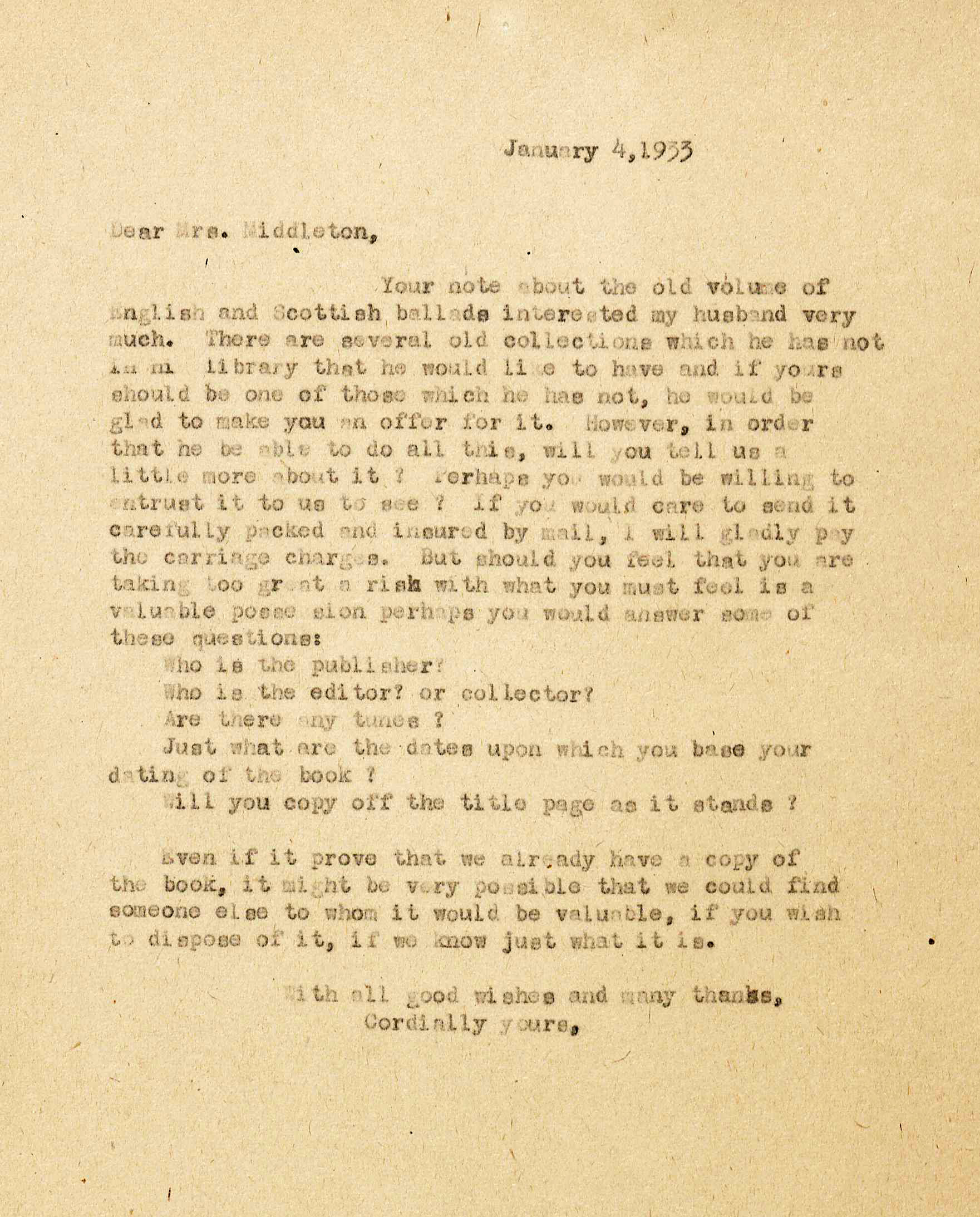
Mr. Powell did more than write and perform music; he also collected it. As an ethno-musicologist, he gathered music written by Anglo-Saxons in an effort to prove not only that his contemporary Anglo-Saxons could write valuable music, but also that Anglo-Saxons had a history of musicianship.

Powell letter to , 1933 (Image by Caroline Newcomb)

Here is a letter written by John Powell’s wife, Louise, to Mrs. Middleton, detailing a potential purchase of Anglo-Saxon music, 4 January 1933.  (MSS 7284. Image by Caroline Newcomb)

If it seems a bit strange to you—as it did to me—that Powell advocated for and collected specifically Anglo-Saxon music, then your intuition would be right on track. John Powell’s life revolved around more than music. Perhaps even more than a musician, John Powell was a eugenicist. The reason he collected Anglo-Saxon folk music was more about establishing this music as the music of the American Nation, supreme over all other music, than it was about proving Anglo-Saxon musical ability.

Pages nine and ten of Powell's "Music and the Nation." (Image by Caroline Newcomb)

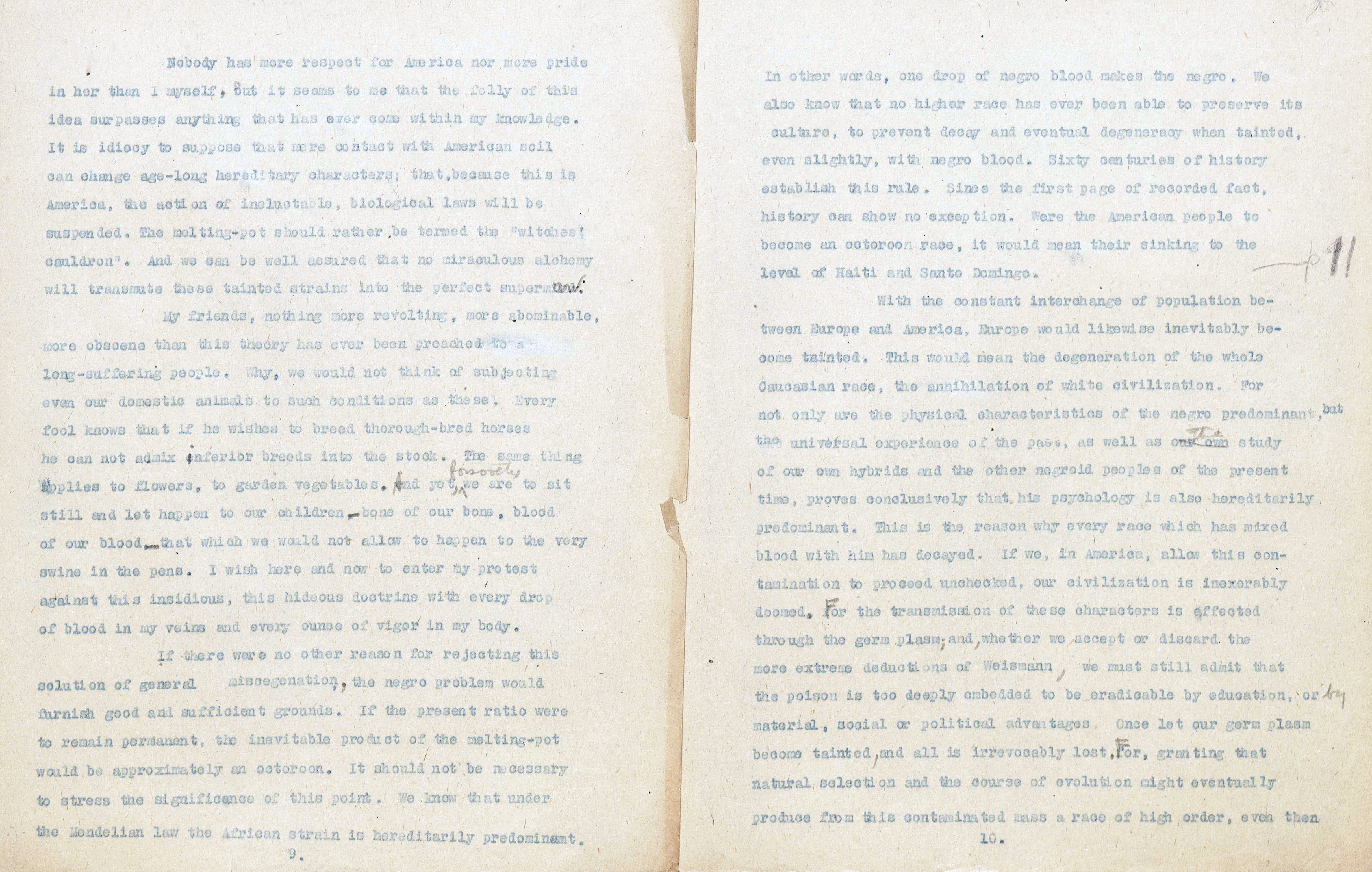
Pages nine and ten of Powell’s “Music and the Nation.” (MSS 7284. Image by Caroline Newcomb)

In “Music and the Nation” [above], Powell argued that the United States at the time was not a nation, because a nation could only exist when it comprised a population homogeneous in blood, language, culture, and values. America, he further argued, used to be a nation, but ceased to be so when non-Anglo-Saxon immigrants and slaves were permitted or forced to enter the country, respectively. Comparing America’s population unfavorably to thoroughbred horse breeding, he argued, “the immense influx of the lower elements of the European and other continents…debase the average level of intelligence and character of the population.” He pushes for the deportation of non-Anglo-Saxon individuals and groups, as well as for stricter immigration laws, to prevent the further “degradation of white civilization.”

This puts a whole new perspective on the “many contributions to the cultural life of America” that Governor Battle extolled in John Powell.

The Last Stand by John Powell (Image by Caroline Newcomb)

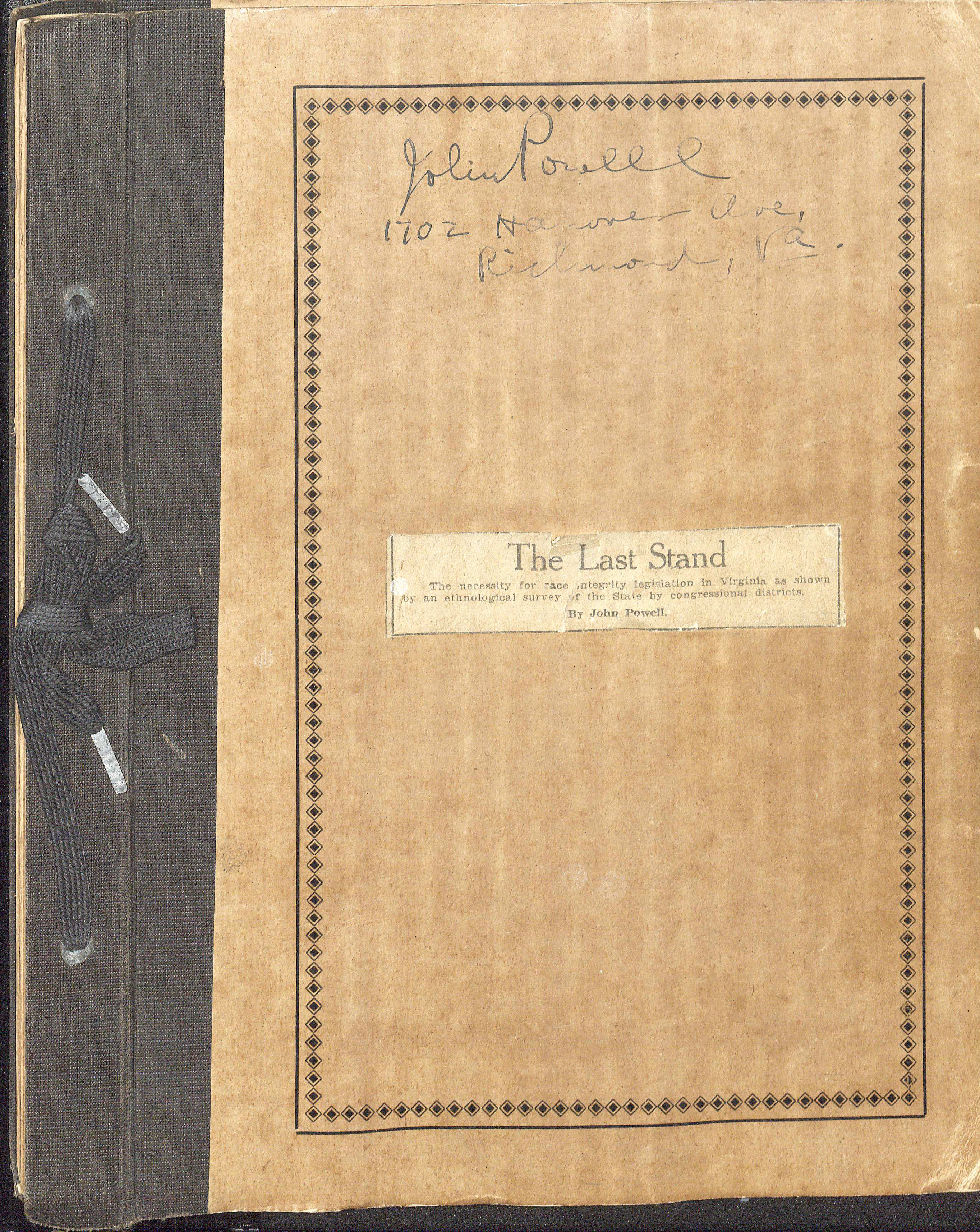
The Last Stand by John Powell (MSS 7284. Image by Caroline Newcomb)

Writings such as “Music and the Nation” and “The Last Stand” do not even begin to cover the massive efforts Powell made to render The United States an entirely Anglo-Saxon nation. Many of his letters, writings, and other works detail his opinions on the superiority of individuals of so-called “Anglo-Saxon stock” in terms of intelligence, language, and culture. What makes John Powell stand out even more is that his approach to eugenics used not only the usual arguments, but also intersected with music—the other love of his life. Not only did he believe that Anglo-Saxon individuals could compose music; he also believed that Anglo-Saxon music constituted the only true music—the best music.

I never found that German Luger I was looking for that day, but instead spent several days exploring Powell’s collection. Each time I found myself leaving feeling angry and sick to my stomach. Part of me wanted to burn the entire thing—all 47 boxes. However, the reality stands that eugenics constitutes an important part of our history in both Virginia and America—important in its danger, and the fact that notable individuals subscribed to this view. There are 47 boxes in Special Collections dealing with just one of the countless eugenicists in Virginia and America’s history. I may have started out looking for an example of racism, oppression, and genocide abroad, but the reality, as well all should know, is that these horrors exist(ed) here too, and constituted the ideals of touted individuals. That is not something we should ignore, but something we can learn from instead.

Mold of John Powell's hand and German Luger, 1917 (Image by Caroline Newcomb)

Cast of John Powell’s hand and German Luger from a collection of German World War I and II materials, 1917. (MSS 7345-a and MSS 9405-u. Image by Caroline Newcomb)

***

Caroline Newcomb, fall semester 2013. (Photograph by Petrina Jackson)

Caroline Newcomb, Class of 2014, fall semester 2013. (Photograph by Petrina Jackson)