Curating Yoko Ono

Anyone who has ever curated or installed an exhibition of books and manuscripts knows that these materials are inherently impossible to exhibit effectively. While paintings and sculpture are created with the intention of exhibition, most of the artifacts we hold are not. Visitors can only see one page of any multipage document, and artifacts that were made to be held in one’s hands and experienced intimately are relatively far away, usually behind glass. Curators are always looking for ways to transcend these difficulties. We hem and haw over writing lengthy descriptions in labels. If we have funds, we create high-quality facsimiles of hidden pages or even a “page-turner” digital facsimile of the complete artifact.

Who knew effective display could involve smashing china cups to smithereens?

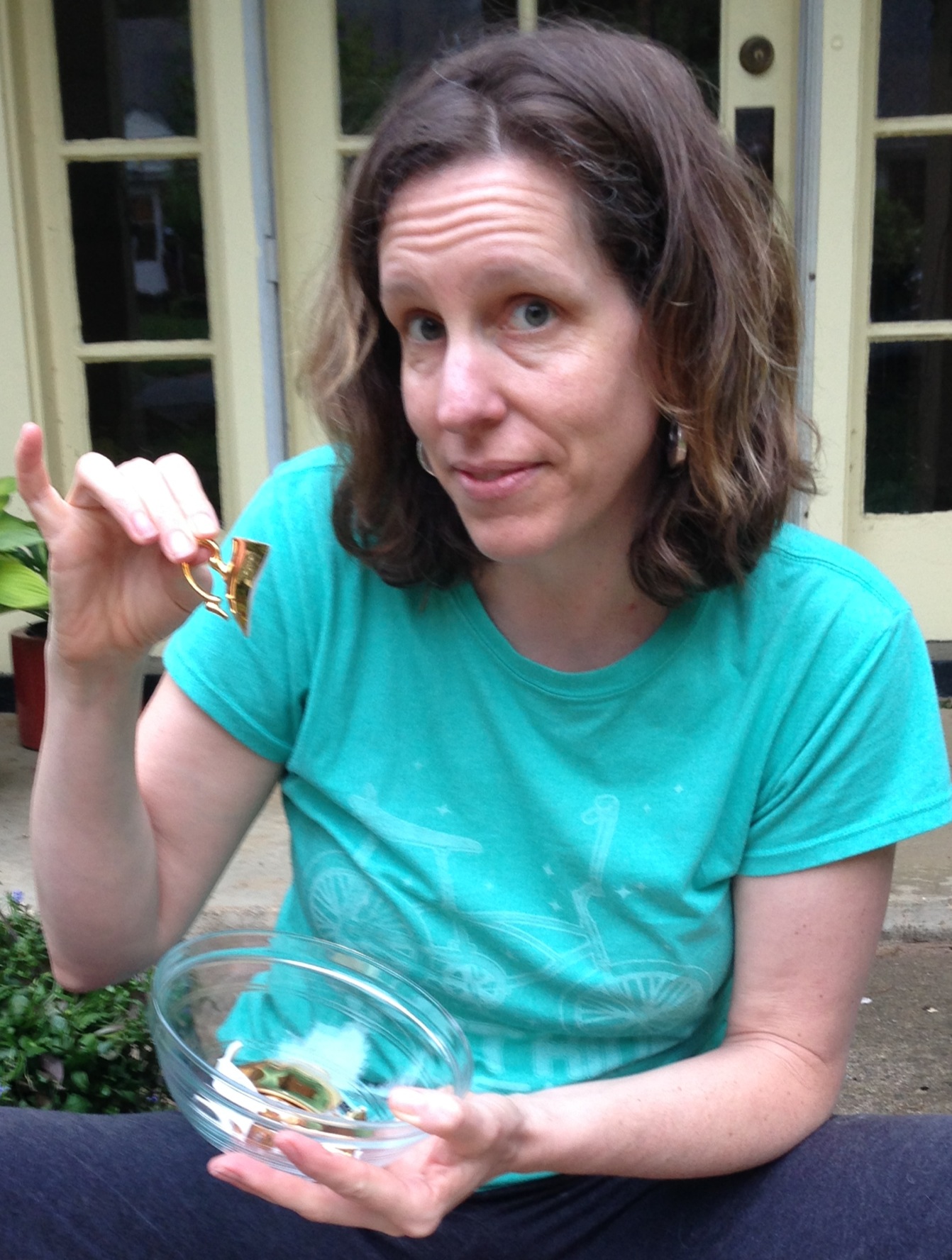
Here is the curator, hard at work.

Here is the curator, hard at work. (Photo by Alicia Dietrich)

I have just finished installing our latest exhibition, “Magazines Unbound: Periodicals as Art 1942-1983.” This project reveals an unexpected strength in our collections: magazines conceived of as formal artistic experiments in and of themselves. Most of the magazines displayed are gatherings of paper or even objects into folders, envelopes, and boxes, rather than bound as books. This makes them, in some ways, ideal for exhibition.

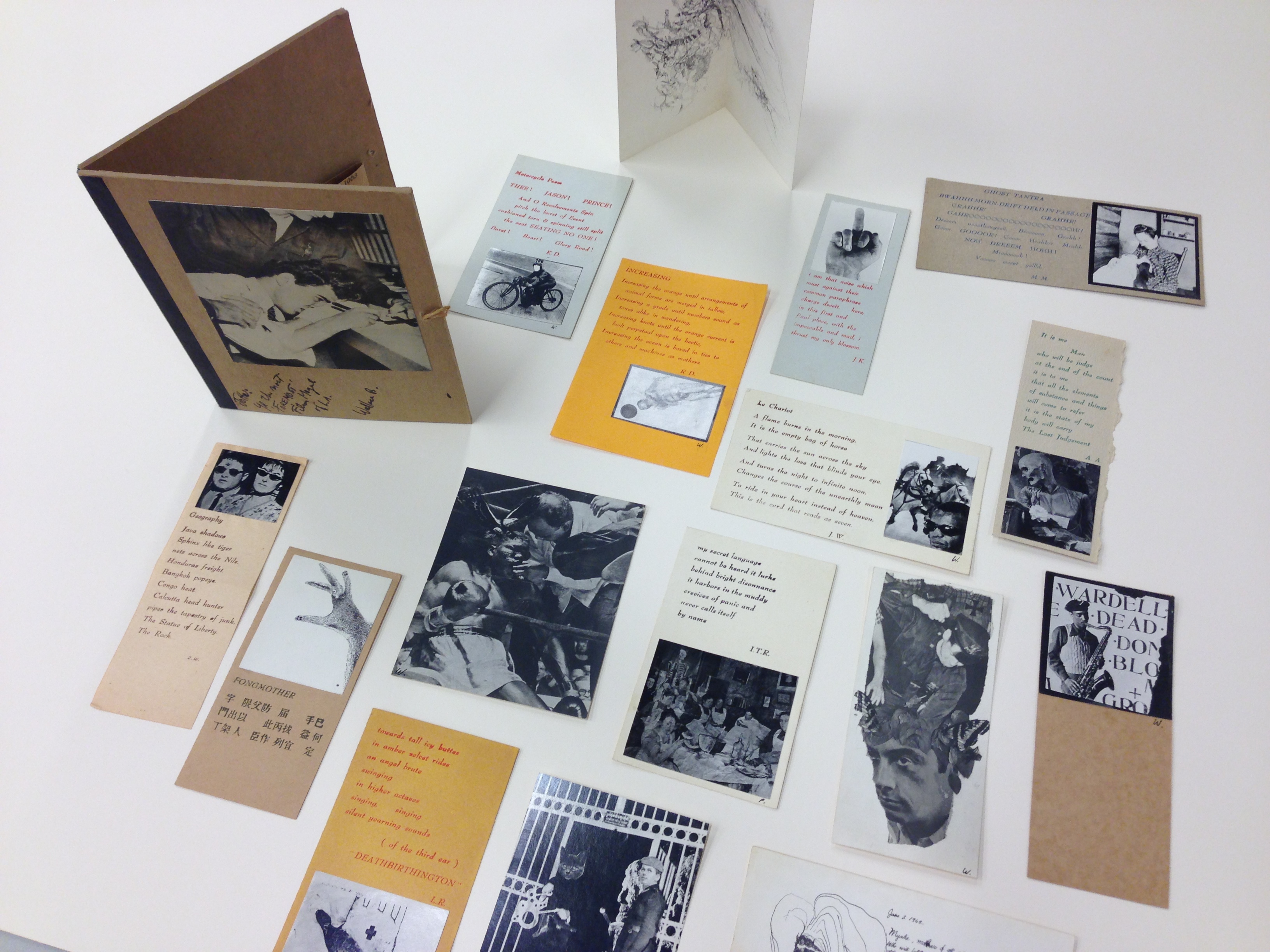
The 1950s west-coast Beat magazine Semina displays beautifully, since most of its contents are loose sheets. (

The 1950s west-coast Beat magazine Semina displays beautifully, since most of its contents are loose sheets. Shown are most of the contents of Semina 8 being prepared for exhibition (PS 580 .S45, Marvin Tatum Collection of Contemporary Literature. Photo by Molly Schwartzburg)

But two of the magazines–Aspen and S.M.S.–were venues for conceptual artists in the 1960s, who had a penchant for works of art that remain incomplete without the participation of the reader or viewer. Among the objects included are records and audio and video tapes that need to be played, instructions for writing a poem, templates for boxes that need to be glued together, and a paper doll and candy-wrapper that need to be cut out. What’s a curator to do?

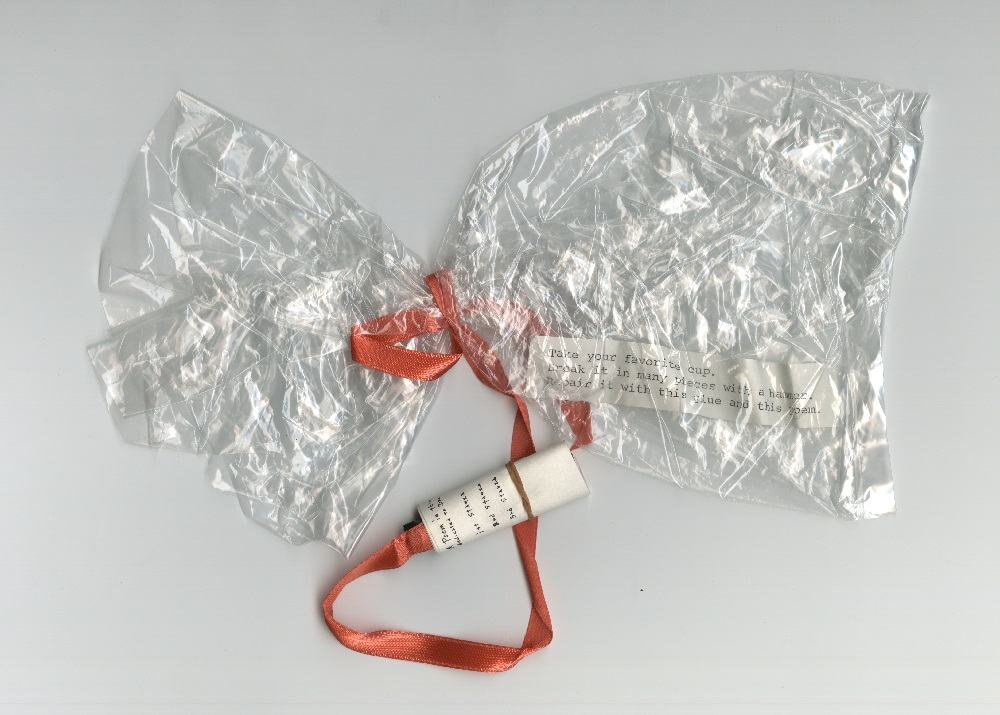
I chose to let all the works stand incomplete with one exception: Yoko Ono’s “Mend Piece for John,” shown below.

Yoko Ono's *****. From S.M.S. 5 (October 1968).

Yoko Ono’s “Mend Piece for John,”. From S.M.S. 5 (October 1968). (N1 .S15, University of Virginia Library Associates Fund. Image by Molly Schwartzburg)

A tube of glue is wrapped with a poem, and attached to a plastic bag with a satin ribbon. Inside the bag is a set of typed instructions:

Take your favorite cup.

Break it in many pieces with a hammer.

Repair it with this glue and this poem.

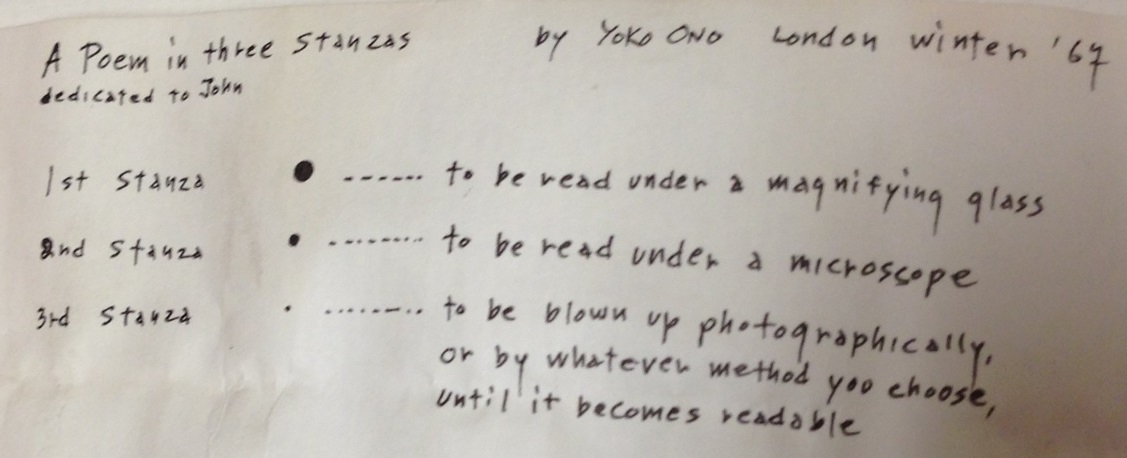
The poem wrapped around the tube of glue in Ono's piece.

This poem comes wrapped around the tube of glue in Ono’s piece with a rubber band. After unwrapping it to be sure I knew what it included, I took a quick snapshot for reference purposes before carefully rewrapping it. (Photo by Molly Schwartzburg)

How could I resist? A friend was visiting from out of town, so we went out to The Factory, my favorite antique mall out in the Shenandoah Valley, where we selected two cheap but visually appealing teacups. “But wait,” you say. “Didn’t the instructions specify that it be ‘your favorite cup’?” Well…let’s just say I wasn’t ready to make that kind of sacrifice for work. It was still a pretty profound experience.

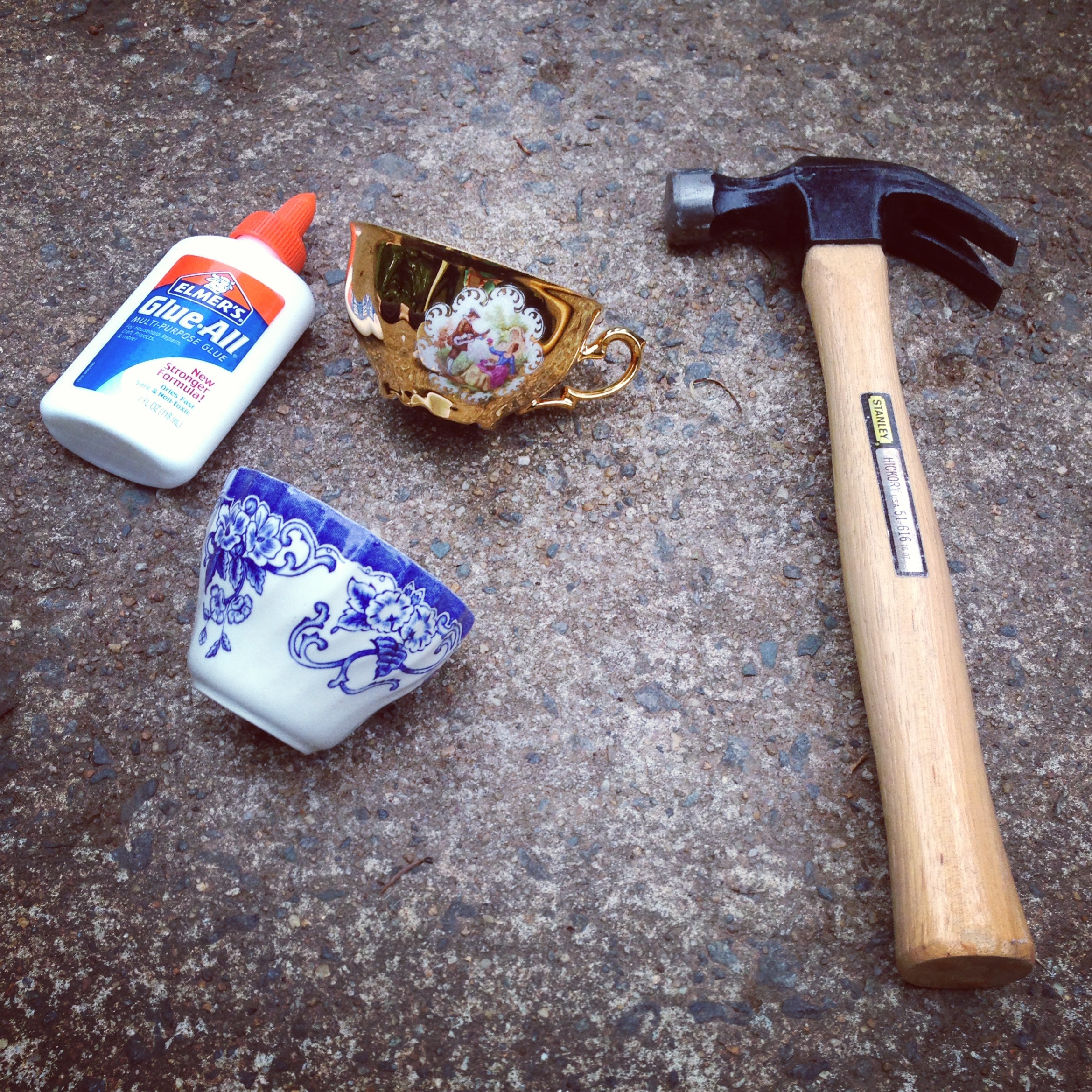
We prepared to destroy the teacups in my front yard.

We prepared to destroy the teacups in my front yard. (Photo by Molly Schwartzburg)

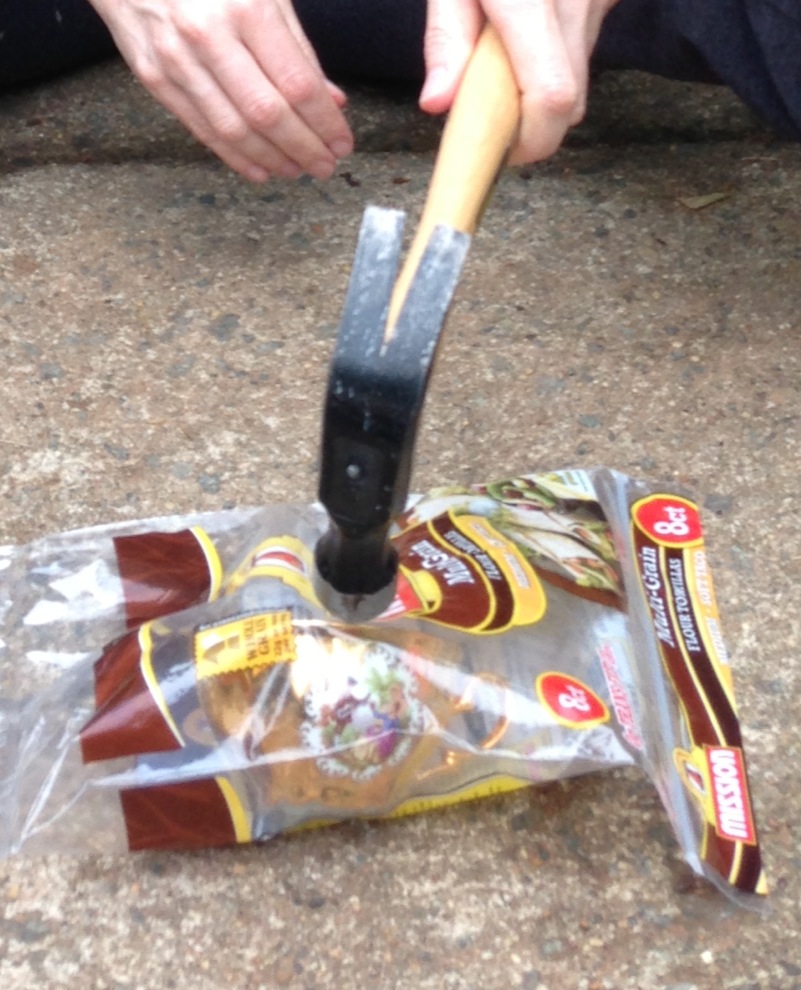
No tortillas were harmed in the making of this artwork. But it only took one try to shatter each cup. This was the fun part.

No tortillas were harmed in the making of this artwork. It only took one blow to shatter each cup. This was the easy part. (Photo by Alicia Dietrich)


The glueing was fun at first, and then we realized how long it was going to take. We had to sit very still holding each piece for at least 15 or 20 minutes before we could safely let it go. So we sat, talked, glued, talked, and mended. It was wonderful.

The glueing was fun at first, and then we realized how long it was going to take. We had to sit very still holding each piece for at least 15 or 20 minutes before we could safely let it go. So we sat, talked, glued, talked, and mended. It was wonderful. (Photo by Molly Schwartzburg)

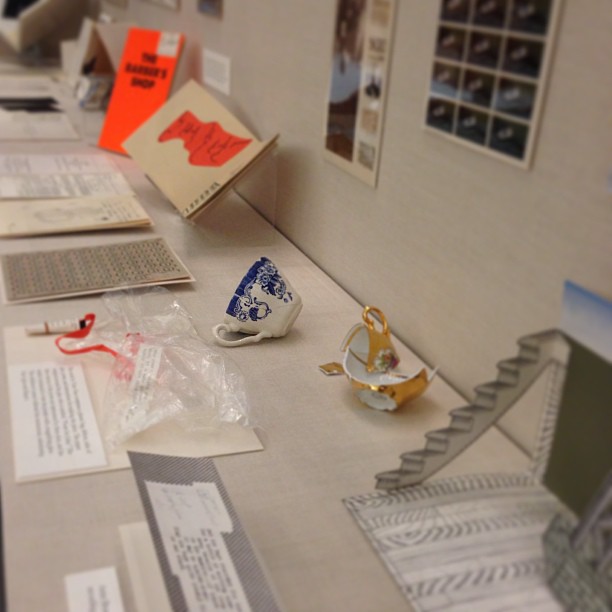
Here's the final view of the item in the exhibition, with all the other materials in S,M.S. 5.

Here’s the final view of the item in the exhibition, with all the other materials in S.M.S. 5. (Photo by Molly Schwartzburg)

I can’t say that visitors to the exhibit will understand the piece fully just because they can view its final result in the cases. But my friend and I discovered that the process itself, even modified, was wonderfully meditative. There is something about mending a cup, slowly and deliberately, that is itself healing, we discovered. Even if the cup is no longer usable. I’ll look forward to taking these results back home after the exhibition comes down.

You can view Ono’s piece in the exhibition “Magazines Unbound: Periodicals as Art 1942-1983” in the First Floor Gallery until January 5, 2014.

This Just In: Summer Beach Reading, Part II

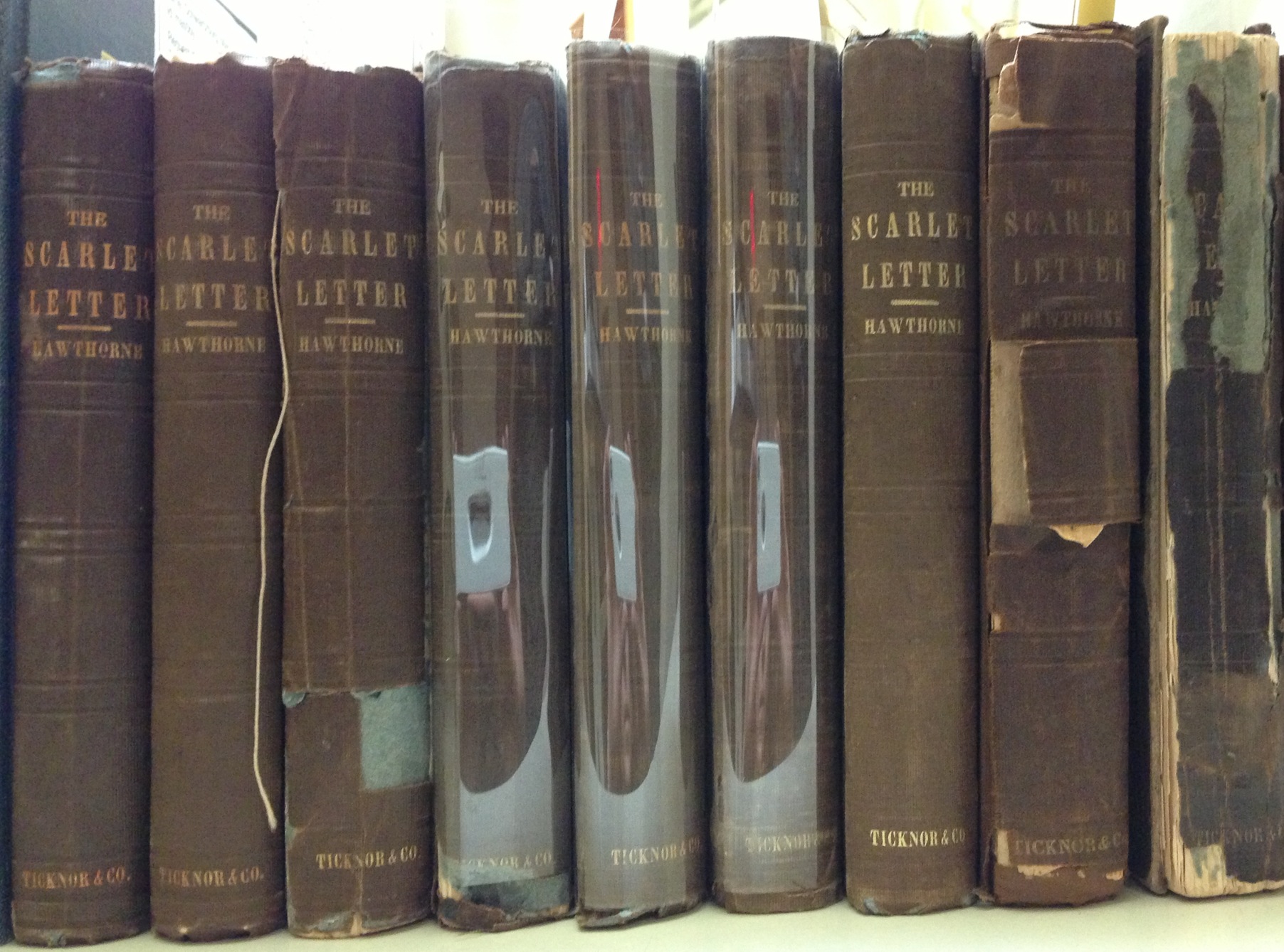
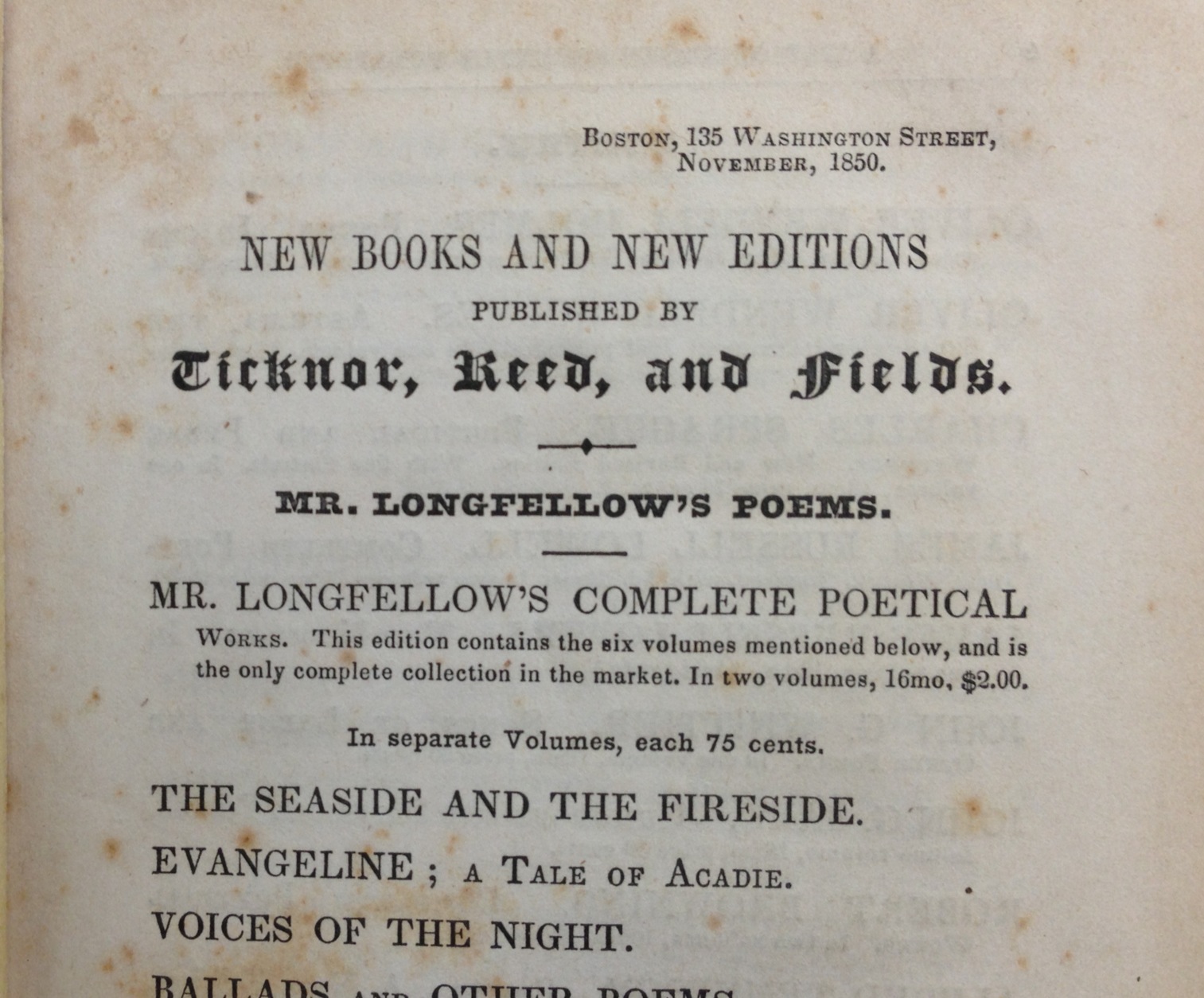
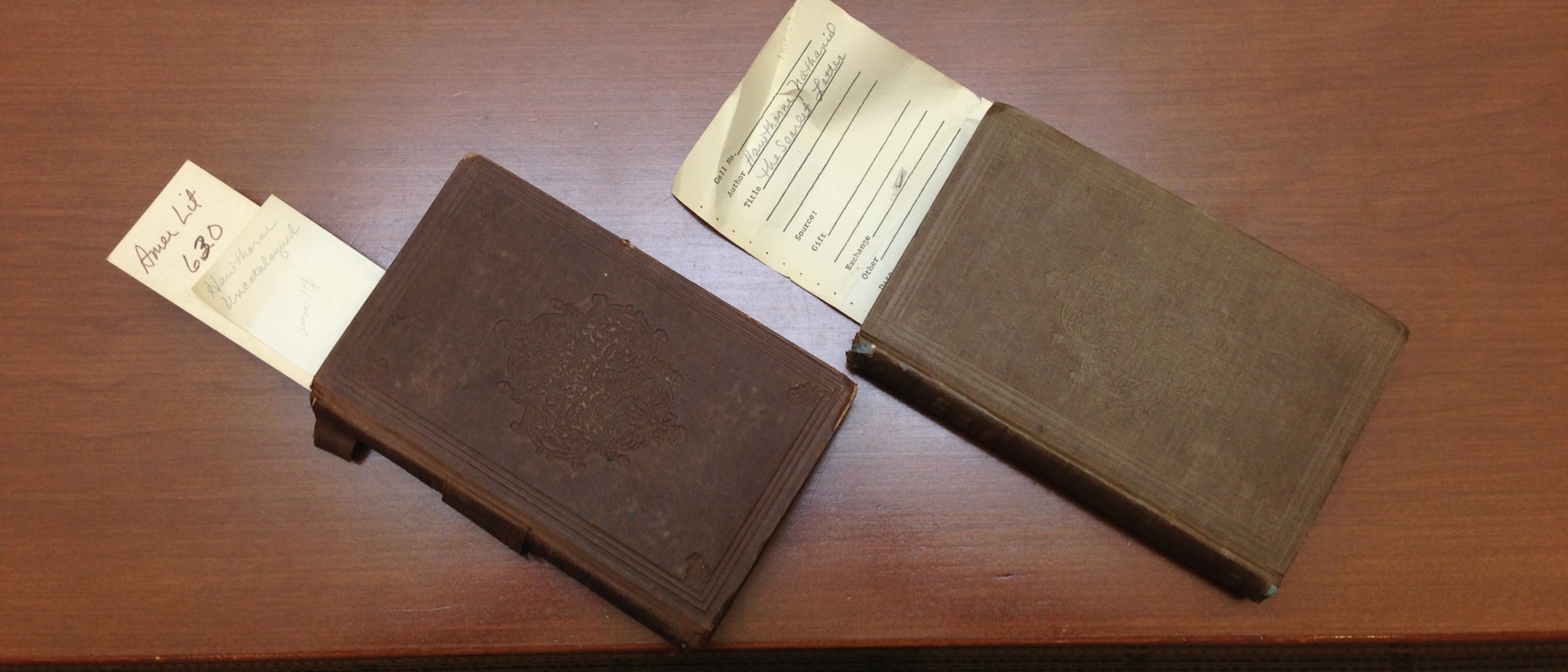
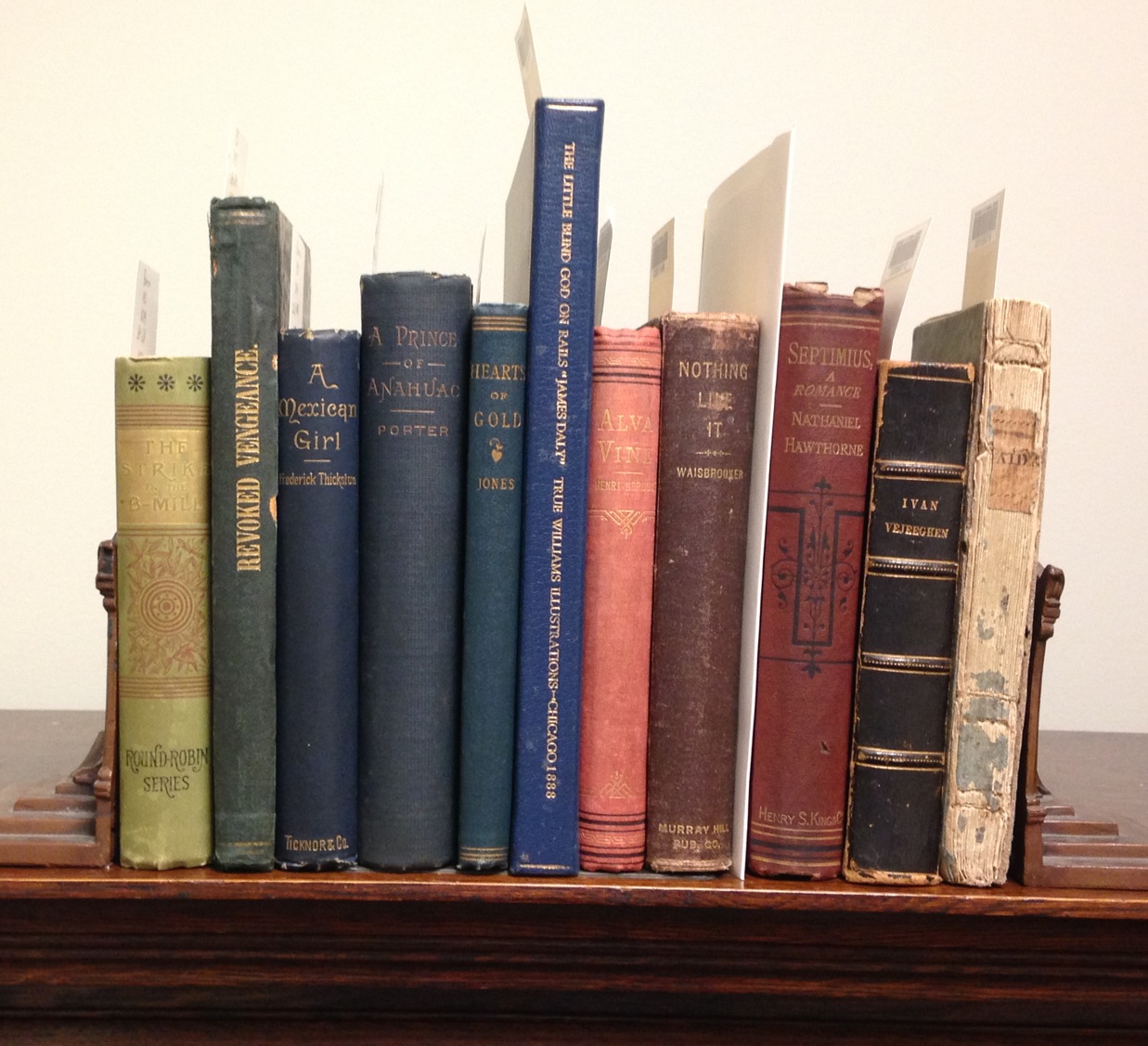
Some of our summer beach reading: 19th-century American fiction newly added to the Clifton Waller Barrett Library of American Literature

Some of our summer beach reading: 19th-century American fiction newly added to the Clifton Waller Barrett Library of American Literature

You may have noticed that “This Just In” took a brief summer hiatus. Yes, it’s true: we were vacationing at the beach, reading!  Catching up, not with the latest Dan Brown thriller, but with an influx of 19th-century American fiction to the Clifton Waller Barrett Library of American Literature. It is unlikely that any of these works ever made the best-seller list, but we recommend them to you nonetheless, for they significantly enrich the Barrett Library’s holdings in interesting ways.

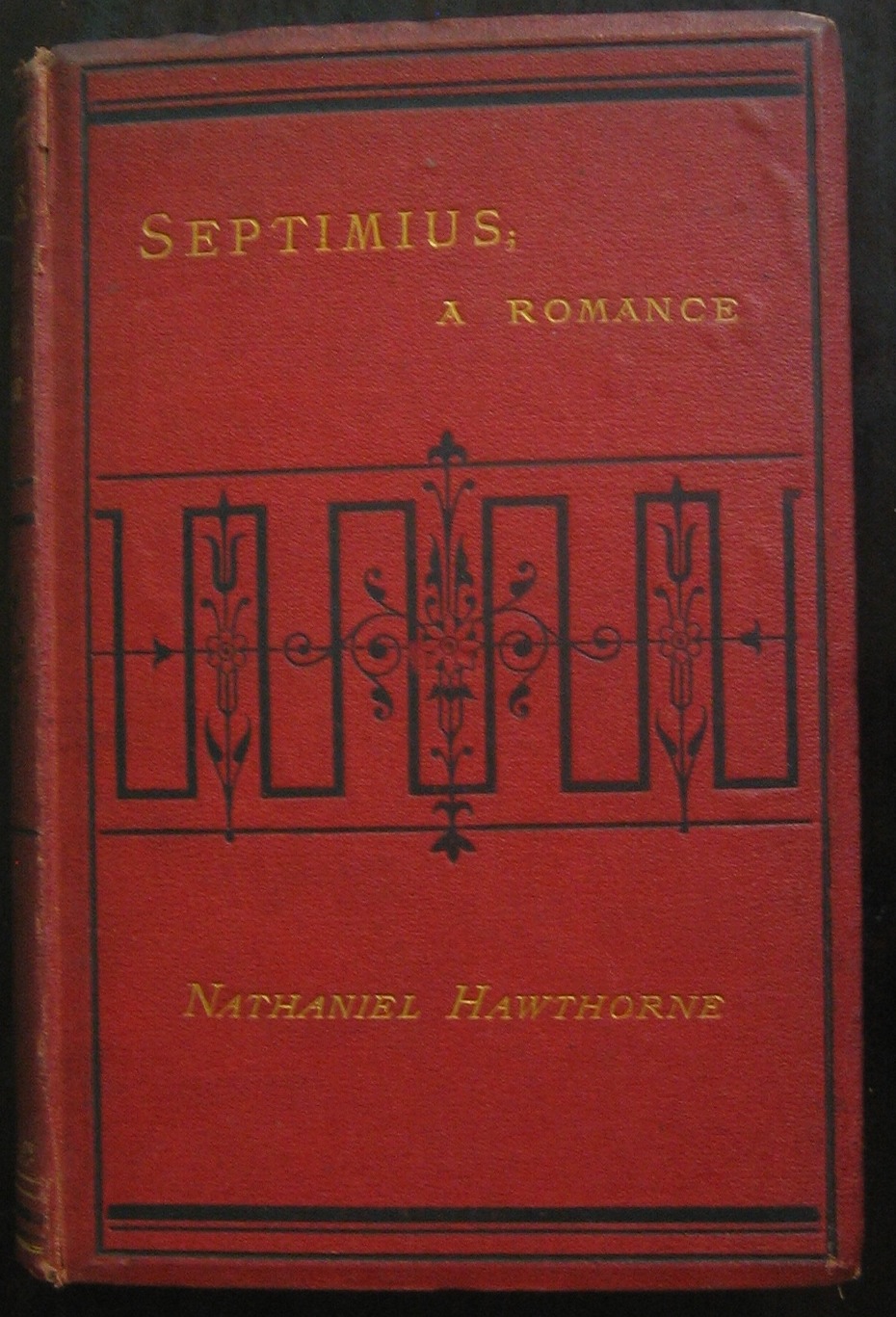
Nathaniel Hawthorne, Septimius: a romance. London: Henry S. King & Co., 1872. (PS1872 .S4 1872d)

Nathaniel Hawthorne, Septimius: a romance. London: Henry S. King & Co., 1872. (PS1872 .S4 1872d)

The Barrett Library is so comprehensive for major American authors that it is hard to believe that it lacked a Nathaniel Hawthorne first edition! But only this spring did we obtain the true first edition of Septimius: a romance. Left unfinished at Hawthorne’s death, Septimius was prepared for publication by his daughter Una with assistance from Robert Browning. The first edition appeared in London in 1872, with the first American edition, retitled  Septimius Felton: the elixir of life, following two months later. Initially well received, Septimius was soon deemed a “failure” by critics, though there are signs of renewed scholarly interest in Hawthorne’s “romance of immortality.”

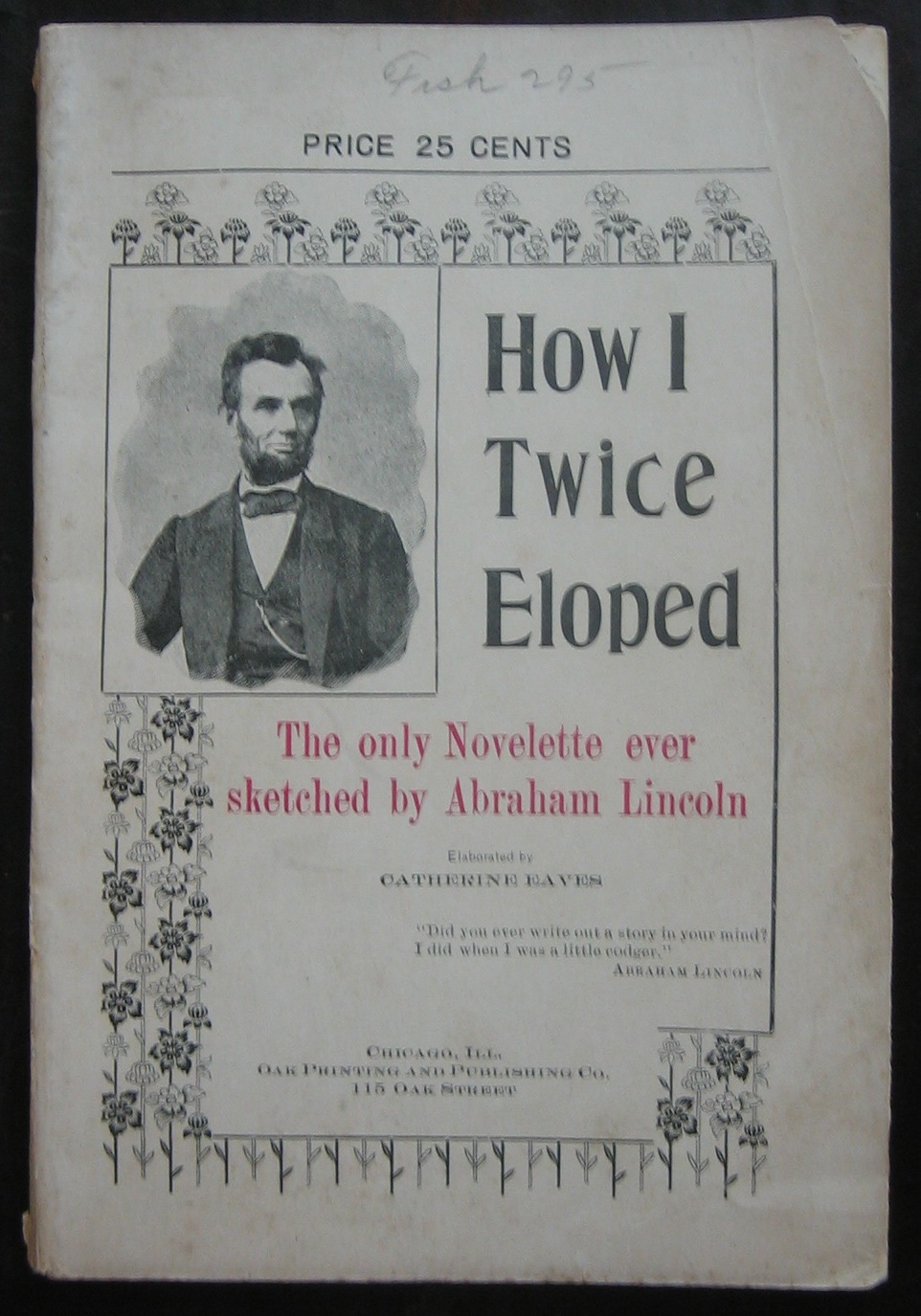
Catherine Eaves, How I twice eloped: an Indiana idyll. Chicago: Oak Print. and Pub. Co., 1901. (PS1567 .E36 H6 1901)

Catherine Eaves, How I twice eloped: an Indiana idyll. Chicago: Oak Printing and Publishing Co., 1901. (PS1567 .E36 H6 1901)

Did you know that Abraham Lincoln authored a short novel? Neither did we, until we encountered at a small book fair a copy in original illustrated wrappers of How I twice eloped: an Indiana idyll, billed as “the only novelette ever sketched by Abraham Lincoln.” Actually, a closer perusal reveals a sort of Lincolnesque tall tale, as Lincoln’s agency in this work was scant indeed. How I twice eloped was penned, we are told, by Catherine Eaves, a member of the Lincoln Literary Society in Hoosier Heights, Indiana, a stone’s throw from Lincoln’s boyhood home near the banks of the Ohio River. (Or perhaps the true author was the copyright holder, Albert Alberg.) Taking her cue from an anecdote (related in Ida Tarbell’s recently published Life of Abraham Lincoln) that Lincoln reputedly told about his youth in Indiana, Eaves “elaborated” it into a short novel. How I twice eloped is one of many fascinating works of regional American fiction to be found in the Barrett Library.

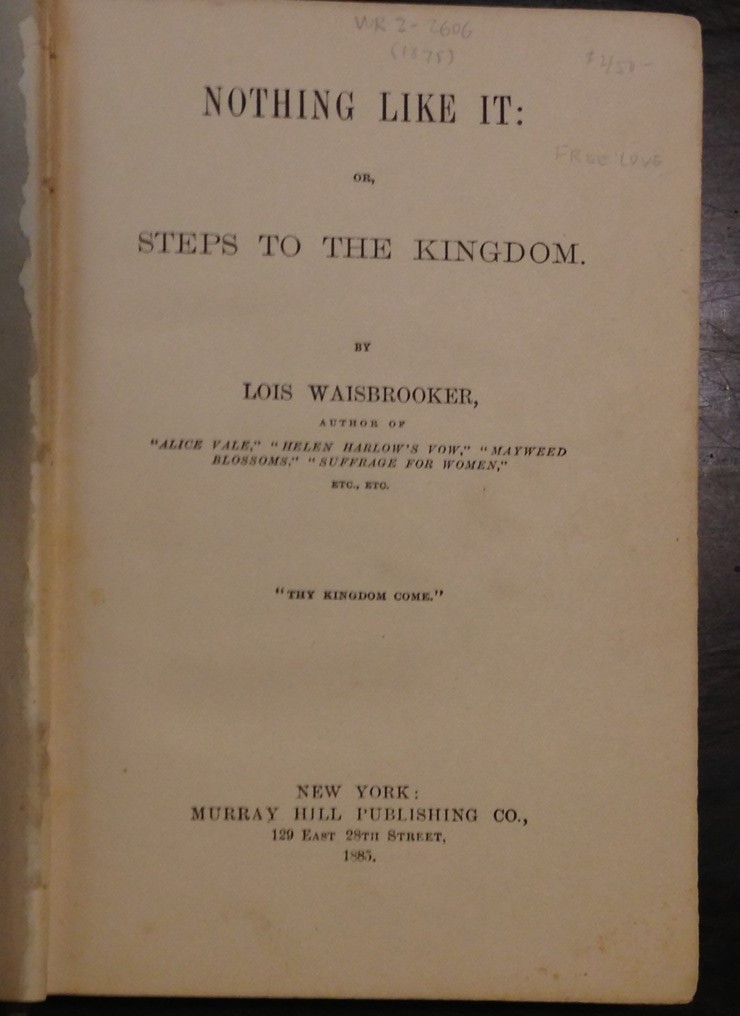
Lois Waisbrooker, Nothing like it, or, steps to the kingdom. New York: Murray Hill Publishing Co., 1885. (PS3129 .W38 N68 1885)

Lois Waisbrooker, Nothing like it: or, steps to the kingdom. New York: Murray Hill Publishing Co., 1885. (PS3129 .W38 N68 1885)

As the 19th century progressed, women’s issues loomed ever larger in American literature. Lois Waisbrooker was one of many who sought to advance the cause of women’s rights through didactic fiction. Born Adeline Eliza Nichols, Waisbrooker adopted a new name and a feminist outlook following a forced marriage. Her career as a radical reformer led her from spiritualism to anarchism, but it was as an advocate of women’s rights and sexual freedom that she was best known. Nothing like it: or, steps to the kingdom, first published in 1875, takes free love, public morals, and the true meaning of marriage as its ambitious subject. The Barrett Library still lacks the first edition, but we have acquired the second edition, published in New York in 1885 by the Murray Hill Publishing Co.—the publishing arm of free speech and birth control advocate Edward Bliss Foote.

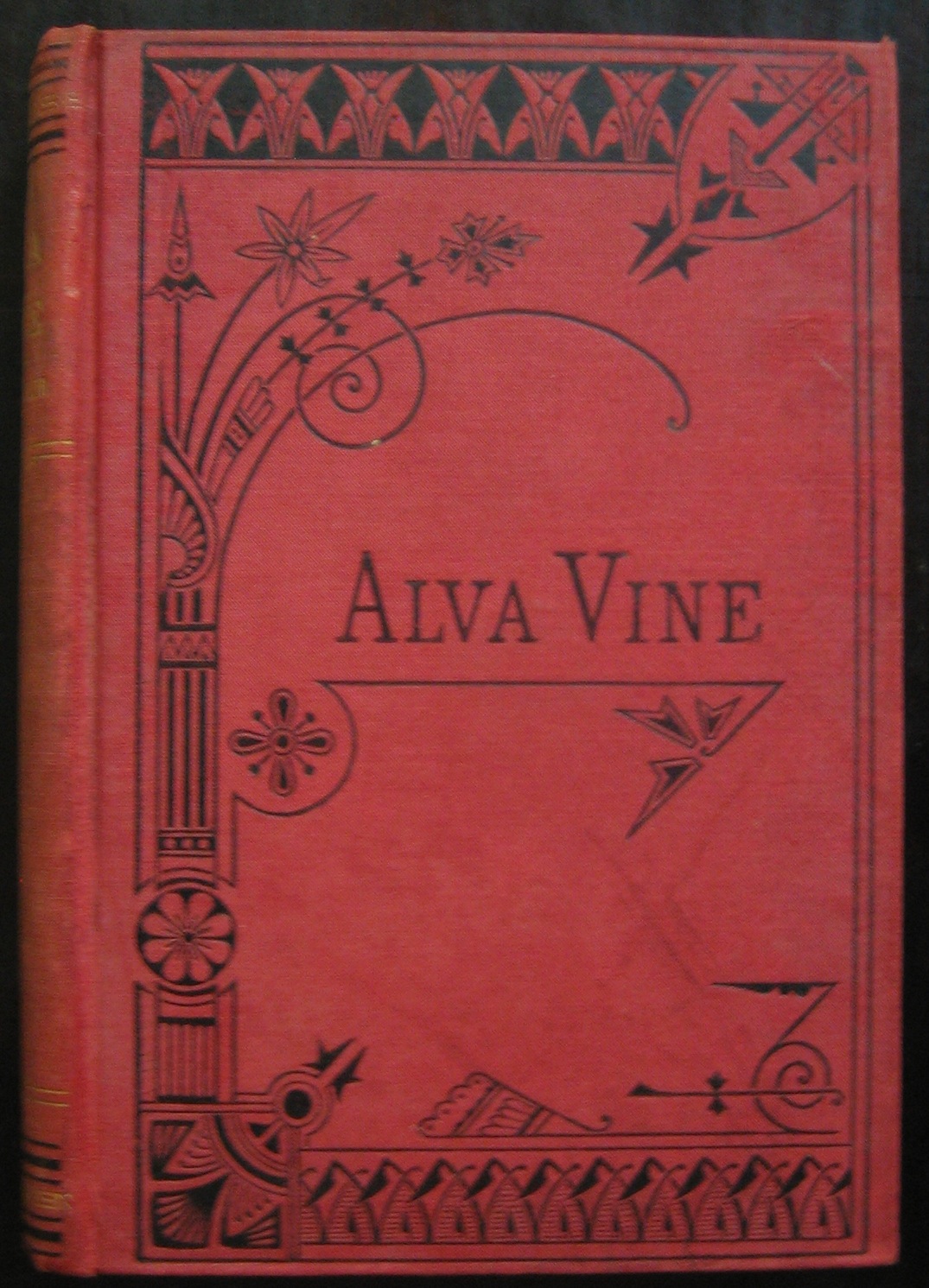
Henri Gordon, Alva Vine, or, art versus duty. New York: American News Co., 1880. (PS1757 .G42 A7 1880)

Henri Gordon, Alva Vine, or, art versus duty. New York: American News Co., 1880. (PS1757 .G42 A7 1880)

The changing role of women is addressed from a different perspective by Henri Gordon in Alva Vine; or, art versus duty, published in 1880. Noting that “one class now rapidly developing in the United States” is that of the career woman, Gordon tells the fictional story of opera singer Alva Vine, who “thinks and acts for herself as an individual endeavoring to do right and follow the dictation of the spirit given her for self direction, without regard to prejudices or received ideas of the exact boundaries of woman’s sphere, or the right she has to be a self-poised untrammeled, helpful woman, being bound only by a sense of duty and good judgment.” The novel is also interesting for its two “Artotype” illustrations, which are unrelated to the text. These probably were inserted at the request and expense of the Artotype patent holder in order to advertise this new photomechanical process. In any case, this is a very early use of Artotype for book illustration.

James Daly, The little blind god on rails: a romaunt of the Gold Northwest. Chicago: Rand, McNally & Co., 1888. (PS1499 .D87 L5 1888)

James Daly, The little blind god on rails: a romaunt of the Gold Northwest. Chicago: Rand, McNally & Co., 1888. (PS1499 .D87 L5 1888)

Another unusual late 19th-century example of “product placement” in American fiction is The little blind god on rails: a romaunt of the Gold Northwest, published in Chicago in 1888. This large-format work, authored by “James Daly” (pseudonym of Frank S. Gray) and profusely illustrated by True Williams (who earlier had illustrated Tom Sawyer), was written to promote leisure travel to the American northwest on board the Chicago & North-Western Railway. Train travel is the true hero of this tale, whose human characters, when not enjoying the sights or pursuing the “little blind god” (i.e. Love), extol the comfort and convenience of riding the rails.

J. McHenry Jones, Hearts of gold: a novel. Wheeling [W.Va.]: Daily Intelligencer Steam Job Press, 1896. (PS2151 .J28 H43 1896)

J. McHenry Jones, Hearts of gold: a novel. Wheeling [W.Va.]: Daily Intelligencer Steam Job Press, 1896. (PS2151 .J28 H43 1896)

The Barrett Library has also acquired a fine copy of Hearts of gold, the only novel published by J. McHenry Jones. An African American born in Gallipolis, Ohio, in 1859, Jones distinguished himself academically before moving to West Virginia in 1882. There he became a leader in the African American community, serving as a school principal and president of what is now West Virginia State University, a prominent member of fraternal organizations, a Republican Party stalwart, and newspaper editor. Jones opens Hearts of gold, published in 1896, in an idealized African American settlement north of the Mason-Dixon line. Its protagonists then move southward to attend a fraternal gathering, only to fall prey to the new forms of racial injustice being instituted by whites in the post-Civil War South.

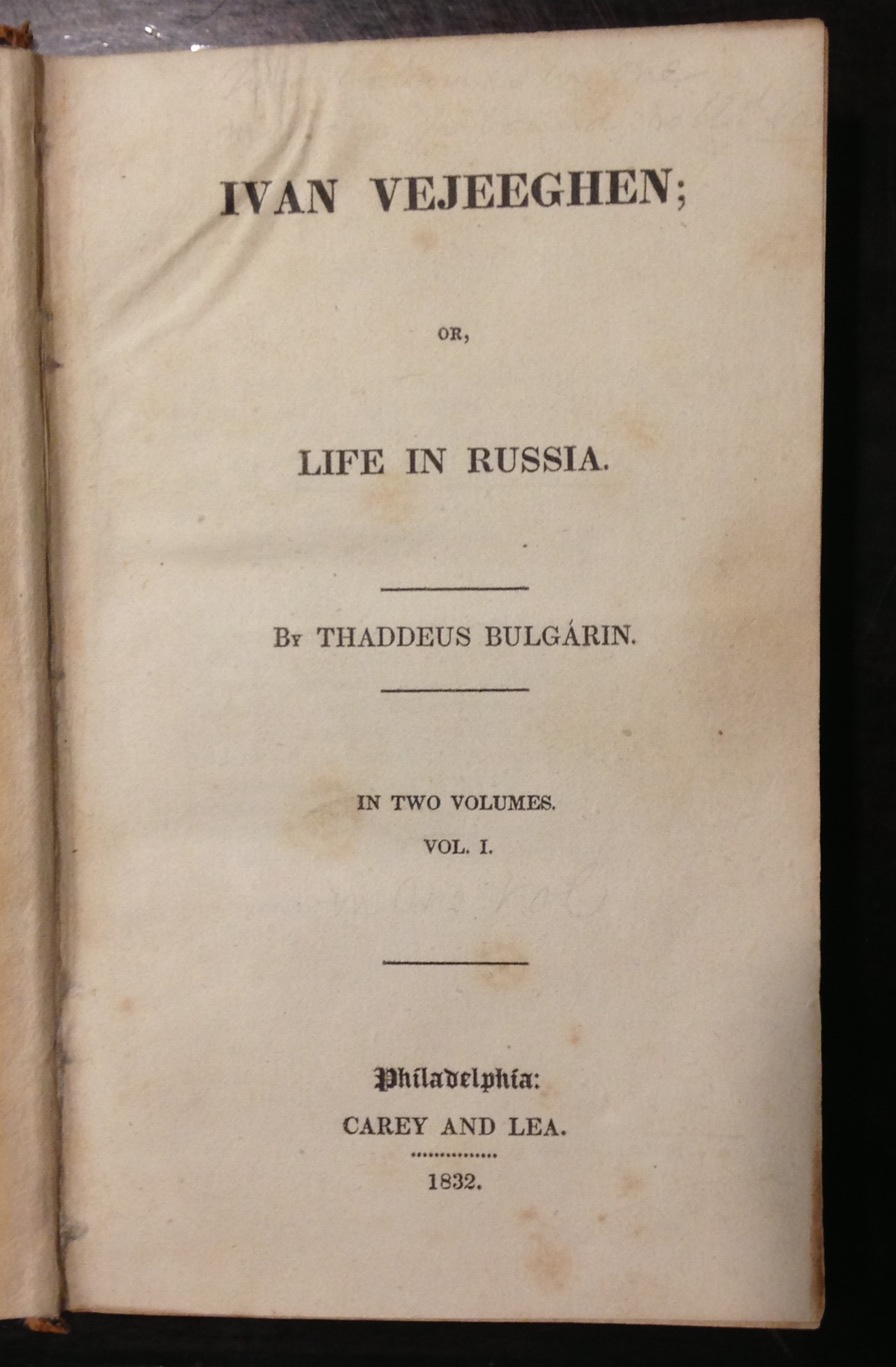
Faddei Bulgarin, Ivan Vejeeghen, or, life in Russia. Philadelphia: Carey and Lea, 1832. (PG3321 .B8 I815 1832)

Faddeĭ Bulgarin, Ivan Vejeeghen, or, life in Russia. Philadelphia: Carey and Lea, 1832. (PG3321 .B8 I815 1832)

Thanks in part to the enterprise of British publishers—and to the absence of international copyright agreements—19th-century American readers also had access to a surprisingly broad range of foreign literature in translation. In 1832, for instance, the Philadelphia firm of Carey and Lea—then the American publisher of James Fenimore Cooper’s best-selling novels—offered to their readers what may be the earliest work of Russian fiction to be translated into English, and the first to be published in the United States: Faddeĭ Bulgarin’s Ivan Vejeeghen; or, life in Russia. Set in early 19th-century Russia, Ivan Vejeeghen is less the story of its rather bland hero than a lively panorama of contemporary Russian society.  Bulgarin’s novel proved popular in Europe following publication in 1829, and an English translation by George Ross followed two years later. Carey and Lea promptly reprinted Ross’s translation, presumably without permission or royalty payment, but it is unlikely that they profited much from this speculation.

Patron’s Choice: Sex, Celebrity and Scandal in the Amélie Rives Chanler Troubetzkoy Papers

This week we are pleased to feature a guest post from Donna M. Lucey, author of Archie and Amélie: Love and Madness in the Gilded Age and Photographing Montana 1894–1928: The Life and Work of Evelyn Cameron and media editor for the online Encyclopedia Virginia being produced by the Virginia Foundation for the Humanities.

In this post, Donna Lucey provides some favorite high-points of using the Albert and Shirley Small Special Collection Library for her 2006 biography Archie and Amélie: Love and Madness in the Gilded Age.

***

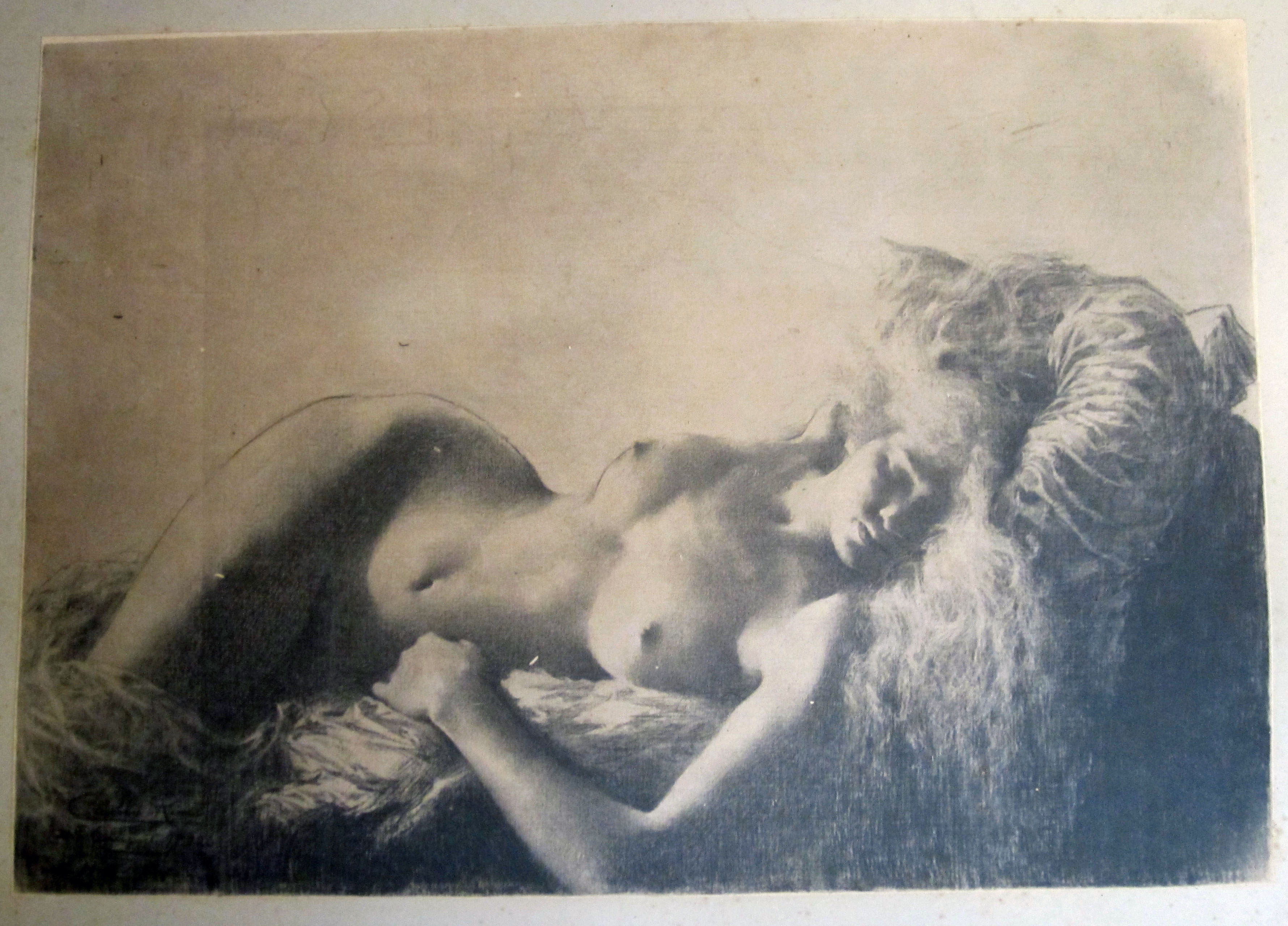
If there is one verity in life, it is this: SEX AND CELEBRITY AND SCANDAL SELLS. And those commodities pop up in the strangest places—take, for instance, the hushed, staid precincts of the Albert and Shirley Small Special Collections Library.  Who knew that sex would be lurking inside MSS 8925 of the Amélie Rives Chanler Troubetzkoy Papers? But open the oversized box of images attached to that number, and there she is—the voluptuous nude Amélie Rives in all her glory, lying on a divan in a kind of post-coital bliss, her eyes closed, her luxuriant mane of hair undone.  And what can one say about that curvaceous figure of hers? Some hyperbole had to be involved in that, right?  Who would draw such a thing in the 1890s?  In fact, Amélie herself created it.  She drew it on a Sunday in August—August 21, 1892, to be precise—the very day her paramour from London, Lord George Curzon (future Viceroy of India), arrived at her family’s ancestral Virginia estate, Castle Hill.  Her husband, John Armstrong “Archie” Chanler, an heir to the Astor fortune, was conveniently in New York City at the time….  Well, such are the secrets that the Special Collections Library harbors amid its underground treasures.

Nude photo of a reclining Amelie Rives Chanler, drawn by the subject. (MSS 8925. Photograph by Petrina Jackson)

Self portrait of a reclining Amelie Rives Chanler. (MSS 8925. Photograph by Petrina Jackson)

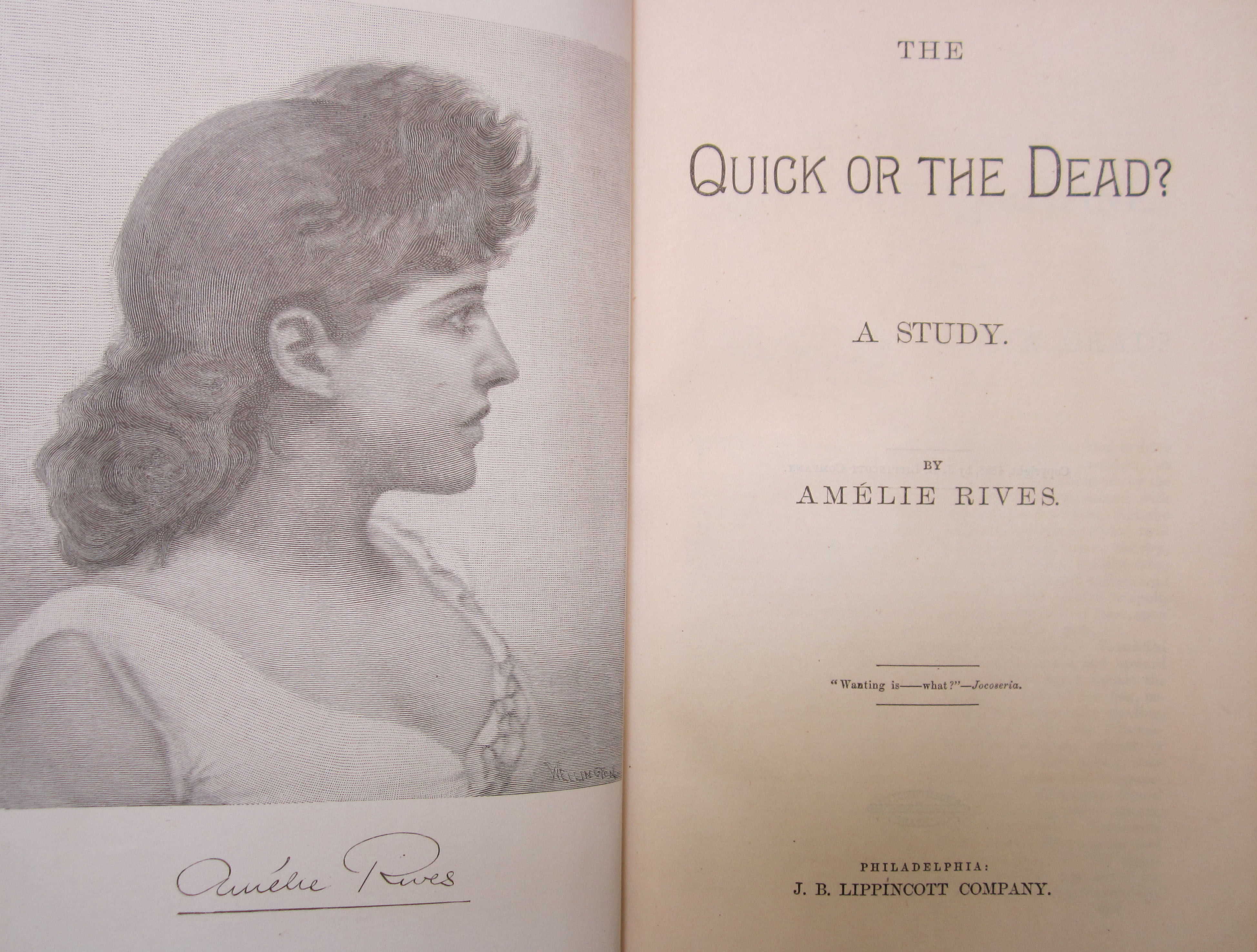
I was working on a joint biography of Amélie and poor, deluded Archie, when I came upon that revealing image.  Archie and Amélie were the Scott and Zelda Fitzgerald of their day—with literary fame, fortune, and madness mingled in equal doses.  Amélie was a Virginia blueblood of the grandest sort—in her great-great-grandfather’s time, Jefferson and Madison were habitués of Castle Hill; Robert E. Lee was her godfather—but she scandalized the entire nation when her first novel, The Quick or the Dead?, was published in 1888.  The book dared to suggest that women had sexual feelings.  Nothing by today’s standards, but the novel featured lots of “soughing” rain and wind, and heaving bosoms, and even passionate kisses (“Jock! kiss me!”). The book was reviled by critics and clergymen across the country—and sold 300,000 copies. A celebrity was born. In a supposedly secret ceremony, the notorious author married her Astor heir; but—thanks to an obliging Amélie—the press covered the event and trumpeted it in newspaper headlines across the country.  Gossip columnists parsed the couple’s every move and utterance.  Amélie loved the attention (note that nude portrait again—she actually had copies of it made); but Archie thought HE deserved the attention.  He was, after all, an ASTOR. It was a marriage from hell, but Archie adored Amélie and continued to support her even after she dumped him and wed a penniless artist/aristocrat named Prince Pierre Troubetzkoy.

Frontispiece and title page of The Quick or the Dead by Amelie Rives, from Lippincott's Monthly Magazine, April 1888. (Taylor 1888 .T76 Q8. Taylor Collection of American Bestsellers. Photograph by Donna Stapley)

Frontispiece and title page of “The Quick or the Dead?” by Amelie Rives, published in full in Lippincott’s Monthly Magazine, April 1888. (Taylor 1888 .T76 Q8. Taylor Collection of American Bestsellers. Photograph by Donna Stapley)

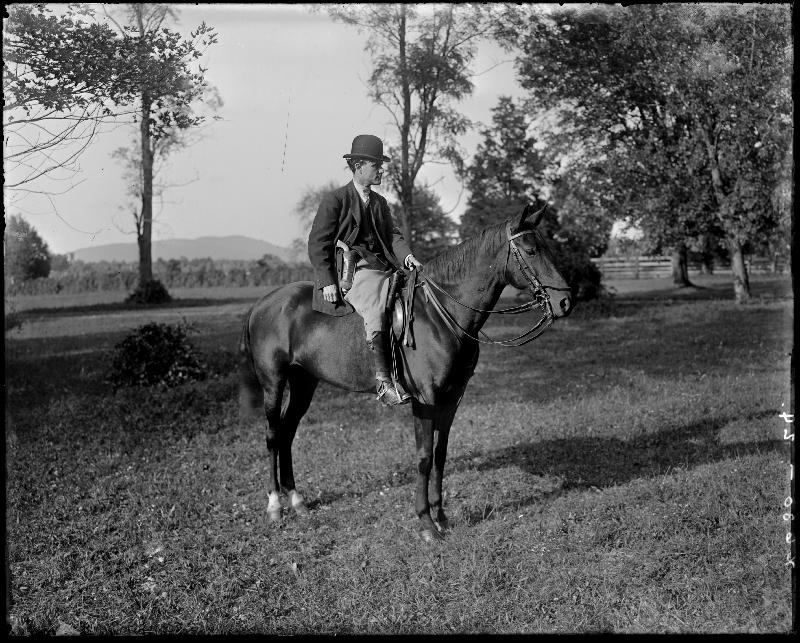
John Armstrong Chaloner (Chanler) seated on a horse, 30 September 1912. (Holsinger Studio Collection. Image by U.Va. Digitization) Services)

John Armstrong “Archie” Chaloner (Chanler), seated on a horse, 30 September 1912. (Holsinger Studio Collection. Image by U.Va. Digitization) Services)

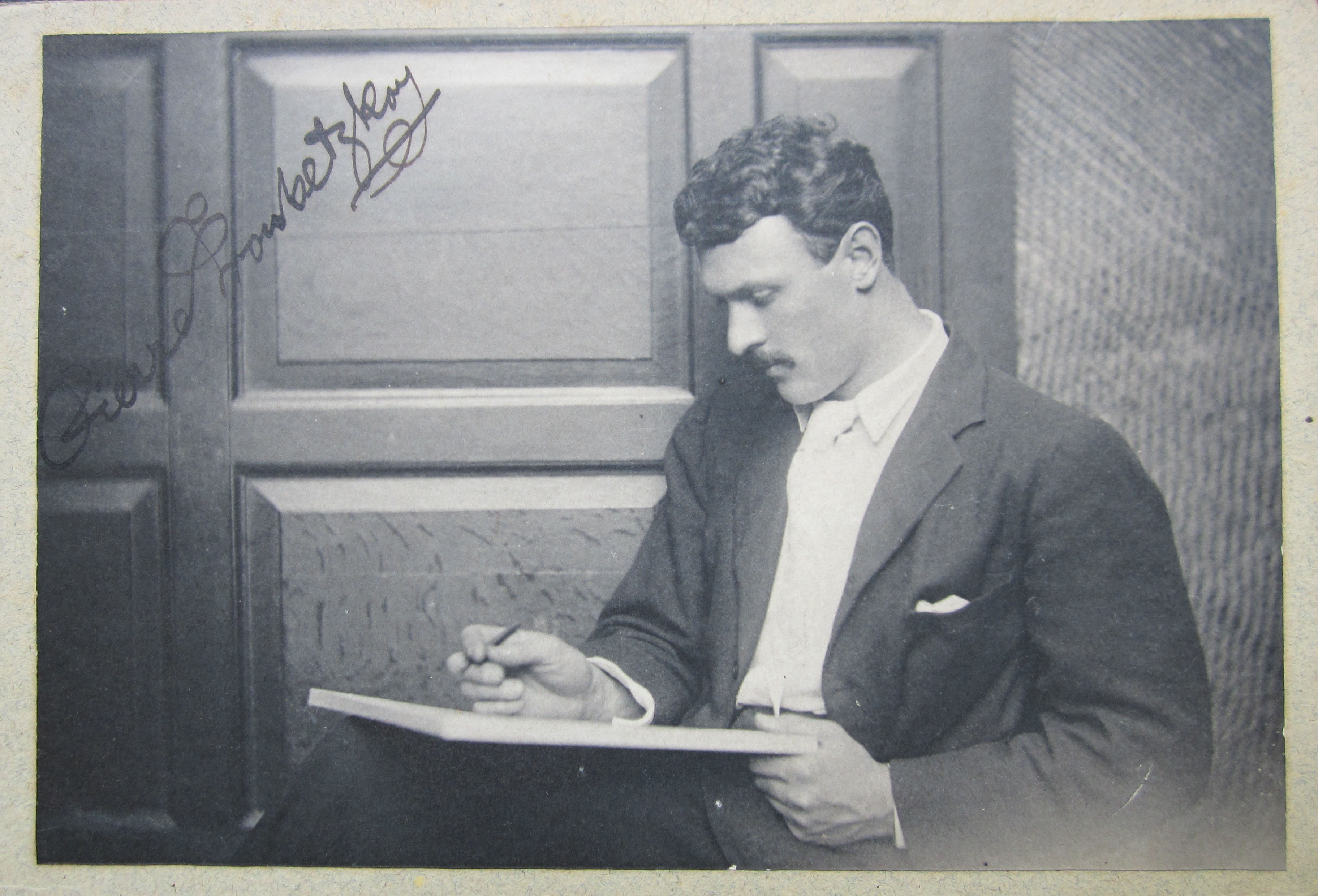
Photograph by Fred Hollyer of Prince Pierre Troubetzkoy sketching, 1 August 1894. (MSS 2532. Photograph by Donna Stapley)

Photograph of Prince Pierre Troubetzkoy by Fred Hollyer, 1 August 1894. (MSS 2532. Photograph by Donna Stapley)

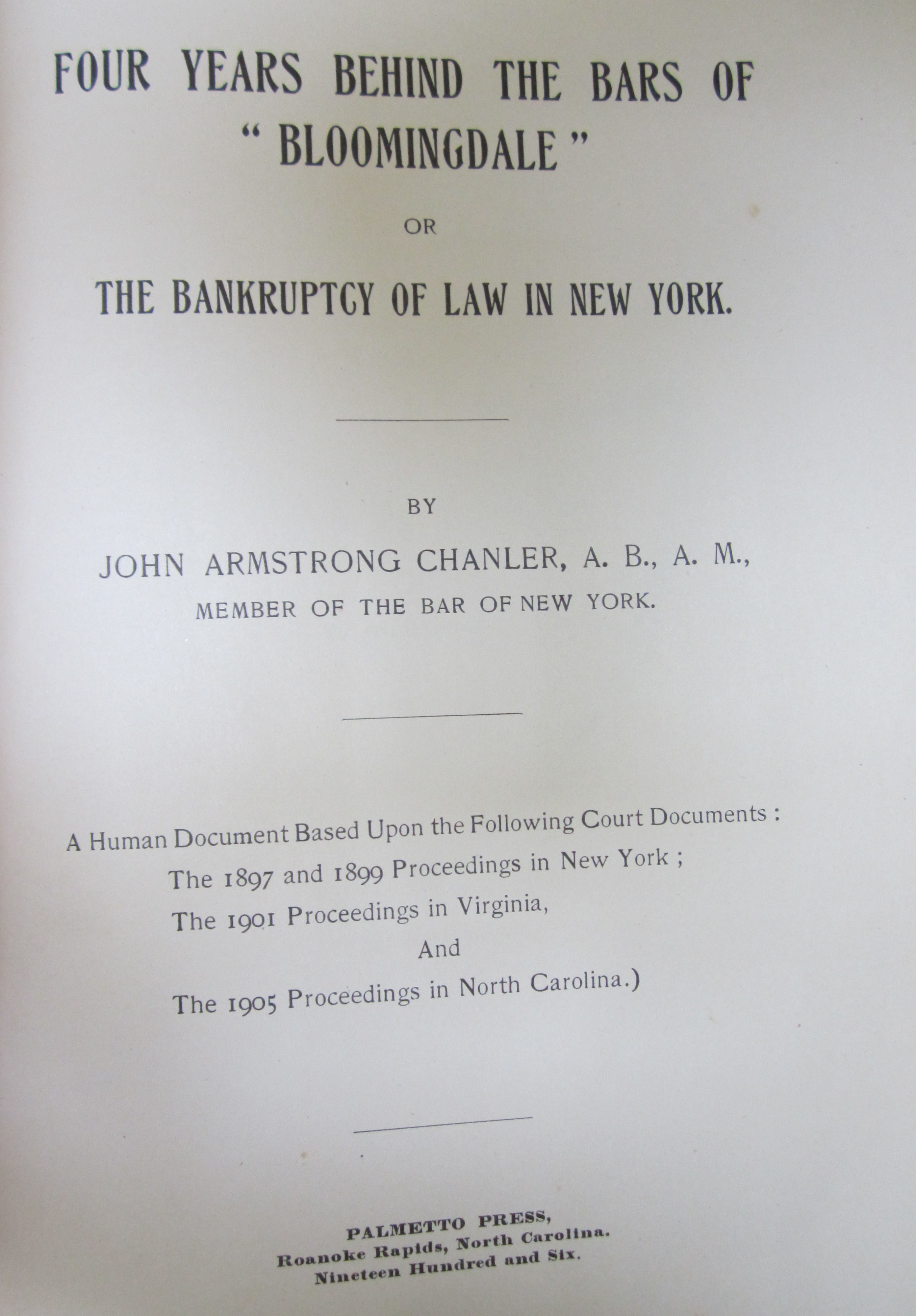
One astonishing story after the next tumbles out of the voluminous papers dealing with both Archie and Amélie at Special Collections. You couldn’t make up Archie’s life: his creation of a mill town in the wilderness of North Carolina; his fascination with the occult; his betrayal by über-architect Stanford White and by his own family, who committed him to an insane asylum for the rich in White Plains, New York; his escape from Bloomingdale Asylum after nearly four years of incarceration; his re-emergence in Charlottesville where, in a famous lunacy trial, he was declared sane in Virginia—but he remained “insane” everywhere else; his killing a man in his own dining room (he was acquitted of the deed but paid for the victim’s funeral and had a six-pointed metal star placed on the dining room floor to commemorate the event); his nearly twenty-year struggle to have himself declared sane in New York and reclaim control of his fortune.  Archie was finally victorious, but thereafter fell into madness, turning into a recluse at his Virginia estate. His renown was secured, however, when he coined the famous line “Who’s Looney Now?” and cabled it to reporters.

So sex and celebrity and scandal, Gilded Age style, lie simmering in those archival boxes.

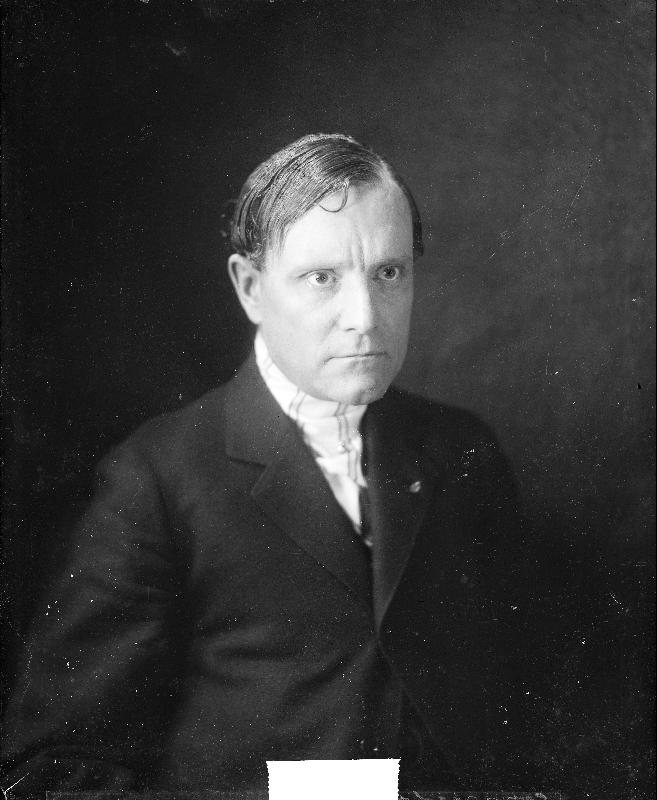
Portrait of John Armstong Chaloner or "Archie." 4 May 1918. (MSS 9862. Holsinger Studio Collection. Image by U.Va. Digitization Services)

Portrait of John Armstrong “Archie” Chaloner (Chanler). 4 May 1918. (MSS 9862. Holsinger Studio Collection. Image by U.Va. Digitization Services)

Four Years Behind the Bars of "Bloomingdale" or The Bankruptcy of Law in New York by John Armstrong Chanler, 1906. (PS3505 .H2 F6 1906. Gift of John Staige Davis. Photograph by Donna Stapley)

Title page of “Four Years Behind the Bars of ‘Bloomingdale'” (1906), John Armstrong Chanler’s scathing account of being placed by his family in “Bloomingdale Asylum,” White Plains, New York. (PS3505 .H2 F6 1906. Gift of John Staige Davis. Photograph by Donna Stapley)


Revealing the Mountain Communities of the Blue Ridge: Emmanuel Episcopal Church provides significant Digitization Grant

This week we feature a guest post from Special Collections staff member in Public Services, Margaret Hrabe:

The Small Special Collections Library is proud to announce our successful application for a seed grant to begin to scan our holdings of the periodical Our Mountain Work in the Diocese of Virginia. Published from 1909 to 1954 by the Board of Missions of the Diocese of Virginia, this periodical documents the founding of Episcopal mission churches and schools in the Ragged and Blue Ridge Mountains of Central Virginia by Frederick Neve, Archdeacon of the Blue Ridge. Our Mountain Work is a uniquely rich resource for the study of communities that were little documented at the time. The periodical’s writers had intimate contact with individuals and families who were otherwise extremely isolated. Many of the magazine’s issues predate the establishment of the Shenandoah National Park in 1933, an act that displaced hundreds of families and eradicated many small mountain communities.

Our Mountain Work, v. 1, no. 1 (BV2575 .O813. Image by Petrina)

Our Mountain Work, v. 1, no. 1 (March 1901). (BV2575 .O813. Image by Petrina Jackson)

The grant of $3000 comes from the Endowment Fund of the Emmanuel Episcopal Church in Greenwood, Virginia. The Emmanuel Endowment Fund Board annually administers grants in “furtherance of exclusively religious, charitable or educational purposes.”  We are grateful to the Board for its support and look forward to having this unique resource made available beyond the underground walls of Special Collections.

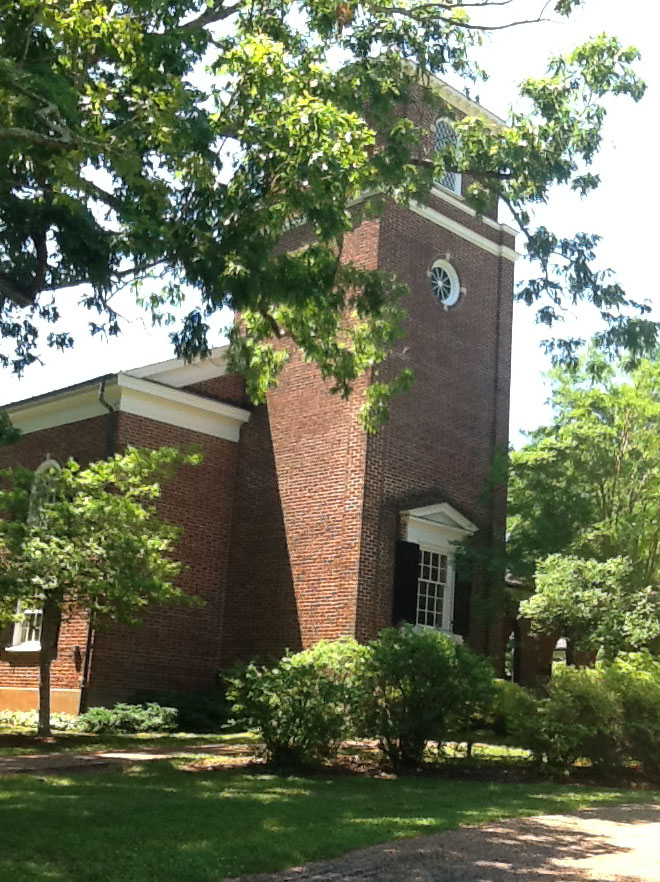
Emmanuel Church today. Photograph  by Margaret Hrabe)

Emmanuel Church, 2013. (Photograph by Margaret Hrabe)

U.Va.’s holdings of Our Mountain Work in Special Collections total 370 issues of the over 400 that were published and comprise the largest single collection available to researchers. Smaller collections reside at the Virginia Theological Seminary’s Bishop Payne Library and the Virginia Historical Society. Special Collections will begin the scanning project in early Fall of 2013. The images will be placed in the University of Virginia Library’s digital repository accessible through the online catalog VIRGO.

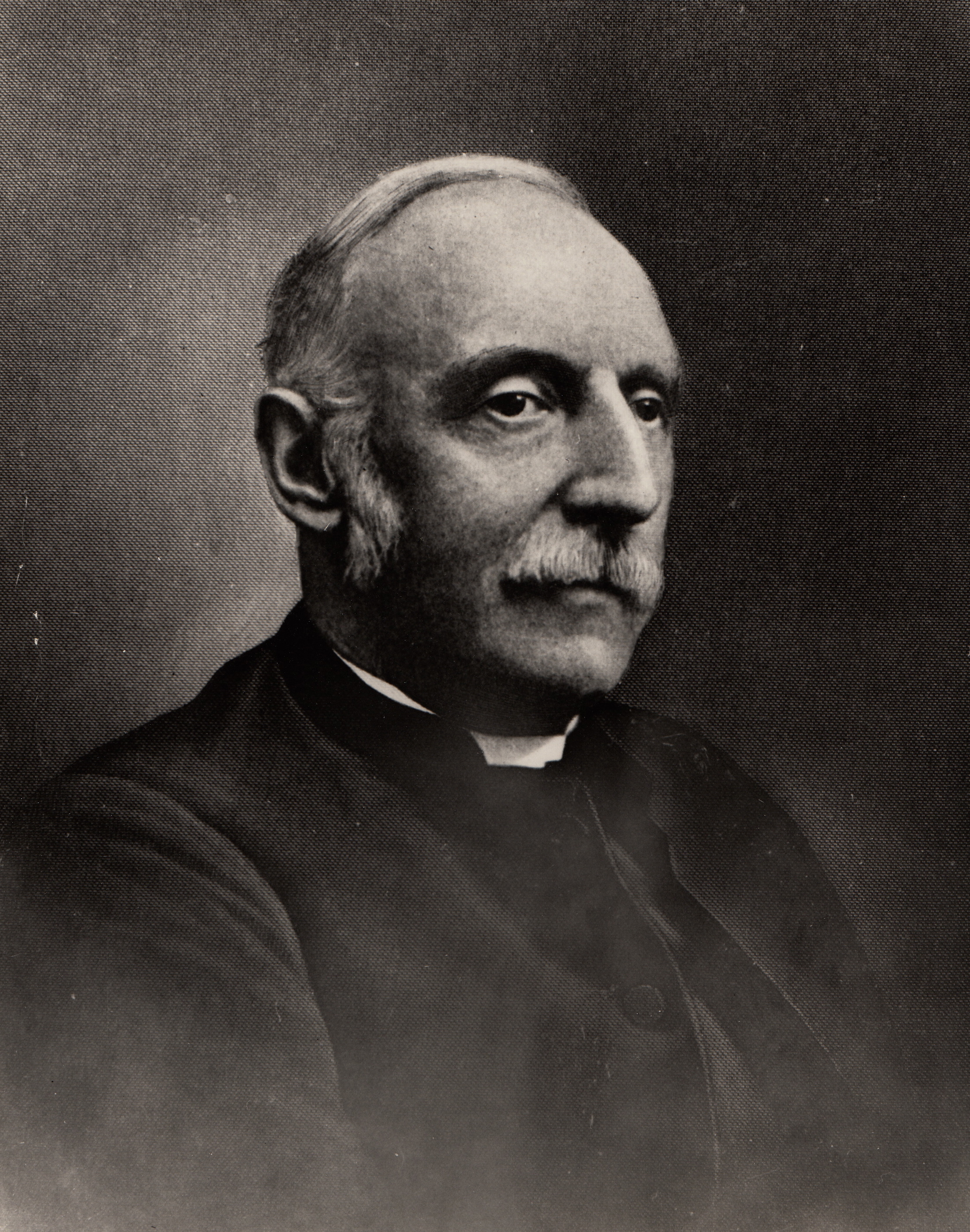
Frederick William Neve

Frederick William Neve, born in the county of Kent, England, was educated at Merton College, Oxford, and ordained a deacon in 1880 at the abbey church of St. Albans. In 1888, the vestries of St. Paul’s (Ivy, Va.) and Emmanuel (Greenwood, Va.) Churches asked Neve to come to Virginia to serve the needs of their congregations, and he accepted. Neve served as the rector of Emmanuel Church from 1888 to 1905  In 1890, Neve built his first mission church in the Ragged Mountains, St. John the Baptist. Ten years later, he began supporting a teacher at Simmon’s Gap, an isolated community in the Blue Ridge Mountains. This was the beginning of his work with the mountain inhabitants that eventually embraced seven Virginia counties and became the Archdeaconry of the Blue Ridge. As editor of Our Mountain Work, Neve made possible this window in time to the history of Central Virginia during the first half of the twentieth century.

Frederick William Neve, undated (MSS 791. Image by PetrinaJackson)

Frederick William Neve, undated (MSS 791. Image by PetrinaJackson)

Digitization as Preservation

Over the years, U.Va.’s holdings of Our Mountain Work have been accessed by researchers both local and distant for their religious, social, educational, and genealogical significance.  Recently a researcher from Northern Virginia requested photocopies of over 800 pages from the periodical—a request which Special Collections had to decline due to preservation concerns. Many of the original issues have small tears and nearly all were initially folded; consequently, there are crease marks and separations at the folds on a large number of issues.  These preservation issues prompted Special Collections to apply to the Emmanuel Endowment Board for funds to scan the paper issues, so that all interested researchers will have access to these documents without producing further damage to the delicate originals.

This image reveals some of the conservation problems inherent in these ephemeral issues of the magazine. _Our Mountain Work_ 1.3 (November 1911) (BV2575 . 082. Photograph by Petrina Jackson).

This image reveals some of the conservation problems inherent in these ephemeral artifacts. _Our Mountain Work_ 1.3 (November 1911). (BV2575 . 082. Photograph by Petrina Jackson).

Beyond Our Mountain Work

Emmanuel Church and Frederick Neve are well-represented in the holdings of Special Collections beyond Our Mountain Work.  The Papers of Emmanuel Church (MSS 10731, etc.) were initially deposited in Special Collections in 1987 and contain parish registers, 1885-1983; vestry books, 1909-1977; Woman’s Auxiliary minutes, 1871-1972; and financial statements, 1976-1977; written and oral histories. With these are also parish and church service registers of Holy Cross Mission, 1912-1942, a mission church established by Neve near Batesville, Va. Three collections of Neve’s personal papers (MSS 9115, MSS 9970,-a-b, and MSS 10505) give an even more in-depth view of the outreach mission work done by this extraordinary individual.

This Just In: “Billy” Cook’s Verse Chapbooks

Front cover of Cook's Fremont: a poem (Salem, Mass., 1856) bound with The Eucleia (Salem, Mass., ca. 1865) (PS1378 .C7 1865; Robert & Virginia Tunstall Trust Fund)

Front cover of Cook’s Fremont: a poem (Salem, Mass., 1856) bound with The Eucleia (Salem, Mass., ca. 1865) (PS1378 .C7 1865; Robert & Virginia Tunstall Trust Fund)

Special Collections is world renowned for its printed and manuscript holdings of American literature, amassed through purchase, gift, and the happy receipt of several substantial collections, most notably the Clifton Waller Barrett Library of American Literature. Deposited at the University of Virginia Library in 1960 and gradually given to the Library over the next three decades, the 250,000-item collection comprehensively surveys American literature in all genres from ca. 1775 to 1950. On its arrival the Barrett Library was rather awkwardly arranged in terms of “major” and “minor” authors—distinctions which of course lose meaning as literary reputations wax and wane and as scholarly interests shift.

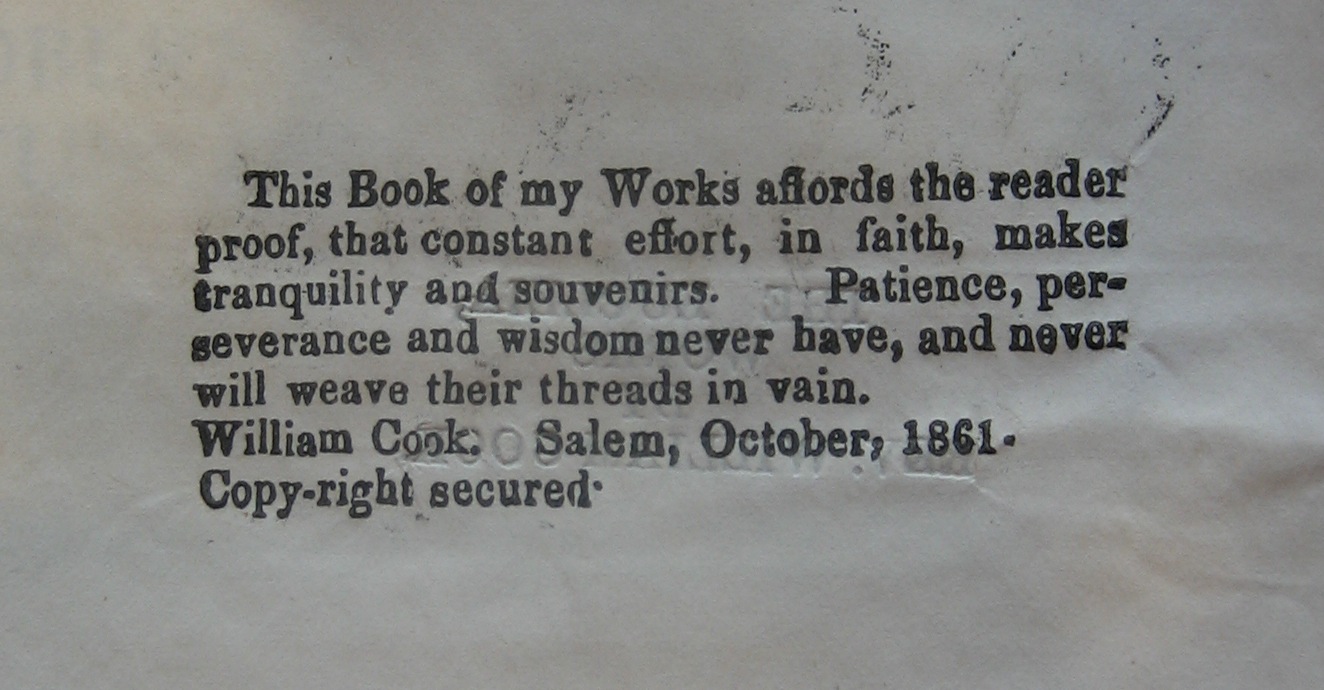
Title page verso to William Cook, the Eucleia: works (Salem, Mass., ca. 1865)

Title page verso to William Cook, The Eucleia: works (Salem, Mass., ca. 1865) (PS1378 .C7 1865; Robert & Virginia Tunstall Trust Fund)

This week’s post highlights one of these “minor” authors—William “Billy” Cook—whose work deserves wider recognition.  The son of a ship captain and a lifelong resident of Salem, Mass., Cook (1807-1876) studied at Yale before his ambitions were checked by physical and mental illness. Back in Salem he conducted a private school for some years, where his students studied Latin, Greek, and mathematics (at which Cook excelled). He also studied for the ministry and conducted religious services at his home, though Cook never advanced beyond the rank of deacon. Beloved for his eccentricities and known locally as “Reverend,” Cook was for decades a fixture of Salem life.

Back cover of Cook's The Ploughboy, part third (Salem, Mass., 1855) and front cover of his The Telegraph, or Starr-banner song (Salem, Mass., 1856); both bound with The Eucleia (Salem, Mass., ca. 1865) (PS1378 .C7 1865; Robert & Virginia Tunstall Trust Fund)

Back cover of Cook’s The Ploughboy, part third (Salem, Mass., 1855) and front cover of his The Telegraph, or Star-banner song (Salem, Mass., 1856); both bound with The Eucleia (Salem, Mass., ca. 1865) (PS1378 .C7 1865; Robert & Virginia Tunstall Trust Fund)

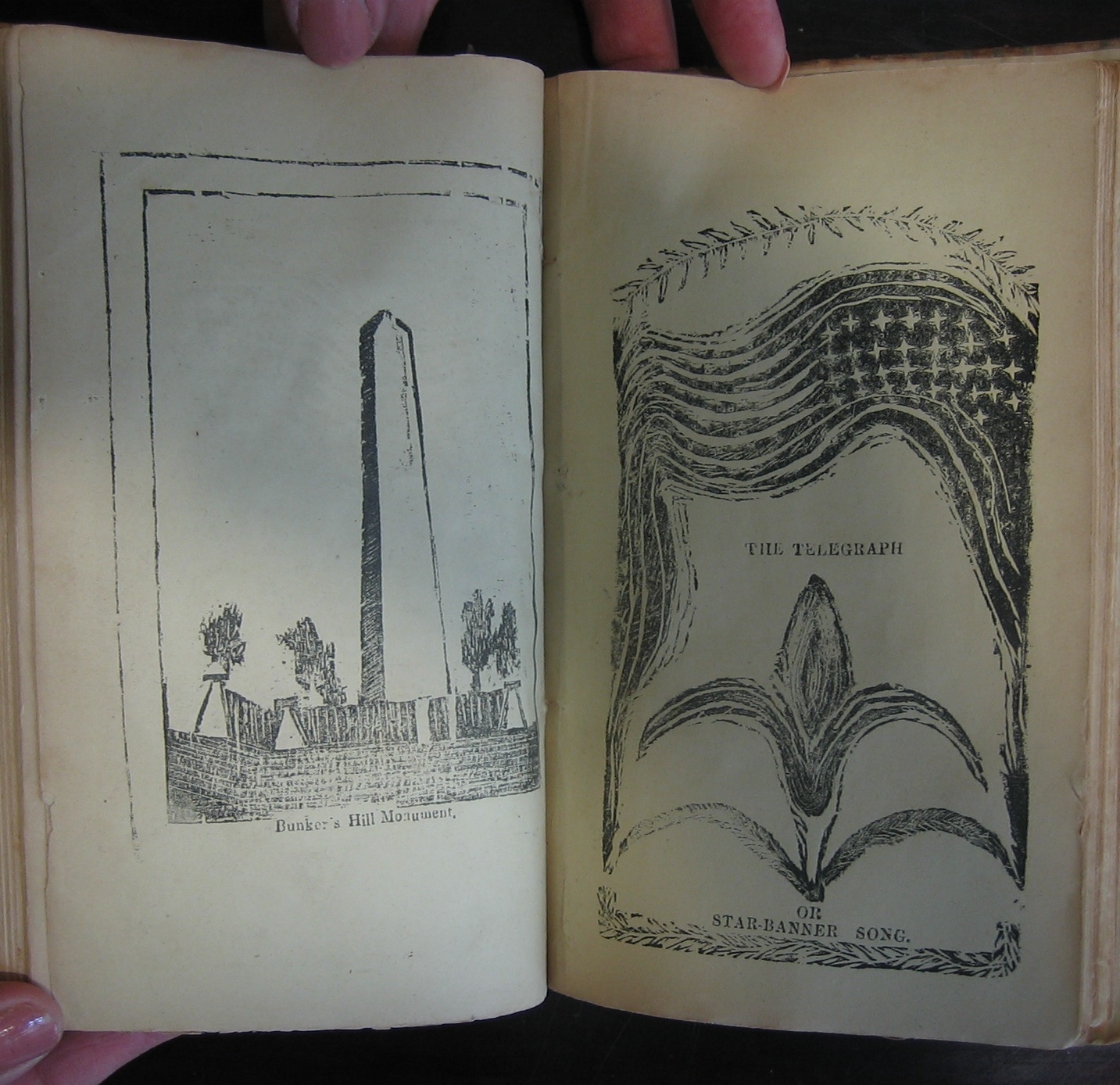
Finding himself jointly summoned in the early 1850s by the Muses of Poetry and Art, Cook began composing verse in which Salem and its residents, contemporary political events and figures, and various philosophical themes loomed large. Unable to afford the services of a commercial printer, Cook salvaged some worn type and a small cast-off jobbing press from a local newspaper office. With this equipment Cook could print only a page or two at a time, but time was a commodity he had in abundance. Over the next two decades Cook issued nearly 50 broadsides and poetry chapbooks, the latter hand-stitched by Cook in printed wrappers or bound in decorated cloth covers. Many were illustrated with Cook’s charming woodcut illustrations, which were typically heightened with pencil (mostly to correct uneven inking) and sometimes in colors. Because Cook often assembled and hand-bound his chapbooks in customized collections, his works exist in many variants.

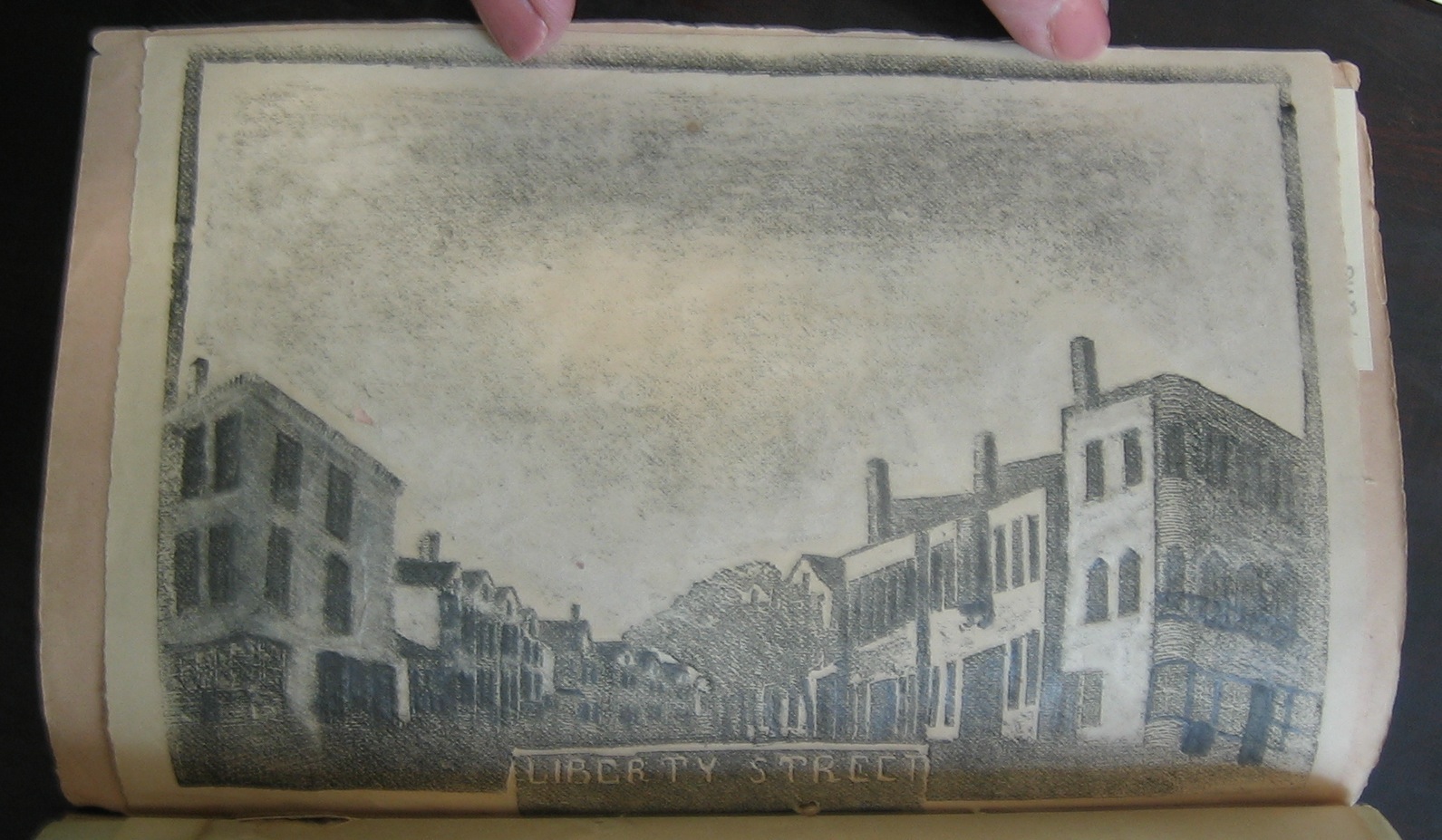
Many of Cook's woodcut illustrations (this one heightened with pencil) are useful contemporary depictions of Salem street scenes, such as this view of Liberty Street.  William Cook, The Columbia (Salem, Mass., 1863) (Barrett PS586 .Z93 C673 C6 1863)

Many of Cook’s woodcut illustrations (this one heightened with pencil) are contemporary depictions of Salem street scenes, such as this view of Liberty Street. William Cook, The Columbia (Salem, Mass., 1863) (Barrett PS586 .Z93 C673 C6 1863)

Strictly speaking, one might classify Cook’s works as examples of “mendicant verse,” a not uncommon sub-genre of 19th-century American minor poetry. Cook supplemented his modest income by peddling these chapbooks on Salem’s streets and to the increasing number of visitors who sought out his singular company. Late in life Cook took up painting, establishing a gallery in his home on Charter Street which attracted a new generation of visitors and chapbook purchasers. Although it would be stretching a point considerably to compare him with, say, William Blake, Cook is undeniably a fascinating practitioner of “folk” or “outsider” art.

Frotn cover of Cook's The Columbia (Salem, Mass., 1863) (Barrett PS586 .Z93 .C673 C6 1863)

Frotn cover of Cook’s The Columbia (Salem, Mass., 1863) (Barrett PS586 .Z93 .C673 C6 1863)

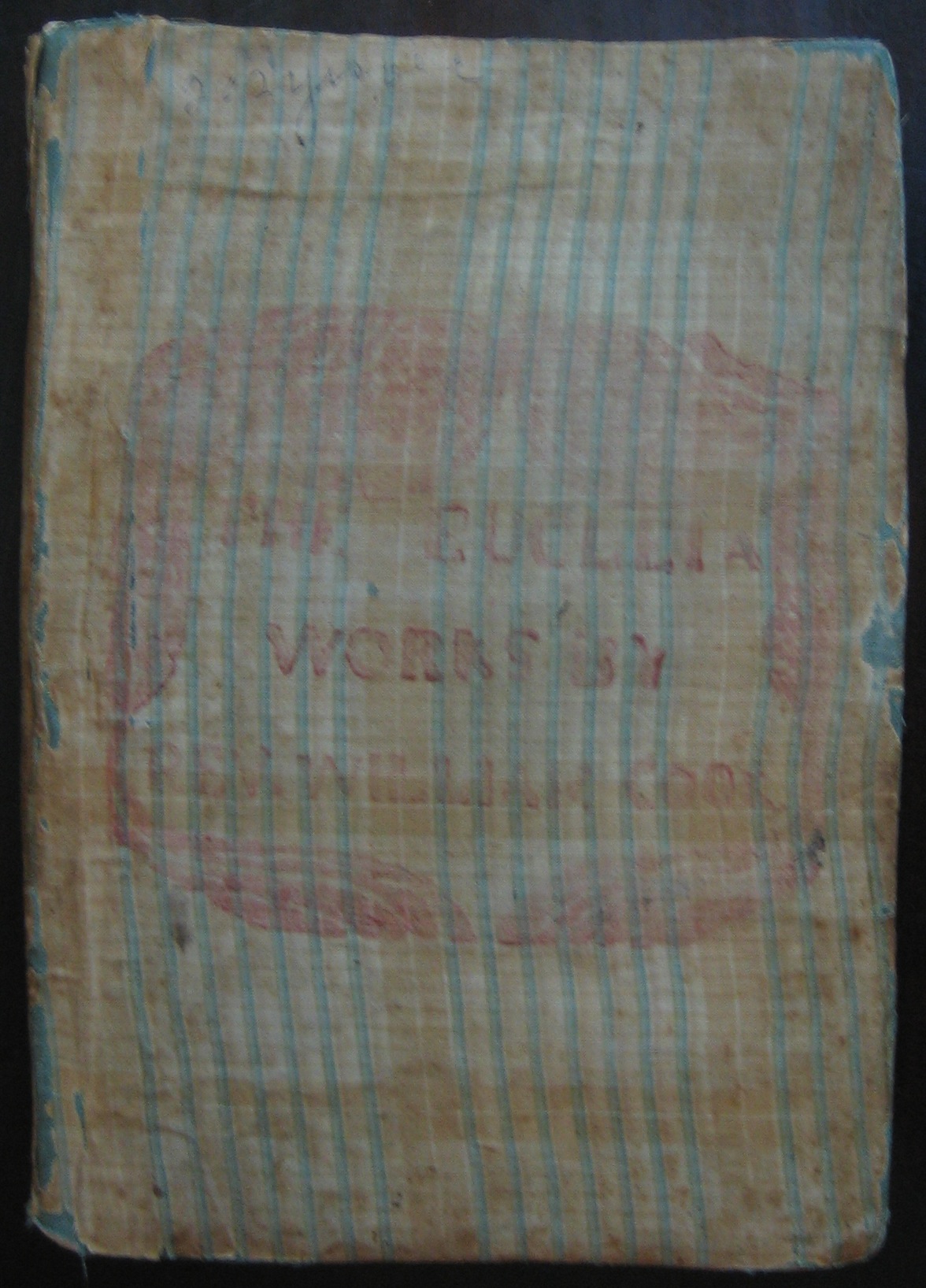
At one time it was not hard to find Cook’s ephemeral publications in New England, but today these are rarely encountered. Until recently the Clifton Waller Barrett Library could boast of holding only 13 Cook chapbooks. Now we have added ten more, increasing our holdings to approximately half of Cook’s recorded oeuvre. Fortuitously, all ten are gathered in one of Cook’s nonce collections, entitled The Eucleia with special added title page, hand bound by Cook in a remnant of striped cloth with woodcut title block stamped on the front cover. As far as we can tell, nothing has been written about Cook since 1924, when Lawrence W. Jenkins’s short article and checklist appeared in the Proceedings of the American Antiquarian Society. Perhaps by having now gone “under Grounds,” Billy Cook will soon receive the attention he deserves.

Front cover of William Cook's nonce collection of some of his works, The Eucleia: works (Salem, Mass., this copy assembled ca. 1865)

Front cover of a William Cook nonce collection containing ten chapbooks, The Eucleia: works (Salem, Mass., this copy assembled ca. 1865). Cook bound this copy in a “publisher’s binding” covered in a striped cloth remnant with woodcut title stamped in red. (PS1378 .C7 1865; Robert & Virginia Tunstall Trust Fund)

Patron’s Choice: Language Battles in the Douglas H. Gordon Collection of French Books

This week we are pleased to feature a guest post from Nicholas Shangler, Lecturer of French at Longwood University in Farmville, Virginia.

Dr. Shangler graduated with a Ph.D. in French from the University of Virginia this past May 2013.  While in graduate school, he worked with rare books as a student employee in Digital Curation Services at the University of Virginia Library, and while doing so, found a series of books by Henri Estienne that would become central to his dissertation work.

***

During my first semester of graduate school, I quickly realized that I needed a part-time job.  Serendipitously, Digital Curation Services was seeking someone to assist with the digitization of the Gordon Collection, an impressive holding of primarily sixteenth century French books, at the Albert and Shirley Small Special Collections Library.  I didn’t know it then, but that job would influence the course of my graduate career and beyond, leading me to specialize in Renaissance literature.  The digitization process involved perusing the books in the Gordon Collection, selecting one, and scanning it page by page.  Although admittedly tedious at times, the process allowed me to spend hours each day becoming acquainted with fascinating materials more profoundly than I ever would have otherwise.  Many of the works are not exactly canonical, affording me a richer experience of Renaissance French culture and literature than I’d previously been exposed to in classes.

A section of the Gordon Collection of French Books stacks. (Photograph by Petrina Jackson)

A section of the Douglas H. Gordon Collection of French Books stacks. (Photograph by Petrina Jackson)
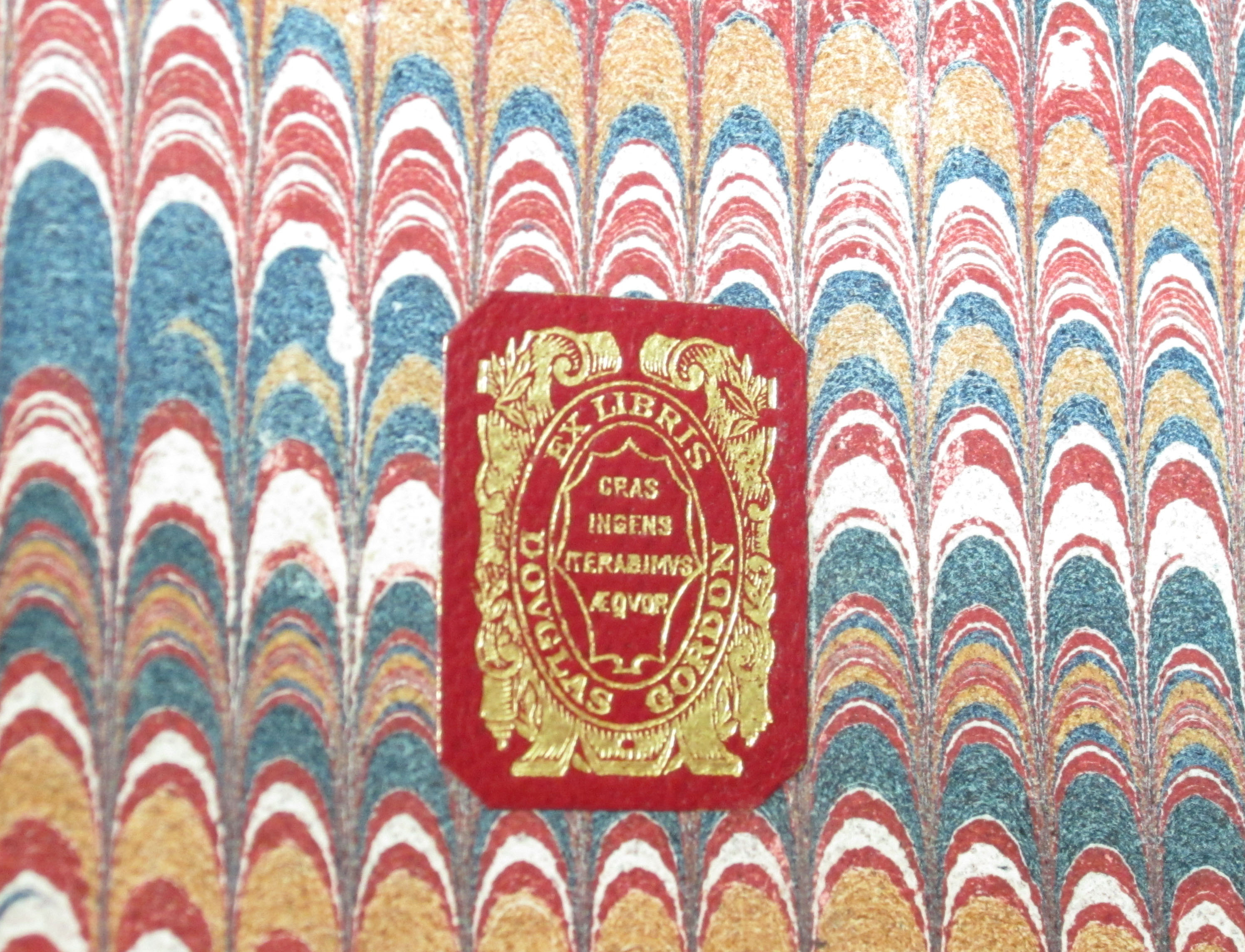
Douglas H. Gordon bookplate. (Photograph of Petrina Jackson)

Douglas H. Gordon bookplate. (Photograph of Petrina Jackson)

One curious work that I spent some time considering was Deux dialogues du nouueau langage françois (1578) by Henri Estienne.  It intrigued me with its descriptions of French words being chopped in half and “stuffed” with Italian words (inserted between the two ends of the original French words).  What?!  Then the author claimed that the French language descended from Greek, not Latin.  Clearly this guy was crazy.  I put it down and chose other works to digitize.  But apparently it stuck with me.  Five years later, while drafting my dissertation prospectus on French language innovation in the Renaissance, I recalled these strange dialogues.  I returned to Special Collections and paid Monsieur Estienne a visit.
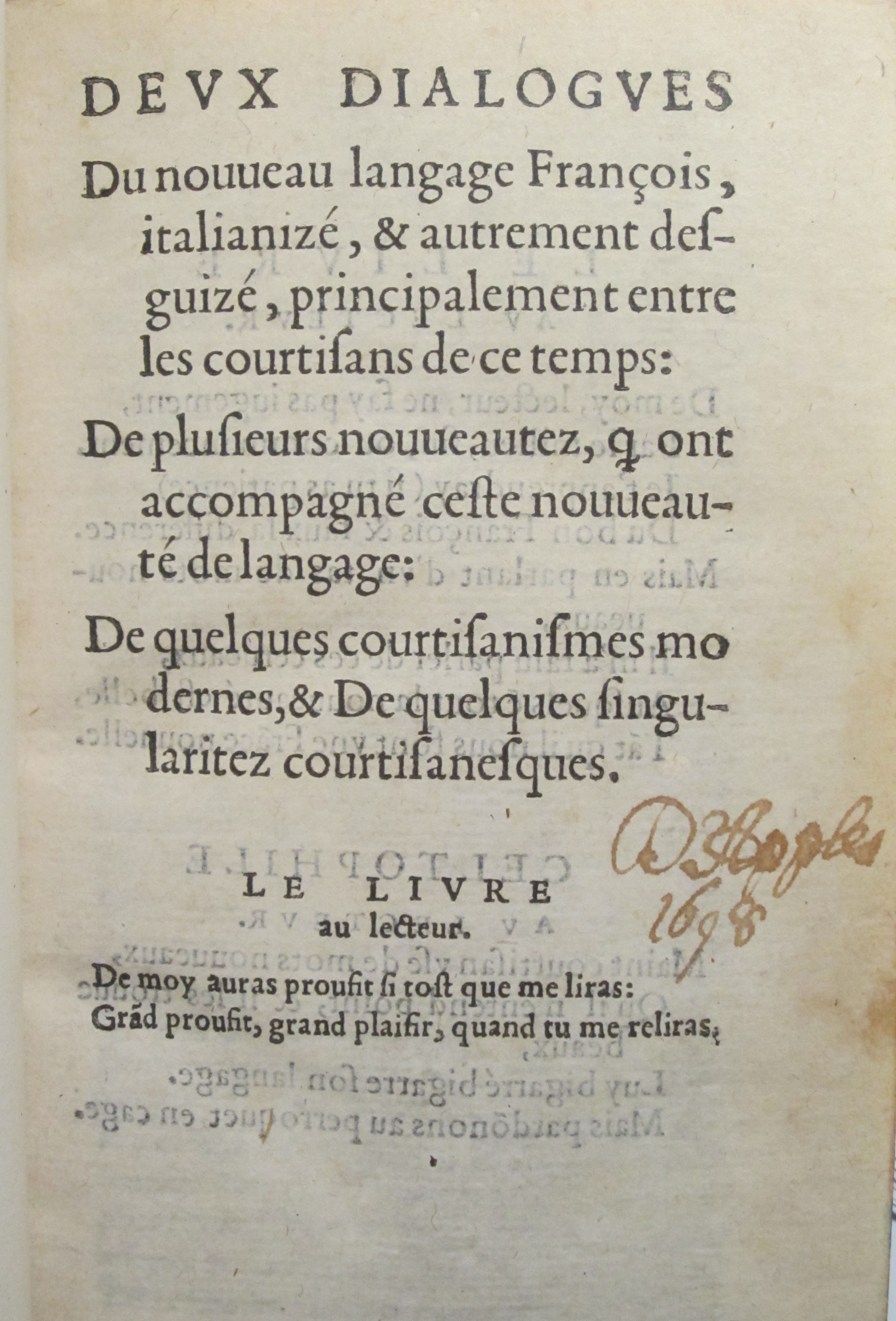
Deux Dialogues (Photograph by Petrina Jackson)

Henri Estienne’s Deux Dialogues du Nouveau Langage Francois, 1578 (Gordon 1578 .E78. Douglas H. Gordon Collection of French Books. Photograph by Petrina Jackson)

France and Italy experienced a mutual cultural and linguistic intertwining beginning in at least the early medieval period.  The influence of the Italians intensified with the marriage of the French prince, Henri II – son of François I – to Catherine de Medici, in 1533.  The ascension of Henri II to the throne in 1547 brought increasing numbers of Italians not only into France, but into the folds of the French Court.  Many courtiers embraced the growing Italianism and affected a language heavily characterized both by Italian words and by French words recomposed so as to incorporate fragments of Italian.  However, a number of prominent voices discouraged their French countrymen from having anything to do with the Italians, urging instead greater respect for French national culture.  Among those who began to protest against the intrusion of Italianism in France, and particularly with regard to language, a certain Parisian printer distinguished himself by his fervor and for his compelling articulation of the argument in support of the purity of French.

Henri Estienne (1528-1598) was destined to participate in the battle over language.  The son of Robert (1503-1559), a renowned printer and scholar, Estienne developed from a young age a curiosity and love for languages and books.  He mastered Latin, Greek and Italian, and devoted a significant amount of work to translating, editing, publishing and/or collating essential classical texts.  During the final two decades of his life, from the mid-1570s until his death, Estienne undertook two original editions of the Greek New Testament accompanied by his own critical commentary.

Henri Estienne’s polemic against the Italianized French employed by French courtiers appears in three separate but related works.  Together they form a sort of trilogy, each attacking various aspects of the central problem.  The first, Traicté de la conformité du language françois avec le grec (1565), denies the superiority of Italian by belittling its roots.  Estienne claims in his preface that the Italian language owes a far greater debt to French than does French to any Italian heritage.  He supports his argument by advancing the idea that French descends directly from Greek and has more in common with Greek than any other language.  Since everyone universally recognizes Greek as the greatest language in history, French must therefore be the second greatest.  Italian, on the other hand, is but the paltry progeny of Latin.  Estienne decries the recent linguistic inventions of the Italianizing courtiers and instead longingly praises the true French language “pure and simple, showing nothing of artifice, nor of affectation: that which Sir Courtier has not yet changed according to his tastes, and which has nothing borrowed from modern languages” [“pur et simple, n’ayant rien de fard, ni d’affectation: lequel monsieur le courtisan n’a point encore changé à sa guise, & qui ne tient rien d’emprunt des langues modernes.”] (Estienne, Conformité, preface, Vvo)
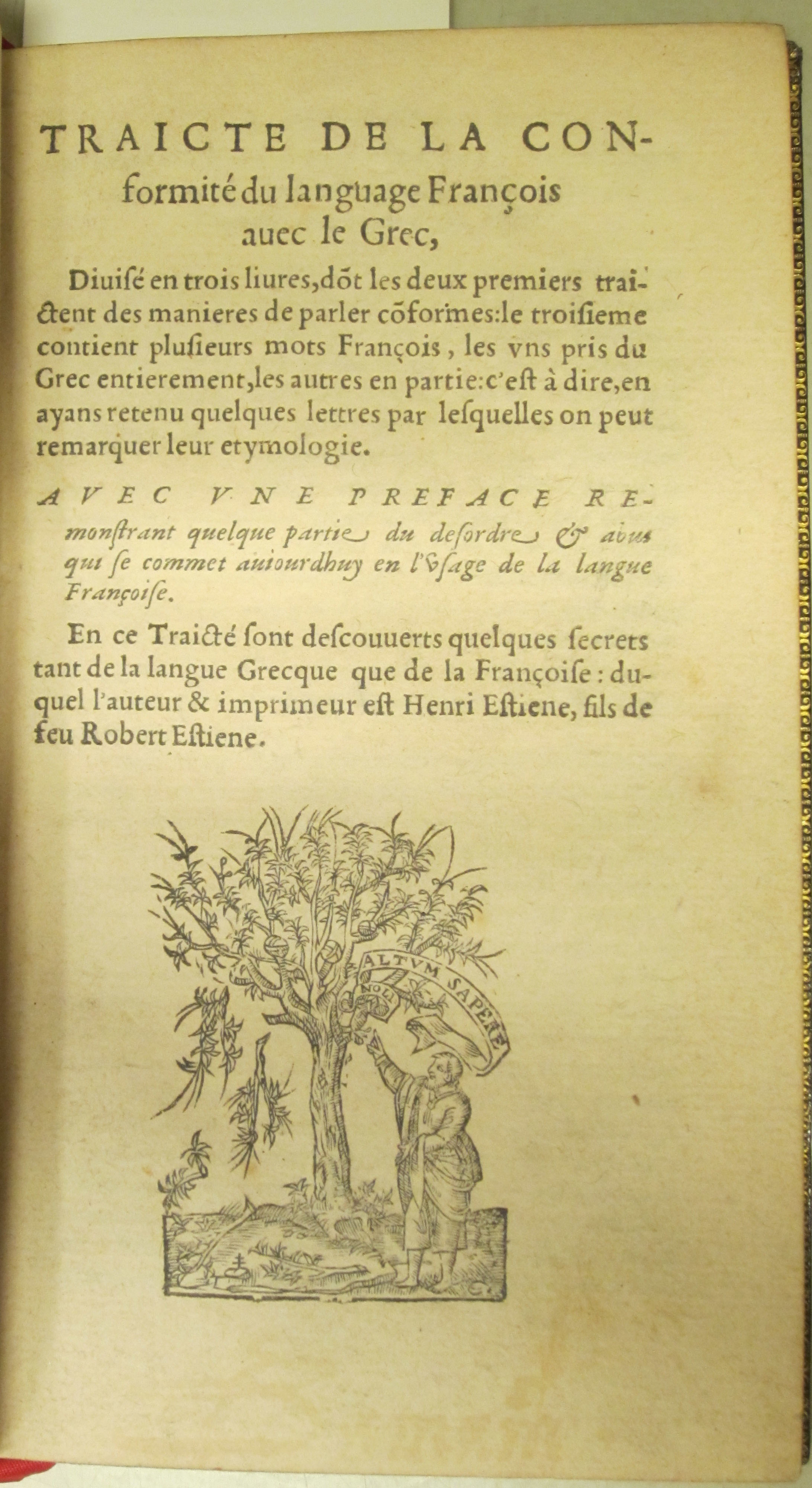
(Typ.E77 1565E. Stone Typography Collection. Photograph by Petrina Jackson)

Henri Estienne’s Traicte de la Conformite du language francois auec le Grec, 1565. (Typ.E77 1565E. Stone Typography Collection. Photograph by Petrina Jackson)

Estienne continues the attack where he left off with the 1578 publication of the Deux dialogues du nouueau langage françois.  The book opens with a series of poems that set the stage for the debate to follow.  In the first of the two dialogues, Estienne posits an exchange between a character named Celtophile (“lover of France”), whose role is to prosecute the case against the Italianized French, and Philausone (“lover of Italy”), who frequents the Court and is charged with defending the practice.  Naturally the jury is rigged in favor of Celtophile, with the accused found guilty even before the opening gavel.  The two interlocutors find themselves at an impasse at the close of the first dialogue.  They agree to reconvene the next morning to continue their discussion, and to go together to consult a third party, Philalethe (“lover of Truth”). Over the course of the second dialogue the topic of their argument gradually progresses to whether French or Italian, considered separately rather than in their blended form, is the greater language.  Once Philalethe joins the conversation he promptly dismantles all of Philausone’s reasoning, according an unconditional victory to the French language.  Still, Philausone refuses to concede.  The book ends with Philalethe promising to demonstrate further the dominance of the French language at a later time.

Keeping Philalethe’s promise, the following year – 1579 – Henri Estienne published De la précellence du langage françois, which he dedicated in the preface to King Henri III.  Though this work stands as a sequel to the Dialogues, Philalethe disappears and Estienne offers the book in his own voice using his real name, opening with a poem entitled “H. Estiene aux François.”   Here he broadens the scope of his attacks, no longer limiting himself to rebutting the use of Italianisms at Court.  Alluding to his own Conformité, he reiterates his claims of the self-sufficiency of French with regard to other languages, particularly Italian.  Most of Estienne’s logic is unsound.  He persists in relying upon his fallacious etymologies relating French to Greek, that he first sketched out in the Conformité, and then states that any words that seem equivalent between French and Italian are the result of Italian borrowing, rather than a common Latin heritage.
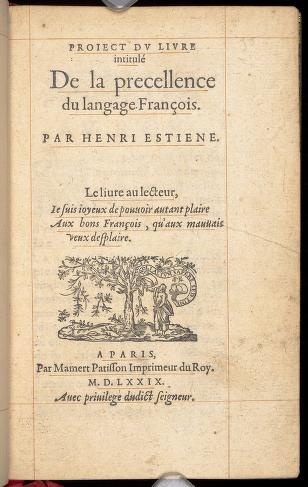
(Gordon 1579. E78. Gordon French Book Collection. Image by Digitization Services )

Henri Estienne’s Project du Livre Intitulé De la Precellence du Language Francois, 1579. (Gordon 1579. E78. Douglas H. Gordon Collection of French Books.  Image by Digitization Services )

Estienne ridicules the changing pronunciation of certain words, and presents his vision of the resulting confusion of words and objects in ways that give his reader to understand the gravity of the situation.  For instance, in the Dialogues, he condemns the changed pronunciation of oi into e.  The examples that he chooses – including “françois” (Frenchman) to “français” and “roine” (queen) to “reine” – underscore the danger of allowing the courtiers’ language to insinuate itself into the formerly pure French.  Not only does the new form of the word for “queen” risk signifying a frog instead, but the pronunciation of the very word indicating national belonging is changing.

Such a world is unstable and proved frightening to Estienne.  Estienne suggests even from the outset that the new words and those who are using them in new ways are already changing France itself.  The Dialogues opens with the poem, “The Book to the Readers” [“Le Livre aux Lecteurs”], which offers the warning that there are those for whom “in everything novelty is beautiful, / So much so that they are making us a new France” [“en tout la nouveauté est belle, / Tant qu’il [sic] nous font une France nouvelle”] (Estienne, Dialogues).  These worries transcend a mere discussion of language, and extend into the realms of politics and society.  Estienne’s works suggest that changes in language will precipitate changes in reality.  Although his focus is ostensibly linguistic, his motivations spring from deep political concerns about the future of his native France.

I suppose Henri Estienne would be relieved to know that the French language I was studying when I discovered his works in 2004 ultimately survived the encroachment of Italian.  His works and the many others of that era housed in the U.Va. Special Collections are all perfectly comprehensible to French speakers of today, despite the occasional variation in spelling and usage.  However, browsing current French-language social media posts online, I suspect that there would still be fodder aplenty for a reincarnated Estienne to pen yet another series of polemical treatises, though the target would no longer be Italian.  As it happens, in 1964, René Étiemble published Parlez-vous franglais?, a work linking patriotism and linguistic purism in which he approvingly references Estienne and cites passages from the Précellence du langage françois.  Indeed, these old rare books continually prove to be far more relevant to modern ideas than one might first imagine.

Nicholas Shangler (Photograph by )

Nicholas Shangler (Photograph by Sarah Reynolds-Shangler)

This Just In: Summer Beach Reading Edition

The following miscellany of recent book acquisitions is intended, not for those basking and basting on a sandy beach, but for those who prefer the cool, calm, and comfortable surroundings of the Special Collections reading room under Grounds. Take a break from tanning and pay us a summer visit!

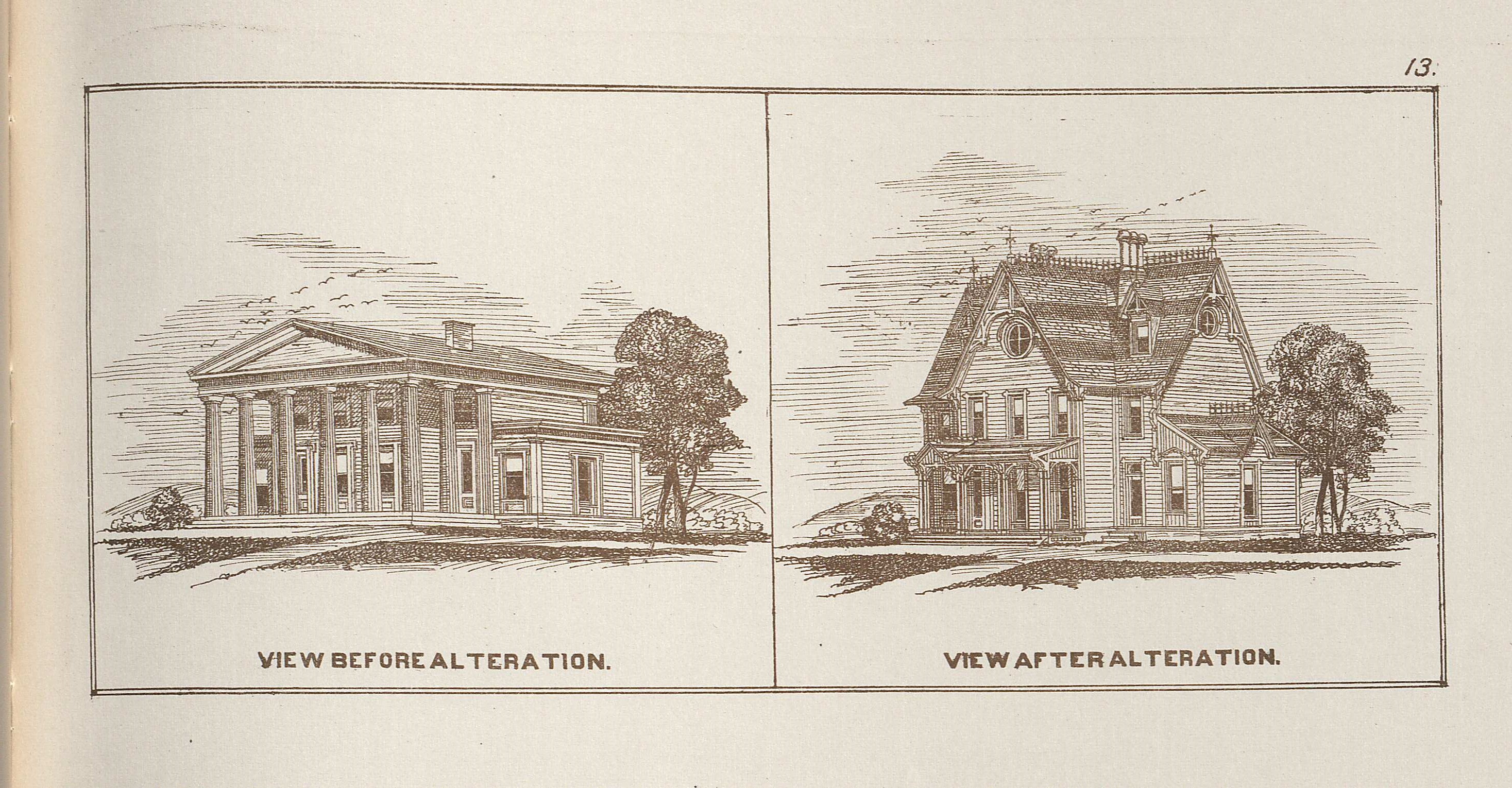
Plate 13 in William M. Woollett, Old homes made new: being a collection of plans ... illustrating the alteration and remodelling of several suburban residences (New York: A. J. Bicknell & Co., 1878).

Plate 13 in William M. Woollett, Old homes made new: being a collection of plans … illustrating the alteration and remodelling of several suburban residences (New York: A. J. Bicknell & Co., 1878).

A new addition to our extensive architecture holdings reminds us that architecture can be a process of renovation as well as creation. In Old homes made new (New York: A. J. Bicknell, 1878), Albany, N.Y. architect William M. Woollett offers remodeling advice to American homeowners.  Stuck with a New England saltbox, Federal mansion, Greek Revival temple, or Gothic Revival embarrassment?  Through before-and-after floor plans and exterior views, Woollett shows how to update one’s ancestral family home to the then-fashionable Queen Anne style. The work closes with exterior photographs of a mid-18th-century home in Ridgefield, Conn. that Woollett had transformed into a Victorian showpiece. Architectural historians, historic preservationists, and others charged with reverse-engineering historic structures may find Woollett’s approach illuminating.

When money is THE object: one way to select a spouse in the Antebellum South, as explicated in S. S. Hall, The bliss of marriage: or, How to get a rich wife. (New Orleans: J. B. Steel, 1858)

When money is THE object: one way to select a spouse in the Antebellum South, as explicated in S. S. Hall, The bliss of marriage: or, How to get a rich wife. (New Orleans: J. B. Steel, 1858)

But the nest must be built before it can be renovated. Populating that nest is the subject of S. S. Hall’s rare and unusual Bliss of marriage: or, How to get a rich wife (New Orleans: J. B. Steel, 1858). In some respects similar to the many courtship guides published in Antebellum America, Hall’s work is in other ways different in claiming to be written for a Southern audience. A New Orleans attorney (and not the prolific dime novel writer “Buckskin Sam” Hall, as often claimed), Hall based this work on three years’ “personal experience and general observation.” After offering advice such as “Marry no woman who sleeps till breakfast,” Hall devotes most of the book to the art of marrying well, and well-to-do. At the end is a 15-page appendix of nearly 400 wealthy “unmarried young ladies and gentlemen”—the former identified only by initials, the latter by full name—residing in various Louisiana, Mississippi, and Kentucky towns, with their estimated net worth. One wonders how successfully Hall followed his own advice.

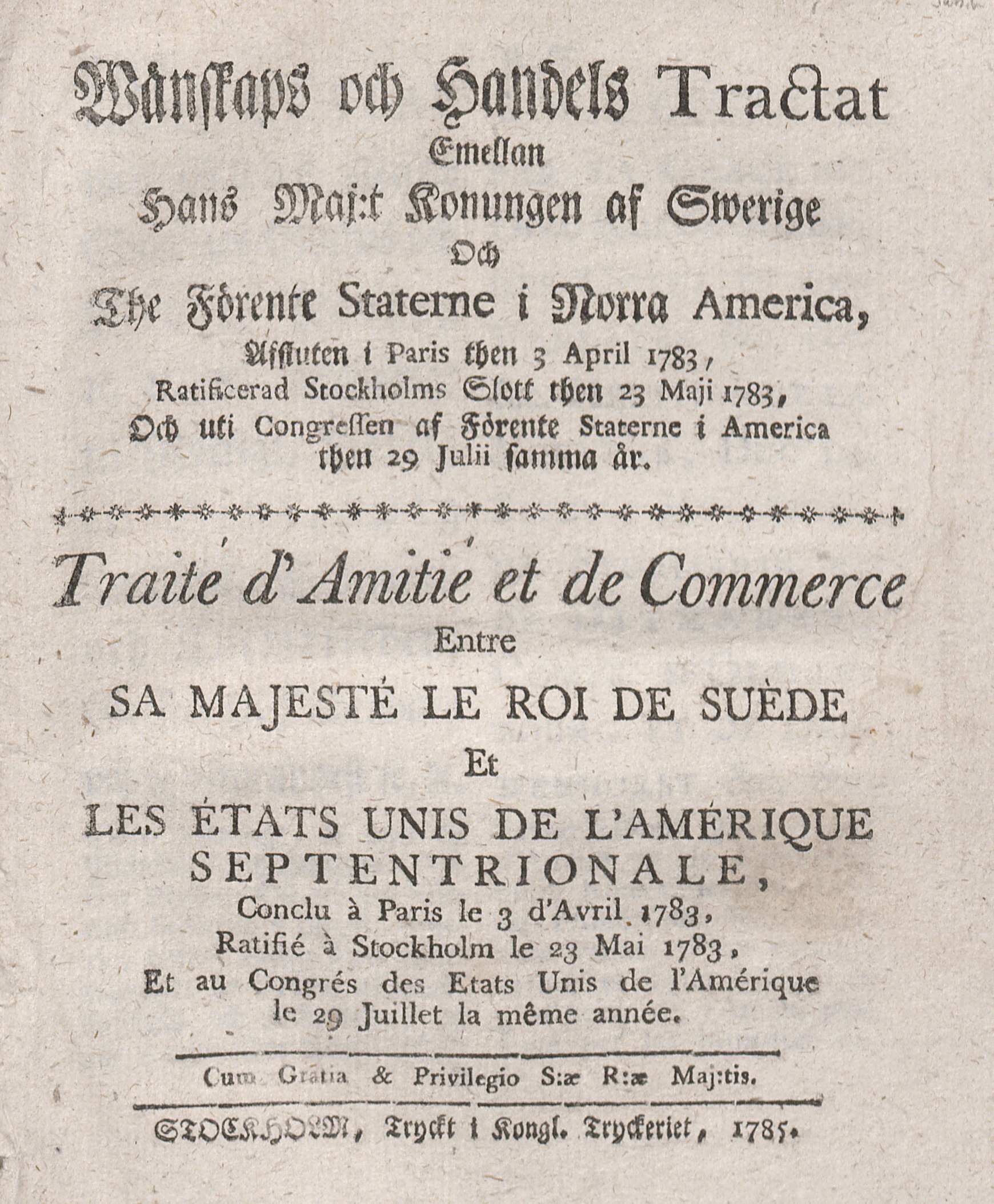
Title page to Wänskaps och handels tractat emellan Hans Maj:t konungen af Swerige och the Förente staterne i Norra America … = Traité d'amitié et de commerce entre Sa Majesté le roi de Suède et les Etats-unis de l'Amérique septentrionale …  (Stockholm: Kongl. Tryckeriet, 1785)

Title page to Wänskaps och handels tractat emellan Hans Maj:t konungen af Swerige och the Förente staterne i Norra America … = Traité d’amitié et de commerce entre Sa Majesté le roi de Suède et les Etats-unis de l’Amérique septentrionale … (Stockholm: Kongl. Tryckeriet, 1785)

To the McGregor Library of American History we have added the rare Swedish printing (Stockholm, 1785) of the landmark 1783 Treaty of Amity and Commerce between Sweden and the United States. In September 1782, with the American Revolution drawing to a close, Congress empowered John Adams, John Jay, Henry Laurens, and Benjamin Franklin to negotiate peace with Britain. At the same time Franklin was appointed minister to Sweden, and he quickly entered into discussions with his Swedish counterpart. A treaty was concluded on April 3, 1783, and ratified by both countries later that year. Sweden thus became the first neutral country to officially recognize the United States. The treaty’s text is printed in parallel columns in Swedish and French, with Congress’s act of ratification appended in English.

A detail from one of the massive (53 x 36 cm.) engraved plates in André François Roland, Le grand art d’ecrire. (Paris: Chez Esnauts et Rapilly, [between 1777 and 1791]

A detail from one of the massive (53 x 36 cm.) engraved plates in André François Roland, Le grand art d’ecrire. (Paris: Chez Esnauts et Rapilly, [between 1777 and 1791]

Summer is no time to dredge up dreary memories of primary school penmanship class, but we can’t resist pointing out that the history of handwriting and calligraphy are strongly represented in Special Collections. At a recent auction we were able to acquire several very rare 18th-century French, Italian, and German penmanship manuals, thereby adding significant depth to our holdings. Penmanship instruction was long the province of writing masters, some of whom published manuals for their students’ use. Typically these consisted of engraved plates reproducing examples of the master’s penmanship. Some plates would demonstrate how to hold the quill pen and execute the basic strokes, others would illustrate the various hands, and still others would advertise the master’s expertise, particularly his command of hand in which texts and even elaborate images were drawn without once lifting the pen from paper. These writing books were often published on demand, with students customizing their copies by selecting from among the available engraved plates, hence copies are rare and tend to vary in content. Shown here is a detail from Le grande art d’ecrire, which features the work of André François Roland, a Parisian writing master active in the mid-18th century. The U.Va. copy, in its original blue paper wrappers, contains 31 plates and was issued sometime between 1777 and 1791. Other copies are known issued as early as 1758. This work is extremely unusual for its large format, with plates measuring 53 x 36 cm.

[Harvey Newcomb], The "Negro pew": being an inquiry concerning the propriety of distinctions in the House of God, on account of color. (Boston: Isaac Knapp, 1837)

[Harvey Newcomb], The “Negro pew”: being an inquiry concerning the propriety of distinctions in the House of God, on account of color. (Boston: Isaac Knapp, 1837)

Another spring auction added several anti-slavery and abolitionist works to Special Collections, including a fine copy in its original publisher’s binding with printed cover label of Harvey Newcomb’s The “Negro pew”: being an inquiry concerning the propriety of distinctions in the House of God, on account of color. Published in Boston in 1837, Newcomb’s book advanced the abolitionist movement a step further by confronting Northern prejudice against African Americans. Taking as his starting point the common practice of restricting where blacks could sit in church, Newcomb marshals many arguments to support his thesis “that every man is entitled to be esteemed and treated according to his social, moral, and intellectual worth.”

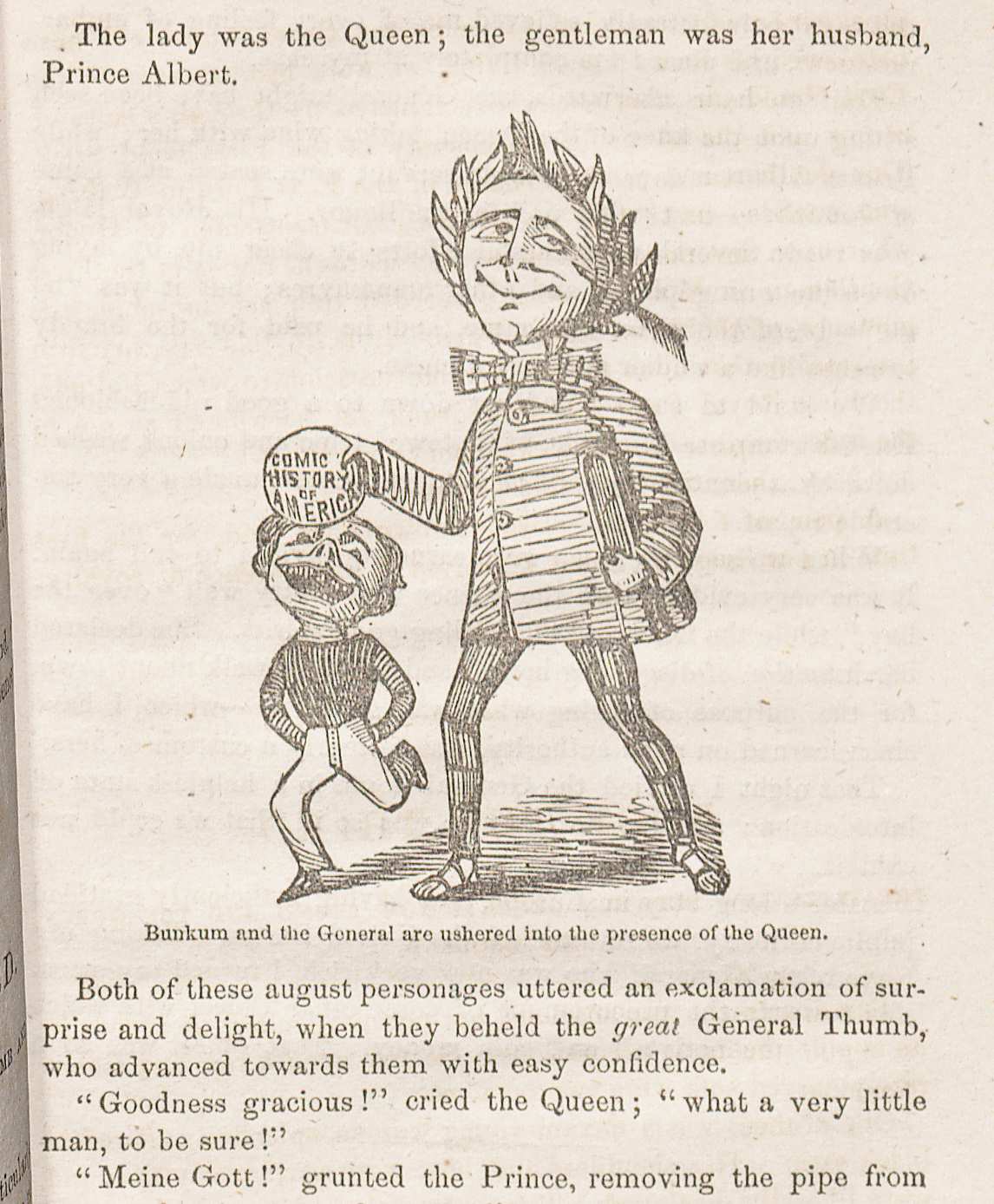
P. T. Barnum (er, Petite Bunkum) and General Tom Thumb make the acquaintance of Queen Victoria and Prince Albert, in The autobiography of Petite Bunkum, the showman. (New york: P. F. Harris, 1855)

P. T. Barnum (er, Petite Bunkum) and General Tom Thumb make the acquaintance of Queen Victoria and Prince Albert, in The autobiography of Petite Bunkum, the showman. (New York: P. F. Harris, 1855)

The great American showman P. T. Barnum makes innumerable cameo appearances under Grounds in Special Collections’ rich holdings relating to 19th-century American literature and culture, hence we were happy to acquire a rare Barnum parody. In 1855, just before financial reversals added further notoriety to his name, Barnum published a best-selling autobiography “written by himself.” The book was quickly and affectionately parodied in The autobiography of Petite Bunkum, the showman (New York: P. F. Harris, 1855), also (and anonymously) “written by himself.” “In these pages I have adhered to the truth as closely as might suit my purpose,” Bunkum allows, before relating his comical rise to fame and fortune. Of the supporting characters, only General Tom Thumb retains his full name. Others receive a modest fig leaf—Joyce Heath (for Joyce Heth, billed as George Washington’s 160-year-old nurse), Jenny [Lind] the Swedish Nightingale, the Fudge Mermaid, the Whiskered Woman—and all are caricatured in image as well as in word.

It’s 5 p.m. and we must close for the day, but perhaps there’s still time for the beach?

Class Notes from Rare Book School: A Special Collections Edition

You know it is officially summer when Rare Book School (RBS) begins at the University of Virginia.  RBS offers week-long, intensive courses on manuscript, printed, and born-digital materials.  Although a completely independent institute, RBS shares a close relationship with the Albert and Shirley Small Special Collections Library. In fact, its director, Michael Suarez, is honorary curator of the Special Collections Library (SC).  Nicole Bouché, director of Special Collections, describes the relationship:

The relationship between SC and the RBS is unique: it allows a convergence of an outstanding Special Collections and a world-class school for the study of the history of the book, combining forces and resources for an intensive summer of instruction.  The Rare Book School program would not be possible without the strength of our collections, and we benefit annually from the expertise that an international faculty brings to the study of the rare books, manuscripts and other resources held by the Small Special Collections Library.

RBS is outfitted with its own well-used teaching collections, and some of its faculty also arrange sessions in the Special Collections Library, using our materials.  RBS also organizes several public lectures of “bookish” matters, coinciding with their summer sessions. All of this makes for an engaging and lively environment around the learning about books.  Two Special Collections and RBS staff pull and organize 800 books over a five week period for approximately 25 classes.  It is a rapid-paced endeavor that takes lots of focus since some of the classes use the same materials, sometimes in the same week.

Here is a little behind the scenes look at what goes on to make the magic happen!

Week one slips for each Special Collections book pulled for Rare Book School.

First week slips for each Special Collections book pulled for Rare Book School (Photograph by Petrina Jackson)

Emily

Emily Cone-Miller pulls the books for each RBS class and organizes them in the stacks. (Photograph by Petrina Jackson)

George Riser checks out Special Collections books for RBS.(Photograph by Petrina Jackson)

George Riser checks out books for each RBS class that visits Special Collections.(Photograph by Petrina Jackson)

Books are ready for an RBS class and include titles, such as the Samuel Johnson's Dictionary, the Kelmscott Chaucer, and the Doves Press Bible.

The books are ready for an RBS class.  This book truck include titles, such as Samuel Johnson’s Dictionary, the Kelmscott Chaucer, and the Doves Press Bible. (Photograph by Petrina Jackson)

All of this preparation results in lots of opportunities for RBS students to immerse themselves in and learn about the many facets of rare books and book history made possible by the rich holdings of Special Collections.  The first week of classes with topics as varied as teaching the history of the book, scholarly editing, and 19th- and 20th-Century typography, included 15 sessions using our collections materials.

Here are some of the classes in action!

Antonetti_3 copy

Martin Antonetti discusses a medieval bible with his The Printed Book in the West to 1800 class. (Photograph by Petrina Jackson)

KandR_1 copy

New RBS faculty John Kristensen and Katherine M. Ruffin give background information on a book. Their class The History of c19 & c20 Typography & Printing made its debut the first week of RBS this summer. (Photograph by Petrina Jackson)

Matthew Kirschenbaum and Naomi Nelson brought their Born-Digital Materials: Theory and Practice to Special Collections to see one book.  The book, featured here,  (Photograph by Petrina Jackson)

Matthew Kirschenbaum and Naomi Nelson brought their Born-Digital Materials: Theory and Practice to Special Collections to see one book, Notebook by Annesas Appel.  According to our catalog record the book “is a project based on mapping the inside of a notebook [computer].” Ours is number 7 of a limited edition.  (N7443.4 .A645 N6 2009. Associates Endowment Fund, 2012/2013. Photograph by Petrina Jackson.)

This summer, RBS runs through the last week of July, including notable faculty such as our very own Curator and Blogger David Whitesell and Mark Dimunition, Chief of the Rare Book and Special Collections Division of the Library of Congress.  If you are looking for an intensive learning experience, surrounded by enthusiastic, like-minded people, and outstanding faculty, look no further than Rare Book School at the University of Virginia.  You may get to study from some of the treasures of the Special Collections Library.

This Just In: Rolling in the Stacks with the Charlottesville Derby Dames

This week, we feature a guest post from Charlottesville Derby Dame Grëtel vön Metäl, also known as Gretchen Gueguen.

When we here at the Small Library think about new materials we would like to add to our collections we take many factors into consideration: the research quality of the content, connections to the University’s curriculum or history, or alignment with our core collecting areas. Given the breadth of subject, time period, and format of our collections we often come across materials that will complement or counterpoint something we already own, even though at first glance it might not seem to fit with everything else.

Such is the story of how we made our newest acquisition, the Charlottesville Derby Dames Records. The Dames are a non-profit women’s sport club here in Charlottesville founded in 2007. My day-job at the library is Digital Archivist, but on the flat-track I am known as “Grëtel vön Metäl.” When I mentioned one day that I was going to be skating with the Dames in an upcoming match (called a “bout” in derby parlance), our current Head of Technical Services, Edward Gaynor, immediately suggested that a collection of Dames materials would make an excellent complement to our collections of the papers of various local and regional “ladies’ clubs” such as The Garden Club or the Ladies’ Sewing Society. When researchers come to the Reading Room to look at these collections they are usually studying the ways in which women construct their identities in public: how do they present themselves? what kinds of activities do they become involved in? what can these things tell us about women’s roles?

A screenshot of the Dames’ website, ca. 2012 (MSS MSS 15490).  Compare with the Team’s current page: http://www.charlottesvillederbydames.com.

A screenshot of the Dames’ website, ca. 2012 (MSS 15490). Compare with the Team’s current page: http://www.charlottesvillederbydames.com.

The sport of roller derby began in the late 1800s as endurance skating races. They were a popular activity for both sexes until entrepreneurs Leo Seltzer and Damon Runyon formed professional leagues featuring women in the 1930s and added elements of competition and physical contact. The sport was immensely popular, a staple of television, until the 70s. While the fights were often staged, the women skaters were skilled athletes.

Roller derby in the fifties was pretty rough and tumble, but with no protective gear (image courtesy of the Library of Congress, Prints and Photographs division: http://www.loc.gov/pictures/resource/cph.3c13476/)

Roller derby in the fifties was pretty rough and tumble, but skaters wore no protective gear (image courtesy of the Library of Congress, Prints and Photographs division: http://www.loc.gov/pictures/resource/cph.3c13476/)

Roller derby began its resurgence in the early 2000s in Austin, Texas. Doing away with the traditional banked track and playing on a flat oval made it easier to find a place to skate – anywhere you can find a big flat space, you can play roller derby (although a few leagues still use a banked track). The game quickly spread across the country and even across the globe. By 2013 over 1,200 leagues had formed on every continent but Antarctica, and men’s, junior’s, and co-ed leagues are growing in numbers as well.

Derby has a growing fan-base, and an even more passionate following among those who play it. Women’s roller derby is especially known for the colorful personas adopted by players, symbolized by their adopted “Derby Names.” The sport itself requires a high degree of athleticism combining strength, endurance, skill, and strategy, but on the flat track skaters can be as menacing (Soulfearic Acid), tough (Punky Bruiser), flirty (Sexy Sladie), or playful (Snot Rocket Science) as they want to be.

damesrink

Today the Dames play with helmets, knee and elbow pads and wrist guards. This photo is from a bout in 2012 at Charlottesville’s Main Street Arena against the Charm City Rollergirls of Baltimore, Maryland (MSS 15490. photo by Dan Purdy).

The newly acquired Derby Dames collection here at UVa is unusual in more than just its subject. It was also a chance for us to acquire a modern collection composed almost entirely of electronic materials. As the Dames have only just recently formed, all of our operational documents, promotional material, and ephemera are created as electronic documents and most are never printed. While the library has collected about 30 posters, handbills, programs, and other ephemera, we’ve also collected more than 12,000 electronic documents including bylaws and policies, meeting minutes, graphics, photos, video, and websites.

I worked with the Dames to download a copy of all of the team’s working files from a shared Google Documents folder. These files were immediately copied for safe keeping and stored on an external hard drive. Next, I used specialized software to create listings of all of the files present and some technical details of each. A key piece of information is what’s called a “checksum” – a kind of digital fingerprint in the form of a numerical code created by running an algorithm on the contents of a file. That file and only that particular file will create that particular checksum. This allows me to verify that files haven’t been corrupted or tampered with over time.

After organizing and removing duplicates from the collection, I uploaded the new collection to networked library storage and created a finding aid. Future work will include creating a searchable, online archive of the documents (access will be available on Grounds in the Reading Room initially) and working with the Library IT department to ensure the long-term preservation of the content within the Library and University’s larger IT infrastructure. This work will not only ensure the future access to the Derby Dames collection, but will pave the way for more electronic collections to come.

Class Notes Goes on the Road: Medieval Manuscripts in South Carolina

This week, we are pleased to feature a guest post from Anne Causey, Public Services Assistant for the Albert and Shirley Small Special Collections Library.

When I joined the Small Special Collections Library eight years ago, I realized how much I loved medieval manuscripts: books from before the emergence of printing (ca. 1450), which are often artfully decorated in vibrant natural colors, and sometimes gold leaf. Mostly I loved them because they are so beautiful (and so old), and amazingly enough, all done by hand!

I am always searching for opportunities to learn more about these gems, so in March I attended “Understanding Medieval Manuscripts,” a two-day seminar at the University of South Carolina. The class was hosted by USC and Scott Gwara, USC professor of English and comparative literature, along with guest lecturer Professor Eric J. Johnson, curator of early books and manuscripts at the Ohio State University, who brought along 8 codices (books) and 40 fragments from his institution for study. In the class, I discovered that beyond the beauty of these illuminated books, there is much to learn–even from a single page of text.

Professors Scott Gwara and Eric Johnson show fragments of medieval manuscripts to the class. (Photograph by Anne Causey)

The Basics

Professor Johnson started us off with a discussion of parchment. Parchment (or, “vellum”) is treated animal skin, and was the dominant surface for writing from the fourth century C. E. to the fourteenth century C. E.

Making parchment was a planned process – “not an afterthought,” he said. It could take eight to 16 weeks.  One has to kill the animal, drain the blood, soak it in water and lime; set the skin on a herse (frame) and with a curved blade and gloves strip away the flesh side and “pull off as much hair and gunk as possible.” The uneven sheet that is left can be cut into regular pieces

You’ll see lots of imperfections in the skin, Johnson pointed out.  The hair and flesh side are easy to distinguish: the hair side has lots of follicles and is rougher. There may be sewing holes that were elongated and repaired on the herse, or round holes that came from a wound or insect bite. “The saggy bits,” such as the neck, shoulders and belly, become translucent and are sometimes wrinkled.

You can determine man-made damage such as cuts and scrapes, or ink that burned through from the letters, or there may be elemental damage – extreme temperatures can cause parchment to be brittle and brown.

There are other things to look for as well. What kind of quill did the scribe use – small bird or large? What is the pricking and ruling like? What kind of ink ? Was it lampblack (not as good for parchment) or was it oak gall mixed with sap? Are visible differences due to a change in the ink or the introduction of a different scribe? Are there scribal errors and corrections – eye skip errors, erasures, insertions?

“This is text under the text – every last bit of manuscript has gone through a craft process,” Johnson said. By studying a manuscript’s physical characteristics and comparing it to other examples, we learned, you can determine how and when it was produced.   He suggested that when teaching to undergraduates, you might even pair fragments with incunables (the earliest printed books, from about 1450 to 1501) as well as books from the sixteenth and seventeenth centuries.

The Unexpected Beauty of Fragments

In the class, we discussed and reviewed Bibles, books of hours, breviaries and psalters. We had ample time for hands-on examination, which we did in pairs. Surprisingly, the category Eric Johnson is most excited about? Fragments! And not even the “prettiest” fragments at that.

The dirtier they are, the better – it means they have been used a lot and they have a lot to say—undergrads have a huge opportunity to access them.

Look at your manuscripts – fragments with many hands [multiple scribes] and imperfections. They are really great places to learn. You can pass them around and give students a chance for the tactile experience.

Professor Johnson talks to the class about a fragment of a medieval manuscript.

Students from South Carolina, North Carolina, New York, Michigan, and Virginia study fragments of medieval manuscripts during class. (Photograph by Anne Causey)

Sometimes fragments come about because someone has broken apart a medieval manuscript. Breaking books is a problem for many reasons – including the fact that pages lose their context. People often want the decorated pieces to frame as artwork and don’t care about the text or meaning. However, the undecorated fragments have much to say to us, Johnson said:

Studying them is not so much about coming up with the right answer but coming up with answers to help us interact with a book.

Returning Home, Energized!

Afterward the course ended, I wanted to rush back to the Albert & Shirley Small Special Collections Library and immediately begin examining our fragments! Besides our thirty  more-or-less complete medieval manuscript codices, there are 235 fragments in the Rosenthal Medieval Manuscript Collection alone. These date from the ninth century C. E. on, and some of the fragments are unidentified and undated. Just what I needed!

Unidentified fragment from the Rosenthal Medieval Manuscripts Collection. (MSS 9772. Photograph by Anne Causey)

The Rosenthal manuscripts were purchased in 1972. The collection contains no pre-800 manuscripts because they are so rare and expensive; interestingly, a note in the collection indicates that just one of these earlier fragments would have cost almost as much as the entire collection. Most of the fragments are vellum, though some later leaves are paper; many were reused as covers for archival bundles or book bindings and show traces of use such as fading, stains, cut edges, remains of glue, and pen and ink scrawls.

There is nothing identifying the fragment, so we must examine it for clues. You will notice the black ink written in the middle–down the “spine.” That was likely added later when the fragment was used to rebind a book. On the right side of the fragment, there is a wrinkled pattern, and it is slightly translucent–probably what Professor Johnson referred to as the “saggy bits,” either from a shoulder or neck of the animal. On the far right edge, you can see holes that were probably prickings made to help rule the page for the scribe. (MSS 9772. Photograph by Anne Causey)

The Rosenthal Collection is not the only place to find medieval fragments at the Small Special Collections Library. There are 20+ manuscript fragments in the Atcheson Hench Collection.

I look forward to using all I learned regularly in my job, whether it’s assisting researchers and students in the reading room or teaching undergraduates how to start understanding these beautiful artifacts.

This amazing course was FREE, underwritten by sponsors in South Carolina, including The Humanities Council of South Carolina, Irvin Department of Rare Books and Special Collections, College of Arts and Sciences, and the Department of English at USC.  Also, Scott James Gwara, professor of English and comparative literature at USC, was a most generous host who added his knowledge of Latin and medieval manuscripts to the class.