Encountering John Powell: Virginian, Musician, Eugenicist

This week, we are pleased to feature a guest post by Caroline Newcomb, 4th year student in the College of Arts and Sciences and Special Collections instruction assistant. 

***

Most students at U.Va. never have the opportunity to enter the stacks at the Albert and Shirley Small Special Collections Library. As such, most students have no idea what it’s like down there. Let me give you a description. The place is practically a bomb shelter. Accessible only with a security badge, the stacks are well underground, designed to preserve and protect the collection of over 13 million manuscripts, 325,000 rare books, 5,000 maps, 3.6 million University Archives items, 250,000 photos, 4,000 broadsides and countless other items from all matters of destruction. If things went wrong on Grounds, I would hide in the stacks. That being said, the stacks can also be a bit scary. Especially late at night, after most people have left, you are one of only two people “under grounds,” and you’re searching for a gun.

Yep. That’s right, a gun. Petrina Jackson, my boss, had sent me on a mission to find the German Luger the library holds for her USEM the next day. Naturally, it was in the far-off corner of the stacks furthest from any doors, where people rarely go. Just where I wanted to look for a gun that belonged to a German officer in World War I—please note my sarcasm. Nevertheless I steeled myself, and searched that isolated corner and found the box where I thought the gun was kept. Not wanting to have to embark on this gun-finding mission a second time, I wanted to ensure that the gun was actually in this particular box. So I pulled it down in that isolated corner, set it down, and lifted off the lid–only to find a preserved human hand inches from my face.

Needless to say, I screamed. And being in an isolated corner of stacks, no one came to my rescue. OK, “screamed” might be a bit of an exaggeration, but the fact that I found a hand in the process of looking for a German Luger was enough to shake me up.

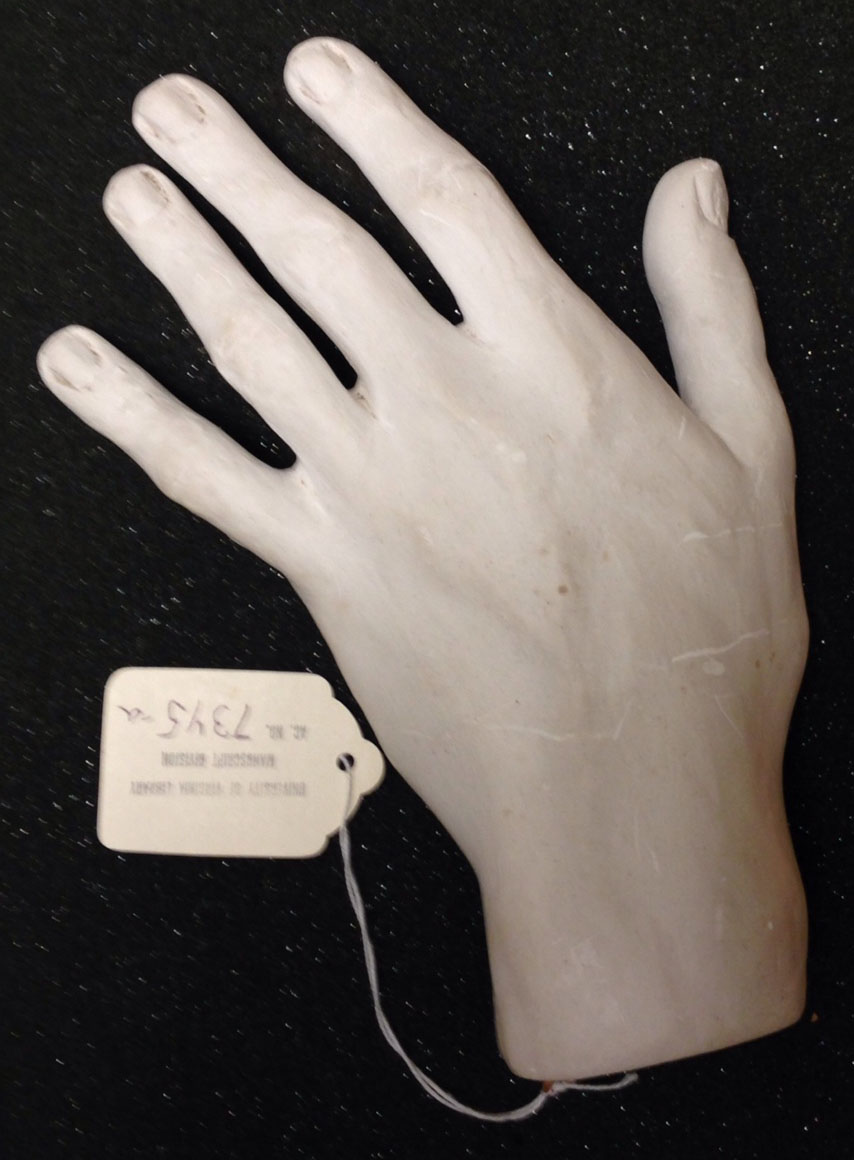
Upon closer inspection, I ascertained that this particular hand was not petrified; but rather, was a cast of someone’s hand– albeit a very convincing cast. Regardless, I wasn’t about to search the box any further for the gun, which, as it turns out, wasn’t even in that box anyway.

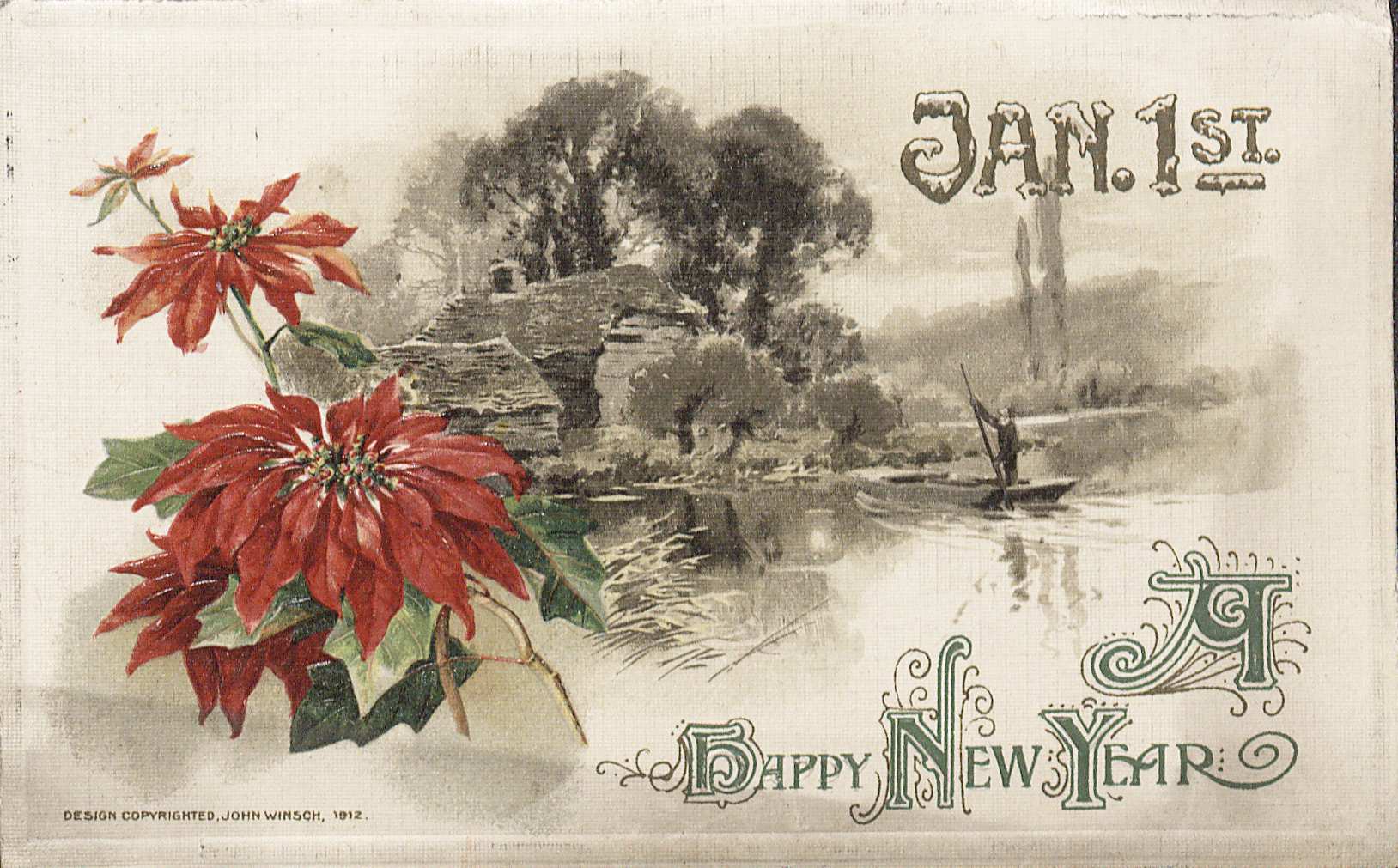
(Photograph by Caroline Newcomb)

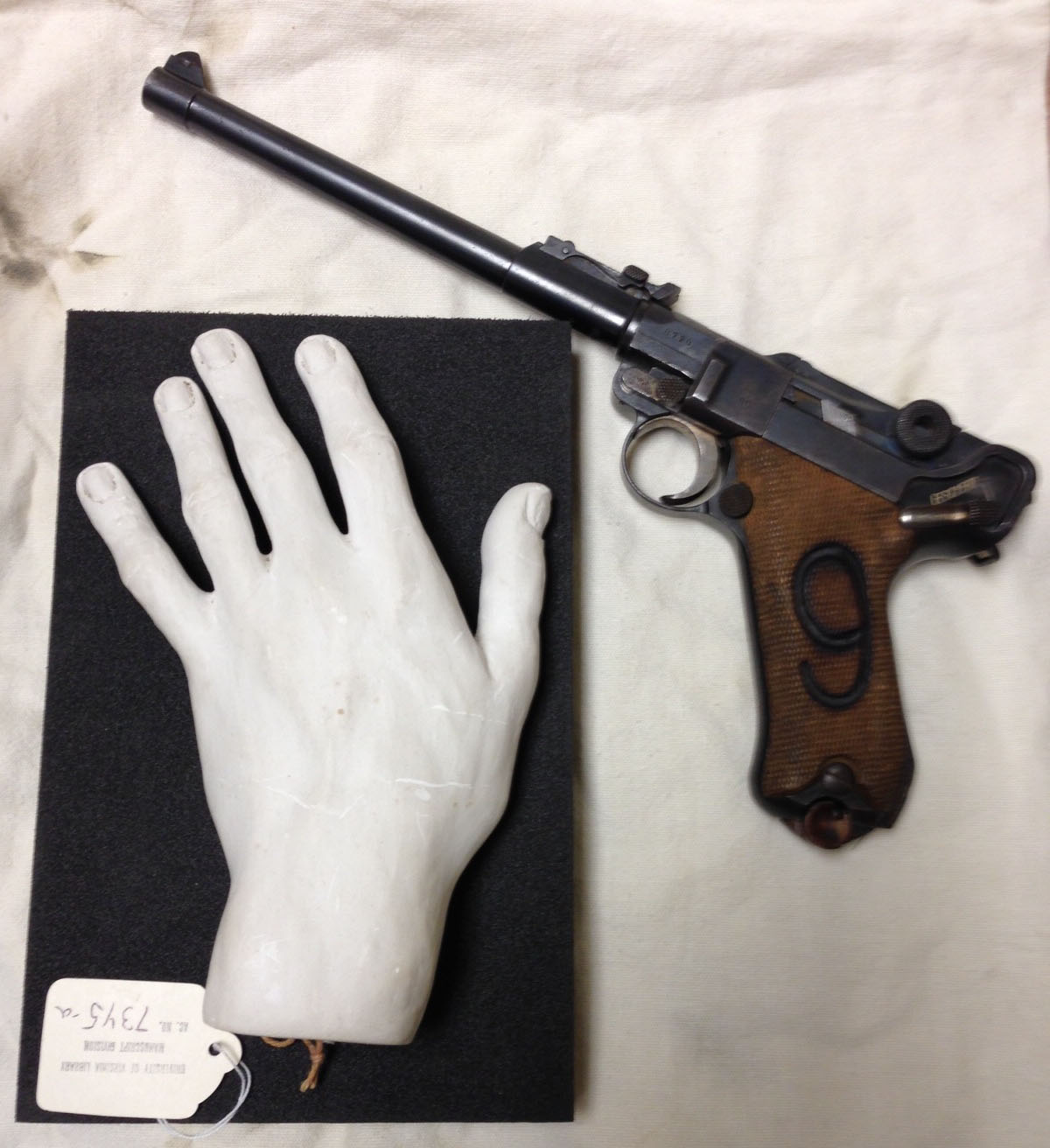
Cast of John Powell’s hand. (MSS 7345-a. Photograph by Caroline Newcomb)

But why on earth does the Special Collections library hold a cast of a hand? Whose hand was it?

As it so happens, this particular hand belonged to the well-known John Powell, whose extensive personal papers are housed in Special Collections.

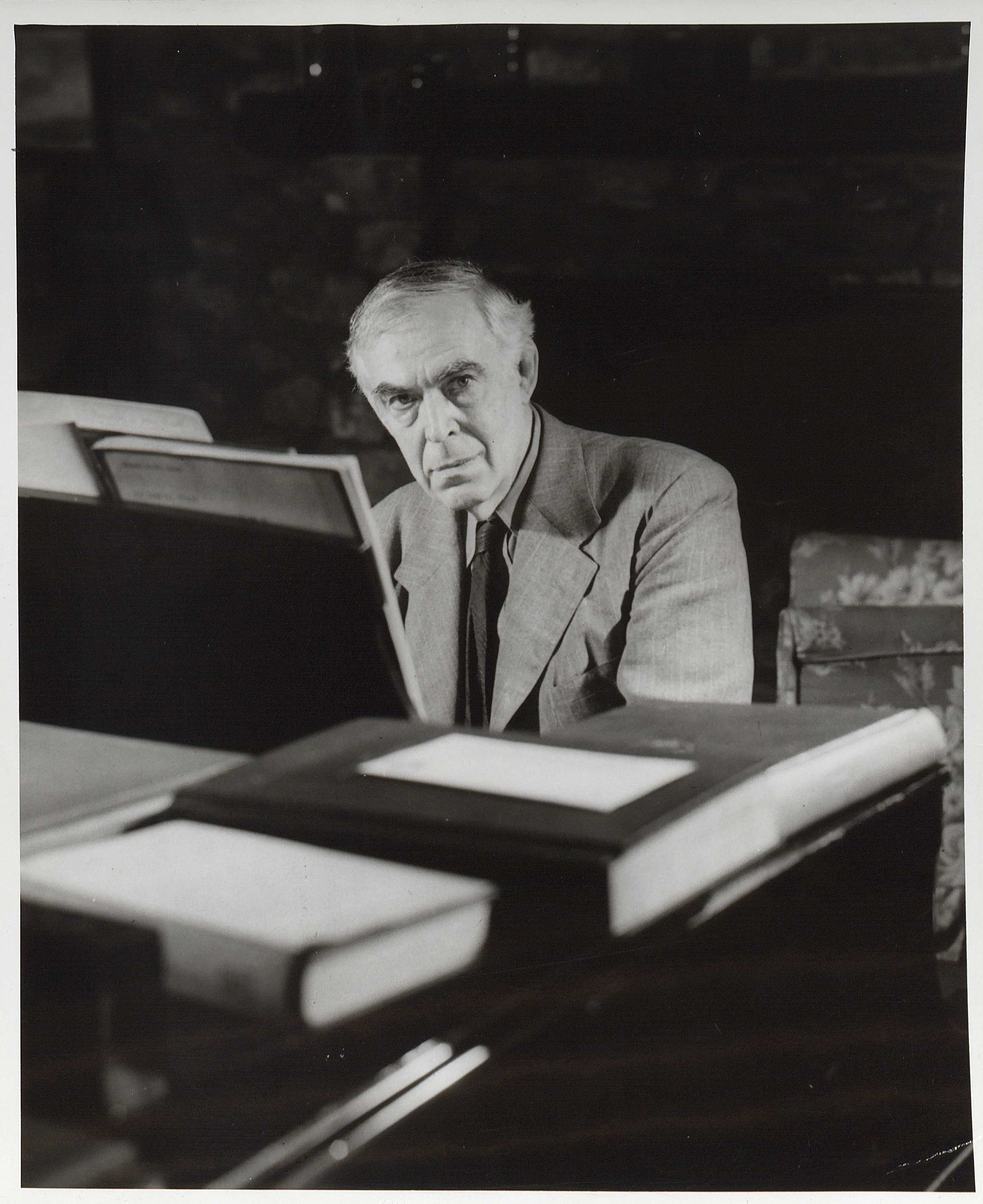
Portrait of John Powell, undated. (Image by Caroline Newcomb)

Portrait of John Powell, undated. (MSS 7284. Image by Caroline Newcomb)

John Powell devoted much of his life to music. In addition to trying to establish a chair of music here at U.Va., he wrote and performed music around the country.
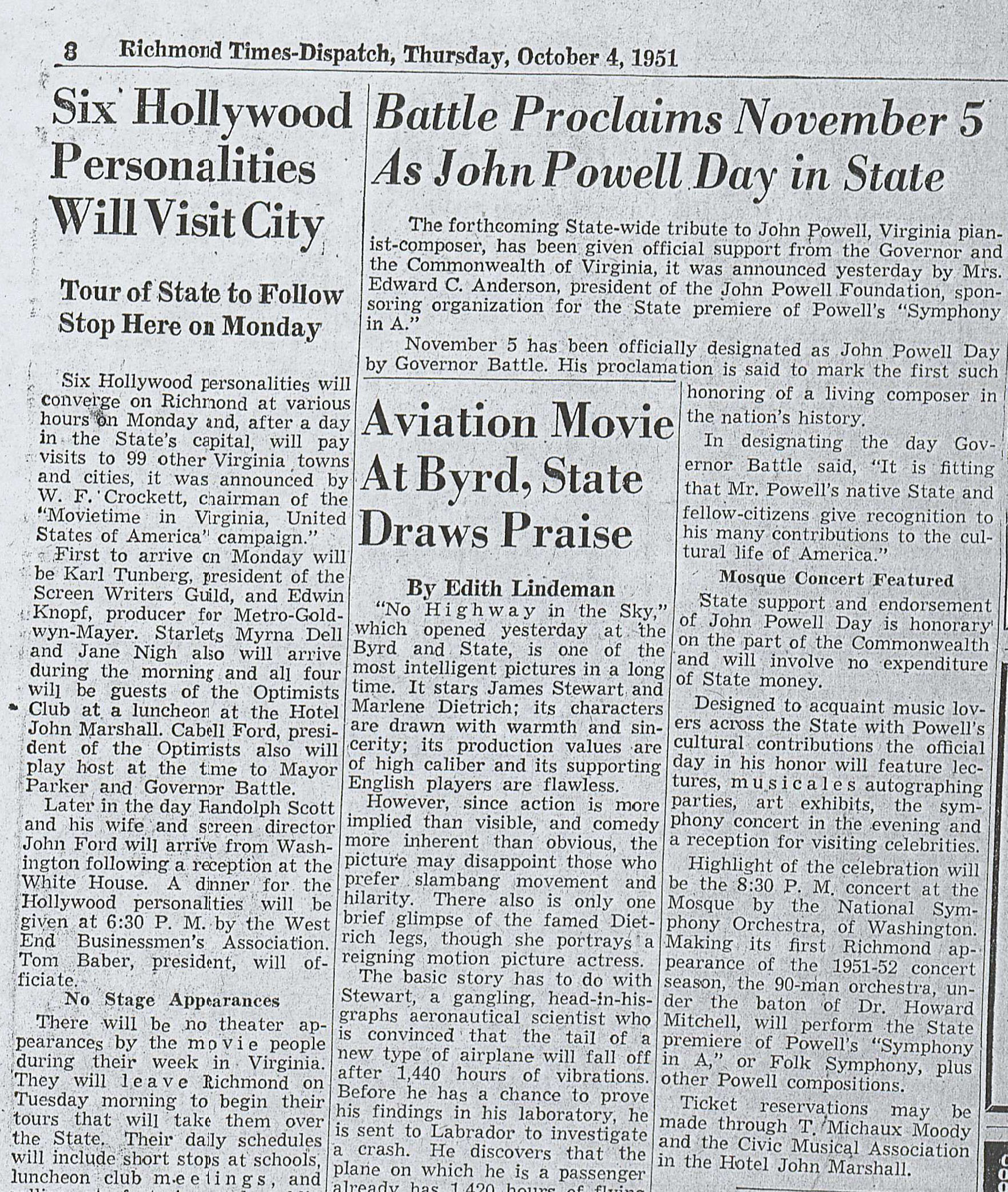
In fact, he was so talented and well-known that when his Symphony in A premiered on November 5, 1951, the governor declared it “John Powell Day.” “It is fitting,” Governor Battle said, “that Mr. Powell’s native State and fellow-citizens give recognition to his many contributions to the cultural life of America”

Newsclipping about John Powell Day, featured in the Richmond Times-Dispatch, 19 (Image by Caroline Newcomb.)
Newsclipping about “John Powell Day,” featured in the Richmond Times-Dispatch, 4 October 1951. (MSS 7284. Image by Caroline Newcomb)
Mr. Powell did more than write and perform music; he also collected it. As an ethno-musicologist, he gathered music written by Anglo-Saxons in an effort to prove not only that his contemporary Anglo-Saxons could write valuable music, but also that Anglo-Saxons had a history of musicianship.

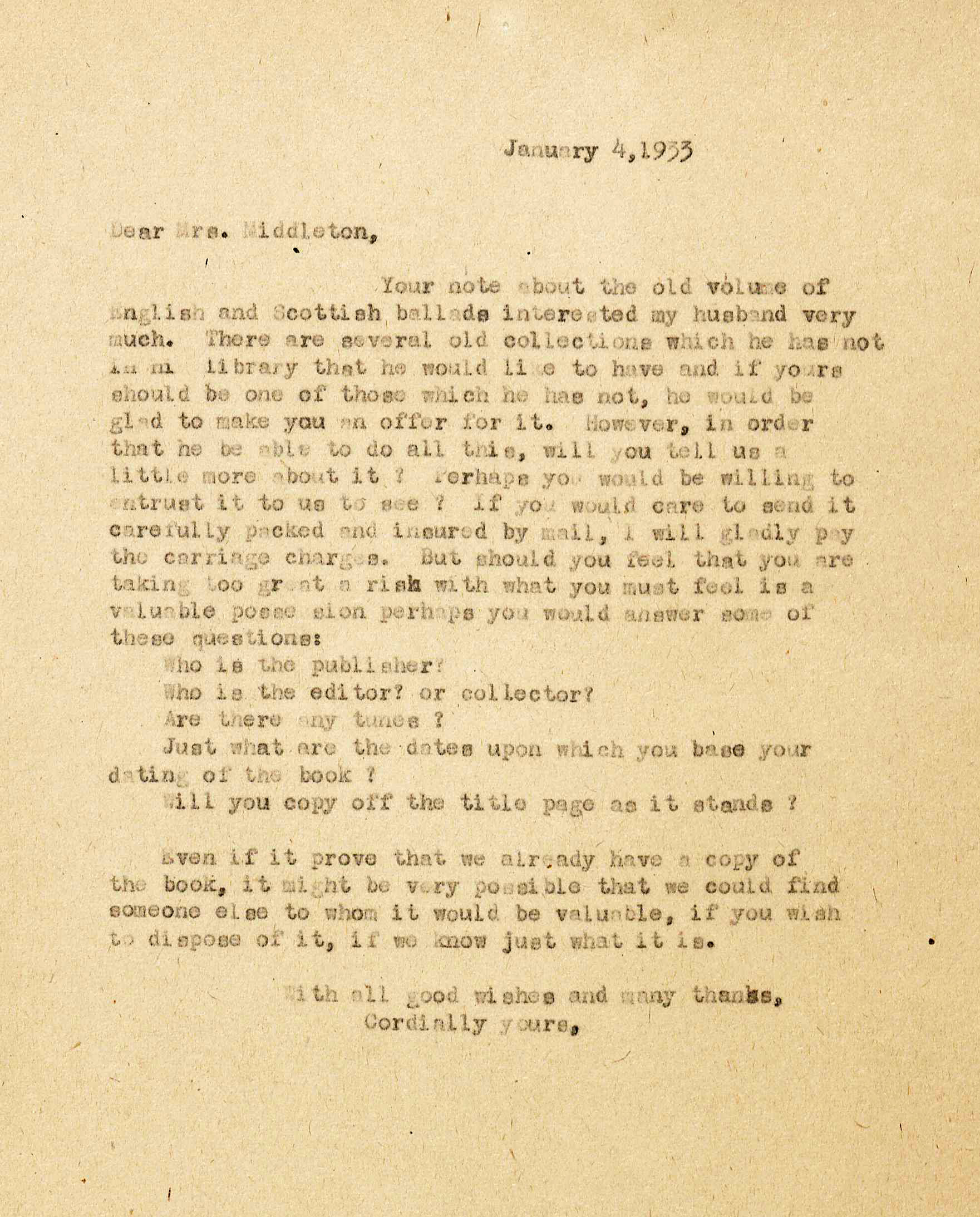
Powell letter to , 1933 (Image by Caroline Newcomb)

Here is a letter written by John Powell’s wife, Louise, to Mrs. Middleton, detailing a potential purchase of Anglo-Saxon music, 4 January 1933.  (MSS 7284. Image by Caroline Newcomb)

If it seems a bit strange to you—as it did to me—that Powell advocated for and collected specifically Anglo-Saxon music, then your intuition would be right on track. John Powell’s life revolved around more than music. Perhaps even more than a musician, John Powell was a eugenicist. The reason he collected Anglo-Saxon folk music was more about establishing this music as the music of the American Nation, supreme over all other music, than it was about proving Anglo-Saxon musical ability.

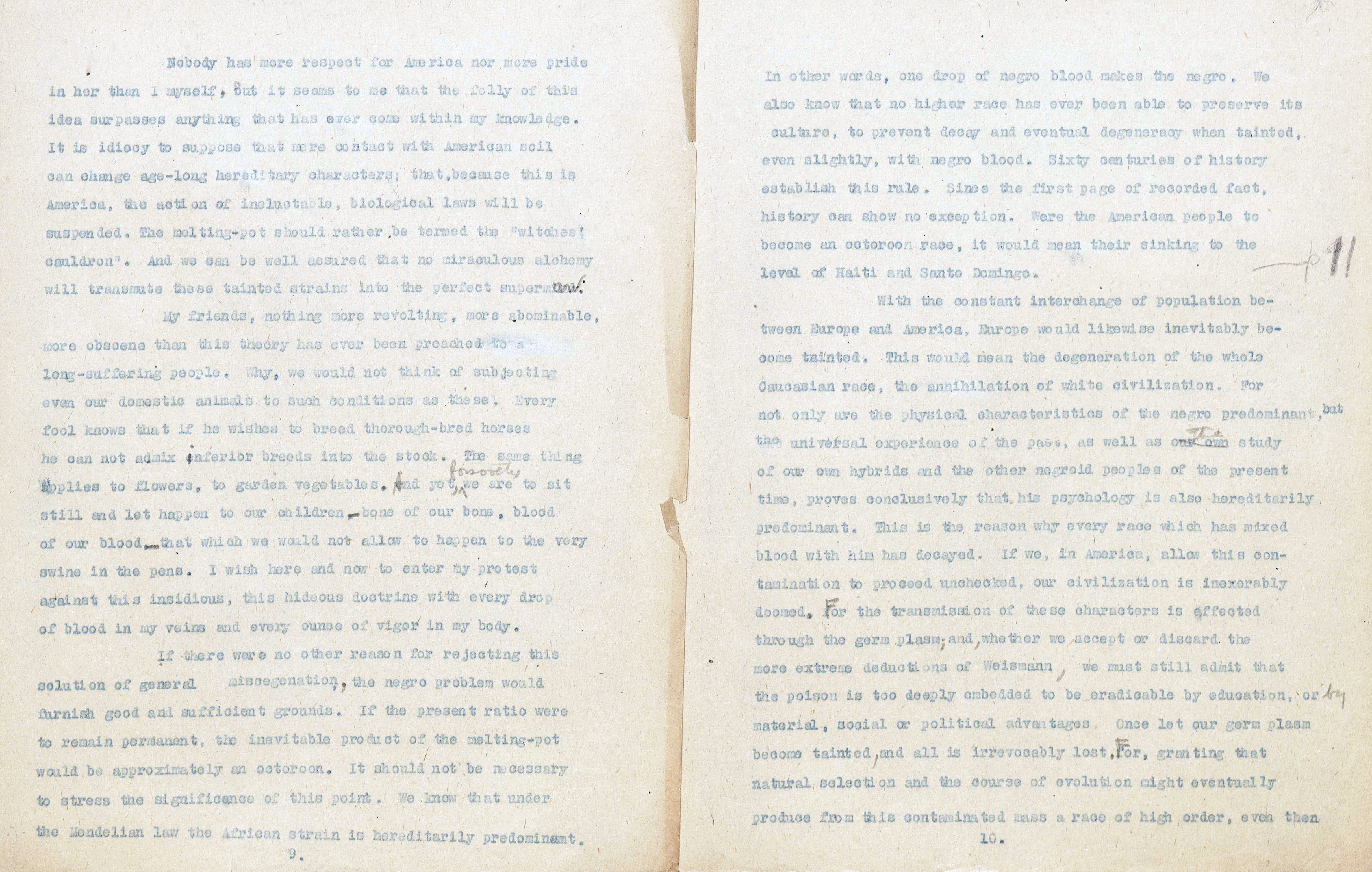
Pages nine and ten of Powell's "Music and the Nation." (Image by Caroline Newcomb)

Pages nine and ten of Powell’s “Music and the Nation.” (MSS 7284. Image by Caroline Newcomb)

In “Music and the Nation” [above], Powell argued that the United States at the time was not a nation, because a nation could only exist when it comprised a population homogeneous in blood, language, culture, and values. America, he further argued, used to be a nation, but ceased to be so when non-Anglo-Saxon immigrants and slaves were permitted or forced to enter the country, respectively. Comparing America’s population unfavorably to thoroughbred horse breeding, he argued, “the immense influx of the lower elements of the European and other continents…debase the average level of intelligence and character of the population.” He pushes for the deportation of non-Anglo-Saxon individuals and groups, as well as for stricter immigration laws, to prevent the further “degradation of white civilization.”

This puts a whole new perspective on the “many contributions to the cultural life of America” that Governor Battle extolled in John Powell.

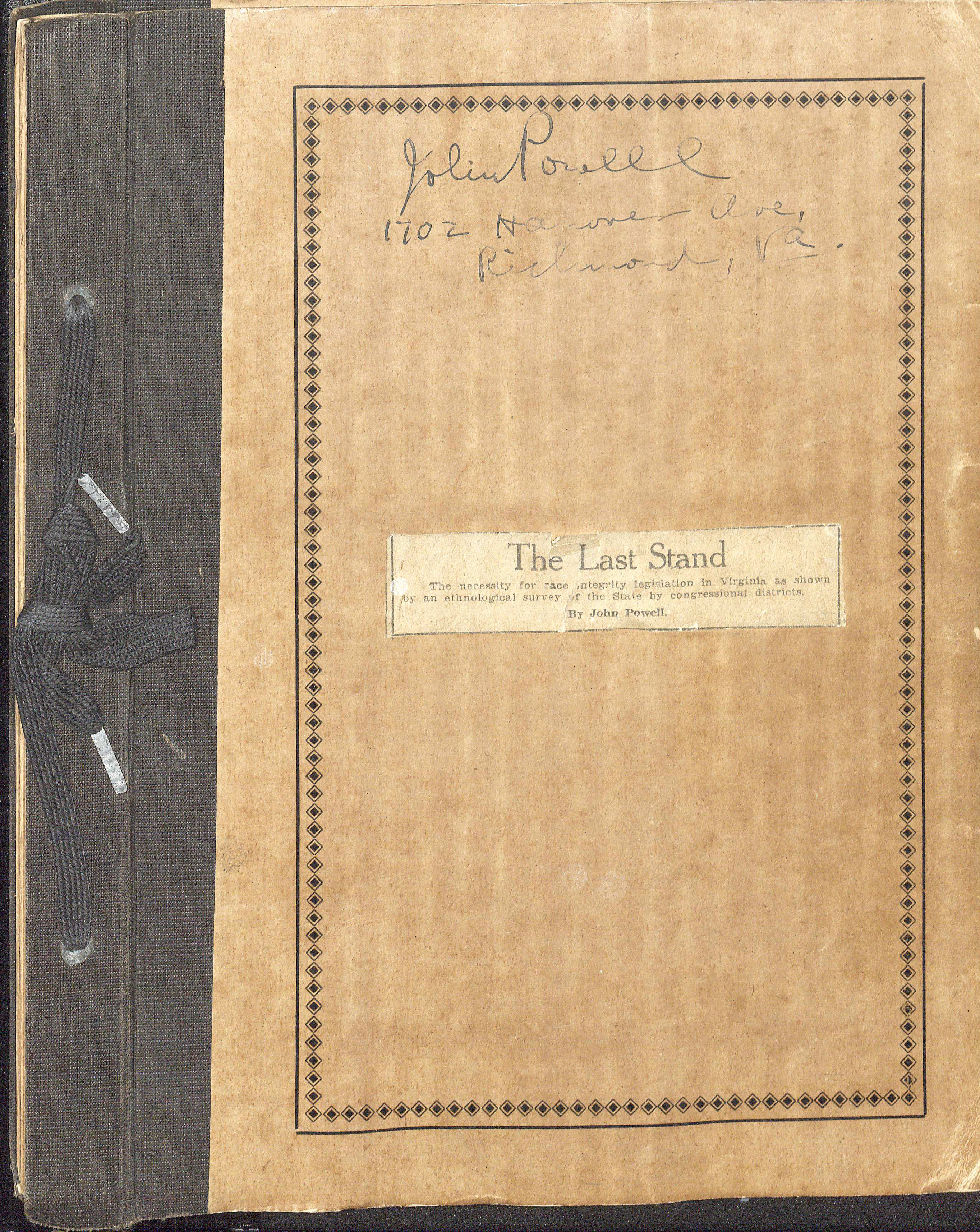
The Last Stand by John Powell (Image by Caroline Newcomb)

The Last Stand by John Powell (MSS 7284. Image by Caroline Newcomb)

Writings such as “Music and the Nation” and “The Last Stand” do not even begin to cover the massive efforts Powell made to render The United States an entirely Anglo-Saxon nation. Many of his letters, writings, and other works detail his opinions on the superiority of individuals of so-called “Anglo-Saxon stock” in terms of intelligence, language, and culture. What makes John Powell stand out even more is that his approach to eugenics used not only the usual arguments, but also intersected with music—the other love of his life. Not only did he believe that Anglo-Saxon individuals could compose music; he also believed that Anglo-Saxon music constituted the only true music—the best music.

I never found that German Luger I was looking for that day, but instead spent several days exploring Powell’s collection. Each time I found myself leaving feeling angry and sick to my stomach. Part of me wanted to burn the entire thing—all 47 boxes. However, the reality stands that eugenics constitutes an important part of our history in both Virginia and America—important in its danger, and the fact that notable individuals subscribed to this view. There are 47 boxes in Special Collections dealing with just one of the countless eugenicists in Virginia and America’s history. I may have started out looking for an example of racism, oppression, and genocide abroad, but the reality, as well all should know, is that these horrors exist(ed) here too, and constituted the ideals of touted individuals. That is not something we should ignore, but something we can learn from instead.

Mold of John Powell's hand and German Luger, 1917 (Image by Caroline Newcomb)

Cast of John Powell’s hand and German Luger from a collection of German World War I and II materials, 1917. (MSS 7345-a and MSS 9405-u. Image by Caroline Newcomb)

***

Caroline Newcomb, fall semester 2013. (Photograph by Petrina Jackson)

Caroline Newcomb, Class of 2014, fall semester 2013. (Photograph by Petrina Jackson)


Patron’s choice: Eliza Keating’s letters to her publisher T. H. Lacy, Fall 1855

This week we are pleased to feature a guest post from U.Va. English Department doctoral candidate Ann Mazur. Ann contacted us earlier this year with a purchase request and we happily obliged. Here, she tells us how this purchase has contributed to her dissertation. Thanks, Ann!

As a Ph.D. student in English literature, I am currently completing my dissertation, The Nineteenth-Century Home Theatre: Women and Material Space. My project aims to recover the nineteenth-century parlour play, an important dramatic outlet to Victorian middle-class women. The parlour play, or home theatrical, was a dramatic performance staged most often within the home, though sometimes plays were also performed at schools or at other venues to raise funds for charities. As the nineteenth century progressed, home theatricals largely replaced earlier forms of home entertainment such as tableaux vivants (“moving pictures”) and charades. Most theatricals lasted around fifteen to thirty minutes, though occasionally they are lengthier.

I argue that in the years from 1860 to1900, the parlour play became more popular among the middle-classes and was especially significant for women. Other literary scholars have shown that women who wrote for the public stage faced immense obstacles and prejudice. Likewise, Victorian public stage actresses had to battle an association with prostitutes. In contrast, the parlour play permitted women to both write and act freely.

One of the difficulties of my project—though this has simultaneously made it more exciting—is tracking down the ephemeral parlour play. Home theatricals were often printed in book collections of plays and in fragile pamphlets. Many libraries have not thought to save this popular entertainment, and I’ve often had to turn to the tireless services of Interlibrary Loan to find plays on microfilm, microcards, and less often, in the form of the real physical pamphlet or book. I have found some items only in the listings of rare booksellers, and as a result have built my own personal collection of parlour plays. In searching AbeBooks.com, I made an exciting find: a set of three letters written by mid-century parlour playwright Eliza Keating to her publisher T. H. Lacy, concerning the publication of her Acting Charades. All evidence in my research pointed to women having an easier time writing for home theatre, but here was a woman’s actual voice offering real details about this process.

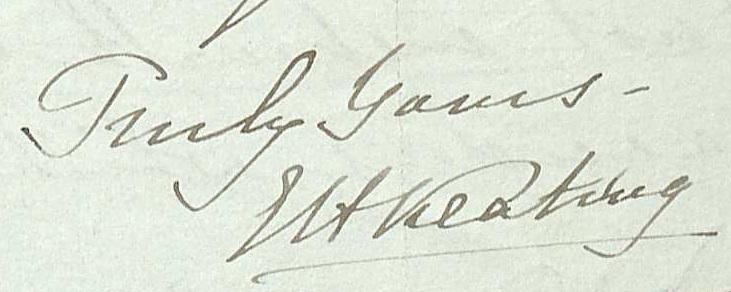
Eliza Keating's signature on one of the 1855 letters (MSS ****)

Eliza Keating’s signature on one of the 1855 letters (MSS 15628. Image by Elizabeth Ott)

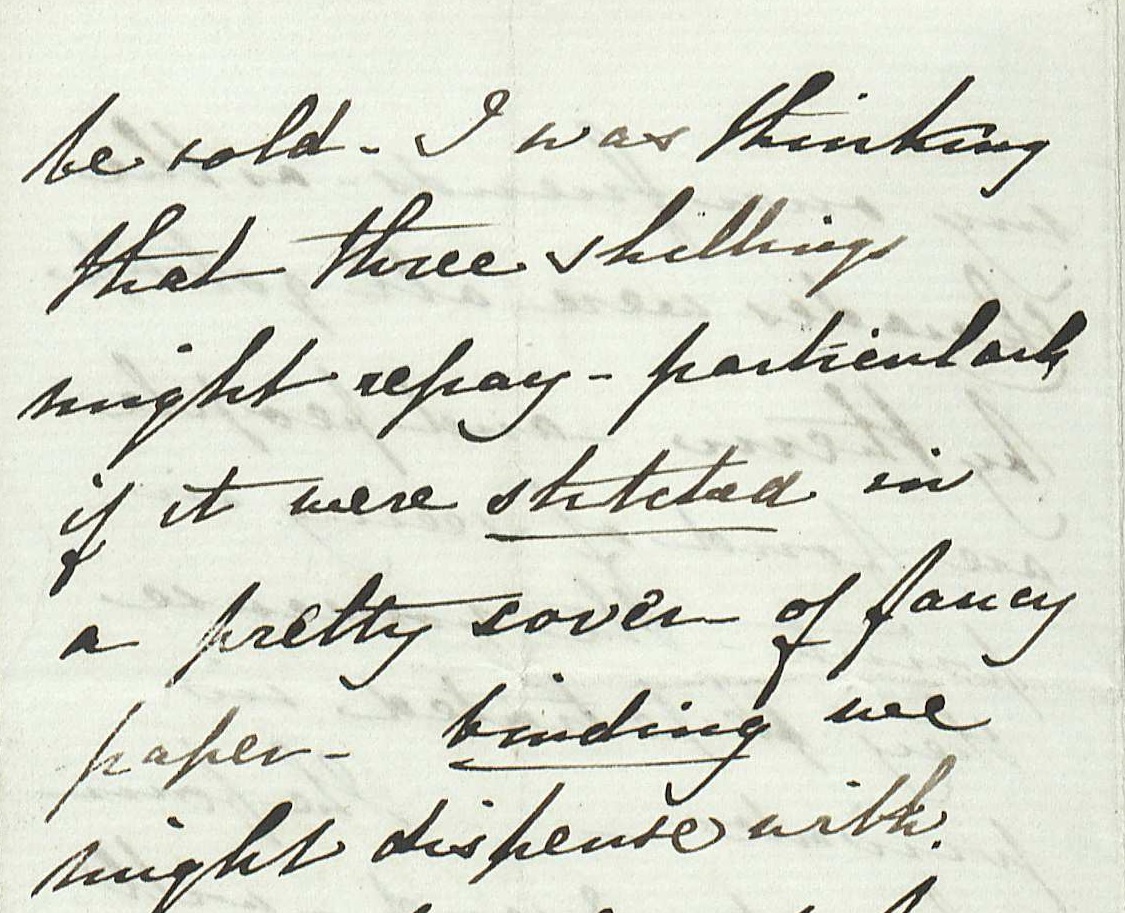
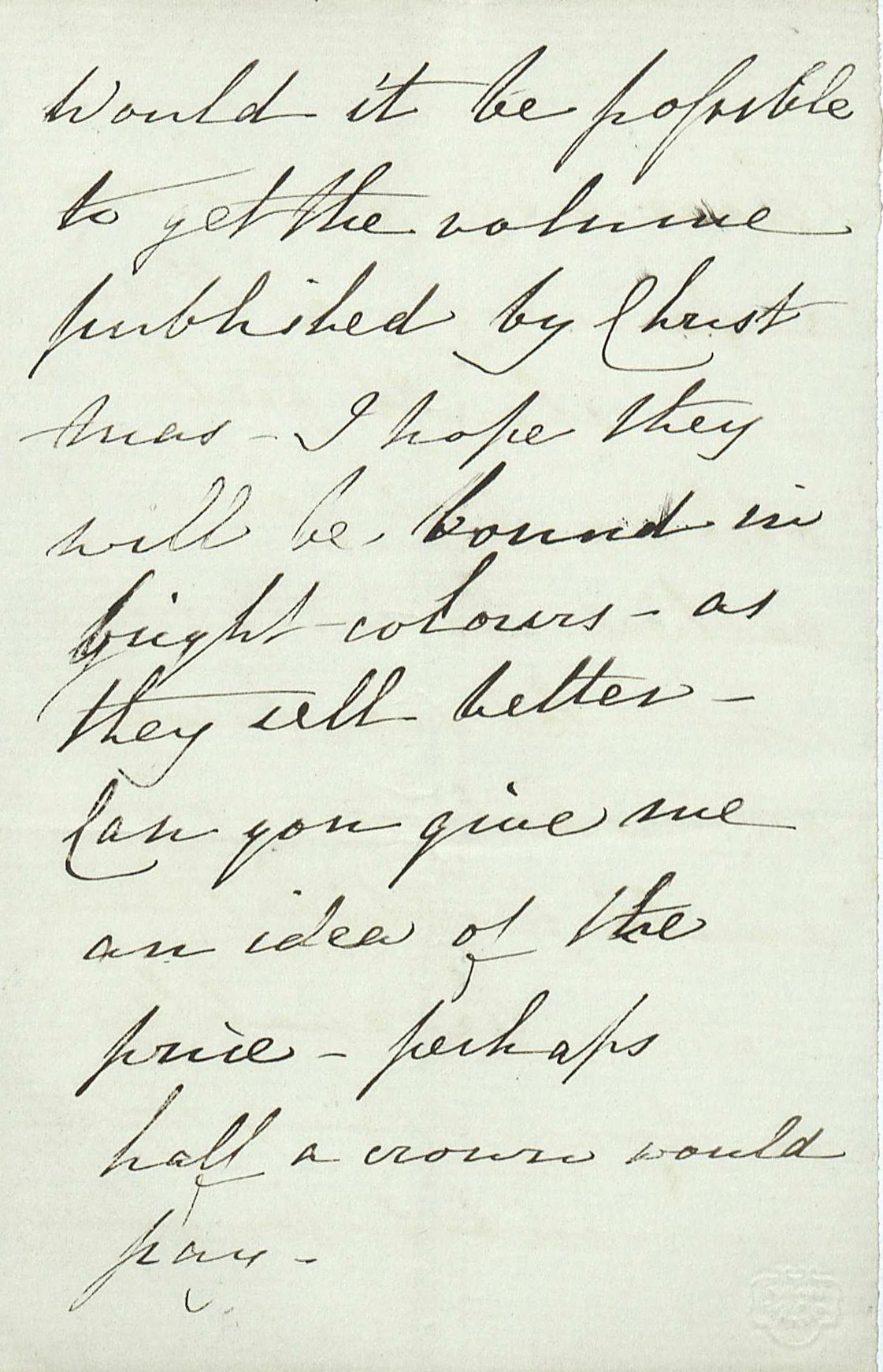
The letters date from the early stage of Keating’s home theatre writing career, as most of her plays date from the 1860s. They are not long, but they reveal her often thoughtful, shrewd, and persuasive business sense in dealing with her publisher. In the first and third letters, she offers suggestions to Lacy about the printing process and pricing. In the first, she writes, “I was thinking that three shillings might repay – particularly if it were stitched in a pretty cover of fancy paper – binding we might dispense with.” In the third letter she states, “I think you do quite right to make the volume of Charades as cheap as you can – for people now like to have a great deal for their money[.] My copies I can sell at the price you mention.” In this letter she includes a postscript noting her further hopes for the timing and color of publication, evidently persuaded by Lacy that binding rather than stitching would suit her work: “Would it be possible to get the volume published by Christmas – I hope they will be bound in bright-colours – as they sell better – Can you give me an idea of the price – perhaps half a crown would pay.” While Keating from the start appears eager to engage in discussions of design and pricing, the continued correspondence suggests that Lacy was an encouraging correspondent.

keating1crop

This passage from the letter dated October 10, 1855 includes the only underlinings that appear in Keating’s letters to Lacy (Image by Elizabeth Ott).

keating3crop2

A passage from the letter dated November 29, 1855 (Image by Elizabeth Ott)

The letters also disclose the role of actual parlour performance in Keating’s own life. Often, her friends are cited as performing her own work. In the first letter she writes: “I shall be enabled to have many copies subscribed for among my own friends – as the Charades were all got up by them – and people are fond of seeing in print – the nonsense they perpetrated in private.” In the third letter, discussing the appropriate order for her plays in the table of contents, she explains that her own personal copy of her plays “is briefly among my private friends.” Having no copy before her, she writes: “I presume the names of the Charade [sic] are very evident – Blue-Beard – Phaeton – Cataline / Guy Fawkes – I forget the order in which they come.” While copies of Blue-Beard exist, I have yet to find any of the other three plays tantalizingly listed here.

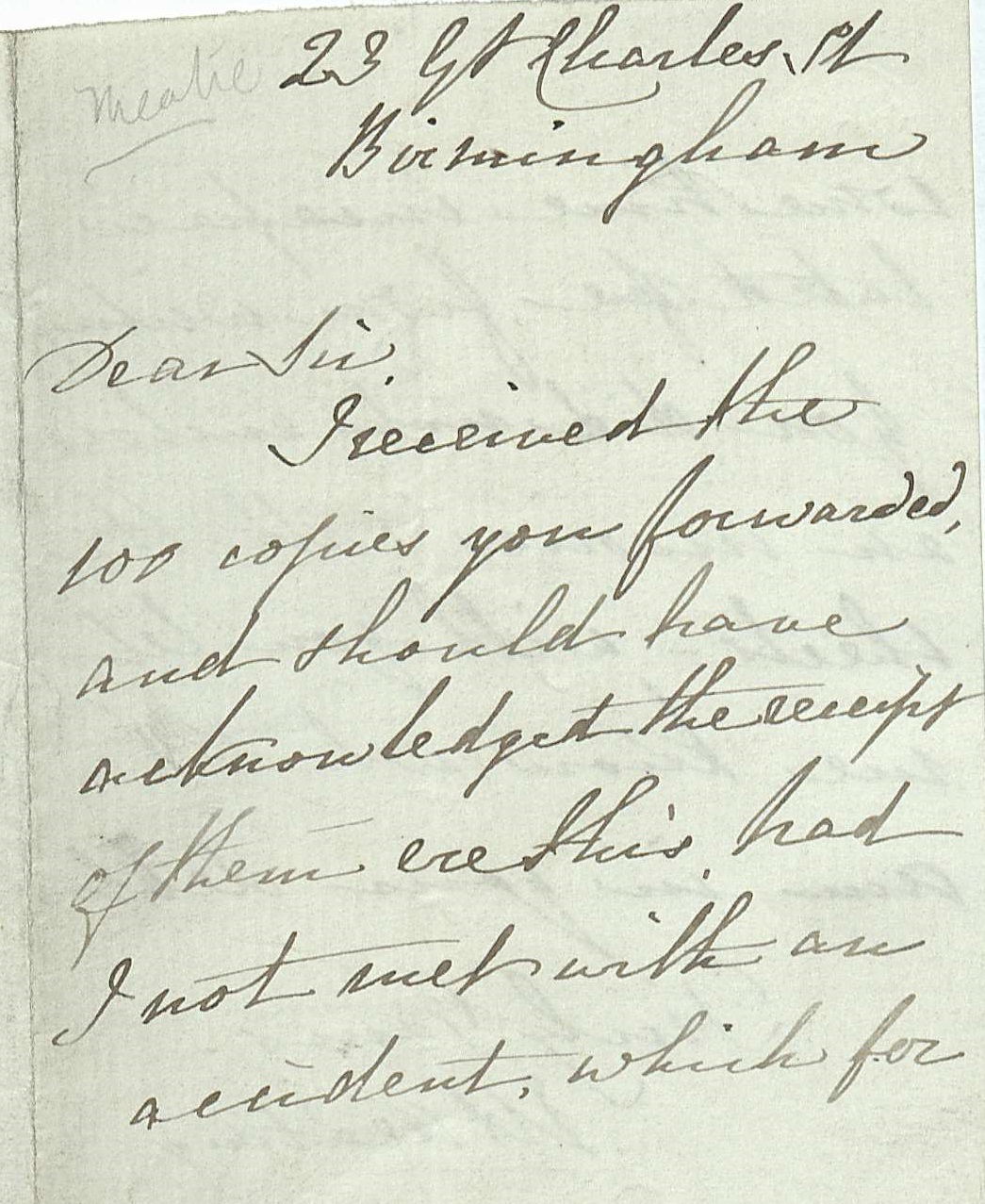
Keating’s second letter makes one curious about other details of her life. She acknowledges having received the “100 copies” forwarded by Lacy, and writes she “should have acknowledged the receipt of them ere this had I not met with an accident which for some time incapacitated me from writing.” To this letter, she adds: “P.S. I directed my friend Mr. Thirlwall to call in Wellingborough for a copy of my Charades – which you will add if you please to my account –.” I suspect she is referring to Connop Thirlwall (1797-1875), who, according to the Dictionary of National Biography was “historian and bishop of St. David’s,” just thirteen miles from Wellingborough. While Keating so kindly offers to add Thirlwall’s book to her own account, I also wonder whether a sort of name-dropping might have come into play here.

keating2crop

Keating alludes, somewhat mysteriously, to an “accident” in this undated letter [1855] (Image by Elizabeth Ott).

If you are interested in learning more about Eliza Keating, stay tuned for the full dissertation-turned-book. Keating is featured in Chapter Two, “A Parlour Education: Reworking Gender and Domestic Space in Ladies’ and Children’s Theatricals,” where I compare her fairy-tale theatricals written for adult performers with Florence Bell’s later 1890s fairy-tale plays written for children. My introductory chapter, the last of my dissertation to be written, discusses Keating’s letters to T. H. Lacy. Thanks to the Small Special Collections Library for making this possible!

This Just In: Rotunda Redivivus

Right now U.Va.’s iconic Rotunda—the centerpiece of Thomas Jefferson’s “Academical Village” and the U.Va. Library’s original home—is undergoing a multi-year, $50 million restoration. These have been interesting times for sidewalk supervisors and armchair architects as the restoration work reveals hitherto unknown details about the Rotunda’s design and construction.  It has also been an interesting time Under Grounds, for we have fortuitously acquired two early images of the Rotunda previously lacking from our collection.  Although these images do not advance our understanding of the Rotunda’s architecture, they do enhance our knowledge of its early iconography.

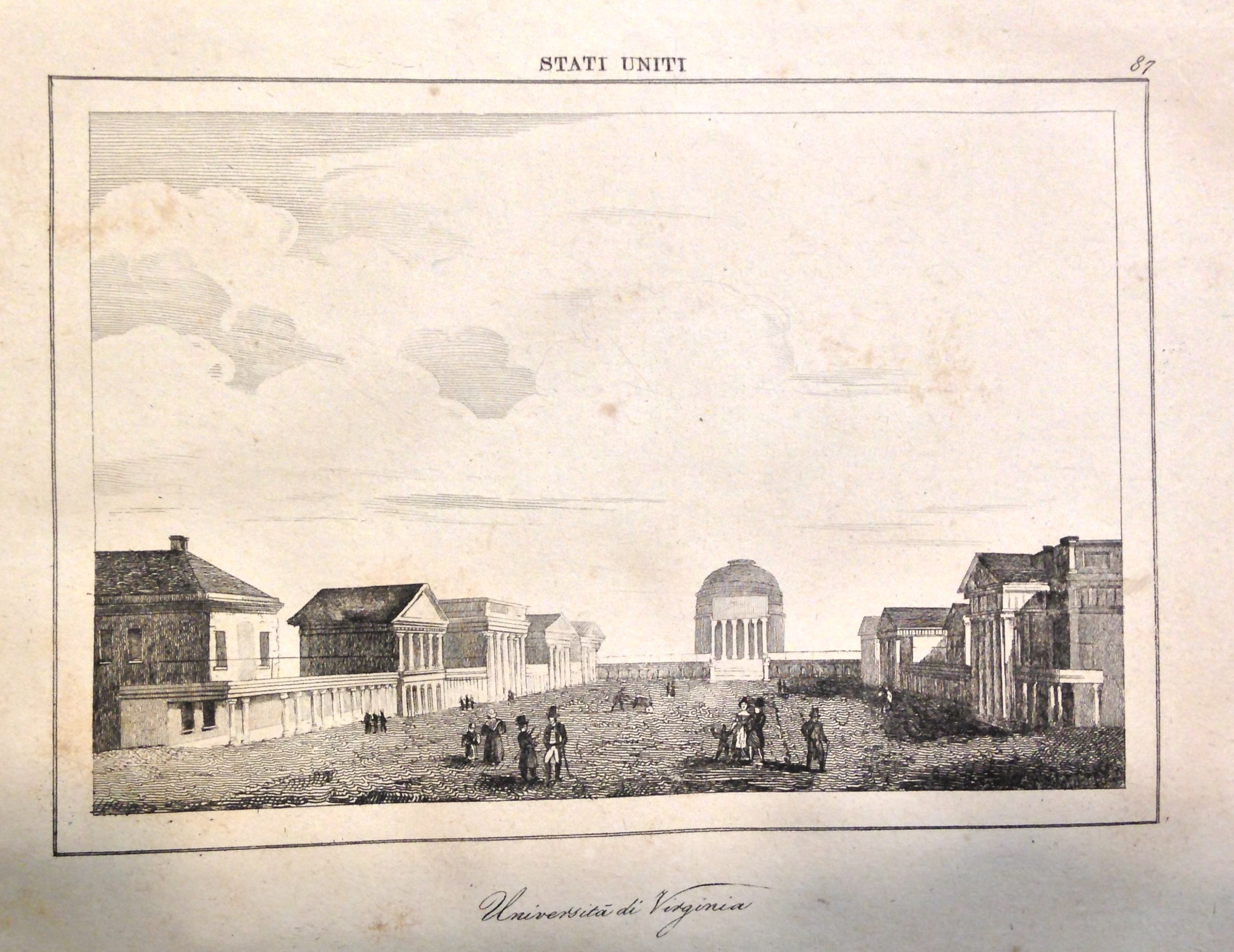
The Lawn, as it appeared in Roux de Rochelle, Stati Uniti d'America (Venice, 1839)   (E178 .R8216 1839).

The Academical Village, as it appeared in Roux de Rochelle, Stati Uniti d’America (Venice, 1839) (E178 .R8216 1839).

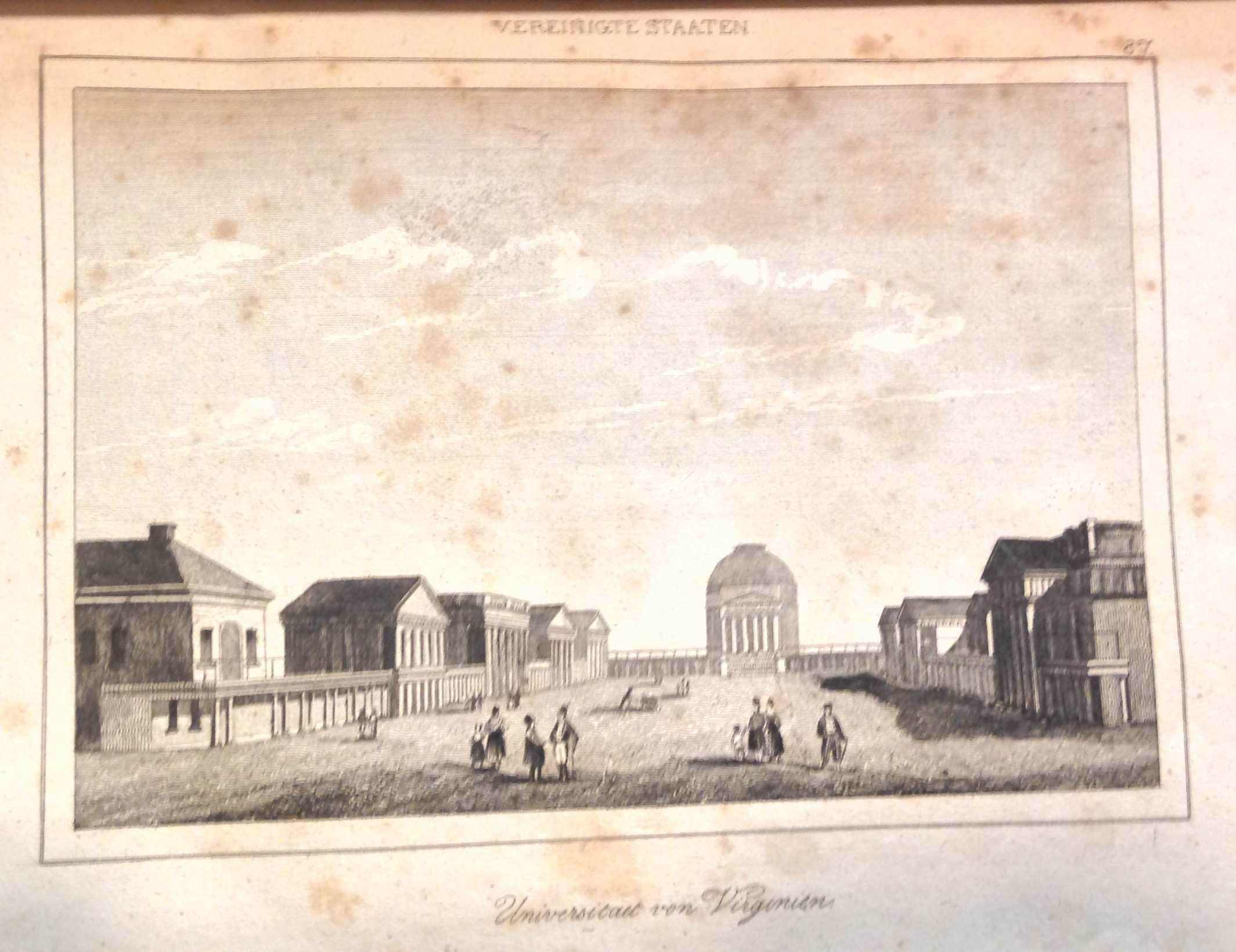
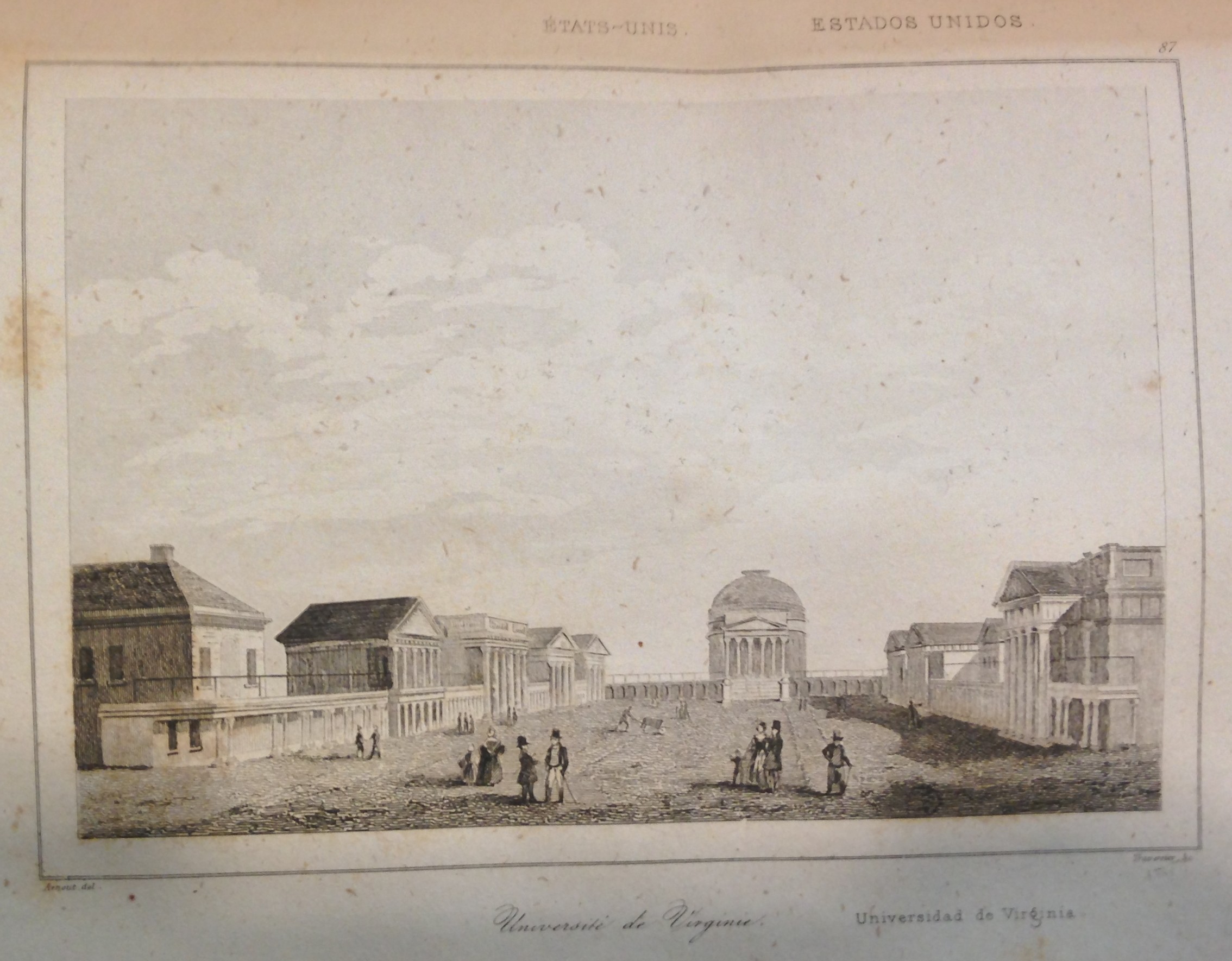
The two newly acquired images are engraved plates in the Italian (Venice, 1839) and Spanish (Barcelona, 1841) translations of Jean Baptiste Gaspard Roux de Rochelle’s États-Unis d’Amérique. This history and description of the United States, first issued in 1837 as part of the series, L’univers, histoire et description de tous les peuples, proved popular and was reprinted several times. Perhaps its major selling point was the 96 engraved plates depicting historical personages and events, as well as numerous contemporary American views. Plate 87 is of special interest, as it depicts U.Va.’s Academical Village as it looked in the mid-1820s, after the Rotunda, faculty pavilions, and student rooms had been completed.

U.Va. has long held copies of the Paris, 1837 and 1838 editions, and the Stuttgart, 1838 German translation.  That we lacked the Italian and Spanish translations was brought to our attention this fall, when a collector offered to donate copies: “I should tell you that I’ve removed the U.Va. plates, but perhaps you could use the books anyway?”  We politely declined the gift, choosing instead to purchase complete copies on the antiquarian market.  To our knowledge, only the Mexico [City], 1841 Spanish edition still eludes our dragnet.

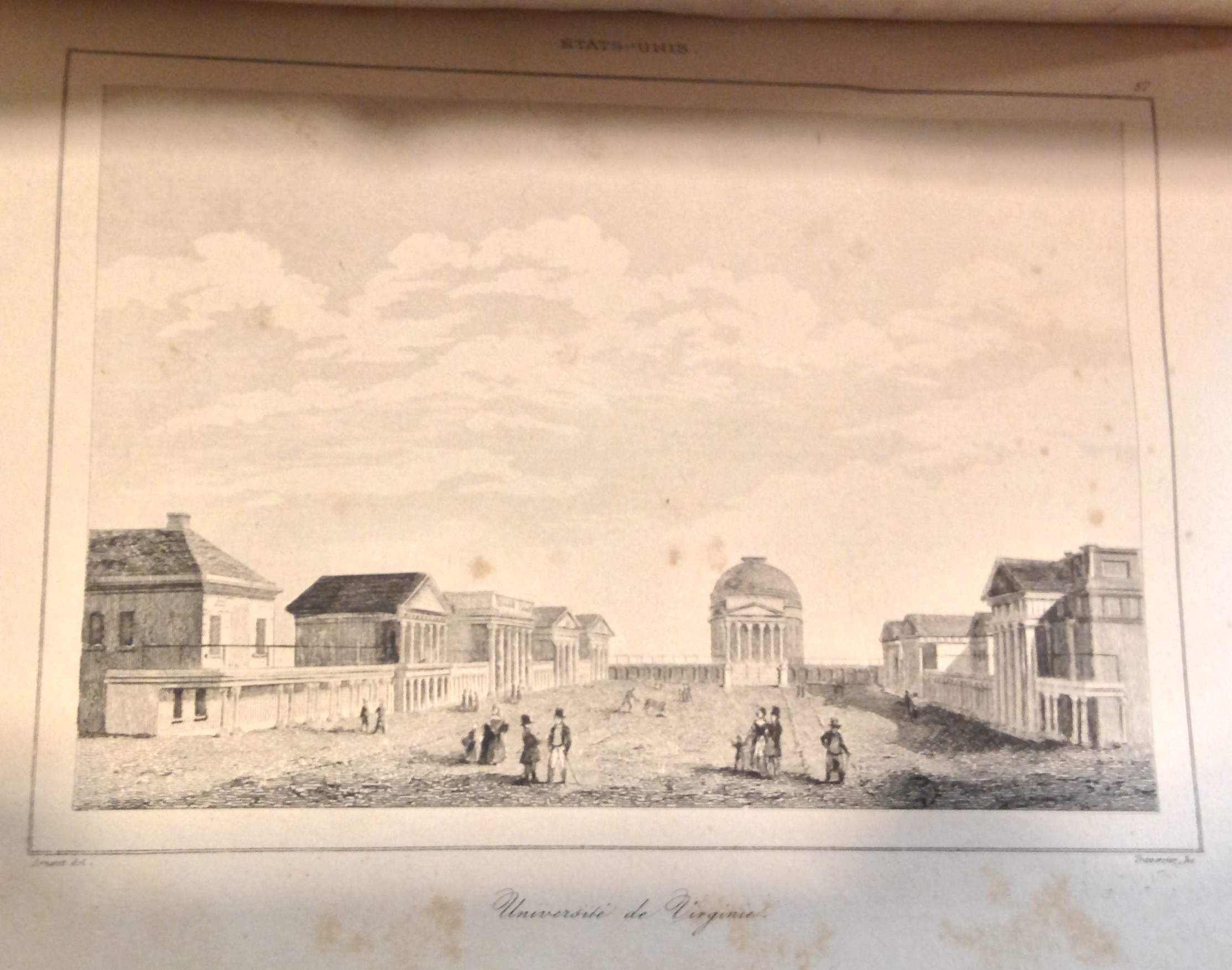
The Academical Village as it appeared in Roux de Rochelle, États-Unis de’Amérique (Paris, 1837) (E178 .R82 1837)

The Academical Village as it appeared in Roux de Rochelle, États-Unis de’Amérique (Paris, 1837) (E178 .R82 1837)

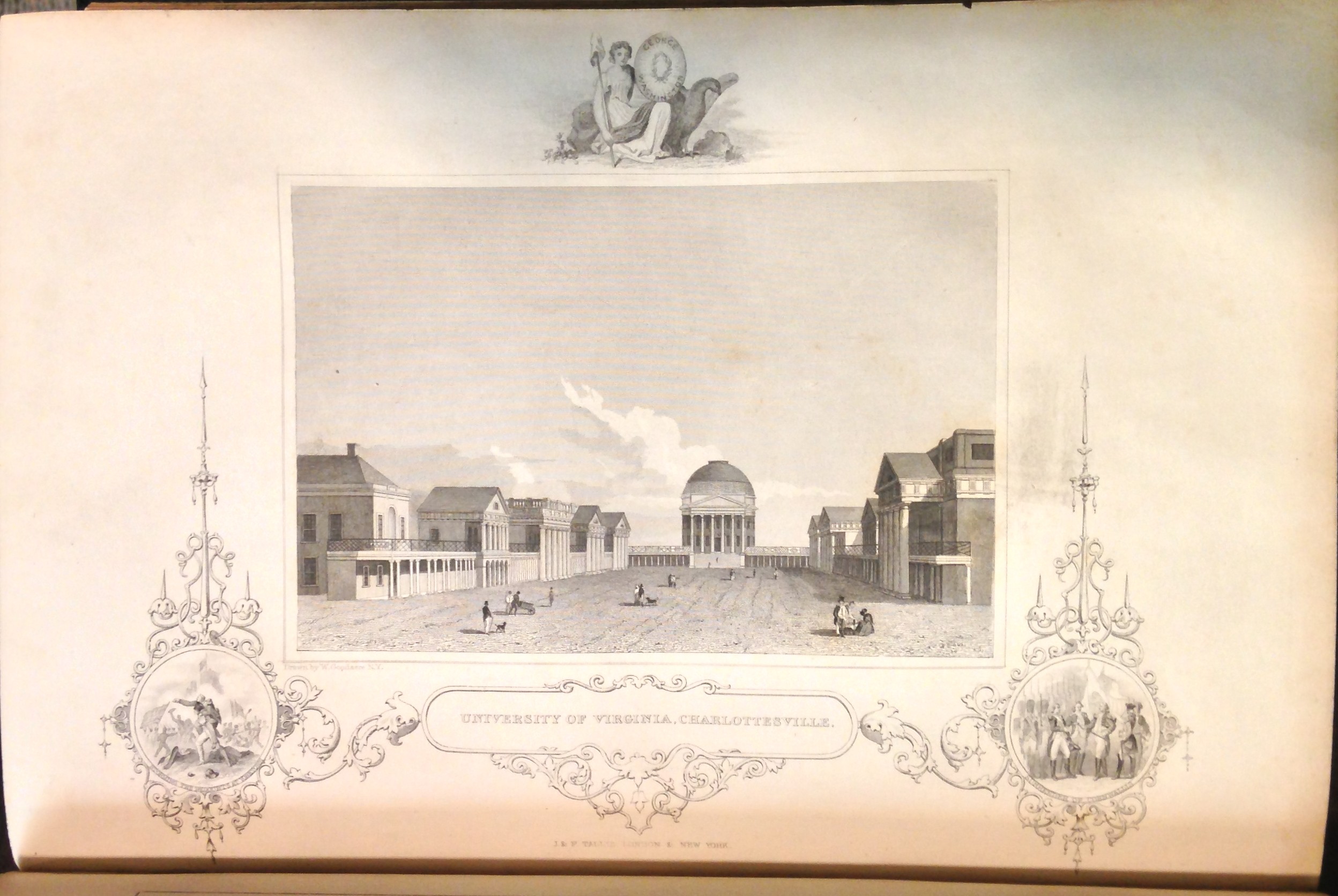
Although the text mentions U.Va. only in passing, it was through the engraving in Roux de Rochelle’s work that many Europeans first learned of U.Va. and its distinctive architecture. What few readers probably realized is that Roux de Rochelle’s knowledge of U.Va. was by no means first-hand. Born in 1762, Roux de Rochelle had served as French consul in New York during the early 1820s, returning as French Minister to the U.S. from 1830 to 1833. Perhaps it was then that he saw a copy of John Howard Hinton’s two-volume History and topography of the United States, published in London, New York, and Philadelphia from 1830-1832. Roux de Rochelle evidently decided to write a similar work for a French audience, and though the text is quite different, its many engraved plates are largely copies of those prepared for Hinton’s work. Indeed, Hinton’s plate 81 is an identical view of U.Va.’s Academical Village.

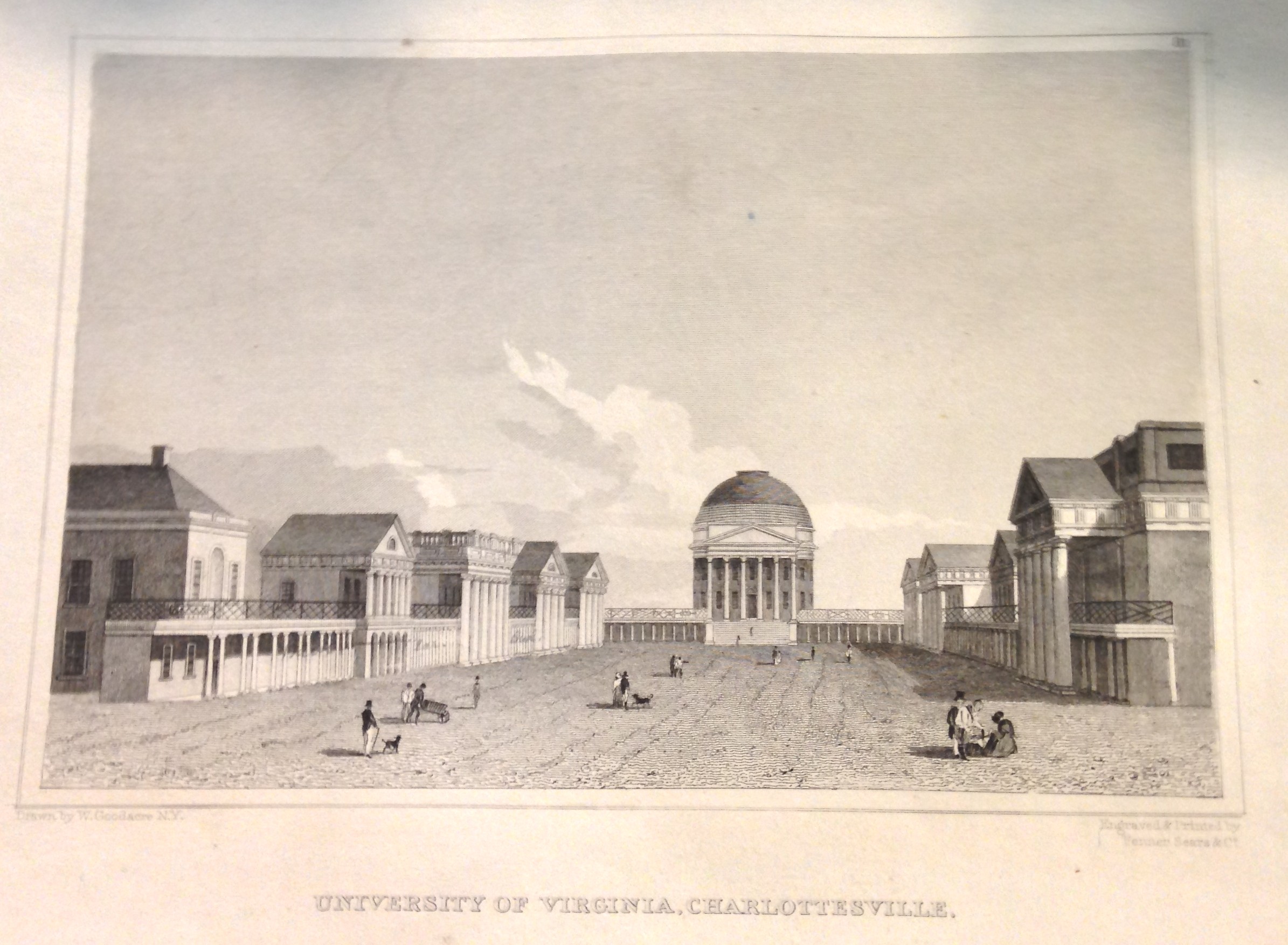
Plate 81 from John Howard Hinton, The history and topography of the United States (London & New York, 1830-1832) (E178 .H691 1830)

Plate 81 from John Howard Hinton, The history and topography of the United States (London & New York, 1830-1832) (E178 .H691 1830)

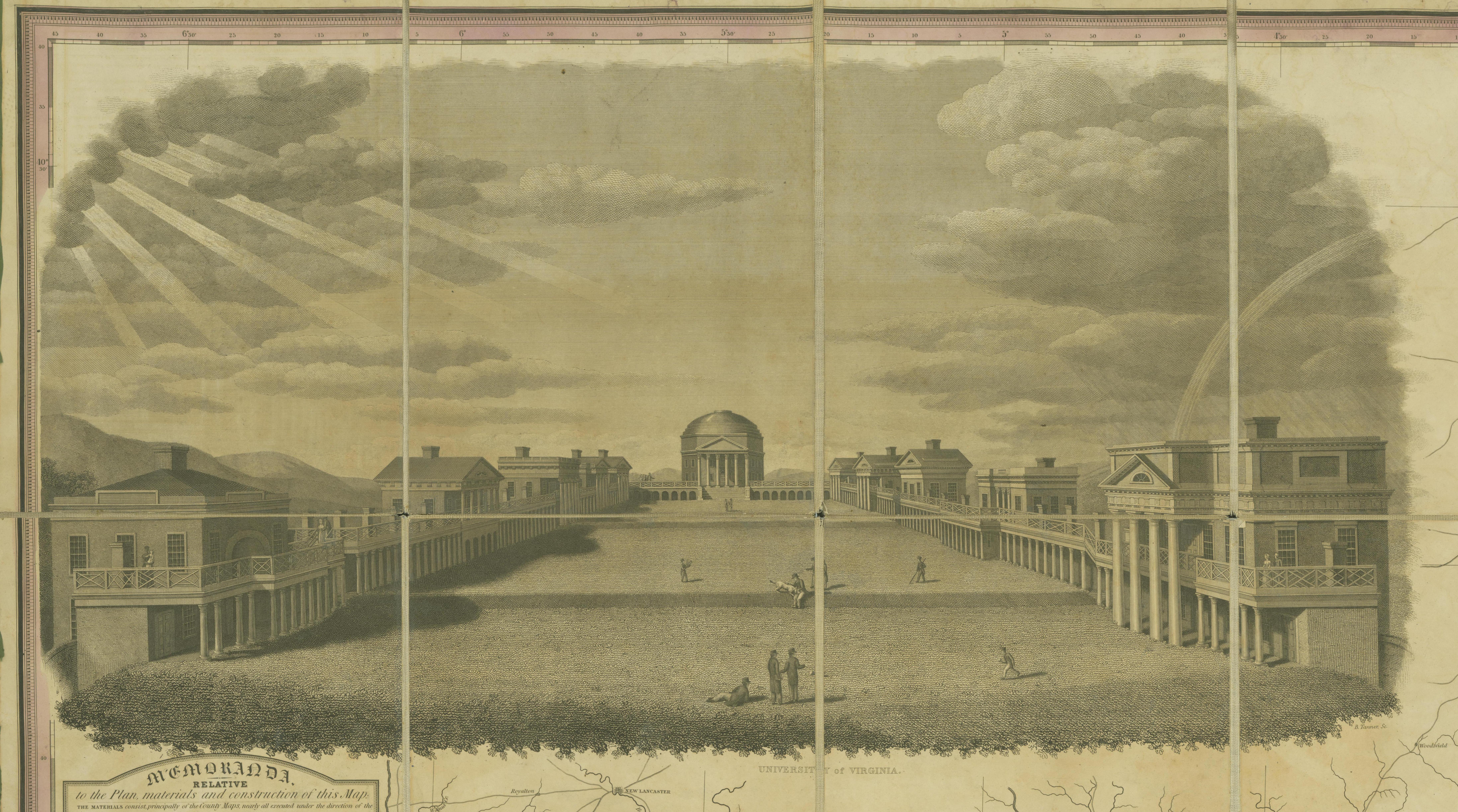
But even Hinton’s plate is derivative, for its immediate source was the highly detailed view of U.Va., engraved by Benjamin Tanner, that appears on the top left sheet of Herman Böÿe’s famous 1826 wall map of Virginia. For Hinton’s work, Tanner’s engraving was copied in New York by landscape artist William Goodacre, whose drawing was sent to London to be engraved on steel by artists in the employ of Fenner Sears & Co. The Hinton engraving is smaller in size and less detailed than Tanner’s view, though some effort was made to render the architectural elements relatively faithfully.

Benjamin Tanner's 1826 engraved view of the newly opened University of Virginia.

Benjamin Tanner’s 1826 engraved view of the newly opened University of Virginia.

In preparing Roux de Rochelle’s work for the press, the Paris publisher commissioned 96 full-page engraved reproductions of existing artworks. Some of the sources are credited in the text, though the liberal copying of plates from Hinton’s work goes unmentioned. In the Roux de Rochelle plate—signed by “Arnoult” as designer [sic] and “Traversier” as engraver—the Hinton view is reduced still further in size and the architectural details muddied somewhat. One wonders whether the book’s European readers could derive from this view an informed appreciation of Jefferson’s architectural vision.

The Academical Village reinterpreted for the German translation of Roux de Rochelle: Vereinigte Staaten von Nord-Amerika (Stuttgart, 1838)  (G115 .W4 1838)

The Academical Village reinterpreted for the German translation of Roux de Rochelle: Vereinigte Staaten von Nord-Amerika (Stuttgart, 1838) (G115 .W4 1838)

A year after Roux de Rochelle’s work first appeared in Paris, a German translation was published in Stuttgart. The Stuttgart publisher did not have access to the engraved plates used for the Paris edition—indeed, per the custom of these pre-copyright days, he likely did not bother to obtain permission to translate and republish the work—so it was necessary to commission German artists to re-engrave the 96 plates. The U.Va. view is a very close copy, albeit a less careful rendering; and while the engraver dutifully reproduced the buildings, he took a bit of artistic license with the human figures on the Lawn.

The following year, the Venice publisher of the Italian translation faced an identical problem and solved it in the same way, by commissioning copies of the 96 plates. And once again, various architectural details have been lost or distorted when re-engraved, and minor liberties taken with the human figures.

The French plate reused, with added captions in Spanish, in Roux de Rochelle, Historia de los Estados-Unidos de América (Barcelona, 1841)  (E178 .R8218 1841)

The French plate reused, with added captions in Spanish, in Roux de Rochelle, Historia de los Estados-Unidos de América (Barcelona, 1841) (E178 .R8218 1841)

Not so with the Spanish translation published in Barcelona in 1841, however. Here the publisher evidently sought and obtained permission to illustrate the edition with the Paris engravings, to which an additional caption in Spanish has been added. (Presumably the Mexico City edition is a reissue of the Barcelona printing and also contains the Paris engravings, but perhaps not.)

The Hinton plate reappeared in the 4th edition (London & New york, 1850?) with an added decorative border (E178 .H691 1850)

The Hinton plate reappeared in the 4th edition of The history and topography of the United States of America (London & New York, 1850?) with an added decorative border (E178 .H691 1850)

And what, finally, of the Hinton plate? Although absent from the second edition of Hinton’s work (Boston, 1846), it reappears in the third and fourth editions (London and New York, 1849 and [1850?]), but with a new caption and an added decorative border.

Happy Thanksgiving!

This Thanksgiving Day blog post is written by our very own Heather Riser, Head of Reference and Research Services.

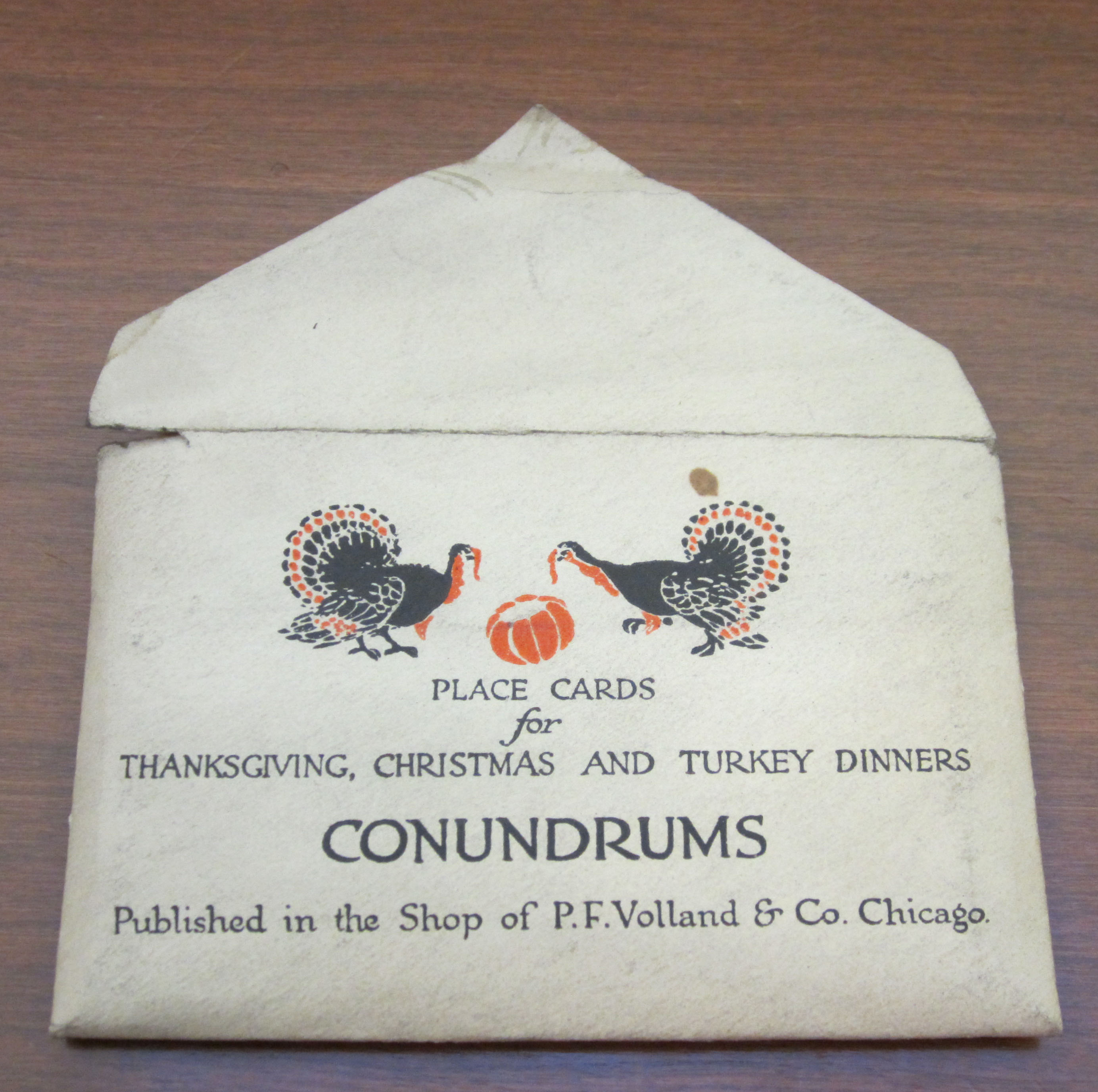
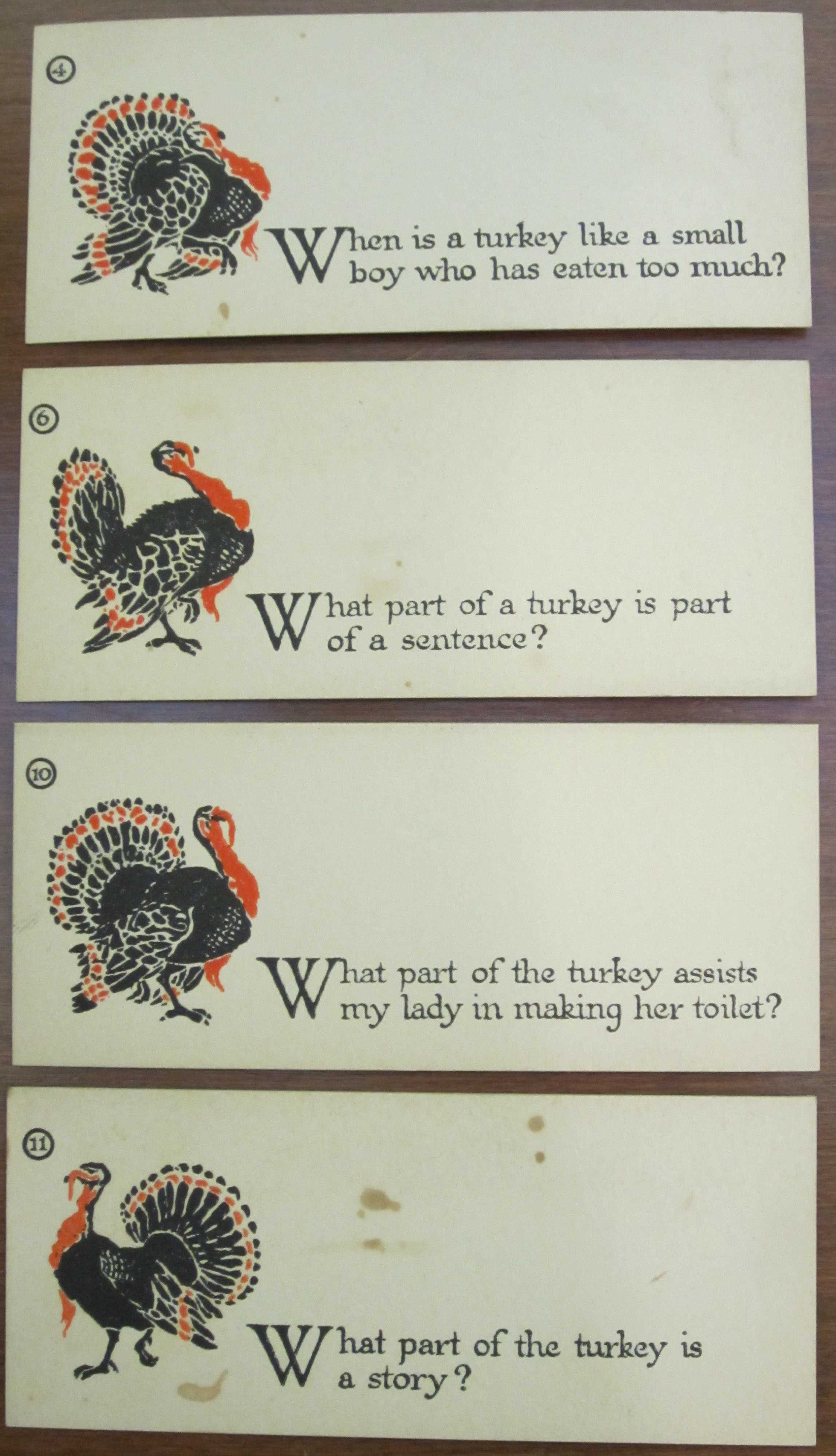
We recently discovered this Thanksgiving gem among the Magruder Family Papers*, a large collection that is currently being sorted, arranged, and described in our processing area in Special Collections.

(Photograph by Petrina Jackson)

“Place Cards for Thanksgiving, Christmas and Turkey Dinners/Conundrums” was published by P.F. Volland & Co. of Chicago, a publisher of children’s books and novelty items from 1908 to 1933. (Photograph by Petrina Jackson)

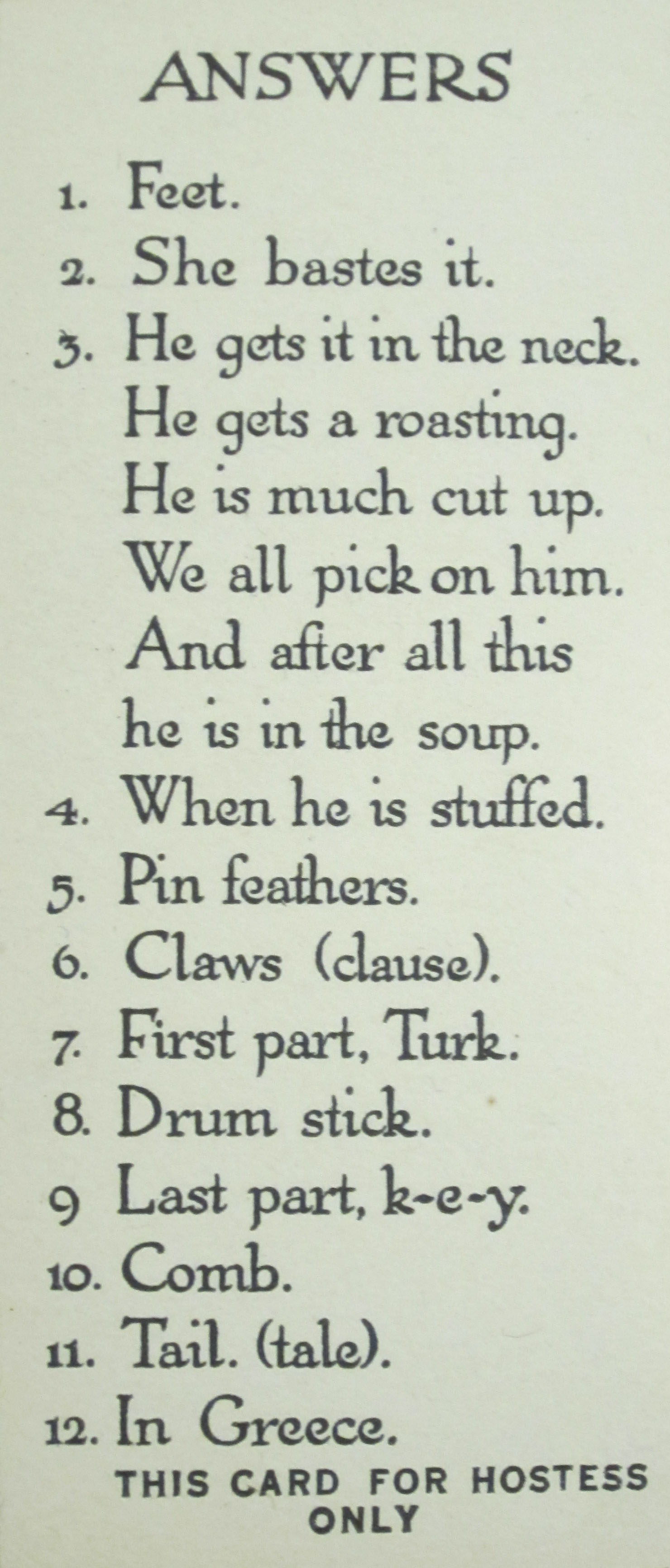
“Place Cards for Thanksgiving, Christmas and Turkey Dinners/Conundrums” contains twelve turkey-related riddles and an answer key.  Can you guess any of the turkey riddles?

Featured are questions number . The envelope contains 12 cards in total. (Photograph by Petrina Jackson)

Featured are questions number four, six, ten, and eleven. (Photograph by Petrina Jackson)

Answer key (Photograph by Petrina Jackson)

Answer key (Photograph by Petrina Jackson)

Whether or not your Thanksgiving dinner requires fancy place cards, we hope you have a happy Thanksgiving!
*Edward May Magruder was a Charlottesville doctor who established a private sanitarium in 1899 at his house on W. Jefferson St. Along with 6 other local doctors, he was one of the founders of Martha Jefferson Hospital in 1902. Magruder’s daughter, Evalina, was the first woman to graduate from the University of Virginia School of Architecture. The Magruder family papers were donated to the University of Virginia by Eleanor Magruder Harris in 2001 when the Magruder house was purchased by Christ Church for use as offices.


This Just In: The UPI Wire, November 22, 1963

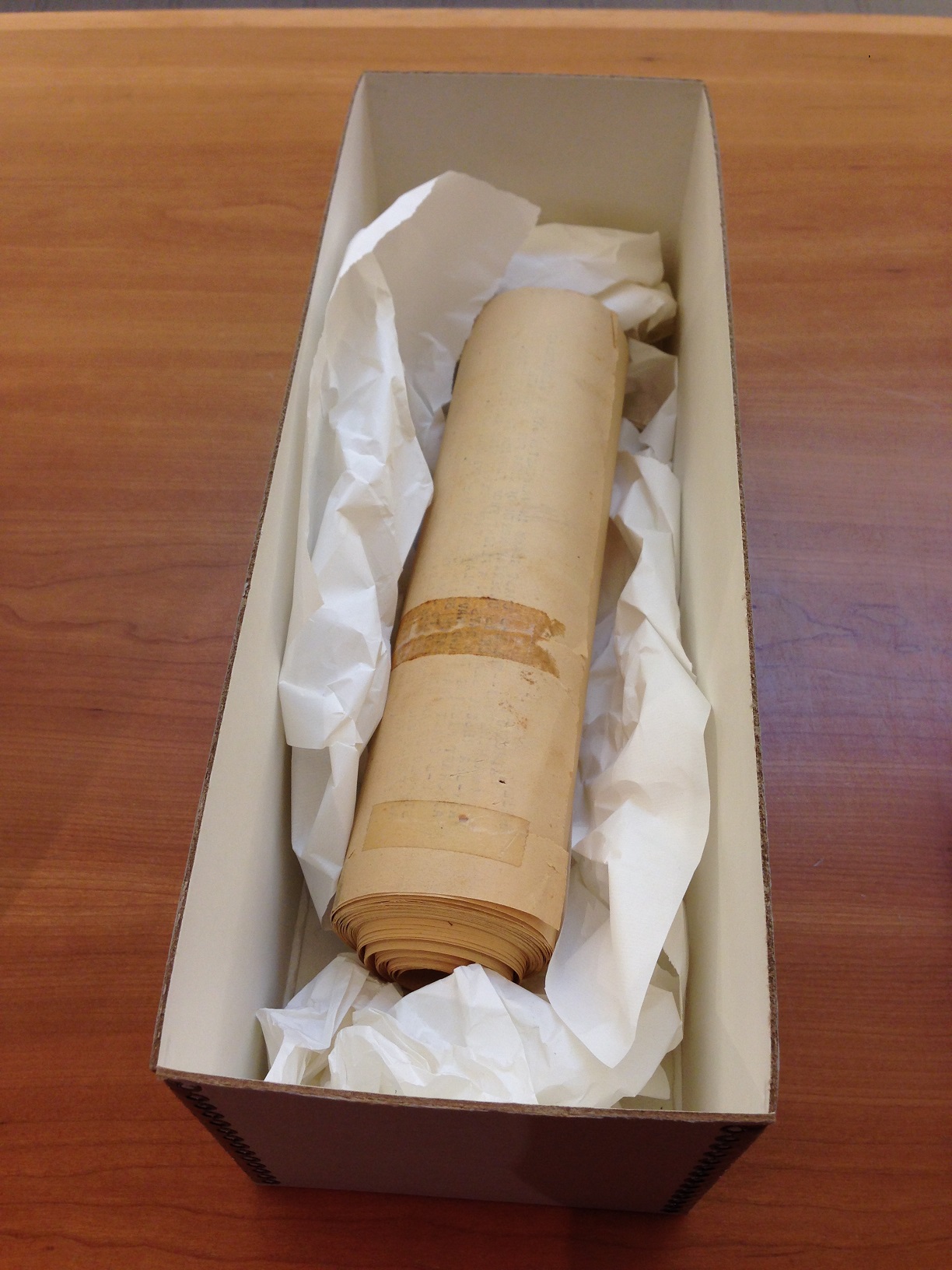
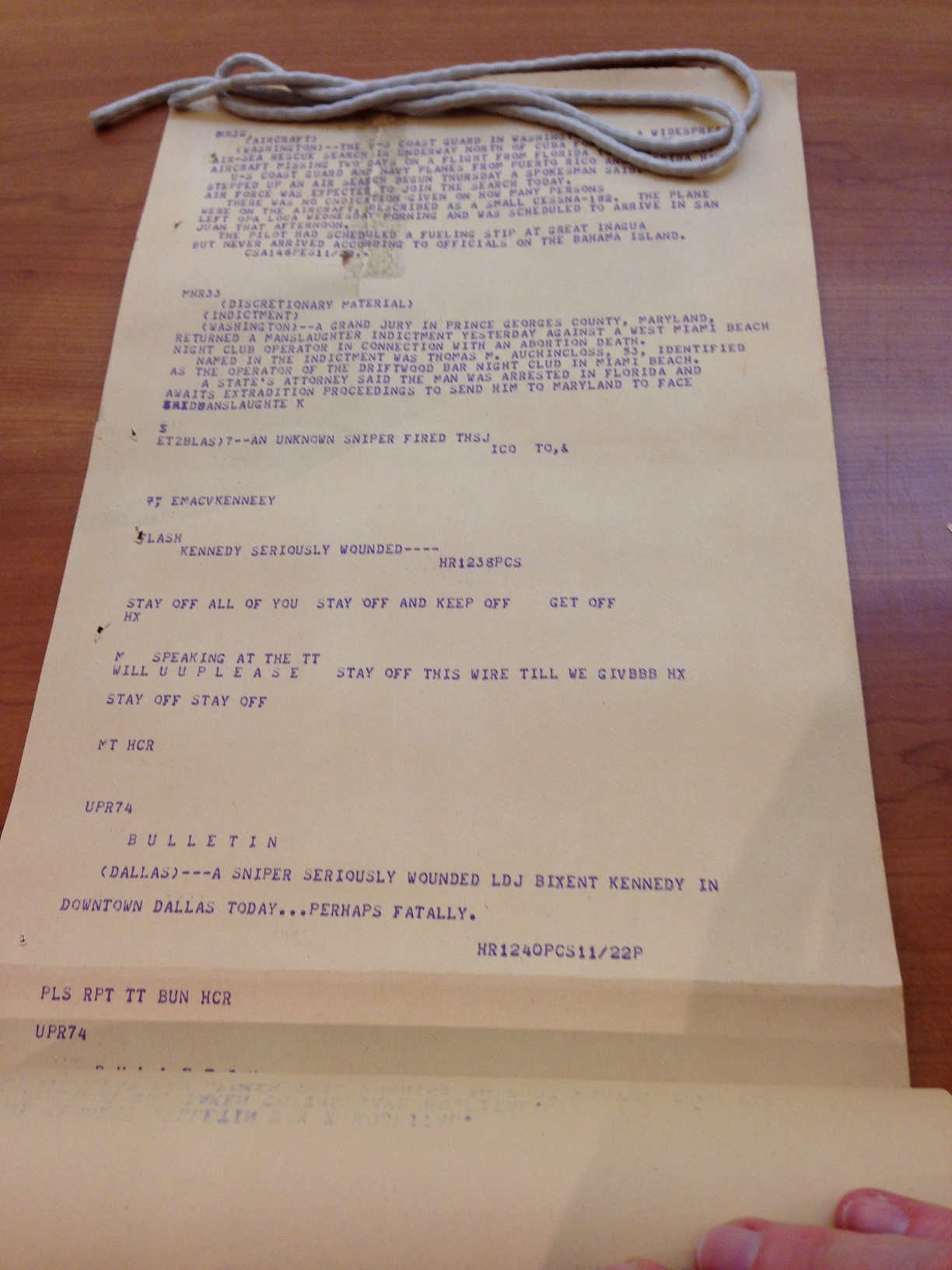
The teletype printout of the UPI broadcast wire from Jacksonville, Florida, from just before the first report of Kennedy's shooting to the end of the day. (MSS 15678, Gift of Randolph Pendleton. Photo by Molly Schwartzburg)

The teletype printout of the UPI broadcast wire from Jacksonville, Florida, from just before the first report of Kennedy’s shooting to the end of the day. (MSS 15678, Gift of Randolph Pendleton. Photo by Molly Schwartzburg)

Special Collections recently received an unusual–and remarkable–gift: a roll of paper, over forty feet long, which plunges its reader into the hours following John F. Kennedy’s assassination. It is a teletype machine printout of wire reports received by the United Press International bureau in Jacksonville, Florida, following the shooting, from which local radio stations–and others across the nation–communicated the news to rapt regional audiences.

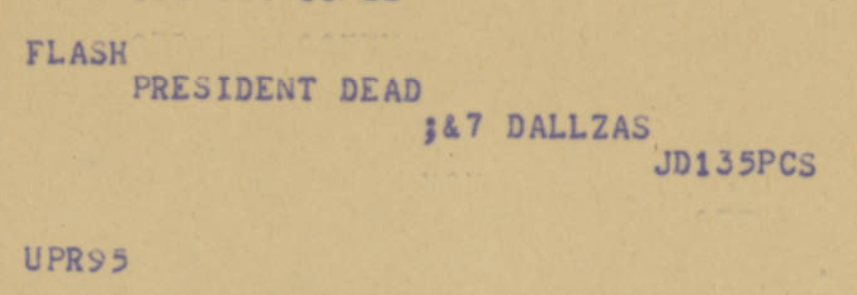
This section of the scroll reveals the moment at which radio-station employees learned that Kennedy had not survived. (Image by U.Va. Library Digitization Services)

This section of the scroll reveals the moment at which radio-station employees learned that Kennedy had not survived. (Image by U.Va. Library Digitization Services)

The printout was rescued for posterity on November 22, 1963, by UPI’s Jacksonville bureau manager Randolph Pendleton, who now lives in Charlottesville. Mr. Pendleton has kept the printout all these years. With the anniversary drawing near, he decided to donate it to Special Collections so it could be seen by all who are interested. We were thrilled to oblige. The library’s Digital Curation Services division rushed to produce a high-resolution digital facsimile of the entire scroll, which is now available to read in full. This Friday, on the fiftieth anniversary of the assassination, you can follow the broadcasts in real time on twitter at @uvadigserv.

Mr. Pendleton contributed a summary of the broadcast’s transmission:

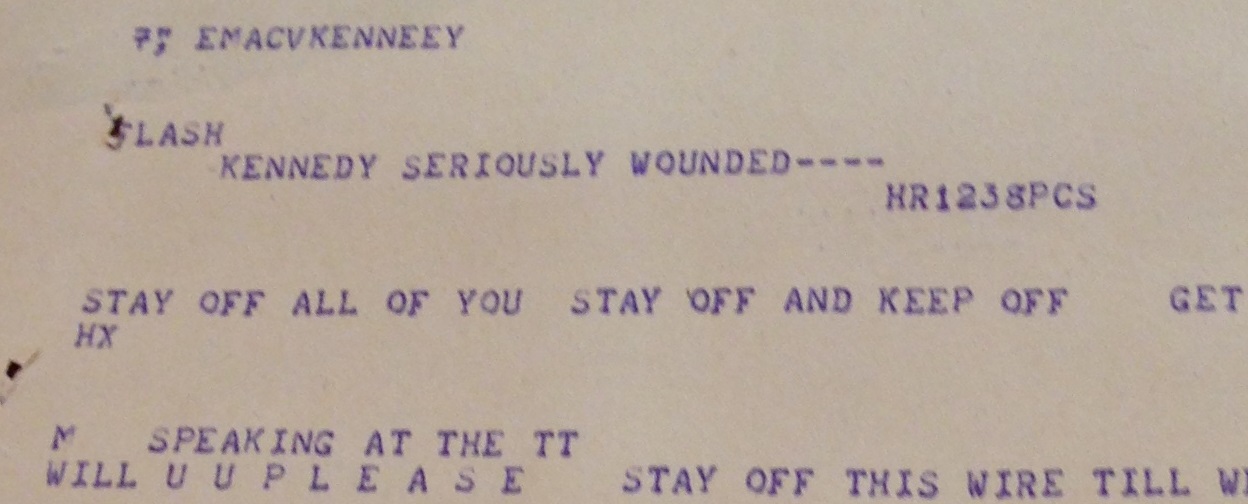
“The broadcast wire, designated 7551 and usually referred to as the radio wire, went to hundreds of radio and television stations across the United States. It was rewritten in broadcast style from the A-wire, which was the main newspaper wire, and thus ran a few seconds behind. It was filed by the Chicago bureau, (call letters HX) and was split for twenty minutes every hour on the half-hour so that local bureaus could file state and local copy. Because this was a teletype in Florida, it was running Florida stories filed by the Miami bureau (call letters MH) when Chicago broke in to reclaim the wire and file the flash, a rarely used priority that is accompanied by ten bells. The Chicago bureau then sought to keep the wire clear by warning bureaus to stay off. This flash was the first word of the shooting that broadcast stations across the country received.

The first news of the shooting appeared in typo-ridden flashes. (Image by Molly Schwartzburg)

The first news of the shooting appeared in  flashes, whose text was sometimes garbled due to the efforts of multiple bureaus to file at once. (Image by Molly Schwartzburg)

Repeated requests from the Chicago bureau for clear lines, in the first minutes of the news breaking. (Image by U.Va. Library Digitization Services)

Repeated requests from the Chicago bureau for clear lines, in the first moments of the news breaking. (Image by Molly Schwartzburg)

“The reporting came from Merriman Smith, the UPI White House reporter and dean of the White House press corps, who was in the front seat of the wire service pool car, riding six cars behind the president’s convertible. He grabbed the car’s phone when he heard three shots and began dictating to the Dallas bureau, fending off attempts by Associated Press reporter Jack Bell to get the phone away from him. On arrival at Parkland Hospital, Smith (who won the Pulitzer Prize for his coverage) was able to grab a Secret Service agent and get confirmation that Kennedy was seriously wounded and then find another phone amid the chaos in the hospital to call in the flash. The bulletin filed from the pool car had said only that three shots had been fired at the motorcade. This ran on the A-wire but came through garbled on the first broadcast wire because Chicago had trouble getting some of the state bureaus to stop filing. The first bulletin after the flash was also garbled and the Los Angeles bureau, (call letters HC) asked for a repeat.

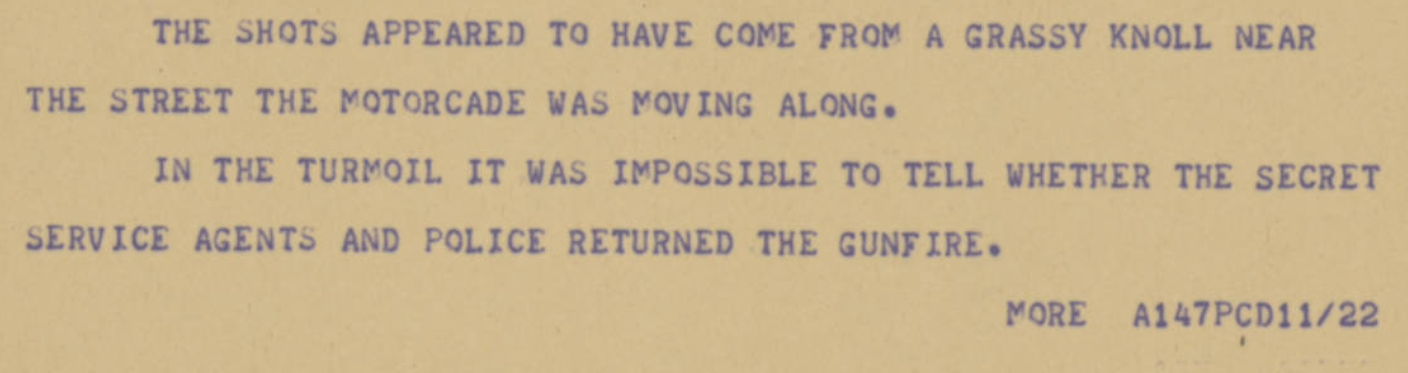
“After that, the story unfolded quickly and within minutes there was a reference to the famous ‘grassy knoll.'”

The first mention of the phrase "grassy knoll." Time stamps at the end of each posting are Central Standard, because the wire was being filed from Chicago.

The broadcast wire’s first use of the phrase “grassy knoll.” Time stamps at the end of each posting are Central Standard, because the wire was being filed from Chicago. (Image by U.Va. Digitization Services)

Thanks to Mr. Pendleton for his generous donation and summary. And thanks also to Digitial Curation Services for the magnificent digital facsimile, which will allow many readers to experience this unique artifact.

We encourage readers to share their memories–particularly if they heard the news on the radio. For more background on the Chicago bureau’s role in the day’s events, see this recent article in the Chicago Sun Times.


Class Notes: 250 Years of Fairy Tales in Print

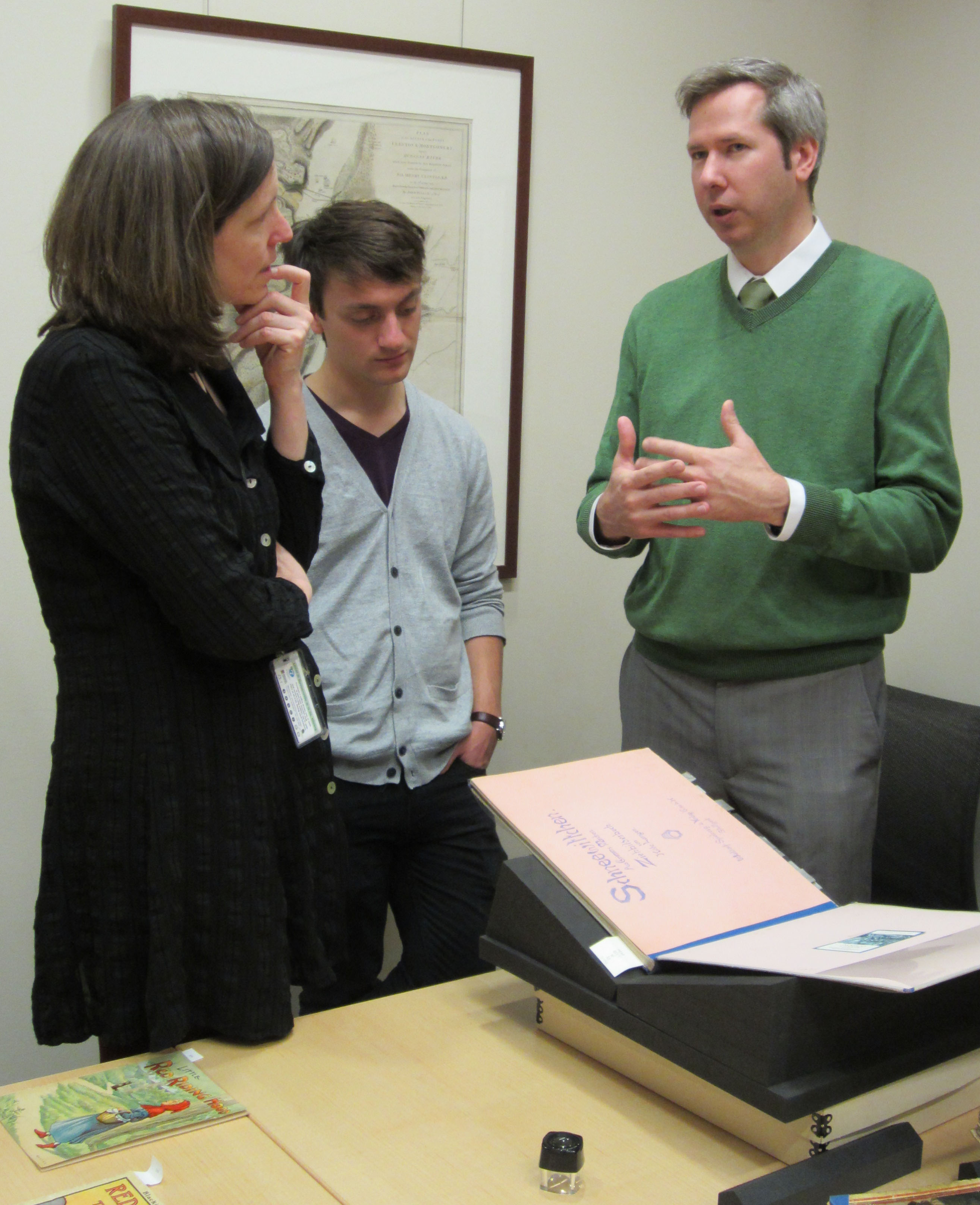
Professor Mark Ilsemann recently brought his class, German 3590: Special Topics–Fairy Tales, to Special Collections to see materials related to the European fairy-tale tradition. He asked if we could “give my students an idea about early collections of tales and the formation of ‘fairy tale’ as a genre; teach them about the importance/style of illustrations and other forms of book art; show them how fairy tale collections were ‘framed’ by their respective authors (through frontispieces, opening remarks, etc.); and to demonstrate to students the importance of the book object and of working with historical artifacts.”

Oh yeah, we could do that. Little did he know the extent of the riches at our disposal.

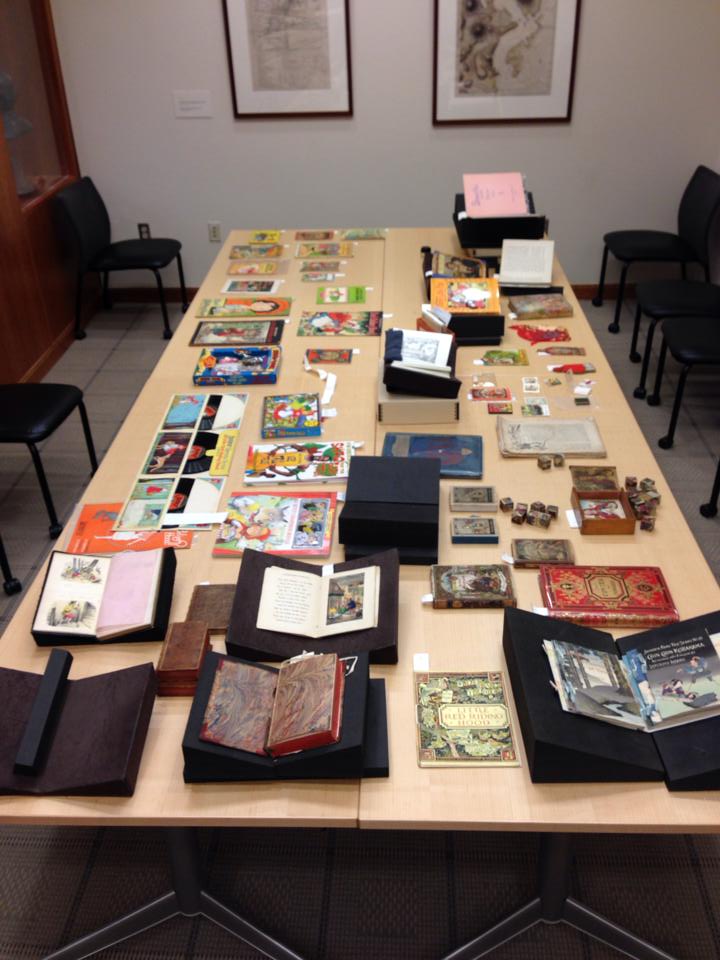
A selection of fairy tales (Photograph by Molly Schwartzburg)

A selection of fairy tale editions, anthologies, recordings, toys, and even finger puppets! (Photograph by Molly Schwartzburg)

Curator Molly Schwartzburg wowed his class with an eclectic selection of some of the fascinating and visually stunning fairy tales that comprise our collections. In turn, Professor Ilsemann provided a great deal of insight on the history of fairy-tale publishing, and his students jumped in with comments based on the knowledge they’ve gained so far this semester. As is often the case, we wondered if we gained even more from the session than our visitors!

Professor Ilsemann explains the likely origins of this unusual and beautiful moveable book. He noticed that the publisher was associated with the Waldorf School movement, based in Stuttgart, where the book was published. The book’s flowing text and images, seem to echo the Waldorf philosophy, which requires that classrooms contain no right angles. (PZ34 .S358 1926. Henry S. Gordon Fund, 2009/2010. Photograph by Petrina Jackson)

Professor Ilsemann explains the likely origins of this unusual and beautiful moveable book. He noticed that the publisher was associated with the Waldorf School movement, based in Stuttgart, where the book was published. The book’s flowing text and images seem to echo the Waldorf philosophy, which requires that classrooms contain no right angles. Hilde Langen, Schneewittchen (Stuttgart: Waldorf-Spielzeug & Verlad G.m.b.H., 1926). (PZ34 .S358 1926. Henry S. Gordon Fund, 2009/2010. Photograph by Petrina Jackson)

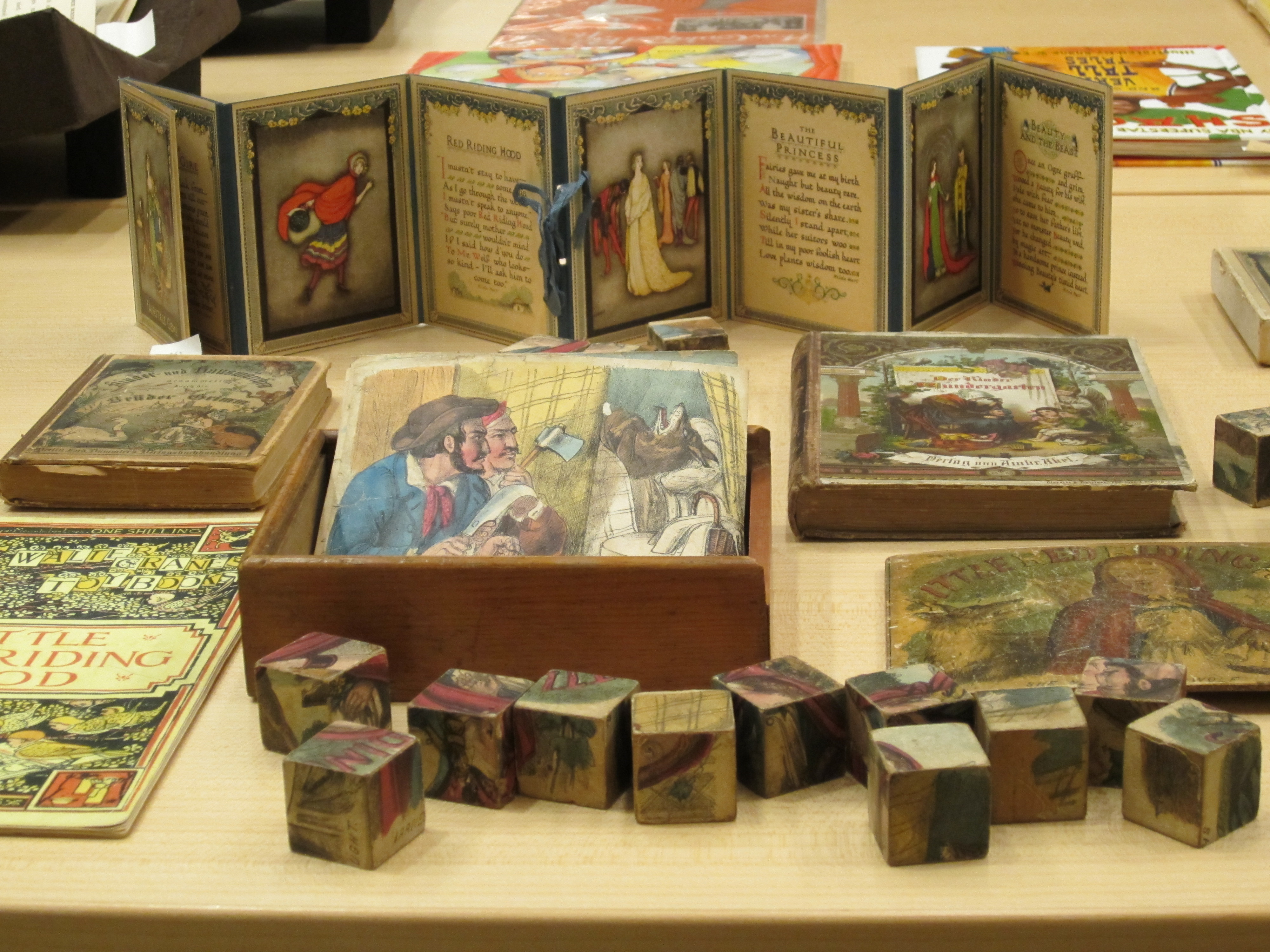
Many of the items we discussed were from Special Collections’s remarkable Little Red Riding Hood Collection, generously donated in 2007 by collector Martha Orr Davenport.  The collection comprises approximately 480 books, a hundred pieces of print ephemera, fifty works of art, ten magic lantern slides, and more than a hundred objects, including tableware, figurines, vases, pottery, puppets, recordings, and more.

Detail of items from the Little Red Riding Hood Collection (Gift of Martha Orr Davenport. Photograph by Petrina Jackson)

Just a few of the items in our Little Red Riding Hood Collection. (Gift of Martha Orr Davenport. Photograph by Petrina Jackson)

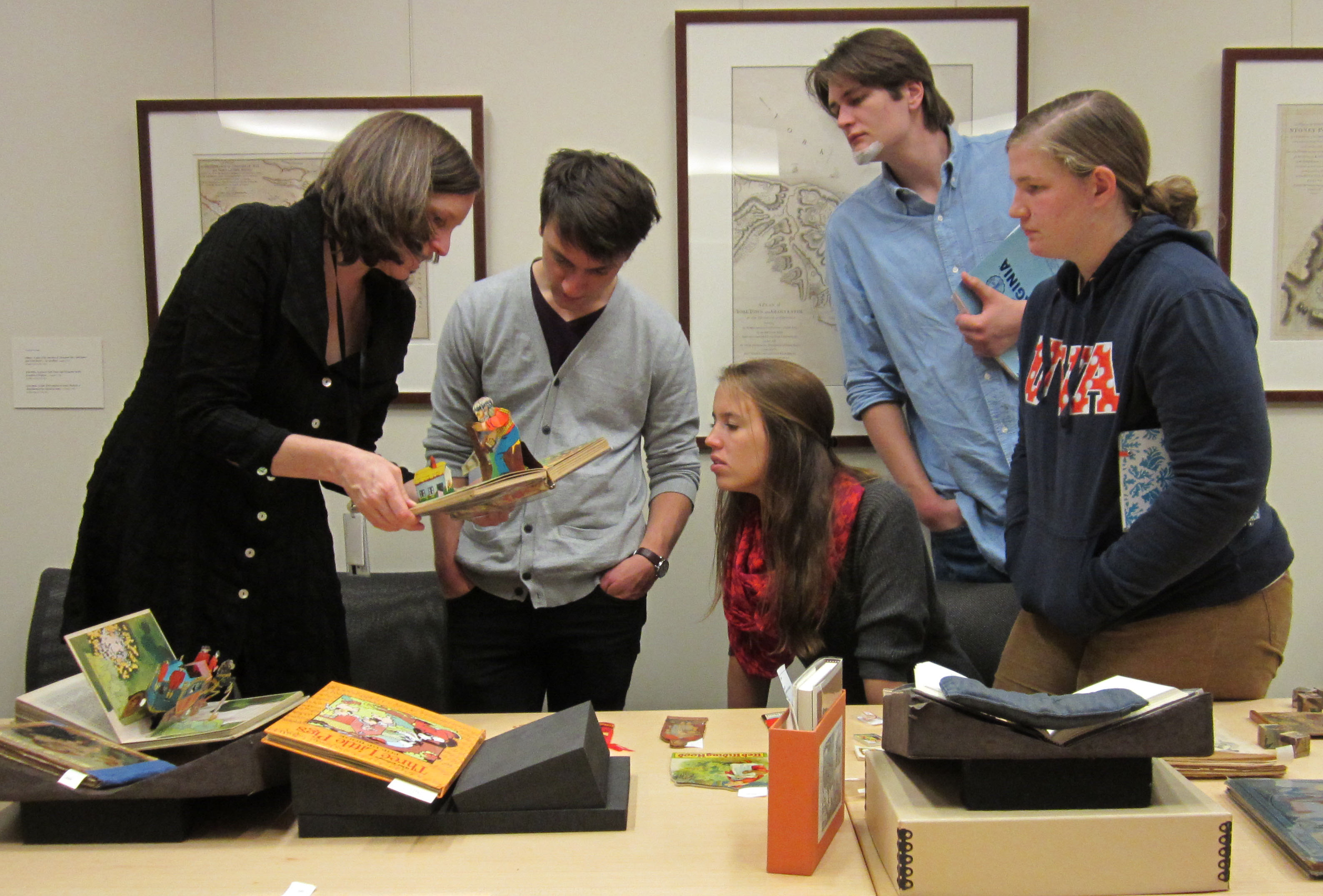
The students also were drawn in by several fabulous pop-up books from the Brenda Foreman Collection of Pop-Up and Moveable Books.

Molly and the students take a closer look at pop-up books. (Photograph by Petrina Jackson)

Molly and the students take a closer look at pop-up books. (Photograph by Petrina Jackson)

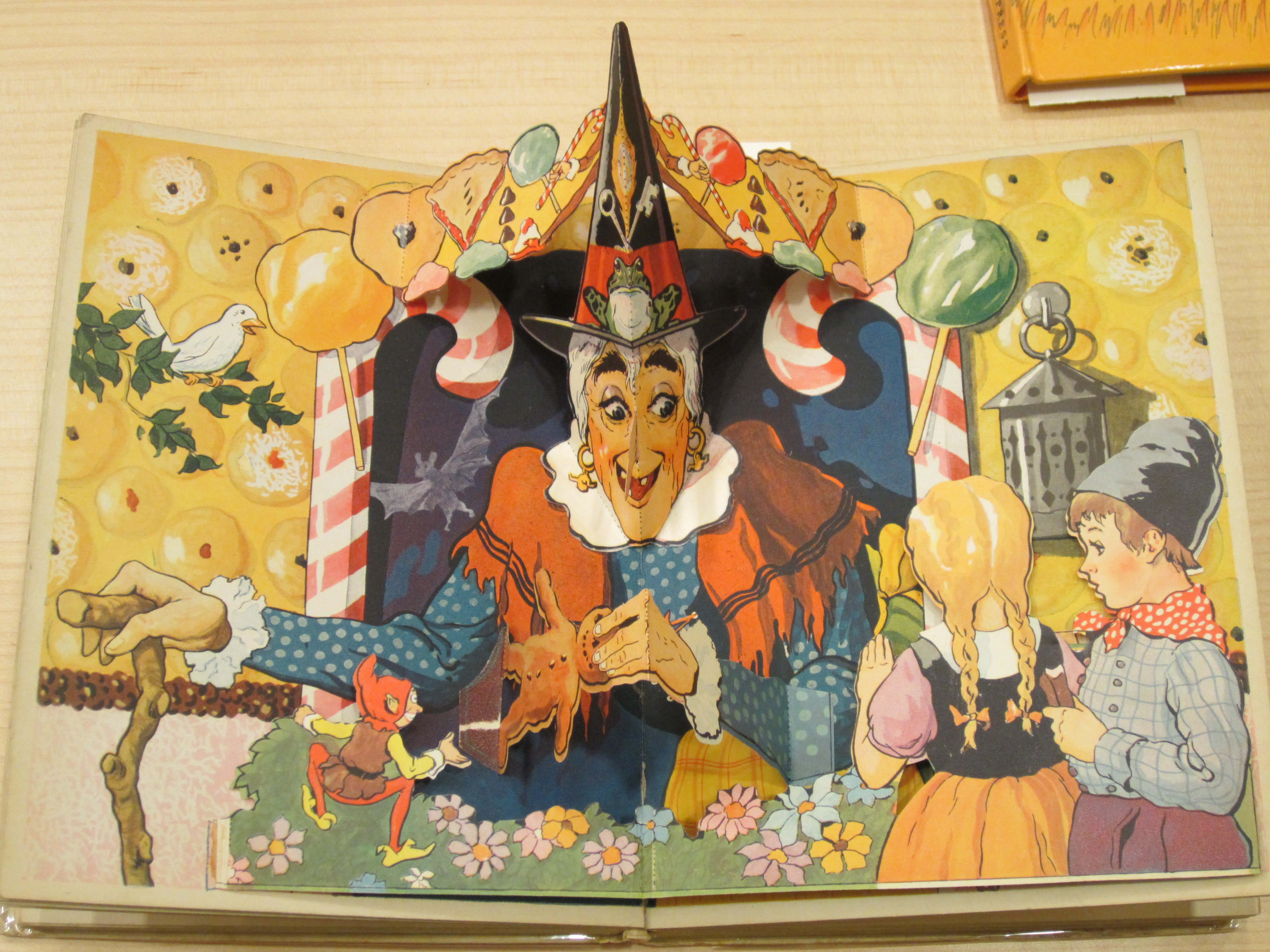
Hansel and Gretel from the "Pop-Up" Cinderella and Other Tales with illustrations by Harold B. Lentz, 1933.  (PZ92 .F6 L46 1933b. Brenda Forman Collection of Pop-Up and Moveable Books. Photograph by Petrina Jackson)

Hansel and Gretel from Harold P. Lentz’s  “Pop-Up” Cinderella and Other Tales, 1933. (PZ92 .F6 L46 1933b. Brenda Forman Collection of Pop-Up and Moveable Books. Photograph by Petrina Jackson)

Perhaps a student paper or two about these magical books will be in hand by the semester’s end, inspired by this wonderful introduction!

This Just In: New McGregor Library Acquisitions

The opening last week of Collecting American Histories: the Tracy W. McGregor Library at 75—the major new exhibition of highlights from our world renowned McGregor Library of American History—prompts us to describe a few of the many acquisitions made for the McGregor Library in recent months.

M8

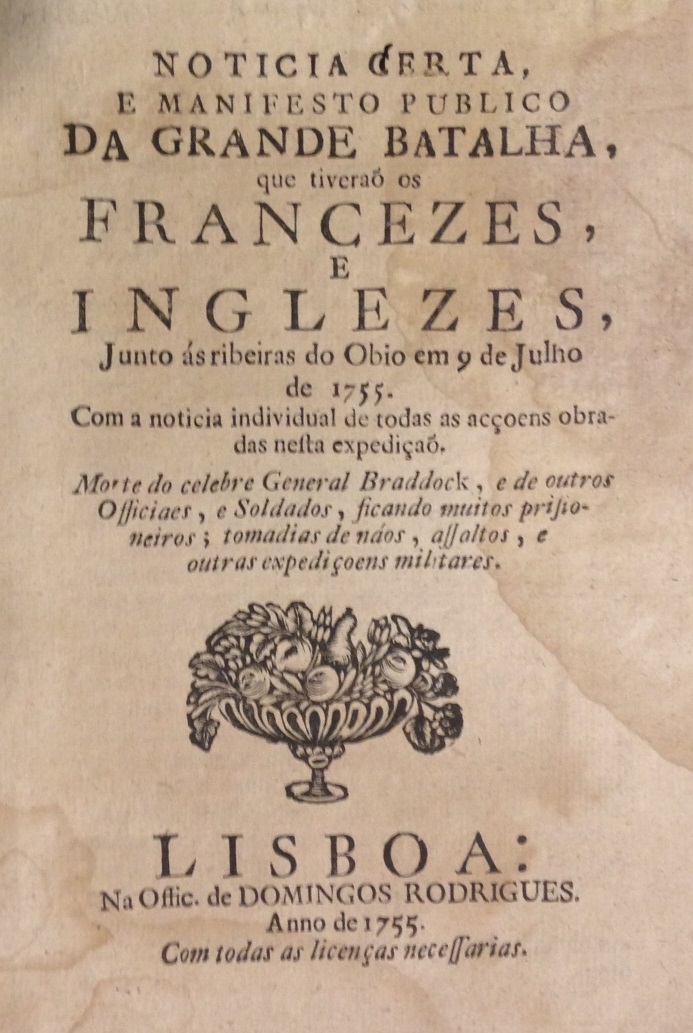
Noticia certa, e manifesto publico da grande batalha, que tiveraõ os francezes, e inglezes, junto ás ribeiras do Obio em 9 de julho de 1755. Com a noticia individual de todas as acçoens obradas nesta expediçaõ. Morte do celebre General Braddock, e de outros officiaes, e soldados, ficando muitos prisioneiros … Lisbon: Domingos Rodrigues, 1755.     (A 1755 .N67)

The French and Indian War began badly for Britain. Sent to rout the French from western Pennsylvania, General Edward Braddock’s forces suffered a disastrous defeat on July 9, 1755, at the Battle of Monongahela near present-day Pittsburgh.  Braddock was among the hundreds of British casualties before a young junior officer—George Washington—was able to lead an orderly retreat.  The McGregor Library contains some important primary sources concerning the battle—two are included in the 75th anniversary exhibition now on view—and this very rare, ephemeral pamphlet is the latest addition. News of Braddock’s defeat spread quickly by letter, word of mouth, newspapers and other printed accounts. This newsletter conveyed the news to a Portuguese audience. Following a brief description of the battle (no mention is made of Washington, however) and the diplomatic aftermath, it lists the names of British officers who were killed or wounded.

M1[Thomas Cooper, 1759-1839?] Extract of a letter from a gentleman in America to a friend in England, on the subject of emigration. [London?, 1794?]     (A 1792 .G45)

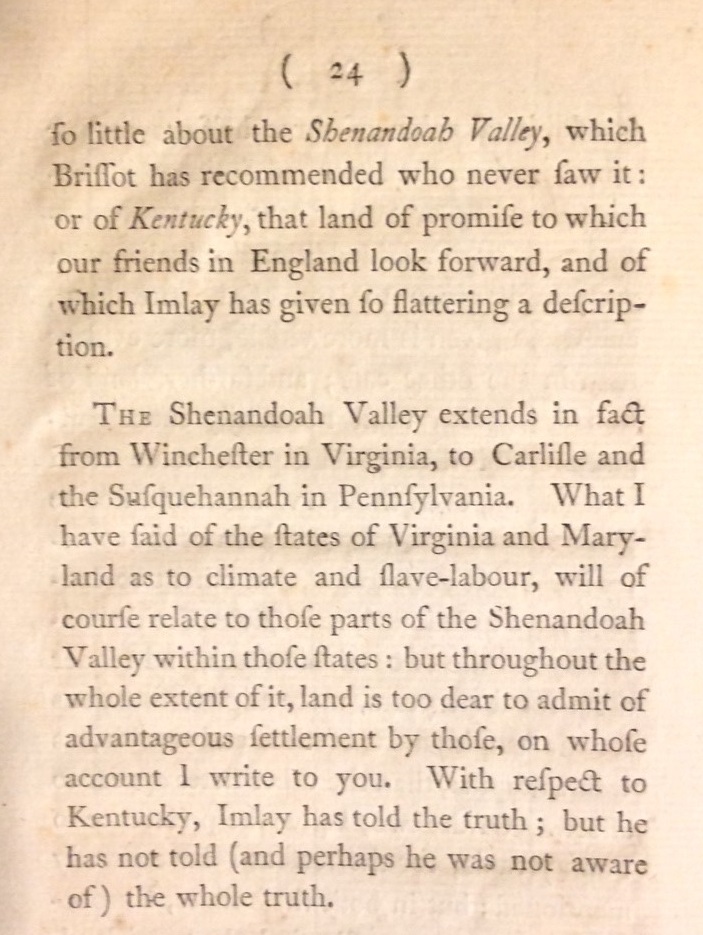
Likely the first edition (of two published in England ca. 1794) of this concise description of the United States. Written from the perspective of an Englishman contemplating emigration, it offers carefully reasoned arguments for and against settling in specific states. Particular consideration is given to the frontier regions of New York and Kentucky, though the anonymous author concludes that Pennsylvania is the better option. Indeed, that is precisely where the probable author, Thomas Cooper, settled later in 1794 after touring the United States; the letter was likely addressed to, and published at the behest of, Joseph Priestley, who also emigrated to Pennsylvania in 1794. An economist and liberal political thinker, Cooper soon developed a thriving Philadelphia law practice which helped to earn him the esteem of Thomas Jefferson. In 1819 Cooper was the first professor appointed to the faculty of the as-yet-unopened University of Virginia, but he resigned in 1820 following controversy over his religious views. Later he served as president of the University of South Carolina.

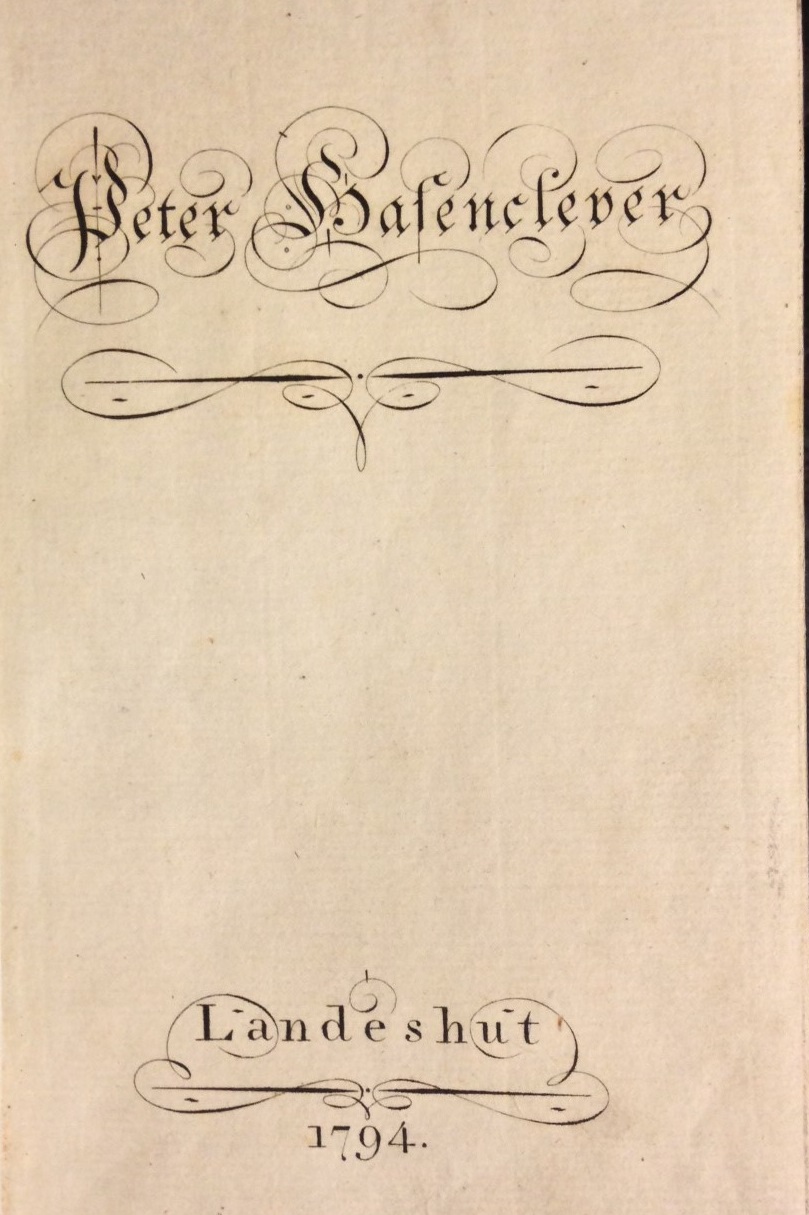
M5Christian Gottlieb Glauber, 1755-1804.  Peter Hasenclever.  Landeshut, 1794.     (A 1794 .G53)

Privately printed in a small number of copies, this is a biography of Peter Hasenclever, a German entrepreneur who, by establishing several business enterprises in New Jersey, Pennsylvania, and New York between 1764 and 1769, became Colonial America’s leading industrialist. With the coming of peace following the Seven Years’ War, Hasenclever raised over £50,000 from English backers to open a network of iron mines and ironworks and a potash manufactory, and to raise hemp and harvest timber. His enterprises were staffed by the over 500 German workers who heeded his invitation to emigrate. Hasenclever spent lavishly on his businesses, only to be plunged into bankruptcy in 1769 when his English partners withdrew financial support. After returning to Germany, Hasenclever was able to rebuild his fortune in the textile trade. The biography concludes with a lengthy appendix of letters written by Hasenclever during his American sojourn.

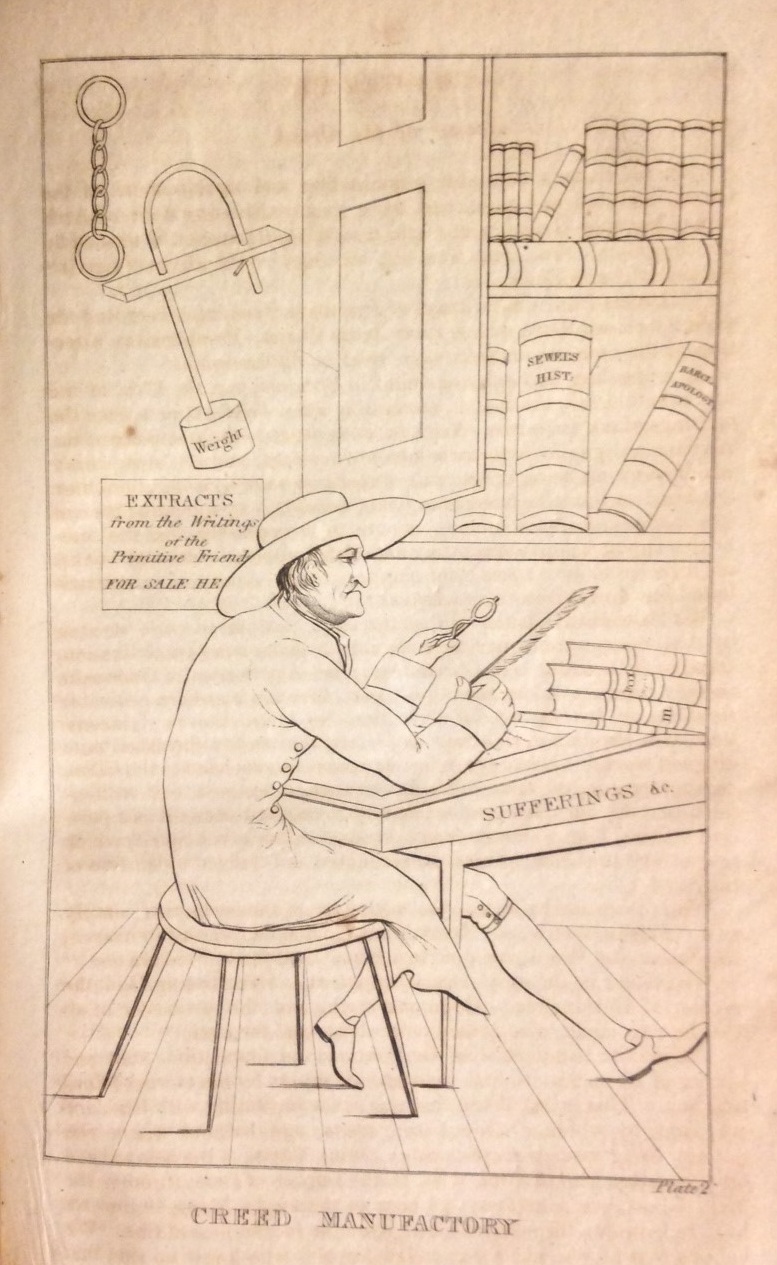
M3Hole in the wall; or A peep at the creed-worshippers. [Philadelphia], 1828.     (A 1828 .H65)

This rare and unusual tract was an important salvo in the bitter schism, or “Great Separation,” between orthodox Quakers and their Hicksite adversaries. By the 1820s significant tensions had arisen between Philadelphia’s wealthy Quaker merchants and the Quaker farmers of southeastern Pennsylvania, who were attracted to the teachings of Elias Hicks—tensions comparable to those between New England Congregationalists and Unitarians. Unable to settle their differences at the 1827 Philadelphia Yearly Meeting, the two camps set up competing Meetings, with the orthodox Quakers adopting and enforcing a doctrinal creed. This pamphlet, which vigorously promotes the Hicksite view, is “embellished” with three accomplished satirical engravings by the anonymous author.

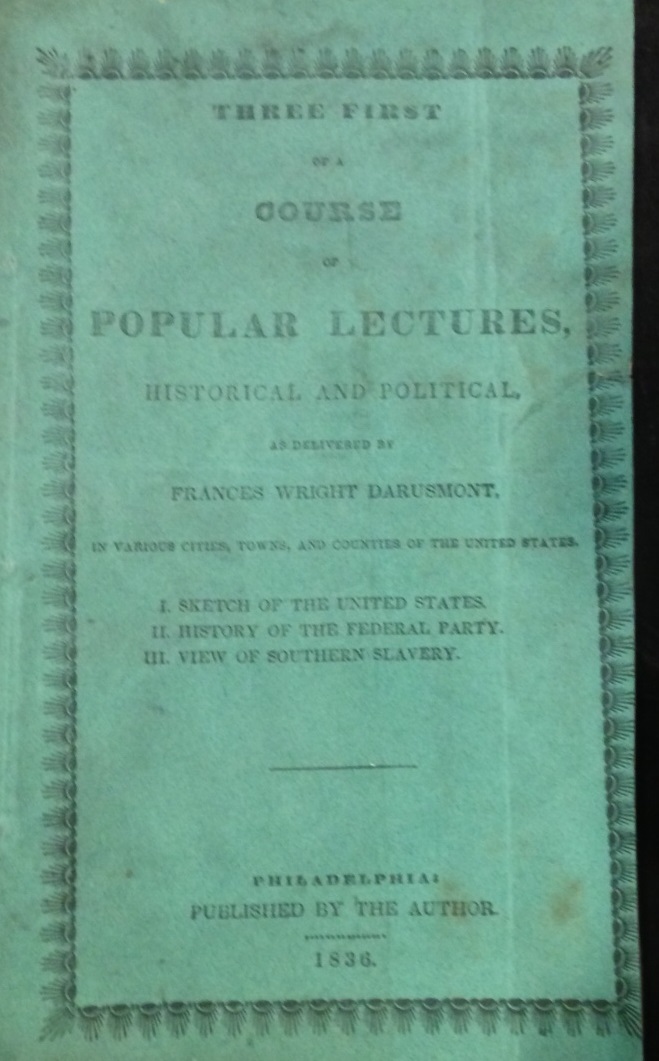
M4Frances Wright (1795-1852). Course of popular lectures, historical and political, Vol. II.  As delivered by Frances Wright Darusmont, in various cities, towns and counties of the United States. Philadelphia: Published by the author, 1836.     (A 1836 .W75)

During the 1820s and 1830s, Fanny Wright was perhaps the most notorious woman in the United States. Born in Scotland, Wright visited the United States from 1818-1820, recording her observations in the bestselling Views of society and manners in America (1821). Having befriended Lafayette, Wright accompanied him on much of his 1824-1825 tour of America. She then launched a career as a radical political and social reformer. An ardent feminist, freethinker, and friend of labor, Wright visited Robert Owen’s utopian community at New Harmony, Ind., before setting up her own settlement, Nashoba, near Memphis. The objective of this multi-racial community was to promote the abolition of slavery by preparing slaves for freedom. By 1830 it had failed, and Wright henceforth promoted her views through journalism and a career as America’s first prominent female public speaker. This very rare pamphlet in its original wrappers prints the text of three lectures from Wright’s 1836 lecture tour: two praise Jefferson’s vision of an agrarian republic and condemn the contrasting Hamiltonian vision, and a third outlines her abolitionist views.

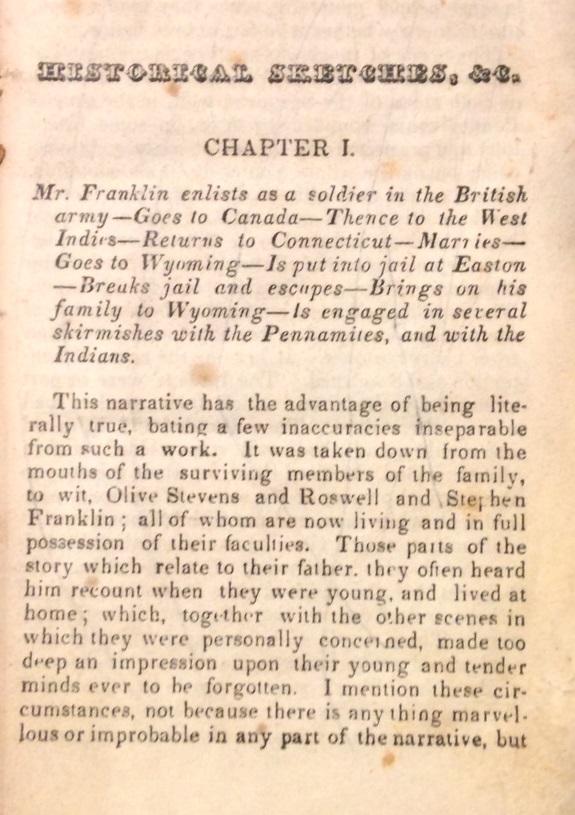
M2Robert Hubbard (1782-1840).  Historical sketches of Roswell Franklin and family: drawn up at the request of Stephen Franklin. Dansville, N.Y.: A. Stevens for Stephen Franklin, 1839.     (A 1839 .H85)

A rare and very early work of American local history, published in a small town some 40 miles south of Rochester, N.Y.  Written by the local minister at the behest of the Franklin family, most of the book is a biography of the family patriarch, Roswell Franklin (d. 1791 or 1792), drawn primarily from family oral tradition. Born in Woodbury, Conn., Franklin fought for the British in the West Indies and Cuba before moving his family to northeastern Pennsylvania’s Wyoming Valley in 1770. With the outbreak of revolution, Franklin and his fellow patriots found themselves in a frontier war zone, besieged by British forces and their Iroquois allies. Included here is a vivid account of the 1778 Battle of Wyoming, in which Franklin was one of few patriots to survive. Subsequent chapters describe the family’s role as pioneers, following the expanding frontier northwestward into west central New York, and the tremendous contrasts between Roswell Franklin’s time and America in 1839.

Preserving Fraternity and Sorority Records: The Legacy of Delta Sigma Theta Sorority, Inc.

Recently, I had the pleasure of facilitating a workshop on preserving historical records at the 2013 Fall State Meeting of Virginia – Delta Sigma Theta Sorority, Inc (DST).  The sorority, which was founded at Howard University, celebrates its centenary this year.

Each chapter is charged with collecting and maintaining its historical records: its charter, photographs, programs, news clippings, etc.  The purpose of my presentation was to give them direction in doing just that, but moreover to share with them the importance of working with local libraries or archives who specialize in keeping such rich historical materials secure, safe, and accessible for the long run.

Preserving the Legacy workshop attendees, October 2013.  The workshop was held at the Jefferson School City Center in Charlottesville. (Photograph by Petrina Jackson)

Some of the attendees at the Preserving the Legacy workshop, October 2013. The workshop was held at the Jefferson School City Center in Charlottesville. (Photograph by Petrina Jackson)

At the University of Virginia, we are committed to collecting personal and organizational records of African Americans.  We do not have a DST collection, but we do have materials in other collections that feature the sorority.  For instance, the Records of the Office of the Dean of Students document the relationship among fraternities, sororities, and the University.  It is in these records that you find correspondence from sorority presidents, event documentation, disciplinary records and more.  Sometimes, you find real treasures.

(RG-Image by Petrina Jackson)

Letter from Linwood Jacobs to Sheila Hardy, congratulating her on the founding of Kappa Rho Chapter of Delta Sigma Theta at the University of Virginia, 19 October 1973. (RG-18/2. Image by Petrina Jackson)

The U.Va. yearbook, Corks and Curls, which ran from 1888 to 2008, also provides a window into fraternity and sorority life.

Photograph of U.Va.'s Deltas from the 1975 Corks and Curls (LD. Photograph by Petrina Jackson)

U.Va.’s Deltas from the 1975 Corks and Curls (LD5687 .C7. Photograph by Petrina Jackson)

Another place to look for sorority information is in the personal papers of its members, such as Alice Jackson Stuart.  Jackson Stuart was a Delta from Richmond who was initiated in 1934 at Virginia State College (now University), the oldest Delta chapter in the state.  She was a student at Virginia Union University, which did not yet have a Delta chapter.

Alice Jackson Stuart has the distinction of being the first known African American to apply to the University of Virginia or any white Virginia college for a professional or graduate degree, which she did in 1935.  U.Va. denied her entry, and she questioned this judgement.  The University’s response was that they denied her because of her race and “other good and sufficient reasons.” After her rejection, the state of Virginia passed laws that funded the tuition for African American students to study outside of the state instead of having them desegregate colleges and universities within Virginia.  Jackson Stuart graduated from Columbia University with a Master of Arts degree in 1939.  Almost seventy years after her rejection by the University of Virginia, her son, Judge Julian Towns Houston of Brookline, Massachusetts, gave her papers to the Special Collections Library in 2003.  She finally “entered” the University.

(Image by Petrina Jackson)

Alice Jackson Stuart’s Delta Sigma Theta Sorority certificate, 1934. (MSS 12512. Gift of Julian T. Houston. Image by Petrina Jackson)

(Image by Petrina Jackson)

Alice Jackson Stuart’s sorority memory book, ca. 1934. (MSS12512. Gift of Julian T. Houston. Image by Petrina Jackson).

Although there is a lot to learn from items across our collections related to Delta Sigma Theta and other African American fraternal organizations, we hope to acquire records of  local chapters and individual alumni, ensuring the preservation of their legacy for generations to come.

I would like to give a special thanks to Schwanzetta Aikens, Heritage & Archives Committee Chair of the South Atlantic Region of Delta Sigma Theta Sorority, Inc. and Charnette Singleton, South Carolina Chair of the South Atlantic Region of Delta Sigma Theta Sorority, Inc., who were such warm and outstanding hostesses.  I had a wonderful time!

This Just In: Scarlet Letters from the Backlog

Every Special Collections library has a number of mysterious boxes that for some reason or another have never been dealt with–gifts with mysterious provenances, duplicate copies, a collection that someone was working on but for some reason never finished, and so on. U.Va. is no exception, though we do pride ourselves on how small that backlog is, and how well-described our cataloged materials are.

Soon after starting this job, I was tasked, with my co-hire David Whitesell, to dig into the backlog. For many months now, we have each enjoyed tackling a box or two on a quiet afternoon at the reference desk, or whenever the temptation is too strong and more pressing work is set aside.

Much of the pleasure of curatorial work comes from the element of surprise–unexpected gifts, unexpected acquisitions opportunities, unexpected discoveries in the stacks, unexpected researcher projects, and so on. So I was thrilled to find one day recently, mixed with various unremarkable volumes in a box, two early copies of Nathaniel Hawthorne’s The Scarlet Letter. I was even more thrilled to discover that neither came near to duplicating the numerous early copies already in our collection.

Existing holdings in early printings of the novel accompanied by the two books that will soon join them on our shelves.The dull brown covers were, in their day, a mark of great prestige, since they were the signature of the highly regarded publishers  Ticknor and Fields.

Seven existing Scarlet Letters accompanied by two volumes that will soon join them on our shelves. The dull brown covers were a mark of literary prestige, since they were the signature of the highly regarded Boston publishing house of Ticknor, Reed and Fields.

The Second Edition Advertisements

The Scarlet Letter was a huge success from the moment it was published. Released on March 16, 1850, the first edition of 2,500 copies sold quickly. On April 22nd, the second edition was released. It also comprised 2,500 copies, and is easily identified because it includes an additional preface by Hawthorne, in which he responds to criticisms of the famous essay that prefaces the novel, “The Custom House.”

Our three cataloged copies of the second edition vary dramatically in condition and paratexts. All but one have bookplates, and all three have advertisements. The publishers added to each copy a multi-page advertising insert variously titled “New Books and New Editions” or “A List of Books Recently Published,” all beginning with the publisher’s Longfellow list.  The three copies have inserts dated March 1850 and May 1850 (in two copies).

Notably, the newly unearthed copy has an advertising insert dated October 1849, which is the earliest insert of any copy of this novel in our collection. Presumably, the insert was lifted from a stack of old leftovers, since the book could not have been bound before the spring of 1850.

The images below show a variety of advertisements from the first three editions of the novel, all published in 1850.

scarlet_march1850ad

Detail of the advertisement in one of our copies of the first edition. (PS 1868 .A1 1850. Gift of Mr. and Mrs. Randolph Catlin. Photograph by Molly Schwartzburg)

scarlet_oct1849ad

Detail of the advertisement in the soon-to-be-added copy of the second edition. (Uncataloged. Photograph by Molly Schwartzburg)

scarlet_november1850ad

Detail of the advertisement in one of our copies of the third edition, the first to be printed from stereotyped plates, and which appeared in September, 1850 (A 1850 .H39 S3a. Tracy W. McGregor Library of American History. Photograph by Molly Schwartzburg)

An 1854 impression

The other volume found in the backlog is unquestionably unique to our collection, as the only standalone copy of the novel we own with an imprint date of 1854 (a collected works edition we hold is also dated that year). It is printed from the stereotyped plates produced in late 1850 for the third edition. The only 1854 printing, it totaled 500 copies, and brought the total number of copies of the novel’s American standalone editions alone to 10,300.

So, Hawthorne fans and bibliographers, we encourage you to come by in a few weeks when these new additions have been cataloged, snugly housed, and added to the shelves alongside their brethren!

scarlet_two_new_copies

Our new second edition, on the left, and third edition, 1854 printing, on the right. The yellowed slips in the book show how long these have waited for their moment in the sun (and in Virgo, our online catalog). The origins of these volumes are lost to the sands of time.


This Just In: Growing the Gothic

Regular readers will know of our fondness for the English Gothic novel, and our pride in the recent bequest of the Maurice Lévy Collection of French Gothic (described in two recent blog posts). We have now acquired a key edition—the rare first edition in French (Lausanne, 1787) of William Beckford’s Vathek—which nicely links the Lévy Collection with its progenitor, the unparalleled Sadleir-Black Gothic Novel Collection housed under Grounds in the Small Special Collections Library.

Title page of the second published edition (and the first printing of  the original French text) of William Beckford's Vathek. Lausanne: Isaac Hignou, 1787.  (PR4091 .V39 1787)

Title page of the second published edition (and the first printing of the original French text) of William Beckford’s Vathek. Lausanne: Isaac Hignou, 1787. (PR4091 .V39 1787)

One of the earliest, and now one of the most widely read English Gothic novels, Vathek has a complicated textual history. In a very important sense it is not even an English novel, for when Beckford composed the text in 1782, he did so in French! Indeed, Beckford never prepared an English translation of his best known work. Rather, most readers have encountered Vathek in the English translation (or in translations of this translation) prepared by the Rev. Samuel Henley, sometime professor at the College of William and Mary in Williamsburg, Virginia.

The first page of the Rev. Samuel Henley's translation, from the first edition of Vathek, published under the title, An Arabian Tale. London: J. Johnson, 1786.  (PR 4091 .V4 1786)

The first page of the Rev. Samuel Henley’s translation, from the first edition of Vathek, published under the title, An Arabian Tale. London: J. Johnson, 1786. (PR 4091 .V4 1786)

Born in 1745 in Devon, Henley was recruited in 1770 for the faculty of William and Mary, where he taught moral philosophy. Popular with his students—who included James Madison and James Monroe—Henley also formed strong friendships with prominent Virginians such as George Wythe and Thomas Jefferson. The looming clouds of war prompted Henley’s return to England in 1775, where he accepted a teaching position at Harrow School. By 1783 Henley had entered the intellectual circle of William Beckford, who entrusted him with translating the as yet unpublished Vathek into English. But Beckford, distracted in part by a scandal which necessitated an extended sojourn in Switzerland, insisted that Henley’s version remain unpublished until he saw fit to publish the original French text.

And for comparison, the first page of Beckford's French text, as it appeared in the Lausanne, 1787 edition.

And for comparison, the first page of Beckford’s French text, as it appeared in the Lausanne, 1787 edition.

Disobeying Beckford’s wishes, Henley instead sent his translation to the press. Published in London in 1786 as An Arabian tale, Henley not only concealed Beckford’s authorship but pretended that the work was translated from an “Arabick” source. When the news reached Beckford in Lausanne, he was furious. Placing the original manuscript in the hands of a Swiss friend, Beckford directed that his French be corrected where necessary and the text rushed into print. The latter request was easier to meet than the former: the novel was published early in 1787 at Lausanne as Vathek, but with Beckford’s faulty French little improved. Today the Lausanne edition is very rare and, because Beckford’s manuscript no longer survives, remains our closest witness to the text as originally written. In subsequent editions, Beckford continued to tinker with both the French text and Henley’s translation, creating an interesting challenge for the textual editor.

The Small Special Collections Library possesses two copies of the London, 1786 edition. One is in a fine binding with distinguished provenance. The other, rather shabby copy is even more interesting, for it bears the contemporary wood-engraved label--by Thomas Bewick, no less!--of Humble's Circulatign Library in Newcastle.

The Small Special Collections Library possesses two copies of the London, 1786 edition. One is in a fine binding with distinguished provenance. Despite its rather shabby appearance, the other copy is even more interesting, for it bears the contemporary wood-engraved label–by Thomas Bewick, no less!–of Humble’s Circulating Library in Newcastle.