On View Now: Fred Hagstrom’s Passage, The Little Book of Slavery and their Origins

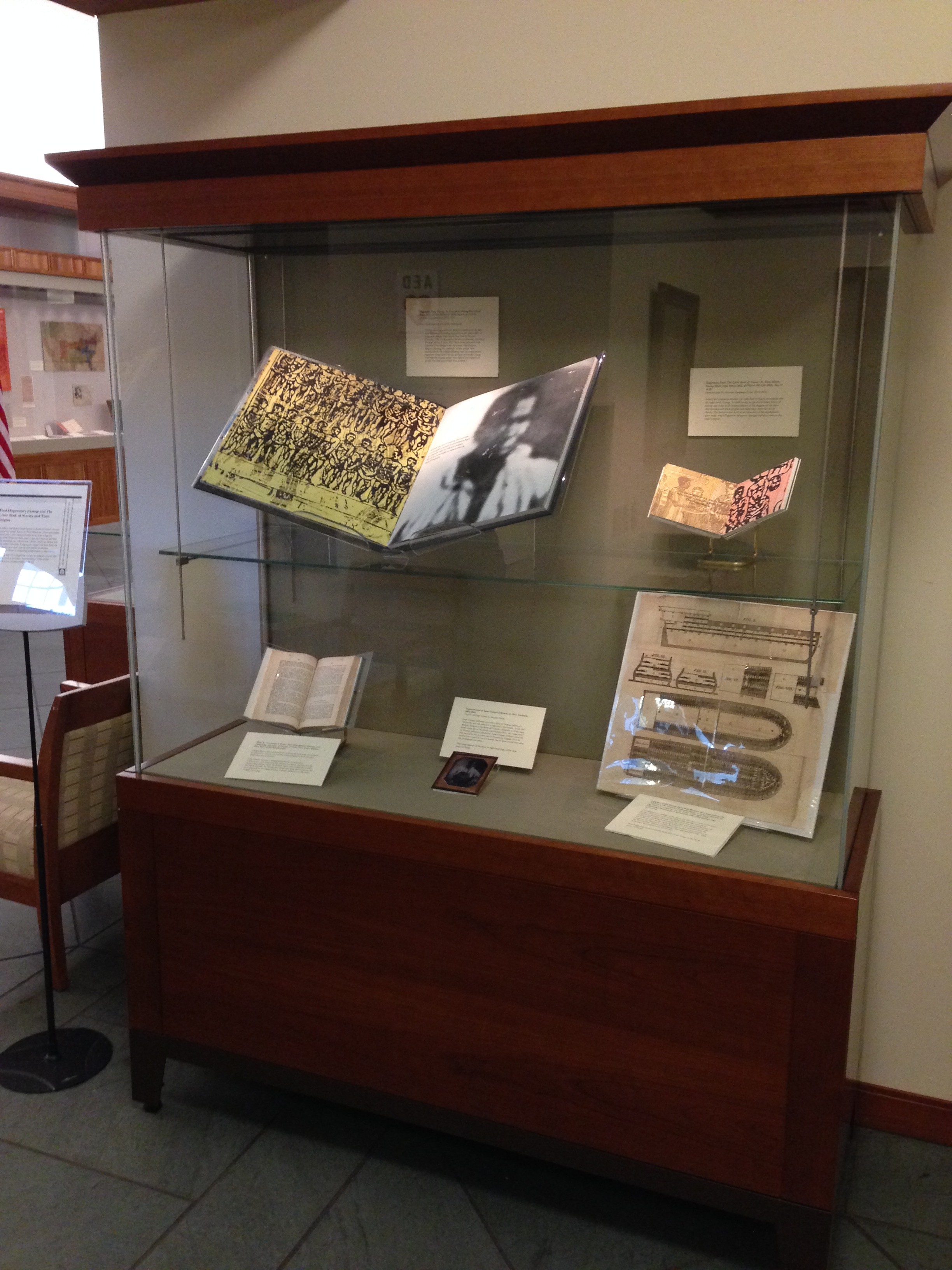
The blog has been on summer vacation! We are so pleased to be back with the news that we have a new mini-exhibition ready for visitors! We encourage you to stop by the First Floor Gallery to take a look at  “Fred Hagstrom’s Passage, The Little Book of Slavery and their Origins.”

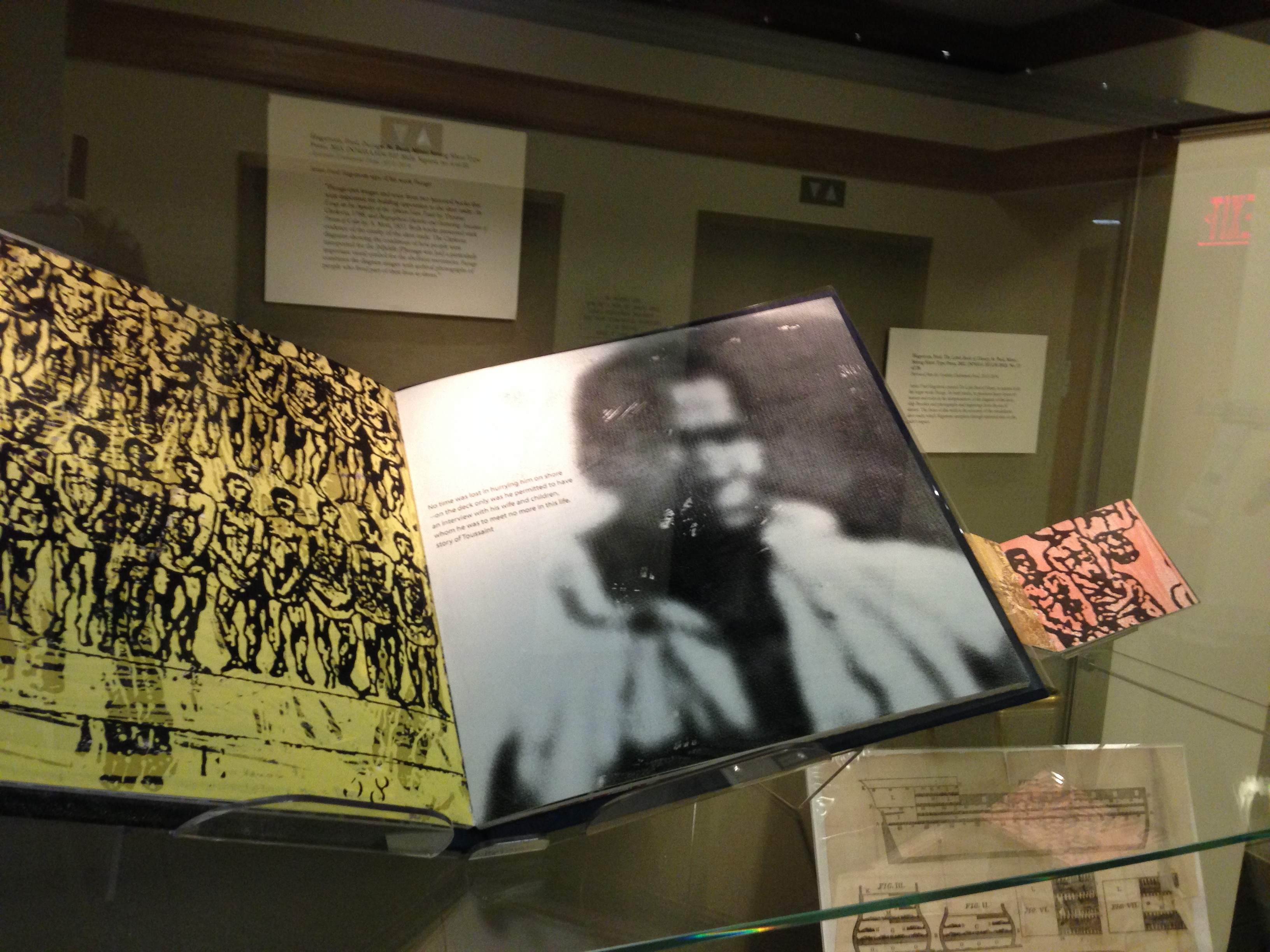
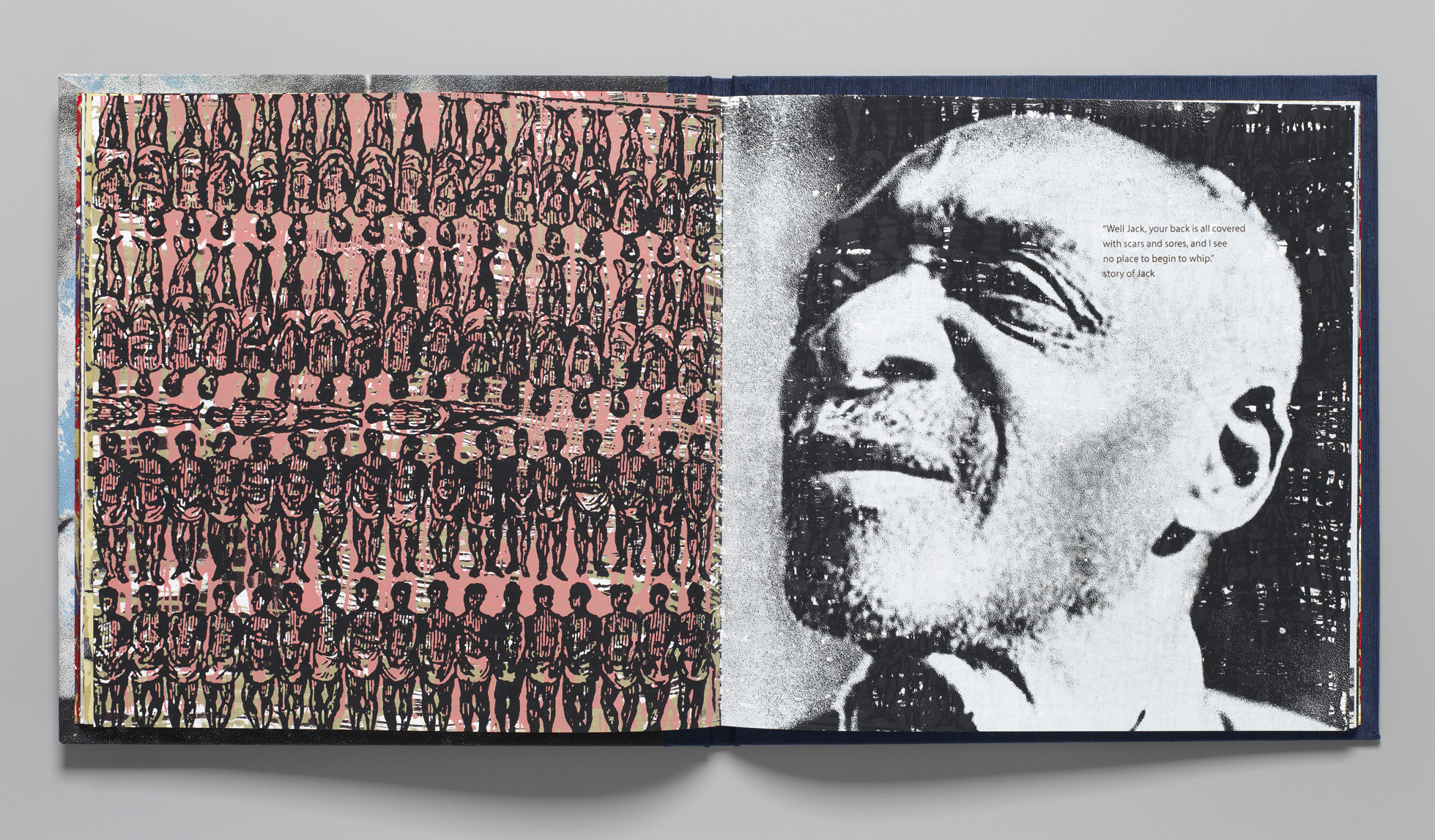
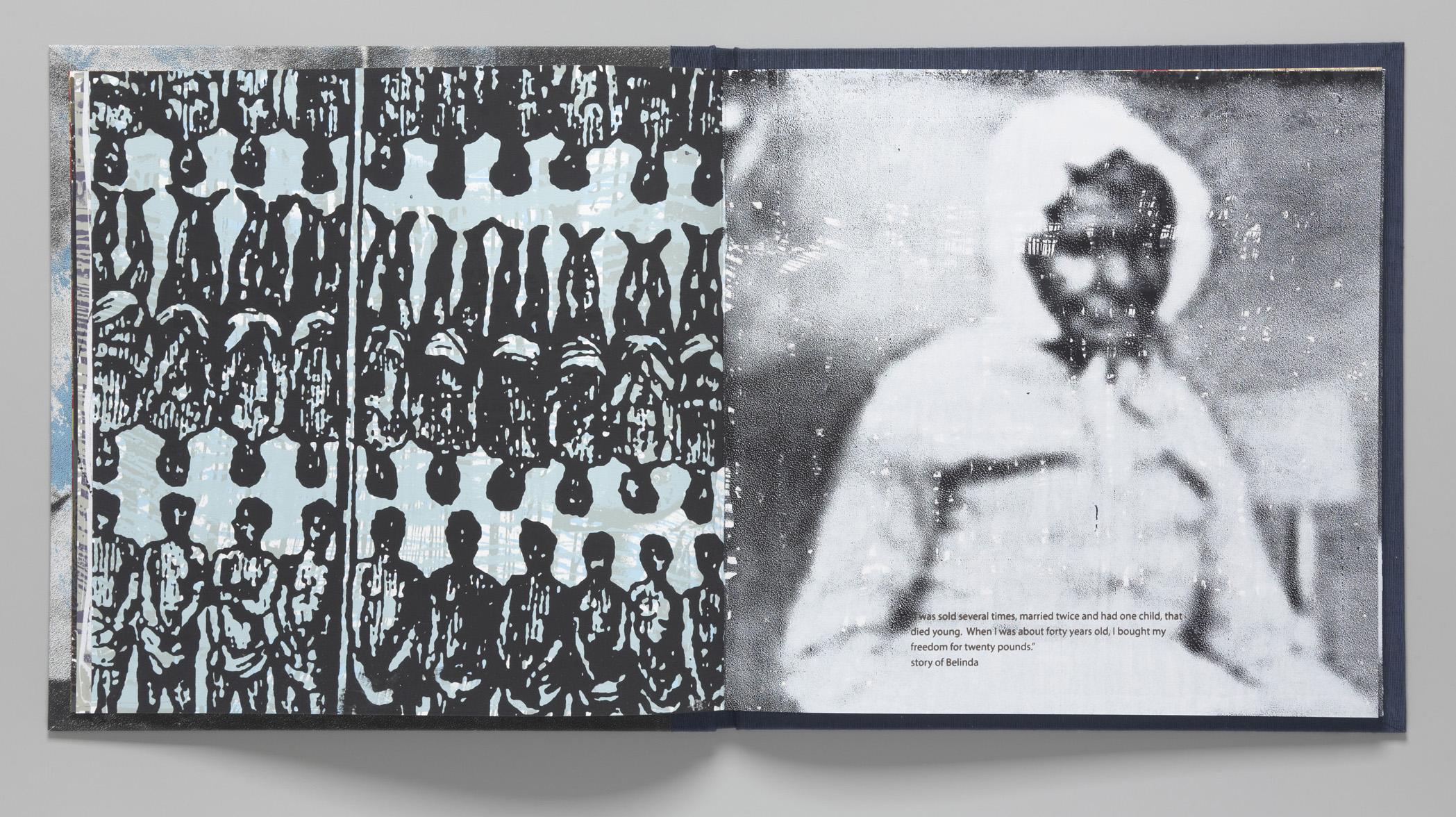
hagstrom_caseThis exhibition features two recently acquired artists’ books that draw on artifacts deeply rooted in our collections of African-American history and slavery-related materials.Using iconic images and texts from the transatlantic slave trade and the anti-slavery movement, American artist Fred Hagstrom produces a compelling interpretation of this history. On display with Hagstrom’s books are artifacts the artist used as the conceptual foundations of his artistic statements about the immorality of slavery. In both books, he produces heavy layers of texture and color in his interpretations of the iconic diagram of the slave ship Brookes, photographs, engravings, and texts from the era of slavery.

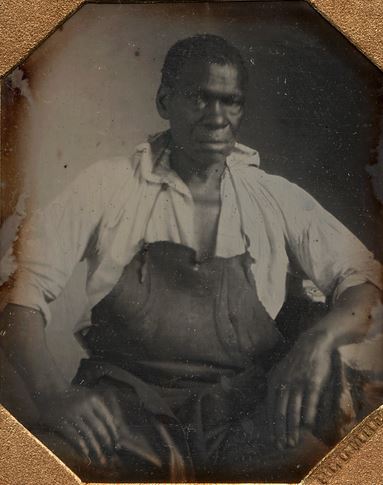
Of particular note is Hagstrom’s use of our library’s famous daguerrotype of Isaac Granger Jefferson, who was enslaved by Thomas Jefferson. Visitors may compare the original image with Hagstrom’s interpretation of it.

This daguerrotype of Isaac Granger Jefferson is frequently reproduced as an historical artifact; Hagstrom's pixellated image of it, juxtaposed with high-resolution close-ups of the equally iconic image of the "Slave Ship Brookes," opens new interpretive possiblities.

This daguerrotype of Isaac Granger Jefferson is frequently reproduced as an historical artifact; Hagstrom’s exaggeratedly pixellated image of it, juxtaposed with high-resolution close-ups of the equally iconic image of the “Slave Ship Brookes,” opens new interpretive possiblities. (MSS 2041. Tracy W. McGregor Library of American History)

Detail of Hagstrom's Passage as it is exhibited.

The page featuring Isaac Granger Jefferson in  “Passage,” as it is exhibited. (N7433.4 .H34 P37 2013. Associates Endowment Fund)

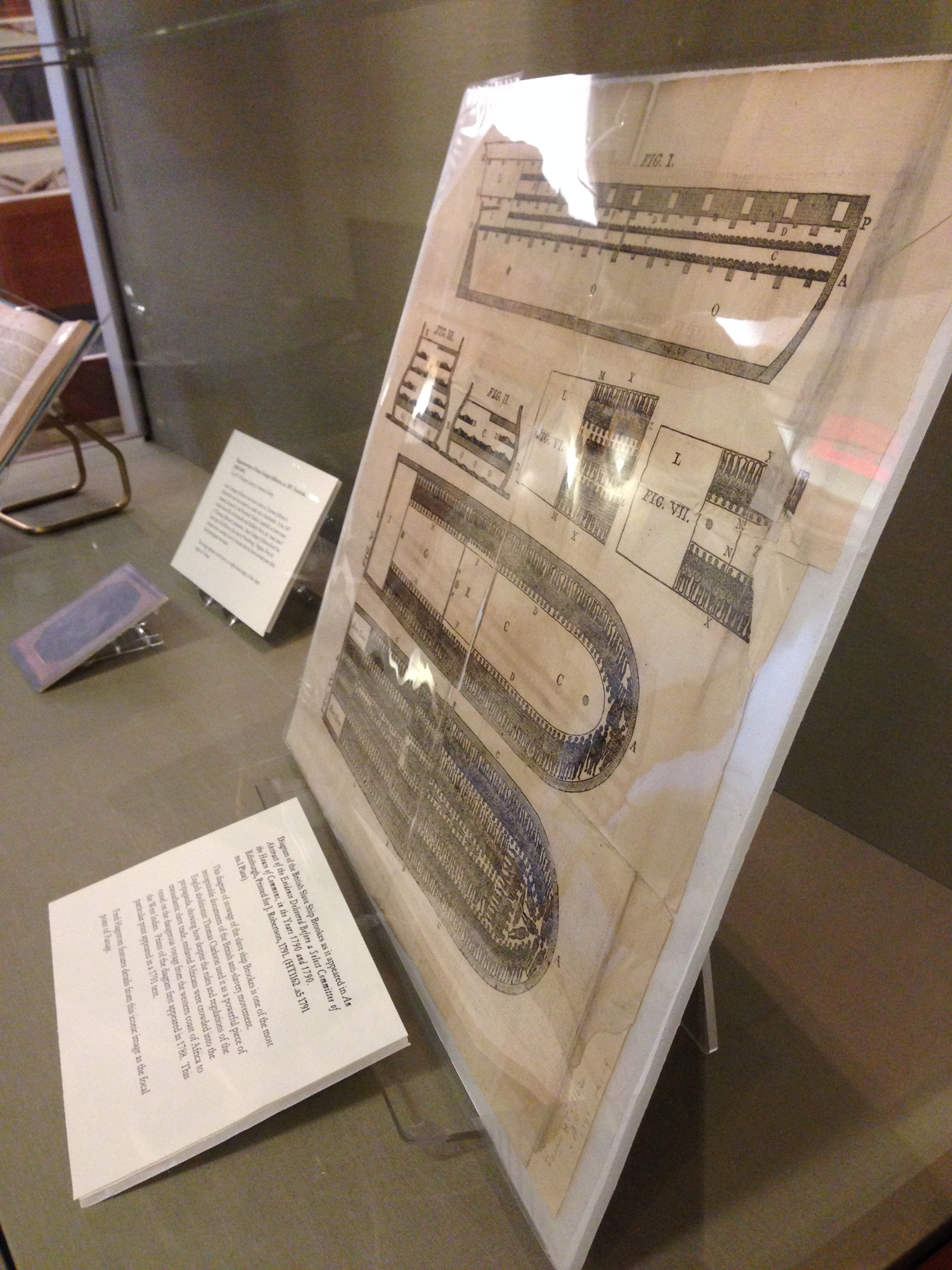
hagstrom_brookes

Also on display is one of our copies of the famous diagram of “The British Slave Ship Brookes,” as it appeared in “An Abstract of the Evidence Delivered Before a Select Committee of the House of Commons, in the Years 1790 and 1790.” Edinburgh, Printed for J. Robertson, 1791. (HT1162 .a5 1791 no.1 Plate)

This exhibition offers just a glimpse into Mr. Hagstrom’s work, which we hope will be a fertile ground for study by students and scholars alike. Our artists’ books collections cover a wide variety of genres, aesthetic approaches, and subject matter, and we are particularly interested in examples that relate to our varied collecting strengths. Perhaps this exhibit will tempt you to come take a closer look at Passage or The Little Book of Slavery in our reading room after the exhibition comes down. Until then,  here are some more of the striking justapositions to be found in Passage:

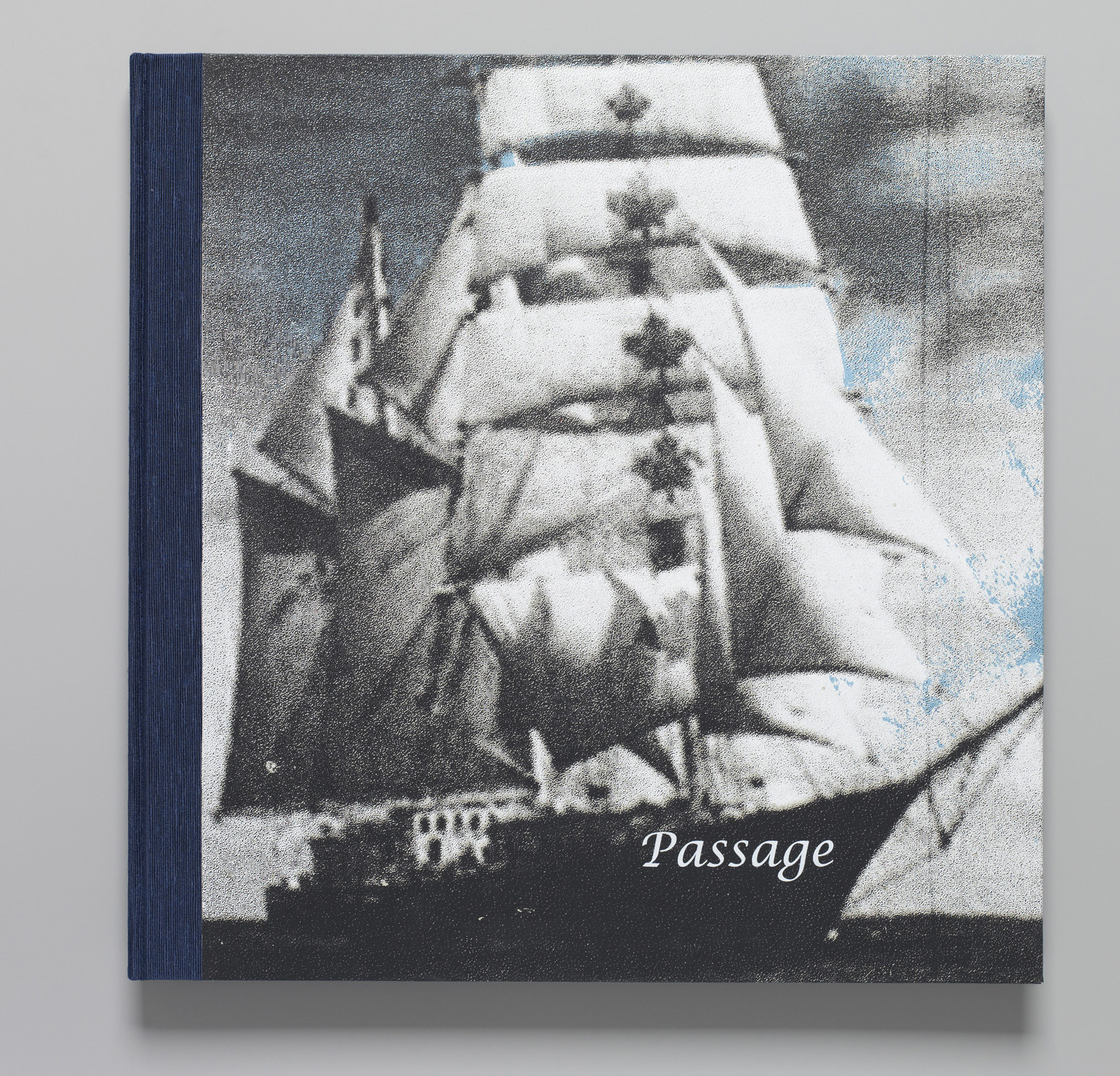
The front cover of Passage. Image courtesy of the artist.

The front cover of “Passage.” Image by Peter Lee, courtesy of Fred Hagstrom.

A page spread in Passage. Image courtesy of the artist.

A page spread from “Passage.” (Click twice to zoom in to read the text.) Image by Peter Lee, courtesy of Fred Hagstrom.

Passage pages 5 (2)

A page spread from “Passage.” (Click twice to zoom in to read the text.) Image by Peter Lee, courtesy of Fred Hagstrom.

You can learn more about Hagstrom’s work on his Carleton College website.

This Just In: Spring Miscellany

U.Va.’s Final Exercises have concluded, and Grounds is quiet this week. Shortly the summer session will begin (as well as the inevitable summer construction projects), and both temperature and humidity will, no doubt, rise. Under Grounds it is busyness as usual as we catch up with what so far has been a banner spring for acquisitions. Following is a random selection of some early printed books newly added to our shelves.

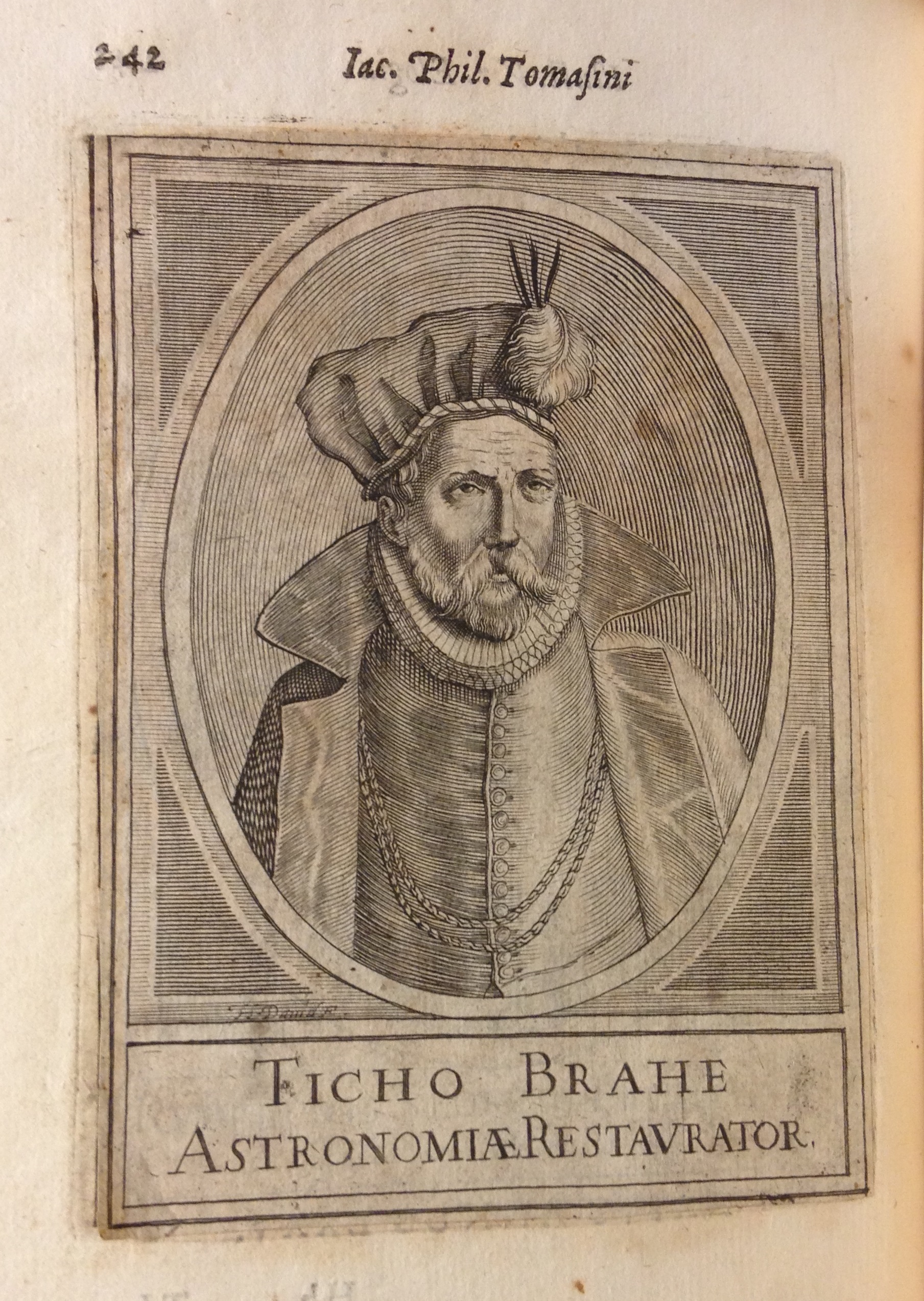
A stellar eclipse! This engraved portrait of astronomer Tycho Brahe is actually a cancel slip pasted over another engraved portrait inadvertently printed on the wrong leaf. Note how the lower left corner is lifting upward, and the engraved border of the underlying portrait visible at left. Giacomo Filippo Tomasini, Illustrium virorum elogia iconibus illustrata (Padua, 1630), p. 242.   (CT1122 .T6 1630)

A stellar eclipse! This engraved portrait of astronomer Tycho Brahe is actually a cancel slip pasted over another engraved portrait inadvertently printed on the wrong leaf. Note how the lower left corner is lifting upward, and the engraved border of the underlying portrait is visible at left. Giacomo Filippo Tomasini, Illustrium virorum elogia iconibus exornata (Padua, 1630), p. 242. (CT1122 .T6 1630)

Giacomo Filippo Tomasini’s Illustrium virorum elogia iconibus exornata (Padua, 1630) is a collection of biographies of noted scientists, astronomers, doctors, jurists, and theologians, most of whom lived in Padua and taught at its famous university. Of special note are the bibliographies of each subject’s writings, and the fine full-page engraved portraits by the French artist Jérôme David. Indeed, it was the engraved portrait of Danish astronomer Tycho Brahe that caught our eye in a bookseller’s booth at the New York International Antiquarian Book Fair last month. Unbeknownst to the dealer, this portrait is actually a cancel pasted over a different engraved portrait inadvertently printed in the wrong place! During the hand-press period, serious printing errors were typically corrected by “cancelling” an entire leaf and replacing it with a corrected replacement leaf or, as here, by pasting a cancel slip over the portion needing correction. Text cancels are fairly common in early printed books, but a cancel illustration is rarely encountered.

Engraved reproduction of the famous Dove Mosaic discovered by Giuseppe Alessandro Furietti at Hadrian's Villa and now in Rome's Capitoline Museum. Furietti believed it to be the actual mosaic created by Sosus for the royal palace at Pergamon, as described by Pliny the Elder in his Natural History. Giuseppe Alessandro Furietti, De musivis (Rome, 1752), plate [1].   (NA3750 .F8 1752)

Engraved reproduction of the famous Dove Mosaic discovered by Giuseppe Alessandro Furietti at Hadrian’s Villa and now in Rome’s Capitoline Museum. Furietti believed it to be the actual mosaic created by Sosus for the royal palace at Pergamon, as described by Pliny the Elder in his Natural History. Giuseppe Alessandro Furietti, De musivis (Rome, 1752), plate [1]. (NA3750 .F8 1752)

De musivis (Rome, 1752), by the Italian antiquarian and cleric Giuseppe Alessandro Furietti, is one of the earliest scholarly works devoted to Roman mosaics. Written just as the rediscovery of Pompeii and Herculaneum was inspiring new interest in Greek and Roman antiquities, Furietti’s work summarizes what was then known about Roman mosaics, incorporating new findings from Furietti’s own excavations at Hadrian’s Villa. Of particular interest are Furietti’s notes on the musivarii (the Roman artisans responsible for the figurative portions of mosaics), as well as his comments on mosaic art in Italy since the fall of the Roman Empire.

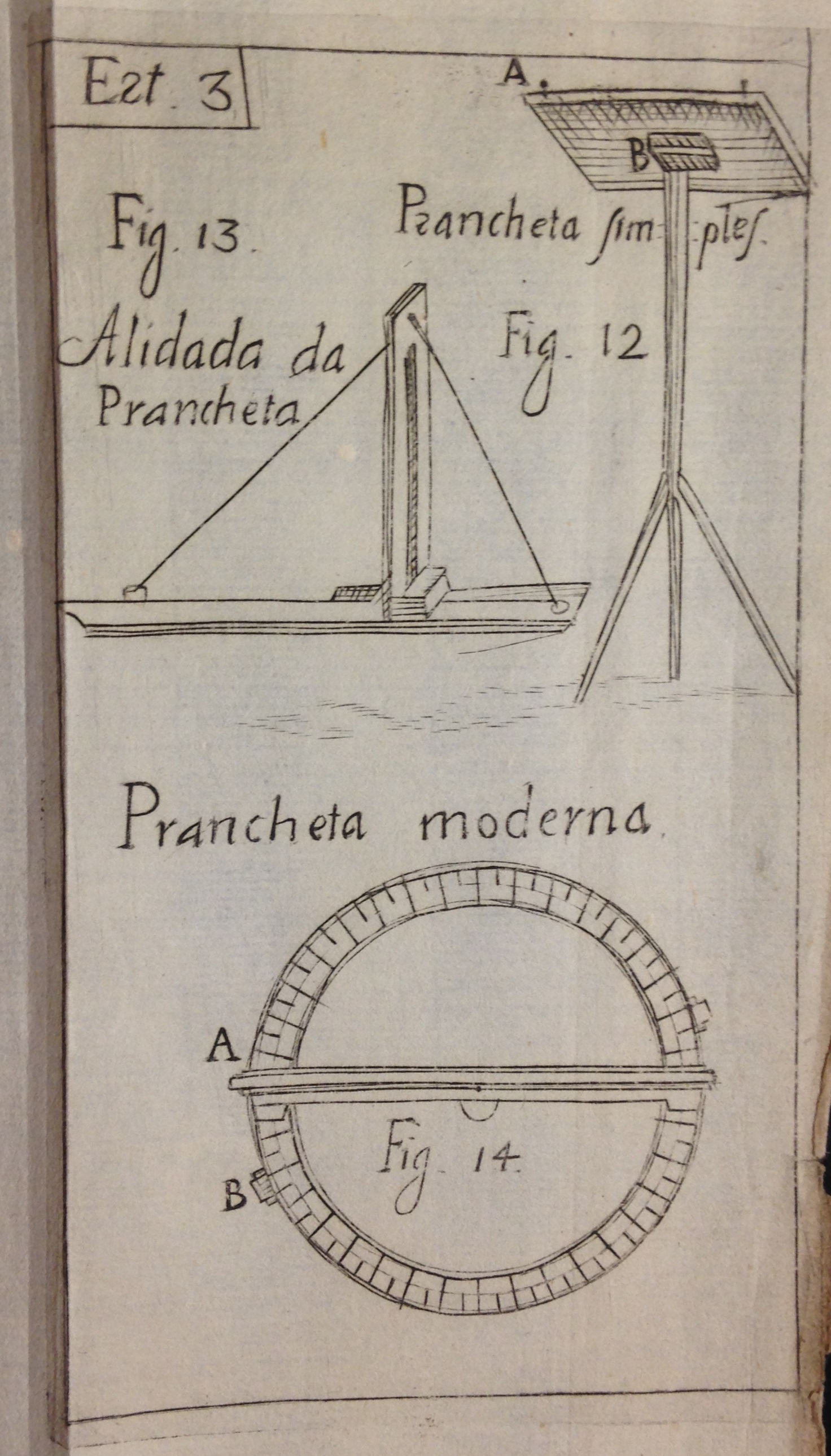
A cartographer's tools, from Manoel de Azevedo Fortes, Tratado do modo o mais facil, e o mais exacto de fazer as cartas geograficas (Lisbon, 1722), plate 3.   (GA102.3 .F67 1722)

A cartographer’s tools, from Manoel de Azevedo Fortes, Tratado do modo o mais facil, e o mais exacto de fazer as cartas geograficas (Lisbon, 1722), plate 3. (GA102.3 .F67 1722)

Special Collections is well known for its distinguished cartographic holdings—particularly of maps and atlases concerning the discovery and exploration of North America—and recently we added the perfect complement: one of the earliest printed manuals on mapmaking. Cartography had long been an essential skill for military engineers and surveyors, who could turn to printed works in their fields for guidance, but manuals specifically directed at cartographers were a late development. Manoel de Azevedo Fortes’s rare Tratado do modo o mais facil, e o mais exacto de fazer as cartas geograficas … (Lisbon, 1722) was the first such manual in Portuguese. Fortes based his work in part on French manuals. Although he writes in part for a military audience, Fortes directs this work primarily at fellow members of Portugal’s Royal Academy of History who desire to complement their writings with maps. Of particular interest are his comments on cartographic symbols and map coloring.

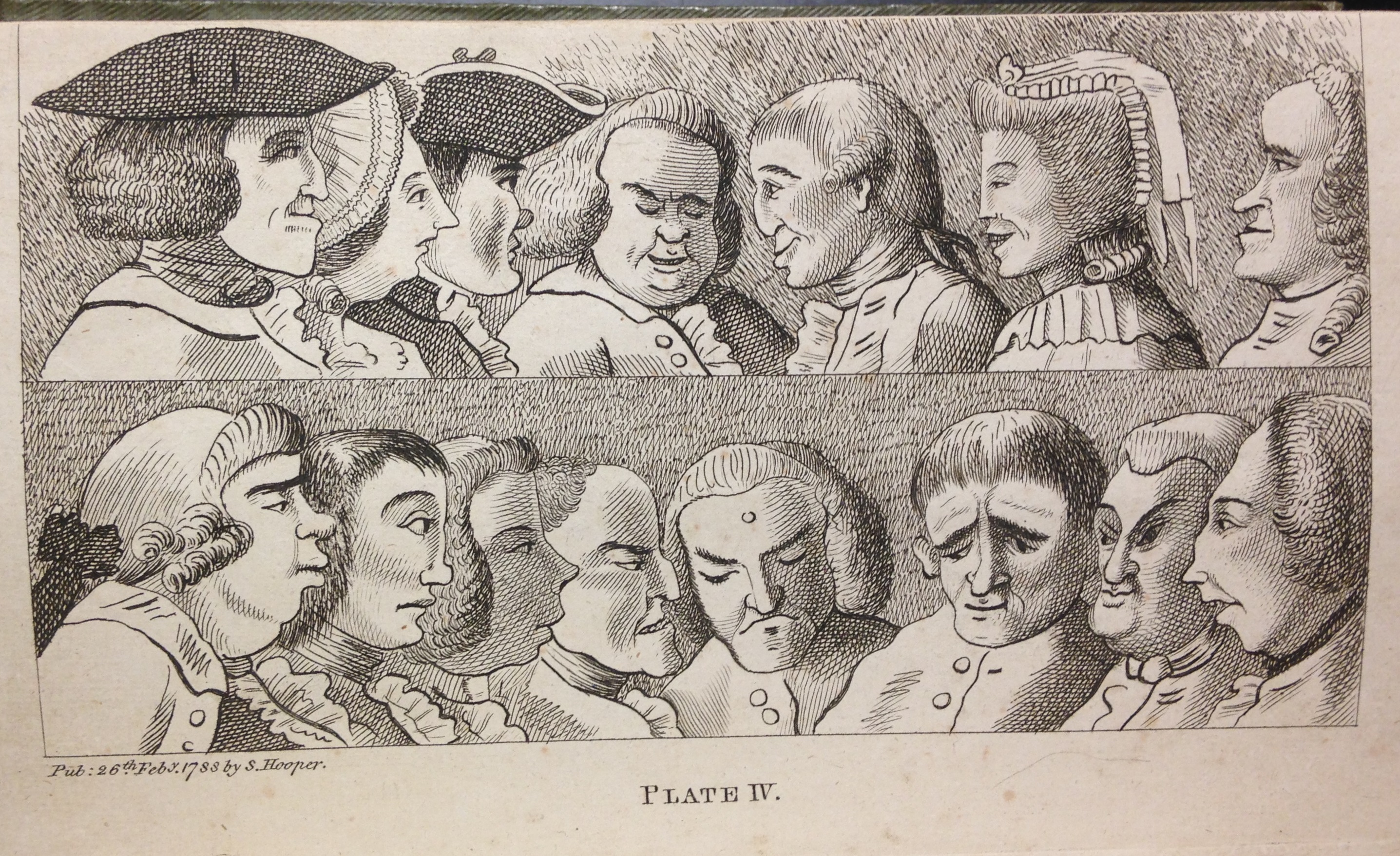
A lesson in caricature: examples of various noses, profiles, and head shapes. Francis Grose, Rules for drawing caricaturas, 2nd ed. (London, 1796), plate IV.   (NC1320 .G76 1796)

A lesson in caricature: examples of various noses, profiles, and head shapes. Francis Grose, Rules for drawing caricaturas, 2nd ed. (London, 1796), plate IV. (NC1320 .G76 1796)

We have also acquired another early manual on an entirely different subject: the art of caricature. A well known English antiquary and scholar of English slang, Francis Grose (1731-1791) was also an amateur artist who delighted in “comic painting.” In Rules for drawing caricaturas: with an essay on comic painting, Grose sought to explain how artists such as Hogarth and Gilpin manipulated the human form and visage for comic effect. This second, expanded edition, published posthumously in London in 1796, includes 21 plates, seventeen of which were etched by Grose himself. Most are caricatures of himself and his fellow antiquaries.

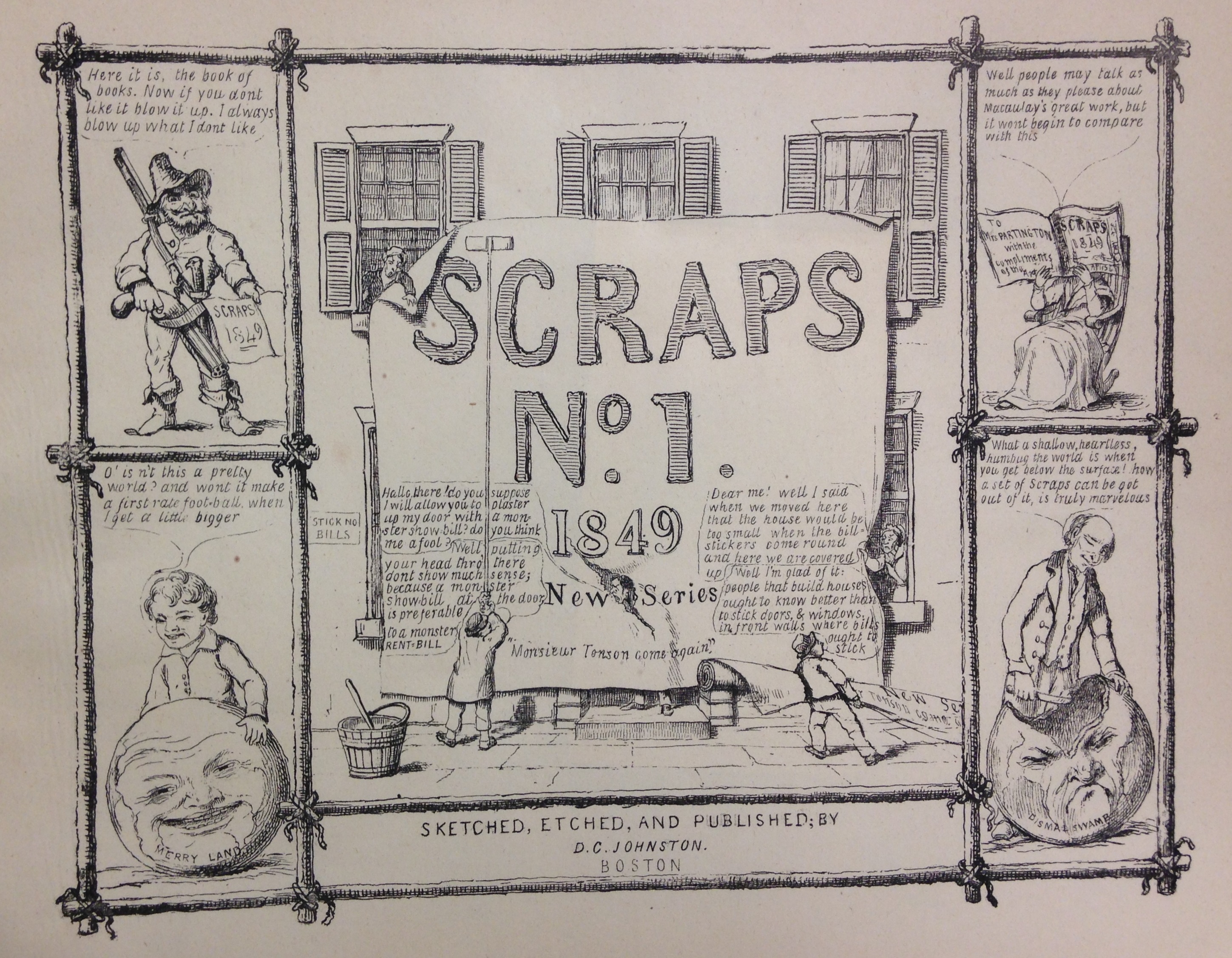
Front cover of David Claypoole Johnston, Scraps no. 1, new series (Boston, 1849).    (E166 .J65 1849)

Front cover of David Claypoole Johnston, Scraps no. 1, new series (Boston, 1849). (E166 .J65 1849)

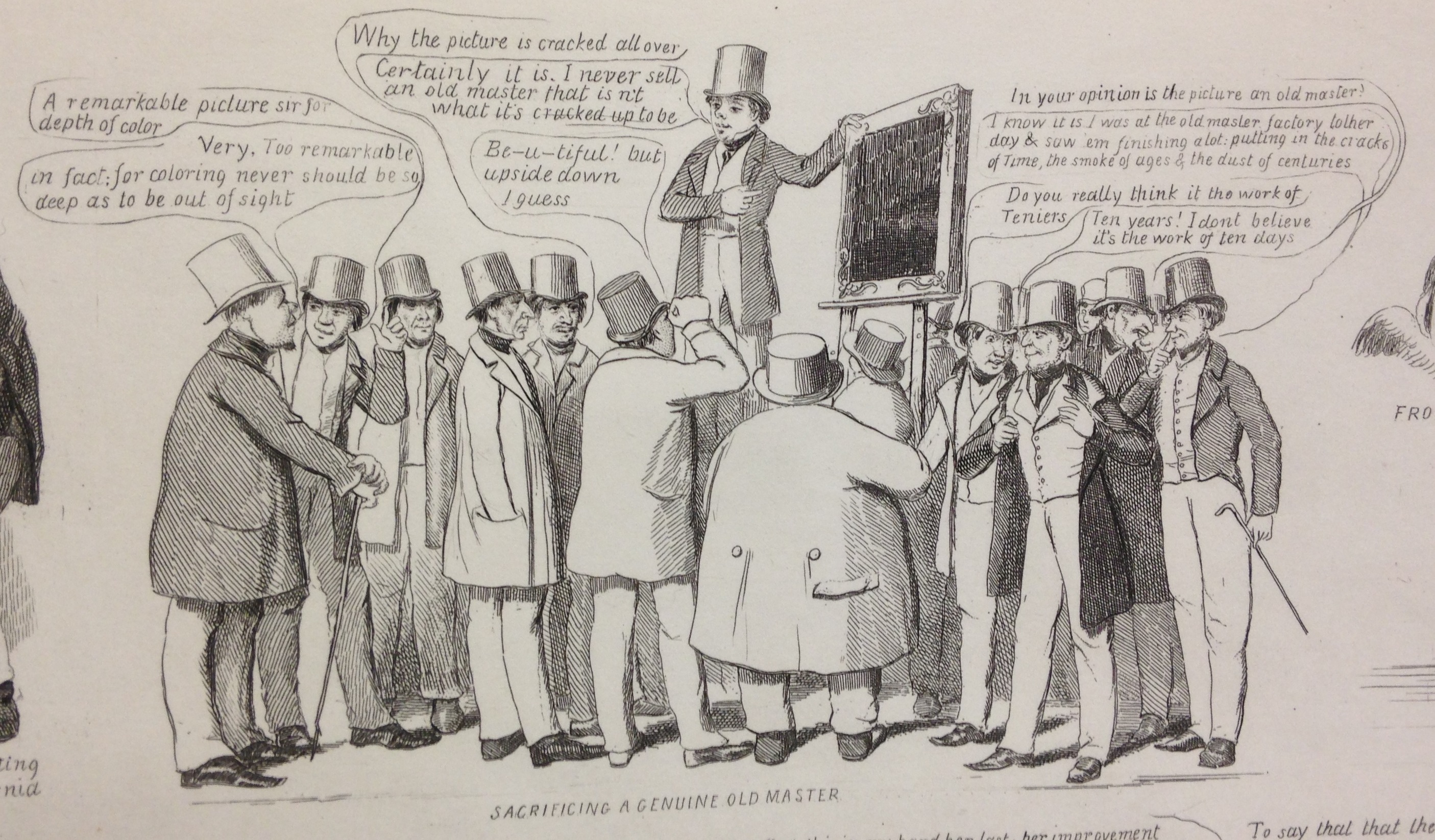
The art of caricature soon took root in the United States, thanks in part to the influence of English émigré artists. One of the most famous antebellum American cartoonists was David Claypoole Johnston (1798-1865), who excelled in many artistic media. Some of his best cartoon “Scraps” were published from 1828 to 1849 in a series of numbered portfolios, of which we recently acquired two. Their etchings poke fun at contemporary events such as the Mexican-American War, emerging issues such as women’s rights, contemporary fads such as phrenology, and, of course, the art world.

One of the cartoon "scraps" in David Claypoole Johnston, Scraps no. 1, new series (Boston, 1849)   (E166 .J65 1849)

One of the cartoon “scraps” in David Claypoole Johnston, Scraps no. 1, new series (Boston, 1849) (E166 .J65 1849)

This Just In: Printing Planographically

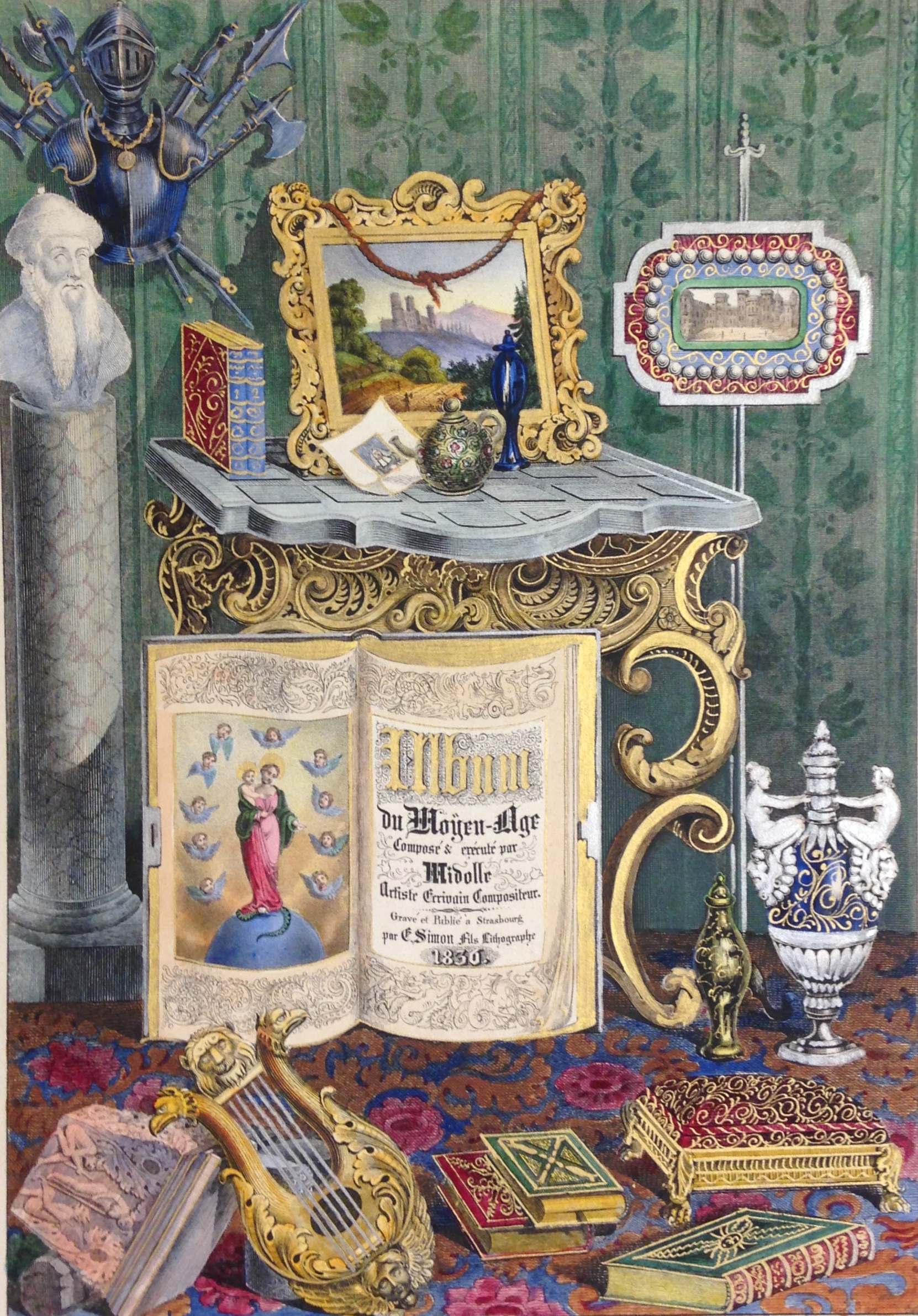
Title page to Jean Midolle, Album du Moyen Âge (Strasbourg, 1836)  ( NK3630 .M53 1836)

Title page to Jean Midolle, Album du Moyen Âge (Strasbourg, 1836) ( NK3630 .M53 1836)

In recent months U.Va. has had unusual opportunities to enhance its already strong collections on 19th-century planographic printing. Prior to the invention of lithography by Alois Senefelder in 1796, printers used a variety of relief (letterpress, woodcut &c.) and intaglio (engraving, etching &c.) processes for replicating text and image. Senefelder’s innovative method of printing from a flat surface offered printers a new tool which, thanks to continuing refinement during the 19th century, emerged as the leading method for printing multicolor illustrations. And by the later 20th century, offset lithography would supplant letterpress as the preferred method for printing text.

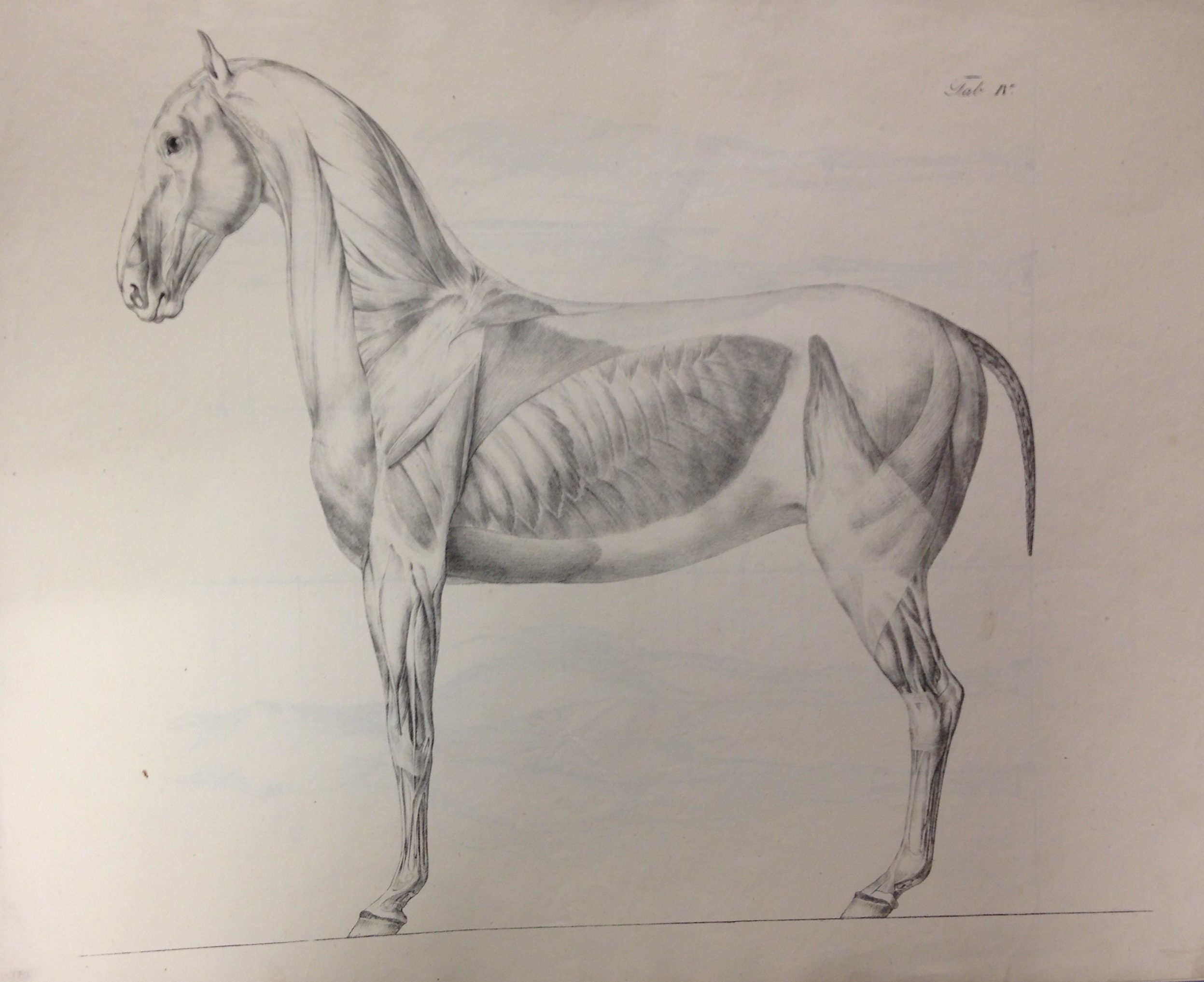
A lithographed plate from Konrad Ludwig Schwab. Anatomische Abbildungen des Pferdekörpers (Munich, 1820 ) (SF765 .S45 1820)

A lithographed plate from Konrad Ludwig Schwab. Anatomische Abbildungen des Pferdekörpers (Munich, 1820 ) (SF765 .S45 1820)

Because the technologies of lithography inform many aspects of 19th-century printing, the graphic arts, and book culture, the Small Special Collections Library has long sought to acquire a representative collection of technical manuals and printing specimens documenting lithography’s gradual ascendancy. Included are rare lithographic “incunabula” printed up to ca. 1820. Five years ago we were fortunate to acquire a fine copy of Konrad Ludwig Schwab’s Anatomische Abbildungen des Pferdekörpers (1813) published (as were many of the earliest lithographed books) in Munich, and illustrated with several large plates depicting horse anatomy. To it we have now added the equally rare second edition (Munich, 1820). This is no mere reprint, for the plates have been redone in more accomplished fashion, demonstrating how far lithography had progressed in only a few short years.

An early lithographic press and related equipment as depicted in Antoine Raucourt de Charleville, A manual of lithography, or memoir on the lithographical experiments made in Paris (2nd ed., London, 1821)  (NE2420 .R25 1821)

An early lithographic press and related equipment as depicted in Antoine Raucourt de Charleville, A manual of lithography, or memoir on the lithographical experiments made in Paris (2nd ed., London, 1821) (NE2420 .R25 1821)

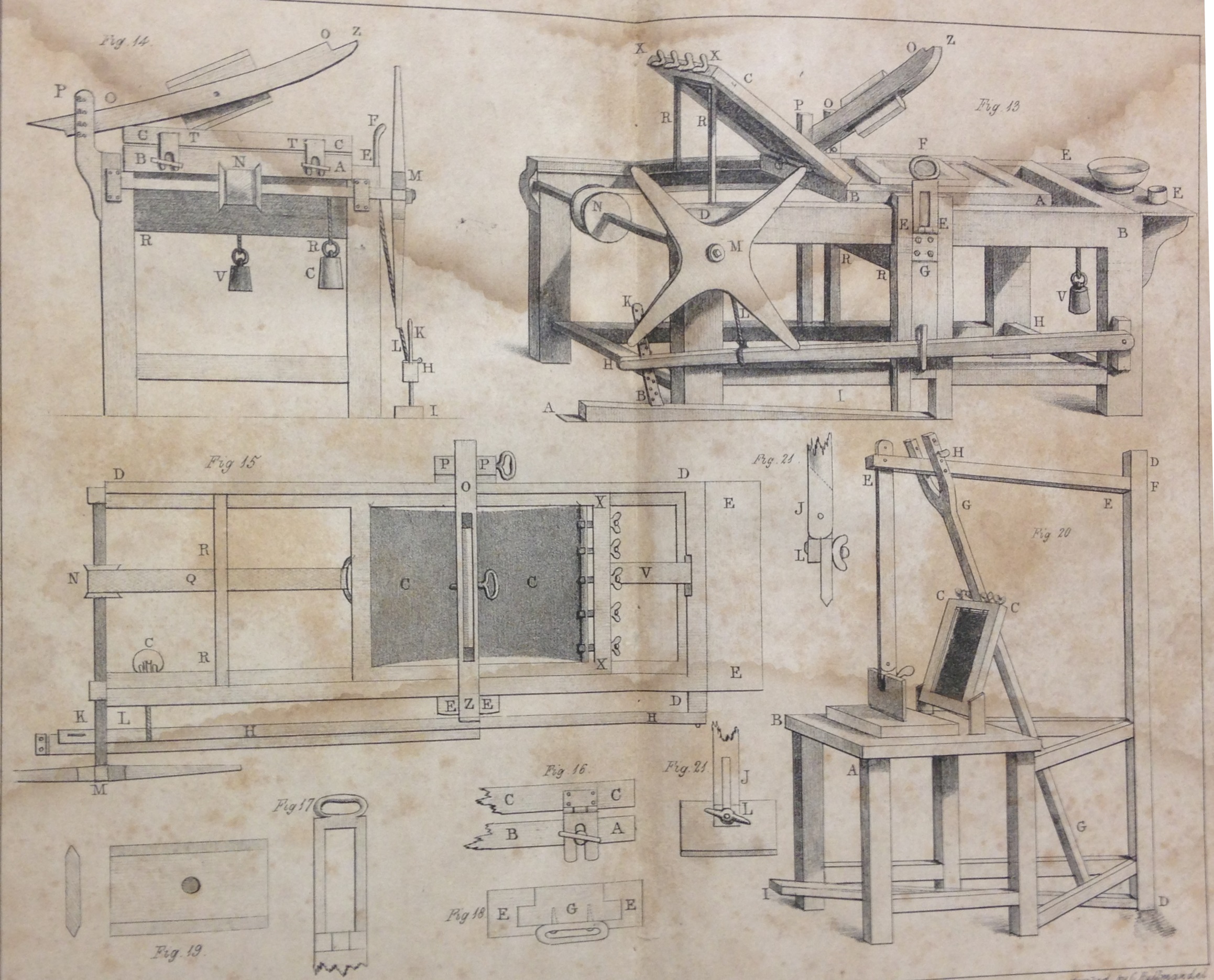
Lithography quickly spread throughout Europe and beyond, particularly after 1818 when Senefelder published the first comprehensive manual. Others followed in quick succession, and through these we can trace the many technical innovations introduced during the 1820s and 1830s. By 1819 English printers could read not only Senefelder’s work, but also the leading French manual (by Antoine Raucourt de Charleville) in an English translation prepared by the London lithographer Charles Hullmandell. We recently acquired the second edition (1821), to which Hullmandell appended plates depicting a lithographic press, which looked and operated far differently from relief and intaglio presses. Another recent acquisition is the very rare Mémoire sur l’art du lithographe (Paris, [1829]) of Alphonse Chevallier. Included is a set of progressive plates illustrating Chevallier’s methods for creating certain artistic effects lithographically.

Two stages in the creation of a lithographic image, from Alphonse Chevallier, Mémoire sur l’art du lithographe (Paris, [1829])  (NE2420 .C54 1829)

Two stages in the creation of a lithographic image, from Alphonse Chevallier, Mémoire sur l’art du lithographe (Paris, [1829]) (NE2420 .C54 1829)

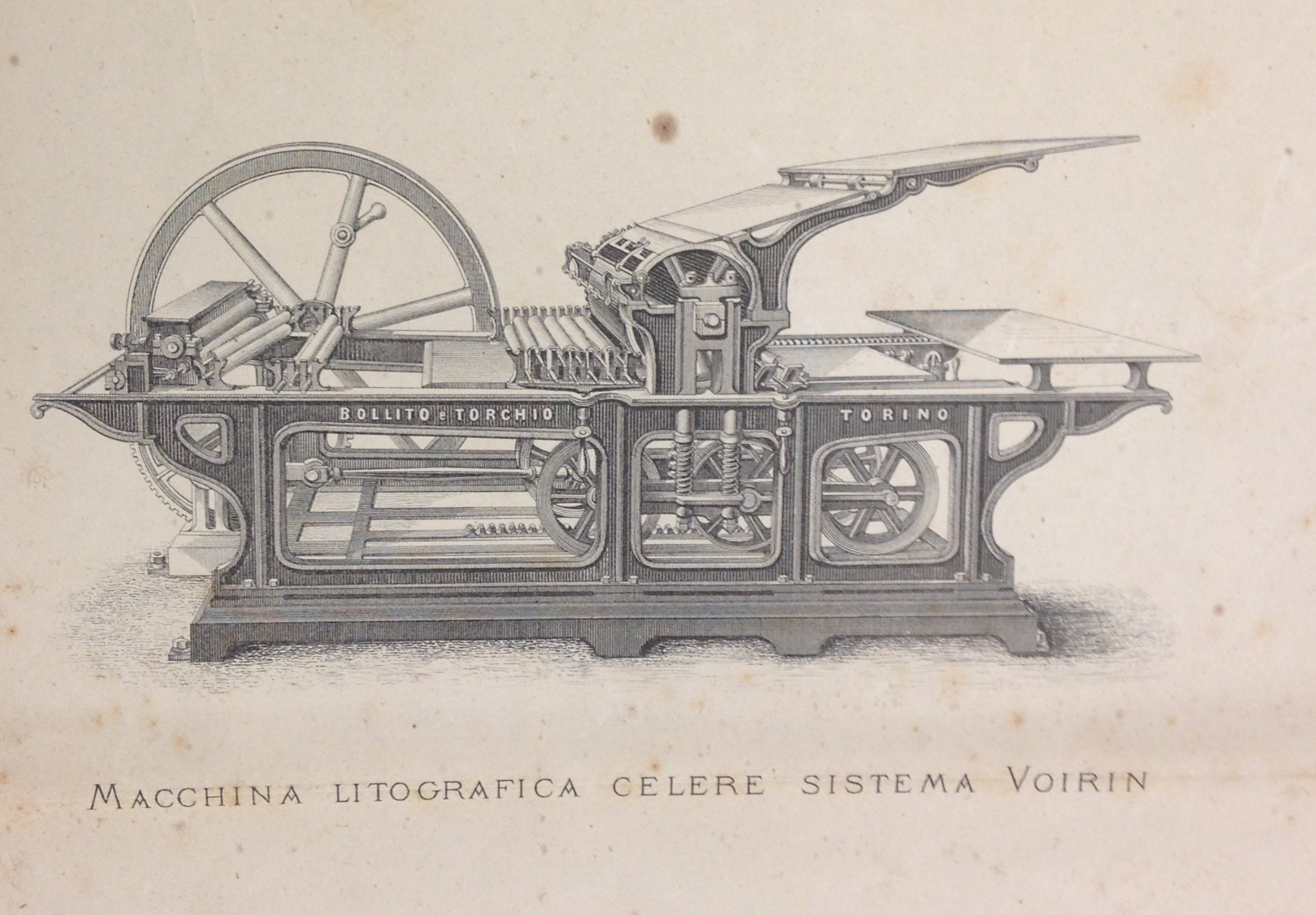
Lithography flourished in the late 19th century with the perfection of new technologies (most notably chromolithography and photolithography), improved equipment (especially steam-powered presses), and its application to new markets such as advertising matter and commercial packaging. Camillo Doyen’s rare Trattato di litografia: storico, teorico, pratico ed economico (Turin, 1877) is typical of later lithographic manuals: massive, richly detailed, and full of useful insights into regional practices.

A steam-powered lithographic press illustrated in Camillo, Doyen, Trattato di litografia: storico, teorico, pratico ed economico (Turin, 1877)  (NE2425 .D68 1877)

A steam-powered lithographic press illustrated in Camillo, Doyen, Trattato di litografia: storico, teorico, pratico ed economico (Turin, 1877) (NE2425 .D68 1877)

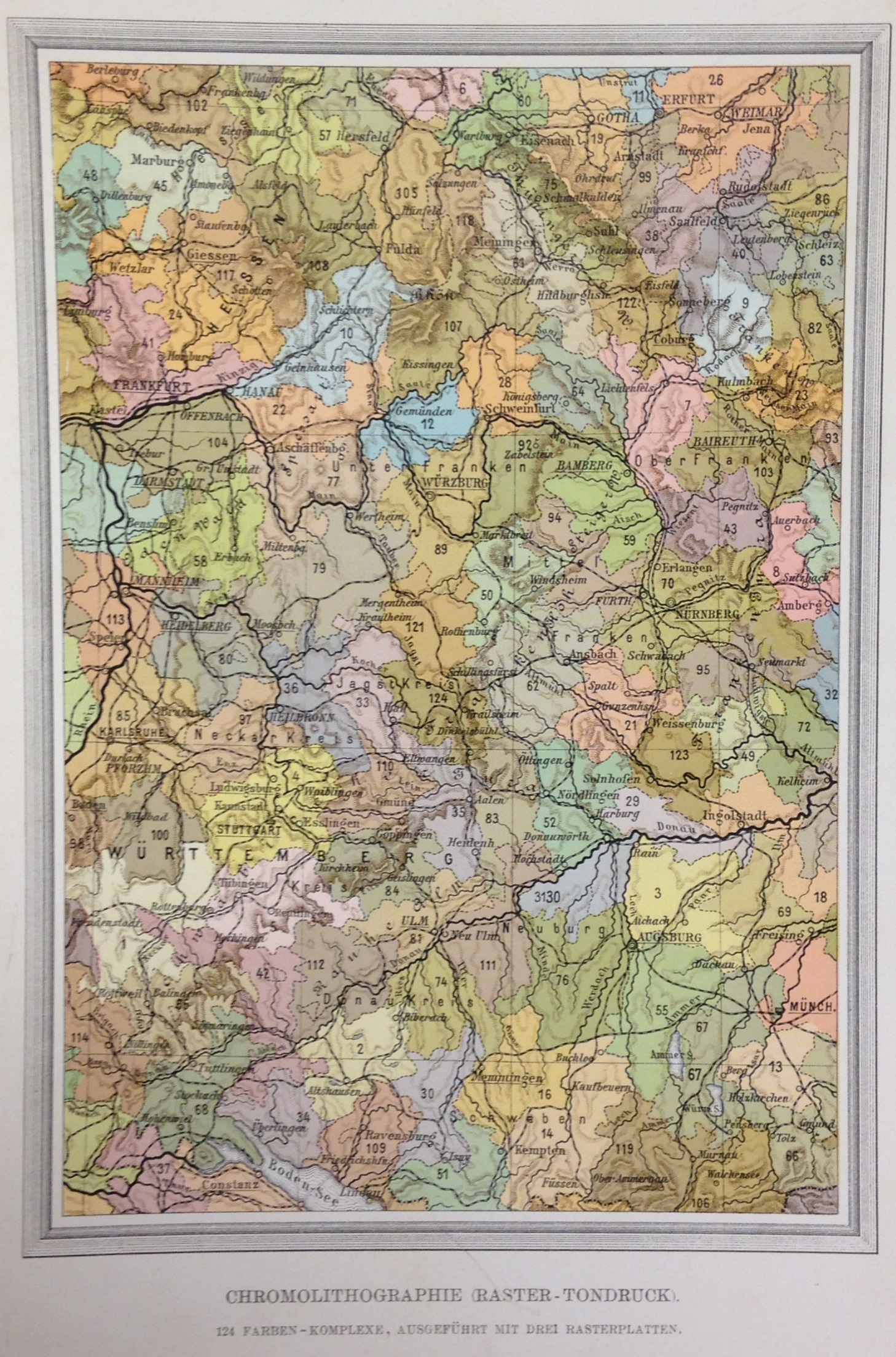
By 1900 German and Austrian lithographers were perhaps the most accomplished in Europe, producing high quality book illustrations and other work for publishers as far afield as the United States. The text and sample plates to Friedrich Hesse’s Die Chromolithographie (2nd ed., Halle, 1906) are important for understanding and identifying the many variant processes in the commercial lithographer’s toolkit.

A specimen chromolithographed map inserted as a plate in Friedrich Hesse, Die Chromolithographie (Halle, 1906)  (NE2500 .H47 1906)

A specimen chromolithographed map inserted as a plate in Friedrich Hesse, Die Chromolithographie (Halle, 1906) (NE2500 .H47 1906)

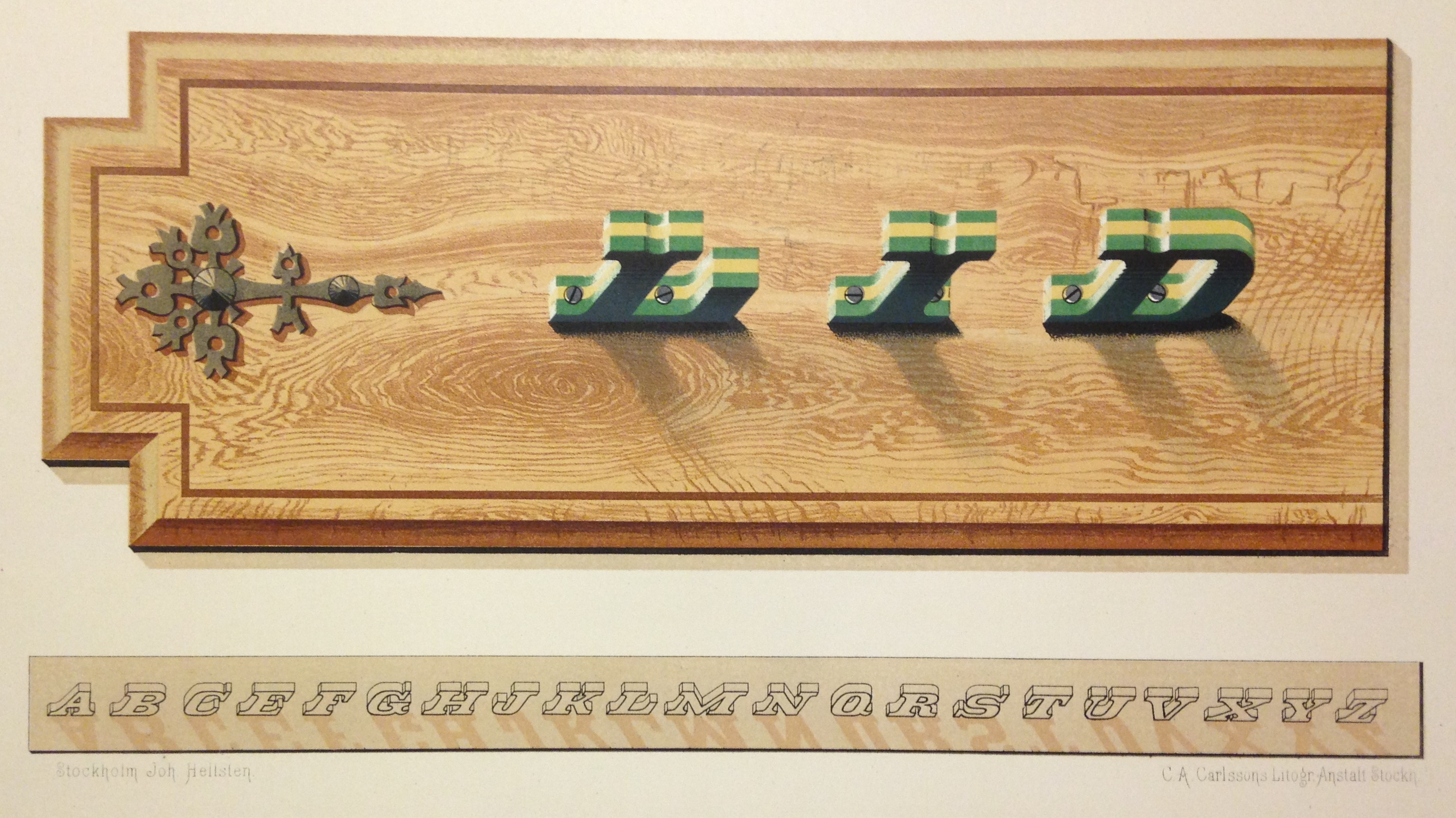
Printers have long sought to demonstrate and advertise their prowess through specimen work, and lithographers have been no exception. Perhaps the finest early chromolithographic printing was that executed by the Strasbourg firm of Frédéric Émile Simon. During the 1830s Simon teamed with the innovative calligrapher Jean Midolle to issue three extraordinary specimen books, one of which we have now acquired: Album du Moyen Âge (1836). That many of its plates are heightened with dusted gold, silver, and bronze powders, and even some discreet hand coloring, does not detract from their beauty and technical mastery. Fifty years later the Swedish sign painter advertised his work to potential clients by issuing Skyltmotiv (1884), a very rare portfolio containing 30 sample designs of his best work. Here the ability of Stockholm chromolithographer C. A. Carlsson to reproduce woodgraining and three-dimensional effects planographically is nothing short of miraculous.

A chromolithographic tour de force  from Frithiof Telenius, Skyltmotiv (Stockholm, 1884)

A chromolithographic tour de force from Frithiof Telenius, Skyltmotiv (Stockholm, 1884)

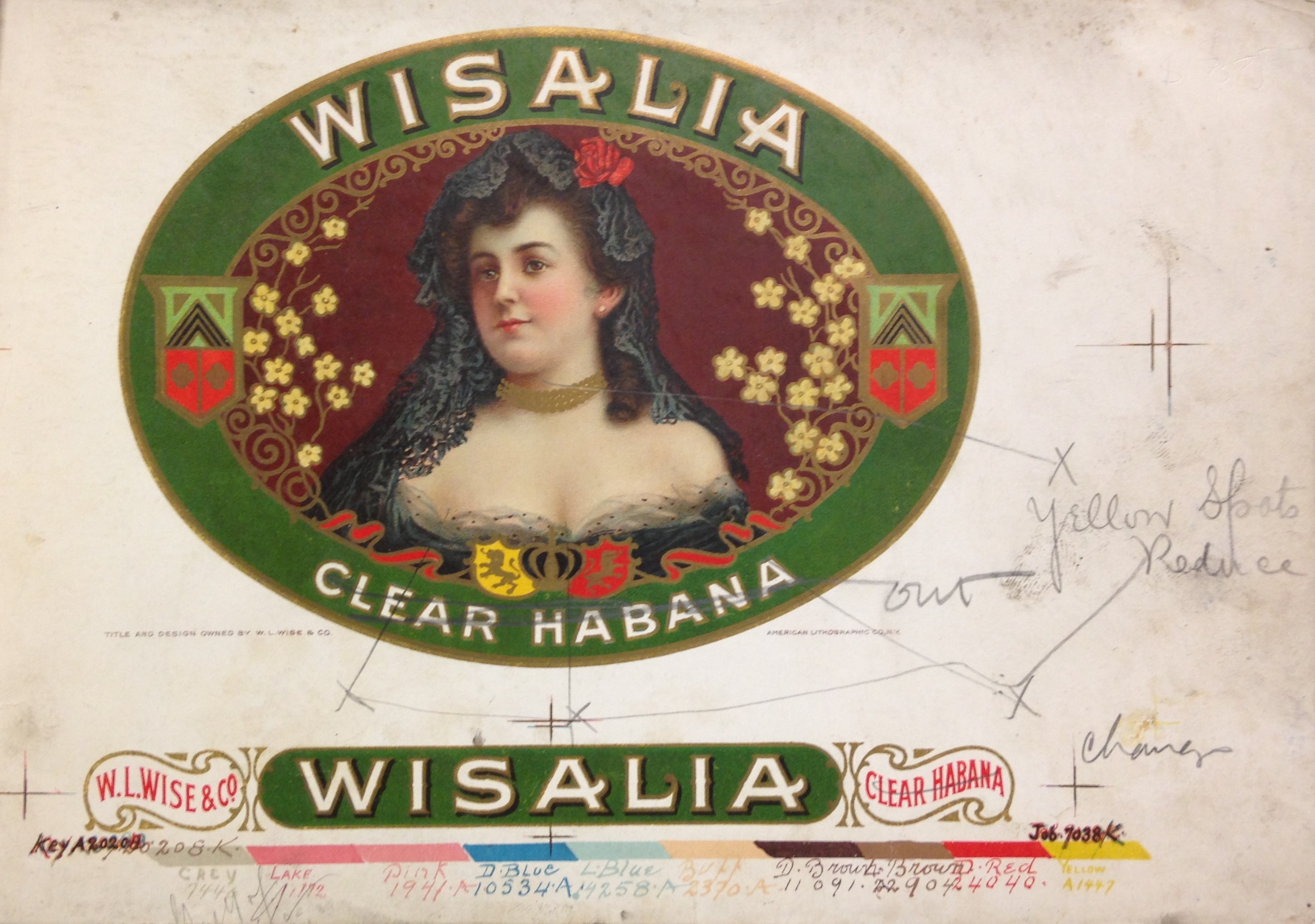
By 1900 it was not unusual for lithographers to print chromolithographic images in 20 or more colors, each applied with a different lithographic stone. A successful image required not only perfect registration, but the careful application of colors in proper sequence to achieve the desired effect. How this was done is illustrated through a set of progressive proofs we recently acquired. Formerly in the archive of the American Lithographic Co., it comprises the firm’s official set of 39 proofs documenting job no. 7038K: a cigar box label printed ca. 1900. Many proofs bear annotations indicating corrections to be made, followed by the corrected proofs. At front is the completed image (still marked for correction) showing at bottom a color bar with the ten hues employed, applied in sequence from right to left.

Proof of a 10-color chromolithographed cigar box label, marked up for correction (NE2515 .A54 1900)

Proof of a 10-color chromolithographed cigar box label, marked up for correction (NE2515 .A54 1900)

Goodbye, Special Collections!: Two graduating student assistants reflect

This week, we are pleased to feature a guest post by two graduating students: Christina Balangue and Alex Valdez. Christina and Alex are long-time student assistants in Special Collections and have generously agreed to tell the blog a bit about their work down in the stacks. We will be so sad to see them go!

CHRISTINA: I’m a fourth year at U.Va.’s McIntire School of Commerce, concentrating in accounting. I started working at Special Collections the summer of my first year. After graduation, I will be joining PwC as a tax associate in the private company services group, preparing entity and partnership returns for clients in the greater Washington Metro area.

ALEX: I’ve been working at Special Collections since February 2012. I am also a fourth year but I am majoring in sociology and economics. My plans for after graduation remain fuzzy, but I’m hoping to get involved in social policy research and consulting.

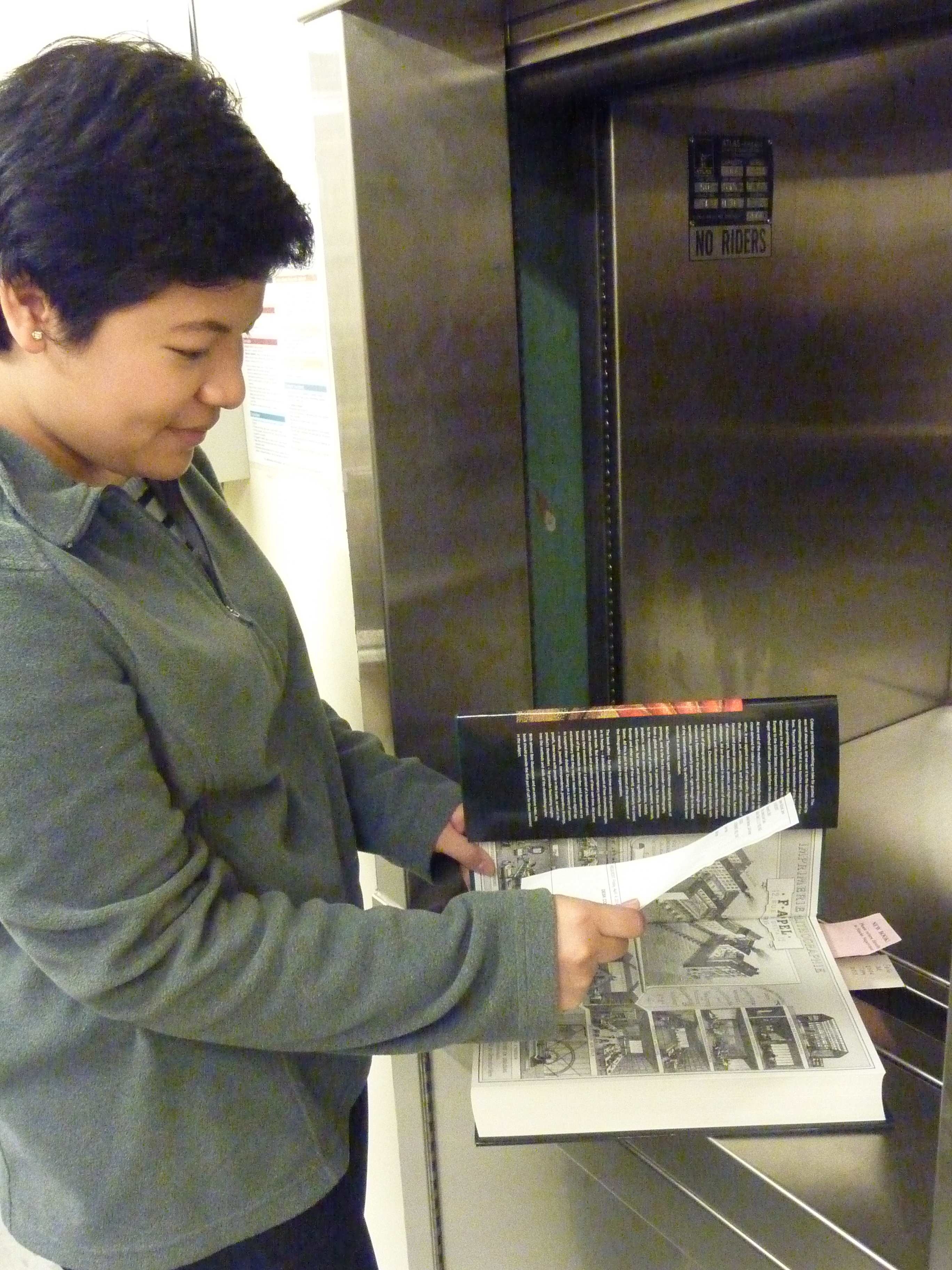
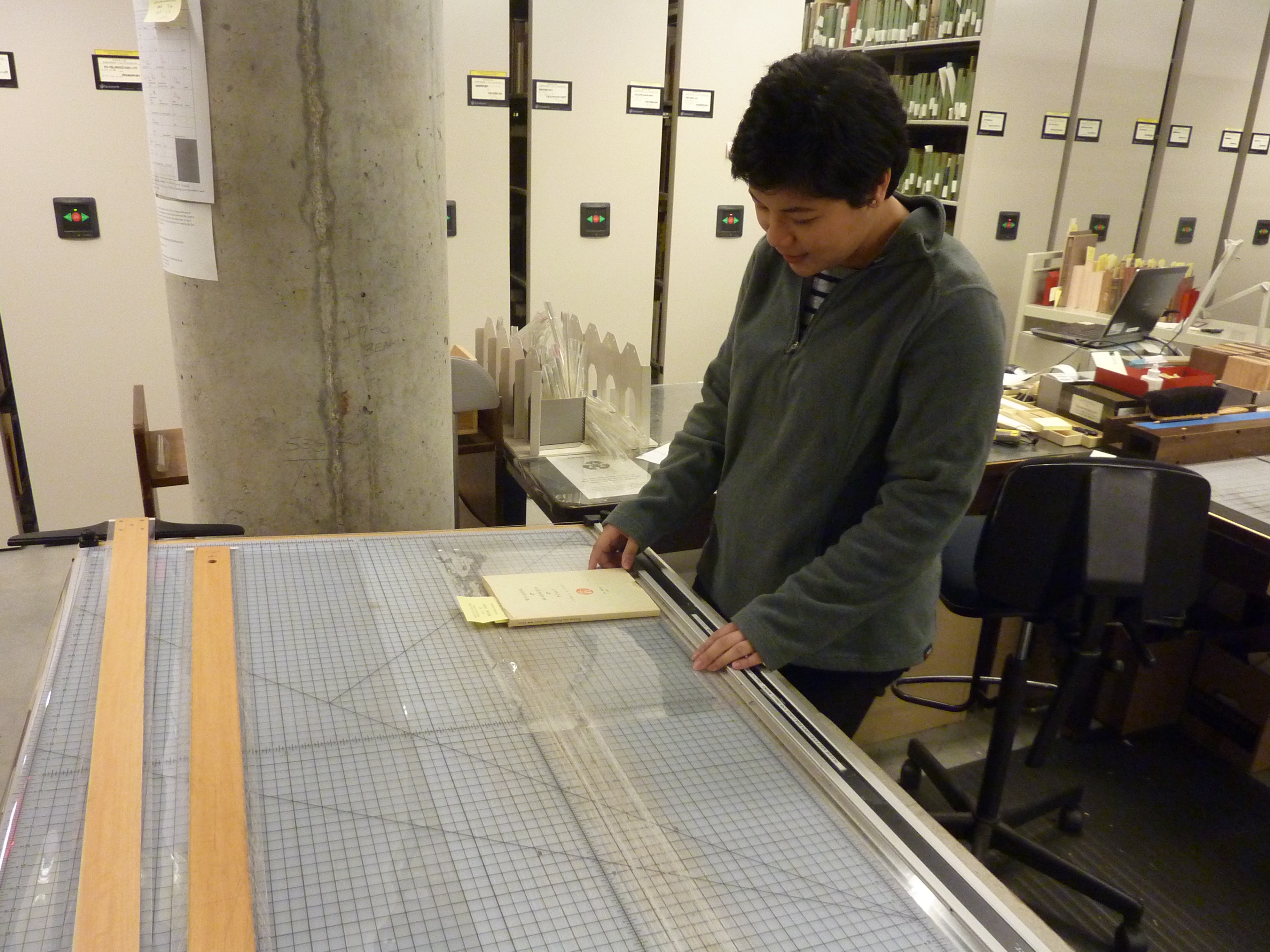
CHRISTINA: The first thing that students realize about the stacks is it’s cold. Not plain cold—parka cold. So we often start our shifts with as much hustle and bustle as possible in order to warm up and acclimate. This means shelving new books, re-shelving pulled books, and pulling patron requests. Re-shelving books and pulling patron requests is one of the first things that students learn in the stacks. Every day, the ding of the dumbwaiter echoes in the stacks, signaling to students that items need to be retrieved from the shelves and sent to the reference desk. After the patrons find what they’re looking for (or not), the items get sent down to be re-shelved.

Christina gets ready to send a book up to the reading room in the dumb waiter.

Christina gets ready to put a patron request in the dumb waiter to be sent up to the reading room.

asdf

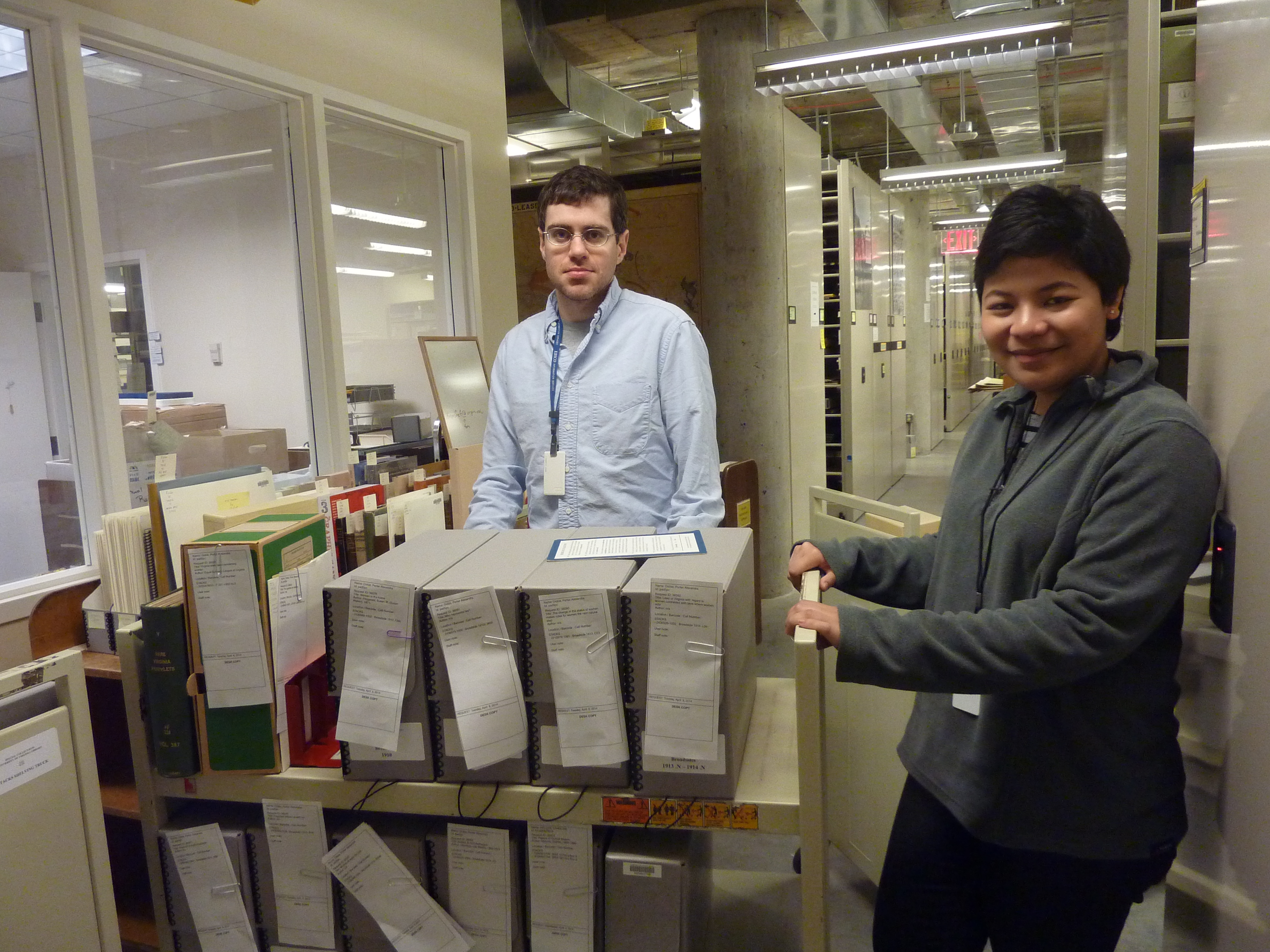
Brendan Fox, Stacks Supervisor, and Christina with a truckful of books and boxes to be reshelved.

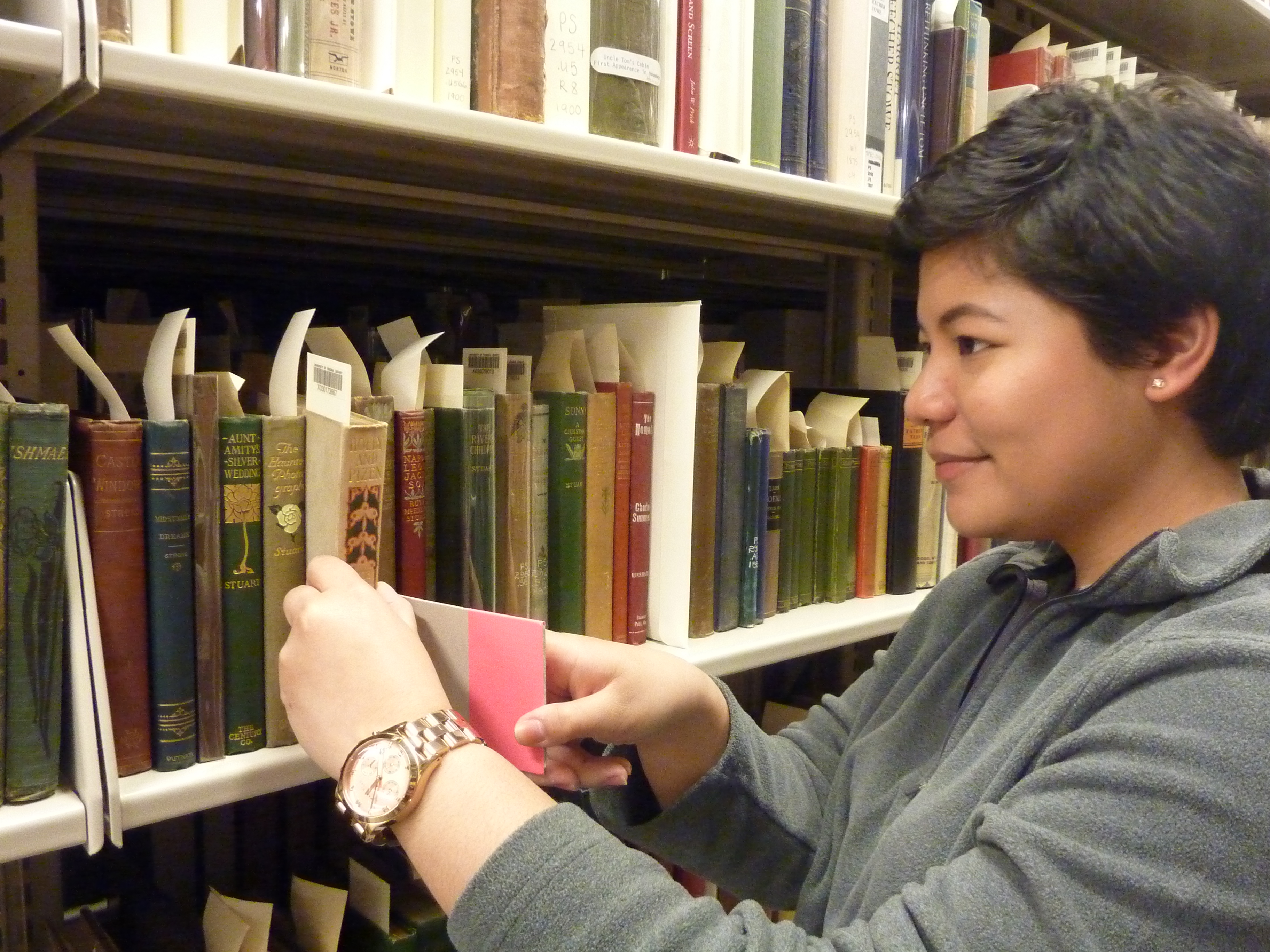
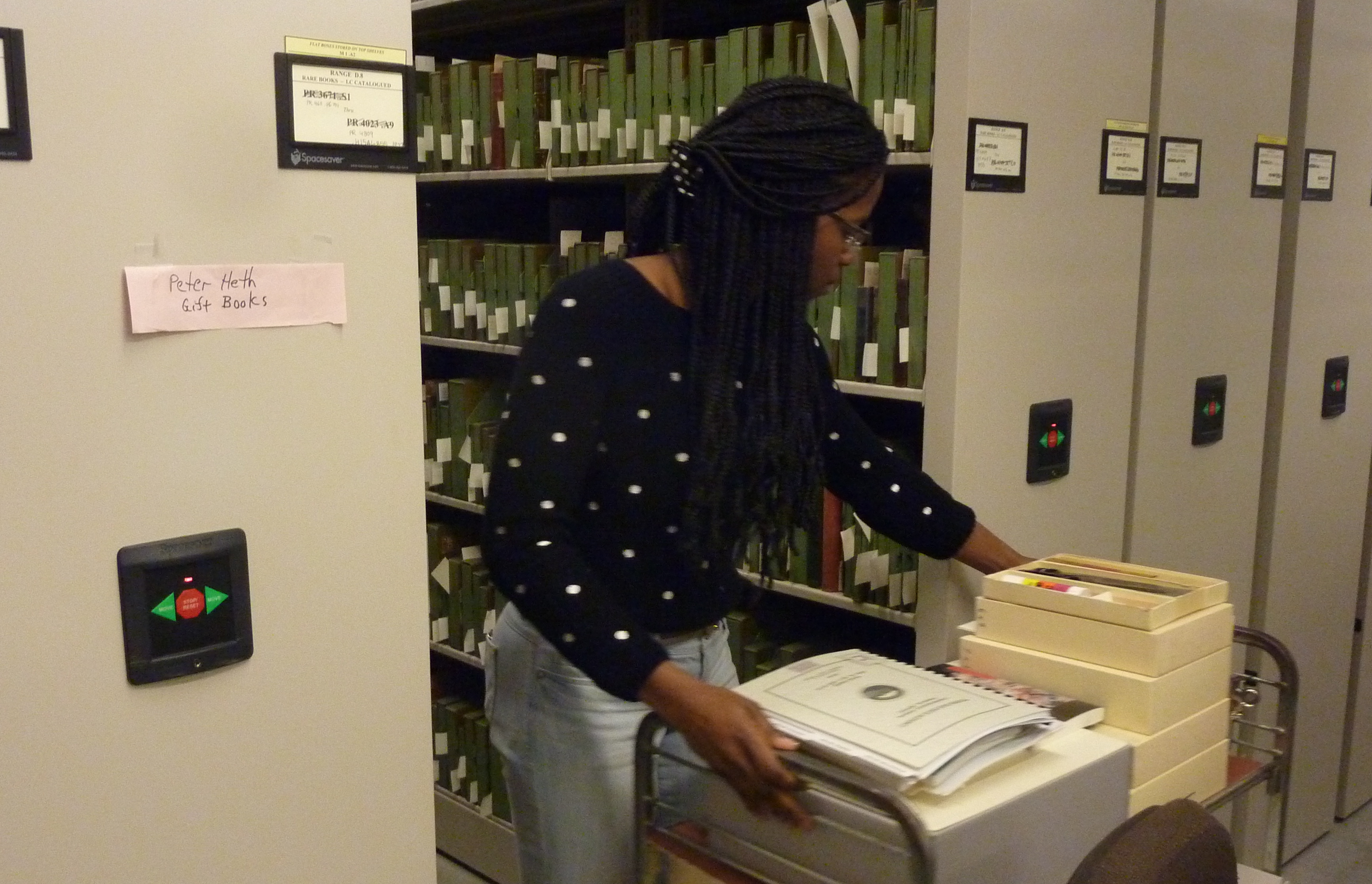
CHRISTINA: New shelving is a task most of us learned on our first day on the job. It’s simple enough: take a cart of newly acquired materials and place them on the shelf accompanied by a colored flag. This allows our supervisor, Brendan, to check and ensure the book is shelved accurately. Most students, including myself, dread new shelving. While I can’t pinpoint an exact reason for my dislike, the fact remains that every time I see a cart of new books, I turn around and dash to find another task, leaving the new books for the next unsuspecting stacks student to discover.

asdf

Christina flagging a new book so that her supervisor can double-check the location.

ALEX: If we’re not putting something away or wandering through the aisles trying to find something, then we’re probably in the preservation area. Here, we carry out tasks meant to protect Special Collection treasures from the many destructive elements threatening an item’s long-term survival (and yes, we are as dramatic about this job as I make it sound). The first task we learn is how to mylar. We create specialized plastic wraps for books with fragile paper dust jackets or fading front covers to prevent the paper from being torn or the covers from fading further.

asdf

Christina prepares a mylar cover for a book with a paper dust jacket.

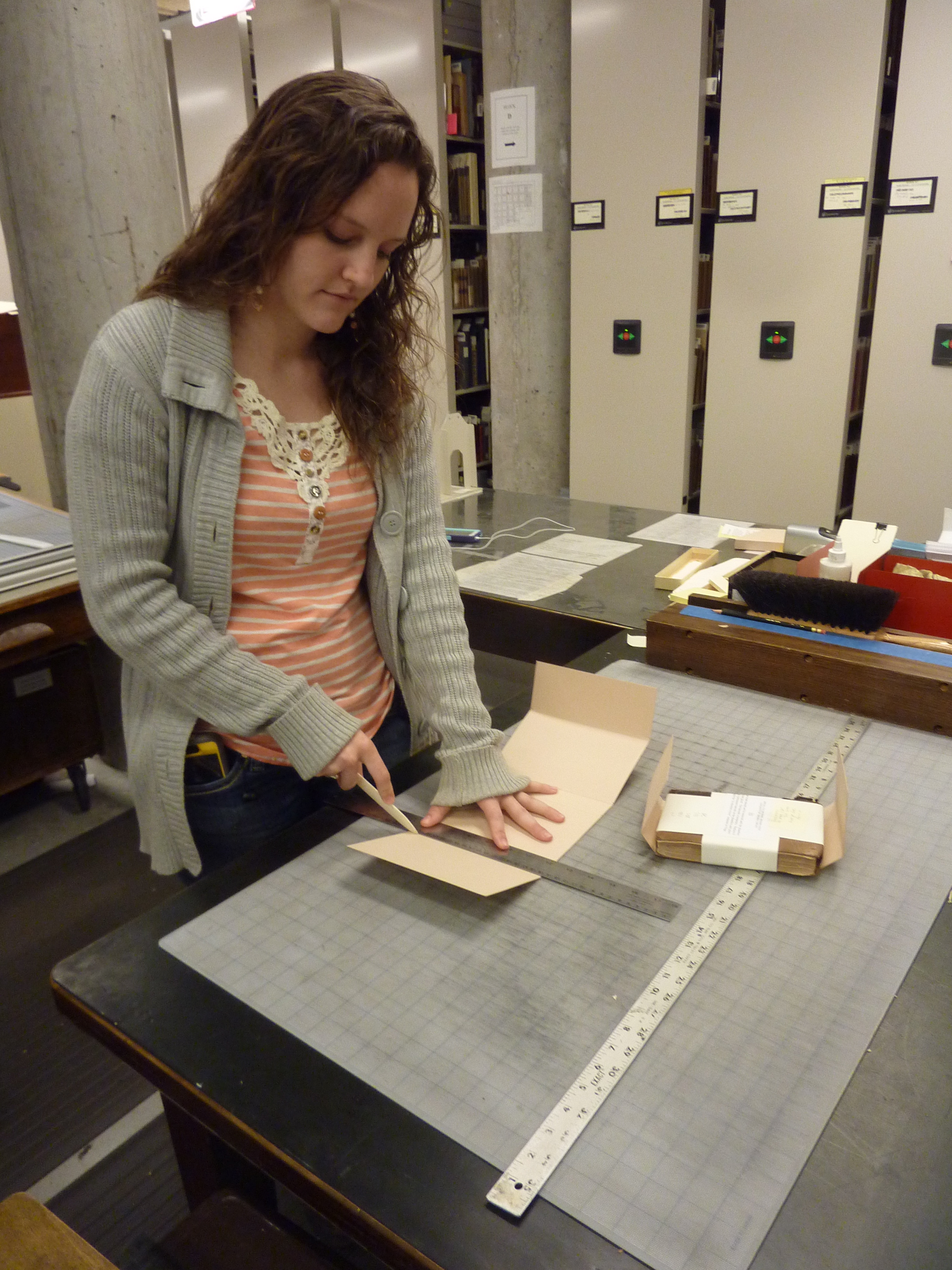
ALEX: The second preservation duty we take on is the construction of phase boxes. These are acid-free cardboard boxes custom-designed to fit each individual book. Their job is to hold together books that are falling apart. In our experience, this task appears particularly daunting to the newbie student employee because of its many steps. You get the hang of it eventually, though, and it has actually become my favorite Special Collections job!

asdf

Alex working on a phase box.

CHRISTINA: Special Collections also collects lots of serial publications from the New Yorker to the obscure Crime Times.  We’re responsible for housing and shelving these materials. What’s my favorite part of shelving serials? Sneaking a peek at this week’s New Yorker Caption Contest winner.

asdf

Student assistant Ashlyn Walker with the special serials truck, preparing to put new issues of serial publications into the stacks.

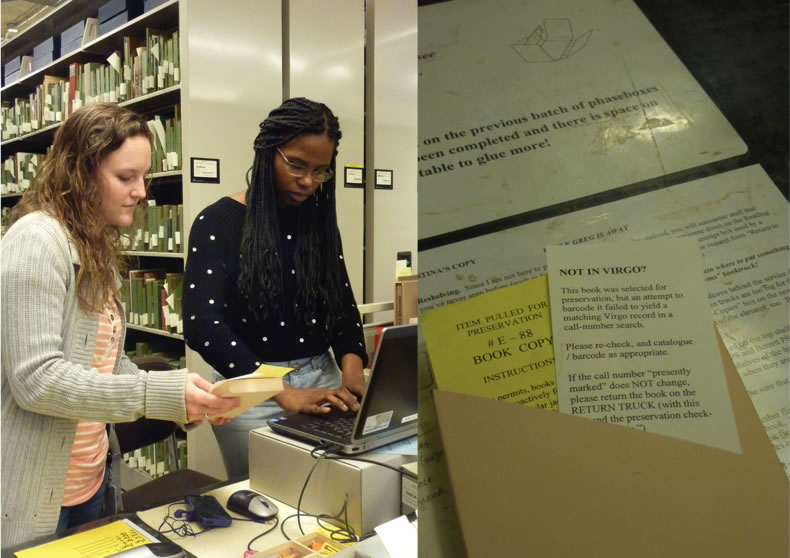
ALEX: Whenever we come into contact with an item that requires unusual housing or has a call number that can’t be found in Virgo, we reach out to our fellow student employees for help. We also often work together to barcode items and make sure the records we have on file are correct.

asdf

Alex and Ashlyn work together to determine why the call number of a phaseboxed book isn’t showing up in U.Va.’s online catalog, Virgo

asdf

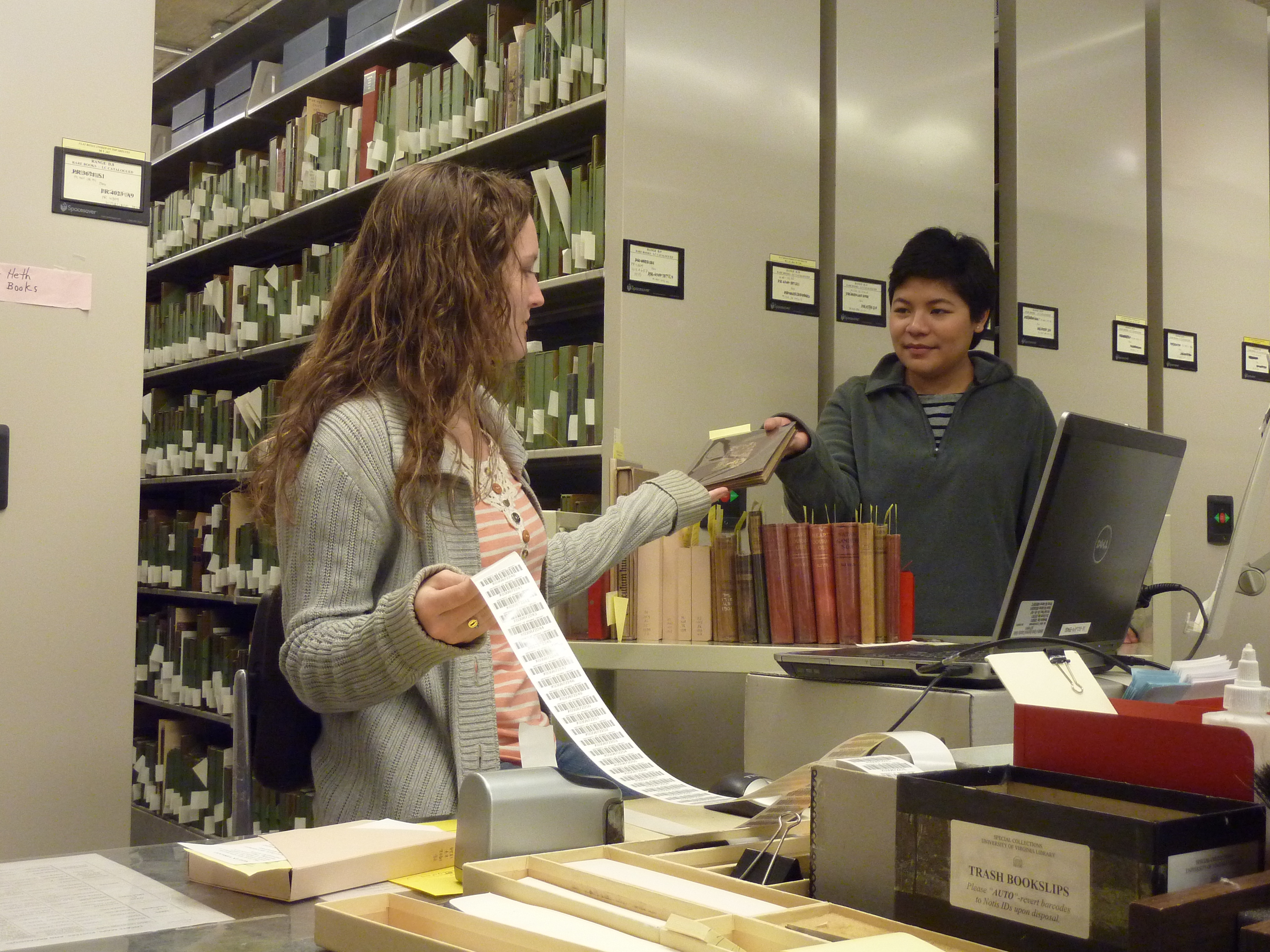
Alex and Christina barcode a truck of books that have just been through the preservation process

CHRISTINA: There are many reasons I love working at Special Collections. Being surrounded by rare materials published hundreds of years ago, and protecting these items, are just the tip of the iceberg. What I will miss the most when I graduate are the people working here.  The smiles, care, and trust that I have received from both student and library employees are incomparable and this is why coming to work is always such a pleasure. Special Collections, thank you for a wonderful four years.

ALEX: I enjoy working here because I love U.Va.’s collections. From the miniature books that are no bigger than my thumb to the elephant folios that weigh a ton, I’m fascinated by them all and honored to be able to help with their preservation. Like Christina said, the people we get to work with here are also amazing. Their passion for the materials inspires me and they’re actually all just fun to be around. It’ll be a difficult goodbye, but I am grateful to have been surrounded by such wonderful company over these last few years.

asdf

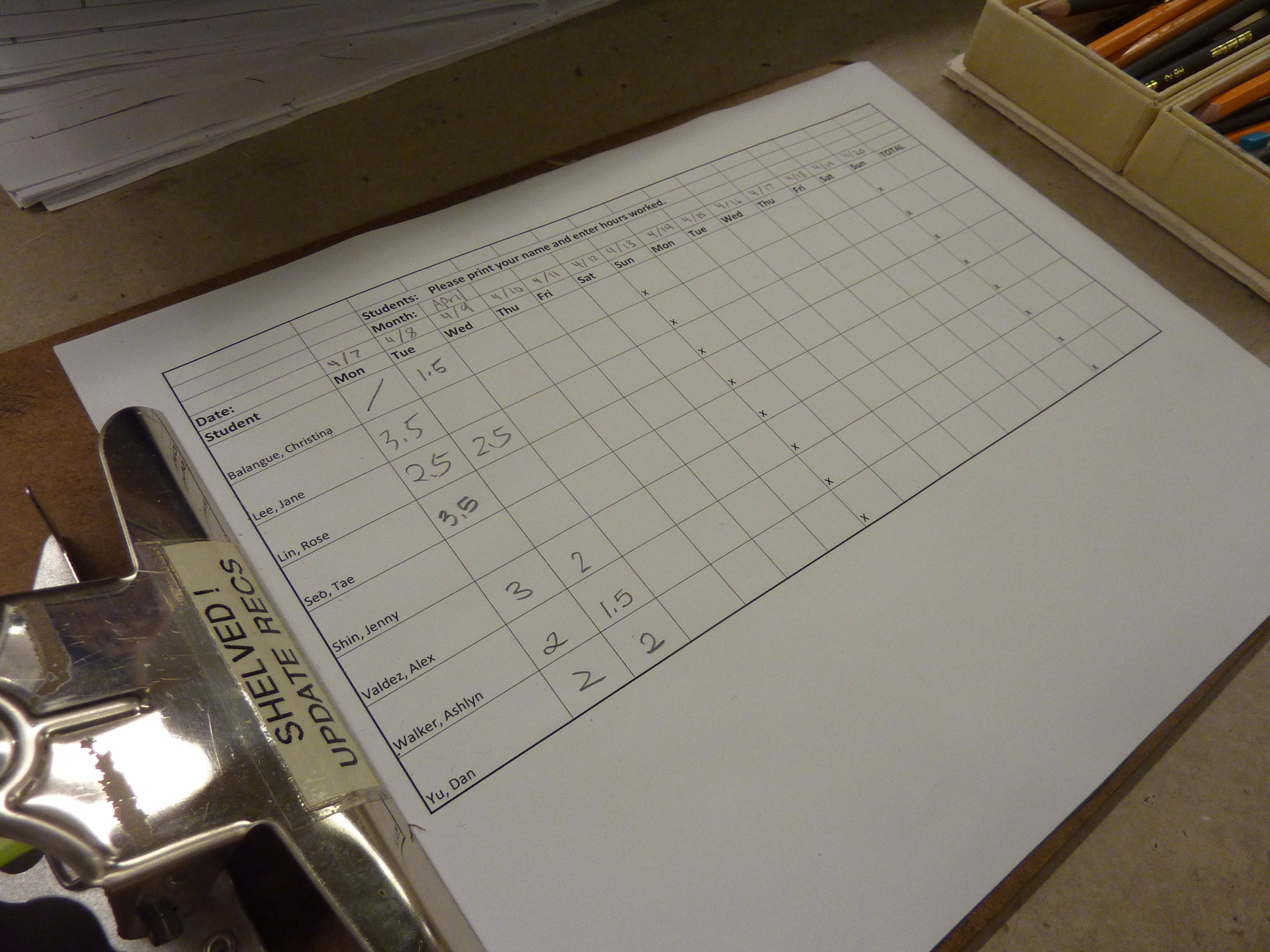
Here’s the timesheet where we record the hours we have worked…it’s our favorite thing.

Thank you, Alex and Christina, for all your wonderful work over the years. We can’t say enough about how much we appreciate your dedication. And congratulations on your upcoming graduations! WAHOOWA!

This Just In: Display Fonts and Clip Art and Show Cards, oh my!

This week, we are pleased to feature a guest post from curatorial assistant Elizabeth Ott, who is a doctoral candidate in the English Department. Liz recently produced preliminary catalog records for the collection she discusses in this post.

Special Collections is known for our fantastic collections in the history of type design; this strength just expanded dramatically with the generous gift of approximately 300 books on typography, letterforms, calligraphy, show cards, and graphic design given by the prolific American type designer Nicholas Curtis (b. 1948). Curtis, a resident of Charlottesville, has had a long a varied career as a graphic artist and type designer dating back the late 1960s when he got his start designing rock posters. He now operates his own independent type foundry, Nick’s Fonts, and his type designs can be found everywhere from Trader Joe’s labels to the titles for the recent film Oz the Great and Powerful (2013)—in fact, Curtis is also responsible for many of those super-condensed fonts you see at the foot of film posters, which help cram in the names of a film’s key cast and crew.

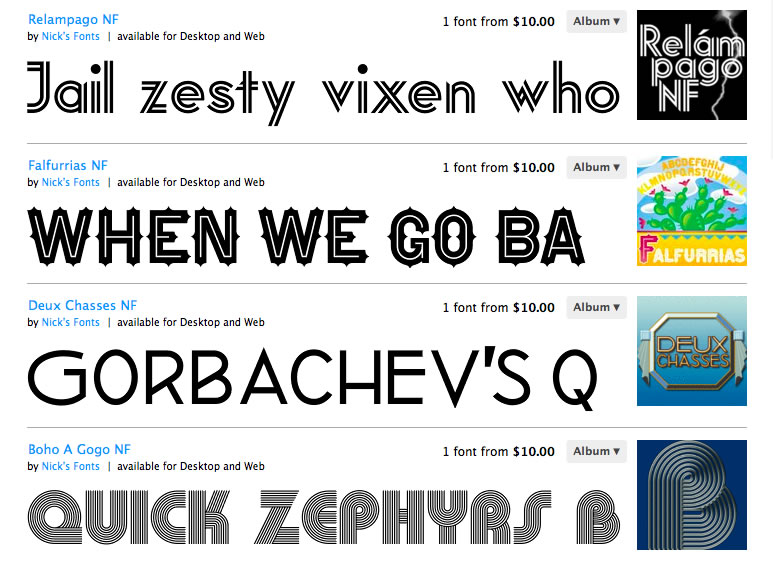
Some of Nick Curtis's type designs. The influence of hand lettering from across the decades may be seen in his faces.

Some of Nick Curtis’s type designs. The influence of lettering and type design from across the decades may be seen in his faces.

The range of books in the Curtis gift reflects Curtis’s eclectic style and nostalgic designs. It includes items such as specimen catalogs from nineteenth-century type foundries, how-to guides for producing calligraphy alphabets, books of clip art for early computers, and many manuals for creating show cards. Most of the items in the gift relate to commercial art and offer a glimpse behind the curtain of nineteenth and twentieth-century graphic design. The show card manuals, in particular, offer an example of a now-obscure commercial art profession that had a profound impact on the visual and print culture of nineteenth and twentieth century America.

Show cards (sometimes show-cards, sho-cards, or sho’ cards) were hand-lettered signs used for local advertising and incidental labeling, popular to the point of near ubiquity between about 1880 and 1920, though the practice of show card writing survived well into the sixties. Show cards filled a niche role in early twentieth-century advertising distinct from printed posters or painted signs, allowing shops, restaurants, and other local businesses to produce inexpensive displays for goods and services. Typical show cards were small in scale, at most 11 by 14 inches, and produced on a stiff cardboard or poster board. Examples may be seen in this series of photographs of Charlottesville in the early twentieth century from the Rufus Holsinger Studio Collection:

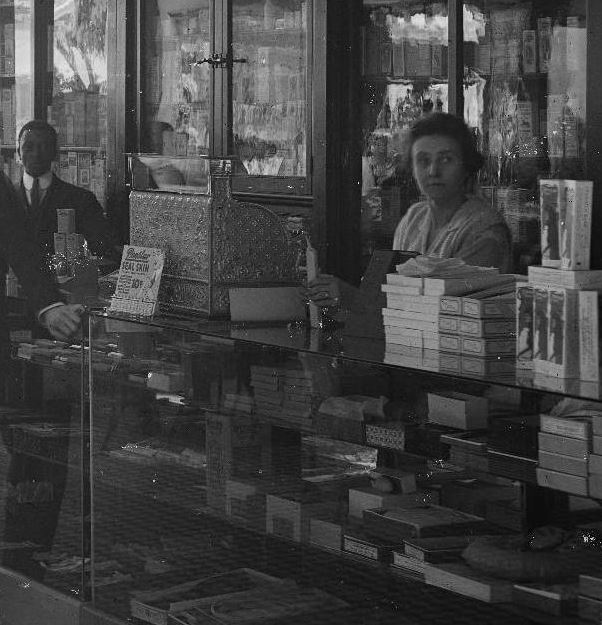
A show card rests in front of the cash register in this detail from a 1917 photograph of the Timberlake Drugstore on mainstreet.

A show card rests in front of the cash register in this detail from a 1917 photograph of the Timberlake Drugstore on Main Street. (MSS 9862. Image by UVA Digitization Services)

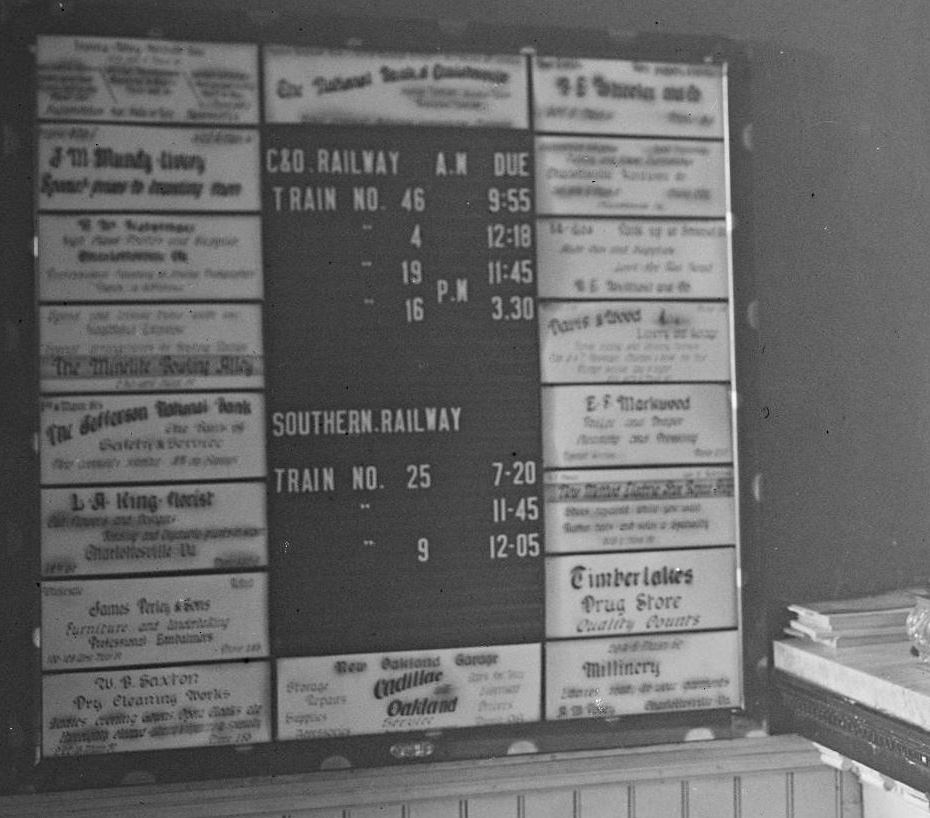
Hand-lettered advertisements for local businesses surround the Charlottesville train timetable in the Gleason Hotel in 1915, detail from a larger photograph. photograph from

Hand-lettered advertisements for local businesses surround the Charlottesville train timetable in the Gleason Hotel in 1915, detail from a larger photograph. (MSS 9862. Image by UVA Digitization Services)

asdf

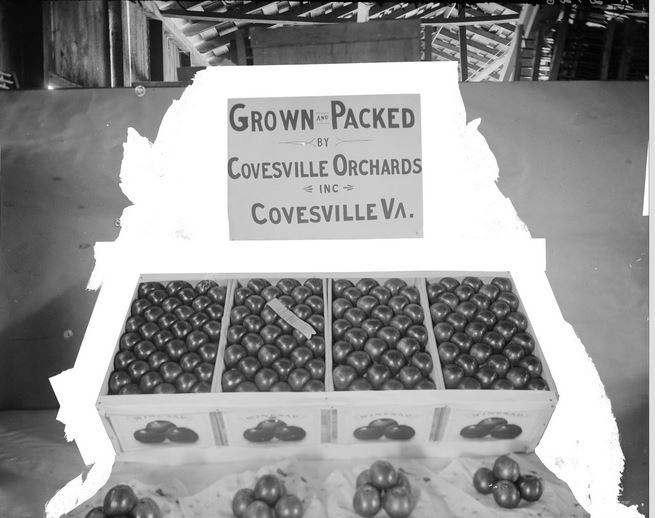
A very simple 1914 show card for tomatoes. Sections of the photograph’s background have been whited out, perhaps in preparation for use of the image in an article or advertisement. (MSS 9862. Image by UVA Digitization Services)

Show card writers used water based paints or inks in conjunction with a “rigger” brush—a long-handled sable brush—or nibbed pen to create designs. Show cards could be made and remade swiftly, so they were ideal for displays where signs needed to be rotated frequently.

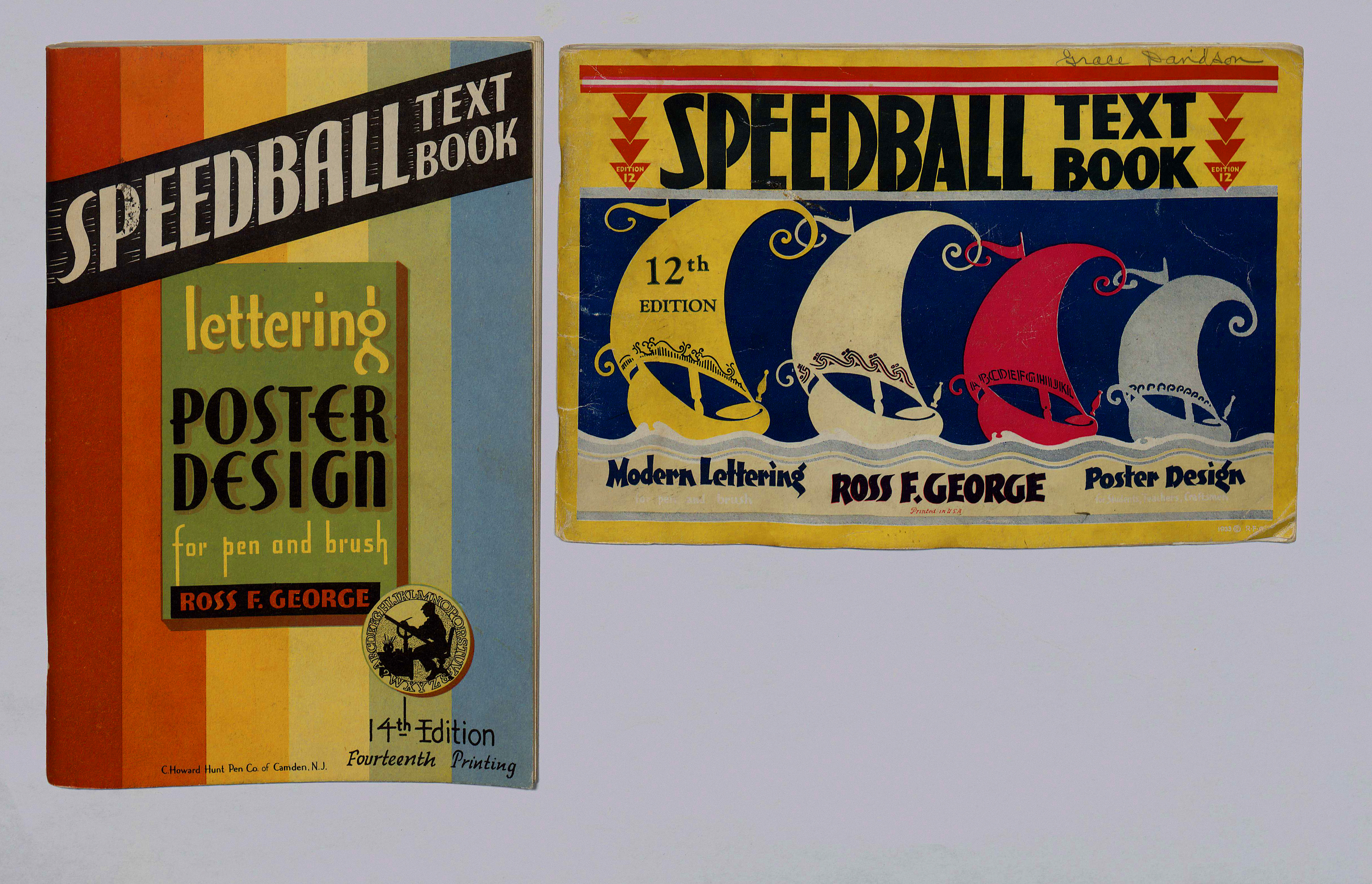
Two scarce instruction books produced by the Speedball pen company, still in operation today. The company name reflects its origins: Speedball began as a specialty company producing nibbed pens specifically for the quick work of show card lettering.

Two scarce instruction books for Speedball pens produced by the C. Howard Hunt Pen Company, which operates today as Speedball. Speedballs were nibbed pens produced specifically for the quick work of show card lettering. Left: Ross F. George,  Lettering, Poster Design for Pen and Brush (Camden: C. Howard Hunt Pen Co., n.d.); Right: Ross F. George, Modern Lettering/Poster Design (Camden: C. Howard Hunt pen Co. , n.d.). (Image by Elizabeth Ott)

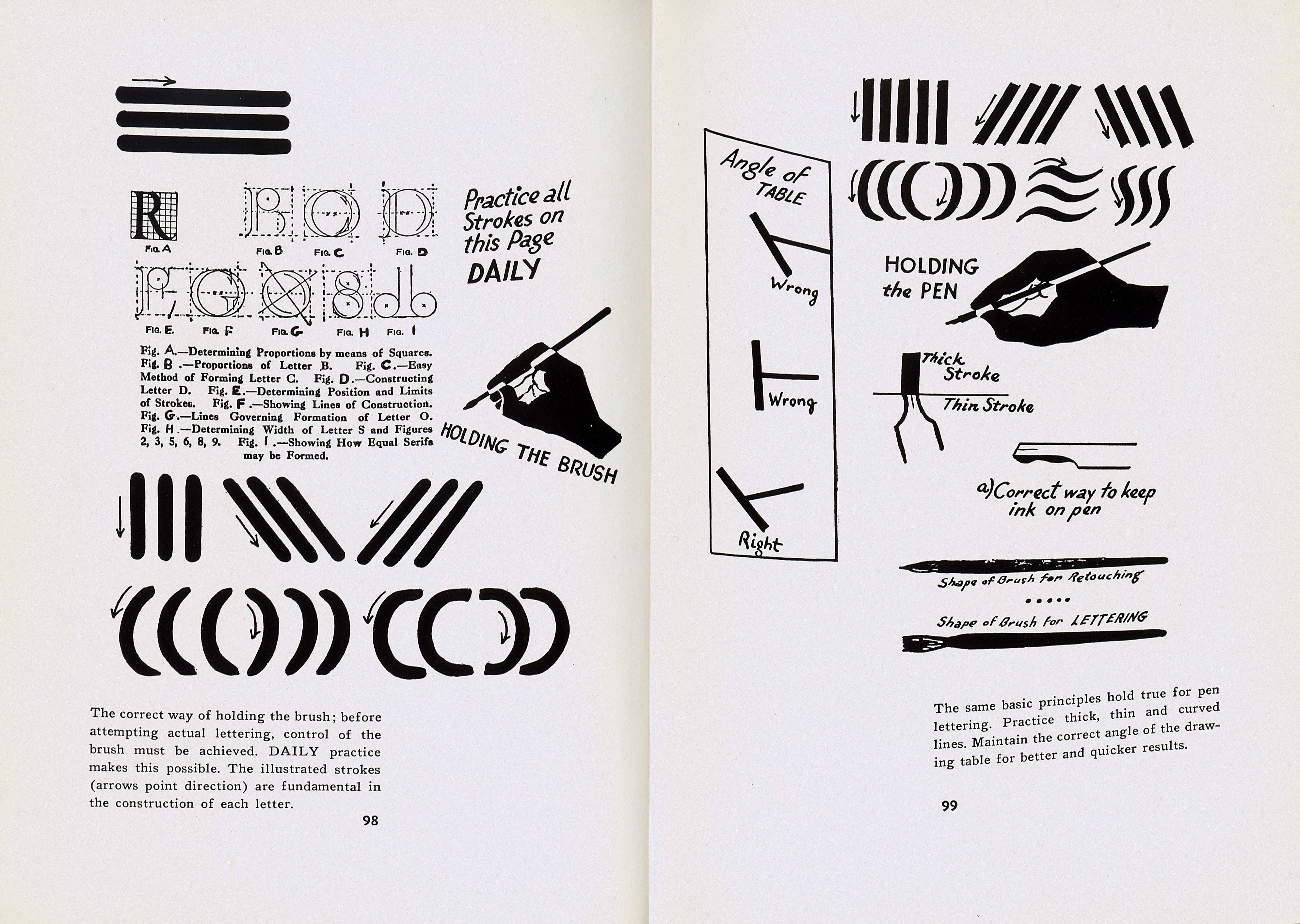
Because show cards were meant to be produced quickly, show card writers did not want to spend time creating unique designs and layouts for every new card. Show card manuals offered design templates and best practices for producing attractive, readable show cards that could be easily copied. Manuals instructed writers on how to scale alphabets up and down, how to balance negative and positive space, and how to choose complementary color schemes. More than just a compendium of display alphabets, show card manuals condense the aesthetics of early twentieth-century graphic design into readable, concrete lessons.

curtispracticestrokes

A page spread from E. C. Matthews, How to Paint Signs and Show Cards (New York: Illustrated Editions, 1940). (Image by Elizabeth Ott)

curtisclouded

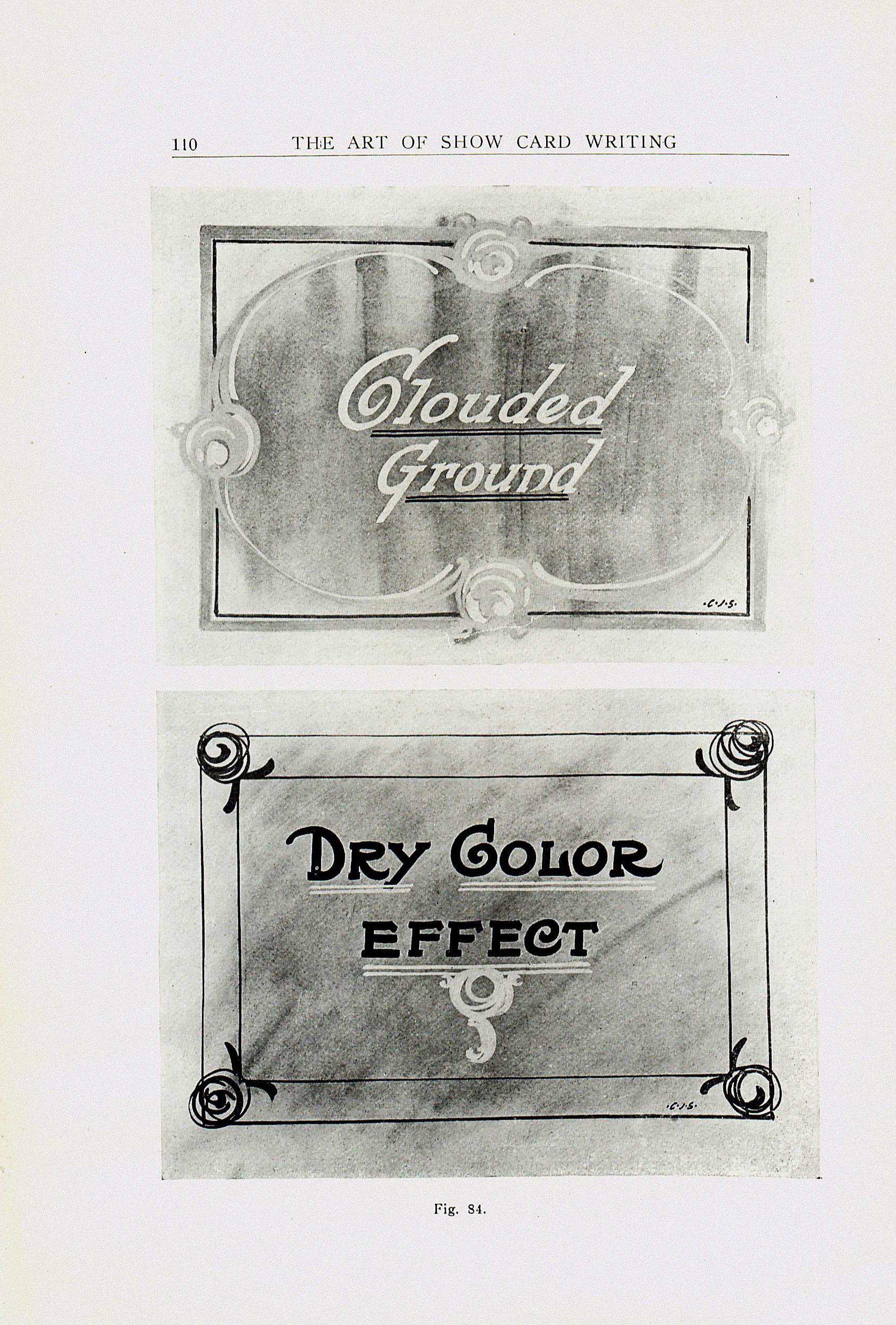
A page from Charles Strong’s The Art of Show Card Writing, showing an airbrushing technique used to add depth and texture quickly to a flat design. (Detroit: The Detroit School of Lettering, 1907).

These show card manuals are an important, but often overlooked, aspect of the history of typography, graphic design, and American advertising. The script alphabets of show cards influenced type design, especially for display types, but also diverged from many trends in typography. Similarly, the non-pictorial nature of most show cards and their freedom from the constraints of printing meant they were both like and unlike printed advertisements produced during the same time. Ephemeral and rarely preserved, show cards are largely absent from the cultural record, except in photographs that attest to their prevalence. Show card manuals are thus an invaluable resource for understanding the practice of show card writing. Many of the manuals in the Nicholas Curtis gift are extremely rare, available in only a handful of libraries world-wide—indeed, we were unable to find existing holdings for more than two dozen. We are particularly pleased to add these books to our collections, adding their richness and texture to our extensive collections on the history of typography and type design.

The books are marvelous specimen collections in their own right. Incidentally, we believe the ancient author of the concept of humours, Galen, would put his stamp of approval on the layout of the recto of this page. From Pen and Brush Lettering and Practical Alphabets (London: Blandford Press, [1947].

The books are themselves often exuberant celebrations of the myriad ways to design the Roman alphabet.  Pen and Brush Lettering and Practical Alphabets (London: Blandford Press, [1947]).

Tales from Under Grounds: Literature and U.Va. Societies

This is the third in a series of four posts, spotlighting the mini-exhibitions of students from USEM 1570: Researching History. This is the abridged version of the students’ projects, featured at their outreach program, Tales from Under Grounds.

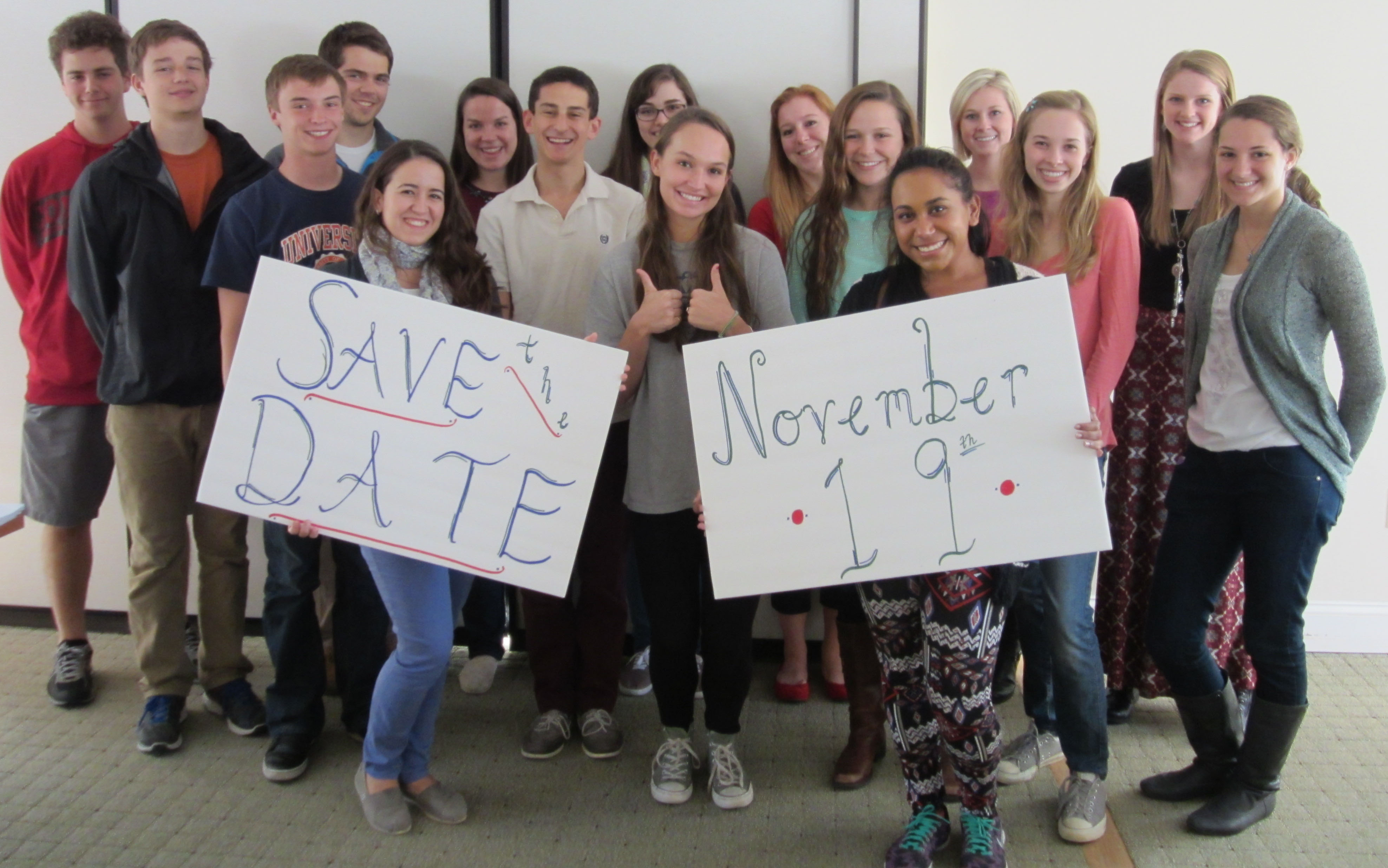
"Save the Date," Fall 2014. (Photograph by Caroline Newcomb)

“Save the Date,” Fall 2014. (Photograph by Caroline Newcomb)

***

Abby Ceriani, First-Year Student

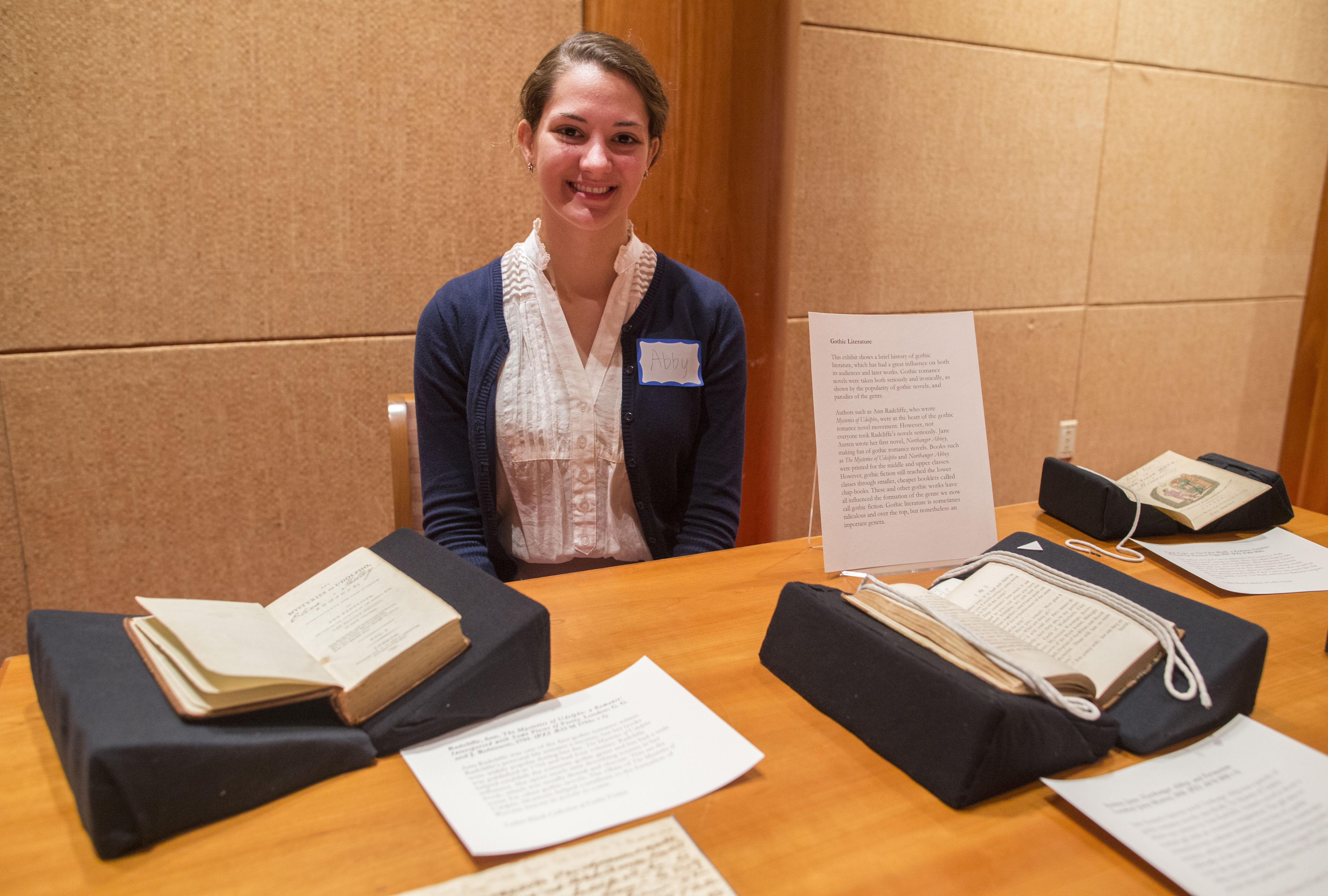
Photograph of Abby Ceriani by Sanjay Suchak, November 19, 2013.

Photograph of Abby Ceriani by Sanjay Suchak, November 19, 2013.

Gothic Literature

This exhibit shows a brief history of Gothic literature, which has had a great influence on both its readership and later literary works. Gothic novels were taken both seriously and ironically as shown by the popularity of the genre and its parodies.

Authors, such as Ann Radcliffe who wrote The Mysteries of Udolpho, were at the heart of the Gothic novel movement. However, not everyone took Radcliffe’s novels seriously. Jane Austen wrote Northanger Abbey, making fun of Gothic romance novels.

To appeal to a broad audience, Gothic fiction was produced in multiple volumes as well as in smaller, cheaper booklets called chap-books. These books, with their elements of romanticism, horror, and mystery have thrilled and entertained audiences over the centuries.

(Photograph by Sanjay Suchak)

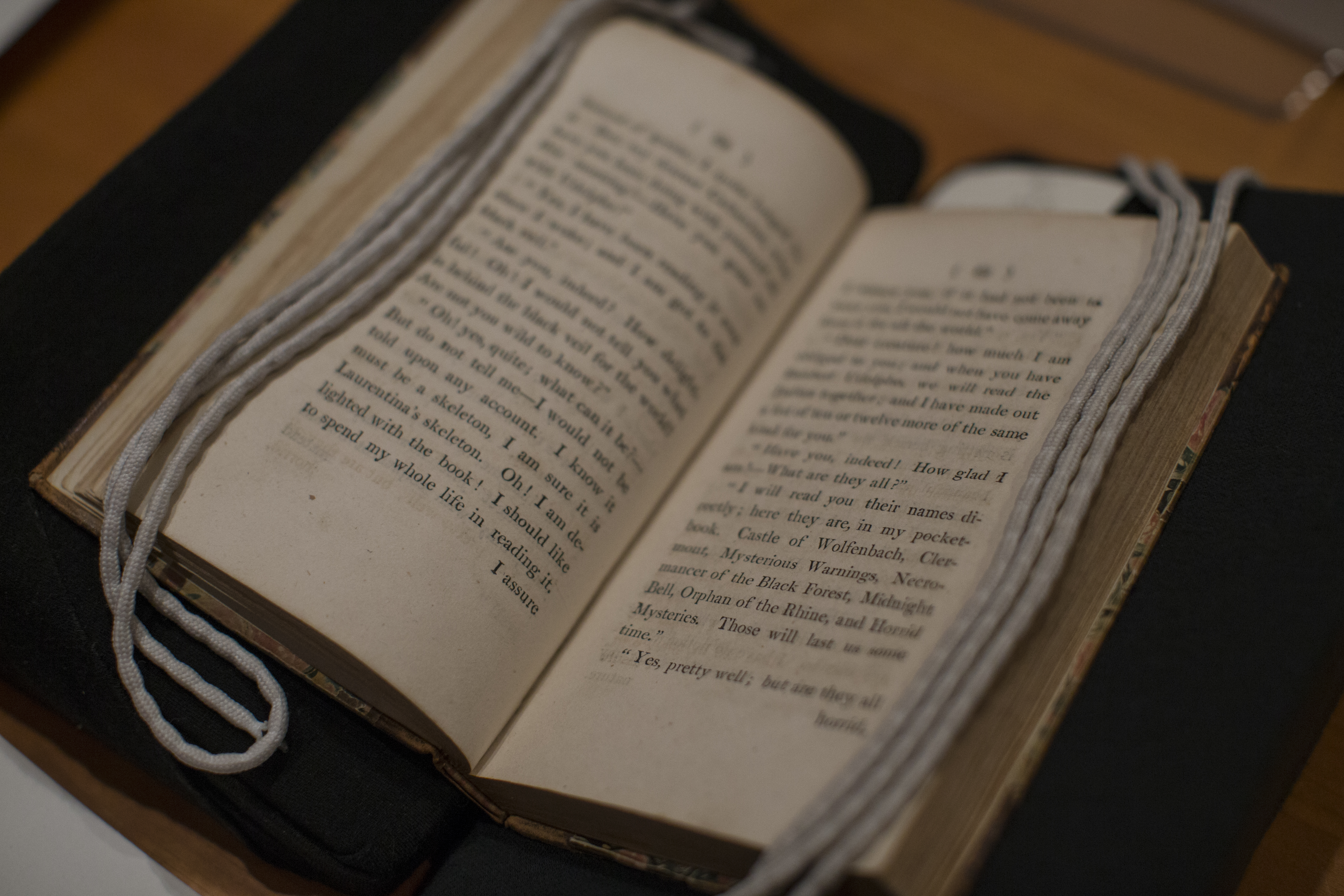
Austen, Jane. Northanger Abbey: and Persuasion. London: John Murray, 1818. Jane Austen’s famous novel Northanger Abbey was a parody of Gothic romance novels, specifically, Ann Radcliffe’s The Mysteries of Udolpho. Austen’s novel is about a girl with an overactive imagination. She tries to imagine her ordinary situation as that of a Gothic romance, which causes her much trouble. Austen also makes use of the iconic Gothic scenery by having much of the book take place in an old Abbey. On page 69 of Northanger Abbey, Austen refers to The Mysteries of Udolpho and lists several other Gothic novels. (PZ2 .A8 N 1818 v.1. Sadlier-Black Collection of Gothic Fiction. Photograph by Sanjay Suchak)

(Image by Petrina Jackson)

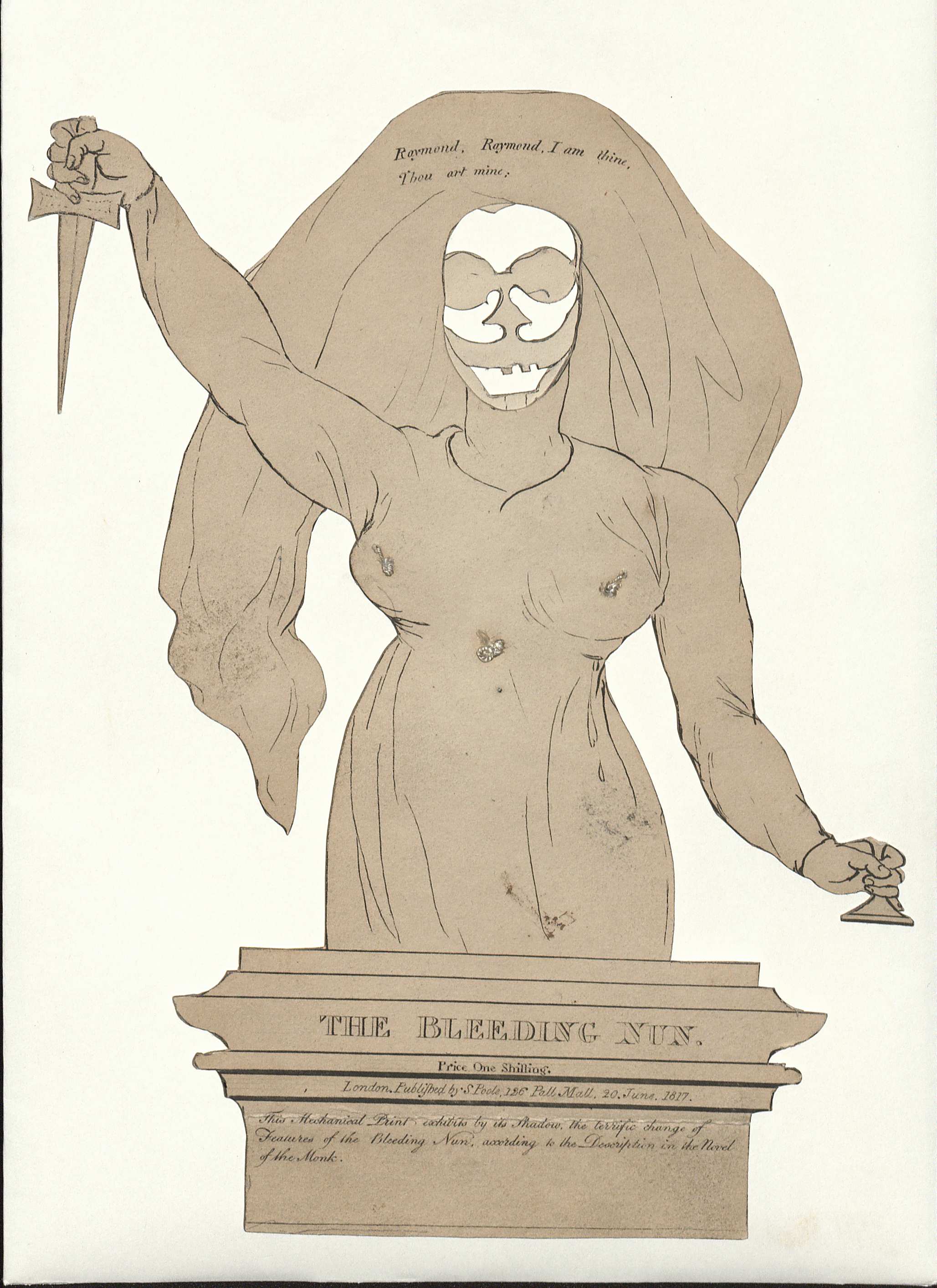
The Bleeding Nun, a Mechanical Print from The Monk. London: S. Poole, 1817.  The writing on the bottom of “The Bleeding Nun” says “This mechanical print exhibits by its shadow, the terrific change of features of the bleeding nun, according to the description in the novel of The Monk.” The Monk, written by Matthew Gregory Lewis, is an iconic Gothic novel. The mechanical print shows the nun with normal features and can be changed to show the nun with a skull’s face. (Broadside 1817 .B54. Sadlier-Black Collection of Gothic Fiction. Image by Petrina Jackson)

***

Becca Pryor, First-Year Student

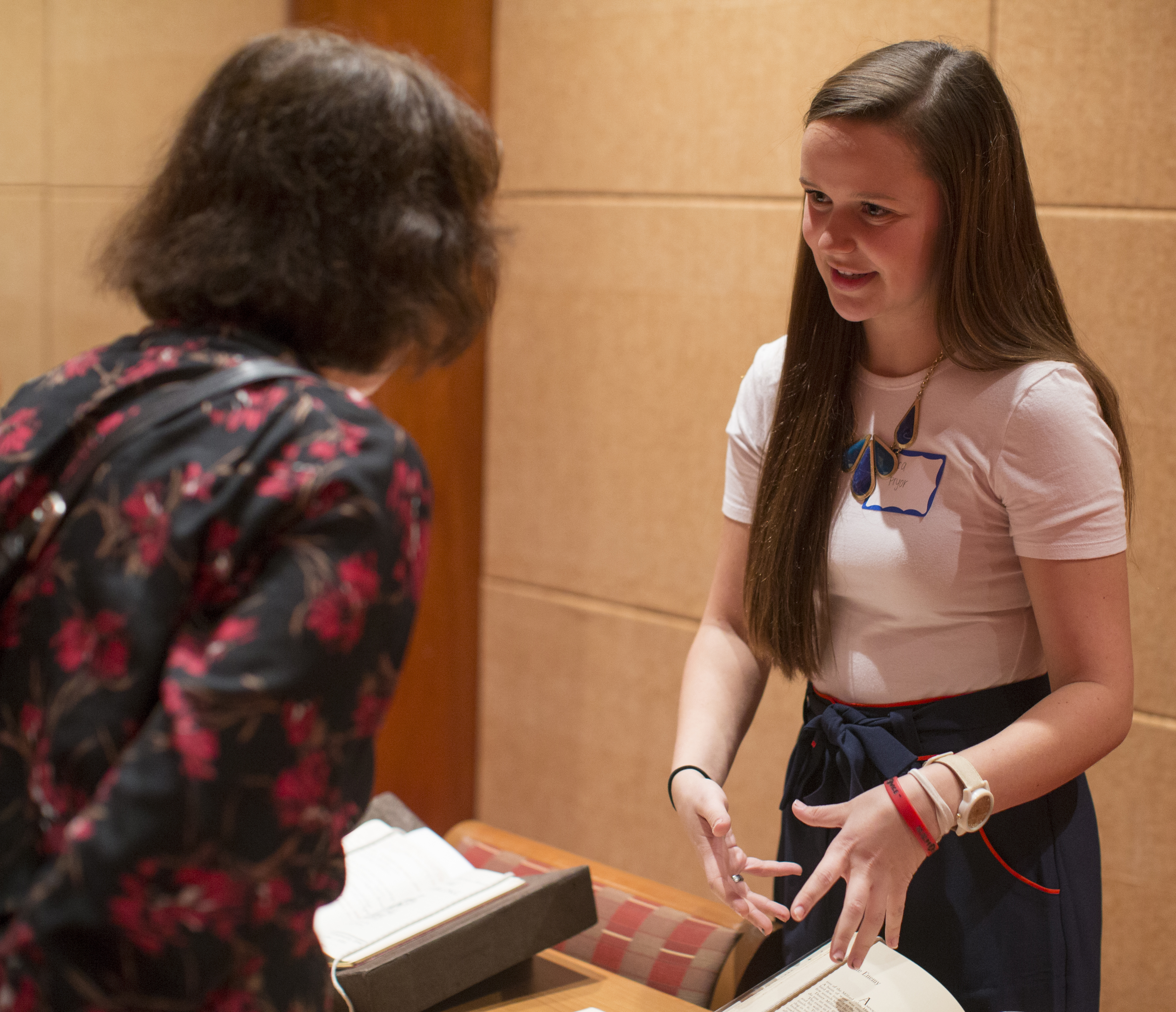
Becca Pryor talks to a guest about her exhibition, November 19, 2013. (Photograph by Sanjay Suchak.)

Becca Pryor talks to a guest about her exhibition, November 19, 2013. (Photograph by Sanjay Suchak.)

Meeting Marjorie

Marjorie Kinnan Rawlings was born on August 8, 1896 in Washington DC. At 14, Rawlings’ short stories were published in the Washington Post. During her studies at the University of Wisconsin, she wrote for the Wisconsin Literary Magazine.  While living in Louisville, KY and Rochester, NY, Rawlings wrote for local journals as well.  After feeling restless living in cities, Rawlings and her husband moved to the rural coast of Florida.  It was here where Rawlings’ writing career really took off.  She drew inspiration from the people, nature, and interactions between the two to shape her novels, such as The Yearling, and short stories.

Rawlings exposed a side of American culture that had not been shared.  She lived in the scrub with a family in order to experience their lifestyle and learn how to appreciate their high spirits amidst low circumstances.  By fully immersing herself in the culture of Florida, she was able to write from a genuine and sincere perspective.

(Image by Petrina Jackson)

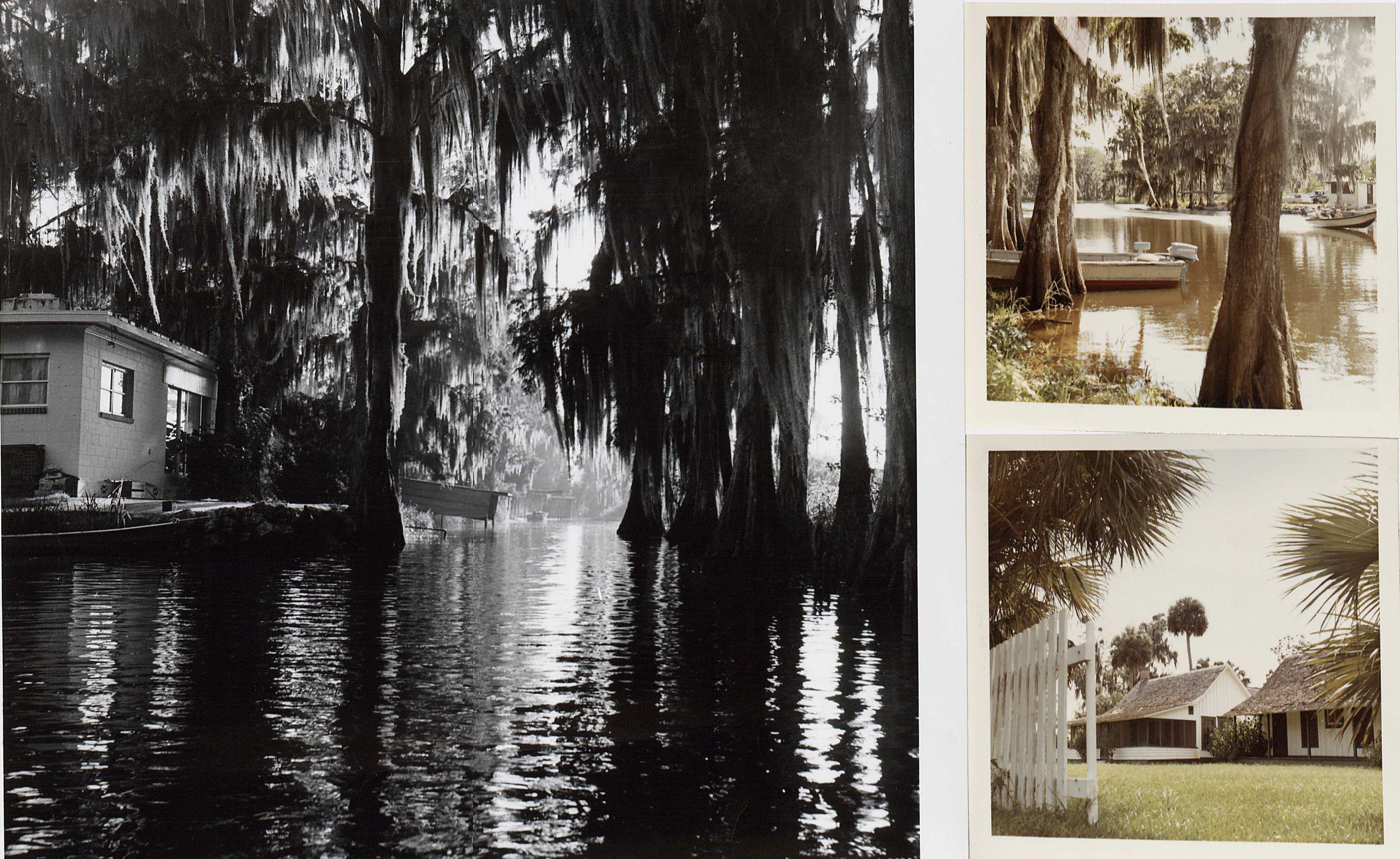
Photographs of Rawlings’ Cross Creek, Florida Home. These photos were developed on October 23, 1968, which is 15 years after Rawling’s death.  Rawlings and her husband bought a seventy-two-acre farm in Cross Creek because of the great beauty she associated with the area.  Cross Creek inspired Rawlings to write many short stories, which were published in Scribner’s Magazine.  After some time at Cross Creek, Rawlings moved in with a family who resided in the scrubs of the inland of Florida, so that she could experience firsthand life in rural Florida.  Here, the honesty of the people in the scrub amidst their challenging circumstances impressed Rawlings. (MSS 6785-d. Clifton Waller Barrett Library of American Literature. Image by Petrina Jackson)

(Image by Petrina Jackson)

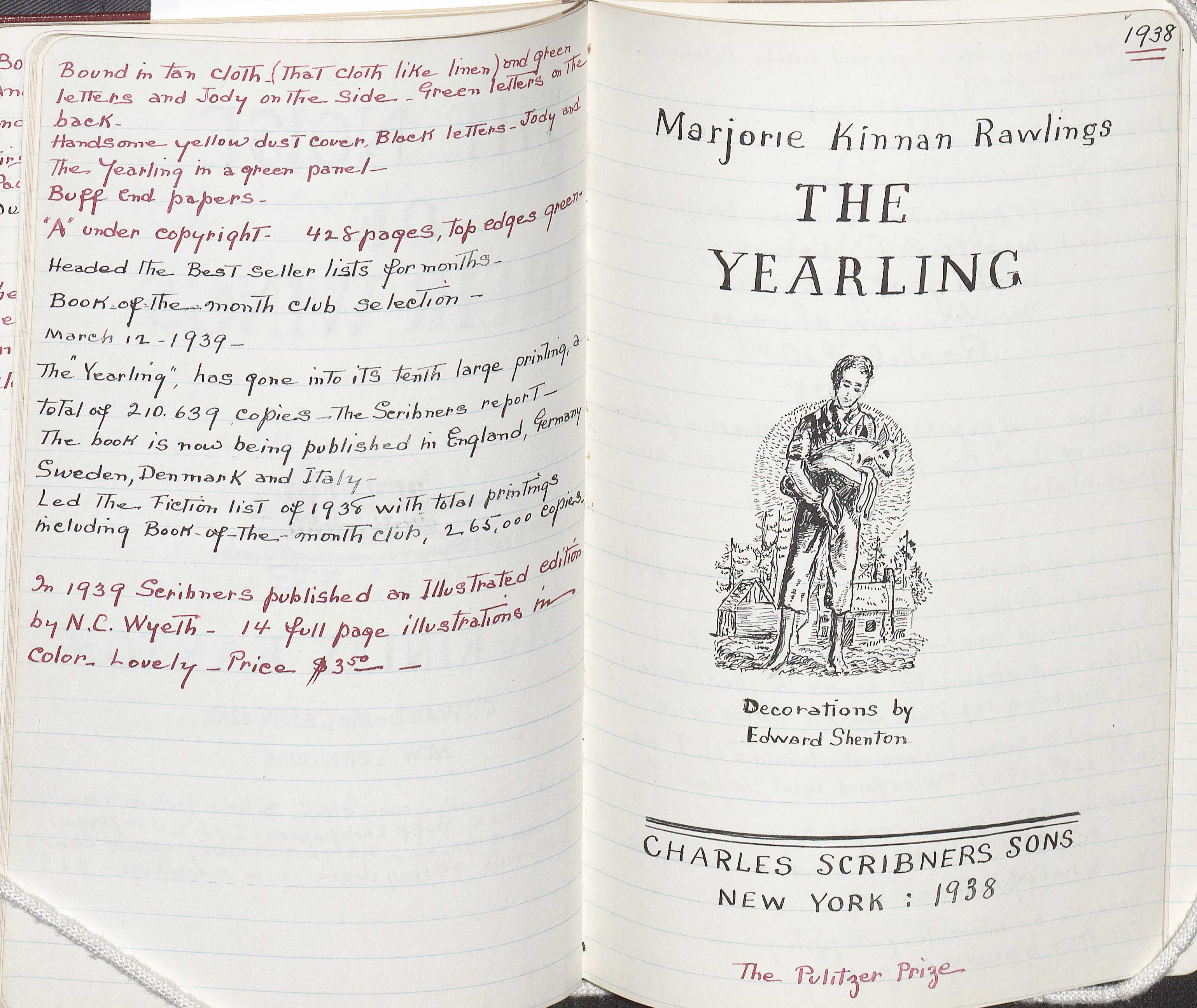
Catalog of Books In the Taylor Library of American Best Sellers. Lillian Gary Taylor records the title page of Marjorie Kinnan Rawlings’ The Yearling as well as other information about the book, including its price and physical description.  The Yearling was published in 1938 and won Rawlings a Pulitzer Prize in 1939.  The novel was also the best selling book of 1938 and sold over 250,000 copies in that year alone.  The popularity of this book was so great that it has been translated in over 20 different languages and also made into a motion picture in 1946.  The novel describes the relationship between a young boy, named Jody, and his pet fawn, Flag. Like Rawlings’ other books, The Yearling is set in the inland of Florida where nature plays a key role in shaping the story. (MSS 5231-b. Taylor Collection of American Best-Sellers. Image by Petrina Jackson)

***

Adam Hawes, First-Year Student

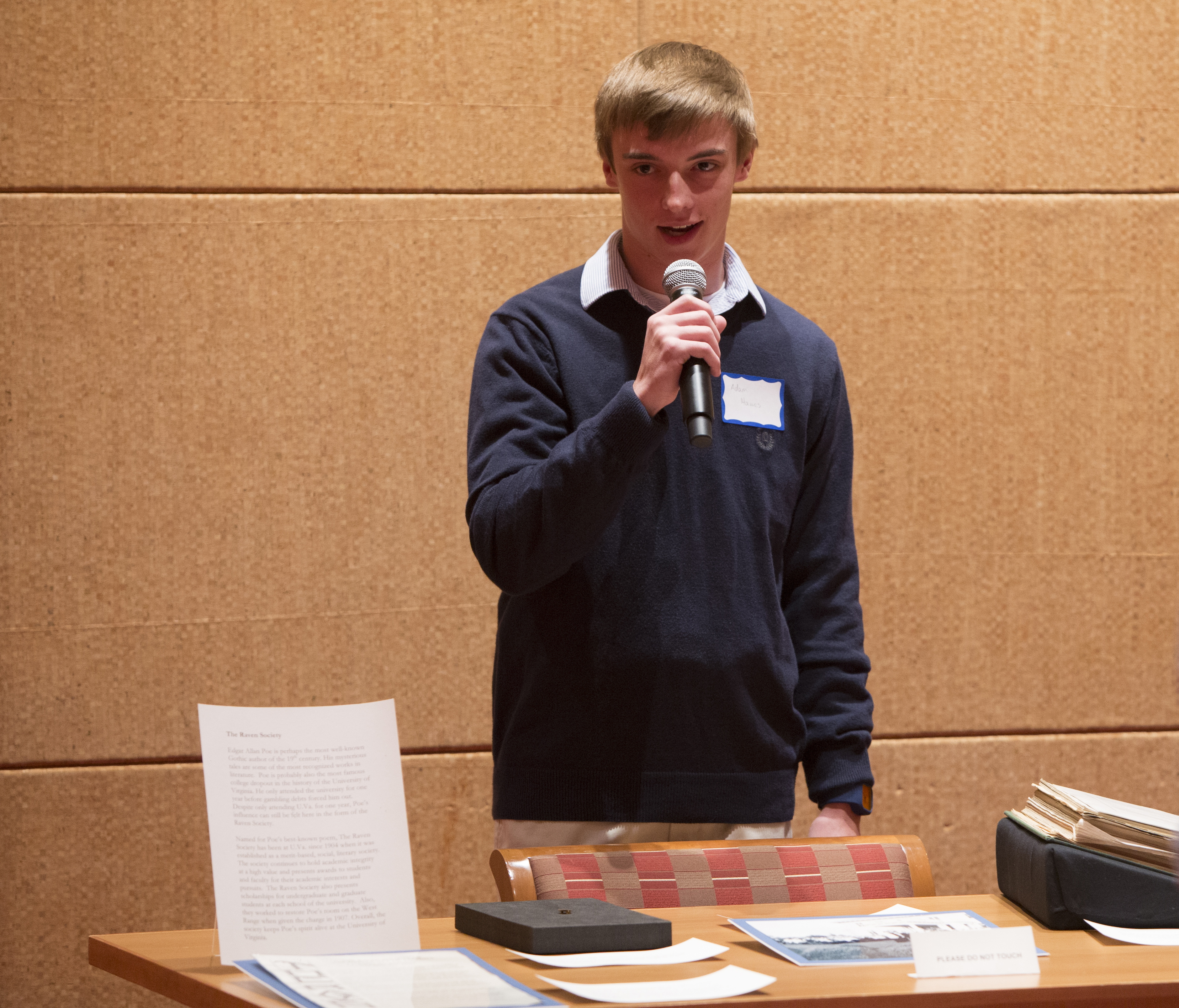
Adam Hawes introduces himself at Tales From Under Grounds, November 19, 2013. (Photograph by Sanjay Suchak.)

Adam Hawes introduces himself at Tales From Under Grounds, November 19, 2013. (Photograph by Sanjay Suchak.)

The Raven Society

Edgar Allan Poe is perhaps the most well-known Gothic author of the 19th-century. His mysterious tales are some of the most recognized works in literature.  Poe is probably also the most famous college dropout in the history of the University of Virginia. He only attended the university for one year before gambling debts forced him out.  Despite only attending U.Va. for one year, Poe’s influence can still be felt here in the form of the Raven Society.

Named for Poe’s best-known poem, The Raven Society has been at U.Va. since 1904 when it was established as a merit-based, social, literary society. The society continues to hold academic integrity at a high value and presents awards to students and faculty for their academic interests and pursuits.  The Raven Society also presents scholarships for undergraduate and graduate students at each school of the university.  In addition to awarding academic achievement, the society has worked since 1907 to restore and upkeep Poe’s room on the West Range. Overall, the society keeps Poe’s spirit alive at the University of Virginia.

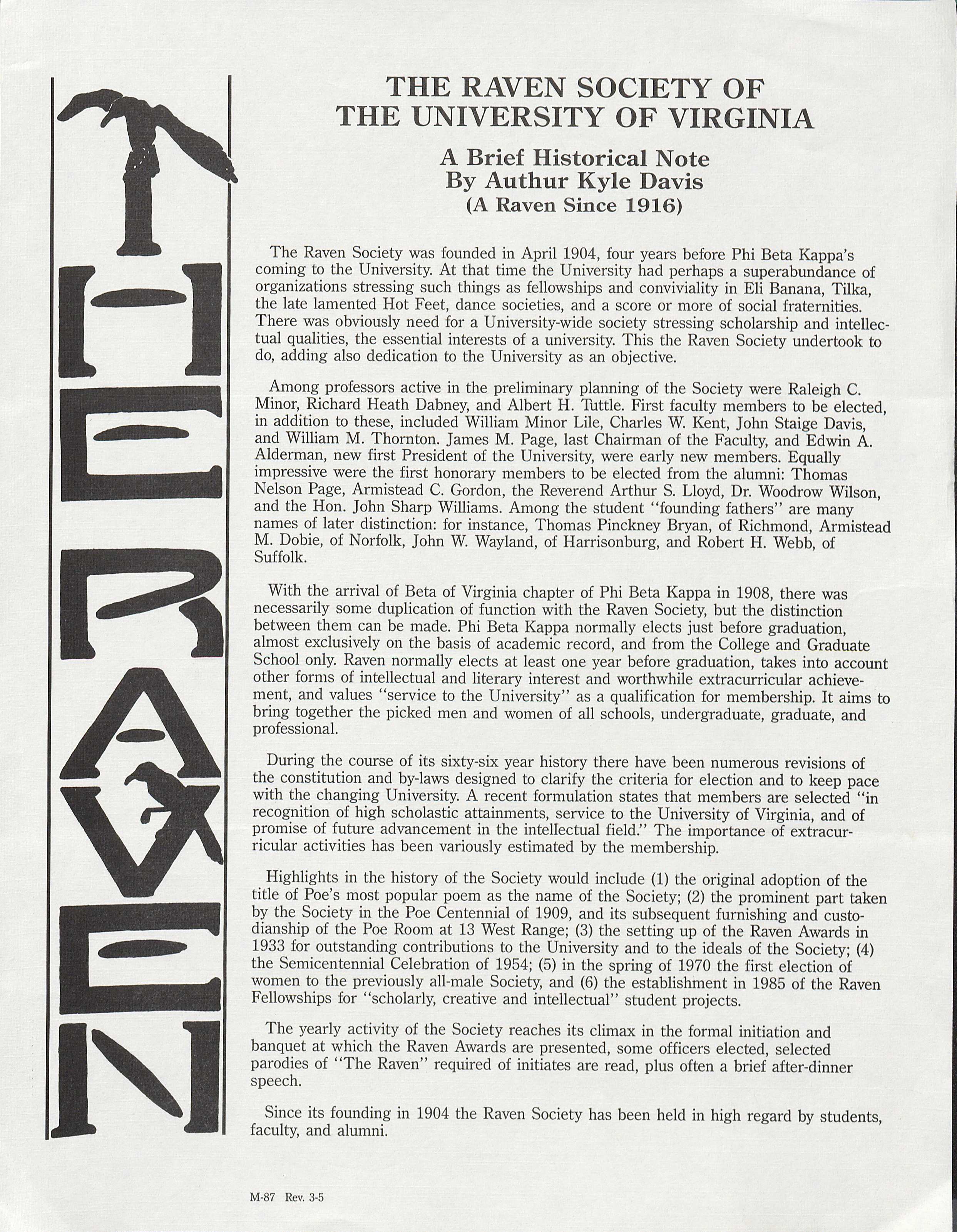
(Image by Petrina Jackson)

The Raven Society of the University of Virginia: A Brief Historical Note by Authur Kyle Davis, 1987. This broadside serves as an overview of the Raven Society. Printed over 80 years after the founding of the society, it lists the history of the society as well as the many aspects of the organization. It also explains membership requirements as well as the the purpose of the society. This document is from the papers of Francis L. Berkeley, Jr. (Broadside 1987 .D38. Image by Petrina Jackson)

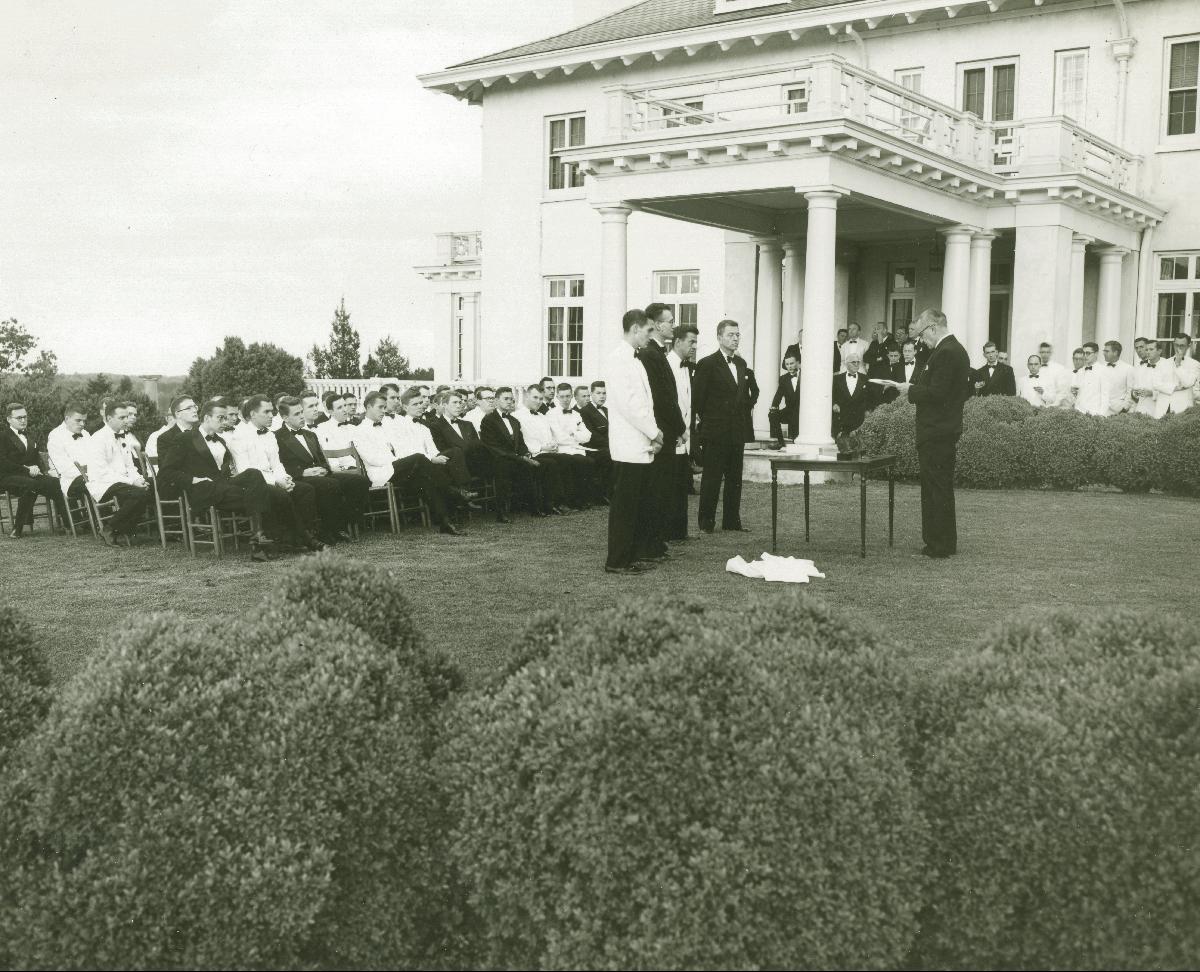
(Image by Digitization Services)

This photograph shows the Raven Society at their annual Raven Awards Ceremony, 1952.  At this ceremony, the Society presents the annual Raven Award to students, faculty, administrators, and alumni, recognizing them for their scholarly pursuits.  The members can be seen here dressed formally. (RG-30/1/10.001. University of Virginia Visual History Collection. Image by Digitization Services)

***

Carrie Zettler, Second-Year Student

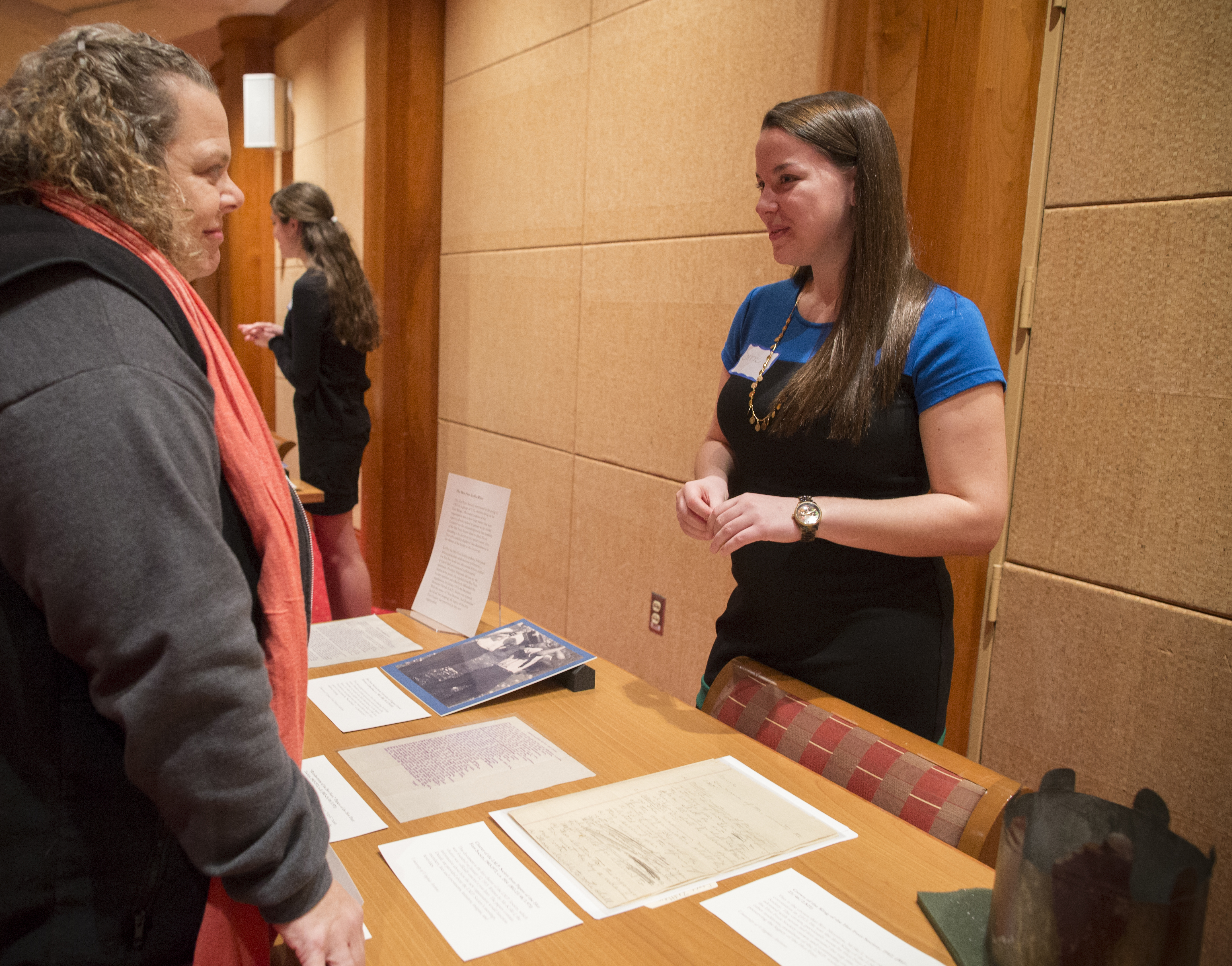
Carrie Zettler discusses her exhibit with (fill in). (Photograph by Sanjay Suchak.)

Carrie Zettler discusses her exhibit with library staff member Barbara Hatcher. (Photograph by Sanjay Suchak.)

The Hot Feet In Hot Water

The Hot Foot Society was formed in the spring of 1902 by a group of U.Va. students living on the East Range. The stated purpose of the organization was to host large parties that were open to all who wished to partake in the revelry. Unstated was the acknowledgement that members of the Hot Foot Society liked to drink. Never intending to be members of a secret society, Hot Feet often publicly displayed their drunkenness to the dismay of the University’s faculty.

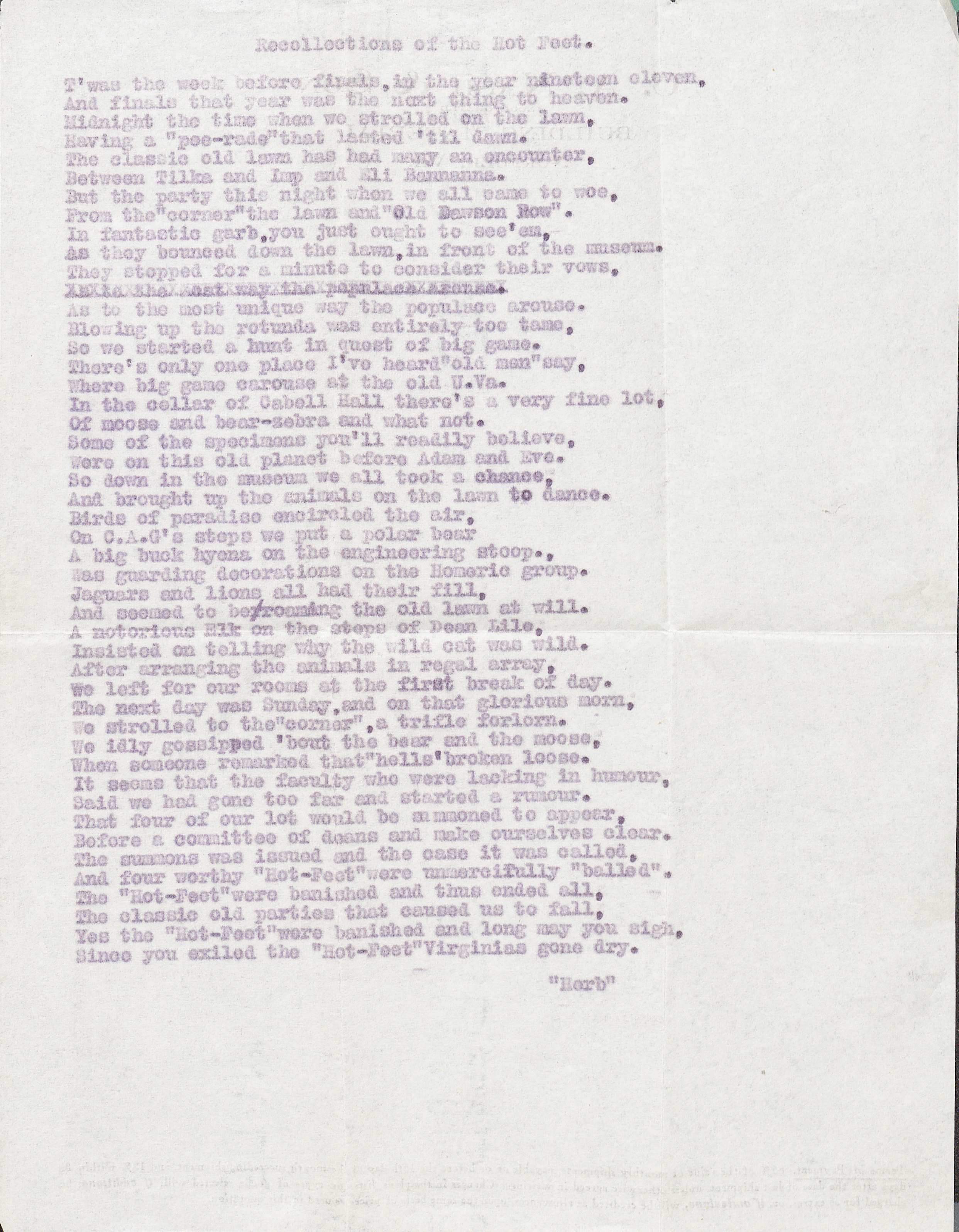
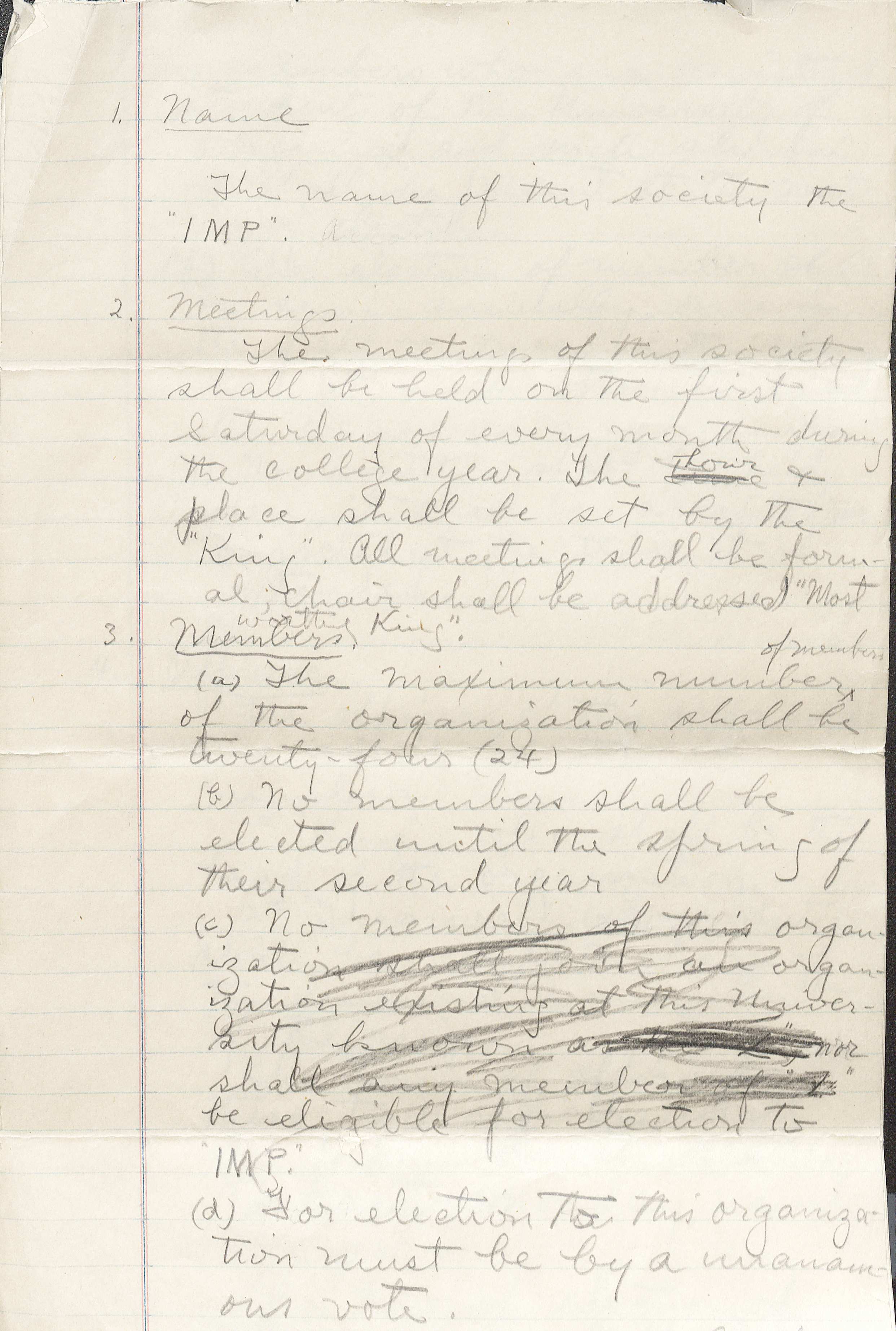
In 1911, the Hot Foot Society pulled a bold prank. After a particularly rambunctious celebration, a few Hot Feet broke into the natural history exhibit in Cabell Hall and extracted stuffed animal specimens. President Alderman did not see the humor in the prank. He expelled four Hot Foot Society members and effectively disbanded the organization. In January 1913, the Incarnate Memories Prevail (I.M.P.) Society was formed. With the motto of “Nos Mortous, Sed Dormiens” (not dead, but sleeping), the legacy of the Hot Foot Society was preserved in this new organization.

(Image by Petrina Jackson)

“Recollections of the Hot Feet.” Papers of the Hot Foot Society, 1903-1973, n.d. Written by Hot Foot Society member Herbert “Herb” Nash, “Recollections of the Hot Feet” is a poem that tells about the notorious prank pulled by the Hot Foot Society, circa May 1911. The incident happened after a celebration on the Lawn attended by members of Tilka, Eli Banana, and the Hot Foot Society. The poem recounts how a few Hot Feet broke into Cabell Hall and removed stuffed animal specimens from the natural history exhibit. They placed these animals, including a polar bear, a Bengal tiger, and an ostrich behind the desks of professors and on the steps of their Lawn residencies. The poem also alludes to the expulsion of four Hot Feet and the banishment of the organization. (RG-23/46/1.971. University of Virginia Archives. Image by Petrina Jackson)

(Image by Petrina Jackson)

Charter of the I.M.P. Society from Papers of the Hot Foot Society, 1903-1973, c.a. 1914. This document is the first charter of the I.M.P. Society, which was founded on January 12, 1913. Written by Mc-K-Ski I, the charter was officially enacted a year later. The papers contain information about how the new organization would function. Details are provided about the I.M.P. Society’s meetings, members, fees and assessments, initiation, insignia, and festivities.(RG-23/46/1.971. University of Virginia Archives. Image by Petrina Jackson)

The Patriarch and Matriarch of the Albemarle County Rushes

This week, we are very pleased to feature a guest post from Special Collections Reference Coordinator Regina Rush.

“…and they stopped in my vision and looked up at me like I had something…to tell or something that needed to be seen or they wanted something to be remembered. So I kinda get this sense that it is time to understand what it must have been like.”

–African-American genealogist Tonya Groomes,
in the documentary Slavery by Another Name

My pursuit for information about the Rush branch of my family began shortly after I began working in the Special Collections Library in the late nineties.

What I knew about my family’s history could be summed up on a notecard. My paternal grandfather’s name was James Neverson Rush; he married my grandmother, Roberta Brooks; and they raised eleven children in a place called Chestnut Grove, a small unincorporated community in Esmont, Virginia, nestled in the Green Mountains of Southern Albemarle County.

An initial conversation with my father helped fill in a few gaps, but certainly not enough to satisfy my curiosity. I learned that my paternal great grandmother’s name was Ella Rush, but beyond that he knew very little of the Rushes’ history. With my appetite sufficiently whetted and wanting to know MORE! MORE! MORE! I embarked on a genealogical quest to “meet” my people. As one genealogist has put it,  “When you search for your ancestors, you find great friends.”

Well, not only did I find “great friends,”  I found them under my feet at my job, one floor below in the stacks of the Albert and Shirley Small Special Collections Library: they were my great-great grandparents, Nicey Ann Coles and Isham Rush.

Here’s how it happened

One Saturday afternoon while visiting my Cousin Gloria, our conversation turned to the subject of our family’s history. After sharing various family anecdotes, I asked her, “Cousin Gloria, do you have any idea what slaveholder owned our family?”  I’d been researching my family’s history for several years, and despite numerous conversations with family members, visits to historical societies, and searching various genealogical databases, this key piece of family lore continued to elude me. So imagine my shock and elation when she responded in her slow, sweet, quiet voice, “Honey, our people were owned by the Rives Family.”

THE RIVES FAMILY??!!

As in the, Special Collections holds numerous collections of this family’s papers, Rives Family? Over the course of the next several weeks, I painstakingly worked my way through collection after collection of Rives papers held at Special Collections. One day, while searching through the papers of a Rives named Robert, I happened upon a letter dated March 24, 1851 to Robert Rives from his sister-in-law, Maria, discussing a recent visit to his home, Oakland, and the declining health of his brother George. I quickly skimmed the contents of the first page and flipped it over. My eyes were immediately drawn to a list of thirty-four names written at the bottom of the page. Excitement slowly began to build in me. Almost afraid to breathe, I quickly scanned the list. PAYDIRT! Number 22 on the list was the name “Nicey.”
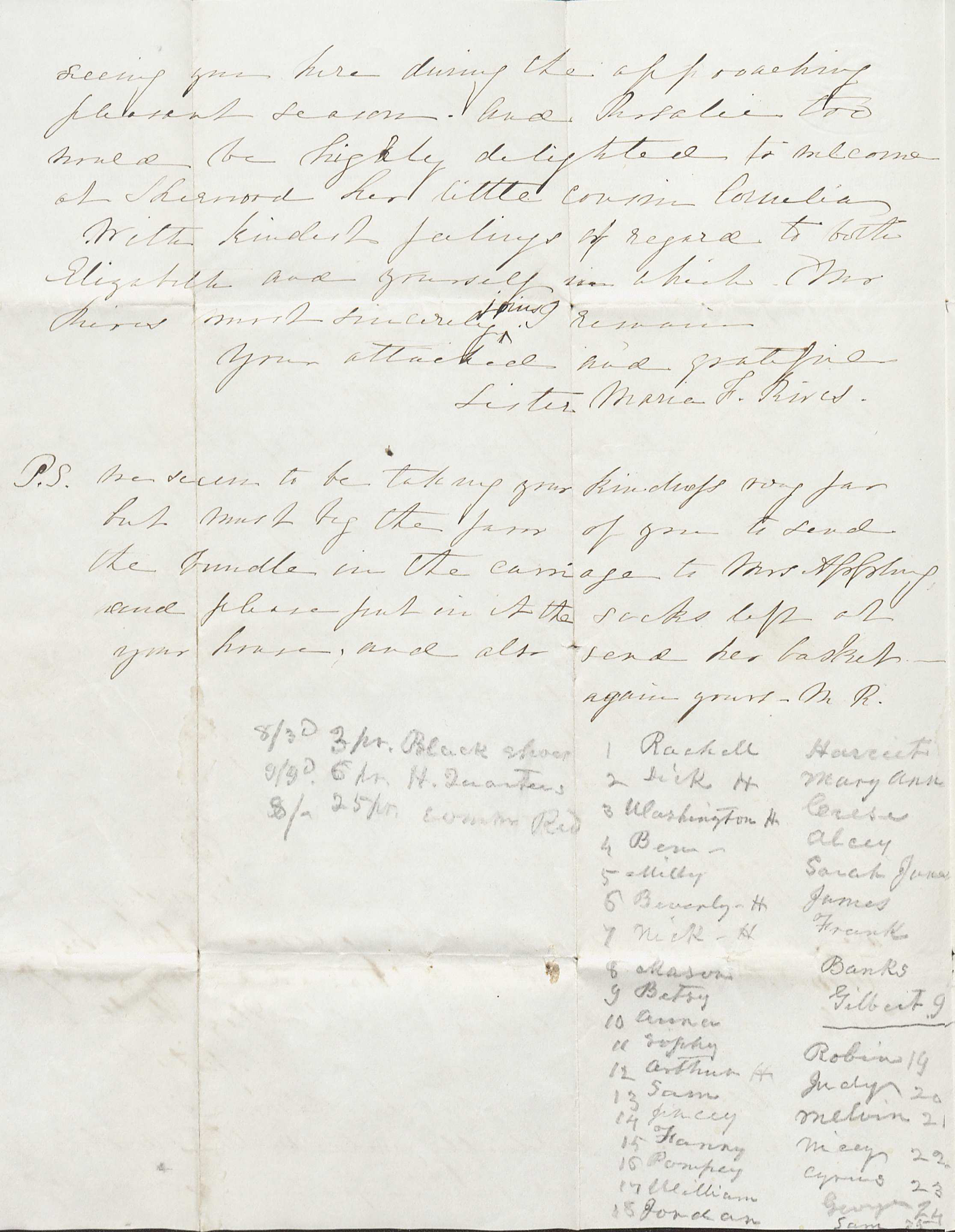
March 24, 1851 letter to Robert Rives Jr.  from his sister- in- law, Maria Rives.  In the letter Maria writes about a recent visit to Rives and his family at their home called Oakland,  and the declining health of his brother George.  The contents of the letter has no connection to the list found at the bottom of page two. Rives uses the bottom of the page as scratch paper to list the names of 34 of his slaves and supplies purchased for them. The number 22 on the list is my great-great grandmother, Nicey Ann Coles. (Image by Regina Rush)

. In the letter Maria writes about a recent visit to Rives and his family at their home called Oakland, and the declining health of his brother George. The contents of the letter has no connection to the list found at the bottom of page two. Rives uses the bottom of the page as scratch paper to list the names of 34 of his slaves and supplies purchased for them. The number 22 on the list is my great-great grandmother, Nicey Ann Coles. (MSS 4289: March 24, 1851 letter from Maria Rives to her brother-in-law, Robert Rives Jr. Image by Regina Rush)
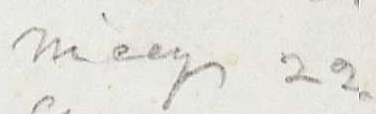
Detail of Nicey's name as it appears on the list shown above.

Detail of Nicey’s name as it appears on the list shown above. (Image by Regina Rush)

Uncovering the stories of Nicey Coles Rush and Isham Rush

Nicey Ann Coles was born circa 1823 in Nelson County, Virginia, most likely on one of the several plantations owned by Robert Rives, Sr. (1764-1845), a wealthy international merchant, who farmed tobacco and wheat, but most importantly owned both my great-grandparents. Nothing is known about Nicey’s parents. Information provided on her 1868 marriage license lists only her father’s last name, which is “Coles.” For reasons unknown, her mother’s name is not listed at all. In all likelihood, both she and her parents lived as slaves on Oak Ridge, the 2555 acre Nelson county, Virginia, estate owned by the Rives family. Oak Ridge was originally an 800-acre tract owned by Colonel William Cabell (1730-1798). Cabell later gave it as a gift to his daughter, Margaret Jordan Cabell, and his son-in-law, Robert Rives, Sr. (1764-1845).

Very little is known about Isham Rush, Nicey’s husband: his birth and death dates and parents’ names remain a mystery.  Isham was possibly born enslaved on the Rives Plantation in South Warren, Albemarle County. Census records of his children confirm that Isham was a native Virginian. Three of his children record him as their father on their marriage licenses. By 1868, he disappears from public record. His oldest child was his namesake (spelled “Isom” in the 1870 census) and down through the generations some variation of the name continues to be used. Even today, more than a 150 years later, Isham remains in the family: one of my paternal uncles was named John Isom Rush.

How long Nicey lived and worked on the Rives’ plantation in Nelson is unclear.  Records reveal that she was relocated at some point to one of the Rives’ Albemarle County plantations, referred to as the South Warren Estate. This estate was originally owned by Robert Rives Sr., but upon his death it passed on to his son Robert, Jr. (1798-1866).  Robert, Jr. was born in Nelson County in 1798. He represented Nelson County in the House of Delegates during 1823-1829 and afterward moved to Albemarle County, eventually becoming one of the wealthiest men in Virginia before the Civil War. The 1860 census record his assets at $280,000; most of his wealth was lost during the Civil War.

Records reveal that my great-great grandparents had a longstanding relationship of more than 13 years on the South Warren Estate and managed to raise a family–as much as one could within the restrictive confines of slavery. Their children’s names were Ella (my great grandmother), Cecelia, Louisiana, Lucy, Isham, Neverson and Fleming.  Some evidence suggest they had as many as ten children, but more research needs to be done before this can be confirmed. The Rush families of Chestnut Grove appear to be descended from two of their children, Ella and Louisiana Rush.

The following images were obtained from several plantation records of Robert Rives and provide brief snippets of information concerning Nicey and Isham’s existence at the South Warren Estate, in Warren Virginia.
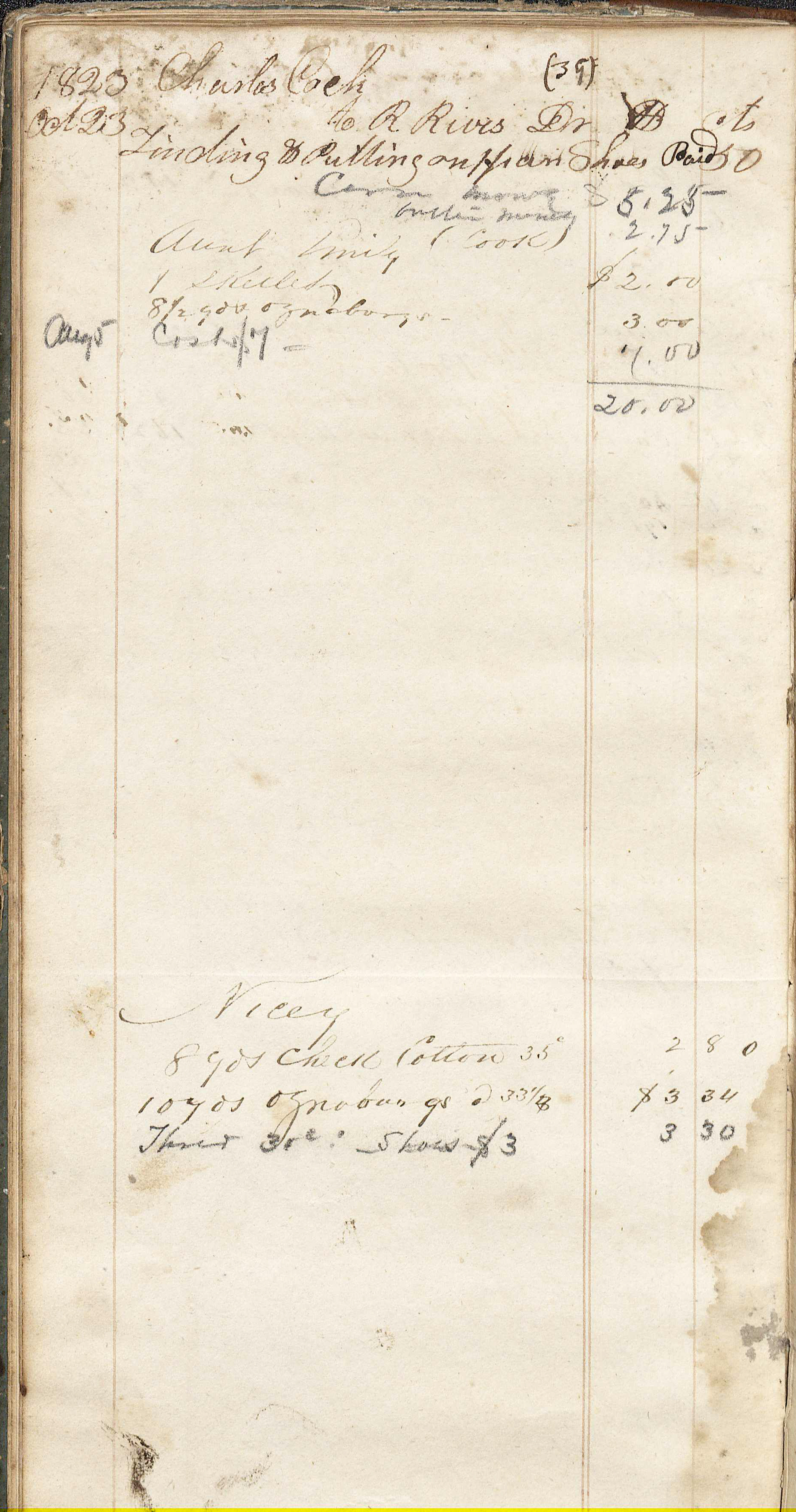
In an account book held by the Special Collections Library Rives purchases   8 yards of check cotton and 10 yards of Osnaburg  fabric for Nicey  for $6.14. On the opposite page of  Nicey's entry is written the name Isham and under the name "suit of clothes $18.00. The entry dates listed on 1823 but the entry was to have been made much later. Most likely sometime in the 1840's Robert Rives Blacksmith Shop Account Book, 1823; 1843-1846, Accession #4655 (Image by Regina Rush)

An account book held by the Special Collections Library shows that Rives purchased eight yards of check cotton and ten yards of Osnaburg fabric for Nicey for $6.14. On the opposite page of Nicey’s entry is written the name Isham and under the name, “suit of clothes $18.00” (see next image). While the page includes other entries as early as 1823, these entries likely date to the 1840s.
(MSS 4655: Robert Rives Blacksmith Shop Account Book, 1823; 1843-1846. Image by Regina Rush)
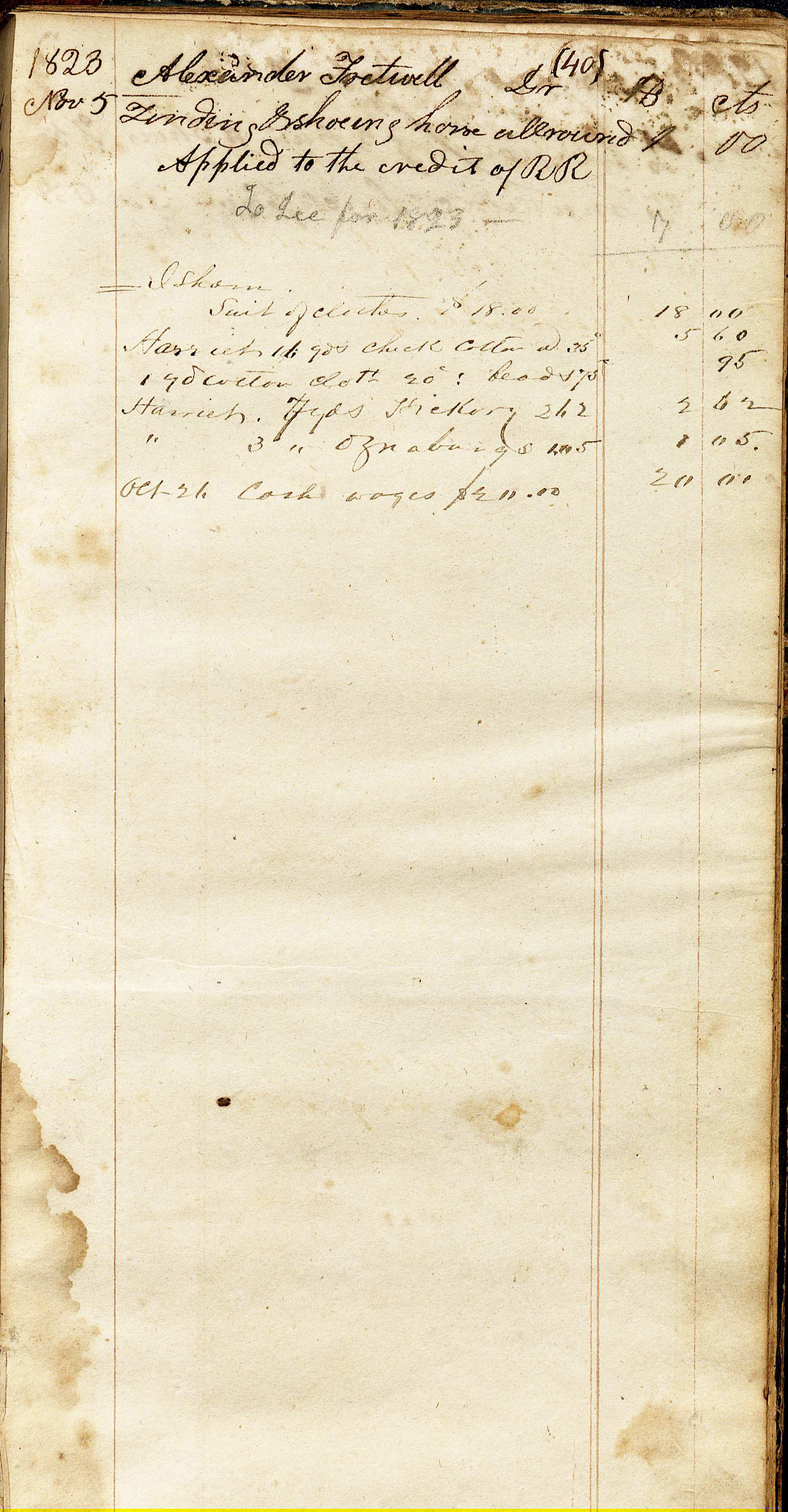
On this page of the Rives account book, opposite of  Nicey's entry is written the name Isham and under the name "suit of clothes $18.00. The entry dates listed on 1823 but the entry was to have been made much later. Most likely sometime in the 1840's Robert Rives Blacksmith Shop Account Book, 1823; 1843-1846, Accession #4655 (Image by Regina Rush)

Opposite Nicey’s entry is written the name “Isham” and under the name “suit of clothes $18.00.”  (Image by Regina Rush)

A discovery in Scottsville

Things got even more interesting when I contacted the Scottsville Museum, after discovering online that they had Rives-related papers. First, I found a relevant entry in a business ledger of Robert Rives, Jr., which is owned by the Scottsville Museum. It lists Rives’ purchase of shoes for some of his slaves.  Among the names on the list are my great-great grandparents, Isham Rush and Nicey Ann Coles. It reads “Shause (Shoes) bought on South Warren Estate June 18, 1849 for the negroes, vis Cyrus, Ben, Robin, Isham, Melvin, Daniel, Washington, Jurdan, Nick, Sophy, Nicey, Jincey, Bevly.” (Robert Rives Ledger 1846-1863. Page 12, Image 8, Scottsville Museum, Scottsville, Virgina).
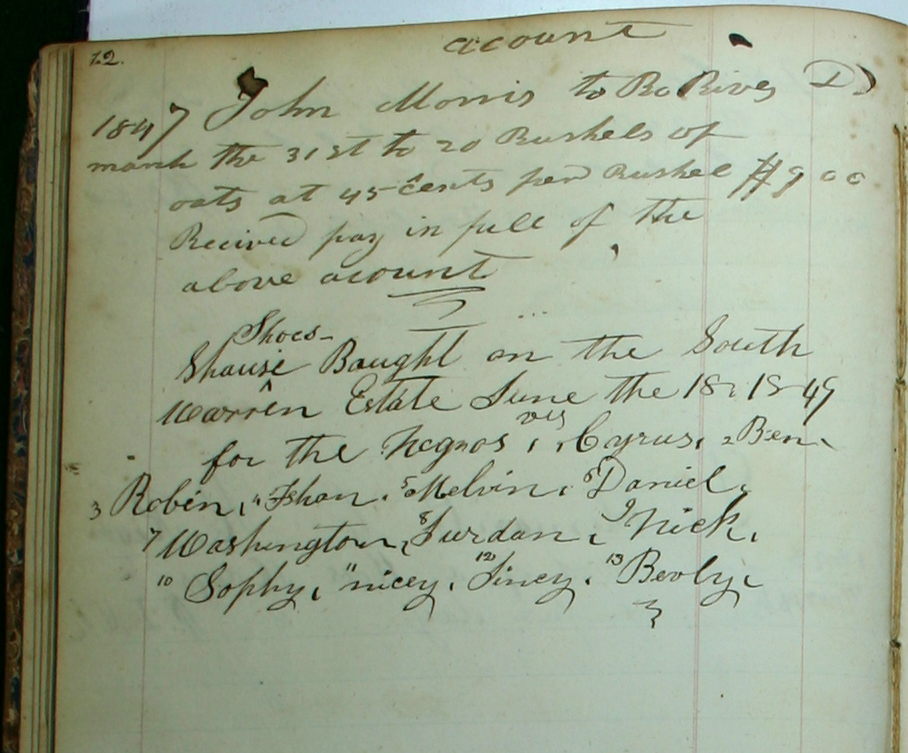
()

Entry from the business ledger of Robert Rives, Jr.  Rives lists shoes that he purchased for some of his slaves.  Among the names on the list are my great-great grandparents, Isham Rush and Nicey Ann Coles. (Robert Rives Ledger 1846-1863. Page 12, Image 8, Scottsville Museum, Scottsville Virginia)

The year 1851 was an eventful one for Nicey. In January 1851, she gave birth to Ella Rush, my great grandmother. Another document indicated that sometime later that year, she attempted to escape from South Warren.

Wait, my great-great grandmother ATTEMPTED TO ESCAPE!!!!!

A September 20, 1851 ledger entry made by Rives reveals that Nicey’s attempt was not successful: “Paid H.D. Robertson for the apprehension of Nicey and mileage there with $7.25.” I wondered at this series of events. Ella is listed in census records as the oldest of Nicey’s children. Perhaps there is a correlation between the two events–her pregnancy and her escape. But no documentation has been uncovered to support this.
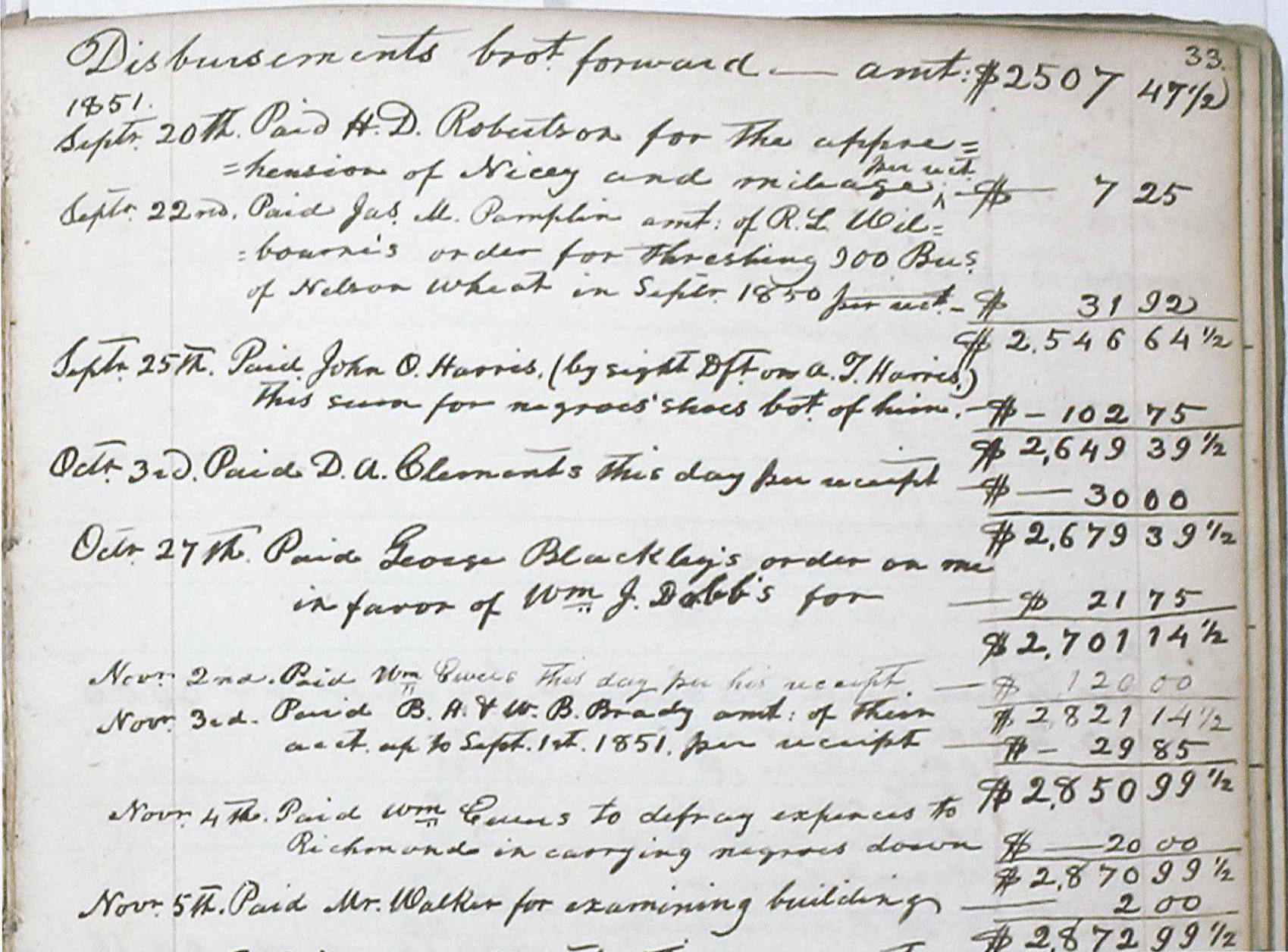
The year 1851 was an eventful one for Nicey. January 1851, she gave birth to Ella Rush, my great grandmother. Sometime later that year she attempted to escape from South Warren. This September 20, 1851 ledger entry made by Rives reveals her attempt was not successful.  "Paid H.D. Robertson for the apprehension of Nicey and mileage there with $7.25." Ella is listed in census records as the oldest, perhaps there is a correlation between the two events-her pregnancy and her escape. but no documentation has been uncovered to support this. Robert Rives Ledger 1846-1863. Page 33, Image 18, Scottsville Museum, Scottsville Virginia.

Nicey’s apprehension is documented on the second and third lines of this page. (Robert Rives Ledger 1846-1863. Page 33, Image 18, Scottsville Museum, Scottsville Virginia.)

Albemarle County Courthouse records helped me understand what happened to Nicey after the Civil War, and after Isham Rush disappeared from public record, presumably deceased. On September 18, 1868, Nicey and a man named Paul Moseley went to the Albemarle County Courthouse to obtain a marriage bond. Two days later, on September 20, 1868, they were married at the Chestnut Grove Church in Esmont, Virginia by a minister named Alexander White.
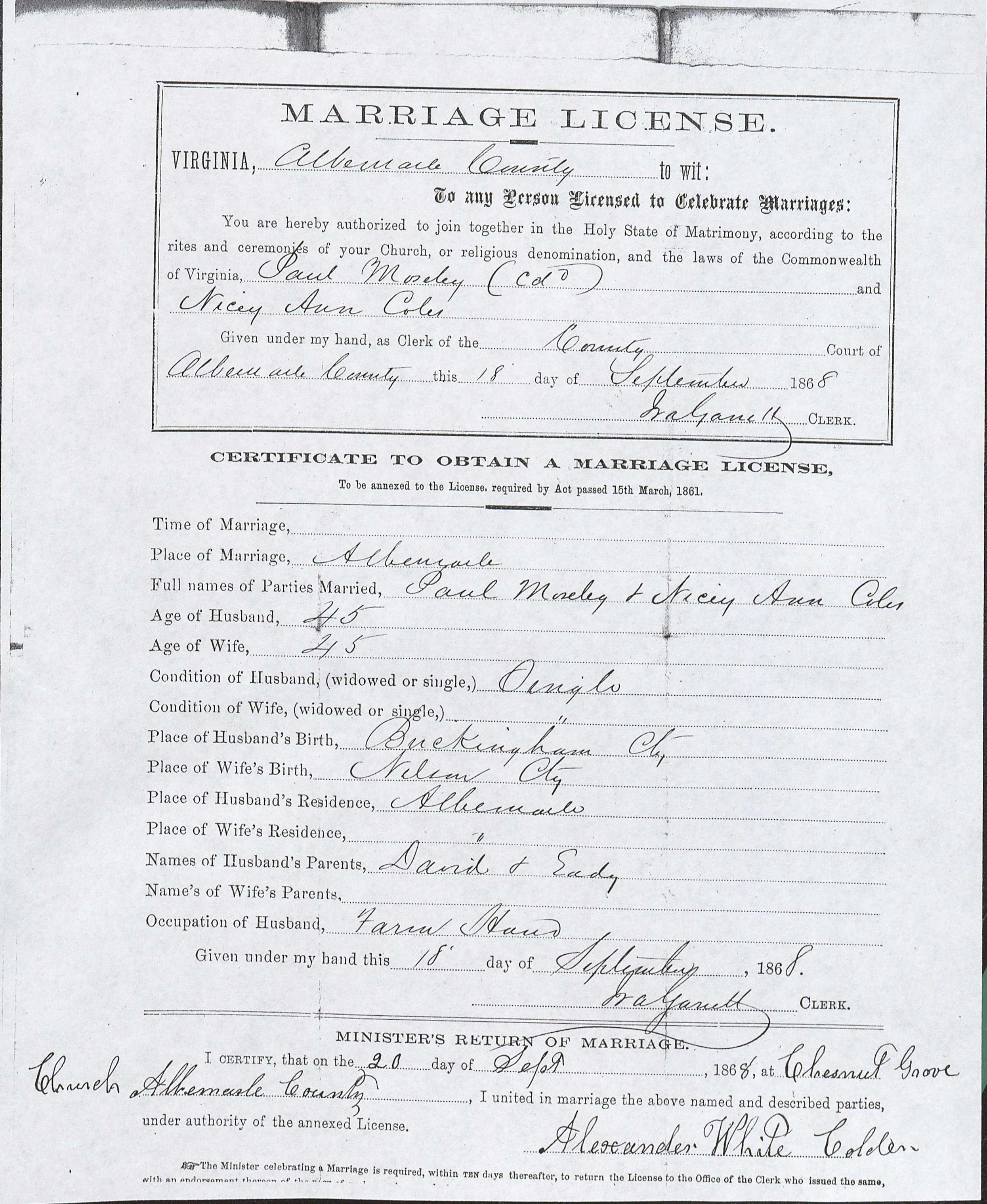
Marriage license of Nicey Ann Coles and Paul Moseley, September 18, 1868. Courtesy of the Albemarle County Courthouse, Charlottesville, Virginia, 22902 (Image by Regina Rush)

Marriage license of Nicey Ann Coles and Paul Moseley, September 18, 1868. Courtesy of the Albemarle County Courthouse, Charlottesville, Virginia, 22902 (Image by Regina Rush)

By 1870 Nicey was 47 years old, still residing in Warren, Virginia. She shared a home with her husband, 47-year-old Paul Moseley, her 12-year-old stepson Paul Jr., and all seven of her children. Ella, 20; Cecelia,18; Lucy, 16; Louisiana, 3; Isham, 13, Neverson, 11; Fleming, 7; and her granddaughter Sophronia, Ella’s 11-month-old daughter. The 1870’s saw Nicey’s daughters Cecelia and Lucy married and out on their own. Her son and step-son had either died or migrated to another area by 1880.

The 1880 census shows that Nicey and her family had moved to Scottsville, near to Cecelia. The census reveals that her husband was still alive and only three of her children remained in her household–Isham, Fleming, Louisiana. Nicey died sometime between 1880 and 1900.

From the first time I looked at the 1870 census record for the Rush line of my family, I felt compelled to learn their stories. Over more than fifteen years of digging into my family’s ancestry, I have amassed quite a bit of raw data that screams out to be put in some sort of form that tells their story. Notes from Under Grounds proved to be the perfect launching pad. It is my honor and privilege to tell the story of my great-great grandparents. I dedicate this blog post to them, the Patriarch and Matriarch of the Albemarle County Rushes of Chestnut Grove.  World, I introduce to you Nicey Ann Coles and Isham Rush, my new friends.
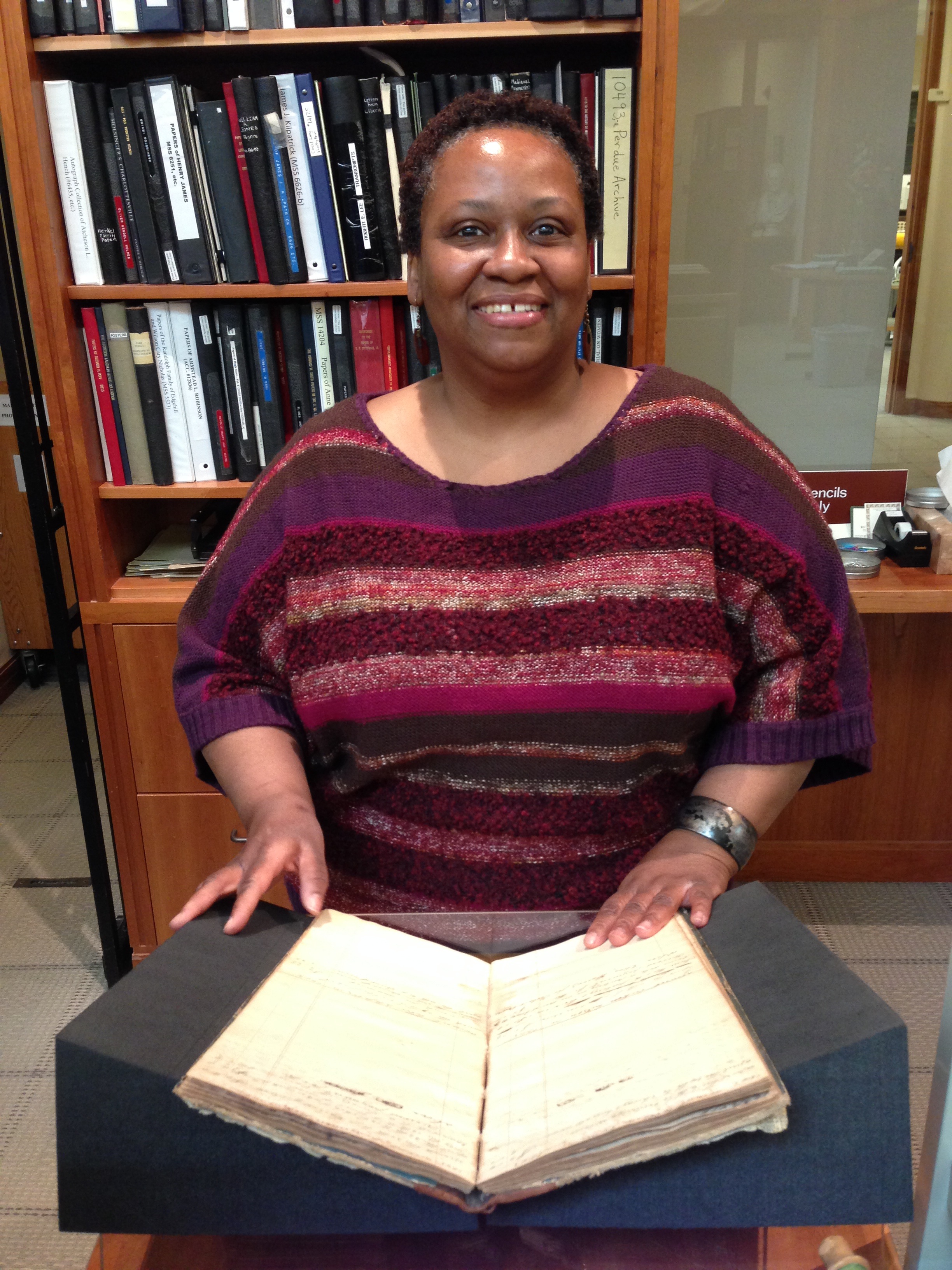
Regina Rush, Reference Coordinator, March 26, 2014. (Photograph by Molly Schwartzburg)

Regina Rush Special Collections Reference Coordinator, March 26, 2014.  She holds one of the Rives ledgers that has helped her recover her family history. (Photograph by Molly Schwartzburg)

Special thanks to the Scottsville Museum and the Albemarle County Courthouse for permission to share images from their collections.

This Just In: Disability in the Archives

"Disability in the Archives," case 1

“Disability in the Archives,” case 1

On February 27-28 U.Va. hosted “Disabling Normalcy,” an interdisciplinary conference organized by Christopher Krentz, Associate Professor of English and Director of American Sign Language.  In conjunction with the conference, Prof. Krentz and graduate student Philip Timmerman prepared an exhibition, “Disability in the Archives,” which is on view in the first floor gallery of the Small Special Collections Library through April 26. Drawn entirely from our holdings, the exhibition features books, manuscripts, and photographs relating to the deaf, blind, physically handicapped, and mentally ill.

"Disability in the Archives," case 2

“Disability in the Archives,” case 2

The exhibition includes several recent acquisitions, some obtained before Prof. Krentz proposed the exhibition and others acquired since, partly with the exhibition in mind.  In this post we feature a few of these items, including several omitted from the exhibition for want of space.

Efforts to educate the blind and vision-impaired received a major boost in the early 19th century with the invention of various tactile reading systems. Although Louis Braille’s dot system has become the international norm, raised letter systems were standard in the United States until the early 20th century. The first to be introduced was “Boston line,” an adaptation by Dr. Samuel Gridley Howe of a Scottish raised-letter alphabet. Much as a type designer adjusts letterforms for legibility, Howe adapted the shapes of letters and numerals so that, when embossed in paper in high relief, they could be more easily distinguished by touch. In 1835 Howe established a press at the New England Asylum for the Blind in Boston (now the Perkins School for the Blind in Watertown, Mass.), where he proceeded to print many raised-letter books for the blind.

Cast list for a benefit performance of Shakespeare's The Merchant of Venice,  by the "Perkins Players" of the Perkins School for the Blind in Watertown, Mass., May 1917  (HV1796 .M46 P4 1917)

Cast list for a benefit performance of Shakespeare’s The Merchant of Venice, by the “Perkins Players” of the Perkins School for the Blind in Watertown, Mass., May 1917. This raised-print program was set in Boston line and printed at the school.  (HV1796 .M46 P4 1917)

We recently added an unusual Boston line imprint to our Joseph M. Bruccoli Great War Collection: a theater program for two benefit performances of Shakespeare’s The Merchant of Venice, held in May 1917 at the Perkins School and featuring Perkins students as actors, musicians, and dancers. Proceeds went to the American, British, French, Belgian Permanent Blind Relief War Fund, which assisted Allied soldiers blinded in battle.

Hans Christian Andersen's The Ugly Duckling, from Fancies of Child-Life (Louisville, Ky.: American Printing House for the Blind, 1877).  (PZ7 .F1997 1877)

Hans Christian Andersen’s The Ugly Duckling, from Fancies of Child-Life (Louisville, Ky.: American Printing House for the Blind, 1877). (PZ7 .F1997 1877)

Following the Civil War, the American Printing House for the Blind in Louisville, Kentucky, became the leading American supplier of raised-letter texts. The APHB employed a modified form of Boston line for its publications until 1893, when Braille was first introduced. At the Boston International Antiquarian Book Fair we acquired a copy of the 1877 APHB edition of Fancies of Child-Life, a collection of children’s stories by Hans Christian Andersen and Harriet Beecher Stowe. This copy was sent to the Virginia Institute for the Deaf, Dumb, and Blind in Staunton, Va., where in 1893 it was presented as a school prize “For learning to read in one Session” to Edgar Hickam. A blind resident of Maces Spring, Va. (in the extreme southwest region bordering Tennessee), Hickam was well known locally as a musician and piano tuner, though celebrity would fall, not to him, but to his neighbors, the Carter Family.

The Rev. William Moon's simplified manual alphabet, in Light for the blind: a history of the origin and success of Moon's system of reading (embossed in various languages) for the blind (London: Longmans & Co., 1873).  (HV1678 .M84 1873)

The Rev. William Moon’s simplified manual alphabet, in Light for the blind: a history of the origin and success of Moon’s system of reading (embossed in various languages) for the blind (London: Longmans & Co., 1873). (HV1678 .M84 1873)

Perhaps Boston line’s primary shortcoming was that it adopted essentially the same rather complex letterforms employed for written and printed texts. Hence publications in Boston line are more easily read by eye than by touch. In 1847 the Rev. William Moon of Brighton, England, invented a simplified alphabet better suited to touch. It consisted of “six of the roman letters unaltered, twelve others with parts left out, and six new and very simple forms, which may be easily learned by the aged, and persons whose fingers are hardened by work.” Moon’s Light for the blind (London, 1873) describes his invention, provides a list of available publications, and chronicles his labors on behalf of the blind.

We know far less about the history of mapmaking for the blind, and embossed maps are very uncommon.  Hence we were delighted to acquire at the California International Antiquarian Book Fair a fine copy of a world atlas for the blind published in Germany in the mid-1930s. The challenge was a straightforward one: how to convert two dimensions into three so that cartographic information could be conveyed by touch?  Here the solution was to emboss maps in high relief on durable kraft paper. Geographic and topographic features are differentiated as follows: coastlines by dotted lines, political boundaries by dashed lines, rivers by solid lines, oceans by a uniform pattern of small dots in low relief, and so on, with captions added in Braille.

A manual alphabet from a collection of ornamental alphabets, Recueil d'alphabets, dedié aux artistes (Paris & New York: L. Turgis jeune, [ca. 1845?].  (NK3600 .B65 1845)

A manual alphabet from a collection of ornamental alphabets, Recueil d’alphabets, dedié aux artistes (Paris & New York: L. Turgis jeune, [ca. 1845?].   (NK3600 .B65 1845)

Last month we acquired a rare mid-19th century alphabet book, with a dual Paris & New York imprint, consisting of 24 lithographic plates bearing elaborate ornamental alphabets. These were intended as inspiration for artists, signmakers, and others seeking out-of-the-ordinary letterforms. Imagine our surprise to find on the penultimate plate the standard manual alphabet on which various sign languages used by the deaf (including American Sign Language) are based.

Nervous disorder conveyed in verse, in Miscellaneous reflections. In Verse (Greenfield, Mass.: Thomas Dickman, 1792)  (BD420 .F52 1750 no. 2)

“Nervous disorder” conveyed in verse, in Miscellaneous reflections. In Verse (Greenfield, Mass.: Thomas Dickman, 1792)   (BD420 .F52 1750 no. 2)

Early autobiographical accounts of battles with mental illness are quite rare, and recently we acquired one for the Clifton Waller Barrett Library of American Literature. In 1792, in the small town of Greenfield, Mass., Thomas Dickman printed Miscellaneous reflections. In verse. Mostly written at sundry times, when under long confinement by a complication of nervous disorders. Only three copies are recorded of this 40-page pamphlet, written “by a valetudinary” (whose identity remains unknown) and “printed by request of friends of that class.” Most of the poems are religious in nature, but the initial poems are extraordinary for attempting to convey, in verse, the author’s experience of being in a state of “nervous disorder.”

On View Now: The Journeys of Vachel Lindsay

We are proud to announce the opening of our new First Floor exhibit, Troubadour, Vagabond, Visionary: The Journeys of Vachel Lindsay, curated by English graduate Student and Special Collections curatorial assistant Elizabeth Ott. Today on the blog, Elizabeth offers some reflections on the curatorial process in the following guest post. Thanks, Liz, and congratulations on your beautiful exhibition!

Poster design by Jeff Hill, U.Va. Library.

Poster design by Jeff Hill, U.Va. Library.

If there were a single collection in the Albert & Shirley Small Special Collections library that could represent all of the reasons special collections libraries exist, I think it would have to be the Vachel Lindsay Collection. Lindsay was an American poet of the early 20th century known for his tramping excursions of hundreds of miles across many states, when he traded poetry pamphlets and performances for food and lodging. He spent much of his life walking the lines between poet, painter, preacher, and philosopher. He’s exactly the kind of writer whose value to the history of literature is most easily lost in the ascetic pages of a Norton Anthology, where his booming vaudevillian voice, syncopated jazz rhythms, and elaborate tongue-in-cheek illustrations are reduced down to plain black ink on a white page.

Exhibition curator Elizabeth Ott and her supervisor, curator Molly Schwartzburg, installing Lindsay's bibles in the exhibition. (Photo by Sanjay Suchak)

Exhibition curator Elizabeth Ott and her supervisor, curator Molly Schwartzburg, installing Lindsay’s Bibles in the exhibition. (Photo by Sanjay Suchak)

To understand Vachel Lindsay, you need to see all his stuff. To understand Vachel Lindsay, you need to visit Special Collections. This is because the manuscripts, printed books, and other materials in the stacks of the Small Library tell a vibrant story, one that casts Lindsay in a kaleidoscopic light of colors and shades, speaking of a rich artistic career. Enterprising, energetic, and prolific, Lindsay traveled America as a self-styled troubadour, distributed art and ideas with an earnest faith in the twin powers of Beauty and Art, and made a name for himself reclaiming poetry as the province of performance. The Vachel Lindsay Collection is wildly eclectic, encompassing everything from oil paintings and cherished slippers to folksy illustrated pamphlets and the blocks used to print them.
One of Vachel Lindsay's Bibles, inscribed with his elegant script, ready to be installed in the exhibition. (Photo by Sanjay Suchak)

One of Vachel Lindsay’s Bibles, inscribed with his elegant script, ready to be installed in the exhibition. (Photo by Sanjay Suchak)

Because of Lindsay’s broad interests and the great scope of the collection, deciding what aspect of Lindsay’s career to exhibit was no small task. I wanted to showcase the range of his work while at the same time giving a sense of just how much he dovetailed with the intellectual and artistic concerns of his day. To me, Lindsay seemed so much a part of the American landscape—an America still in the process of building an identity. Lindsay, like many American poets, looked back to create something unique and new, breaking from tradition by invoking an almost transcendental link to a mythic and stylized past.

The exhibition installation process continues. (Photo by Sanjay Suchak)

The exhibition installation process continues. (Photo by Sanjay Suchak)

The decision to focus the exhibition on Lindsay’s journeys, both literal and figurative, grew out of two maps that now hang in the first case of the exhibition. Both maps are fairly ordinary, save that Lindsay has embellished both, labeling them with paint and pen. The first records his tramping journeys between 1904 and 1916. The second divides the country into regions of Lindsay’s devising, with his characteristic penchant for the symbolic over the literal. I wanted to tell the story of these two maps, of Lindsay’s actual treks across the United States, but also of his visions of the journey America, as a country, was to undertake.

Elizabeth supervises Molly as she levels one of Lindsay's maps. (Photo by Sanjay Suchak)

Elizabeth supervises Molly as she levels one of Lindsay’s maps. (Photo by Sanjay Suchak)

The resulting exhibition thus tells two stories. The first is the story of what Vachel Lindsay means to America—how his tramping journeys presaged the hobo culture of the 1920s and 30s and influenced generations of poets who drew inspiration from folk culture. The second is the story of what America meant to Vachel Lindsay, his mythopoeic universe with Springfield, Illinois (his hometown) at the center. Though this exhibition barely scratches the surface of his fascinating life and work, it samples a great range of the materials that survive in the Vachel Lindsay Collection, testifying to the life and works of this now obscure but enduringly influential American poet.

Elizabeth puts the finishing touches on her exhibition. (Photo by Sanjay Suchak)

Elizabeth puts the finishing touches on her exhibition. (Photo by Sanjay Suchak)

This Just In: Brutal Coppers and Queer Floppers: A Glimpse into the Hobo Collection

This week we are pleased to feature a guest post by curatorial student assistant Elizabeth Ott, who has written an in-depth account of just one of the many wonderful books in our recently acquired Hobo Collection. Hats off to rare book cataloger Gayle Cooper, who brought to our attention the discrepancy between the two copies discussed here.

Visitors to the Albert and Shirley Small Special Collections Library may find themselves pricking up their ears to catch the far-off, lonesome whistle of a nighttime freight train. The occasion for these phantom whispers is the recent acquisition of the Hobo Collection, comprising 73 books and approximately 40 items of ephemera related to vagrancy, tramping, migrant workers, and hobo life in nineteenth and twentieth-century America.

The collection spans more than 150 years and includes fiction, autobiography, pamphlets, periodicals, photographs, songbooks, and even cookbooks. Some of the highlights of the collection include early issues of the Hobo News, a first edition of Woody Guthrie’s fictionalized autobiography Bound for Glory (1943), and a run of the “A-no.1” series written by famous hobo “Rambler” Leon Ray Livingston.

Three issues of the A-1 Series,

Three issues of the A-No.1 series of tales of hobo life (HV 4505 .L58 B66, Associates Endowment Fund. Photo by Elizabeth Ott)

Among the many noteworthy items in this rich collection is a copy of the first American edition of West Virginia writer Tom Kromer’s 1935 novel-memoir Waiting for Nothing. Though never a runaway bestseller, Kromer’s hardboiled account of his years as a migrant laborer and itinerant bum was widely lauded for presenting a compelling and unsentimental portrait of hobo life during the Great Depression. Kromer wrote the bulk of the novel in 1933 while working for the Civilian Conservation Corps at Camp Murphy in Jupiter, Florida. He initially struggled to interest a publisher in his manuscript, but gained the attention of the prominent journalist Lincoln Steffens, who encouraged him to pursue Max Lieber as a literary agent. Lieber quickly secured Alfred A. Knopf as publisher.

Kromer became something of a critical darling. His clipped style and aggressive use of slang gained him a reputation as a street-smart Hemingway. Among those who championed the novel was Theodore Dreiser, whose novels Sister Carrie and Jennie Gerhardt, amongst others, explore similar themes of poverty, labor, and class relations. Dreiser was so taken with Kromer’s tale that he convinced his British publisher, Constable & Co., to undertake a British edition and agreed to write an introduction for it.

For many years, this British edition has been the only copy of Waiting for Nothing in Special Collections at U.Va. because of its association with Dreiser, a writer heavily represented in the Barrett Library of American Literature. Now that it is joined by its American counterpart, researchers will have a much more complete picture of the novel’s cultural significance. For while the American edition lacks the preface written by Dreiser, the British edition lacks the book’s entire fourth chapter.

The page opening where chapter 4 is meant to appear in the first British printing of Nowhere to Run.

The page opening where chapter 4 is meant to appear in the first British printing of Waiting for Nothing (PS 3507 .R55 A165 .K7 1935, Clifton Waller Barrett Library of American Literature, Theodore Dreiser Collection. Photograph by Elizabeth Ott).

Where the fourth chapter should appear in its pages is instead an eight-page insert about the nature of censorship on blue paper titled “To the Reader: in lieu of Chapter IV.” The decision to replace chapter four seems to have been last minute, as described in the appendix of to a 1977 scholarly edition of the novel:

Constable originally seems to have seen nothing especially objectionable in this fourth chapter; the text was typeset and printed with the other chapters in the first impression. Bibliographical evidence indicates that the sheets of this impression were folded and ready for stitching and binding when Constable decided not to risk publication of chapter 4. Pages 75-94 of the unstitched gatherings (all of chapter 4) were cancelled—that is, were razored out—and in their place was inserted an eight-page gathering…

Our newly acquired American edition allows us to finally get a peek at what salacious happenings occur in this objectionable fourth chapter:

           “How do you eat?”
He knows how I eat, but we are playing a game.

The selling point of Waiting for Nothing is that it illuminates the unsavory aspects of tramping—desperate men, degenerate women, seedy flophouses and near escapes from brutal coppers—without appearing sensational. It’s tricky to strike this balance; the material must contain calculated shocks without tipping over into sentiment and all the while the narrator must remain sympathetic, above the dirt and grime even as he wades through it.

A passage from the American edition of Waiting for Nothing.

A passage from chapter 4, which appear in full in the American edition of Waiting for Nothing (PS 3521 .R57 W3 1935, Associates Endowment Fund. Photograph by Elizabeth Ott).

Nowhere is this tenuous balance more on display than in the controversial Chapter Four, where Kromer meets and “makes” a transgendered woman, Mrs. Carter, in a park. Kromer flirts with her and obtains money to buy dinner, repeatedly reminding the reader that “we are playing a game.” The two agree to meet later to go to a show together, though we are to understand that the real arrangement is that payment for the meal will be sex. The chapter ends with the fulfillment of this promise: “You can always depend on a stiff having to pay for what he gets. I pull off my clothes and crawl into bed.”

The balance of Kromer’s matter-of-fact admission of prostitution is his insistence on his own revulsion: “A pansy like this, with his plucked eyebrows and his rouged lips, is like a snake to me. I am afraid of him. Why I am afraid of this fruit with his spindly legs and his flat chest, I do not know.” Kromer’s desire to distance himself from Mrs. Carter paradoxically calls attention to his own outsider status, odd in a narrative that theoretically offers an insider’s view of being down-and-out. Rarely at a loss for the right slang to describe his adventures, Kromer here fumbles to correctly categorize Mrs. Carter, identifying her with male pronouns consistently until he is confronted by a local:

            “Did you make her?” This skinny stiff next to me at the counter says.
“Make who?”
“Mrs. Carter,” he says. “I see you talkin’ to her in the park.”

When Kromer asks about Mrs. Carter’s roommate, the correction is even more palpable:

            “He queer, too,” I say.
“Sure, she’s queer,” he says, “but you will not have a chance with her.”

In the blue paper insert for the British edition, the publishers dither about where the line may be drawn about which “horrors to which helpless vagrants are exposed” can be represented in print. Kromer’s narrative in the chapter, though, insists that he and Mrs. Carter are playing a game in which he is the victor, the one on the make. It is perhaps this, more than any other element of the chapter, that opens it up to censure and moralizing. Unable to subordinate himself to Mrs. Carter, Kromer steps out of the role of helpless vagrant; after all, “A guy has got to eat, and what is more, he has got to flop.”

Kromer’s book is just one example of how the items in this collection will spark new conversations about life on the skids in the twentieth century.

Top is the newly acquired American edition; below is the British edition with Dreiser's introduction.

Top is the newly acquired American edition; below is the British edition with Dreiser’s introduction.