This Just In: The Maurice Lévy Collection of French Gothic

This week Nicole Bouché, Director of Albert and Shirley Small Special Collections Library, relates the story of how a major new acquisition came to U.Va.:
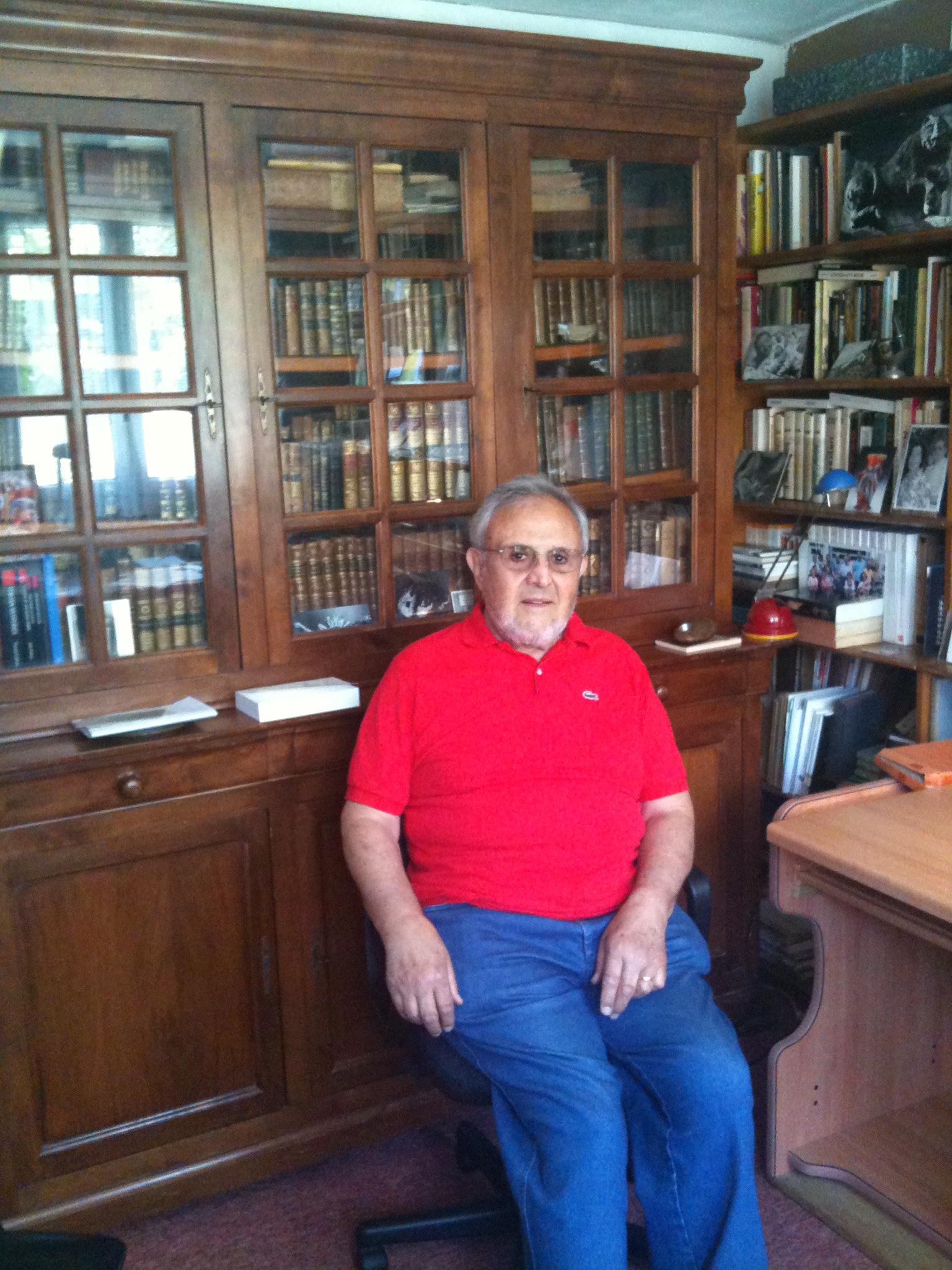
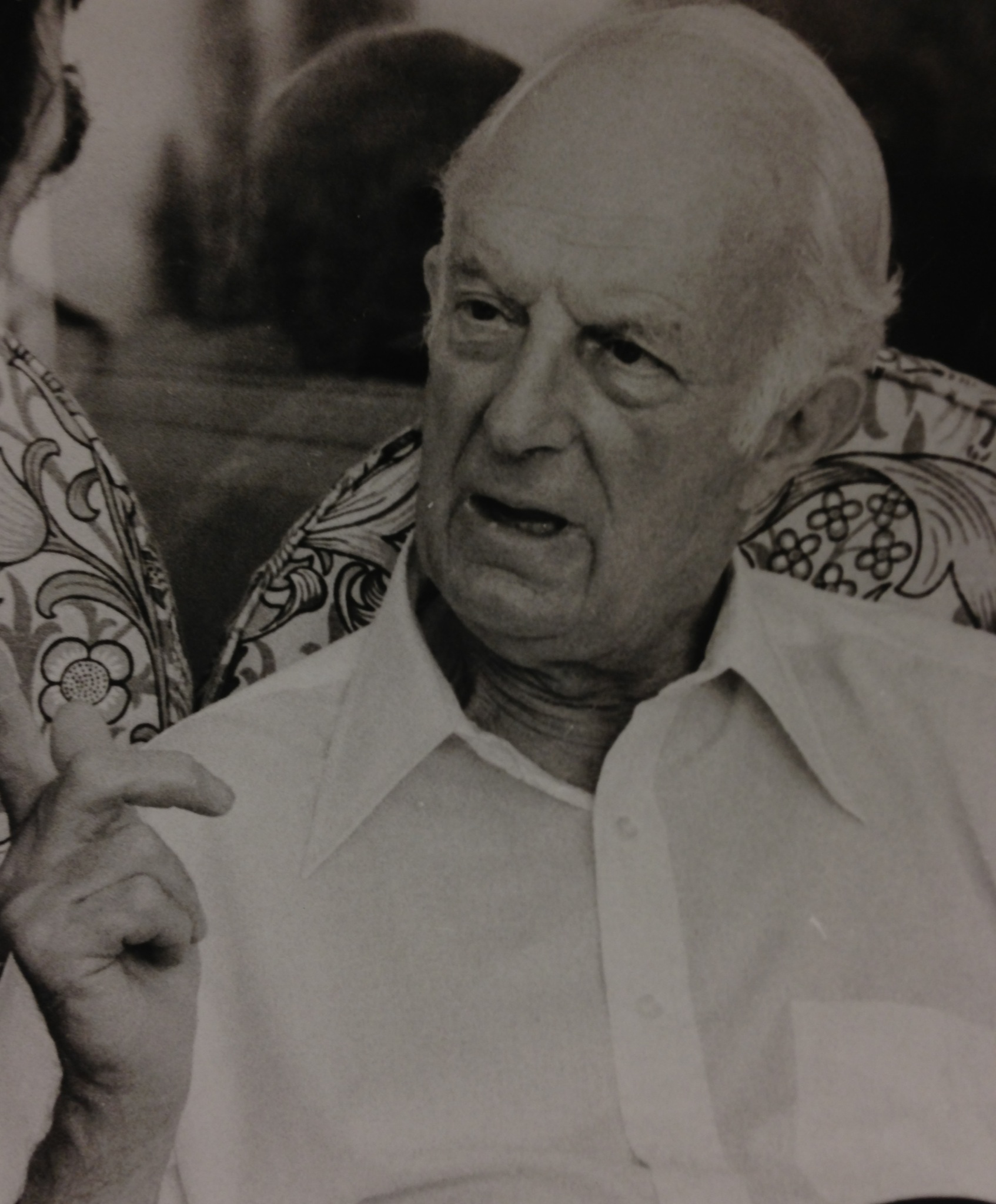
Maurice Lévy in his Toulouse study, seated before the glass-front bookcase containing his French Gothic collection.

“I have now reached a time in life where one inevitably ponders over the fate of the books one may have had the good fortune to collect over the years.”  —Maurice Lévy

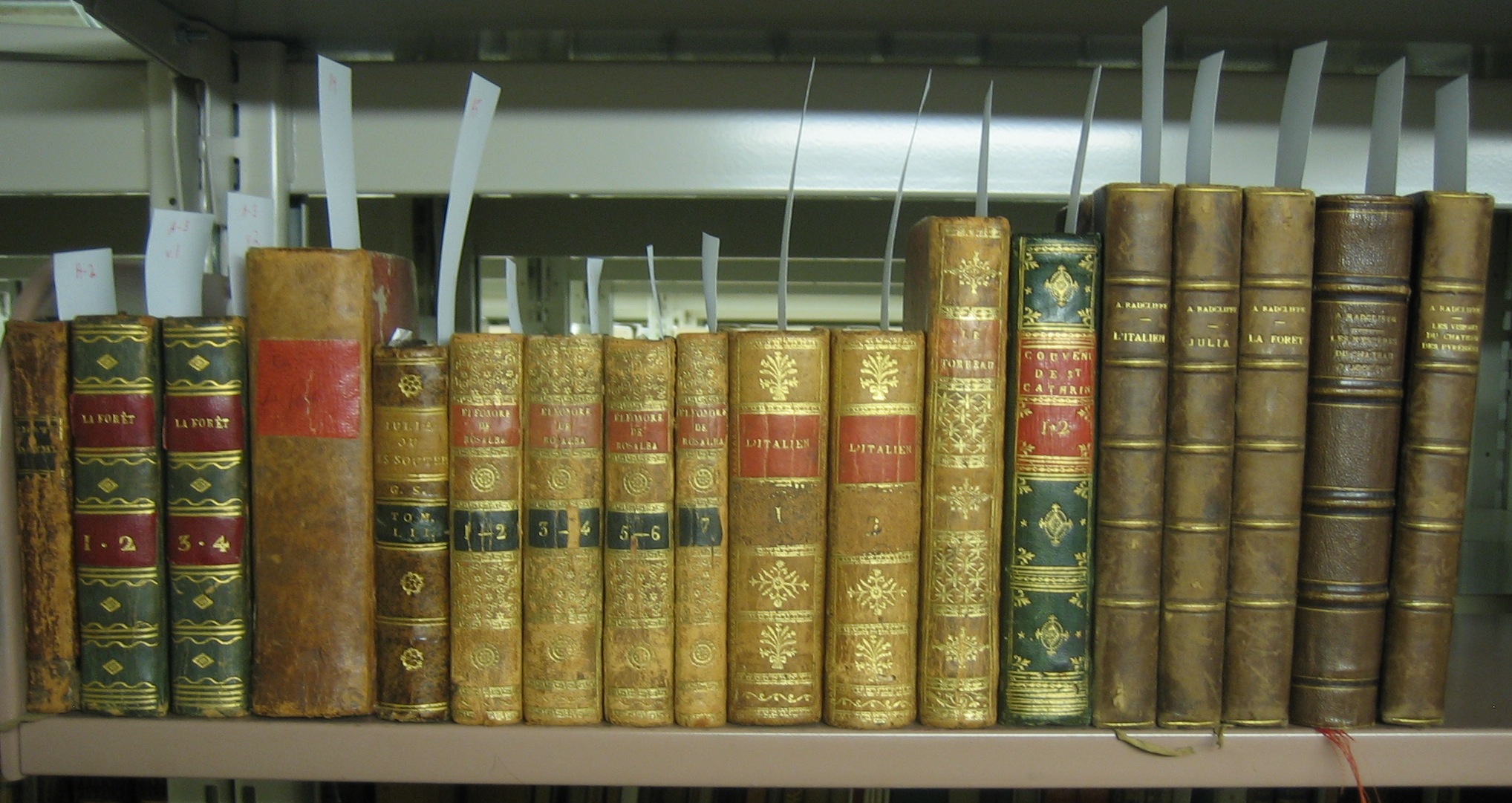
Serendipity often plays a role in building great library collections, and a chance encounter between an institution and a scholar can yield an extraordinary and wholly unanticipated legacy years, sometimes decades, later.  Such is the story of the Maurice Lévy Collection of French Gothic, a recent bequest of over 450 rare books now housed in the Albert and Shirley Small Special Collections Library.

Sometime in the early 1960s, Maurice Lévy (1929-2012), then a graduate student of English Literature at the Sorbonne in Paris, proposed to write his dissertation on the American writer, William Faulkner.  “Ah, but we don’t write dissertations on living authors” was the (predictable) reply from the French academy.

Instead, the young scholar was assigned to write about English gothic literature. With the help of a summer fellowship Lévy found his way to U.Va., where he spent three months immersed in an intensive study of the Sadleir-Black Collection of Gothic Fiction, among the world’s finest collections on the gothic genre. Lévy’s dissertation, Le Roman “Gothique” Anglais, 1764-1824, became a standard source and helped to revive scholarly interest in the field, and Lévy became a recognized authority on the gothic genre. Maurice’s final work, a scholarly edition of Matthew Gregory Lewis’ classic gothic tale, The Monk, was published posthumously in 2012.
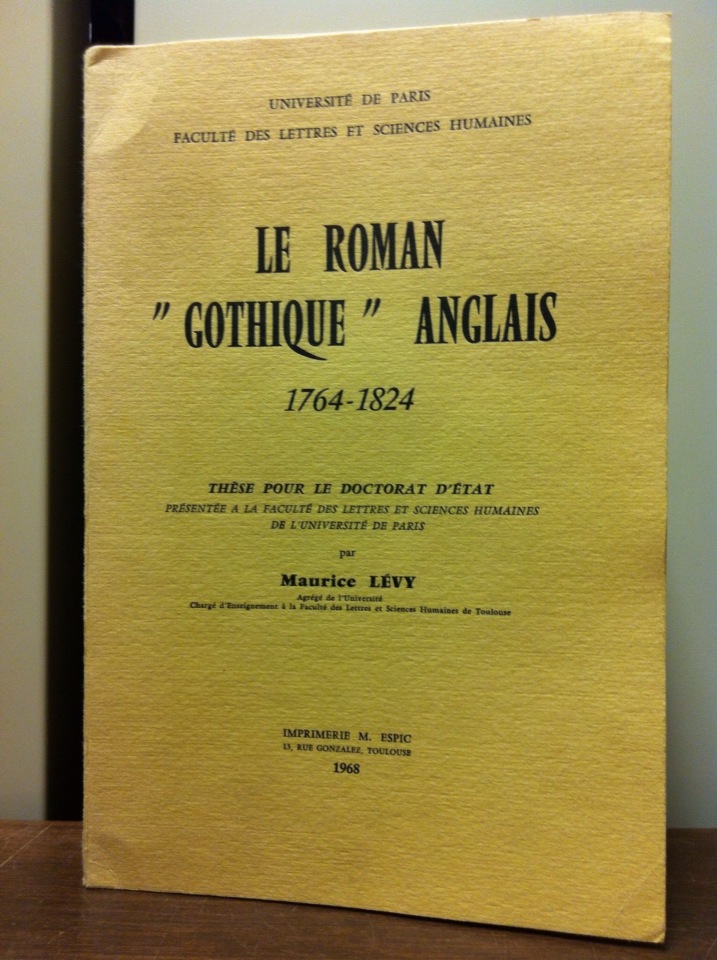
Maurice Lévy’s doctoral dissertation, based in part on research done with U.Va.’s Sadleir-Black Collection of Gothic Fiction.

At the end of his fellowship, Lévy returned to France, never to return to Charlottesville, but with fond memories of his summer on Grounds. By his own account, he was never again in contact with the U.Va. Library, or with the Rare Book Department staff that had been so welcoming and helpful during his stay.

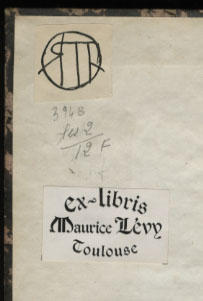
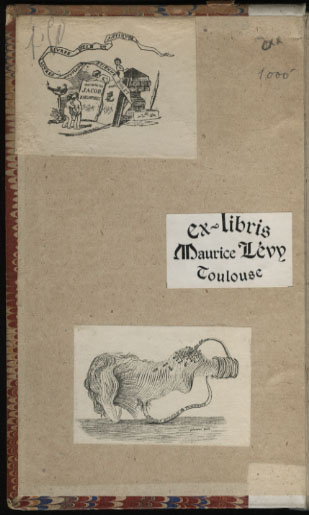
Jump forward several decades:  Lévy, now an emeritus professor of the Université de Toulouse, “pondered” what do with the treasured collection of French editions of gothic novels that he had painstakingly assembled.  An American colleague recalled how Maurice frequently spoke with deep appreciation of his summer spent in Charlottesville. Might U.Va. be a possibility?  And thus, in the fall of 2009, an e-mail arrived in Special Collections from an “unknown” French scholar, inquiring whether the library might perhaps be interested in acquiring his collection.

most of them first or early editions: about 60 titles, representing something like 200-250 volumes …. which compose, literally speaking, the French side of the same literary movement and could perhaps be considered by future researchers as a helpful complement, however modest and limited in size, of the prestigious Sadleir-Black collection.

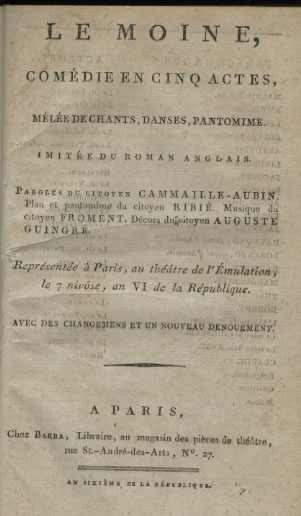
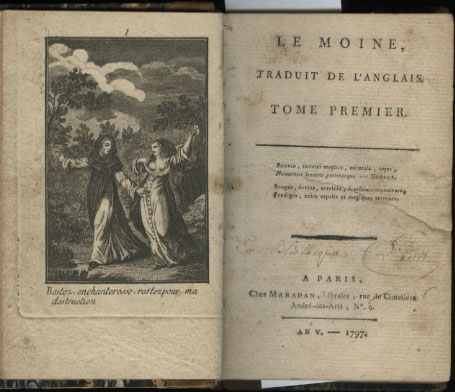
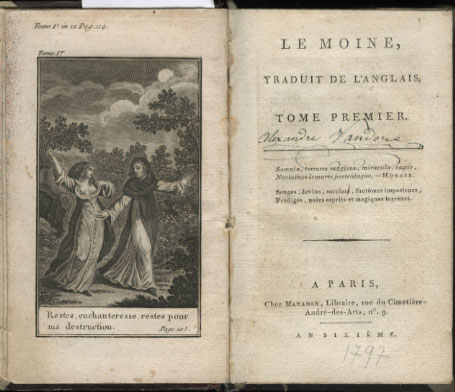
I am currently looking for a home for this collection, which, although relatively modest in size when compared to others, has the advantage of illustrating the extraordinary vogue of the “roman noir” during the French Revolutionary period, and of including volumes which offer the distinctive feature (not shared by corresponding English volumes) of being individually illustrated with frontispieces by (most of them) reputed engravers. To pay homage to their talent, I published Images de Roman Noir in 1973 [Paris, Losfeld].

Should you be interested in this donation, I would take the necessary legal steps to ensure that they eventually come into your possession after my demise, so that they may be made available to future students.

If, on the occasion of a visit to France, you wished to inspect the books, you would be very welcome to do so.

Lévy’s letter included a detailed title list. We were instantly intrigued, and our interest was quickly echoed by members of the English and French faculty. Whatever the likely costs (not to mention bureaucratic hassles) associated with shipping a large antiquarian book collection from overseas, this offer clearly merited serious consideration.  A site visit was definitely in order.  Happily, I had already planned a visit to France; a detour to spend a few days in Toulouse with Professor Lévy and his wife, Ellen (an American) was easily added to the schedule.  Professor Lévy would meet me at the train station in Toulouse, where I would recognize him by the sign (“GOTHIC”) that he would be carrying.

As we conversed on our first evening together at the Lévy home, warm memories of Charlottesville, surrounded by the riches of the Sadleir-Black Collection and the gracious hospitality of then Rare Book Librarian John Cook Wyllie and his colleagues, were still vivid in Maurice’s mind.  It took very little time to confirm our interest in accepting the Lévy collection. And so we spent two enjoyable days reviewing and inventorying a seemingly endless stream of compact little volumes from the late 18th and early 19th century, almost all in their original, often quite striking French bindings.
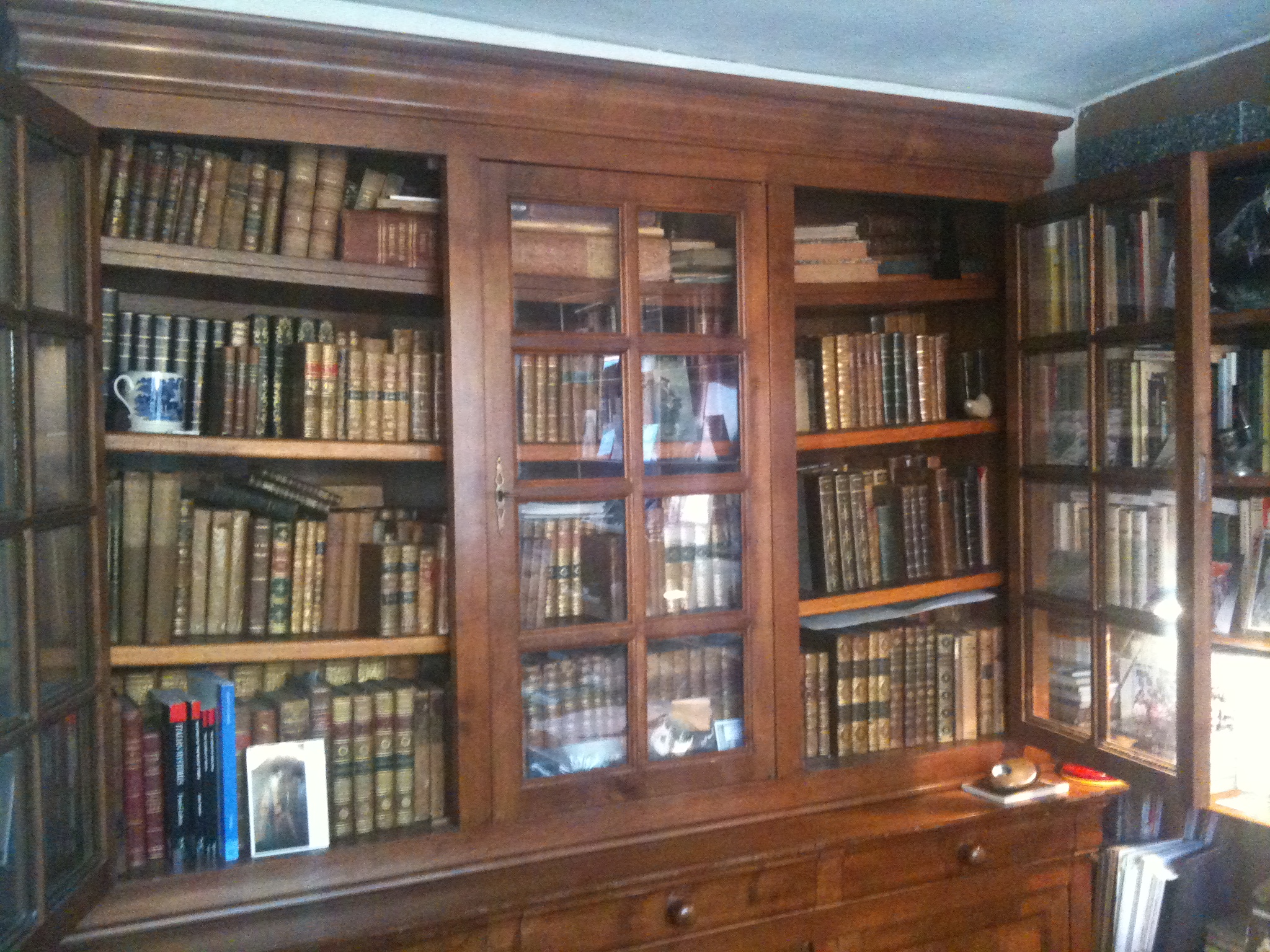
“Oh, the horror!” groan the sagging shelves of Maurice Lévy’s bookcase.

The large, glass fronted, wooden book cabinet in which they were stored occupied an entire wall of his study. It was tightly packed two, sometimes three, rows deep, and its thick wooden shelves were so full that they bowed at the center, giving the impression that the entire bookcase was weighed down by the burden of keeping these precious volumes safe from harm.

Maurice removed each work as though he were encountering an old friend. He would pause for a moment to recall the circumstances of their first acquaintance: when, from whom, and where had he acquired the title? What drew them together, and what special significance justified the volume’s retention and inclusion in the “special” bookcase?  After a moment’s quiet reflection, Maurice would “introduce” the book to me, and we would add it to our growing list of titles destined for Virginia.

As our work progressed, it became clear that Maurice’s collection of French gothic accounted for only a small portion of the overtaxed bookcase’s contents. The remaining titles, he explained, were not his “French gothic collection” and would no doubt eventually find a home in France.  There was neither time (nor encouragement) to explore these volumes: Maurice, after all, was still consulting his library for ongoing research.

I devoted a return visit in 2011 to assessing Maurice’s extensive reference library on the gothic. No further reference was made to the other, intriguing “old” volumes, which remained undisturbed in the bookcase. However, Maurice had decided that it was nearly time to see the French gothics safely installed at U.Va.  We therefore said our good-byes with the understanding that I would return the following summer to oversee packing and shipment. Tragically, Maurice did not live to see the final transfer of his collection to U.Va.  He succumbed to a long illness only weeks before my return to Toulouse in the summer of 2012. It remained for his widow, Ellen, his children, and the U.Va. Library to follow through on the terms of Maurice’s bequest.

But there was a new twist.  Shortly before his death, as Maurice still had not arranged for the disposition of the remaining rare books in the old bookcase, his wife Ellen asked him about them. What should she do with them? “Offer them first to Virginia,” was his reply.  And so she did. It was an interesting prospect, but just what books were they? Ellen could tell me little, occupied as she was with other family and personal matters. And so I arrived in Toulouse late last July to arrange for the final packing and shipment of the ca. 250 volumes in the Lévy French gothic collection, and to ascertain which, if any, of the remaining books might be of interest to the U.Va. Library.
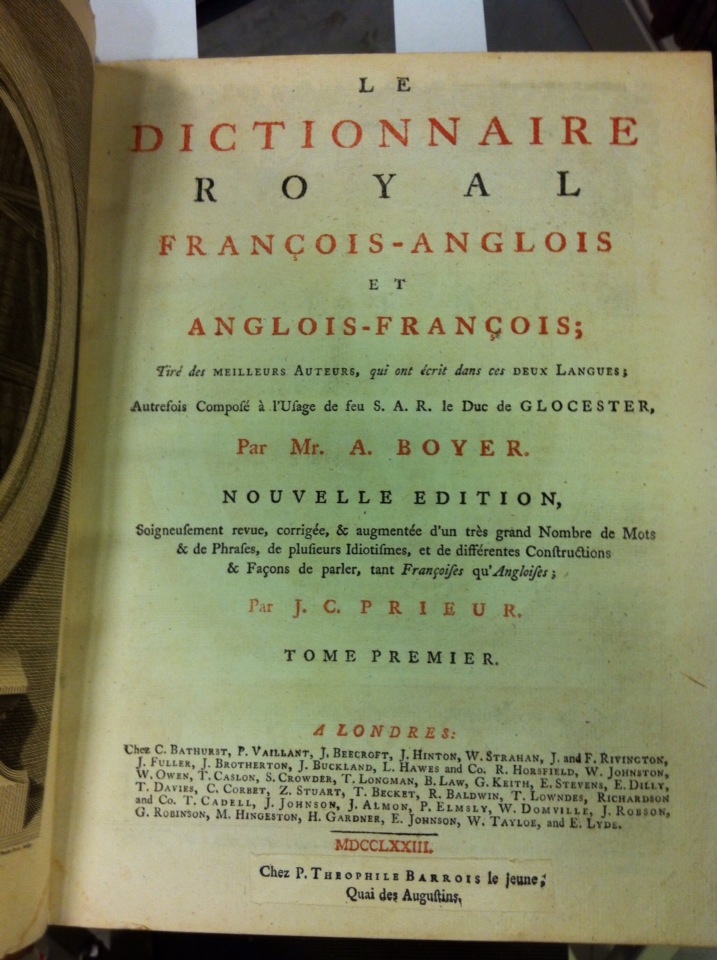
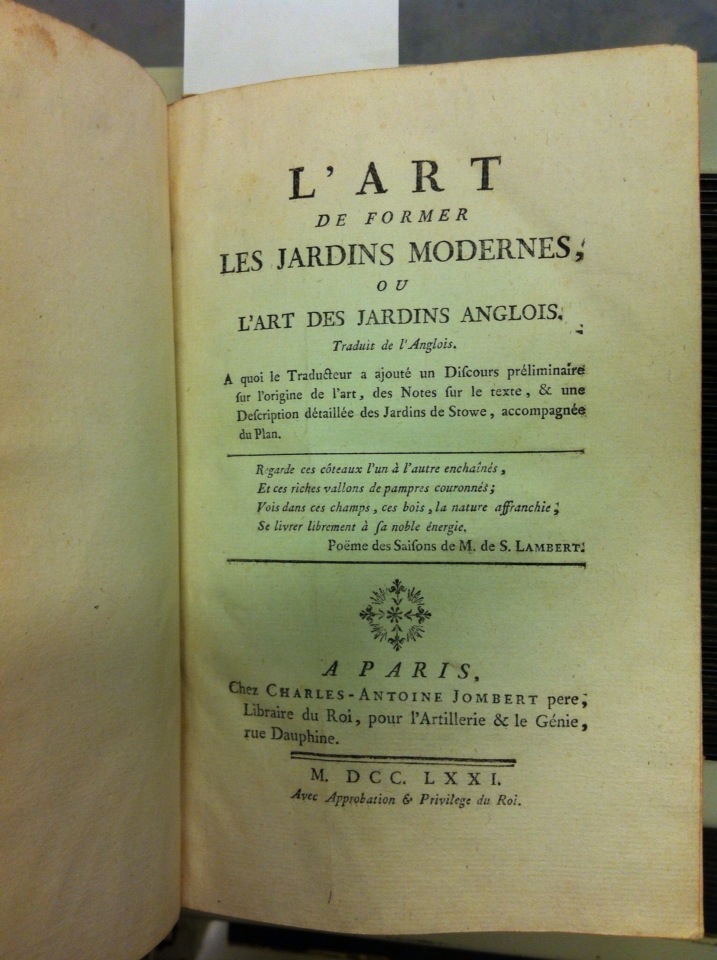
What I encountered was a revelation and delight!  As I made my way systematically through the bookcase, a pattern slowly but unmistakably emerged.  This was not a miscellaneous assortment of old books, but a complementary collection of rare (some extremely rare) and early works of gothic literature, many in  English, augmented by various 18th-and 19th-century source materials used and cited in Maurice’s scholarly writings.  The supplementary material included such works as Edmund Burke’s A Philosophical Inquiry into the Origin of Our Idea of the Sublime and the Beautiful (London, 1801), and Edward Mangin’s An Essay on Light Reading, as it May be Supposed to Influence Moral Conduct and Literary Taste (London, 1808). Maurice’s copy of the Dictionnaire royal françois-anglois, et anglois-françois (London, 1773) would have been an invaluable resource for study of translations, and then there was L’Art de former les jardins modernes; ou l’art des jardins anglois (Paris, 1771). What gothic novel doesn’t have a garden as a significant “setting”!
We were delighted by the new discoveries, and the possibilities that this expanded universe of resources would offer to students of gothic and related themes. It was quickly decided that virtually the entire contents of the bookcase would be packed and shipped to Charlottesville.  In due course, and with only the usual customs and other delays, the collection arrived last fall at the Albert and Shirley Small Special Collections Library, where it now waits patiently in the cataloging queue.
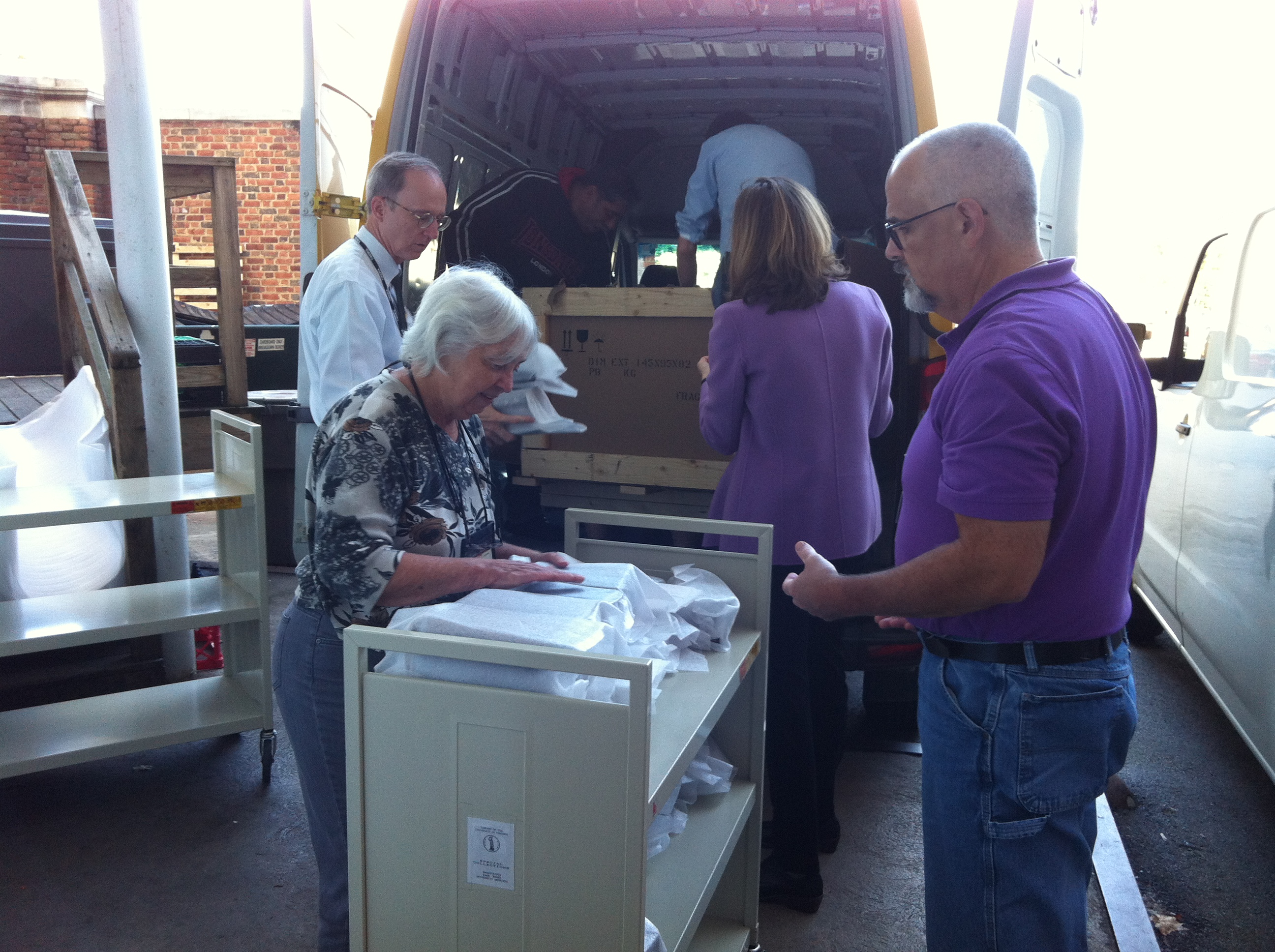
Special Collections staff unload the Maurice Lévy French Gothic collection, October 9, 2012.

The Lévy family, for their part, was delighted and relieved to see Maurice’s treasured “rare book cabinet” transferred virtually intact to its new and permanent home at U. Va., where it will be consulted by future generations of students and scholars of the “gothic,” and serve as a permanent tribute to Maurice’s life and career as a scholar, teacher, and mentor.  Nothing, they felt, would have pleased Maurice more. And like many other collections “under Grounds,” the Lévy collection also serves as an instructive reminder of how great library collections may be built, to a significant degree, by the cumulative legacies of chance encounters.

(A future posting will feature more highlights from the Lévy collection.)
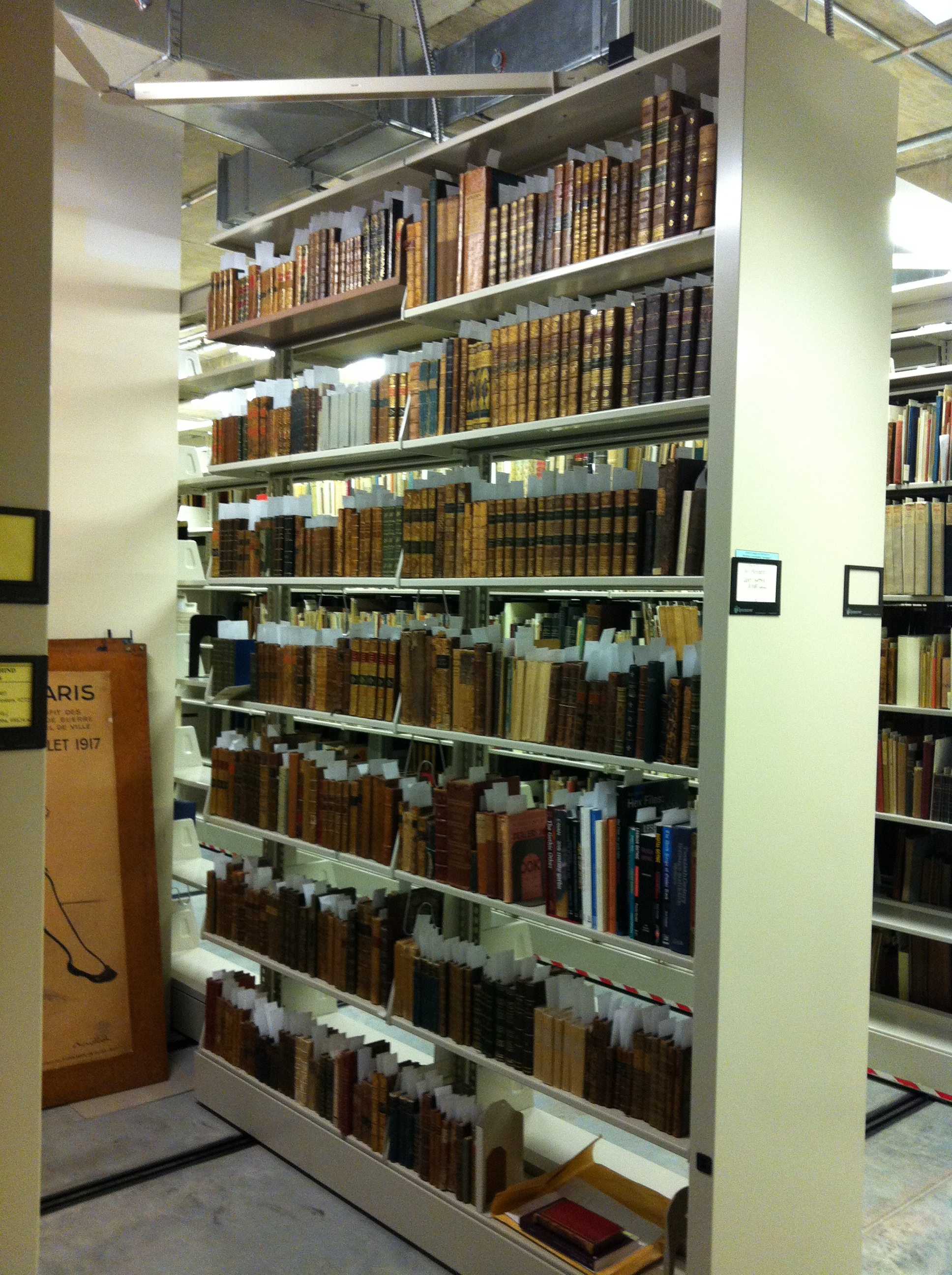
The Maurice Lévy French Gothic collection as it looks today, under Grounds.

Joseph Blotner (1923-2012): A Photoessay in the Stacks

It is almost impossible to imagine the Albert and Shirley Small Special Collections Library without William Faulkner. His portrait hangs in the gallery leading to our reading room, and the typewriter he used while at U.Va. sits prominently in our reception area. Dozens of Faulkner-related manuscript collections and several thousand books by and about him fill shelves and ranges in our stacks.

Late last year, we lost one of the people responsible for Faulkner’s presence at the University: former English Department faculty member Joseph Blotner. Dr. Blotner is perhaps best remembered for his monumental 1979 biography of Faulkner and for his Library of America editions of Faulkner’s works; the editions and his popular 1984 condensed version of the biography remain in print today and are standard sources for the study of one of the greatest writers of the twentieth century. After a long career as a biographer, editor, and academic, Professor Blotner passed away at his home in Oakland, California on November 16, 2012.  His obituary in the New York Times reflects his influence and reputation nationally, while his work here at U.Va. was summarized in a lengthy 2007  appreciation of Blotner’s legacy published on the university’s main news site, “U.Va. Today.”

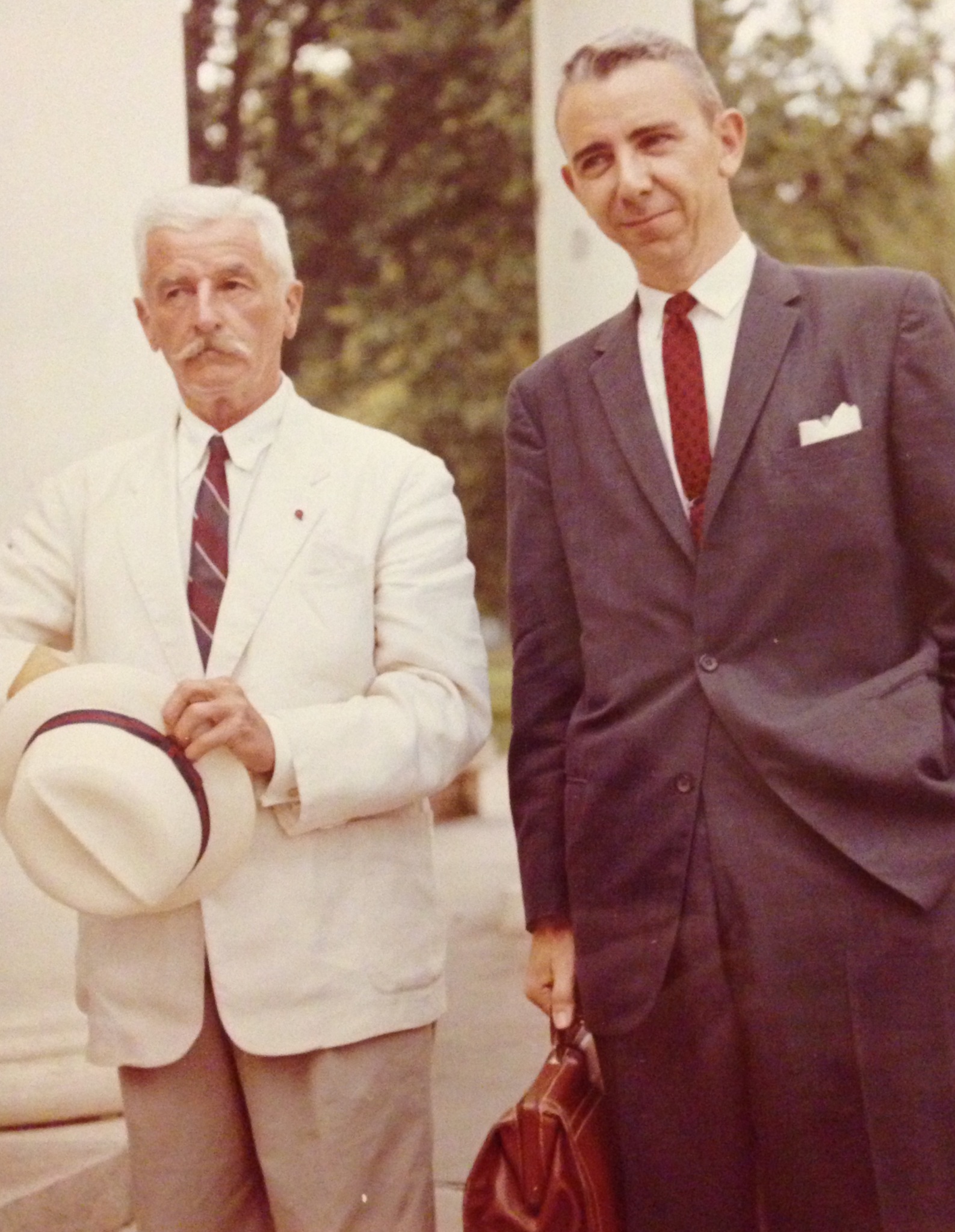
William Faulkner and Joe Blotner standing near the Rotunda at the University of Virginia, May 1962. (Photograph by Dean Cadle)

Dr. Blotner left both a personal legacy and a paper legacy at the university, the latter in the form of manuscripts and books in the Albert and Shirley Small Special Collections Library. The papers of major biographers and editors are consulted by the scholars who follow in their wake, and there is much here of value for future generations of Faulkner scholarship.

As a relatively new arrival on the library staff, I wasn’t sure what I’d find when I took the opportunity recently to go down into the stacks to investigate our holdings related to Dr. Blotner’s work. I brought my camera along and shot some photos of some of my favorite finds. I hope they provide a sense of the richness of our Blotner holdings:

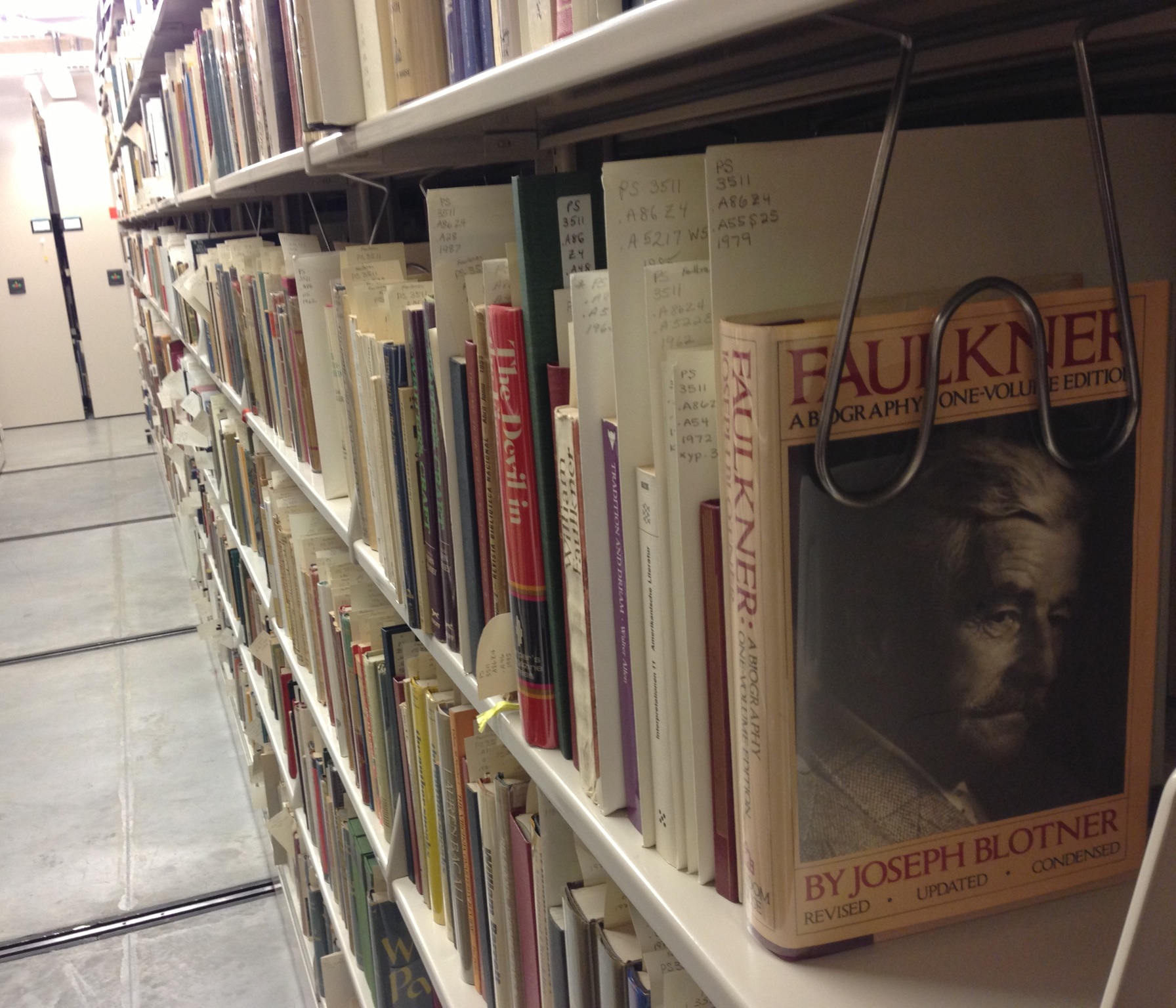
Joseph Blotner’s _Faulkner: A Biography: One-Volume Edition_ (New York: Random House, 1984). The book is seen here in the Faulkner section of the Albert and Shirley Small Special Collections general stacks. All of the books visible in this picture are by or about William Faulkner, and this captures only a segment of our Faulkner book holdings.

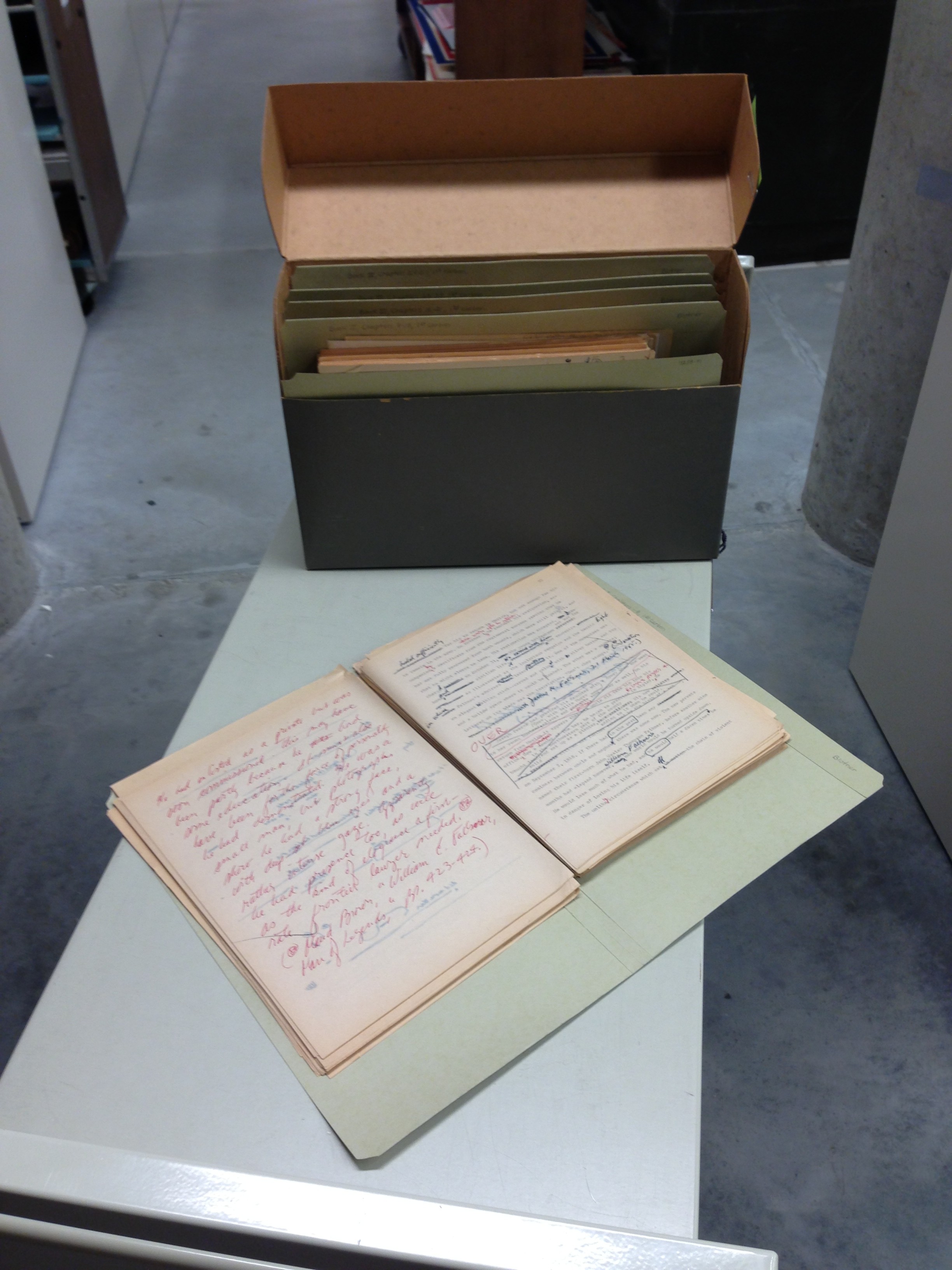
A heavily annotated draft of Blotner’s Faulkner biography. This folder contains a lengthy discussion of Faulkner’s time in New Orleans. (MSS7258-m).


A 1960 draft schedule of Faulkner’s appearances at the University of Virginia, including a meeting with the English Club in Alderman Library, a group of blind visitors, and law professor Marian Kellog’s Uruguayan Seminar. Joe Blotner’s name appears at the top of the page, presumably as organizer of the visits, and the phrase “Chief’s Sched” at the bottom. (MSS 7362. Photograph by Molly Schwartzburg)

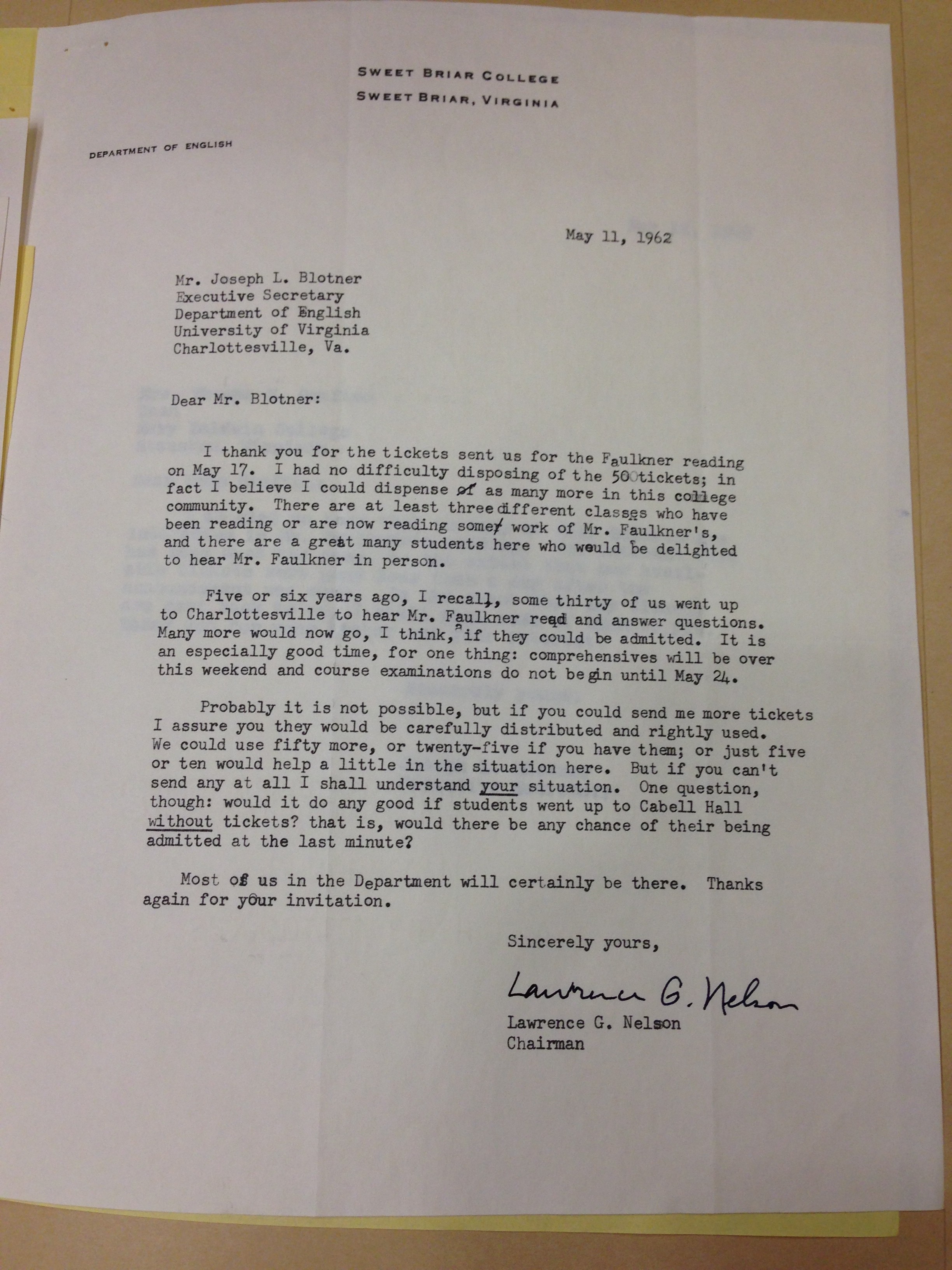
In 1962, Faulkner gave a reading from his new novel, _The Reivers_, for which Joe Blotner sent out tickets to English Departments across the region. A generous stack of letters from the faculties of these departments is held in the collection, and with rare exception, the tickets were all taken and more requested. Here, the chair of the English Department at the all-women Sweet Briar College, located about an hour south of Charlottesville, requests as many tickets as possible for his community. (MSS 7362. Photograph by Molly Schwartzburg)

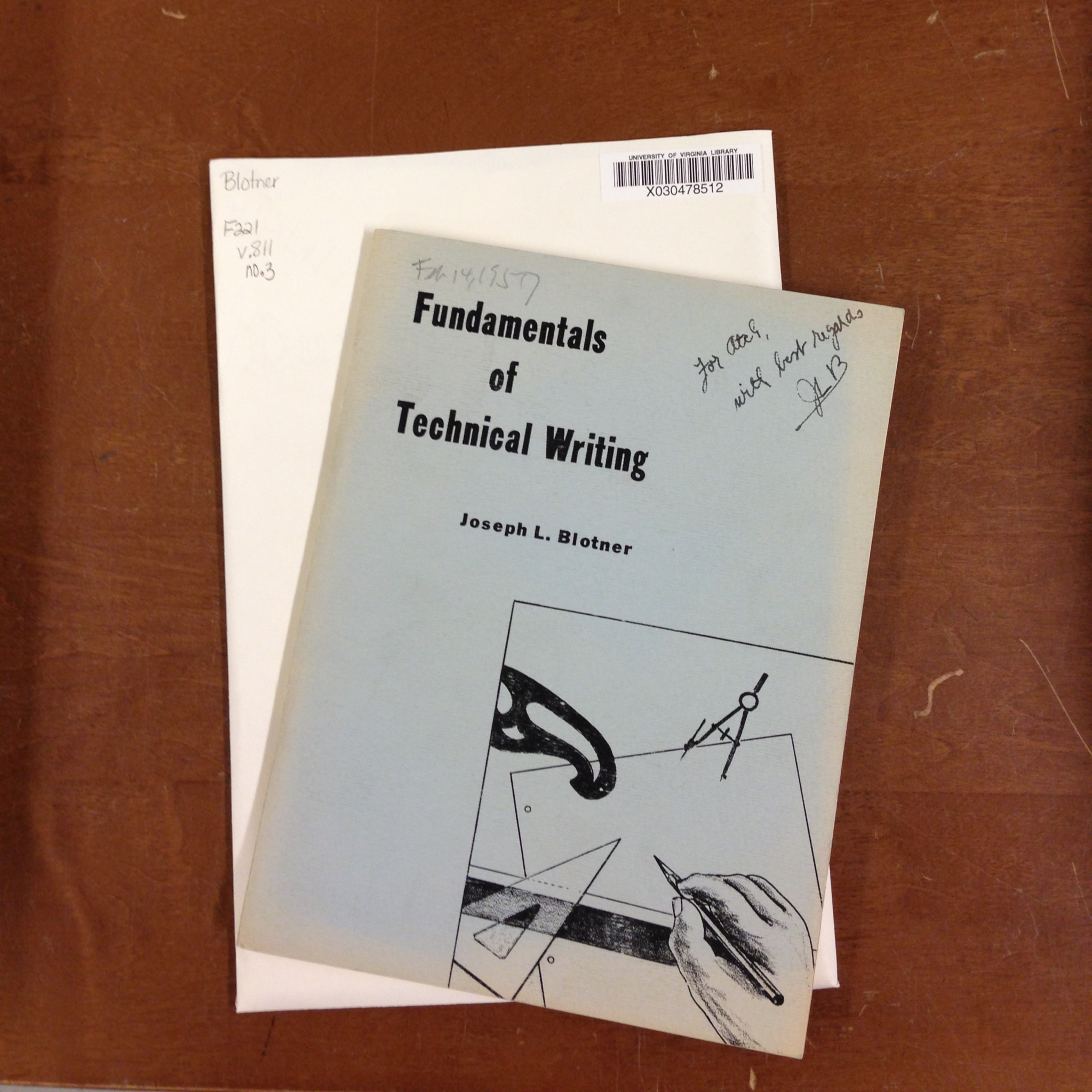
The book holdings in Special Collections contain almost seventy works authored by Joe Blotner, including several books, magazine articles, and other materials relating to Faulkner and other writers. Shown here is our earliest Blotner book, a guide to technical writing based on his experience working in the field before he took on his first academic post at the University of Idaho. This copy is inscribed to Atcheson Hench, who joined the faculty of the English Department at U.Va. in 1922. (F22 v.811 no3)

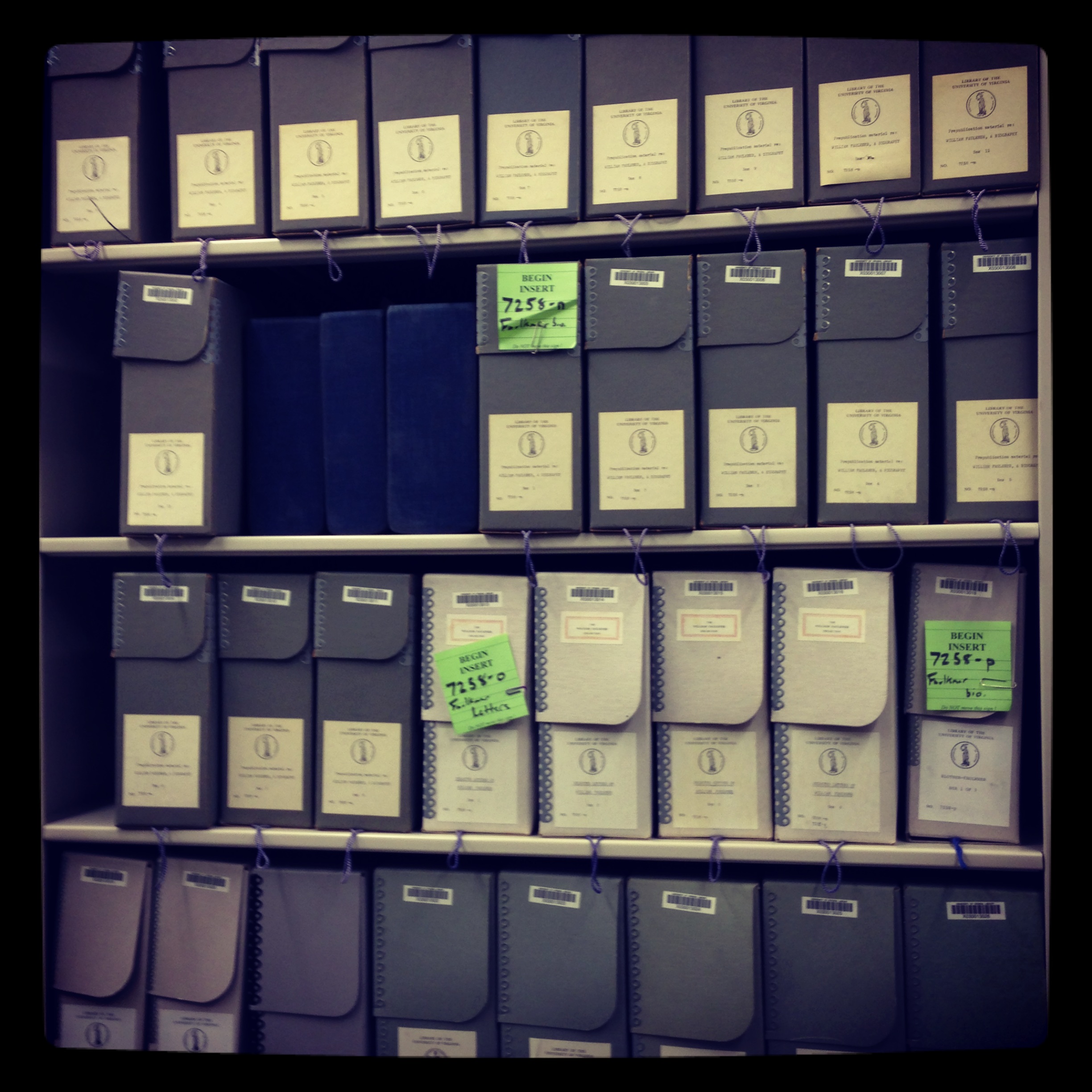
A curator’s favorite sight: lots of boxes, lots of mysteries until they’re opened. These are the papers of Joseph Blotner, which entered the collections in various accessions and are cataloged and available for use. The green slips show our archivists’ working annotations.


On View Now, in Celebration of Martin Luther King Day.

Special Collections faculty member Ervin Jordan has curated an exhibition entitled, “Embracing Equality: Before and Beyond Brown v. Board of Education, 1950-1969: An American Civil Rights Exhibition.”  The exhibit highlights local, state and national Civil Rights events through selected legislation, letters, reports, speeches, and photographs including:

  • the 1950 lawsuit of Gregory Swanson, the University of Virginia’s first African-American student;
  • a printed copy of the United States Supreme Court decision Brown v. Board of Education;
  • the 1961 letter of a African-American schoolgirl who complains about desegregation
  • a program and route map for the 1963 March on Washington;
  • a 1964 Martin Luther King letter discussing the Civil Rights Movement’s “non-violent army”
  • UVA administrator William Elwood’s advisory document prepared for a public meeting at a black Charlottesville church on impact of the Civil Rights Act of 1964 upon public schools

“Embracing Equality” will be on display at the Albert and Shirley Small Special Collections Library, First Floor Lobby, until March 1, 2013.

March on Washington program and route map, August 28, 1963. (MSS 8003-A, Photo by Molly Schwartzburg)

Class Notes: Mapping the Globe from Ancient Times to Google Maps

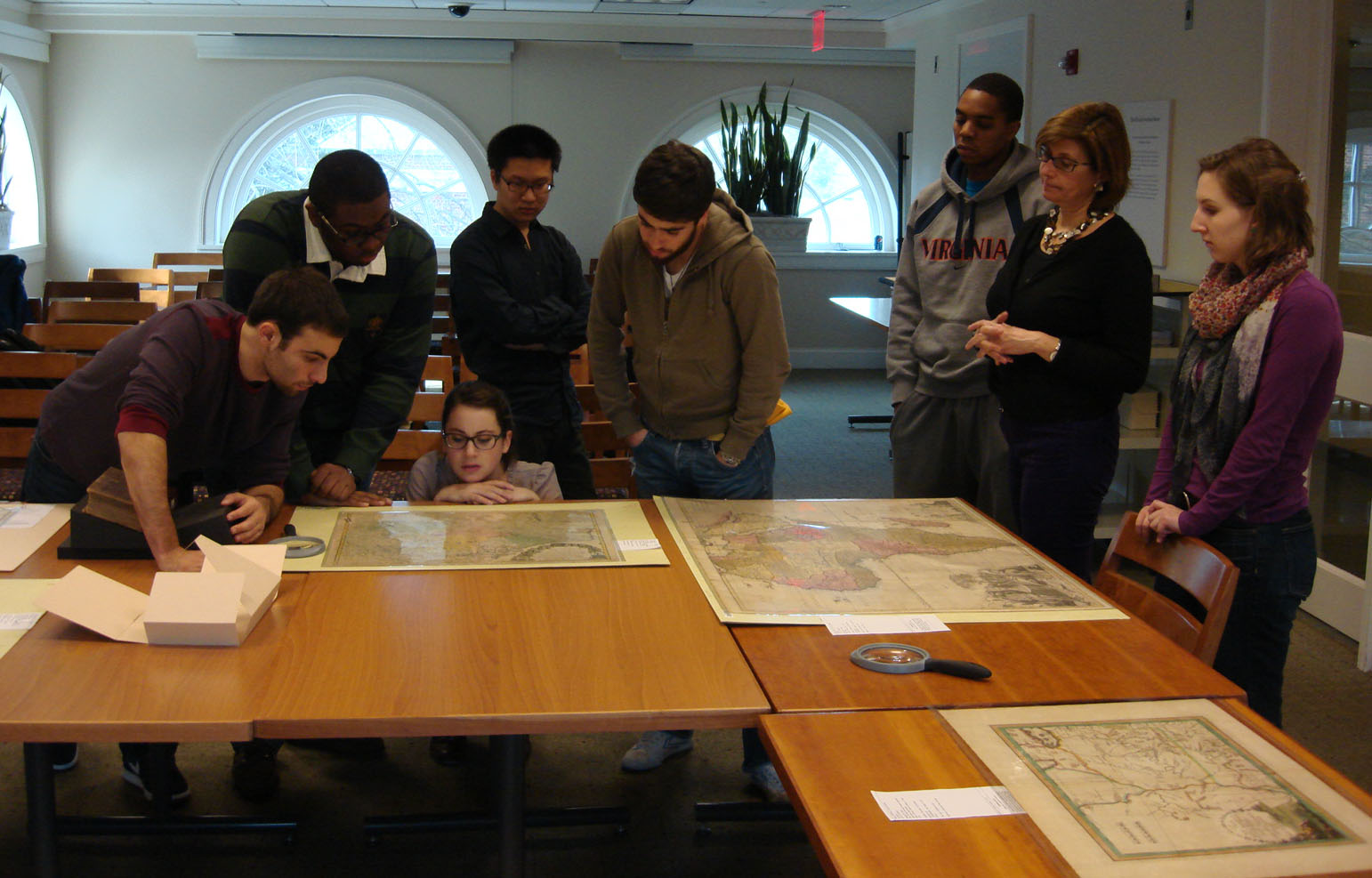
Fresh into the new year, Associate Professor Francesca Fiorani brought her January Term class, Mapping the Globe from Ancient Times to Google Maps, to Special Collections to take advantage of our extensive map collection. This particular course focused on the visual, linguistic, political, and religious rhetoric of maps and map making.

Francesca Fiorani (second from right) and her January Term students examine a map. (Image by Petrina Jackson)

Professor Fiorani’s engaged and intense group of students spent six sessions in Special Collections, examining, thinking about, and challenging themselves and their classmates while studying some of our most exquisite maps.  The class later went to the University of Virginia Library’s Scholars’ Lab to explore Geographic Information Systems (GIS), which captures, analyzes and displays maps electronically.

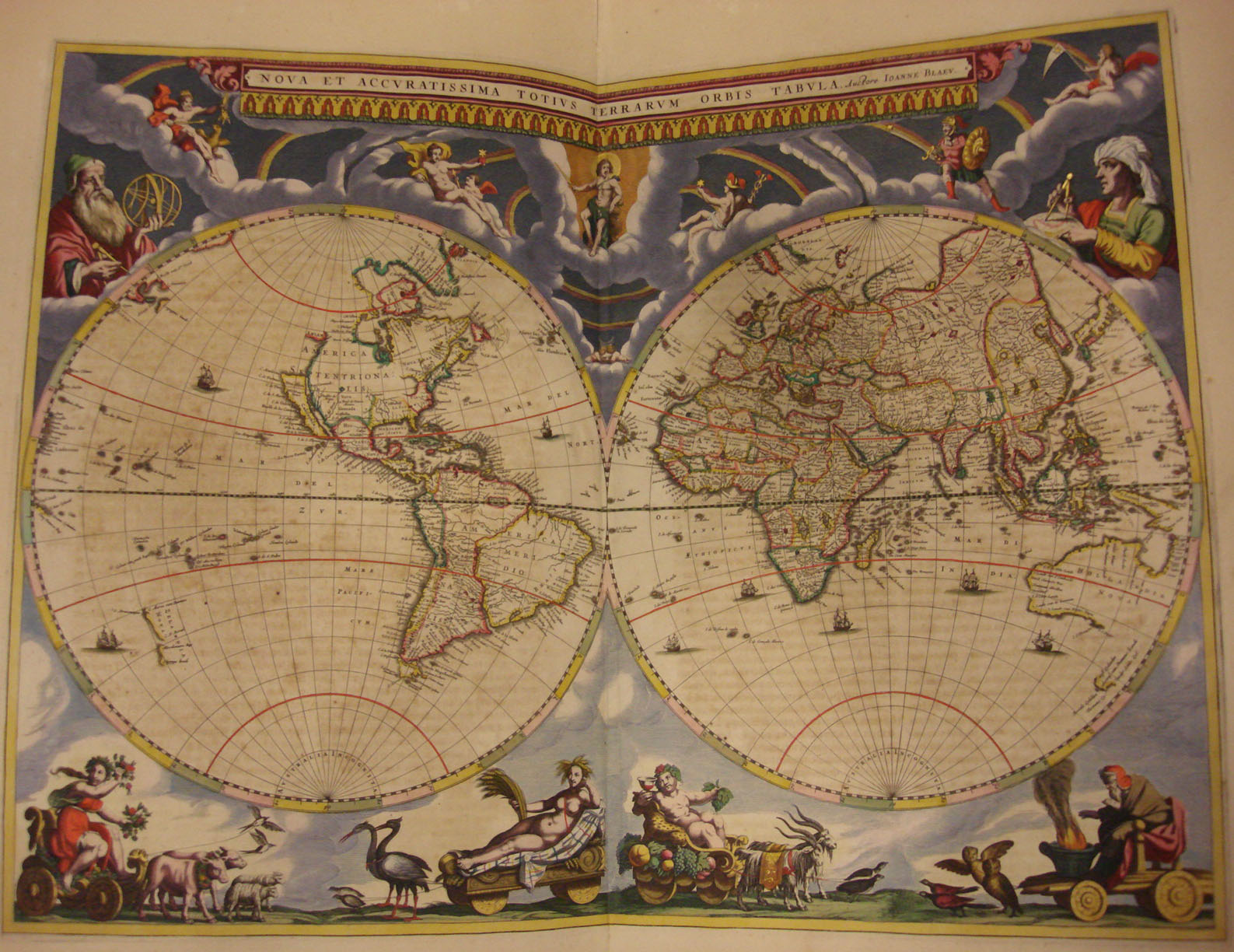
Map of the world from the Blaeu Atlas, 1662. (A 1662 .B53 v.1, Tracy W. McGregor Library. Image by Petrina Jackson)

To measure the impact of seeing the maps in person, I asked the students, “How would your experience be different if you only saw these maps in digital form?” Here are some of their responses:

“Being able to see these maps in person allows for greater understanding and appreciation for the worksmanship and detail that would perhaps be lost if [they were] seen only in digital form.  Seeing the actual physical size and dimensions of these maps provides greater insight into how these maps would have been used or displayed when [they were] originally published.”

“These maps represent the work of many individuals and being able to see first-hand the mapping activity of the past, through manuscripts and facsimile, gave me a better understanding and appreciation of the objects themselves.”

“Having tangible maps also makes the class seem more authentic.  I like having a hands-on education.”

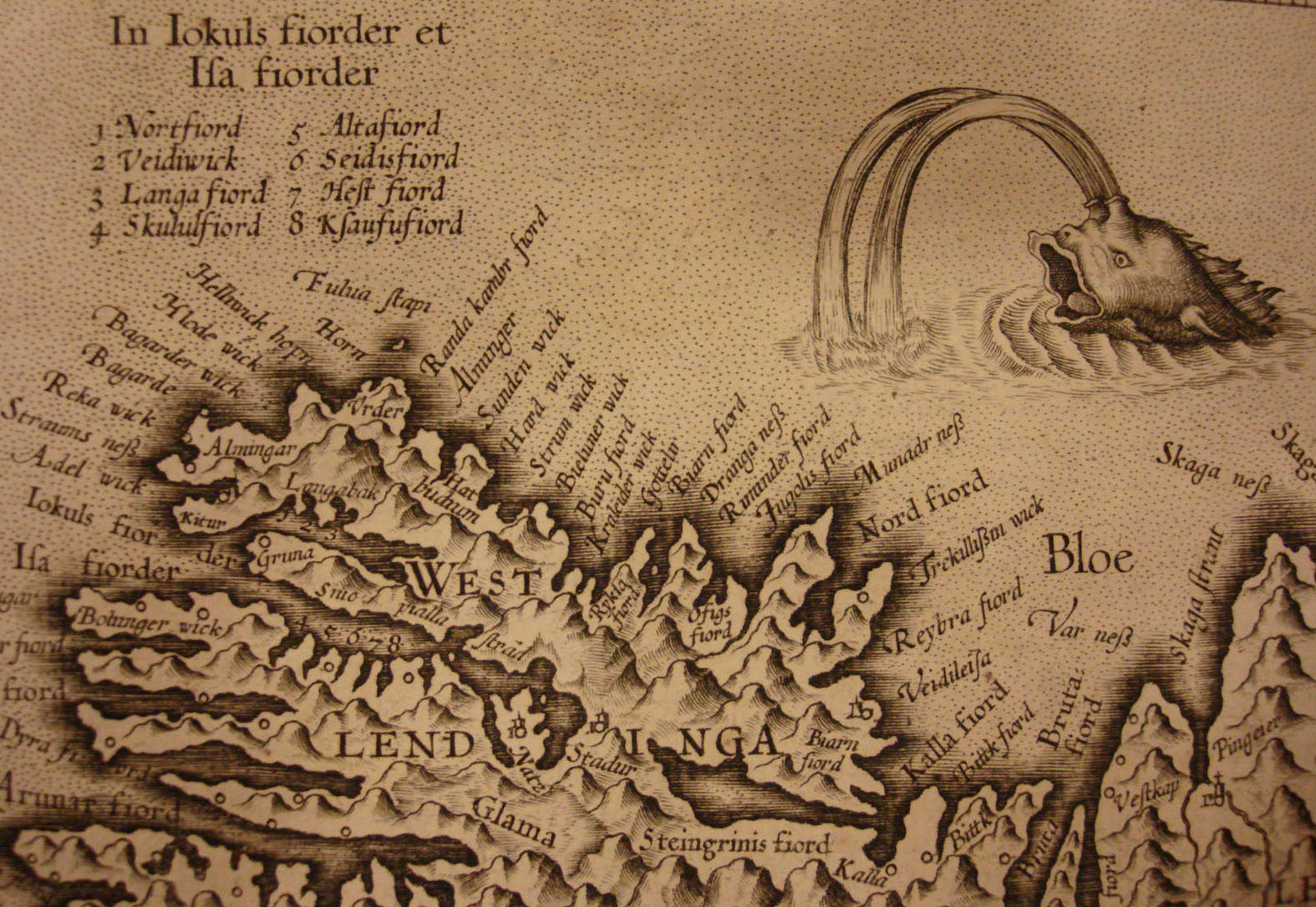
Detail from the map of Islandia (Iceland) from the Mercator Atlas, 1606. (A 1606 .M47, Tracy W. McGregor Library. Image by Petrina Jackson)

I also asked the students what surprised them about the maps they saw in Special Collections and got a variety of responses.  The following was the most representative:  “I was surprised by the size of some of these maps.  Having seen many on the computer screen, I was floored by the actual sizes, both enormous and small, [in which] these maps have come to us.”

Map of Virginia and Carolina by Giovanni Maria Cassini, 1797. (Area Table 75 1797 Cassini, Tracy W. McGregor Library. Image by U.Va. Library Digitization Services)


This Just In: What’s New in the McGregor Library

1938 was an annus mirabilis for the U.Va. Library and its Special Collections: Alderman Library opened; Special Collections moved into purpose-built quarters on the second floor (today’s McGregor Room); and U.Va. was given the Tracy W. McGregor Library of American History.  This extraordinary holding of several thousand rare books, maps, and manuscripts, assembled by Detroit philanthropist Tracy W. McGregor (1869-1936), instantly provided U.Va. with a world-class collection of primary sources for American history.  In 2013 the McGregor Library will celebrate its 75th anniversary with a major exhibition opening in October.

Since 1938 the McGregor Library has nearly tripled in size, thanks to substantial ongoing support from the McGregor Fund.  The following sampling from the several dozen acquisitions made in 2012 suggests not only the McGregor Library’s range and depth, but also some of the criteria we use in selecting additions.

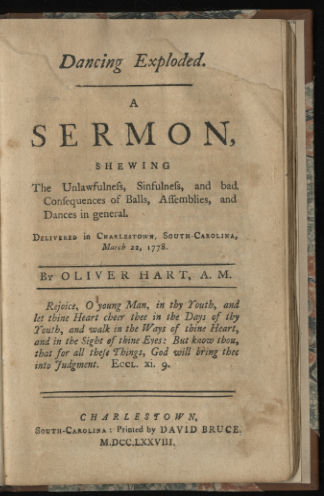
Oliver Hart, Dancing exploded. Charlestown, S.C.: David Bruce, 1778. (A 1778 .H27, McGregor Endowment & Associates Endowment Funds, image by U.Va. Library Digitization Services)

One of the McGregor Library’s greatest strengths is its coverage of the American South, and this remains a collecting priority.  Particularly desirable are rare Southern imprints such as Oliver Hart’s memorably titled Dancing exploded, published in Charleston, S.C. in 1778.  A Baptist minister, Hart (1723-1795) first preached this sermon condemning dancing and fancy dress balls in 1759.  Nineteen years later, he found it necessary to fix his admonition in print. No sooner had the embers of Charleston’s devastating January 15, 1778 fire cooled than “we had Balls, Assemblies and Dances in every quarter.”  The conflagration, coupled with the ongoing privations of the American Revolution, were for Hart “so many loud calls to repentance, reformation of life, and prayer, that the wrath of God may be turned away from us.”  Hart specifies fourteen evils of dancing, including wasted time, unnecessary expense, vulgar music, and immodesty of conversation and movement. “Thus the heart becomes a sink of uncleanness—a cage of all manner of abominable and filthy lusts.”  Only six copies are recorded of this, the third earliest American work on dance.  (The McGregor Library also holds the earliest, Increase Mather’s An arrow against profane and promiscuous dancing.)

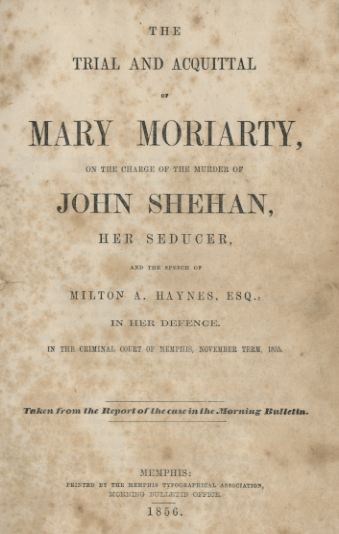
The trial and acquittal of Mary Moriarty. Memphis: Memphis Typographical Association, Morning Bulletin Office, 1856. (A 1856 .T75, McGregor Endowment Fund, image by U.Va. Library Digitization Services)

We are especially eager to add unrecorded works to the McGregor Library.  One might think that copies of virtually everything printed a century or two ago would have found their way into libraries by now, but previously unknown works continue to turn up with surprising frequency.  It is our mission to make these new discoveries accessible to scholars.  A case in point is The trial and acquittal of Mary Moriarty: the only known copy surfaced only last year and was quickly snapped up for the McGregor Library.  An Irish immigrant working as a domestic in antebellum Memphis, Mary Moriarty was engaged to wed John Shehan, the father of her child, only to have Shehan back out at the last minute.  In a rage, Mary stabbed him to death in broad daylight.  Attorney Milton Haynes expertly defended her in front of an all-male jury, arguing per the Bible “that he who seduces a maid, upon the most solemn vow of marriage, hath committed a worse crime than that of murder!”  The jury then “retired for a few minutes, and returned a verdict of ‘NOT GUILTY,’ the announcement of which was enthusiastically cheered by the large crowd of people in the Court House.”  Capitalizing on the case’s notoriety, the Memphis Morning Bulletin condensed and repackaged its newspaper coverage in this crudely printed pamphlet.

Historia nova, e complete da America. Lisboa: Officina Litteraria do Arco do Cego, 1800. (A 1800 .H57, McGregor Endowment Fund, image by U.Va. Library Digitization Services)

The McGregor Library is especially rich in “European Americana.”  These European imprints provide many of our best primary sources for New World discovery and exploration, as well as alternate perspectives on American history and culture.  Historia nova, e complete da America is the latest addition.  This rare history of the Americas from Columbus’s discovery to 1763 was compiled for a Portuguese audience from a variety of sources.  Printed in 1800 at the newly founded “Arco do Cego” press (still active as Portugal’s Imprensa Nacional), the Historia reflects Portugal’s late 18th-century effort to invigorate its arts and sciences.

William Charles. A wasp taking a frolick, or a sting for Johnny Bull. [Philadelphia]: Wm. Charles, [ca. 1813] (Broadside 1813 .C55, McGregor Endowment Fund, image by U.Va. Library Digitization Services)

A little-known strength of the McGregor Library is its collection of early 19th-century American satirical prints, recently augmented by two rare etchings by William Charles. Around 1806 Charles emigrated from Scotland to the United States, where he helped to introduce the thriving British tradition of political caricature.  During the War of 1812 Charles issued a number of prints which vividly and humorously convey American popular opinion.  In A wasp taking a frolick, or a sting for Johnny Bull, Charles references the heroic naval engagements of the U.S.S. Wasp and Hornet during the war’s first months. The Hornet captured several British ships, and the Wasp also “stung” John Bull by capturing two British warships before surrendering to a far larger British vessel.

Lunsford Lane, The narrative of Lunsford Lane. 3rd ed. Boston: [Lunsford Lane], 1845. (A 1845 .L3, McGregor Endowment Fund, image by U.Va. Library Digitization Services)

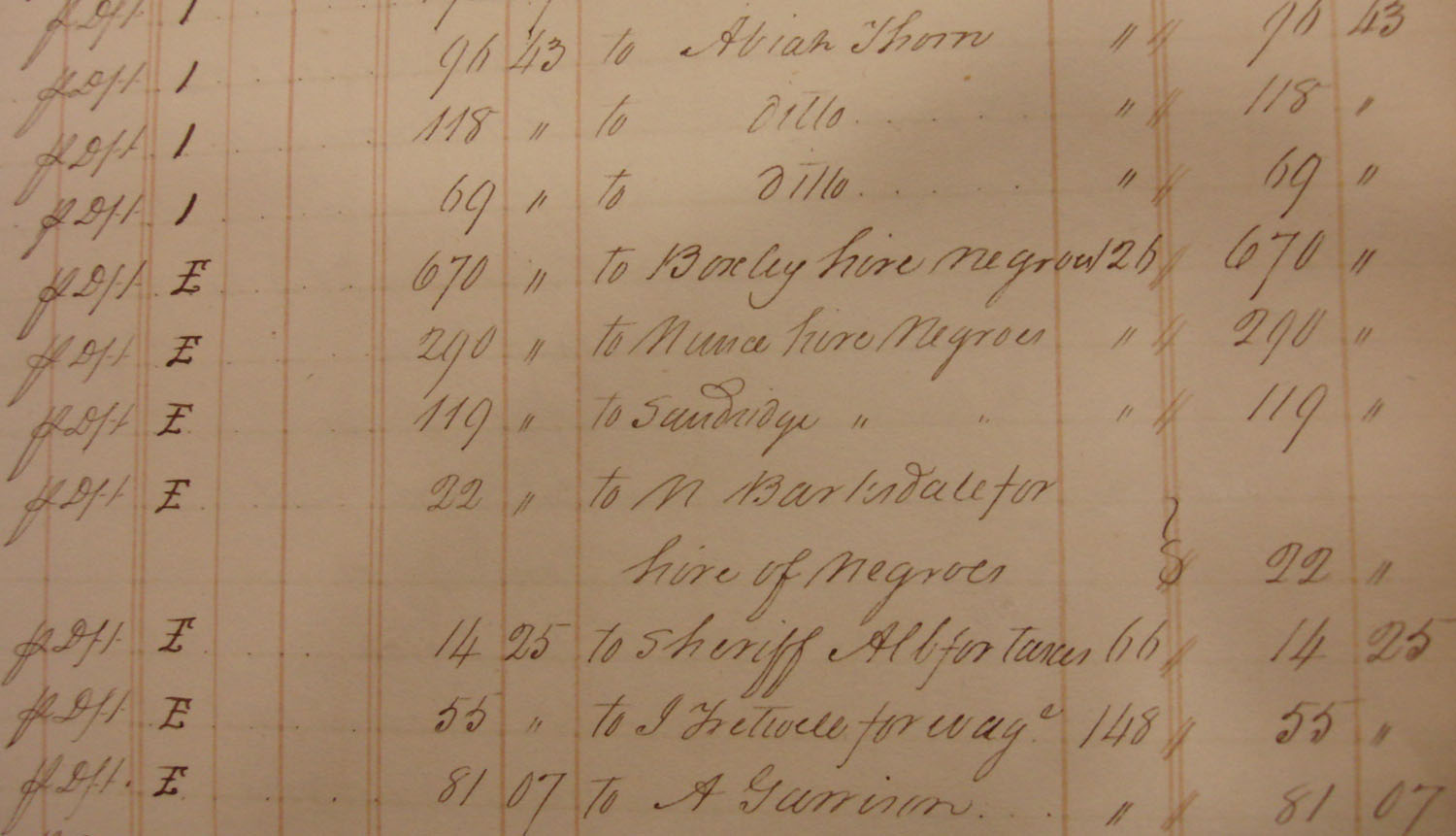
The McGregor Library possesses an enviable collection of antebellum slave narratives, of which The narrative of Lunsford Lane, in its original printed wrappers, is a noteworthy example. Typically these narratives were self-published (as here) and sold for the author’s benefit while traveling the anti-slavery lecture circuit. Lane was born into slavery on a plantation near Raleigh, N.C., but his wife and growing family were owned by a different master.  With his owner’s tacit consent, Lane rented out his own labor so that he could establish a pipe and tobacco shop in Raleigh.  It thrived, in part because Lane was careful to maintain the appearance of being poor and uneducated.  Eventually Lane earned enough to purchase his freedom, open more businesses, and begin to emancipate his wife and children.  By 1840, however, Lane found himself the target of whites fearful that he was spreading abolitionist sentiments. Two years later he fled with his newly freed family to Boston.

Sneak Peek: the exhibition “Drawn From Life” opens January 22

On Tuesday, January 22, visitors to the first floor of Harrison/Small will see a new set of materials on exhibition in the main gallery. We’re cutting mat board, writing labels, and measuring frames for “Drawn From Life: Collecting Cartoons and Caricatures.”  This 40-item exhibition reveals little-known gems–and some quirky treats–from across our collections, alongside a number of items loaned by Charlottesville resident John Francis.

John’s grandfather, Edward William Francis, became acquainted with a number of Britain’s leading commercial artists in the 1910s and 1920s;  he successfully requested cartoons, caricatures, and other small pieces of original art from major figures such as Heath Robinson and Harry Rountree, as well as lesser known artists who are unknown today. John inherited the resulting collection, which features many of the genres, styles, and themes that dominated the era known as the “Golden Age” of cartooning. We’ve selected complementary items from our holdings, including other works by the same artists, periodicals and books in which similar work is to be found, and other original art from the same era.

Come to the exhibition to learn more about how Edward William Francis gathered together his specimens and how Special Collections has built its own holdings in this varied field over the course of many decades. Until then, here are some samples to tempt you:

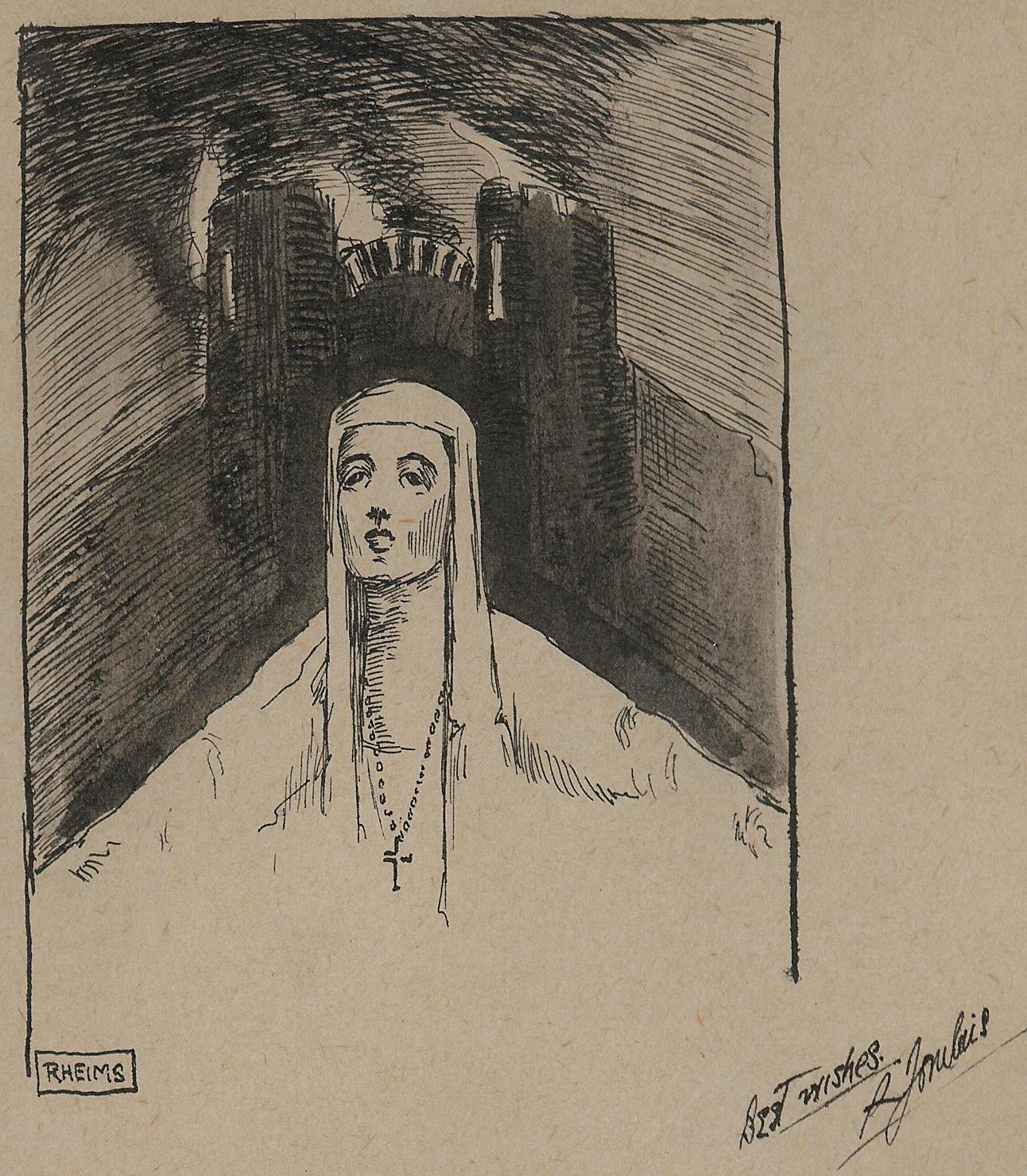
Unidentified artist, “Rheims,” ca. 1918. (Collection of John Francis.)

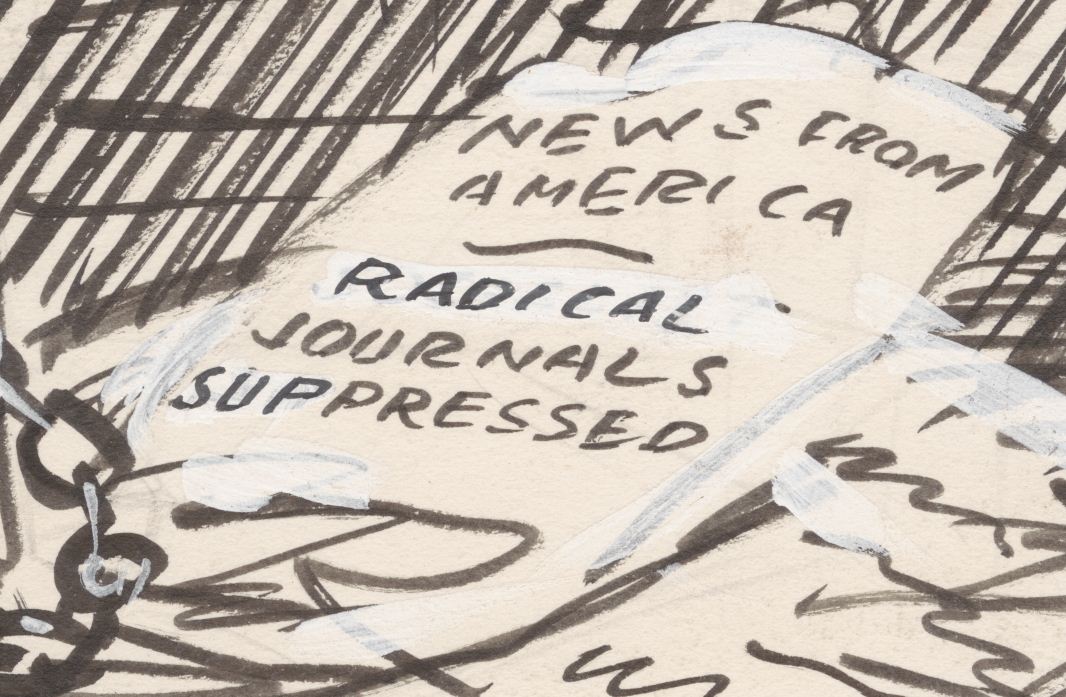
A detail from Oscar Cesare’s “Making the World Safe For Autocracy,” ca. 1917-1918. (MSS 4101. Image by Special Collections staff.) White ink shows final edits to this section of the much larger cartoon, revealing that the word “socialist” has been replaced by the world “radical.”

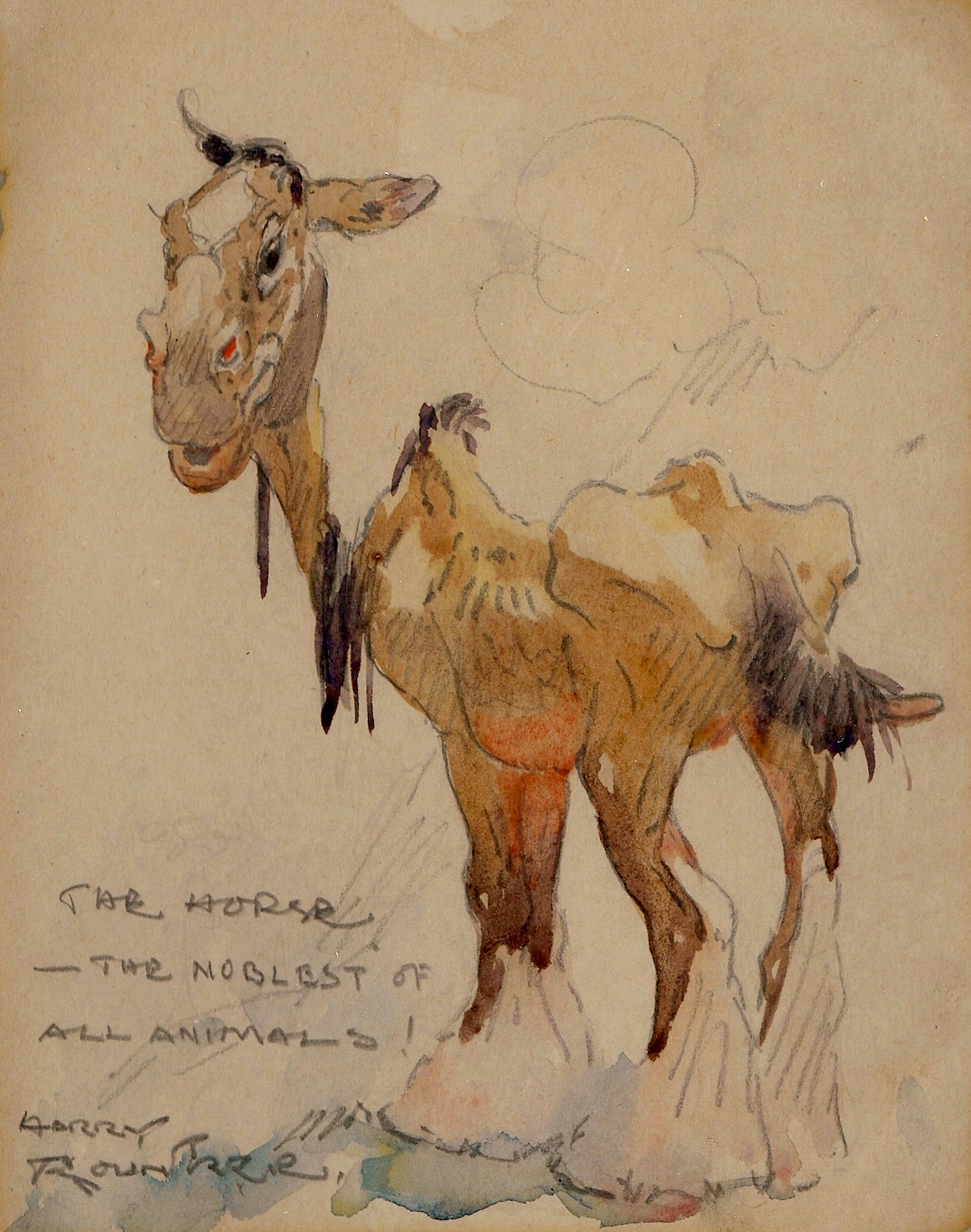
Harry Rountree, “The Horse–the noblest of all animals!,” undated. (Collection of John Francis.)

Detail from Peggy Bacon, “The Country Girl Who Decides to Be an Artist,” undated. (MSS 6442. Image by Special Collections staff.)

Anatomy of a Lesson Plan: History of Art I

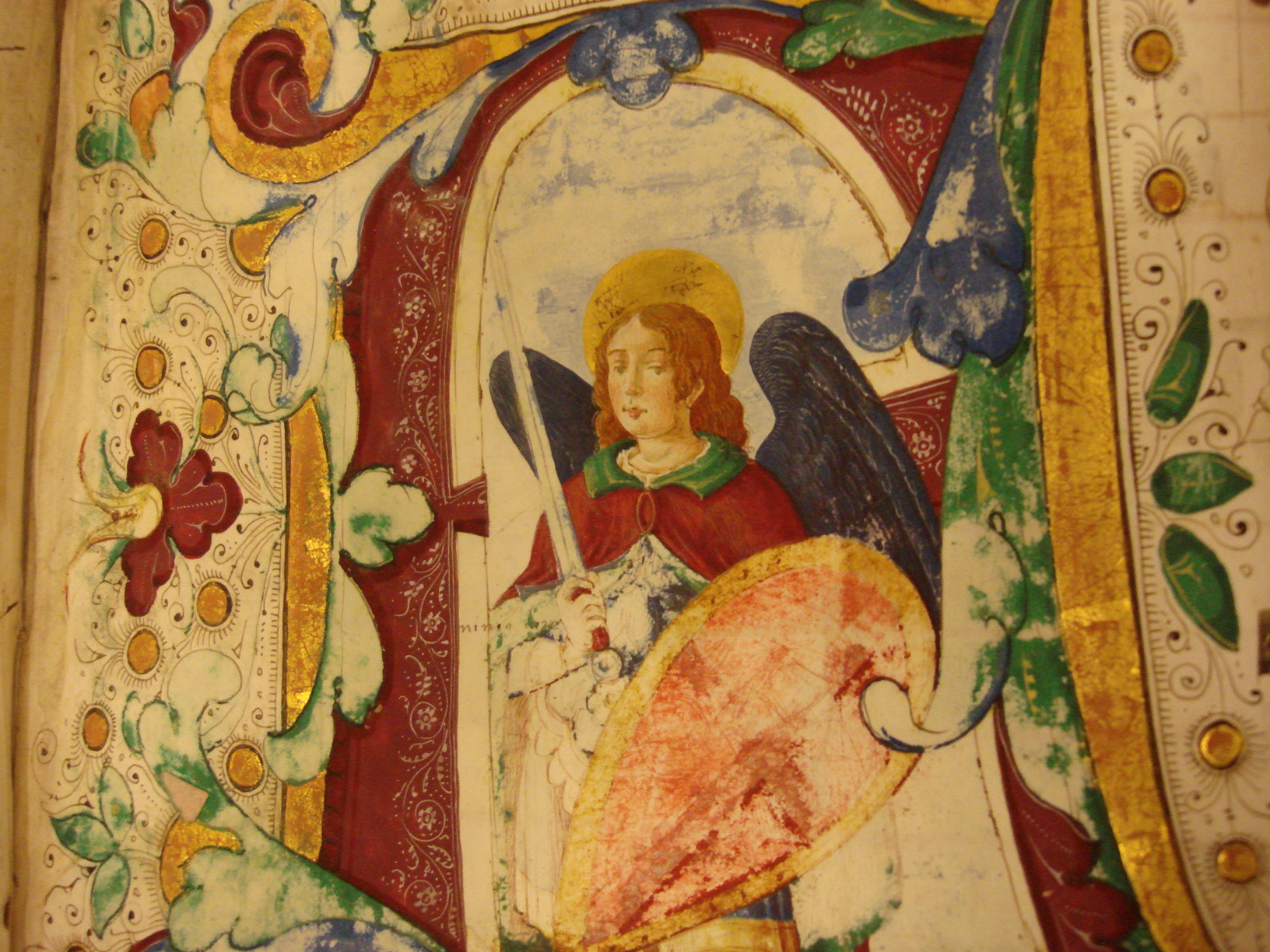
Historiated capital featuring Michael in a choir book, ca. 1450 (MSS 229, v. 1. Image by Petrina Jackson.)

As part of my duties as head of instruction and outreach, I am contacted each semester by many professors who wish to bring their classes to Special Collections, so that they can introduce them to original artifacts.  This fall, all 10 sections of Professor John Dobbins’s History of Art I course paid a visit to Special Collections to explore our illuminated manuscript holdings.  With 127 first-year students, four instructors, five Special Collections staff, and some of the most precious and delicate collection materials, I had a big project on my hands!

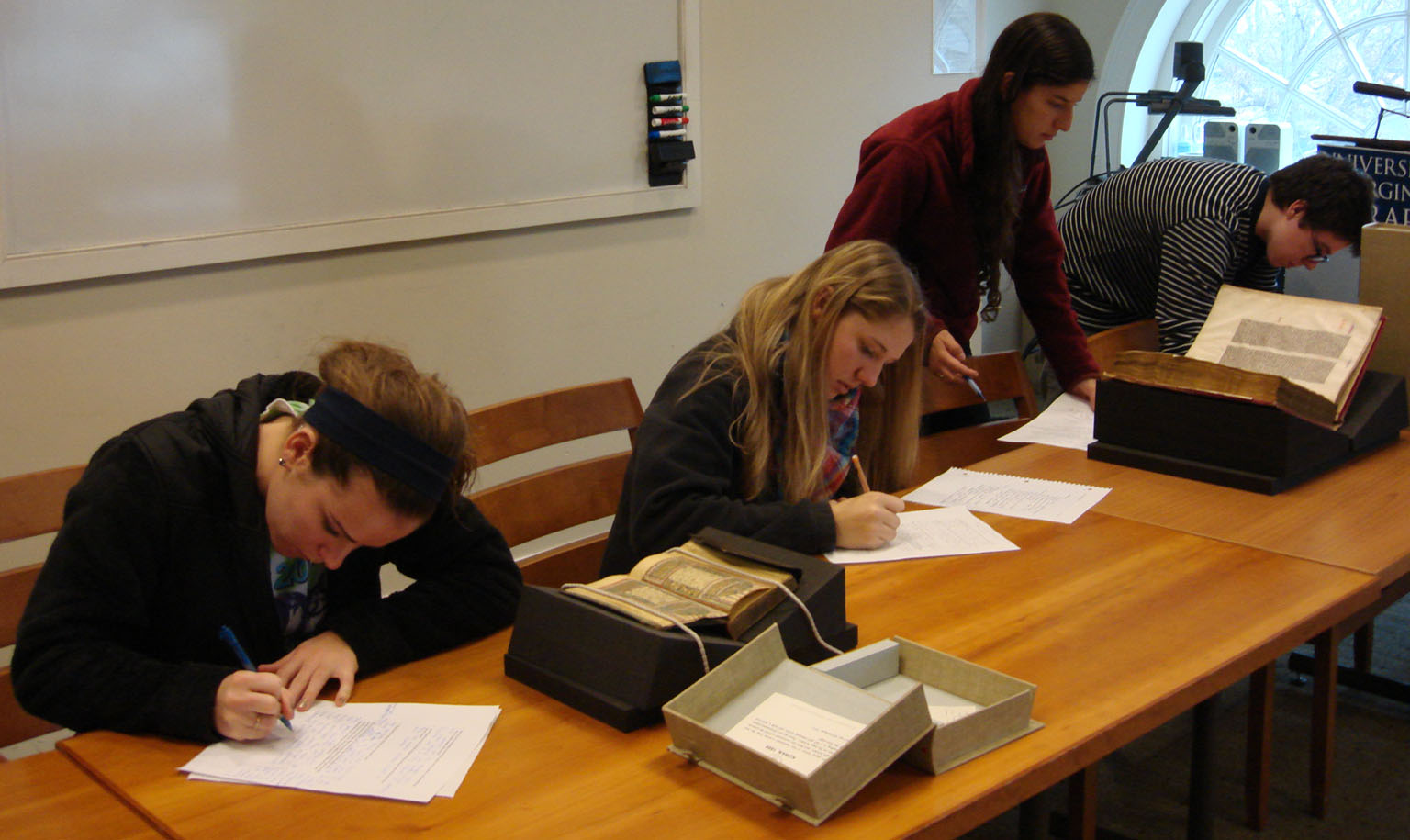
In preparation for the visit, Professor Dobbins and his teaching assistants, spearheaded by Tracy Cosgriff, arranged time in Special Collections to review our hand-decorated religious manuscripts, ranging from a fourteenth-century prayer book to a nineteenth-century Koran. From this meeting, they created a lesson plan.  The lesson, which emphasized proper handling of rare materials and identification of the elements of medieval manuscripts, turned out to be a well-balanced collaboration between Special Collections staff, the teaching assistants, and the students.

What we wanted students to take from the lesson:

  • know how to request an item in Special Collections;
  • know how to properly handle medieval manuscripts;
  • be able to identify and describe the iconography in the manuscripts and relate it to its text;
  • be able to explain some of the purposes of text in the margins of the books; and
  • be able to identify the uses of the manuscripts.

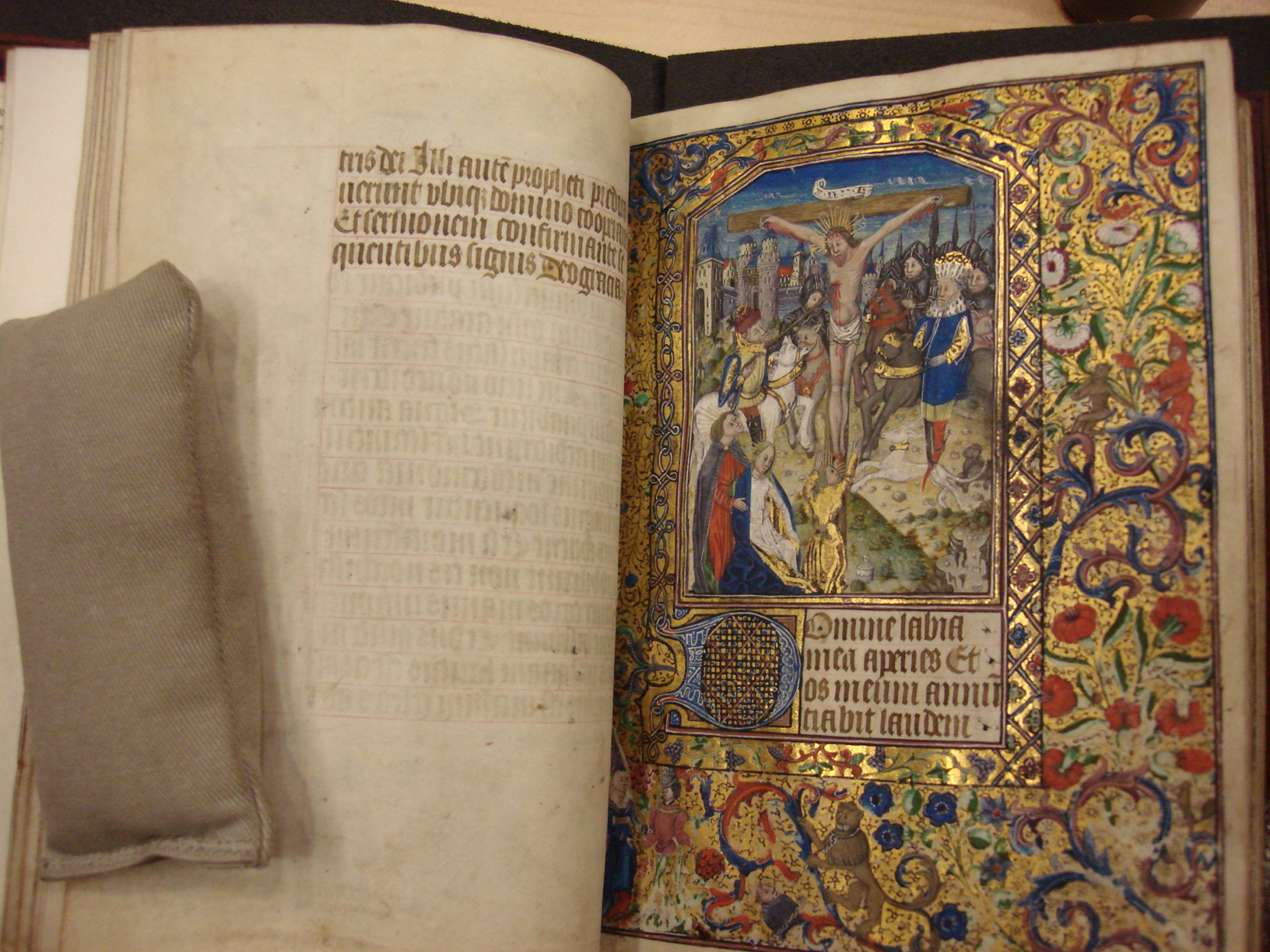
Illumination of Jesus on the cross from a French book of hours (M.Ms. P/MSS 38-728, Tracy W. McGregor Library. Image by Petrina Jackson)

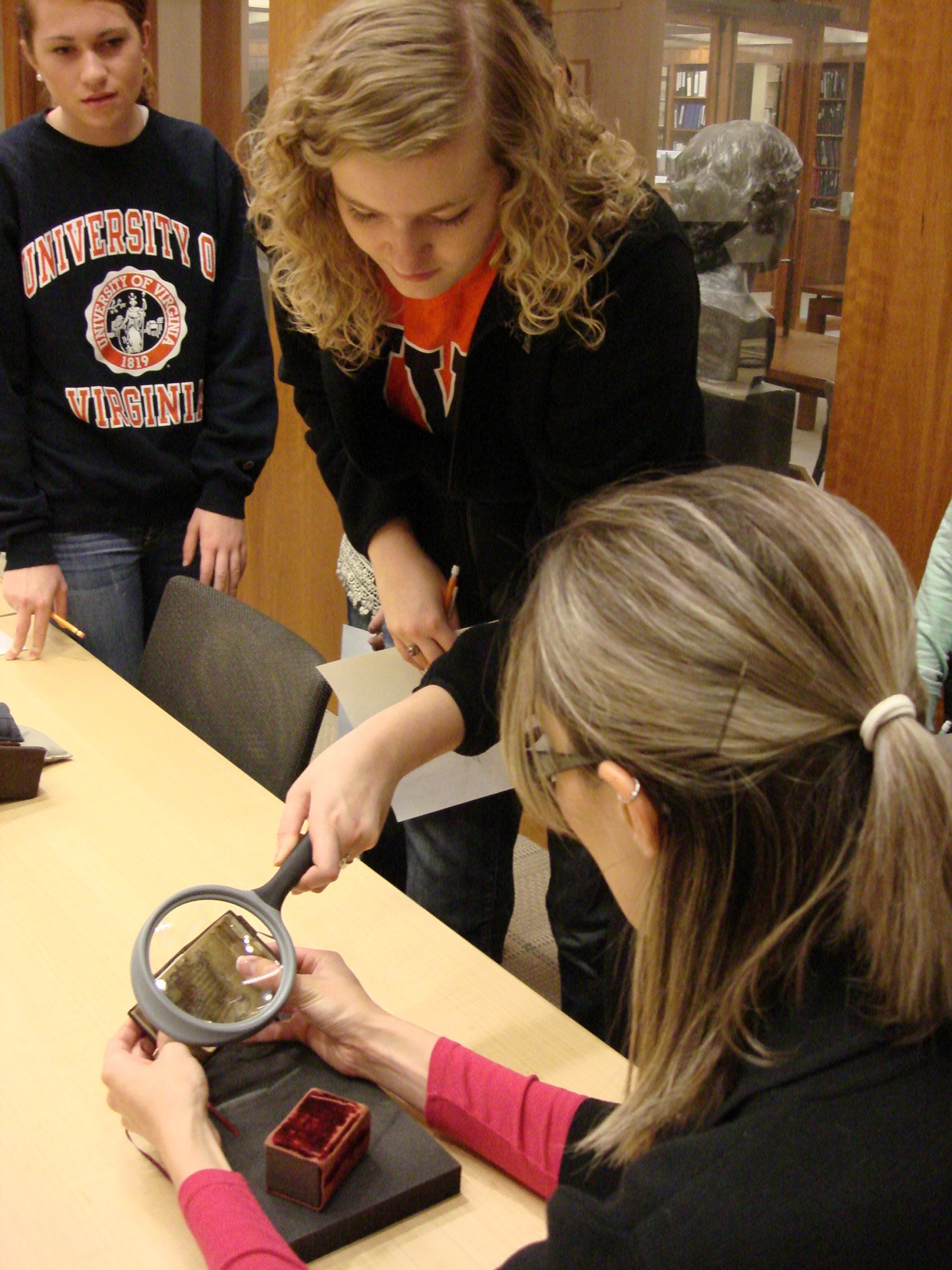
TA Tracy Cosgriff helps a student examine a small medieval prayer book. (Image by Petrina Jackson.)

Tools we used:

  • nine manuscripts, including several French books of hours (prayer book), a large Italian choir book, an English Bible, and a Koran
  • a worksheet with questions about the Special Collections policies and the examination of religious manuscripts
  • pencils

What we did:

  1. Set manuscripts stations around the classroom.
  2. Special Collections staff gave a 10-minute overview of Special Collections, including how to request and handle materials.
  3. Teaching Assistant gave students assignment worksheets and explained them.
  4. Students went to a station and filled in the worksheet as it related to each manuscript.  This step was repeated for each station.
  5. Special Collections staff assisted in the handling of the manuscripts and with questions.
  6. Teaching Assistants collected the completed worksheets and reviewed them for discussion in their next section meeting.

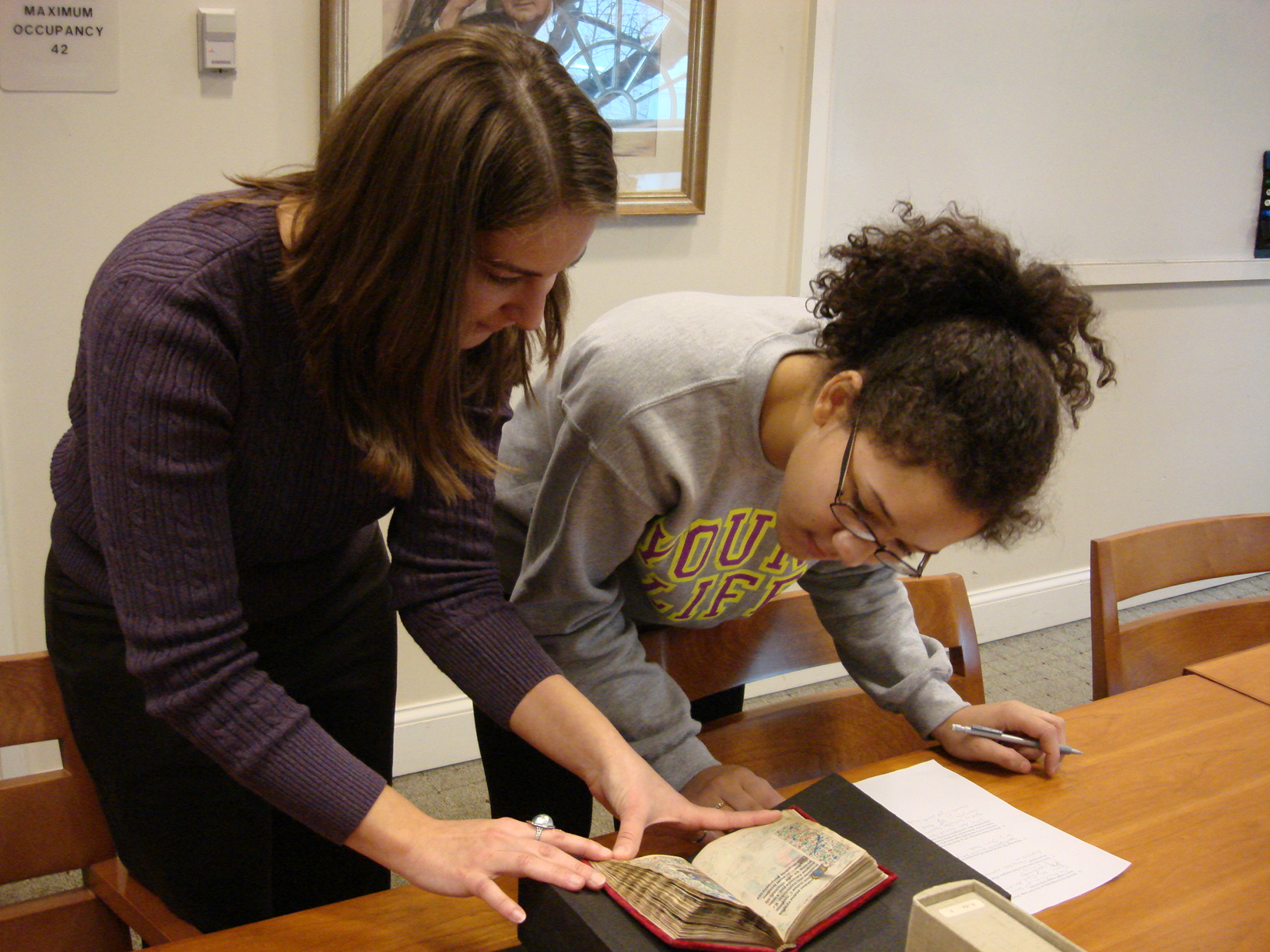
TA Alicia Dissinger and a student discuss the iconography in a book of hours. (Image by Petrina Jackson.)

Students produce detailed descriptions of the physical characteristics of their assigned manuscripts. (Image by Petrina Jackson.)

Considering the number of people involved with the History of Art I section visits to Special Collections, it went extraordinarily smoothly and was a lot of fun.  After the visits, I received an email from TA Tracy Cosgriff, which stated “[t]he students really enjoyed their lesson in Special Collections, and many are still talking about it. Thank you so much again for making our visit such a pleasure!” Although that was not a stated learning outcome, I am always happy to hear that students are talking about their time with us long after it has ended.

Koran, 1859 from the Homer S. Cummings Papers (M.Ms. AB/MSS. 9973)


This Just In: Translations by Jorge Luis Borges

Virginia Woolf, Orlando. Buenos Aires: Editorial Sudamericana, 1945. (PQ7797 .B635 O73 1945, Robert and Virginia Tunstall Trust Fund, image by U.Va. Library Digitization Services)

The celebrated Argentinian author (and sometime librarian) Jorge Luis Borges (1899-1986) was famous for his fictional account of the universal library which, because it contains all information, is useless.  Since 1977 the U.Va. Library has built one of the world’s great collections on Borges, encompassing significant manuscripts as well as writings by and about Borges in multiple editions and languages.  Our modest aim has been to form the universal library of Borges, a collection we have found to be far from useless!  Housed under Grounds in Special Collections, the Borges collection was initially described in 1993 by its first curator, C. Jared Lowenstein, in A descriptive catalogue of the Jorge Luis Borges collection at the University of Virginia Library.  Then numbering 979 entries, the collection has since grown to nearly 1,200 entries.  (To see them, search Virgo for “Jorge Luis Borges” and limit to Special Collections.)

Franz Kafka, La metamorphosis. Buenos Aires: Editorial Losada, 1943. (PQ7797 .B635 V4718 1943, Robert and Virginia Tunstall Trust Fund, image by U.Va. Library Digitization Services)

Through the good offices of a Buenos Aires bookseller, Special Collections recently added thirty more titles to the collection.  Of particular note are several works Borges translated into Spanish, a lesser-known aspect of his literary career. Indeed, Borges’s earliest publication, at the age of 11, was a Spanish translation of Oscar Wilde’s The Happy Prince, published in a Buenos Aires newspaper. Translation also figures prominently in several of Borges’s most celebrated stories.

Proficient in English, French, German, Italian, and later Anglo-Saxon and Old Norse, Borges read widely in world literature.  By publishing Spanish translations of numerous works in his newspaper columns and in book form, Borges was instrumental in introducing many contemporary writers to a Latin American audience.  Special Collections already owned Borges’s translations of such authors as William Faulkner, André Gide, and Walt Whitman.  Newly added translations, some with illuminating prefaces by Borges, include Franz Kafka’s Metamorphosis (a copy signed by Borges); Virginia Woolf’s Orlando; Herman Melville’s Bartleby, the scrivener (“Preferiría no hacerlo”); Henri Michaux’s A Barbarian in Asia; and the first part of Snorri Sturluson’s Prose Edda.  For the last Borges teamed with his wife, Maria Kodama.  During the 1930s and 1940s, as he went blind, Borges was often assisted by his mother, who published several Spanish translations of her own, including a collection of short stories by D.H. Lawrence.

Herman Melville, Bartleby. Buenos Aires: EDICOM, 1969. (PQ7797 .B635 B38 1969, Robert and Virginia Tunstall Trust Fund, image by U.Va. Library Digitization Services)

Borges’s translations provide valuable insights into his literary art.  Many of the works Borges selected for translation directly influenced specific elements of his own writing.  Of special interest is Borges’s theory of translation for, as one critic has wryly noted, Borges held that “an original can be unfaithful to a translation.”  Rather than offer readers a literal translation, Borges did not hesitate to “improve” the original as he saw fit, believing that the work was ultimately more important than its creator.  And because Borges frequently revised his own works—including the translations—from edition to edition, it is critical for scholarship that all lifetime editions of Borges’ writings be collected in one place and made available for textual comparison.  That place—the Aleph, if you will—is under Grounds, in Special Collections.

Henri Michaux, Un bárbaro en Asia. Buenos Aires: Sur, 1941. (PQ7797 .B635 B3718 1941, Robert and Virginia Tunstall Trust Fund, image by U.Va. Library Digitization Services)

* * *

Postscript:  Acquisitions are the lifeblood of the Albert and Shirley Small Special Collections Library.  Our holdings of books, manuscripts, archives, ephemera, maps, photographs, digital media, and other formats grow constantly by design and serendipity, singly and in bulk, through gift, purchase, and transfer from individuals, publishers, book and manuscript dealers, auction houses, other libraries, and U.Va. departments.  Hardly a day passes without at least one significant acquisition arriving under Grounds.  Curious about what relevant materials this acquisitions flood is bringing your way?  Finding out is easy: simply do a Virgo search for “2012/2013” and limit it to Special Collections in order to see what we’ve added since the fiscal year began on July 1.  New acquisitions will also appear, as appropriate, in any Virgo search you make.

“This Just In” will sample the acquisitions stream, periodically showcasing one or more new and noteworthy items.  Our goal is not only to inform you of interesting acquisitions but to demystify the process through which we build our collections: how we select new acquisitions, where we find them, how these broaden and strengthen our existing holdings, and how these enhance research and instruction on, and under, Grounds.  Please come visit!

D. H. Lawrence, La mujer que se fué a caballo. Buenos Aires: Editorial Losada, 1946. (PQ7797 .B635 Z999 .A25 M8 1946, Robert and Virginia Tunstall Trust Fund, image by U.Va. Library Digitization Services)

Welcome to our new blog!

We are pleased to announce the launch of the Albert and Shirley Small Special Collections Library’s blog. With contributions from staff, faculty, students, and visiting researchers, “Notes from Under Grounds” will offer glimpses into all aspects of Special Collections here at the University of Virginia: new acquisitions, instruction, little-known collections, staff projects, exhibitions, special events, and more. This project joins two other blogs directly associated with our collections: manuscript cataloger Ann Southwell’s real-time Civil War blog “150 Years Ago Today,” and conservator Eliza Gilligan’s “At the Bench.”

Our title was chosen with care: you can expect these posts to be variously informal, personal, and maybe even a little “underground” sometimes. They will bring to the surface activities and artifacts from the lower levels of the Harrison-Small building just next to Alderman Library: from our main floor, where public spaces, staff offices, and our vault are located, and our lower stack level, where the vast majority of the collections are housed.

Posts will be managed by three staff members: curator David Whitesell will share fresh acquisitions, head of instruction and outreach Petrina Jackson will cover visiting courses and student engagement, and curator Molly Schwartzburg will fill in the gaps with posts on just about everything else. We encourage you to contact us if you would like to write a post or if there’s a subject you want us to cover.

So look for a new post every Thursday, and be sure to come visit us under Grounds!