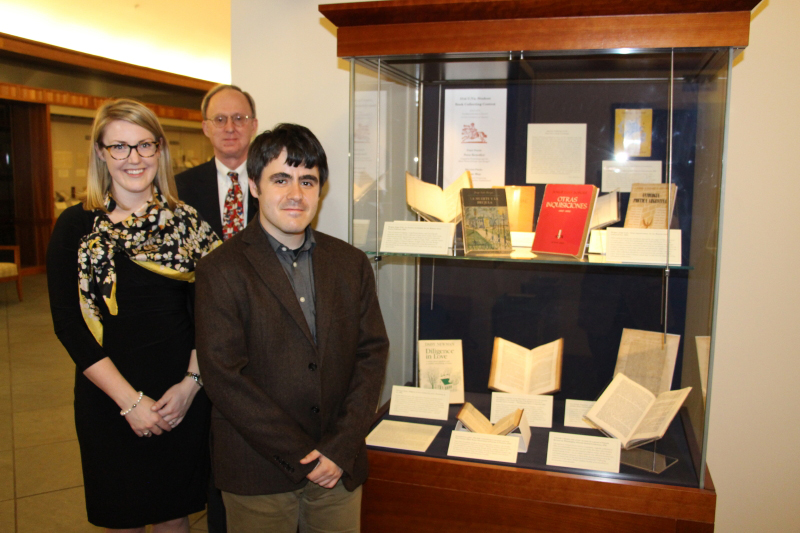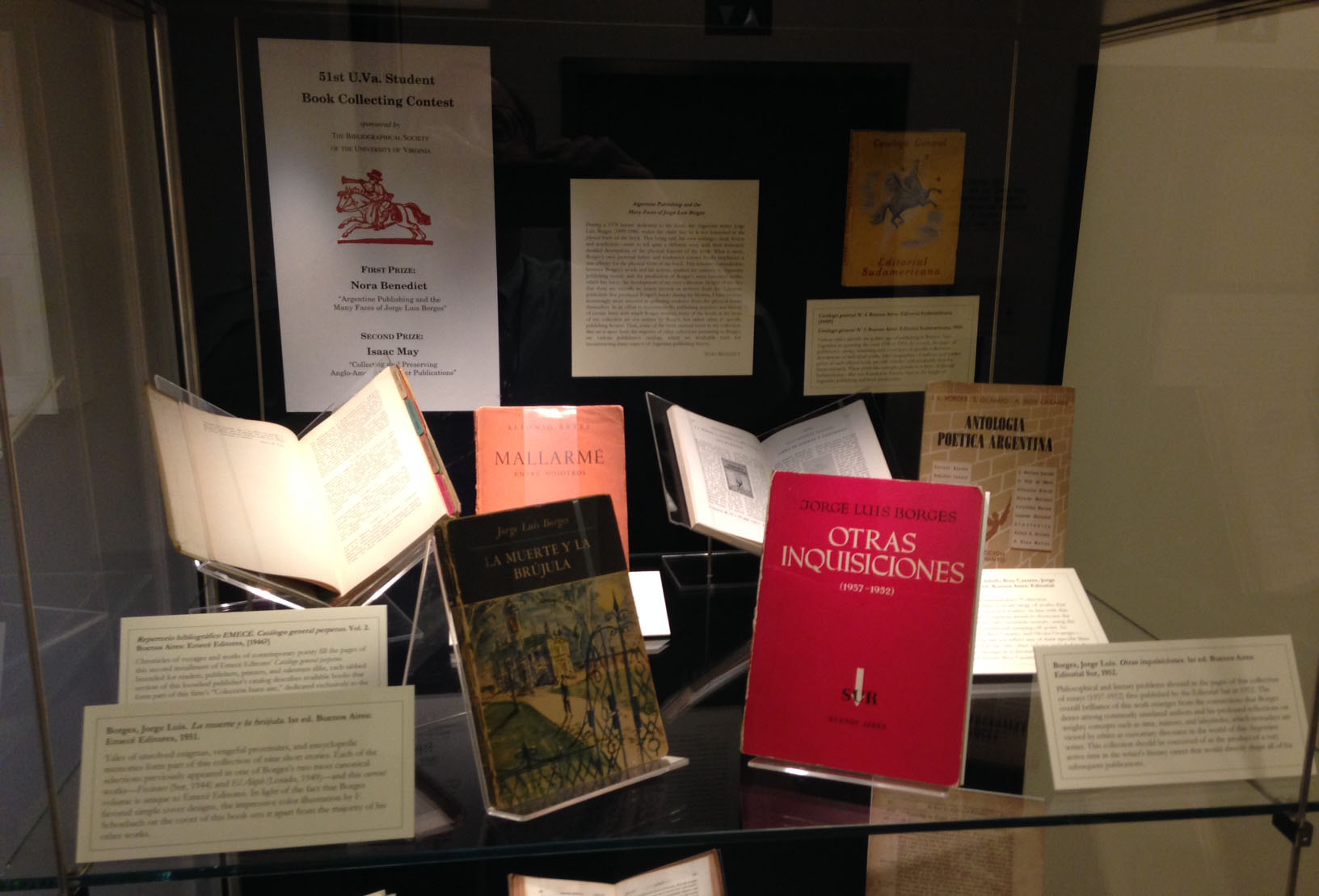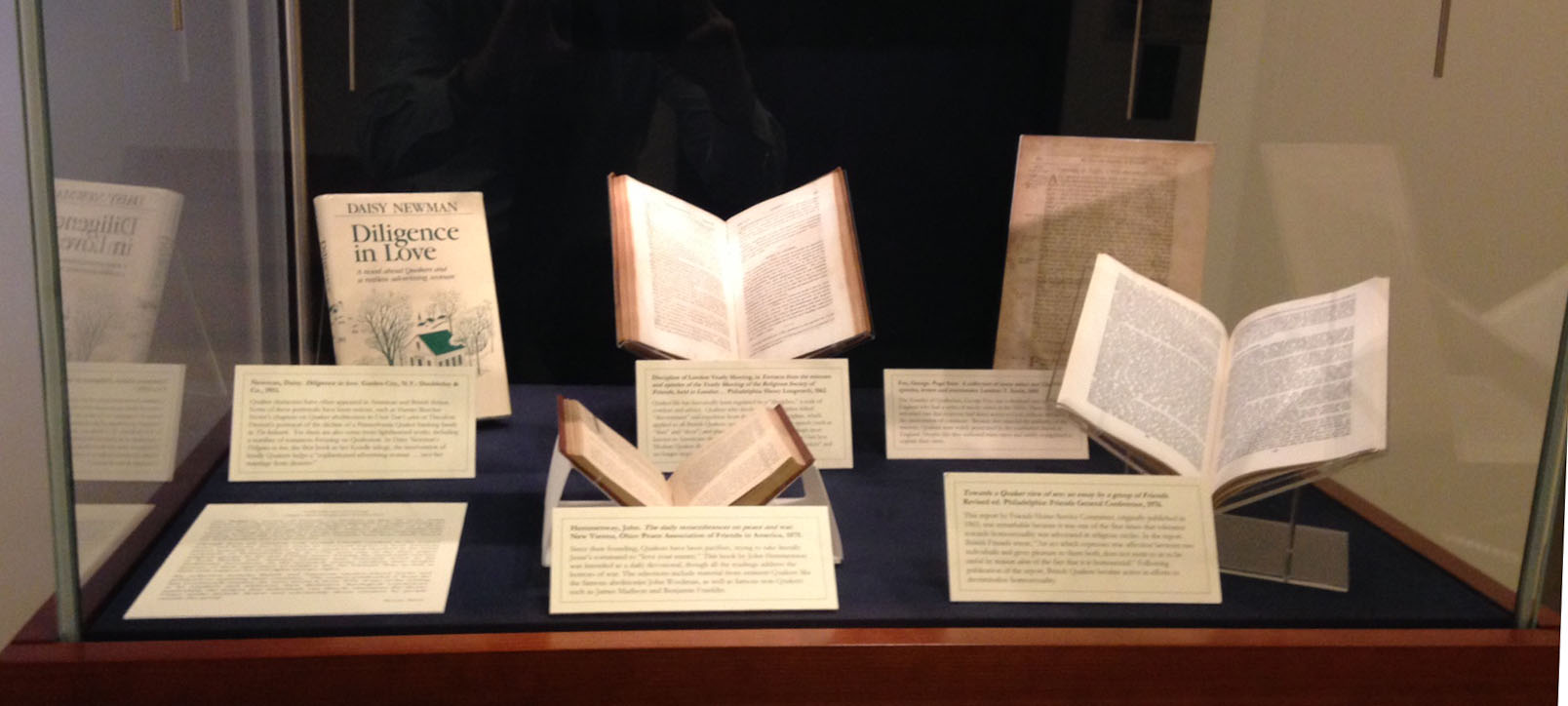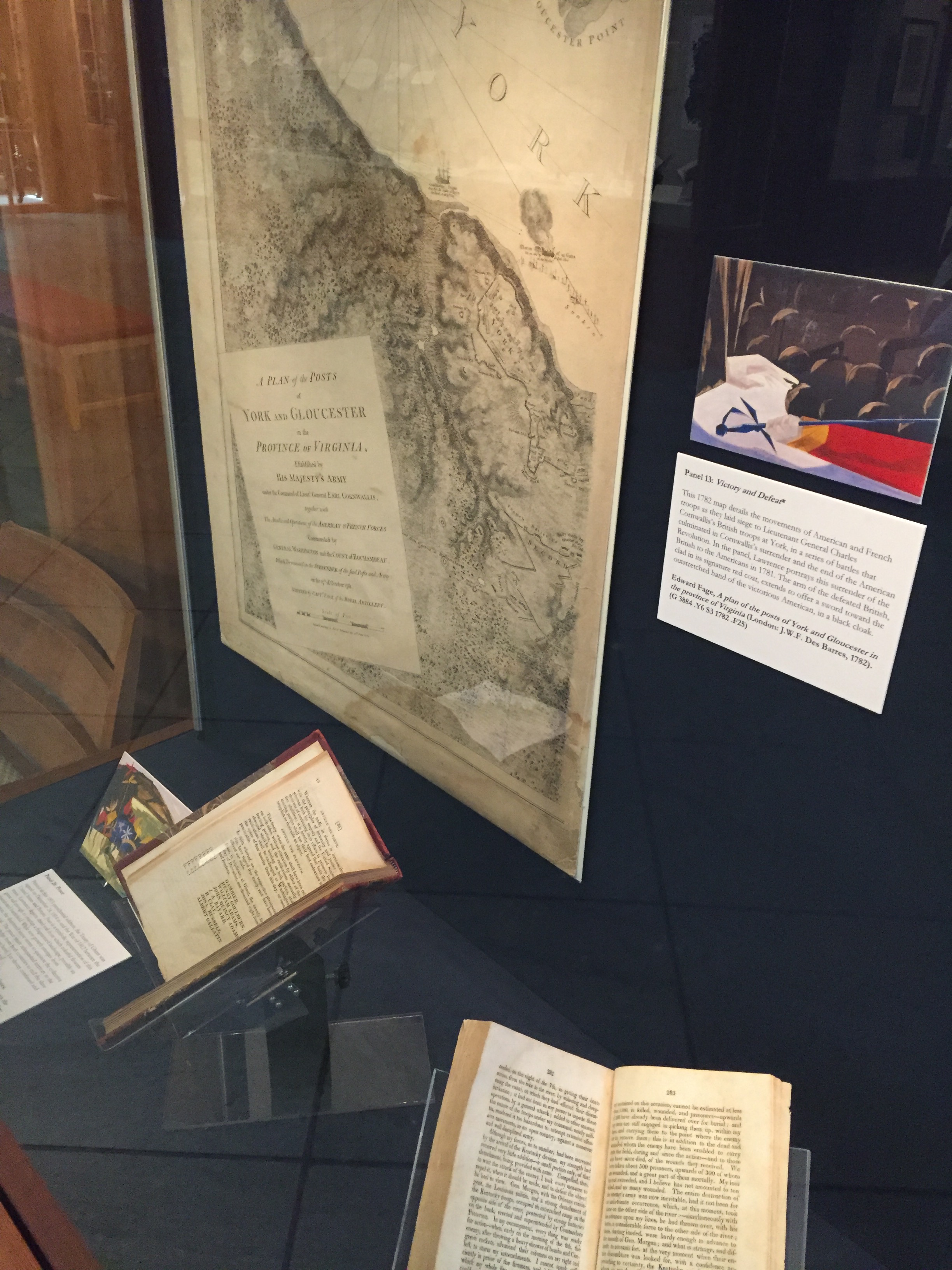
On View Now: Talkin’ ‘Bout a Revolution

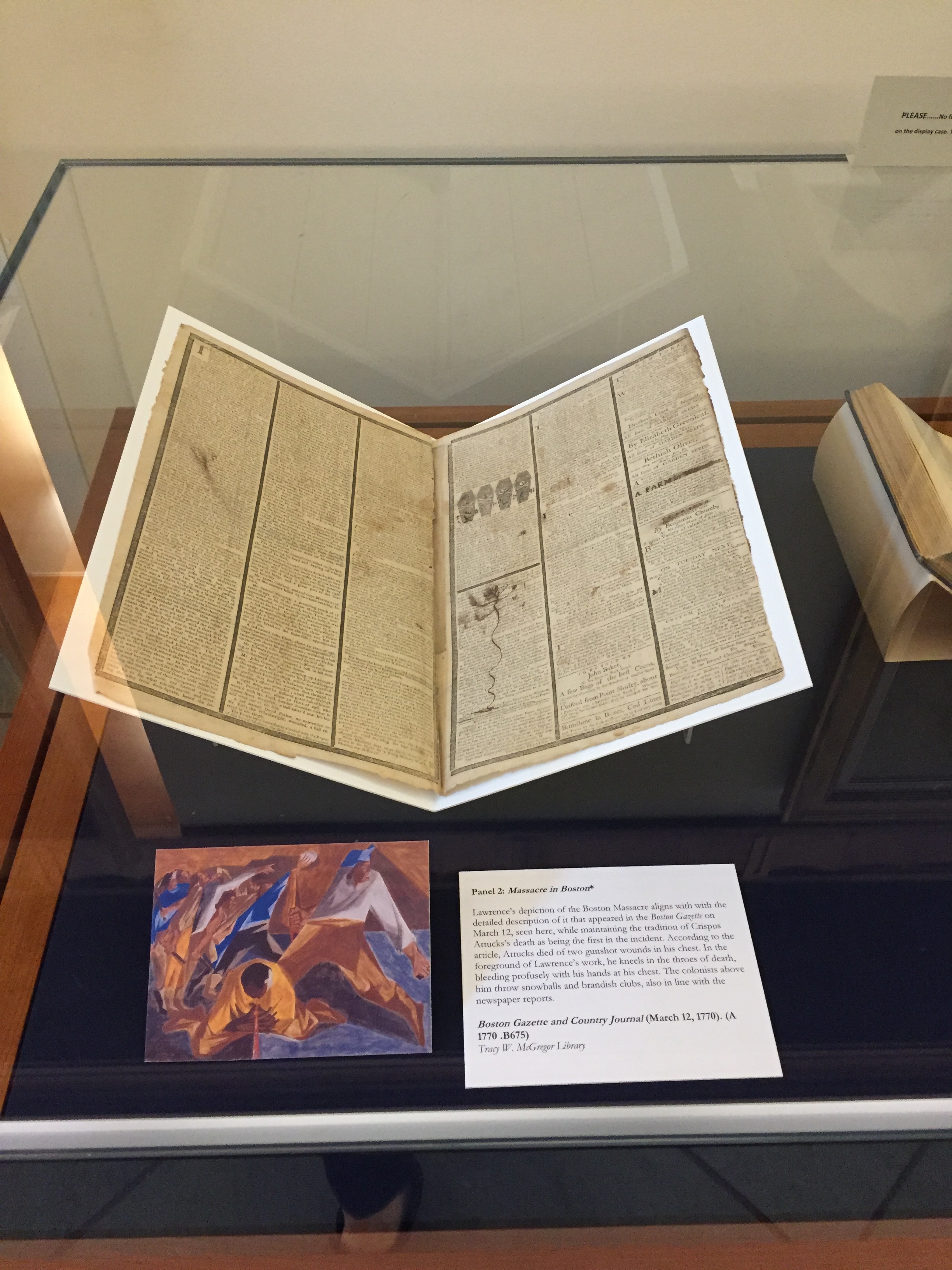
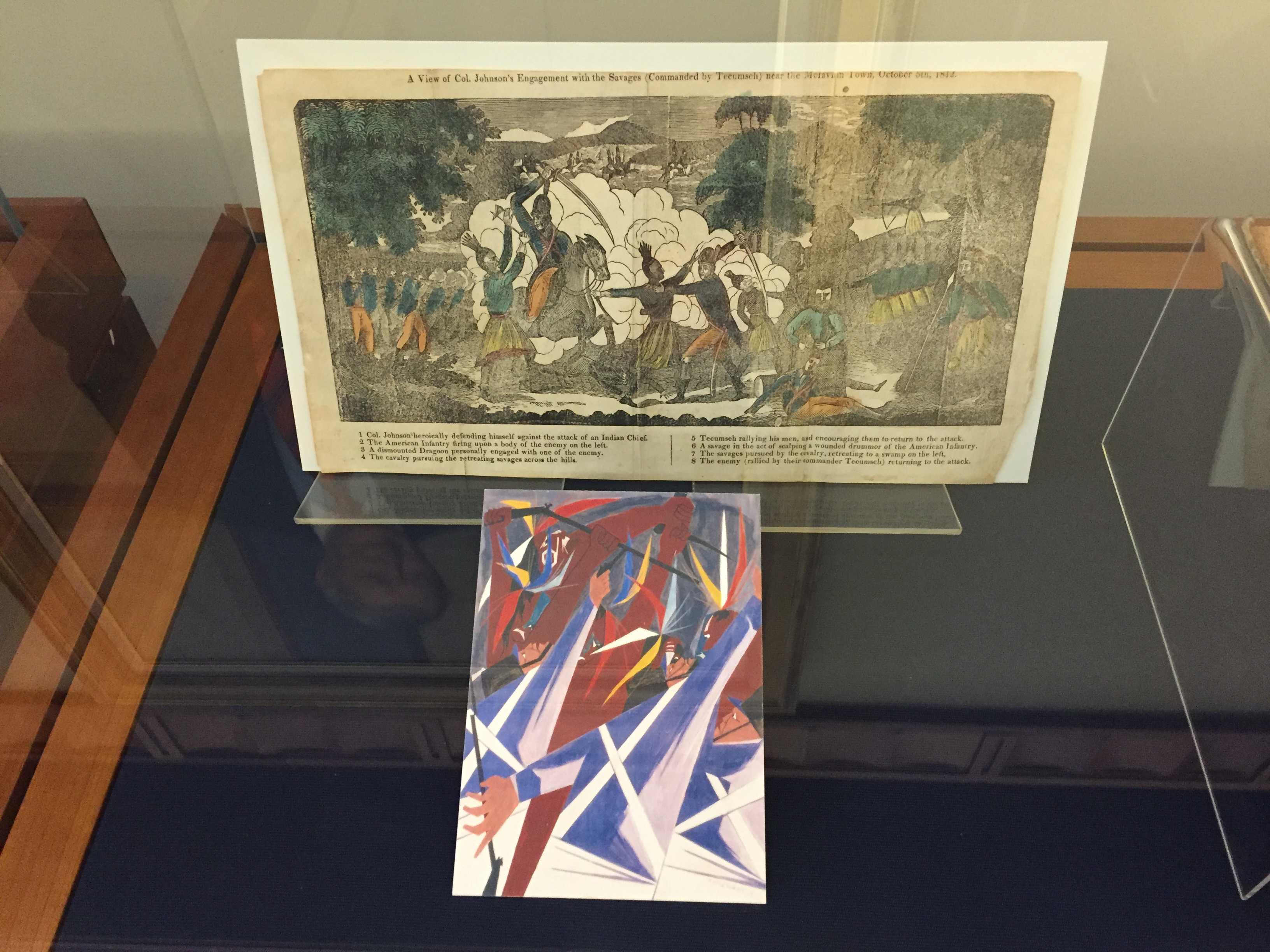
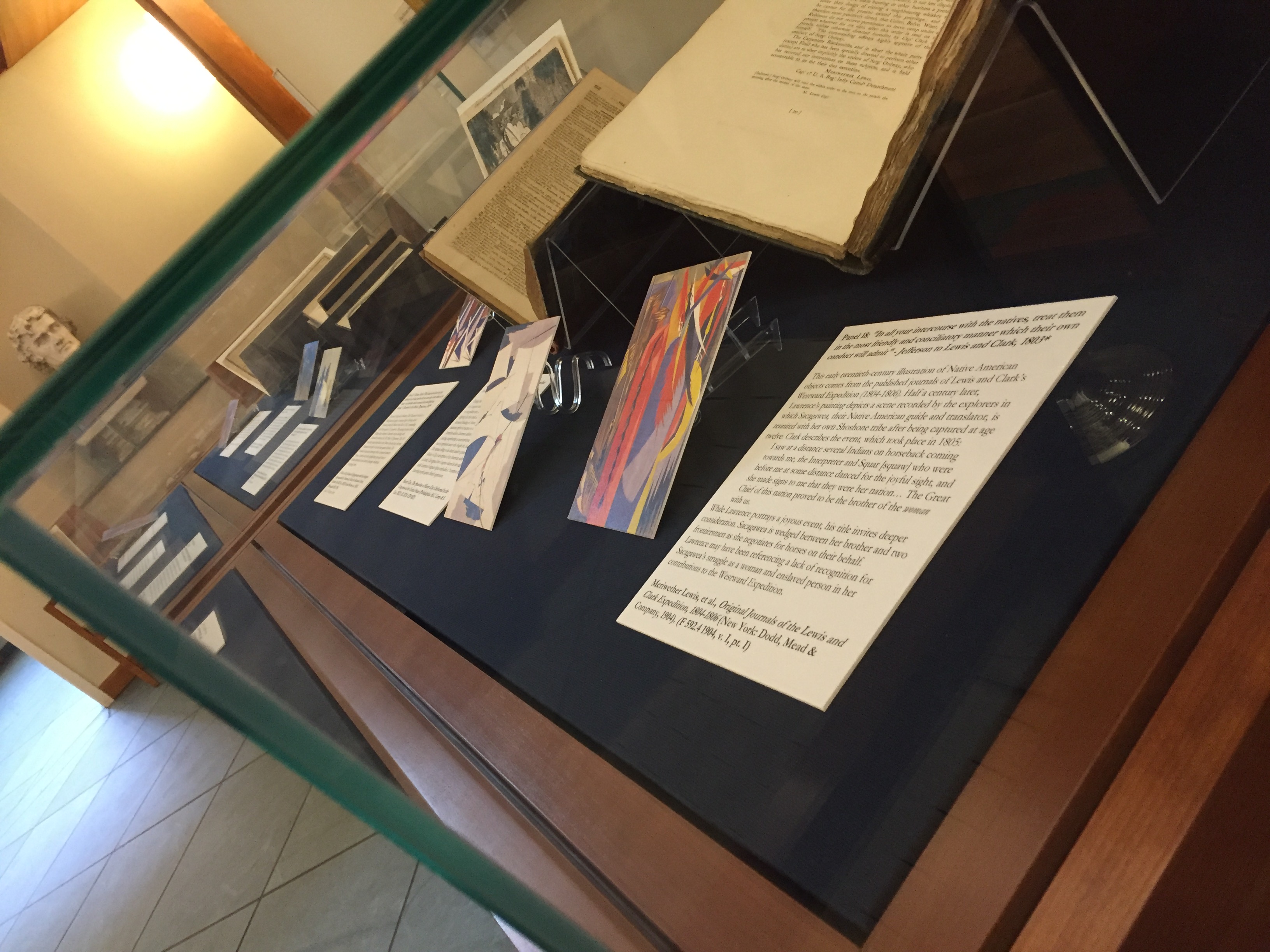
We’re pleased to announce the opening of our latest mini-exhibition,  “Talkin’ ‘Bout a Revolution: The American Civil Rights Movement, 1954-1970,” which runs through the end of February and is part of the University’s 2016 community MLK Day celebration, “The Call to Higher Ground.” The exhibition is curated by our own Ervin Jordan, research archivist.

mlk3

Jordan writes, “The American Civil Rights Movement (1954-1970) intensely transformed American society and inspired similar movements worldwide. Its nonviolent protests and civil resistance for equal citizenship under the law enhanced African-Americans’ self-dignity and collective commitment in the face of white supremacist terrorism. Others too, were allies, martyrs and beneficiaries of this undertaking to fulfill the promises America had made on paper since 1776.”

mlk5

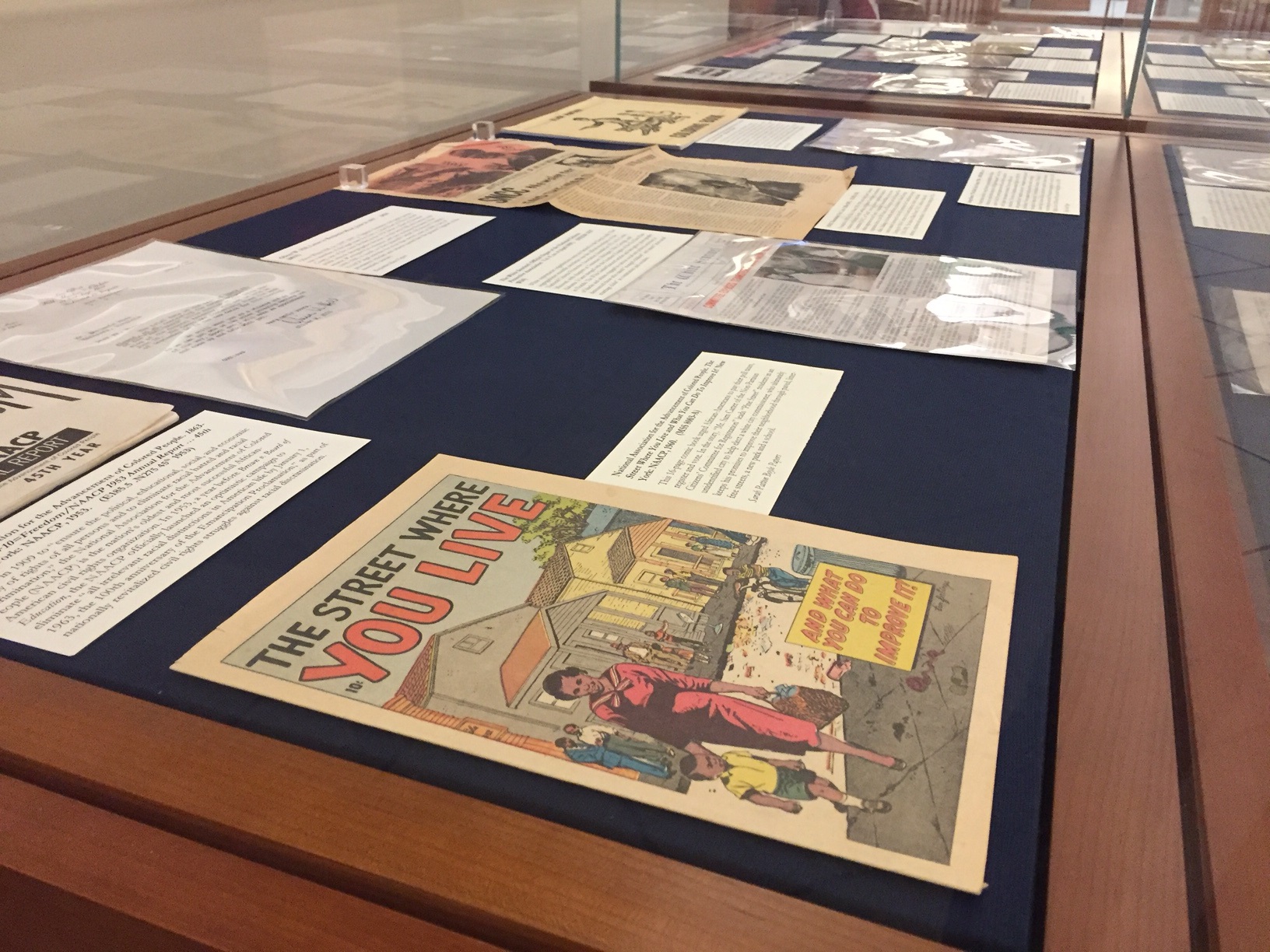
The exhibit’s 24 items on display comprise letters, newsletters, photographs, poetry and reports; special items of interest include:

  • A 1960 NAACP voting rights comic book
  • Alex Haley’s 1963 interview of Malcolm X
  • A 1969 Black Panther Party coloring book
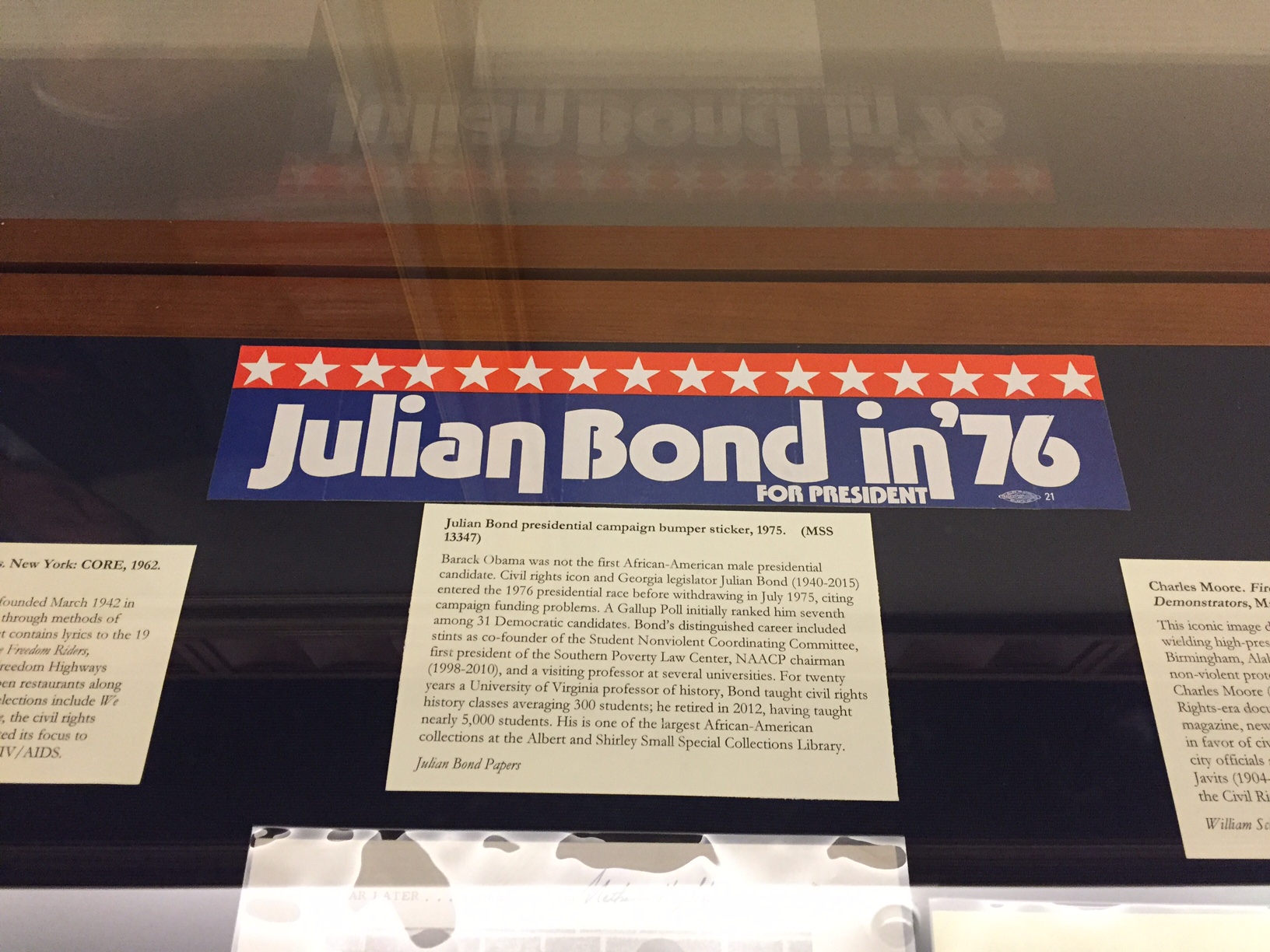
  • A 1976 Julian Bond for President bumper sticker
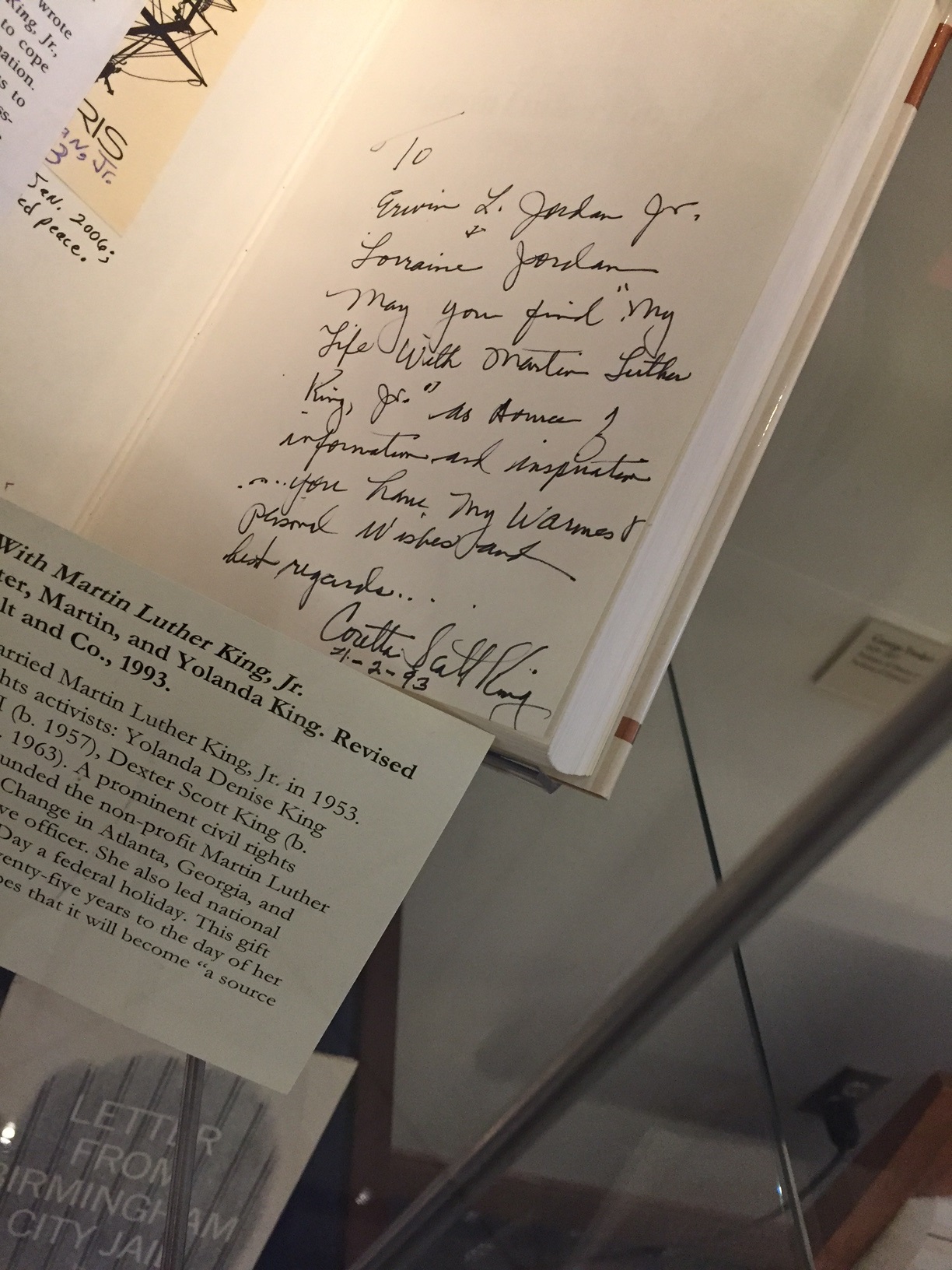
  • An inscribed copy of Coretta Scott King’s published memoirs

mlk2

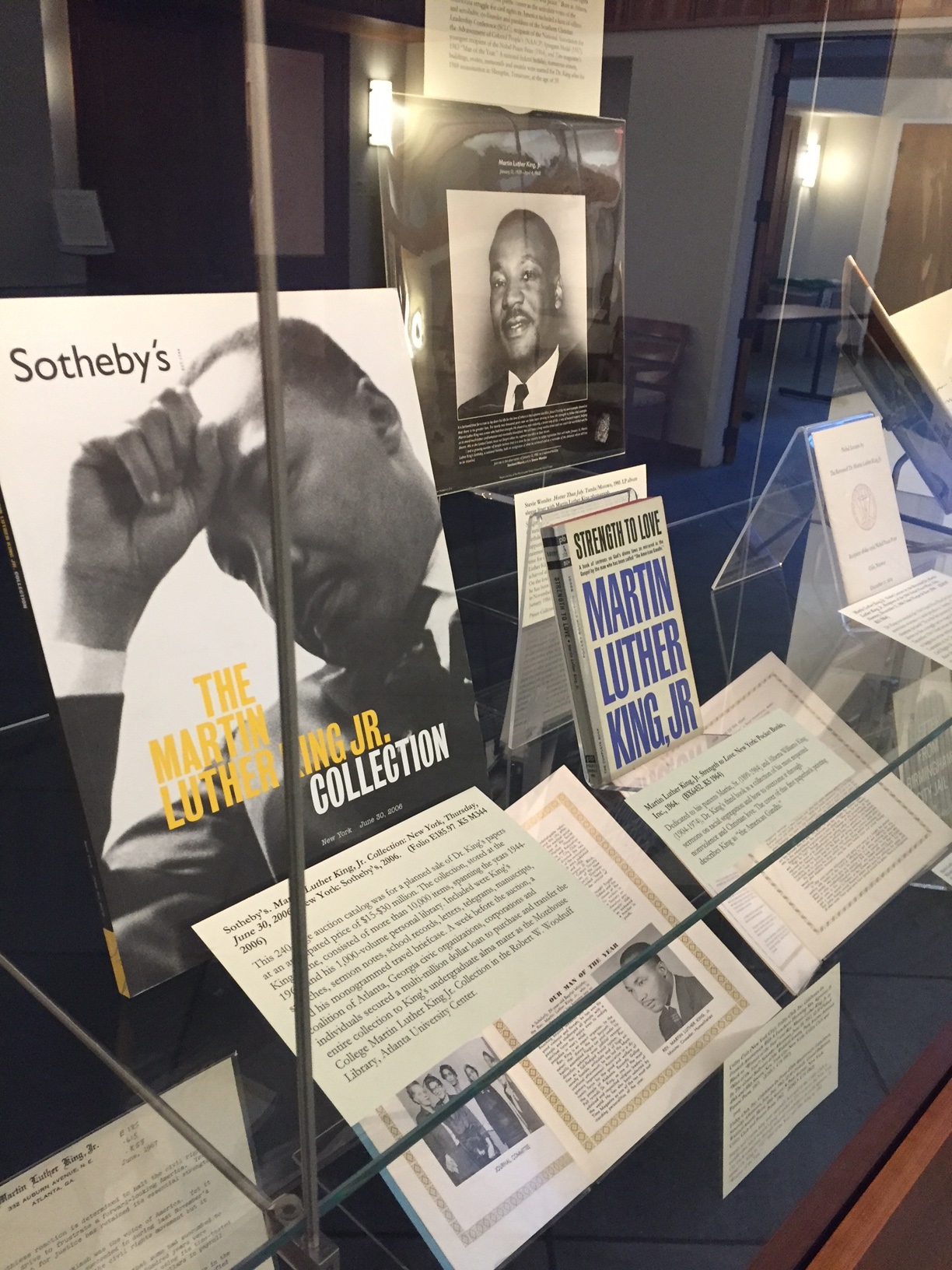
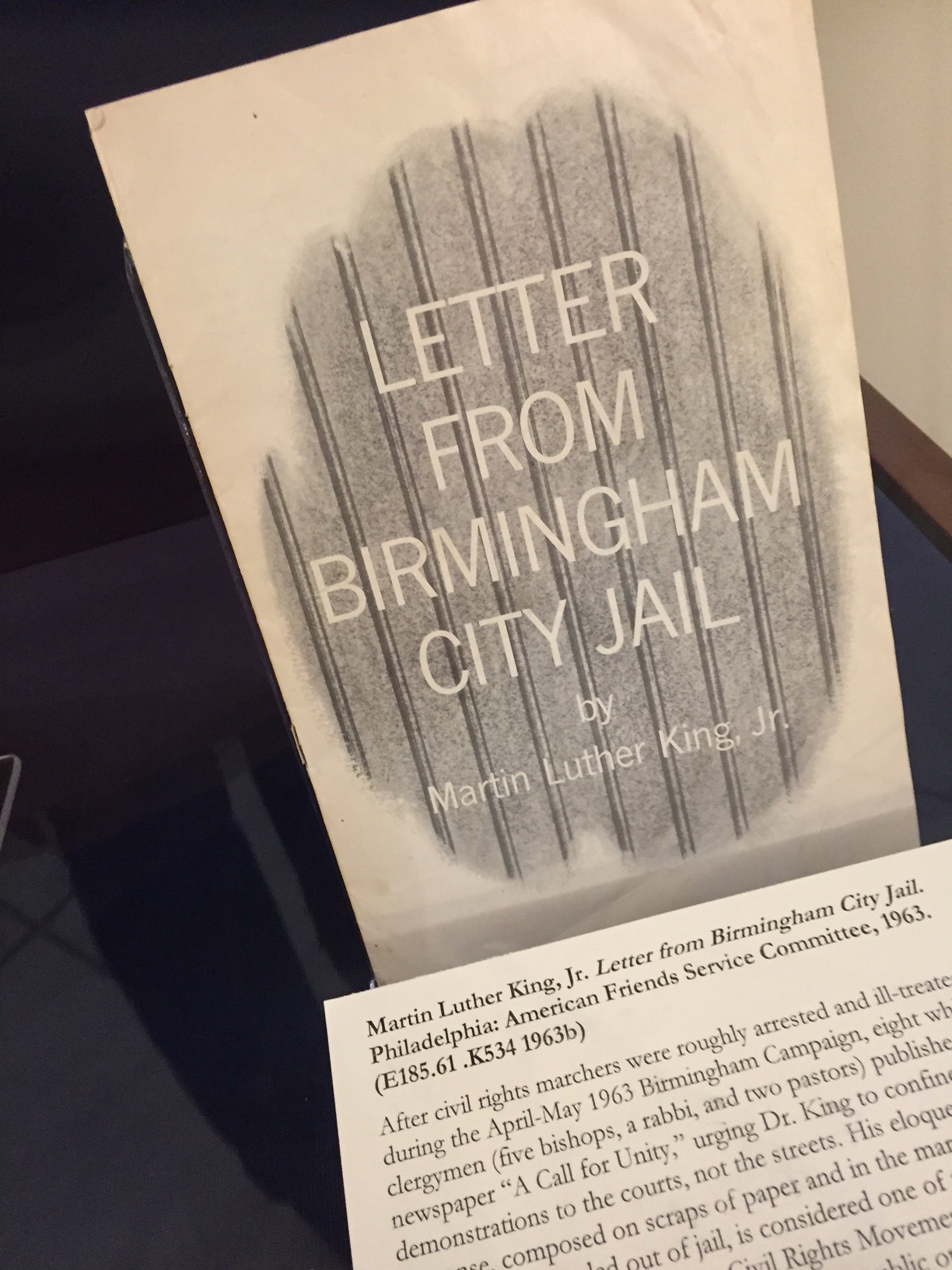
One of the exhibition’s three display cases features the life and career of the Reverend Dr. Martin Luther King, Jr., charismatic leader of the Civil Rights Movement and “a drum major for justice and peace” in his letters and publications.

mlk1

Please stop by for a visit!

mlk4

…And to all a Good Night! —that means you, John Boy

The holidays are upon us! As we watch the students head home, the weather cool (well…not as much as we might like), and twinkling lights appear all over town, we are adding to the holiday mood with a special post from Reference Coordinator Regina “Ms. Claus” Rush. Enjoy, and be sure to check our website for holiday hours in the next couple of weeks. Thanks for the movie recommendation, Regina!

Inquire of any of my colleagues at Special Collections Library and they will attest that I govern my life by the Golden Rule. No, not that Golden Rule. I follow the Golden Rule according to Ebenezer Scrooge. Allow me to clarify further: not the Bah-Humbug Scrooge, but the kinder-gentler-post-three-ghostly-visitations Scrooge. His Golden Rule reads, “I will honour Christmas in my heart and try to keep it all year!”

Throughout the year, my colleagues can count on me to daily mention a Christmas movie, sing a verse or two from a favorite Christmas carol, or contemplate my plans for the coming year’s Christmas tree themes for my home. These are ways that I keep the ghosts of Christmas Past, Present, and Future at bay. So when asked by my colleague Molly Schwartzburg to write a post highlighting an item from our collection pertaining to Christmas, quicker than “Jack Frost can nibble at your nose,” I. WAS. ON. IT!

regina_anne

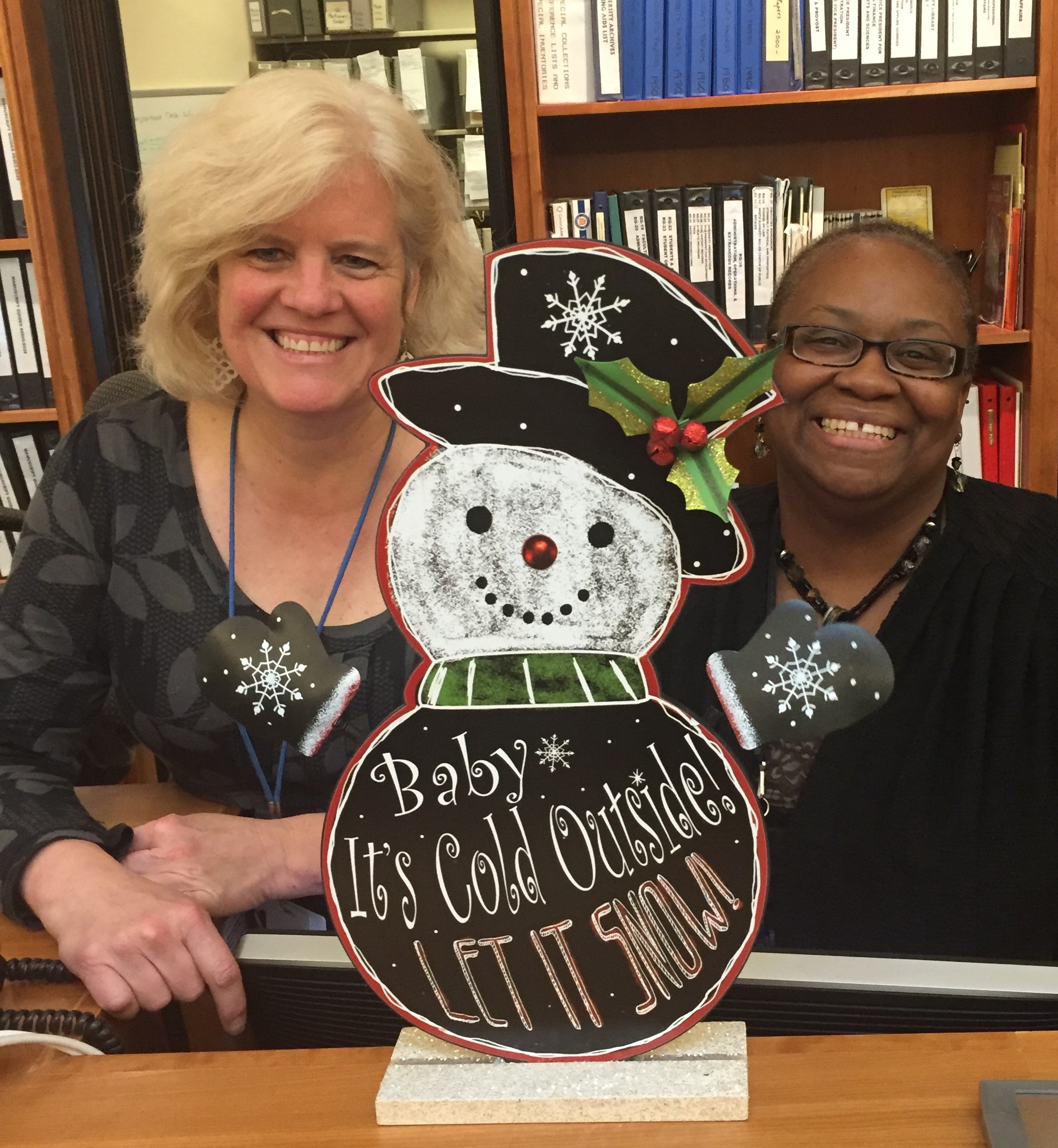
Regina, at right, with fellow snow fan and Reference Coordinator Anne Causey. They both wish that the claim made on this Reading Room holiday decoration was TRUE!

Shortly after I began looking into the Small Library’s treasure troves, I was delighted to discover that we hold a small but rich collection of Virginia native Earl Hamner Jr., an Emmy-winning television writer and director during the 1970’s and 80’s. The collection includes a first edition of Hamner’s 1970 novel, The Homecoming: A Novel about Spencer’s Mountain, the final shooting script for the 1971 film The Homecoming: A Christmas Story and television scripts for three mid-1970s episodes of The Waltons.

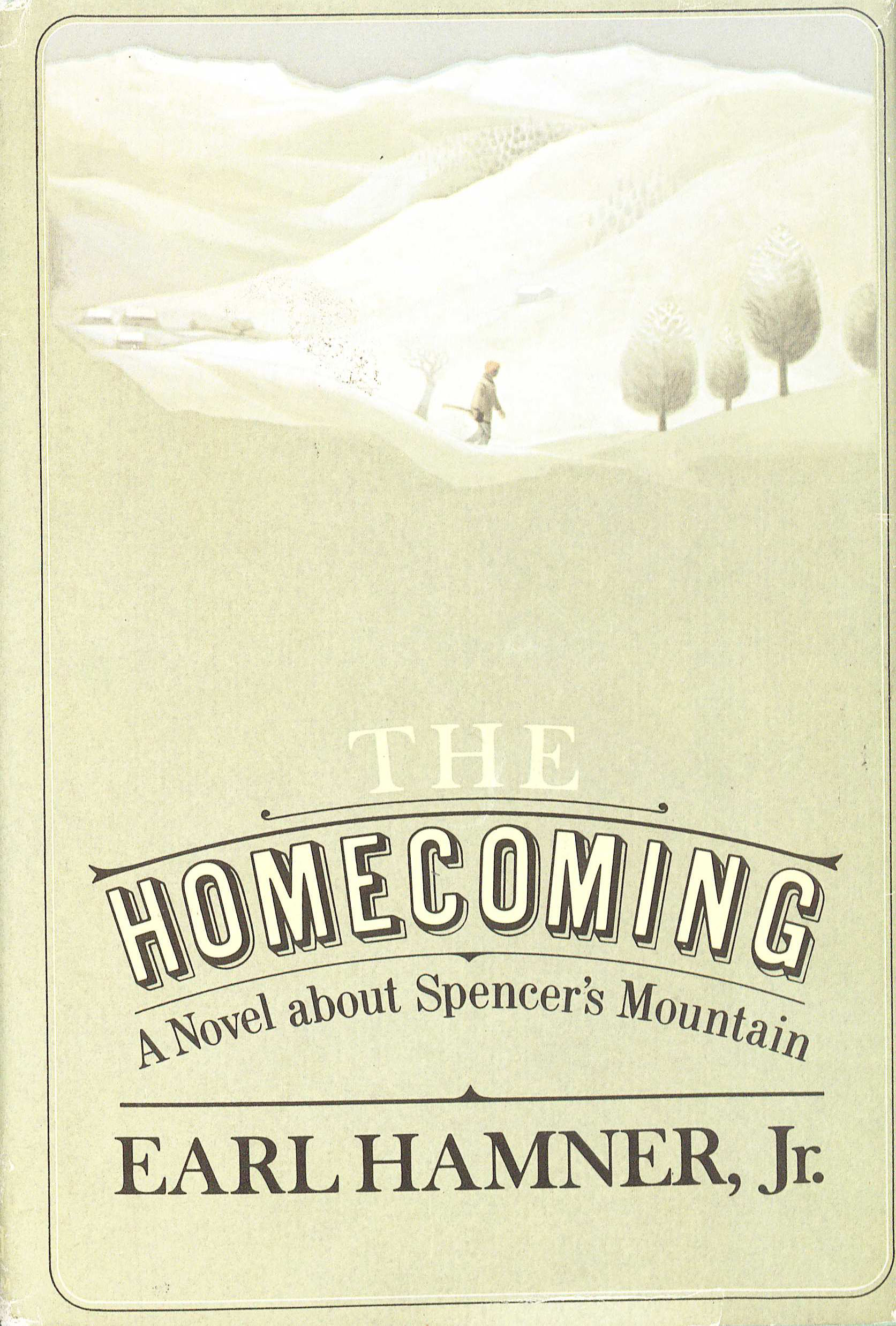
Earl Hamner, Jr. The Homecoming: A Novel about Spencer's Mountain.

Earl Hamner, Jr. The Homecoming: A Novel about Spencer’s Mountain. (PS3558 .A456 H6 1970). The novel’s epigraph reads, “It is remembered in my family that Christmas Eve of 1933 my father was late arriving home. That, along with the love he and my mother bestowed upon their eight red-headed offspring, is fact. The rest is fiction.”

The novel, drawn from Hamner’s childhood experiences growing up in Schuyler, Virginia during the Great Depression, was the impetus for the film. Originally aired on CBS on December 19, 1971, the movie was so popular that it spun off a series, “The Waltons’, which aired on CBS in September 1972 and became wildly popular, lasting nine seasons.

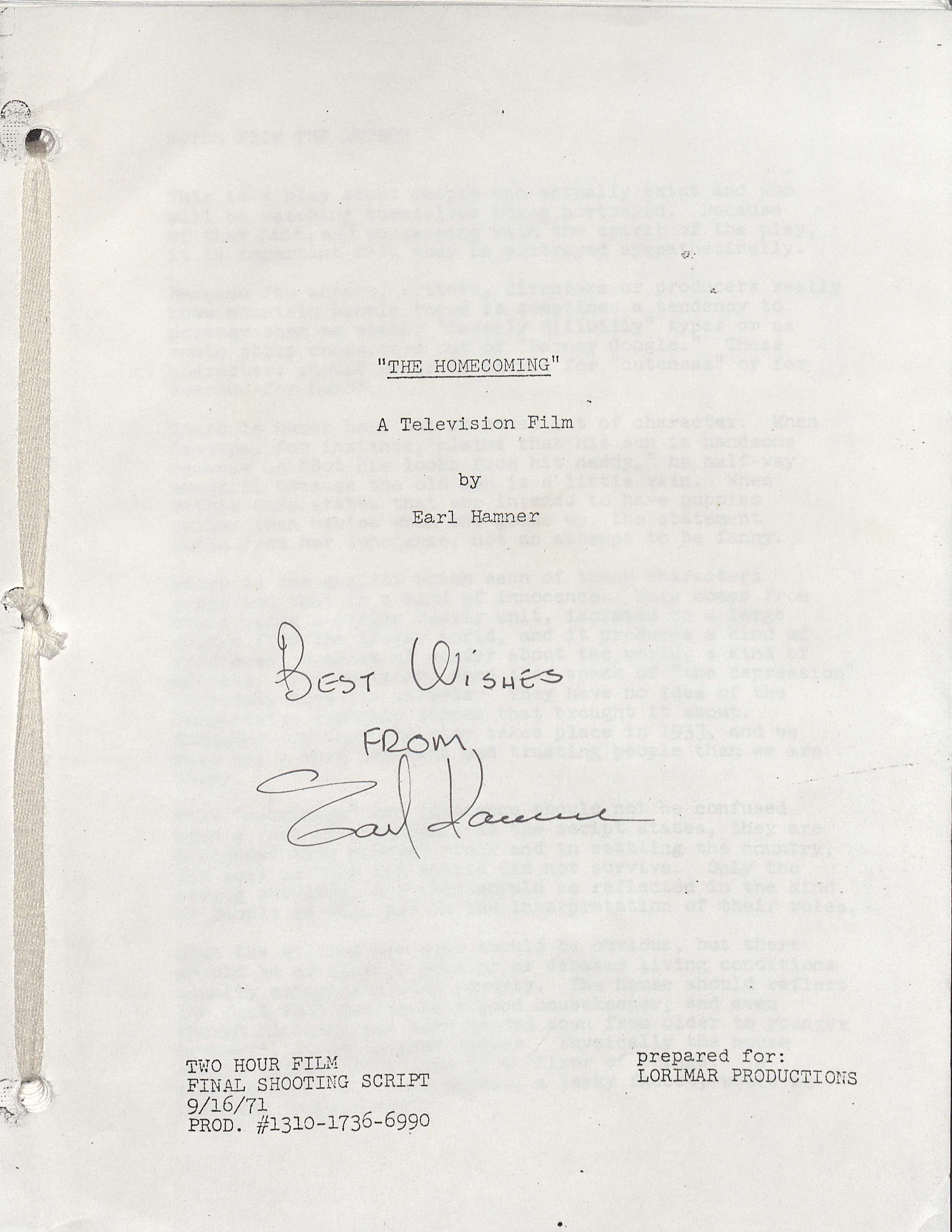
Final Shooting Script of The Homecoming

Cover of the Final Shooting Script for the Lorimar Productions film “The Homecoming” (MSS 10380,-a,-b)

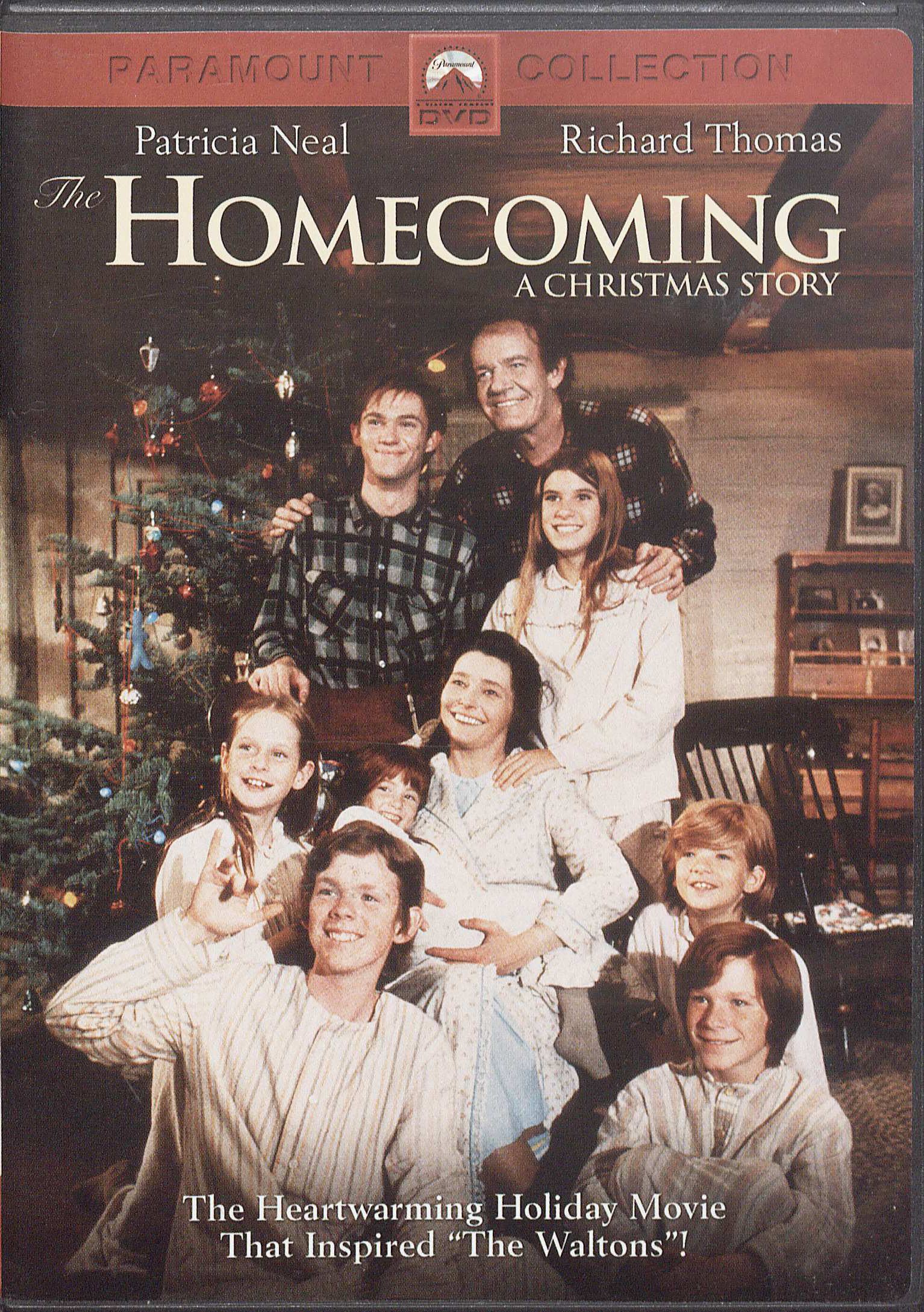
The Homecoming movie

DVD of the movie The Homecoming: A Christmas Story, by Earl Hamner, Jr.

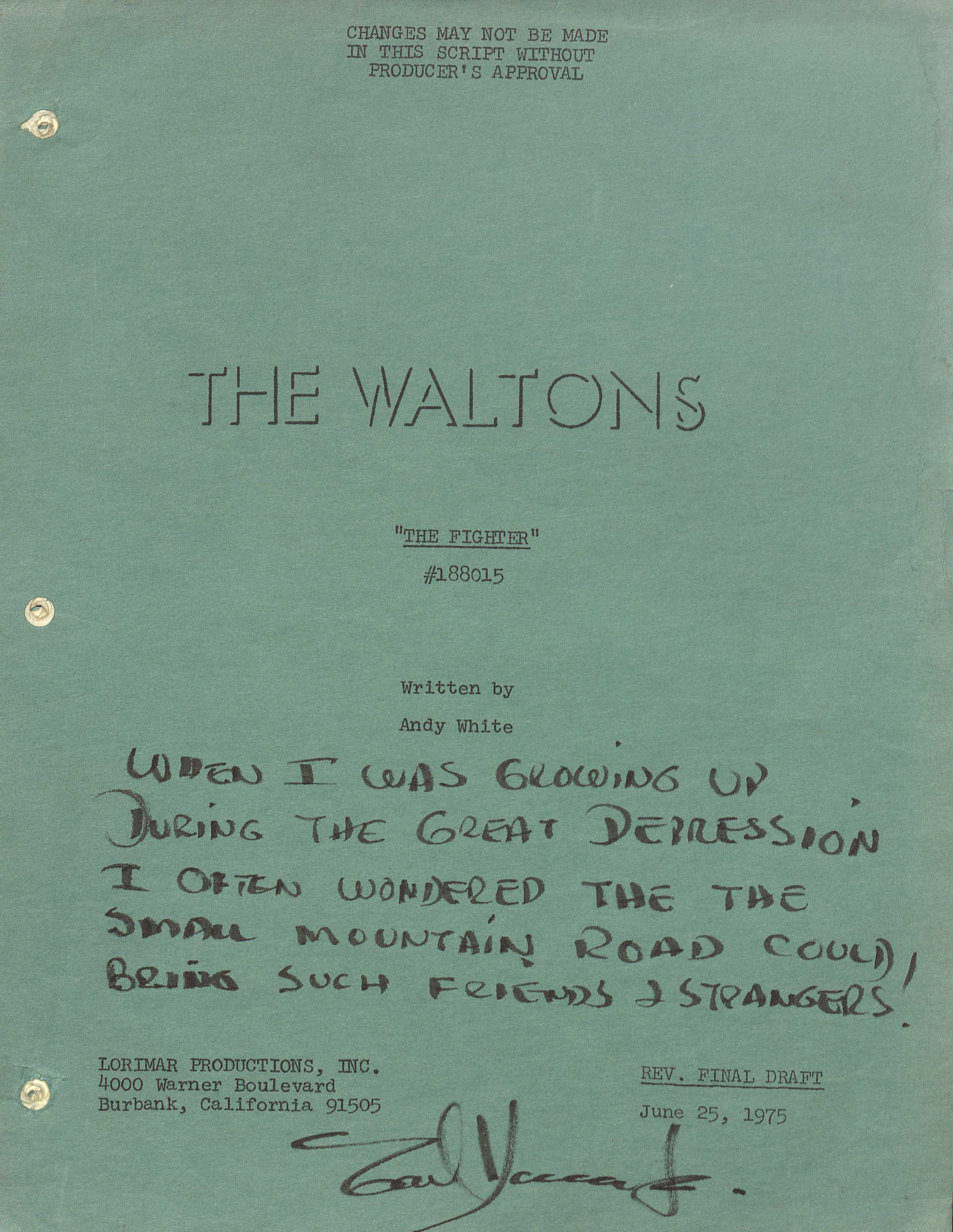
The final draft of of The Waltons television script

Cover of the television script for an episode of “The Waltons.” This is the revised final draft of episode #188015, “The Fighter” by Andy White (MSS 10380,-a,-b)

Christmas fans like myself know that the film that started the Waltons’ phenomenon is a holiday must-see. Included in the final script of the 1971 film ‘The Homecoming’ is a section entitled “Notes from the Author”:

[The] Christmas Season and Christmas has become a nightmare for most people. The packed stores, the enraged crowds, the stalled traffic and money worries that are common to our audience for the most part produce a national insanity. Yet underneath there is a pathetic wish that they can really experience something, maybe “The Christmas Spirit” something that no other time provides.

This holiday classic is a great start toward achieving that “Something.” So, shut out the madness of the holiday hustle and bustle. Pour yourself a BIG glass of egg-nog, get comfortable in your favorite chair and lose yourself in this wonderful coming-of-age Christmas classic. By the film’s end, I guarantee you will feel all warm and fuzzy inside (though that BIG glass of rum-infused egg nog may be partly responsible!). Wishing my colleagues and all the loyal readers of ‘Notes from Under Grounds’ a very safe and happy Holiday!

“Good Night, Penny”

“Good Night, Edward”

Good Night, David”

“Good Night, Heather and Gayle”

“Good Night George, Petrina, and Molly”

“Good Night E.J., Sharon, Ellen, Barbara, Jane…………”

Good Night, “Notes from Under Grounds” Readers!

Glimpses of Lafcadio Hearn in Virginia

This week we are pleased to share a guest post by Rodger Steele Williamson, who is a professor at the University of Kitakyushu, Japan. Professor Williamson spent several months over the last year working in the Lafcadio Hearn collection in the Barrett Library of American Literature. Professor Williamson was a cheerful and vibrant addition to our community during his time here and we miss him (and his pastry-chef wife’s delectable and elegant treats, delivered at impressive intervals to the staff break room!).

In Japan the names Lafcadio Hearn (1850-1904) or Koizumi Yakumo, his name after adoption into his Japanese wife’s family register, are synonymous with ghost stories or nostalgic and exotic tales of Japanese cultural heritage. Today Hearn is renowned by the Japanese public for his advocacy, respect, and praise for what he viewed as refined and even superior cultural traits of Japanese culture and society that disappeared with the rapid modernization that characterized the Meiji Era (1868-1912). If one mentions him to locals in the two major American cities (Cincinnati and New Orleans) that he called home for a total of almost twenty years, you most likely get a blank stare.

Outside of most academic circles Hearn is relatively unknown in a country he called home for nearly twice as long as Japan. His many publications on Japan (all of which may be found at the University of Virginia) had been the cornerstone of any American studies on Japan until he was essentially blacklisted due to Japanese use of his writings as propaganda during World War II; also damaging was the fact that he took Japanese citizenship to protect his family at a time when marrying a non-citizen would have meant his wife’s loss of rights as a Japanese.

In contrast to the United States, Hearn studies thrive in Japan, where numerous books, mostly in Japanese, continue to be written about his life and works. Interestingly, there are many Japanese who do not even realize that all of Hearn’s works are available in English and are widely available online for free, making them great resources for English-language classroom readings.
A longtime resident of Japan, I was, in fact, introduced to Hearn in Virginia, by my history professor at the University of Richmond: around that time there were several new publications related to the centennial of Hearn’s arrival in Japan (1890). That led to research in the Hearn holdings in the Clifton Waller Barrett Library of American Liteature at U.Va. and then graduate studies in Japan. I had the great privilege of writing my dissertation at Kumamoto University, where Hearn taught at the Higher Middle School from 1891 to 1894. I am fortunate to have come full circle with an investigation of Hearn’s Irish and American roots (even though he was never an American citizen).

Clifton Waller Barrett (1901-1991), 1920 alumnus of the University of Virginia, wrote in 1983 that, “In 1939 I made a decision that brought about a radical change in my life. I decided to amass a comprehensive collection of American Literature.” Writing on the occasion of a U.Va. Library exhibition of his Hearn collection, he stated, “One writer who stood out in this group was Lafcadio Hearn. His amazing originality, combined with the unusual beauty and quality of his writing had won praise from discriminating critics; however, in the years of World War II and the decade following he was neglected.”  During his lifetime Lafcadio Hearn never mentioned any personal connections with Virginia or the University of Virginia but scholars of Hearn owe much gratitude to the pursuits of Clifton Waller Barrett in building “a representative collection of Hearn’s printed works and manuscripts most particularly.” One might say it is now the greatest depository of Hearn related materials and original manuscripts in the world.

I was glad to return recently for an in-depth study of the Hearn collection, and have reflected during that time on its strengths and its history as a collection. It is  important to realize the dedication of family and scholars responsible for some of the Barrett collection’s core Hearn materials. Hearn’s eldest son, Kazuo Hearn Koizumi, writes about his attempt to save his father’s papers in his essay “On War’s Futility,” published in the collection Re-Echo in 1957:

During World War II I was afraid that Father’s treasured manuscripts would be burned in an incendiary bomb attack. I divided his mementos into three packages, two of which I left with friends. I kept one packet. One package my friend stored in a warehouse which was burned; the other package was stolen.

Once the war was over he dug out his package and while airing out the papers “in the sunbeams, under the bright, blue, peaceful, autumn sky in which there were no more air raids, the memories of the dear old days of my childhood returned to heart.” It was his hope that the papers could be published in some form;  his book and the works of numerous others greatly benefited from this labor of love. Most of the papers and notebooks from the bundle are now easily accessed in the Barrett Reading Room in the Albert and Shirley Small Special Collections Library. The original manuscripts of Re-Echo are perfectly preserved there along with all the artwork that Hearn’s son painstakingly took out as clippings from the notebooks for the publication.

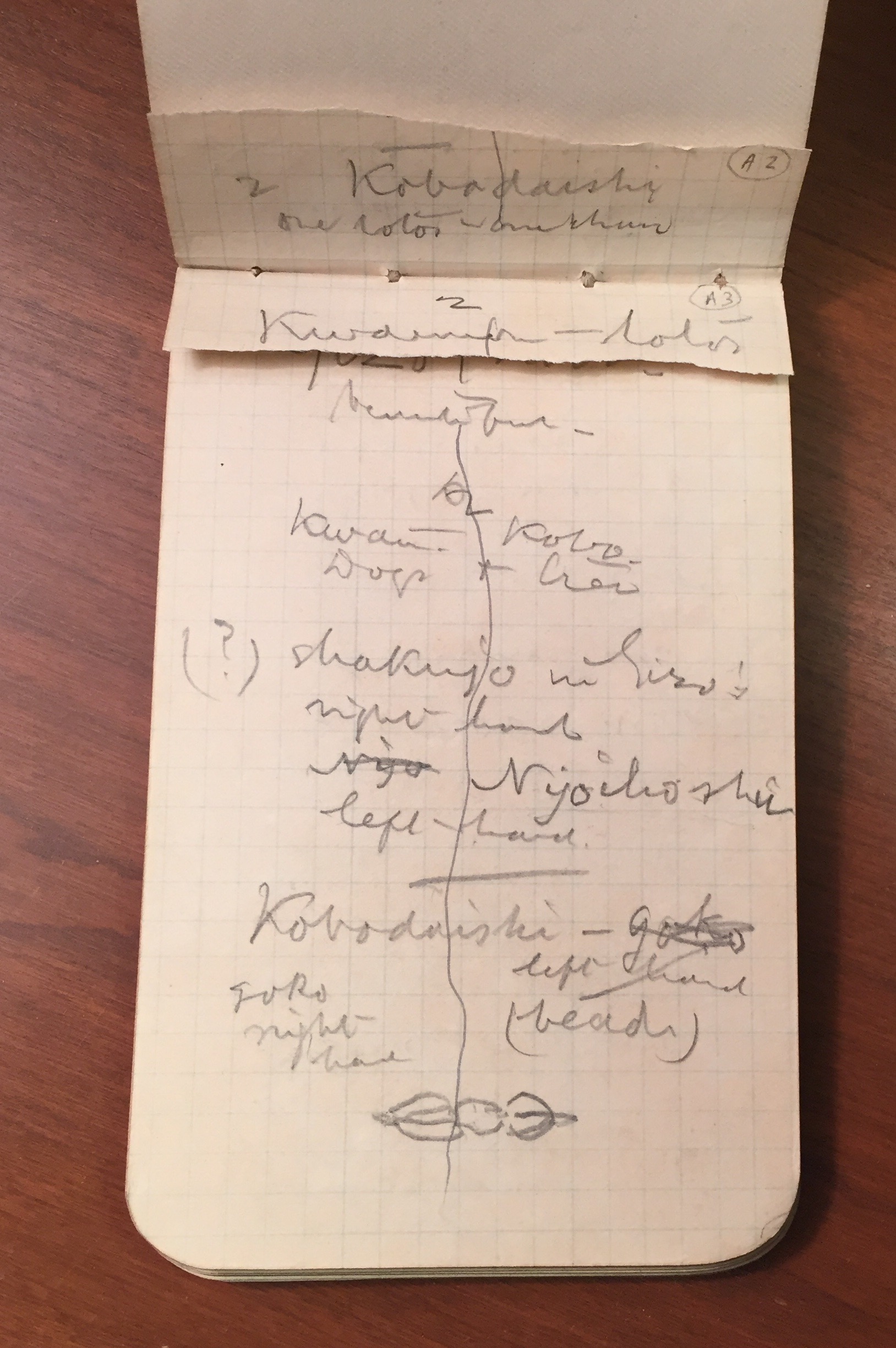
Hearn’s early notebook draft material for “Re-Echo.” (MSS 6101)

hearn1

Draft illustration for “Re-Echo.”

hearn4

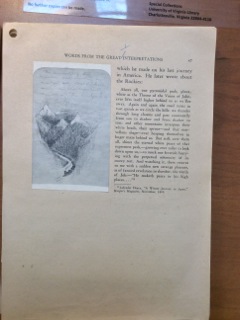
Page proof for “Re-Echo.”

Another contributor to whom much is owed is P.D. Perkins, who compiled and published a comprehensive bibliography of Hearn in 1934 during the commemorations of the thirtieth anniversary of Hearn’s passing. Perkins also saved some of Hearn’s rarest–and most politically forceful–work from destruction. In a letter to Barrett, he describes how, at his own personal risk, he traveled to Japan and “spent two weeks in September 1941 three months before the start of World War II going over the files of the [Japan Chronicle] newspaper for 1894-95,” when Hearn wrote for hte paper.  If not for his actions all would have been lost: “the file of the Chronicle from which I obtained these articles was destroyed during the bombing of Kobe during the war. To the best of my knowledge there is now no file of the Chronicle in existence.” Perkins was unable to publish these pieces and they remain in the Hearn collection at Virginia as a a set of typescripts.

In these typescripts, Hearn uses his unusual position to critique foreign views of both Japanese and Western culture. Writing in 1895 to Atlantic Monthly editor Horace Scudder, Hearn states, “The difference between myself and other writers on Japan is simply that I have become practically a Japanese – in all but knowledge of language; while other writers remain foreigners, looking from outside at riddles which cannot be read except from the inside.” From this vantage point, Hearn condemned what he thought to be predominating social and racial biases among foreign residents in Japan. In a notable unpublished Chronicle article from August 1895, Hearn advocates for the rights of religious minorities:

The majority have no more right to say that the minority shall be voiceless than the minority have the right to compel the majority to accept their view. It is indeed a proof of how very little the civilization of the nineteenth century has advanced in certain respects beyond that of the Middle Age.

In an editorial of October 1885, he writes on racism that “Race hatred itself [is] based on a sort of perverted emotionalism….Certainly it is clear that it is the growth of intellectuality that we must look for [in] the elimination of race hatreds and the spread of a sane cosmopolitanism.”

Hearn believed that his opinions did not sit well with some expat readers in Japan. After leaving Kobe for Tokyo he would write in a letter, “I have long been a subject of persecution in Japan . . . The matter appears to have been managed by a humble clique of English officials, with the aid of the religious bodies.” With this in mind, we can only speculate why these particular articles were not originally chosen for publications. Some of them might have been viewed as too controversial for their anti-western sentiments. In any case a great debt is owed to P.D. Perkins for saving them and then Mr. Barrett for adding them to his collection.

A key strength of the Hearn collection is in its breadth, as may be seen in the library’s own description of the collection: “three hundred letters, some of them to Ernest Fenollosa and to Japanese friends, twenty-five groups of manuscripts, including those of Kwaidan and the description of feudal customs, Glimpses of Unfamiliar Japan, over thirty notebooks, and innumerable periodical appearances and translations.” The essayist Guy Davenport, writing for a U.Va. exhibition on Hearn, noted the voluminous presence of “variant bindings, later editions, periodical printings, translations, [and] inscribed association copies.” It holds a true wealth of resources for a visiting Hearn scholar.

hearn2

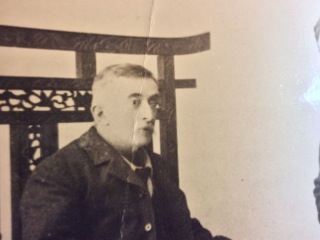
Lafcadio Hearn was virtually always photographed in profile, with his right side visible. This was due to a disfiguring scar caused by an accident in his youth. The injury was not attended to quickly enough, causing him to lose the sight of the left eye: his cornea was completely transformed into a white scar. His right, uninjured eye was so myopic that, even with lenses, he could scarcely see clearly beyond six inches from his nose. This 1898 image shows Hearn facing the camera much more directly than other photographs. (MSS 6101)


Exhibition Prep Special: Translating Shakespeare’s Sonnets into…Morse Code?

This week we are pleased to feature the third guest blog post from graduate curatorial assistant Kelly Fleming, who will be sharing selected treats from our upcoming exhibition, “Shakespeare by the Book,” over the coming months. The exhibition opens February 22, 2016.

Most readers of Shakespeare’s sonnets associate his poetry with love. In films and literary works of all kinds, Shakespeare’s sonnets are quoted and used to confirm the love between two people. Sonnet 116 (“Let me not to the marriage of true minds”) is probably one of the most popular readings on the wedding circuit. As much as Shakespeare’s sonnets are about love, time is more likely to be the subject of the poet’s meditations. The first seventeen—“the procreation sonnets”—urge a young man to make much of time, to get married, and to procreate so that he can live forever through his children. Many of the sonnets after 17 continue to address, to personify, and to apostrophize time, as these first lines illustrate: “Against that time, if ever that time come” (Sonnet 49); “That time of year thou mayst in me behold” (Sonnet 73); “No, Time, thou shalt not boast that I do change” (Sonnet 123).

Knowing the sonnets’ preoccupation with time, I completely “nerded out” when I discovered that someone had turned Shakespeare’s sonnets into a watch. My own scholarship has nothing to do with Shakespeare, but every time Molly, our curator here at Special Collections, mentioned the watch to me, I would get so excited that I would say in a high-pitched voice, “But Shakespeare’s sonnets are all about time!” I cannot imagine a more perfect way to represent his sonnets than a watch.

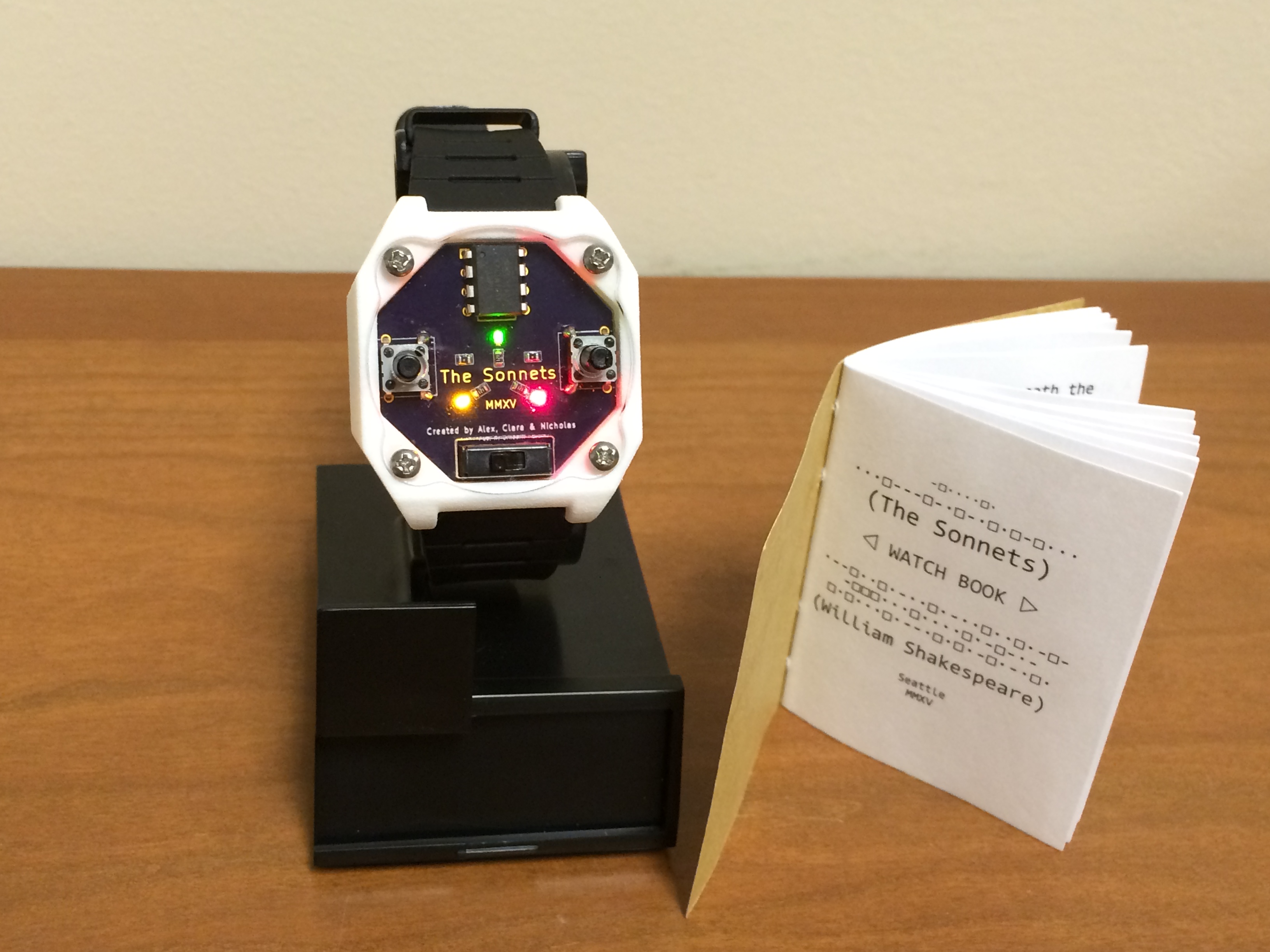
Pictured here is the watch with the instructional booklet open to the title page.

Pictured here is the watch with the instructional booklet open to the title page.

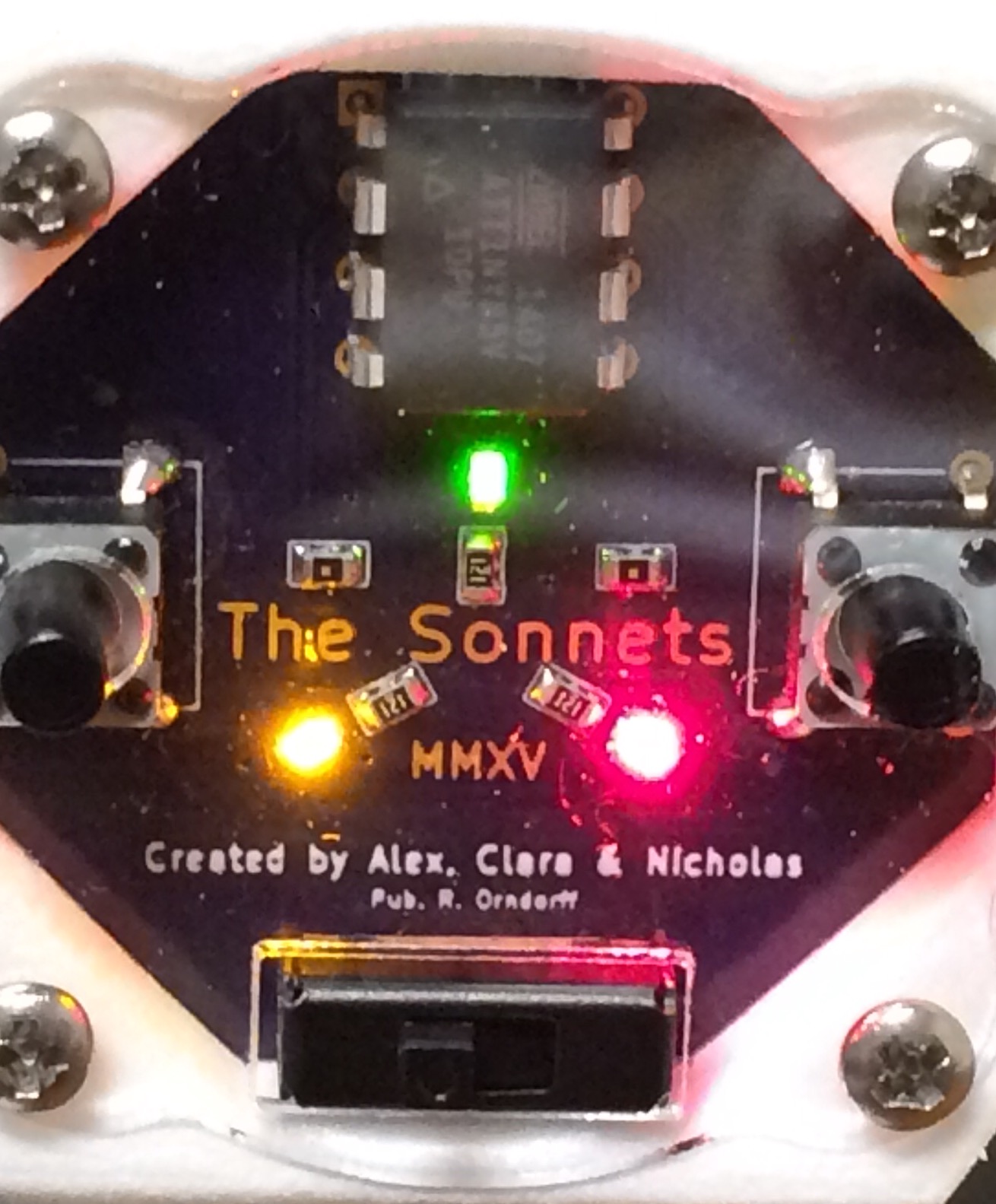
The Sonnets Watch Book is book inside a watch; it is a watch that ticks out Shakespeare’s sonnet 18 (“Shall I compare thee to a summer’s day?”) and sonnet 130 (“My mistress’ eyes are nothing like the sun…”) in Morse code. It was dreamed up and built by three Seattle teenagers (credited on the watch as “Alex, Clara, and Nicholas”) and published by miniature-book publisher and technologist Robert Orndorff (who happens to be the father of two of the makers). Only eighteenth copies of The Sonnets Watch Book are in existence and number eighteen will appear in our exhibition. Bright lights flicker out the letters and punctuation marks of each sonnet. Even though I can’t understand Morse code, there is something incredibly moving about watching the lights change and knowing that Shakespeare’s words are still slowly being repeated throughout time.

Here is an image of the watch as it ticks out one of Shakespeare's sonnets in Morse code.

Here is an image of the watch as it ticks out one of Shakespeare’s sonnets in Morse code.

Last week, I spent a full hour close reading Shakespeare’s Sonnet 65 and talking about time with my ENGL 3810 students. We were stuck on the following lines for a while:

O, how shall summer’s honey breath hold out
Against the wreckful siege of battering days,
When rocks impregnable are not so stout,
Nor gates of steel so strong, but Time decays?

Shakespeare’s answer to this question is his sonnet. Unlike the sea, stone, or shining metals, his “black ink” may be able to withstand the rages of time. His “black ink” will continue to “shine bright” and tell of his love. As my students will tell you, this is exactly what happened. We spent twenty-five minutes of our class on four lines because his “black ink” does still “shine bright” in the history of literature.

Imagine, then, an object that literalizes the hope, the wish of this sonnet. Shakespeare’s words, his “black ink,” actually “[shining] bright” in little yellow, green, and red blinking lights on the face of a watch.

Now, who is excited?

Click on the link below for a video of the watch in action and proof that Shakespeare’s sonnets are now more portable than ever before. The Sonnets Watchbook will be on view—alive and ticking—in “Shakespeare by the Book: Four Centuries of Printing, Editing, and Publishing,” which runs February 22-December 2016 at the University of Virginia Library. 

Oh, and in case you are wondering about the history of literature translated into code, perhaps you would like to see Monty Python’s take on the topic. They  start with Wuthering Heights and go on from there…make sure to stay to the end!:


Exhibition Prep Special: Searching for Shakespeare in Booksellers’ Records

This week we are pleased to feature the second guest blog post from graduate curatorial assistant Kelly Fleming, who will be sharing selected treats from our upcoming exhibition, “Shakespeare by the Book,” over the coming months. The exhibition opens February 22, 2016.

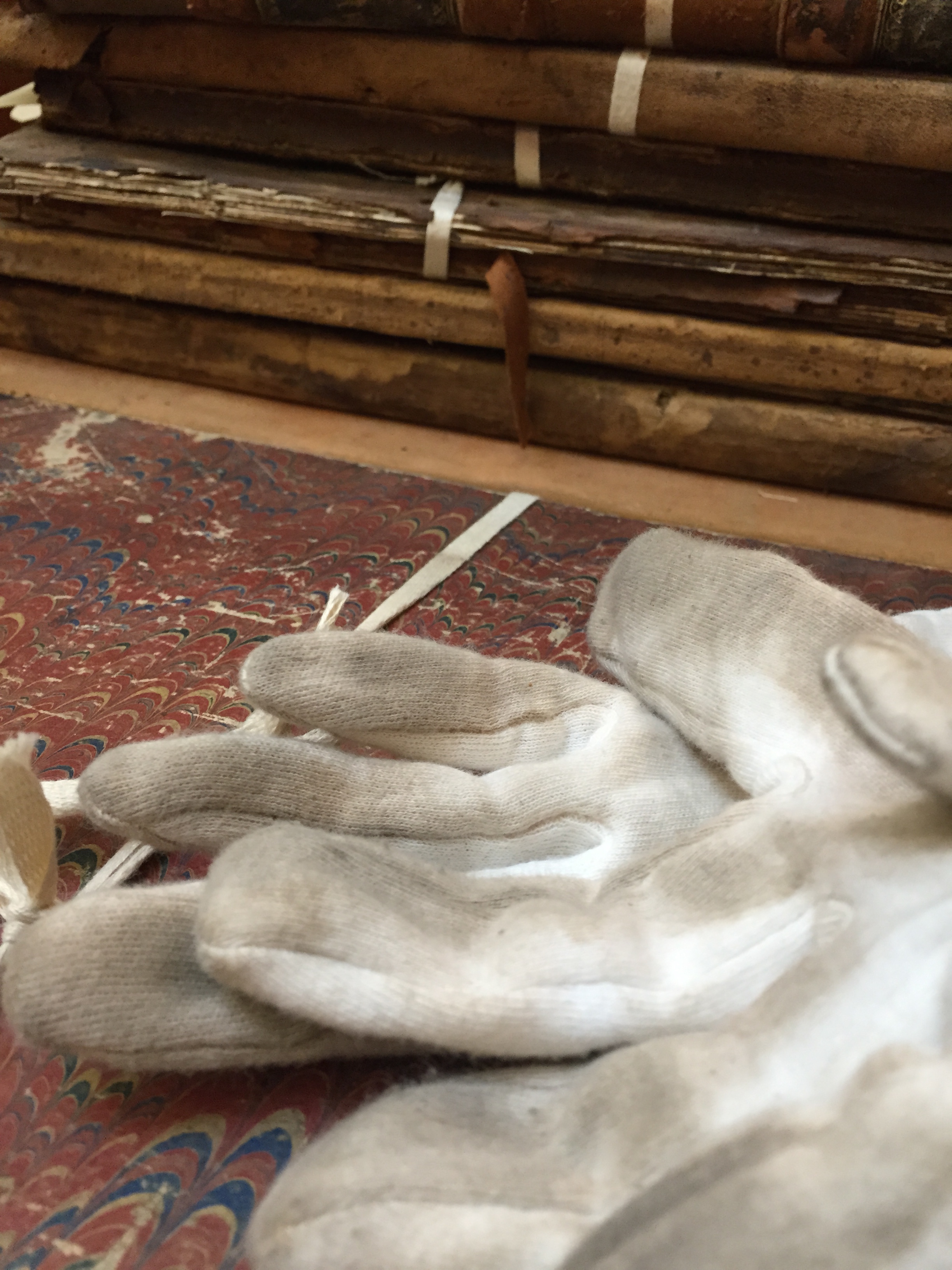
My first two weeks at Special Collections were spent hoisting hulking ledgers from the stacks and placing them gently onto cradles to investigate whether two early booksellers in Virginia sold Shakespeare. After the first day, I found my legs covered in wisps of binding and my hands stained with “red rot” from the ledgers’ leather bindings. Thank goodness for gloves.

Here's what my gloves looked like after several ledgers. Imagine what my bare hands looked like before I put them on.

Here’s what my gloves looked like after several ledgers. Imagine what my bare hands looked like before I put them on.

I combed through the account books of Bell & Co., a printer in Alexandria, Virginia active in the nineteenth century and the Virginia Gazette, a newspaper and printer active in Williamsburg, Virginia in the eighteenth century. My eyes sought any spelling variation of the name “Shakespeare” amidst endless purchases of envelopes and paper. Despite our modern perception that Shakespeare’s works are “classics” and that he is a father of the English language, his place in the literary canon was yet to be defined in the eighteenth and nineteenth centuries. As my findings attest, Virginians chose to read a myriad of other things more frequently than Shakespeare.

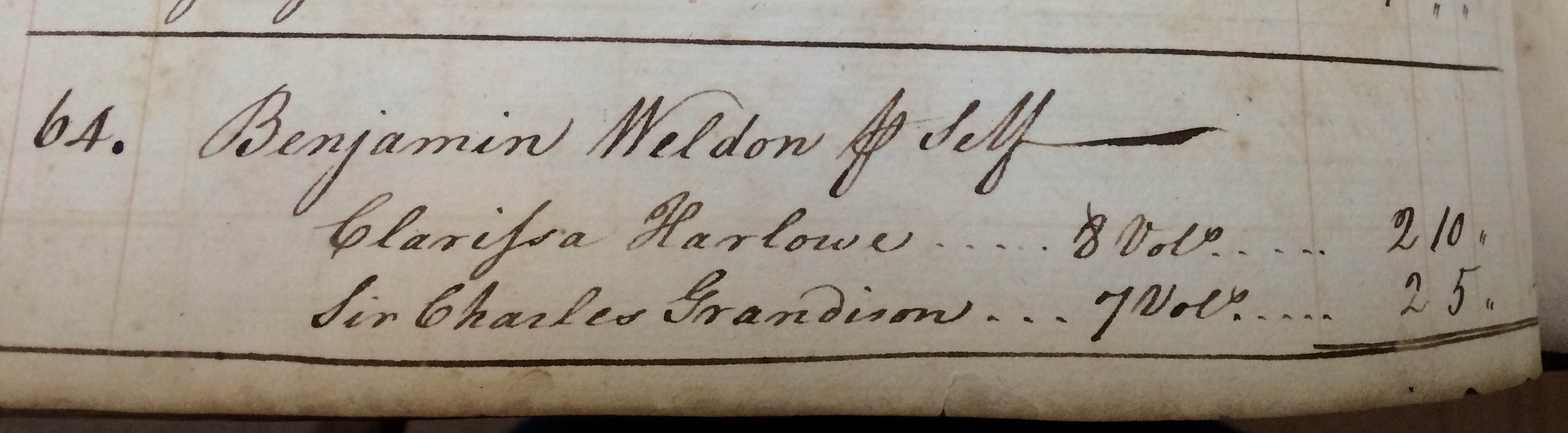
Only one copy of Shakespeare was sold by the Virginia Gazette in the years 1750–1752 and 1764–1766. Even though David Garrick was busily working to increase the popularity of Shakespeare in London at this time, the colonies seem to have been a step behind. Since Williamsburg was home to the Virginia legislature and the College of William & Mary, it is not surprising that the books sold by the Virginia Gazette were largely educational: Latin grammar textbooks, dictionaries, and religious texts like the Book of Common Prayer. Despite the fact that Samuel Johnson’s Dictionary of the English Language (a book the Virginia Gazette also sold) marks Shakespeare’s works as the first usage of many English words, students were not studying Shakespeare. The education system in the eighteenth century trained students (that is to say, young men) in what they considered the “classics”: philosophical and literary texts from ancient Greece and Rome. When students did read literary texts in English, it seems that they read English epics, which use classical elements to describe contemporary England. The epic works of Milton, Dryden, and Pope, for example, appear numerous times in the accounts of the Virginia Gazette. In addition to English epics, we find our copy of Shakespeare alongside another genre excluded from the education system: the novel. In the ledger in our exhibition, we find popular English novels such as Samuel Richardson’s Clarissa and Tobias Smollett’s Roderick Random.

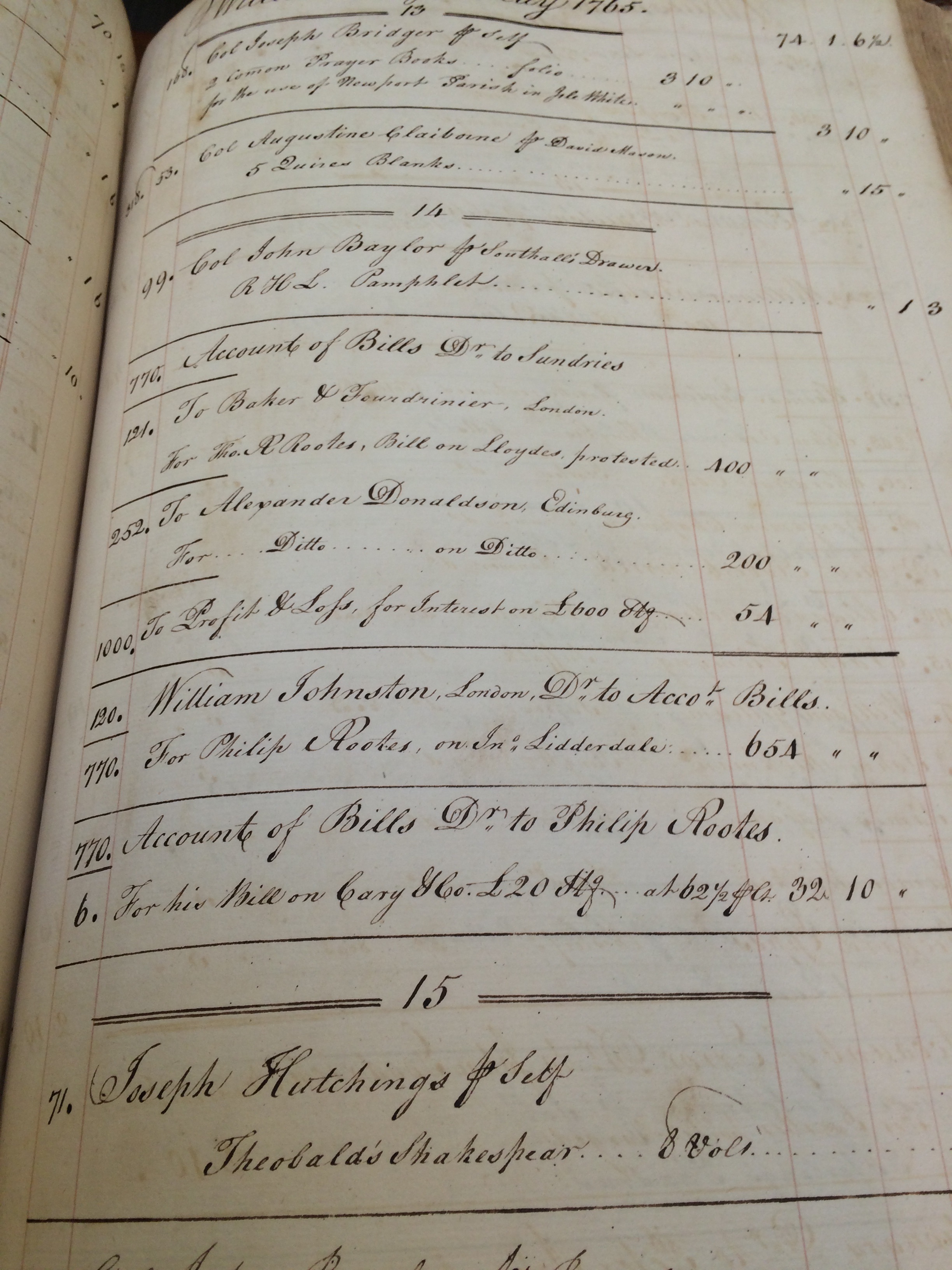
Page of Virginia Gazette Day Book showing the purchase of Theobald's edition of Shakespeare (MSS 467)

Page of Virginia Gazette Day Book showing a purchase of Theobald’s edition of Shakespeare (MSS 467)

Joseph Hutchings purchased 8 volumes of of Shakespeare "for [his] self" (MSS 467).

The Virginia Gazette records show Joseph Hutchings purchasing 8 volumes of Shakespeare “for [him] self” (MSS 467).

Alongside Shakespeare in the Virginia Gazette Daybook, I found a recorded purchase of two of Samuel Richardson's novels, "Clarissa: Or, the History of a Young Lady" (1747-8) and "The History of Sir Charles Grandison" (1753).

Alongside Shakespeare in the Virginia Gazette records are two of Samuel Richardson’s novels, “Clarissa: Or, the History of a Young Lady” (1747-8) and “The History of Sir Charles Grandison” (1753). (MSS 467)


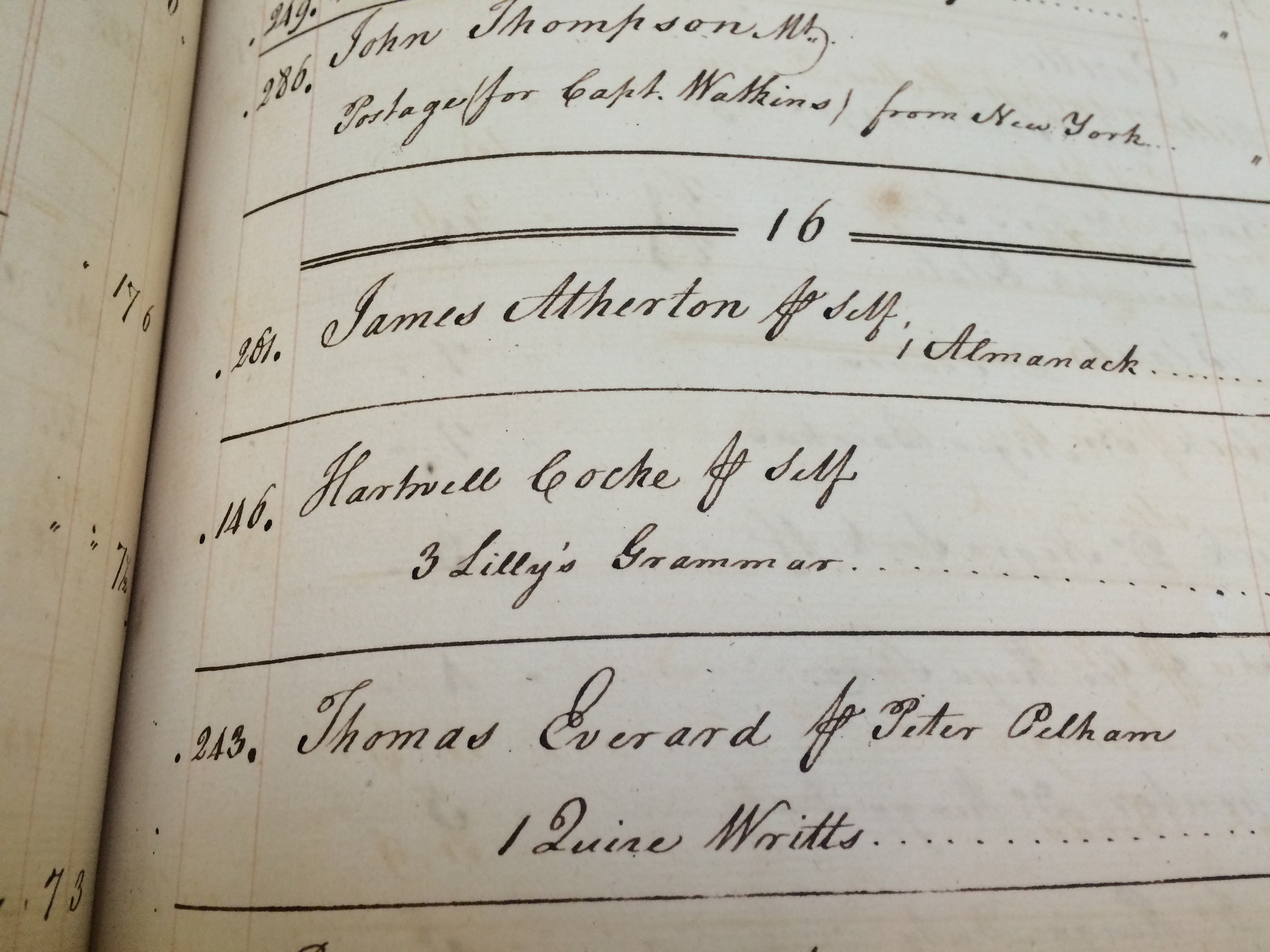
Alongside Shakespeare in the Virginia Gazette records are many educational texts such as Lilly's Latin Grammar. (MSS 467)

Alongside Shakespeare in the Virginia Gazette records are many educational texts such as Lilly’s Latin Grammar. (MSS 467)

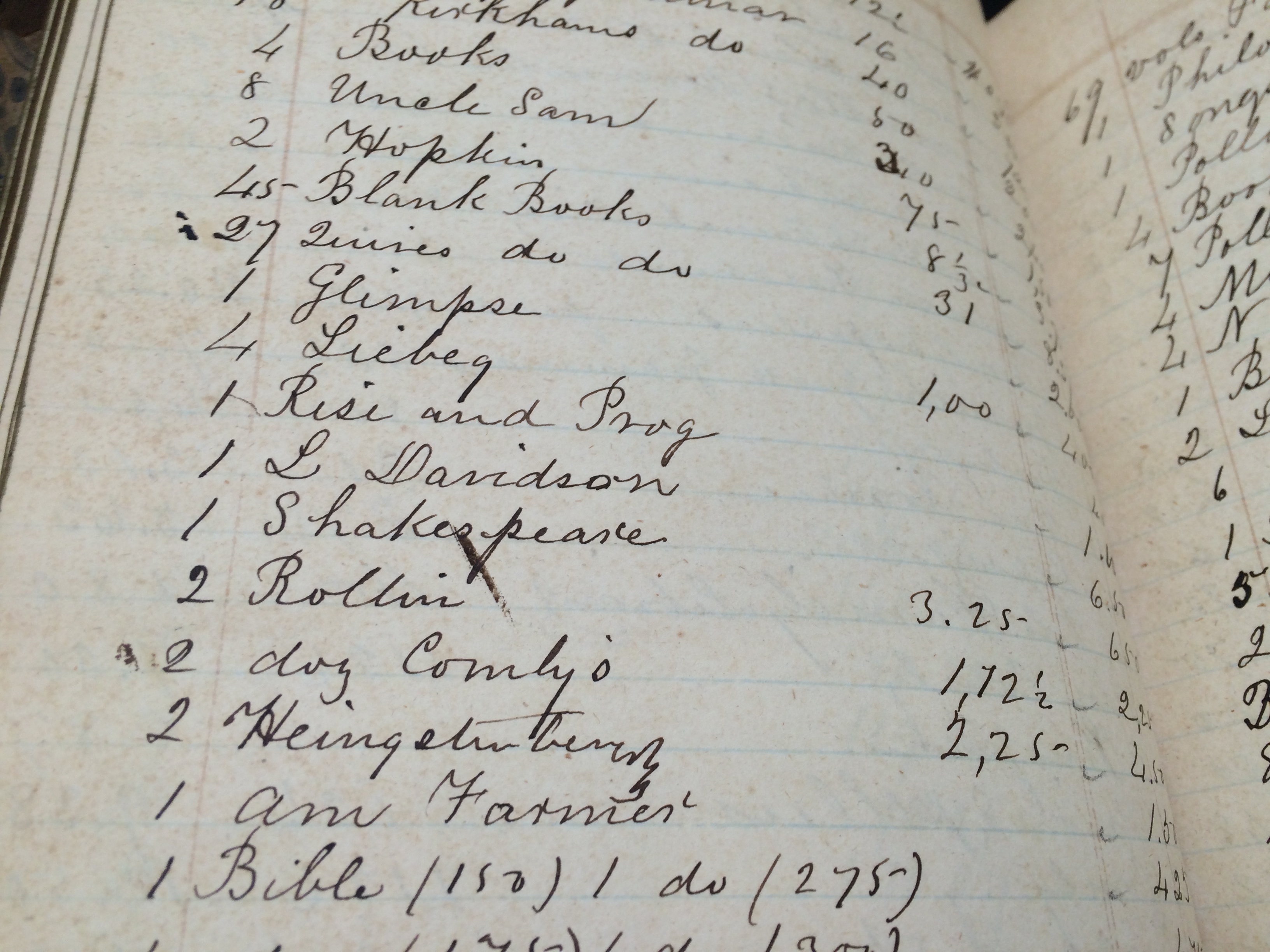
Thanks largely to new performances of Shakespeare plays, Garrick’s Shakespeare Jubilee, and new editions of Shakespeare works in the eighteenth century, Shakespeare’s words come alive by the nineteenth century. The accounts of Bell & Co. reflect this increasing popularity. I found seven copies of Shakespeare sold at Bell & Co. over the course of the nineteenth century (1809–1899). The specific ledger we are using in the exhibition shows Shakespeare alongside Susanna Rowson’s novel Charlotte Temple, Wordsworth, Cooper’s Virgil, and the Bible.

Bell & Co. sold Shakespeare for "6.50" (MSS 2989).

Bell & Co. sold Shakespeare for “6.50.” Different types of currency were in use in the colonies at this time. Without further research, all we can tell from this record is that it is expensive and suggests that the reader bought a multi-volume set (MSS 2989).

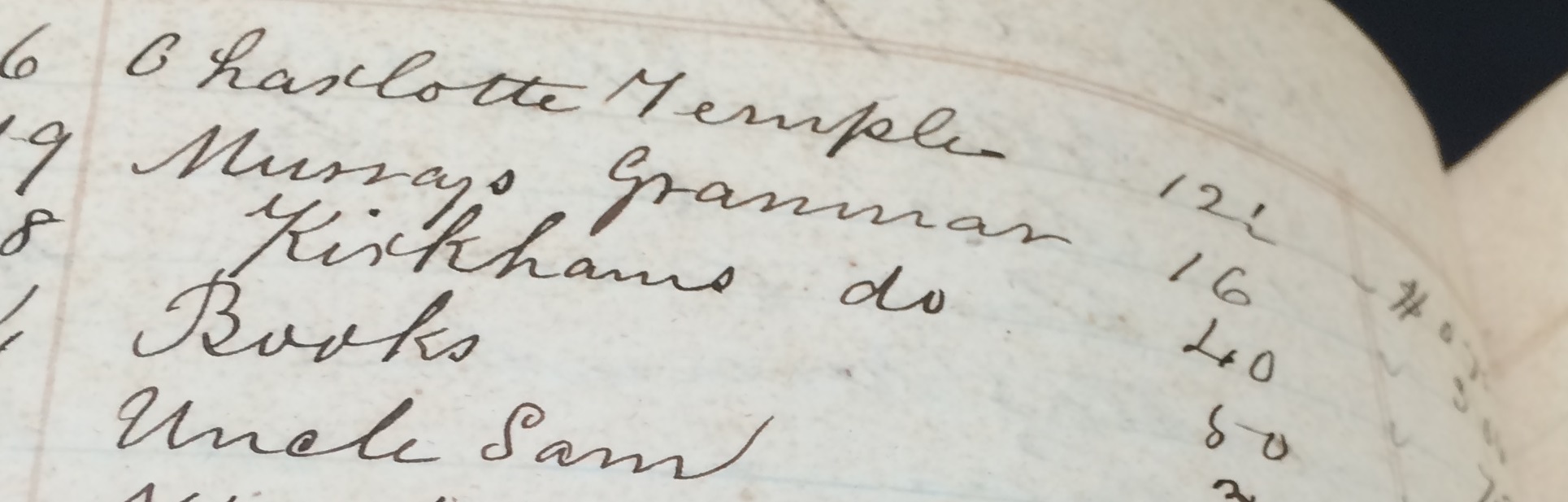
On the same page, Bell & Co. recorded the purchase of Susanna Rowson's novel "Charlotte Temple" and two grammar books.

On the same page as Shakespeare, Bell & Co. recorded the purchase of Susanna Rowson’s novel “Charlotte Temple” and two grammar books. (MSS 2989)

Finally, in the twentieth century, Shakespeare begins to be studied and to be studied as a father of the English language. Today, Shakespeare is probably the most often memorized, most often recited English author in schools. I still can recite the famous speech of Titania’s from A Midsummer’s Night Dream that I memorized in the tenth grade and that begins “Set your heart at rest.” But as the exhibition at the Special Collections Library will show us in February, our hearts do anything but rest when we hear the heartbeat of Shakespeare’s iambs, even four hundred years after his death.


On View Now: American Broadsides to 1860

This week’s feature is a post by George Riser, Collections and Instruction Assistant for the Albert and Shirley Small Special Collections Library.

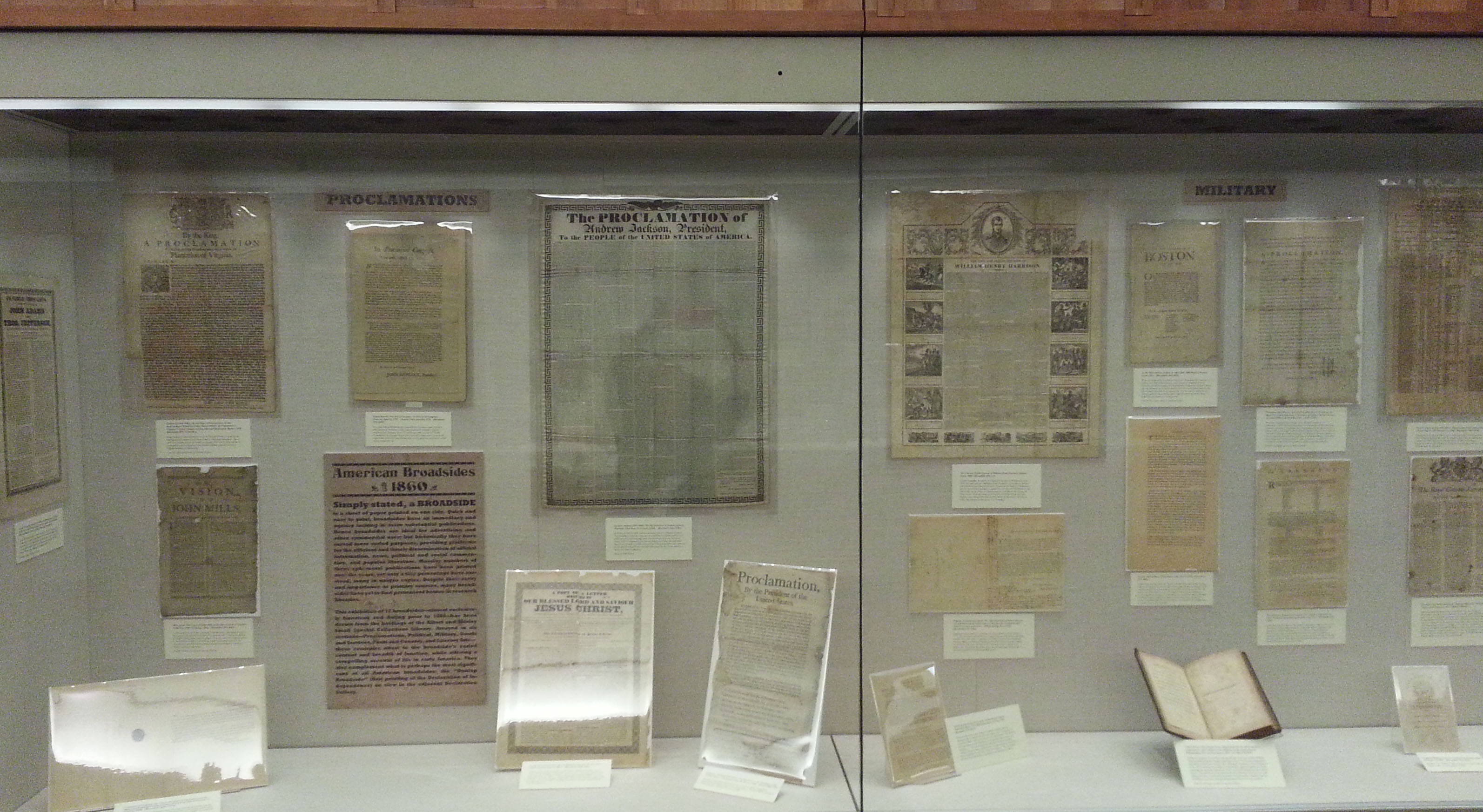
American Broadsides to 1860 features 72 broadsides—almost exclusively American and dating prior to 1860—drawn from the holdings of the Albert and Shirley Small Special Collections Library. Arrayed in six sections—Proclamations, Political, Military, Goods and Services, Town and Country, and Literary Arts—these examples attest to the broadside’s varied content and breadth of function, while offering a fascinating account of life in early America. They also complement what is perhaps the most significant of all American broadsides: the “Dunlap Broadside” (first printing of the Declaration of Independence) on view in the adjacent Declaration Gallery.” Text by David Whitesell from the exhibition’s introductory panel.

One case of the exhibition American Broadsides to 1860. Photograph by Petrina Jackson.

One case of the exhibition American Broadsides to 1860. Photograph by Petrina Jackson.

The following is a sampling of what you will find in each of the exhibition’s sections.

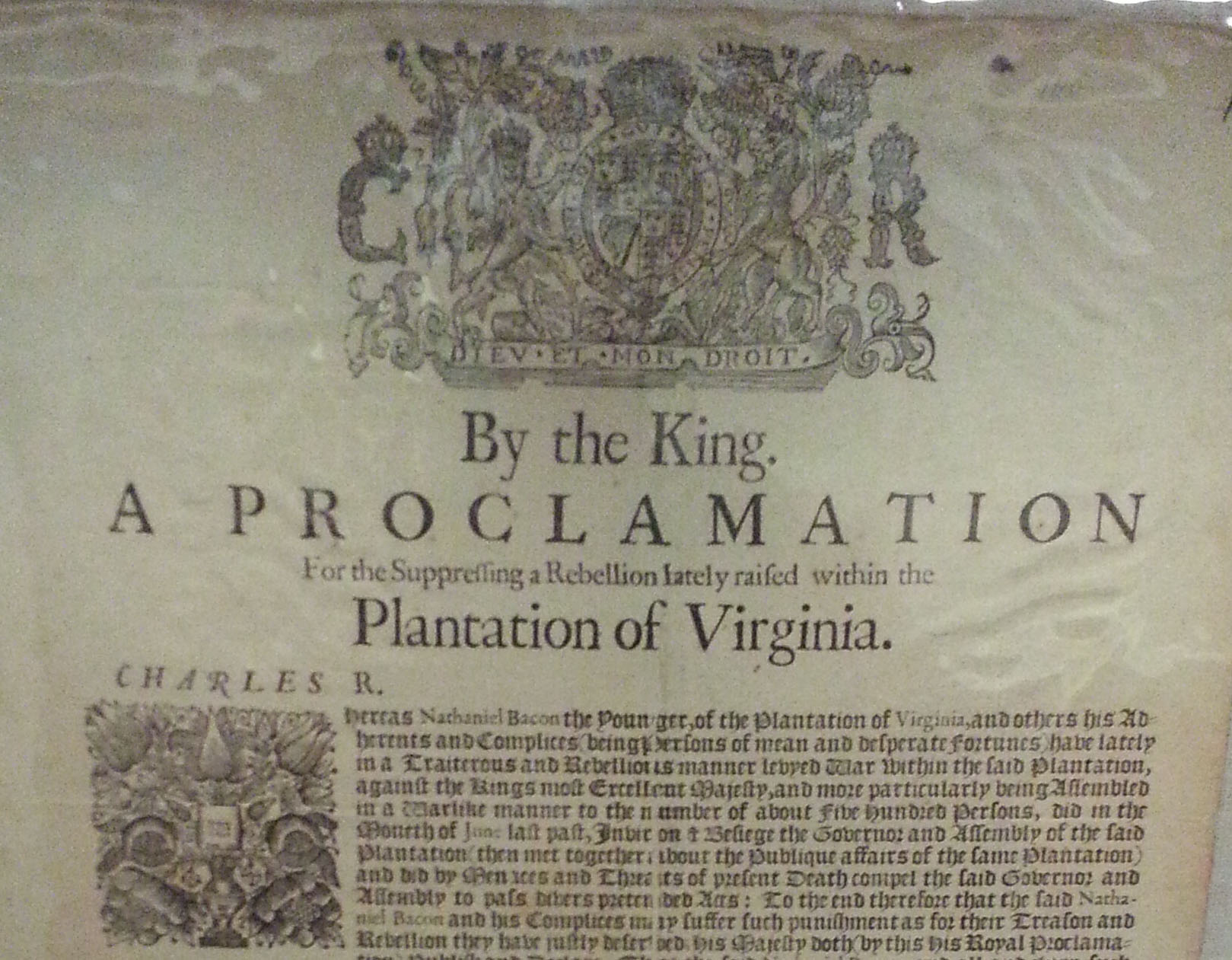
The earliest broadside on display is found in the “Proclamations” section. “By the King. A Proclamation for the Suppressing a Rebellion Lately Raised Within the Plantation of Virginia,” is King Charles II’s 1676 response to Nathaniel Bacon’s rebellion, which was raging in the fledgling Virginia colony.

Detail of By the King. (fill in). Photograph by Petrina Jackson.

Detail of Charles II (1630-1685). By the King. A Proclamation for the Suppressing a Rebellion Lately Raised Within the Plantation of Virginia. London: Assigns of John Bill and Christopher Barker, 1676. (Broadside 1676 .G744 S63). Photograph by Petrina Jackson.

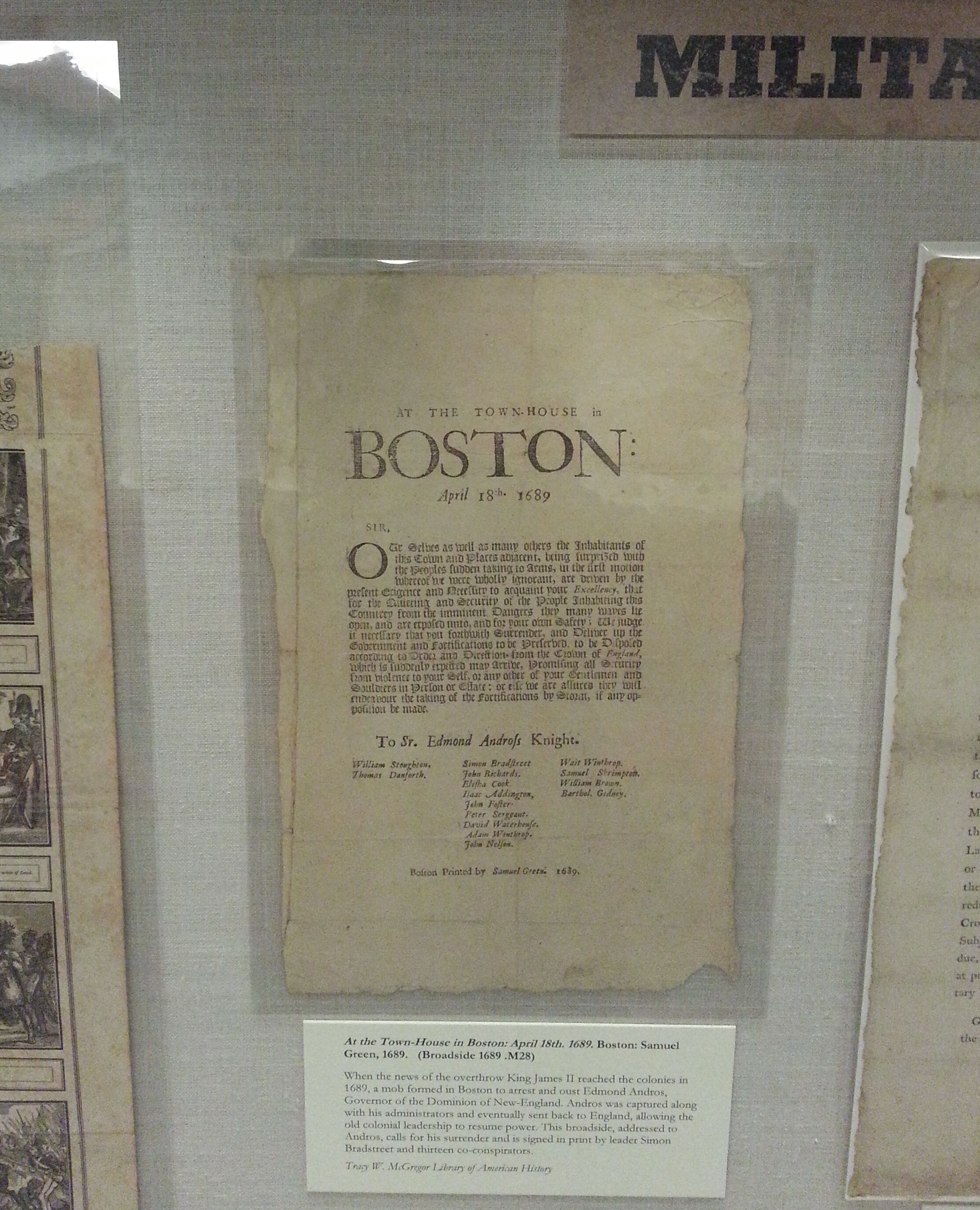
In the “Military” category, “Boston, 26th of June, 1775,” features a first-hand account, printed just nine days after the Battle of Bunker Hill, offering a somewhat rosy view of the catastrophic attempt to dislodge 1,200 colonial troops who had taken up positions in the hills surrounding Boston.

Boston. Photograph by Petrina Jackson

Boston, 26th of June, 1775. [Boston: John Howe, 1775] (Broadside 1775 .B67). Photograph by Petrina Jackson

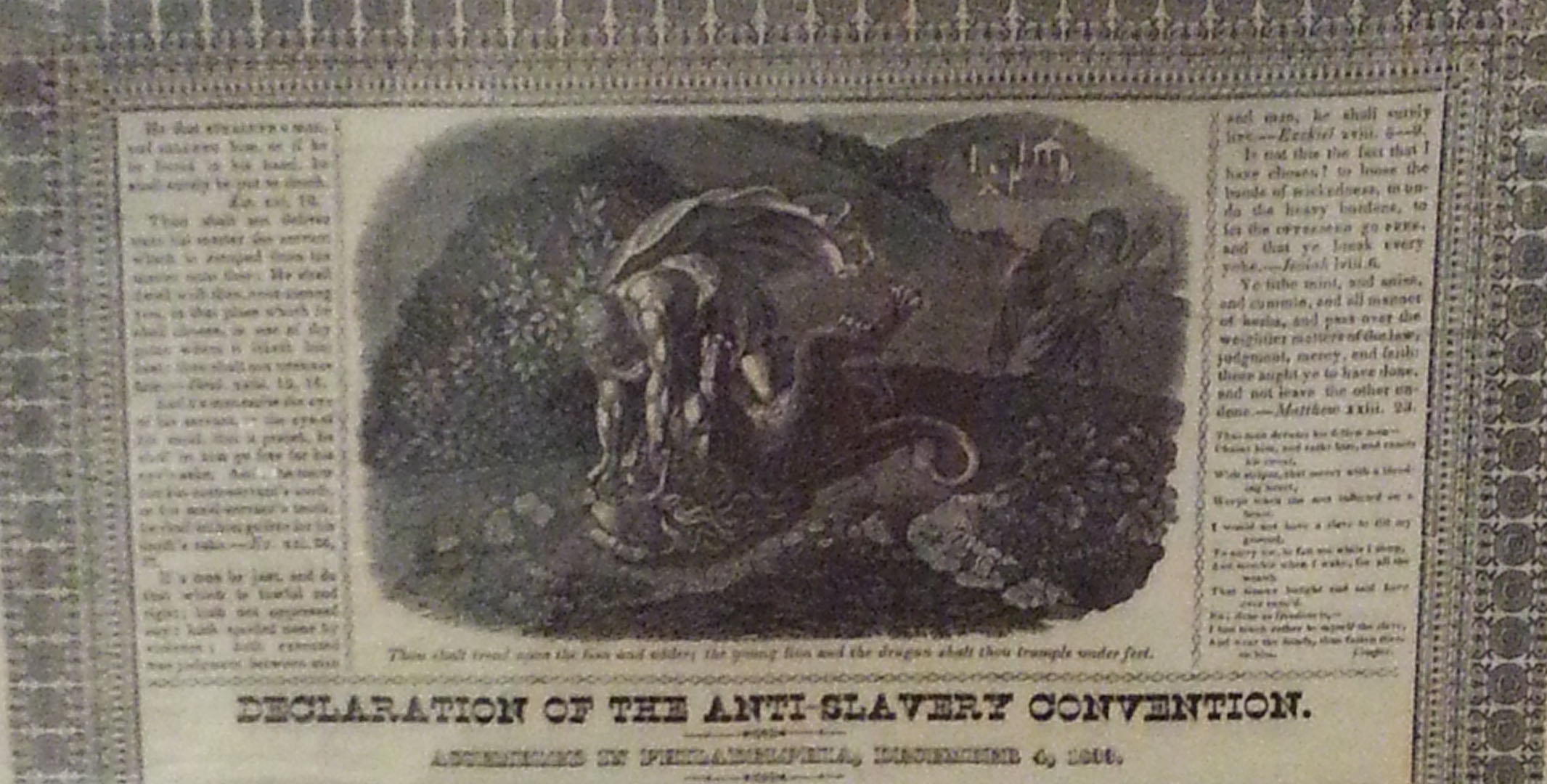
In the “Political” section, the “Declaration of the Anti-slavery Convention, 1833,” calls for the formation of a national anti-slavery society—henceforth to be known as the American Anti-Slavery Society—and lists the names of delegates from ten states.

Detail of Declaration of the Anti-slavery Convention. [Philadelphia] : Merrihew & Gunn, [1833] (Broadside .W54 Z99 1833). Photograph by Petrina Jackson.. Photograph by Petrina Jackson.

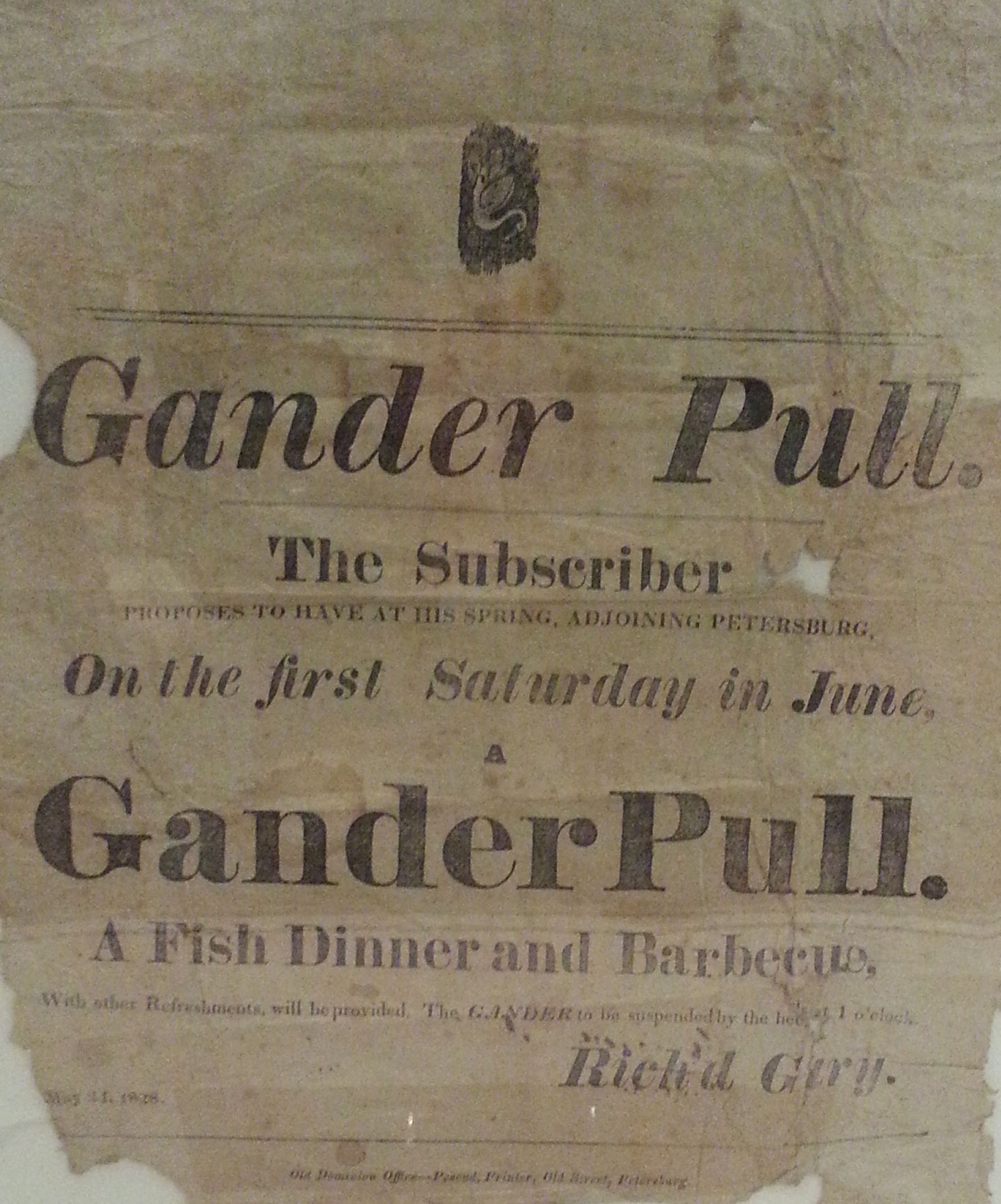
The “Farm and Country” category features an 1828 broadside advertising a Gander Pull outside of Petersburg, Virginia. A Gander Pull involves the hanging of a neck-greased goose upside down from a scaffold, whereby well-lubricated participants attempt to decapitate the bird as they ride past at full gallop. The event also featured a fish dinner and a barbecue.

Gander Pull. Photograph by Petrina

Gary, Rich[ar]d. Gander Pull. Petersburg [Va.]: Old Dominion Office, [1828] (Broadside 1828 .G27). Photograph by Petrina

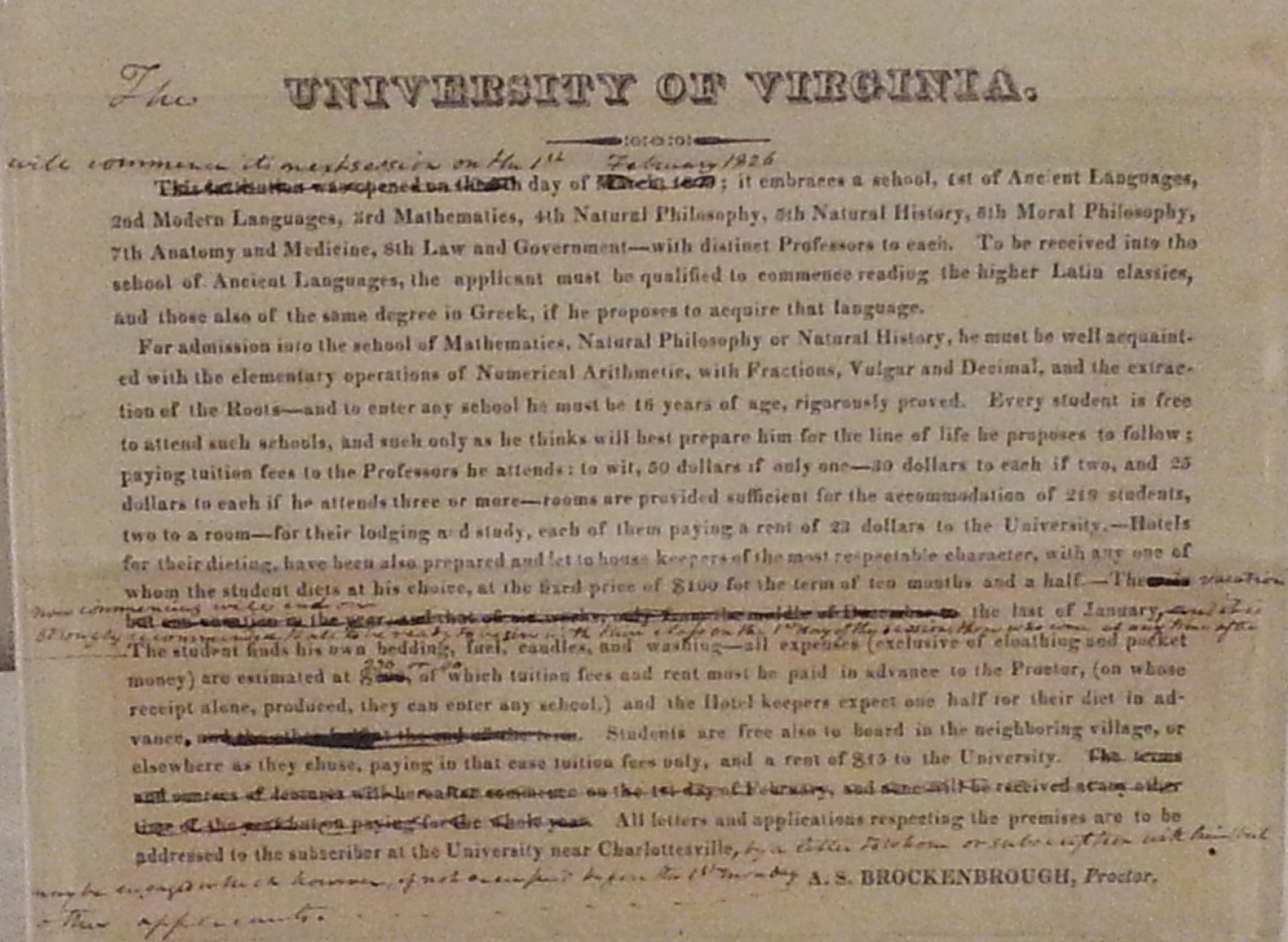
Two University of Virginia broadsides are found in the “Goods and Services” section: “Explanations, of the Ground Plan of the University of Virginia,” printed in Charlottesville in 1824. This broadside, printed to accompany Peter Maverick’s 1822 engraved “Plan of the University,” describes the pavilions, locations of the hotels, and the placement of the Rotunda, as well as the general layout of the only partly completed university Grounds. The 1825 program, “University of Virginia. This Institution Was Opened on the 5th Day of March, 1825,” was used to draft the text of the program for the second session of 1826. The first line—“This institution was opened on the 5th day of 1825”—is crossed out and changed in manuscript to read, “will commence its next session on the 1st day of February, 1826.” Other alterations indicate changes made for the second session.

University of Virginia. Photograph by Petrina Jackson.

University of Virginia. This Institution Was Opened on the 5th Day of March, 1825 … [Charlottesville: University of Virginia, 1825?] (Broadside 1825 .U65).. Photograph by Petrina Jackson.

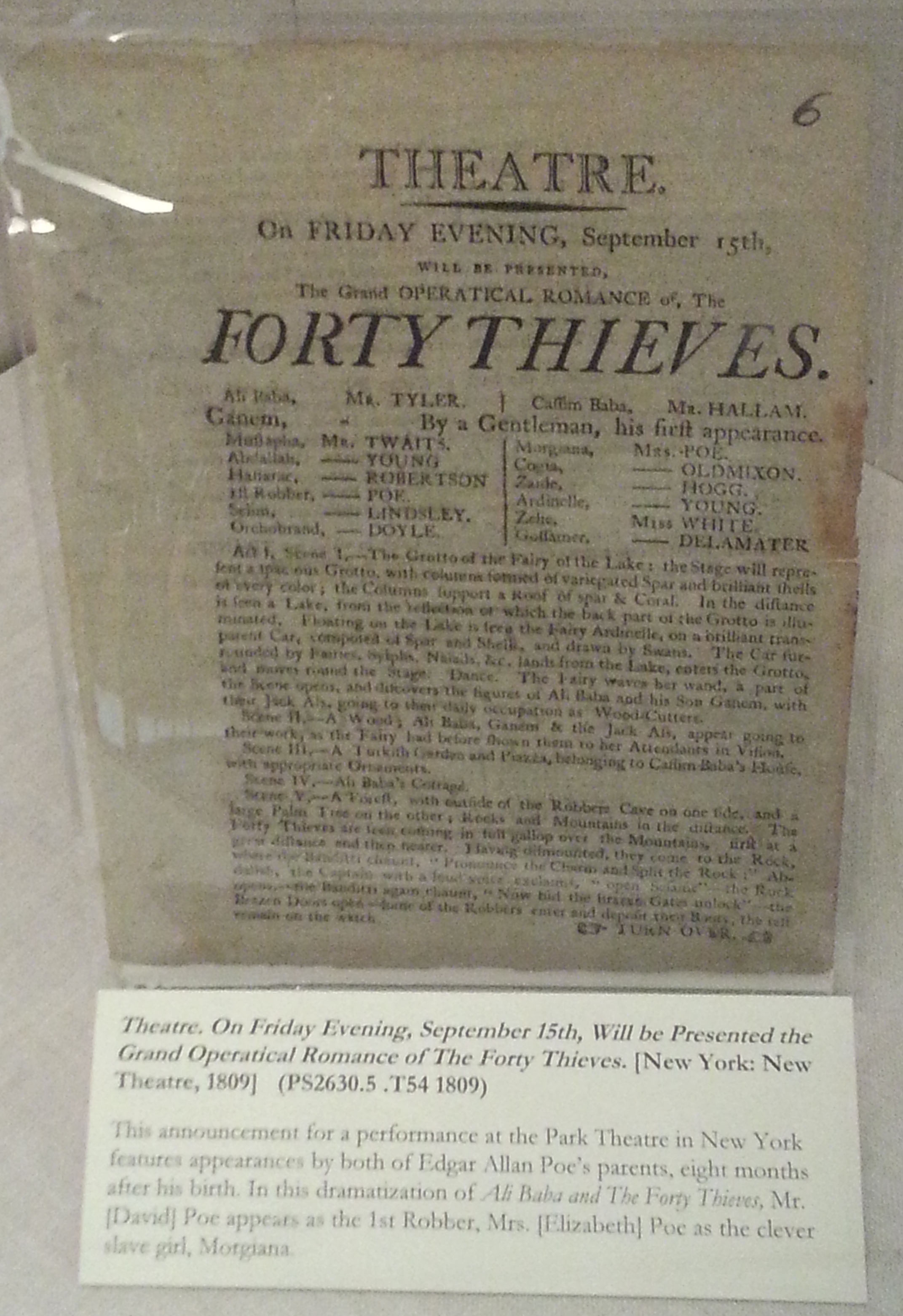
In the “Literary” section don’t miss, “Theatre. On Friday Evening, September 15th, Will be Presented the Grand Operatical Romance of The Forty Thieves.” This 1809 announcement for a performance at the Park Theatre in New York features appearances by both of Edgar Allan Poe’s parents, eight months after his birth. In this dramatization of Ali Baba and The Forty Thieves, Mr. [David] Poe appears as the 1st Robber, Mrs. [Elizabeth] Poe as the clever slave girl, Morgiana.

Forty Thieves. Photograph by Petrina Jackson

Theatre. On Friday Evening, September 15th, Will be Presented the Grand Operatical Romance of The Forty Thieves. [New York: New Theatre, 1809] (PS2630.5 .T54 1809). Photograph by Petrina Jackson

In addition, there are 64 other fascinating broadsides on display, each offering a unique and varied look at American culture in the seventeenth, eighteenth and nineteenth centuries. The exhibition may be viewed in the barrel-vaulted hallway on the first floor of the Harrision/Small building, just outside of the Albert and Shirley Small Declaration Gallery.


Lafayette at U. Va.

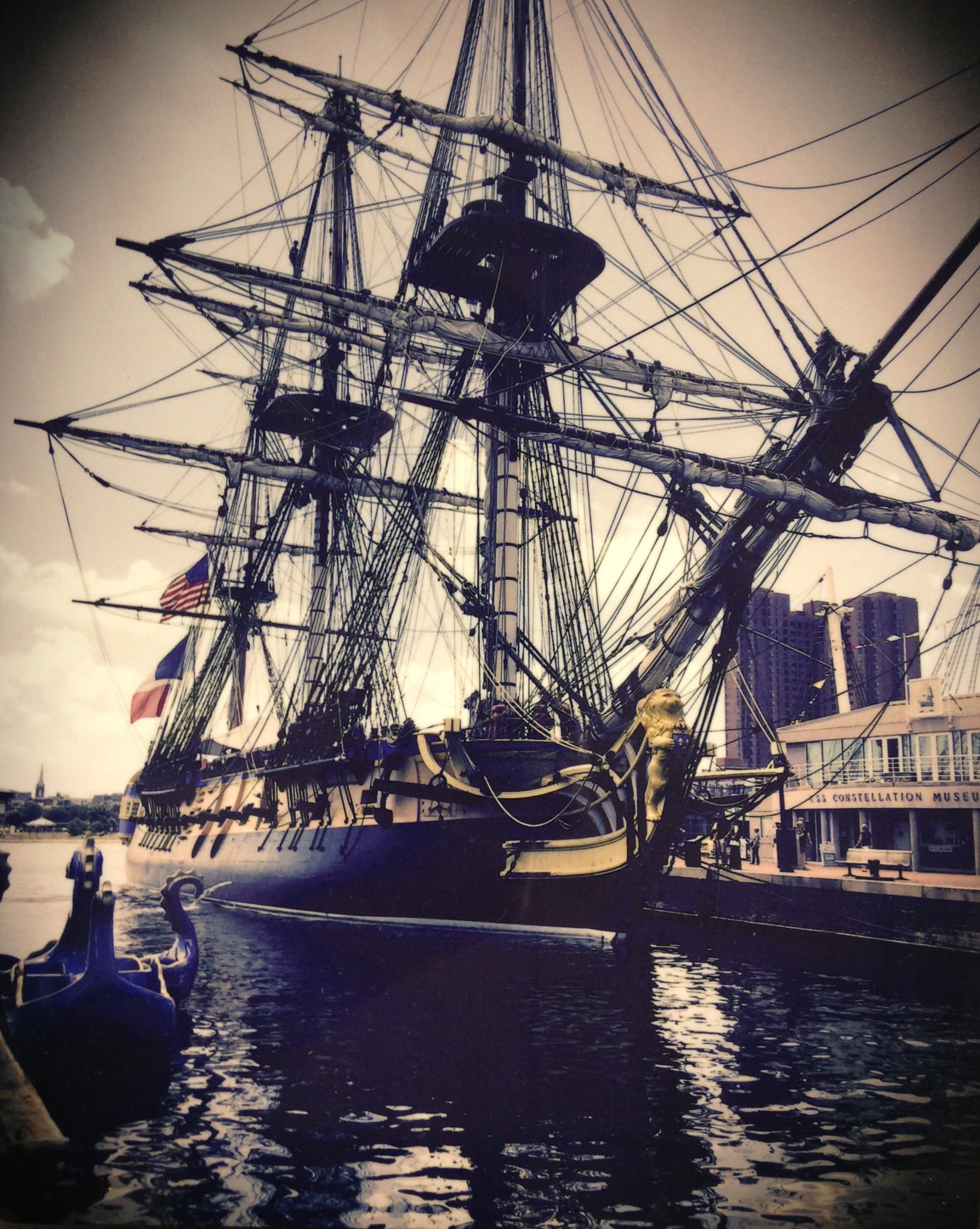
This summer the French frigate Hermione—a reconstruction of the vessel which, in 1780, brought the Marquis de Lafayette back to the United States with welcome news of French aid, and which then helped to secure final victory at Yorktown in 1781—made a triumphal voyage to the United States. Built in France between 1997 and 2012 at a cost of over $20 million, the Hermione—measuring 213 x 37 feet, its center mast reaching 177 feet—takes pride of place as France’s grandest “tall ship.” After arriving at Yorktown, Va., to a gala reception on June 5, the Hermione stopped at a dozen ports of call along the eastern seaboard before departing for France on July 18.

The Hermione at anchor in Baltimore's Inner Harbor, June 2015.   (Gift of Albert H. Small)

The Hermione at anchor in Baltimore’s Inner Harbor, June 2015. (Gift of Albert H. Small)

As a memento of the Hermione’s visit, the U.Va. Library’s devoted friend and generous supporter Albert H. Small has presented us with a photograph of the reconstructed ship at anchor in Baltimore’s Inner Harbor. Mr. Small’s gift prompted us to search Under Grounds for rare books, manuscripts, and other artifacts relating to Lafayette, and we located much of interest! Following is a brief sampling of what Lafayette enthusiasts will find in the Albert and Shirley Small Special Collections Library.

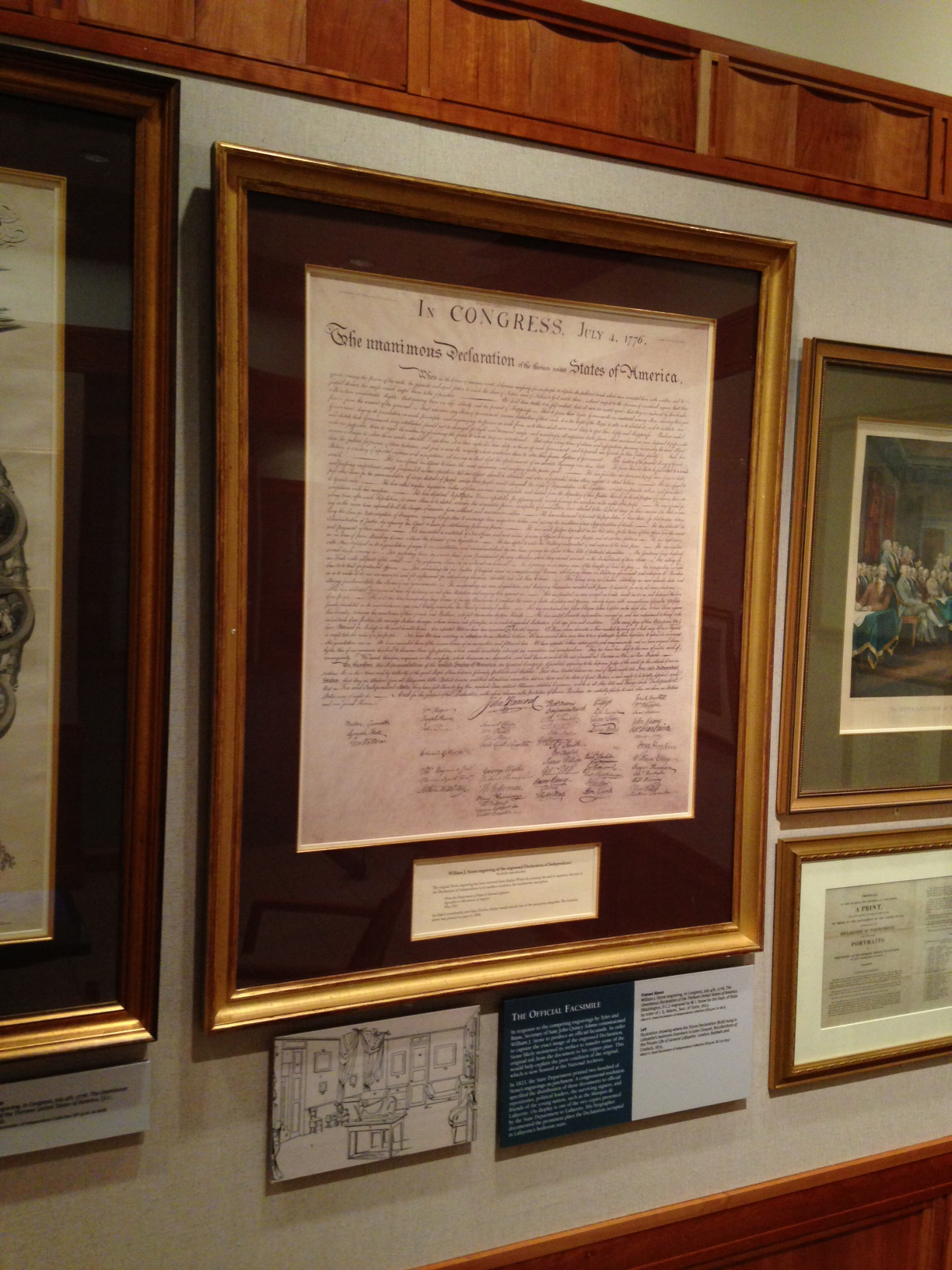
The Marquis de Lafayette - Albert H. Small copy of the 1823 "Stone" facsimile of the Declaration of Independence, on display in the Small Special Collections Library's Declaration Exhibition Gallery.   (KF4506 .A1 1823; Gift of Albert H. Small)

The Marquis de Lafayette – Albert H. Small copy of the 1823 “Stone” facsimile of the Declaration of Independence, on display in the Small Special Collections Library’s Declaration Exhibition Gallery. (KF4506 .A1 1823; Gift of Albert H. Small)

Perhaps pride of place should go to Lafayette’s own copy of the Declaration of Independence—the document he devoted his life to defending and disseminating. During Lafayette’s triumphal tour of the United States in 1824-1825, he was presented with an official full-size engraved facsimile, printed on vellum, of the original Declaration now on display in the National Archives. Lafayette treasured this copy of the “Stone printing,” hanging it in his bedchamber after returning to France. Eventually acquired by Albert H. Small, Lafayette’s copy now resides at U.Va., where it forms part of Mr. Small’s superlative Declaration of Independence collection. Visitors may view it (or rather, for conservation reasons, an exact facsimile of the original) in the Small Special Collections Library’s permanent exhibition of highlights from Mr. Small’s collection.

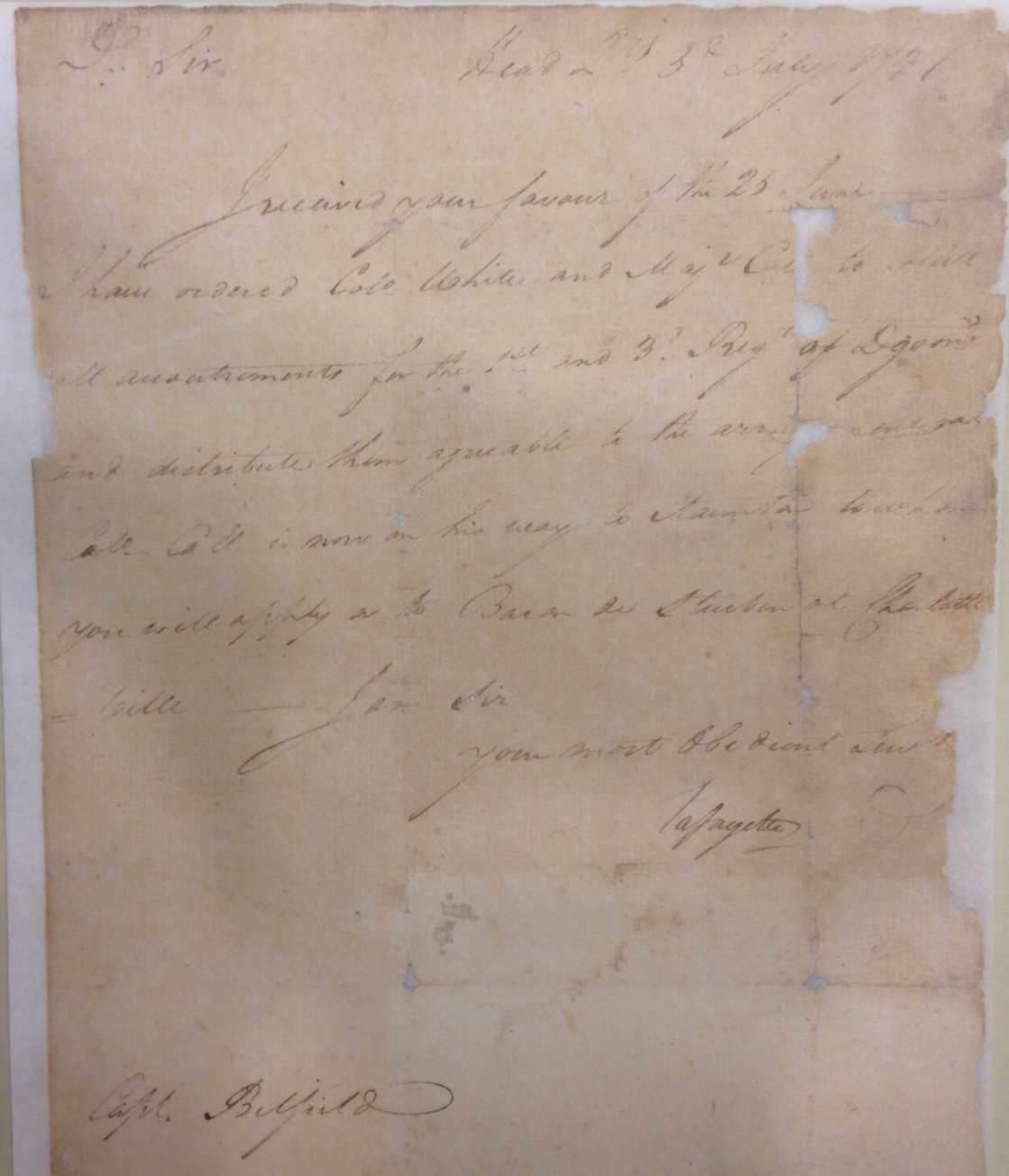
Lafayette sends orders to Capt. Belfield in Staunton, Va., July 3, 1781.   (MSS 8097)

Lafayette sends orders to Capt. Belfield in Staunton, Va., July 3, 1781. (MSS 8097)

Arriving in the U.S. in 1777 as a newly commissioned officer, the 19-year-old Lafayette soon won the respect and friendship of George Washington while contributing significantly to the American cause. In the early summer of 1781, Lafayette played a critical role in skirmishing with British forces in Virginia until Washington had time to spring his trap at Yorktown. On July 3, 1781, Lafayette sent the orders shown above to a Capt. Belfield at Staunton, Va., also noting the presence of Baron von Steuben in Charlottesville.

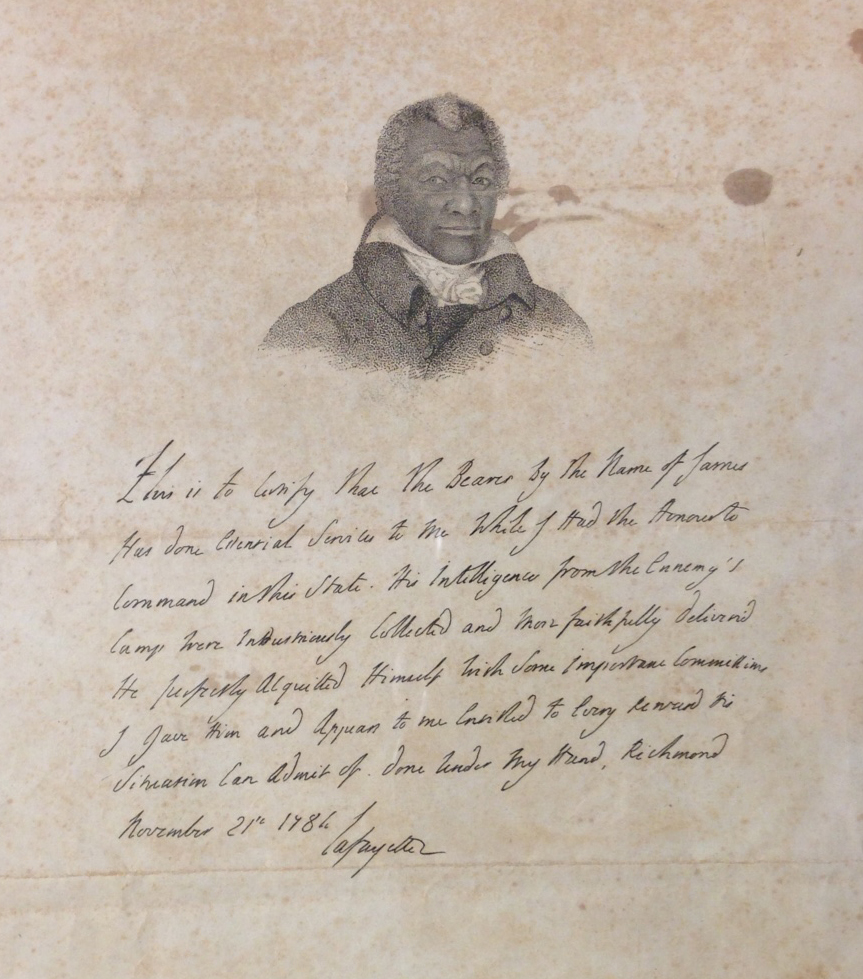
An engraved facsimile, ca. 1824, of Lafayette's 1784 testimonial letter on behalf of James Armistead Lafayette, with added portrait.   (Broadside 1824 .L25)

An engraved facsimile, ca. 1824, of Lafayette’s 1784 testimonial letter on behalf of James Armistead Lafayette, with added portrait. (Broadside 1824 .L25)

Another Virginian in Lafayette’s service was James, a slave permitted by his master to serve as an American spy behind British lines by posing as a fugitive. In 1787, with his owner’s support and a testimonial letter from Lafayette, James was freed by the Virginia Assembly and took the name James Armistead Lafayette. When Lafayette returned to the U.S. in 1824, his kindness to James—and his ardent support for the as-yet-unrealized ideal that “all men are created equal”—were commemorated in an engraved print bearing James’s likeness above a facsimile of Lafayette’s testimonial letter.

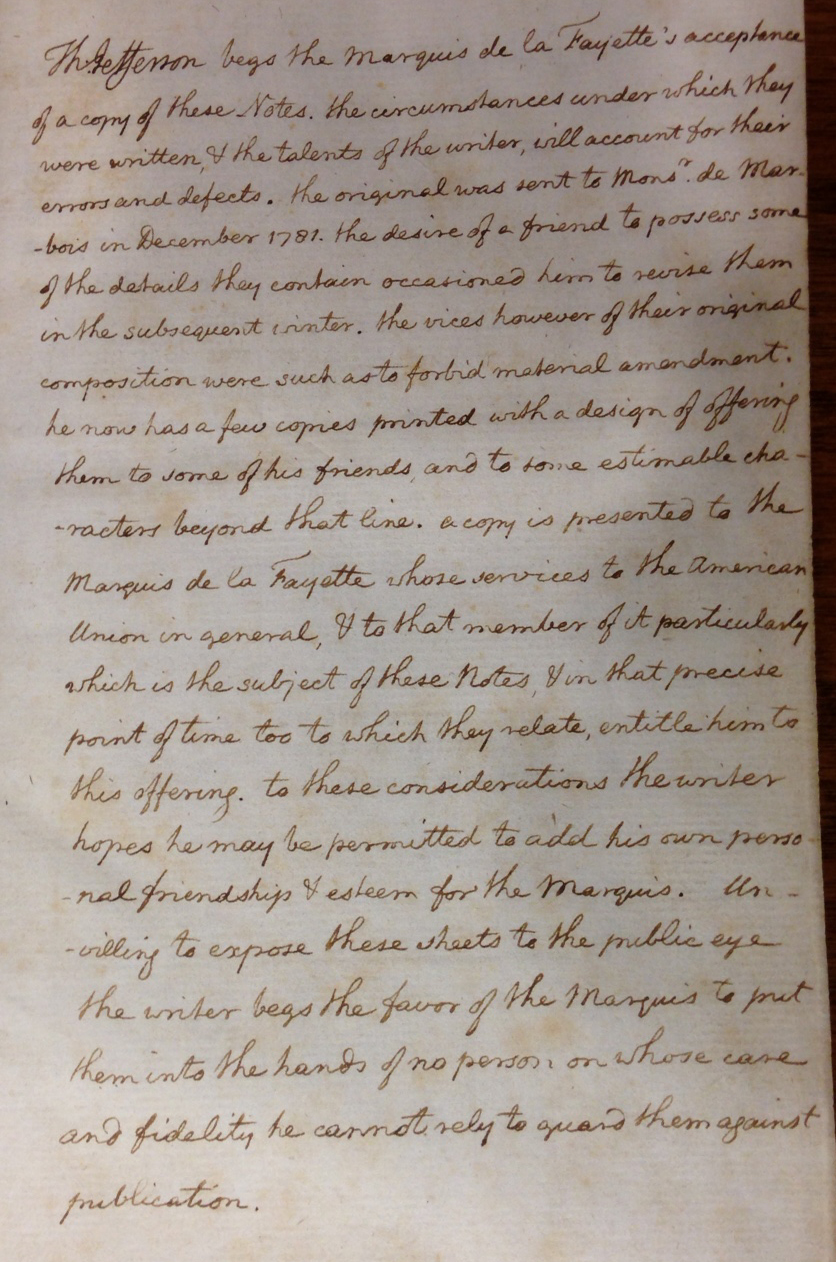
Jefferson's presentation inscription to Lafayette in the gift copy of Notes on the State of Virginia (Paris, 1784-1785).   (F230 .J4 1785; Gift of William Andrews Clark, Jr.)

Jefferson’s presentation inscription to Lafayette in a gift copy of Notes on the State of Virginia (Paris, 1784-1785). (F230 .J4 1785; Gift of William Andrews Clark, Jr.)

While James sought his freedom another Virginian, Thomas Jefferson, was in Paris, where he arranged to print 200 copies of his book, Notes on the State of Virginia, during 1784-1785. These he privately distributed as he saw fit on both sides of the Atlantic. To a small number of specially bound presentation copies, including one sent to Lafayette, Jefferson added long, personal inscriptions. Lafayette’s copy now resides at U.Va., the gift of William Andrews Clark, Jr.

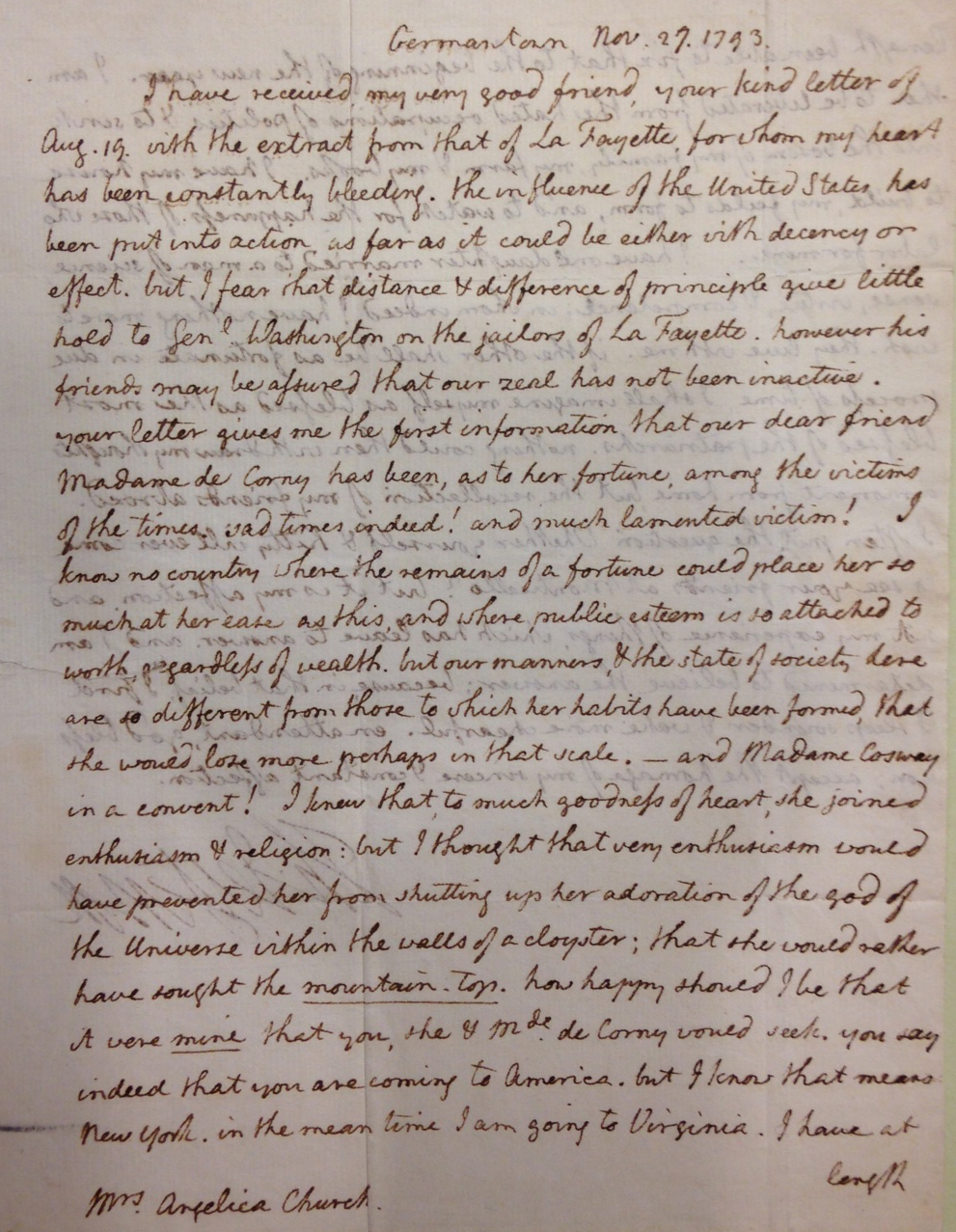
Thomas Jefferson's letter of November 27, 1793 to Angelica Schuyler Church, in which he discusses American efforts to free Lafayette from a French prison.   (MSS 11245-b)

Thomas Jefferson’s letter of November 27, 1793 to Angelica Schuyler Church, in which he discusses American efforts to free Lafayette from a French prison. (MSS 11245-b)

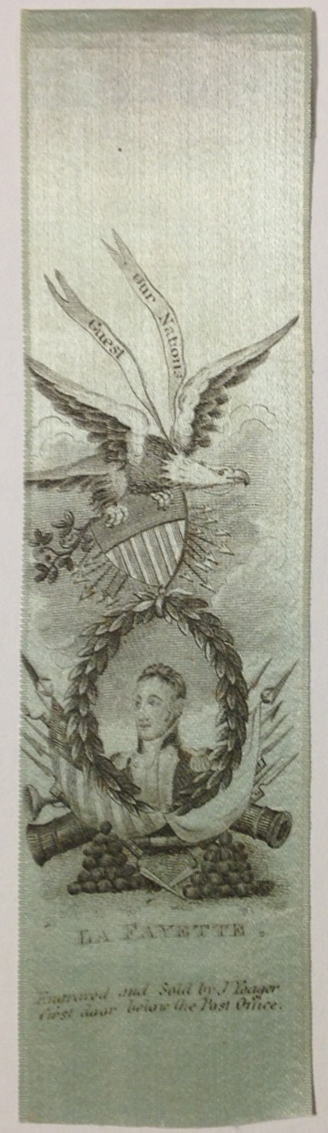
Silk ribbon commemorating Lafayette's 1824-1825 visit to the U.S.   (MSS 14211)

Silk ribbon commemorating Lafayette’s 1824-1825 visit to the U.S. (MSS 14211)

Among the many friendships Jefferson cultivated in Paris was that of American expatriate Angelica Schuyler Church, wife of an American diplomat and Alexander Hamilton’s sister-in-law. Church later moved to London, where she monitored with increasing dismay the unfolding French Revolution and its tragic consequences for her friends. In her unceasing efforts to aid one imprisoned friend—the Marquis de Lafayette—Church was ultimately successful, as documented in an extraordinary cache of correspondence obtained by U.Va. a few years ago. Included is a 1793 letter from Jefferson, then Secretary of State, who thanks Church for forwarding a letter from “my very good friend” Lafayette, and informs her that “the influence of the United States has been put into action as far as it could be either with decency or effect.” (Sharp-eyed readers will also note a fascinating reference to Maria Cosway.)

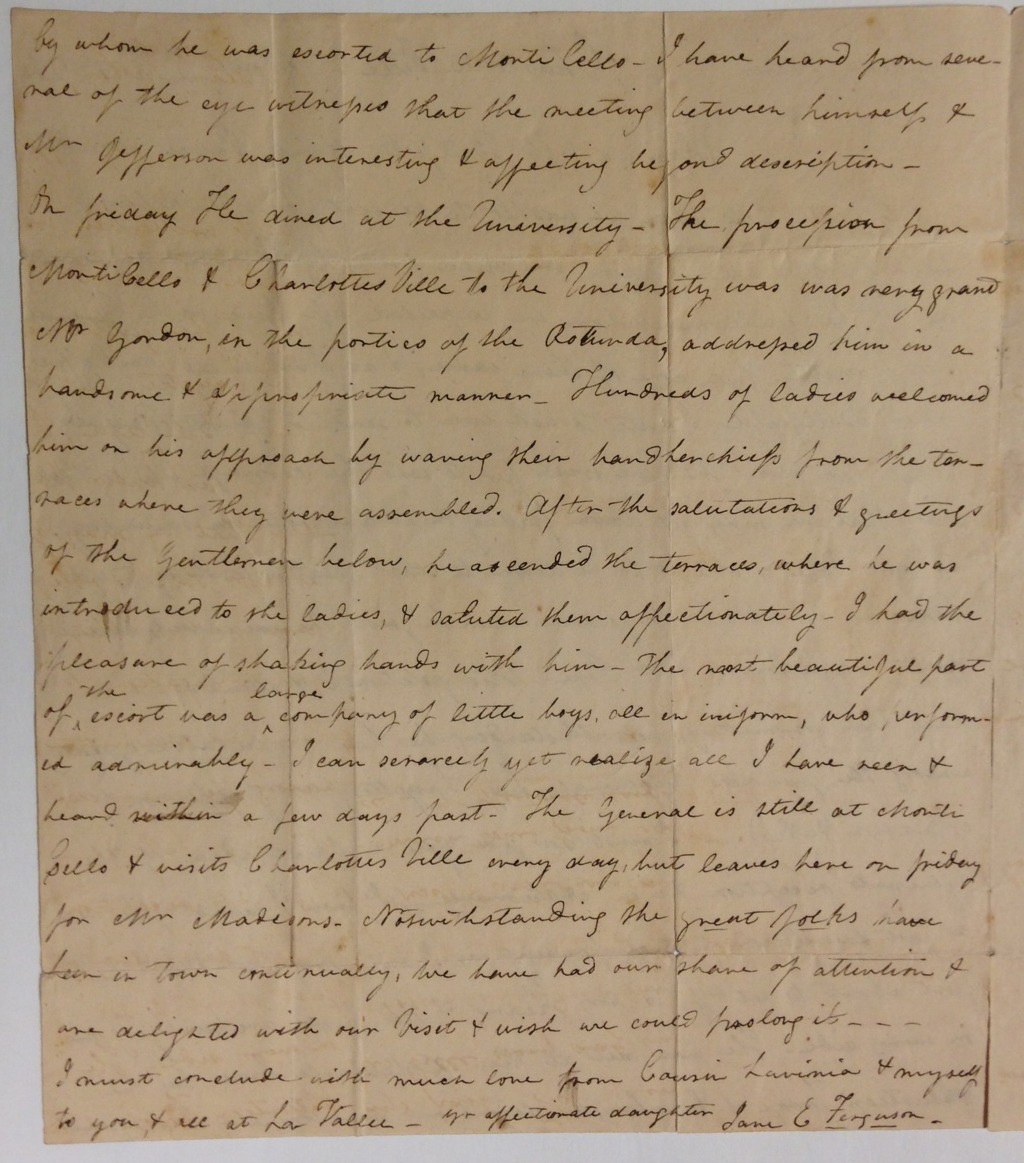
Most of our Lafayette holdings, however, relate to his extended American tour, from July 1824 to September 1825, during which he received the proverbial hero’s welcome from Americans in 24 states. In Special Collections one will find a diverse assortment of primary sources documenting Lafayette’s American travels, ranging from commemorative silk ribbons worn in his honor to eyewitness accounts of local festivities in letters sent to friends and family. From November 4-8, 1824, Lafayette was in Charlottesville where, after an emotional reunion with Jefferson at Monticello, Lafayette was fêted at a banquet held in the still-unfinished U.Va. Rotunda. Many interesting details of the event were conveyed in this letter from local resident Jane E. Ferguson to her father.

Jane E. Ferguson's account of Lafayette's reception at the U.Va. Rotunda on November 8, 1824.   (MSS 38-122-a)

Jane E. Ferguson’s account of Lafayette’s reception at the U.Va. Rotunda on November 8, 1824. (MSS 38-122-a)

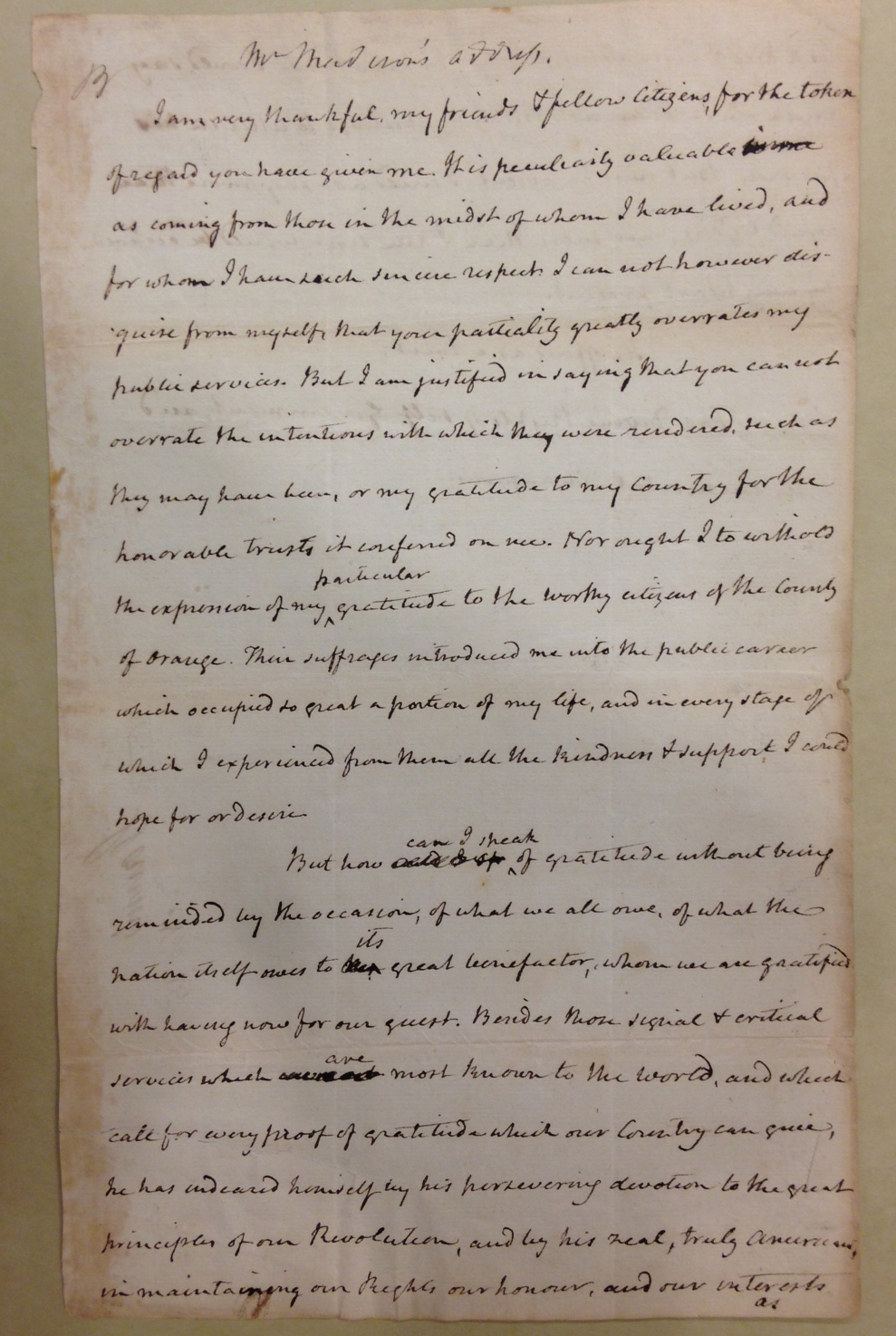
From Charlottesville Lafayette journeyed overland to Orange, Va., where on November 25, 1824, he was received with great ceremony. Making the public introduction was former president (and local resident) James Madison, whose remarks are preserved in the holograph draft to be found in the Small Special Collections Library.

James Madison's remarks introducing Lafayette to the citizens of Orange, Va., November 25, 1824.   (MSS 4677)

James Madison’s remarks introducing Lafayette to the citizens of Orange, Va., November 25, 1824. (MSS 4677)

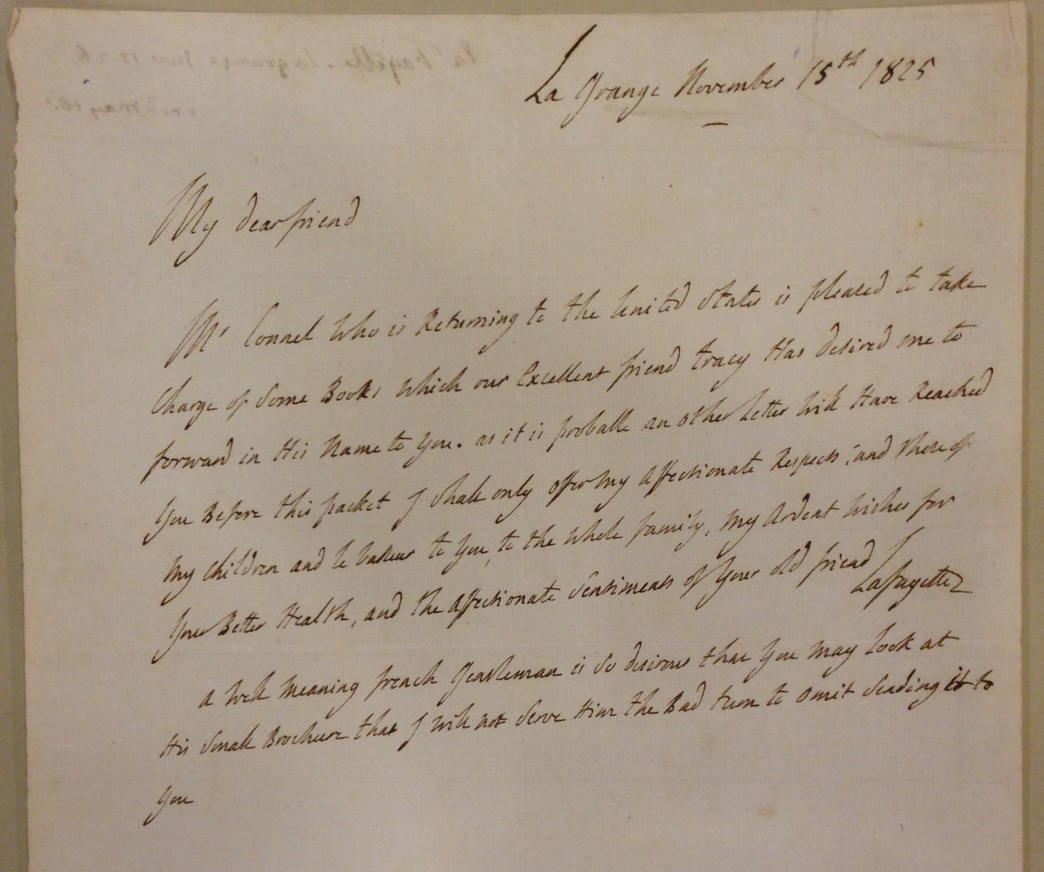
Nearly a year later Lafayette was back in France. On November 5, 1825, Lafayette wrote to Jefferson from his home in La Grange, advising him of a shipment of, what else but books, and sending “my ardent wishes for your better health, and the affectionate sentiments of your old friend.” On the reverse Jefferson noted the letter’s receipt at Monticello on May 18, 1826—perhaps the final communication he would receive from Lafayette.

Lafayette to Thomas Jefferson, November 15, 1825.  (MSS 8885)

Lafayette to Thomas Jefferson, November 15, 1825. (MSS 8885)

On View Now: Alice’s Adventures in Wonderland

This year marks the 150th anniversary of the first publication of Lewis Carroll’s Alice’s Adventures in Wonderland. Special Collections holds a collection of more than 1500 items related to this and Charles Dodgson’s other works, such as Through The Looking Glass and various works on logic and mathematics. The portion of the collection relating to Alice is the largest, and includes hundreds of editions as well as parodies, interpretations, and reimaginings of Alice’s adventures from all periods and in many different languages. This collection was built  by U.Va. Professor of Philosophy Peter Heath, who taught at the university from 1962 to 1995. His own book, The Philosopher’s Alice (1974), juxtaposes the novel’s text with Heath’s own philosophical commentary.

In honor of Professor Heath’s collection, undergraduate Wolfe Docent Susan Swicegood curated the mini-exhibition “Happy 150th Birthday, Alice!” Faced with the daunting prospect of selecting just a handful of items from the remarkable Heath collection, Susan decided to focus on how illustrators have envisioned the figure of Alice herself over the course of the book’s publishing history. She did a beautiful job, and has filled three exhibition cases with items to stimulate memories and artistic inspiration for all generations of Alice readers. Here are just a few examples to tempt you:

asdf

This detail comes from a pop-up edition advertised as a “come to life panorama.”  With her rosy cheeks and curly hair, this Alice looks more like a cherub than a curious Victorian child. Lewis Carroll, Alice’s Adventures in Wonderland, illustrated by A. L. Bowley. (London: Raphael Tuck, [1920s]). (PR 4611 .A7 1920b). Peter Heath Lewis Carroll Collection. Gift of Diana Salcedo and Philip Heath.

IMG_3502
Alice parodies use the book’s playful structure as an avenue for political or social commentary. This space-age Alice no longer travels down a rabbit hole, but to a new planet. Renzo Rossott, Alice in 2000, illustrated by Grazia Nidasio. (London : Ward Lock Limited, [1970]) (PR4611 .A72 R68 1970). Peter Heath Lewis Carroll Collection.Gift of Diana Salcedo and Philip Heath.


asdf

Alice got a big makeover in the 1970s, as modern printing techniques gave illustrators brighter and more dynamic colors that embody childish imagination, and finally giving Wonderland its psychedelic flair. This beautiful pop-up book displays a fabulous, hippie Alice at the Mad Hatter’s Tea Party. Lewis Carroll, Alice in Wonderland Retold by Albert G Miller, designed by Paul Taylor, illustrated by Dave Chambers, Gwen Gordon and John Spencer. (New York: Random house [1968]) (PR4611 .A72 M53 1968). Peter Heath Lewis Carroll Collection. Gift of Diana Salcedo and Philip Heath.

IMG_3500

The exhibition is broken into three sections: “The Origins of Alice,” which looks at how Alice’s visual identity first emerged, “Alice in the Golden Age of Illustration,” focusing on the lavish aesthetic of the early twentieth century, and “An Alice for Every Generation,” looking at Alices from the 1960s through our own time, with examples ranging from the iconic Disney animation aesthetic to the edgy pen and ink imaginings of Ralph Steadman.


We encourage you to stop by and visit the exhibition, which is on view in the First Floor Gallery through September 18. It’s a visual feast–or should we say, tea party?


Tales from Under Grounds II: War

This is the final of four posts, spotlighting the mini-exhibitions of students from USEM 1570: Researching History.

***

Turner Labrie, First-Year Student

Turner Labrie

Photograph of Turner Labrie by Sanjay Suchak, November 18, 2014.

Virginia and The Spanish American War

In February of 1895, the Spanish-controlled island of Cuba erupted in rebellion. Over the course of their fighting with the rebels, the Spanish employed increasingly brutal repression tactics. These brutal tactics were further sensationalized by American newspapers, a method that is now better known as “yellow journalism.”  In response to the growing unrest in Cuba and domestic pressures at home, the United States government sent naval crafts to protect US citizens residing in Cuba.

The Spanish-American War began in April of 1898, prompted by the inexplicable explosion in the USS Maine, which was one of the ships based outside of Havana protecting U.S. interests. After the explosion, fighting erupted between the United States and Spain in various parts of the world, including Puerto Rico, Spain and the Philippines. Ultimately, the United States won the war, made Puerto Rico and the Philippines their territories, and freed Cuba from Spanish control.

This exhibition documents Virginia’s involvement in the Spanish American War.

Soldier's Memorial, Spanish American War of 1898: Suffolk Light Infantry. Company G. Fourth Regiment, Virginia Volunteer Infantry ... Organized at Suffolk, Va., June 22, 1892 mustered into the United States Service at Richmond, Va., May 23, 1898. Washington, D.C.: Fuller Bros., 1898. (Poster 1898 .S73) This poster portrays the Suffolk Light Infantry in combat, and in the middle, it lists members of the Company G, including officers. Virginia was expected to contribute heavily to the war, but outside of the involvement of a couple regiments, it served more in an ancillary role. Many supplies were shipped through its ports and camps were established throughout the state to train soldiers for combat. That being said, fourteen of the deceased sailors from the explosion of the Maine were originally from Virginia.

Soldier’s Memorial, Spanish American War of 1898: Suffolk Light Infantry. Company G. Fourth Regiment, Virginia Volunteer Infantry … Organized at Suffolk, Va., June 22, 1892 mustered into the United States Service at Richmond, Va., May 23, 1898. Washington, D.C.: Fuller Bros., 1898. (Poster 1898 .S73)
This poster portrays the Suffolk Light Infantry in combat, and in the middle, it lists members of the Company G, including officers. Virginia was expected to contribute heavily to the war, but outside of the involvement of a couple regiments, it served more of an ancillary role. Many supplies were shipped through Virginia’s ports, and camps were established throughout the state to train soldiers for combat. That being said, fourteen of the deceased sailors from the explosion of the USS Maine were originally from Virginia.

Capt. Edgar de Duphane. Wanted. 100 Volunteer Crack Shots, for Immediate Service. New Market, VA: Henkel & Co., Printers, 1898. (Broadside 1898 .D84) Captain Edgar de Duphane posted this message in New Market, Virginia to encourage proficient shooters to join the US Army at the outbreak of the Spanish American War. These shooters would then be shipped off to various camps throughout the country for integration into the army. From there, they would be sent to participate in the fighting against Spanish forces.

Capt. Edgar de Duphane. Wanted. 100 Volunteer Crack Shots, for Immediate Service. New Market, VA: Henkel & Co., Printers, 1898. (Broadside 1898 .D84)
Captain Edgar de Duphane posted this message in New Market, Virginia to encourage proficient shooters to join the U.S. Army at the outbreak of the Spanish American War. The shooters were then sent to various camps throughout the country for integration into the army. From there, they  fought against Spanish forces.

***

Max Novick, First-Year Student

Max Novick presents a WWI era scrapbook, November 18, 2014. (Photograph by Sanjay Suchak)

Max Novick presents a WWI era scrapbook, November 18, 2014. (Photograph by Sanjay Suchak)

Propaganda and Sentiments of World War I

While World War I can be at times dwarfed by the magnitude of the Second World War, many of the same feelings of fear that the Allies expressed towards the German enemy still existed. Through this mélange of emotions, the use of propaganda became commonplace to strike fear in the heart of the enemy and to motivate the allied nations. Though propaganda can be quite coarse and grating, this mini-exhibition makes an attempt to display a few types of this curious art form.

Through the use of five dissimilar items, this exhibit moves in a somewhat linear fashion, from crass to serious, in order to capture the very essence of the emotions that were shared in the Allies battle against the Imperial forces.  Nevertheless, Novelist James Dickey’s sentiments to a major donor to Virginia of this era caps the exhibition in its ability to look beyond the pairing of one side versus another and at the real issue of humans versus humans.

Falser, M. “Pour le suprême effort.” World War I posters 1914-1918.  (MSS 5023-b) Robertson Gift Dec. 1969 Produced in 1918, artist, M. Falser, shows a darkly colored image of a French soldier in fierce, but advantageous, combat with an eagle. This black eagle as well as the helmet known as a Pickelhaube, are signs of the German Imperial Army. The violent force with which the French soldier maims this Imperial enemy seeks to inspire hope and courage within the nation of interest, like many propaganda posters of the time, and to deflate the image of the enemy.

Falser, M. “Pour le suprême effort.” World War I posters 1914-1918. (MSS 5023-b) Robertson Gift Dec. 1969
Produced in 1918, artist M. Falser shows a darkly colored image of a French soldier in fierce combat with an eagle. This black eagle as well as the helmet known as a Pickelhaube are signs of the German Imperial Army. The violent force with which the French soldier maims this Imperial enemy seeks to inspire hope and courage within the nation of interest and to deflate the image of the enemy.


Dickey, James. “For Matt Bruccoli’s Father.” Letter. World War I Memorabilia. (MSS 10875-s) Bruccoli Great War Collection. Gift of Matthew J. Bruccoli, July, 1997  Famous American novelist, James Dickey, through this extremely personal letter, offers a writer’s input on the war. This letter looks beyond the simplicities of propaganda and talk about war’s more virulent nature. This note does not degrade the enemy in any way, but rather looks at the matter from the perspective of a human being to express the atrocities and horrors that war imposes on mankind.

By arrangement with the Heirs of James Dickey and their agents Raines & Raines. James Dickey. Letter for Matt Broccoli’s Father, July 1997. (MSS 10875-s) Bruccoli Great War Collection. Gift of Matthew J. Bruccoli.
Famous American novelist, James Dickey, through this extremely personal letter, offers a writer’s input on the war. This letter looks beyond the simplicities of propaganda and talks about war’s more virulent nature. This note does not degrade the enemy in any way, but rather looks at the matter from the perspective of a human being to express the atrocities and horrors that war imposes on mankind.


 ***

Emily Templin, First-Year Student

Emily Templin

Photograph of Emily Templin by Sanjay Suchak, November 18, 2014.

World War II Propaganda in America

America officially entered World War II after Japan’s attack on Pearl Harbor on December 7, 1941. While American soldiers were off fighting for the Allied cause, other forces worked to keep the home front involved and in support of the war. The Office of War Information (OWI), created by Franklin Delano Roosevelt in 1942, was designed to help mobilize domestic support and keep citizens informed. The OWI produced propaganda, such as radio broadcasts, newspaper articles, posters, and photographs that served as a direct appeal to citizens at home to support the war.

Much of the propaganda tended to focus on how everyone could “play their part” in the war effort, including buying war bonds, rationing, and conserving scrap metal and rubber. Ultimately, propaganda helped to shape the culture of the American home front, sparking a unified effort to help fight the war by any means possible.

1942 War Bonds Poster. "We Shall Win Or We Shall Die": Double Your Shares In the U.S.A. ... Buy War Bonds and Stamps Today!. Washington, D.C.: U.S. Government Printing Office, 1942.  (Poster 1942 .W4) This 1942 propaganda poster advertises the sale of war bonds as a way for people at home to contribute to the war effort. Since World War II was a “total war,” patriotic propaganda was used to garner support for the war on the American home front. The poster’s language serves to unite soldiers with civilians back home in a combined revenue-raising effort that both financially and morally supports the war

1942 War Bonds Poster. “We Shall Win Or We Shall Die”: Double Your Shares In the U.S.A. … Buy War Bonds and Stamps Today!. Washington, D.C.: U.S. Government Printing Office, 1942. (Poster 1942 .W4)
This 1942 propaganda poster advertises the sale of war bonds as a way for people at home to contribute to the war effort. Since World War II was a “total war,” patriotic propaganda was used to garner support for the war on the American home front. The poster’s language serves to unite soldiers with civilians back home in a combined revenue-raising effort that both financially and morally supports the war.


United States of America. Four Freedoms Booklet. Louis G. Cowan World War II Propaganda Collection, 1941-1946  (MSS 11569) Based on Franklin D. Roosevelt’s Four Freedoms speech, this booklet elaborates how the freedoms of speech and worship and the freedoms from want and fear operated in America. The booklet contrasts pictures of America’s happy children, education systems, and plentiful harvests with pictures of the violence, government restrictions, and food lines in Axis countries in order to promote the Allied war efforts.

United States of America. Four Freedoms Booklet. Louis G. Cowan World War II Propaganda Collection, 1941-1946. (MSS 11569)
Based on Franklin D. Roosevelt’s Four Freedoms speech, this booklet elaborates how the freedoms of speech and worship and the freedoms from want and fear operated in America. The booklet contrasts pictures of America’s happy children, education systems, and plentiful harvests with pictures of the violence, government restrictions, and food lines in Axis countries in order to promote the Allied war efforts.

***

Timothy Rodriguez, First-Year Student

Timothy Rodriguez

Timothy Rodriguez talks to a attendee about his exhibition, November 18, 2014. (Photograph by Sanjay Suchak)

Cold War Propaganda in the United States and the Soviet Union

The Cold War, which started in 1946 after the end of the Second World War, produced a significant amount of propaganda on both sides. In the United States, this propaganda was focused against the nature of the communist regimes in Soviet Bloc countries and on the ideals of communism. For the Soviets, the propaganda was more focused on convincing citizens that their system of governance and economic structuring was superior to capitalist countries like the United States.

This exhibition contains propagandist pictures, literature and broadsides that represent some of the most subtle and blatant propaganda of the Cold War. Sources include both the Soviet and American governments as well as special interest groups with Anti-communist agendas.

Siebel, Fred O. "Eyes on Formosa." Richmond Times Dispatch. 1 Jan. 1950. Original drawing by Fred Seibel. Published in the Richmond Times Dispatch, this cartoon, drawn by Fred Siebel, is a piece of American anti-communist propaganda and political commentary. The depiction of communism as a gigantic octopus, embossed the Soviet Union’s hammer and sickle, is a clear statement of the American perspective of communism as an expansionary threat to the world. The cartoon is intending to convey the intent of the communists specifically in China of taking over the island of Formosa, now known as Taiwan.    (still need permission)

Siebel, Fred O. “Eyes on Formosa.” Richmond Times Dispatch. 1 Jan. 1950. Original drawing by Fred Seibel. (MSS 2531)
Published in the Richmond Times Dispatch, this Fred Siebel cartoon is a piece of American anti-communist propaganda and political commentary. The depiction of communism as a gigantic octopus, embossed with the Soviet Union’s hammer and sickle, is a clear statement of the American perspective of communism as an expansionary threat to the world. The cartoon conveys the intent of the communists, specifically in China, to take over the island of Formosa, now known as Taiwan.

Pedigo, Jess L. Yes, Ginger. Communism Is Your Enemy. Tulsa: Christian Crusade Publications, 1970.  This booklet was published by the Christian Crusade publication company in 1970. During the Cold War many organizations in the United States, including Christian Crusades, published Anti-Communist literature. This specific booklet is a story directed at children informing them of the supposed evils of communism and as per the title explains why communism is their enemy. This artifact is a prime example of religious, anti-communist propaganda which was prevalent during the cold war era.

Pedigo, Jess L. Yes, Ginger. Communism Is Your Enemy. Tulsa: Christian Crusade Publications, 1970. (HX44 .P42 1972)
During the Cold War, many organizations in the United States, including Christian Crusades, published anti-communist literature. This specific booklet, directed at children, informs them of the supposed evils of communism and as per the title explains why communism is their enemy. This artifact is a prime example of religious, anti-communist propaganda which was prevalent during the cold war era.


This Just In: Problematic Provenance

My previous post on the acquisition of U.Va.’s first papyrus manuscript has been a popular one, made more so by a subsequent U.Va. news release. Two readers have since contacted me with a question unaddressed in the blog post and news release (the latter now amended): What is the document’s provenance, that is, its recent ownership history? This follow-up post seeks to summarize what little is known at this point about its provenance, acknowledge an error of judgment in this instance, and touch upon an important ethical issue concerning the antiquities trade.

P. Virginia 1, U.Va.'s first papyrus document, measures 16.5 x 8 cm. It was written in Greek, probably in Egypt during the 3rd century CE. Purchased on the Associates Endowment Fund.

P. Virginia 1, U.Va.’s first papyrus document, measures 16.5 x 8 cm. It was written in Greek, probably in Egypt during the 3rd century CE. Purchased on the Associates Endowment Fund.

UVa’s papyrus fragment was purchased at the March 19, 2015 public auction (lot 71) of Swann Galleries, a major New York auction house. The lot description offered no provenance information, nor (as is common in the auction trade) was the consignor identified. When the papyrus was unpacked at U.Va. on May 7, I saw on the glass mount, sealed with a distinctive “papyrus”-patterned tape, an identification label with the handwritten notation “M30305/2.” Neither feature had been visible in the cropped image accompanying the lot description. Was this a collection inventory number, or, more likely, a dealer or auction house number? I have since done what I should have done initially, prior to bidding, and that is to contact the auction gallery for all documentation the gallery and the consignor may have on the papyrus’s ownership over the last several decades. Swann Galleries has confirmed that the label bears its “internal cataloguing number.” Swann has also requested documentation from the consignor, “a dealer with whom we have done business on a number of occasions,” and we are awaiting a response.

So far my other efforts to trace this fragment to a known collection, to a previous auction or trade sale, or to other pieces have been fruitless. If readers have any knowledge of other papyrus documents in mounts sealed with the same tape (visible in the attached images), I would be grateful to hear from you.

Provenance is no small matter, for we want to avoid acquiring, whether through purchase or gift, collection items for which we do not have clear title. The matter is a complicated one, for we obtain a wide chronological and geographical range of materials, in a variety of formats, from many different sources. In the case of antiquities (and certain categories of books and manuscripts), provenance is paramount, for many countries now require a license for the export of such objects, or for export after a specified date from their country of origin.

The verso of P. Virginia 1 clearly shows the vertical papyrus strips which form the document's secondary layer. Additional lines of Greek text--perhaps docketing, or unrelated manuscript notes--are also visible.

The verso of P. Virginia 1 clearly shows the vertical papyrus strips which form the document’s secondary layer. Additional lines of Greek text–perhaps docketing, or unrelated manuscript notes–are also visible.

For papyrus documents of Egyptian origin, the primary statute is Egypt’s 1983 law on the protection of antiquities, which henceforth prohibited their export without a proper license. Many, of course, were exported before the law took effect. What if we cannot trace the document’s ownership prior to 1983? That would neither prove nor disprove that the papyrus was properly exported. Here, however, assuming proper export in the absence of contrary evidence is not sufficient, for ethically we would want assurance that U.Va. was not supporting, in even the smallest way, the illegal antiquities trade.

The situation could have been avoided, of course, had I sought provenance information prior to bidding; if the document’s history could not be verified earlier than 1983, there would be no point in bidding. To my regret, I did not. I am deeply indebted to the readers who have enlightened me by sharing information on what is apparently an active, illegal market in papyrus manuscripts, online and elsewhere, conducted by dealers outside the established antiquities and manuscripts trade channels. Accounts such as those posted by Brice Jones and Dorothy King present a disturbing picture of this market, which is likely replenished by continuing illegal exports and supported by buyers who neither demand full documentation, nor convey it to the next owner. Often the provenance information supplied is either insufficient or dubious.

It may take some time to complete our investigation into the document’s provenance and then settle on a course of action. Readers will receive an update in a future blog post.