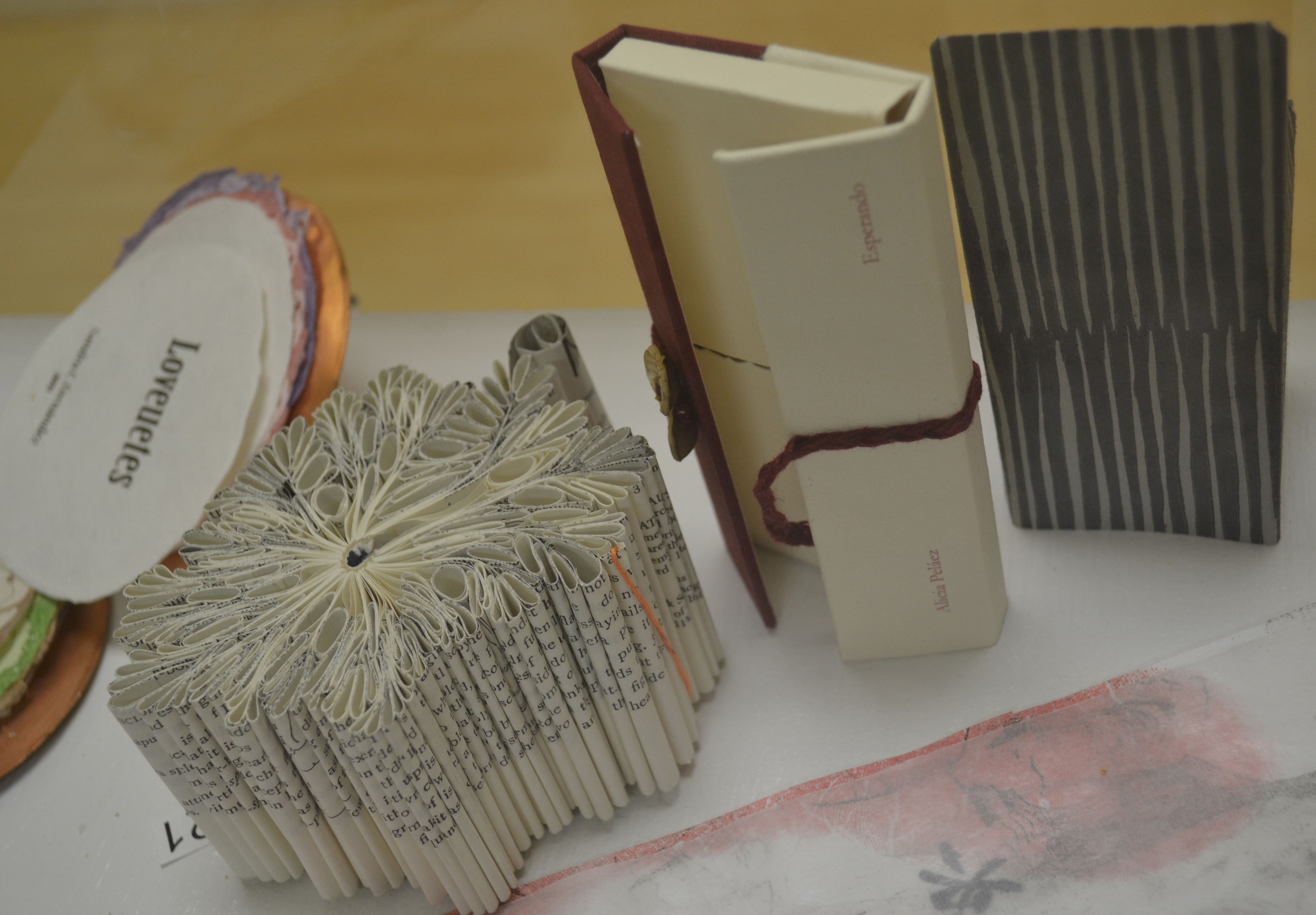
This Just In: An Artist’s Book from CODEX

In mid-February, I took a trip out to the San Francisco Bay Area to attend the biennial Codex International Book Fair, which began in 2007 and has emerged as the premier venue for artists, printers, and dealers to display and sell artists’ books, fine press editions, and book art, with a particular emphasis on fine limited editions. Held this year at the beautiful Craneway Pavilion in Richmond, which overlooks the San Francisco Bay, the fair was a light-filled, dazzling display of creative production and craftsmanship. This new venue was necessitated by the growing number of visitors and exhibitors at the last fair. If, as they say, the book is a dying medium, “they” haven’t seen the diverse productions of book artists in recent decades, nor have they observed the increasing visibility of artists’ books beyond the small world of book artists and collectors.

Looking down on the Codex booths and buyers. (Photo by Molly Schwartzburg)

I went to the fair seeking items that would help us expand Special Collections’ already robust and diverse collection of artists’ books and fine press editions, which are used widely in teaching by academic and Rare Book School faculty alike. I left having met dozens of artists, printers, and publishers from around the world, and waited eagerly for the arrival of my various purchases for the collection.

A great artist’s book is like a great poem. When you read such a poem the first time, you see it whole, appreciate its beauty and formal sophistication, grasp it fully on some level. When you reread it, you suddenly find that you do not understand it at all, and you’re not even sure what questions you need to ask of the poem before you can begin to understand it again. The deep pleasure that poetry brings me begins when I start formulating these questions, and it does not end until I must put down the poem to go wash the dishes or answer my email. It is this type of engagement I seek when I am selecting artists’ books for the collection.

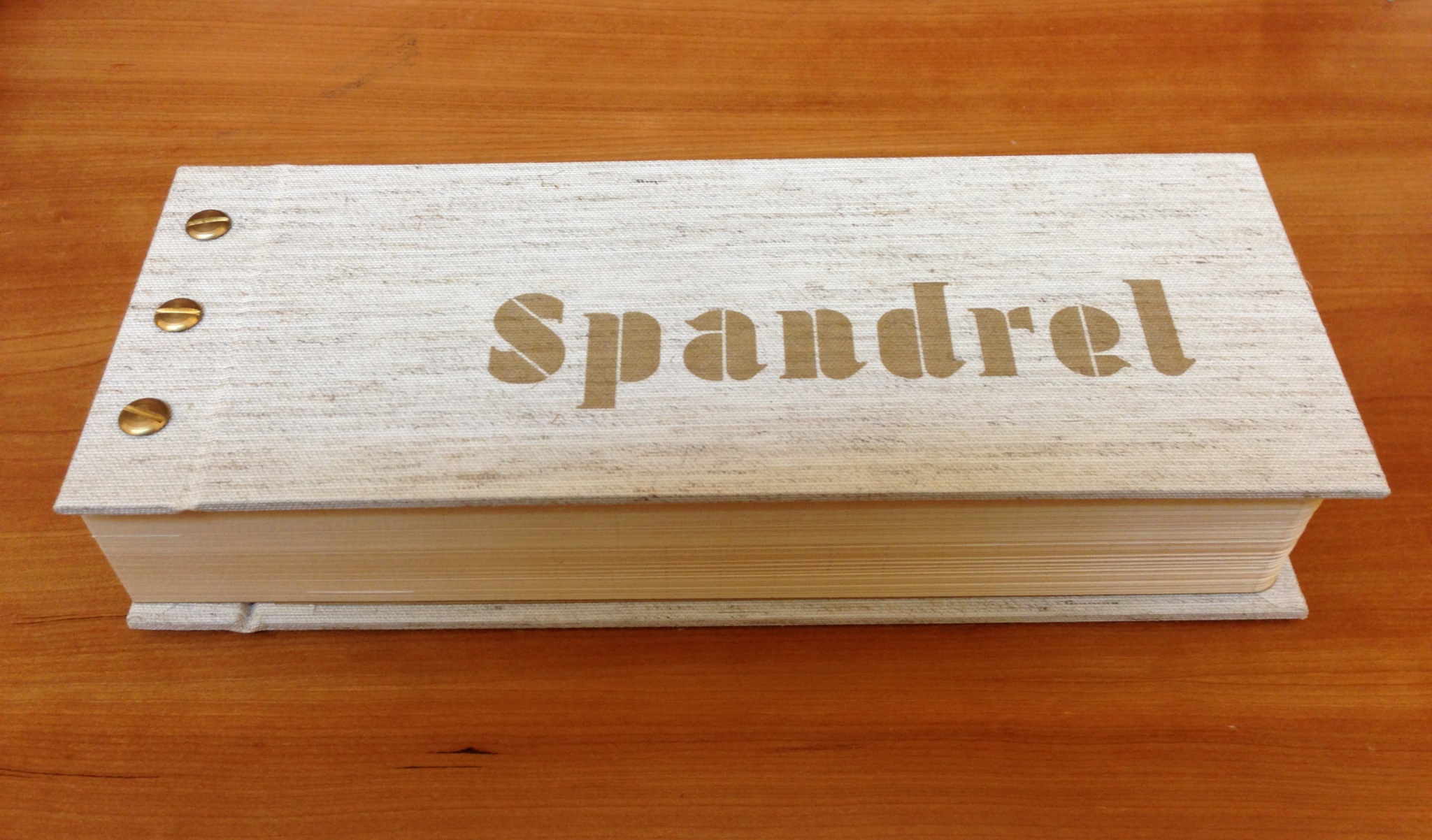
I had this kind of experience when I came across the elegant Spandrel, a collaboration between Frank Giampietro and Denise Bookwalter, published by Small Craft Advisory Press at Florida State University, which had a booth at the fair:

The front cover of Spandrel. The book is very thick and has the appearance of great heft, but is surprisingly light when you pick it up. This is due to the cut interior and the Hosho paper, which is thick and fluffy. (Photo by Molly Schwartzburg)

The title is an architectural term that refers to the empty space at the side of an arch (I can’t seem to explain this in words–I recommend that you Google it!). The press provides an excellent description of the book’s form: “Spandrel uses traditional and non-traditional processes to play with the reading of a poem.  One poem is on the first page and slowly transforms through the 150 pages into the second poem, which is on the last page.  In the middle of the book the text is unreadable but as the viewer nears the end the text comes back into focus.”

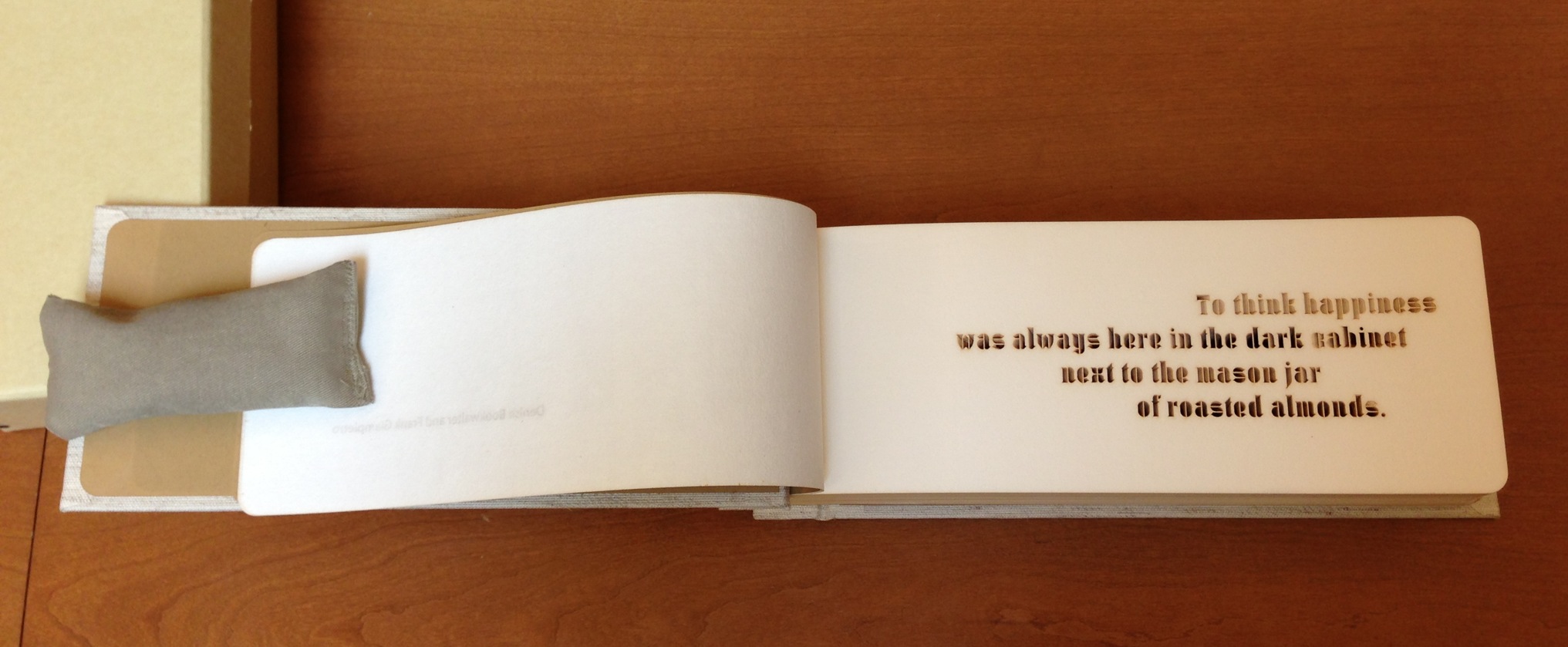
What this description doesn’t note is that none of this is printed: the text is an absence, cut out of the book with a laser, its font like a stencil. The shadows produced by the stacks of slowly shifting cuts on subsequent pages produces the visible text:

The first page of the text proper. (Photo by Molly Schwartzburg)

A detail view of two words on the first page of the book reveals the edges of cuts below. (Photo by Molly Schwartzburg)

The laser printing very slightly singes the page, producing a tinge of brown around each letter. Near parallels between the text of the poem and the form of the book begin to emerge as one considers the opening page: the singed pages and “roasted almonds” share the same color. The receding darkness behind each cut on the page seems somehow connected to the “dark cabinet.” There are disjunctions too: laser cutting is a relatively new technology associated with high-tech industry, while mason jars evoke homemade preserves. But this jar doesn’t hold preserves, just as this book doesn’t hold printing. Both hold something singed by heat. There is a sort of symmetry here.

But what happens next is more interesting. Looking at the first page, one might imagine that the entire text block (the “stack” of all of the book’s pages), was laser cut in one step. Page after page, the same poem appears again and again, but soon, it begins to shift slightly, and then more, until it moves towards illegibility and then back to legibility. Each page is cut separately from a series of digitally generated tempates:

Photo by Molly Schwartzburg

Photo by Molly Schwartzburg

Photo by Molly Schwartzburg

In the final pages, the text becomes clearer and clearer, and lighter and lighter, as there are fewer shadows to define the text. It finally resolves into this chilling poem, which takes more effort to read than the first one did:

Photo by Molly Schwartzburg

The image of domestic comfort in the opening poem is replaced by one of urban violence in the latter: ball-peen hammers are a dangerous weapon. The poem’s opening symbol of happiness–whole almonds protected in a clear jar inside a closed cupboard inside a home–is replaced by an image of the layers of someone’s skin, then skull, then brain being violently broken, shattered, and compressed respectively by a heavy blow. The lack of human actors in the first poem suddenly becomes apparent.

The second poem seeks actively to shock: mason jars are replaced by snot, and the strange elegance of the opening page is utterly lost.The reader begins shifting back and forth between the two poems, seeking to understand the differences between them, the justification for their juxtaposition, the physical location in which one word or phrase replaces another. I find my own mind running down multiple interpretive paths: which wins out in this book, happiness or the social self? What would happen if the two poems traded places, and it began with the social self and ended with happiness?  Once I come to the word “ball peen” this suddenly seems to be a book about a man, since I only associate this kind of violence with men. Is he the subject of both poems? Is there a woman in the domestic space of the kitchen? And why are there almonds in the jar instead of preserves? And while I’m at it, what does any of this have to do with spandrels? It has something to do with empty spaces, with round holes produced by a hammer, with jars, cupboards. With absence–an empty house with an empty space in a cupboard, and a “social self” who experiences only violence. What lesson am I to learn from all of this? What is the poet  telling me? What is the book telling me?

There are likely no clear answers to these questions; the two poems are not entirely symmetrical, do not have some kind of straightforward causal relationship. If they did, the book would fail because it would be clever, even smug. Instead, its mysterious, discomfitting texts and physical form together produce a fertile space for contemplating the poetry, heightening the reader’s capacity to observe the very specific elements of sentences, phrases, and lines. It is a dazzling example of the productive relationship that can exist between a book and its contents.
This is just one of the many wonderful items found at the fair. Too bad I have to wait two years for the next one!

If you get overwhelmed looking at books at Codex, step just outside and take in the view. The Bay Bridge may be seen on the left. (Photo by Molly Schwartzburg)


How to make miniature book mounts with everyday library supplies: An Amateur’s Guide

When you apply for a job as a Special Collections curator, the required skills do not include “arts and crafts.” But an ability to work with your hands comes in handy, so to speak, especially when it comes to putting on small exhibitions on short notice. One of my favorite parts of the job is learning new and unexpected skills that help me to share our collections–especially when it means I get to play around with paper.

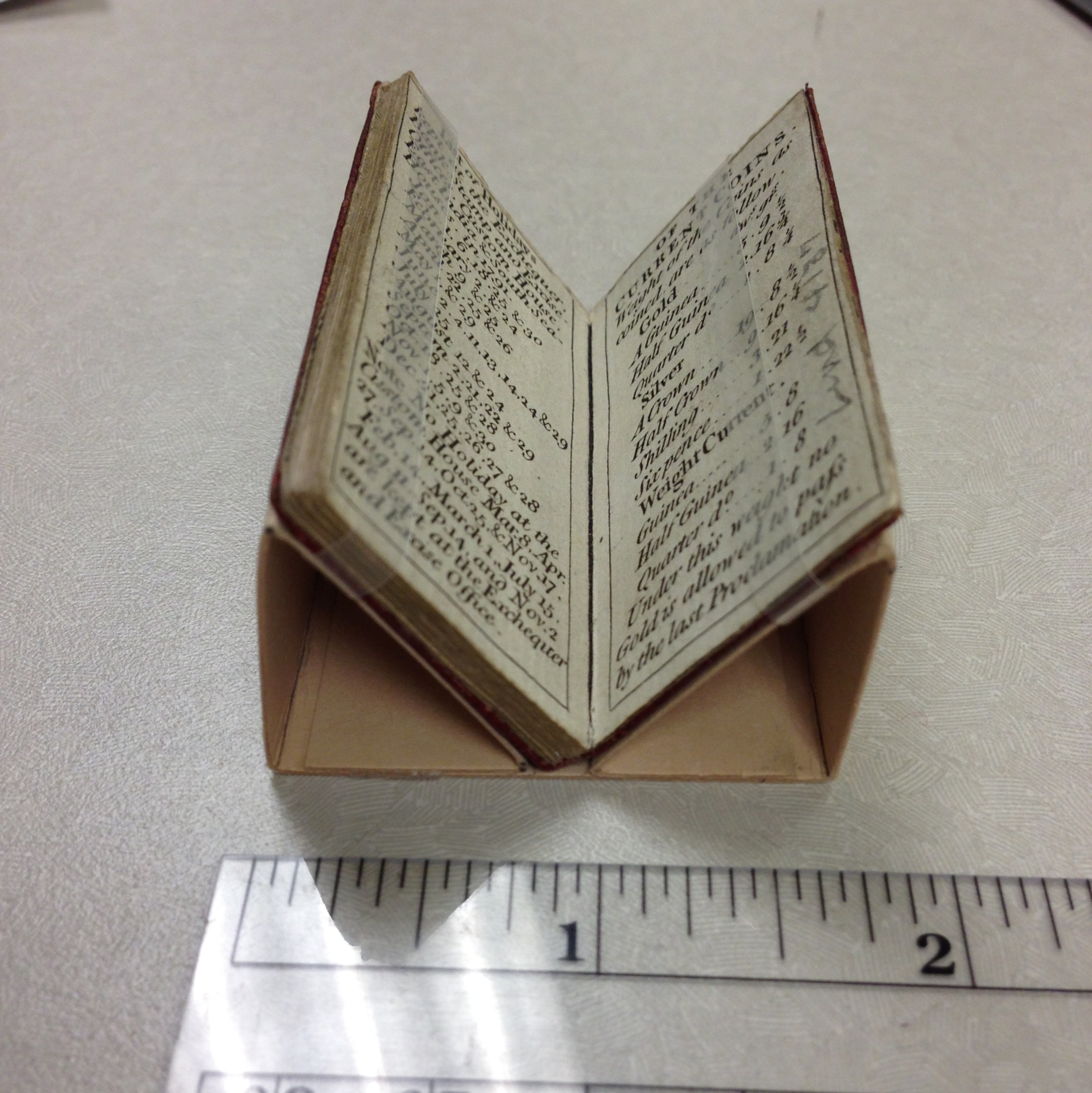
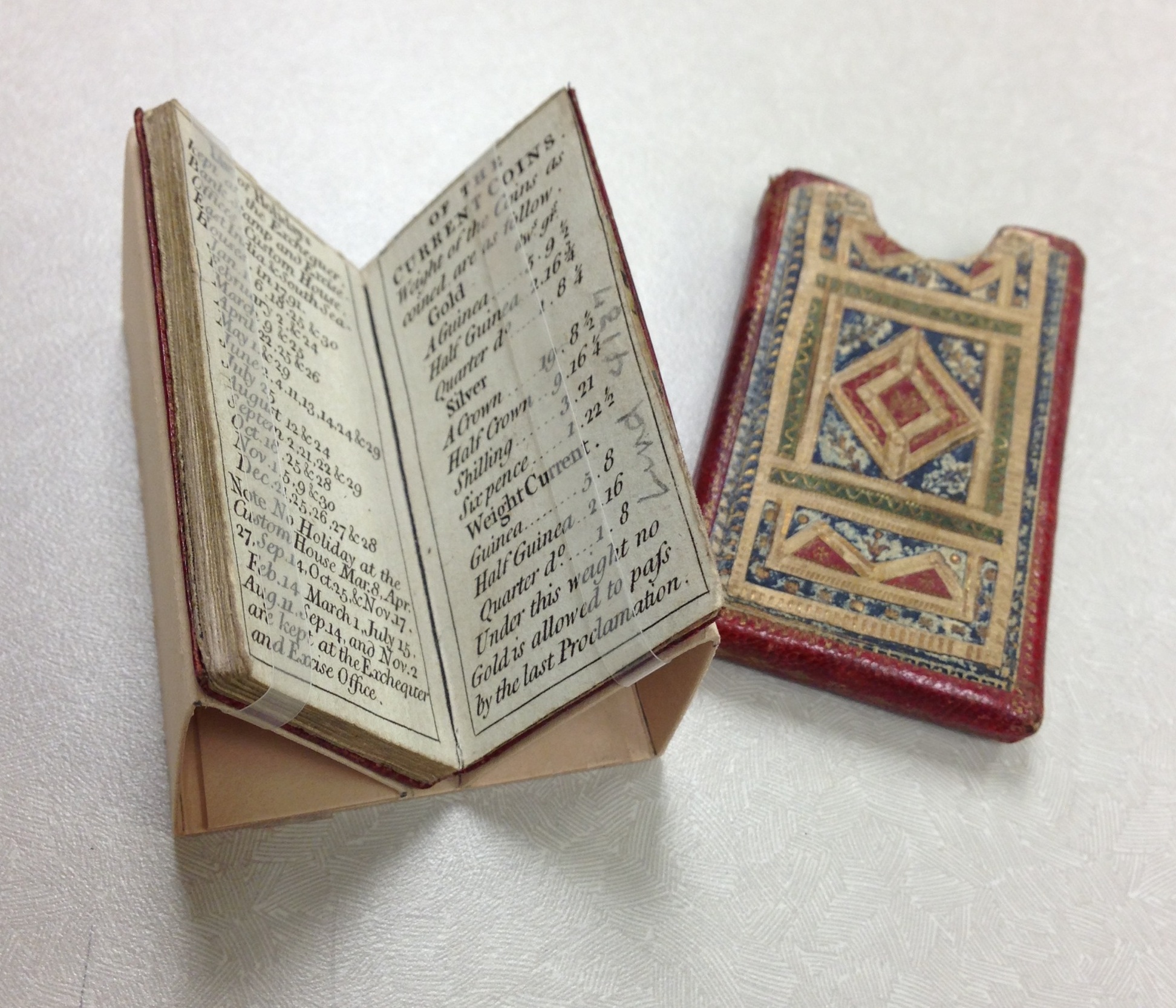
London Almanack for the Year of Christ 1791 ([London]: Printed for the Company of Stationers, [1790]. (Lindemann 04137, Photo by Molly Schwartzburg).

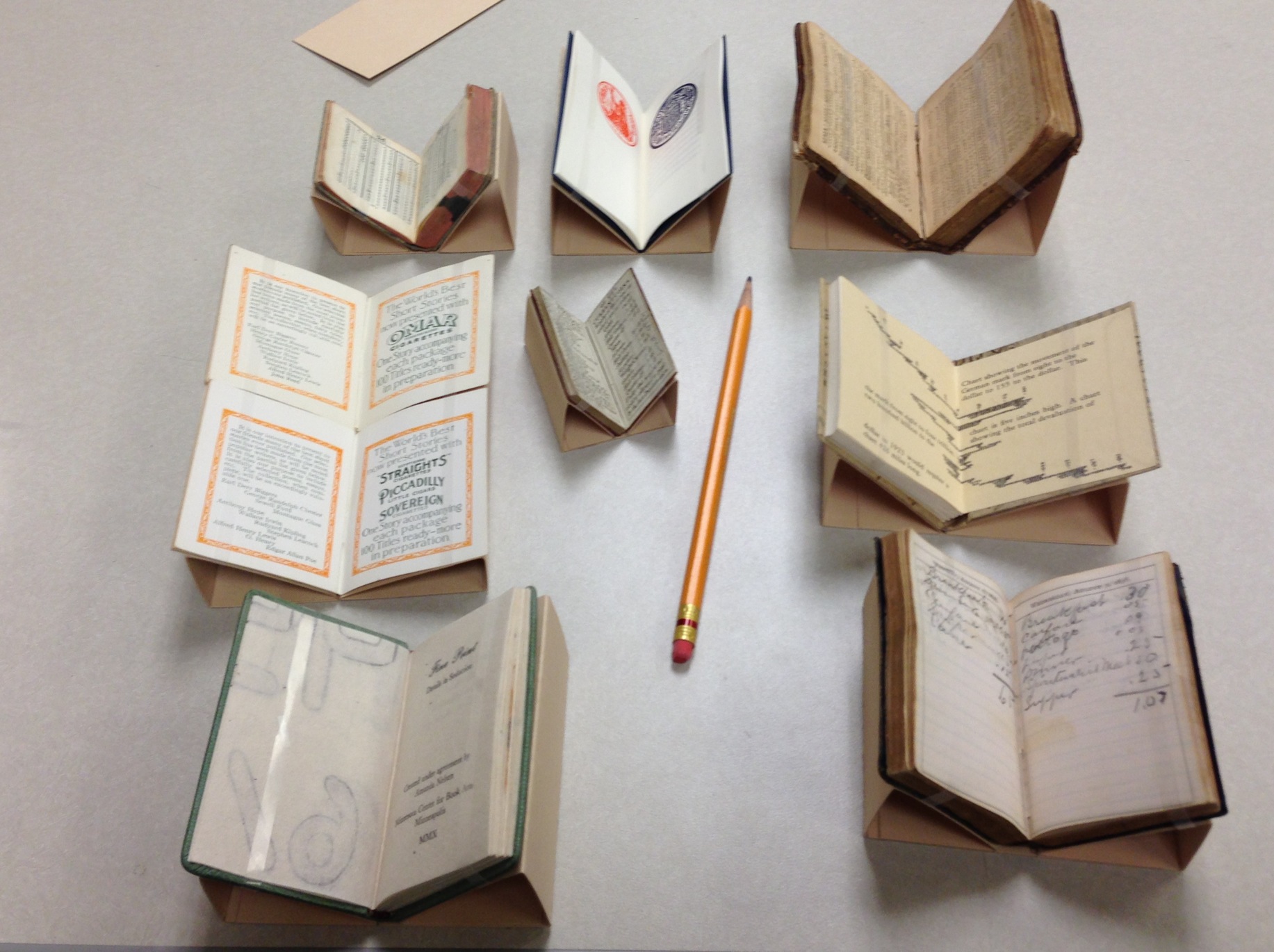
This week, I was thrilled to receive a quick and dirty lesson on how to make these simple but effective display cradles, courtesy of our book conservator, Eliza Gilligan. After some mumbled curses and false starts, I had soon produced half a dozen mounts that I believe would make her proud. If you’d like to display your own miniature books, take my lead and follow Eliza’s instructions, which are straightforward and allow you to leave your book safe on the shelf for almost the entire process.

Step One: Gather Supplies

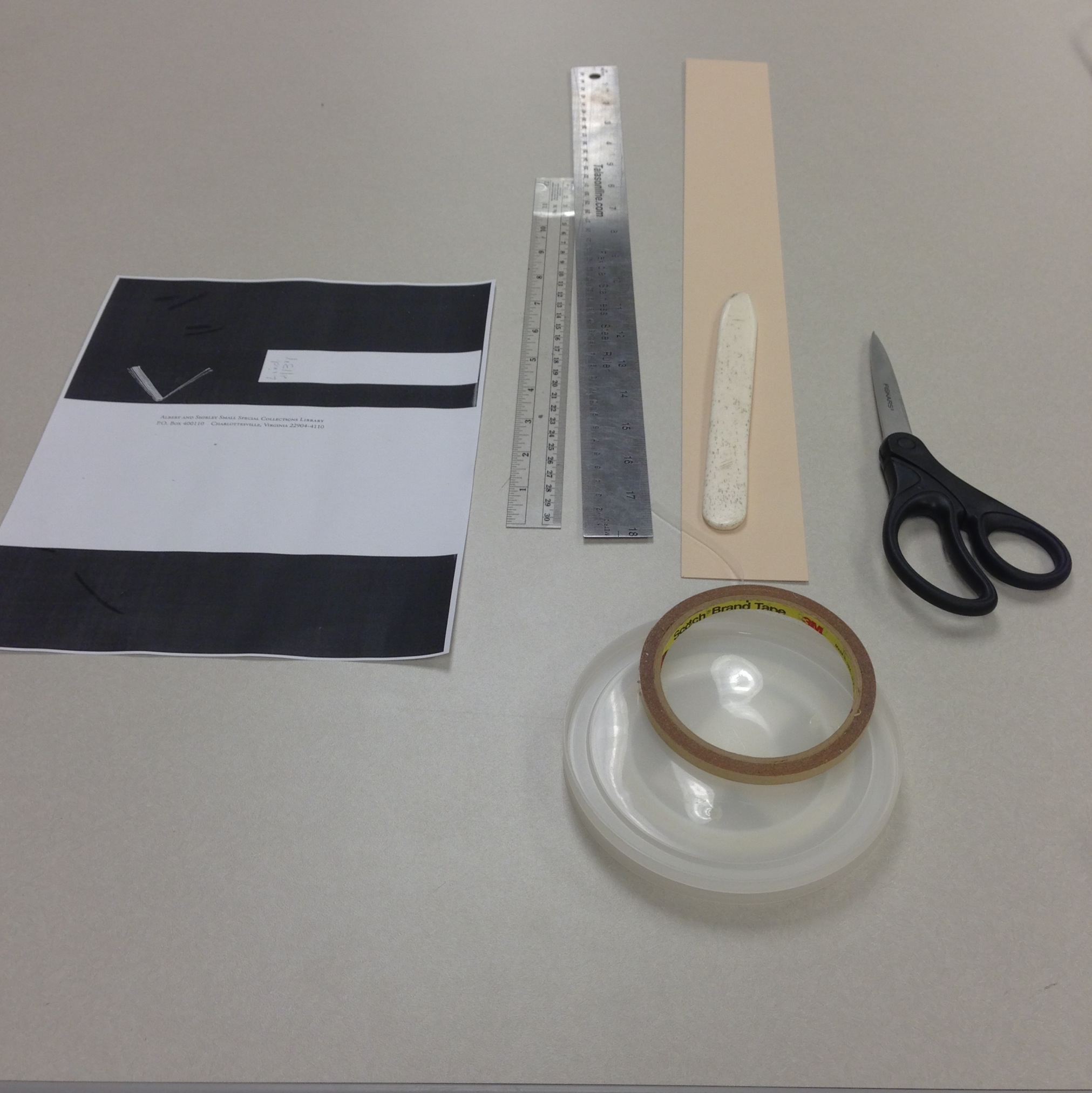
Photo by Molly Schwartzburg

Gather your supplies: rulers, bone folder, scissors, 20-point acid-free board (the weight used to make most collection housings), thin poly strap, narrow double-sided tape, and scissors. You’ll also need a photocopy machine. To get a nice clean cut when you slice your board, I recommend using a board shear, but scissors and a ruler will work in a pinch. Oh, you’ll also need a little book. Please note that these instructions apply only to miniature books, and may not succeed with larger books.

Step Two: Make your Template

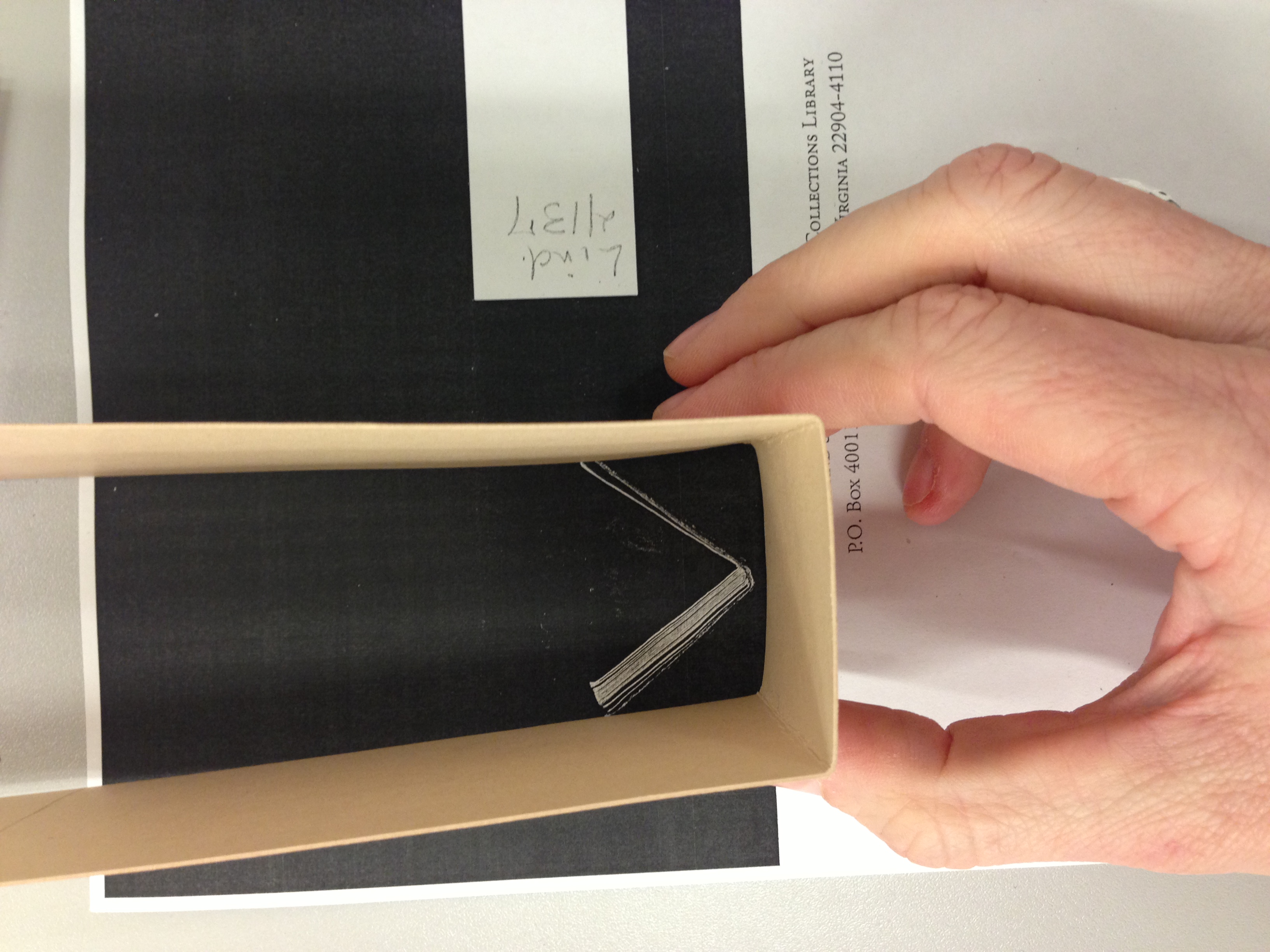
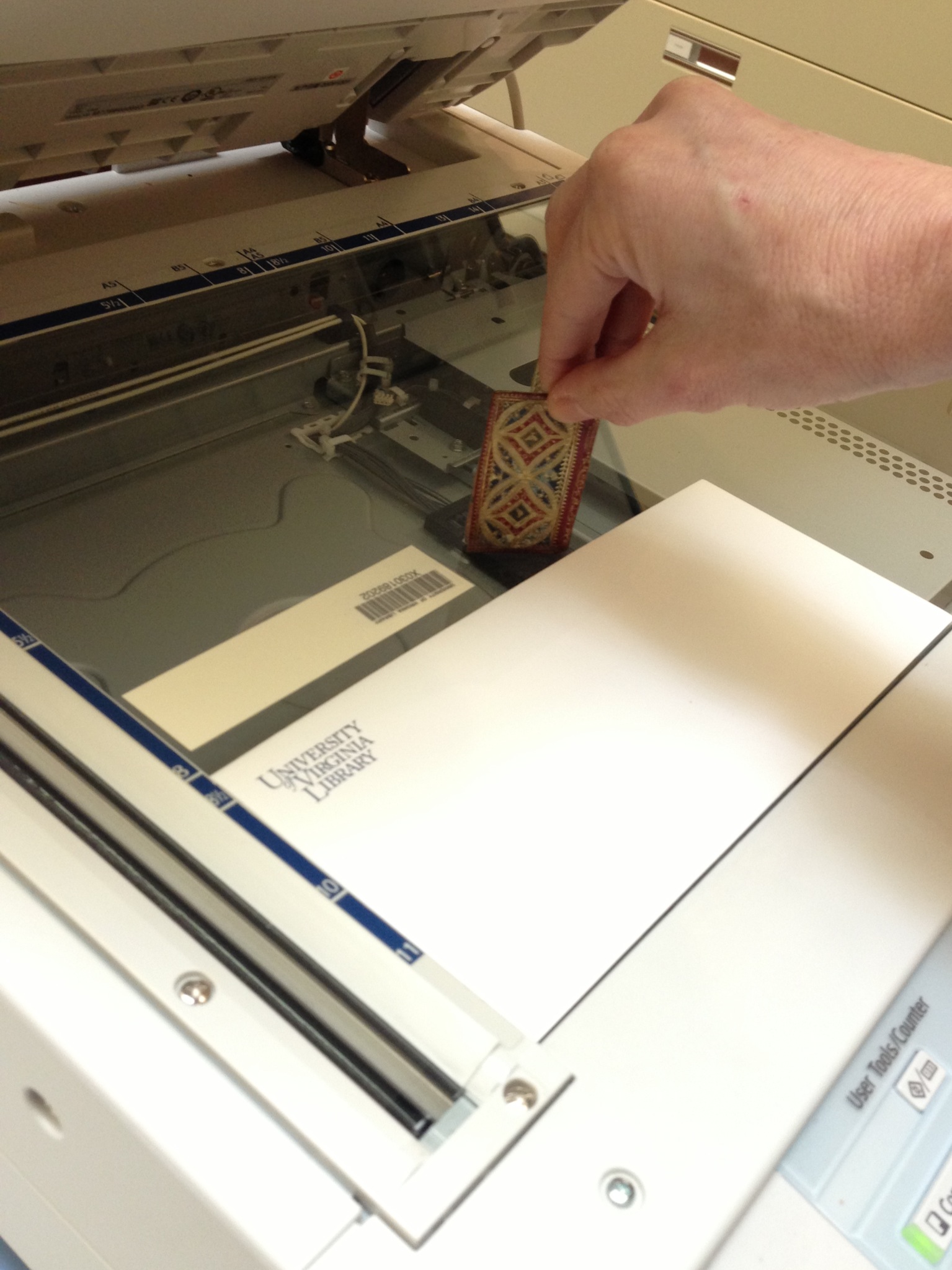
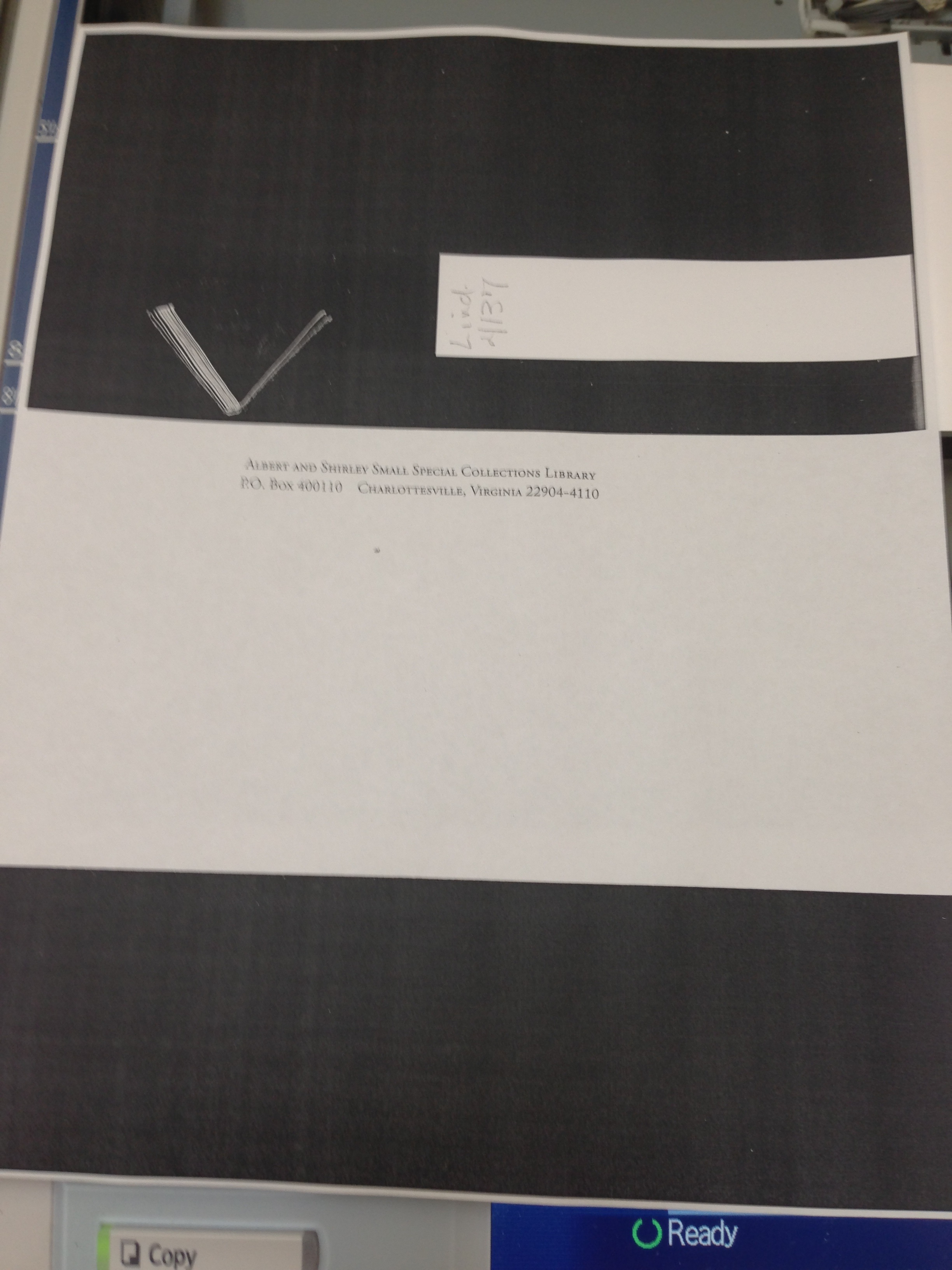
Consult with your conservator to determine a safe and healthy opening angle for your book. Hold the book open at this angle, standing upright in your photocopier, so the angle is visible to the camera. Place a straight-edge where the base of the item will be, and photocopy the book. I also included the call tag in my images, since I was photocopying several books at once and didn’t want to get them mixed up.

You’ll end up with an image that looks something like this:

Photo by Molly Schwartzburg

Step Three: Prep your board

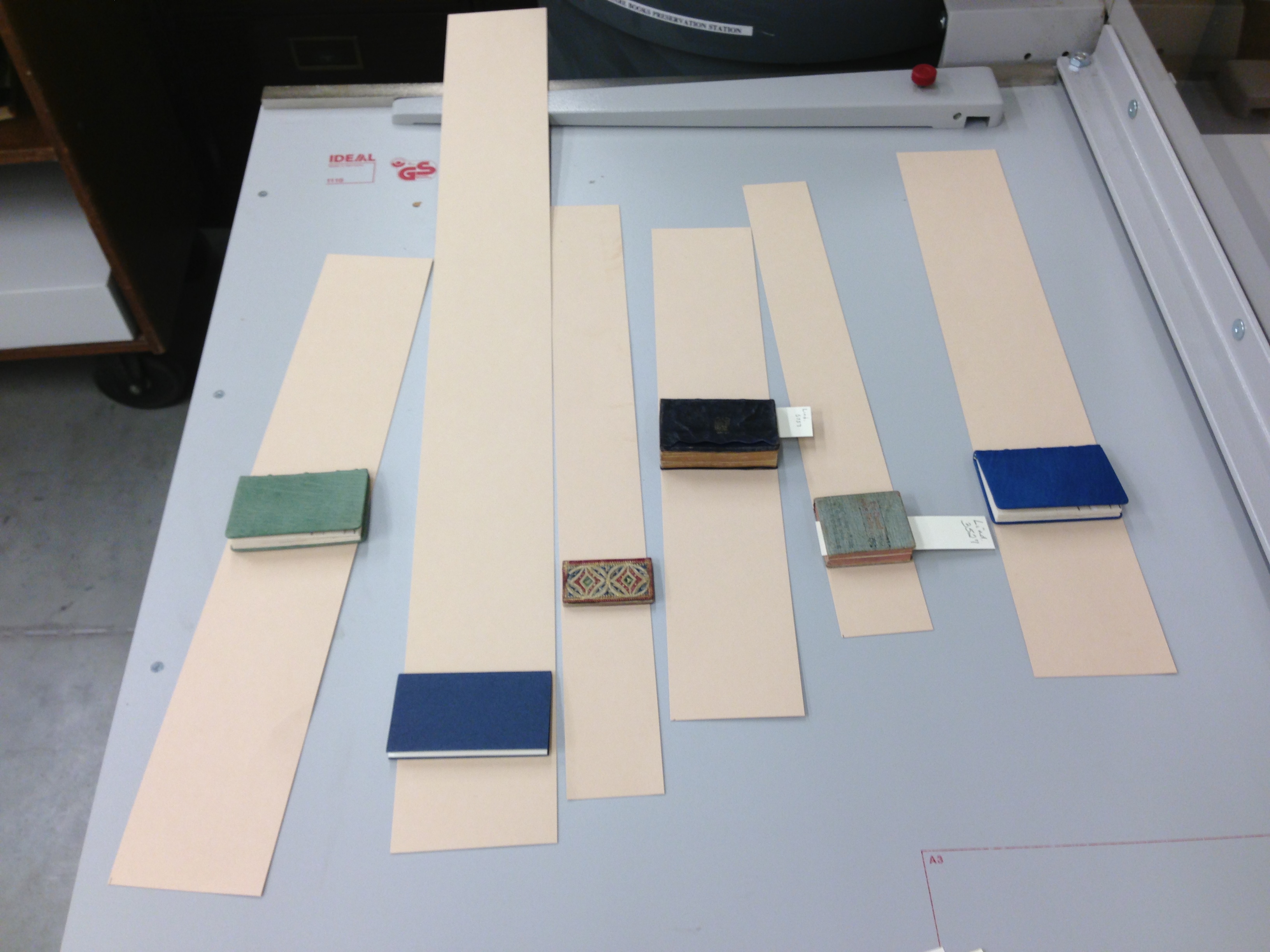
Cut a generous strip of board to the exact height of your miniature book. It must be the exact height so you do not place stress on the book’s edge when you strap it to the cradle later in the process. Don’t skimp on length until you know what you’re doing. The shortest of these pieces is plenty long.

Lots of minis, ready to go.  (Photo by Molly Schwartzburg)

Step Four: Make Your Six Folds

OK, now for the fun part. Put your miniature book somewhere safe (the little devils are easy to lose track of!) and clear your workspace. You will now use your photocopy as a template to determine the placement first for the binding to rest, and then for each of the six folds you will create.

Start by marking on either side of the spine–that is, whatever you do not want to rest on an angled surface. Then, use your ruler to mark a line that comes down at a 90-degree angle from just inside the edge of the book’s angled cover. If you line it up with the cover of the book exactly, your cradle will stick out and disrupt the view. Also be sure to keep your lines square with the top and bottom edge of the board. If you do not keep it square at all times, your cradle will be cocked.

Yes, those wavy lines were made with a ruler. I’m a bit embarrassed, but honesty is the best policy. (Photo by Molly Schwartzburg)

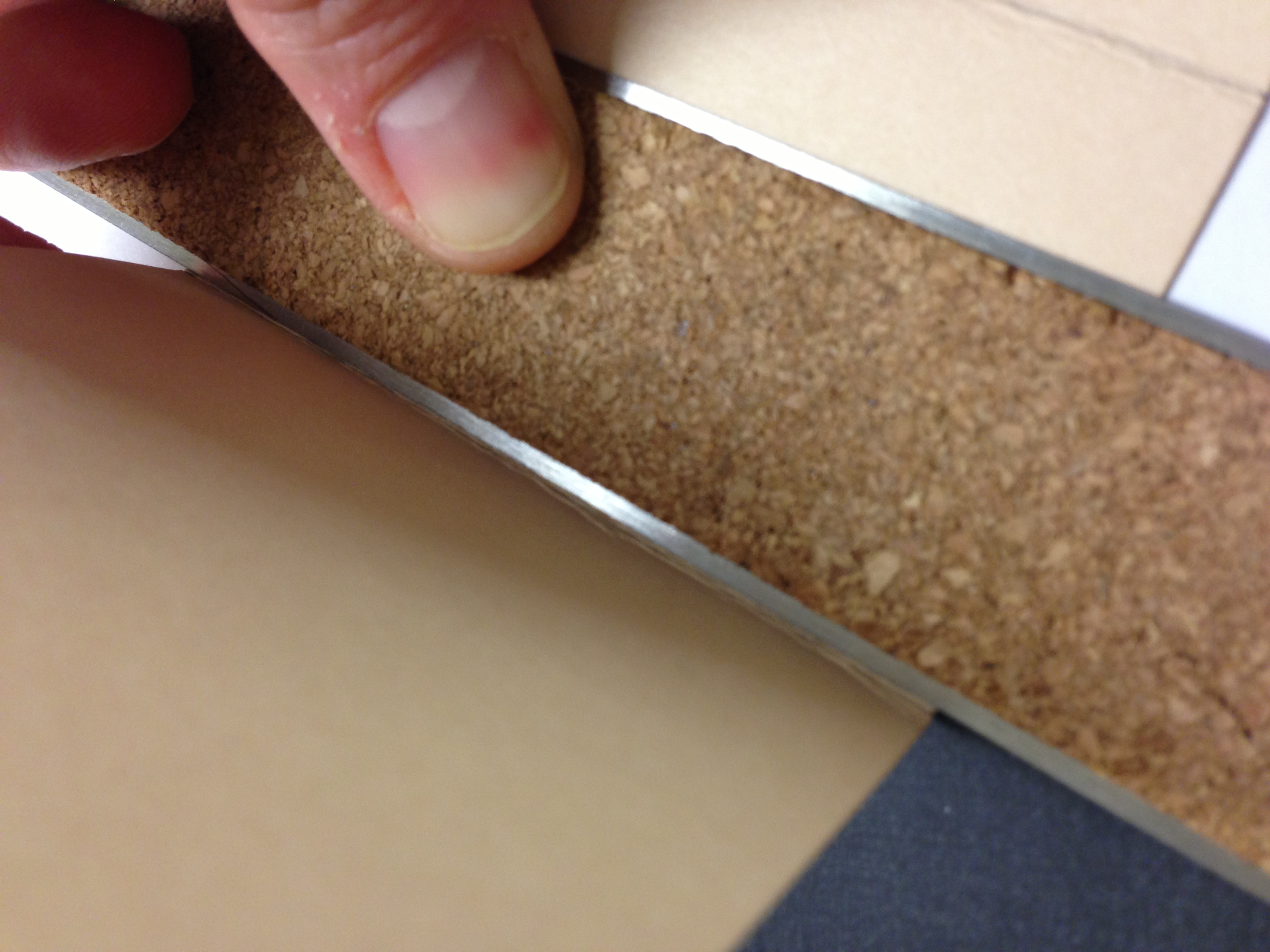
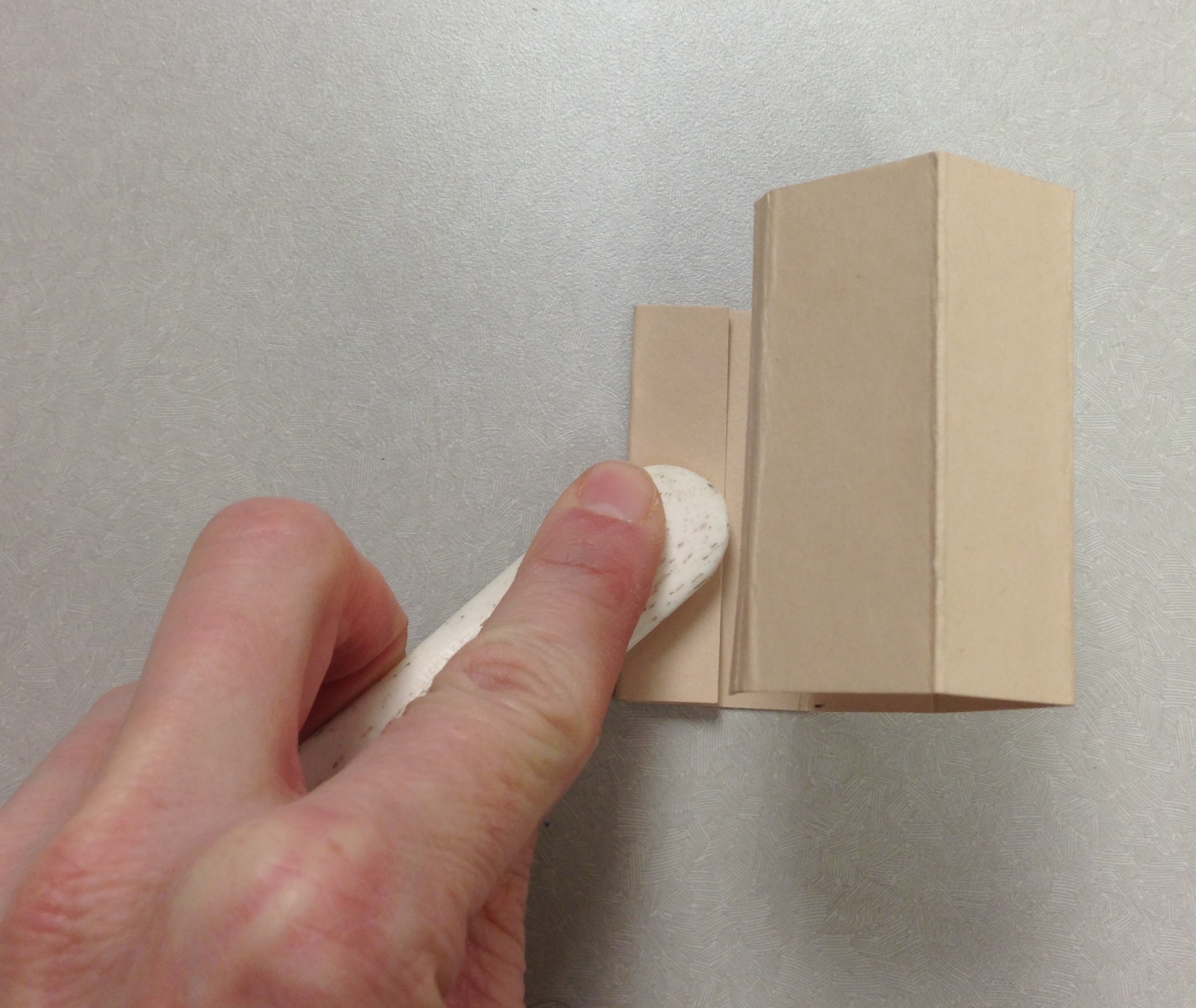
Fold up. I recommend using a heavy metal ruler for a nice solid edge. The board is stiff, so you’ll have to fudge with your lines to get the fold to rest exactly where you want it to (if this doesn’t make sense to you, try it and I think you’ll see what I mean). Folding is not an exact science. Did you remember to keep it squared up?

Don’t let that pesky cork get in the way of an accurate fold! Turn your ruler upside down for the best result. (Photo by Molly Schwartzburg)

Use your bone folder sharpen the edge of your fold.

I don’t know which paper tool I love more: the board shear or the bone folder. (Photo by Molly Schwartzburg)

After you make your first fold, place it over the template to mark the next one, then flatten your paper and mark a fold line, and fold again. Be sure to mark on the inside of your board, since all your marks will fold inward. If this is too difficult, you can mark on the outside and then transfer the mark to the inside.

Be sure that this first fold is at a 90-degree angle when you make your mark for the next fold. (Photo by Molly Schwartzburg)

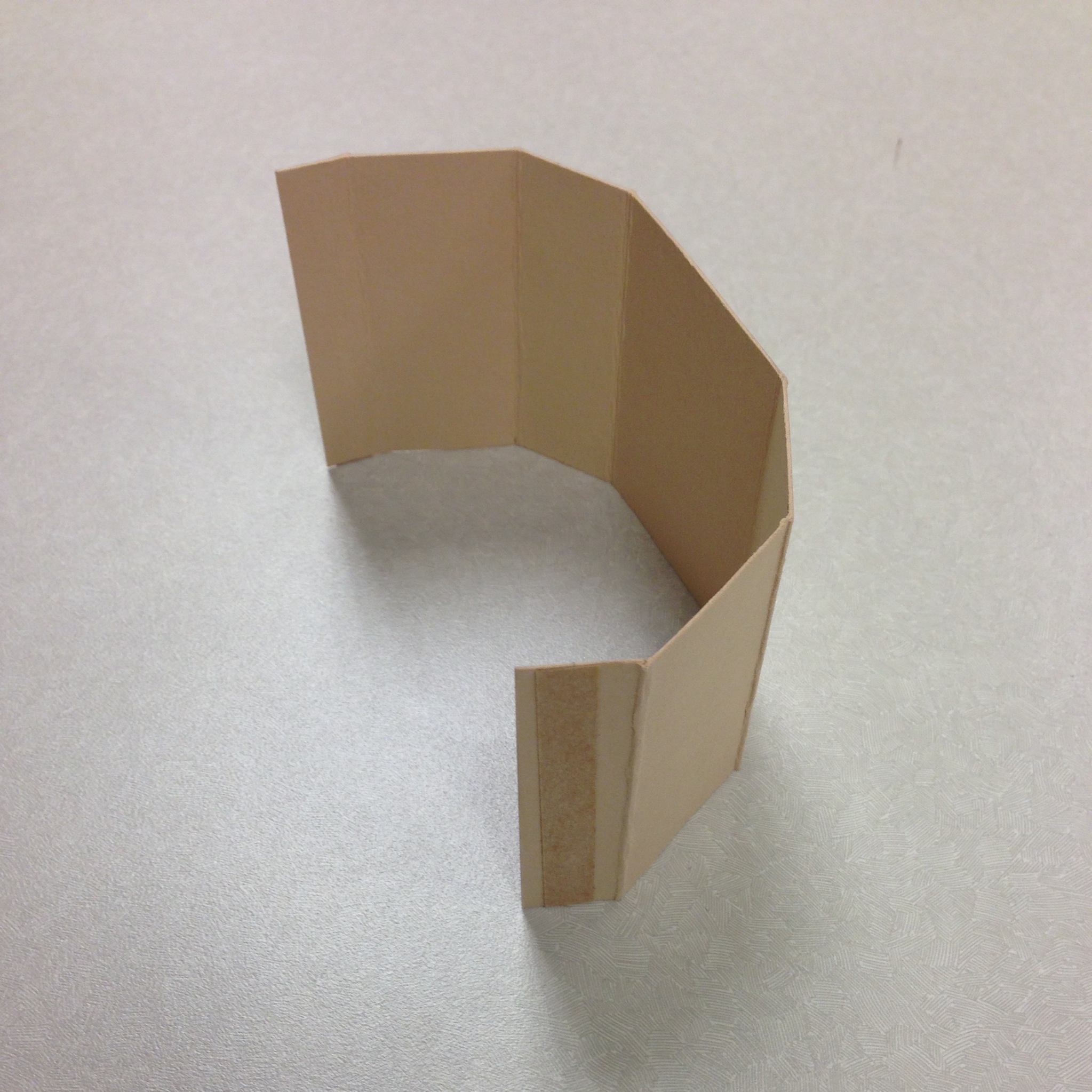
You will make three folds on each side. Return to the first image in the blog post if you need a reminder of your final goal. Don’t try to keep the first or second fold in place as you go–just turn the whole strip of paper around the template image as you work. You will need to trim excess paper off as you prepare to make your final fold. Be careful not to cut off too much–you’ll want a generous piece to tape to the base. Here’s what you’ll end up with.

Photo by Molly Schwartzburg

Step Five: Adhere Double-sided Tape

Place a line of tape on each of your final sections, on the outer side of your cradle. Fold in and adhere, being sure that your final fold lines up with your spine markers.

Double-sided tape before final placement. (Photo by Molly Schwartzburg)

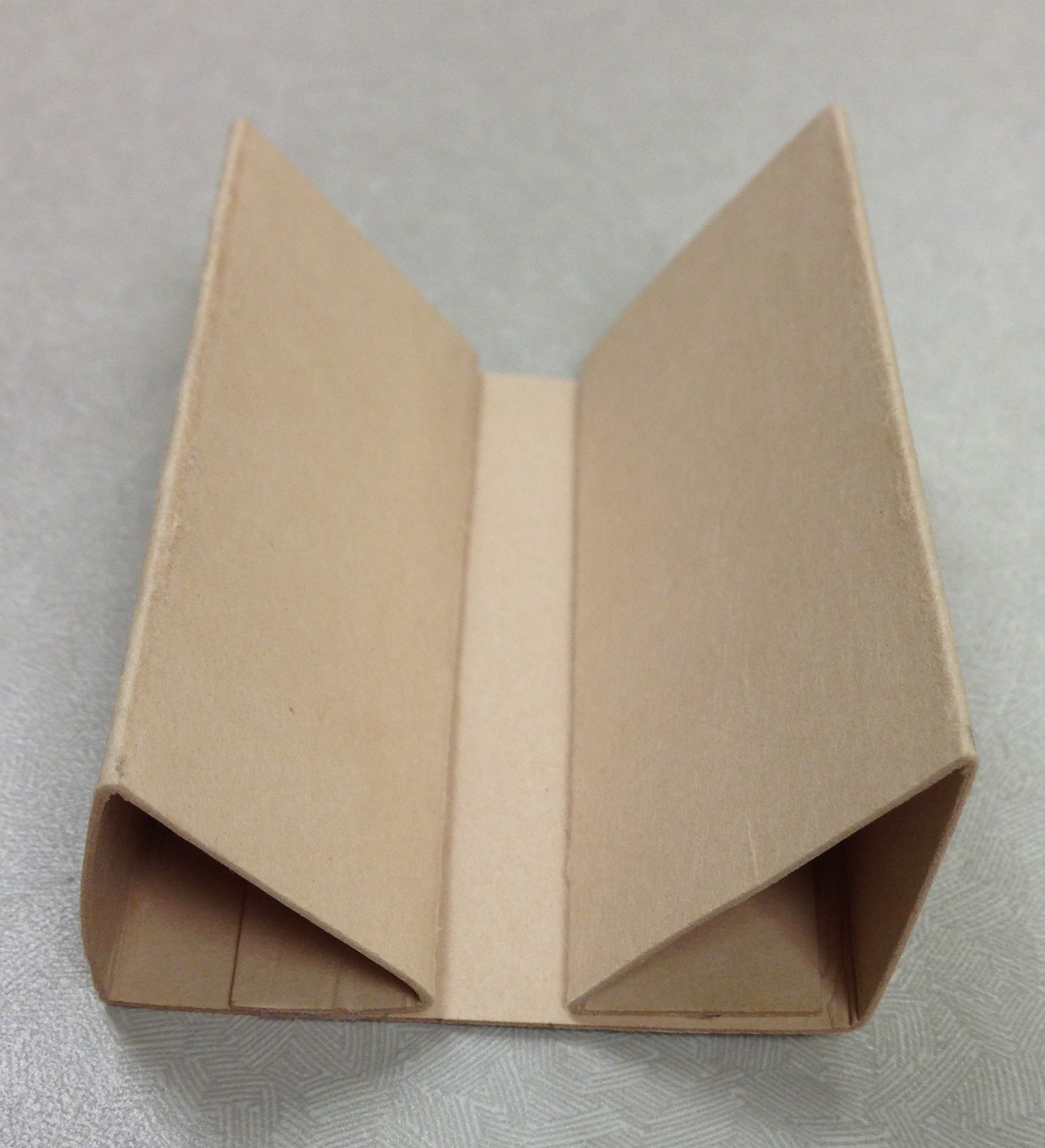
The next picture shows what your cradle will look like. Actually, it should look a lot better, as this was my first effort. Overall, this cradle is correctly assembled, but you can see the signs of my inexperience. On the right hand side, I did not achieve a right angle in my first fold, probably because I marked my folds inaccurately. The right side was not adhered squarely either; you can see that the folded section of board is not lined up with the edge of the base. As a result, the entire cradle is slightly cocked. I was less than consistent in my use of the bone folder, so the right-angle fold on the left is not solid. Finally, I made a marking error for my final fold on the left, resulting in an extra fold that had to be flattened out. You should expect to make all these errors and more your first time out!

So did I keep this first try for posterity? No way. Into the recycling bin it went. (Photo by Molly Schwartzburg)

Step Six: Strap Your Book

Place your miniature book in its cozy new cradle and strap it in, adhering the strap to the cradle. Most regular books require multiple straps to remain safely in a cradle without putting pressure on the text block, but many miniature books are very lightweight and only require one piece of thin strapping on each side. Use your judgment.

Double-sided tape adheres the strapping to your cradle. If you work in a shared space, be prepared to muffle your curses as you try to make this final step, as your fingers will seem too big and the spaces too small to ever get it all in place. Patience, grasshopper. (Photo by Molly Schwartzburg)

Step Seven: Admire Your Final Product!

This elegant little almanac is ready to go into the exhibition case, accompanied by its original matching carrying sleeve. Squee! (Photo by Molly Schwartzburg)

Warning: miniature cradle-making is addictive. (Photo by Molly Schwartzburg)

I hope this little tutorial is useful to you. Please let us know in the comments if you decide to use it for your own projects. Many thanks to Eliza Gilligan for her expert guidance. Now, go forth and fold!
Mini-Books in Small: A Photoessay

This week’s post is written by Anne Causey, Public Service Assistant at the Albert and Shirley Small Special Collections Library:

Local bookmakers and bookbinders involved with the Virginia Arts of the Book Center (VABC) in Charlottesville are gearing up for this year’s collaborative project:  creating a miniature book. In fact, each participant must make fifteen books. What better way to become inspired than to visit the Albert and Shirley Small Special Collections Library, which houses more than 13,000 miniatures?
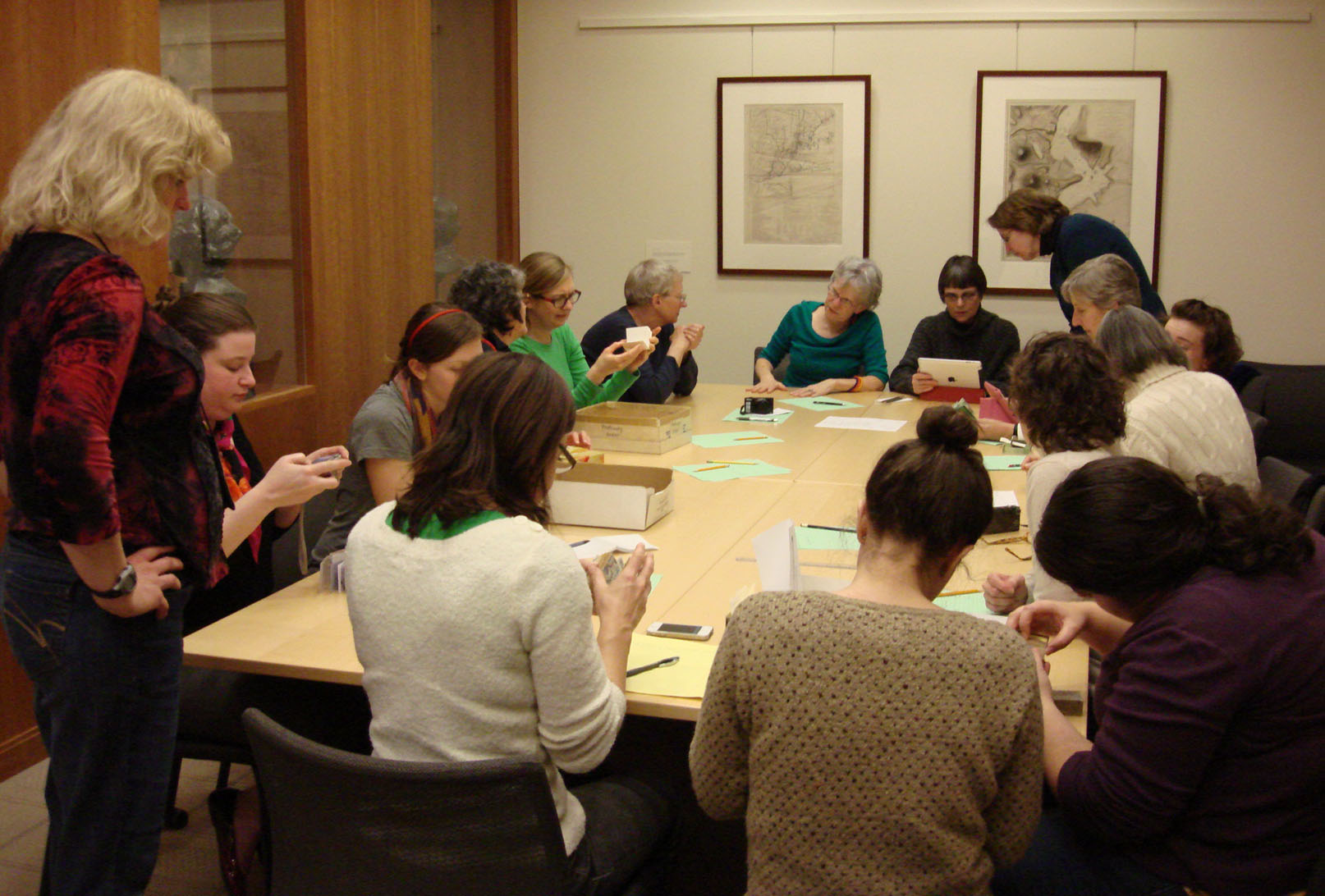
Here the 15 bookbinders and bookmakers investigate several boxes of miniature books, primarily from the McGehee Miniature Book Collection. I pulled some older more traditional printed books and then some contemporary artists books that use a variety of materials, binding and art work. They were excited by many of the examples – and excited by the housings as well. (Photograph by Petrina Jackson)

Miniature books are defined as smaller than three inches in each direction, and yes, they are “real” books – just printed on a smaller scale. The printer uses a text small enough to fit the size and form of the pages and sizes down the illustrations.

The participants looked at about 40 examples, including a Medieval Manuscript. A Parisian, miniature book of hours, dated from the 14th-century is the oldest such book in Special Collections. This tiny book contains five full-page illustrations and a vine design on every page, not to mention grotesques in the form of dragons and other beasts on some of the pages.

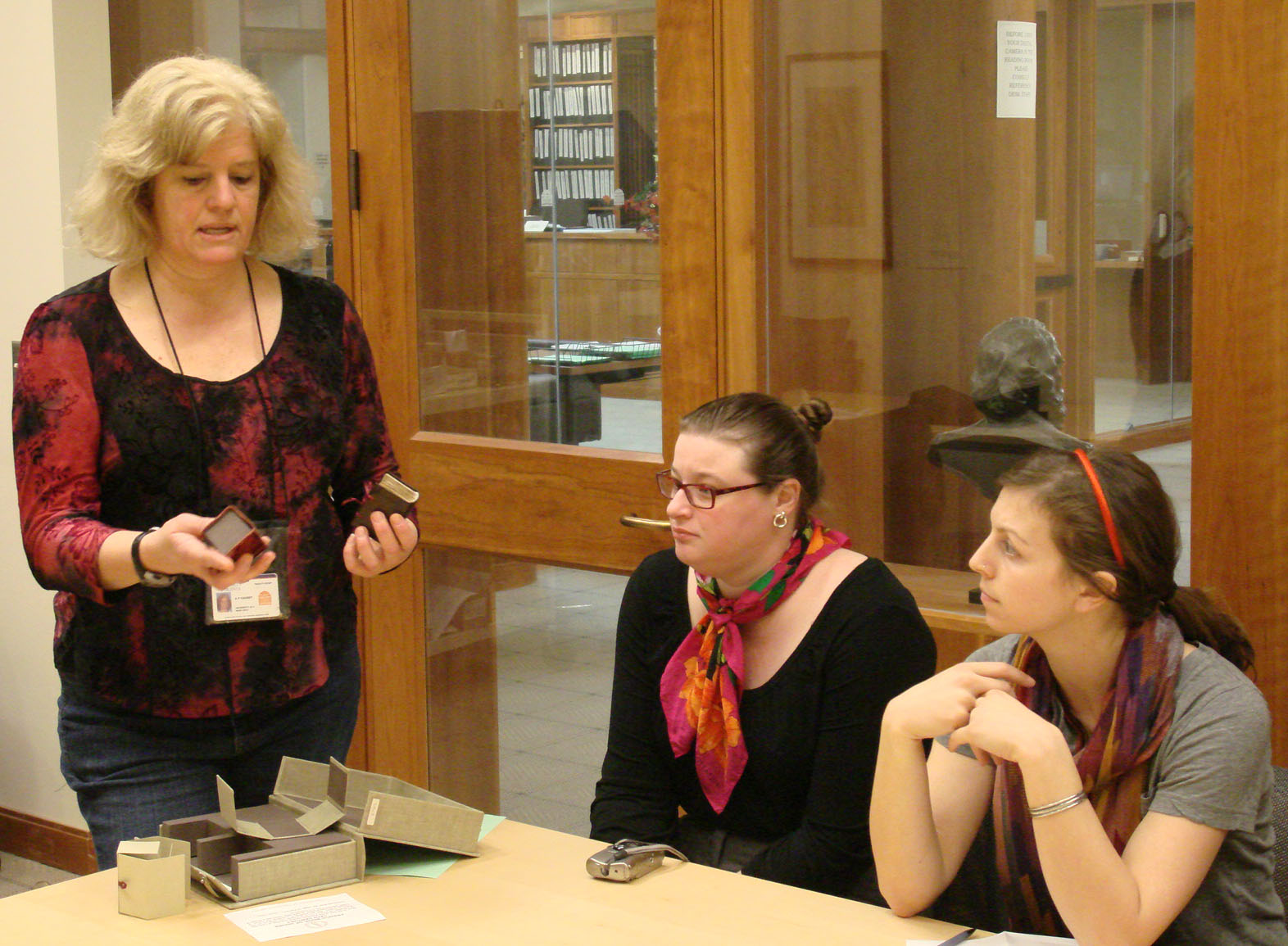
I am showing the group a 14th-century illuminated manuscript, a Parisian book of hours. Nicknamed “Baby,” it is 6.5 X 5 cm and 239 folios, or pages. The text is Gothic script on vellum and is in Latin except for the 12-page calendar, which is French. We had it rebound in a historically-correct leather binding with ties. The group was almost as interested in the 19th century red velvet binding that was removed but still kept with the book. (MSS. 382 /M.MS. W. From the Papers of Edward L. Stone, purchased 1938. Photograph by Petrina Jackson)

Books in miniature were made for various reasons. Some were made small so they were easy to carry, while some accompanied packages as advertisements. Some were made for children, and still others were made because the content of the book or its ownership was controversial.

The miniature books in Special Collections comprise a wide range—from traditional older printed books to more whimsical artist books. The collection includes more than 12,000 miniatures donated by Mrs. Caroline Brandt. Her collection has accumulated over 40 years, spans six centuries and contains volumes in more than 30 languages.  Mrs. Brandt donates more books to the collection every year.

The VABC is hosting an exhibition, entitled Monumental Ideas in Miniature Books 2: A Traveling Exhibit from March 1 – April 26 at the Virginia Arts of the Book Center, 2125 Ivy Road, Charlottesville, VA.

VABC will host a reception during the Virginia Festival of the Book on Sunday, March 24 at 2:30PM, including a discussion of the exhibit by Molly Schwartzburg, curator of the Albert and Shirley Small Special Collections Library. During March, Special Collections will also have an exhibit from its holdings of miniature books to coordinate with this visit.

This group of miniatures were all designed and hand-written by contemporary bookmaker Margaret Challenger between 1999 and 2003. Several are accordion-style, and all of them have specialty hand-made papers and Challenger’s calligraphy. The book with the black cover and gold center medallion, which shows a knight’s shield and sword, is called “St. Patrick’s Breastplate.” Enclosed in the front cover is another smaller book, containing his prayer; her calligraphy, written in purple is, “an Anglo Saxon version of Italian Uncial, as used in The St. Cuthbert Gospels, written before 716 A.D.” Many of the books have interesting paper closures or boxes. I was hoping such variety would give the bookmakers inspiration for their own projects. (Lindemann 3747-3760. Photograph by Petrina Jackson)

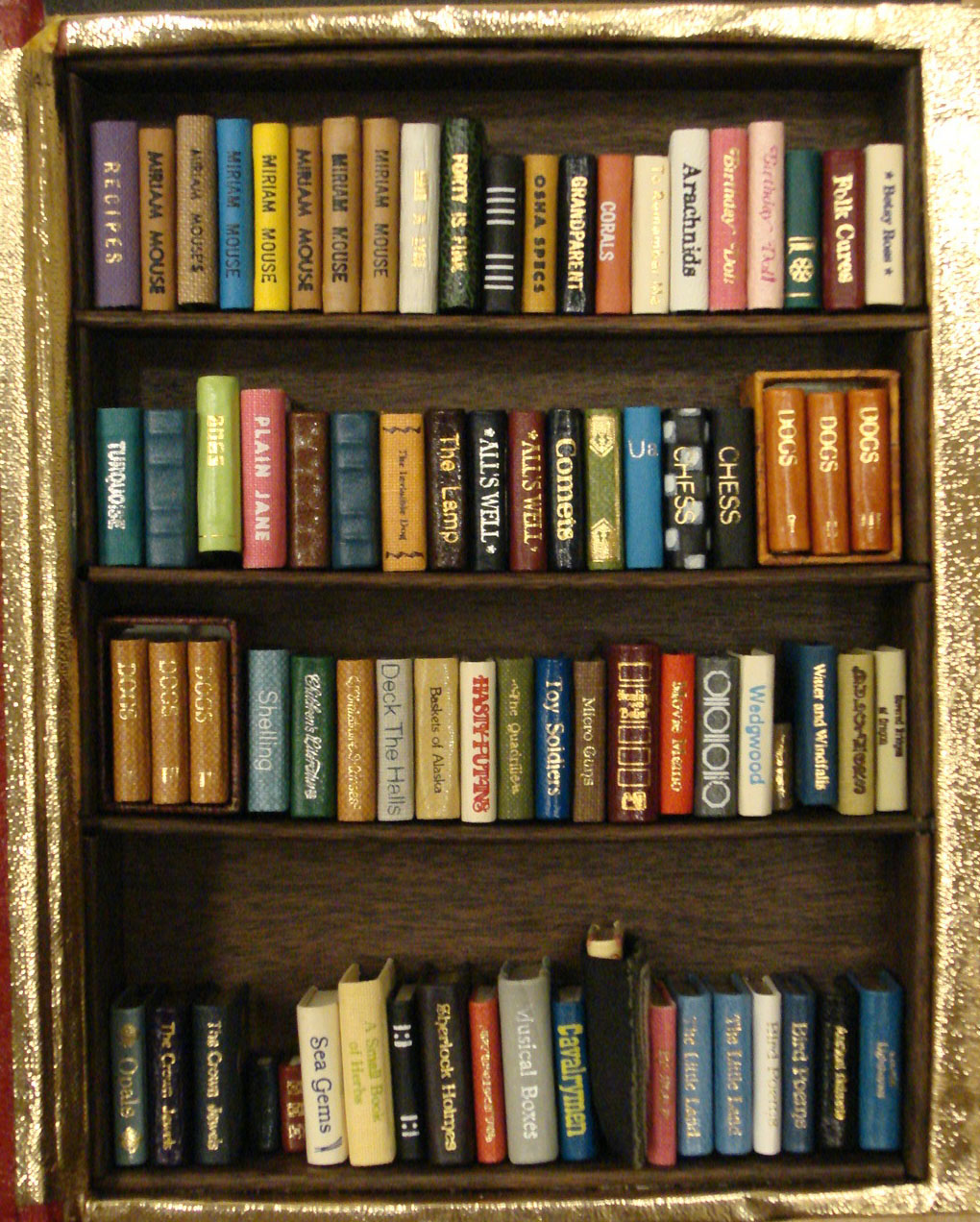
This red and gold miniature bookcase, which is the size of a more typical book (6 1/4 x 7 ½ in), holds 65 tiny volumes. They are each bound in colorful book cloth and have tiny text. The first one, “Aunt Faith’s Recipes,” does indeed contain actual recipes – for desserts, candy, and beverages. I only know this because the group wanted a book to be taken out to see if it contained text. Less than half of these are known as micro-minis, which are between 1” to 2” tall, while the rest are ultra-micro-minis, defined as smaller than 1” in any measurement (Lindemann 5766, no. 1-65. Photograph by Petrina Jackson)

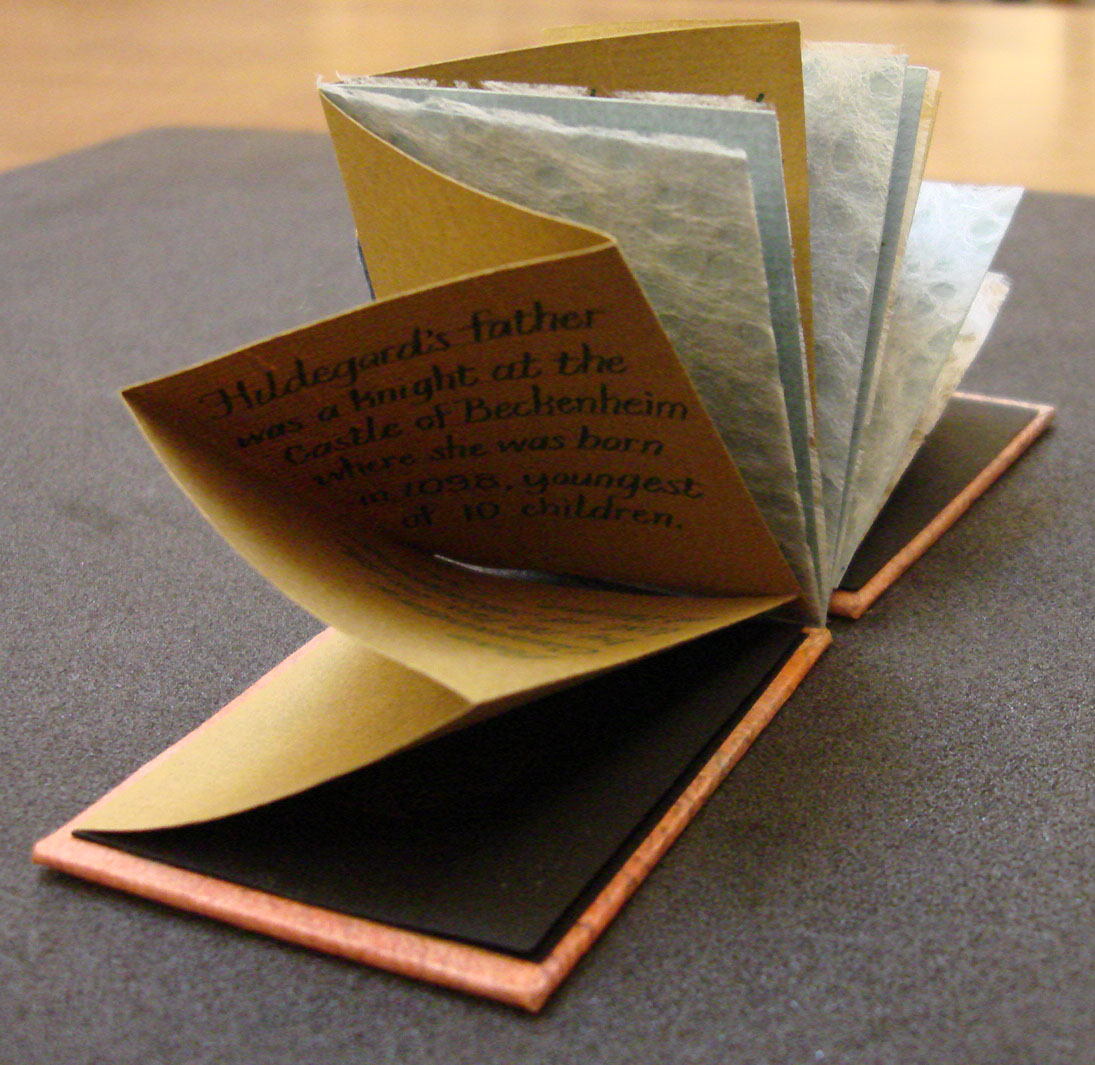
This accordion-style book has a bright orange cover and is enclosed in a black envelope stamped with a silver cross. It is entitled “Hildegard of Bingen: Her Music.” The calligraphy in green is “from Commentary by M. Fox on the text of Hildegard of Bingen: 1985.” Hildegard was a saint born in 1098 who composed over 70 songs. The book is a creation of Margaret Challenger, 2000. The colophon reports that she used Ingres paper and gouache calligraphy. (Lindemann 03747. Photograph by Petrina Jackson)

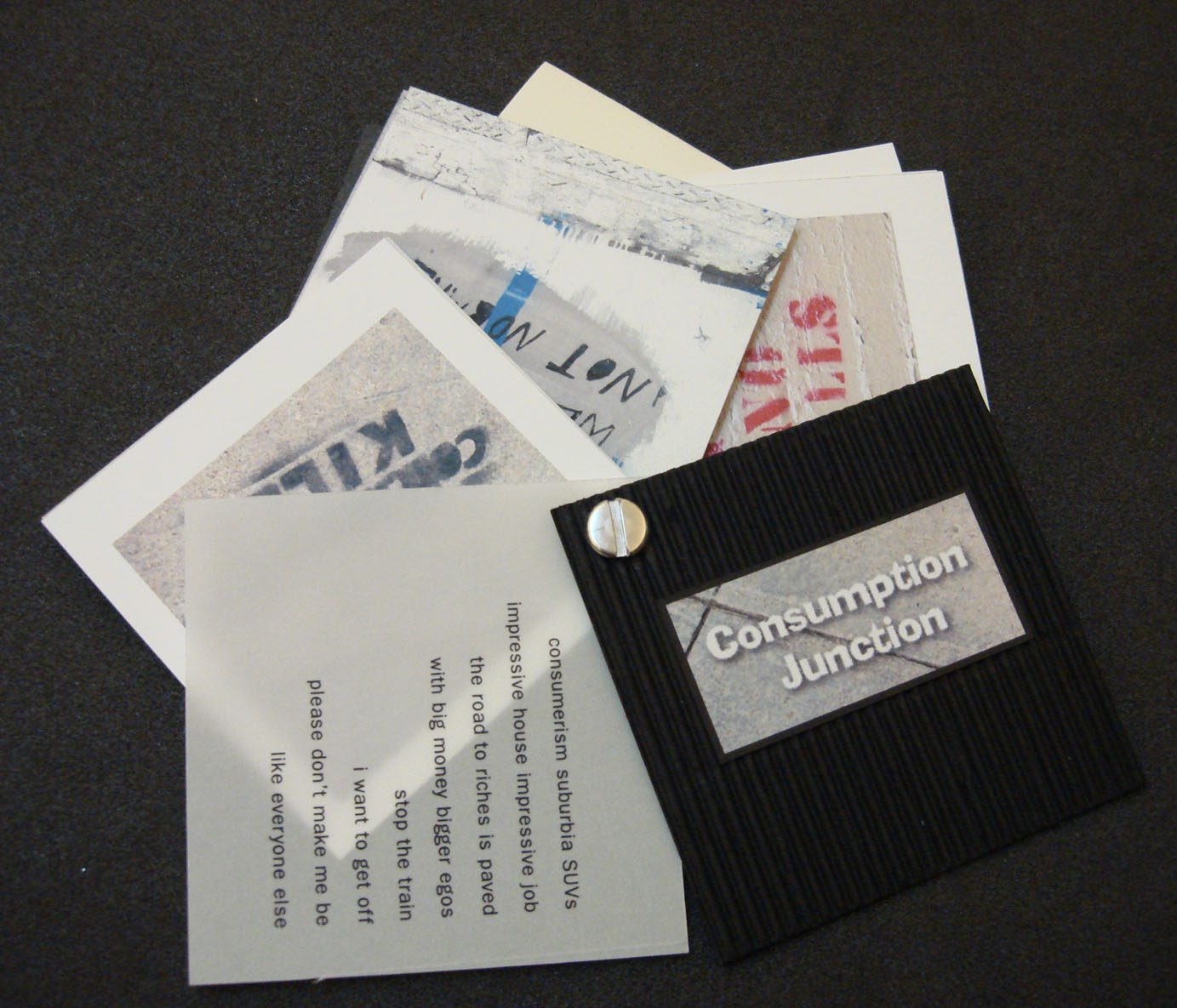
Miniatures are sometimes commentaries about the times in which we live. For instance, “Consumption Junction” a miniature created by Laura Russell in 2002, features painted corrugated cardboard covers, affixed by a single bolt. The book is a protest against modern consumerism. (Lindemann 05115. Photograph by Petrina Jackson)

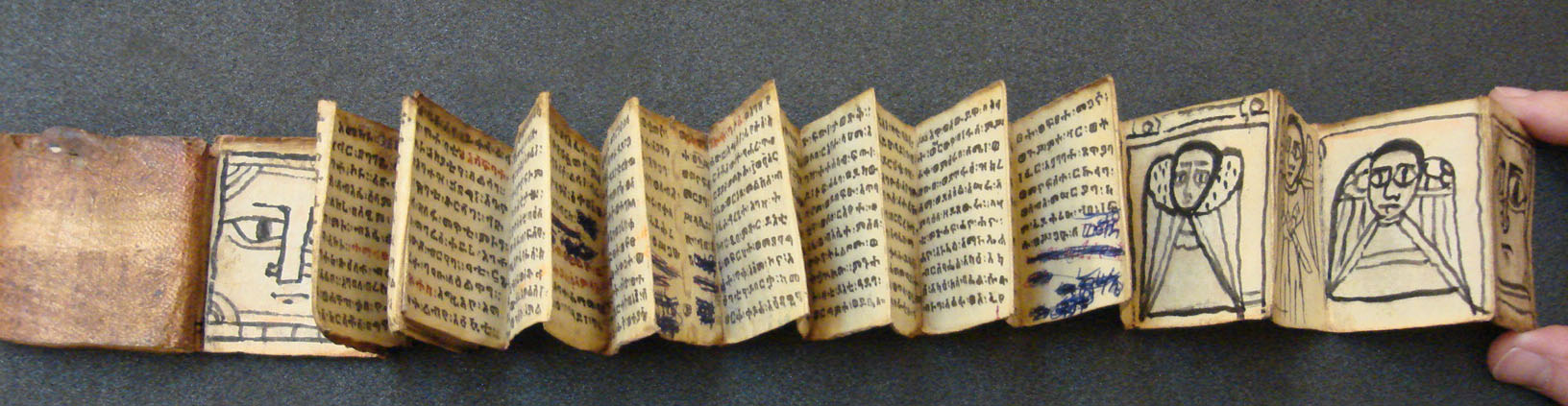
This manuscript from Ethiopia looks rather old, but is estimated to date from the twentieth century. The script is in black and red ink on vellum, and the vellum binding wraps around the accordion-style text block. There are 7 hand-painted illustrations. (Not yet cataloged, from the McGehee Miniature Book Collection. Photograph by Petrina Jackson)

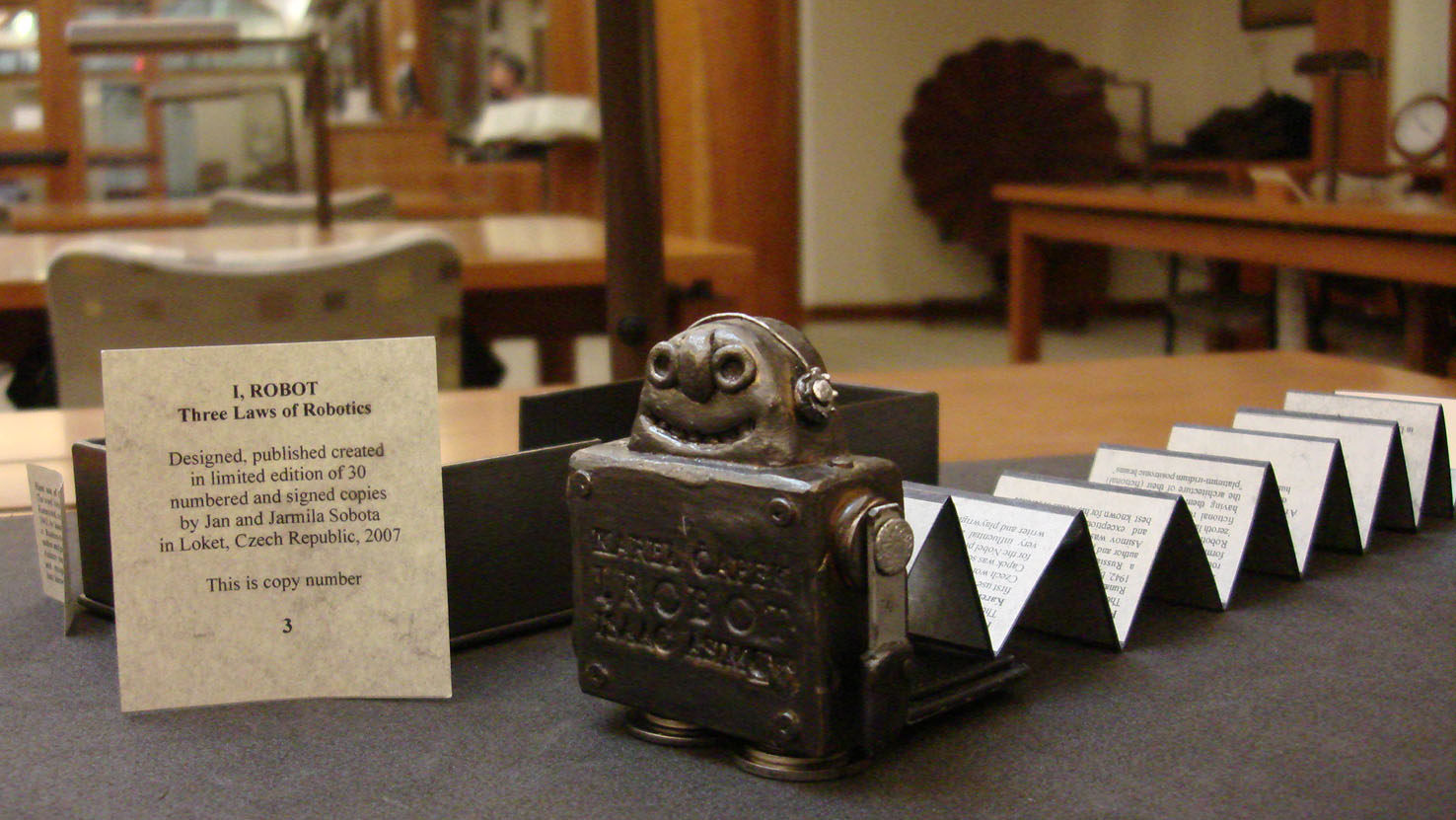
The “I, Robot” miniature is too cute! The group chuckled at this one. The robot “covers” or container is metal with a magnetized closing at the back of its head. The fun surprise comes in opening it and pulling out the pages. This creative miniature was made by Jan and Jarmila Sobota, in the Czech Republic, 2007. Ours is number 3 of 30. (Not yet cataloged, from the McGehee Miniature Book Collection. Photograph by Petrina Jackson)

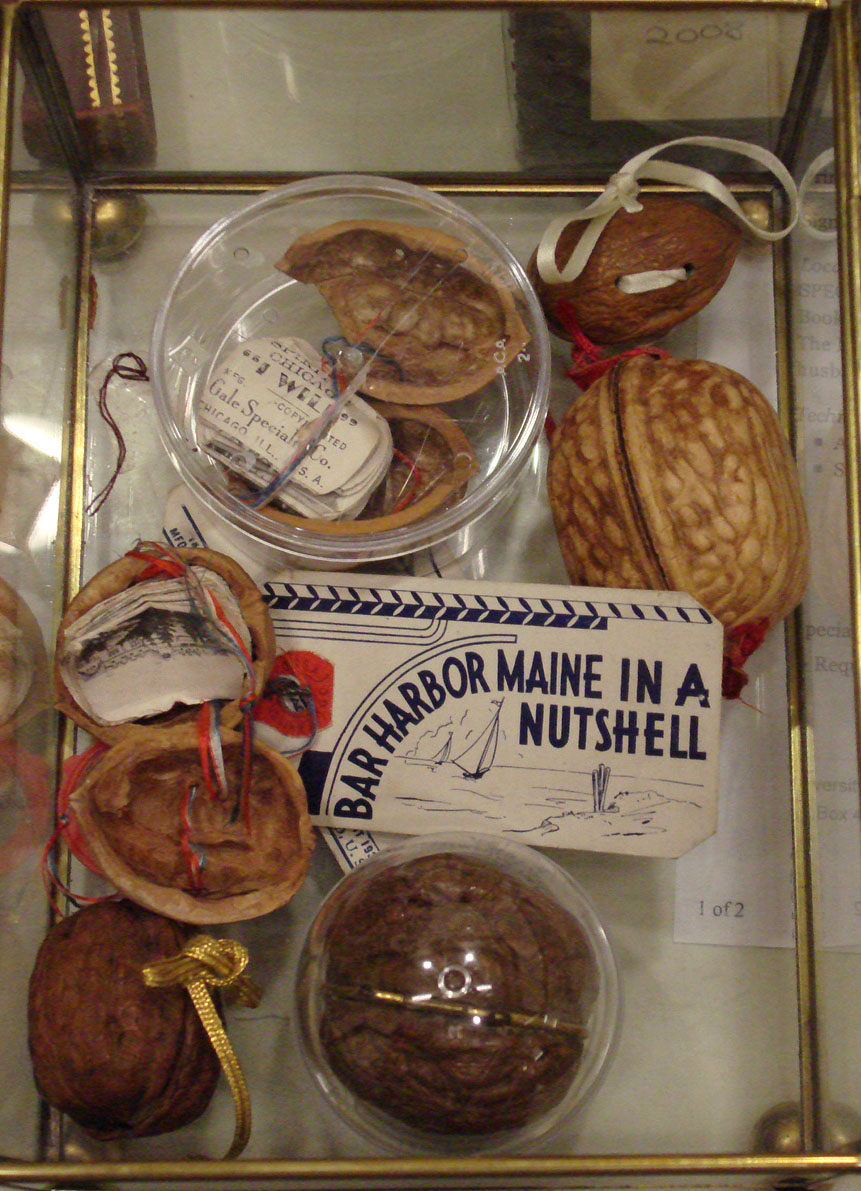
Nutshell books are always a big hit. Some are still in stages of being cataloged (From the McGehee Miniature Book Collection. Photograph by Petrina Jackson)

This Just In: A Peek Inside the Maurice Lévy Collection of French Gothic

In a previous post Nicole Bouché, Director of the Small Special Collections Library, related the story of how the Maurice Lévy Collection of French Gothic arrived at its permanent home under Grounds.  Thanks to the magnificent gift of the Sadleir-Black Collection of Gothic Novels received in 1942, U.Va. has world-renowned holdings in the English Gothic novel, now wonderfully augmented by the Lévy Collection.  Here is a brief peek at a few of its riches.

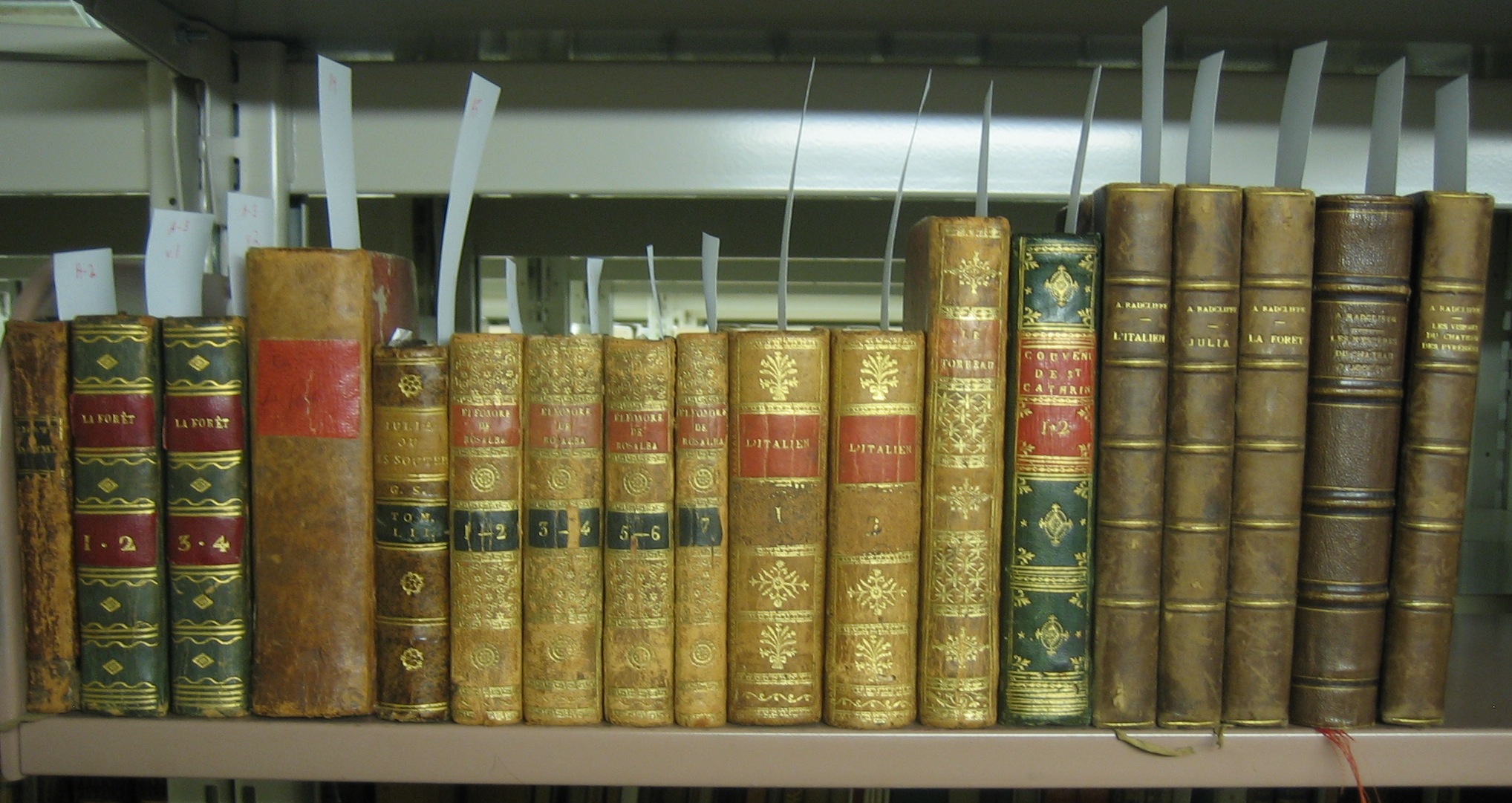
A shelf of Ann Radcliffe in French translation.

At the core of the Lévy Collection are its many contemporary French translations of English Gothic novels.  Here, for instance, is a listing of the Ann Radcliffe works to be found in the Lévy Collection:

  • Les châteaux d’Athlin et de Dunbayne. Paris: Testu, 1797.
  • Le couvent de Sainte Catherine, ou les moeurs du XIII° Siècle. Paris: Renard,1810.
  • Eléonore de Rosalba, ou le confessionnal des pénitens noirs. Paris: Lepetit, 1797.
  • La forêt, ou l’Abbaye de Saint-Clair. Paris: Denne, 1796.
  • La forêt, ou l’Abbaye de Saint-Clair. Paris: Maradan, 1798.
  • La forêt, ou l’Abbaye de Saint-Clair. Paris: Lévy, 1880.
  • L’italien, ou le confessionnal des pénitens noirs. Paris: Maradan, 1798.
  • L’italien, ou le confessionnal des pénitents noirs. Paris: Lévy, 1873.
  • Julia, ou les souterrains de Mazzini. Paris: Maradan, 1798.
  • Julia, ou les souterrains du château de Mazzini. Paris: Lévy, 1897.
  • Les mystères du château d’Udolphe. Paris: Lévy, 1874.
  • Le tombeau. Paris: Lerouge, 1812.
  • Les visions du château des Pyrénées. Paris: Lévy, 1896.

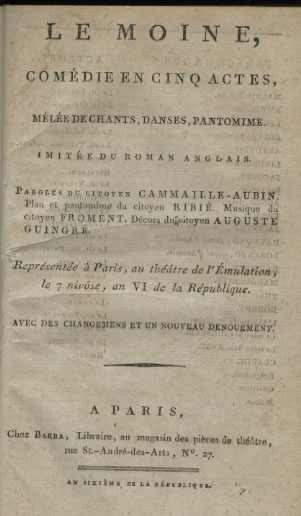
Le moine, comédie en cinq actes (Paris, an VI [1797/98])

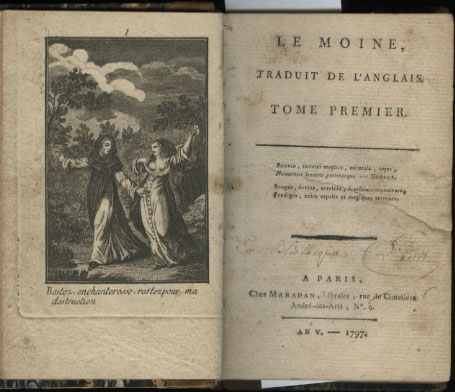
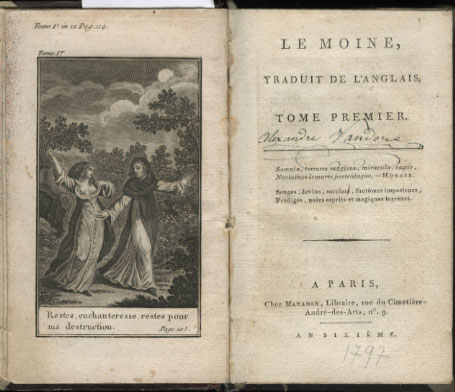
The Gothic novel proved so popular with readers that it quickly penetrated popular culture in both England and France, attracting a wider audience.  Consider, for example, Matthew Gregory Lewis’s novel, The Monk.  It created a sensation when first published in London in 1796. The following year it was translated into French and published in Paris as Le moine, and the Lévy Collection contains a copy of the first French edition. In December of 1797 Lewis’s novel was adapted for the Paris stage, in true French fashion, as a “comédie en cinq actes, mélée de chants, danses, pantomime.” The Lévy Collection includes a fine copy of the rare printed text, which contains a cast list for the  premiere performance at the Théâtre de l’Émulation, together with, intriguingly, “des changemens et un nouveau denouement.” (Please, not a happy ending!)

Matthew Gregory Lewis, Le moine (Paris, 1797)

Reversed positions: Matthew Gregory Lewis, Le moine (Paris, an VI [1797/98])

As Nicole Bouché has noted, Maurice Lévy was fascinated by the illustrations found in French Gothic novels, and in 1973 he published a book on the subject, Images du roman noir.  Illustrations may reveal unexpected things about a publication.  For example, the first French translation of The Monk (Paris, 1797) includes an etched frontispiece depicting one of the novel’s most dramatic moments.  The translation sold so well that the same publisher issued a new edition later that same year.  But in that edition’s frontispiece, the characters switch positions.  It is likely that the publisher, not anticipating the need for a second edition, neglected to save the copperplate and therefore had to commission a new plate of the same image.  In copying the original frontispiece (which printed in reverse orientation from the design as etched on the copperplate), the etcher necessarily reversed the image!

The castles of Montreuil & Barre (London, [ca. 1820])

For those English readers who could not afford the cost of a multi-volume novel, publishers offered Gothic fiction in shorter, less expensive form.  The castles of Montreuil & Barre was first serialized in The Lady’s Magazine during 1797-1798, then printed in chapbook form (“price sixpence”) with a lurid hand-colored frontispiece to attract purchasers. Special Collections already possesses two early chapbook editions of this work, courtesy of the Sadleir-Black Collection, and the Lévy Collection contributes a third, published by W. Mason and dating to ca. 1820. This copy is in its original blue paper wrappers, which feature on the inside a list of the various chapbooks available at “Mason’s Pamphlet Warehouse” on Clerkenwell Green.

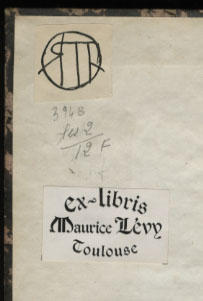
Because many of the Lévy volumes are two centuries old, they display interesting evidence of ownership and use by multiple generations of readers and collectors.  Two works in the Lévy collection, for instance, bear the booklabel of noted artist Henri de Toulouse-Lautrec (1864-1901).  It is shown here (above Maurice Lévy’s booklabel), pasted into a copy of the intriguingly titled Miss Glamour, ou les hommes dangereux (Paris, an IX [1800/01]).  Styled on the title-page as a ‘free translation from the English’ by Théodore-Pierre Bertin, the original English novel has yet to be positively identified. Perhaps Bertin, who self-published this very rare edition, was actually its author?

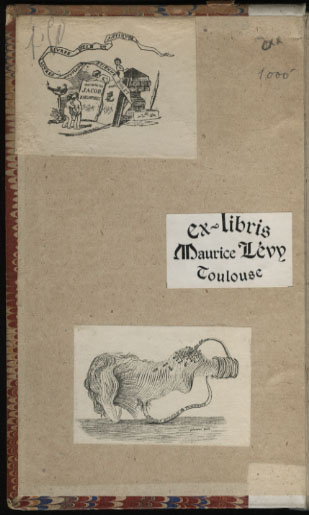
Emanuella, ou la découverte premature (Paris, an IX [1800/01]) is a French translation of Eliza Haywood’s The rash resolve, or the untimely discovery. First published in 1724, decades before the heyday of the Gothic novel in England, its plot nonetheless contains some Gothic elements, and it is interesting to see it revived at this time for the French market. Also interesting is the provenance: this copy bears the booklabels of (at top) prolific author Paul Lacroix (“Bibliophile Jacob,” 1806-1884) and (at bottom) the founder of Surrealism, André Breton (1896-1966).  Fittingly, Breton’s arresting booklabel was designed by Salvador Dalí.

Class Notes: Kirt von Daacke’s HIUS 4501: Slavery & Social Life at Early U.Va.

Yesterday, Kirt von Daacke, history professor and former Special Collections student employee, and his HIUS 4501: Slavery & Social Life at Early U.Va. researched through some of our most treasured, old, and fragile University Archives materials.  They pored through these early records, which document the founding, building, and day-to-day management of U.Va.  These early records include Board of Visitors minutes, faculty chairman journals, faculty minutes, letters from Thomas Jefferson’s descendants, proctor’s ledgers, etc.  So what do these records have in common?  The threads of a slave economy run through them.

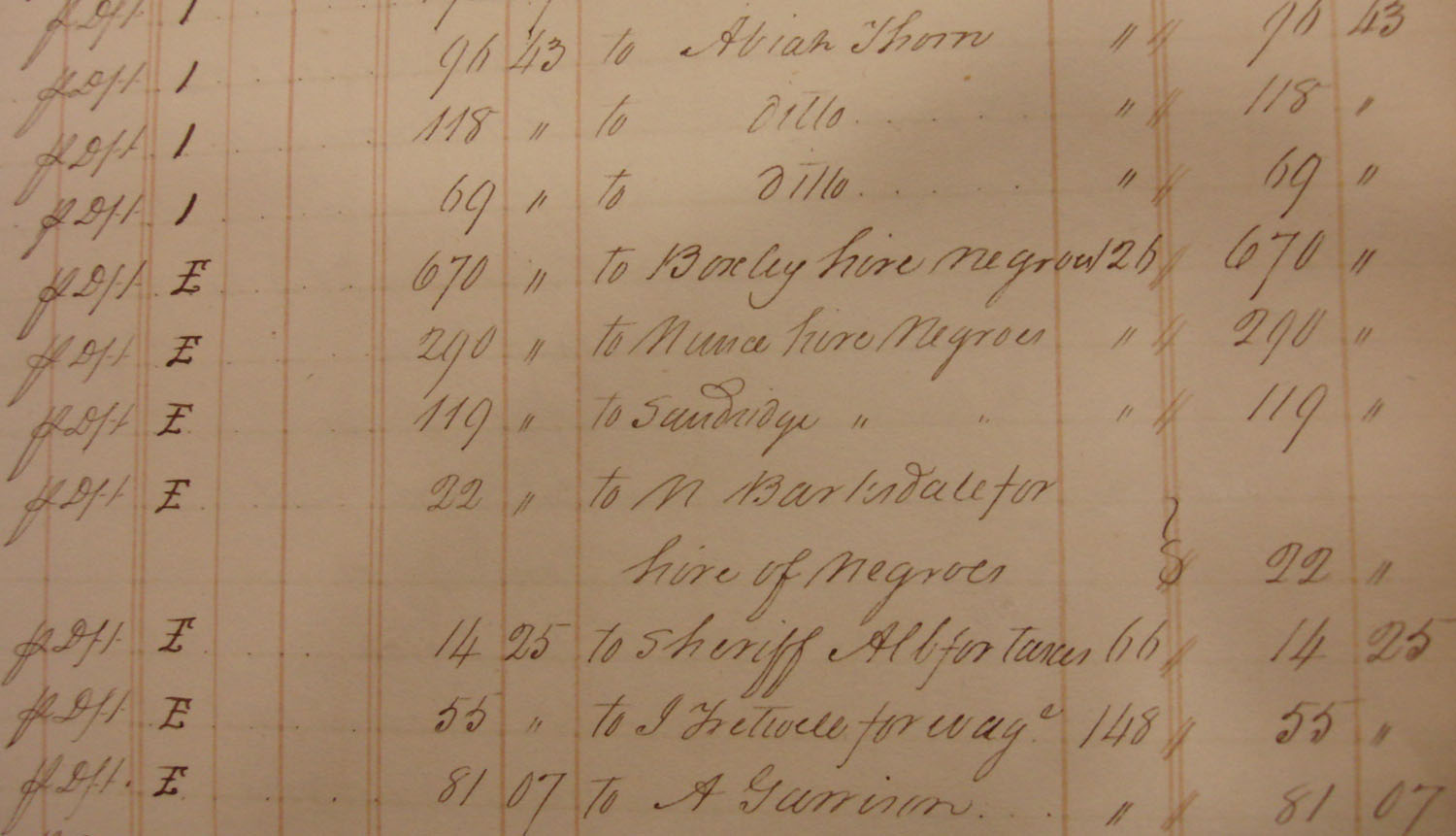
One student was doing preliminary research on the University’s practice of hiring out slaves for labor.  He searched through the proctor’s ledgers (proctor’s ledgers show evidence of financial transactions) and found many kinds of payments, including purchases of stoves, fees for brick work, and the hiring out of slaves.  Although challenged by the stylized script of the time, the student found several entries related to his topic in the February 12, 1820 labor account.  Lines 4 through 8 from the top of part of the ledger page, below, show the University paying a Boxley, Nu[nce], Sandridge, and Barksdale for the hiring of negroes.  Incidentally, N[elson] Barksdale was a University employee, so it appears that the University may have been getting enslaved workers owned by their employees.  These enslaved workers likely worked on crews, building the University.

The student not only learned about the topic he was researching, but gained insight into the materials and methods of primary research scholarship.

Detail showing slaves being hired out for work at U.Va., 12 February 1820, from the University of Virginia Proctor’s Ledger, 1819 to 1825. (RG-5/3/2.961. Image by Petrina Jackson)

This Just In: The Maurice Lévy Collection of French Gothic

This week Nicole Bouché, Director of Albert and Shirley Small Special Collections Library, relates the story of how a major new acquisition came to U.Va.:

Maurice Lévy in his Toulouse study, seated before the glass-front bookcase containing his French Gothic collection.

“I have now reached a time in life where one inevitably ponders over the fate of the books one may have had the good fortune to collect over the years.”  —Maurice Lévy

Serendipity often plays a role in building great library collections, and a chance encounter between an institution and a scholar can yield an extraordinary and wholly unanticipated legacy years, sometimes decades, later.  Such is the story of the Maurice Lévy Collection of French Gothic, a recent bequest of over 450 rare books now housed in the Albert and Shirley Small Special Collections Library.

Sometime in the early 1960s, Maurice Lévy (1929-2012), then a graduate student of English Literature at the Sorbonne in Paris, proposed to write his dissertation on the American writer, William Faulkner.  “Ah, but we don’t write dissertations on living authors” was the (predictable) reply from the French academy.

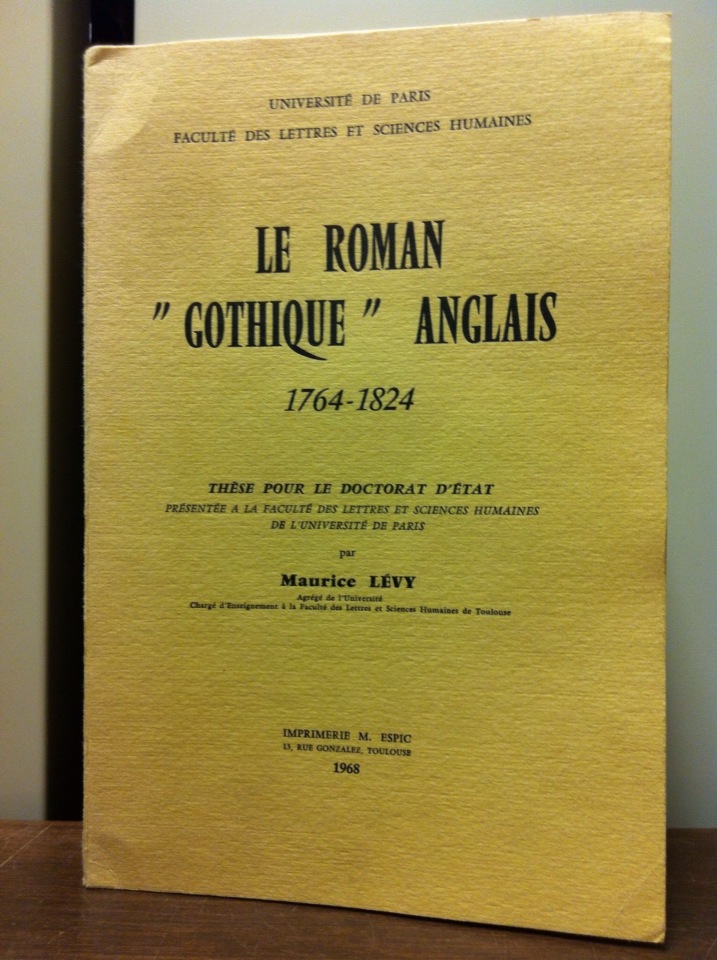
Instead, the young scholar was assigned to write about English gothic literature. With the help of a summer fellowship Lévy found his way to U.Va., where he spent three months immersed in an intensive study of the Sadleir-Black Collection of Gothic Fiction, among the world’s finest collections on the gothic genre. Lévy’s dissertation, Le Roman “Gothique” Anglais, 1764-1824, became a standard source and helped to revive scholarly interest in the field, and Lévy became a recognized authority on the gothic genre. Maurice’s final work, a scholarly edition of Matthew Gregory Lewis’ classic gothic tale, The Monk, was published posthumously in 2012.

Maurice Lévy’s doctoral dissertation, based in part on research done with U.Va.’s Sadleir-Black Collection of Gothic Fiction.

At the end of his fellowship, Lévy returned to France, never to return to Charlottesville, but with fond memories of his summer on Grounds. By his own account, he was never again in contact with the U.Va. Library, or with the Rare Book Department staff that had been so welcoming and helpful during his stay.

Jump forward several decades:  Lévy, now an emeritus professor of the Université de Toulouse, “pondered” what do with the treasured collection of French editions of gothic novels that he had painstakingly assembled.  An American colleague recalled how Maurice frequently spoke with deep appreciation of his summer spent in Charlottesville. Might U.Va. be a possibility?  And thus, in the fall of 2009, an e-mail arrived in Special Collections from an “unknown” French scholar, inquiring whether the library might perhaps be interested in acquiring his collection.

most of them first or early editions: about 60 titles, representing something like 200-250 volumes …. which compose, literally speaking, the French side of the same literary movement and could perhaps be considered by future researchers as a helpful complement, however modest and limited in size, of the prestigious Sadleir-Black collection.

I am currently looking for a home for this collection, which, although relatively modest in size when compared to others, has the advantage of illustrating the extraordinary vogue of the “roman noir” during the French Revolutionary period, and of including volumes which offer the distinctive feature (not shared by corresponding English volumes) of being individually illustrated with frontispieces by (most of them) reputed engravers. To pay homage to their talent, I published Images de Roman Noir in 1973 [Paris, Losfeld].

Should you be interested in this donation, I would take the necessary legal steps to ensure that they eventually come into your possession after my demise, so that they may be made available to future students.

If, on the occasion of a visit to France, you wished to inspect the books, you would be very welcome to do so.

Lévy’s letter included a detailed title list. We were instantly intrigued, and our interest was quickly echoed by members of the English and French faculty. Whatever the likely costs (not to mention bureaucratic hassles) associated with shipping a large antiquarian book collection from overseas, this offer clearly merited serious consideration.  A site visit was definitely in order.  Happily, I had already planned a visit to France; a detour to spend a few days in Toulouse with Professor Lévy and his wife, Ellen (an American) was easily added to the schedule.  Professor Lévy would meet me at the train station in Toulouse, where I would recognize him by the sign (“GOTHIC”) that he would be carrying.

As we conversed on our first evening together at the Lévy home, warm memories of Charlottesville, surrounded by the riches of the Sadleir-Black Collection and the gracious hospitality of then Rare Book Librarian John Cook Wyllie and his colleagues, were still vivid in Maurice’s mind.  It took very little time to confirm our interest in accepting the Lévy collection. And so we spent two enjoyable days reviewing and inventorying a seemingly endless stream of compact little volumes from the late 18th and early 19th century, almost all in their original, often quite striking French bindings.

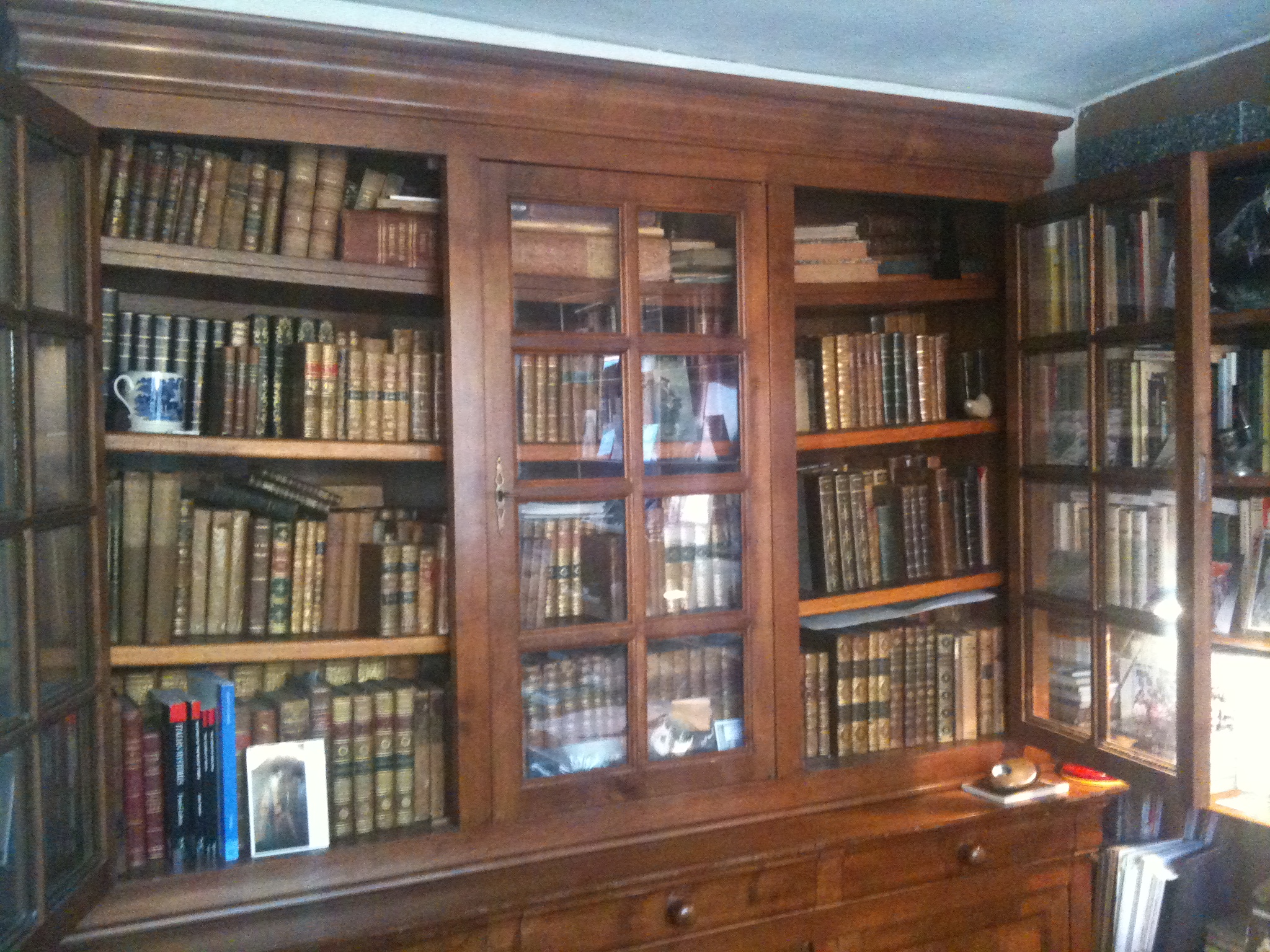
“Oh, the horror!” groan the sagging shelves of Maurice Lévy’s bookcase.

The large, glass fronted, wooden book cabinet in which they were stored occupied an entire wall of his study. It was tightly packed two, sometimes three, rows deep, and its thick wooden shelves were so full that they bowed at the center, giving the impression that the entire bookcase was weighed down by the burden of keeping these precious volumes safe from harm.

Maurice removed each work as though he were encountering an old friend. He would pause for a moment to recall the circumstances of their first acquaintance: when, from whom, and where had he acquired the title? What drew them together, and what special significance justified the volume’s retention and inclusion in the “special” bookcase?  After a moment’s quiet reflection, Maurice would “introduce” the book to me, and we would add it to our growing list of titles destined for Virginia.

As our work progressed, it became clear that Maurice’s collection of French gothic accounted for only a small portion of the overtaxed bookcase’s contents. The remaining titles, he explained, were not his “French gothic collection” and would no doubt eventually find a home in France.  There was neither time (nor encouragement) to explore these volumes: Maurice, after all, was still consulting his library for ongoing research.

I devoted a return visit in 2011 to assessing Maurice’s extensive reference library on the gothic. No further reference was made to the other, intriguing “old” volumes, which remained undisturbed in the bookcase. However, Maurice had decided that it was nearly time to see the French gothics safely installed at U.Va.  We therefore said our good-byes with the understanding that I would return the following summer to oversee packing and shipment. Tragically, Maurice did not live to see the final transfer of his collection to U.Va.  He succumbed to a long illness only weeks before my return to Toulouse in the summer of 2012. It remained for his widow, Ellen, his children, and the U.Va. Library to follow through on the terms of Maurice’s bequest.

But there was a new twist.  Shortly before his death, as Maurice still had not arranged for the disposition of the remaining rare books in the old bookcase, his wife Ellen asked him about them. What should she do with them? “Offer them first to Virginia,” was his reply.  And so she did. It was an interesting prospect, but just what books were they? Ellen could tell me little, occupied as she was with other family and personal matters. And so I arrived in Toulouse late last July to arrange for the final packing and shipment of the ca. 250 volumes in the Lévy French gothic collection, and to ascertain which, if any, of the remaining books might be of interest to the U.Va. Library.

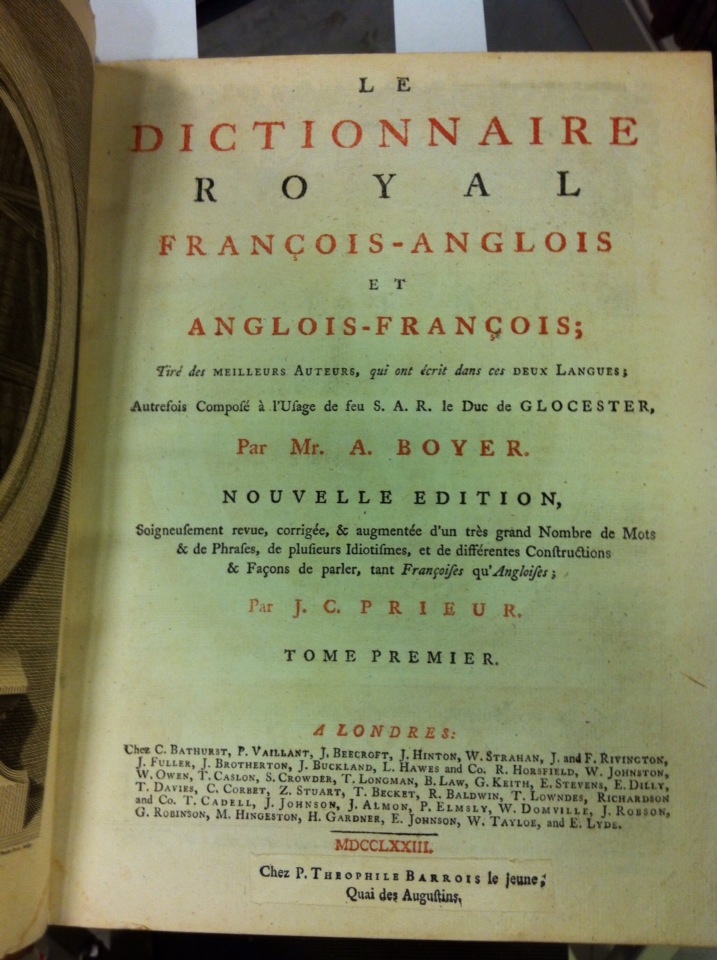
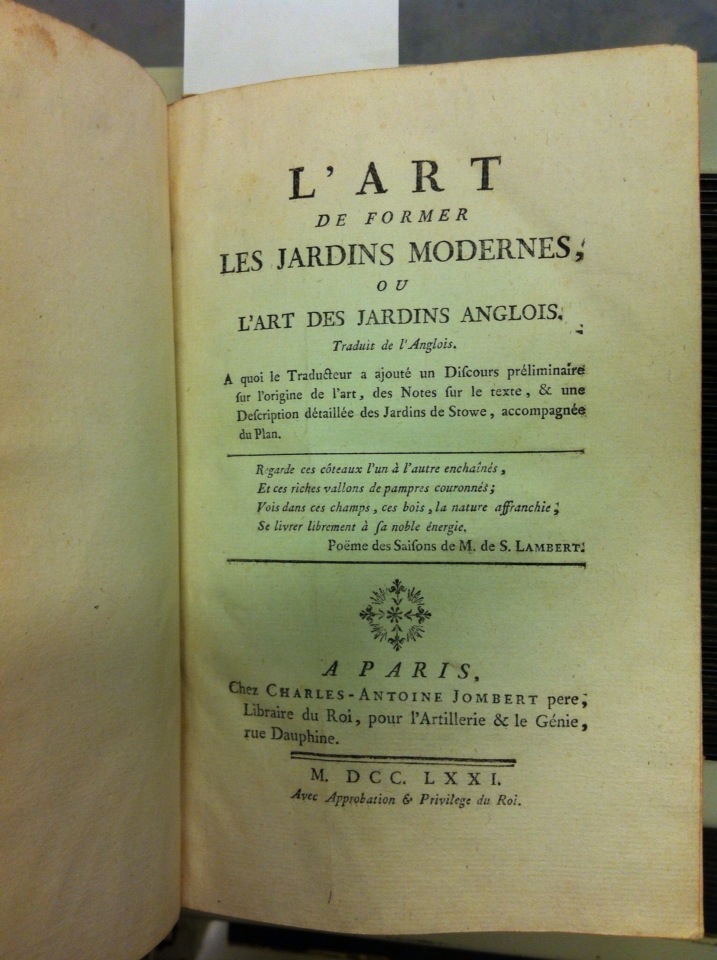
What I encountered was a revelation and delight!  As I made my way systematically through the bookcase, a pattern slowly but unmistakably emerged.  This was not a miscellaneous assortment of old books, but a complementary collection of rare (some extremely rare) and early works of gothic literature, many in  English, augmented by various 18th-and 19th-century source materials used and cited in Maurice’s scholarly writings.  The supplementary material included such works as Edmund Burke’s A Philosophical Inquiry into the Origin of Our Idea of the Sublime and the Beautiful (London, 1801), and Edward Mangin’s An Essay on Light Reading, as it May be Supposed to Influence Moral Conduct and Literary Taste (London, 1808). Maurice’s copy of the Dictionnaire royal françois-anglois, et anglois-françois (London, 1773) would have been an invaluable resource for study of translations, and then there was L’Art de former les jardins modernes; ou l’art des jardins anglois (Paris, 1771). What gothic novel doesn’t have a garden as a significant “setting”!

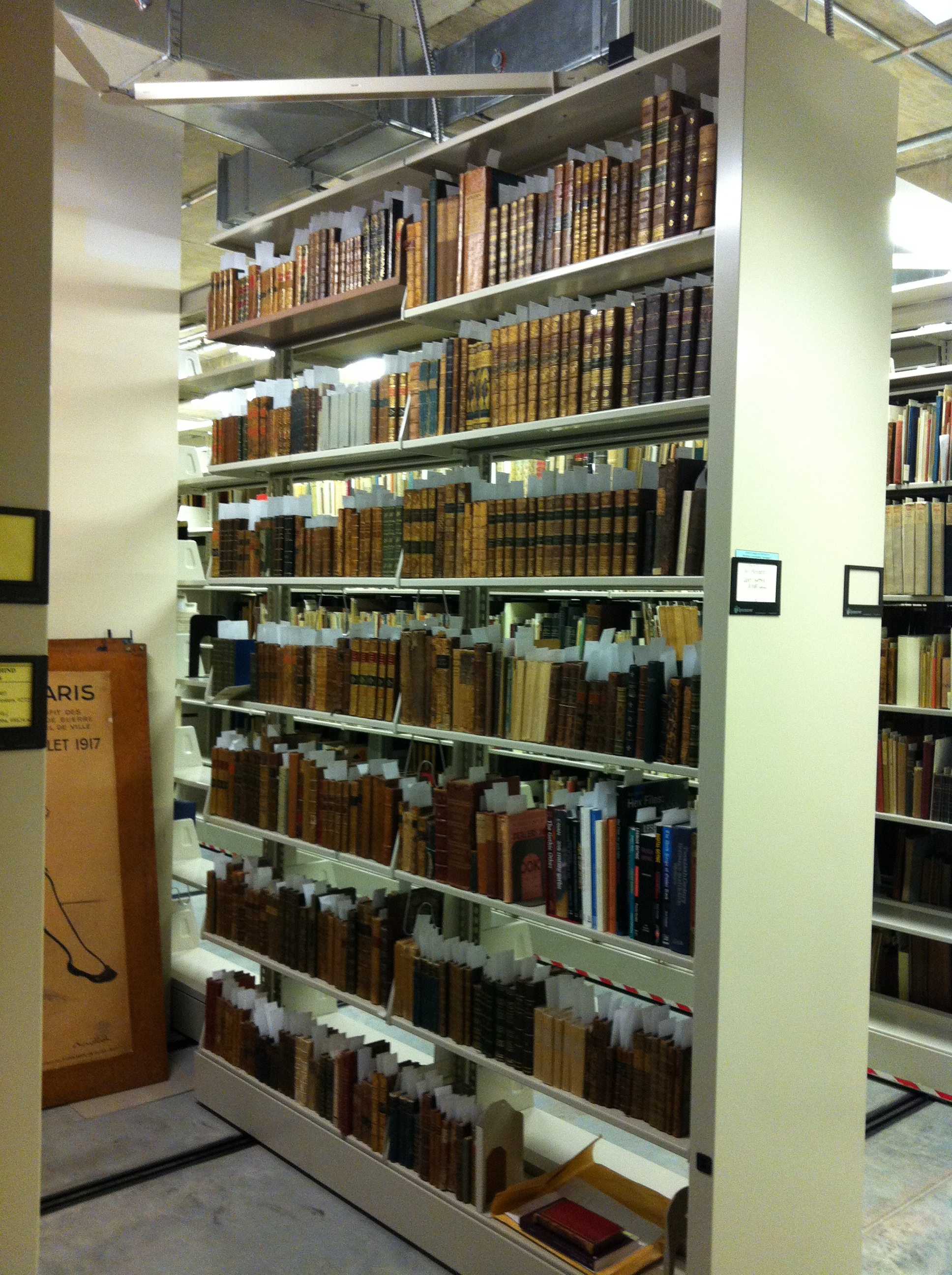
We were delighted by the new discoveries, and the possibilities that this expanded universe of resources would offer to students of gothic and related themes. It was quickly decided that virtually the entire contents of the bookcase would be packed and shipped to Charlottesville.  In due course, and with only the usual customs and other delays, the collection arrived last fall at the Albert and Shirley Small Special Collections Library, where it now waits patiently in the cataloging queue.

Special Collections staff unload the Maurice Lévy French Gothic collection, October 9, 2012.

The Lévy family, for their part, was delighted and relieved to see Maurice’s treasured “rare book cabinet” transferred virtually intact to its new and permanent home at U. Va., where it will be consulted by future generations of students and scholars of the “gothic,” and serve as a permanent tribute to Maurice’s life and career as a scholar, teacher, and mentor.  Nothing, they felt, would have pleased Maurice more. And like many other collections “under Grounds,” the Lévy collection also serves as an instructive reminder of how great library collections may be built, to a significant degree, by the cumulative legacies of chance encounters.

(A future posting will feature more highlights from the Lévy collection.)

The Maurice Lévy French Gothic collection as it looks today, under Grounds.

Joseph Blotner (1923-2012): A Photoessay in the Stacks

It is almost impossible to imagine the Albert and Shirley Small Special Collections Library without William Faulkner. His portrait hangs in the gallery leading to our reading room, and the typewriter he used while at U.Va. sits prominently in our reception area. Dozens of Faulkner-related manuscript collections and several thousand books by and about him fill shelves and ranges in our stacks.

Late last year, we lost one of the people responsible for Faulkner’s presence at the University: former English Department faculty member Joseph Blotner. Dr. Blotner is perhaps best remembered for his monumental 1979 biography of Faulkner and for his Library of America editions of Faulkner’s works; the editions and his popular 1984 condensed version of the biography remain in print today and are standard sources for the study of one of the greatest writers of the twentieth century. After a long career as a biographer, editor, and academic, Professor Blotner passed away at his home in Oakland, California on November 16, 2012.  His obituary in the New York Times reflects his influence and reputation nationally, while his work here at U.Va. was summarized in a lengthy 2007  appreciation of Blotner’s legacy published on the university’s main news site, “U.Va. Today.”

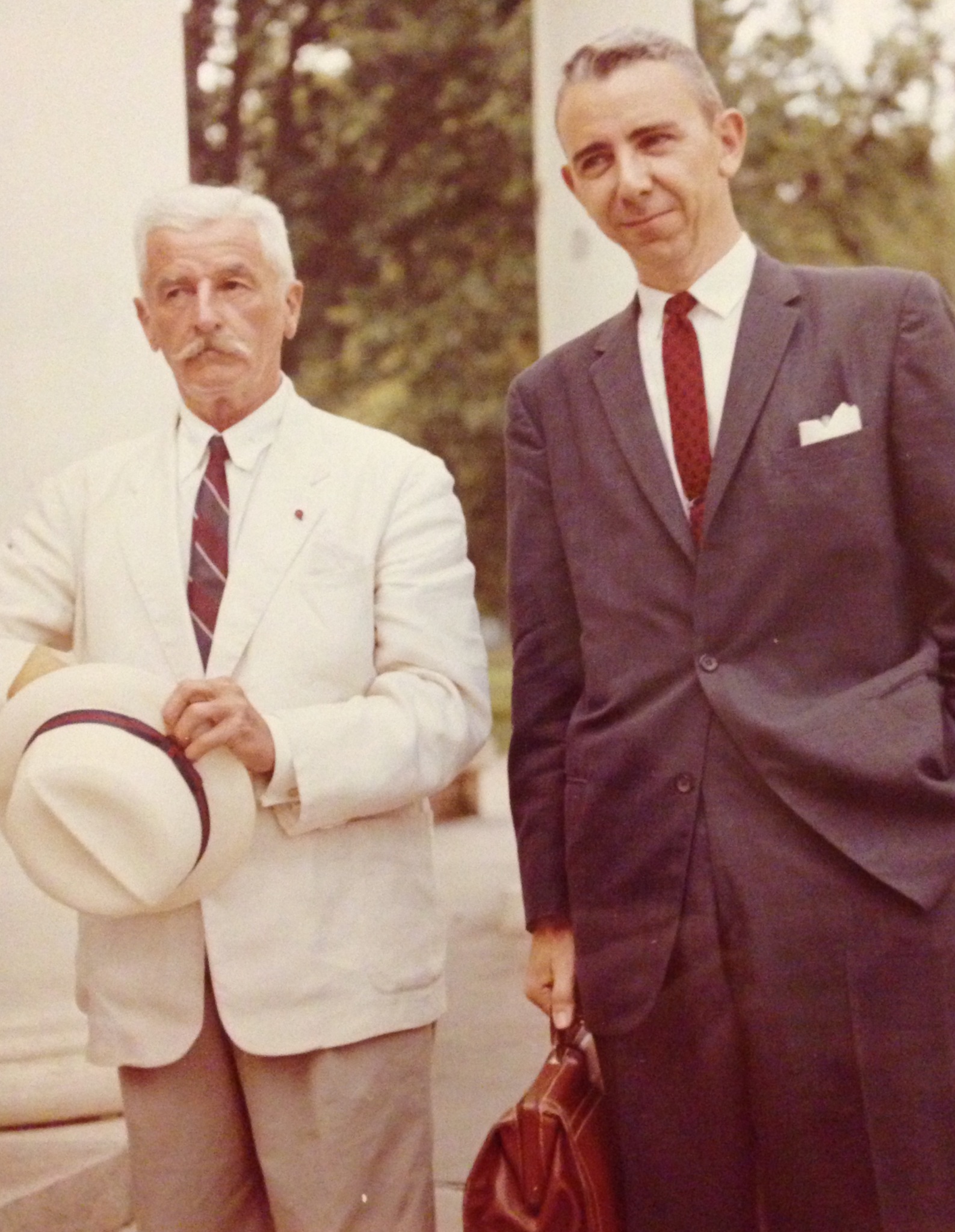
William Faulkner and Joe Blotner standing near the Rotunda at the University of Virginia, May 1962. (Photograph by Dean Cadle)

Dr. Blotner left both a personal legacy and a paper legacy at the university, the latter in the form of manuscripts and books in the Albert and Shirley Small Special Collections Library. The papers of major biographers and editors are consulted by the scholars who follow in their wake, and there is much here of value for future generations of Faulkner scholarship.

As a relatively new arrival on the library staff, I wasn’t sure what I’d find when I took the opportunity recently to go down into the stacks to investigate our holdings related to Dr. Blotner’s work. I brought my camera along and shot some photos of some of my favorite finds. I hope they provide a sense of the richness of our Blotner holdings:

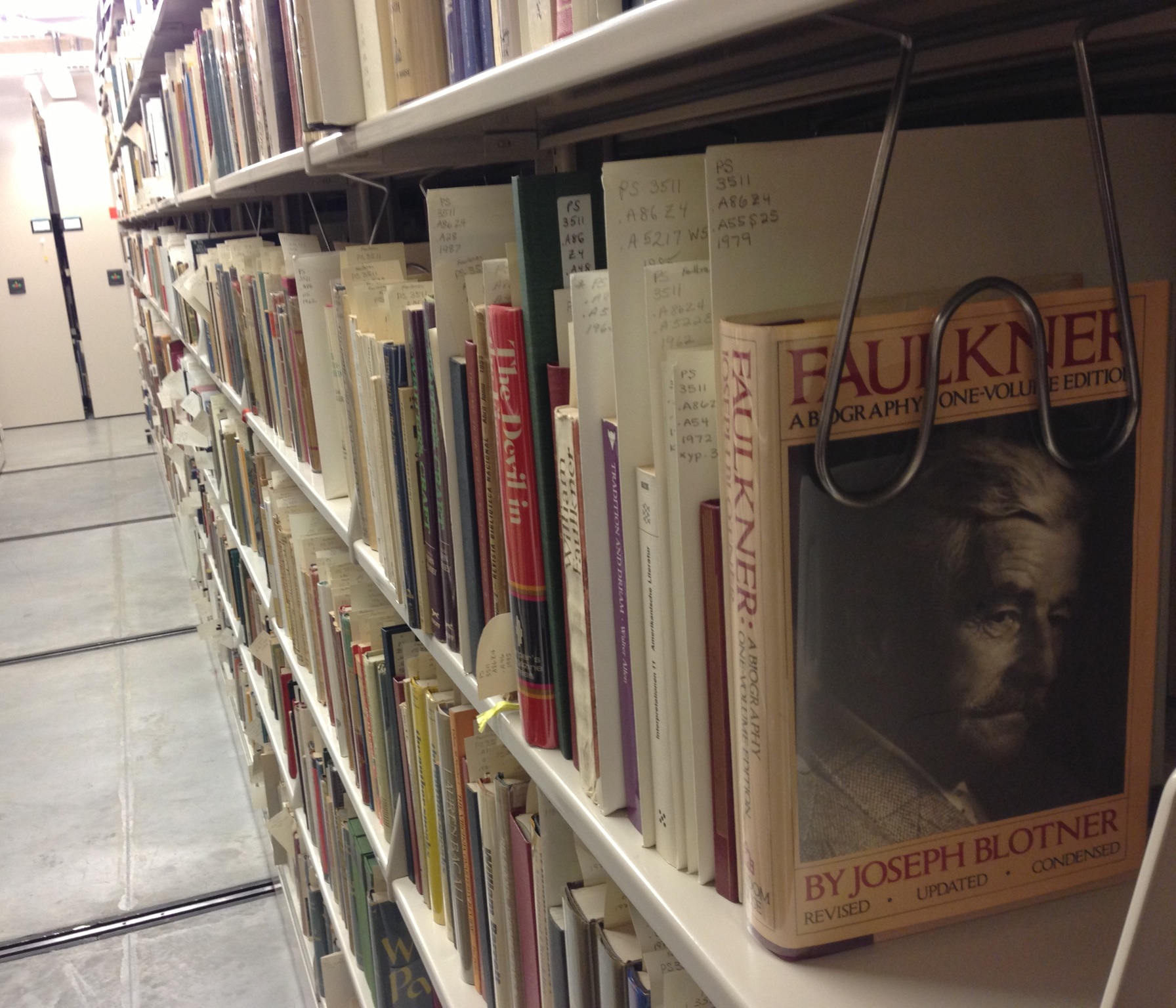
Joseph Blotner’s _Faulkner: A Biography: One-Volume Edition_ (New York: Random House, 1984). The book is seen here in the Faulkner section of the Albert and Shirley Small Special Collections general stacks. All of the books visible in this picture are by or about William Faulkner, and this captures only a segment of our Faulkner book holdings.

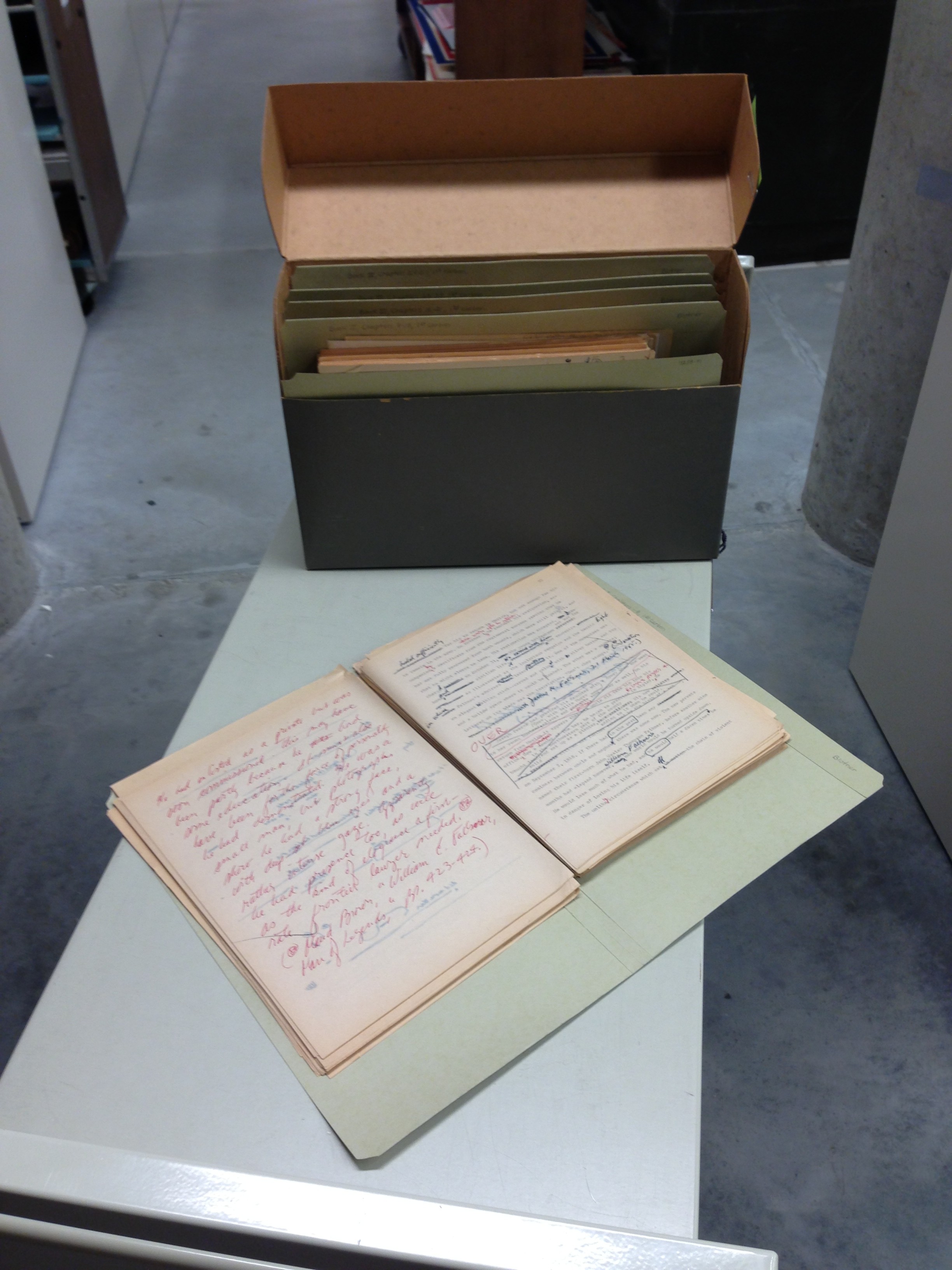
A heavily annotated draft of Blotner’s Faulkner biography. This folder contains a lengthy discussion of Faulkner’s time in New Orleans. (MSS7258-m).


A 1960 draft schedule of Faulkner’s appearances at the University of Virginia, including a meeting with the English Club in Alderman Library, a group of blind visitors, and law professor Marian Kellog’s Uruguayan Seminar. Joe Blotner’s name appears at the top of the page, presumably as organizer of the visits, and the phrase “Chief’s Sched” at the bottom. (MSS 7362. Photograph by Molly Schwartzburg)

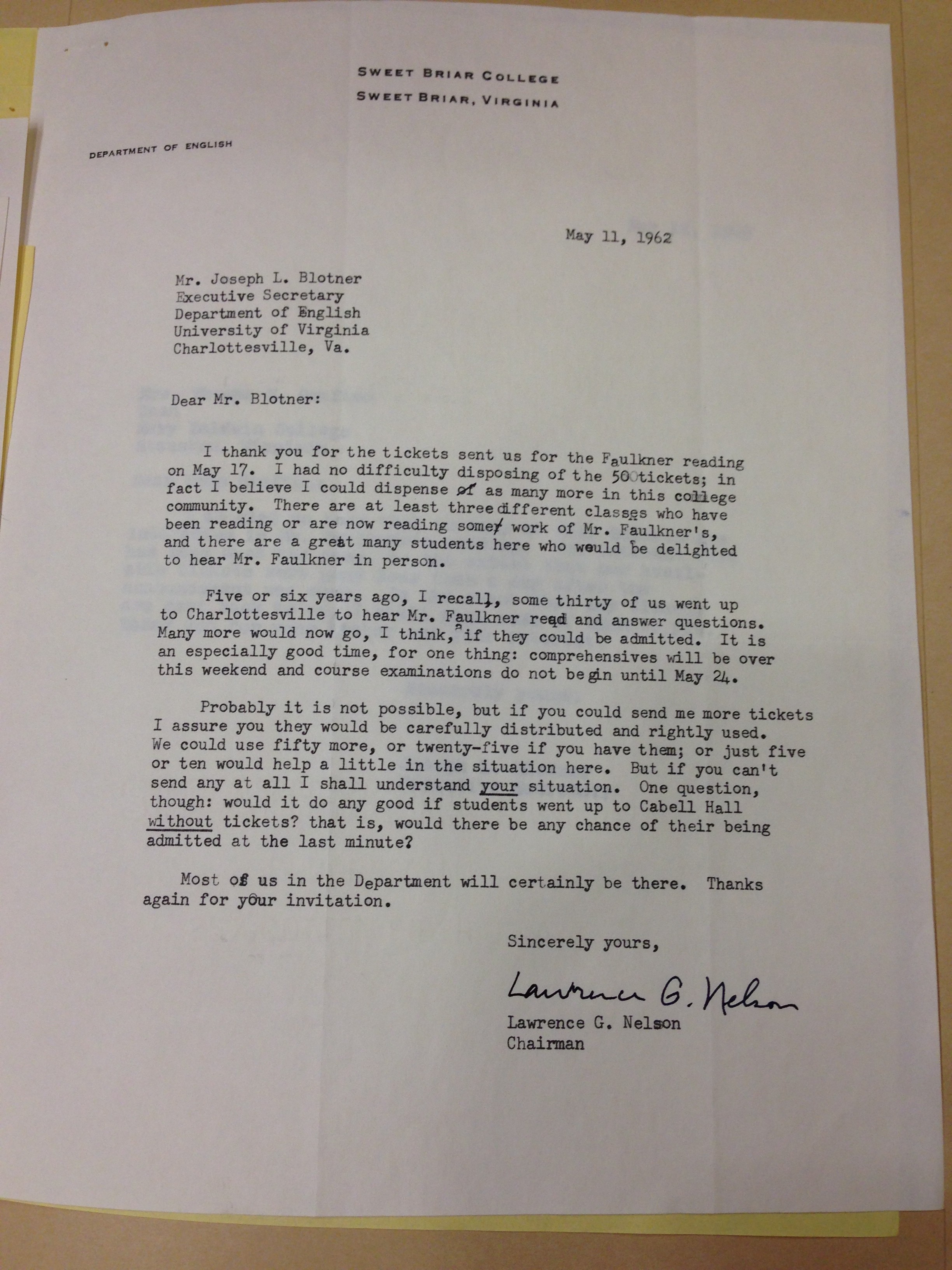
In 1962, Faulkner gave a reading from his new novel, _The Reivers_, for which Joe Blotner sent out tickets to English Departments across the region. A generous stack of letters from the faculties of these departments is held in the collection, and with rare exception, the tickets were all taken and more requested. Here, the chair of the English Department at the all-women Sweet Briar College, located about an hour south of Charlottesville, requests as many tickets as possible for his community. (MSS 7362. Photograph by Molly Schwartzburg)

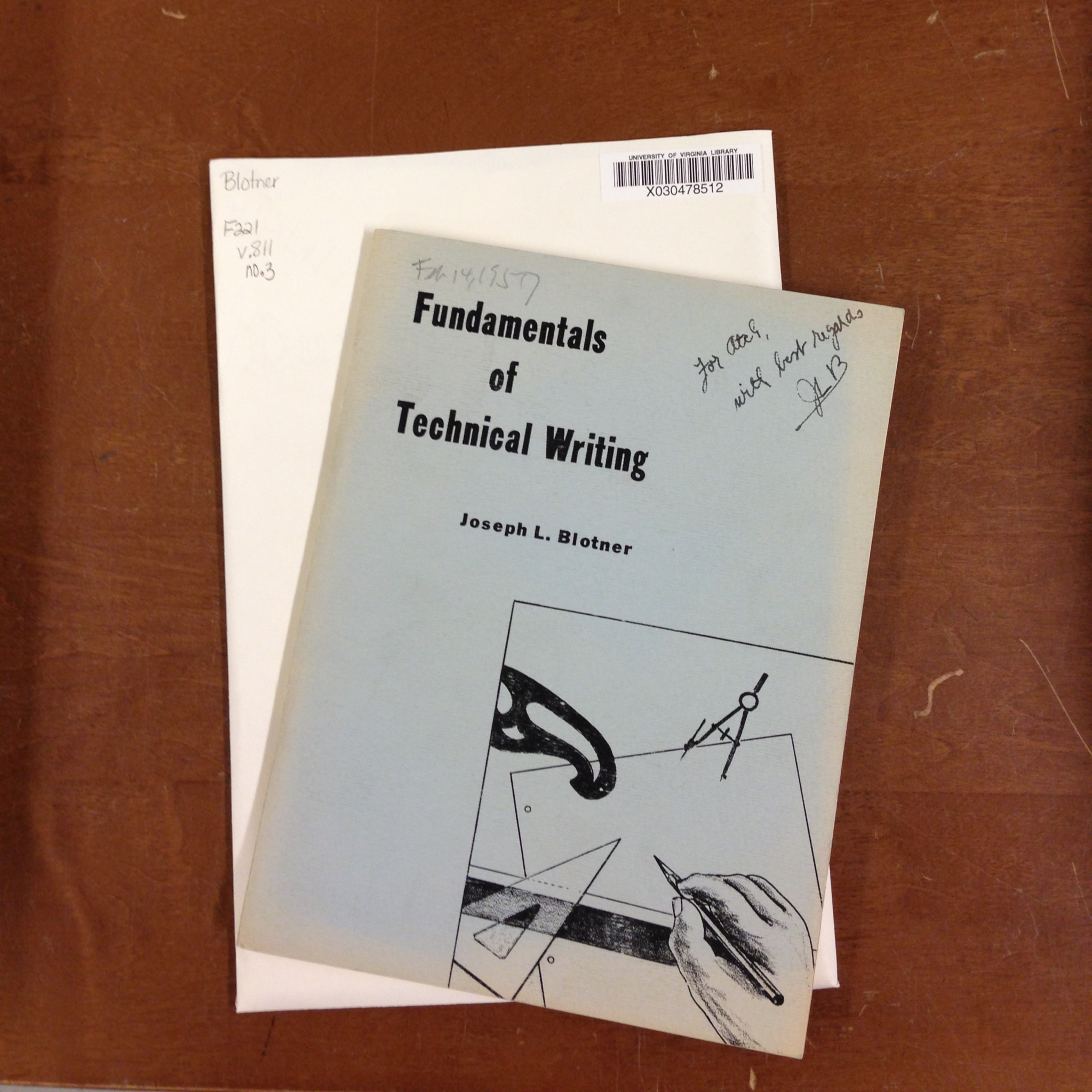
The book holdings in Special Collections contain almost seventy works authored by Joe Blotner, including several books, magazine articles, and other materials relating to Faulkner and other writers. Shown here is our earliest Blotner book, a guide to technical writing based on his experience working in the field before he took on his first academic post at the University of Idaho. This copy is inscribed to Atcheson Hench, who joined the faculty of the English Department at U.Va. in 1922. (F22 v.811 no3)

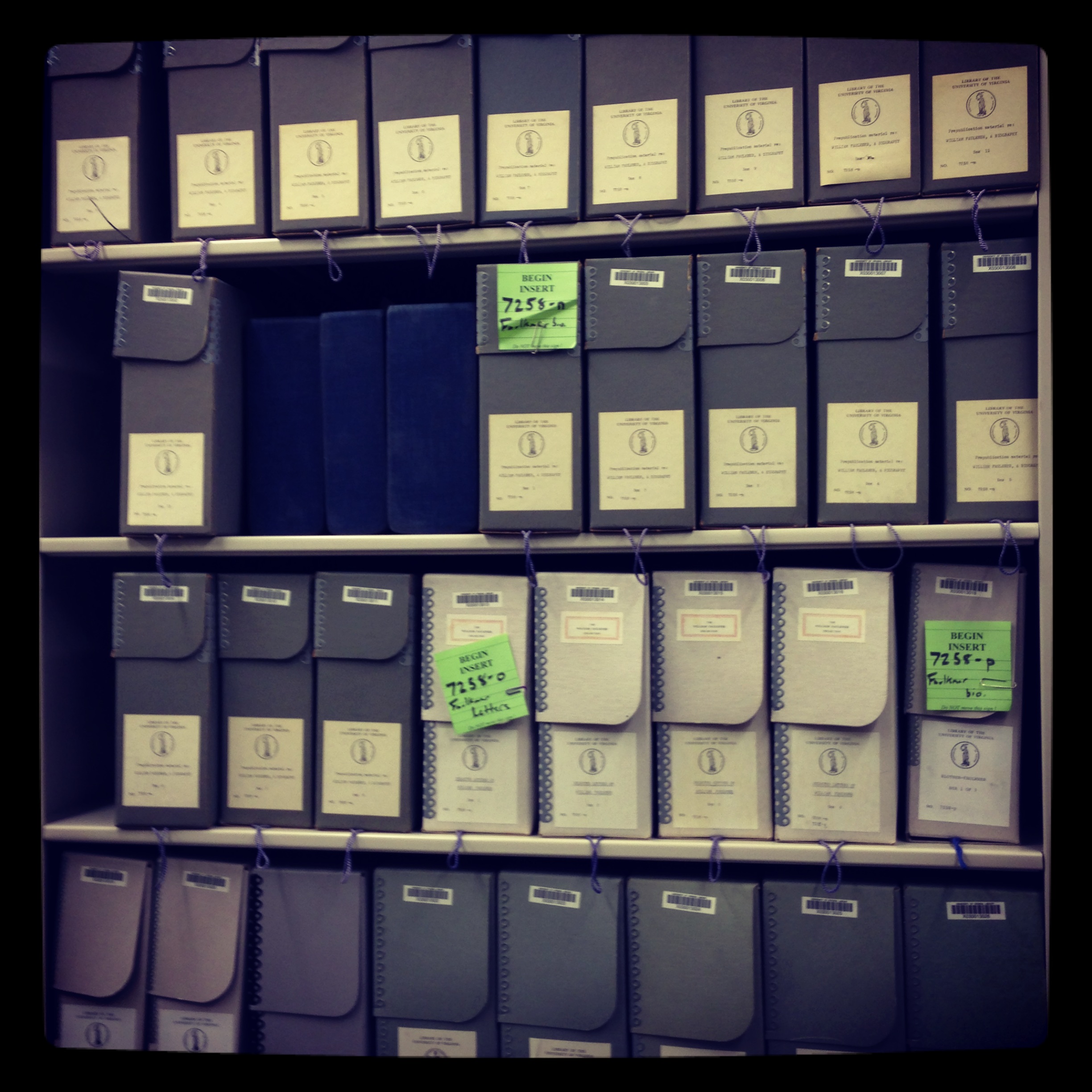
A curator’s favorite sight: lots of boxes, lots of mysteries until they’re opened. These are the papers of Joseph Blotner, which entered the collections in various accessions and are cataloged and available for use. The green slips show our archivists’ working annotations.


Class Notes: Mapping the Globe from Ancient Times to Google Maps

Fresh into the new year, Associate Professor Francesca Fiorani brought her January Term class, Mapping the Globe from Ancient Times to Google Maps, to Special Collections to take advantage of our extensive map collection. This particular course focused on the visual, linguistic, political, and religious rhetoric of maps and map making.

Francesca Fiorani (second from right) and her January Term students examine a map. (Image by Petrina Jackson)

Professor Fiorani’s engaged and intense group of students spent six sessions in Special Collections, examining, thinking about, and challenging themselves and their classmates while studying some of our most exquisite maps.  The class later went to the University of Virginia Library’s Scholars’ Lab to explore Geographic Information Systems (GIS), which captures, analyzes and displays maps electronically.

Map of the world from the Blaeu Atlas, 1662. (A 1662 .B53 v.1, Tracy W. McGregor Library. Image by Petrina Jackson)

To measure the impact of seeing the maps in person, I asked the students, “How would your experience be different if you only saw these maps in digital form?” Here are some of their responses:

“Being able to see these maps in person allows for greater understanding and appreciation for the worksmanship and detail that would perhaps be lost if [they were] seen only in digital form.  Seeing the actual physical size and dimensions of these maps provides greater insight into how these maps would have been used or displayed when [they were] originally published.”

“These maps represent the work of many individuals and being able to see first-hand the mapping activity of the past, through manuscripts and facsimile, gave me a better understanding and appreciation of the objects themselves.”

“Having tangible maps also makes the class seem more authentic.  I like having a hands-on education.”

Detail from the map of Islandia (Iceland) from the Mercator Atlas, 1606. (A 1606 .M47, Tracy W. McGregor Library. Image by Petrina Jackson)

I also asked the students what surprised them about the maps they saw in Special Collections and got a variety of responses.  The following was the most representative:  “I was surprised by the size of some of these maps.  Having seen many on the computer screen, I was floored by the actual sizes, both enormous and small, [in which] these maps have come to us.”

Map of Virginia and Carolina by Giovanni Maria Cassini, 1797. (Area Table 75 1797 Cassini, Tracy W. McGregor Library. Image by U.Va. Library Digitization Services)


This Just In: What’s New in the McGregor Library

1938 was an annus mirabilis for the U.Va. Library and its Special Collections: Alderman Library opened; Special Collections moved into purpose-built quarters on the second floor (today’s McGregor Room); and U.Va. was given the Tracy W. McGregor Library of American History.  This extraordinary holding of several thousand rare books, maps, and manuscripts, assembled by Detroit philanthropist Tracy W. McGregor (1869-1936), instantly provided U.Va. with a world-class collection of primary sources for American history.  In 2013 the McGregor Library will celebrate its 75th anniversary with a major exhibition opening in October.

Since 1938 the McGregor Library has nearly tripled in size, thanks to substantial ongoing support from the McGregor Fund.  The following sampling from the several dozen acquisitions made in 2012 suggests not only the McGregor Library’s range and depth, but also some of the criteria we use in selecting additions.

Oliver Hart, Dancing exploded. Charlestown, S.C.: David Bruce, 1778. (A 1778 .H27, McGregor Endowment & Associates Endowment Funds, image by U.Va. Library Digitization Services)

One of the McGregor Library’s greatest strengths is its coverage of the American South, and this remains a collecting priority.  Particularly desirable are rare Southern imprints such as Oliver Hart’s memorably titled Dancing exploded, published in Charleston, S.C. in 1778.  A Baptist minister, Hart (1723-1795) first preached this sermon condemning dancing and fancy dress balls in 1759.  Nineteen years later, he found it necessary to fix his admonition in print. No sooner had the embers of Charleston’s devastating January 15, 1778 fire cooled than “we had Balls, Assemblies and Dances in every quarter.”  The conflagration, coupled with the ongoing privations of the American Revolution, were for Hart “so many loud calls to repentance, reformation of life, and prayer, that the wrath of God may be turned away from us.”  Hart specifies fourteen evils of dancing, including wasted time, unnecessary expense, vulgar music, and immodesty of conversation and movement. “Thus the heart becomes a sink of uncleanness—a cage of all manner of abominable and filthy lusts.”  Only six copies are recorded of this, the third earliest American work on dance.  (The McGregor Library also holds the earliest, Increase Mather’s An arrow against profane and promiscuous dancing.)

The trial and acquittal of Mary Moriarty. Memphis: Memphis Typographical Association, Morning Bulletin Office, 1856. (A 1856 .T75, McGregor Endowment Fund, image by U.Va. Library Digitization Services)

We are especially eager to add unrecorded works to the McGregor Library.  One might think that copies of virtually everything printed a century or two ago would have found their way into libraries by now, but previously unknown works continue to turn up with surprising frequency.  It is our mission to make these new discoveries accessible to scholars.  A case in point is The trial and acquittal of Mary Moriarty: the only known copy surfaced only last year and was quickly snapped up for the McGregor Library.  An Irish immigrant working as a domestic in antebellum Memphis, Mary Moriarty was engaged to wed John Shehan, the father of her child, only to have Shehan back out at the last minute.  In a rage, Mary stabbed him to death in broad daylight.  Attorney Milton Haynes expertly defended her in front of an all-male jury, arguing per the Bible “that he who seduces a maid, upon the most solemn vow of marriage, hath committed a worse crime than that of murder!”  The jury then “retired for a few minutes, and returned a verdict of ‘NOT GUILTY,’ the announcement of which was enthusiastically cheered by the large crowd of people in the Court House.”  Capitalizing on the case’s notoriety, the Memphis Morning Bulletin condensed and repackaged its newspaper coverage in this crudely printed pamphlet.

Historia nova, e complete da America. Lisboa: Officina Litteraria do Arco do Cego, 1800. (A 1800 .H57, McGregor Endowment Fund, image by U.Va. Library Digitization Services)

The McGregor Library is especially rich in “European Americana.”  These European imprints provide many of our best primary sources for New World discovery and exploration, as well as alternate perspectives on American history and culture.  Historia nova, e complete da America is the latest addition.  This rare history of the Americas from Columbus’s discovery to 1763 was compiled for a Portuguese audience from a variety of sources.  Printed in 1800 at the newly founded “Arco do Cego” press (still active as Portugal’s Imprensa Nacional), the Historia reflects Portugal’s late 18th-century effort to invigorate its arts and sciences.

William Charles. A wasp taking a frolick, or a sting for Johnny Bull. [Philadelphia]: Wm. Charles, [ca. 1813] (Broadside 1813 .C55, McGregor Endowment Fund, image by U.Va. Library Digitization Services)

A little-known strength of the McGregor Library is its collection of early 19th-century American satirical prints, recently augmented by two rare etchings by William Charles. Around 1806 Charles emigrated from Scotland to the United States, where he helped to introduce the thriving British tradition of political caricature.  During the War of 1812 Charles issued a number of prints which vividly and humorously convey American popular opinion.  In A wasp taking a frolick, or a sting for Johnny Bull, Charles references the heroic naval engagements of the U.S.S. Wasp and Hornet during the war’s first months. The Hornet captured several British ships, and the Wasp also “stung” John Bull by capturing two British warships before surrendering to a far larger British vessel.

Lunsford Lane, The narrative of Lunsford Lane. 3rd ed. Boston: [Lunsford Lane], 1845. (A 1845 .L3, McGregor Endowment Fund, image by U.Va. Library Digitization Services)

The McGregor Library possesses an enviable collection of antebellum slave narratives, of which The narrative of Lunsford Lane, in its original printed wrappers, is a noteworthy example. Typically these narratives were self-published (as here) and sold for the author’s benefit while traveling the anti-slavery lecture circuit. Lane was born into slavery on a plantation near Raleigh, N.C., but his wife and growing family were owned by a different master.  With his owner’s tacit consent, Lane rented out his own labor so that he could establish a pipe and tobacco shop in Raleigh.  It thrived, in part because Lane was careful to maintain the appearance of being poor and uneducated.  Eventually Lane earned enough to purchase his freedom, open more businesses, and begin to emancipate his wife and children.  By 1840, however, Lane found himself the target of whites fearful that he was spreading abolitionist sentiments. Two years later he fled with his newly freed family to Boston.

Anatomy of a Lesson Plan: History of Art I

Historiated capital featuring Michael in a choir book, ca. 1450 (MSS 229, v. 1. Image by Petrina Jackson.)

As part of my duties as head of instruction and outreach, I am contacted each semester by many professors who wish to bring their classes to Special Collections, so that they can introduce them to original artifacts.  This fall, all 10 sections of Professor John Dobbins’s History of Art I course paid a visit to Special Collections to explore our illuminated manuscript holdings.  With 127 first-year students, four instructors, five Special Collections staff, and some of the most precious and delicate collection materials, I had a big project on my hands!

In preparation for the visit, Professor Dobbins and his teaching assistants, spearheaded by Tracy Cosgriff, arranged time in Special Collections to review our hand-decorated religious manuscripts, ranging from a fourteenth-century prayer book to a nineteenth-century Koran. From this meeting, they created a lesson plan.  The lesson, which emphasized proper handling of rare materials and identification of the elements of medieval manuscripts, turned out to be a well-balanced collaboration between Special Collections staff, the teaching assistants, and the students.

What we wanted students to take from the lesson:

  • know how to request an item in Special Collections;
  • know how to properly handle medieval manuscripts;
  • be able to identify and describe the iconography in the manuscripts and relate it to its text;
  • be able to explain some of the purposes of text in the margins of the books; and
  • be able to identify the uses of the manuscripts.

Illumination of Jesus on the cross from a French book of hours (M.Ms. P/MSS 38-728, Tracy W. McGregor Library. Image by Petrina Jackson)

TA Tracy Cosgriff helps a student examine a small medieval prayer book. (Image by Petrina Jackson.)

Tools we used:

  • nine manuscripts, including several French books of hours (prayer book), a large Italian choir book, an English Bible, and a Koran
  • a worksheet with questions about the Special Collections policies and the examination of religious manuscripts
  • pencils

What we did:

  1. Set manuscripts stations around the classroom.
  2. Special Collections staff gave a 10-minute overview of Special Collections, including how to request and handle materials.
  3. Teaching Assistant gave students assignment worksheets and explained them.
  4. Students went to a station and filled in the worksheet as it related to each manuscript.  This step was repeated for each station.
  5. Special Collections staff assisted in the handling of the manuscripts and with questions.
  6. Teaching Assistants collected the completed worksheets and reviewed them for discussion in their next section meeting.

TA Alicia Dissinger and a student discuss the iconography in a book of hours. (Image by Petrina Jackson.)

Students produce detailed descriptions of the physical characteristics of their assigned manuscripts. (Image by Petrina Jackson.)

Considering the number of people involved with the History of Art I section visits to Special Collections, it went extraordinarily smoothly and was a lot of fun.  After the visits, I received an email from TA Tracy Cosgriff, which stated “[t]he students really enjoyed their lesson in Special Collections, and many are still talking about it. Thank you so much again for making our visit such a pleasure!” Although that was not a stated learning outcome, I am always happy to hear that students are talking about their time with us long after it has ended.

Koran, 1859 from the Homer S. Cummings Papers (M.Ms. AB/MSS. 9973)