Three Elizabeths: Shakespeare Criticism by Women in the Eighteenth Century

Our current exhibition at the Albert & Shirley Small Special Collections Library, Shakespeare by the Book, focuses on the history of Shakespeare as a book. As a result, the exhibition showcases mostly male editors and publishers until we reach the twentieth century. (Hannah Whitmore, our widow publisher of The Merchant of Venice, is a notable exception.) However, this is not to say that women were not involved in building Shakespeare in the early modern era. In fact, it is said that the first critical essay ever written on Shakespeare was by Margaret Cavendish, Duchess of Newcastle, in 1664. In the eighteenth century, a number of other female critics published works on Shakespeare, some of which are held here in the Small Library.
Elizabeth Montagu
Out rush’d a Female to protect the Bard,
Snatch’d up her Spear, and for the fight prepar’d:
Attack’d the Vet’ran, pierc’d his Sev’n-fold Shield,
And drove him wounded, fainting from the field.
With Laurel crown’d away the Goddess flew,
Pallas contest then open’d to our view,
Quitting her fav’rite form of Montagu.
The stanza above is how David Garrick, famous Shakespearean actor, characterized Elizabeth Montagu on the occasion of the Shakespeare Jubilee in 1769, the same year that Montagu’s An Essay on the Writings and Genius of Shakespeare was published. Montagu is perhaps best known for being “Queen of the Bluestockings,” a group of women who held a literary salon where they engaged in “rational conversation.” Her essay on Shakespeare is an important moment in Shakespearean criticism. This Bluestocking had the audacity to “protect the Bard” from the famed French critic Voltaire, and from her good friend, Samuel Johnson, whose preface to his edition of Shakespeare (1765) she felt neglected Shakespeare’s genius. In her essay, Montagu emphasizes Shakespeare’s understanding of human nature and his genius despite his lack of education.
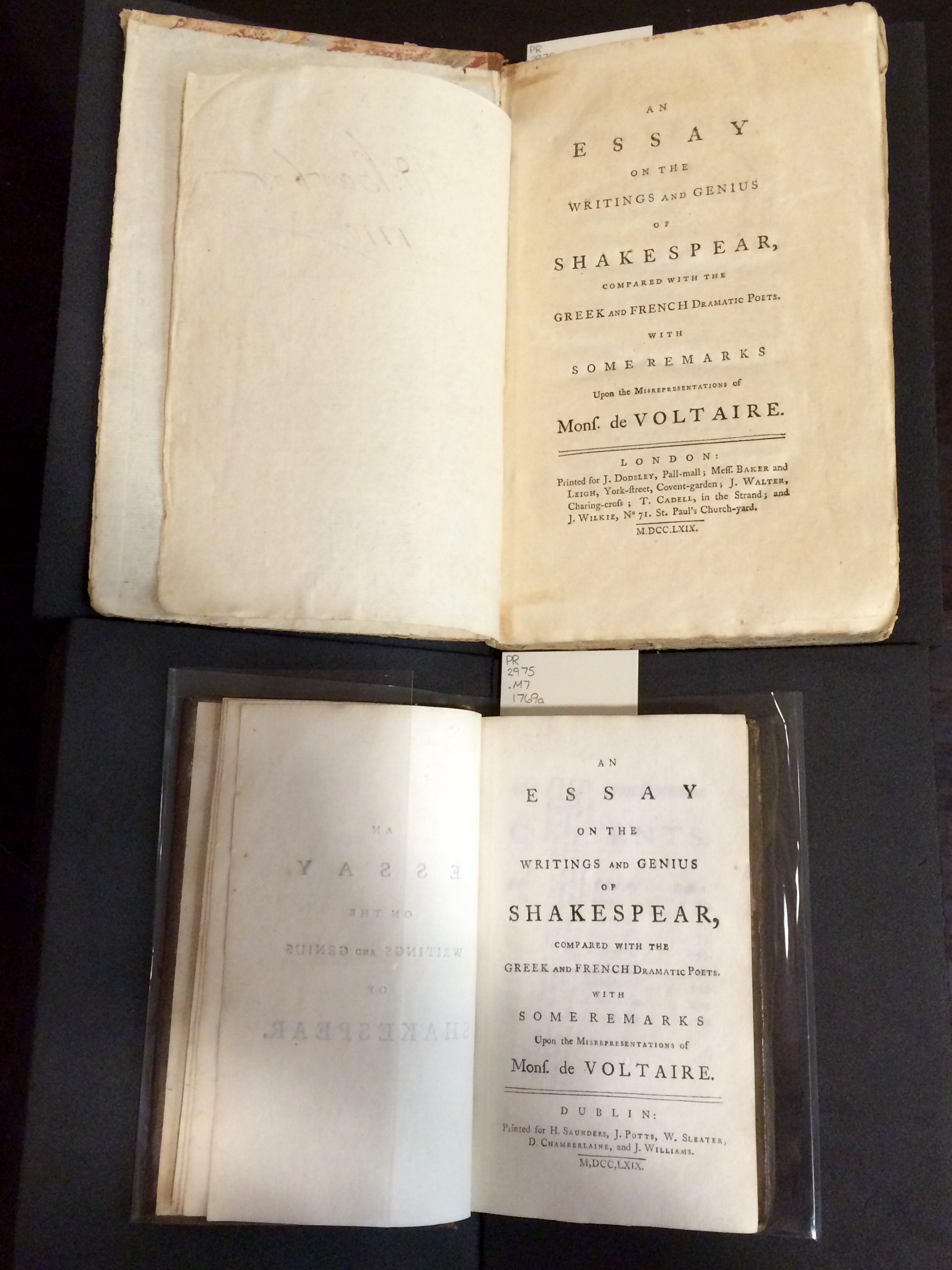
image3

Montagu’s essay sold exceptionally well: it went through seven editions and was translated into French and Italian. Shown here are first English and Irish editions. (PR 2975 .M7 1769, PR 2975 .M7 1769a)

Significantly, Montagu calls the playwright “Our Shakespeare” almost immediately in her preface. What follows is an apotheosis of William Shakespeare. As if warring with all of France and not just Voltaire (whose terrible translations she ridicules), she defends Shakespeare for not following all the rules of classical drama, declaring that his plays are more natural for their irregularities than the artificial plays of the French. Additionally, she is one of the earlier critics to take his history plays seriously, arguing that they are excellent vehicles for moral instruction, which, in her view, is the aspiration of all drama. Unlike many of the male editors represented in our exhibition who tried to “fix” or find the “true” Shakespeare, Montagu understands that Shakespeare’s dramatic irregularities are what make him a genius.
Elizabeth Griffith
Another Elizabeth picked up the “spear” and rushed out to protect Shakespeare a few years later: Irish playwright, novelist, and actor Elizabeth Griffith. Griffith debuted on the stage as Juliet at Dublin’s Smock Alley theatre in 1749, eventually specializing in tragic roles like Cordelia and Ophelia. Inspired by Montagu’s work on Shakespeare’s genius, she set out to defend his morals in The Morality of Shakespeare’s Drama Illustrated (1775). Griffith wanted to illustrate a system of “social duties” that Johnson claimed could be culled from Shakespeare’s plays in his preface: “I have ventured to assume the task of placing his Ethic merits in a more conspicuous point of view, than they have ever hitherto been presented in to the Public.” She contends that Shakespeare’s plays are effective because the morals arise naturally out of the play’s action and his characters are so attuned to human nature that audiences promptly grasp the lesson.
Griffith

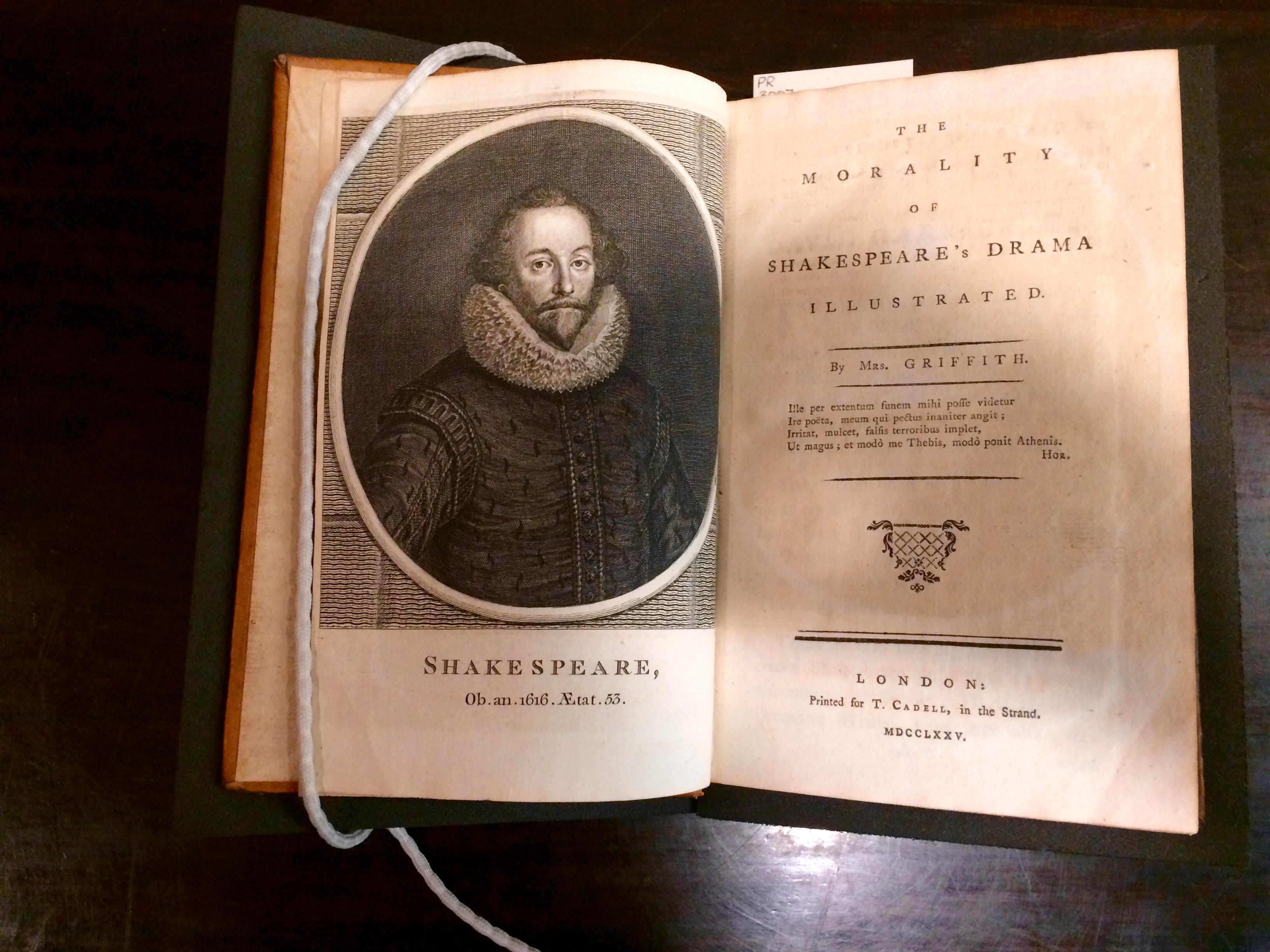
Note that unlike Montagu’s Essay, Elizabeth Griffith’s title page lists her name. (PR 3007 .G7 1775)

Griffith’s emphasis on the naturalness of Shakespeare’s characters brings us to her radical reading of drama. Like Montagu, she also defends Shakespeare from Voltaire, who criticizes Shakespeare for breaking from the classical unities of time, place, and action. In response, Griffith invents a fourth unity: character. For her, Shakespeare’s consistency in character is more important than whether his plays take place in one day or in one place because character is what makes the plays, as well as morals, succeed. Griffith’s work, moreover, is radical in its own right: she is the first woman ever to emend Shakespeare’s plays. While her work is not an edition, she includes passages with her own textual alterations and she explains Shakespeare’s language in her own footnotes. When coupled with her popular plays and novels, it should come as no surprise that this work earned her a spot next to Elizabeth Montagu in the famed portrait, “The Nine Living Muses of Great Britain” (1779).
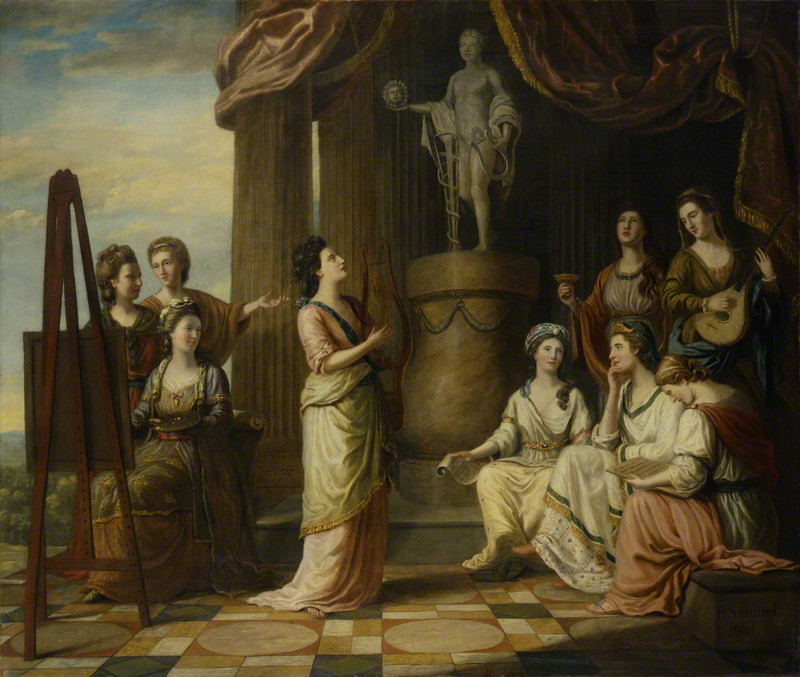
The Nine Living Muses of Great Britain by Richard Samuel, oil on canvas, 1778

The Nine Living Muses of Great Britain by Richard Samuel, oil on canvas, 1778. Elizabeth Montagu is on the right, wearing a red cape with a cup in her hand. Elizabeth Griffith is seated on the right in white with a hand on her cheek. (NPG 4905: Image courtesy of the National Portrait Gallery, Creative Commons Licence).


Elizabeth Inchbald
Our last Elizabeth is an author, playwright, and actor who was perhaps a little too outrageous to be considered one of the nine living muses of Great Britain, but she and Shakespeare have that moral condemnation in common. Elizabeth Simpson ran away from home at the age of nineteen to become an actor despite having a stammer and no place to go. After marrying fellow Catholic actor Joseph Inchbald, she eventually made her stage debut as Cordelia to her husband’s Lear in 1772. Not only did she continue to act in Shakespeare’s plays for some time (she acted in the production of The Merchant of Venice represented in the Hannah Whitmore edition in our exhibition), she also began to write her own plays: Lovers’ Vow features prominently in Jane Austen’s Mansfield Park (1814). Yet today, she is best remembered for her novels, particularly A Simple Story (1791).

After her reputation was well established, publisher Joseph Longman asked Inchbald to write prefaces to The British Theatre, a collection of plays in twenty-five volumes, five volumes of which were Shakespeare’s plays (1806–1809). It is for this work that Inchbald has been labeled Britain’s first professional theater critic. Like Montagu and Griffith, she argues for Shakespeare’s morality in her prefaces, but notably she traces his morality and his realism to the way he mixes vice and virtue in some characters. In her analysis of Shakespeare’s morals, she also offers commentary on contemporary social mores, as in her preface to I Henry IV:
This is a play which all men admire , and which most women dislike. Many revolting expressions in the comic parts, much boisterous courage in some of the graver scenes, together with Falstaff’s unwieldy person, offend every female auditor; and whilst a facetious Prince of Wales is employed in taking purses on the highway, a lady would rather see him stealing hearts at a ball, though the event might produce more fatal consequences.
In addition to her hint about the problems of the sexual double standard here (“more fatal consequences”), we also see Shakespeare described in terms of performance (“auditor”). Inchbald’s prefaces are the first critical works to appreciate the theatrical as well as literary value of Shakespeare. She even criticizes some of her editorial predecessors for not addressing the role of performance and the pleasures we glean from Shakespeare’s language. Unlike the other Elizabeths, who mostly focused on morality and genius, Inchbald was condemned for daring to be a female critic: as her male biographer, James Boaden, wrote, “there is something unfeminine, too, in a lady’s placing herself in the seat of judgment” (1833).
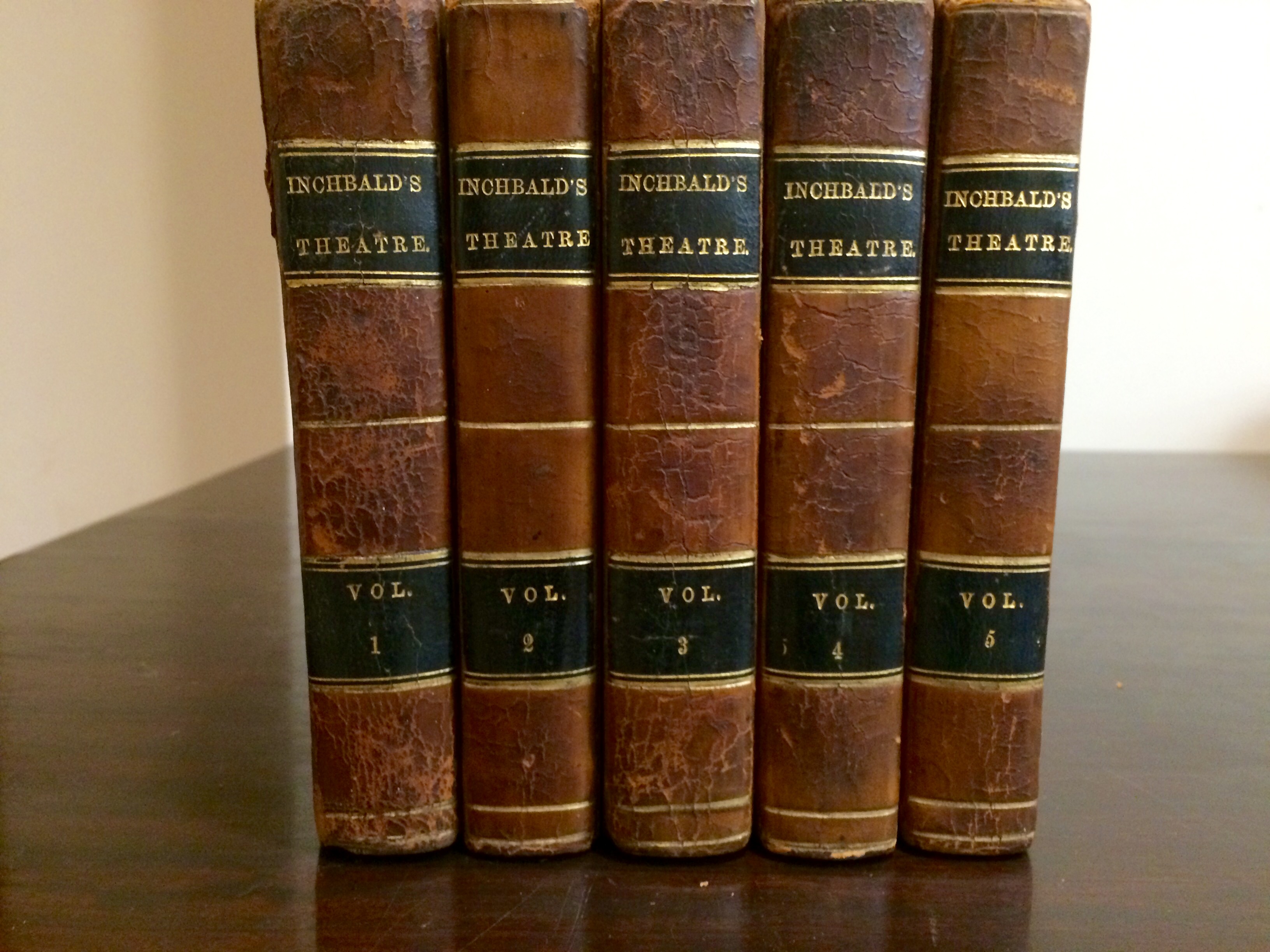
Inchbald

These beautiful bindings of the first edition of Inchbald’s British Theatre feature her name in equal prominence with the subject of the books. (PR 1243 .I4 1808, v.1-5 shown)

As the works of all three Elizabeths shown here intimate, Shakespeare’s education was closer to their own than it was to Voltaire’s or Johnson’s. His work and success, like theirs, trespassed social and moral boundaries. Shakespeare’s rise to “genius” glimmered with the possibility of their own fame.
New Exhibition Now Open: “Fearsome Ink”

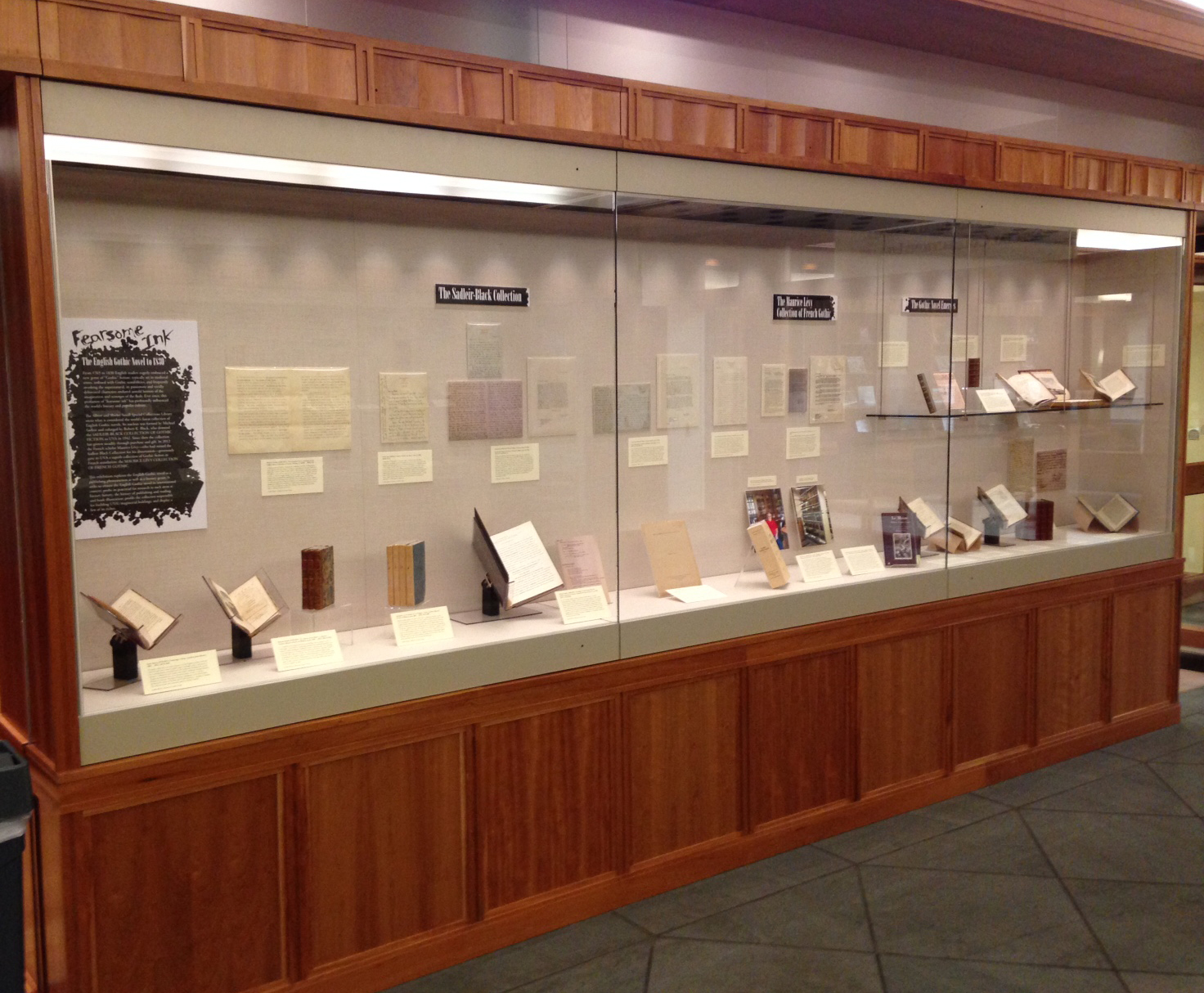
Part of the exhibition, "Fearsome Ink: The English Gothic Novel to 1830," on view through Mat 28.

A portion of the exhibition, “Fearsome Ink: The English Gothic Novel to 1830,” on view through May 28.

Some readers will know that the Albert and Shirley Small Special Collections Library possesses what is considered the world’s finest collection of English Gothic novels. From approximately 1765 to 1830 English readers eagerly embraced a new genre of “Gothic” fiction: typically set in medieval times, imbued with Gothic sensibilities, and frequently invoking the supernatural, its passionate and vividly delineated characters endured untold horrors of the imagination and scourges of the flesh. Ever since, this profusion of what one might term “fearsome ink” has profoundly influenced the world’s literary and popular culture.

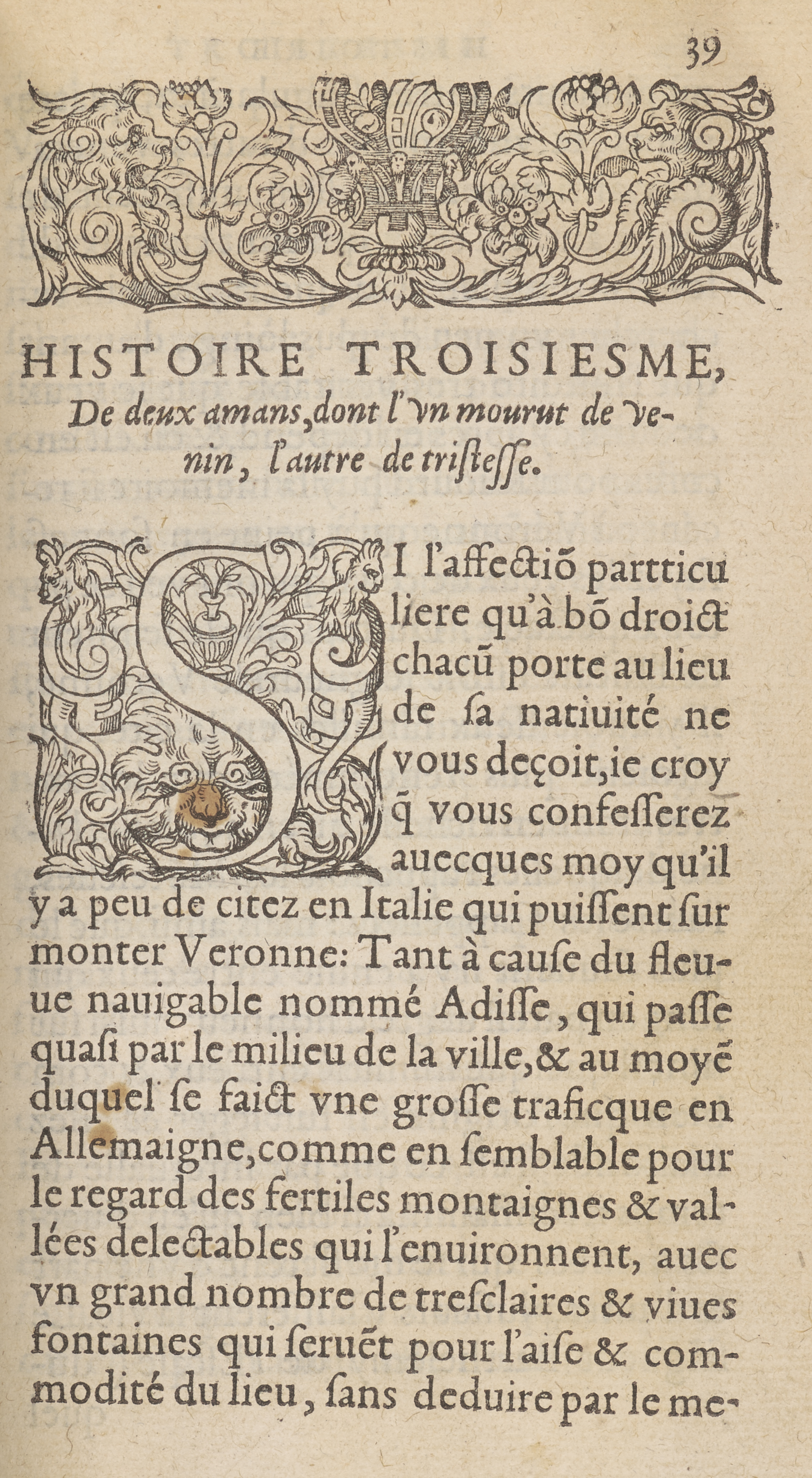
A Gothic precursor and Shakespeare source: Matteo Bandello's tale of the ill-fated lovers of Verona, Romeo and Juliet, in French translation. Matteo Bandello, Histoires tragiques. Paris: Gilles Robinot, 1559. (Gordon 1559 .B3)

A Gothic precursor and Shakespeare source: Matteo Bandello’s tale of the ill-fated lovers of Verona, Romeo and Juliet, in French translation. Matteo Bandello, Histoires tragiques. Paris: Gilles Robinot, 1559. (Gordon 1559 .B3)

The nucleus of U.Va.’s collection was formed by British bibliographer Michael Sadleir and enlarged by U.Va. graduate student Robert K. Black, who donated the Sadleir-Black Collection of Gothic Fiction to U.Va. in 1942. Since then the collection has grown steadily through purchase and gift. In 2012 the French scholar Maurice Lévy—who five decades earlier had mined the Sadleir-Black Collection for his dissertation—generously gave to U.Va. a superb collection of Gothic fiction in French translation: the Maurice Lévy Collection of French Gothic. Highlights from these two collections are now on view in the exhibition “Fearsome Ink: the English Gothic Novel to 1830.”

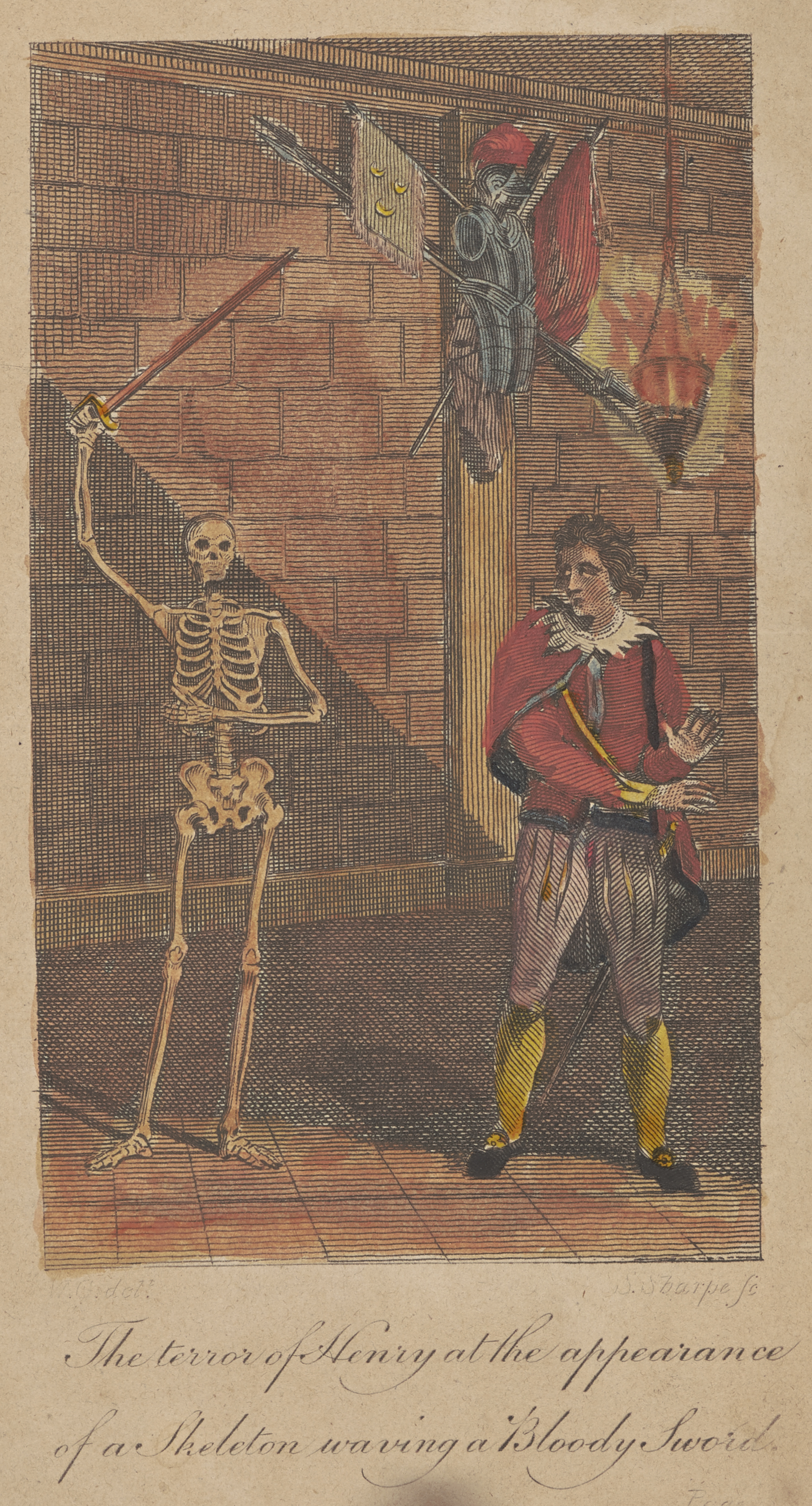
Oh, the horror! A hand-colored, engraved frontispiece to an early 19th-century "shilling shocker," or chapbook adaptation of a Gothic novel.

Oh, the horror! A hand-colored, engraved frontispiece to an early 19th-century “shilling shocker,” or chapbook adaptation of a Gothic novel.

“Fearsome Ink” explores the English Gothic novel as a publishing phenomenon as well as a literary genre. It seeks to situate the English Gothic novel in international context; probe its potential for research in such areas as literary history, the history of publishing and reading, and book illustration; and profile the collectors responsible for building U.Va.’s magisterial holdings. Highlights include 16th– and 17th-century precursors of Gothic literature; contemporary German “shudder novels”; French translations of English Gothic novels; early American attempts to write Gothic fiction suited to American audiences; parodies of Gothic fiction; strikingly illustrated popular chapbook versions of Gothic novels; copies owned (and presumably read) by “persons of quality”; and battered circulating library copies read by the majority of contemporary readers.

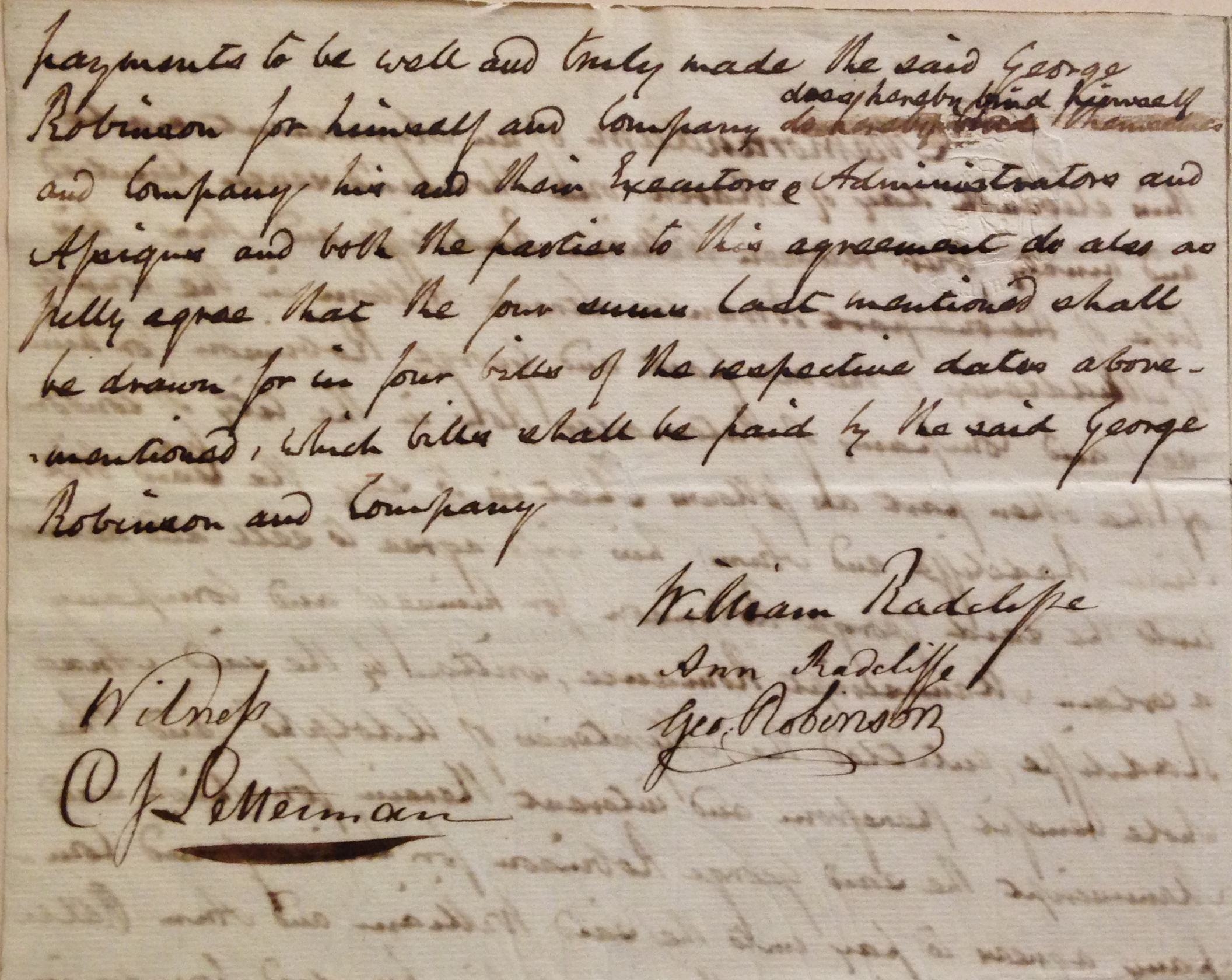
Original manuscript contract, signed by Ann Radcliffe, for her bestselling the Mysteries of Udolpho (London: G.G. and J. Robinson, 1794). Radcliffe's novel commanded the princely sum of 500 British pounds from publisher George Robinson. (MSS 1625)

Original manuscript contract, signed by Ann Radcliffe, for her bestselling novel, The Mysteries of Udolpho (London: G.G. and J. Robinson, 1794). Radcliffe’s novel commanded the princely sum of 500 British pounds from publisher George Robinson. (MSS 1625)

On March 25-26, U.Va.’s Department of French is sponsoring a related conference, “The Dark Thread: From histoires tragiques to Gothic Tales.”

G5“Fearsome Ink” will remain on view through May 28 in the first floor gallery of the Small Special Collections Library.

Open Now!: Shakespeare by the Book

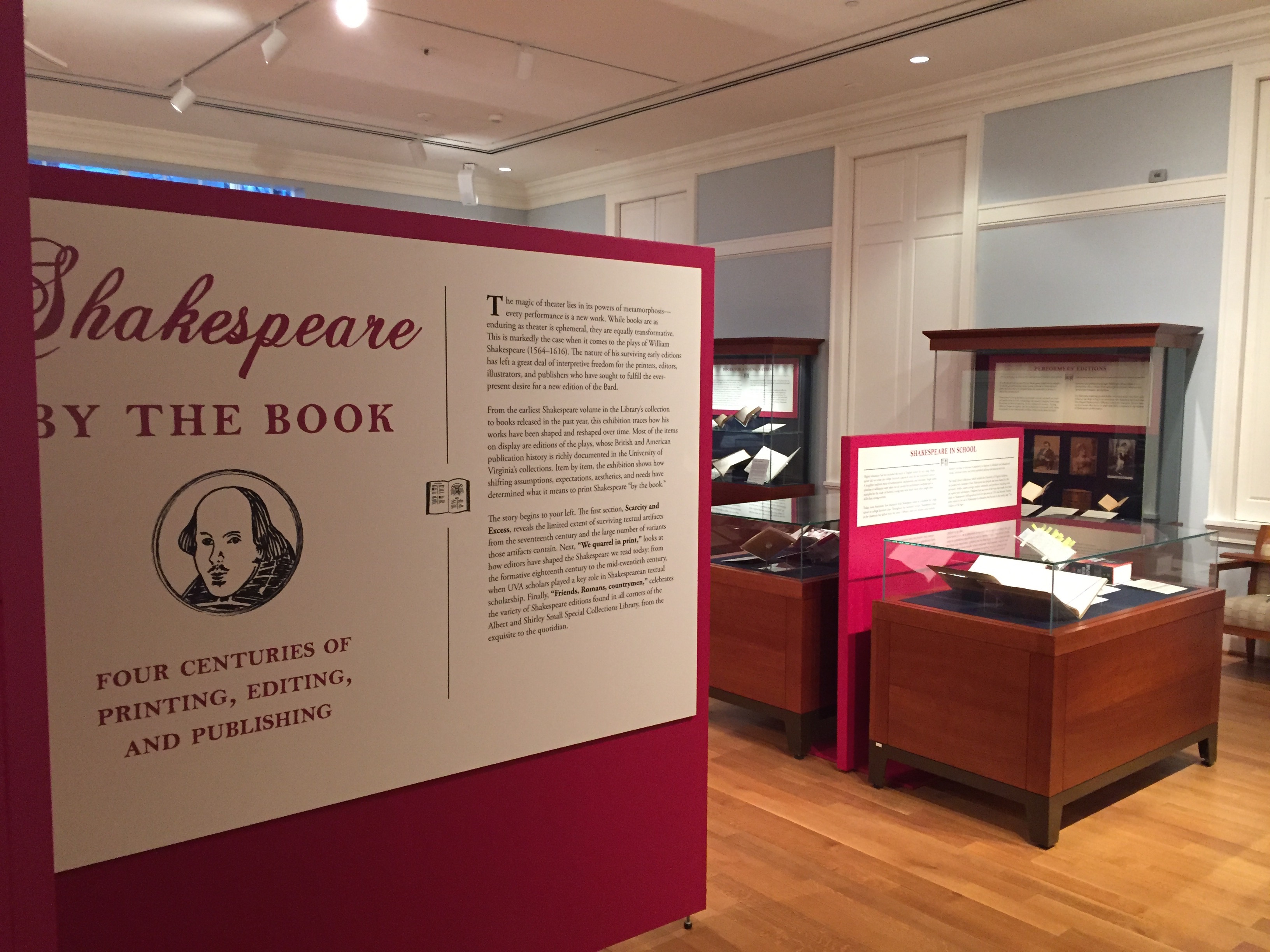
This year, libraries, museums, theaters, and universities across the globe are marking the four-hundredth anniversary of William Shakespeare’s death by celebrating his life and works. In our small corner of the world here at UVA, the Albert & Shirley Small Special Collections Library is making its own unique contribution to the festivities with the exhibition, Shakespeare by the Book: Four Centuries of Printing, Editing, and Publishing.

Few literary works have been preserved, transformed, or reinvented in print as often as the plays of William Shakespeare. From the First Folio to YOLO Juliet, this exhibition of over one hundred items shows how shifting assumptions, expectations, aesthetics, and needs have determined what it means to print Shakespeare “by the book.”

All Gallery The exhibition is broken up into three “acts.” The first, “Scarcity & Excess,” investigates the tension between the very few extant texts of Shakespeare’s work from the seventeenth century and the many variants that exist in the volumes that do survive. Highlights include the Library’s First Folio fragment of Much Ado About Nothing and Love’s Labour’s Lost (1623) and our quarto of King Lear (1619). As part of the Folger Shakespeare Library’s First Folio tour, a complete First Folio will join the exhibition for the month of October.

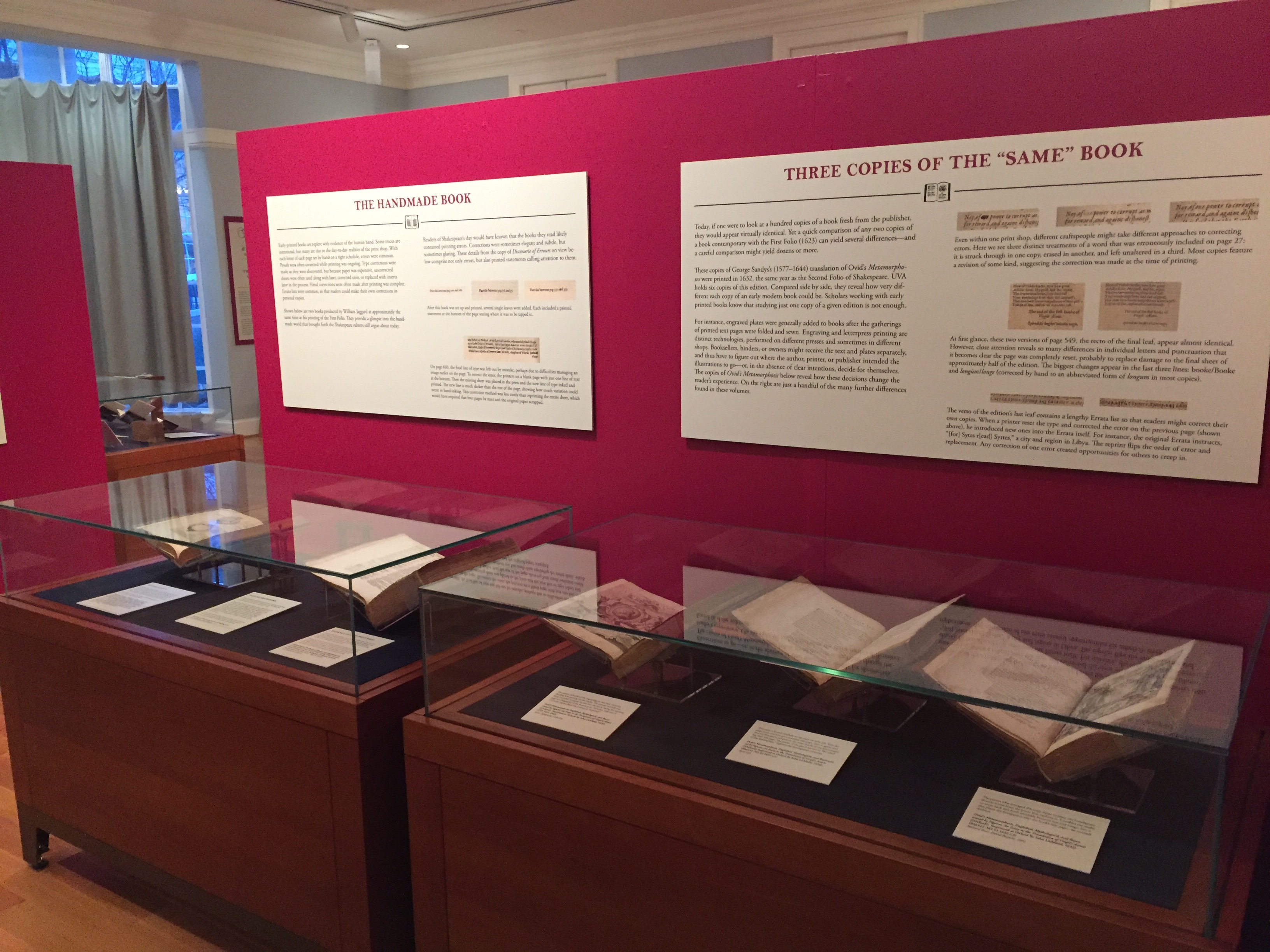
The Handmade Book

Folio editions printed around the same time as the first two Folios of Shakespeare, including two books printed at the same printing house as the First Folio, reveal some of the characteristics of English printed books in the 1620s and 1630s.

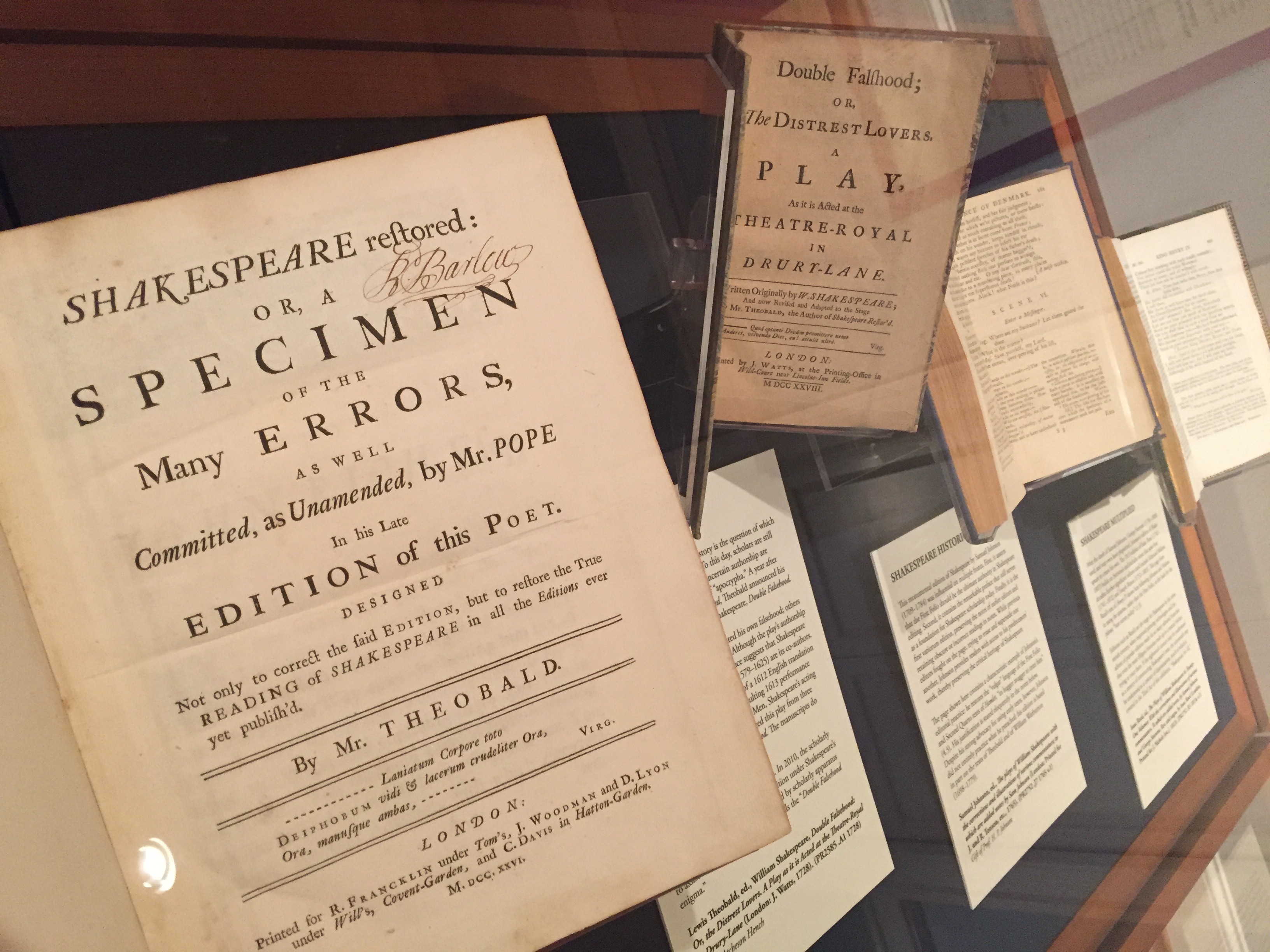
The second act, “We Quarrel in print,” traces how editors have transformed the text of Shakespeare  at two key moments: the eighteenth century  and the mid-twentieth century. In the latter period, UVA English Professor Fredson Bowers and UVA English Ph.D. Charlton Hinman played a pivotal role in Shakespearean scholarship. Highlights include landmark editions of Shakespeare, two videos about Bowers and Hinman’s contributions to bibliography, our research into a minor–but majorly interesting–edition of Shakespeare from the 1780s, and a “listicle” of the best editorial insults by the first generations of Shakespeare editors.

Shown here is Lewis Theobald’s book-long attack on Alexander Pope’s edition of Shakespeare, Shakespeare Restored.

The final act, “Friends, Romans, countrymen” explores the myriad ways Shakespeare has been transformed for a variety of audiences in the modern era, from the child to the bibliophile. Miniature books abound in this section, as do gorgeously illustrated editions of Shakespeare’s plays. Blinking beautifully over this section of the exhibition will be our famous watch ticking out Sonnets 18 and 130 in Morse code.

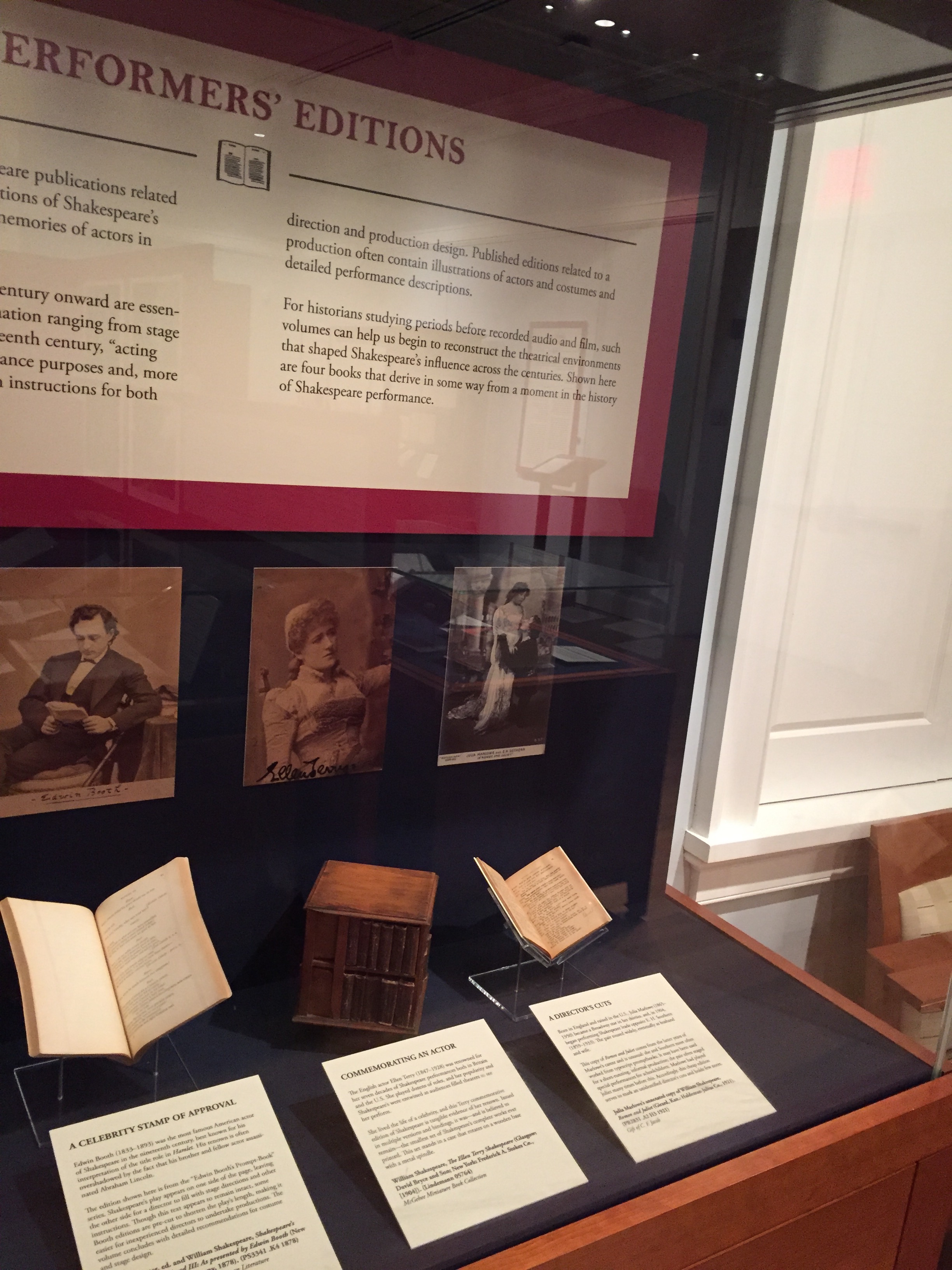
Shown here are photographs of famous Shakespearean actors whose performances also inspired textual editions of the Bard.

Shown here are photographs of famous Shakespearean actors alongside books associated with them.

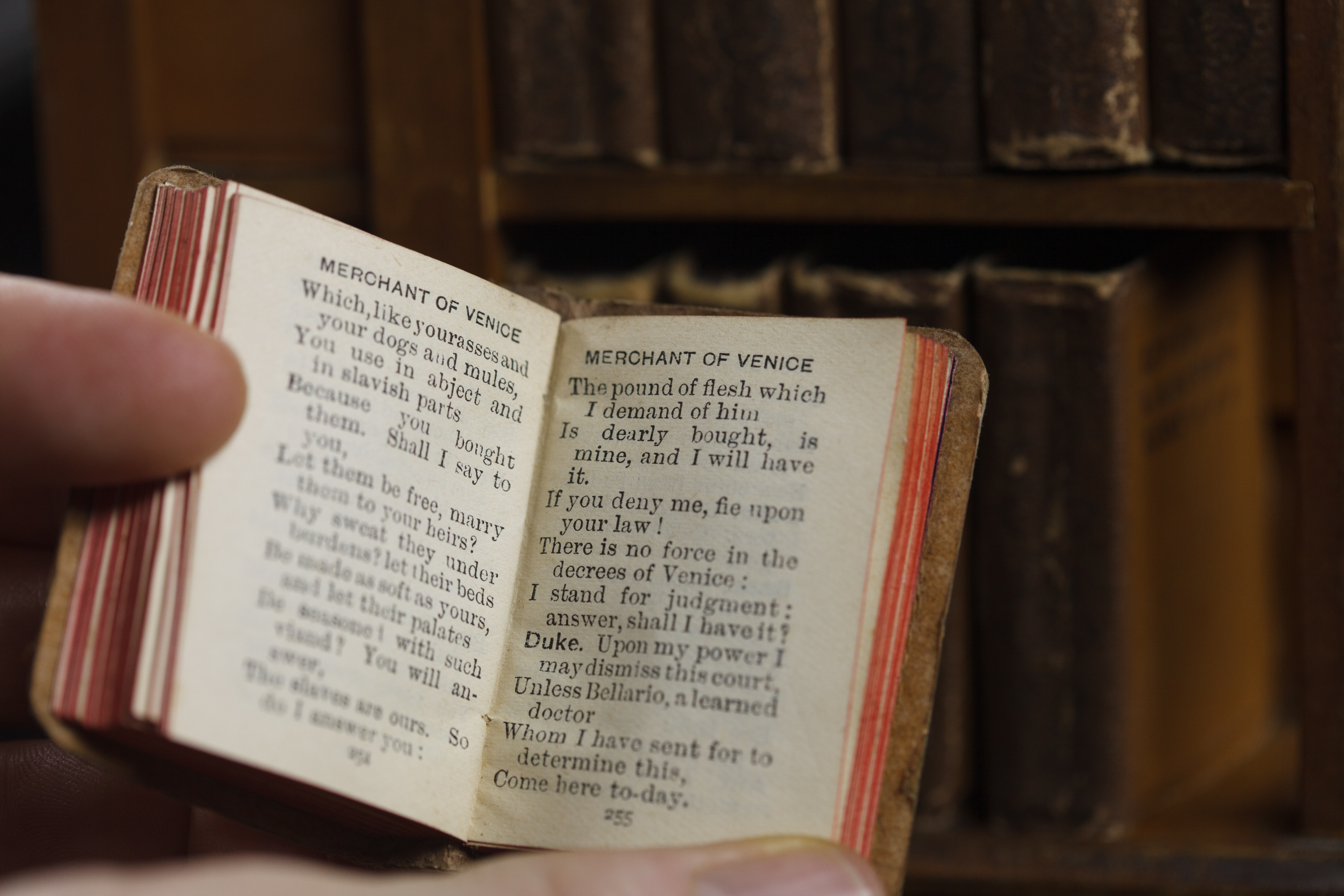
mini-merchant

One of more almost 150 miniature volumes of Shakespeare in the exhibition. This example is from the 1904 Ellen Terry edition of Shakespeare.

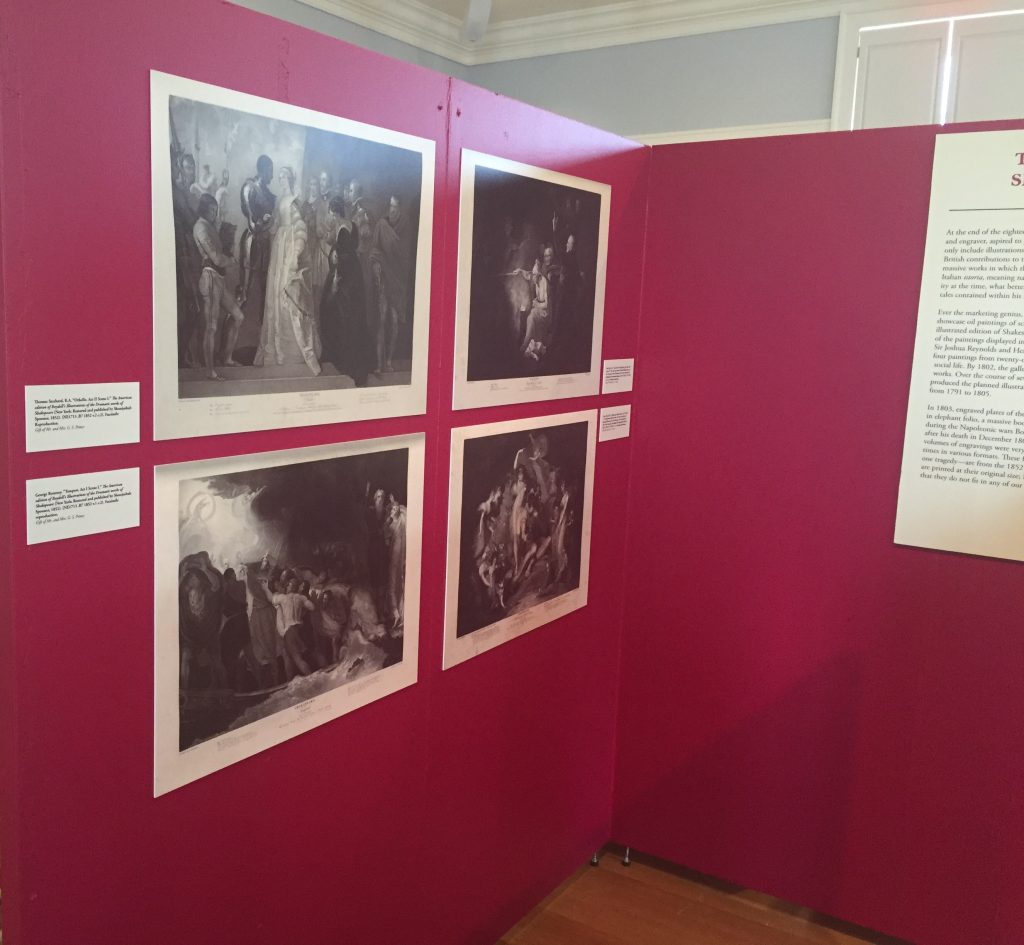
Other highlights include images from the monumental Boydell Shakespeare and a how-to-collate Shakespeare workstation.

Our miniature Boydell Shakespeare Gallery with prints of Shakespeare's The Tempest, Midsummer Night's Dream, Othello, and King Henry VI, Part Two.

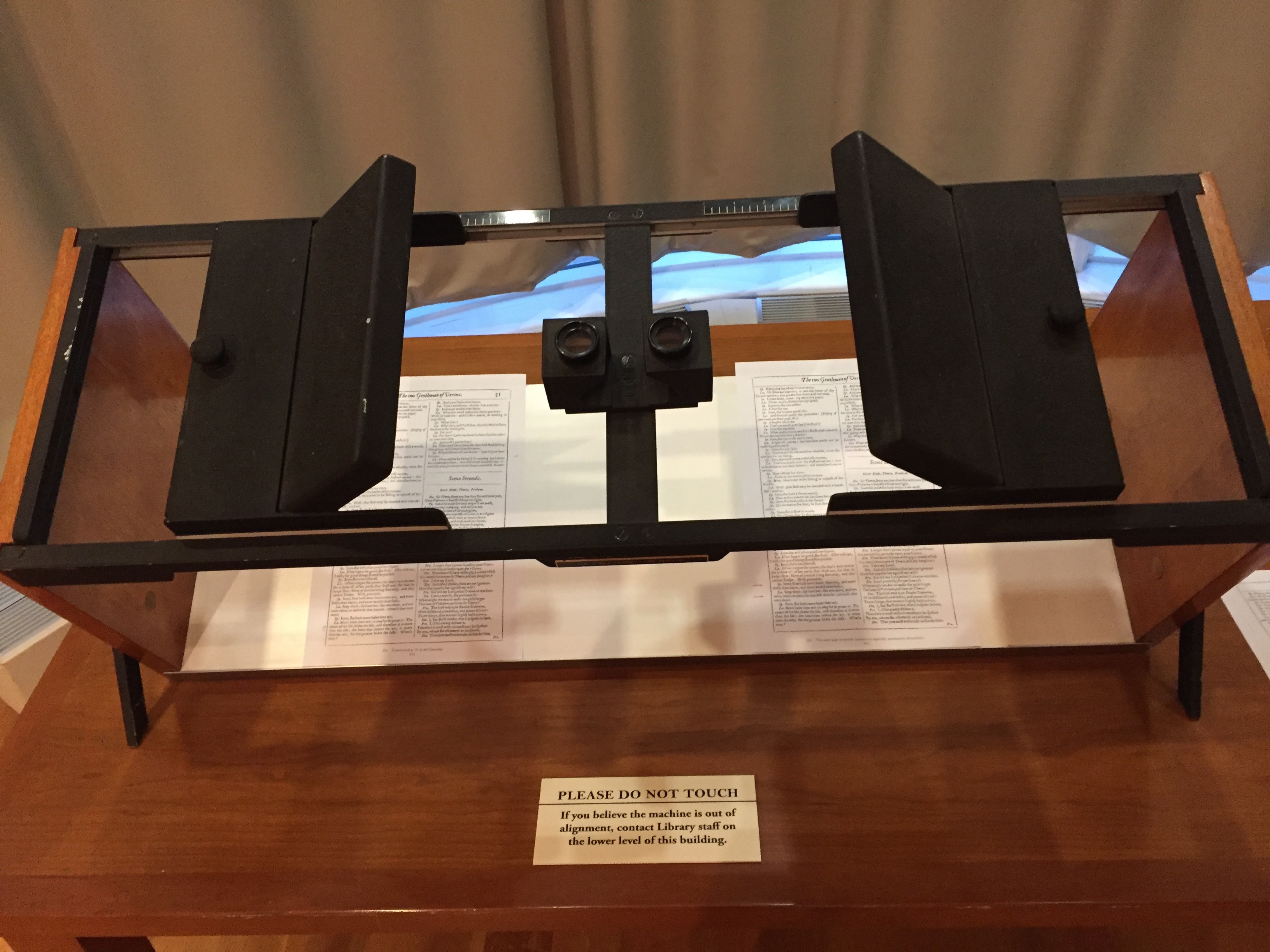
The exhibition includes a feature on how technology of the mid-twentieth century allowed editors to compare copies of Shakespeare’s works with greater accuracy and speed. While we pay a great deal attention to Charlton Hinman’s collating machine, we have installed a more user-friendly Lindstrand Comparator in the gallery so visitors can try to compare two pages themselves. It takes a bit of time to see comfortably through the lenses, but soon you will see variants pop off the page! Come check it out.

The exhibition runs through December 29, 2016, with the Folger Shakespeare’s Library’s First Folio making its appearance for the month of October. A public reception will be held on Friday February 26th from 5–7 PM. All are welcome and encouraged to attend!

On View Now: Talkin’ ‘Bout a Revolution

We’re pleased to announce the opening of our latest mini-exhibition,  “Talkin’ ‘Bout a Revolution: The American Civil Rights Movement, 1954-1970,” which runs through the end of February and is part of the University’s 2016 community MLK Day celebration, “The Call to Higher Ground.” The exhibition is curated by our own Ervin Jordan, research archivist.

mlk3

Jordan writes, “The American Civil Rights Movement (1954-1970) intensely transformed American society and inspired similar movements worldwide. Its nonviolent protests and civil resistance for equal citizenship under the law enhanced African-Americans’ self-dignity and collective commitment in the face of white supremacist terrorism. Others too, were allies, martyrs and beneficiaries of this undertaking to fulfill the promises America had made on paper since 1776.”

mlk5

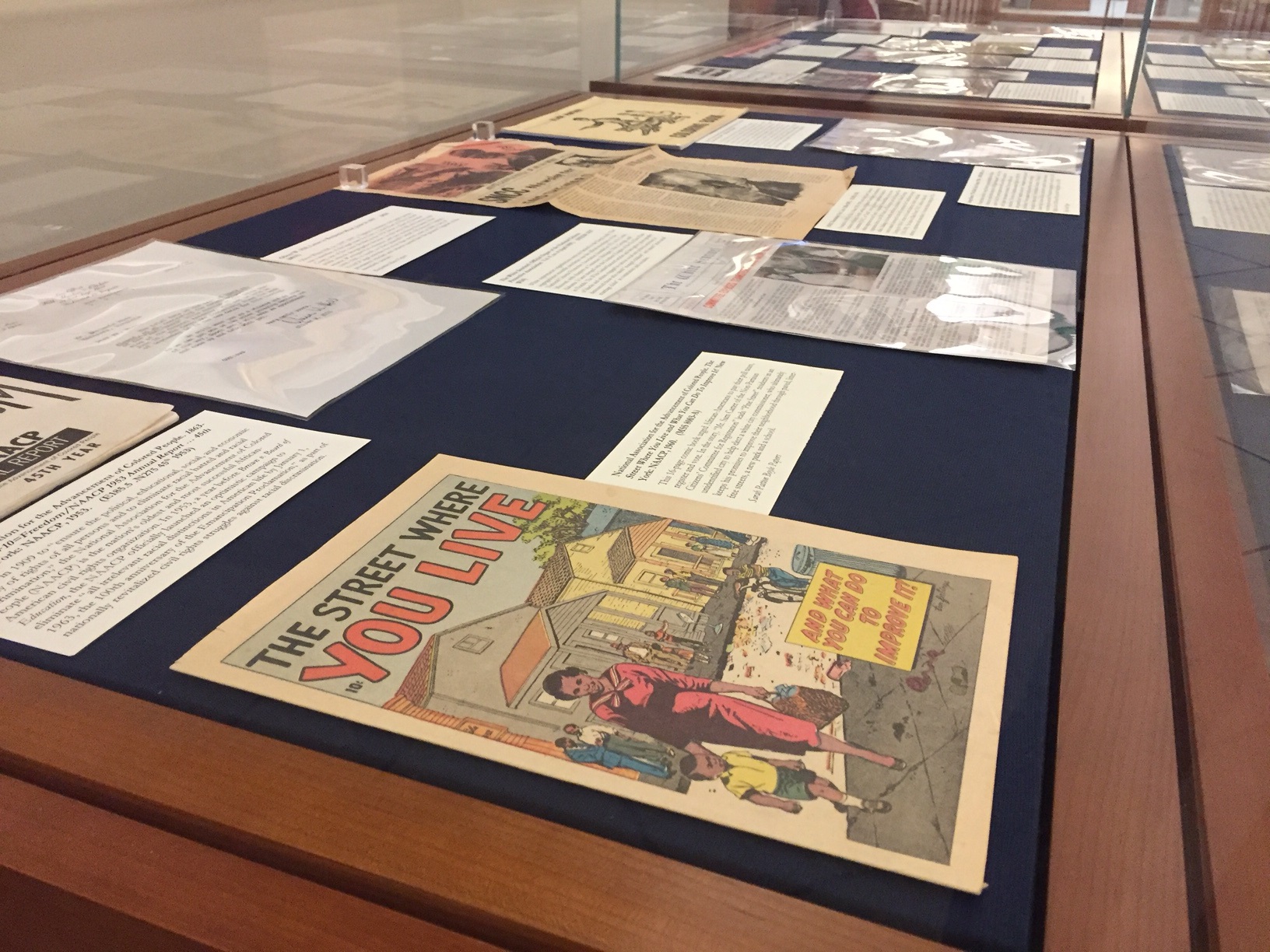
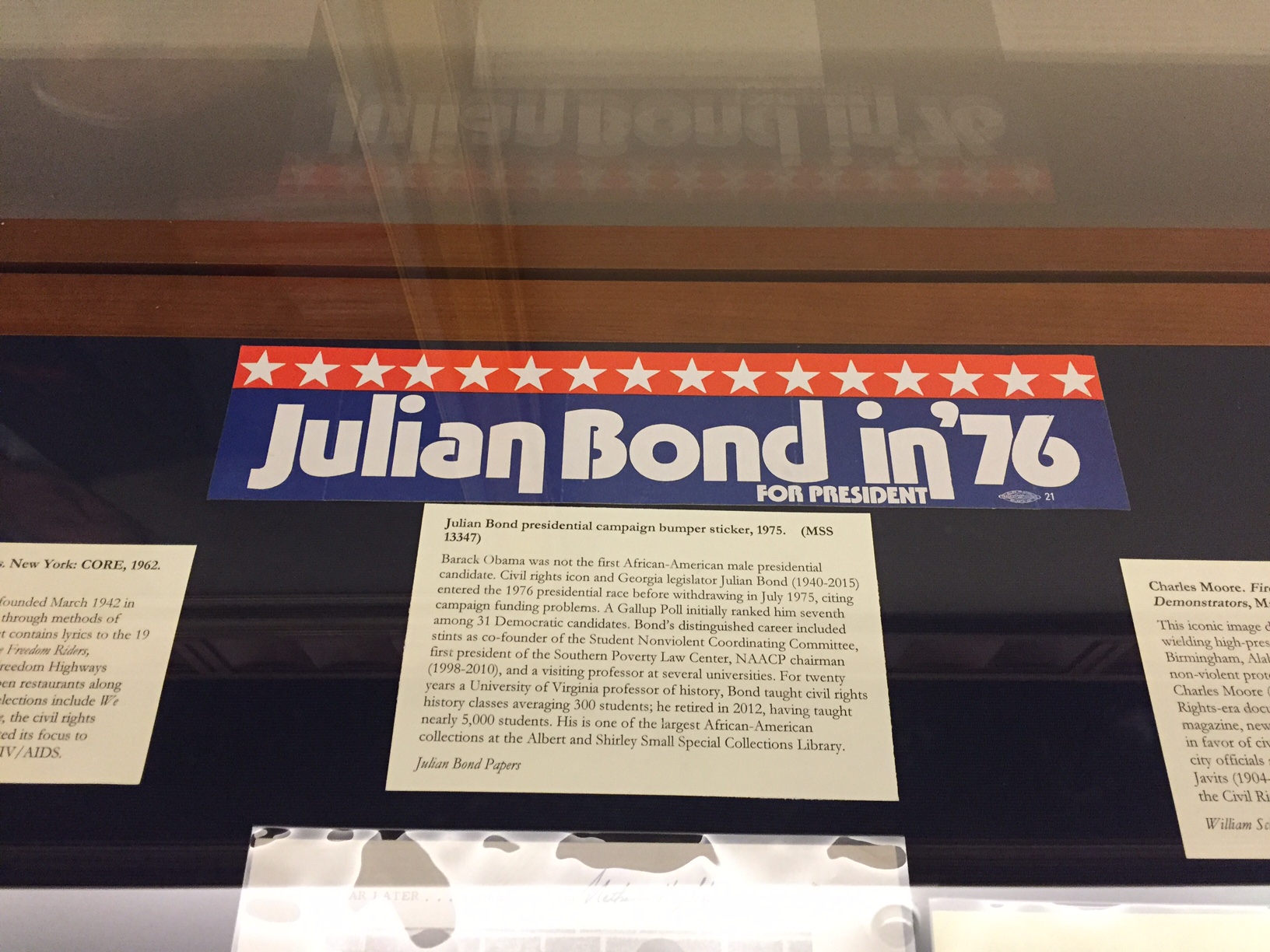
The exhibit’s 24 items on display comprise letters, newsletters, photographs, poetry and reports; special items of interest include:

  • A 1960 NAACP voting rights comic book
  • Alex Haley’s 1963 interview of Malcolm X
  • A 1969 Black Panther Party coloring book
  • A 1976 Julian Bond for President bumper sticker
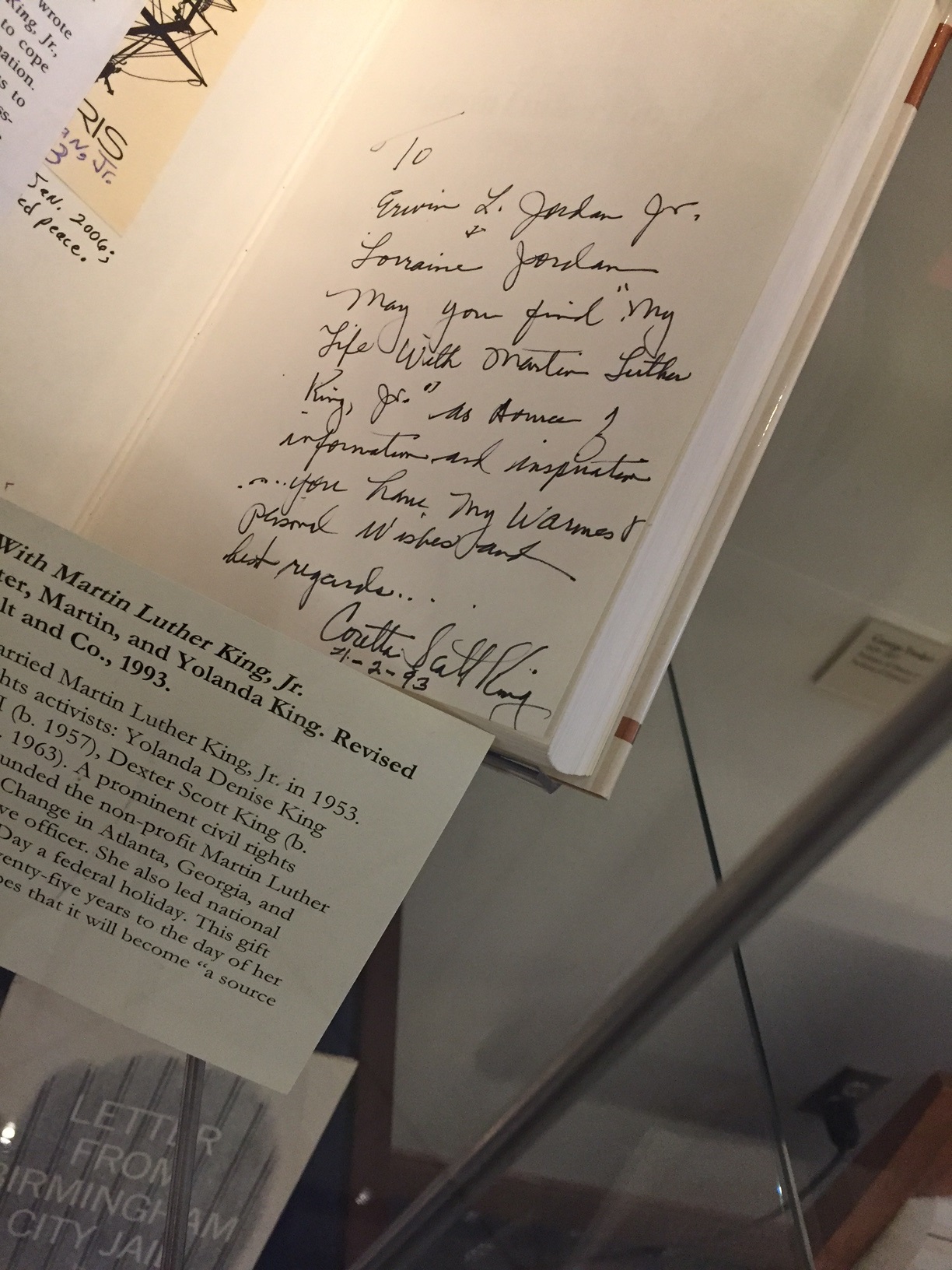
  • An inscribed copy of Coretta Scott King’s published memoirs

mlk2

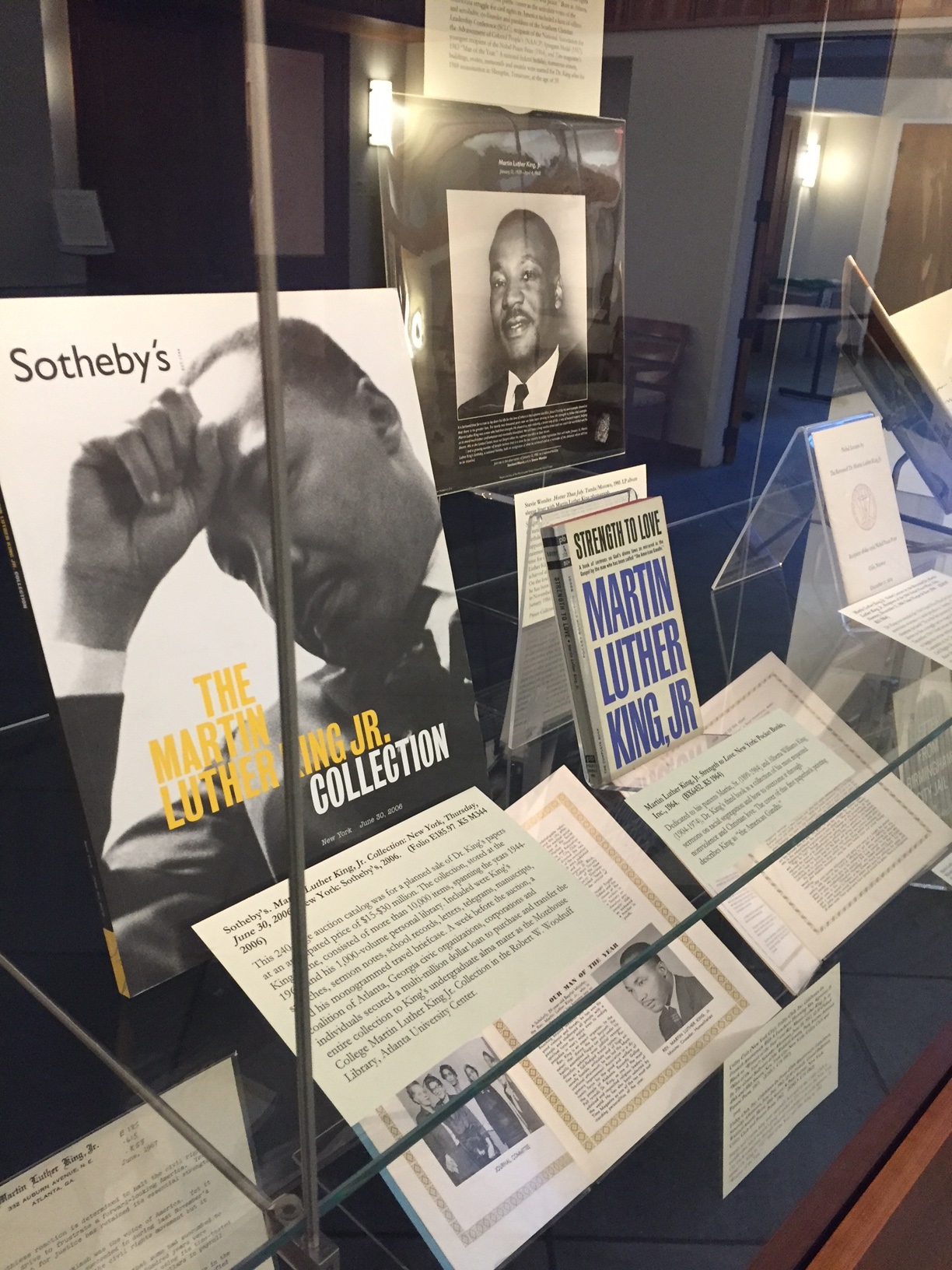
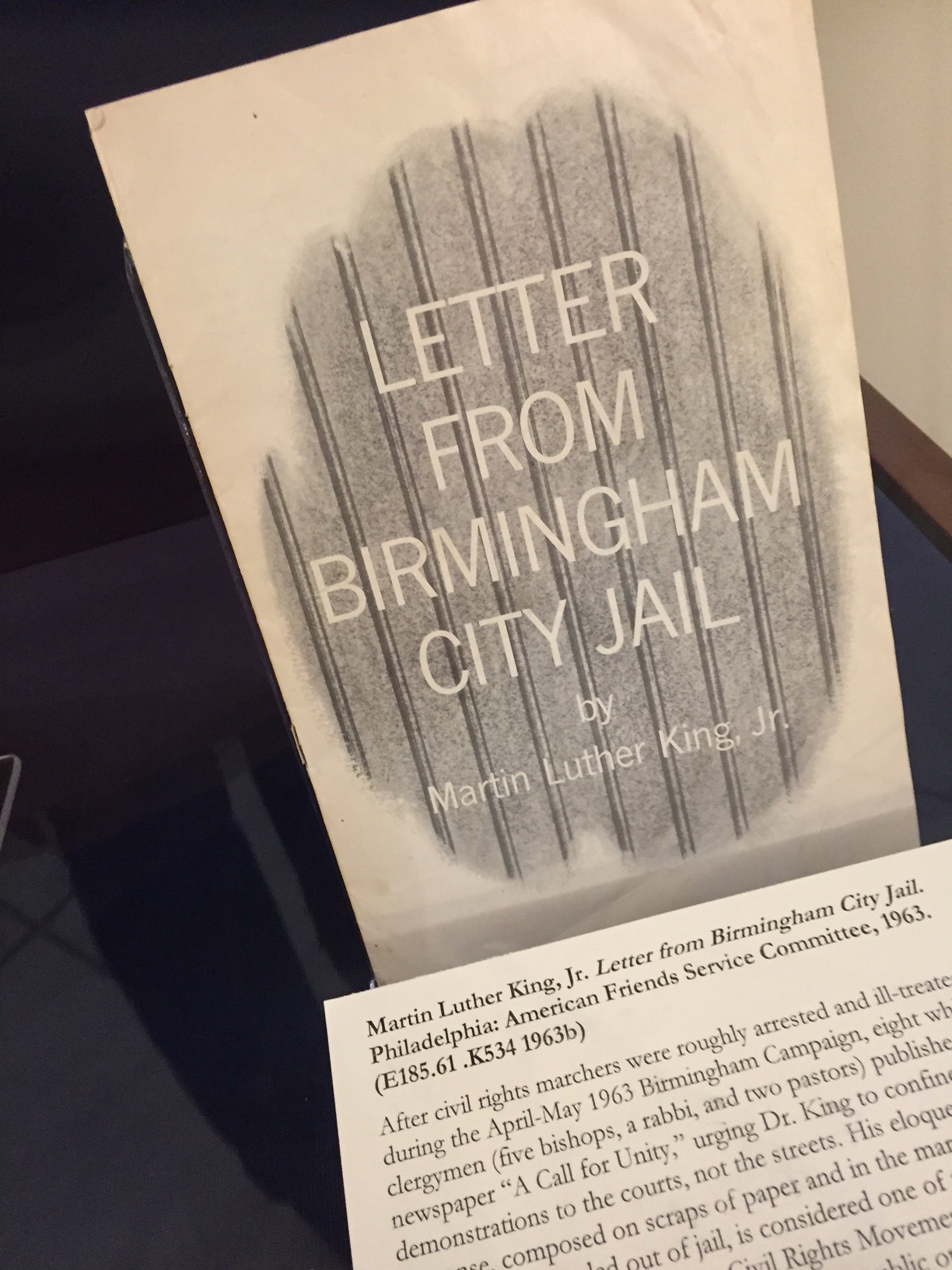
One of the exhibition’s three display cases features the life and career of the Reverend Dr. Martin Luther King, Jr., charismatic leader of the Civil Rights Movement and “a drum major for justice and peace” in his letters and publications.

mlk1

Please stop by for a visit!

mlk4

Exhibition Prep Special: Translating Shakespeare’s Sonnets into…Morse Code?

This week we are pleased to feature the third guest blog post from graduate curatorial assistant Kelly Fleming, who will be sharing selected treats from our upcoming exhibition, “Shakespeare by the Book,” over the coming months. The exhibition opens February 22, 2016.

Most readers of Shakespeare’s sonnets associate his poetry with love. In films and literary works of all kinds, Shakespeare’s sonnets are quoted and used to confirm the love between two people. Sonnet 116 (“Let me not to the marriage of true minds”) is probably one of the most popular readings on the wedding circuit. As much as Shakespeare’s sonnets are about love, time is more likely to be the subject of the poet’s meditations. The first seventeen—“the procreation sonnets”—urge a young man to make much of time, to get married, and to procreate so that he can live forever through his children. Many of the sonnets after 17 continue to address, to personify, and to apostrophize time, as these first lines illustrate: “Against that time, if ever that time come” (Sonnet 49); “That time of year thou mayst in me behold” (Sonnet 73); “No, Time, thou shalt not boast that I do change” (Sonnet 123).

Knowing the sonnets’ preoccupation with time, I completely “nerded out” when I discovered that someone had turned Shakespeare’s sonnets into a watch. My own scholarship has nothing to do with Shakespeare, but every time Molly, our curator here at Special Collections, mentioned the watch to me, I would get so excited that I would say in a high-pitched voice, “But Shakespeare’s sonnets are all about time!” I cannot imagine a more perfect way to represent his sonnets than a watch.

Pictured here is the watch with the instructional booklet open to the title page.

Pictured here is the watch with the instructional booklet open to the title page.

The Sonnets Watch Book is book inside a watch; it is a watch that ticks out Shakespeare’s sonnet 18 (“Shall I compare thee to a summer’s day?”) and sonnet 130 (“My mistress’ eyes are nothing like the sun…”) in Morse code. It was dreamed up and built by three Seattle teenagers (credited on the watch as “Alex, Clara, and Nicholas”) and published by miniature-book publisher and technologist Robert Orndorff (who happens to be the father of two of the makers). Only eighteenth copies of The Sonnets Watch Book are in existence and number eighteen will appear in our exhibition. Bright lights flicker out the letters and punctuation marks of each sonnet. Even though I can’t understand Morse code, there is something incredibly moving about watching the lights change and knowing that Shakespeare’s words are still slowly being repeated throughout time.

Here is an image of the watch as it ticks out one of Shakespeare's sonnets in Morse code.

Here is an image of the watch as it ticks out one of Shakespeare’s sonnets in Morse code.

Last week, I spent a full hour close reading Shakespeare’s Sonnet 65 and talking about time with my ENGL 3810 students. We were stuck on the following lines for a while:

O, how shall summer’s honey breath hold out
Against the wreckful siege of battering days,
When rocks impregnable are not so stout,
Nor gates of steel so strong, but Time decays?

Shakespeare’s answer to this question is his sonnet. Unlike the sea, stone, or shining metals, his “black ink” may be able to withstand the rages of time. His “black ink” will continue to “shine bright” and tell of his love. As my students will tell you, this is exactly what happened. We spent twenty-five minutes of our class on four lines because his “black ink” does still “shine bright” in the history of literature.

Imagine, then, an object that literalizes the hope, the wish of this sonnet. Shakespeare’s words, his “black ink,” actually “[shining] bright” in little yellow, green, and red blinking lights on the face of a watch.

Now, who is excited?

Click on the link below for a video of the watch in action and proof that Shakespeare’s sonnets are now more portable than ever before. The Sonnets Watchbook will be on view—alive and ticking—in “Shakespeare by the Book: Four Centuries of Printing, Editing, and Publishing,” which runs February 22-December 2016 at the University of Virginia Library. 

Oh, and in case you are wondering about the history of literature translated into code, perhaps you would like to see Monty Python’s take on the topic. They  start with Wuthering Heights and go on from there…make sure to stay to the end!:


Exhibition Prep Special: Searching for Shakespeare in Booksellers’ Records

This week we are pleased to feature the second guest blog post from graduate curatorial assistant Kelly Fleming, who will be sharing selected treats from our upcoming exhibition, “Shakespeare by the Book,” over the coming months. The exhibition opens February 22, 2016.

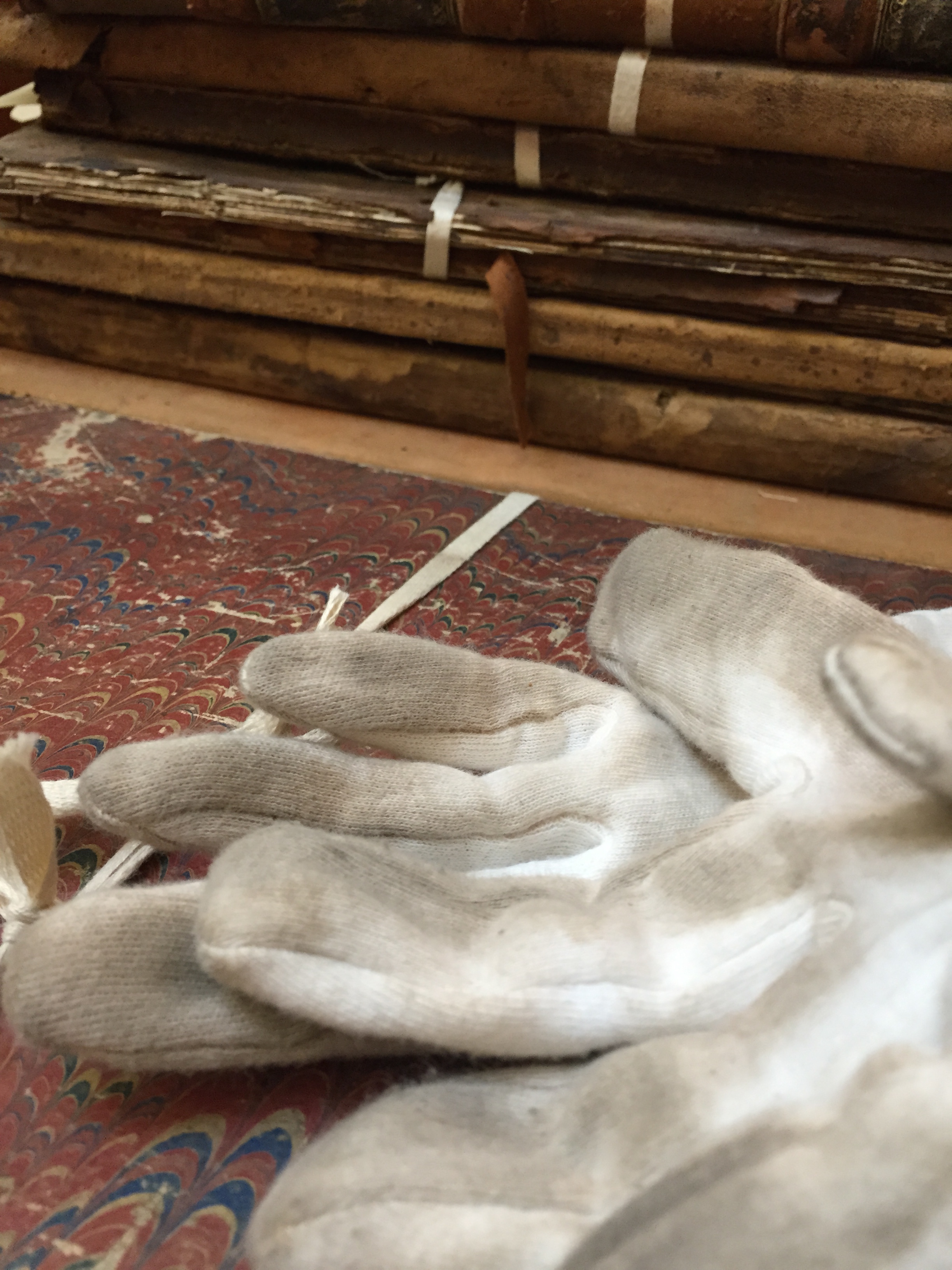
My first two weeks at Special Collections were spent hoisting hulking ledgers from the stacks and placing them gently onto cradles to investigate whether two early booksellers in Virginia sold Shakespeare. After the first day, I found my legs covered in wisps of binding and my hands stained with “red rot” from the ledgers’ leather bindings. Thank goodness for gloves.

Here's what my gloves looked like after several ledgers. Imagine what my bare hands looked like before I put them on.

Here’s what my gloves looked like after several ledgers. Imagine what my bare hands looked like before I put them on.

I combed through the account books of Bell & Co., a printer in Alexandria, Virginia active in the nineteenth century and the Virginia Gazette, a newspaper and printer active in Williamsburg, Virginia in the eighteenth century. My eyes sought any spelling variation of the name “Shakespeare” amidst endless purchases of envelopes and paper. Despite our modern perception that Shakespeare’s works are “classics” and that he is a father of the English language, his place in the literary canon was yet to be defined in the eighteenth and nineteenth centuries. As my findings attest, Virginians chose to read a myriad of other things more frequently than Shakespeare.

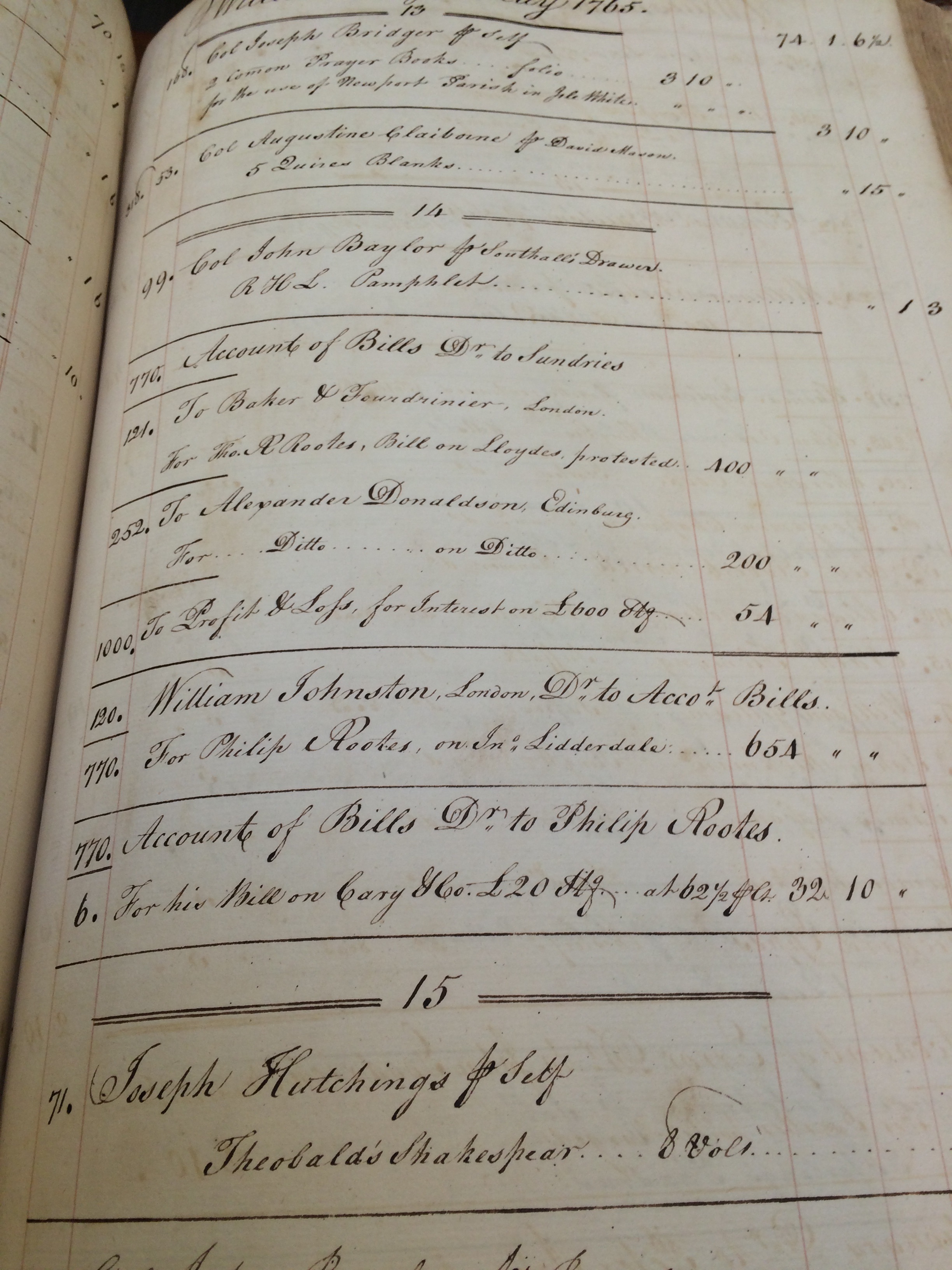
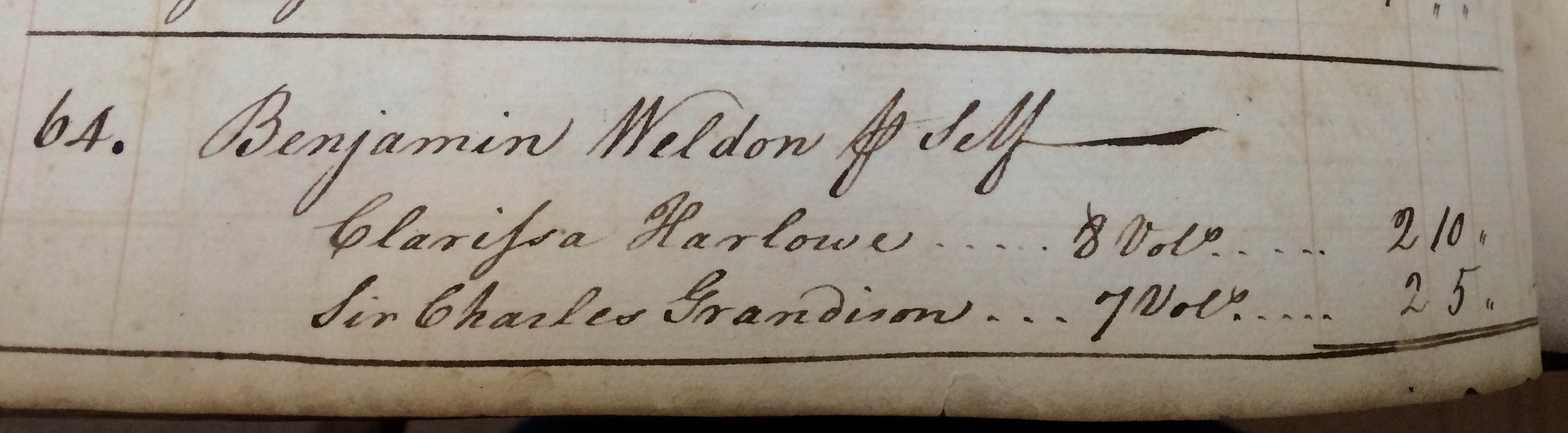
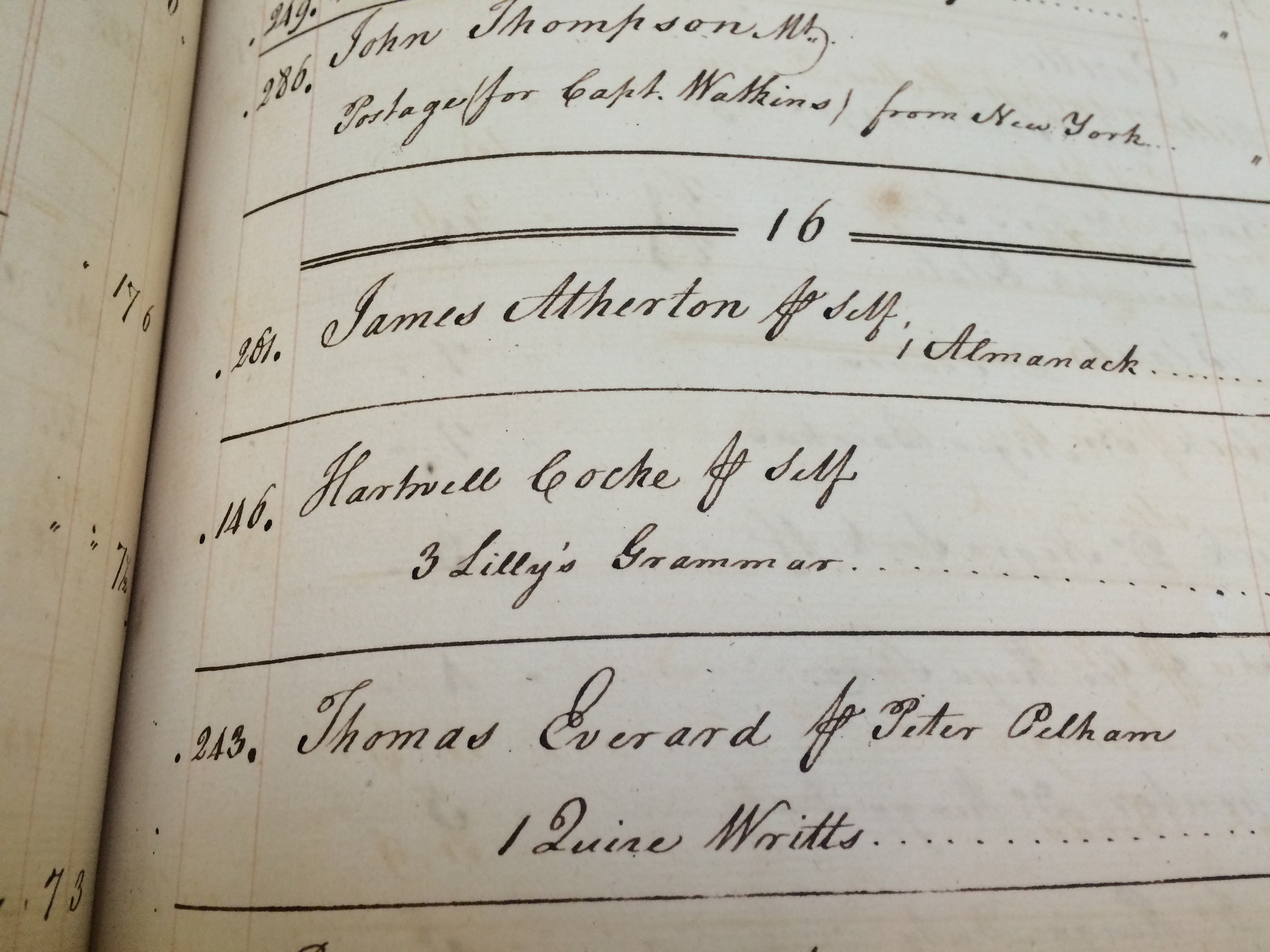
Only one copy of Shakespeare was sold by the Virginia Gazette in the years 1750–1752 and 1764–1766. Even though David Garrick was busily working to increase the popularity of Shakespeare in London at this time, the colonies seem to have been a step behind. Since Williamsburg was home to the Virginia legislature and the College of William & Mary, it is not surprising that the books sold by the Virginia Gazette were largely educational: Latin grammar textbooks, dictionaries, and religious texts like the Book of Common Prayer. Despite the fact that Samuel Johnson’s Dictionary of the English Language (a book the Virginia Gazette also sold) marks Shakespeare’s works as the first usage of many English words, students were not studying Shakespeare. The education system in the eighteenth century trained students (that is to say, young men) in what they considered the “classics”: philosophical and literary texts from ancient Greece and Rome. When students did read literary texts in English, it seems that they read English epics, which use classical elements to describe contemporary England. The epic works of Milton, Dryden, and Pope, for example, appear numerous times in the accounts of the Virginia Gazette. In addition to English epics, we find our copy of Shakespeare alongside another genre excluded from the education system: the novel. In the ledger in our exhibition, we find popular English novels such as Samuel Richardson’s Clarissa and Tobias Smollett’s Roderick Random.

Page of Virginia Gazette Day Book showing the purchase of Theobald's edition of Shakespeare (MSS 467)

Page of Virginia Gazette Day Book showing a purchase of Theobald’s edition of Shakespeare (MSS 467)

Joseph Hutchings purchased 8 volumes of of Shakespeare "for [his] self" (MSS 467).

The Virginia Gazette records show Joseph Hutchings purchasing 8 volumes of Shakespeare “for [him] self” (MSS 467).

Alongside Shakespeare in the Virginia Gazette Daybook, I found a recorded purchase of two of Samuel Richardson's novels, "Clarissa: Or, the History of a Young Lady" (1747-8) and "The History of Sir Charles Grandison" (1753).

Alongside Shakespeare in the Virginia Gazette records are two of Samuel Richardson’s novels, “Clarissa: Or, the History of a Young Lady” (1747-8) and “The History of Sir Charles Grandison” (1753). (MSS 467)


Alongside Shakespeare in the Virginia Gazette records are many educational texts such as Lilly's Latin Grammar. (MSS 467)

Alongside Shakespeare in the Virginia Gazette records are many educational texts such as Lilly’s Latin Grammar. (MSS 467)

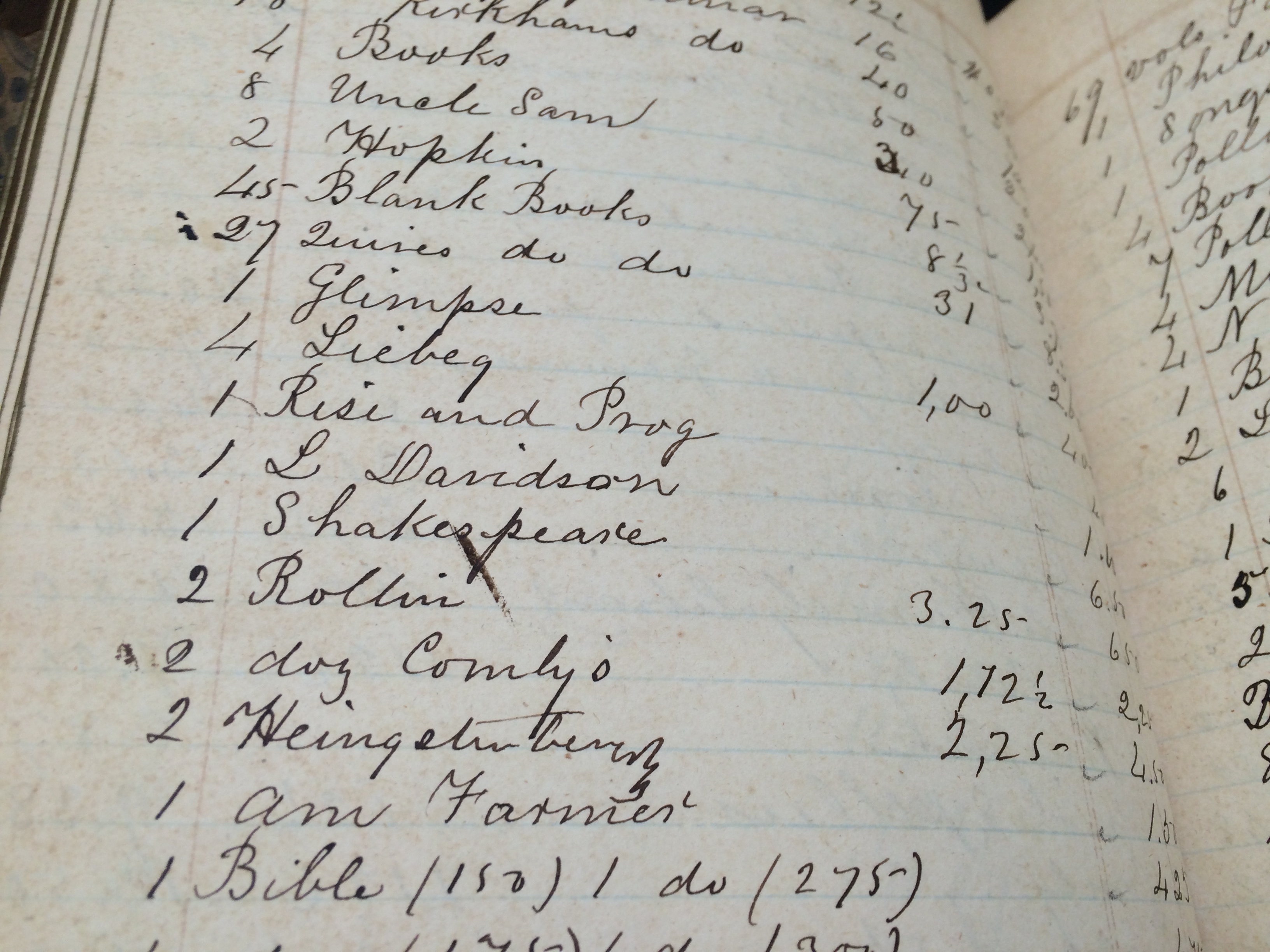
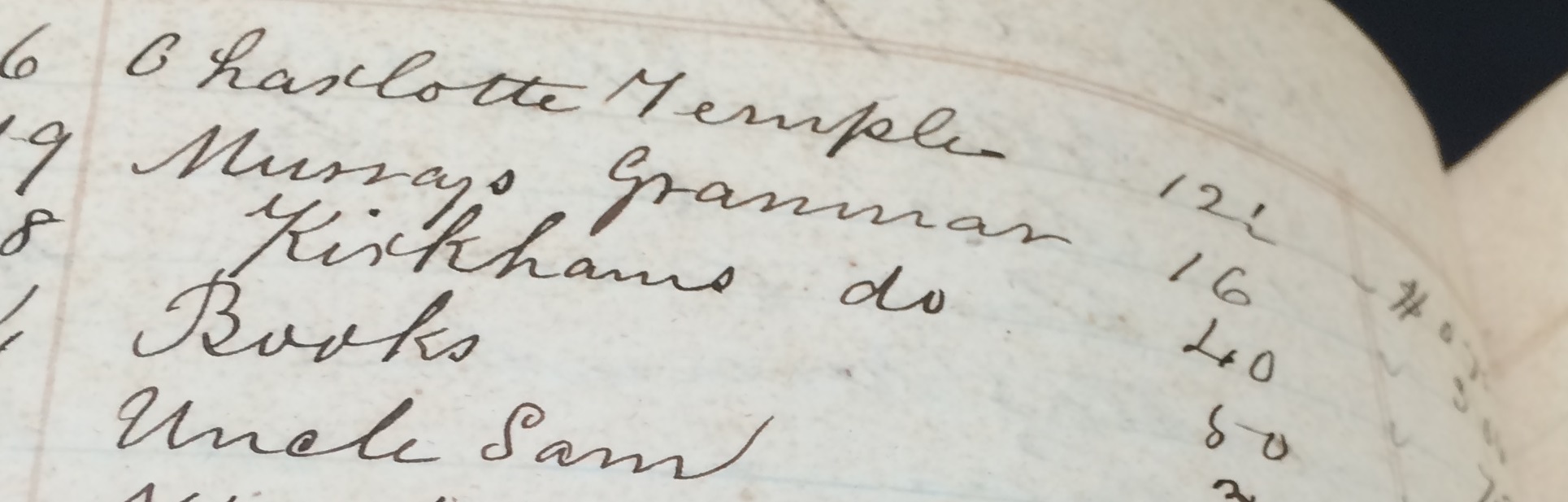
Thanks largely to new performances of Shakespeare plays, Garrick’s Shakespeare Jubilee, and new editions of Shakespeare works in the eighteenth century, Shakespeare’s words come alive by the nineteenth century. The accounts of Bell & Co. reflect this increasing popularity. I found seven copies of Shakespeare sold at Bell & Co. over the course of the nineteenth century (1809–1899). The specific ledger we are using in the exhibition shows Shakespeare alongside Susanna Rowson’s novel Charlotte Temple, Wordsworth, Cooper’s Virgil, and the Bible.

Bell & Co. sold Shakespeare for "6.50" (MSS 2989).

Bell & Co. sold Shakespeare for “6.50.” Different types of currency were in use in the colonies at this time. Without further research, all we can tell from this record is that it is expensive and suggests that the reader bought a multi-volume set (MSS 2989).

On the same page, Bell & Co. recorded the purchase of Susanna Rowson's novel "Charlotte Temple" and two grammar books.

On the same page as Shakespeare, Bell & Co. recorded the purchase of Susanna Rowson’s novel “Charlotte Temple” and two grammar books. (MSS 2989)

Finally, in the twentieth century, Shakespeare begins to be studied and to be studied as a father of the English language. Today, Shakespeare is probably the most often memorized, most often recited English author in schools. I still can recite the famous speech of Titania’s from A Midsummer’s Night Dream that I memorized in the tenth grade and that begins “Set your heart at rest.” But as the exhibition at the Special Collections Library will show us in February, our hearts do anything but rest when we hear the heartbeat of Shakespeare’s iambs, even four hundred years after his death.


On View Now: American Broadsides to 1860

This week’s feature is a post by George Riser, Collections and Instruction Assistant for the Albert and Shirley Small Special Collections Library.

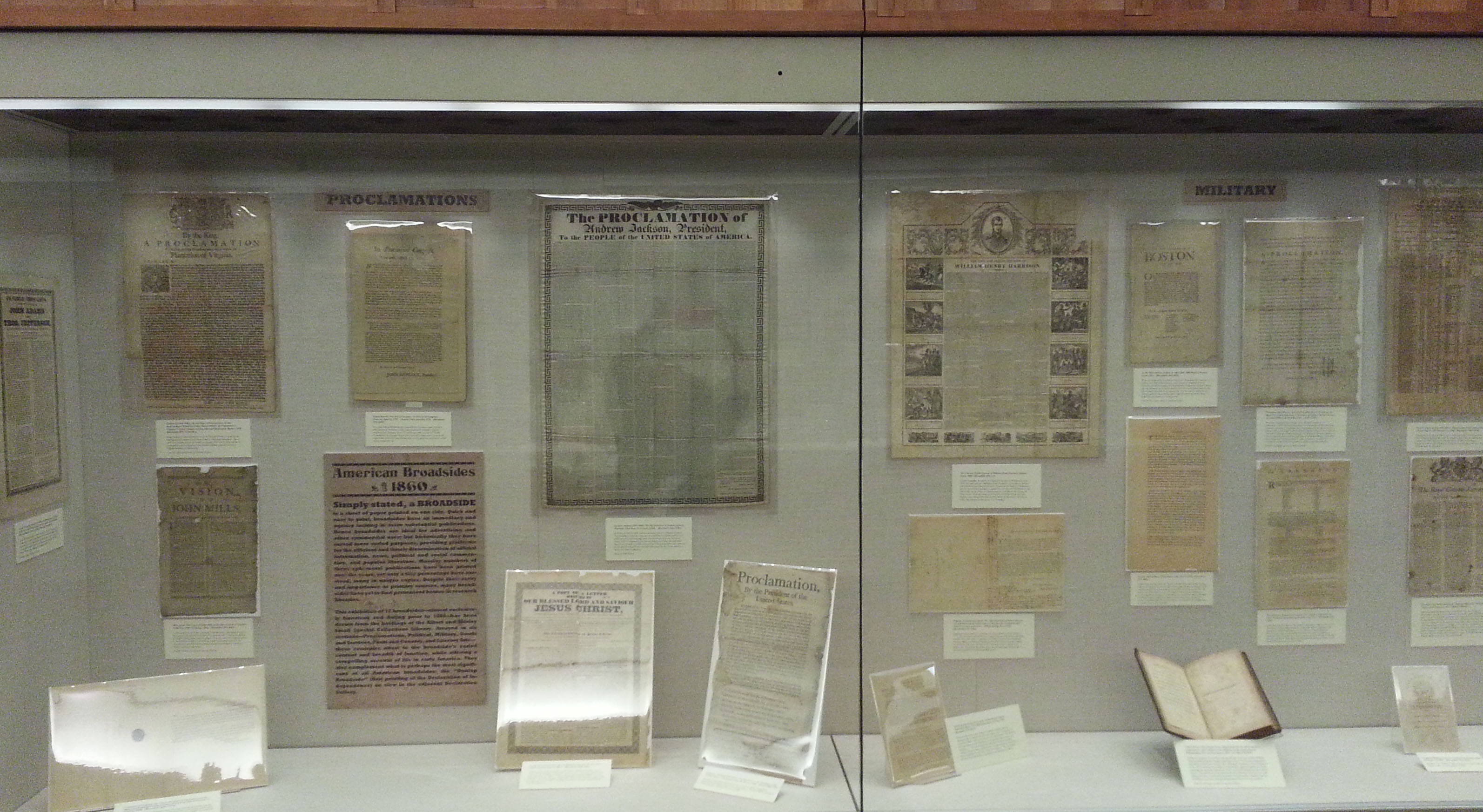
American Broadsides to 1860 features 72 broadsides—almost exclusively American and dating prior to 1860—drawn from the holdings of the Albert and Shirley Small Special Collections Library. Arrayed in six sections—Proclamations, Political, Military, Goods and Services, Town and Country, and Literary Arts—these examples attest to the broadside’s varied content and breadth of function, while offering a fascinating account of life in early America. They also complement what is perhaps the most significant of all American broadsides: the “Dunlap Broadside” (first printing of the Declaration of Independence) on view in the adjacent Declaration Gallery.” Text by David Whitesell from the exhibition’s introductory panel.

One case of the exhibition American Broadsides to 1860. Photograph by Petrina Jackson.

One case of the exhibition American Broadsides to 1860. Photograph by Petrina Jackson.

The following is a sampling of what you will find in each of the exhibition’s sections.

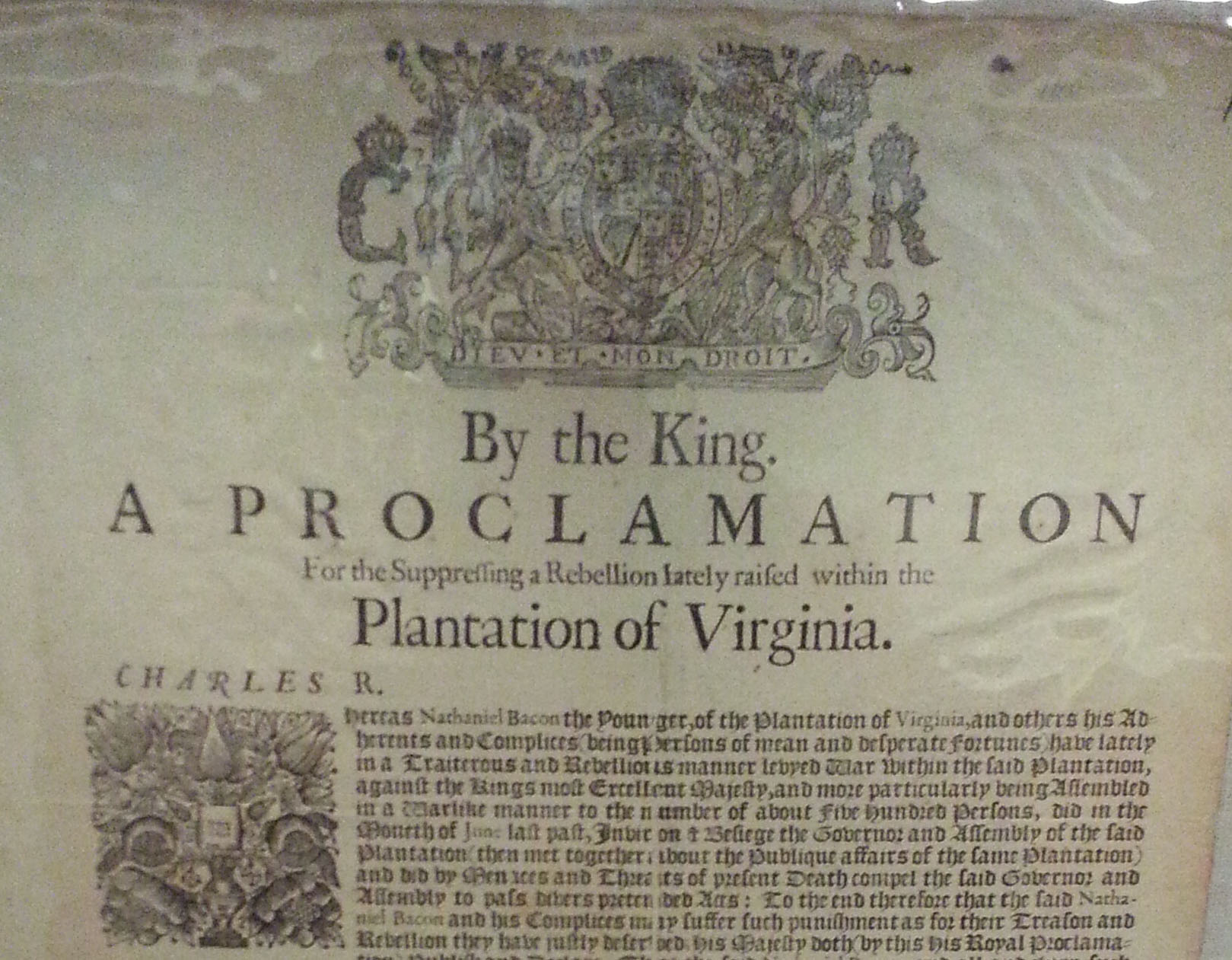
The earliest broadside on display is found in the “Proclamations” section. “By the King. A Proclamation for the Suppressing a Rebellion Lately Raised Within the Plantation of Virginia,” is King Charles II’s 1676 response to Nathaniel Bacon’s rebellion, which was raging in the fledgling Virginia colony.

Detail of By the King. (fill in). Photograph by Petrina Jackson.

Detail of Charles II (1630-1685). By the King. A Proclamation for the Suppressing a Rebellion Lately Raised Within the Plantation of Virginia. London: Assigns of John Bill and Christopher Barker, 1676. (Broadside 1676 .G744 S63). Photograph by Petrina Jackson.

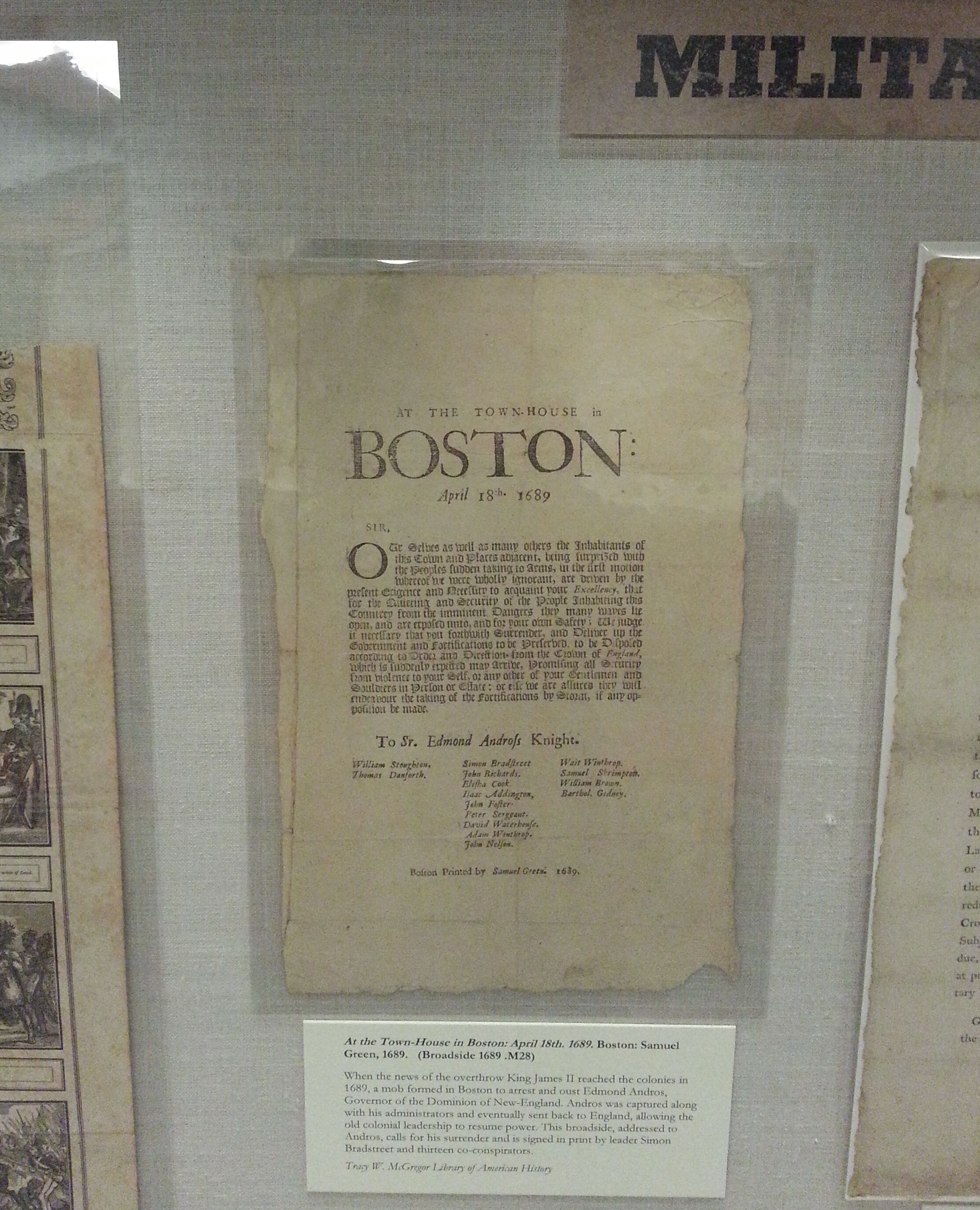
In the “Military” category, “Boston, 26th of June, 1775,” features a first-hand account, printed just nine days after the Battle of Bunker Hill, offering a somewhat rosy view of the catastrophic attempt to dislodge 1,200 colonial troops who had taken up positions in the hills surrounding Boston.

Boston. Photograph by Petrina Jackson

Boston, 26th of June, 1775. [Boston: John Howe, 1775] (Broadside 1775 .B67). Photograph by Petrina Jackson

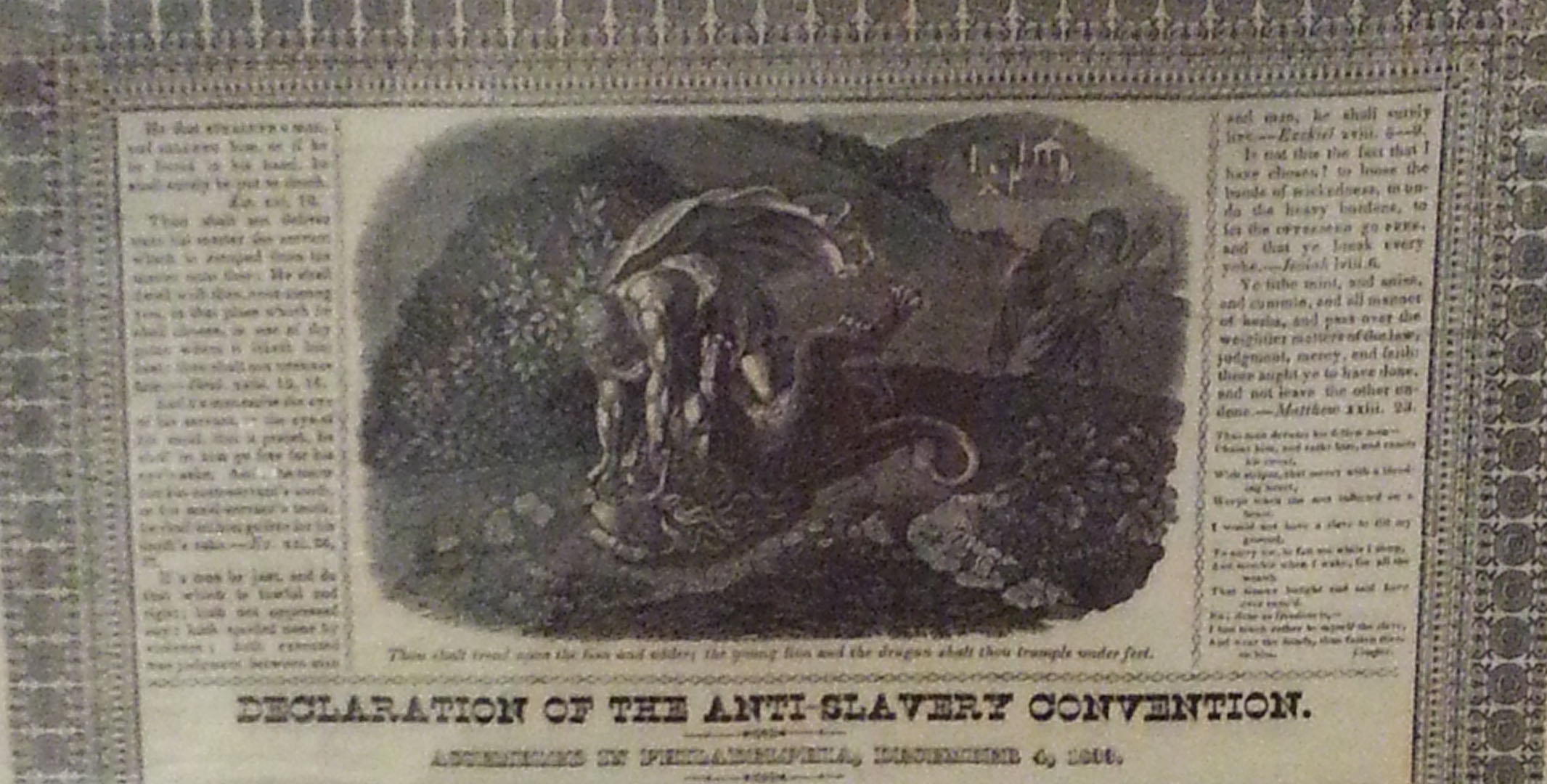
In the “Political” section, the “Declaration of the Anti-slavery Convention, 1833,” calls for the formation of a national anti-slavery society—henceforth to be known as the American Anti-Slavery Society—and lists the names of delegates from ten states.

Detail of Declaration of the Anti-slavery Convention. [Philadelphia] : Merrihew & Gunn, [1833] (Broadside .W54 Z99 1833). Photograph by Petrina Jackson.. Photograph by Petrina Jackson.

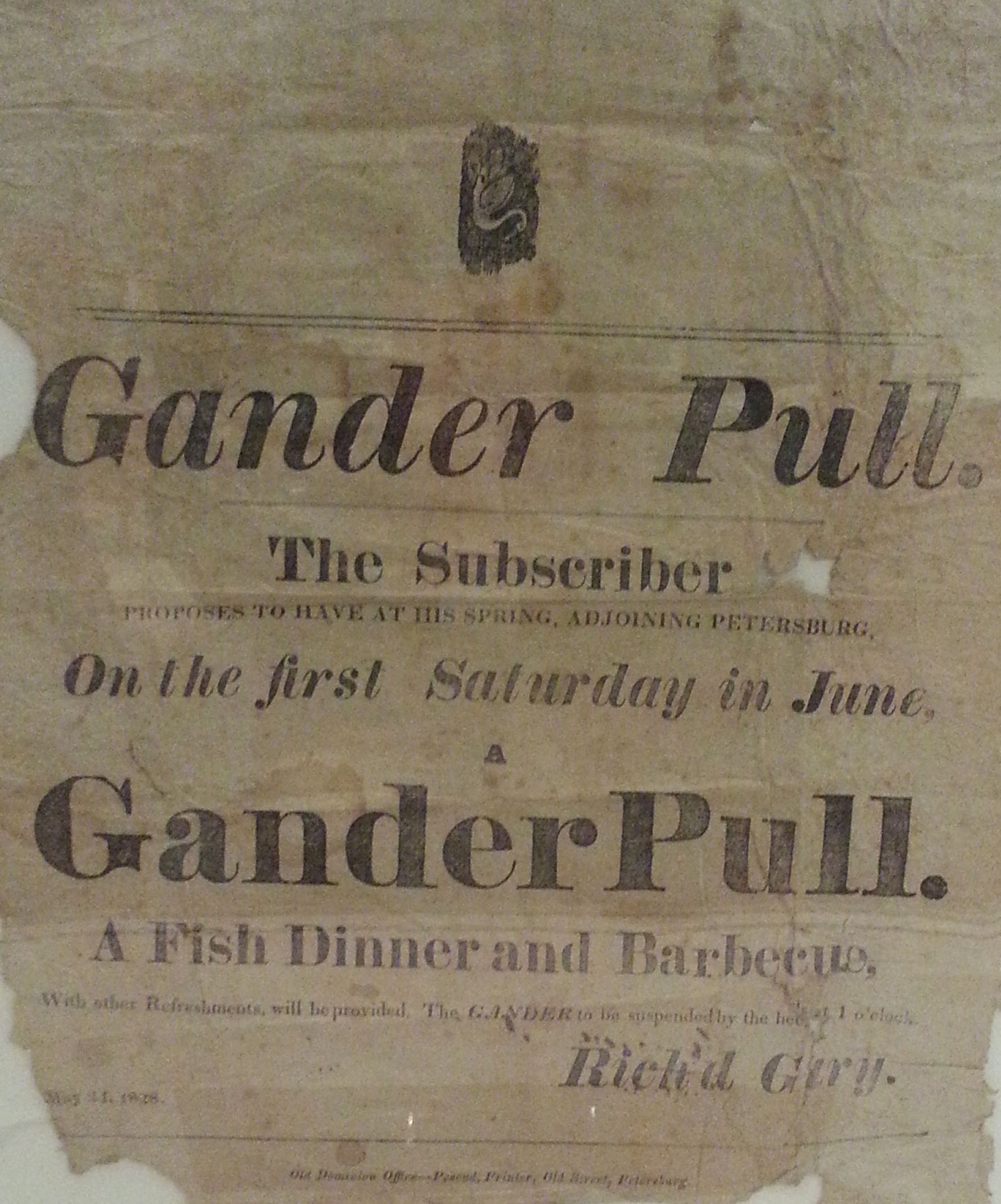
The “Farm and Country” category features an 1828 broadside advertising a Gander Pull outside of Petersburg, Virginia. A Gander Pull involves the hanging of a neck-greased goose upside down from a scaffold, whereby well-lubricated participants attempt to decapitate the bird as they ride past at full gallop. The event also featured a fish dinner and a barbecue.

Gander Pull. Photograph by Petrina

Gary, Rich[ar]d. Gander Pull. Petersburg [Va.]: Old Dominion Office, [1828] (Broadside 1828 .G27). Photograph by Petrina

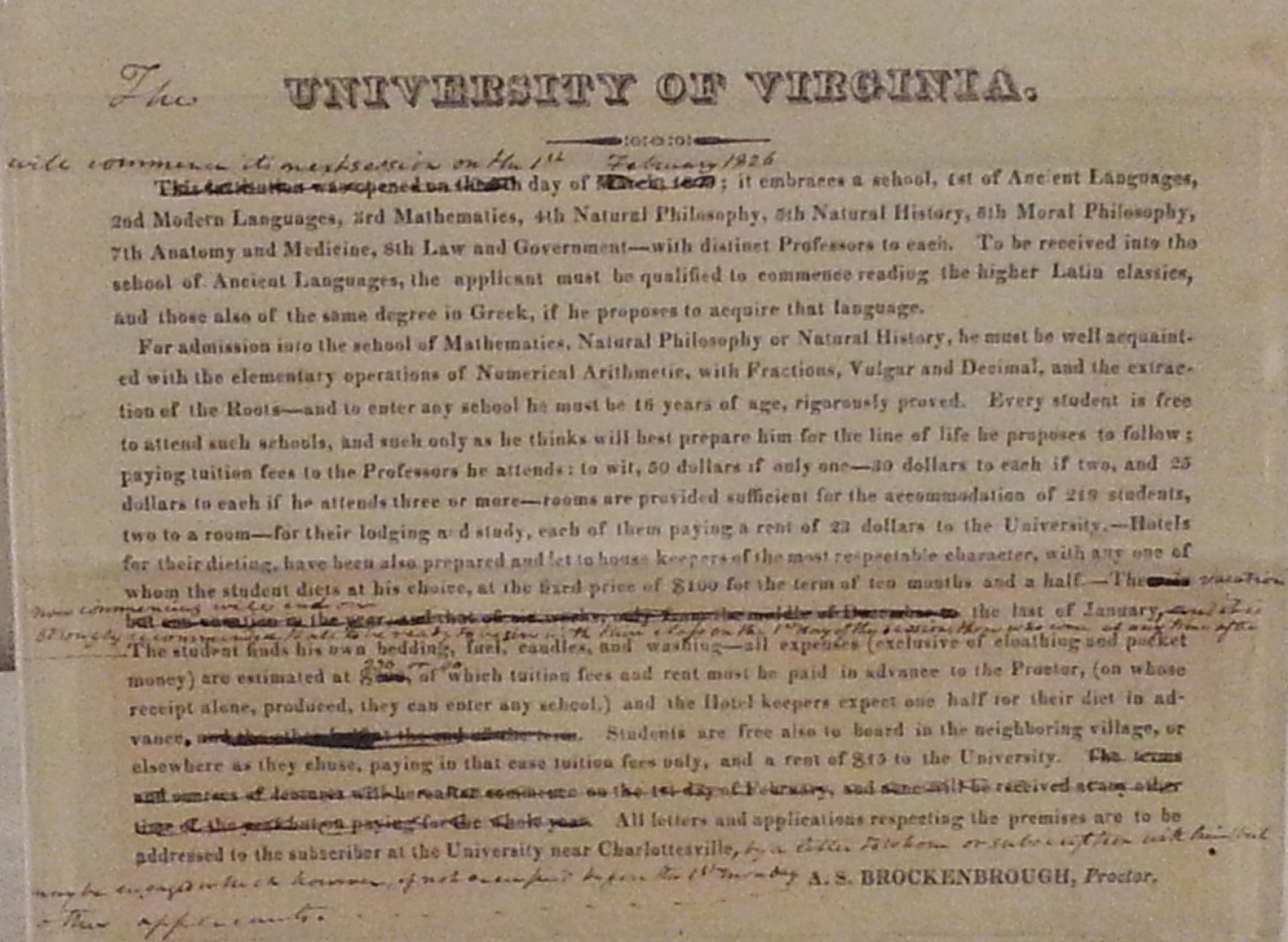
Two University of Virginia broadsides are found in the “Goods and Services” section: “Explanations, of the Ground Plan of the University of Virginia,” printed in Charlottesville in 1824. This broadside, printed to accompany Peter Maverick’s 1822 engraved “Plan of the University,” describes the pavilions, locations of the hotels, and the placement of the Rotunda, as well as the general layout of the only partly completed university Grounds. The 1825 program, “University of Virginia. This Institution Was Opened on the 5th Day of March, 1825,” was used to draft the text of the program for the second session of 1826. The first line—“This institution was opened on the 5th day of 1825”—is crossed out and changed in manuscript to read, “will commence its next session on the 1st day of February, 1826.” Other alterations indicate changes made for the second session.

University of Virginia. Photograph by Petrina Jackson.

University of Virginia. This Institution Was Opened on the 5th Day of March, 1825 … [Charlottesville: University of Virginia, 1825?] (Broadside 1825 .U65).. Photograph by Petrina Jackson.

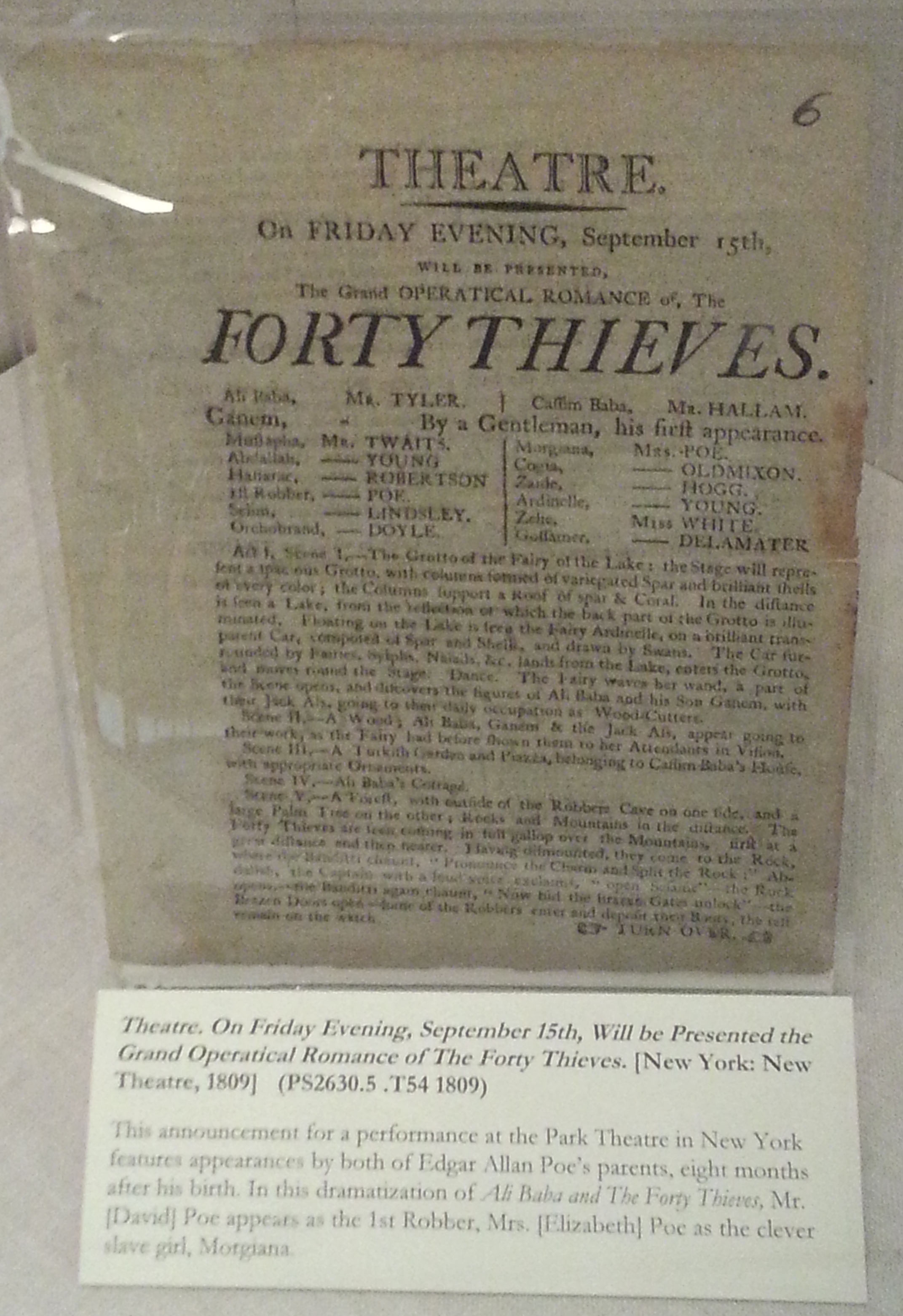
In the “Literary” section don’t miss, “Theatre. On Friday Evening, September 15th, Will be Presented the Grand Operatical Romance of The Forty Thieves.” This 1809 announcement for a performance at the Park Theatre in New York features appearances by both of Edgar Allan Poe’s parents, eight months after his birth. In this dramatization of Ali Baba and The Forty Thieves, Mr. [David] Poe appears as the 1st Robber, Mrs. [Elizabeth] Poe as the clever slave girl, Morgiana.

Forty Thieves. Photograph by Petrina Jackson

Theatre. On Friday Evening, September 15th, Will be Presented the Grand Operatical Romance of The Forty Thieves. [New York: New Theatre, 1809] (PS2630.5 .T54 1809). Photograph by Petrina Jackson

In addition, there are 64 other fascinating broadsides on display, each offering a unique and varied look at American culture in the seventeenth, eighteenth and nineteenth centuries. The exhibition may be viewed in the barrel-vaulted hallway on the first floor of the Harrision/Small building, just outside of the Albert and Shirley Small Declaration Gallery.


On View Now: The Lure of Italy

This week’s feature is a guest post by Kelly Fleming, Special Collections curatorial assistant and doctoral candidate in the U.Va. English Department.

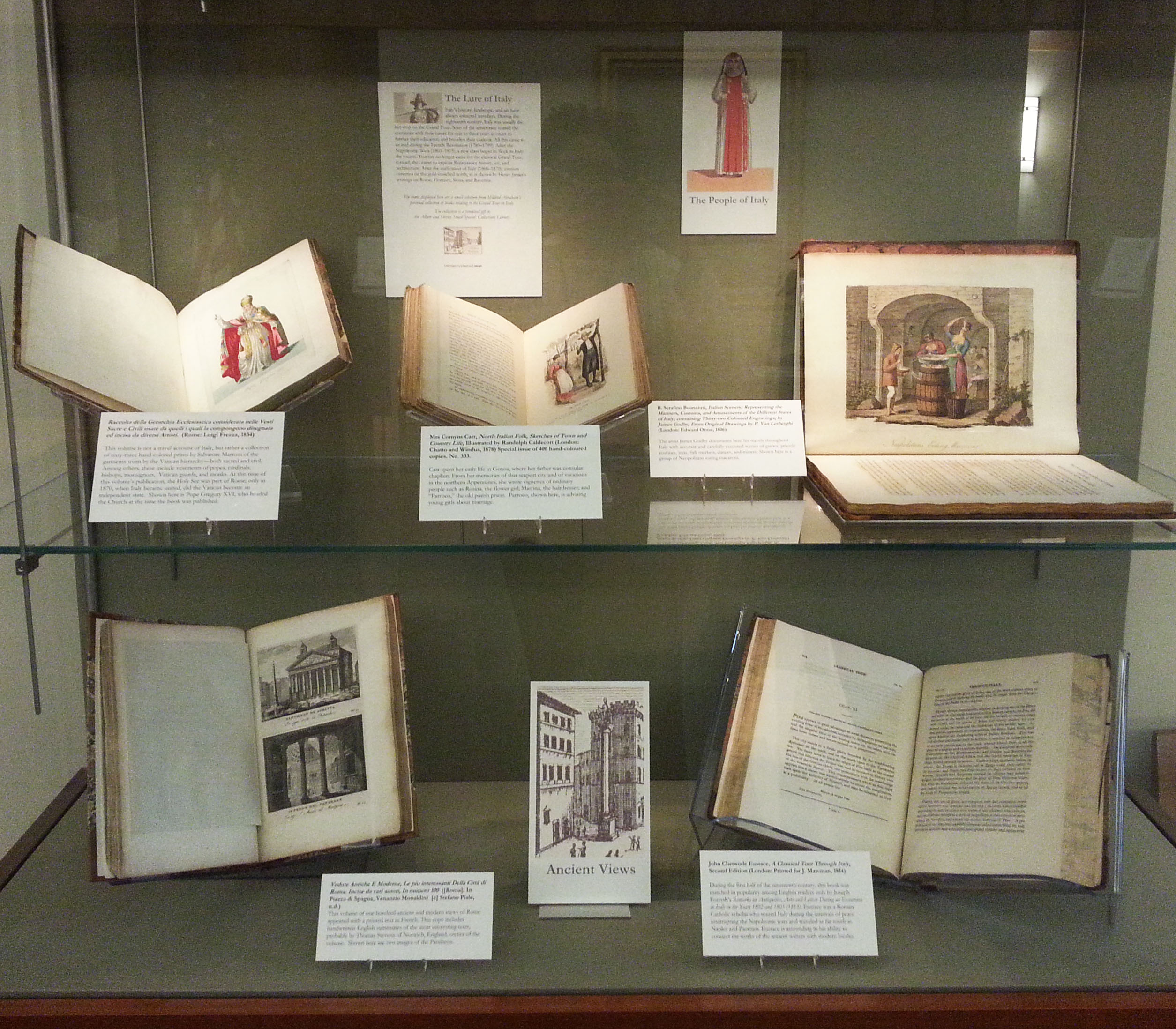
“The Lure of Italy,” an exhibition drawn from Mildred Abraham’s personal collection of rare books on the Grand Tour, offers viewers a chance to travel back in time to experience the Italy famous for its classical origins, Carnival, and banditti. During the eighteenth century, Italy was usually the last stop on the Grand Tour. Sons of the aristocracy toured the continent with their tutors for one to three years in order to further their education and broaden their outlook. With the advent of the neoclassical aesthetic in the eighteenth century, Italy was the perfect place to study the art and the architecture of the ancients.

Books featuring ancient views from the exhibition "The Lure of Italy." Photograph by Petrina Jackson.

Books featuring the people of Italy and ancient views from the exhibition “The Lure of Italy.” Photograph by Petrina Jackson.

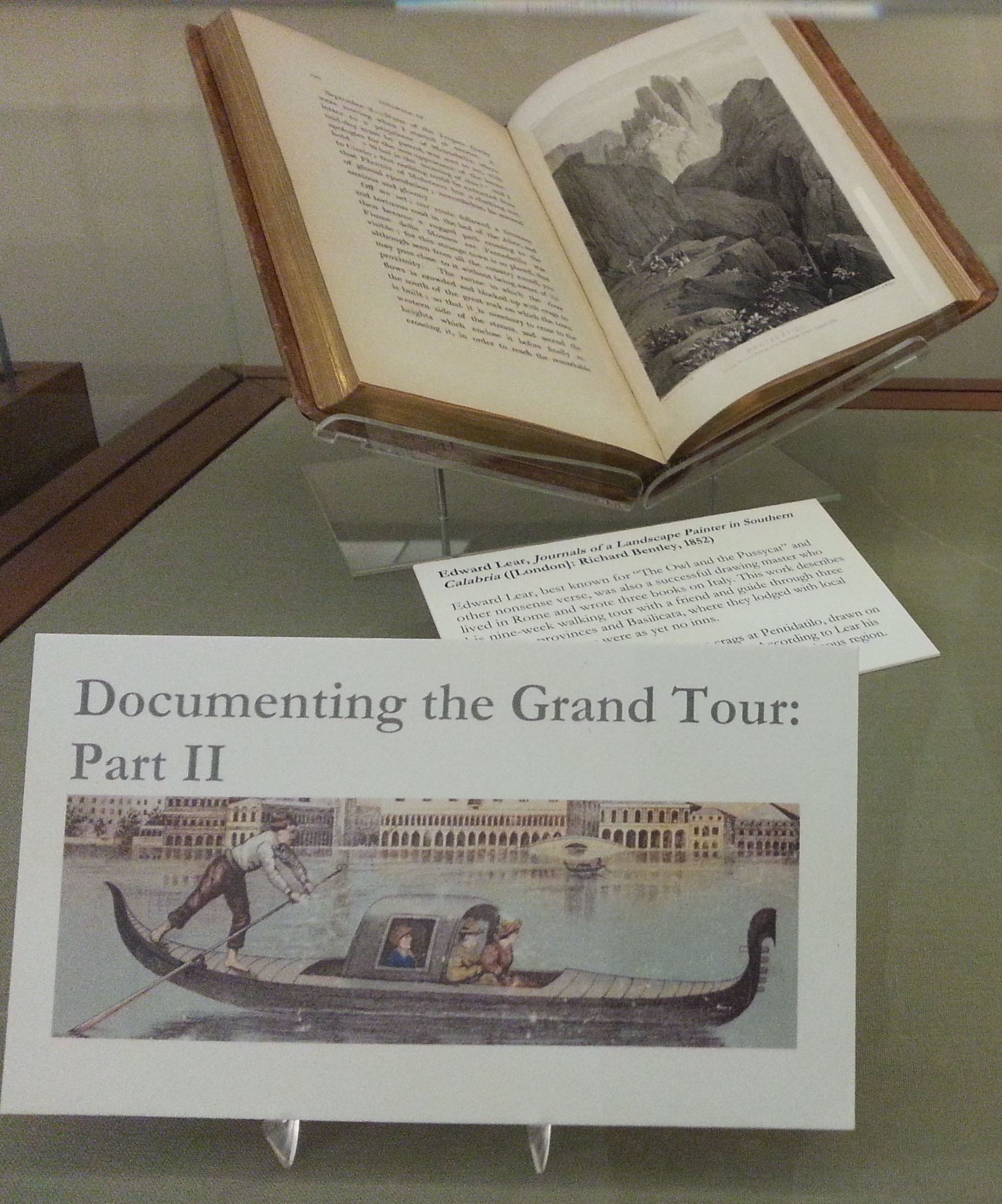
Detail from one of the exhibition cases. Photograph by Petrina Jackson.

Detail from one of the exhibition cases. Photograph by Petrina Jackson.

In addition to their studies, men on their Grand Tours frequently attended the extravagant celebration of Carnival, participating in masquerade balls and grand parades. All this came to an end during the French Revolution (1789–1799). After the Napoleonic Wars (1803–1815), a new class began to flock to Italy: the tourist. Tourists no longer came for the classical Grand Tour. They travelled to Italy to explore the history, art, and architecture of the Renaissance. Moreover, a new group of travellers began to regularly tour Italy in the nineteenth century: Americans. As Abraham’s collection attests, women also began to travel to Italy in order to broaden their horizons. Frequently both male and female tourists turned their experiences in Italy into fictional works, such as Henry James’s Daisy Miller (1879), whose sketch “Italian Hours” appears in the exhibit, and Elizabeth Williams Champney’s novel, Three Vassar Girls in Italy (1886). “The Lure of Italy” contains exciting visual and textual sketches of the people, traditions, and landscape of Italy over the course of three centuries.

“Gossip” from Mrs Comyns Carr, North Italian Folk, Sketches of Town and Country Life, Illustrated by Randolph Caldecott (London, Chatto and Windus, 1878). Image by Digital Production Group.

“Gossip” from Mrs Comyns Carr, North Italian Folk, Sketches of Town and Country Life, Illustrated by Randolph Caldecott (London, Chatto and Windus, 1878). Image by Digital Production Group.

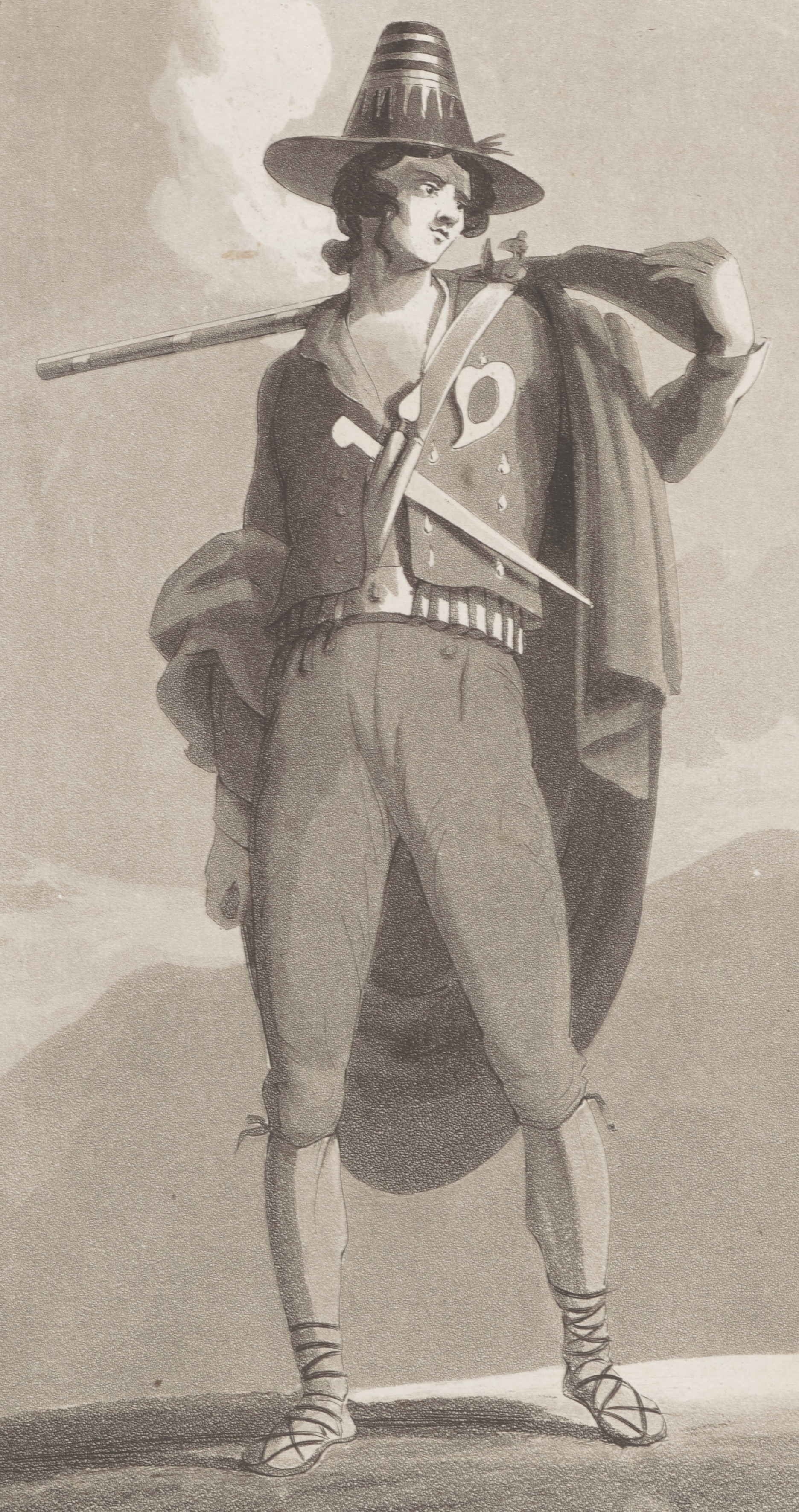
My favorite piece is a sketch of a rather dashing Italian bandit from Maria Graham’s Three Months Passed in the Mountains East Of Rome, During the Year 1819.

Maria Graham, Three Months Passed in the Mountains East Of Rome, During the Year 1819, Second Edition (London, Printed for Longman, Hurst, Rees, Orme, and Brown, 1821). Image by Digital Production Group.

Maria Graham, Three Months Passed in the Mountains East Of Rome, During the Year 1819, Second Edition (London, Printed for Longman, Hurst, Rees, Orme, and Brown, 1821). Image by Digital Production Group.

Mildred Abraham, a member of the prestigious Grolier club, was a Rare Books staff member for twenty-three years. Her collection contains hundreds of volumes on travel in Italy, ranging from the seventeenth through the early twentieth centuries. The bulk of her collection is described in Pine Coffin’s seminal work, The Bibliography of British and American Travel. Her collection, of which the exhibit is a small, but fabulous sampling, is a promised gift to the Albert and Shirley Small Special Collections Library.

Bookplate of Mildred K. Abraham. Image by Digital Production Group.

Bookplate of Mildred K. Abraham. Image by Digital Production Group.

If you need some Italian color to combat winter’s gray skies, or if you’ve ever wondered what it would be like to ride a tandem bicycle on your honeymoon through Italy, come see “The Lure of Italy” at Special Collections.

“The Lure of Italy” is on display on the first floor of the Harrison-Small building through December 31, 2015.


On View Now: Alice’s Adventures in Wonderland

This year marks the 150th anniversary of the first publication of Lewis Carroll’s Alice’s Adventures in Wonderland. Special Collections holds a collection of more than 1500 items related to this and Charles Dodgson’s other works, such as Through The Looking Glass and various works on logic and mathematics. The portion of the collection relating to Alice is the largest, and includes hundreds of editions as well as parodies, interpretations, and reimaginings of Alice’s adventures from all periods and in many different languages. This collection was built  by U.Va. Professor of Philosophy Peter Heath, who taught at the university from 1962 to 1995. His own book, The Philosopher’s Alice (1974), juxtaposes the novel’s text with Heath’s own philosophical commentary.

In honor of Professor Heath’s collection, undergraduate Wolfe Docent Susan Swicegood curated the mini-exhibition “Happy 150th Birthday, Alice!” Faced with the daunting prospect of selecting just a handful of items from the remarkable Heath collection, Susan decided to focus on how illustrators have envisioned the figure of Alice herself over the course of the book’s publishing history. She did a beautiful job, and has filled three exhibition cases with items to stimulate memories and artistic inspiration for all generations of Alice readers. Here are just a few examples to tempt you:

asdf

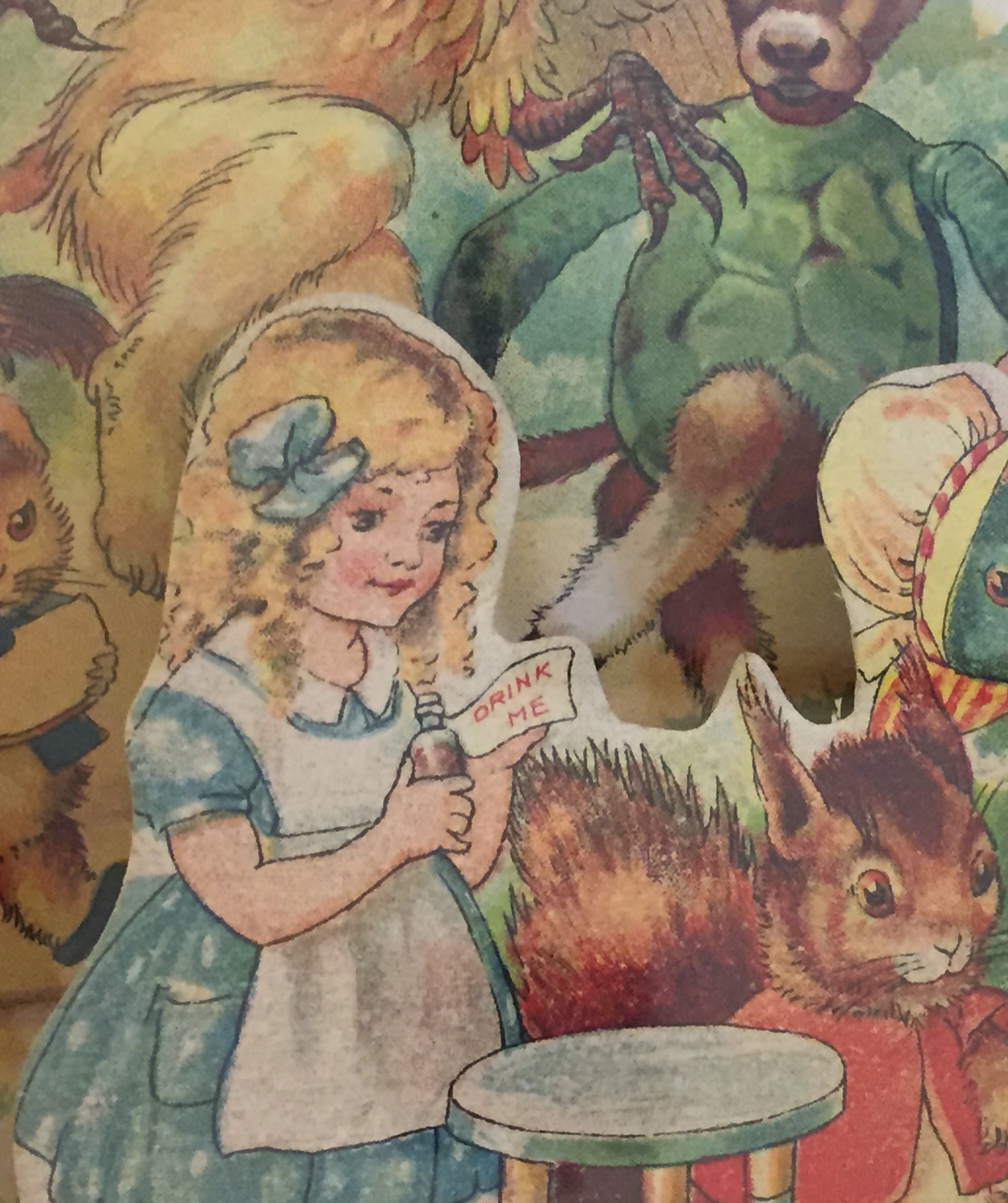
This detail comes from a pop-up edition advertised as a “come to life panorama.”  With her rosy cheeks and curly hair, this Alice looks more like a cherub than a curious Victorian child. Lewis Carroll, Alice’s Adventures in Wonderland, illustrated by A. L. Bowley. (London: Raphael Tuck, [1920s]). (PR 4611 .A7 1920b). Peter Heath Lewis Carroll Collection. Gift of Diana Salcedo and Philip Heath.

IMG_3502
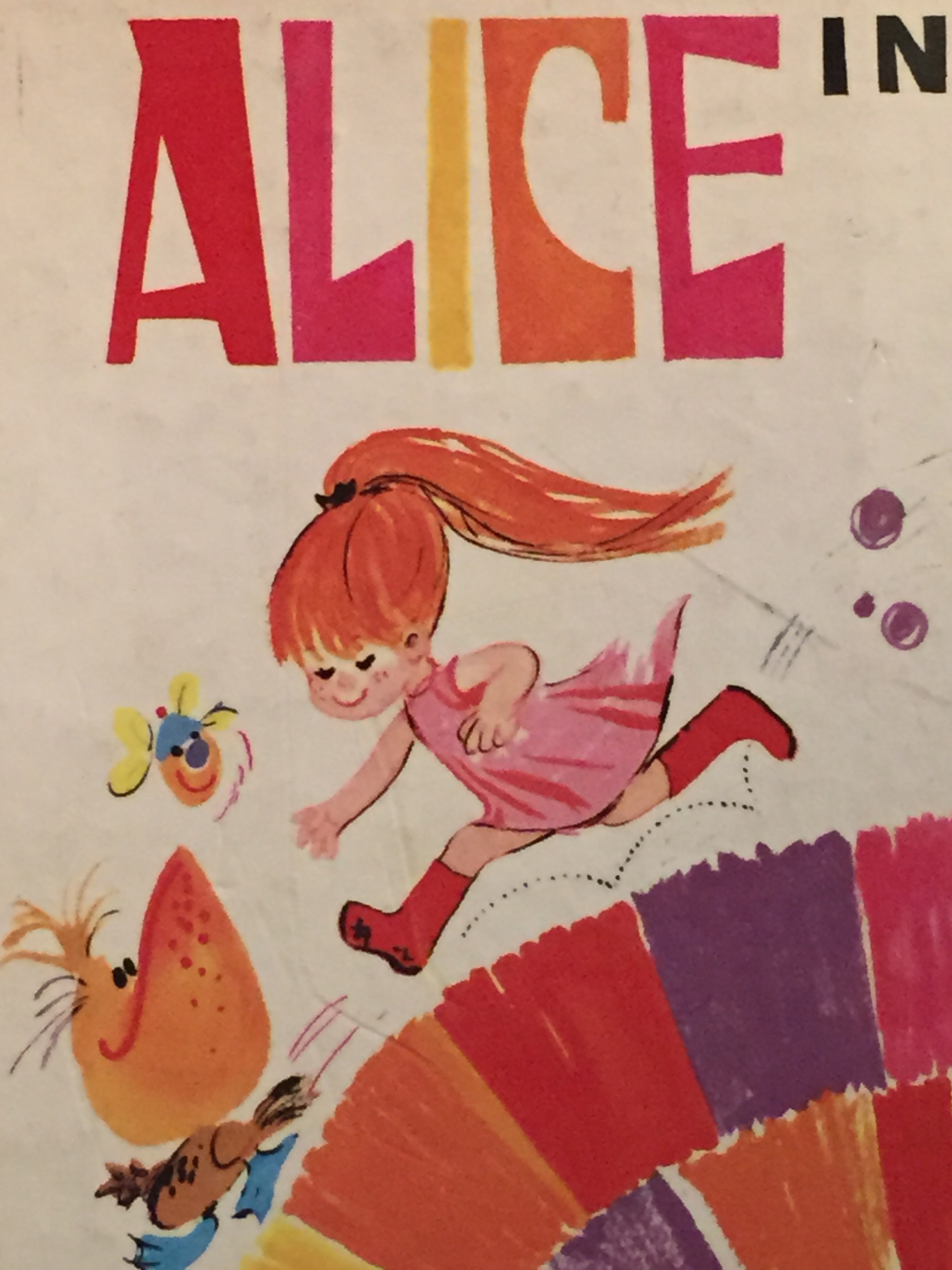
Alice parodies use the book’s playful structure as an avenue for political or social commentary. This space-age Alice no longer travels down a rabbit hole, but to a new planet. Renzo Rossott, Alice in 2000, illustrated by Grazia Nidasio. (London : Ward Lock Limited, [1970]) (PR4611 .A72 R68 1970). Peter Heath Lewis Carroll Collection.Gift of Diana Salcedo and Philip Heath.


asdf

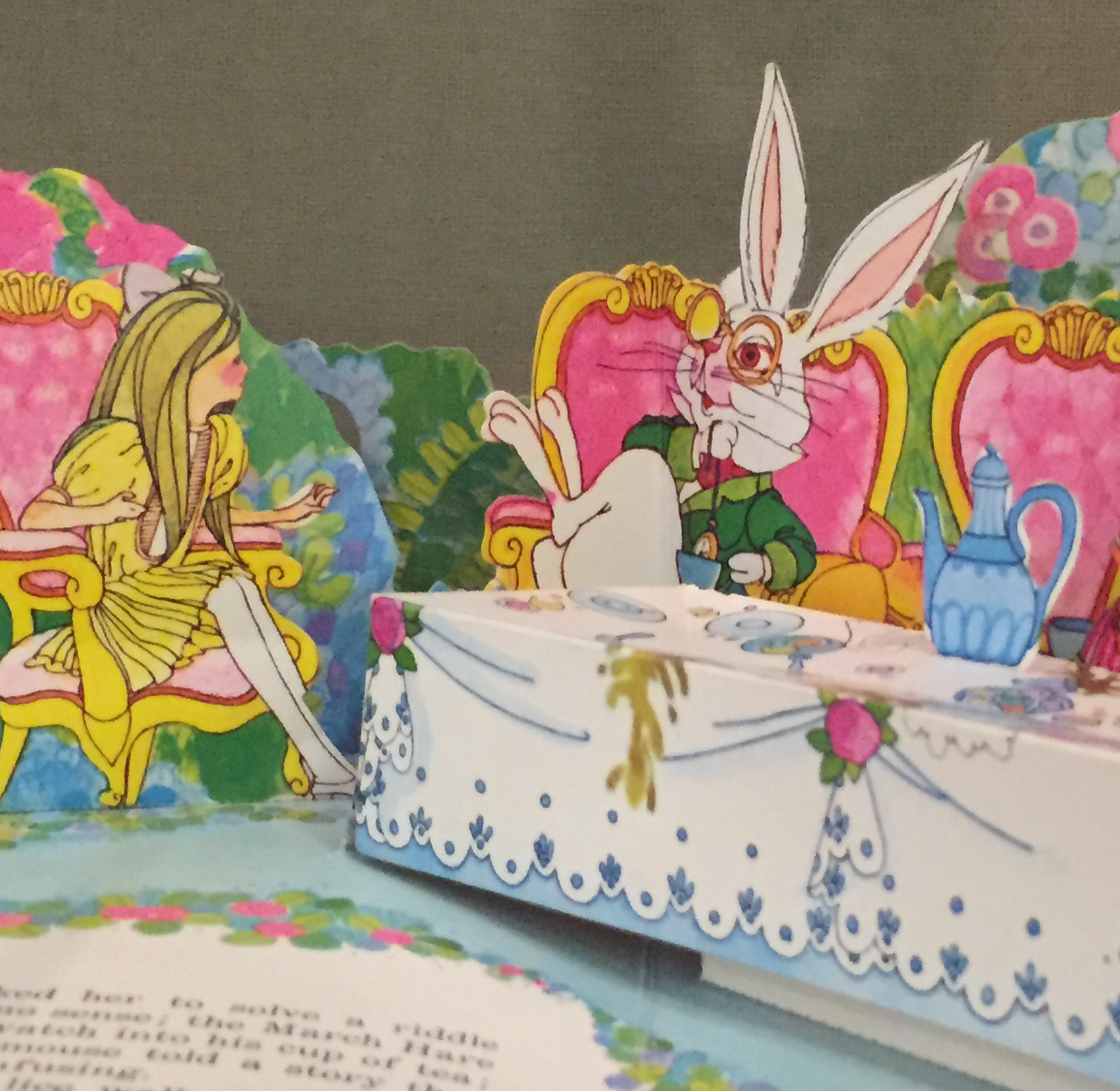
Alice got a big makeover in the 1970s, as modern printing techniques gave illustrators brighter and more dynamic colors that embody childish imagination, and finally giving Wonderland its psychedelic flair. This beautiful pop-up book displays a fabulous, hippie Alice at the Mad Hatter’s Tea Party. Lewis Carroll, Alice in Wonderland Retold by Albert G Miller, designed by Paul Taylor, illustrated by Dave Chambers, Gwen Gordon and John Spencer. (New York: Random house [1968]) (PR4611 .A72 M53 1968). Peter Heath Lewis Carroll Collection. Gift of Diana Salcedo and Philip Heath.

IMG_3500

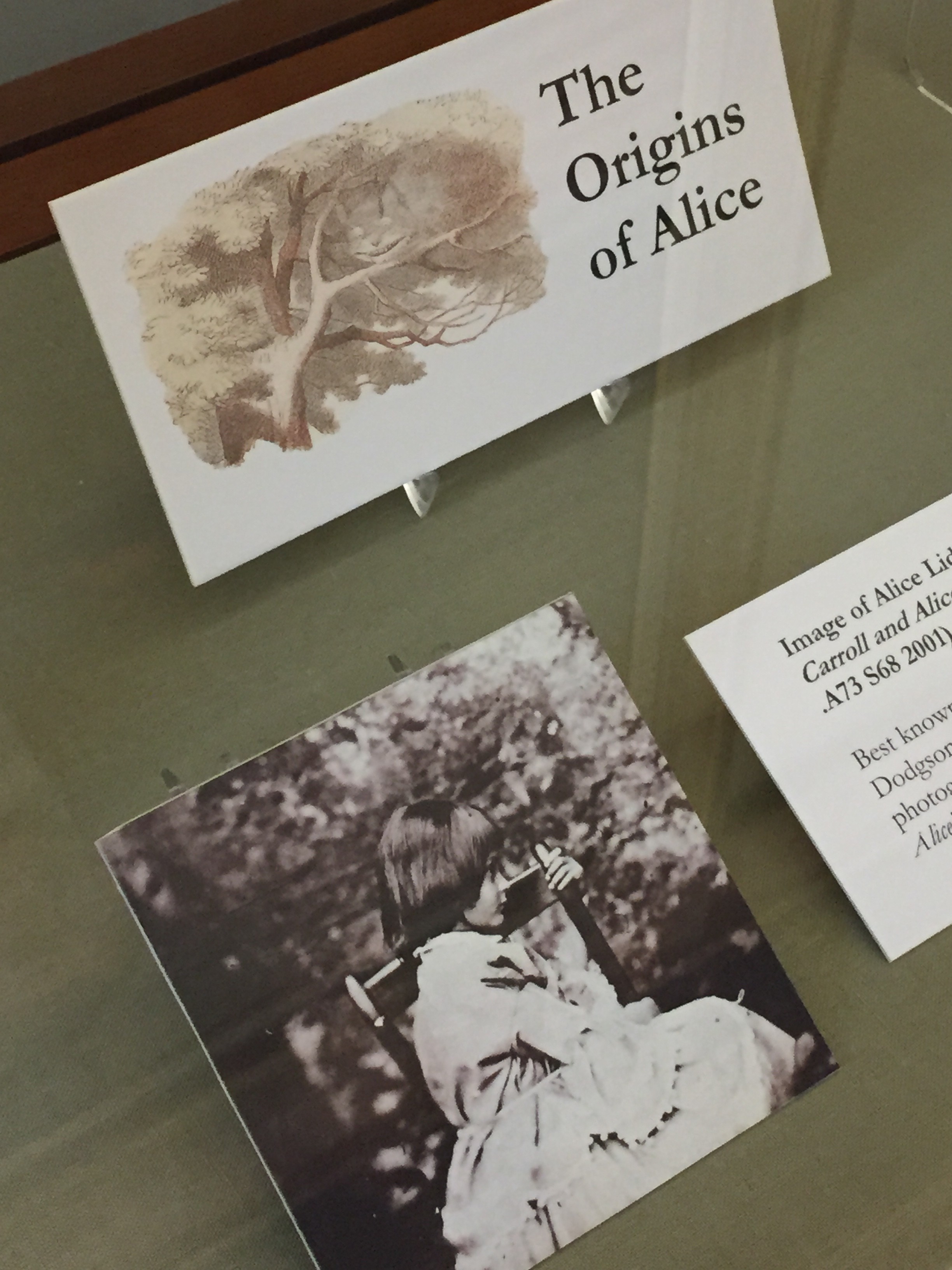
The exhibition is broken into three sections: “The Origins of Alice,” which looks at how Alice’s visual identity first emerged, “Alice in the Golden Age of Illustration,” focusing on the lavish aesthetic of the early twentieth century, and “An Alice for Every Generation,” looking at Alices from the 1960s through our own time, with examples ranging from the iconic Disney animation aesthetic to the edgy pen and ink imaginings of Ralph Steadman.


We encourage you to stop by and visit the exhibition, which is on view in the First Floor Gallery through September 18. It’s a visual feast–or should we say, tea party?


First Floor Exhibitions Explore Slavery and Abolition

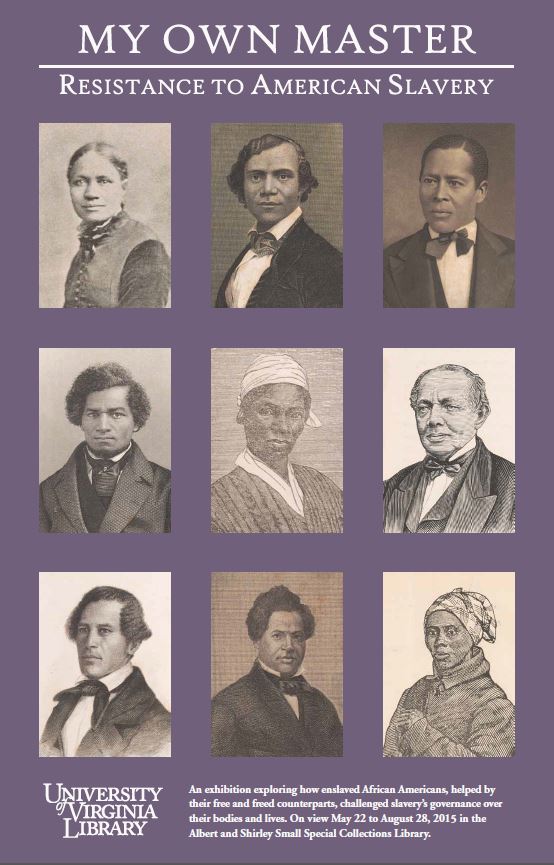
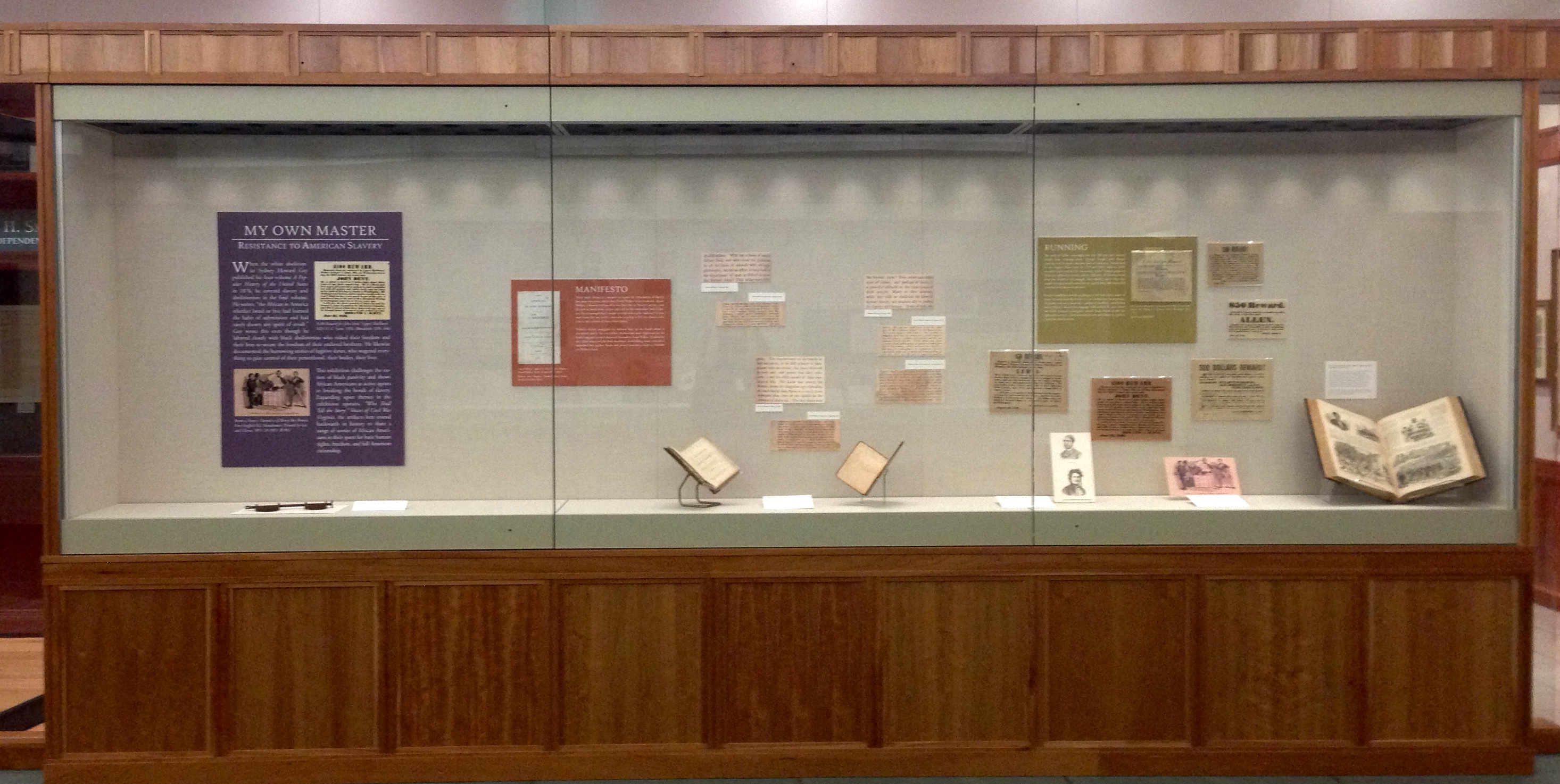
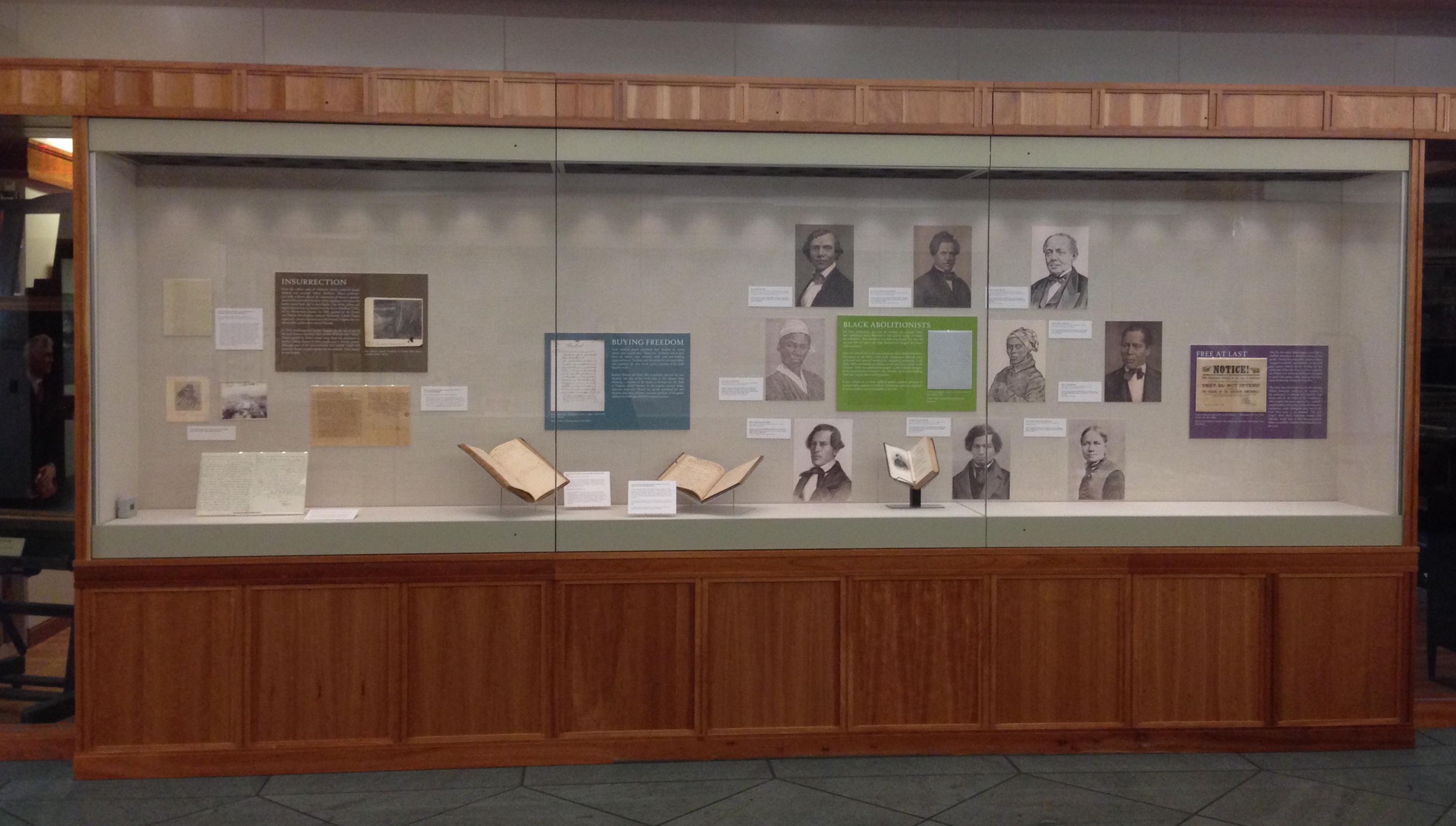
The Harrison/Small First Floor Gallery is excited to announce our two summer exhibitions: “My Own Master: Resistance to American Slavery” and the mini-exhibition “‘Read, Weep, and Reflect’: Creating Young Abolitionists through Uncle Tom’s Cabin.” Together these two exhibitions extend some of the themes explored in our Harrison Gallery exhibition, “Who Shall Tell the Story: Voices of Civil War Virginia. ”  Come in out of the heat and spend some time with these marvelous exhibitions. Some images to tempt you follow…

MoM_poster

The larger exhibition, “My Own Master,” is of particular note because it is the first exhibition in memory that the University of Virginia Library has mounted on the topic of slavery (a fact discovered in discussions with long-time Special Collections staff). Though artifacts relating to slavery have been included and the topic discussed in past exhibitions, slavery has not been the sole subject of an exhibition here.  We are very pleased to end that tradition this summer. Even more exciting, in 2018 we will mount a major exhibition on the topic of slavery at the University of Virginia in the Harrison Gallery, in support of the President’s Commission on Slavery and the University.

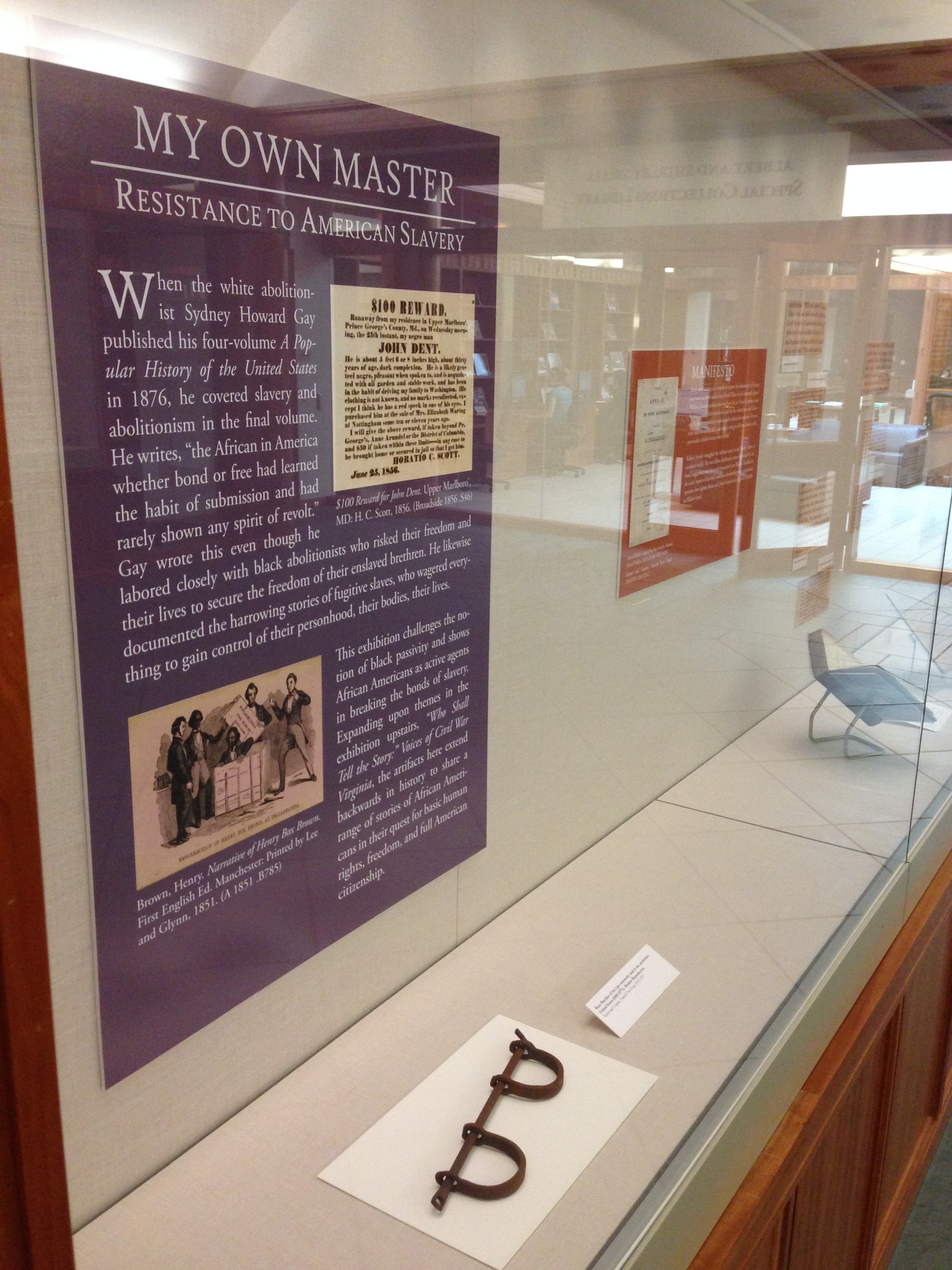
“My Own Master” showcases thirty remarkable items from the collections demonstrating some of the ways that blacks–slave, free, and freed–fought against slavery. Curator Petrina Jackson describes the exhibition’s project as follows: “When the white abolitionist Sydney Howard Gay published his four-volume A Popular History of the United States in 1876, he covered slavery and abolitionism in the final volume. He wrote, ‘the African in America whether bond or free had learned the habit of submission and had rarely shown any spirit of revolt.’ Gay wrote this even though he labored closely with black abolitionists who risked their freedom and their lives to secure the freedom of their enslaved brethren. He likewise documented the harrowing stories of fugitive slaves, who wagered everything to gain control of their personhood, their bodies, their lives. “My Own Master” challenges the notion of black passivity and shows African Americans as active agents in breaking the bonds of slavery.”

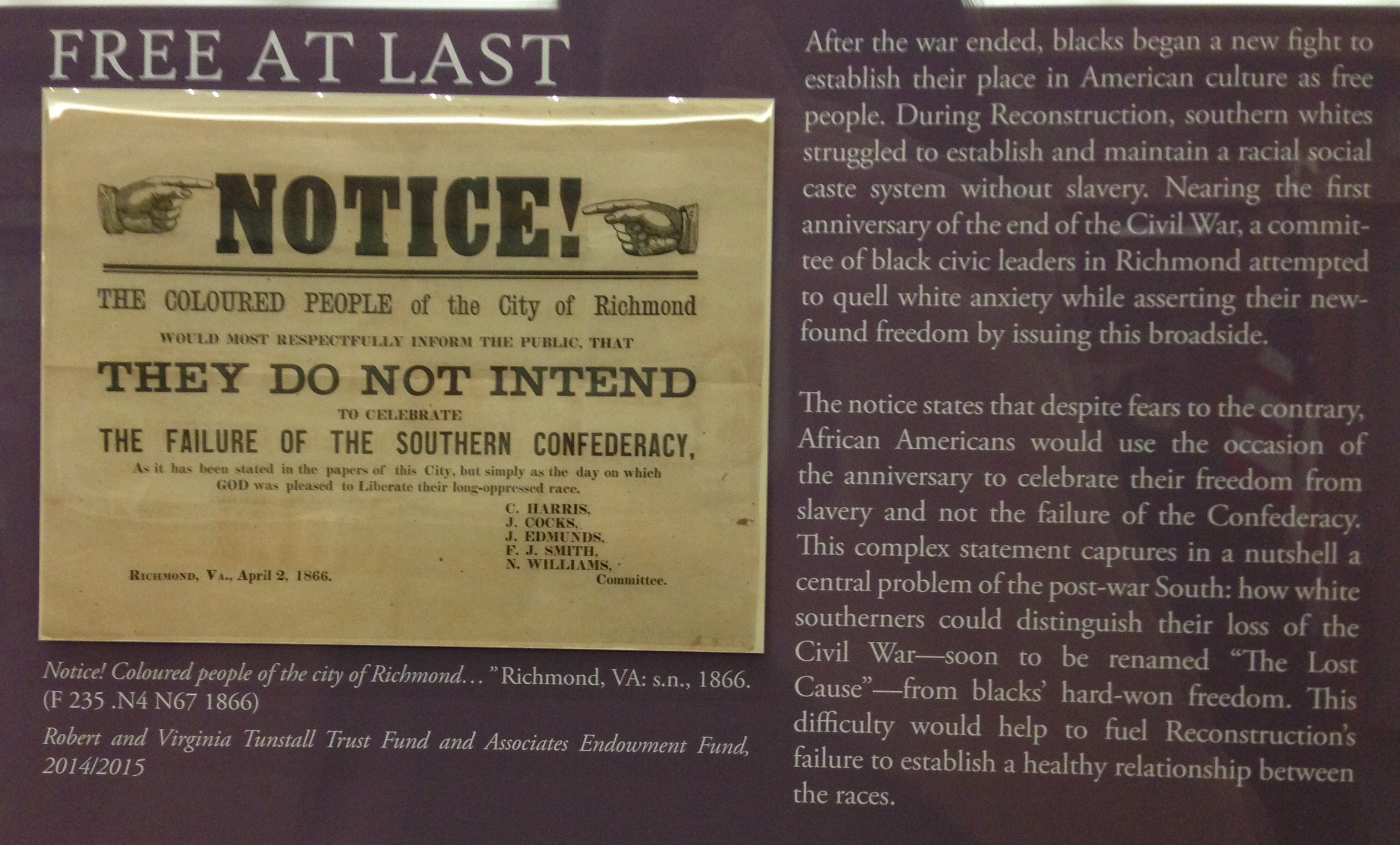
mom3The exhibition displays artifacts that document a variety of forms of rebellion: running away, planning insurrections, writing abolitionist works and manifestoes, and buying one’s own and one’s family’s freedom. It concludes with a recently acquired broadside printed by African-American leaders in Richmond a year after the city surrendered.

mom4

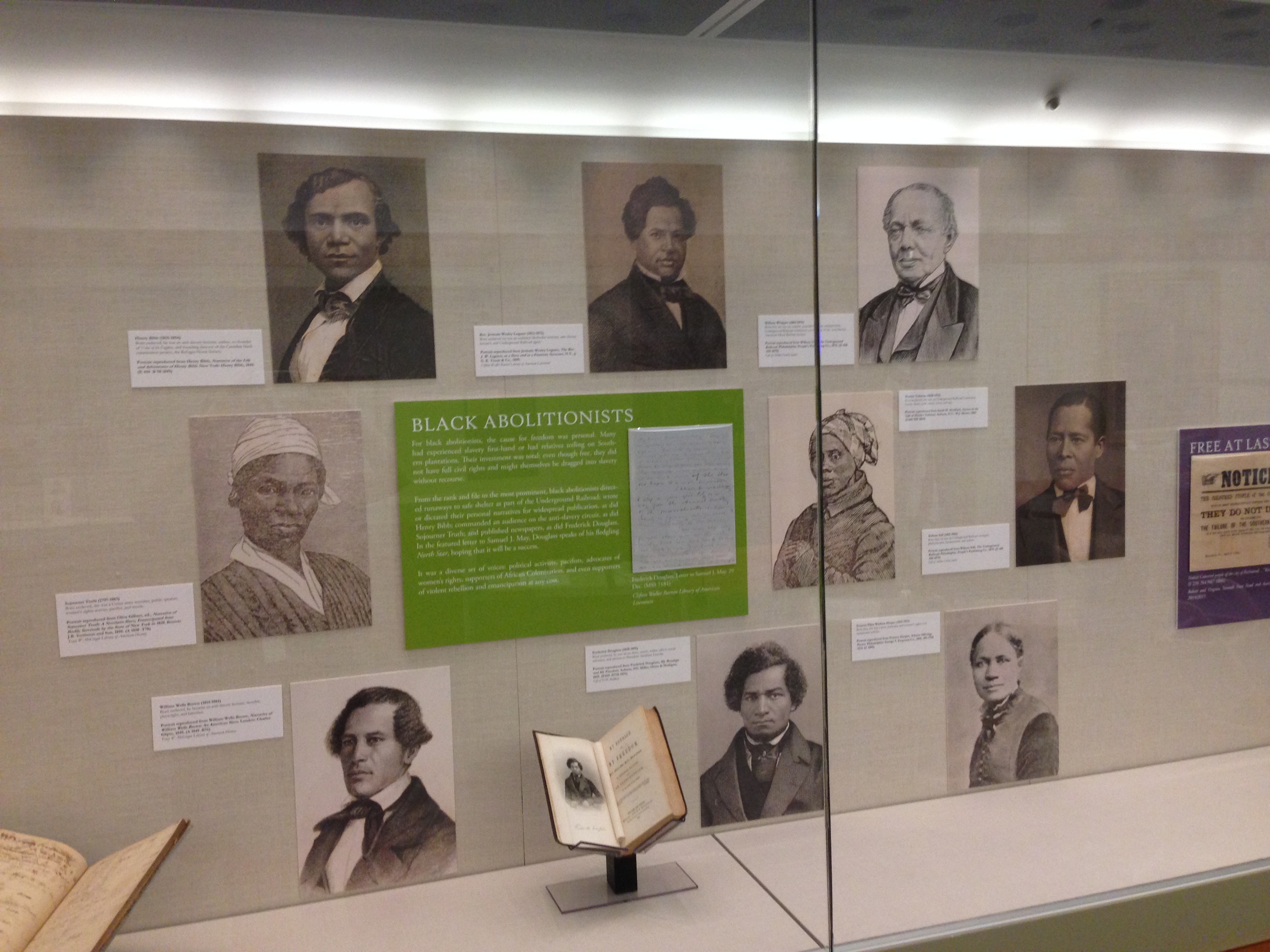
Portraits of black abolitionists from books in our collections are featured in the gallery and on the poster.

FullSizeRender (10)

mom1

mom2
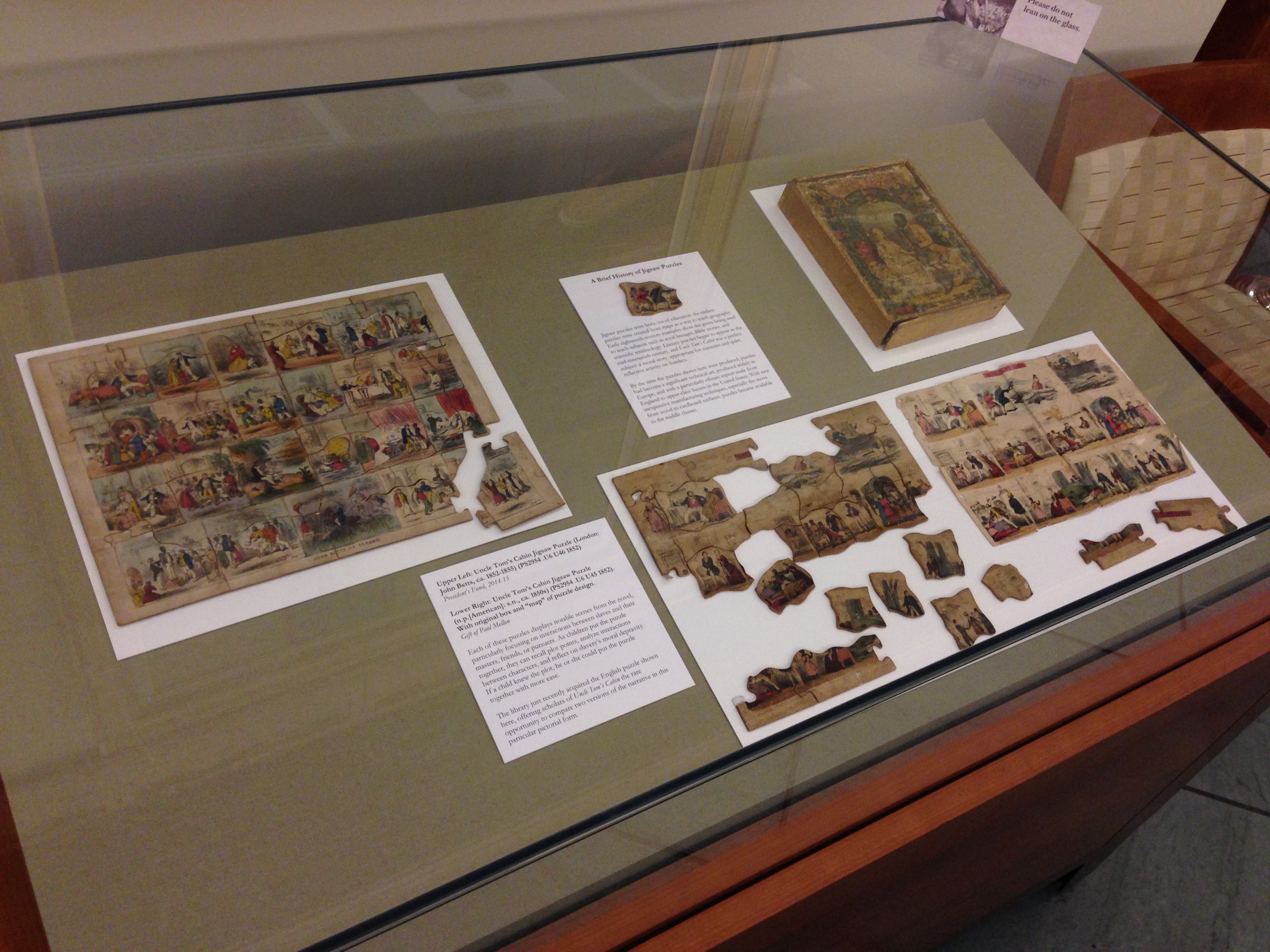
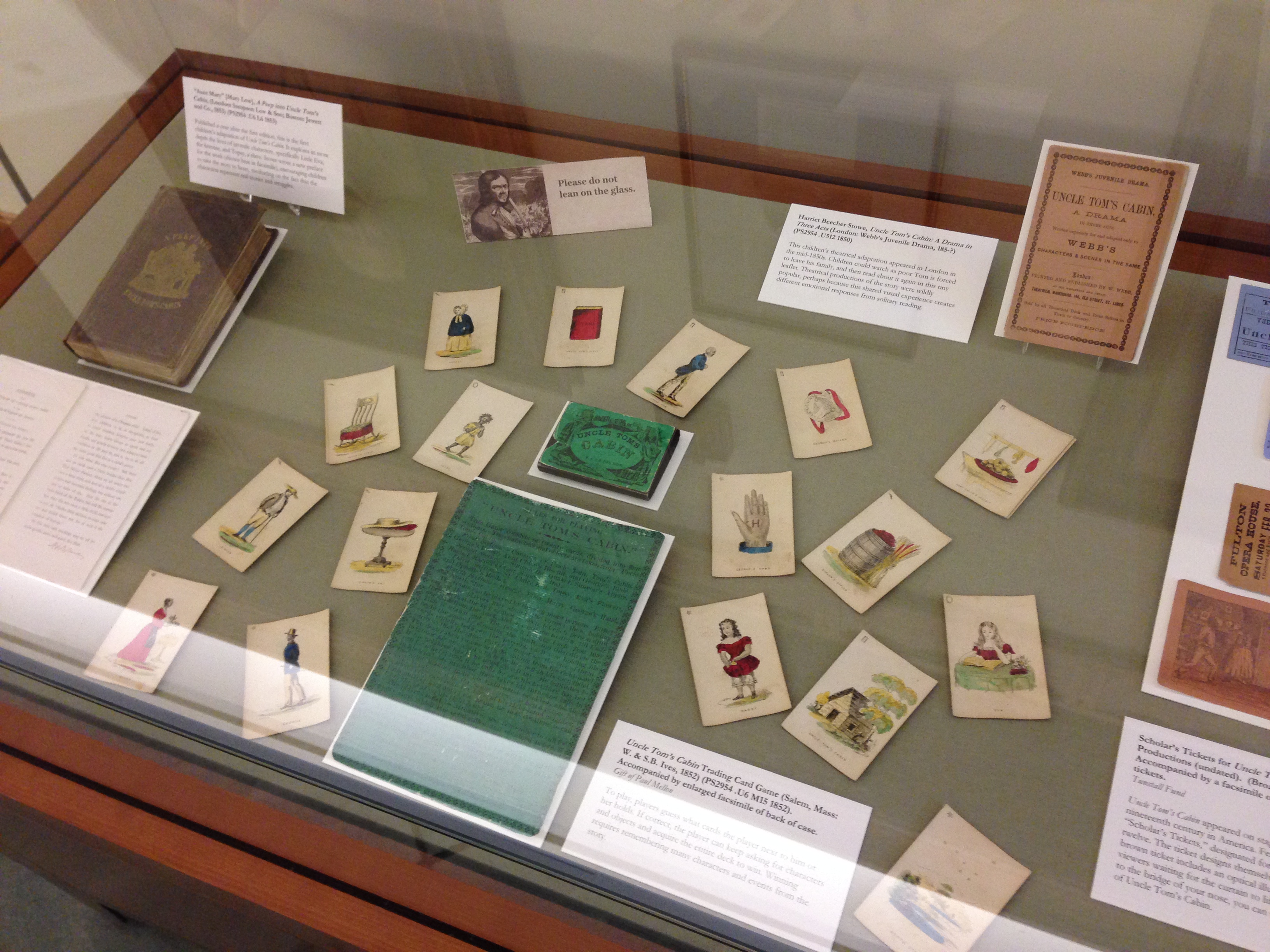
Our mini-exhibition, “Read, Weep, and Reflect: Creating Young Abolitionists through Uncle Tom’s Cabin” was curated by undergraduate Wolfe Docent Susan Swicegood (CLAS 2015, Curry 2016). Curator Molly Schwartzburg asked Susan to develop an exhibition around a recently acquired early puzzle about Harriet Beecher Stowe’s novel, which is our second such puzzle. Susan tracked down a wonderful range of children-related publications and “tie-in products” from the nineteenth century. It is not to be missed!

uncle1

The new puzzle is on the left.

uncle2

Games, theater tickets, and more!

uncle3Come on by and take a look!