Samuel V. Lemley Wins the National Collegiate Book Collecting Contest

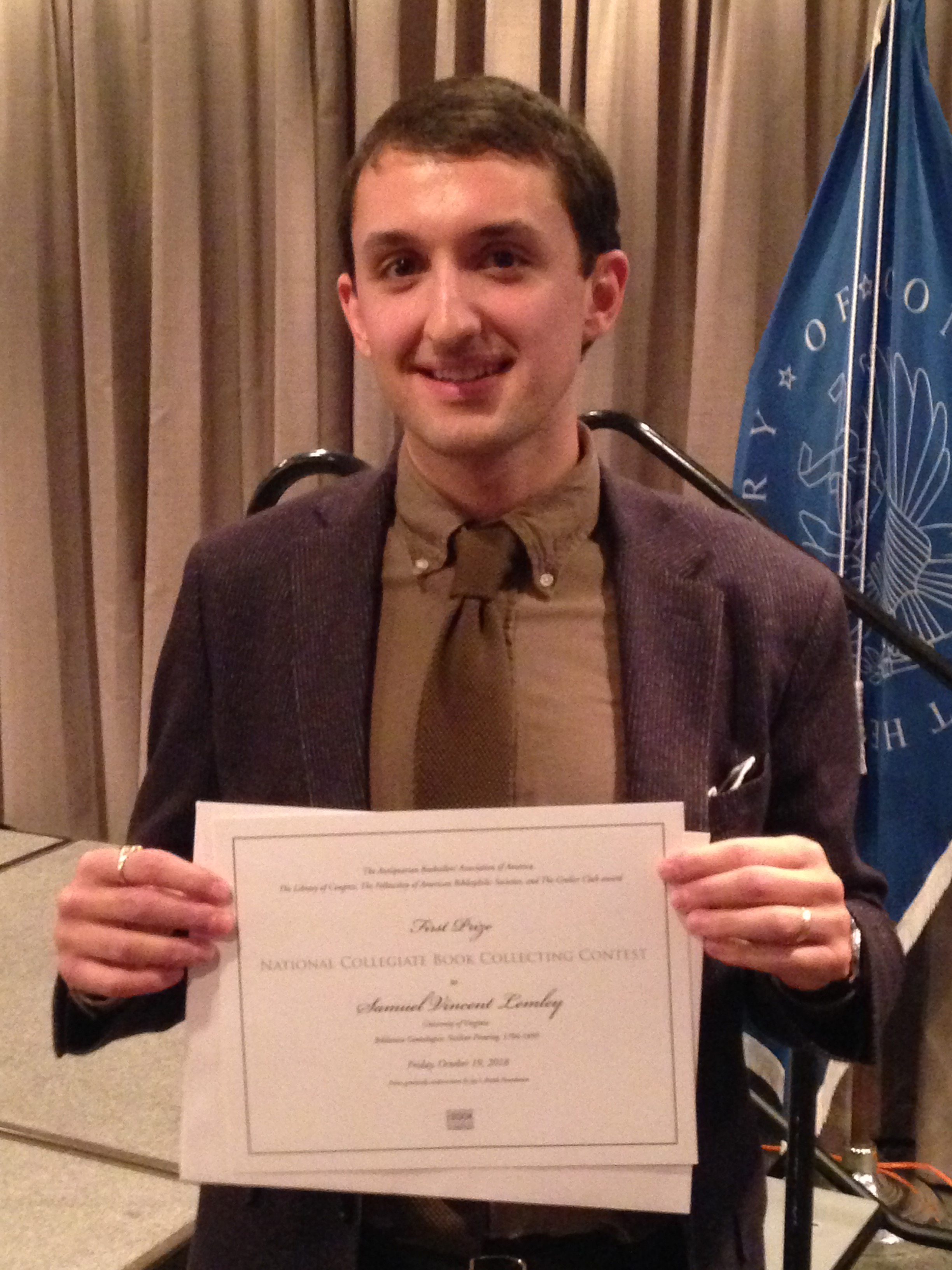
Samuel V. Lemley displays his 2018 National Student Book Collecting Contest First Prize certificate.

On Friday, October 19, bibliophiles from around the nation gathered at the Library of Congress for the presentation of the 2018 National Collegiate Book Collecting Contest awards. Established in 2005 to recognize bibliophilic excellence among American college and university students, the annual competition is open to the first place winners of the over 40 collegiate book collecting competitions held nationwide. The national contest is jointly administered by the Antiquarian Booksellers’ Association of America, the Fellowship of American Bibliophilic Societies, the Grolier Club, and the Library of Congress’s Center for the Book and Rare Books and Special Collections Division.

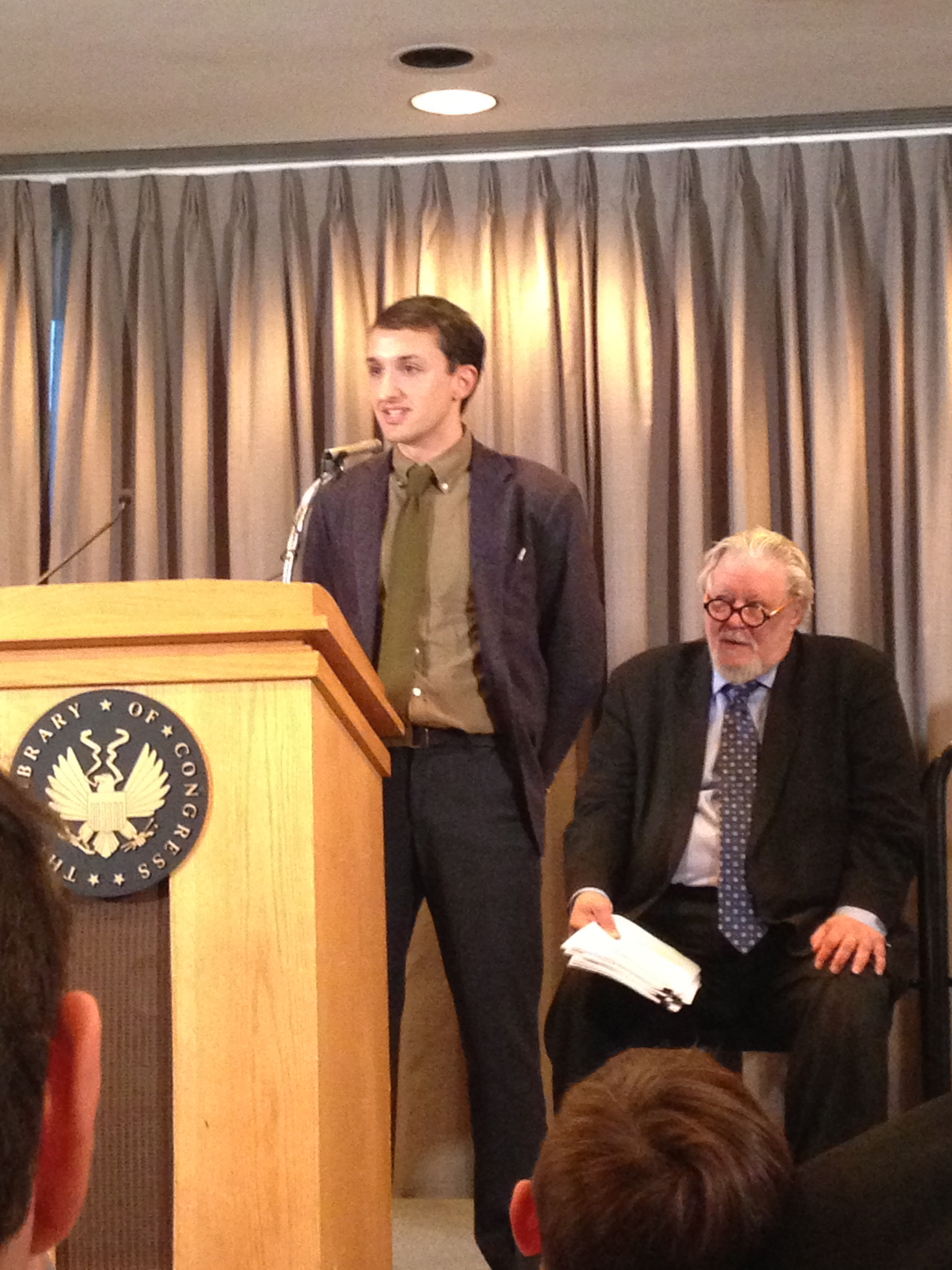
Samuel V. Lemley discusses his collection of Sicilian imprints at the awards ceremony for the 2018 National Student Book Collecting Contest. Seated behind is awards presenter Mark Dimunation, Chief of the Rare Book and Special Collections Division, Library of Congress.

This year’s First Prize winner is U.Va. doctoral candidate in English Samuel V. Lemley, whose entry, Biblioteca Genealogica: Sicilian Printing, 1704-1893, won the 52nd U.Va. Student Book Collecting Contest held earlier this year.  Several U.Va. Contest winners have won national awards in previous years, but Sam is the first to claim the top prize.  In addition to a cash award of $2,500, he will receive a year’s membership in the Grolier Club, the nation’s leading bibliophilic society.  Students from the University of Kansas, Harvard University, and Washington University also received national awards at the awards presentation in the Library of Congress’s Montpelier Room.

Visitors under Grounds may recall seeing highlights from Sam’s collection on display last spring in the First Floor corridor leading to the Special Collections Reading Room.  Special Collections was pleased to honor the winners of the 52nd U.Va. Student Book Collecting Contest–Samuel V. Lemley, James P. Ascher, and Philip M. Tan–by hosting an exhibition drawn from their collections.

The U.Va. Student Book Collecting Contest is one of many activities undertaken by the Bibliographical Society of the University of Virginia.  Watch their website for news of the 53rd U.Va. Student Book Collecting Contest!

How Borges Wrote: Symposium on the Creative Process of Jorge Luis Borges

Please join us on Tuesday, April 24, 2018, at 4:00 pm in the auditorium of the Albert and Shirley Small Special Collections Library for a special event marking the publication of an important new book on the great Argentine writer Jorge Luis Borges. The event is free and open to the public.

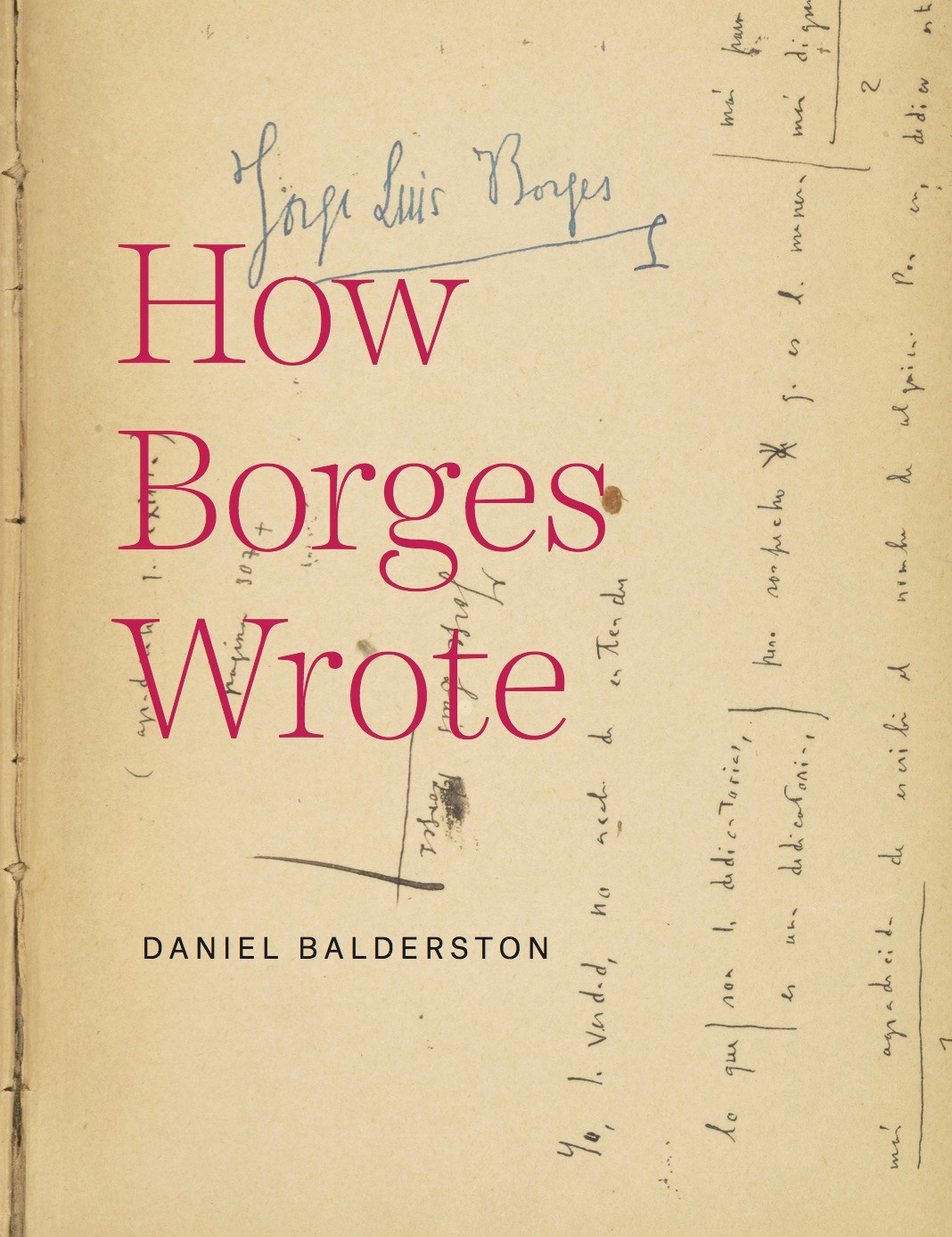
Cover of Daniel Balderston’s “How Borges Wrote” (University of Virginia Press, 2018)

This month the University of Virginia Press is publishing How Borges Wrote, a monograph by Daniel Balderston, Director of the Borges Center and Andrew W. Mellon Professor of Modern Languages at the University of Pittsburgh. Drawing on nearly four decades of research into Borges’s life and writings, and having examined nearly 200 of Borges’s surviving literary manuscripts, Balderston carefully explicates the complex process by which Borges composed and revised the short stories, essays, and poems that brought him worldwide fame.

Daniel Balderston

“How Borges Wrote” will feature presentations by Balderston and three other Borges scholars: Jared Loewenstein (founding curator of U.Va.’s Borges Collection), Nora Benedict (Princeton University), and María Laura Bocaz (University of Mary Washington).

The Albert and Shirley Small Special Collections Library holds one of the world’s best collections relating to Jorge Luis Borges, numbering over 1,100 printed works and including the largest holding of Borges manuscripts outside of Argentina. The collection was a major resource for Balderston while researching his book. Highlights from U.Va.’s Borges manuscript holdings will be on display during the event.

52nd U.Va. Student Book Collecting Contest Winners

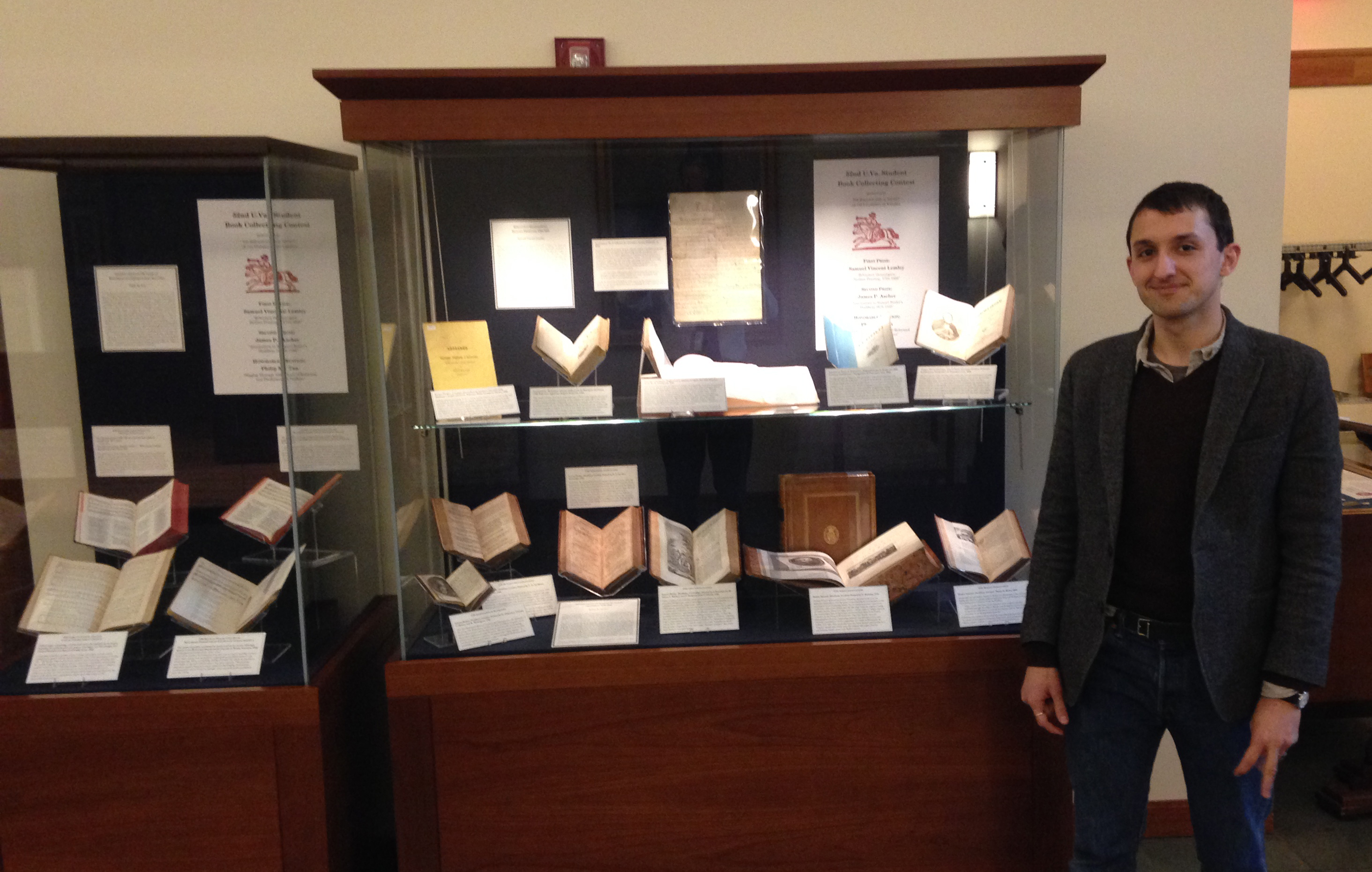
First prize winner Samuel V. Lemley with selections (top shelf) from his collection of Sicilian printing.

Winners of the 52nd U.Va. Student Book Collecting Contest were announced at the Bibliographical Society of the University of Virginia’s annual meeting on Friday, March 23, 2018 in the Auditorium of the Albert and Shirley Small Special Collections Library. The competition, sponsored by the Bibliographical Society, is a tradition dating back to 1948. It offers all U.Va. students a chance to showcase their personal book collections, and to win substantial cash prizes as well. Highlights from the winners’ collections were exhibited in our first floor exhibition gallery.

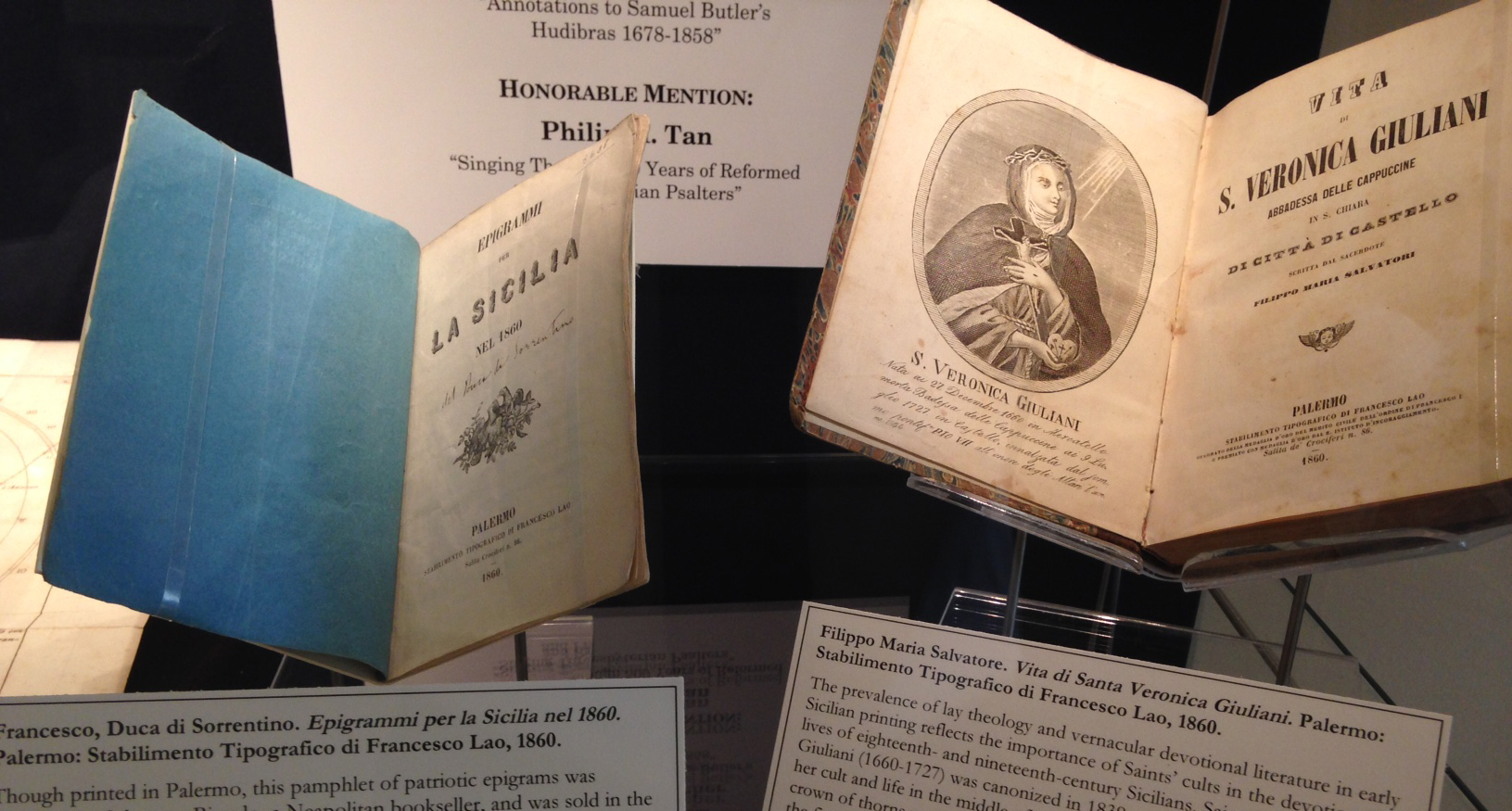
A closeup of two mid-19th century Sicilian imprints.

First prize was awarded to Samuel V. Lemley, a Ph.D candidate in the Dept.of English, for “Biblioteca Genealogica: Sicilian Printing, 1704-1893.”  Lemley’s collection “offers a representative sample of Sicilian printing and ephemera from the 18th and 19th centuries, a period in which my maternal ancestors lived in the Sicilian provinces of Palermo and Agrigento. The chronological limits, 1704 to 1893, reflect the years for which genealogical records (births, baptisms, and deaths) for the Militello and Marchese families survive: Gabriele Militello, my earliest documented ancestor, was born in Bivona in 1704; my great-grandfather, Pietro Marchese, was born in Pollina in 1893. These are the genetic bookends of my Sicilian family tree and the figurative bookends of this collection.” Lemley will represent U.Va. in this year’s National Collegiate Book Collecting Contest.

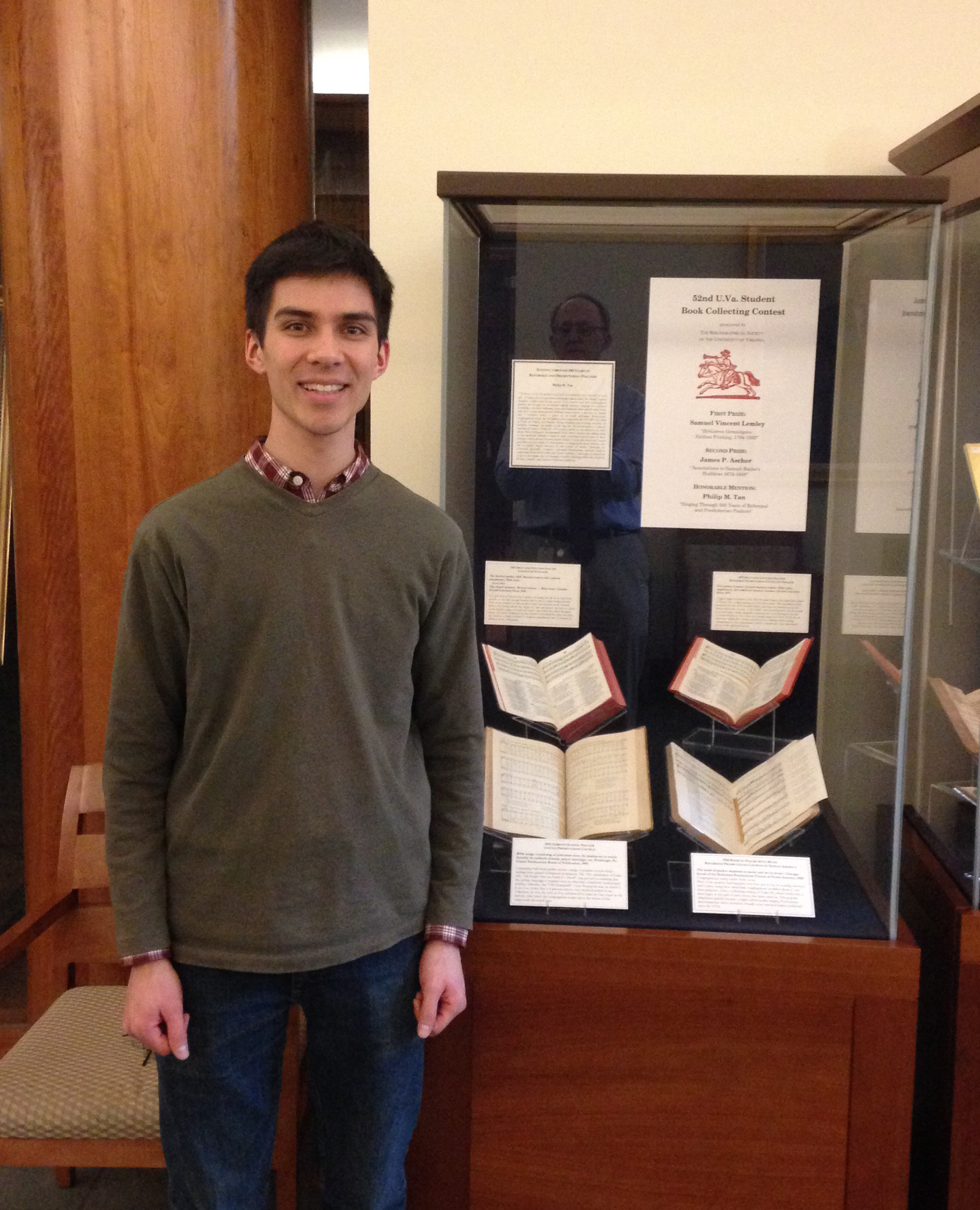
Honorable mention was awarded to Philip M. Tan, a fifth-year doctoral student in the Dept. of Biomedical Engineering, for “Singing Through 500 Years of Reformed and Presbyterian Psalters.”  Tan comments: “Unlike most books, meant to be merely read and contemplated, psalters are the gear for an intense athletic activity—singing! In a tradition extending over three millennia, Jews and Christians have united mind, body, and soul to sing these ancient Hebrew compositions, a practice my friends and I continue today. I grew up in small reformed Presbyterian congregations where the 150 psalms were sung from the 1973 RPCNA Book of Psalms for Singing, but we were always discovering new arrangements and adding them to our repertoire. Eventually I began purchasing other psalters, or begging the more obscure ones off of church music directors in the course of travels. Although the collection primarily comprises reformed Presbyterian metrical psalters originating from the Scottish and Dutch traditions, I am eager to expand its scope to encompass the rich heritage of psalm chanting within the Anglican, Roman Catholic, and Eastern Orthodox traditions.”

Philip M. Tan with selections from his collection of psalters.

Calling All U.Va. Student Book Collectors!

Since 1948 the Bibliographical Society of the University of Virginia has been pleased to sponsor a book collecting contest open to all U.Va. students. Originally held annually, and now biennially, the contest offers all students a chance to showcase their personal book collections, and to win substantial cash prizes as well. Entries are now being accepted for the 52nd U.Va. Student Book Collecting Contest. The deadline for submissions is February 12, 2018. Winners will be announced at the BSUVA’s annual meeting on Friday, March 23, 2018 n the Auditorium of the Albert and Shirley Small Special Collections Library.

To enter, students submit a list of items in their collection along with a short essay describing its contents and their objectives in forming the collection. Judges evaluate entries on the basis of the collection’s coherence of focus, method of collecting, progress made in forming the collection, and the quality of the descriptive essay. Collections are not judged on dollar value or size.

The first place winner receives a $1,000 cash prize and a $1,395 scholarship covering the full tuition for a Rare Book School course; the winner is also eligible to enter this year’s National Collegiate Book Collecting Contest. Prizes of $600 and $300 are awarded for second and third place respectively. In addition, eight local booksellers have generously contributed gift certificates to be distributed among the contest winners.

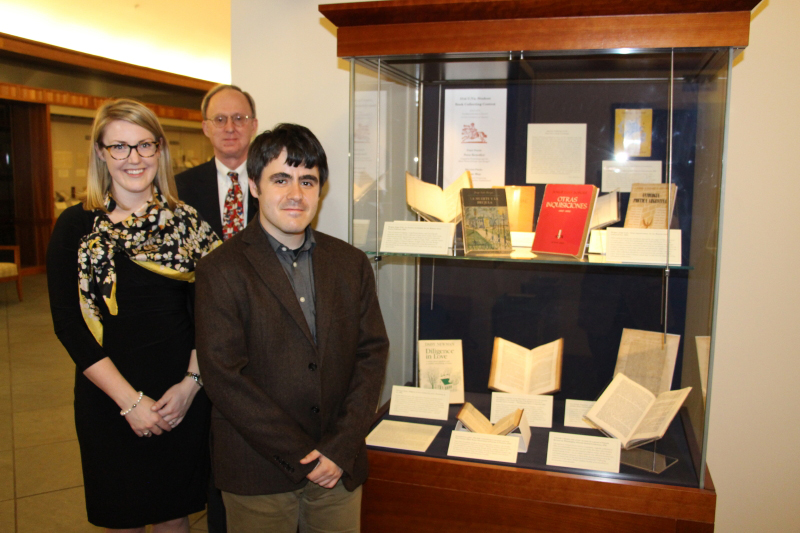
Winners of the 51st U.Va. Student Book Collecting Contest: Nora Benedict (at left) and Isaac May (at front), with contest judge David Whitesell. (Photo courtesy of David Vander Meulen)

Winners of the 51st U.Va. Student Book Collecting Contest: Nora Benedict (at left) and Isaac May (at front), with one of the contest judges David Whitesell. (Photo courtesy of David Vander Meulen)

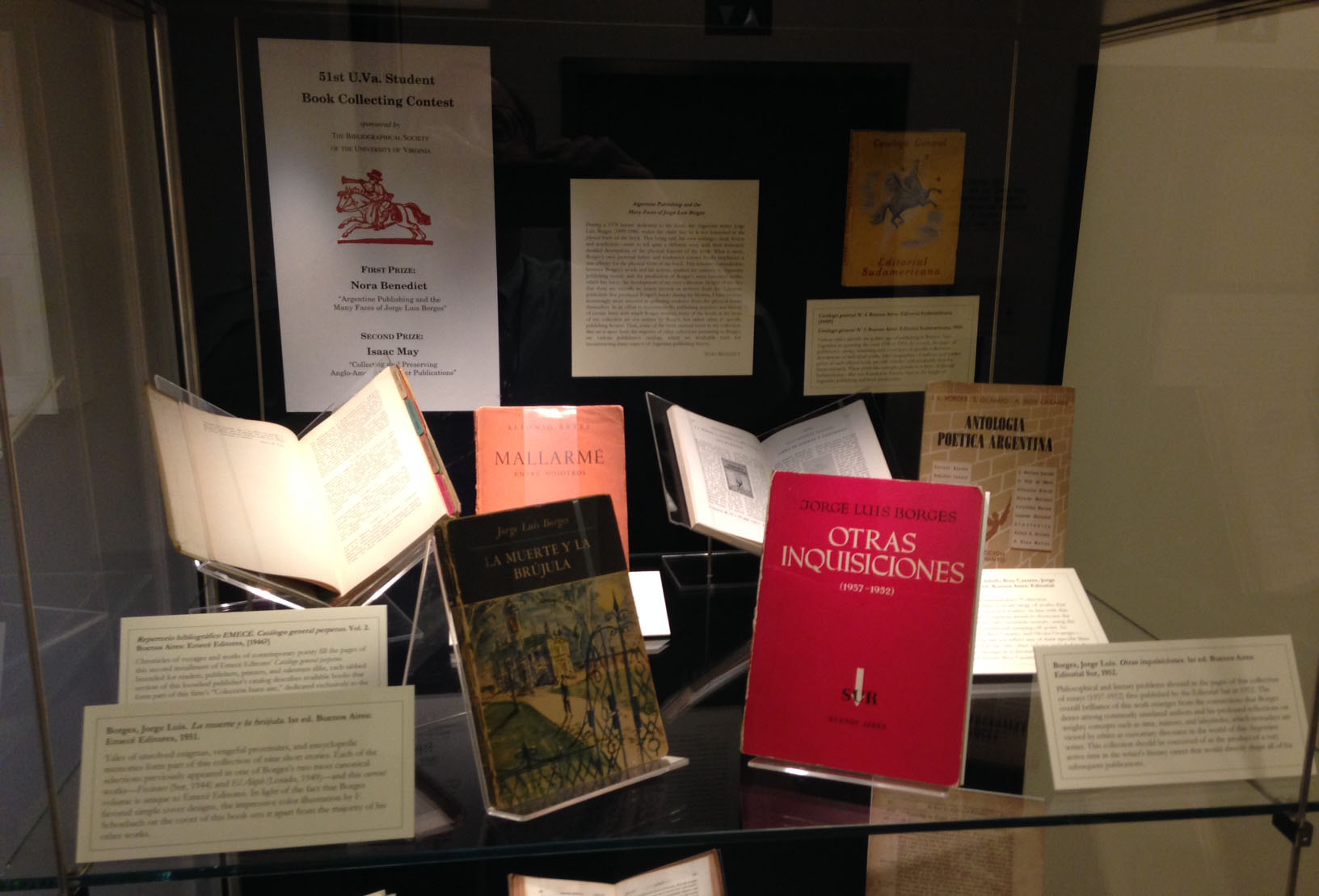
The previous U.Va. Student Book Collecting Contest — the 51st — was held in 2016. First prize was awarded to Nora Benedict, doctoral candidate in the Department of Spanish, Italian, and Portuguese, for her entry, “Argentine Publishing and the Many Faces of Jorge Luis Borges.”

Selections from Nora Benedict's winning entry, "Argentine Publishing and the Many Faces of Jorge Luis Borges."

Selections from Nora Benedict’s winning entry, “Argentine Publishing and the Many Faces of Jorge Luis Borges.”

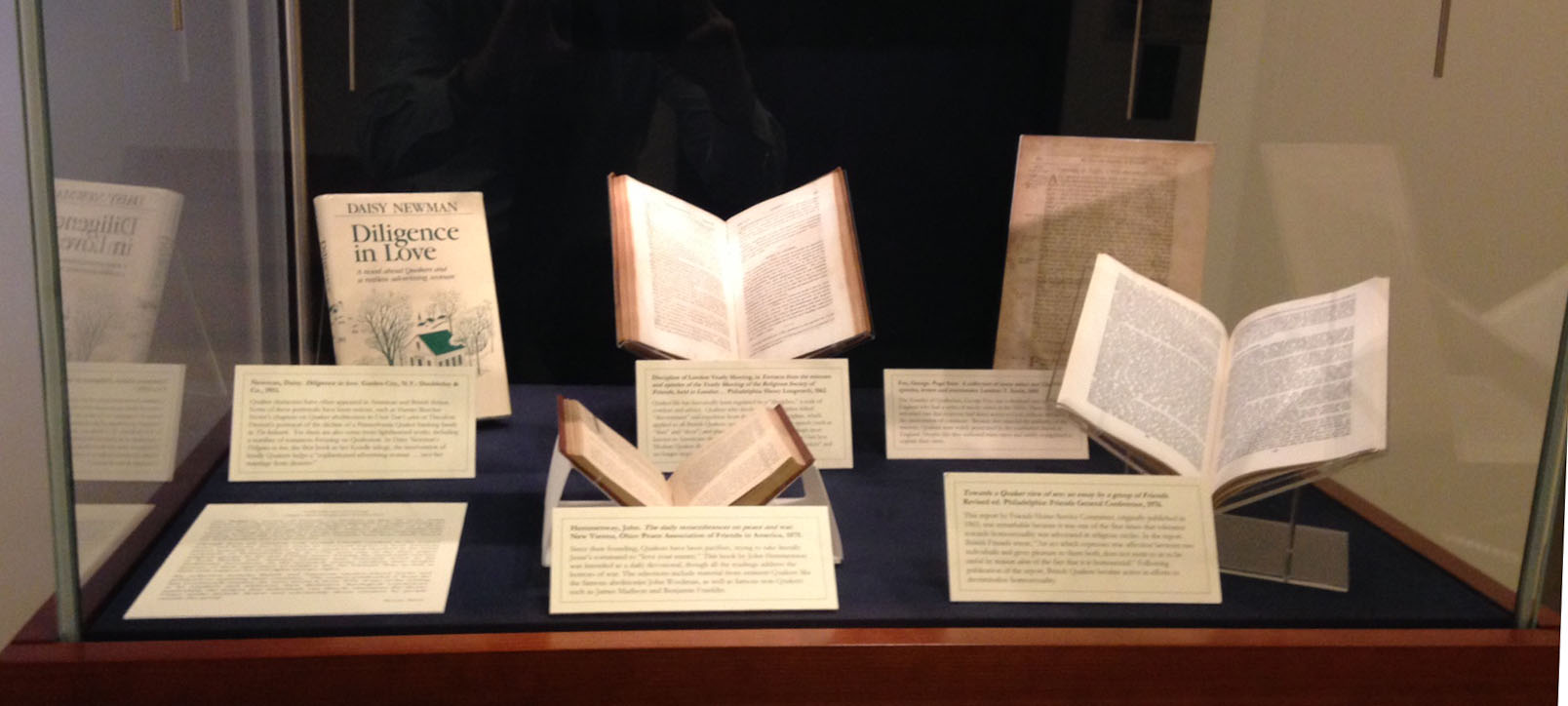
Isaac May, a doctoral student in the Department of Religious Studies, was awarded second prize for his entry, “Collecting and Preserving Anglo-American Quaker Publications.”

Highlights from Isaac May's entry, "Collecting and Preserving Anglo-American Quaker Publications"

Highlights from Isaac May’s entry, “Collecting and Preserving Anglo-American Quaker Publications”

In conjunction with each biennial contest, the Small Special Collections Library is pleased to host an exhibition of highlights from the winners’ collections. This year’s exhibition will be on view in the first floor hallway leading to the Special Collections reading room from March 23 through April 13.

William Styron’s “Confessions of Nat Turner” at 50

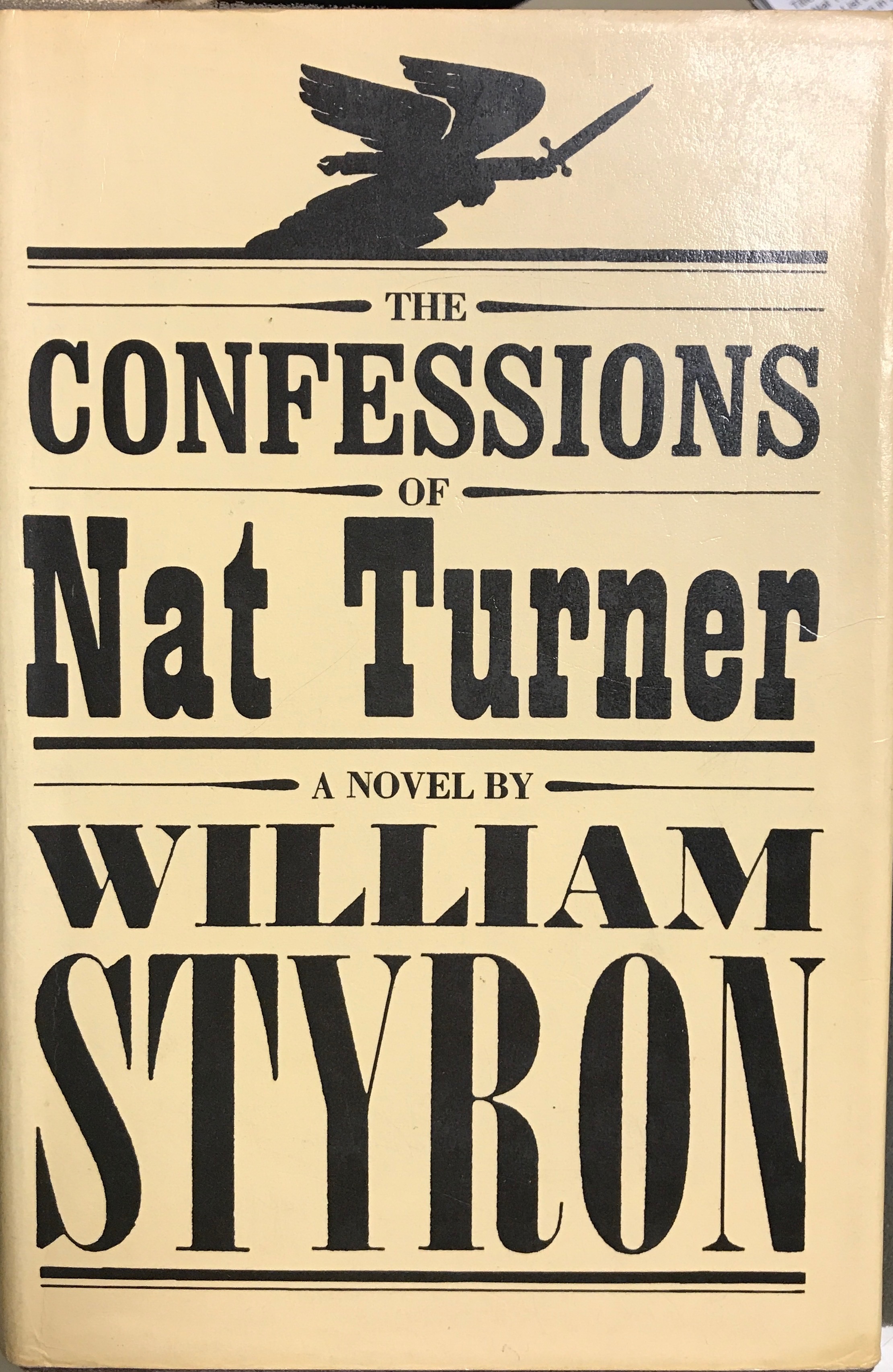
On October 9, 1967, William Styron’s novel from history, The Confessions of Nat Turner, was published to acclaim and controversy. Styron was raised in Newport News, Virginia, about a hundred miles from the site of the rebellion in Southampton County, Virginia. The novel was awarded the Pulitzer Prize, despite controversy over its characterization of Turner and other characters, and the fact that it was written in the voice of a Black man by a white writer. The novel remains in print today, and is still widely read.

The text-heavy cover of the first edition evokes broadsides of the early nineteenth century. (PS 3569 .T9 C6 1967)

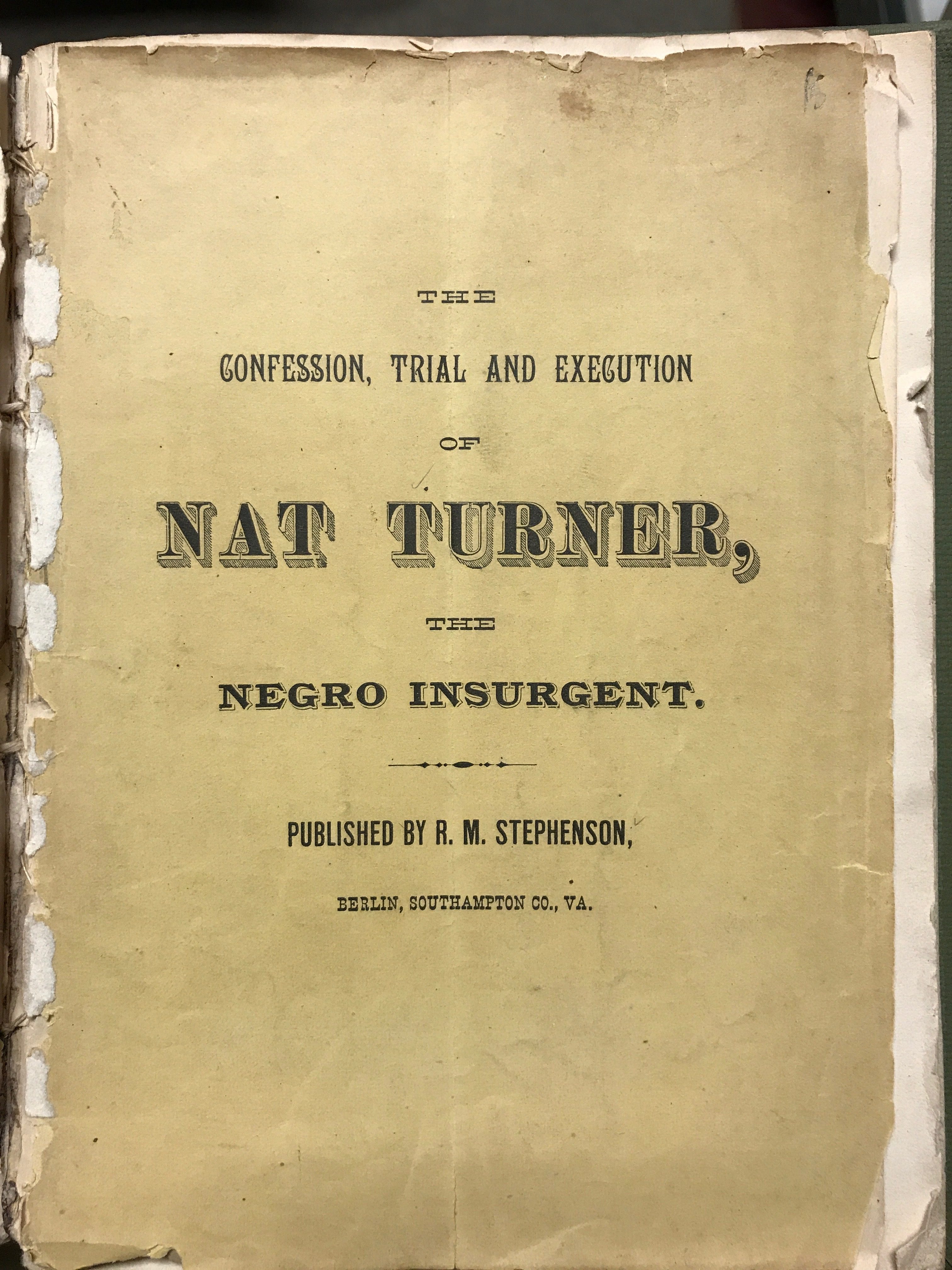
Our strong holdings in the history of Virginia include some of the essential source material upon which Styron based the novel. Of particular importance was this text, first published in 1831. It is written in the form of an interview with Turner, who tells his tale in the first person:

Gray’s “The Confession, Trial and Execution fo Nat Turner, the Negro Insurrectionist” (Berlin, VA: R.M. Stephenson,  1881). (F 221 v.163 no. 15)

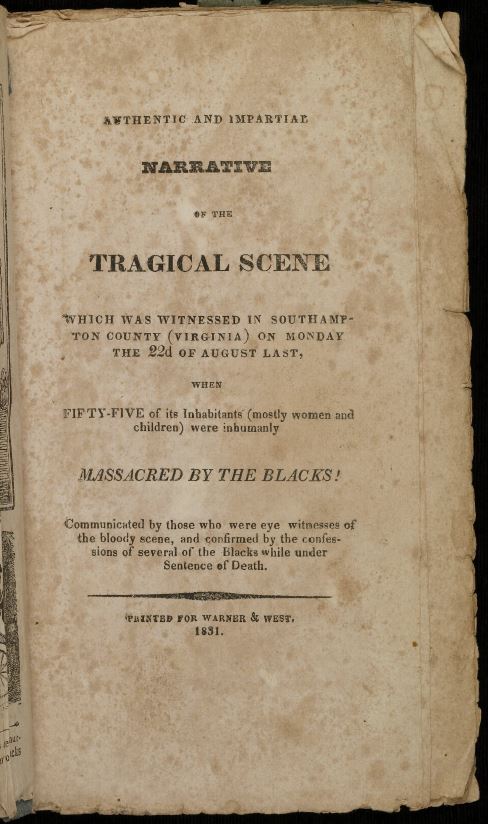
Also in the collections is another period narrative, shown below. this item is digitized in full and available online:

“Authentic and Impartial Narrative of the Tragical Scene Which Was Witnessed in Southampton County (Virginia) on Monday the 22d of August Last: When Fifty-Five of Its Inhabitants (Mostly Women and Children) Were Inhumanly Massacred by the Blacks! : Communicated by Those Who Were Eye Witnesses of the Bloody Scene, and Confirmed by the Confessions of Several of the Blacks While Under Sentence of Death” [New York]: Printed for Warner & West., 1831. (A1831 .W377)

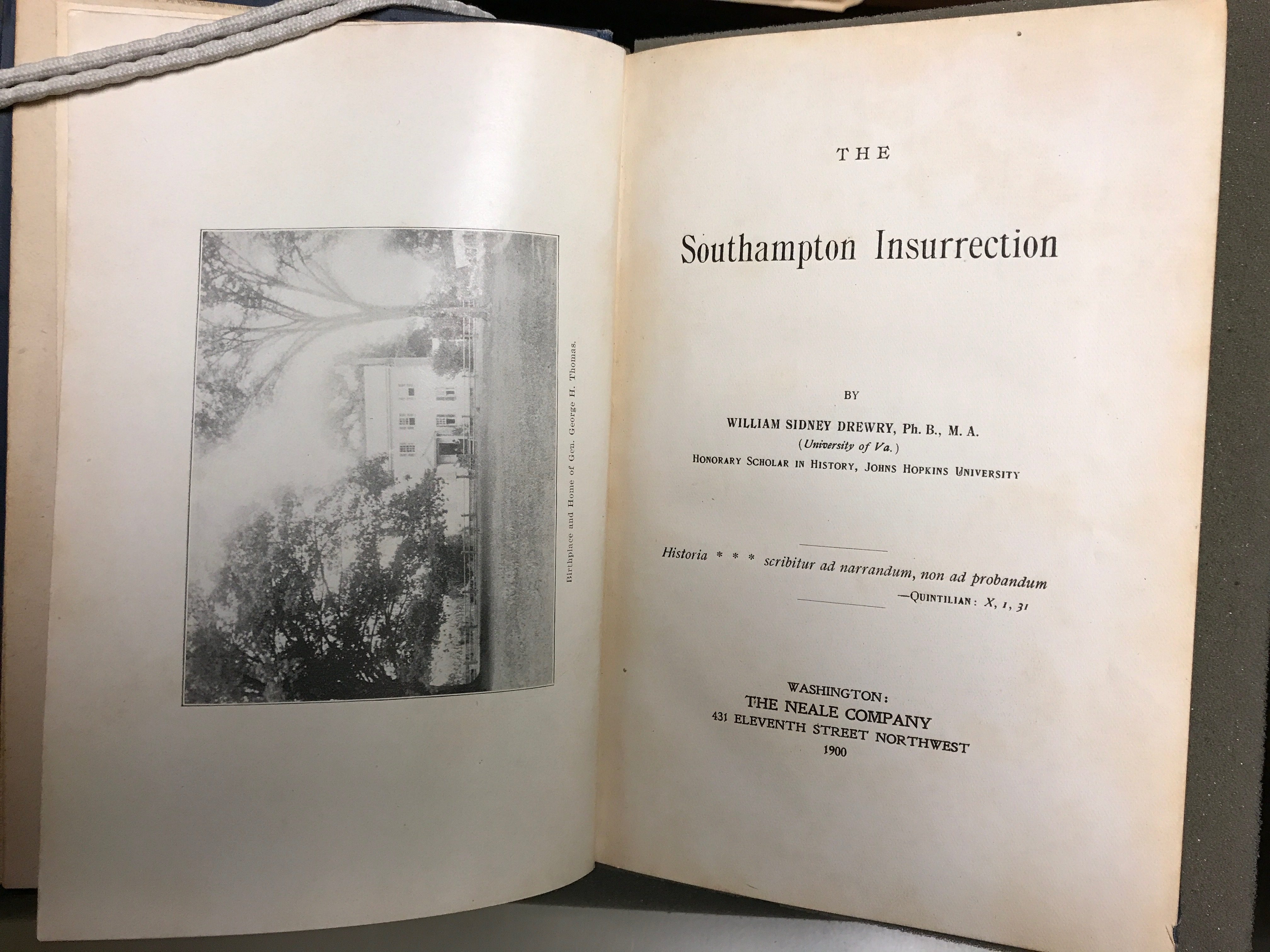
Styron is also known to have depended on the following two volumes for his project, copies of both of which are likewise held in our collections:

Almost half of Frederick Law Olmstead’s” A Journey in the Seaboard Slave States: With Remarks on Their Economy” (New York: Dix & Edwards,1856) is dedicated to Virginia. (A1856 .O55)

At the turn of the century, William Sidney Drewry composed a book-length study, “The Southampton Insurrection” ((Washington: Neale, 1900). (F232 .S7 D7 1900)

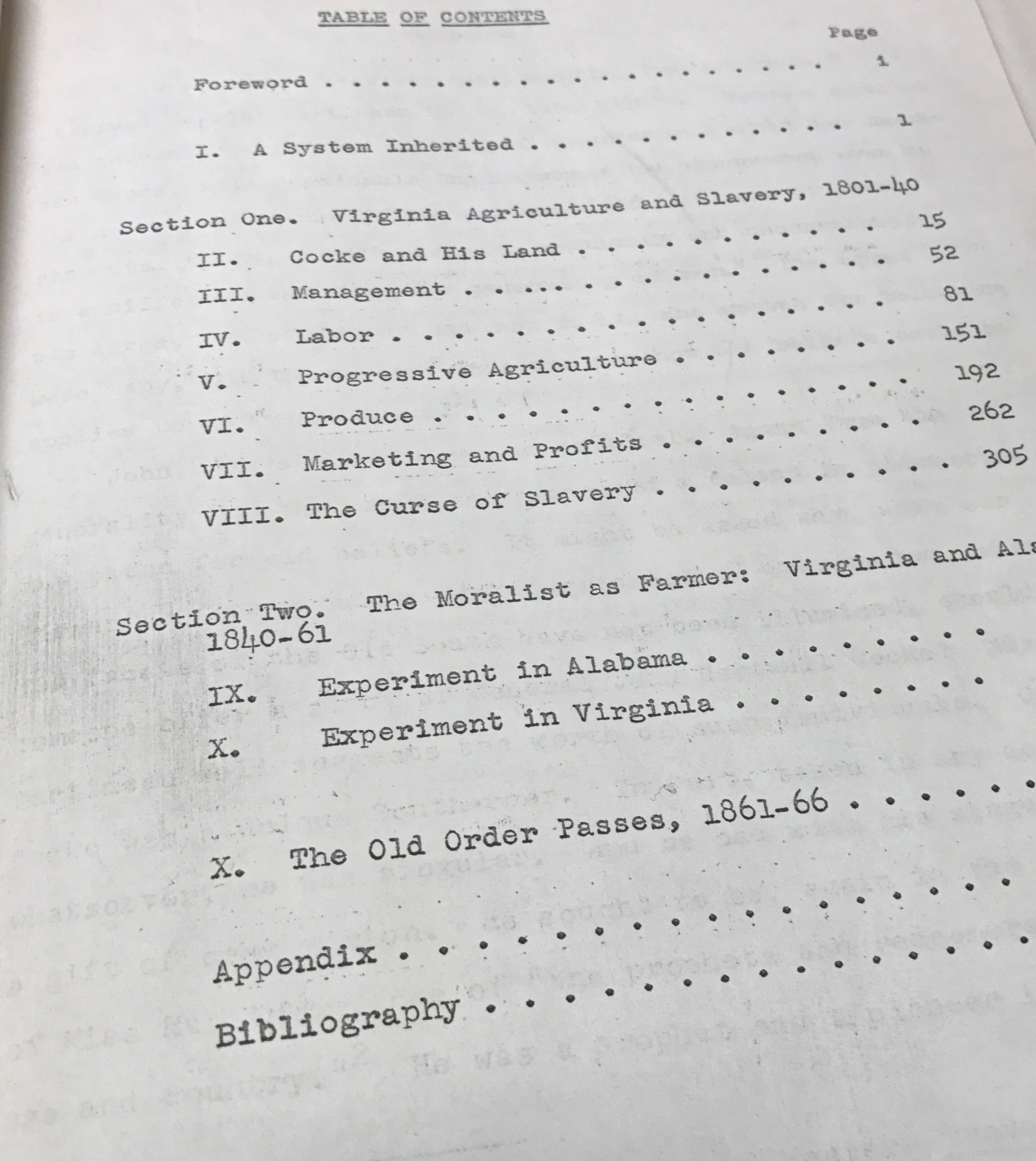
Finally, Styron depended upon M. Boyd Coyner’s UVA dissertation based upon our Cocke family papers collection. As James West tells it, “Styron was alerted to the existence of the dissertation by C. Vann Woodward, and Styron secured a copy of it from Coyner, who was then teaching at Hampden-Sydney.”

The table of contents page of M. Boyd Conyer,  “John Hartwell Cocke of Bremo: Agriculture and Slavery in the Ante-bellum South.” (Diss. 992).

Thanks to donor and Styron bibliographer James West for calling our attention to this anniversary and these fantastic source materials!

Miniature Books, coming to you from Facebook Live

Today, the folks over at UVA’s facebook page invited curator Molly Schwartzburg to share with them some of her favorite items in the miniature book collection on the Facebook Live streaming video platform. For those of you not on Facebook, here’s the video. We’re impressed that those teeny tiny books are actually in pretty good focus! Check out some of our beautiful and unusual minature treasures.

https://www.facebook.com/plugins/video.php?href=https%3A%2F%2Fwww.facebook.com%2FUniversityofVirginia%2Fvideos%2F10155802478383331%2F&show_text=0&width=560

John O’Brien’s Literature Incorporated Wins the Louis Gottschalk Prize

It is one thing to write a book. It is quite another for that book to receive widespread acclaim from one’s peers, as is the case with Literature Incorporated: The Cultural Unconscious of the Business Corporation, 1650-1850, the most recent work by John O’Brien, NEH Daniels Distinguished Teaching Professor in U.Va.’s Department of English. Literature Incorporated has been awarded the Louis Gottschalk Prize, presented annually “for an outstanding historical or critical study on the eighteenth century” by the American Society for Eighteenth Century Studies.

One need not be aware of the Supreme Court’s 2010 ruling in Citizens United or of Mitt Romney’s statement that “corporations are people” to benefit from a close reading of Literature Incorporated. Its subject is the corporation, “an abstraction that gathers up a long history of institutions and practices as varied as city governance, guild organization, state-sponsored colonial exploration, money lending, insurance, slave trading and university funding.”  Its method is to trace the trope of incorporation in a wide range of Anglo-American texts, including “economic tracts, legal cases, poems, plays, essays, novels, and short stories.” And its goal “is to discover some of the ways in which language has ‘repeated’ the influence of the corporation to us, given it form in our imaginations.”

The U.Va. Library is proud to have earned a place in the book’s Acknowledgements. Indeed, most of the works discussed in Literature Incorporated (and many more that inform and amplify its arguments) can be found in the Albert and Shirley Small Special Collections Library. Here is a modest selection, which we invite you to come explore in more depth.
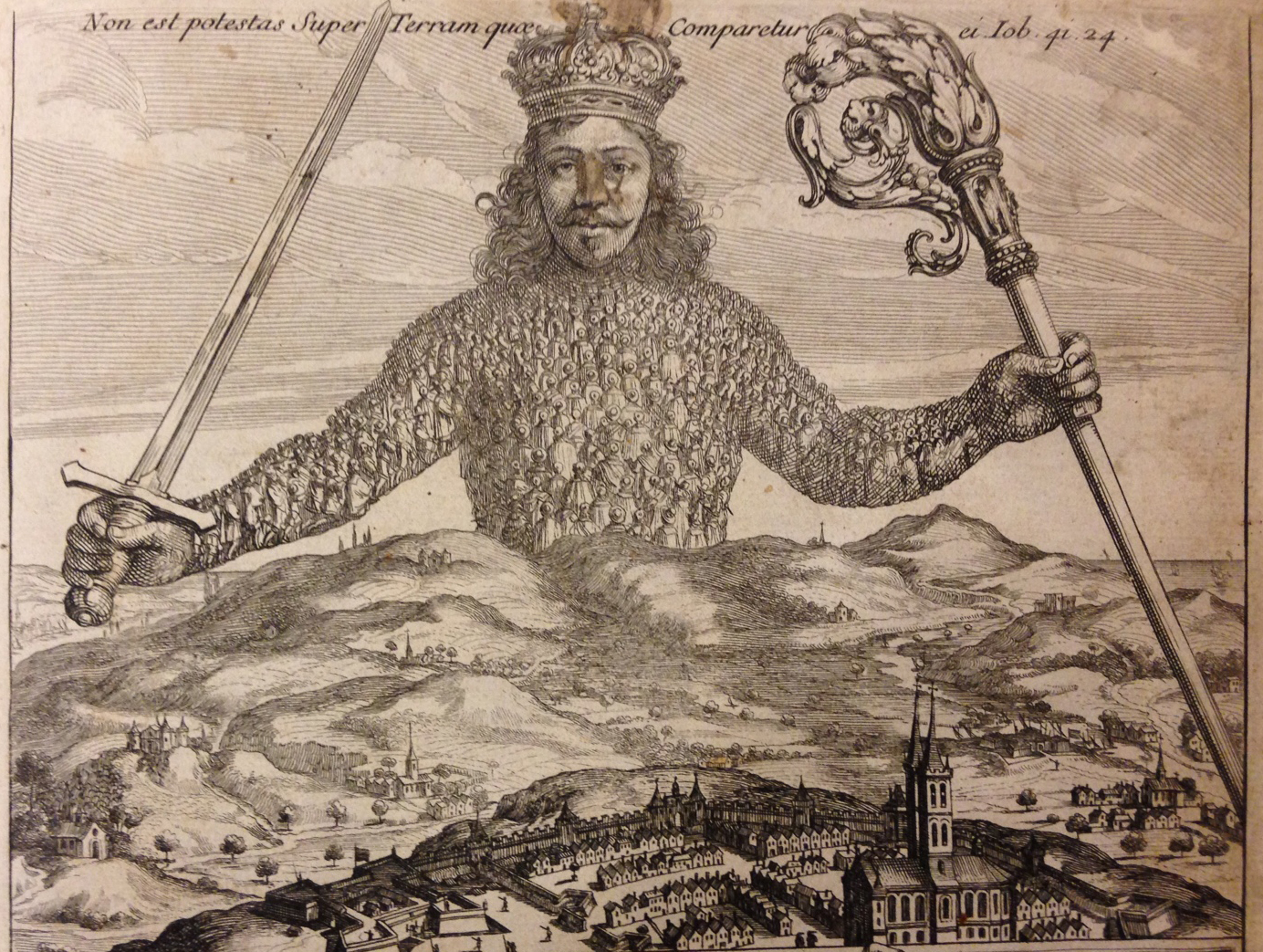
King as corporation, comprised of the bodies of his subjects. Detail from the engraved title page to Thomas Hobbes, Leviathan (London, 1651). (E 1651 .H658; Tracy W. McGregor Library of English Literature)

Literature Incorporated begins with Thomas Hobbes’ work of political theory, Leviathan (1651). Its famous engraved title page “offers an image of incorporation, of the people of a realm incorporated into the sovereign.” Although Hobbes viewed private corporations as potential rivals to government, O’Brien shows how Alexander Hamilton and John Marshall, among others, appropriated Hobbes’ language in support of corporations.
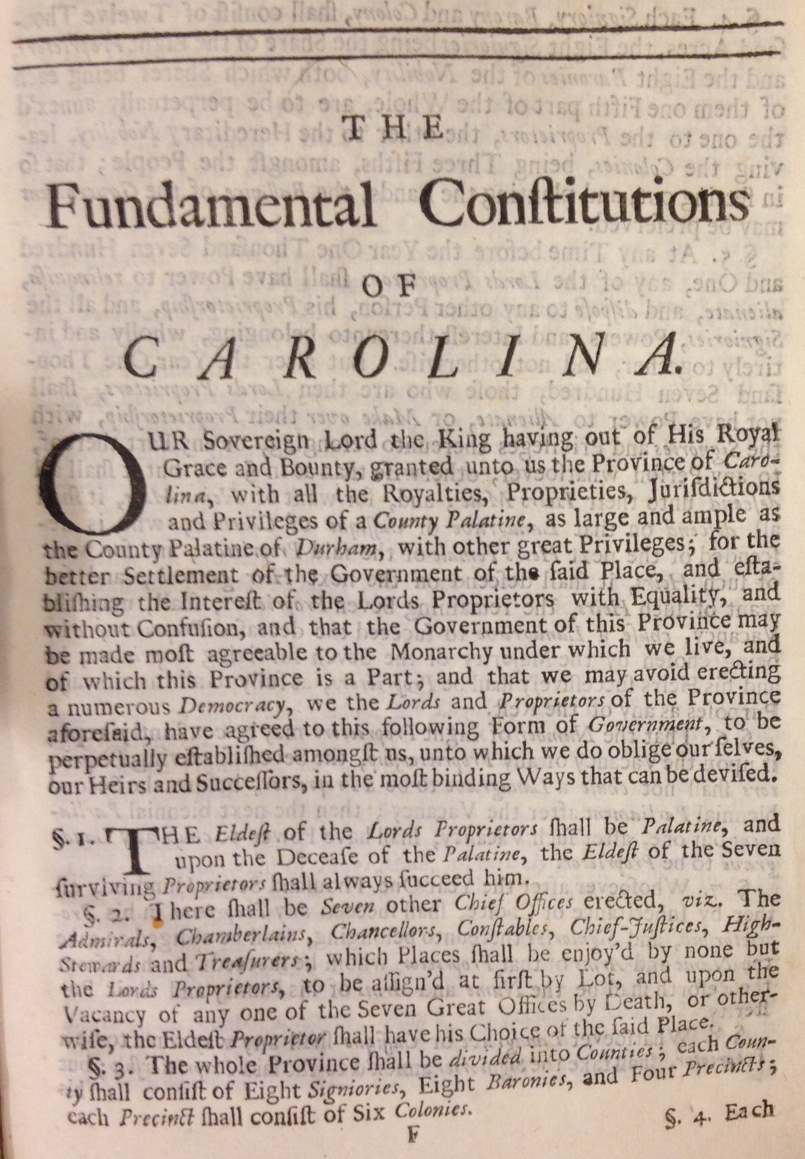
The Carolina Company’s vision for its American colony, drafted in large part by John Locke. The Two Charters Granted by King Charles IId to the Proprietors of Carolina (London, 1698). (A 1698 .G746; Tracy W. McGregor Library of American History)

Among the earliest English corporations were entities such as the Carolina Company, chartered by the sovereign to promote colonial settlement and trade. The philosopher John Locke was instrumental in developing the English mercantilist system, and O’Brien traces Locke’s crucial role in drafting the company’s Fundamental Constitutions (1669; final edition 1698), in which the Carolina proprietors envisioned the society they hoped to establish in the New World. Indeed, Locke’s empiricist philosophy permeates the document.
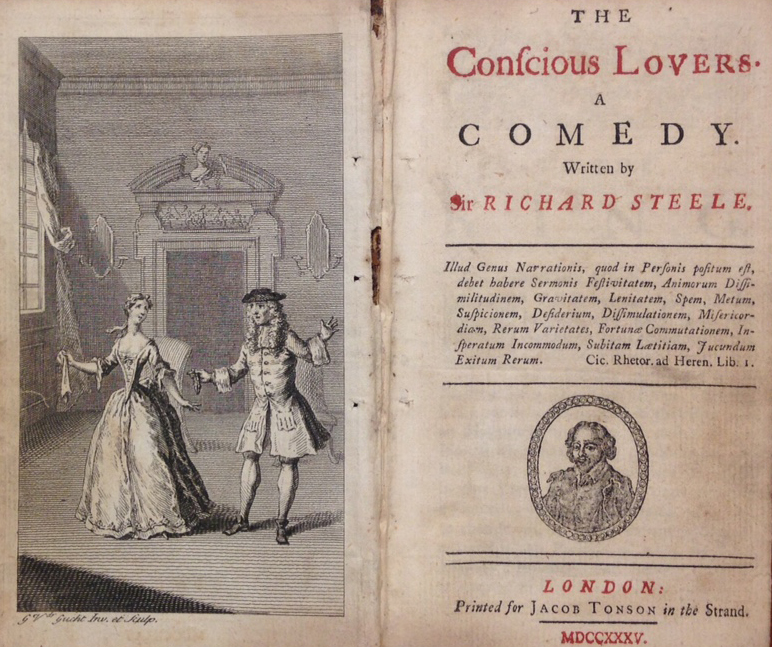
Frontispiece and title page to an early edition of Richard Steele’s The Conscious Lovers (London, 1735). (PR3704 .C66 1735)

Another such company, the South Sea Company, was at the heart of one of the greatest financial bubbles of all time, the South Sea Bubble of 1720. The speculative frenzy and resulting financial crash can be traced in many contemporary literary works, such as Sir Richard Steele’s play, The Conscious Lovers (1720). To the familiar plot lines of marriage and mistaken identity Steele added innovative complications concerning property rights. Steele also found himself accused publicly, through his involvement with the Drury Lane Company, of creating a theatrical equivalent of the South Sea Bubble to unfairly inflate the play’s ticket prices.
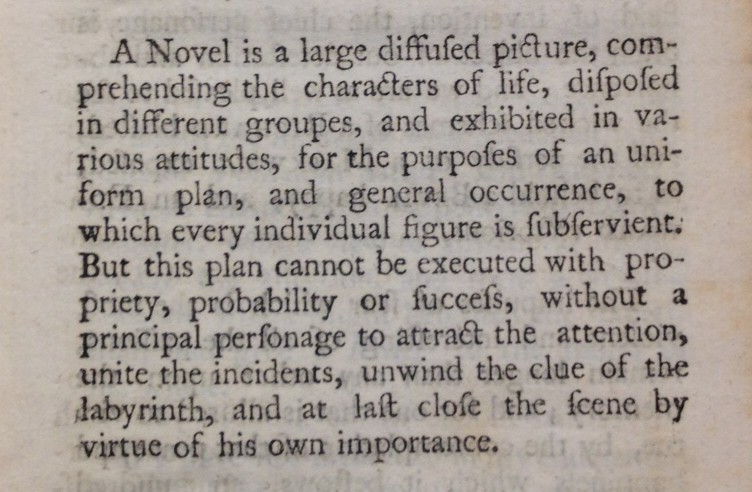
Tobias Smollett on why a novel needs a “principal personage,” from The Adventures of Ferdinand Count Fathom (London, 1753). (PR33694 .F54 1753 v.1)

The 18th century also saw the rise of insurance companies, which offered protection from risk and the fickle winds of divine providence. O’Brien demonstrates how contemporary English fiction’s “well-known investigations of risk and reward look different when they are read in the context of insurance history.” A perfect example is Tobias Smollett’s Adventures of Peregrine Pickle (1751), in which the plot is driven by Peregrine’s involvement with two different insurance policies. O’Brien also invokes Smollett’s famous statement, in the preface to The Adventures of Ferdinand Count Fathom (1753), that a novel requires “a principal personage to attract the attention, unite the incidents, unwind the clue of the labyrinth, and at last close the scene by virtue of his own importance.” In O’Brien’s words, the protagonist of a novel “resembles the corporation itself, a prosthetic person who helps bring the broader organization of a specific kind of economic activity into representation.”
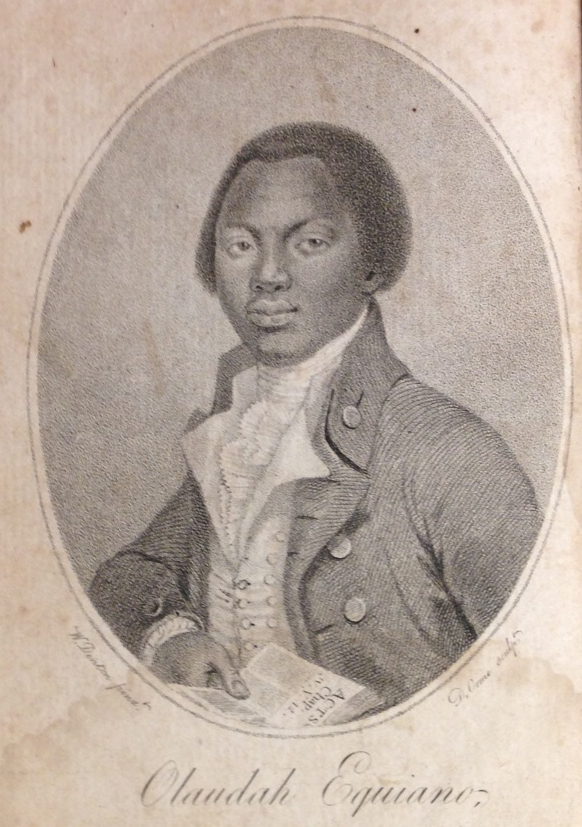
Frontispiece to The Interesting Narrative of the Life of Olaudah Equiano (London, 1789). (CT2750 .E7 1789; Gift of Mrs. Emily D. Kornfeld)

During the late 18th century, the London Society for Effecting the Abolition of the Slave Trade waged a successful abolitionist campaign. O’Brien traces how “the society became a corporate voice that found itself emulating the very entities that it sought to attack,” for example, through its frequent use of an emblem featuring a supplicatory slave on bended knee. However, one key abolitionist publication—The Interesting Narrative of the Life of Olaudah Equiano (1789)—deliberately separated itself in form and content from this corporate voice, instead establishing itself “as a kind of corporate representative [of] ‘the African.’”
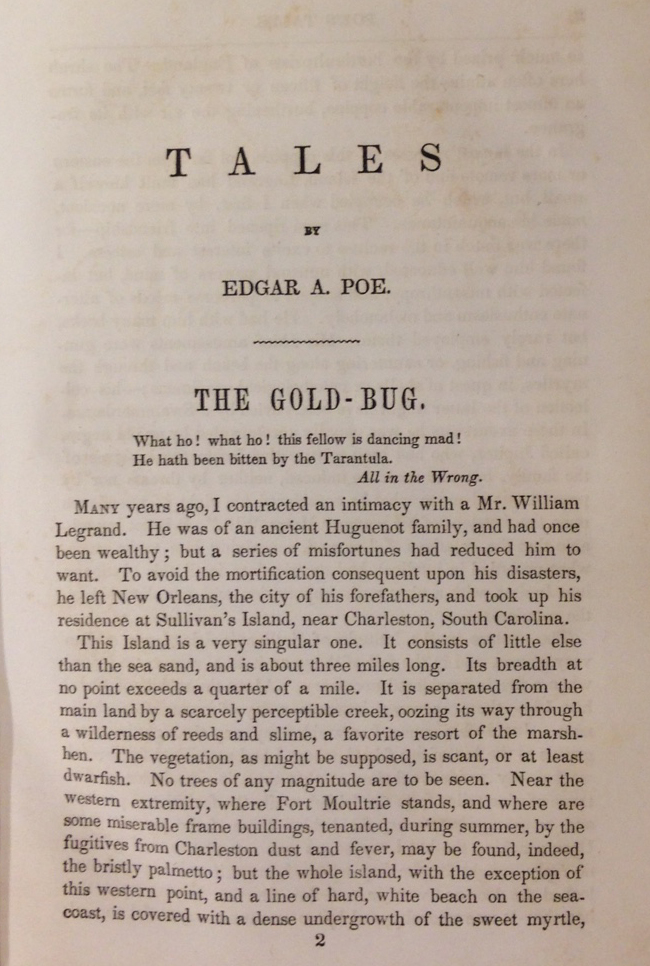
Beginning of Edgar Allan Poe’s story, The Gold-Bug, which leads off his Tales (New York, 1845). (PS2612 .A1 1845 copy 3; Gift of D. N. Davidson)

Literature Incorporated concludes with a discussion of Anglo-American literary responses to the fiscal and banking crises of the 1820s, 1830s, and 1840s. In particular, O’Brien offers a close reading of The Gold-Bug, the lead-off story in Edgar Allan Poe’s Tales (1845) and his most popular with contemporaries.

And to wrap up: hold the date! Another recent recipient of the Louis Gottschalk Prize—David Hancock, Professor of History at the University of Michigan—will deliver this year’s Thomas Jefferson Foundation Lecture on Wednesday, April 5, 2017 at 4:00 p.m. in the auditorium of the Albert and Shirley Small Special Collections Library. His talk, “The Man of Twists and Turns: Personality, Portrait & Power in the Re-Shaping of Empire,” concerns the 2nd Earl of Shelburne, the British prime minister who helped negotiate an end to the American Revolution. The lecture is co-sponsored by the Thomas Jefferson Foundation and the U.Va. Library.

…And to all a Good Night! —that means you, John Boy

The holidays are upon us! As we watch the students head home, the weather cool (well…not as much as we might like), and twinkling lights appear all over town, we are adding to the holiday mood with a special post from Reference Coordinator Regina “Ms. Claus” Rush. Enjoy, and be sure to check our website for holiday hours in the next couple of weeks. Thanks for the movie recommendation, Regina!

Inquire of any of my colleagues at Special Collections Library and they will attest that I govern my life by the Golden Rule. No, not that Golden Rule. I follow the Golden Rule according to Ebenezer Scrooge. Allow me to clarify further: not the Bah-Humbug Scrooge, but the kinder-gentler-post-three-ghostly-visitations Scrooge. His Golden Rule reads, “I will honour Christmas in my heart and try to keep it all year!”

Throughout the year, my colleagues can count on me to daily mention a Christmas movie, sing a verse or two from a favorite Christmas carol, or contemplate my plans for the coming year’s Christmas tree themes for my home. These are ways that I keep the ghosts of Christmas Past, Present, and Future at bay. So when asked by my colleague Molly Schwartzburg to write a post highlighting an item from our collection pertaining to Christmas, quicker than “Jack Frost can nibble at your nose,” I. WAS. ON. IT!

regina_anne

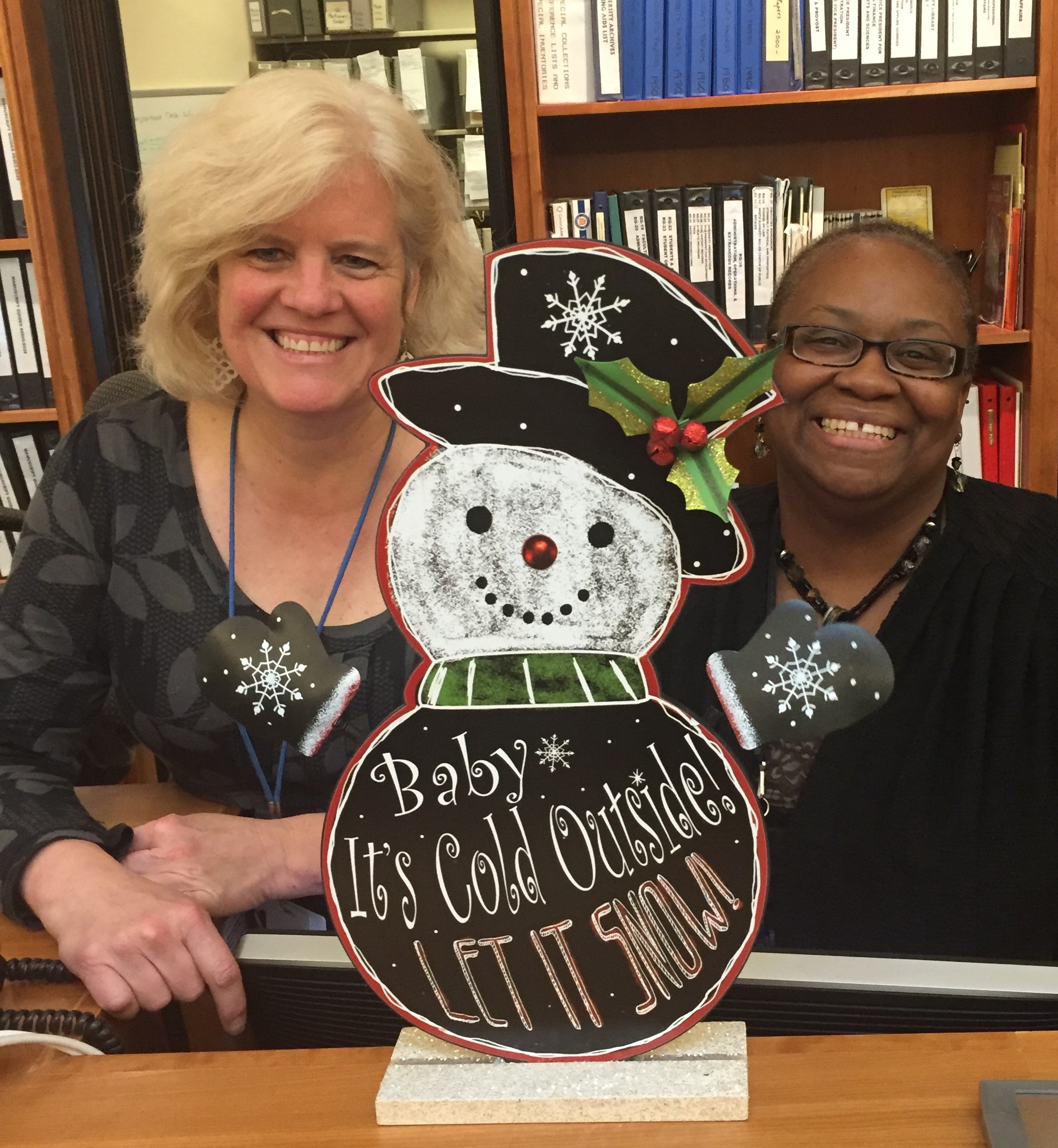
Regina, at right, with fellow snow fan and Reference Coordinator Anne Causey. They both wish that the claim made on this Reading Room holiday decoration was TRUE!

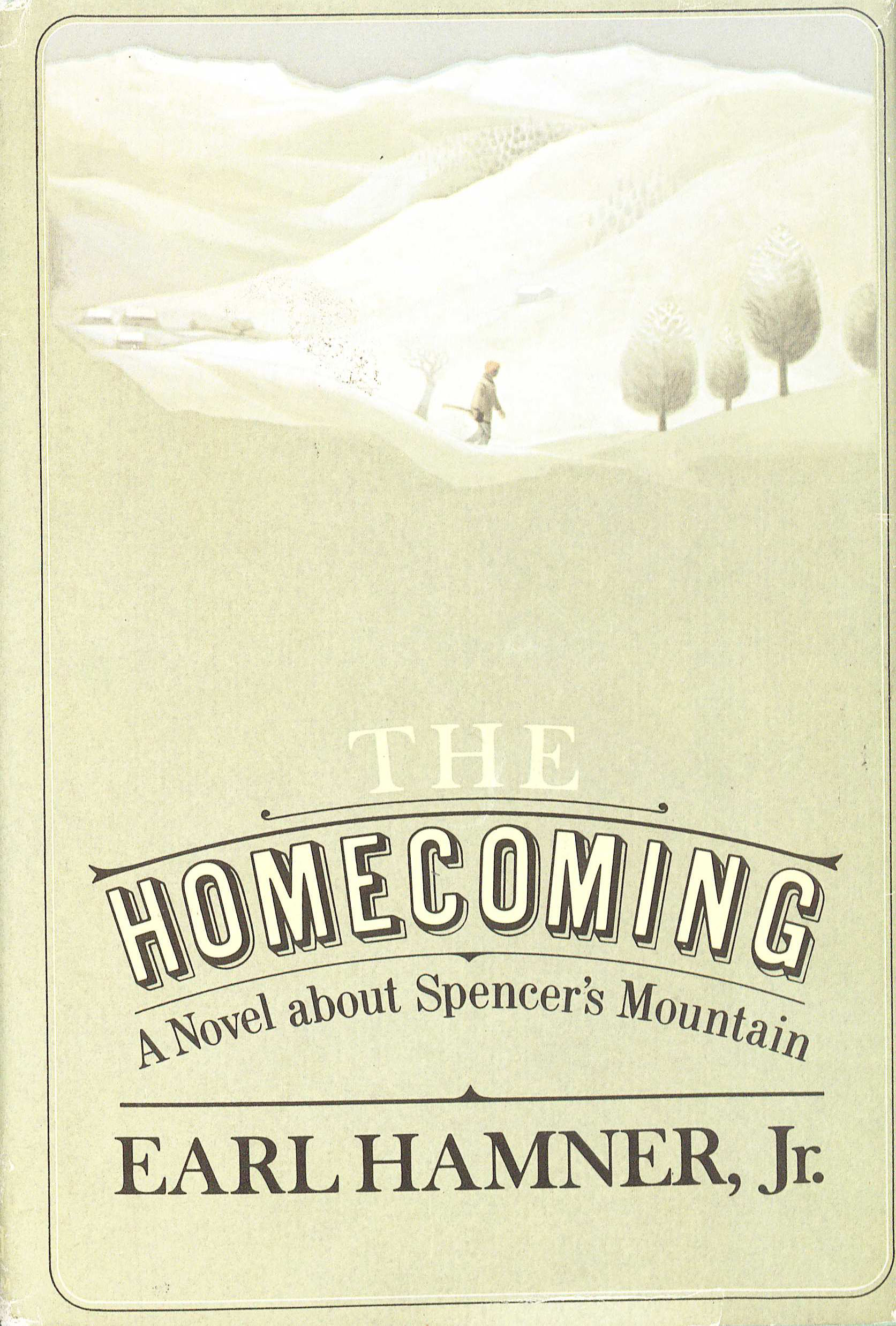
Shortly after I began looking into the Small Library’s treasure troves, I was delighted to discover that we hold a small but rich collection of Virginia native Earl Hamner Jr., an Emmy-winning television writer and director during the 1970’s and 80’s. The collection includes a first edition of Hamner’s 1970 novel, The Homecoming: A Novel about Spencer’s Mountain, the final shooting script for the 1971 film The Homecoming: A Christmas Story and television scripts for three mid-1970s episodes of The Waltons.

Earl Hamner, Jr. The Homecoming: A Novel about Spencer's Mountain.

Earl Hamner, Jr. The Homecoming: A Novel about Spencer’s Mountain. (PS3558 .A456 H6 1970). The novel’s epigraph reads, “It is remembered in my family that Christmas Eve of 1933 my father was late arriving home. That, along with the love he and my mother bestowed upon their eight red-headed offspring, is fact. The rest is fiction.”

The novel, drawn from Hamner’s childhood experiences growing up in Schuyler, Virginia during the Great Depression, was the impetus for the film. Originally aired on CBS on December 19, 1971, the movie was so popular that it spun off a series, “The Waltons’, which aired on CBS in September 1972 and became wildly popular, lasting nine seasons.

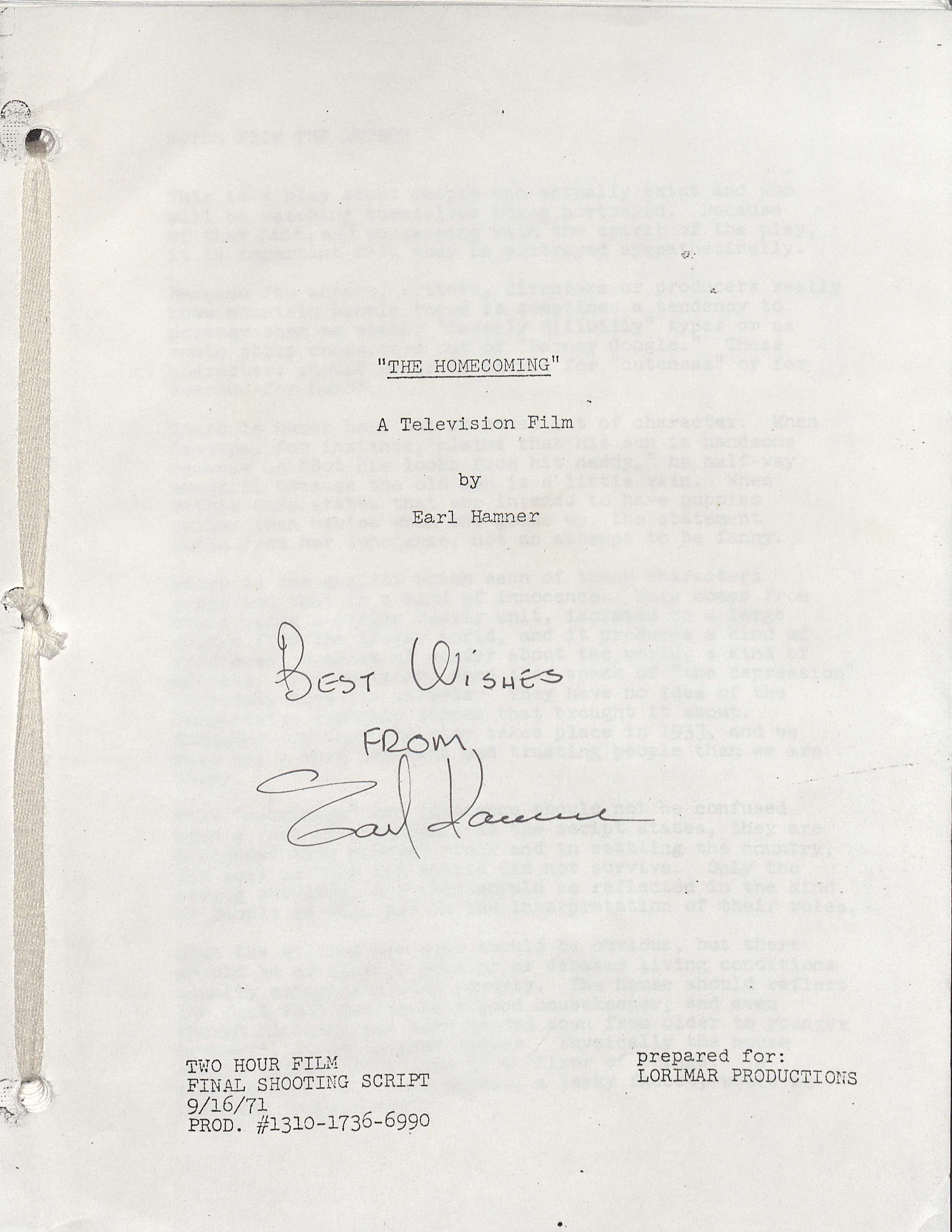
Final Shooting Script of The Homecoming

Cover of the Final Shooting Script for the Lorimar Productions film “The Homecoming” (MSS 10380,-a,-b)

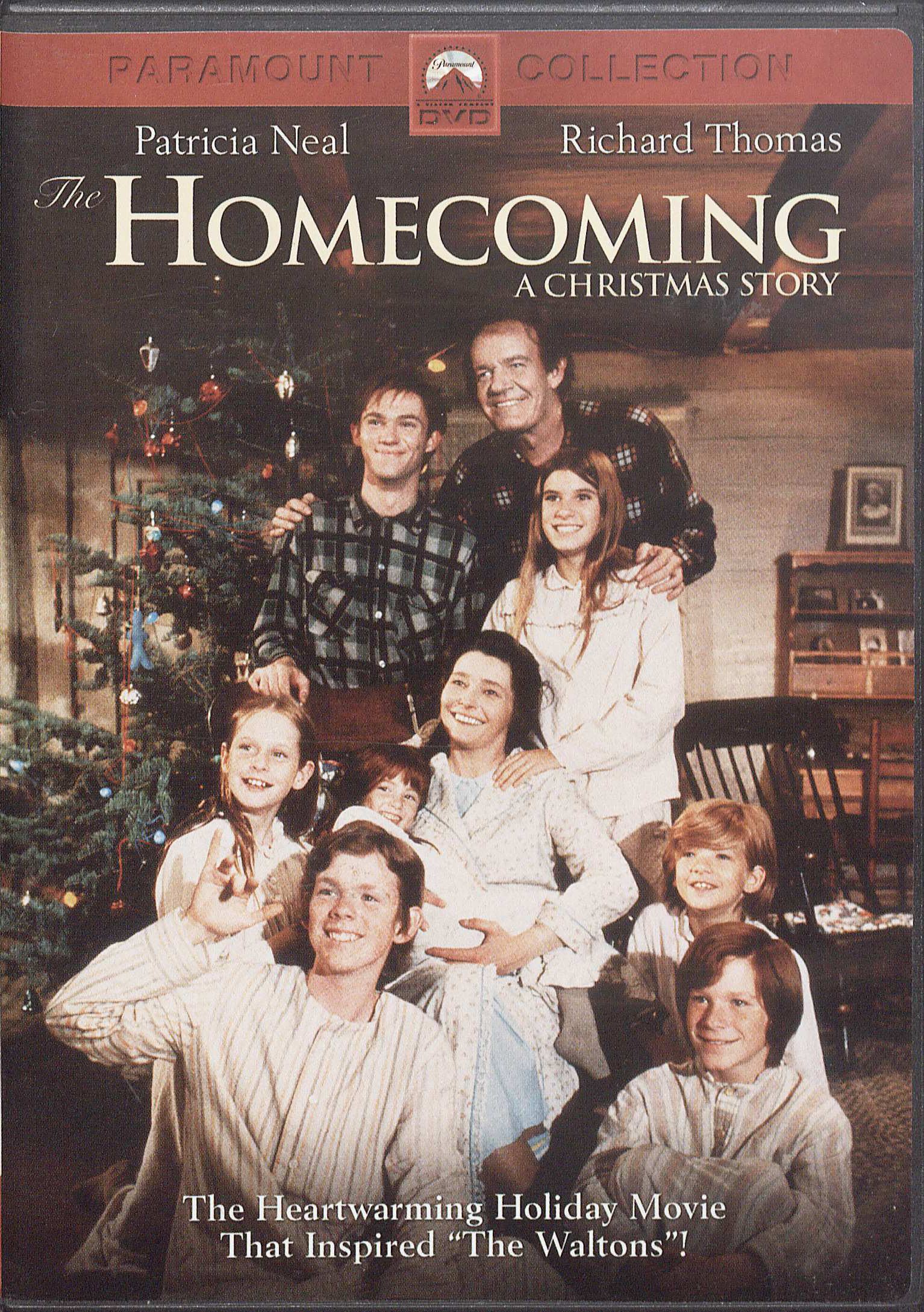
The Homecoming movie

DVD of the movie The Homecoming: A Christmas Story, by Earl Hamner, Jr.

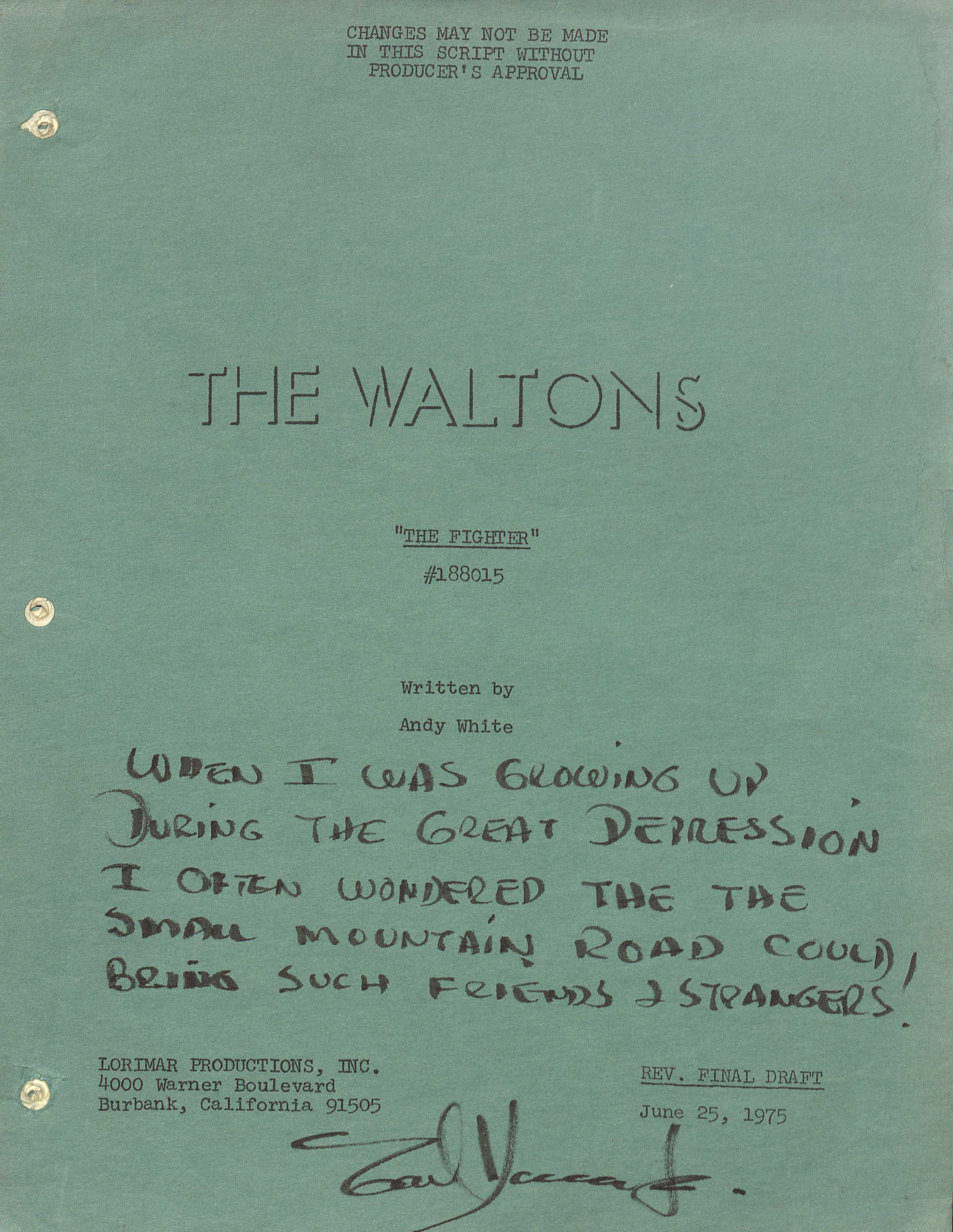
The final draft of of The Waltons television script

Cover of the television script for an episode of “The Waltons.” This is the revised final draft of episode #188015, “The Fighter” by Andy White (MSS 10380,-a,-b)

Christmas fans like myself know that the film that started the Waltons’ phenomenon is a holiday must-see. Included in the final script of the 1971 film ‘The Homecoming’ is a section entitled “Notes from the Author”:

[The] Christmas Season and Christmas has become a nightmare for most people. The packed stores, the enraged crowds, the stalled traffic and money worries that are common to our audience for the most part produce a national insanity. Yet underneath there is a pathetic wish that they can really experience something, maybe “The Christmas Spirit” something that no other time provides.

This holiday classic is a great start toward achieving that “Something.” So, shut out the madness of the holiday hustle and bustle. Pour yourself a BIG glass of egg-nog, get comfortable in your favorite chair and lose yourself in this wonderful coming-of-age Christmas classic. By the film’s end, I guarantee you will feel all warm and fuzzy inside (though that BIG glass of rum-infused egg nog may be partly responsible!). Wishing my colleagues and all the loyal readers of ‘Notes from Under Grounds’ a very safe and happy Holiday!

“Good Night, Penny”

“Good Night, Edward”

Good Night, David”

“Good Night, Heather and Gayle”

“Good Night George, Petrina, and Molly”

“Good Night E.J., Sharon, Ellen, Barbara, Jane…………”

Good Night, “Notes from Under Grounds” Readers!

Exhibition Prep Special: Translating Shakespeare’s Sonnets into…Morse Code?

This week we are pleased to feature the third guest blog post from graduate curatorial assistant Kelly Fleming, who will be sharing selected treats from our upcoming exhibition, “Shakespeare by the Book,” over the coming months. The exhibition opens February 22, 2016.

Most readers of Shakespeare’s sonnets associate his poetry with love. In films and literary works of all kinds, Shakespeare’s sonnets are quoted and used to confirm the love between two people. Sonnet 116 (“Let me not to the marriage of true minds”) is probably one of the most popular readings on the wedding circuit. As much as Shakespeare’s sonnets are about love, time is more likely to be the subject of the poet’s meditations. The first seventeen—“the procreation sonnets”—urge a young man to make much of time, to get married, and to procreate so that he can live forever through his children. Many of the sonnets after 17 continue to address, to personify, and to apostrophize time, as these first lines illustrate: “Against that time, if ever that time come” (Sonnet 49); “That time of year thou mayst in me behold” (Sonnet 73); “No, Time, thou shalt not boast that I do change” (Sonnet 123).

Knowing the sonnets’ preoccupation with time, I completely “nerded out” when I discovered that someone had turned Shakespeare’s sonnets into a watch. My own scholarship has nothing to do with Shakespeare, but every time Molly, our curator here at Special Collections, mentioned the watch to me, I would get so excited that I would say in a high-pitched voice, “But Shakespeare’s sonnets are all about time!” I cannot imagine a more perfect way to represent his sonnets than a watch.

Pictured here is the watch with the instructional booklet open to the title page.

Pictured here is the watch with the instructional booklet open to the title page.

The Sonnets Watch Book is book inside a watch; it is a watch that ticks out Shakespeare’s sonnet 18 (“Shall I compare thee to a summer’s day?”) and sonnet 130 (“My mistress’ eyes are nothing like the sun…”) in Morse code. It was dreamed up and built by three Seattle teenagers (credited on the watch as “Alex, Clara, and Nicholas”) and published by miniature-book publisher and technologist Robert Orndorff (who happens to be the father of two of the makers). Only eighteenth copies of The Sonnets Watch Book are in existence and number eighteen will appear in our exhibition. Bright lights flicker out the letters and punctuation marks of each sonnet. Even though I can’t understand Morse code, there is something incredibly moving about watching the lights change and knowing that Shakespeare’s words are still slowly being repeated throughout time.

Here is an image of the watch as it ticks out one of Shakespeare's sonnets in Morse code.

Here is an image of the watch as it ticks out one of Shakespeare’s sonnets in Morse code.

Last week, I spent a full hour close reading Shakespeare’s Sonnet 65 and talking about time with my ENGL 3810 students. We were stuck on the following lines for a while:

O, how shall summer’s honey breath hold out
Against the wreckful siege of battering days,
When rocks impregnable are not so stout,
Nor gates of steel so strong, but Time decays?

Shakespeare’s answer to this question is his sonnet. Unlike the sea, stone, or shining metals, his “black ink” may be able to withstand the rages of time. His “black ink” will continue to “shine bright” and tell of his love. As my students will tell you, this is exactly what happened. We spent twenty-five minutes of our class on four lines because his “black ink” does still “shine bright” in the history of literature.

Imagine, then, an object that literalizes the hope, the wish of this sonnet. Shakespeare’s words, his “black ink,” actually “[shining] bright” in little yellow, green, and red blinking lights on the face of a watch.

Now, who is excited?

Click on the link below for a video of the watch in action and proof that Shakespeare’s sonnets are now more portable than ever before. The Sonnets Watchbook will be on view—alive and ticking—in “Shakespeare by the Book: Four Centuries of Printing, Editing, and Publishing,” which runs February 22-December 2016 at the University of Virginia Library. 

Oh, and in case you are wondering about the history of literature translated into code, perhaps you would like to see Monty Python’s take on the topic. They  start with Wuthering Heights and go on from there…make sure to stay to the end!:


Exhibition Prep Special: Searching for Shakespeare in Booksellers’ Records

This week we are pleased to feature the second guest blog post from graduate curatorial assistant Kelly Fleming, who will be sharing selected treats from our upcoming exhibition, “Shakespeare by the Book,” over the coming months. The exhibition opens February 22, 2016.

My first two weeks at Special Collections were spent hoisting hulking ledgers from the stacks and placing them gently onto cradles to investigate whether two early booksellers in Virginia sold Shakespeare. After the first day, I found my legs covered in wisps of binding and my hands stained with “red rot” from the ledgers’ leather bindings. Thank goodness for gloves.

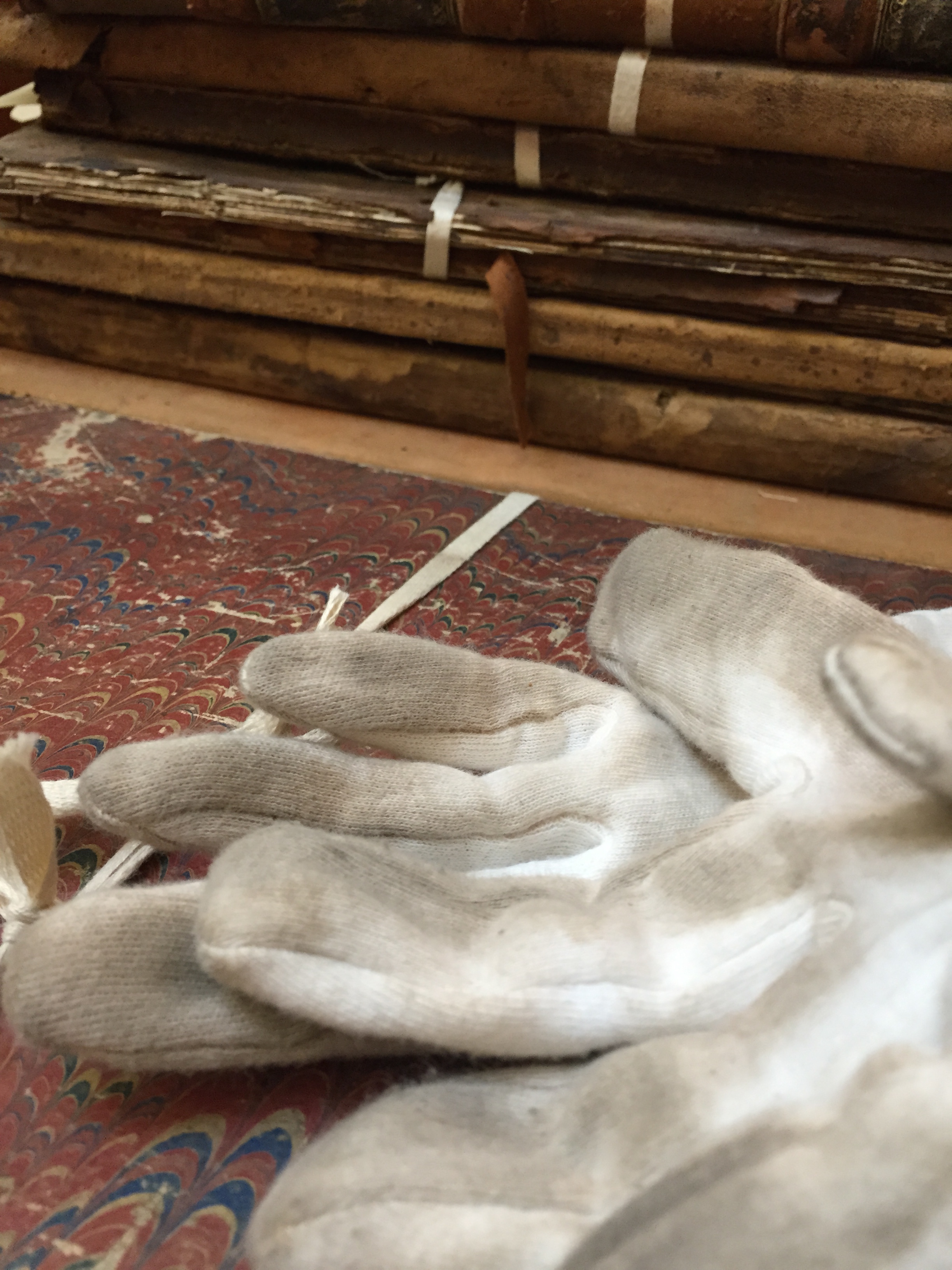
Here's what my gloves looked like after several ledgers. Imagine what my bare hands looked like before I put them on.

Here’s what my gloves looked like after several ledgers. Imagine what my bare hands looked like before I put them on.

I combed through the account books of Bell & Co., a printer in Alexandria, Virginia active in the nineteenth century and the Virginia Gazette, a newspaper and printer active in Williamsburg, Virginia in the eighteenth century. My eyes sought any spelling variation of the name “Shakespeare” amidst endless purchases of envelopes and paper. Despite our modern perception that Shakespeare’s works are “classics” and that he is a father of the English language, his place in the literary canon was yet to be defined in the eighteenth and nineteenth centuries. As my findings attest, Virginians chose to read a myriad of other things more frequently than Shakespeare.

Only one copy of Shakespeare was sold by the Virginia Gazette in the years 1750–1752 and 1764–1766. Even though David Garrick was busily working to increase the popularity of Shakespeare in London at this time, the colonies seem to have been a step behind. Since Williamsburg was home to the Virginia legislature and the College of William & Mary, it is not surprising that the books sold by the Virginia Gazette were largely educational: Latin grammar textbooks, dictionaries, and religious texts like the Book of Common Prayer. Despite the fact that Samuel Johnson’s Dictionary of the English Language (a book the Virginia Gazette also sold) marks Shakespeare’s works as the first usage of many English words, students were not studying Shakespeare. The education system in the eighteenth century trained students (that is to say, young men) in what they considered the “classics”: philosophical and literary texts from ancient Greece and Rome. When students did read literary texts in English, it seems that they read English epics, which use classical elements to describe contemporary England. The epic works of Milton, Dryden, and Pope, for example, appear numerous times in the accounts of the Virginia Gazette. In addition to English epics, we find our copy of Shakespeare alongside another genre excluded from the education system: the novel. In the ledger in our exhibition, we find popular English novels such as Samuel Richardson’s Clarissa and Tobias Smollett’s Roderick Random.

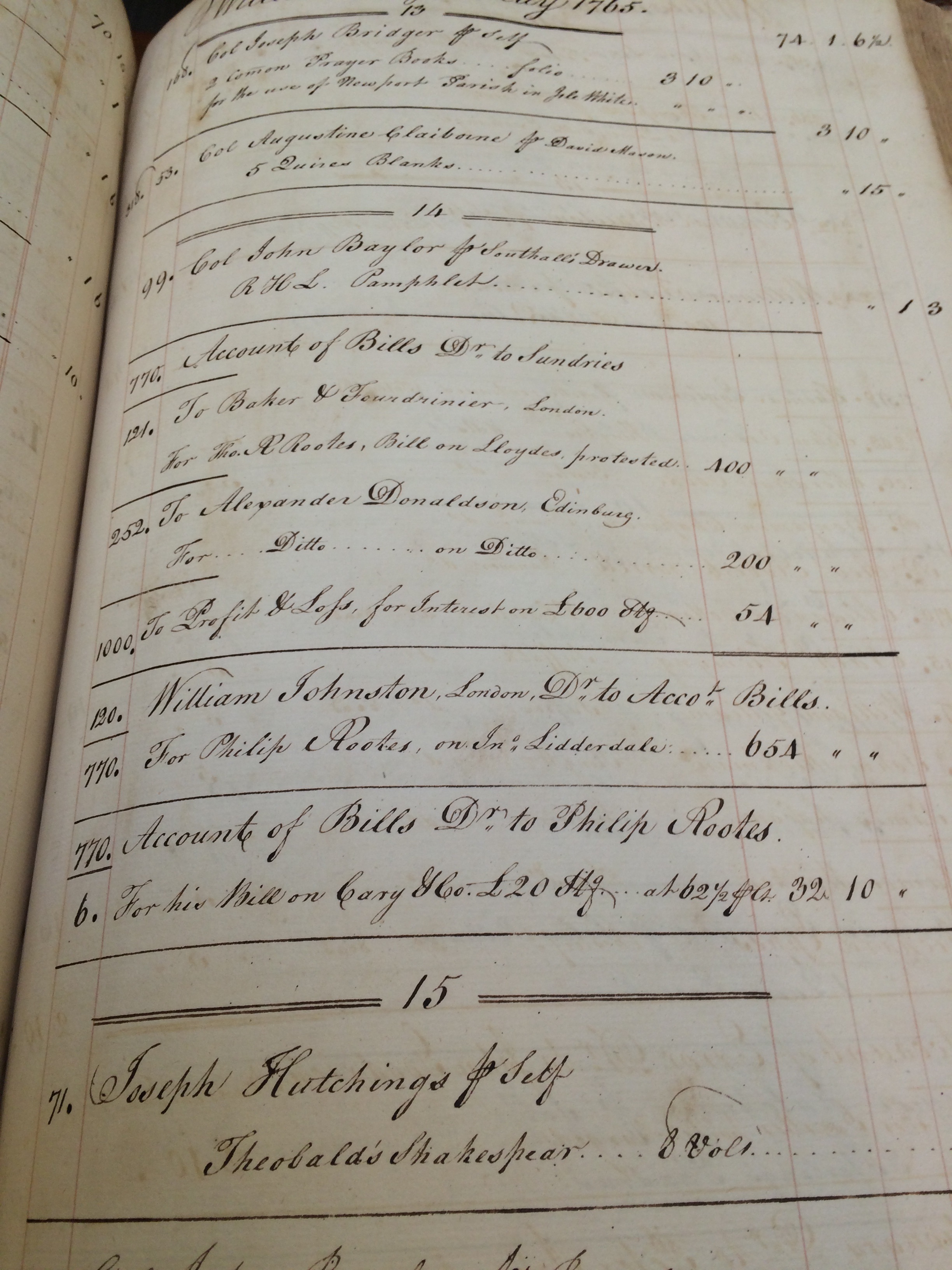
Page of Virginia Gazette Day Book showing the purchase of Theobald's edition of Shakespeare (MSS 467)

Page of Virginia Gazette Day Book showing a purchase of Theobald’s edition of Shakespeare (MSS 467)

Joseph Hutchings purchased 8 volumes of of Shakespeare "for [his] self" (MSS 467).

The Virginia Gazette records show Joseph Hutchings purchasing 8 volumes of Shakespeare “for [him] self” (MSS 467).

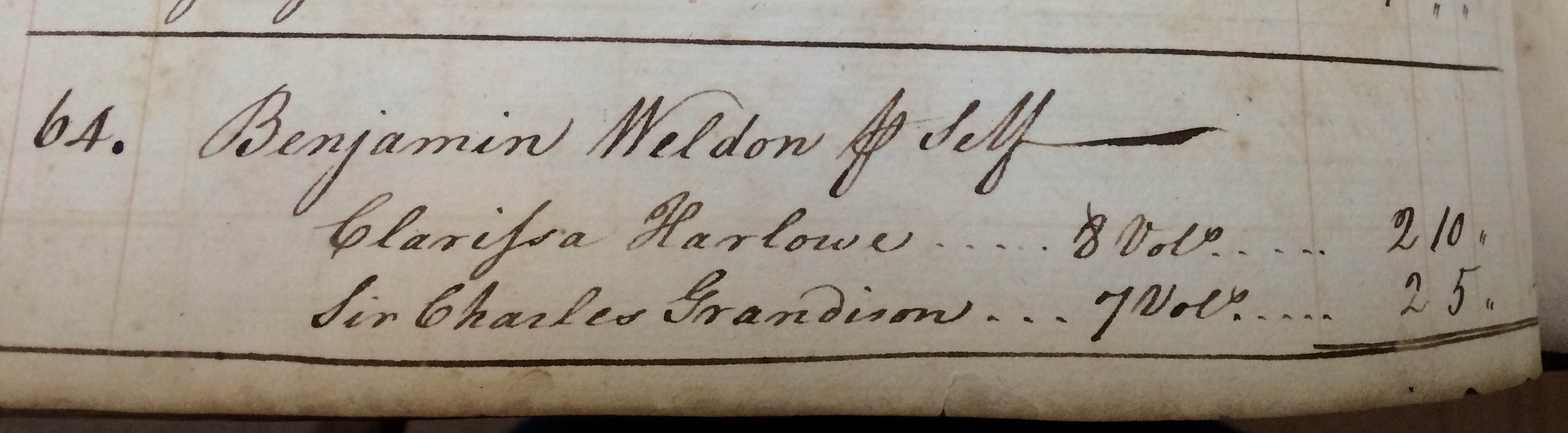
Alongside Shakespeare in the Virginia Gazette Daybook, I found a recorded purchase of two of Samuel Richardson's novels, "Clarissa: Or, the History of a Young Lady" (1747-8) and "The History of Sir Charles Grandison" (1753).

Alongside Shakespeare in the Virginia Gazette records are two of Samuel Richardson’s novels, “Clarissa: Or, the History of a Young Lady” (1747-8) and “The History of Sir Charles Grandison” (1753). (MSS 467)


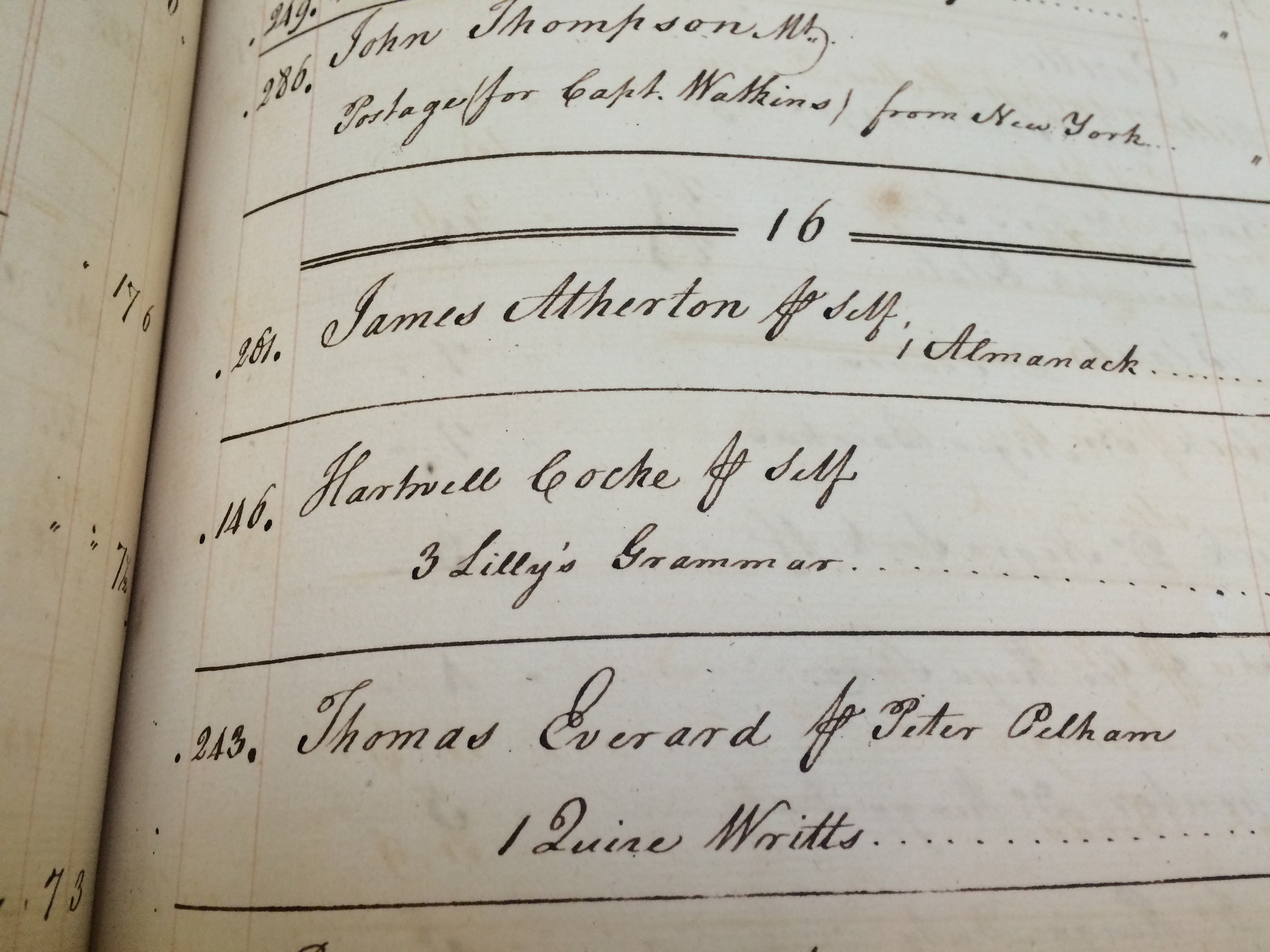
Alongside Shakespeare in the Virginia Gazette records are many educational texts such as Lilly's Latin Grammar. (MSS 467)

Alongside Shakespeare in the Virginia Gazette records are many educational texts such as Lilly’s Latin Grammar. (MSS 467)

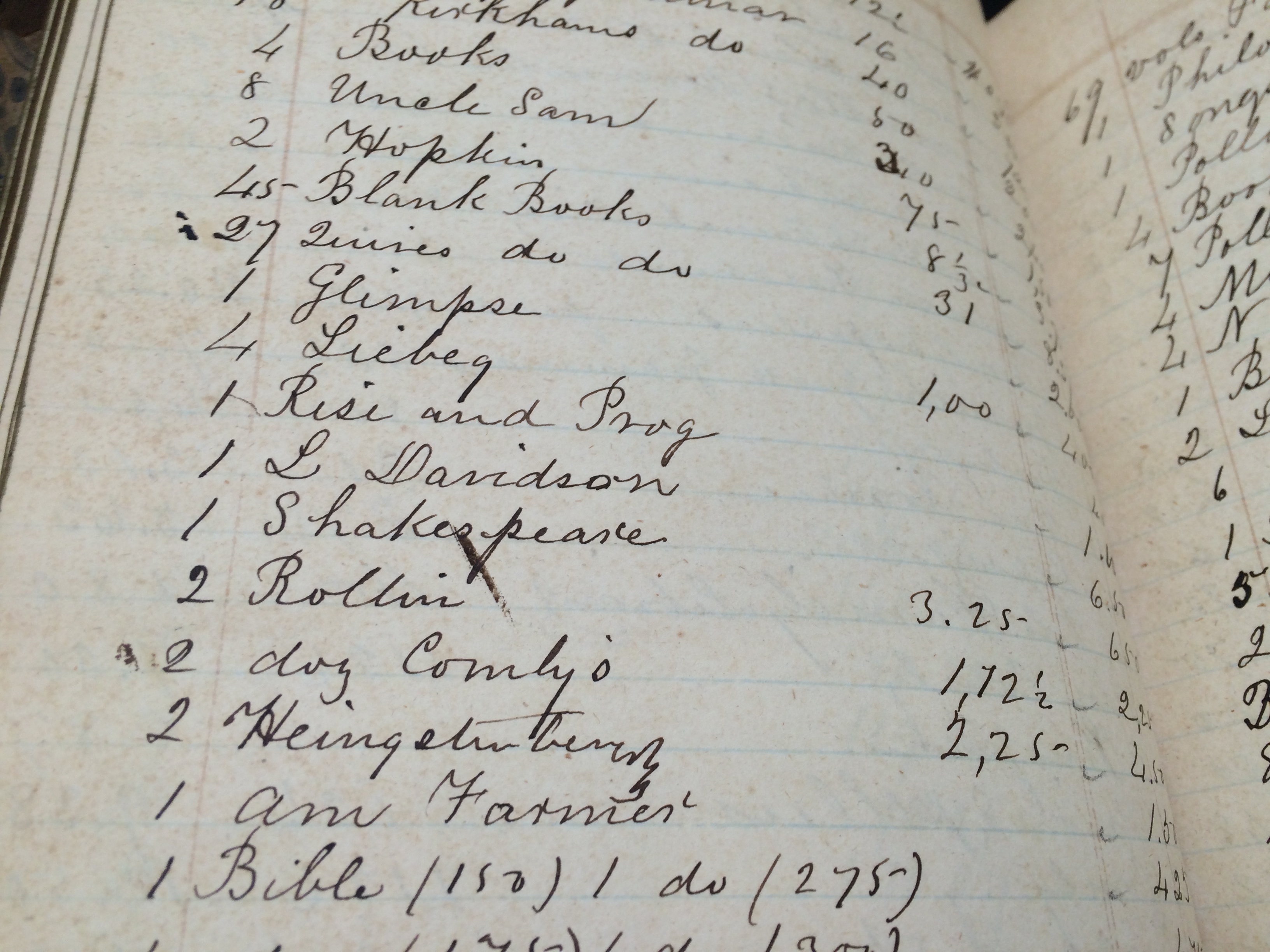
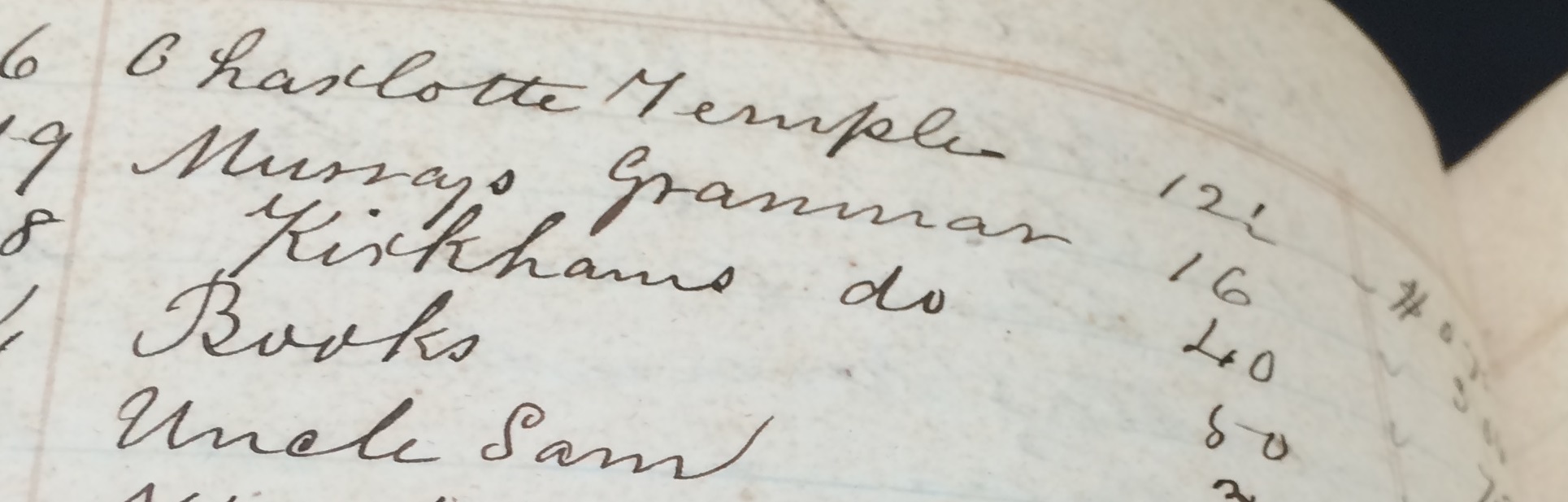
Thanks largely to new performances of Shakespeare plays, Garrick’s Shakespeare Jubilee, and new editions of Shakespeare works in the eighteenth century, Shakespeare’s words come alive by the nineteenth century. The accounts of Bell & Co. reflect this increasing popularity. I found seven copies of Shakespeare sold at Bell & Co. over the course of the nineteenth century (1809–1899). The specific ledger we are using in the exhibition shows Shakespeare alongside Susanna Rowson’s novel Charlotte Temple, Wordsworth, Cooper’s Virgil, and the Bible.

Bell & Co. sold Shakespeare for "6.50" (MSS 2989).

Bell & Co. sold Shakespeare for “6.50.” Different types of currency were in use in the colonies at this time. Without further research, all we can tell from this record is that it is expensive and suggests that the reader bought a multi-volume set (MSS 2989).

On the same page, Bell & Co. recorded the purchase of Susanna Rowson's novel "Charlotte Temple" and two grammar books.

On the same page as Shakespeare, Bell & Co. recorded the purchase of Susanna Rowson’s novel “Charlotte Temple” and two grammar books. (MSS 2989)

Finally, in the twentieth century, Shakespeare begins to be studied and to be studied as a father of the English language. Today, Shakespeare is probably the most often memorized, most often recited English author in schools. I still can recite the famous speech of Titania’s from A Midsummer’s Night Dream that I memorized in the tenth grade and that begins “Set your heart at rest.” But as the exhibition at the Special Collections Library will show us in February, our hearts do anything but rest when we hear the heartbeat of Shakespeare’s iambs, even four hundred years after his death.